Econlib

The Library

Other Sites

Front Page arrow Titles (by Subject) arrow INTRODUCTION - New Individualist Review

Return to Title Page for New Individualist Review

Search this Title:

Also in the Library:

Subject Area: Economics
Subject Area: Political Theory
Subject Area: History
Order this book from Liberty Fund

INTRODUCTION - Ralph Raico, New Individualist Review [1961]

Edition used:

New Individualist Review, editor-in-chief Ralph Raico, introduction by Milton Friedman (Indianapolis: Liberty Fund, 1981).

About Liberty Fund:

Liberty Fund, Inc. is a private, educational foundation established to encourage the study of the ideal of a society of free and responsible individuals.


INTRODUCTION

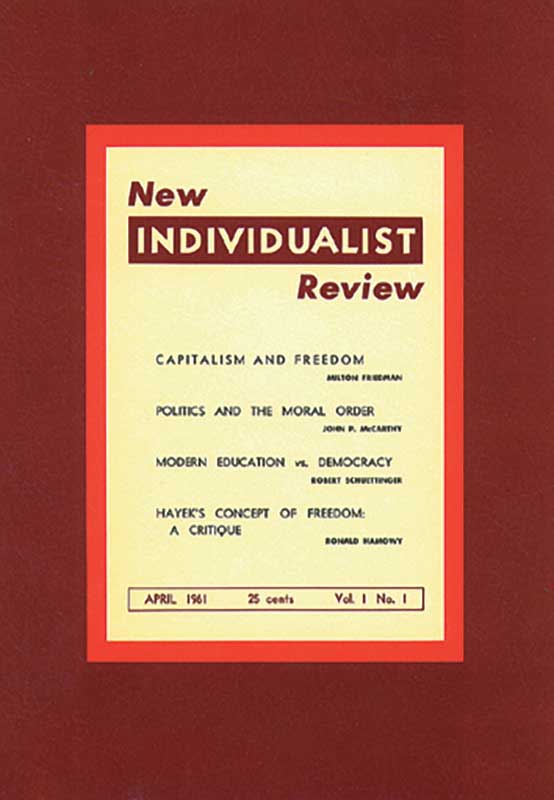
When the New Individualist Review was founded, belief in “free, private enterprise, and in the imposition of the strictest limits to the power of government” and in “a commitment to human liberty”—to quote from the editorial introducing volume 1, number 1 (April 1961)—was at a low ebb even in the countries of the so-called free world. Yet, at the same time, there were many signs of an intellectual reaction against collectivist views, of a resurgence of interest in the philosophy of classical liberalism.

Two organizations in particular served to channel and direct this resurgence: the Mont Pelerin Society, founded in 1947 primarily as a result of the initiative of Friedrich Hayek, whose book The Road to Serfdom did so much to spark the resurgence; and the Intercollegiate Society of Individualists, founded in 1953 by Frank Chodorov, a freelance writer and journalist and a dedicated opponent of collectivism.

The Mont Pelerin Society brought together relatively mature intellectuals—economists, historians, journalists, businessmen—who had kept the faith and had not succumbed to the temper of the times. Its members were representatives of a small minority, but one that had more than its share of independence, integrity, selflessness, and breadth of vision. The Intercollegiate Society of Individualists (ISI) operated at the other end of the age scale. It promoted the establishment of chapters among undergraduate and graduate students on college campuses throughout the country. The members of these chapters too were a minority, but also one that had more than its share of independence, integrity, selflessness, and breadth of vision.

As the New Individualist Review’s introductory editorial of 1961 put it,

Two or three decades ago, individualism was held in contempt by American intellectuals, and a decade ago they regarded it as at least mildly eccentric. We certainly do not deny that the majority of today’s intellectuals are still guided by the ideas which grew up in the 1930s. But the slogans which the New Deal shouted, and the stereotypes which it propagated, while perhaps fresh and exciting then, have lost their appeal to the generation which has emerged in recent years, one which sees no reason to consider our march toward the Total State to be as “inevitable as a law of nature.”

. . . An increasing number of students in the past decades have recognized the inadequacies of the orthodox response to most of the present-day social and economic challenges. The party of liberty is steadily gaining adherents among students.

The University of Chicago played a key role in the preservation of liberalism and the resurgence of “the party of liberty.” It was one of the few major universities in the world at which there persisted throughout the thirties and forties a strong liberal tradition, conveyed and maintained by eminent and respected members of the academic community like Frank H. Knight, Jacob Viner, Henry Simons, and others of their colleagues in the economics department, in other social science departments, in the Business School, and in the humanities. The university was by no means monolithic. Indeed, it had the general reputation of being a radical left-wing institution. Its student body and faculty had its share of Communist Party members, fellow travelers, and socialists. What distinguished it from most other institutions was that it also had a strong, cohesive, and intellectually respectable group of defenders of a free society.

After the war Hayek moved from the London School of Economics to the University of Chicago, where he became a professor in a newly formed Committee on Social Thought. Of the founding members of the Mont Pelerin Society, four were from the University of Chicago, more than from any other institution.

Both the time and the place were ripe for the emergence of the New Individualist Review. The time was ripe because the reaction against collectivism, and the resurgence of belief in individualism, had gone far enough to provide a sufficiently large and sophisticated audience—and pool of potential contributors—for a publication which aimed at a high intellectual level and proclaimed that “the viewpoints presented will generally be libertarian or conservative, but we will consider for publication any essay which indicates a reasoned concern for freedom, and a thoughtful valuation of its importance.” The time was ripe also because the libertarian resurgence was still in an early enough stage that there were few periodical publications dealing with intellectual issues and offering a forum for their serious discussion. National Review, Human Events, and The Freeman were in existence but they were directed at an audience of concerned and interested citizens of all professions and viewpoints, and served a different purpose, being devoted largely to reporting developments in the world of affairs or to commenting on and analyzing current issues primarily from a traditionally conservative—as opposed to libertarian—perspective.

The place was ripe because at the time the University of Chicago was almost surely the only academic institution at which there was a sufficient concentration of students not only committed to the values of a free society but also engaged in serious scholarly study of the intellectual and historical underpinnings of a free society. In particular, Hayek had attracted a group of able, dedicated, and like-minded students to the Committee on Social Thought. They formed the core group responsible for the New Individualist Review, reinforced by students in economics, business, and other areas who shared the value commitment although they were more technically and professionally oriented in their studies. Faculty support was also present and important. However, it cannot be too strongly emphasized that the New Individualist Review was throughout—in its conception, editing, and management—a student venture.

The ISI assisted at the birth of the New Individualist Review. The first three issues were described as being published by “the University of Chicago chapter of the Intercollegiate Society of Individualists”; thereafter as being published by the New Individualist Review. The first eleven issues carried full-page advertisements for the ISI—presumably the form that financial assistance took. In addition, Don Lipsett, the midwestern representative of the ISI, who was primarily responsible for founding the Chicago chapter, advised and assisted on business matters.

The initial editorial board consisted of editor-in-chief Ralph Raico; associate editors John McCarthy, Robert Schuettinger, John Weicher; and book review editor Ronald Hamowy. Each of these contributed an article to the first issue. Three were students in the Committee on Social Thought, one a student in the history department, one in the economics department. Raico served as editor-in-chief, alone or along with Schuettinger or Hamowy, for all but the final two issues. Joe M. Cobb served in that capacity for the final two issues and has been guardian of the tradition ever since.

The editorial advisory board initially consisted of myself from the economics department, F. A. Hayek from the Committee on Social Thought, and Richard M. Weaver from the English department. Aside from occasionally contributing articles, our role was strictly advisory and little advice was required. The students who undertook the project were not only dedicated; they were also extraordinarily able and talented, and that continued to be the case with the students who joined or replaced the founders. Most of them remain active and effective defenders of a free society, and have achieved careers that fulfill their initial promise. Few phenomena have so reinforced my own personal belief in the validity of the philosophy of freedom as the high quality, both intellectual and personal, of the young men and women who were attracted to the “party of liberty”—to use the New Individualist Review’s parlance—when it had all the appearance of being a lost cause.

The Review quickly established itself as the outstanding publication in the libertarian cause. Although every contributor to its first issue was from the University of Chicago (one faculty member, five students), by the second issue, two out of five were from outside the university, and in the third, five out of seven. As every reader of this volume will find for himself, the quality of the Review was consistently high. The contributions were directed at important and controversial issues; they were reasoned and thoughtful without being arid; they touched on both basic philosophical issues and important practical problems; they were, as the initial editorial promised, “generally . . . libertarian or conservative” but not narrowly parochial, and ranged over a wide variety of points of view.

The subsequent history of the Review and its ultimate termination were partly typical of student ventures—ups and downs as the student body changed and the number of persons interested in its subject matter and willing to devote the time to its publication fluctuated. But two other events played a role—one local, the other national.

The local event was Friedrich Hayek’s retirement from the University of Chicago and his relocation to Freiburg, Germany. His students had formed the core of the initial founders and had remained an important component of the editorial staff throughout.

The national event was the Vietnam War. In the early 1960s there was, as the introductory editorial said, a rising tide of support among the young for the party of liberty, for the principles of free, private enterprise, and a strictly limited government. I believe that tide would have continued to rise if the passions of the young had not been diverted by the Vietnam War and above all by conscription. The antiwar, anti-draft movement gained the support of young men and women of the left, the center, and the right; it absorbed their energies and their enthusiasm. The battle on the campuses deteriorated to an elemental level, as the very basic principles of civil discourse and reasoned, open-minded discussion came under attack. Little energy or possibility was left for more sophisticated examination of basic intellectual issues.

One of the final issues of the Review reflected one facet of this development: the spring 1967 issue devoted to a symposium on conscription. And even that was partly derivative from a conference on the draft held at the University of Chicago in December 1966.

Once the Vietnam War ended and the draft was replaced by an all-volunteer military, the former intellectual tide in favor of the party of liberty resumed, reinforced indeed by the antigovernment attitudes generated by the war and the draft. The result has been a veritable outpouring of publications, articles, and books devoted to examining and discussing the kinds of issues to which the New Individualist Review was devoted.

It is therefore highly appropriate that the progenitor of these publications be reprinted now. Most of the articles remain timely and relevant. More important, perhaps, this student venture, despite its narrow base and its limited resources, sets an intellectual standard that has not yet, I believe, been matched by any of the more recent publications in the same philosophical tradition.

NEW INDIVIDUALIST REVIEW

[* ]Milton Friedman is Paul Snowden Russell Distinguished Service Professor of Economics at the University of Chicago, and Senior Research Fellow at the Hoover Institution on War, Revolution and Peace, Stanford, California. He is the author of numerous books, among them A Monetary History of the United States, 1867-1960 (coauthored by Anna J. Schwartz) and Capitalism and Freedom. His most recent work is Free to Choose (coauthored by Rose Friedman). Dr. Friedman received the Nobel Prize for economic science in 1976.