Econlib

The Library

Other Sites

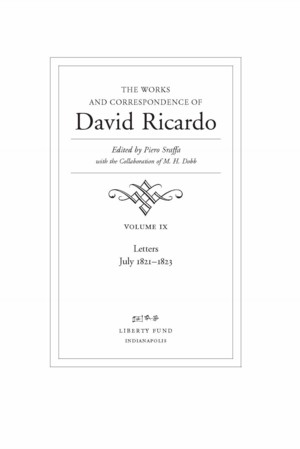
Front Page arrow Titles (by Subject) arrow 442.: ricardo to malthus1[Reply to 440.—Answered by 443] - The Works and Correspondence of David Ricardo, Vol. 9 Letters 1821-1823

Return to Title Page for The Works and Correspondence of David Ricardo, Vol. 9 Letters 1821-1823

442.: ricardo to malthus1[Reply to 440.—Answered by 443] - David Ricardo, The Works and Correspondence of David Ricardo, Vol. 9 Letters 1821-1823 [1821]

Edition used:

The Works and Correspondence of David Ricardo, ed. Piero Sraffa with the Collaboration of M.H. Dobb (Indianapolis: Liberty Fund, 2005). Vol. 9 Letters 1821-1823.

Part of: The Works and Correspondence of David Ricardo, 11 vols (Sraffa ed.)

About Liberty Fund:

Liberty Fund, Inc. is a private, educational foundation established to encourage the study of the ideal of a society of free and responsible individuals.


442.

ricardo to malthus1
[Reply to 440.—Answered by 443]

My Dear Malthus

I am sorry that you will not spare me a few days before you return to London. Pray reconsider your determination, and if you can alter it, do. On Saturday I expect Mr. Tooke—it is a long time since he fixed on that day to come to me, and I am sure the pleasure of his visit will be much increased, both to him and to me, if you also formed one of our party.

M Culloch has specifically, and strongly, objected to my chapter on Machinery—he thinks I have ruined my book by admitting it, and have done a serious injury to the science, both by the opinions which I avow, and by the manner I have avowed them. Two or three letters have passed between us on this subject;—in his last, he appears to me to acknowledge that the effect of the use of machinery may be to diminish the annual quantity and value of gross produce. In yielding this, he gives up the question, for it is impossible to contend that with a diminished quantity of gross produce there would be the same means of employing labour. The truth of my propositions on this subject appear to me absolutely demonstrable.

M’Culloch is lamenting over the departure from my plan of currency, and means to make it the subject of an article in the Edin. Review, as he has already done in the Scotsman.1 I very much regret that in the great change we have made, from an unregulated currency, to one regulated by a fixed standard, we had not more able men to manage it than the present Bank Directors. If their object had been to make the revulsion as oppressive as possible, they could not have pursued measures more calculated to make it so than those which they have actually pursued. Almost the whole of the pressure has arisen from the increased value which their operations have given to the standard itself. They are indeed a very ignorant set.

You are right in supposing that I have understood you in your book not to profess to enquire into the motives for producing, but into the effects which would result from abundant production. You say in your letter “We see in almost every part of the world vast powers of production which are not put into action and I explain this phenomenon by saying that from the want of the proper distribution of the actual produce adequate motives are not furnished to continued production.” If this had been what I conceived you to have said I should not have a word to say against you, but I have rather understood you to say that vast powers of production are put into action and the result is unfavourable to the interests of mankind, and you have suggested as a remedy either that less should be produced, or more should be unproductively consumed. If you had said, “after arriving at a certain limit there will in the actual circumstances be no use to try to produce more—the end cannot be accomplished, and if it could instead of more less would belong to the class which provided the capital”, I should have agreed with you—yet in that case I should say the real cause of this faulty distribution would be to be found in the inadequate quantity of labour in the market, and would be effectually cured by an additional supply of it. But I say with you, there could be no adequate motive to push production to this length, and therefore it would never go so far. I do not know whether I am correct in my observation, that “I say so with you,” for you often appear to me to contend not only that production can go on so far without an adequate motive, but that it actually has done so lately, and that we are now suffering the consequences of it in stagnation of trade, in a want of employment for our labourers &c. &c., and the remedy you propose is an increase of consumption. It is against this latter doctrine that I protest and give my decided opposition. I acknowledge there may not be adequate motives for production, and therefore things will not be produced, but I cannot allow, first that with these inadequate motives commodities will be produced, and secondly that, if their production is attended with loss to the producer, it is for any other reason than because too great a proportion is given to the labourers employed. Increase their number, and the evil is remedied. Let the employer consume more himself, and there will be no diminution of demand for labour, but the pay of the labourer, which was before extravagantly high, will be reduced. You say in your letter “If an increased power of production be not accompanied by an increase of unproductive expenditure it will inevitably lower profits and throw labourers out of employment.” In this proposition I do not wholly1 agree. First I say it must be accompanied with an increase either of productive or of unproductive expenditure. If the labourer receives a large proportion of the produce as wages, all that he receives more than is sufficient to prompt him to the necessary exertions of his powers, is as much unproductive consumption as if it were consumed by his master, or by the state—there is no difference whatever. A master manufacturer might be so extravagant in his expenditure, or might pay so much in taxes, that his capital might be deteriorated for many years together—his situation would be the same, if, from his own will, or from the inadequacy of the population, he paid so much to his labourers as to leave himself without adequate profits, or without any profits whatever. From taxation he might not be able to escape, but from this last most unnecessary unproductive1 expenditure, he could, and would escape, for he could have the same quantity of labour, with less pay, if he only saved less;—his saving would be without an end and would therefore be absurd. You perceive then I fully admit more than you ask for—I say that under these circumstances without an increase of unproductive expenditure on the part of the masters, profits will fall; but I say this further, that even with an increased unproductive consumption and expenditure by the labouring classes profits will fall. Diminish this latter unproductive expenditure, and profits will again rise;—this may be done two ways, either by an increase of hands which will lower wages, and therefore the unproductive expenditure of the labouring class;—or by an increase of the unproductive expenditure of the employing class, which will also lower wages by reducing the demand for labour.2

I fear I have been guilty of needless repetition but I have really a great wish to shew you what the points are on which our difference really exists. I am glad to hear that you are in a pleasant country. Mrs. Ricardo, my sons, and daughters all unite with me in kind remembrances to Mrs. Malthus and yourself.

Ever Yrs.

David Ricardo

[1 ]Addressed: ‘The Revd. T. R. Malthus / —Eckersell’s Esq / St. Catherine’s / Bath’. Franked by Ricardo ‘July Ten 1821’.

MS in the possession of Dr Bonar to whom it was given by Col. Malthus.—Letters to Malthus, LXXVI.

[1 ]See above, VIII, 378, n. 5 and 392, n. 2.

[1 ]‘wholly’ is ins.

[1 ]Underlined twice in MS.

[2 ]For a similar discussion of the effects of unproductive expenditure, see above, I, 150–1, especially the additions in ed. 3.