Econlib

The Library

Other Sites

Front Page arrow Titles (by Subject) arrow 324.: malthus to ricardo2[Answered by 328] - The Works and Correspondence of David Ricardo, Vol. 8 Letters 1819-June 1821

Return to Title Page for The Works and Correspondence of David Ricardo, Vol. 8 Letters 1819-June 1821

324.: malthus to ricardo2[Answered by 328] - David Ricardo, The Works and Correspondence of David Ricardo, Vol. 8 Letters 1819-June 1821 [1819]

Edition used:

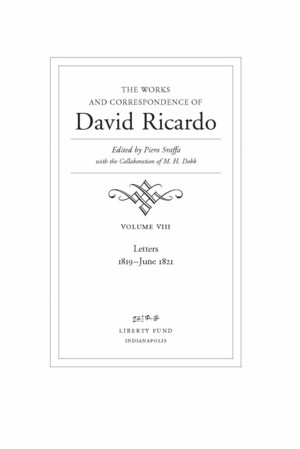
The Works and Correspondence of David Ricardo, ed. Piero Sraffa with the Collaboration of M.H. Dobb (Indianapolis: Liberty Fund, 2005). Vol. 8 Letters 1819-1821.

Part of: The Works and Correspondence of David Ricardo, 11 vols (Sraffa ed.)

About Liberty Fund:

Liberty Fund, Inc. is a private, educational foundation established to encourage the study of the ideal of a society of free and responsible individuals.


324.

malthus to ricardo2
[Answered by 328]

My dear Ricardo,

I trust you have been spending your time very pleasantly at Gatcomb. After I had the pleasure of seeing you in Town,3 the Eckersalls changed their abode from Henley to Ray Mill Cottage near Maidenhead Bridge, whither we accompanied them, and continued our excursions upon the water. We finally came to Town the end of July in the four oar, having explored above 110 miles of the course of the Thames.

We have been now returned to the College above a month, nearly indeed six weeks, and I have been endeavouring to get on a little with my volume4 ; but I have been delayed and led away as usual by thoughts relating to the subjects of some of our discussions. In pursuing one of the suppositions which I believe I mentioned when I saw you in Town I have been rather struck with the consequences which seem to flow from it.

If we suppose half an ounce of silver on an average to be picked up by a days search on the sea shore, money would then always retain most completely the same value. It would always on an average both cost, and command the same quantity of labour. The money price of labour could never permanently either rise or fall; and the accumulation of capital in all cases where capital was used and the same quantity of labour employed, would shew itself in a fall of prices owing to the diminished rate of profits. Corn alone would rise in money price on account of the increased quantity of labour required; but the rise would be inconsiderable, and strictly limited by the diminution of corn wages which the labourer could bear.

Under these circumstances I should like to know from you how the profits of stock would be regulated. They could not evidently be regulated by the rise in money wages of labour, because labour would not alter in money value.

I am strongly disposed to think that a rise of money wages, supposing money always to retain its value, is by no means absolutely necessary in the progress of cultivation to its extreme limits. It is only necessary that corn should rise to such a point, as with fixed money wages will put a stop to the further increase of population. In general when money wages rise, which is one of the commonest events in the progress of wealth, I am inclined to think, it may be fairly concluded that the value of money has fallen. According to my measure of value indeed I should say at once that money had fallen if it would command less labour; and according to your theory it could only command less labour and yet retain the same value, from the accidental circumstance of capital being employed in the production of it.

I have been saying in my introduction, that my work has been delayed by my respect for your authority, and the fear that I must have overlooked some essential points either in your view of the subject or in my own.1 But though I have been lately finishing the beginning, I have by no means arrived at the end. I think I have a fourth or a fifth to write yet; and having composed the different parts at different times and not in their natural order, I have still much to put out and put in, before it will be fit to send to the press. I can hardly expect to be out before February or March.

What do you think of this terrible Manchester business.2 It was a most cruel and unjust proceeding in itself; and I fear it is likely to be attended with the most unfortunate consequences, by giving additional importance and influence to such persons as Hunt.3

Mrs. M joins me in kind remembrance to Mrs. Ricardo. All well here. I hope you can make the same report at Gatcomb.

Ever truly Yours

T R Malthus.

[2 ]MS in R.P.

[3 ]See above, p. 47.

[4 ]Principles of Political Economy.

[1 ]See above, II, 11–12.

[2 ]‘Peterloo’, 16 August.

[3 ]Henry Hunt.