Econlib

The Library

Other Sites

Front Page arrow Titles (by Subject) arrow 296.: ricardo to mill1[Reply to 294.—Answered by 297] - The Works and Correspondence of David Ricardo, Vol. 7 Letters 1816-1818

Return to Title Page for The Works and Correspondence of David Ricardo, Vol. 7 Letters 1816-1818

296.: ricardo to mill1[Reply to 294.—Answered by 297] - David Ricardo, The Works and Correspondence of David Ricardo, Vol. 7 Letters 1816-1818 [1816]

Edition used:

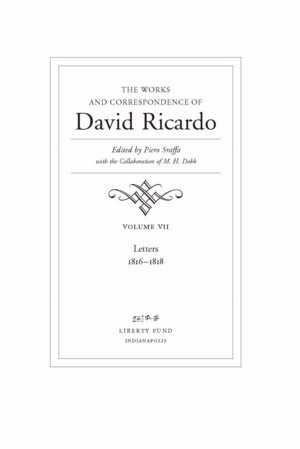
The Works and Correspondence of David Ricardo, ed. Piero Sraffa with the Collaboration of M.H. Dobb (Indianapolis: Liberty Fund, 2005). Vol. 7 Letters 1816-1818.

Part of: The Works and Correspondence of David Ricardo, 11 vols (Sraffa ed.)

About Liberty Fund:

Liberty Fund, Inc. is a private, educational foundation established to encourage the study of the ideal of a society of free and responsible individuals.


296.

ricardo to mill1
[Reply to 294.—Answered by 297]

My dear Sir

I cannot send you more than half a sheet, least I may make my packet too bulky for Mr. Hume’s privelege. I yesterday sent you Trower’s letter to me—to day I send you my answer to him.2 —After you have read it put a wafer or seal to it, and dispatch it by the Post.

I received your letter at the post office on saturday on my way hither. I am glad that you do not think me wrong in remarking the altered terms which are now proposed for the loan. In Mr. B.’s3 note to you he does not mention 6 pct. as his inference, but as the condition on which the business was settled.

With regard to the experiment of educating the young children I have now no objection to offer to it,—though I think that it will not answer as a general plan.

The French translation of my book with M. Say’s notes has been returned to Mr. Murray—I hope you will soon see it. M Say does not appear to me to have clearly seen the doctrine which I wish to establish,—but I would rather hear your opinion than give mine. That both our views might have been at once before the public I could have wished that the notes were translated and published with the new edition. So much of the edition is printed, however, that it could not be done otherwise than by putting them altogether, as an appendix, with reference to the pages to which they are attached.

Mr. Malthus staid a very short time with me. We had our usual discussions both on politics, and on political economy. He read to me some more of his intended publication.1 He has altered his opinion you know about there being land in every country which pays no rent, and appears like M Say to think that when that is proved, my doctrine of rent not entering into price is overthrown—they neither of them advert to the other principle which cannot be touched, of capital being employed on land, already in cultivation, which pays no rent. I have entered my protest against his omitting the consideration of this important fact.

On politics we did not more nearly accord—he talks of a reform but when his plan is examined it is in fact no reform at all. I insisted on the propriety of calling things by their right names.

I hope Hobhouse will continue to be virtuous, and still more do I wish that I may never think the smiles of the great and powerful a sufficient inducement to turn aside from the straight path of honesty and the convictions of my own mind. Where so many fall I dare not boast of my superior integrity,—but I implore you to speak the truth to me if you see me beginning to swerve from my duty. I wish much to get the character with those with whom I associate, and who have many estimable qualities, of daring to differ from them.

I have not entered into a long dissertation in my answer to Torrens. I wrote it for my own satisfaction and with no idea of publishing it. I will send it to you when I get back to Gatcomb.—

To-morrow we are to have a county meeting at Gloucester, to consider of an address to the Prince Regent, on the death of the Queen, at which I must preside. From thence I shall return home, and hope that I may not be obliged to go to London before the time that my family go, to present it.—The marriage of my daughter will make us stay later in the country than usual. This will not of course retard the settlement of the business that Brougham has kindly undertaken for me, as I can give directions to my brother to pay the money as soon as my solicitor tells me that every thing is right.—It is probable that I may not finally leave Gatcomb till the very end of January.

I am glad that you are making such progress with Mr. Hume, I hope that you may succeed in making him a good political economist.—My daughter is I think better, and in a fair way of recovering.—I hope that you also are making progress in the same way.

Ever Yrs.

D Ricardo

[1 ]Addressed: ‘James Mill Esqr. /1 Queen Square / Westminster’.

MS in Mill-Ricardo papers.

[2 ]Letters 287 and 295.

[3 ]Brougham’s.

[1 ]Principles of Political Economy.