Econlib

The Library

Other Sites

Front Page arrow Titles (by Subject) arrow A Landholder [Oliver Ellsworth] The Letters: VII, XIII - Friends of the Constitution: Writings of the Other Federalists, 1787-1788

Return to Title Page for Friends of the Constitution: Writings of the “Other” Federalists, 1787-1788

Search this Title:

“A Landholder” [Oliver Ellsworth] The Letters: VII, XIII - Colleen A. Sheehan, Friends of the Constitution: Writings of the “Other” Federalists, 1787-1788 [1998]

Edition used:

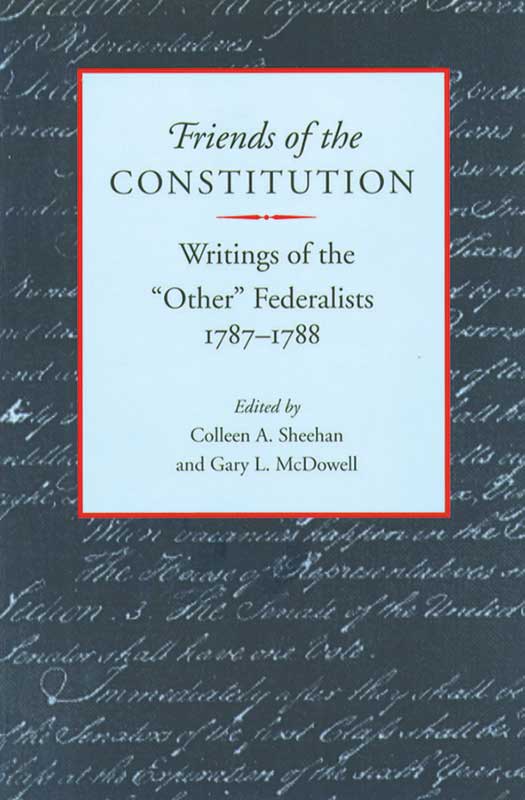
Friends of the Constitution: Writings of the “Other” Federalists, 1787-1788, edited by Colleen A. Sheehan and Gary L. McDowell (Indianapolis: Liberty Fund, 1998).

About Liberty Fund:

Liberty Fund, Inc. is a private, educational foundation established to encourage the study of the ideal of a society of free and responsible individuals.


“A Landholder” [Oliver Ellsworth]

The Letters: VII, XIII

VII

To the Landholders and Farmers.

I have often admired the spirit of candour, liberality, and justice, with which the Convention began and completed the important object of their mission. “In all our deliberations on this subject,” say they, “we kept steadily in our view, that which appears to us the greatest interest of every true American, the consolidation of our union, in which is involved our prosperity, felicity, safety, perhaps our national existence. This important consideration, seriously and deeply impressed on our minds, led each state in the Convention to be less rigid on points of inferior magnitude, than might otherwise have been expected; and thus the Constitution which we now present, is the result of a spirit of amity, and of that mutual deference and concession, which the peculiarity of our political situation rendered indispensible.”

Let us, my fellow citizens, take up this constitution with the same spirit of candour and liberality; consider it in all its parts; consider the important advantages which may be derived from it, and the fatal consequences which will probably follow from rejecting it. If any objections are made against it, let us obtain full information on the subject, and then weigh these objections in the balance of cool impartial reason. Let us see, if they be not wholly groundless; But if upon the whole they appear to have some weight, let us consider well, whether they be so important, that we ought on account of them to reject the whole constitution. Perfection is not the lot of human institutions; that which has the most excellencies and fewest faults, is the best that we can expect.

Some very worthy persons, who have not had great advantages for information, have objected against that clause in the constitution, which provides, that no religious Test shall ever be required as a qualification to any office or public trust under the United States.1 They have been afraid that this clause is unfavourable to religion. But, my countrymen, the sole purpose and effect of it is to exclude persecution, and to secure to you the important right of religious liberty. We are almost the only people in the world, who have a full enjoyment of this important right of human nature. In our country every man has a right to worship God in that way which is most agreeable to his own conscience. If he be a good and peaceable citizen, he is liable to no penalties or incapacities on account of his religious sentiments; or in other words, he is not subject to persecution.

But in other parts of the world, it has been, and still is, far different. Systems of religious error have been adopted, in times of ignorance. It has been the interest of tyrannical kings, popes, and prelates, to maintain these errors. When the clouds of ignorance began to vanish, and the people grew more enlightened, there was no other way to keep them in error, but to prohibit their altering their religious opinions by severe persecuting laws. In this way persecution became general throughout Europe. It was the universal opinion that one religion must be established by law; and that all, who differed in their religious opinions, must suffer the vengeance of persecution. In pursuance of this opinion, when popery was abolished in England, and the church of England was established in its stead, severe penalties were inflicted upon all who dissented from the established church. In the time of the civil wars, in the reign of Charles I. the presbyterians got the upper hand, and inflicted legal penalties upon all who differed from them in their sentiments respecting religious doctrines and discipline. When Charles II. was restored, the church of England was likewise restored, and the presbyterians and other dissenters were laid under legal penalties and incapacities. It was in this reign, that a religious test was established as a qualification for office; that is, a law was made requiring all officers civil and military (among other things) to receive the Sacrament of the Lord’s Supper, according to the usage of the church of England, written six months after their admission to office, under the penalty of 500 l. and disability to hold the office. And by another statute of the same reign, no person was capable of being elected to any office relating to the government of any city or corporation, unless, within a twelvemonth before, he had received the Sacrament according to the rites of the church of England. The pretence for making these severe laws, by which all but churchmen were made incapable of any office civil or military, was to exclude the papists; but the real design was to exclude the protestant dissenters. From this account of test-laws, there arises an unfavourable presumption against them. But if we consider the nature of them and the effects which they are calculated to produce, we shall find that they are useless, tyrannical, and peculiarly unfit for the people of this country.

A religious test is an act to be done, or profession to be made, relating to religion (such as partaking of the sacrament according to certain rites and forms, or declaring one’s belief of certain doctrines,) for the purpose of determining, whether his religious opinions are such, that he is admissible to a public office. A test in favour of any one denomination of christians would be to the last degree absurd in the United States. If it were in favour of either congregationalists, presbyterians, episcopalions, baptists, or quakers; it would incapacitate more than three fourths of the American citizens for any public office; and thus degrade them from the rank of freemen. There needs no argument to prove that the majority of our citizens would never submit to this indignity.

If any test-act were to be made, perhaps the least exceptionable would be one, requiring all persons appointed to office, to declare, at the time of their admission, their belief in the being of a God, and in the divine authority of the scriptures. In favour of such a test, it may be said, that one who believes these great truths, will not be so likely to violate his obligations to his country, as one who disbelieves them; we may have greater confidence in his integrity. But I answer: His making a declaration of such belief is no security at all. For suppose him to be an unprincipled man, who believes neither the word nor the being of a God; and to be governed merely by selfish motives; how easy is it for him to dissemble? how easy is it for him to make a public declaration of his belief in the creed which the law prescribes; and excuse himself by calling it a mere formality? This is the case with the test-laws and creeds in England. The most abandoned characters partake of the sacrament, in order to qualify themselves for public employments. The clergy are obliged by law to administer the ordinance unto them; and thus prostitute the most sacred office of religion; for it is a civil right in the party to receive the sacrament. In that country, subscribing to the thirty-nine articles is a test for admission into holy orders. And it is a fact, that many of the clergy do this; when at the same time, they totally disbelieve several of the doctrines contained in them. In short, test-laws are utterly ineffectual; they are no security at all; because men of loose principles will, by an external compliance, evade them. If they exclude any persons, it will be honest men, men of principle, who will rather suffer an injury, than act contrary to the dictates of their consciences. If we mean to have those appointed to public offices, who are sincere friends to religion; we the people who appoint them, must take care to choose such characters; and not rely upon such cob-web barriers as test-laws are.

But to come to the true principle, by which this question ought to be determined: The business of civil government is to protect the citizen in his rights, to defend the community from hostile powers, and to promote the general welfare. Civil government has no business to meddle with the private opinions of the people. If I demean myself as a good citizen, I am accountable, not to man, but to God, for the religious opinions which I embrace, and the manner in which I worship the supreme being. If such had been the universal sentiments of mankind, and they had acted accordingly, persecution, the bane of truth and nurse of error, with her bloody axe and flaming hand, would never have turned so great a part of the world into a field of blood.

But while I assert the right of religious liberty; I would not deny that the civil power has a right, in some cases, to interfere in matters of religion. It has a right to prohibit and punish gross immoralities and impieties; because the open practice of these is of evil example and public detriment. For this reason, I heartily approve of our laws against drunkenness, profane swearing, blasphemy, and professed atheism. But in this state, we have never thought it expedient to adopt a test-law; and yet I sincerely believe we have as great a proportion of religion and morality, as they have in England, where every person who holds a public office, must be either a saint by law, or a hypocrite by practice. A test-law is the parent of hypocrisy, and the offspring of error and the spirit of persecution. Legislatures have no right to set up an inquisition, and examine into the private opinions of men. Test-laws are useless and ineffectual, unjust and tyrannical; therefore the Convention have done wisely in excluding this engine of persecution, and providing that no religious test shall ever be required.

XIII

The attempt to amend our federal Constitution, which for some time past hath engrossed the public regard, is doubtless become an old and unwelcome topic to many readers whose opinions are fixed, or who are not concerned for the event. There are other subjects which claim a share of attention, both from the public and from private citizens. It is good government which secures the fruits of industry and virtue; but the best system of government cannot produce general happiness unless the people are virtuous, industrious and œconomical.

The love of wealth is a passion common to men, and when justly regulated it is condusive to human happiness. Industry may be encouraged by good laws—wealth may be protected by civil regulations; but we are not to depend on these to create it for us, while we are indolent and luxurious. Industry is most favourable to the moral virtue of the world, it is therefore wisely ordered by the Author of Nature, that the blessings of this world should be acquired by our own application in some business useful to society; so that we have no reason to expect any climate or soil will be found, or any age take place, in which plenty and wealth will be spontaneously produced. The industry and labour of a people furnish a general rule to measure their wealth, and if we use the means we may promise ourselves the reward. The present state of America will limit the greatest part of its inhabitants to agriculture; for as the art of tilling the earth is easily acquired, the price of land low, and the produce immediately necessary for life, greater encouragement to this is offered here than in any country on earth.—But still suffer me to enquire whether we are not happily circumstanced and actually able to manage some principal Manufactories with success, and encrease our wealth by encreasing the labour of the people, and saving the surplus of our earnings, for a better purpose than to purchase the labour of European nations. It is a remark often made, and generally believed, that in a country so new as this, where the price of lands is low and the price of labour high, manufactories cannot be conducted with profit. This may be true of some manufactures, but of others it is grossly false. It is now in the power of New-England to make itself more formidable to Great-Britain, by rivaling some of her principal manufactures, than ever it was by separating from her government. Woolen cloaths the principal English manufacture, may more easily be rivaled than any other. Purchasing all the materials and labour at the common price of the country, cloths of three quarters width, may be fabricated for six shillings per yard, of fineness and beauty equal to English cloths of six quarters width, which sell at twenty shillings. The cost of our own manufacture is little more than half of the imported, and for service it is allowed to be much preferable. It is found that our wool is of equal quality with the English, and that what we once supposed the defect of our wool, is only a deficiency in cleansing, sorting and dressing it.

It gives me pleasure to hear that a number of gentlemen in Hartford and the neighbouring towns are forming a fund for the establishment of a great Woolen Manufactory—The plan will doubtless succeed, and be more profitable to the stockholders than money deposited in trade. As the manufacture of cloths is introduced, the raising of wool and flax the raw materials, will become an object of the farmers attention.

Sheep are the most profitable part of our stock, and the breed is much sooner multiplied than horses or cattle. Why do not our opulent farmers avail themselves of the profit? An experiment would soon convince them there is no better method of advancing property, and their country would thank them for the trial. Sheep are found to thrive and the wool to be of a good quality in every part of New-England, but as this animal delights in grazing, and is made healthy by coming often to the earth, our sea coasts with the adjacent country, where snow is of short continuance, are particularly favourable to their propagation. Our hilly coasts were designed by nature for this, and every part of the country that abounds in hills ought to make an experiment by which they will be enriched.

In Connecticut, the eastern and south-eastern counties, with the highlands on Connecticut river towards the sea, ought to produce more wool than would cloath the inhabitants of the state. At present the quantity falls short of what is needed for our own consumption; if a surplusage could be produced, it would find a ready market and the best pay.

The culture of flax, another principal material for manufacturing, affords great profit to the farmer. The seed of this crop when it succeeds well will pay the husbandman for his labour, and return a better ground rent than many other crops which are cultivated. The seed is one of our best articles for remittance and exportation abroad. Dressing and preparing the flax for use is done in the most leisure part of the year, when labour is cheap, and we had better work for six pence a day and become wealthy, than to be idle and poor.

It is not probable the market can be overstocked, or if it should chance for a single season to be the case, no article is more meliorated by time, or will better pay for keeping, by an increase of quality. A large flax crop is one most certain sign of a thrifty husbandman. The present method of agriculture in a course of different crops is well calculated to give the husbandman a sufficiency of flax ground, as it is well known that this vegetable will not thrive when sown successively in the same place.

The Nail Manufacture might be another source of wealth to the northern states. Why should we twice transport our own iron, and pay other nations for labour which our boys might perform as well. The art of nail making is easily acquired. Three thousand men and boys in Connecticut, might spend our long and idle winters in this business, without detriment to their agricultural service. Remittances have actually been made from some parts of the state in this article, the example is laudable and ought to be imitated. The sources of wealth are open to us, and there needs but industry to become as rich as we are free.

[1. ]See the letter of William Williams, “A Letter to The Landholder,” in Paul Leicester Ford, Essays on the Constitution of the United States (New York: Historical Printing Club, 1892), 207-9.