Econlib

The Library

Other Sites

Front Page arrow Titles (by Subject) arrow An American Citizen [Tench Coxe] An Examination of the Constitution of the United States - Friends of the Constitution: Writings of the Other Federalists, 1787-1788

Return to Title Page for Friends of the Constitution: Writings of the “Other” Federalists, 1787-1788

Search this Title:

“An American Citizen” [Tench Coxe] “An Examination of the Constitution of the United States” - Colleen A. Sheehan, Friends of the Constitution: Writings of the “Other” Federalists, 1787-1788 [1998]

Edition used:

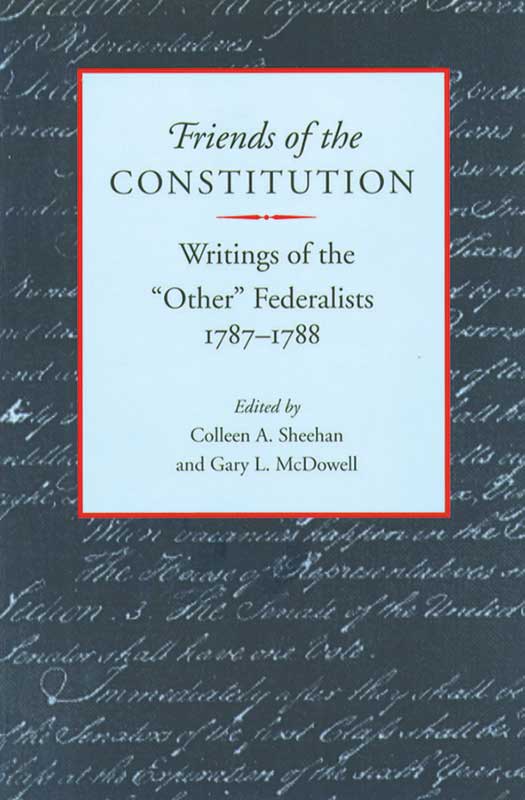
Friends of the Constitution: Writings of the “Other” Federalists, 1787-1788, edited by Colleen A. Sheehan and Gary L. McDowell (Indianapolis: Liberty Fund, 1998).

About Liberty Fund:

Liberty Fund, Inc. is a private, educational foundation established to encourage the study of the ideal of a society of free and responsible individuals.


“An American Citizen” [Tench Coxe]

“An Examination of the Constitution of the United States”

Essays I, II, and III in this series appeared in the Independent Gazetteer on 26, 28, and 29 September. On or before 21 October, a reprint of the series was printed by Hall and Sellers of the Pennsylvania Gazette, Philadelphia, in which the fourth essay first appeared.

I

It is impossible for an honest and feeling mind, of any nation or country whatever, to be insensible to the present circumstances of America. Were I an East Indian, or a Turk, I should consider this singular situation of a part of my fellow creatures, as most curious and interesting. Intimately connected with the country, as a citizen of the Union, I confess it entirely engrosses my mind and feelings.

To take a proper view of the ground on which we stand, it may be necessary to recollect the manner in which the United States were originally settled and established. Want of charity in the religious systems of Europe and of justice in their political governments were the principal moving causes which drove the emigrants of various countries to the American continent. The Congregationalists, Quakers, Presbyterians and other British dissenters, the Catholics of England and Ireland, the Huguenots of France, the German Lutherans, Calvinists, and Moravians, with several other societies, established themselves in the different colonies, thereby laying the ground of that catholicism in ecclesiastical affairs, which has been observable since the late Revolution. Religious liberty naturally promotes corresponding dispositions in matters of government. The constitution of England, as it stood on paper, was one of the freest at that time existing in the world, and the American colonies considered themselves as entitled to the fullest enjoyment of it. Thus when the ill-judged discussions of latter times in England brought into question the rights of this country, as it stood connected with the British Crown, we were found more strongly impressed with their importance and accurately acquainted with their extent, than the wisest and most learned of our brethren beyond the Atlantic. When the greatest names in Parliament insisted on the power of that body over the commerce of the colonies, and even the right to bind us in all cases whatsoever, America, seeing that it was only another form of tyranny, insisted upon the immutable truth, that taxation and representation are inseparable, and while a desire of harmony and other considerations induced her into an acquiescence in the commercial regulations of Great Britain, it was done from the declared necessity of the case, and with a cautious, full and absolute saving of our voluntarily suspended rights. The Parliament was persevering, and America continued firm till hostilities and open war commenced, and finally the late Revolution closed the contest forever.

Tis evident from this short detail and the reflections which arise from it, that the quarrel between the United States and the Parliament of Great Britain did not arise so much from objections to the form of government, though undoubtedly a better one by far is now within our reach, as from a difference concerning certain important rights resulting from the essential principles of liberty, which the constitution preserved to all the subjects actually residing within the realm. It was not asserted by America that the people of the island of Great Britain were slaves, but that we, though possessed absolutely of the same rights, were not admitted to enjoy an equal degree of freedom.

When the Declaration of Independence completed the separation between the two countries, new governments were necessarily established.1 Many circumstances led to the adoption of the republican form, among which was the predilection of the people. In devising the frames of government it may have been difficult to avoid extremes opposite to the vices of that we had just rejected; nevertheless many of the state constitutions we have chosen are truly excellent. Our misfortunes have been, that in the first instance we adopted no national government at all, but were kept together by common danger only, and that in the confusions of a civil war we framed a federal constitution now universally admitted to be inadequate to the preservation of liberty, property, and the Union. The question is not then how far our state constitutions are good or otherwise—the object of our wishes is to amend and supply the evident and allowed errors and defects of the federal government. Let us consider awhile, that which is now proposed to us. Let us compare it with the so much boasted British form of government, and see how much more it favors the people and how completely it secures their rights, remembering at the same time that we did not dissolve our connection with that country so much on account of its constitution as the perversion and maladministration of it.

In the first place let us look at the nature and powers of the head of that country, and those of the ostensible head of ours.

The British king is the great bishop or supreme head of an established church, with an immense patronage annexed. In this capacity he commands a number of votes in the House of Lords, by creating bishops, who, besides their great incomes, have votes in that assembly, and are judges in the last resort. They have also many honorable and lucrative places to bestow, and thus from their wealth, learning, dignities, powers and patronage give a great luster and an enormous influence to the Crown.

In America our President will not only be without these influencing advantages, but they will be in the possession of the people at large, to strengthen their hands in the event of a contest with him. All religious funds, honors and powers are in the gift of numberless, unconnected, disunited, and contending corporations, wherein the principle of perfect equality universally prevails. In short, danger from ecclesiastical tyranny, that longstanding and still remaining curse of the people—that sacrilegious engine of royal power in some countries, can be feared by no man in the United States. In Britain their king is for life. In America our President will always be one of the people at the end of four years. In that country the king is hereditary and may be an idiot, a knave, or a tyrant by nature, or ignorant from neglect of his education, yet cannot be removed, for “he can do no wrong.” In America, as the President is to be one of the people at the end of his short term, so will he and his fellow citizens remember, that he was originally one of the people; and that he is created by their breath. Further, he cannot be an idiot, probably not a knave or a tyrant, for those whom nature makes so, discover it before the age of thirty-five, until which period he cannot be elected. It appears we have not admitted that he can do no wrong, but have rather presupposed he may and will sometimes do wrong, by providing for his impeachment, his trial, and his peaceable and complete removal.

In England the king has a power to create members of the upper house, who are judges in the highest court, as well as legislators. Our President not only cannot make members of the upper house, but their creation, like his own, is by the people through their representatives, and a member of assembly may and will be as certainly dismissed at the end of his year for electing a weak or wicked Senator, as for any other blunder or misconduct.

The king of England has legislative power, while our President can only use it when the other servants of the people are divided. But in all great cases affecting the national interests or safety, his modified and restrained power must give way to the sense of two-thirds of the legislature. In fact it amounts to no more, than a serious duty imposed upon him to request both houses to reconsider any matter on which he entertains doubts or feels apprehensions; and here the people have a strong hold upon him from his sole and personal responsibility.

The president of the upper house (or the chancellor) in England is appointed by the king, while our Vice President, who is chosen by the people through the Electors and the Senate, is not at all dependent on the President, but may exercise equal powers on some occasions. In all royal governments an helpless infant or an inexperienced youth may wear the crown. Our President must be matured by the experience of years, and being born among us, his character at thirty-five must be fully understood. Wisdom, virtue, and active qualities of mind and body can alone make him the first servant of a free and enlightened people.

Our President will fall very far short indeed of any prince in his annual income,2 which will not be hereditary, but the absolute allowance of the people passing through the hands of their other servants from year to year as it becomes necessary. There will be no burdens on the nation to provide for his heir or other branches of his family. Tis probable, from the state of property in America and other circumstances, that many citizens will exceed him in show and expense, those dazzling trappings of kingly rank and power. He will have no authority to make a treaty without two-thirds of the Senate, nor can he appoint ambassadors or other great officers without their approbation, which will remove the idea of patronage and influence, and of personal obligation and dependence. The appointment of even the inferior officers may be taken out of his hands by an act of Congress at any time; he can create no nobility or titles of honor, nor take away offices during good behavior. His person is not so much protected as that of a member of the House of Representatives; for he may be proceeded against like any other man in the ordinary course of law. He appoints no officer of the separate states. He will have no influence from placemen in the legislature, nor can he prorogue or dissolve it. He will have no power over the treasures of the state; and lastly, as he is created through the Electors by the people at large, he must ever look up to the support of his creators. From such a servant with powers so limited and transitory, there can be no danger, especially when we consider the solid foundations on which our national liberties are immovably fixed by the other provisions of this excellent Constitution. Whatever of dignity or authority he possesses is a delegated part of their majesty and their political omnipotence, transiently vested in him by the people themselves for their own happiness.

II

We have seen that the late Honorable Convention, in designating the nature of the chief executive office of the United States, have deprived it of all the dangerous appendages of royalty, and provided for the frequent expiration of its limited powers. As our President bears no resemblance to a king, so we shall see the Senate have no similitude to nobles.

First then not being hereditary, their collective knowledge, wisdom and virtue are not precarious, for by these qualities alone are they to obtain their offices; and they will have none of the peculiar follies and vices of those men who possess power merely because their fathers held it before them, for they will be educated (under equal advantages and with equal prospects) among and on a footing with the other sons of a free people. If we recollect the characters, who have, at various periods, filled the seats of Congress, we shall find this expectation perfectly reasonable. Many young men of genius and many characters of more matured abilities, without fortunes, have been honored with that trust. Wealth has had but few representatives there, and those have been generally possessed of respectable personal qualifications. There have also been many instances of persons, not eminently endowed with mental qualities, who have been sent thither from a reliance on their virtues, public and private. As the Senators are still to be elected by the legislatures of the states, there can be no doubt of equal safety and propriety in their future appointment, especially as no further pecuniary qualification is required by the Constitution.

They can hold no other office civil or military under the United States, nor can they join in making provisions for themselves, either by creating new places or increasing the emoluments of old ones. As their sons are not to succeed them, they will not be induced to aim at an increase or perpetuity of their powers, at the expense of the liberties of the people of which those sons will be a part. They possess a much smaller share of the judicial power than the upper house in Britain, for they are not, as there, the highest court in civil affairs. Impeachments alone are the cases cognizable before them, and in what other place could matters of that nature be so properly and safely determined? The judges of the federal courts will owe their appointments to the President and Senate, therefore may not feel so perfectly free from favor, affection and influence as the upper house, who receive their power from the people, through their state representatives, and are immediately responsible to those assemblies, and finally to the nation at large. Thus we see when a daring or dangerous offender is brought to the bar of public justice, the people who alone can impeach him by their immediate representatives will cause him to be tried, not by the judges appointed in the heat of the occasion, but by two-thirds of a select body, chosen a long time before, for various purposes by the collected wisdom of their state legislatures. From a pretense or affection of extraordinary purity and excellence of character their word of honor is the sanction under which these high courts in other countries have given their sentence. But with us, like the other judges of the Union, like the rest of the people of which they are never to forget they are a part, it is required that they be on oath.

No ambitious, undeserving or unexperienced youth can acquire a seat in this house by means of the most enormous wealth or most powerful connections, till thirty years have ripened his abilities and fully discovered his merits to his country—a more rational ground of preference surely than mere property.

The Senate, though more independent of the people as to the free exercise of their judgment and abilities than the House of Representatives, by the longer term of their office, must be older and more experienced men, and the public treasures, the sinews of the state, cannot be called forth by their original motion. They may restrain the profusion or errors of the House of Representatives, but they cannot take the necessary measures to raise a national revenue.

The people, through the Electors, prescribe them such a President as shall be best qualified to control them.

They can only, by conviction on impeachment, remove and incapacitate a dangerous officer, but the punishment of him as a criminal remains withinthe province of the courts of law to be conducted under all the ordinary forms and precautions, which exceedingly diminishes the importance of their judicial powers. They are detached, as much as possible, from local prejudices in favor of their respective states by having a separate and independent vote, for the sensible and conscientious use of which, every member will find his person, honor and character seriously bound. He cannot shelter himself, under a vote in behalf of his state, among his immediate colleagues. As there are only two, he cannot be voluntarily or involuntarily governed by the majority of the deputation. He will be obliged, by wholesome provisions, to attend his public duty, and thus in great national questions must give a vote of the honesty of which he will find it necessary to convince his constituents.

The Senate must always receive the exceptions of the President against any of their legislative acts, which, without serious deliberation and sufficient reasons, they will seldom disregard. They will also feel a considerable check from the constitutional powers of the state legislatures, whose rights they will not be disposed to infringe, since they are the bodies to which they owe their existence, and are moreover to remain the immediate guardians of the people.

And lastly the Senate will feel the mighty check of the House of Representatives—a body so pure in its election, so intimately connected, by its interests and feelings, with the people at large, so guarded against corruption and influence—so much, from its nature, above all apprehensions, that it must ever be able to maintain the high ground assigned to it by the Federal Constitution.

III

In pursuing the consideration of the new Federal Constitution, it remains now to examine the nature and powers of the House of Representatives—the immediate delegates of the people.

Each member of this truly popular assembly will be chosen by about six thousand electors, by the poor as well as the rich. No decayed and venal borough will have an unjust share in their determinations. No old Sarum will send thither a Representative by the voice of a single elector. As we shall have no royal ministries to purchase votes, so we shall have no votes for sale. Forthe suffrages of six thousand enlightened and independent freemen are above all price. When the increasing population of the country shall render the body too large at the rate of one member for every thirty thousand persons, they will be returned at the greater rate of one for every forty or fifty thousand, which will render the electors still more incorruptible. For this regulation is only designed to prevent a smaller number than thirty thousand from having a Representative. Thus we see a provision follows, that no state shall have less than one member; for if a new and greater number should hereafter be fixed on, which shall exceed the whole of the inhabitants of any state, such state, without this wholesome provision, would lose its voice in the House of Representatives, a circumstance which the Constitution renders impossible.

The people of England, whose House of Commons is filled with military and civil officers and pensioners, say their liberties would be perfectly secured by triennial parliaments. With us no placemen can sit among the Representatives of the people, and two years are the constitutional term of their existence. Here again, lest wealth, powerful connections, or even the unwariness of the people should place in this important trust an undeserving, unqualified or inexperienced youth, the wisdom of the Convention has proposed an absolute incapacity till the age of twenty-five. At twenty-one a young man is made the guardian of his own interests, but he cannot for a few years more be entrusted with the affairs of the nation. He must be an inhabitant of the state that elects him, that he may be intimately acquainted with their particular circumstances. The House of Representatives is not, as the Senate, to have a president chosen for them from without their body, but are to elect their speaker from their own number. They will also appoint all their other officers. In great state cases, they will be the grand inquest of the nation, for they possess the sole and uncontrollable power of impeachment. They are neither to wait the call nor abide the prorogations and dissolutions of a perverse or ambitious prince, for they are to meet at least once in every year, and sit on adjournments to be agreed on between themselves and the other servants of the people. Should they differ in opinion, the President, who is a temporary fellow servant and not their hereditary master, has a mediatorial power to adjust it for them, but cannot prevent their constitutional meeting withinthe year. They can compel the attendance of their members, that their public duty may not be evaded in times of difficulty or danger. The vote of each Representative can be always known, as well as the proceedings of the House, that so the people may be acquainted with the conduct of those in whom they repose so important a trust. As was observed of the Senators, they cannot make new offices for themselves, nor increase, for their own benefit, the emoluments of old ones, by which the people will be exempted from needless additions to the public expenses on such sordid and mercenary principles. They are not to be restrained from the firm and plain language which becomes the independent representatives of freemen, for there is to be a perfect liberty of speech. Without their consent no monies can be obtained, no armies raised, no navies provided. They alone can originate bills for drawing forth the revenues of the Union, and they will have a negative upon every legislative act of the other house. So far, in short, as the sphere of federal jurisdiction extends, they will be controllable only by the people, and in contentions with the other branch, so far as they shall be right, they must ever finally prevail.

Such, my countrymen, are some of the cautionary provisions of the frame of government your faithful Convention have submitted to your consideration—such the foundations of peace, liberty and safety, which have been laid by their unwearied labors. They have guarded you against all servants but those “whom choice and common good ordain,” against all masters “save preserving Heaven.”

IV

In considering the respective powers of the President, the Senate and the House of Representatives, under the fœderal constitution, we have seen a part of the wholesome precautions, which are contained in the new system. Let us examine what further securities for the safety and happiness of the people are contained in the general stipulations and provisions.

The United States guarantee to every state in the union a separate republican form of government. From thence it follows, that any man or body of men, however rich or powerful, who shall make an alteration in the form of government of any state, whereby the powers thereof shall be attempted to be taken out of the hands of the people at large, will stand guilty of high treason; or should a foreign power seduce or over-awe the people of any state, so as to cause them to vest in the families of any ambitious citizens or foreigners the powers of hereditary governors, whether as Kings or Nobles, that such investment of powers would be void in itself, and every person attempting to execute them would also be guilty of treason.

No religious test is ever to be required of any officer or servant of the United States. The people may employ any wise or good citizen in the execution of the various duties of the government. In Italy, Spain, and Portugal, no protestant can hold a public trust. In England every Presbyterian, and other person not of their established church, is incapable of holding an office. No such impious deprivation of the rights of men can take place under the new fœderal constitution. The convention has the honour of proposing the first public act, by which any nation has ever divested itself of a power, every exercise of which is a trespass on the Majesty of Heaven.

No qualification in monied or landed property is required by the proposed plan; nor does it admit any preference from the preposterous distinctions of birth and rank. The office of the President, a Senator, and a Representative, and every other place of power or profit, are therefore open to the whole body of the people. Any wise, informed and upright man, be his property what it may, can exercise the trusts and powers of the state, provided he possesses the moral, religious and political virtues which are necessary to secure the confidence of his fellow citizens.

The importation of slaves from any foreign country is, by a clear implication, held up to the world as equally inconsistent with the dispositions and the duties of the people of America. A solid foundation is laid for exploding the principles of negro slavery, in which many good men of all parties in Pennsylvania, and throughout the union, have already concurred.3 The temporary reservation of any particular matter must ever be deemed an admission that it should be done away. This appears to have been well understood. In addition to the arguments drawn from liberty, justice and religion, opinions against this practice, founded in sound policy, have no doubt been urged. Regard was necessarily paid to the peculiar situation of our southern fellow-citizens; but they, on the other hand, have not been insensible of the delicate situation of our national character on this subject.4

The people will remain, under the proposed constitution, the fountain of power and public honour. The President, the Senate, and the House of Representatives, will be the channels through which the stream will flow—but it will flow from the people, and from them only. Every office, religious, civil and military will be either their immediate gift, or it will come from them through the hands of their servants. And this, as observed before, will be guaranteed to them under the state constitution which they respectively approve; for they cannot be royal forms, cannot be aristocratical, but must be republican.

The people of those states which have faithfully discharged their duty to the union will be no longer subjected alone to the weight of the public debts. Proper arrangements will call forth the just proportion of their sister states, and our national character will again be as unstained as it was once exalted. Elevation to independence, with the loss of our good name, is only to be conspicuous in disgrace. The liberties of a people involved in debt are as uncertain as the liberty of an individual in the same situation. Their virtue is more precarious. The unfortunate citizen must yield to the operation of the laws, while a bankrupt nation too easy annihilates the sacred obligations of gratitude and honour, and becomes execrable and infamous. I cannot refrain from reminding my fellow-citizens of our near approach to that deplorable situation, which must be our miserable condition, if the defects of the old confederation remain without amendment. The proposed constitution will cure the evil, and restore us to our rank among mankind.

Laws, made after the commission of the fact, have been a dreadful engine in the hands of tyrannical governors. Some of the most virtuous and shining characters in the world have been put to death, by laws formed to render them punishable, for parts of their conduct which innocence permitted, and to which patriotism impelled them. These have been called ex post facto laws, and are exploded by the new system. If a time of public contention shall hereafter arrive, the firm and ardent friends to liberty may know the length to which they can push their noble opposition, on the foundation of the laws. Should their country’s cause impel them further, they will be acquainted with the hazard, and using those arms which Providence has put into their hands, will make a solemn appeal to “the power above.”

The destruction of the ancient republics was occasioned in every instance by their being ignorant of a great political position, which was left for America to discover and establish. Self-evident as the truth appears, we find no friend to liberty in ancient Greece or Rome asserting, that taxation and representation were inseparable. The Roman citizens, proud of their own liberty, imposed, in the freest times of the commonwealth, the most grievous burdens on their wretched provinces. At other times we find thousands of their citizens, though residing within the walls of Rome, deprived of legislative representatives. When America asserted the novel truth, Great Britain, though boasting herself as alone free among the modern nations, denied it by her legislature, and endeavoured to refute it by her arms—the reasoning of tyrants.5 But the attempt was vain, for the voice of truth was heard above the thunders of the war, and reached the ears of all nations. Henceforth the people of the earth will consider this position as the only rock on which they can found the temple of liberty, that taxation and representation are inseparable. Our new constitution carries it into execution on the most enlarged and liberal scale, for a Representative will be chosen by six thousand of his fellow-citizens, a Senator by half a sovereign state, a President by a whole nation.

The old fœderal constitution contained many of the same things, which from error or disingenousness are urged against the new ones. Neither of them have a bill of rights, nor does either notice the liberty of the press, because they are already provided for by the state constitutions; and relating only to personal rights, they could not be mentioned in a contract among foreign states.

Both the old and new fœderal constitutions, and indeed the constitution of Pennsylvania, admit of courts in which no use is made of a jury. The board of property, the court of admiralty, and the high court of errors and appeals, in the state of Pennsylvania, as also the court of appeals under the old confederation, exclude juries. Trial by jury will therefore be in the express words of the Pennsylvania constitution, “as heretofore,”—almost always used, though sometimes omitted. Trials for lands lying in any state between persons residing in such state, for bonds, notes, book debts, contracts, trespasses, assumptions, and all other matters between two or more citizens of any state, will be held in the state courts by juries, as now. In these cases the fœderal courts cannot interfere.* But when a dispute arises between the citizens of any state about lands lying out of the bounds thereof, or when a trial is to be had between the citizens of any state and those of another, or the government of another, the private citizen will not be obliged to go into a court constituted by the state, with which, or with the citizens of which, his dispute is. He can appeal to a disinterested fœderal court. This is surely a great advantage, and promises a fair trial, and an impartial judgment. The trial by jury is not excluded in these fœderal courts. In all criminal cases, where the property, liberty or life of the citizen is at stake, he has the benefit of a jury. If convicted on impeachment, which is never done by a jury in any country, he cannot be fined, imprisoned or punished, but only may be disqualified from doing public mischief by losing his office, and his capacity to hold another. If the nature of his offence, besides its danger to his country, should be criminal in itself—should involve a charge of fraud, murder or treason—he may be tried for such crime, but cannot be convicted without a jury. In trials about property in the fœderal courts, which can only be as above stated, there is nothing in the new constitution to prevent a trial by jury. No doubt it will be the mode in every case, wherein it is practicable. This will be adjusted by law, and it could not be done otherwise. In short, the sphere of jurisdiction for the fœderal courts is limited, and that sphere only is subject to the regulations of our fœderal government. The known principles of justice, the attachment to trial by jury whenever it can be used, the instructions of the state legislatures, the instructions of the people at large, the operation of the fœderal regulations on the property of a president, a senator, a representative, a judge, as well as on that of a private citizen, will certainly render those regulations as favorable as possible to property; for life and liberty are put more than ever into the hands of the juries. Under the present constitution of all the states, a public officer may be condemned to imprisonment or death on impeachment, without a jury; but the new fœderal constitution protects the accused, till he shall be convicted, from the hands of power, by rendering a jury the indispensible judges of all crimes.

The influence which foreign powers may attempt to exercise in our affairs was foreseen, and a wholesome provision has been made against it; for no person holding an office under the United States is permitted to enjoy any foreign honours, powers or emoluments.

The apprehensions of the people have been excited, perhaps by persons with good intentions, about the powers of the new government to raise an army. Let us consider this point with moderation and candour. As enemies will sometimes insult us, invade our country and capture our property, it is clear a power in our government to oppose, restrain or destroy them, is necessary to our honor, safety and existence. The military should, however, be regarded with a watchful eye; for it is a profession that is liable to dangerous perversion. But the powers vested in the fœderal government do not go the length which has been said. A standing army is not granted or intended, for there can be no provision for its continuing three years, much less for its permanent establishment. Two years are the utmost time for which the money can be given. It will be under all the restrictions which wisdom and jealousy can suggest, and the original grant of the supplies must be made by the House of representatives, the immediate delegates of the people. The Senate and President, who also derive their power from the people, appoint the officers; and the heads of the departments, who must submit their accounts to the whole legislature, are to pay and provide them, as shall be directed by the laws that shall contain the conditions of the grant. The militia, who are in fact the effective part of the people at large, will render many troops quite unnecessary. They will form a powerful check upon the regular troops, and will generally be sufficient to over-awe them—for our detached situation will seldom give occasion to raise an army, though a few scattered companies may often be necessary. But whenever, even on the most obvious reasons, an army shall be raised, the several states will be called, by the nature of things, to attend to the condition of the militia. Republican jealousy, the guardian angel of these states, will watch the motions of our military citizens, even though they will be the soldiers of a free people. There is a wide difference however between the troops of such commonwealths as ours, founded on equal and unalterable principles, and those of a regal government, where ambition and oppression are the profession of the king. In the first case, a military officer is the occasional servant of the people, employed for their defence; in the second, he is the ever ready instrument to execute the schemes of conquest or oppression, with which the mind of his royal master may be disturbed.

Observations have been made on the power given to the fœderal Government in regard to the elections of Representatives and Senators. The regulations of these elections are, by the first part of the clause, to be prescribed by the state legislatures, who are certainly the proper bodies, if they will always execute the duty. But in case the union or the public safety should be endangered by an omission of this duty, as in the case of Rhode-Island, then the legislature of the United States can name for the people a convenient time, and do other matters necessary to insure the free exercise of their right of election. The exception, in regard to the places of chusing Senators, was made from due respect to the sovereignty of the state legislatures, who are to elect the senators, and whose place of meeting ought not to be prescribed to them by any authority, except, indeed, as we always must, by the authority of the people. This power given to the fœderal legislature is no more than what is possessed by the governments of all the states. The constitution of Pennsylvania permits two thirds of such cities and counties, as shall elect representatives, to exercise all the powers of the General Assembly, “as fully and amply as if the whole were present,” should any part of the state neglect or refuse to perform their duty in this particular. In short, it is a power necessary to preserve the social compact of each state and the confederation of the United States.

Besides the securities for the liberties of the people arising out of the fœderal government, they are guarded by their state constitutions, and by the nature of things in the separate states.6 The Governor or President in each commonwealth, the Councils, Senates, Assemblies, Judges, Sheriffs, Grand and Pettit Juries, Officers of Militia, Clergy and Lay Officers of all churches, state and county Treasurer, Prothonotaries, Registers, Presidents and other officers of Universities, Colleges and Academies, Wardens of ports and cities, Burgesses of towns, Commissioners of counties, County Lieutenants, and many other officers of power and influence, will still be chosen within each state, without any possible interference of the fœderal Government. The separate states will also choose all the members of the legislative and executive branches of the United States. The people at large in each state will choose their fœderal representative, and, unless ordered otherwise by state legislatures, may choose the electors of the President and Vice-President of the Union. And lastly, the legislature of the state will have the election of the senate, as they have heretofore had of the Members of Congress. Let us then, with a candor worthy of the subject, ask ourselves, whether it can be feared, that a majority of the Representatives, each of whom will be chosen by six thousand enlightened freemen, can betray their country?—Whether a majority of the Senate, each of whom will be chosen by the legislature of a free, sovereign and independent state, without any stipulations in favour of wealth or the contemptible distinctions of birth or rank, and who will be closely observed by the state legislatures, can destroy our liberties, controuled as they are too by the house of representatives? or whether a temporary, limited, executive officer, watched by the fœderal Representatives, by the Senate, by the state legislatures, by his personal enemies among the people of his own state, by the jealousy of the people of rival states, and by the whole of the people of the Union, can ever endanger our Freedom.*

Permit me, my fellow-citizens, to close these observations by remarking, that there is no spirit of arrogance in the new fœderal constitution. It addresses you with becoming modesty, admitting that it may contain errors. Let us give it a trial; and when experience has taught its mistakes, the people, whom it preserves absolutely all powerful, can reform and amend them. That I may be perfectly understood, I will acknowledge its acceptance by all the states, without delay, is the second wish of my heart. The first is, that our country may be virtuous and free.

[1. ]See Adams, The First American Constitutions.

[2. ]In the Federal Convention, Franklin spoke in favor of not paying the chief executive at all. To Franklin’s way of thinking, payment would serve only to unite the passion of avarice with the passion of ambition in those who would seek the executive office: “Place before the eyes of such men a post of honour that shall at the same time be a place of profit, and they will move heaven and earth to obtain it.” The “pleasure of doing good & serving their Country and the respect such conduct entitles them to,” Franklin insisted, “are sufficient motives” to draw the most capable men into public affairs. The suggestion was not taken seriously. As Madison recorded in his notes, “No debate ensued.” Farrand, Records, 1:81-85.

[3. ]See Crito, Friends, 441-49; One of the People Called Quakers, Friends, 457-58; Cf. Civis, Friends, 450-56.

[4. ]See Storing, “Slavery and the Moral Foundations of the American Republic.”

[5. ]As Chief Justice John Marshall would have occasion to instruct in McCulloch v. Maryland: “The power to tax involves the power to destroy.”

[* ]Trials between a state and its own Citizens, and between Citizens of the same state, involving questions concerning state laws that infringe this constitution, may be carried by appeal, it is presumed, into a fœderal court.

[6. ]Cf. The Federalist, No. 51.

[* ]There is one grand operation of the new fœderal constitution, favorable to general liberty, which I do not remember to have heard from any of its friends. It is well known, that in most of the states the members of their Houses of Representatives are chosen in equal numbers from each county, and in the eastern states, in equal numbers from each town, without any regard to the number of taxable inhabitants, or the number of souls. Hence it is very frequent for a county, with ten thousand souls, to send only the same number of members to the state house of representatives, as a county with two thousand souls, by which each person in the least populous county has five times as great a voice in electing representatives, as his fellow citizen of the most populous county. This is clearly a departure from the principles of equal liberty, and ought to be altered in the several states. I speak the more plainly because our state constitution is free from that fault in the formation of our house of Assembly. Now the new constitution expressly declares, that the fœderal Representatives shall be in the proportion of one to every thirty thousand, which accords with reason and the true principles of liberty. This house, therefore, so far as national matters go, will remedy the evil spoken of in the several states, and is one more great step towards the perfection of equal liberty and genuine republicanism in America. It must strongly recommend the fœderal constitution to the serious reflecting patriot, even though he may formerly have had doubts, and it will suggest to the several states the propriety of reconsidering that point in their respective constitutions. Pennsylvania, though right in the principles on which her legislative elections are and will be held, is less safe from the existence of this fault in the adjoining sister states of Virginia, Maryland, Jersey, Delaware and New York, and in others more remote.