EconlibThe LibraryOther Sites |
Front Page Titles (by Subject) [59]: Americanus [TIMOTHY FORD 1762-1830]: The Constitutionalist: Or, An Inquiry How Far It Is Expedient and Proper to Alter the Constitution of South Carolina - American Political Writing During the Founding Era: 1760-1805, vol. 2
Return to Title Page for American Political Writing During the Founding Era: 1760-1805, vol. 2The Online Library of LibertyA project of Liberty Fund, Inc.Search this Title:Also in the Library:
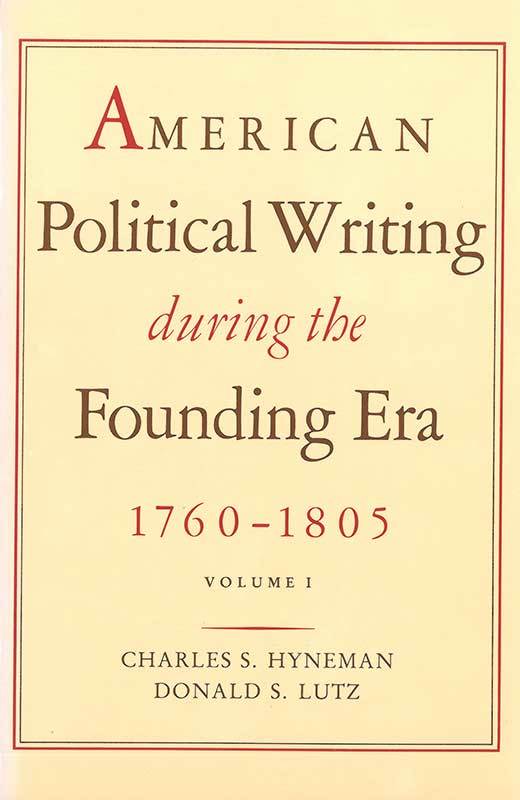
[59]: Americanus [TIMOTHY FORD 1762-1830]: The Constitutionalist: Or, An Inquiry How Far It Is Expedient and Proper to Alter the Constitution of South Carolina - Charles S. Hyneman, American Political Writing During the Founding Era: 1760-1805, vol. 2 [1983]Edition used:American Political Writing During the Founding Era: 1760-1805, ed. Charles S. Hyneman and Donald Lutz (Indianapolis: Liberty Fund, 1983). 2 vols. Volume 2.
Part of: American Political Writing During the Founding Era: 1760-1805, 2 vols.About Liberty Fund:Liberty Fund, Inc. is a private, educational foundation established to encourage the study of the ideal of a society of free and responsible individuals. Copyright information:The copyright to this edition, in both print and electronic forms, is held by Liberty Fund, Inc. Fair use statement:This material is put online to further the educational goals of Liberty Fund, Inc. Unless otherwise stated in the Copyright Information section above, this material may be used freely for educational and academic purposes. It may not be used in any way for profit.
[59]Americanus [TIMOTHY FORD 1762-1830]The Constitutionalist: Or, An Inquiry How Far It Is Expedient and Proper to Alter the Constitution of South Carolinacharleston, 1794 Born and raised in New Jersey, Ford graduated from Princeton and studied law in New York. Thereafter he practiced law in Charleston, South Carolina, where he was prominent in public life and civic affairs. Between September 29 and November 10, 1794, Ford published ten essays in Charleston’s City Gazette and Daily Advertiser under the name Americanus. At issue was the demand by those in the uplands of South Carolina, the Piedmont area west of the first set of falls, for a redistricting of the legislature to take into account population shifts during the previous two decades. Those in the eastern tidewater region, now in a minority among the voting population, naturally opposed such reapportionment, as well as any attempt to reapportion the upper house on the basis of anything but wealth. Ford, speaking for the tidewater interests, outlines a theory of representation drawn from a conservative Whig perspective that looks back to the pre-Revolution era for its roots, and foreshadows the Southern view until the Civil War. Only the first seven essays are reproduced here because the last three are taken up with specific and technical details of proposed districts. No. I.It has been customary amongst theoretical writers on government, to deduce the rights of man from an ideal state, called a state of nature. This is a state in which the human race is supposed to have been placed by their Maker, the world being a great common, and man the incumbent; a state in which each one had a right to take what he wanted from the objects that surrounded him but acquired no property in what he did take, except while using or consuming it; that the moment he laid it out of his hand, it reverted to the general mass, and became the equal property of all, by ceasing to be the peculiar property of any. Possession was the only legitimate mode of acquiring right, and that right could be secured only by consuming the subject. The part that remained unconsumed, though only laid down upon the turf while the possessor could go to the spring and drink, immediately belonged to the byestander, who, in his absence might incline to take it up. To make the hypothesis better answer the ends of its creation, it goes on to say, that in this state might and right were synonimous terms; and he who wrested from the hands of his weaker neighbour the root which he had dug out of the ground, or the prey which he had hunted in the forest, acquired the privilege of calling it his own. That the state of nature was by this means a scene of constant strife, and man the most barbarous savage of the wilderness; that victory and defeat were the only events that could be recorded, and alternate plunder the only intercourse amongst God’s creation; that the moral principle had no place amongst men, mere inclination being the only incentive to action, and their will the only law they knew. The hypothesis then supposes, that men, grown weary of a state so barbarous and bloody, at length took up the idea of associating together in a compact, in order that they might, by the united strength, curb the outrageous, and protect the weak and pusilanimous; that by this means the world was transformed from a state of nature to a state of society, from a state of war to a state of peace. There is a rule in arithmetic called the rule of false, which teaches us by assuming some numbers known not to be true, but working with them as though they were true, to find out that which is really so. Fortunately, arithmetic furnishes other methods of arriving at the truth, and I should be sorry if it were the only science that could boast of that prerogative. Indeed, the very rule itself requires, that as there should be some other rule by which it can be tested; no man could ever know that the conclusions to which he might be conducted by the rule of false were just, unless he had the result of a true rule to compare them with. The only advantage derivable from the fact is, that we are thereby taught that falsehood may be so disguised under the garb of truth, as to confound all distinction between them, unless the mind be guarded by caution. Now, it is manifest, that such a state as is called a state of nature never in fact existed since the creation of Adam and Eve. Man was no sooner born, than he was associated under some common tie, which bound the human race together. The first knowledge he had of himself was this. Nature implanted the ties, habit confirmed them, and experience approved them. Man knew his powers and his rights, before the fancy of philosophers ever engendered this ideal state; and felt the relation in which he stood to his fellowmen, by rules superior to those which were metaphysically deduced from it. The laws of nature he knew from his own experience; but a state of nature was neither intelligible nor credible. When he was told, that what he acquired by his own industry was his own, he understood it; but when he was talked to of a state of nature, in which nothing was his own, but that he had felt the inconveniencies of his weak and destitute situation, and had transferred himself into a state of society in order to acquire property, he recollected nothing of it. He attended to the narrative concerning it, as to a fairy tale which amused his curiosity; but when he sat down soberly to reflect upon his rights and his duties, he placed himself under the direction of his senses, and deduced his rule of conduct from the real situation which he found he occupied in the world, and which he understood to be much the same as the generations of men who had gone before. It appeared safer to reason upon things as they are, than as they might have been; rather upon that which was real, than upon that which feigned. Nor was he destitute of sufficient lights to guide his reason. Observing that every man came into the world equally naked and helpless, and all returned to a state of perfect equality in the grave, he easily inferred that each was by nature as good as his neighbour. When he experienced hunger and thirst, cold and nakedness, he learnt the necessity and the means of remedying them at the same time. Feeling that the benevolencies and affections of the heart rewarded their possessor with peculiar gratification, and made all around him contented and happy; and perceiving that the angry passions harrowed up his own repose, and threw all around him into a state of ferment and confusion; he at once learnt the value of the social duties and kindred virtues. When he trangressed the rules which these virtues invariably suggested, he felt a degree of self reproach; and when he performed them, of self-approbation; which taught him to mark the difference between good and evil, virtue and vice. The principles of honor and shame sprung spontaneously from the evolutions of the moral sense; and man was at once referred to a monitor within, to which he entrusted the government of his actions. When he surveyed his strength and his faculties, and found that they were subjected by nature to his own volition only, and that each was endowed with his portion thereof, he easily learnt that the portion allotted to each individual belonged exclusively to himself. When he perceived that in the exercise of them he could procure what nature prompted him to desire he learnt that the things procured belonged to himself in the same manner. The rules of justice resulted from every thing he saw and felt. It was easy to conclude, that no one could take from another the fruits of his faculties, since he could not command the faculties themselves. Each one was of course entitled to his acquisitions in proportion to his own exertions, or to the degree of ability which nature had conferred; for it was soon evinced that she had her favorites. In a word, the moral principle aided by experience, and unfolding itself at every turn, became the able instructor and the unerring guide of man; his rights, his interests, his duties and his obligations naturally sprung from this source; he felt it in every emotion, and saw it exemplified in all the works of nature. But, as the first station he found himself in was the social, so his first and all his subsequent reflections arose in it; its benefits and conveniencies, which every day’s experience demonstrated, were not considered as the moving cause with man to form that state, but as the substantial reason why he was placed in it. Unbiassed nature could never believe that the Maker of man placed him in a state excessively bad, and that he altered it for the better by a contrivance of his own. The inference which man naturally drew from every thing he saw, knew and felt, was, that God placed him in a social state, but left the regulation of the terms of association to himself. To be associated, therefore, was the law of his nature; but the modification of the social compact was to be governed by those various circumstances in which each society might find themselves; each was at liberty to form their own contract, and fix their own principles. The Scythians might choose one mode, the companions of Cecrops another, and the followers of Romulus, a third; each might bind themselves by their own institutes, but could not be bound by those of one another. Men did not, therefore, learn their rights from the form of the compact they made, but made the compact the means of protecting the rights which they had previously ascertained to belong to them as associating beings. To say then, that this or that particular right is the offspring of a social compact, if true at all, is not the whole truth, and therefore misleads. Every substantial right depends as much upon society as every other. The right of property is generally adduced as an instance of what is derived merely from the social compact. To prove this, it is said, that the strong rob the weak of their acquisitions in a state of nature, and therefore that the institution of society is necessary to guarantee the possession and enjoyment of them. Yielding for a moment to the supposition of such a state as is called a state of nature, I will prove that the right to life depends on the same principle: for, let me ask, if the same superiority of strength in that state, is not equally sufficient to take the life? and not the combined force of society equally necessary to protect it? It follows then, that life, and every other right, are as much the gift or emanation of society, as the right of property; because, it must be confessed, that in a state of nature they are equally subject to the invasion of the strong. Will it be answered, that life being the gift of nature, and necessarily existent under her laws, is to be distinguished from property, which being a subsequent acquisition made by man, has no dependence on the laws of nature? It will not avail; for the preservation of life is nature’s first law, and she herself points out the means. These consist in the fruits of the earth, or the prey of the forest, acquired by him whose existence is to be preserved thereby; to take these away, is to take life itself. If, therefore, the right to the property thus acquired be not a natural right, neither is the right to life such: for, I can see no substantial difference between taking away the life of a man by intercepting his food, or by strangling. Nor is this right of property confined to mere present subsistence, as it is very easy to evince. Nature has ordained a period to the bodily powers, short of that she has assigned for life. She has implanted in man as strong an attachment to his existence when those powers have sunk under the elapse of years, as when the vigor of youth enabled him to provide the requisites of life. She has bestowed upon him in youth more strength and activity than the current exigencies of life require, with an evident reference to the wants and imbecility of his declining years. She has, therefore, announced to him, that the time will come when he will wish to live, and shall not be able, unless he devotes the surplus of his youthful strength to provide for his helpless condition when age shall have dissolved his nerves. Thus having implanted in every man the right to future as well as present existence, and appointed the same means for both, the right and the means are as clear and inviolable in the one case as the other. To this we may add, that she has laid her strongest injunctions on man to provide for the infant years of his offspring; the right to that provision, when made, is therefore as strong as is the right of his offspring to life. The conclusion then is, that the right of property, as well as those of life and liberty, are the gifts of nature. The end of civil society is to guard them by stronger sanctions, the moral sense being too weak and too unequal amongst men for that purpose. The two last are common to all men in equal degrees; the first is common to all, but the degree depends upon the endowments of nature, and industry and success in the pursuit. The idle and the indigent acquire no title, under the social compact to supply their own remissness out of the acquisitions of the industrious; yet this is ever the tendency of human nature: against this the social institutions ought chiefly to be directed. If an individual attempt it, he is instantly punished by the sentence of the laws, as an invader both of natural and social right. No aggregation of numbers can sanction the act; and that social compact or constitution must be exceedingly imperfect, which does not protect the industrious as well against public rapacity as against private robbery. The latter we know can be at all times suppressed; it is from the former that most is to be apprehended, and against it therefore the civil institutions ought chiefly to be directed. When men confederate for wicked purposes, their numbers keep them in countenance; and under the plausible pretence of being a majority, they may be led to attempt that which, as individuals, they would blush to avow. And when by deceitful casuistry, they are reconciled to the attempt of preying upon the possessions of the wealthy, the point of satiety is the only one at which they will be likely to stop. Where this point is, would be hard to know. The merely malevolent passions expire of their own violence, or subside with the blood; perfidy and fraud may out-run their means, or grow tired: but rapacity, when once put into motion, knows no bounds short of exhausting the objects. Small successes are the parents of greater desires; the sweets of enjoyment tempt on the pursuit, and that which began in vice becomes sanctioned by precedent. No. II.The natural rights of men undoubtedly form the rational foundation of the social compact. I say the rational foundation; for, it cannot be doubted, that if man be a free agent, endowed by nature with the power of disposing of his own situation in the world, he may in this and every other instance make a compact or agreement irrational and foolish. I have shewn, in a former number, that these natural rights are derived from the laws of necessities of nature; that is, what is common and necessary to all men, as such, must spring from nature. It is not requisite to frame the fanciful system of a state of nature, in order to learn what these are; for, as the laws of nature cannot be changed, so neither can they be beholden to any contrivances of man. They illustrate and prove themselves. Life, liberty and property, have been adduced as the chief among the natural rights of men. The two former are common to all men, and in equal degree; the latter is indeed common to all, but the degree depends upon industry and success. That very industry, while it produces the personal benefit of each individual, constitutes the prosperity, strength and comfort of the whole. It is as necessary to the existence of the body-politic, under its best organization, as to the existence of the individual in the supposed natural state. A variety of writers have attempted to shew what a people ought to do when they form a social compact for the purpose of perpetuating or securing their rights. If the natural rights were the only matters to be regarded, perpetuated or secured by the institution of society, the rules which they commonly frame would be liable to fewer exceptions. It is here that their fancied state of nature misleads them; they first of all place man naked and destitute amongst the roving animals of the forest, where they run for some time without connection, and almost without knowledge of one another; then they collect their rude materials into a plain and form a horde, and out of this horde springs a social compact. Here, as every man comes out of the same rude situation of nakedness and savage barbarity, all are to start even and equal in the career of society, no interest being acquired by any, with nothing in possession, but every thing in pursuit, the object of the association may be summed up in a short sentence—“Life, liberty and property shall be secured to all;” and all that would be required of a constitution would be to provide the means of accomplishing that end. But as such a previous state never existed but in the dreams of theorists, so the rules that are formed upon it must be imperfect for a practical system. If men, at the formation of a compact or constitution, are in fact possessed of acquired rights, and vested interests, these must be regarded, or the compact will embrace but one half of its object. Instead of being founded upon the principles of reason and justice, it would be evidently partial; and the descriptions of people, whose peculiar rights and interests were thus discarded from the compact, in subscribing to it, would authenticate the evidence of their own folly. A late ingenious author* seems to have had a view to this distinction, when he says, “Besides the general maxims of legislation which apply to all, there are particular circumstances confined to each people, which must influence their establishment, and render their regulations proper only for themselves. Thus we see that the Hebrews formerly, and the Arabs in later times, have had religion for their principal object; the Athenians, literature; Tyre and Carthage, commerce; Rhodes, her marine; Sparta, war; and Rome, virtue.” If the accidental state into which society may be thrown after the formation of a constitution, ought to influence the laws and regulations, by parity of reason ought the pre-existent state of the people themselves to influence the consitution. For what purpose is it made, if not to suit the state and condition of men? The natural rights of man ought indeed to be common to all constitutions; but the real situation of each people ought to govern their own institutes, and make them peculiar to themselves. The natural rights of man can never vary in any society, because they are built upon the eternal principles of nature; but the interests of man are subject to all those vicissitudes to which the state of society is itself liable. Where there is but one specie of interest among the people who are about to adjust their association it will be as easy to adopt their constitution to their acquired interests as to their natural rights. If they were all shepherds, whatever guaranteed the interests of one, would serve for all. If they were all huntsmen or husbandmen, the rules would still be simple and plain. But if the husbandmen should come to associate with the shepherds, the latter would necessarily stipulate, that the pastures should not all be turned up by the plow; and if the huntsmen should join both, the one would stipulate that they should not frighten away or scatter the flocks; the other that they should not trample the fields of grain. And here it is proper to distinguish the rights of prior occupants from those of subsequent emigrants. It can never be contended under any laws, human or divine, that a body of husbandmen have a right to enter upon the peaceful society of shepherds, and prescribe their own terms of association. This would be neither a social nor a civil compact; it would be a forcible invasion of right, which is the very thing the social compact is intended to avoid. If the prior occupants were free, they would surely have a right to prescribe to the new comers such stipulations as would effectually guard their acquired interests; and all that the latter could in decency ask, would be such stipulations as would secure to them the enjoyment of all the natural rights, and the benefit of all their acquired interests. If the interests of the two were of such a nature as to be utterly inconsistent and incapable of union, the emigrants ought to seek some other place, or some other people, and leave the prior occupants to themselves, none the worse for their visit. But if a union should be still insisted upon by the visitants, they ought to take the benefit, willing to yield their interests or their claims in those points where they could not be made consistent with the condition of the other party. Natural reason and unbiassed justice would dictate such a concession. The superior right was on the side of the occupants, and no people can have a right to set down amongst them upon terms subversive of the rights they antecedently possessed; at least such a pretence can spring from nothing better than mere conquest which at this time of day no person will, I believe, contend to be a legitimate source of right. The occupants may indeed concede some of their rights, in order to facilitate the union, but the very idea of concession supposes a liberty of refusal. It at once involves the idea of a mere contract, in which each party may propose their terms of union, but neither can be compelled to accept; but, when they do accept, the compact then takes its rise, and is equally obligatory upon all, and is to be the touchstone of all future claims. The very essence of the compact, when made, is mutual obligation, which is obviously inconsistent with a power reserved in either party to rescind or remodel the stipulations so as to suit only themselves. Force or conquest can be the only source of such a claim, and its advocates must equally contend for a right in the hunters of setting down, under terms prescribed by themselves, upon the prior occupancy of the peaceful shepherds. The party who would attempt either, place themselves at once in a state of war, and depend on force, and not on reason, for the accomplishment of their ends. An intrusion like this into the domains of a settled people can claim no more pretence of right than Alexander, when he passed the Granicus, or Caesar when he passed the Rubicon. A wandering horde has just as good a right to set down amongst a people, and be their law givers, as they have, after having formed an association upon mutual principles, to change them at pleasure, as their varying interests, their passions, or their caprice may dictate. Power is in each case the only source of right, and arbitrary will the measure of its exercise. The common notions of a contract utterly exclude the idea of a right residing in one party to alter or rescind it—mutual obligation forms its very essence. To bind one party, and leave the other at large, is to impose a law upon a conquered people, instead of forming a contract between free and equal parties. Mere power can never constitute a legitimate right, and yet by what other claim can one party presume, of their own accord, to change the compact? It is said indeed, that the majority ought to govern. This principle is true under modifications, but it is not indefinitely so. It is a principle very capable of being perverted, and likely always to be enlisted on the side of those who have or hope to have a majority, let their views or principles be what they may. But I contend, 1st. That the majority of an associated people have no right to infringe the social compact. If they have, then it follows that the compact has no existence longer than while the contracting interests are equal in point of number or power. It would derive its sanctions not from mutual assent, nor from moral obligation, but from physical force. It would be no breach of civil duty to attempt a subversion of the government at any time, provided the enterprizing leader had a tolerable prospect of gaining a successful majority; for it never can be unlawful to attempt that which would be lawful if attended with success; and on this principle Cataline’s name ought to be erased from the records of infamy, and inscribed in the brightest page of Roman virtue. The weaker party in society would literally have no right whatever: neither life, liberty or property would be guaranteed to them by the social compact, seeing the majority are not bound by it, but might destroy the whole, and by the same rule any part of it at pleasure. In the case which we have supposed above of the husbandmen associating with the shepherds, the farmers, if a majority, would be justifiable in commiting rapine upon the flocks of their associates. Virtue and vice would lose their distinction; the most vicious views would be sanctified, if pursued by the greater number, and the most virtuous resistance punishable in the less. 2d. If the principles of justice are derived from a higher source than human institutions, (and who will deny it?) I contend that the majority have no right to infringe them. Society is made up of different descriptions of men; between each description a common interest creates a common sympathy. The merchants, the farmers, the planters and the manufacturers, each have their common interests; each of these interests have their respective rights annexed to them, independently of the great natural rights which are common to all. Suppose one of these communities of interest (as the mercantile) to include a majority of the whole society—May they infringe the rights of any or of all of the others? May they do to the others as in return they would be unwilling should be done to themselves? (This I take as the best criterion of justice or injustice.) If they may, then a majority have a right to infringe the laws of nature, and every other law which dictates the rules of justice. These cease to be obligatory of course when three men chuse to abolish them, and but two men vote to observe them. In fine, justice would import no obligation per se, and must always count the number of her votaries against that of her opponents, to know whether she had any existence at all. The truth is, that the term majority is a relative term, and supposes a compact already made; by which compact it is stipulated or implied, that the general will in the functions of government shall be taken to be that which a majority declares. But take away the idea of a compact or association, and to what does this term then relate? It relates to nothing; or, which is the same thing, to an indefinite number of unassociated men, none of whom have any power or controul over the others. If then the rights of the majority (be they what they may) derive themselves from a previous compact, the compact is the principal, and those rights the accessory dependant upon it; and whenever the latter attempt to destroy the former, it in the same instant destroys itself. And what sort of right must that be, the exercise of which necessarily works its own destruction? A phantom raised up in the dark recesses of brooding theory, where “airy nothing often gains a local habitation and a name,” but which the light of practical reason dissolves away “like the baseless fabric of a vision.” No. III.In my first number I took the liberty of refusing my assent to the doctrine of a state of nature as being precedent to a state of society; because it is a mere creature of theory, and as such capable of being so managed and moulded as to mislead the candid enquirer. If any person will, however, point out to me the time and place, when and where it had existence, I will still acknowledge myself a convert to the doctrine. It would be sufficient for all my present purposes to deny, (which I believe I may safely do) that it ever existed in Carolina. I contended also, that a state of society is the natural state; that nature placed man in it the moment she produced him, but left the regulation of the terms of association to himself, as she did every thing else which respected his transactions and circumstances in this world. That without resorting to a state of nature, the natural rights of men may be easily known and understood, being in fact nothing more than what nature has obviously conferred or made necessary to every man. Of these were enumerated life, liberty and property. The first is conferred, the second and third made necessary by the decrees of nature. We might have included the intellectual right: but it might have led to a prolixity of metaphysical discussion unnecessary for the present purpose. These rights being common to all men, necessarily formed the foundation of the social compact. In the second number, however, it has been shewn, that they do not form the only foundation of it. The acquired interests of the different parties in society necessarily enter into the constitution of it. If this were not the case a party of merchants could never voluntarily associate with a party of planters, or a party of manufacturers with either. If their several interests be precious to each, neither can ever be supposed to assent to a compact, in which those interests are disregarded. What temptation could they have to associate? The rights about which they would be most solicitous (being most liable to invasion) would be those which the social compact would not provide for. This compact then, rationally understood, supposes the contracting parties to be of two descriptions. When it immediately regards the natural rights of man, each individual is a party per se, because each individual, as such, possesses those rights. When the rights of certain descriptions are to be provided for, each description, composed of many individuals, forms a contracting party. In no country under heaven is the latter better exemplified than in Carolina, being composed of the mercantile, the planting, the farming and the manufacturing interests. Each of these is as much entitled to consideration, in forming a compact, as any of the others; and neither submitted to it upon the principle of holding their peculiar rights and interests at the courtesy of any of the others. Such a submission, as I have before shewn, would import an act of necessity, and not of free agency and assent. There is a more general division, into which the society we live in may be viewed; I mean, the holders of slaves, and those who have none; or, more properly, those who pursue and must pursue their occupations by slaves, and those who pursue, or may pursue, their occupations of themselves. This latter division is, perhaps, the most comprehensive of any that can be made, and forms two interests very distinguishable from each other. This distinction must be qualified by a very important consideration. Not every one who holds slaves merely, is to be considered as forming a branch of the former description; but those whose cultivation is of such a nature, as that the very existence of it depends on that property. Nature has decreed, that the race of white people shall not labour in the fertile swamps of this climate; but she has not interdicted their labouring in the up lands, particularly above the falls of the rivers. These truths none will, I presume, undertake to controvert in the face of every day’s experience. It follows necessarily that, on the one hand, an upland farmer may part with all his slaves and be a farmer still; while, on the other, a swamp planter parting with them is broken up entirely, and is a planter no more. Let not, therefore, these distinct circumstances be confounded; for in confounding them we confound the rights of different parties, and open the door for erroneous reasoning. The slave is essential to the one; he is but convenient to the other. In the second number I have stated what I conceive to be rights of prior occupants, of those who have first discovered and settled a country, compared with the rights of those who afterwards emigrate and join them. A union between two such people can arise from but two sources, conquest or compact. As the former claims every thing, the occupants can have nothing but what is derived from courtesy. It is vain to attempt to reason upon rights unreasonably acquired. Instead of rights, reason declares them to be wrongs ab initio; and disclaims the having of any connexion with them. There is, as yet, no avowed pretence in Carolina, of any rights being derived from this source. It is to be passed over as unworthy of discussion in a free country. Compact then is the foundation on which we stand, subsisting as I have already shewn, between each individual of the one part, and the whole mass on the other, so far as respects life, liberty and property, and the other natural rights of men; and between each description of interest, and the residue collectively, so far as regards the common interests of each description. Thus the common mercantile interest contracts that the planting, farming and manufacturing interests shall be sacredly regarded, while they, on the other hand, guarantee the mercantile. Each of these interests alternately contract with all the others; and this branch of the social compact is as necessary, as obvious, and as indispensible as the former: as necessary, because the danger of invasion is as great; as obvious, because the title of each party is as clear; and as indispensible, because the inducements are as cogent as any right to which the social compact can have relation. Nay, the danger of invasion is greater than in the case of the natural rights, as I have hinted in a former number; for although these interests are the emanation of one of the natural rights, vis. property, yet there are a thousand ways in which arbitrary restrictions, preferences, monopolies, or unequal taxation may be brought to bear upon some one or more of them, without a direct invasion of the natural right of property. The sacredness of the natural rights forms in a great degree their protection, and throws a sudden and forcible check upon the effects of power. But when interest has seduced the heart, insidious glosses dazzled the understanding, and consciousness of power tempted the act, the subverted interests of particular classes have been made to bear reluctant testimony to the truth of the assertion. Every citizen then in society, who was of a particular description of interest, may be said to have contracted in a double capacity. If a planter, he stipulated as a man, that his natural rights should be preserved, and as a planter, that the planting interest should not be swallowed up by the other interests in the state. It would be a piece of mockery, if the former only were provided, and the latter left unsecured. The same may be said of all the other descriptions. In this view of the compact, there is no mystery, no far fetched theory; it is what every man feels when he refers to himself, and all must approve when applied to others. It takes man as it finds him, with all his real rights, interests and circumstances attending him. The social compact appears what it ought to be; a bargain, in which a variety of interests are concerned, adopted by common consent for the safety of all. In adjusting such a compact, amongst a people extensive in numbers and territory, unequal in population and riches, diverse in habits and manners, many difficulties must be expected to occur. Some will be natural, some fictitious. That effort which self-interest always makes to gain the advantage of a contract, will be no less employed on an occasion like this. Each party will set off their respective interests, and state their demands with peculiar ferver. It is here that the different interests which I have been contending for, but which the common theory takes no notice of, make their appearance. Each interest unites in distinct views, and makes an integral party in the discussion. The natural rights, as all men agree in them, are found easy to adjust; the difficulty made no account of in theory, turns out in practice to be the subject most agitated in arranging the social compact. It is morally impossible that the several interests should be composed of equal numbers. Nor is it necessary they should, in order that they may be entitled to weight as an interest in the adjustment of the social compact, because it would at once be estimating the rights and interests of man by the number of votes, and not by principle; a position which I trust has been refuted in a former number. As in a free constitution, no man is so poor or contemptible, but his natural rights are to be sacredly regarded, so no existing interest is to be set at nought or sacrificed, because of its comparative smallness in point of number. If it forms in reality a contracting party, that is sufficient to entitle it to every claim it could have, were the numbers never so much augmented. If this were not so, the master interest, like Aaron’s serpent, might constitutionally swallow up all the rest; and an Agrarian law be engrafted upon legitimate right, under a system which professes to secure to every man his possessions. When by a compact, a people have determined that the society shall be governed by laws made for the common good (so they do not oppugn the compact) it is natural indeed, that they should agree to take the sense of the majority of the constituted bodies as the touch stone of such laws; because there is no other method for them to fix upon. But they could never make a compact, and then submit to the majority of the people, who contract, whether it is a compact or not, or whether it should continue as they made it. Three men might as well sign and seal a mutual obligation, and after they had done, leave it to the determination of any two of them, whether it is obligatory or not; any two might in that case collude together for the purpose of defrauding the third. It follows from this, that, as to all legislative acts, the majority of the constituted body has a right to determine; but that the right is derived from the very compact itself, and not from any pre-existent quality supposed to reside in the people during the time they were in an unconnected state, or were passing from that to another state. It has been shewn before, that any attempt to exercise such a right upon a contract itself, would be the same thing as an attempt to rescind and destroy it. Thus, then, the minority are bound to the majority in the making of laws; but in the making of constitutions the obligation is reciprocal, and therefore equal upon both. This is a distinction of the utmost consequence to a free government. Laws spring from constantly varying circumstances of the society: their objects, and of course, their duration, are often temporary; they are sometimes founded in mistake, sometimes made for experiment, and are therefore in all cases subject to be varied or abrogated. The good of society requires that the laws should change with its exigencies; and the power of deciding when these exigencies occur, must be referred to the majority of the constituted bodies. This majority may speak the sense of a majority of the people, or it may not; but I know of no constitution which prescribes a mode of ascertaining the fact, or that requires the ascertainment of the fact as a prerequisite to give force and validity to the law. The people having, in their charter of association, drawn certain rules for the government of the bodies they constitute, surrender to those bodies the right of judging upon matters of public expediency; reposing their safety and tranquility in this, that let them institute what they may, there are certain rights and interests which they cannot invade, certain prescribed boundaries which they cannot pass. Their constitution is a strong citadel which commands every part that is without, and, having been built by the aid of all, nothing less than the strength of all can demolish it. But when a part of the association, perhaps a bare majority by one, assumes the privilege of destroying this goodly fabrick of pleasure, it then becomes rather a place of annoyance than of defence. Nothing is, from that moment, safe in society. A majority—it is an appellation easy to assume, a thing which every man in society (no matter by what means) will assume the right to form if he can. The vilest of factions may sometimes acquire it in the moments of popular delusion, and invoke its sanction in the worst of causes. A compact which cannot secure society against such efforts or pretensions, is unworthy of a free people. It ensures no tranquility to the peaceable, no success to the industrious, and no prospect of reward to any, but those who would break all the bands of society and commence a general plunder. No. IV.In the three former numbers I have stated certain principles which influence men upon entering into society, as well as in adjusting the association; or, in other words, in framing a constitution. These have been deduced from practice and experience, from acknowledged rights and interests, and not from any particular theory. They have been illustrated and proved in a manner at least satisfactory to myself. They are before the public, who will form their own judgment concerning them. Persuaded as I am myself, of their solidity, it will not be inconsistent in me to build upon them as upon a solid foundation. It has probably struck the reader already, that these papers have a reference to a subject which has lately been made public, and which is likely to become highly interesting to the people of this country. It has been announced that a number of gentlemen in the upper country, have associated together as reformers; have organized themselves into a systematic body, and have dispersed their subordinate bodies throughout the country, under prescribed principles and special instructions. They have addressed themselves to the people at large, telling them that they had made a new discovery which had astonished them; though they had indeed suspected before, from some facts within their knowledge, that matters were as they turned out to be upon their “careful and attentive examination.”* This new discovery, it seems, was of an inequality in the representation of this country: from whence it was inferred, that our government possesses the form of freedom without the substance; and the constitution being radically defective or oppressive, the people are called upon to join the reformers in setting it right. The latter have promised to draw petitions for the people to sign, and to support them before the legislature in such a manner as will not be unworthy of the cause. They tell the people, that attempts had before been made to obtain a partial redress, but the legislature was of opinion that the people did not wish it. They are therefore exhorted to refute this opinion by the unanimity of their measures; although the evil itself was announced by the association as a recent discovery, which they were then giving the first notice of to the people. These communications have been followed by a series of letters, signed Appius, addressed in a familiar style to the people of South-Carolina; but upon a perusal of them, we find, that they are particularly addressed to that part of the state commonly called the upper or back country. The object seems to be to convince the inhabitants that they are exceedingly oppressed under the existing form of government in this state, and to reinforce the address from the reform association. To remodel the constitution, in point of representation, so as to place the wealth of the low country, and all its interests and concerns, under the immediate administration of the back country, seems to be the direct view both of the association and of the address. It is declared, that wealth ought not be represented; that a rich citizen ought to have fewer votes than his poor neighbour; that wealth should be stripped of as many advantages as possible, and it will then have more than enough; and finally, that in giving property the power of protecting itself, government becomes an aristocracy. The advocates for such a system, have, in my view, but one step further to go. These principles are well pointed, and their aim pretty well disclosed, in the 31st page of the pamphlet, where it is said, “The upper and lower countries have opposite habits and views in almost every particular. One is accustomed to expence, the other to frugality. One will be inclined to numerous offices, large salaries, and an expensive government; the other, from the moderate fortunes of the inhabitants, and their simple way of life, will prefer low taxes, small salaries, and a very frugal civil establishment. One imports almost every article of consumption, and pays for it in produce; the other is far removed from navigation, has very little to export, and must therefore supply its own wants. Consequently one will favor commerce, the other manufactures; one wishes slaves, the other will be better without them. Where two classes of people in the same community have such opposite inclinations and customs, it is fit that the most numerous should govern.” I cannot think that the people of this country, and particularly of the lower country, have been tranquil readers of these doctrines. To them it involves a question no less than “to be or not to be.” I profess myself to be one who considers it of the utmost magnitude, who views the attempt now making, as of the most dangerous and alarming kind, and one which ought to arouse our most steady and determined opposition. Under this impression, I shall proceed, in the course of a few remaining numbers, to discuss these claims under the principles which I have already laid down with that freedom which becomes a citizen, and I trust with that respectful deference which is due to the public. It is observable, that not only the right to govern, but the manner in which the government is to be exerted, are plainly disclosed in this pamphlet; commerce and slaves, and the other points which constitute “the opposite views and interests,” are to be governed (perhaps abolished) by the “most numerous,” whose manufacturing interests are repugnant to the first, and who would “be better without the second.” One unavoidable inference results from the whole, which is, that the upper and lower country, as they are at present situated, never can be connected under any form which does not explicitly lay all the peculiar rights of the latter at the feet of the former. I shall, however, refer observations of this kind to a future paper, and at present resume my plan. I trust I have demonstrated already, that certain rights attach to the prior occupants of a country, which subsequent emigrants can claim no right to divest, unless it is the right of conquest. I have also hinted, and in some measure exemplified what these rights are; and now lay it down as a principle, that the right of prior occupancy comprehends all those advantages and immunities which are essential to the nature of the industry andpursuits which led the prior occupants to settle and attach themselves to the country in which the emigrants foundthem. If the latter cannot associate with the former under any other terms than compelling them to abandon their original occupations, the latter have no right to associate at all; because their union becomes inconsistent with the very existence of one of the parties; and if so, who ought to give way? Appius tells us the prior occupants: then Appius must contend for the right of conquest. Let the republicans of Carolina weigh well the principles of such a pretence, before they decide upon it. Here then we come to the question, in whom doth the rights of prior occupancy reside? A short survey of the history of Carolina will answer the question. Indeed Appius himself tells us who are not the prior occupants, by setting forth the great rapidity with which the upper country has become peopled within the few last years. He tells us that “all that is now called the back country, and even the middle districts, were for a long time held by the savages; that population and wealth were confined to a few leagues along the sea coast; and that the lower country was flourishing and wealthy, while the middle was either wholly unsettled, or contained only a few indigent and scattering inhabitants, and the more remote, interior parts now called the back country, entirely unknown or occupied by savages.” Those Carolinians who have formed any acquaintance with the history of their own country, know, that some where about the year 1670, a number of adventurers, under the auspices of the first proprietors, fled from want and religious persecution at home, and took refuge amongst the forests of this country. The first settlement was made under governor Sayle, upon the spot where Charleston now stands. Those poor occupants, and such as joined them from year to year, encountered every possible hardship incident to their situation, and braved the hostile tribes of barbarians that surrounded them; fondly imagining that they would enjoy themselves and transmit to their children all the rights, civil and religious, which they sacrificed so much to obtain. After twenty years labour, expended with little reward, in clearing and cultivating the sandy uplands near the coast, accident discovered that the riches of the country lay in the swamps; and the rice was the grain congenial both to the soil and the climate. It was soon found, however, that the race of white people could not labour there, and that he who attempted it, seldom cleared more ground than sufficed for his own grave, in which he was very shortly deposited. Captive Indians were soon substituted, and in process of time, labourers were drawn from Africa. The cultivation of the swamps, by their agency, became a system which made the low country flourishing and wealthy; while the upper country was the habitation of savages, and the place from whence the settlers were constantly invaded. Inconsiderable in numbers as they were, their blood and treasure were often drawn upon to purchase that peaceable territory now enjoyed by their brethren of the upper country. Children are now alive, who have wept a father slain by the hands of the savages; nay, there are now many citizens whose feet have trodden the wilderness of that country, and who, at the risk of their lives, have derived to the present inhabitants the privilege of setting down upon lands uninfested by the barbarous tribes. Not more than twenty-one years before the late war, the territory which now claims to govern the low country, was acquired from the Indians, and forts were built for the defence of it. And who are the present occupants? Those who have gathered from all quarters of late years, and associated themselves with the people of the low country; the first occupants of the one place, and for the most part the first proprietors of the other. The latter were in possession of their country, their slaves, their rights, and their properties, as they now stand; while the former were in other countries and associated with other people. Hither they came, acquiescing in the country as they found it; they found it a country abounding in wealth, but weak in numbers; they held out their numbers as the guarantee, and not as the destroyer of its wealth; and in return acquired the equal right of pursuing their fortunes and partaking of its privileges. The population of the low country was nearly as great as it is at the present time, when that of the middle country was but inconsiderable, and when the trees of the back forest had never felt the axe. In the low country it spread from the sea coast; in the back country it arose from a current of migrations setting down the continent on each side of the mountains. The settlers of the low country, for the most part, brought with them a stock of wealth which they threw into the common fund. In the back country the settlers brought little else but their persons. I mean no offence by this distinction; but the fact is not controvertible. All the emigrants who joined the low country, found it peculiarly situated both with regard to its government and its slaves; they acquiesced in a system which they saw so necessary and proper for a people so peculiarly situated. They felt many advantages in their indigent situation, of sitting down amongst a people whose resources of wealth were abundantly competent for all the exigencies both of government and defence. The people with whom they associated, cheerfully recognized their title to all the privileges of freemen, and all the rights of protection; they were even content to see the fruits of their labour enure to themselves with little or no exactions to government; but they uniformly said, “that our very existence as a people, depends upon the perpetual observance of certain fundamental institutions, and we cannot submit to any people on earth the power of abrogating or altering them.” We have embarked all that is dear to us in this system, which our forefathers planted and transmitted to us; and we must cease to be altogether, the instant we cease to be just what we are. To you who are settling a different country, we chearfully guarantee every benefit and immunity you can possibly derive from it; our ancient system possesses nothing that opposes any obstacle to you; but on the contrary, our wealth purchases the means of your protection, and our commerce affords reward to your industry. We are willing to share with you every interest and every right which we possess; but we cannot surrender the power of regulating our great and peculiar concerns. Though we take you into our association, content that you should share the government, yet we can never surrender ourselves into your hands with power to dispose of us as you please; being bound by no natural or moral obligation to do so, and feeling that it would be reposing too much in the hands of a people, strangers to our interests, our customs and our concerns. The nature of the country you are about to settle, and of the pursuits of the settlers, point out that its numbers will soon transcend those of the low country; and we must at this moment stipulate for our ultimate safety, or by admitting you into our body, we surrender ourselves to your disposal. As an alliance upon such terms would probably be fatal unto us at some time or another, we would rather decline its present advantages; but if your object be, as you profess, to embark with us, content that wealth should form the ballast, as it does in fact the sinews of the state, we welcome you as fellow citizens, and embrace you as brethren. The language was natural, the compact reasonable, and therefore acquiesced in. The emigrants in the back country felt an honest disposition to subscribe to the superior rights of the prior occupants; they pretended no claim of setting down amongst the latter, and being their law-givers; they did that from principle which they clearly felt they should themselves have required under like circumstances. They stipulated that man should be free, and all his natural rights sacredly regarded; and under these stipulations they were content to associate and pursue their industry. They saw that the occupants of the low country could never, with safety, blend themselves with a people who were likely to be superior in numbers, and in every respect so differently circumstanced, upon any other terms; they were conscious of no right themselves to negative the terms, being free to accept them, or seek some other people, whose interests, habits and views were more congenial with their own. They found them advantageous and accepted them. Under the union thus formed, they have lived happy and free; their numbers have increased almost beyond example, and the later emigrants have discovered nothing in the state of the connexion to prevent their placing themselves, their interests, and their families under it. Bad as it is, in the opinion of the reformers, thousands have thought it more eligible than any thing offered by the neighboring states, and, without any view of altering the system, have planted their vines and fig trees in confidence of peace and happiness. No. V.I hope that it has been evinced in the last number, to every candid and unprejudiced mind, that the inequality of representation between the low and the back country, so much exclaimed against by Appius hath sprung from no usurpation, nor from any novel principles incorporated into the government of this country. Instead, therefore, of announcing it as a discovery just made, as a horrible thing just burst upon them, the association might have read it in every period of the Carolina history, and traced it through every vestige of its government. They might have seen it not only at the original settlement of the upper and back country, but found it running through the progress of the connexion to the present day; and some of them might perhaps have recognized it as the system under which they were born. Had they been willing, they might also have surveyed the causes that produced it. They would have noticed it as the production of assent, always implicitly and often expressly given. As relating to the people of the low country, they would have recognized in it nothing but what common prudence and self preservation would dictate; as relating to the back country, nothing but reasonable and just acquiescence. Placing themselves amongst the former, they would have felt at once that they would themselves have stipulated for it, placing themselves candidly amongst the latter, that they could not with reason refuse it. They must in the one case feel all the solicitude of prior occupants, who had grown old and wealthy under a system, the violation of which would be their ruin; as emigrants on the other hand, who had acquired every thing but the mere balance of the government, or a power to violate the established system, they must feel every reason to be satisfied. The emigrants having acquired every thing necessary to the success of their own views in joining a settled people, and all that was consistent with the safety of that people could claim no more under professions of a peaceable connexion. To have then demanded more, would have betrayed an overweening ambition; and would have suggested to the occupants well founded apprehensions that the demand was prompted by other views than those of sitting down peaceably and pursuing their fortunes under equal laws. They might have began to dread, that in fostering these emigrations, they would plant in their own bosoms the seeds of their ruin. Under such an impression, instead of draining their treasury, and even mortgaging their future industry, as they often did, to drive from the back country those who were constantly opposing the progress of that settlement; they would rather have entered into an everlasting treaty with Moytoy and Skijogustah, and the nations they represented, to stand a barrier to foreign migrations. Better might they conceive it, to resort occasionally to arms to repel savage invasions, than to surrender themselves by compact to the unqualified disposal of people from all countries, little better acquainted with the pre-existent institutions and peculiar circumstances of the country than the aborigines, and restrained by no constitutional check from the violation of them. Had the settlers, in fact, announced or avowed one half of what Appius has done, instead of being welcomed as associates by the occupants, under the persuasion that by such accessions, strength and prosperity would be derived to the state, the latter would have been shocked at every emigration, viewing as a reinforcement to an internal enemy. The usual means of public safety would have become the harbingers of real danger; and the low country must have considered themselves as a crop ripening for the sickle, to be cut down and divided when the upper country should have increased in labourers sufficient to begin the harvest. For to what principle of probable safety could they have entrusted themselves and their posterity, after putting into the possession of indefinite numbers of needy settlers, in the back country, all the power that could be requisite for invading and subverting their essential interests? Human nature, it is well known, is too frail to be always true to the principles of virtue and justice; too often tempted, too seldom rectified to be safely relied on. Could then its mere clemency and moderation form a safe depository of all that was precious, to a people in all respects so differently circumstanced as Appius has described them? Though virtue and justice sometimes bind men to the right, yet their efficacy is not uniform; if it were there would be no need of laws or constitutions. Interest, the most powerful impulse of the human breast, often overlooks or out runs the dictates of the regular virtues. In the mad career of its pursuits, when thoroughly excited, laws themselves form feeble obstacles; and what could be expected from those rights or possessions of other people, which were the objects of the excitement? It was obvious to the slightest observation, that the emigrants to the back country, for some time, at least, must be poor and necessitous, they therefore could not want temptation; that they must soon become very numerous, and therefore could not want the power. In the same part of society then must soon unite the two requisites which seldom fail to set mankind in motion, vis. temptation, or an ardent desire to obtain an object; and power to accomplish what they wish. The power and temptation to do wrong have seldom found any successful restraint or opposition. To unite these two in any one party, or in any one person, is always dangerous in the extreme. If he must necessarily be cloathed with the power, prudence required that every thing be thrown in which can mitigate or destroy the temptation; if he must be placed in a way of temptation, all proper checks ought to be directed against the power. From hence it is plain, that the low country occupants preserved to themselves no more than the principle of mere self preservation dictated, and that the emigrants as reasonable beings, were content to acquiesce in an arrangement which left them every thing, but the mere power of oppressing by numbers, the few, but wealthy people with whom they associated. Increasing as they were every day, by accessions of people from all quarters, with whom they had no prior acquaintance, however honest their own intentions might have been, it was strictly impossible for them to ensure the low country against abuses, otherwise than by leaving in their hands those checks which they found them in possession of. If then, there ever subsisted between the back and the low country anything of that original compact upon which, the association tells us, all lawful governments rests, it is to be found here; and its leading feature is that very inequality of representation which they have so recently discovered. Hence the people of the low country, so far from being chargeable with usurpation, or with wresting the government from its original institution, have adhered to original terms and stipulations; while the association, guided by some new lights or smitten by some new impulse, are attempting the destruction of the fundamental system, to make way for a government all their own. They have claimed the right to govern in explicit terms, and yet talk about “the origin of the society when the mutual contract was formed.” At the origin of society in Carolina, I have shewn that the people they address were no parties to the compact. And if ever any compact was made, which conferred upon them the right they now contend for, let them shew it. Perhaps I shall yet produce them a compact to the contrary. The association further alledges, that “all the contracting parties, that is all the people, were equal and stipulated to continue so.” Reserving for another occasion, the particular consideration of the perverted term equality, I will here examine a little this general and unequalified position, as relating to this country. 1st. All the people were not equal in rights. In natural rights I admit they were. But the rights of prior occupancy have been, in my view, clearly defined and brought home to the people of the low country. In this respect, therefore, the emigrants to the back country, have at no time been upon terms of equality. 2nd. I believe it will hardly be affirmed, that the people between whom the question is at issue, were equal in their circumstances. 3rd. The efficient motives which induced the association were not equal. One party had everything to gain from it; the other could gain nothing but the additional benefits that might be derived from an augmentation of the settlement. All that the one could want was the peaceable enjoyment of what they already possessed; the other sat down to gain that which was unpossessed. The one was happy before the union; the other fought the union as the means of happiness. Thus then, though the association may have read of people who were in all respects equal at the time they formed an association it is manifest that it is improperly affirmed of the people of Carolina. It is as far from being true that any stipulation was ever made, that all the people should in all respects continue equal. If the rights of prior occupancy, if the rights of extensive wealth did in fact exist, it remains for the association to shew us when the stipulation was made to give them up and equalize them. I have shewn, from the history of this country, that the reverse was the fact. There can be but two modes of parting with a right of any kind: voluntarily surrender, or forcible divestment. The latter has never taken place, as yet, in Carolina, whatever may happen under the auspices of the association. They indeed, seem to have taken liberty, one of the natural rights of man, and erected it into a deity mighty to destroy: cloathed it with omnipotence and fallen down to invoke it’s aid, in bringing to the dust every other right, natural and acquired. In the blaze of glory with which they have incircled the god, all the rights of property are lost. One would almost imagine that, in their views, a free government is to consist of nothing but mere freedom; that liberty and property have no affinity to each other. But on the contrary, that true liberty confers the divine right of “stripping property of all its advantages,” and of presenting the proprietors, like Charon’s passengers, in the form of naked skeletons. But let them beware, lest in arraying liberty with the omnipotence of a deity, or the captiousness of an arbitrary monarch, they convert her into a tyrant; and on the placid brow which naturally beams peace and all the charming virtues, they stamp the scowl of malevolence and the terrific bodings of civil discord. No. VI.When a favorite principle has gone forth in society, and every person smitten with its captivating qualities, has given it a cordial admission, any attempt to lop off its excrescences, or to bound its extent is apt to meet with a cold reception. The fancy wrought up by degrees to the highest pitch, and indulging an enthusiastic rapture, is disturbed by the smallest break or diminution; like the ear of the amateur, when the full chorus is invaded by the grating discords of an untuned instrument. The term equality has of late been chaunted with so much delight, and echoed from all quarters with so much fervor, that it has become almost the only carmen necessarium; the centre and substance of all that is precious. It has been said, with truth, “that best things spoiled, corrupt to worst.” Liberty abused to licentiousness has become a curse; religion pushed to enthusiasm has drenched the earth in blood. From hence the enemies of both have taken occasion to infer that there is no reality in either; or that they are inconsistent with human happiness. Their advocates, on the other hand, have always exerted themselves to restrain the one within the bounds of temperate enjoyment, and the other within those of rational exercise; and in effecting these they have always had the sublime satisfaction of evincing the reality and the blessings of both. Equality, like liberty, its sister, and religion, its supporter, when the notions concerning it are confined to the boundaries nature has prescribed, displays at once the reality of its existence, the divinity of its origin, and the substantial blessings of its institution. But when carried to an excess which nature never intended; when employed to support a set of illusions which experience must sooner or later explode, (as cool deliberating reason always disclaims) it is in danger of expiring with its own unnatural works; and its real utility of being at length questioned or denied. If we wish to ensure its permanency, and transmit it as a blessing to posterity, we ought to avoid connecting it with any thing that is impure or unnatural; assured that nothing of that kind can last longer than the fleeting passion of the times in which they subsist; and that posterity judging coolly, will be urged in vain to accept the legacy. To form extravagant or erroneous notions upon almost any subject whatever, is not a difficult matter. We need only let the mind or the fancy run without the curb of reason, and their own vagaries will soon effect it. But to rectify and reform them, is always a work arduous in the attempt, slow and doubtful in the progress and effect. There is a reluctance in human nature to confess its error and to tread back its mazes, which is always forward. These considerations point out the propriety of our guarding against erroneous notions respecting so valuable a principle as that of equality. So much has it been the theme of popular eulogy, so animated and extravagant the praises lavished upon it, and so copiously have its qualities been described, that it is no wonder if men should begin to call for a general plan of equalization. A few degrees more of the calorific principle would probably produce ebullition or inflammation, beyond the power of the body politic to endure. Already has it been carried so far as to intimate that it would not be improper to strip wealth of its advantages; and to assert roundly that it ought to have no representation or influence in civil society. It is but one gradation to say it ought to have no specific protection. Thus the term equality has been made to signify the state and condition of men, though the abusers of the principle have not avowed it. We observe inequality of condition so constantly set in contrast with civil liberty, that the implication cannot be disguised. Yet, however, the most extravagant advocates of these notions, profess to draw their principles from nature—from a state of nature. I will then discuss this point upon their own grounds, and the institutes of nature shall decide. That she created all men free and equal in their rights; and that in this respect she has not one favorite in all her progeny, I most religiously believe. But in the endowment of natural gifts and faculties, nature has instituted almost every gradation, from the confines of inferior animals to the state of superior creation. Her views in the human condition are evidently to inequality. Why hath she made one man strong and another weak; one nimble and alert, another heavy and inactive; one industrious and another slothful? Why hath she dropped scarcely a solitary spark of her celestial fire into one mind, and beamed into another the richest and most copious effulgence? Why are some men bold and others timid; some sagacious and others dull; some successful and others unfortunate? Delivering mankind out of her hands so differently and unequally endowed in these respects, can it for a moment be imagined that nature ever intended they should be equal in their circumstances? If she did she stands fairly convicted of instituting means which must of necessity frustrate her own ends; of making war upon her own purposes. If nature then has not only made men unequal at first, but has put them into a situation in which the fruits of that inequality must be constantly accumulating; if in all the combinations into which men have been thrown in the world, it has ever been preserved, the unavoidable conclusion is, that inequality of condition is one of nature’s laws. If we consider this matter in a civil view, the result will be the same. If inequality of condition be in fact the institution of nature herself, it would be rather presumptuous to attempt to establish civil society upon principles repugnant to her laws. Indeed those civil institutions have seldom lasted long which have counteracted them. All seem to agree however, that the fundamental rights of men in civil society are to be inferred from the laws of nature. It will appear then that equality of rights and equality of conditions are matters entirely distinct; and that the former is so far from implying the latter, that it is the true parent of the very reverse. For instance the equal rights of men require that each individual should be the exclusive proprietor of the fruits of his own industry. Take then a strong man and a weak one, or one who is industrious, and another who is indolent, and let them start even in a course of labor. At the expiration of any given period, how will matters stand amongst them? Obviously, the former must have acquired abundantly more than the latter. Now society, by the very principles of the social compact, guarantees to each what each acquires; and in so doing must necessarily guarantee inequality of condition. Let us, for the sake of argument, take this matter upon a larger scale. Suppose 100 men, with a bow and a hatchet each should set down together in a wilderness; these men, it is obvious, would be all equal in condition as well as in rights; all at full liberty to pursue the plan they like best: in the course of the first year, 20 of these clear ten acres of land each, build a house and set down to agriculture: twenty more catch and tame ten head of cattle each, and subsist upon the milk and the young of their flocks. The remaining sixty wander about the settlement, and depend upon the precarious chance of their bow, perhaps upon pilfering, for daily subsistence; will it be said at the end of the first year, that their circumstances or their rights, are equal; obviously not the first, nor also the second; because the industrious forty have acquired rights in property, which the idle sixty have not. Yet Appius will tell us, that because the latter are most numerous, and possess the natural right of liberty (in common with the others) they are unquestionably entitled to govern the whole; to dispose of the hard earned property of the industrious forty, at pleasure. Strange state indeed, must that be, where the rights of the citizen diminish in proportion as his industry and acquisitions increase, and where he who contributes nothing, has a right to dispose of all! It might afford a subject of curious speculation, to enquire what sort of laws they would be likely to make for the good government and police of the settlers? They would pass no criminal laws against pilfering and plundering, robbery or rapacity; no laws to check idleness and vagrancy; no laws to protect property, and no other laws in short, but such as would authorize the lounging crew to prey upon the industrious. If some public exigency should require the raising of a common fund, the other party would, of course, be called upon to raise it. If personal services should be requisite, the government party, too idle to afford them, would call as readily upon the habits of industry of the others, as they had usually done upon the fruits of their industry on other occasions. The honest minority would probably be obliged first to labour in building fortifications, and then to pay themselves for it. These proceedings of the majority would naturally arise from the strong principle of self love, moving in concert with absolute authority; or rather, as I have stated in my last number, from the dangerous and destructive union of power with temptation. If such a government as I have been describing is not perfectly consistent with the political dogmas avowed by the association and supported by Appius, I shall be glad they will point out the difference. But to return to the question of equality. I think it must be manifest that men cannot be considered equal in their natural endowments, nor in their personal acquisitions; nor in their civil rights, so far as regards such acquisitions: that is to say, that though the man worth but 10£ has as clear a right to what he holds, as the one worth 10,000£ yet the latter surely has more extensive civil rights guaranteed by society, than the former. In a word, equality of condition is inconsistent with the laws of nature, not derivable from the rights of man, and not to be found in any of the institutions of civil society. It is as absurd to look for it, or to attempt to force the human condition to it, as equality of happiness. To what then does this term equality relate? I will answer in the words of the French constitution; “men are born and always continue free, and equal in respect of their rights.” Thus, my personal liberty is equal to that of any other man; my life is equally sacred and inviolable, my bodily powers are equally my own; my power over my own actions is equally great and equally secured from external restraint; my will is equally free; what I acquire, be it greater or less, I have an equal right to possess, to use and to enjoy. I have an equal claim upon the protection of the laws; an equal right to serve my country, and an equal claim to be exempted from service. If I am the most weak, the most indigent man in society, the laws of the land, no person, no description of persons can do to me what might not equally be done to the most powerful and the most wealthy. And finally, when I dislike the government under which I live, I have an equal right to transport myself into another country, and associate with another people. Here is matter sufficient for the republican to prize; sufficient to constitute honest contentment with his lot in other respects. He may be happy even in indigent circumstances and placid, though unfortunate. In the possession of rational liberty, he may pursue his industry under the most flattering omens; and enjoy the fruits of it, with the highest relish. But when his mind is poisoned with notions of equality of condition (which the incautious and undiscriminating use of the term is apt to effect) he is at once soured with discontentment with his own lot; and with envy at the lot of others. Private repose and public tranquility are alike sacrificed; and one of the best principles of reformed government becomes the bane of society. And so it must ever be when men refine on theory, and endeavor forcibly to warp every thing into a mathematical agreement. When in spite of nature’s decrees, her inequalities are to be broken down for the purpose of making equal fractions; when an artificial frame is made, like Dionysius’s bedstead, and every thing is to be cut and spliced to suit it; no wonder if society should be found in tatters and fragments. Short, however, must be the reign of such politics; nature will speak out; a little experience must soon condemn, and sober reason explode the delusion. If the effects would instantly expire with the cause, good men might always wait the event with patience. But in such cases the sentiment of the poet is too often verified.
No. VII.We are told by Appius, “that wealth will always acquire influence enough in every government to protect itself. That the influence it does acquire, is a dangerous disease, which ought to be checked.” Let us enquire a little how these observations apply, as between the lower and the back country; for it is to be remembered that the present controversy is between them. And here we shall find that Carolina, so distinguishable in many other respects from all other countries, has also her peculiarities in this respect. Appius himself, has drawn the picture of the two. He has pointed all his arguments respecting the influence of wealth against the low country; and has also said, that in the upper country, a great equality of property prevails, and that the fortunes of the inhabitants are moderate. The lower country then is generally wealthy, or in easy circumstances; the upper or back country generally possessed of but moderate acquisitions. Now I can easily conceive that a very rich man, if he be also a good man, seated in the midst of a circle of poor people, will acquire amongst those people, a considerable degree of influence. He has it in his power to employ their industry, to relieve their necessities, and to bestow many comforts upon them. In this respect, a rich man on the bank of the Keowee, and another on the Santee, would be similarly situated. But the question is, how the man at Keowee is to acquire his influence upon the Santee, and vice versa. I believe Appius would not very readily solve it. Here it is, as in many other parts, that the mind would be misled by a general principle, unqualified by circumstances. It is generally true, that great riches are apt to acquire influence; but it is as true, that the influence is acquired only in and about the place where the riches are seated. The association have given pretty good proofs of late, that the “protecting influence,” of low country riches, acts rather feebly beyond the falls of the rivers. Nor do present omens leave it much to confide in, when divested of all other means of protection. It is not probable that a poor man at Enoree or Tyger, being told that the low country was very rich, would feel himself much influenced to protect those riches; it would be well if he did not feel a persuasion that they were “a dangerous disease,” which required a remedy. The truth is, that in countries where wealthy men are dispersed, pretty equally throughout, some influence may attach to their situation, and that influence will act in every part of society; but in countries like Carolina, where a geographical line may be drawn, so as to divide the rich from those of moderate property; the influence of riches, however it may act within the tract to which it is confined, can take no effect beyond it. Low country wealth therefore, will have as little influence in Pinckny and Washington, as beyond the Atlantic. Instead of acquiring influence enough to protect itself, as Appius tells us, it is manifest, that by placing the government of Carolina in the hands of the back country, the wealth of the low country will be divested of every means of protection; even that silent influence which it possesses in almost every other country, by being dispersed equally throughout. It may not be amiss to enquire a little into the effect of the government as it now stands, with a view to the safety and protection of all parties. The controversy resolves itself indeed into a question of right, and a question of expediency. The right to govern has been already variously considered with relation to prior occupancy, to the claims of majority, and those other claims deducible from the natural rights of man. I shall add here, that the low country possesses in common with the upper country, every thing that comes under the denomination of personal right; over and above these, the rights of superior property, clearly appertain to the low country. If the latter does not include the balance (and in the opinion of Appius, it seems it does not) it must be for this only reason, that property is entitled to no consideration in a free government. Let the maintainers of this doctrine tell us for what purpose, in reality, men enter into and support society? If it be not to strengthen the right of property, and to make each one the sovereign master and sole possessor of his goods and chattels, houses and land. I confess I see no temptation to adopt or support it. Assuming the affirmative however, as a principle, I must believe that he will be most attached to the government, who has most at stake in it. So universal is this opinion amongst men that I belive there are but few constitutions in the United States, which do not like our own, make the possession of property to a certain extent, most commonly a freehold, an essential qualification for a seat in the legislature. Appius might upon his principles as well complain, that the citizen who owns nothing but his cloaths and his gun is excluded from the legislature, as that the superiority of more numbers does not govern. The principle to be complained against is precisely the same in both cases, only differing in degree. But take it upon the point [of] expediency. That mode of government is surely the most proper and expedient which gives the most reasonable prospect of protecting the rights of all parties; because this is the end of government. The question then is whether it is most likely that the low country, possessing the balance of the government, will invade the personal rights of the back country (which the low country hold in common with them) or that the back country would be more likely to invade the rights of wealth, which they do not hold in common with the low country; that is to say in extent. In the one case the personal right could not be subverted by the low country, without injuring themselves; in the other, the possessions of the wealthy may be infringed not only without injury to the back country, but perhaps in pursuance of their own interests. Here then is a distinguishing mark of probability in favor of the present system, and against the reform. While the spirit of liberty prevails in the low country, they must regard as sacredly as their own, the personal rights of their back country brethren. That this spirit does now exist in equal degree, I presume will not be questioned; that it will continue as long, if not longer, I will endeavor to prove. Liberty is a principle which naturally and spontaneously contrasts itself with slavery. In no country on earth can the line of distinction ever be marked so boldly as in the low country. Here there is a standing subject of comparison, which must be ever present and ever obvious. The instant a citizen is oppressed below par (if I may so express myself) in point of freedom, he approaches to the condition of his own slave, his spirit is at once aroused, and he necessarily recoils into his former standing. The constant example of slavery stimulates a free man to avoid being confounded with the blacks; and seeing that in every instance of depression he is brought nearer to a par with them, his efforts must invariably force him towards an opposite point. In the country where personal freedom, and the principles of equality, were carried to the greatest extent ever known, domestic slavery was the most common, and under the least restraint. I shall at once be understood as speaking of the Spartans. They threw all property into common stock, abolished gold and silver circulation, and no man could call any one thing his own. The Helots, like our negroes, were slaves. The citizens exercised the most savage authority over them. Children might hunt them and kill them, provided they did it skillfully, in order to exercise themselves in the art of insidious warfare. Yet the Spartans possessed freedom in the greatest extent, and were abundantly jealous of it. If then domestic slavery, so far from being inconsistent, has in fact, a tendency to stimulate and perpetuate the spirit of liberty in the low country, it is to be fairly inferred, that under their management, the personal rights would receive as effectual and as permanent protection, as under any other people. Consistently with the constitution we live under, all laws must be general; of course any act calculated to invade personal rights, must operate every where, and by necessity, upon the low country people themselves. The question of expediency then is, whether the low country, are as likely to subvert the personal rights of the back country as the latter would be to invade the property of the former? If the same tie does not secure the latter, which (as I have shewn) secures the former, the answer must be in the negative. And it follows of course, that the back country are much safer under the present system, then the low country would be under the change proposed by the association. Upon the whole, then, the superior right to govern, as claimed by the back country, has been discussed under a variety of views, independently of the constitution, and proved to be without foundation. The question of expediency, situated as Carolina is, has also been considered, and results in favor of the government as it now stands for the safety, as well of the personal rights, as of the rights of property. That both parties are safe as matters now stand, one might be unsafe after the proposed alteration. It is a thing therefore not demandable of right, and not adviseable in point of expediency. americanus [* ] Rousseau [* ] It is wonderful that the fact should be announced with the pompous affectation of a new discovery, seeing that a very large number, if not a majority of the association, were members of that convention which instituted the very inequality they complain of. |

Titles (by Subject)