EconlibThe LibraryOther Sites |
Front Page Titles (by Subject) [50]: Benjamin Franklin 1706-1790: An Account of the Supremest Court of Judicature in Pennsylvania, viz., The Court of the Press - American Political Writing During the Founding Era: 1760-1805, vol. 2
Return to Title Page for American Political Writing During the Founding Era: 1760-1805, vol. 2The Online Library of LibertyA project of Liberty Fund, Inc.Search this Title:Also in the Library:
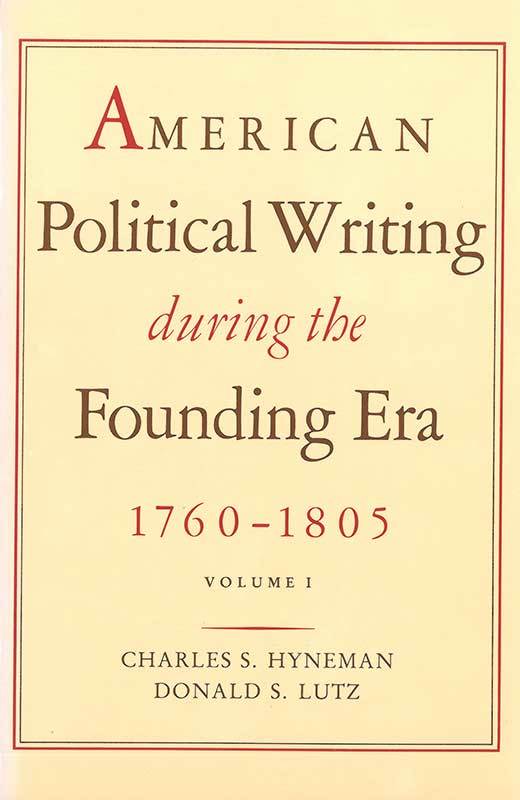
[50]: Benjamin Franklin 1706-1790: An Account of the Supremest Court of Judicature in Pennsylvania, viz., The Court of the Press - Charles S. Hyneman, American Political Writing During the Founding Era: 1760-1805, vol. 2 [1983]Edition used:American Political Writing During the Founding Era: 1760-1805, ed. Charles S. Hyneman and Donald Lutz (Indianapolis: Liberty Fund, 1983). 2 vols. Volume 2.
Part of: American Political Writing During the Founding Era: 1760-1805, 2 vols.About Liberty Fund:Liberty Fund, Inc. is a private, educational foundation established to encourage the study of the ideal of a society of free and responsible individuals. Copyright information:The copyright to this edition, in both print and electronic forms, is held by Liberty Fund, Inc. Fair use statement:This material is put online to further the educational goals of Liberty Fund, Inc. Unless otherwise stated in the Copyright Information section above, this material may be used freely for educational and academic purposes. It may not be used in any way for profit.
[50]Benjamin Franklin 1706-1790An Account of the Supremest Court of Judicature in Pennsylvania, viz., The Court of the Pressphiladelphia, 1789 Franklin had multiple careers as printer, sage of wide renown (through Poor Richard’s Almanac), civic leader, scientist and inventor, superb representative of America in Europe, and towering figure in conventions that produced written constitutions for the state of Pennsylvania and the United States of America. It is his first career that is germane here because, having spent most of his life printing and distributing the works of others as well as writing a great deal on his own for publication, Franklin was very familiar with the strengths and weaknesses of a free press. American pamphleteers loved to imitate the pamphleteers in England, where there was a long tradition of vicious satire, biting irony, parody, and inventive prose forms. While on the whole less sophisticated than their English counterparts, American pamphleteers did display the entire range of formats and literary styles found in England, and the fact that many published under pseudonyms did not always reflect fear of political reprisal so much as fear of a suit for libel. It is not possible to convey the literary richness of the era in a book focusing upon theoretical excellence, but this satire by Franklin is good enough to do double duty as a statement by an experienced professional on the limits of a free press and as an example of a more literary style of argument. It was published in the Philadelphia Federal Gazette on February 12, 1789, approximately a year before his death. One prominent author has dubbed the piece “On Freedom of the Press and Freedom of the Cudgel.” Power of This Court. It may receive and promulgate accusations of all kinds against all persons and characters among the citizens of the State, and even against all inferior courts; and may judge, sentence, and condemn to infamy, not only private individuals, but public bodies, & c., with or without inquiry or hearing, at the court’s direction. In Whose Favor and for Whose Emolument This Court Is Established. In favor of about one citizen in five hundred who, by education or practice in scribbling, has acquired a tolerable style as to grammar and construction, so as to bear printing; or who is possessed by a press and a few types. This five hundredth part of the citizens have the privilege of accusing and abusing the other four hundred and ninety-nine parts at their pleasure; or they may hire out their pens and press to others for that purpose. Practices of The Court. It is not governed by any of the rules of common courts of law. The accused is allowed no grand jury to judge of the truth of the accusation before it is publicly made, nor is the name of the accuser made known to him, nor has he an opportunity of confronting the witnesses against him, for they are kept in the dark as in the Spanish court of Inquisition. Nor is there any petty jury of his peers, sworn to try the truth of the charges. The proceedings are also sometimes so rapid that an honest, good citizen may find himself suddenly and unexpectedly accused, and in the same morning judged and condemned and sentence pronounced against him, that he is a rogue and a villain. Yet, if an officer of this court receives the slightest check for misconduct in this his office, he claims immediately the rights of a free citizen by the constitution and demands to know his accuser, to confront the witnesses, and to have a fair trial by a jury of his peers. The Foundation of Its Authority. It is said to be founded on an article in the State Constitution, which established the liberty of the press; a liberty which every Pennsylvanian will fight and die for, though few of us, I believe, have distinct ideas of its nature and extent. It seems indeed somewhat like the liberty of the press that felons have by the common law of England before conviction, that is, to be pressed to death or hanged. If by the liberty of the press were understood merely the liberty of discussing the propriety of public measures and political opinions, let us have as much of it as you please; but if it means the liberty of affronting, calumniating, and defaming one another, I, for my part, own myself willing to part with my share of it whenever our legislators shall please so to alter the law, and shall cheerfully consent to exchange my liberty of abusing others for the privilege of not being abused myself. By Whom This Court is Commissioned or Constituted. It is not by any commission from the Supreme Executive Council (who might previously judge of the abilities, integrity, knowledge, & c. of the persons to be appointed to this great trust of deciding upon the characters and good fame of the citizens) for this court is above that Council, and may accuse, judge, and condemn it, at pleasure. Nor is it hereditary, as in the court of dernier resort in the peerage of England. But any man who can procure pen, ink, and paper, with a press, a few types, and a huge pair of Blacking balls, may commissionate himself, and [thereby] his court is immediately established in the plenary possession and exercise of its rights. For if you make the least complaint of the judge’s conduct, he daubs his blacking balls in your face wherever he meets you; and, besides tearing your private character to flitters, marks you out for the odium of the public, as an enemy to the liberty of the press. Of the Natural Support of These Courts. Their support is founded in the depravity of such minds as have not been mended by religion, nor improved by good education:
Whoever feels pain in hearing a good character of his neighbour, will feel a pleasure in the reverse. And of those who, desparing to rise into distinction by their virtues, are happy if others can be depressed to a level with themselves, there are a number sufficient in every great town to maintain one of these courts by their subscriptions. A shrewd observer once said that, in walking the streets in a slippery morning, one might see where the good-natured people lived by the ashes thrown on the ice before their doors; probably he would have formed a different conjecture of the temper of those whom he might find engaged in such a subscription. Of the Checks Proper to be Established Against the Abuse of Power in These Courts. Hitherto there are none. But since so much has been written and published on the federal Constitution, and the necessity of checks in all other parts of good government has been so clearly and learnedly explained, I find myself so far enlightened as to suspect some check may be proper in this part also; but I have been at a loss to imagine any that may not be construed an infringement of the sacred liberty of the press. At length, however, I think I have found one that, instead of diminishing general liberty, shall augment it; which is, by restoring to the people a species of liberty of which they have been deprived by our laws, I mean the liberty of the cudgel. In the rude state of society prior to the existence of laws, if one man gave another ill language the affronted person would return it by a box on the ear, and, if repeated, by a good drubbing; and this without offending against any law. But now the right of making such returns is denied and they are punished as breaches of the peace, while the right of abusing seems to remain in full force, the laws made against it being rendered ineffectual by the liberty of the press. My proposal then is to leave the liberty of the press untouched, to be exercised in its full extent, force, and vigor; but to permit the liberty of the cudgel to go with it pari passu. Thus, my fellow-citizens, if an impudent writer attacks your reputation, dearer to you perhaps than your life, and puts his name to the charge, you may go to him as openly and break his head. If he conceals himself behind the printer and you can nevertheless discover who he is, you may in like manner way-lay him in the night, attack him behind, and give him a good drubbing. Thus far goes my project as to private resentment and retribution. But if the public should ever happen to be affronted, as it ought to be, with the conduct of such writers, I would not advise proceeding immediately to these extremities but that we should in moderation content ourselves with tarring and feathering and tossing them in a blanket. If, however, it should be thought that this proposal of mine may disturb the public peace, I would then humbly recommend to our legislators to take up the consideration of both liberties, that of the press and that of the cudgel, and by an explicit law mark their extent and limits; and, at the same time that they secure the person of a citizen from assaults they would likewise provide for the security of his reputation. |

Titles (by Subject)