EconlibThe LibraryOther Sites |
Front Page Titles (by Subject) ON BLAKE'S 'OBSERVATIONS ON THE EFFECTS PRODUCED BY THE EXPENDITURE OF GOVERNMENT' 1823 - The Works and Correspondence of David Ricardo, Vol. 4 Pamphlets and Papers 1815-1823
Return to Title Page for The Works and Correspondence of David Ricardo, Vol. 4 Pamphlets and Papers 1815-1823The Online Library of LibertyA project of Liberty Fund, Inc.Search this Title:Also in the Library:
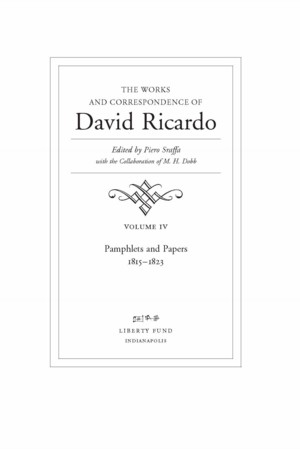
ON BLAKE’S ‘OBSERVATIONS ON THE EFFECTS PRODUCED BY THE EXPENDITURE OF GOVERNMENT’ 1823 - David Ricardo, The Works and Correspondence of David Ricardo, Vol. 4 Pamphlets and Papers 1815-1823 [1815]Edition used:The Works and Correspondence of David Ricardo, ed. Piero Sraffa with the Collaboration of M.H. Dobb (Indianapolis: Liberty Fund, 2005). Vol. 4 Pamphlets and Papers 1815-1823.
Part of: The Works and Correspondence of David Ricardo, 11 vols (Sraffa ed.)About Liberty Fund:Liberty Fund, Inc. is a private, educational foundation established to encourage the study of the ideal of a society of free and responsible individuals. Copyright information:First published by Cambridge University Press in 1951. Copyright 1951, 1952, 1955, 1973 by the Royal Economic Society. This edition of The Works and Correspondence of David Ricardo is published by Liberty Fund, Inc., under license from the Royal Economic Society. Fair use statement:This material is put online to further the educational goals of Liberty Fund, Inc. Unless otherwise stated in the Copyright Information section above, this material may be used freely for educational and academic purposes. It may not be used in any way for profit.
ON BLAKE’S ‘OBSERVATIONS ON THE EFFECTS PRODUCED BY THE EXPENDITURE OF GOVERNMENT’ 1823NOTE ON THE PAPERS ON BLAKEMcCulloch, in a letter to Ricardo on 21 March 1823, sharply criticised Blake’s pamphlet, but he wished to have Ricardo’s opinion before attacking it in print, for he did not trust his own judgement in matters of exchange: ‘I should esteem it as a most particular favour if you could find time to give me a few remarks on Mr. Blake’s pamphlet’. It was probably this hint that set Ricardo working on the review which is printed below from the MS. However, he did not finish it, nor did he send it to McCulloch. He wrote him instead a letter on 25 March 1823, which follows closely the argument of the first part of the review, but sets it out more clearly and briefly. There can be little doubt that the review was written just before that letter. In the present edition each remark has been given a roman number. In each case, a short quotation from Blake’s pamphlet is printed first, in small type; then Ricardo’s comment upon it, in larger type; finally Blake’s reply, in small type. To the first there is prefixed the page reference to the pamphlet, to the second the letter [R.], to the third the letter [B.]. The quotations are only intended to identify the sentence to which the comment is directly attached; they do not attempt to enable the reader to follow the line of Blake’s argument. Ricardo’s notes and his review are here published for the first time. Blake’s replies have been printed in Ricardo’s Minor Papers on the Currency Question, ed. J. H. Hollander, Baltimore, The Johns Hopkins Press, 1932. The MS of Blake’s reply is in Ricardo’s Papers. The MS of Ricardo’s review is in the Mill-Ricardo Papers. [Notes on Blake’s ‘Observations on the Effects Produced by the Expenditure of Government’ 1823 with Blake’s Replies]I[Blake’s Observations, p. 7.] As the law now stands upon this point, the coin is permitted to be exported, and therefore no alteration whatever would take place in the price of gold so long as the merchant exporter could apply at the Bank and convert the paper currency into exportable coin. [Ricardo’s note.] How long could he do so? Would the few millions of gold in the Bank, the greatest part of which is absolutely required to keep up a money circulation, have the effect ascribed by the author? [Blake’s reply.] The author merely says that no alteration would take place in the price of Gold so long as the merchant could convert paper into Gold at the Bank. If the critic is determined to ask how long the author answers it would depend upon the amount of foreign expenditure; if that was very large the Bank would soon be drained. II[p. 9.] It is manifest to common sense, that with such an alteration in the exchange, there must be a corresponding and proportional alteration in the price of bullion. Now, if the paper currency of the kingdom is not convertible into coin, what is there in this demand for bullion that can have any influence on the amount of the currency? [R.] The exportation of commodities would prevent the rise of bullion. We have a debt to pay, why should it be assumed that the payment must be made in bullion to the exclusion of commodities. Every fall in the exchange is a bounty on the exportation of commodities. [B.] The exportation of commodities would prevent the rise of Bullion if a sufficient quantity could be got out at a small variation in the Exchange but when the Expenditure is very large foreigners will not take our goods unless we can sell them cheap and we cannot sell them cheap enough to make the foreigner buy large quantities except the Exchange becomes adverse to a sufficient degree. III[p. 9.] It is curious to observe, in the examinations of the merchants on this point before the committees of 1810 and 1819, the extreme perplexity they evinced, when pressed to explain how the value of gold could rise partially here, without a corresponding rise on the Continent; [R.] I should not call this a rise in the value of gold in England but a fall in the value of money peculiar to England. [B.] When the Exchange became adverse so as to exceed the expenses of the transit of Bullion considerably the author maintains that the value of Bullion would rise although the currency remained at an invariable value. IV[pp. 9–10, consecutive to preceding quotation.] and with what complacency the examiners seem to have regarded the steadiness of its price on the Continent, as a proof that its high price here must have arisen from depreciation dependent upon over issue. Now there is nothing whatever in the effect just described, that in the slightest degree indicates the currency to have changed its value in relation to commodities in general. It marks neither more nor less than that gold acquired an artificial increase of value in this country, in consequence solely of the premium on foreign bills. [R.] The complacency was well founded. I do not know what sense the author gives to the word value when he talks of an artificial increase in the value of gold in this country. Can this artificial increase of value exist for years. The subject in dispute is, was gold increased in value when it differed from the value of paper or was paper low? The author answers gold had increased in value. I ask for his proofs and he answers that though gold rose other commodities did not rise. The fact however is directly the reverse—the author himself acknowledges it and endeavours to account for it by a theory of his own built upon a great government expenditure. He acknowledges that in our paper currency gold and all commodities rose in value whilst no such rise took place abroad, and yet he denies that it was our peculiar currency which fell in value. [B.] This artificial increase of value might exist for years if the expenditure created an adverse Exchange for years—the author purposely avoids at present the discussion respecting the price of commodities generally—all that he contends for is that with an adverse exchange exceeding the expenses of the transit of Bullion—the price of Bullion must rise although currency remained unaltered and the prices of commodities generally remained the same—the demonstration is given first independently of all application to existing circumstances—then application is made afterwards. V[p. 10, consecutive to preceding.] The restriction on the specie payments of the Bank virtually precluding the accustomed contraction of the currency, it no longer rose to a level with the gold; and the excess of the market price above the mint price, marked the height to which the gold had risen. [R.] Here the question in dispute is taken for granted. Did gold rise or paper fall? In either case the price of bullion would appear high and the exchanges unfavorable. Goods rose as well as gold, and therefore the probability is in our favor. [B.] The question is not taken for granted—the inference is drawn from the preceding demonstration. If there was no other cause for the rise of goods the probability would be in favor of the critic’s opinion that the paper altered—but why will not the critic be content to examine the demonstration whether Gold would or would not rise even though the paper did not alter. VI[p. 10, consecutive to preceding.] Admitting then, that if the Bank had been paying in specie, the difference in the value of gold would not have shown itself, would it not be a strange confusion to say that the restriction was the cause of the increased value? [R.] We say the restriction was the cause of the increased price. We have doubts about the increased value of gold. [B.] If the critic doubts whether the Gold increased in value let him remain sceptical till the author removes those doubts let him attend first to the demonstration that the price of Gold might alter and afterwards to the facts which prove that it did alter. VII[p. 11.] The moment the term depreciation is applied to the currency, it is assumed as the cause of the increase of prices generally. If an adverse exchange raises the price of bullion 20 per cent. above the Mint price, it is supposed to account for an increase in the price of commodities to the extent of 20 per cent. also; than which nothing can be more fallacious. [R.] This is not precisely what we say, for bullion itself may have varied all over the world. [B.] The critic and his friends may not mean what is here stated but the public certainly misapply the term depreciation and do not use it in the sense ascribed to it by the critic. The author is writing for the public. VIII[p. 13.] And in another part of his evidence he [Mr. Ricardo] says, ‘I think it quite possible that a bank note may be depreciated, although it should rise in value, if it did not rise in value in a degree equal to the standard.’ [R.] I believe all the other witnesses agreed with Mr. Ricardo in this explanation of the meaning of the word depreciation. [B.] The author agrees with the critic that Mr. Ricardo is consistent in his use of the term depreciation—although some passages in the pamphlet on the protection of Agriculture might lead to an opposite inference—but the author very much doubts whether the other witnesses are equally consistent—he believes that they frequently confound the two senses when their attention is not immediately drawn to the distinction. IX[pp. 13–14.] This question—whether the currency or the gold had altered?—was continually put to the witnesses by the committee in 1810 and 1819, and never received a precise and definite reply. To read the evidence, one would imagine both the examiners and the examined were alike perplexed. If the witness affirms, that gold has risen in value because it is wanted for exportation (which is quite correct), he is immediately asked, whether it has risen in the general market of the commercial world, whether there was any greater demand for gold on the Continent, or whether there was any scarcity in the supply there? [R.] What should make gold go from England to the Continent where it did not go before unless it had fallen in England or had risen abroad? To say that it rose in value in England and remained steady abroad, and yet that it was profitable to export it is a manifest contradiction. [B.] How can the critic ask such a question? The reason is obvious. If the premium on the foreign Bill was greater than the loss from the difference of prices the Gold would go. It might go too at a loss, if the loss was less upon the Gold, than upon the export of goods. The critic seems to forget that there was an expenditure that must be provided for coute qui coute. X[p. 14.] Whereas, the true and proper answer would have been, It has not risen in the general market of the world; it is not in greater demand abroad; there is no scarcity in the supply there. If goods could be exported without loss, they would answer the purpose as well as gold. The demand is for foreign payment, not for gold; and it rises in value in this country, and this country alone, because the exchange has become so adverse as to create a large premium on a foreign bill, and a profit is to be obtained by the export of gold. [R.] A large premium on a foreign bill undoubtedly makes it profitable to export gold if its price does not rise in the same degree as the bill, but is not this true also of every other commodity? does it not become profitable to export them as well as gold? Why does the author always speak of gold as a commodity differing from all others and as alone calculated to discharge the expense of a foreign expenditure. Bills of exchange never really discharge a balance of debt, debts must be paid by things having value, a bill of exchange has none. If we observe that gold is regularly for years exported from one country into another shall we be wrong in saying that it is dearer or of greater value in the importing than in the exporting country? [B.] Here the critic answers his own preceding question, and explains the supposed contradiction—but he asks—‘Why does the author always speak of Gold as alone calculated to discharge the foreign expenditure?’ This is a strange question in a note upon a passage where the author expressly says—‘If goods could be exported without loss they would answer the purpose as well as gold, the demand is for foreign payment, not for gold’. The author is perfectly aware that the foreign expenditure must be discharged by goods (except where it is very trifling) but he is also aware that goods have to come in competition with the goods of the foreigner in the foreign market, and that consequently he must sell them cheap in order to make the foreigner buy; but he cannot sell them cheap unless the Exchange is adverse in proportion to the quantity of goods that must be sent—whereas gold is nearly sure of a market. Goods go first. When the premium on the Bill exceeds the expenses of the transit of Bullion —Bullion goes. And as I have said in a note p. 8. a half cent profit would drain the country of all disposable Bullion. After that drain, goods must liquidate the balance—but in proportion as that balance is large, must the Exchange be depressed, before the goods can be sold cheap enough abroad. When the Exchange is thus depressed, what Gold remains in the country for the purpose of manufacture must be sold at a proportionally high price, for without that high price all would go. XI[pp. 15–16.] The price of corn, of cloth, of every other commodity, might remain precisely the same, and nothing alter but the price of gold. Not only might it vary to any extent without altering the price of these articles, but for any length of time too, provided the foreign expenditure continued upon the same scale that first induced the adverse exchange, and was constantly creating a fresh adverse balance, as the export of bullion or of other commodities was tending to liquidate it. [R.] This idea of commodities remaining at the same price while gold rises considerably, and no impediment is offered to foreign commerce, appears to me to have no foundation. [B.] I do not believe that Gold would have remained at so high a price as it reached during the war, unless impediments had been thrown in the way of foreign commerce. It was during the Milan decrees and American Embargo that Gold continued at a very high price; from 1800 to 1802 and to 1808 it was scarcely more than 4£. oz. It is not denied either that the price of such goods as suited the foreign market might rise—but this would be a rise from demand not from an alteration in the value of currency neither would it affect all commodities. It could not in this country for instance affect the value of our Corn. XII[p. 17.] It will be asked, however, does not this excess [of the market price above the mint price of gold] imply a derangement in the currency? Does it not imply a greater amount of circulating medium than could have existed under similar circumstances, if the Bank had been paying in specie? Undoubtedly it does. [R.] This is the sole admission that my theory requires. [B.] This is the sole admission too that I require. I think it ought to conform to Gold—but I am examining whether Gold rises, not whether the currency ought not to rise also. XIII[p. 18.] But how is the currency to be so regulated? And to whom is the regulation to be committed? To the bank directors? By no means. Much of unmerited odium, as I believe these gentlemen to have incurred,... [R.] What odium have they acquired except that of ignorance? is that unmerited? [B.] The public certainly charged the Bank Directors with taking advantage of their privileges to enrich themselves and proprietors at the expense of other classes—they were charged too with the murder of all the poor wretches hanged for forgery &c. &c. XIV[pp. 19–20.] After this examination it may be assumed, that provided the paper be not convertible at option into coin or bullion, the price of gold will be advanced by an adverse exchange; and yet, that the currency may remain at its natural level, that is, unaltered in value, and be maintained in its exact and perfect relative proportion to the commodities to be circulated by it. [R.] This is undoubtedly a possible case, and would happen if gold generally rose in value all over the world, but the proof to be given of that rise should be very satisfactory before it ought to be admitted. [B.] It is more than a possible case it is a demonstrable case. Gold must advance under an adverse exchange, with a currency not convertible although invariable in value. It would happen too although Gold remained perfectly steady all over the world. XV[pp. 20–21.] Not only is there a general accordance between the exchanges and price of bullion whether rising or falling, but if taken for any long periods of time the connexion may be stated to be absolutely invariable. [R.] The connexion cannot be otherwise than invariable after a certain limit of unfavourable exchange is passed.— [B.] What does the critic mean? If the connexion is invariable how can the inference be denied that an adverse Exchange must raise the price of Gold here? XVI[p. 21, consecutive to preceding] Whilst, on the contrary, no such connexion has subsisted between the amount of Bank issues and the high price of gold: nay, so far from it, that for months together they are found to run in opposite directions. It was this want of connexion, between the amount of Bank notes and the price of bullion, that first led me to suspect the accuracy of the theory, that attributed the high price of gold to the over-issues of the Bank;... [R.] “Over issues of the Bank” Is not every thing an overissue after the market price of gold rises above the mint price, whether caused by a real rise in the value of gold or a real fall in the value of paper? [B.] Yes overissue in the sense in which it is used by consistent political Oeconomists but not in the sense in which the public use it—viz. that notes have been issued in such excess as to alter the value of currency in respect to all commodities; there is a material difference between “overissue” and “non-contraction”. XVII[p. 29, n.] England might send hardware to Spain, Spain might send wool to France, and France send wine to England; in which case the respective debts and credits would be liquidated through a circuitous remittance, known technically by the term arbitration of exchange. The direct exchanges, however, between England and Spain would be in favour of England; between Spain and France, in favour of Spain; and between France and England, in favour of France. [R.] The author appears to me to have fallen into a great error in this passage and I should be willing to rest the truth of our different theories on this proposition. In the case supposed the exchanges of all the three countries would be at par. If not an exchange broker might get 3 pct. by merely sending a bill to Spain with instructions to forward it to France and from France again to England—This bill would effect all the payments. XVIII[pp. 30–31.] There is another powerful auxiliary to rectify the fluctuations of the exchange. For as soon as the premium on a foreign bill has exceeded the limits which will repay the exporter the expenses of transmitting bullion, the coin itself will be exported in payment of the adverse balance. This will lead to a contraction of the currency, and an artificial elevation of its value; and this elevation of the value of the currency, lowering the prices of produce, will still further increase the profits upon export, and diminish the profits upon import.... Now it is thisfall of price, arising from the forced contraction, that enables the exporting merchant to gain augmented profits upon all his exports; he would buy cheaper here, and sell at the same price abroad. [R.] So he would without a contraction of currency. The author appears to forget here that it is only the fall in the real, and not in the nominal exchange, which operates as a bounty on exportation. [B.] The author admits himself to have been asleep when he wrote this passage or that he had forgotten the distinction which his own pamphlet on the Exchange was (as far as he knows) the first to point out—but he cannot understand how the critic should admit of any distinction between real and nominal Exchange since as far as the author is enabled to understand the critic’s theory he supposes all variations in the exchange to depend upon a previous alteration in the value of currency and this is precisely what the author means by a nominal Exchange. No export or import of goods can rectify a nominal Exchange. Export or import of currency would be the only remedy. How does the critic shew upon his theory of Exchange that it could ever afford a bounty on the exportation of goods? XIX[p. 42.] Every manufacturer is aware, that during the pressure of unusual demand, he can well afford to pay higher wages to his workmen; because he not only reimburses himself for the extra advances, but is enabled to increase the price of his articles so as to augment his profits also. In a particular case then, his power of adding wages to the price will depend upon the demand compared with the means of supplying that demand. But the same reasoning will apply to the whole mass of manufacturers, provided a general demand arises for their commodities beyond the customary powers of supply. [R.] The author appears to me to fall into an error when he supposes that because an individual manufacturer may raise the price of his commodities when he has increased wages to pay that therefore the whole mass of manufacturers may do the same. The two cases are widely different. [B.] The author does not suppose the same reasoning will apply to the whole mass of manufacturers unless a general demand arises beyond the customary powers of supply. And this question leads to his following discussion—whether such a general demand can occur or not. XX[pp. 50–51.] Assuming then twenty millions to be wanted for the service of the year, let us suppose that this amount of capital is taken from an employment where it is reproduced with a profit, and that it is transferred to be expended unproductively, so that at the end of the twelve-month, no traces of it shall appear. This is precisely what is meant by converting capital into revenue. Now twenty millions of circulating capital thus borrowed will, of course, throw out of work all the hands employed by the capitalists who lend it. The persons thus deprived of employment would be chiefly artisans, and might, one with another, earn £40 per annum each. At this rate, the twenty millions of capital would give employment to five hundred thousand workmen, and as many of these might be heads of families, there could hardly be (taking workmen and their families together) less than one million of souls depending for subsistence upon their employment. [R.] Why suppose all capital to be circulating capital? [B.] The author does not suppose all capital to be circulating capital but he supposes that Government obtains circulating capital alone and therefore his reasoning is confined to a change in the employment of circulating capital. XXI[p. 51, consecutive to preceding.] To prevent the convulsion incident to such a diversion of capital, let us suppose that government employs a certain number as soldiers, and that the remainder could find work in manufacturing the warlike stores and accoutrements,* all of which are to be consumed, according to the conditions, unproductively. In this way, no inconvenience would be felt; the whole million of souls would be provided for, and it would be a fair representation of the change of productive capital into unproductive revenue. [R.] *They could not find work in these manufactories if the former supposition be realised namely that there should be a destruction of capital equal to 20 millions. [B.] The author in order to give every advantage to the opposite arguments supposes that the men thrown out of work by the diversion of circulating capital find employment from the same capital distributed by Government amongst troops and manufactories of warlike stores. XXII[pp. 51–52, consecutive to preceding.] Thus far the process goes on very smoothly; and were we to stop here, no other difficulty would ensue, except that which attends all violent transitions. But what is to be done the second year? Government requires a further supply of twenty millions, which is to be borrowed in the same manner, and with the same consequences. Five hundred thousand more artisans are thrown out of work, who with their families constitute a second million of persons wanting the means of subsistence, in addition to the million of the former year. [R.] Again all capital is supposed to be circulating capital. XXIII[p. 52, consecutive to preceding.] Continuing, then, the same supposition, that government could apply, as before, the twenty millions of money in providing work for the discharged artisans, we should still have two millions of persons to support with a fund equal only to the supply of one million: the third year would give three millions of people to be employed by a fund of the same limited power, and thus in succession as long as the war lasted. So that at the end of the late struggle, after twenty-two years of war, there would be a destruction of four hundred and forty millions of capital, and twenty-one millions of souls would have been left without subsistence, or any possibility of finding employment. A more striking example of a moral reductio ad absurdum could hardly be imagined; and yet, extravagant and preposterous as this conclusion may appear, I am not aware of any exaggeration. [R.] Who has ever supposed this? The author raises a phantom of the imagination and then demolishes it. There can be no doubt that a nation may make great inroads on its capital. In point of fact it never does, because public extravagance is made up by private frugality and savings. [B.] Many persons have supposed this. I have imagined that nothing more was required than to convert capital into revenue in order to account for the high prices of the last 20 years. It was absolutely necessary to shew that such a conversion upon the scale that occurred during the war must have entailed irretrievable ruin unless some counteracting cause corrected the mischief. The author may have mistaken the best mode of conducting his argument but the mode adopted appeared to him to make a deeper impression. XXIV[pp. 54–55.] It appears to me that the error lies in supposing, first, that the whole capital of the country is fully occupied; and, secondly, that there is immediate employment for successive accumulations of capital as it accrues from saving. I believe there are at all times some portions of capital devoted to undertakings that yield very slow returns and slender profits, and some portions lying wholly dormant in the form of goods, for which there is not sufficient demand. I believe, too, that when capital accumulates rapidly from savings, it is not always practicable to find new modes of employing it. Now, if these dormant portions and savings could be transferred into the hands of government in exchange for its annuities, they would become sources of new demand, without encroaching upon the existing capital. [R.] Suppose these dormant portions to consist of goods for which there is no market, how will the government expenditure procure a market for them? How should they do it if the proprietors cannot? In point of fact these dormant portions never find their way into the hands of Government. [B.] Some dormant portions may not find their way to the hands of Government, and may be irretrievably lost by miscalculation, such as machinery that is rendered useless by the invention of that which is more perfect. But suppose a quantity of cotton or woollen goods without a market, such goods may be bought by the working classes receiving more wages from full employment in consequence of the capital which Government distributes. It would be effected through the circulation of money which alone passes through the hands of Government. But substantially it would be as if Government granted an annuity for the woollens and cottons and then distributed those woollens and cottons as wages for which it would receive as an equivalent the warlike stores fabricated by the workmen. XXV[p. 55, consecutive to preceding.] Unless savings were actually accumulating simultaneously with the expenditure of government, it appears to me that all the mischief described in the foregoing pages would have followed, and that long before the expiration of the contest our efforts must have been completely paralysed. [R.] Who denies that savings actually accumulate simultaneously with the expenditure of Government? It is the only theory by which the actual phenomena of the last 25 years can be explained. [B.] No one denies it, whose attention is strictly drawn to the subject but an author is obliged in the conduct of his argument frequently to introduce propositions which no one denies. No one denies the propositions of Euclid, are they not therefore to be published. I am disposed to think however that the same capital may be made to produce more work or if I may use the expression— may be put to harder work under the influence of great demand by quicker rapidity of return—but I did not venture to hazard the opinion without more maturely weighing it and chiefly out of deference to the authority of the Critic himself. If this opinion should be well founded—then the extravagance of Government might be supplied to a certain extent at least without having recourse to the supposition of simultaneous saving. XXVI[pp. 55–56.] It will be contended, no doubt, that if the savings had remained in the hands of the capitalist, they would have equally been a source of demand as when transferred to the government; but this is the very point at issue. [R.] This will not be contended, because profits have a tendency to fall as capital increases, and vice versa. A Government expenditure reduces capital and increases profits and therefore render every given proportion of profits more efficacious as a fund for replacing expended capital. [B.] I do not see the bearing of the Critic’s remark in this case. The author is speaking of demand and the Critic seems to be speaking of Profits. XXVII[p. 56.] Now, whenever savings are made from revenue, it is clear that the person entitled to enjoy the portion saved is satisfied without consuming it. It proves that the industry of the country is capable of raising more produce than the wants of the community require. [R.] There would be more in this argument if a man had a right to consume all which his capital contributed to produce. As it is every thing produced is actually consumed. [B.] It proves that the person whose capital has been raising him a revenue was supplied with a revenue that he did not want for the purpose of consumption. If that revenue is made to produce again, there will be two portions of revenue the 2d. year not wanted for consumption. It appears to me that there must be some limit to the degree in which this process can go forward. XXVIII[p. 56, consecutive to preceding.] If the quantity saved is employed as capital in reproducing a value equivalent to itself, together with a profit, this new creation, when added to the general fund, can be drawn out by that person alone who made the savings; that is, by the very person who has already shown his disinclination to consume. [R.] It is not all drawn out by him: the greatest part is drawn out by the workmen he employs and is actually consumed by them. XXIX[p. 57, consecutive to preceding.] When once the division of labour has taken place, the efforts of each individual are directed to the fabrication of some specific commodity. He fabricates it in the hopes that there will be a demand for all that he can produce. If every one consumes what he has a right to consume, there must of necessity be a market. Whoever saves from his revenue, foregoes this right, and his share remains undisposed of. [R.] I deny this, it is disposed of when it becomes a fund for future production. [B.] His share remains undisposed of in the consumption of that year. Whether it will be disposed of in the following year as a fund for reproduction depends upon the opportunity of finding what M. Say calls un emplacement. XXX[p. 57, consecutive to preceding.] Should this spirit of economy be general, the market is necessarily overstocked, and it must depend upon the degree in which this surplus accumulates, whether it can find new employment as capital. For it is quite evident, that to continue to fabricate the same sort of goods that have been already rejected would only tend to increase the evil. [R.] This is to suppose demand to be limited which is not true either in theory or practice. [B.] There can be no doubt that there will be no progressive improvement without accumulation but it is a question of degree and whether capital may not increase faster than the employment for it. I am not aware that I can state my opinion more clearly than in the text. It seems that the Author and the Critic differ here materially and the Author is sorry to find such a difference with a person to whose opinion he looks up with so much respect. There seems to be no alternative but to agree to differ. XXXI[p. 58.] This doctrine, I think, has been pushed a little too far. It proceeds upon the assumption that every addition to capital necessarily creates its own demand; but in applying the theory to the actual circumstances of mankind, some inseparable conditions appear to me to have been overlooked. It takes for granted, that new tastes, new wants, and a new population, increase simultaneously with the new capital; a supposition which is not consonant with the fact. [R.] It is not necessary that in such a country as England new tastes and new wants should be generated—the old tastes are sufficient for the purpose. Tastes and wants exist already in a sufficient degree, give but the means of satisfying them and demand follows. [B.] Conceive the immense revenue that is at present spent for the luxury of having Physicians, Lawyers, Clergymen, Musicians, Players Buffoons, &c. &c. suppose those tastes to be annihilated what would become of the revenue or how would it be disposed of—Have those tastes grown up suddenly? have they not been the growth of centuries—May not the means of indulgence in them increase faster than the desire of indulgence— Does not saving imply a want of desire to indulge? There was a time when these tastes did not exist—would production have gone on without them. I cannot conceive production for the sake of production—without an ultimate desire to gratification by consumption. XXXII[pp. 59–60.] But this proposition implies that there is not more corn and cloth in the whole than the two classes of capitalists [producing corn and cloth] want to consume. If more than that is produced, the surplus is absolute waste on both sides; and all the labour thrown away. [R.] True. This is what the Political Economists of the present day call glut arising from miscalculation. They do not say there may not be a glut of 2 or of 10 commodities but they say there cannot be a glut of all. [B.] The author has supposed a case of a country divided into two sets of capitalists, one producing food and the other clothing —but where the division of labour was complete. If these persons produce more food and clothing on the whole than is wanted, there will be general glut. It is not a case of two or ten commodities—but of all commodities—the author having supposed no other production than cloth and corn. XXXIII[p. 60.] How is it possible for this process to continue without a fall in prices, and a lower rate of profit to the capitalist? [R.] Certainly not possible without a lower rate of profit in the particular trade. XXXIV[pp. 60–61, consecutive to preceding.] The difficulty of finding employment for new capital is acknowledged by all practical men. They continually feel and complain that every channel is full. The evidence is brought home to them, by the general accumulation of commodities undisposed of, and stored in the warehouse. These are the records of so much capital in a state of actual stagnation, neither affording profit to the owner, nor employment to the workman, and discouraging all future exertion. [R.] When markets are dispersed and competition active great mistakes are made in the application of capital to the production of particular commodities, but this only proves the great risk of miscalculation, it does not impugn the general principle that if there were no mistakes there would be no glut. [B.] This case therefore if founded does impugn the general principle. It shews that there may be more of every thing than is wanted—unless new tastes are introduced. XXXV[p. 62.] The immediate means of purchasing which government possesses is derived from the sale of annuities. [R.] Will the sale of annuities create a demand for cloth and corn which were before and are still in excess? [B.] The sale of annuities gives Government money with that money a demand is made for commodities the cost of those commodities is chiefly made up of wages—the money therefore distributed as wages enables the workmen to buy the cloth and corn which were in excess. Without the demand of Government those extra wages would not have been distributed. XXXVI[p. 62, consecutive to preceding.] The power of levying taxes in perpetuity, and of transferring the income arising therefrom to individuals, enables the government to collect all those savings that find no immediate employment as capital,* and to devote them to expenditure. [R.] *In what shape does this capital exist which is to be devoted to expenditure? [B.] It exists in the shape of goods unemployed for want of demand—as soon as the extra employment is given to workmen their wages purchase the goods. XXXVII[p. 63.] No proposition is more generally admitted, than that the market rate of interest paid for the loan of capital is proportionate to the profits that can be made from the employment of it. [R.] This proposition cannot be admitted without great qualification. [B.] There can be no doubt that the market rate of interest must be a tolerably correct index of the rate of profits. XXXVIII[p. 64, consecutive to preceding.] If profits, then, were regulated solely by those made upon the last quality of land taken into cultivation, we should observe in all countries a regular fall in the market rate of interest as the population increased, and was compelled to have recourse to inferior land. Now it is not denied that such has been the usual course of the rate of interest;... [R.] Not if great improvements were at the same time made in agriculture, nor if wages fell from a too abundant supply of labourers. XXXIX[p. 65.] These facts are in direct opposition to the theory of profits being regulated always by the quality of the last land taken into cultivation;... [R.] This is not a correct representation. I say that profits depend always upon wages—that wages depend upon demand and supply, and are also mainly regulated by the price of food, and that the price of food depends on the productiveness of the last capital employed on the land. I see the greatest difference between this proposition and that in the text. [B.] The critic will see that the text is a repetition of what was expressed before nearly in his own words—at p. 58. XL[p. 67.] The trade with India is thrown open, and instantly the different presidencies are glutted with English goods, without any diminution in the supply of the home market. [R.] Who says without any diminution in the supply of the home market? XLI[pp. 69–70.] The demand, however, of a large manufacturing population, receiving high instead of low wages, and in full employment, is an efficient and powerful cause, that must produce an immediate effect upon consumption, more especially of food and the raw materials of coarse clothing. The numbers in the higher classes of society bear no sort of proportion to that of the working class. We are apt to dwell upon the expenditure of the former, as if their revenues were the great source of national demand; forgetting that the bulk of the gross annual produce is consumed by workmen whilst preparing commodities to gratify the tastes of capitalists. A return of 10 per cent. has been thought a fair profit to the possessor of capital. For every £100, then, of circulating capital that is distributed amongst workmen as wages, which is the measure of their consumption, the possessor himself can consume but to the extent of £10. XLII[p. 70, consecutive to preceding.] If, in consequence of brisk markets, the artisans are employed fourteen hours a day instead of twelve, and they receive wages in proportion, the demand for goods suited to their consumption will be increased in the same ratio as the wages. An increased exertion amounting to one-sixth would be tantamount to an increase of population to the same extent; and a population, too, possessing the means of effective demand. [R.] What is the complaint? a redundant production which cannot find a market. What is the remedy? a demand by Government which immediately leads to an increased production leaving the former surplus just what it was. [B.] The demand of Government leads to an increased production, but the workmen having more wages consume the excess that was previously existing and the government consumes the stores that are produced. There are two extra consumptions and only one extra production. XLIII[p. 71.] When the capitalist furnishes an extra quantity of goods, he acquires a greater amount of profits, but not a greater rate of profits. [R.] Surely to[o] a greater rate of profits if the machinery and buildings are adequate to the performance of the increased work. They do not rise in price or in value. [B.] There may be some inaccuracy in the Author’s expression here but he did not mean in this passage that the increased work was produced from the same capital. The latter part of the paragraph evidently shews that more wages were given to the workmen which implies that more capital was employed. XLIV[p. 72.] But it does appear to me, that not only was there an increased amount of wages and profits from the extra work done [during the war], but also an increased rate of both, and that this was effected through the medium of prices.... I am, therefore, disposed to concur with Mr. Malthus, that the rise of wages which took place during the war did actually afford a greater remuneration to the labourers. [R.] Profits and wages were both higher it seems. Was this general? If you say yes I ask how they can both be higher if the value of commodities is at all times equal to the value of wages and profits together? [B.] Wages and profits together cannot (perhaps) be higher unless there is a large class of consumers who do not produce— but with such a class a new distribution may take place affording higher wages and profits at the expense of that class. XLV[pp. 73–74.] If A, having a certain capital, and employing a certain number of labourers in raising corn, has to exchange his produce with B, who, with a similar capital and number of workmen, is fabricating cloth, it is evident that no advantage could accrue to either of them by increasing the price at which they interchanged the corn and the cloth. But if both A and B have to contribute a fixed sum for the expenses of government, for the payment of public creditors, for the interest on capital borrowed, for the support of the clergy, it is their interest to inter-change commodities at the highest prices that can be obtained. [R.] This is only proving that it is the interest of all producers at all times to depreciate the value of money, because by so doing they defraud the public creditor. No proposition can be more true. I do not see how the payment of the clergy or the expences of the government can affect this question, they must vary with the alteration of prices because they are not fixed payments. [B.] Great part of the Clergy receive nominal sums for their livings and curacies—by the expenses of Government was here meant the consolidated fund and the nominal sum paid to the Stockholders. XLVI[pp. 74–75.] In times of peace, when more is produced than finds a ready consumption, there is a difficulty in raising prices as wages rise. But in time of war, when there is an unusual demand, when the markets are more scantily supplied in proportion to the extent of consumption, when the supply can only be obtained by increased exertion on the part of the capitalists and the labourers, then it is that the working classes reap their harvest, and acquire not only the increased wages and profits to which they are entitled from the addition to the annual produce, which their extra exertion has created, but an increased rate both of wages and profits. [R.] Is war then the interest of the country? XLVII[p. 75.] A given number of workmen, and a given number of capitalists employing them, are called upon to furnish an extra quantity of work. Is it possible to conceive that they will not take advantage of the urgent necessities of the buyer, even if they could produce the articles wanted without additional sacrifices? But if the men are to work thirteen hours a day instead of twelve, and the machinery is to be watched night and day, and the employers to devote more time to superintendence, are they not entitled to a greater remuneration? [R.] I do not call it an increase of wages if the men are paid more only because they do more. [B.] When men are paid more because they do more, they receive increased wages but certainly not a higher rate of wages. It is not necessary for the author’s argument to suppose that workmen received higher wages—if they received more wages their effectual demand would be proportionally increased. The author cannot help thinking that workmen must have received higher wages during the war than previously to the war—but it is an incidental remark that might have been omitted without prejudicing his argument. XLVIII[p. 76.] During the progress of the war, five hundred and nine millions sterling were in this way devoted to the purchase of commodities intended for consumption, instead of being devoted to reproduction. [R.] Much more than 509 millions must have been expended by Government. [B.] Much more was spent by Government but not in the form of loans—the sum is taken from Dr. Hamilton and includes all sums funded either in loans or Exchequer Bills. The sums derived from war taxes was only a transfer of Income and has therefore been omitted by the author. XLIX[pp. 78–79.] When commodities become high priced, and continue so for a length of time, it is sometimes argued that this circumstance of itself is proof of a depreciation of the currency....Be it so: but let us understand each other.... Let us not invalidatethe fixed contracts between man and man.... [R.] Very good and so is almost all that follows. [B.] The only few words of comfort that the author receives for all his labours. L[p. 93.] This [glut] might arise partly from the cessation of our own demand, and partly from the cessation of demand which the war expenditure of other governments had created. [R.] Have you not in a former part ridiculed the idea of the war having made much difference in the quantity consumed? LI[p. 94.] To those who imagine consumption not to be a necessary ingredient of demand, and that in order to make a market for commodities, it is only necessary to produce more, these phenomena [of the universal distress] offer problems not very easy of solution; nor is the difficulty less for those who conceive the previously existing capital to have been diminished by being converted into revenue. Accordingly, every drowning theorist has caught at the various straws that crossed him. [R.] Drowning theorist! I am not one for I as well as you say the supply was too great for the demand. [B.] The author certainly did not apply the term drowning Theorist to the Critic but perhaps the Critic may be included in the class of those who just keep their heads above water by supposing a cycle of abundant harvests since the termination of the War. [An Unfinished Review of Blake’s ‘Observations on ... the Expenditure of Government’ 1823]Mr. Blake is a gentleman whose reputation must be well known to our readers, he was1 the author of one of the few good pamphlets which were published on the bullion question in the year [1810]2 . In that pamphlet Mr. Blake explained in a perspicuous manner the theory of Exchanges and the laws which governed the variations in the nominal and real course of exchange. We opened his present publication with considerable interest, but although we saw the same marks of ability in the clearness of his statements we must confess we finished the perusal of his tract with regret and disappointment. Mr. Blake appears to us to agree with those whose theory he attacks without being himself aware of it, and to confirm by his authority every principle which he has with so much pains attempted to overturn. This remark is perhaps only strictly and fairly applicable to the first part of his Essay, but if this be established there will not remain much matter of dispute between him and those whose opinions he attempts to controvert. Those who have written on the subject of the currency it will be recollected maintain that during the war and the Bank restriction act the prices of gold and of all commodities have been raised by the over-issues of paper money; that during such depreciation many loans have been made, the interest on which, now that the standard is restored, and money has regained its former value is paid in a medium more valuable than that in which the debt was contracted, and that as the prices of gold and of all commodities have fallen since the cessation of the restriction on Bank payments, it may be justly attributed to the rise in the value of money. It is Mr. Blake’s object to prove that money has not varied in value—that when commodities and gold were high in price it was they which had risen and not money that had fallen, and that now that gold and commodities have fallen in price, the fall is really in them and that it would be a great mistake to say that money had fallen1 in value. Now all this we confess appears to us to be a dispute about words for Mr. Blake agrees with his opponents2 in thinking that the rise in the price of gold and of commodities during the war, and the subsequent fall since the peace, would not have taken place if there had not been a restriction on specie payments. In that case Mr. Blake says gold and bank notes must have agreed in value and therefore goods would not have been high in this more valuable medium. He agrees with his opponents too that the present prices of goods and gold would have been just as they now are. Every one is agreed as to the actual phenomena; a high price of gold and commodities, during the war; an unfavorable exchange to a degree without example; a great injustice to the public creditor in his being prevented from receiving his dividends in a medium as valuable as gold; a fraud on all other creditors but one party says all these effects followed from a depreciation in the value of money, no says Mr. Blake that is not the right way of stating the case, it proceeded from the increased value of gold, to which increased value money ought to have conformed, but as it was prevented from doing so by the interference of the legislature a great mass of injustice was the consequence. Here then is a perfect agreement as to the effects but one party calls the cause a fall in the value of money, the other a rise in the value of gold. A dispute about a point so trifling appears to us totally unworthy of Mr. Blake’s talents, but if it were worthy we think he has utterly failed in proving his view correct. A rise in the value of gold necessarily implies a relative1 fall in the value of commodities, we should expect then to find that after this great rise in gold an ounce of that metal would exchange for a larger quantity than before of commodities. Did it do so? quite the contrary; if any thing gold was of a less exchangeable value than before. Mr. Blake acknowledges this and endeavors to get over the difficulty by a supposed rise in the value of all commodities in consequence of the great expenditure of Government. This cause appears to us to be utterly inadequate to produce the alleged effect. If it could be conceded, which I think it could not, that the prices of all the commodities demanded by Government could be affected for 15 years together by their increased expenditure even then the rise would be only in those commodities, and not in others for which there would necessarily be rather a diminished than an increased demand. Mr. Blake invariably contends that a large government expenditure is a great stimulus to an increase of industry and of production. Suppose this true it in no way accounts for the increased prices of things which are not demanded by Government. Mr. Blake says this increased demand will induce labourers to work extra hours —these labourers will receive increased wages, these wages will be expended on all sorts of commodities and consequently they will all rise. But from whence do these increased wages come? from the contributions of all other classes. If labourers can demand more these other classes must demand less and consequently the aggregate of demand must be precisely the same, if we except only the government demand which Mr. Blake supposes will be met by an increased supply added to the former supply all2 raised by the same amount of capital and by the same number of labourers, only working1 for a greater number of hours. It is evident then that Mr. Blake has by no means proved that independent of the increased demand of government there would be any other increased demand in the country. But can Mr. Blake’s proposition, that with the same capital by means of increased exertion and industry, the increased quantity of commodities, required by Govt., can be produced, without occasioning any diminished supply of commodities in any other quarter?2 If industry be encouraged in one department it is discouraged in another. Wages are always advanced to the workmen before the commodity is produced—the means of employing workmen are not increased at any rate in the first instance. If more warlike stores be produced more capital must be employed in that line whether the same labourers do more work or new labourers are employed, for the very wages which pay them for their work constitute a part of the capital of the master. How is his capital to be augmented but at the expense of some other persons?—how can the same identical commodities be paid to two persons at the same time for wages? There appears to us this sort of contradiction in Mr. Blake’s statement, The gunsmith, the army clothier, the gunpowder manufacturer are all to produce an increased quantity of commodities—they are to have an increased quantity of capital to enable them to do so and yet this additional quantity is to be found without influencing the production of any other commodity. ABSOLUTE VALUE AND EXCHANGEABLE VALUE 1823NOTE ON ‘ABSOLUTE VALUE AND EXCHANGEABLE VALUE’This paper on Absolute Value and Exchangeable Value, of which we have a complete rough draft and an unfinished later version, was written by Ricardo in the last few weeks of his life. Besides presenting his own views on the subject of a measure of value, the draft contains criticism of the measures advocated by Malthus, McCulloch, Mill and Torrens; while what there is of the later version discusses only those of Malthus and McCulloch. Yet this paper has importance since it develops an idea which existed previously in Ricardo’s writings only in occasional hints and allusions: namely, the notion of a real or absolute value underlying and contrasted with exchangeable or relative value. The papers here printed thus belong to the period between the beginning of August 1823 (after he had completed his Plan for a National Bank) and the onset of his fatal illness in the first few days of September. Besides the draft and the later version there are two sheets which mark stages of transition between them. The first of these (a) is printed below in full at the end of the draft (below, pp. 396–7). It is written on a letter-cover postmarked 18 August 1823. The other sheet (b) is closely similar to the opening pages of the later version, including the two headings ‘Exchangeable Value’ and ‘Absolute Value’. But it contains a paragraph which is a revision of a passage of sheet (a) and which does not re-appear in the later version. This is given below, p. 399, n. [Absolute Value and Exchangeable Value][A Rough Draft]The only qualities necessary to make a measure of value a perfect one are, that it should itself have value, and that that value should be itself invariable,1 in the same manner as in a perfect2 measure of length the measure should have length and that length should be neither liable to be increased or diminished; or in a measure of weight that it should have weight and that such weight should be constant. Altho’ it is thus easy to say what a perfect3 measure of value should be it is not equally easy to find any one commodity4 that has the qualities required. When we want a measure of length we select a yard or a foot—which is some determined definite length neither liable to increase or diminish, but when we want a measure of value what commodity that has value are we to select which shall itself not vary in value5 ? Mr. Malthus has recommended the pay of a day’s labour whatever it may happen to be as a perfect measure6 of value* —labour has value, and so far no objection can be made to it, but is its value invariable? No one will assert that it is, and least of all should Mr. Malthus who has written ably on the subject of population, and endeavored to shew the great effects which are produced on the value of labour by the increase of numbers1 when it is not proportioned to the increase of the capital which is to employ them. Suppose the capital of a country to continue unaltered, and the population to be greatly increased in consequence of the influx of a great number of people from foreign countries or that by unwise laws at home injudicious encouragements are given to marriage, and to the birth of children, can it be denied that labour would fall in value, and that every commodity in the country excepting indeed those which are produced by a day’s labour only2 would exchange for a greater quantity of it? Would it be just in this case, to do what Mr. Malthus requires of us, to say that all commodities had fallen in value, and that labour alone had remained invariable, when we should all know that nothing had occurred to alter the value or price3 of these commodities, but that the alteration had been specifically in labour, which had greatly increased in quantity, and had consequently made the supply excessive as compared with the demand. Now let us suppose an opposite case, let us suppose that while the capital of the country remained the same an epidemic disorder carried off a vast number of the people[,] would not the supply of labour have diminished as compared with the demand, would not every commodity in the country (excepting again those commodities which are produced by a day’s labour and which therefore are always equivalent to a day’s labour)4 exchange for a smaller quantity of it, and would it not be correct to say that labour had risen in value, and not as Mr. Malthus requires us to say that all commodities had fallen in value.— It is I believe contended by Mr. Malthus and1 acknowledged on all hands that if all commodities were produced with labour alone and brought to market immediately2 after having had one day’s labour bestowed on them,3 commodities would then be valuable in proportion to the number of mens labour bestowed on them. If 5 men were employed for one day in cutting down trees which were found in a Forest that was no man’s property, the trees would be of 5 times the value of the game which one man could kill in a day. This is true, but it would not be true that if one man was 365 days in cutting down trees and at the end of that time brought his trees to market they would then be of the same value. In this case the game killed in one day, or the fifth part of the trees cut down in a day would be equally a good measure of value and all the commodities brought to market might be estimated by this measure. The measure would be invariable while the same quantity of labour was required to kill game or fell trees, and commodities could not vary in such a measure for any other reason than because the labour of fewer or more men4 for a day was required to produce them. Thus if the same number of trees could by some improvement of skill5 be felled by 4 men they would be worth only 4 times the produce of a days labour by one man in the killing of game. If then all commodities were produced by labour employed only for one day Mr. Malthus’s proposed measure would be a perfect one, for however abundant or however scarce might be the number of hands yet the exchangeable value of a day’s labour would be always precisely the same as1 the commodities that a day’s labour could produce.2 If all commodities required a year’s time before they were in a state to be brought to market, and required the continued labour of men to produce them during that time, then again they would be valuable according to the number of men employed on their production. If a piece of furniture were twice the value of a piece of cloth, it would be so because double the number of men had been occupied in producing one that3 had been employed in producing the other. In this case too any commodity which continued uniformly to require the same quantity of labour would be an accurate measure of value. It would in fact be invariable, and the variations in the relative value of this commodity to others, when they occurred, would be owing to some alteration in the facility or difficulty of producing those other commodities, by which a less quantity of labour was employed on them. This is in fact the measure which I have proposed as the nearest approximation to a perfect measure.4 If all commodities required 2 years time before they could be brought to market the same argument would apply: either would be a good measure of value while it required the same quantity of labour to produce it and if any varied in this measure it would only be because more or less labour was required for its production.1 If all commodities were produced by labour employed only for one day there could be no such thing as profits for there would be no capital employed, beyond that of which every labourer is in possession before he commences to work—there could as we have seen be no variation in the value of labour, but commodities would vary as labour was more or less productive. If a labourer by a day’s labour could get a thousand shrimps 1000 shrimps would be of the value of a day’s labour and if he could get only 500, 500 would be of the same value. If a labourer could pick up on the sea shore as many grains of gold as are coined into 2 shillings, 2 shillings would be of the value of a day’s labour and if he could pick up half the quantity one shilling would be of the same value.2 But of the commodities which are brought to market after the lapse of one year or of two years there are in fact two classes of persons who are joint proprietors. One class gives its labour only to assist towards the production of the commodity3 and must be paid out of its value the compensation to which it is entitled, the other class makes the advances required in the shape of capital and must receive remuneration from the same source.4 Before a man can work for a year a stock of food and clothing and other necessaries must be provided for him. This stock is not his property but is the property of the man who sets him to work. Out of the finished commodity they are in fact both paid—for the master who sets him to work and who has advanced him his wages must have those wages returned with a profit or he would have no motive to employ him, and the labourer is compensated by the food clothing and necessaries with which he is furnished, or which is the same thing which his wages enable him to purchase. It greatly depends then on the proportion of the finished work which the master is obliged to give in exchange to replace the food1 and clothing expended on his workman what shall be his profits. It not only depends on the relative value of the finished commodity to the necessaries of the labourer, which must always be replaced, to put the master in the same condition as when he commenced his yearly business but it depends also on the state of the market for labour (or on the quantity of necessaries which competition obliges the master to give for these necessaries)2 , for if labour be scarce the workman will be able to demand and obtain a great quantity of necessaries (or which is the same thing to the master luxuries)3 and consequently a greater quantity of the finished commodity must be devoted to the payment of wages and of course a less quantity remains as profit for the master. The profits of the master depend then on two circumstances first on the comparative value which necessaries bear to the finished commodity, secondly on the quantity of necessaries and enjoyments which the labourer by his position can command. If however commodities were all the result of labour, employed for4 and brought to market precisely in the same length [of]5 time, the rise or fall of wages,6 either in consequence of the rise or fall of necessaries advanced to the labourer or in consequence of the favorable or unfavorable position in which he stands in relation to his employer, will not produce any effect whatever on the relative value of one commodity to another and consequently any commodity which continues always to require the same quantity of labour to produce it will be a perfect measure of value. For if the manufacturer of cloth should demand in exchange for his cloth more furniture, in consequence of the greater quantity of his commodity which he was obliged to part with in order to replace the advances which he made1 to his workmen, the upholsterer would answer that the very same circumstance operated with equal force upon him as he also was obliged to part with more of his furniture to satisfy the demands of his workmen. Either of these commodities would be a correct measure of value and would therefore shew correctly all the variations which took place in the value of commodities provided there was no other cause of the variation of commodities but the2 increased or diminished difficulty of producing them. Though this is by far the greatest cause3 it is not strictly the only one.4 If by a day’s labour fewer shrimps were obtained and nothing altered in regard to cloth and wine5 shrimps would sell for more wine and for more cloth and exactly in proportion to the increased quantity of labour required to procure them. The same may be said of wine (supposing that to be the commodity requiring more labour),6 if measured either by cloth or shrimps, and of cloth if measured by wine or shrimps, but they would be still liable to variations in value from variations in the value of labour which though comparatively of rare occurrence cannot be omitted in this important enquiry. Either1 of these commodities would in the case supposed correctly indicate all variations in value because they would themselves be invariable, but difficulty or facility of production is not absolutely the only cause of variation in value there is one other, the rise or fall of wages, which though comparatively of little effect and of rarer occurrence yet does affect the value of commodities and must not be omitted in this important enquiry. As this increase of wages then would operate equally on all, it could not be admitted as a plea either to raise the value of their commodities in relation to others, or in relation to that which2 for the general accommodation was recognised as the common measure. It appears then that we should have no difficulty in fixing on a measure of value, or at least in determining on what constituted a good measure of value, if all commodities were produced exactly under the same circumstances—that is to say if all required labour only without advances, to produce them, or all requiring labour and advances3 could be produced and brought to market in4 precisely the same time. The difficulty then under which we labour in finding a measure of value applicable to all commodities proceeds from the variety of circumstances under which commodities are actually produced. Some, such as shrimps and a few others, are the result of a few hours labour without any advances which are actually acknowledged to be such; others such as cloth is the result not of labour only, but of advances made probably for a year before the finished commodity is brought to market. Others again such as wine mellowed by age after being kept long in the merchant’s cellar, is the result also of labour and advances but advances made for a much greater length of time than in the case of the cloth, and therefore requiring an increased price to afford the regular profit on such advances. Now while these commodities continued to be produced precisely in the same way—shrimps would be an excellent measure of value for all things produced under the same circumstances as shrimps are produced, cloth for all commodities produced under the same circumstances as cloth, and wine for all commodities produced under the same circumstances as wine, but shrimps would be very far from an accurate measure of value for cloth or wine, cloth not a good one for shrimps or wine and wine a very inaccurate measure for shrimps and cloth. If for example labour rose from one of the two causes mentioned before, namely the higher relative value of food and other necessaries, or the advantageous position in which the labourer found himself placed, it would affect all commodities produced under the same circumstances as shrimps alike, and therefore their relative value would continue unaltered—it would affect all commodities produced under the same circumstances as cloth alike, and therefore their relative1 value would also remain unaltered—it would affect all commodities produced under the same circumstances as wine alike and therefore their relative value would also continue unaltered. Altho’ each would bear the same relative value to things produced under circumstances precisely similar, yet each would not bear the same relative value to the other which was not produced under similar circumstances. In proportion as labour rose a given quantity of shrimps would exchange for more cloth, for the whole value of cloth is not the reward of labour, a part constitutes the profits of the master who makes the advances, (while the whole value of the shrimps is the reward of the labourer and he has nothing to allow out of it for profits on capital or advances)1 and for the same reason they would exchange for more wine, for a still greater portion of the value of the wine is made up of the profits on advances and a less portion of the wages2 of labour. If then we constituted the shrimps the measure of value of all things, cloth and wine would fall in such measure altho’ nothing had altered in respect to the circumstances of3 actual labour and advances under which all these commodities were produced. If we constituted cloth the measure of value wine would fall in such measure and shrimps would rise, and if we chose wine as the measure both cloth and shrimps would rise but in unequal degrees the shrimps in which nothing but labour entered would rise a great deal, cloth in which there were profits as well as labour would rise in a more moderate degree. In this then consists the difficulty of the subject that the circumstances of time for which advances are made are so various that it is impossible to find any one commodity which will be an unexceptionable measure, in those cases in which wages rise and in which consequently profits fall, or in those in which wages fall and profits consequently rise. What are we to do in this difficulty, are we to leave every one to chuse his own measure of value or should we agree to take some one commodity and provided it were always produced under the same circumstances constitute that as a general measure to which we should all refer that we may at least understand each other when we are talking of the rise or fall in the value of things. When Mr. Malthus speaks of the rise or fall in the value of commodities he estimates value by shrimps, or by commodities produced under similar circumstances in which shrimps are produced, and which are1 wholly made up of labour. When Mr. Ricardo speaks of the rise or fall in commodities he estimates value by commodities produced under the same circumstances as cloth or gold, always supposing that cloth or gold require capital as well as labour to produce them, and always require them in the same proportions, for on no other conditions does he hold them to have any of the characters of invariability without which character there can be no measure. Now against Mr. Malthus’s measure I object that it assumes labour itself to be invariable; that under all the circumstances of a redundant or a deficient population, under all the circumstances of an abundant supply or of a great demand for labour, it supposes labour to be of the same value. Labour might and probably would be of the same value, whatever might be its redundancy or deficiency, as compared with shrimps and other things produced by labour only, but it would vary prodigiously in value as compared with corn, with clothes, with furniture, with wine and millions of other things. We should as I have already observed be always required to say that it was these millions of commodities that had varied in value whether the cause of the variation was a deficiency of labour in the market, or an abundance of commodities from new facilities of producing them,—now I confess I prefer a measure, though confessedly an imperfect one, which will give some idea whether when labour varies as compared with commodities it is the value of labour which has undergone a change, or whether it is the commodity which rises or falls. Now this is what Mr. Ricardo’s measure does. It is not like Mr. Malthus’s measure one of the extremes it is not a commodity produced by labour alone which he proposes, nor a commodity1 whose value consists of profits alone, but one which may fairly be considered as the medium between these two extremes, and as agreeing more nearly with the circumstances under which the greater number of2 commodities are produced than any other which can be proposed. He does not propose it as a perfectly correct measure for none such can be obtained but as one more nearly approaching to that character than any that has been suggested. In this measure, if labour became abundant or scarce, it would, like all other things, rise or fall. If it became difficult, from the appropriation of land to agriculture, to obtain an additional supply of corn without the expenditure of more capital for each quarter obtained, corn would rise, and nearly in proportion to the increased difficulty. In Mr. Malthus’s measure provided the labourer were always paid the same quantity of corn for his labour the value would always be the same although to obtain this same quantity double the expenditure of labour and capital might be necessary at one time to what was necessary at another. If by improvements in husbandry corn could be produced with half the expenditure of labour and capital it would by Mr. M be said to be unaltered in value provided the same quantity and no more was given to the labourer as wages. It is indeed acknowledged by Mr. Malthus, (and how could it be denied?)1 that under such circumstances corn would fall very considerably in money price—it would fall also in the same degree in exchangeable value with all other things, but still Mr. M says it would not fall in absolute value, because it did not vary in his measure of value. On the contrary all these things as well as money would under the circumstances supposed vary in this measure and therefore he would say they had all risen considerably in value. He would say so altho’ with respect to any one or more of them great improvements may have been made in the means of producing them by the application of machinery, or from any other cause which should render it cheap in price and lower in exchangeable value with regard to all things corn and labour excepted. In Mr. Ricardo’s measure every thing to which such improvements were applied would fall in value[,] and price and value would be synonymous while gold the standard of money cost the same expenditure of capital and labour to produce it. If the commodity chosen for Mr. Ricardo’s measure, whose value confessedly consists of profit and labour, were divided in the proportion of 90 for labour and 10 for profit—it is manifest that with every rise of 1 pct. in2 labour a commodity produced by labour alone would rise one per cent.3 If the measure was perfect it ought not to vary at all. Now suppose any other commodity whose value is made up of 40 pc. for profit and 60 pc. for labour, how much would that fall with 1. pc. rise in wages? Probably about 3 pct. These are the two extremes, and it is evident that by chusing a mean the variations in commodities on account of a rise or fall in wages would be much less than if we took either of the extremes.4 By many it is contended that the sole way of ascertaining value is by estimating the commodity whose value we wish to ascertain in the mass of commodities—that if at one time it will exchange for more of these than it did at another we may justly say that it has risen in value and vice versa. Now the objection to this is that it assumes invariability in the value of the mass of commodities, for as has been already observed nothing can be a proper measure of value which is not itself exempted from all variations. In our own times great improvements have been made in the mode of manufacturing cloth, linen and cotton goods, iron, steel, copper, stockings—great improvements have been made in husbandry all which tend to lower the value of these goods and of the produce of the soil and yet these are made a part of the measure by which you would measure the value of other things. Col. Torrens does not scruple to confound two things which ought to be kept quite distinct—if a piece of cloth will exchange for less money than formerly he would say that cloth had fallen in value but he would also say that money had risen in value because it would exchange for more cloth. This language may be correct as he uses it to express only exchangeable value but in Political Economy we want something more we desire to know whether it be owing to some new facility in manufacturing cloth that its diminished power in commanding money is owing, or whether it be owing to some new difficulty in producing money. To me it appears a contradiction to say a thing has increased in natural1 value while it continues to be produced under precisely the same circumstances as before. It is a contradiction too according to the theory of Col. Torrens himself for he says that commodities are valuable in proportion to the quantity of capital employed on their production. If less capital then be required to produce cloth, cloth will fall in value—in this we all agree but would it not be wrong while the same quantity of capital was required to produce money to say that money had risen in value. It has risen in value as compared with cloth he will say. It is undoubtedly of a higher relative value than cloth but how it can be said to have risen in value because another commodity had fallen in value does not appear clear to me nor can it be warranted but by an abuse of language. Mr. Mill says2 that commodities are valuable according to the quantity of labour worked up in them and when the objection is made to him3 that cloth and wine which has been kept several years are not valuable in proportion to the quantity of labour worked up in them as the wine must in its price pay a compensation for the time that the merchants capital has been invested in it he answers4 that such an objection shews that the principle contended for is too strictly applied. The wine is not valuable exactly in proportion to the quantity of labour worked up in it, but that its value is regulated by the value of the commodity in which labour is worked up, and which for a sufficient reason has been chosen as the measure of value. But this is not exactly true. Wine now bears some relative value to cloth and let us suppose cloth the measure of value. Next year1 a greater proportion of the finished commodity is paid for labour in consequence of a scanty supply of or a greater demand for labour. It becomes necessary then that wine should alter in relative value to cloth, although there is the same quantity of labour, neither more nor less, worked up in the cloth. If it did not so alter, if wine did not fall in this measure, the wine manufacturer’s profits would be greater than those of the clothier, and consequently competition would immediately operate on that trade. How can Mr. Mill then be right in saying that the value of wine is regulated by the quantity of labour worked up in cloth the measure, when it may exchange for a greater or smaller quantity altho’ no alteration has taken place in the mode of producing it.2 Mr. MCulloch defends the principle on a somewhat different ground—he estimates the quantity of labour employed by the quantity of capital employed. If I employ £1000 this year in erecting the walls of my house, £1000 the next in laying the timbers, £1000 the next in finishing and completing it my house ought not to be of the value only of a commodity on which so much labour was employed as £3000 could pay for one year, which is really all the labour which is put in the house but something more. If profits were 10 pct. a commodity on which £3000 worth of labour was bestowed in one year, cloth for example,3 should be of the value of £3300 but the house would be of the value of £3641.—for £1000 expended the first year ought at the end of it to be worth £1100 and this £1100 the second year would be of the value of £1210 and the third year this again would be of the value of £1331 con-more
than the other commodity would sell for. Now in the house more labour is realised than in the other commodity according to Mr. McCulloch because the capitals employed for three years were not equal to £3000 employed for one year but to £34101 ; for 1000£ was employed the first year,
on 3410 is equal to £341 the difference between the value of the cloth and the house. I have a right says Mr. MCulloch to estimate the value of my house by the quantity of2 labour which I might have realised in a commodity if I could have realised the profit from year to year. On an oak tree at the end of 73 years I have only perhaps expended as much labour as 2 shillings could command, but if my profits had been received at the end of each year, at the end of the first year I should have had 2.2 shillings at the end of the second2.42 shillings and at the end of 73 years my 2/- would have amounted to £100, I contend then that in saying my tree is of a value equal to the labour which is expended upon it, I am not to be supposed to maintain that as much labour has been actually expended on the tree as on a commodity such as cloth which sells for £100 for that would be absurd1 , but that if from year to year I had realised my original 2/- with the profits on it I should this last year have been able to employ as much labour for this particular year as the clothier and therefore the commodity which I should have had to sell would have been of the same value as the cloth, or of2 the tree. Mr. MCulloch may be quite right in saying what he does but in that case he is only contending for the propriety and correctness of the measure of value which he adopts in which he in fact estimates the value of all things and gives his reasons for so doing, but that language is not strictly correct which affirms that commodities bear a relative value to each other according to the quantity of labour worked up in each.—To enable the capitalist of 2/- who received no fruits of it for 73 years to be on a par with those who employed labour all the time with annual profits of 10 pct. he should sell his tree for £100—that is undoubtedly true and no one contests it3 —but supposing labour so rises as to sink profits to 5 pct. 2/- expended for the next 73 years without any revenue derived from it for the whole of that time should produce only £35.—. The subject is a very difficult one for with the same quantity of labour employed a commodity may be worth £100 or £35 of a money always produced under the same circumstances, and always requiring the same quantity of labour. Mr. MCulloch in fact shews as Mr. Malthus might do that if you grant his measure to be a correct one it is adequate to the object of measuring commodities, but the dispute really is about the invariability of the measure chosen. If that chosen by Mr. MCulloch be invariable Mr. Malthus’s is not invariable, and if Mr. Malthus’s be invariable Mr. MCulloch’s is not. 1. All1 commodities having value are the result either of immediate labour, or of immediate and accumulated labour united. 2. The proportions in which immediate labour and accumulated labour enter into different commodities are exceedingly various and will not admit of definite enumeration. 3. That part of the value of a commodity which is required to compensate the labourer for the labour he has bestowed on it is called wages, the remaining part of its value is retained by the master and is called profit. It is a remuneration for the accumulated labour which it was necessary for him to advance, in order that the commodity might be produced. 4. If I have a foot measure I can ascertain the length of a piece of cloth, of a piece of muslin, or of a piece of linen and I can not only say which is the longest and which the shortest, but also what their proportional lengths are. 5. In the same way if I take any commodity having value and which is freely exchanged for other commodities in the market, I can ascertain the proportional value of those other commodities. I can discover for example that one is twice, another one half and another three fourths of the value of the measure of which I make use for ascertaining their value. 6. There is this difference however between a measure of length and a measure of value, with respect to the measure of length we1 have a criterion by which we can always be sure of regulating it to2 the same uniform length or of making a due allowance for any deviation.3 (In the measure of value we have no such criterion.)4 If I have any doubt whether my foot measure is of the same length now that it was of 20 years ago I have only to compare it with some standard afforded by nature, with a portion of the arc of the meridian—or with the space thro’ which a pendulum swings in a given portion of time. But if I have similar doubts with respect to the uniformity of the value of my measure of value at two distant periods what are the means by which I should arrive at the same degree of certainty as in the case of the measure of length. 6[*]. We are possessed then of plenty of measures of value and either might be arbitrarily selected for the purpose of ascertaining the relative value of commodities at the time they are measured, but we are without any by which to ascertain the variations in the values of commodities for one year, for two years or for any distant portions of time. I cannot for example say that linen is 20 pct. cheaper now than it was a year ago unless I can with certainty say that the commodity in which I ascertain its value at the two periods had been itself invariable, but by what test shall I ascertain whether its value has remained fixed or has also altered. I can have no difficulty in asserting that a piece of cloth which measures 20 feet now is twice the length of a piece of cloth which was measured a year ago—I have no means whatever of ascertaining whether it be of double the value. 7. The difficulty being stated, the question is how it shall be best overcome, and if we cannot have an absolutely uniform measure of value what would be the best approximation to it? 8. Have we no standard in nature by which we can ascertain the uniformity in the value of a measure? It is asserted that we have, and that labour is that standard. The average strength of 1000 or 10,000 men it is said1 is nearly the same at all times. A commodity produced in a given time by the labour of 100 men is double the value of a commodity produced by the labour of 50 men in the same time. All then we have to do it is said to ascertain whether the value of a commodity be now of the same value as a commodity produced 20 years ago is to find out what quantity of labour for the same length of time was necessary to produce the commodity 20 years ago and what quantity is necessary to produce it now. If the labour of 80 men was required for a year then and the labour of 100 is required now we may confidently pronounce that the commodity has risen 25 pct..— 9. Having discovered this standard we are in possession of an uniform measure of value as well as an uniform measure of length[;] for suppose 1000 yards of cloth or 100 ounces of gold to be the produce of the labour of 80 men we have only to estimate the value of the commodity we wish to measure at distant periods by cloth or gold, and we shall ascertain what variations have taken place in its value, and if we have any doubt whether our measure itself has varied in value there is an easy method of correcting it by ascertaining whether the same quantity of labour neither more nor less is necessary to produce the measure, and making a correction or allowance accordingly. 10. This measure would have all the merit contended for if precisely the same length of time and neither more nor less were necessary to the production of all commodities. Commodities would then have an absolute value directly in proportion to the quantity of labour bestowed upon them. But the fact is otherwise, some commodities require only a day for their production, others require 6 months, many a year and some 2 or 3 years. A commodity that requires the labour of 100 men for one year is not precisely1 double the value of a commodity that requires the labour of 100 men for 6 months; a commodity that requires the labour of 100 men for two years is not precisely of twice the value of a commodity which requires the same quantity of labour for one year, nor of 24 times the value of a commodity produced with the same quantity of labour in one month. Nor is the value of a commodity produced with the labour of 100 men in one month 30 times the value of one produced with the same quantity of labour in one day. It might nevertheless be said that if we even allow that no measure of value can be an universally accurate one for ascertaining the relative variations of commodities produced under different circumstances of time, yet that one might be found which would inform us of the relative value of the same commodity at different periods—that if for example the same quantity of cloth required now 100 men to make it and 20 years ago required 80 men we might say its value had increased 25 pct., and the same might be said of every other commodity which required a fourth more labour whether produced in 1 day 1 month 1 year or 5 years. But if wine produced in 5 years and cloth produced in one, each required one fourth more labour to produce them they would not exchange for the same proportional increased quantity of any commodity whatever. If for example I valued them in a commodity produced during the whole time with one uniform quantity of labour.1 11. A commodity produced in two years is worth more than twice2 a commodity produced with an equal quantity of labour in one year for if profits be 10 pct. £100 employed for one year will produce a value equal to £110 and £110 employed the second year will produce a value equal to
If then a commodity be produced in one year by such a quantity of labour as £100 will employ it ought to be worth at the end of the year £110 but if an equal quantity of labour be further employed upon it, if the labour which a sum of £100 can command be employed the second year the whole value of the commodity would be £231.—This value would be necessary in order to afford the fair remuneration of profits but1 if it were valued according to the quantity of labour employed on it, its value would be only £220. Its value therefore is not regulated by the actual quantity of labour bestowed upon it.2 Suppose however the labour that £200 can employ upon it be worked up in it the first year it will at the end of the year be worth £220—but if it be a commodity that improves by age such as wine and it be kept in a cellar for one year more at the end of the second year its value should be £242. Here then are 3 commodities all with the same quantity of labour employed upon them for the same time, one of which is of the value of £220—one of the value of £231 and one of the value of £242. 12. 3 Suppose now labour to rise in value, and profits to fall—that from 10 pct. they fall to 5 pct., the value of one commodity will be £210, of the other £215.25—and of the third £220.5. But if the first of these be the measure of value, it cannot itself vary, and therefore will be still of the value of £220. In this case the second will be £225.5 and the third £231. Measured then by the first, the second will have fallen 2.38 pct., the last 4.54 pct.. While as far as labour is concerned in their production nothing has occurred to alter the value of these different commodities, because the same quantity of labour neither more nor less is worked up in them they vary however and vary very unequally.4 It is true that the labour actually worked up in these commodities is the same under every supposition you1 have made, and therefore it is not strictly correct to say that commodities only vary2 on account of the quantity of labour worked up in them being either increased or diminished, for we see they may vary also3 merely on account of an alteration in the rate of profits, and wages—that is to say on account of the different proportions in which the whole result of labour is4 distributed, between master and workers.5 But does this prove the measure proposed an imperfect one? May I not say that I estimate the value of commodities once a year—that at the end of the first year the wine on which £200 has been employed is worth £220 and both the other commodities on which only half the labour has been employed for the same time £110. So far their values agree with the quantities of labour employed, and if you were to alter profits to 20 pct. or to 5 pc their relative value would be precisely the same.6 If you employ the first of these capitals without employing any labour its value must be the same precisely as if you employed an equal value in the support of labour and therefore if profits be 10 pct. they will both be of the value of £242 the second year. In the second case you actually employ only as much labour as £210 can employ (only such a capital as is equal to £210 employed in labour)7 and therefore you obtain only a value of £231. If the measure of value be8 produced in a year, the commodity to be measured must be valued annually, and must not be valued by the quantity of labour actually employed on the commodity, but by the quantity which its value could employ1 if devoted to the production of the commodity which is the measure. We have already had occasion to remark that a measure of value which is the result of immediate2 labour only without any advances whatever, as in the case of shrimps or any other commodity which requires a day’s or a few hours labour to produce it; or a measure of value3 which is the result of immediate labour and of accumulated labour, that is of labour and capital expended for a given time[,] a year for example[,] are equally accurate measures of value if confined respectively to the class of commodities which are produced precisely under the same circumstances as themselves. If gold and cloth be produced under the same circumstances of labour and capital united, for the same time, then will either of them be an accurate measure by which to estimate the variations in other things also produced under the same circumstances4 provided the gold or cloth be always produced with the same quantity of labour—and if shrimps and broken stones prepared for the roads be produced also under similar circumstances either of them will also be an accurate measure of the value of commodities produced by a days labour without advances in the same manner as shrimps and stones, but the stones or shrimps will not accurately measure the value and variations of the commodities produced under the same circumstances as cloth and gold, nor will cloth and gold measure accurately the variations in the commodities produced under the same circumstances as shrimps and stones. This then seems to hold universally true that the commodity valued must be reduced to circumstances precisely similar (with respect to time of production)1 to those of the commodity in which the valuation is made. Tho’ wine be not fit to drink for 3 years after it is made, in the first year some if not all the labour has been bestowed, cloth and gold is a good measure of its value at that period. Whatever its value may be at that period we may enquire what quantity of labour that capital would employ if bestowed on the production of cloth or gold, and then again after another year has elapsed the wine would be worth more cloth and gold by all the profits which such a capital is calculated to produce. The third year it would be still more valuable and so on as long as it was advantageous to keep it. If I am possessed of equal values in cloth and in wine I have equal powers with either to employ labour. If I dispose of the cloth and employ labour, in the production of cloth, and for the satisfaction of the wine drinker lock up the wine in my cellar and forbear selling it for one year ought I not to obtain an additional value for it equal to that which the cloth which I have produced will enable me to get. If I had 100 pieces of cloth and by the exchange for food raw material &ca. and the employment of 50 men for a year I obtain 120 pieces of cloth, as my cloth has increased one fifth in quantity and value, ought not my wine to increase also one fifth in value. Tho’ it is not strictly right to say that these two commodities are valuable in proportion to the quantity of labour actually bestowed on them, would it be not correct to say that the value of the wine after two years was in proportion to the labour actually employed on it the first year, and to the labour which might have been employed on wine or on some other commodity if it had been brought to market after the first year of its production. An oak which is the growth of 100 years in like manner has perhaps from first to last only one day’s labour bestowed upon it, but its value depends on the accumulations of capital by the compound profits on the one day’s labour and the quantity of labour which such accumulated capital would from year to year have employed. Iron is the production of many days perhaps a year’s labour before it is finally brought to market, and accordingly is accurately measurable by a commodity produced under the same circumstances as itself such as cloth and gold—but we may make use of the1 measure for commodities of the produce of one day’s labour such as shrimps and broken stones if we reduce the iron in its rude state to the same condition as the shrimps and stones. When the ore is first dug from the earth the quantity obtained by one man’s labour in one day will probably be of the same value as the shrimps or broken stones obtained by the labour of one man for one day. After the second day it will be of more than double the value, because it will not only be increased in value by the second day’s labour but by the profit on a capital advanced for one day and which is equal to a man’s wages for one day. This case in days is precisely similar to that for years in our former supposition respecting the cloth and wine, one the produce of one year’s labour the other the produce of two years labour. If the Iron should have 365 days labour bestowed upon it, it will be more than 365 times the value of the ore when it was first dug by one day’s labour from the mine, because it will have all the successive profits on the advances which were made and which if realised at any of the intermediate periods would have commanded a greater quantity of labour than had been actually expended. If we succeeded in our object we have shewn that one of these measures is best calculated to measure one class of objects and that another of them is more applicable to a different class. But as it is desirable that we should have one measure of value only which it is acknowledged cannot be accurate for all objects, to which shall we give the preference[:] to that commodity which is the result of continued labour for one year, and whose value must consequently include profits as well as wages, or that commodity which is the result of the labour of one day only and which consequently does not require advances and does not include profits. The choice is in some degree arbitrary and should be governed only by expediency. If the generality of commodities which are the objects of the traffic of mankind were produced under the circumstances of the shrimps and stones, shrimps or stones should be the measure of value and whenever we said a thing had risen or fallen in value it should always be in reference to that measure; if the generality of commodities were produced under circumstances similar to those under which wine is produced and required 2 or 3 years before it could be brought to market then a commodity similar to wine should be the general measure of value. But if as is most certain a much greater proportion1 of the commodities which are the objects of exchange amongst men are produced under circumstances similar to those under which gold and cloth are produced and are the result of labour and capital applied for a year, then gold or cloth is2 the most proper measure of value (while they require precisely the same quantity of labour and capital3 to produce them)4 and to that measure should we always refer when we are speaking of the rise or fall in the1 absolute value of all other things. It cannot have escaped the attention of the reader that for the measure which I have proposed I have not claimed the character of perfection—I have now and at all other times acknowledged that it was not under every circumstance a measure against which no objections could be urged; on the contrary when I first proposed it I shewed that there were many cases of exception where it could not be correctly denominated an accurate measure of value—I claimed for it only the preference over all measures which had up to that time2 been proposed. Mr. Malthus was the first who questioned the correctness of the principle on which this measure was founded. He made use of the very exceptions which I had mentioned to shew its inaccuracy as a general measure of value, and insisted that though it was a correct measure of value for all commodities produced under like circumstances with itself, for all others it was an incorrect one, and could not on the one hand measure the variations in those things which were the produce of labour alone as shrimps and broken stones,3 nor of commodities produced with advances employed for a much longer time than those employed on the production of the measure itself. Mr. Malthus was perfectly right in these observations and in fact I had made them myself before he made them4 , but what has Mr. Malthus subsequently done he has himself written a pamphlet to recommend a general measure of value against which every objection which he has made against mine exists in full force. He in fact constitutes as his measure a commodity which is produced by labour alone, and has not appeared to see that if a commodity produced by labour and capital united is a bad measure of value for a commodity produced by labour alone, a commodity produced by labour alone must be a bad measure of value for a commodity produced by labour and capital united. What should we think of a man who should object to a yard measure for measuring [the]1 dimensions of a foot and yet propose the foot measure for measuring the dimensions of a yard? He might say that the foot was a more convenient measure than the yard, but he could not say that the one was an accurate measure founded on a principle, and the other an inaccurate measure founded on no principle, for it would be certain that if 1 yard were equal to 3 feet, 1 foot would be the third part of 1 yard and therefore the expressions of one foot and the third part of 1 yard, or 1 yard and 3 feet would be equivalent. Mr. Malthus has in fact made an objection against my measure to which his own is more peculiarly liable. It is in fact founded as he tells us himself on the quantity of labour necessary to production, but necessary to the production of a few particular commodities, and in these he estimates the value of all other things. A pipe of wine for example he says is equivalent to so much of his measure as would require the labour of 1000 men to produce it, in one day—that does not mean that 1000 men’s labour for one day or the labour of 500 men for 2 days have been bestowed on the wine, but it means that the wine will exchange for more labour than it cost, and therefore if it cost the labour of 200 men for one day the value of the labour of 800 men will constitute the profit and the whole value of the wine is divided into fifths one fifth of which is the value of the wages and four fifths the value of the profits. If it had sold for 900 then it would have been divided into ninths of which 2 would have constituted wages and 7 profits.1 But if it cost 20£ and will sell for £100—or 20 yards of cloth and will sell for 100, these facts would be equally indicated. In saying this then Mr. Malthus appears to me only to repeat that the value of all commodities resolves itself into wages and profits, and therefore all above the value of wages which is produced when sold constitute profits. This is a proposition which no man will dispute but which may be equally known whether we use gold, silver, cloth, hats, wine or labour for our measure of value. It in fact indicates nothing but the proportions in which the finished commodity is divided amongst the master and his workmen. Labour says Mr. Malthus never varies in itself, a day’s labour is always worth a day’s labour, therefore labour is invariable and a good measure of value. In this way I might prove that no commodity ever varied and therefore that any one was equally applicable as a measure of value, as for example gold never varies in itself and therefore is an invariable measure of value—cloth never varies in itself and therefore is an invariable measure of value, but labour, gold, and cloth vary in each other—they vary in all other commodities, and therefore they are not all invariable and we are as far as ever from the object of our search which is not a measure invariable in itself but invariable in some standard which is itself fixed and unalterable. If no commodities but those which are the result of one day’s labour existed in the world Mr. Malthus would have obtained this desirable standard, for as2 the average strength of a man is at all times nearly the same, the labour of 1000 men in one commodity for one day would be equal in intensity and therefore equal in value to the labour of 1000 men in another commodity and for this reason the commodities themselves would be of equal value but as the result of the labour of 1000 men for 365 days is and always will be of considerably1 more value than 365 times the result of the labour of 1000 men for one day Mr. Malthus cannot claim the character of invariability for his measure which he refuses to accord and justly refuses to accord to the measure proposed by others. “After capitalists become a distinct class from labourers, competition turns, not upon the quantity of labour, but on the amount of capital expended in production; and the results obtained after the employment of equal capitals, will always tend to an equality of value in the market”.2 Coll. Torrens means that if two equal capitals be employed for the same time the commodities produced will be of equal value. No one can doubt the truth of this proposition, but I may ask Coll. Torrens what he means by equal capitals? If he answer I mean what I have often mentioned equal quantities of loaves and suits of cloathing for the support of labourers I understand him, but I again ask him to compare the capital of the clothier consisting of buildings steam engines, raw material &ca., with the capital of the sugar baker consisting of a very different set of commodities, and then to tell me what he means by equal capitals—he must answer that by equal capitals he means capitals of equal value. Now how does he discover that they are of equal value? he will tell me by comparing them with a third commodity which will accurately determine their relative value—he is quite correct but suppose now something occurs to alter the value of the clothiers capital as compared with the sugar bakers the means are undoubtedly easy of ascertaining what the alteration is in the relative value of these two capitals but what I want to know [is]1 in which the alteration has taken place and here Coll. Torrens’ rule fails me. I can only know that their relative value has altered but I have no measure by which I can tell whether the capital of the one has fallen or the capital of the other has risen. A yard of cloth may be worth 5 loaves of sugar. The difficulty of producing cloth and sugar may be increased two fold, or it may be doubly easy to produce them both, in neither of these cases will the relative value of these two commodities alter, a yard of cloth will be still worth 5 loaves of sugar, and because their relative value has not altered Col. Torrens would lead you to infer that their real value has not altered—I say their real value has certainly altered, in one case they have both, the yard of cloth and the 5 loaves of sugar, become less valuable, in the other they have both become more valuable. If Col. Torrens says that he also says they are altered in real value I ask by what rule he estimates the alteration—if he says by comparing them with a third or fourth commodity I ask him for his proof that they have not altered [in]2 value for it can not be too often repeated that nothing can be a measure of value which is not itself invariable. If he says that this third or fourth commodity are invariable then he has found out an invariable measure of value and then I ask him for his proof of its invariability. But instead of making any such claim he says expressly there is no measure of absolute3 value and all we can know any thing about is relative value. When Coll. Torrens says4 that equal capitals will produce equal values he must then clearly define what he means by equal capitals, and he ought to add “when employed for equal times” for equal capitals do not produce equal results unless they are employed for equal times. “Exchangeable value &ca. &ca. Page 56.1 “Nothing can be an accurate measure of value &ca. &ca. —59.2 In page 49 Col. Torrens says the exchangeable value of cottons would fall one half if they could only purchase half the former quantity of commodities altho’ they might at the same time exchange for double the former quantity of wine, corn, labour, or money.3 But suppose that their exchangeable value rose relatively to as many commodities as it fell relatively to others we should not then say its exchangeable value had fallen. I suppose Col. Torrens would say their exchangeable value had both risen and fallen, according to the goods [with]4 which he compared them. But if I asked him whether their value, leaving out the word exchangeable, had altered, he would be puzzled for an answer. Now with respect to the correctness of Col. Torrens’ definition of exchangeable value no one questions it, no one who has preceded him in these enquiries who has not nearly said the same thing on the subject as he has himself, but there are writers deeply impressed with the importance of possessing an absolute measure of value to which all things may be referred, and the question is not whether an accurate measure of this description can be obtained, but whether any thing approximating to it can be suggested? [The following is the draft described as sheet (a) in the introductory Note, above, p. 360]It is a great desideratum in Polit. Econ. to have a perfect measure of absolute1 value2 in order to be able to ascertain what relation commodities bear to each other3 at distant periods. Any thing having value is a good measure of the comparative value of all other commodities at the same time and place, but will be of no use in indicating the variations in their absolute value4 at distant times and in distant places. If I want to know what the relative values of cloth, leather, copper and lead bear to each other I may successively compare them to gold, iron, corn or any other commodity—if a given quantity of cloth be worth twice a like quantity of leather, it will also be worth twice the value of the gold, or iron or corn which a like quantity of leather will exchange for. But if I want to know whether cloth be of a greater absolute value5 now than at a former period I can know nothing of this fact, unless I can compare it to a commodity which I am sure has itself not varied during the time for which the comparison is to be made. If for example a piece of cloth is now of the value of 2 ounces of gold and was formerly of the value of four I cannot positively say that the cloth is only half as valuable as before, because it is possible that the gold may be twice as valuable as before. That the cloth is only half as valuable as before must depend therefore on the invariability of the measure by which I endeavor to ascertain the fact. If to determine the value of gold I compare it with some other one commodity or many other commodities how can I be sure that that one commodity or all the other commodities have not themselves varied in value. I may be asked what I mean by the word value, and by what criterion I would judge whether a commodity had or had not changed its value. I answer, I know no other criterion of a thing being dear or cheap but by the sacrifices of labour made to obtain it. Every thing is originally purchased by labour—nothing that has value can be produced without it, and therefore if a commodity such as cloth required the labour of ten men for a year to produce it at one time, and only requires the labour of five for the same time to produce it at another it will be twice as cheap. Or if the labour of ten men should be still required to produce the same quantity of cloth but for 6 months instead of twelve cloth would fall in value. That the greater or less quantity of labour worked up in commodities can be the only cause of their alteration in value is completely made out as soon as we are agreed that all commodities are the produce of labour and would have no value but for the labour expended upon them. Though this is true it is still exceedingly difficult to discover or even to imagine any commodity which shall be1 perfect general measure of value, as we shall see by the observations which follow. [Absolute Value and Exchangeable Value]
|

Titles (by Subject)