EconlibThe LibraryOther Sites |
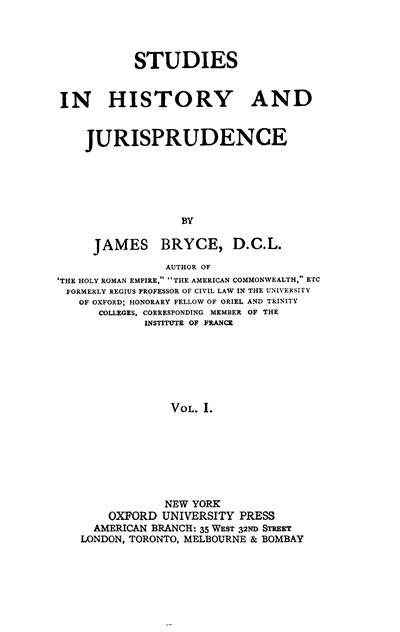
Front Page Titles (by Subject) VIII: THE CONSTITUTION OF THE COMMONWEALTH OF AUSTRALIA - Studies in History and Jurisprudence, vol. 1
Return to Title Page for Studies in History and Jurisprudence, vol. 1The Online Library of LibertyA project of Liberty Fund, Inc.VIII: THE CONSTITUTION OF THE COMMONWEALTH OF AUSTRALIA - Viscount James Bryce, Studies in History and Jurisprudence, vol. 1 [1901]Edition used:Studies in History and Jurisprudence (New York: Oxford University Press, 1901). 2 vols.
Part of: Studies in History and Jurisprudence, 2 vols.About Liberty Fund:Liberty Fund, Inc. is a private, educational foundation established to encourage the study of the ideal of a society of free and responsible individuals. Copyright information:The text is in the public domain. Fair use statement:This material is put online to further the educational goals of Liberty Fund, Inc. Unless otherwise stated in the Copyright Information section above, this material may be used freely for educational and academic purposes. It may not be used in any way for profit.
VIIITHE CONSTITUTION OF THE COMMONWEALTH OF AUSTRALIAI.Introductory.Australia is the first instance in history of a whole continent whose inhabitants are all (if we exclude the vanishing aborigines) of one race and all owe one allegiance. Thus it has supplied the only instance in which a political constitution has been, or could have been, framed for a whole continent. It is moreover one of the very few cases in history in which a number of communities politically unconnected (save by their common allegiance to a distant Crown) who had felt themselves to be practically a nation have suddenly transformed themselves into a National State, formally recognizing their unity and expressing it in the national institutions which they proceeded to create. There could hardly be a more striking illustration of the speed with which events have been moving during the last and the present age than the fact that Australia, or New Holland as it was then called, was, except as to part of its coasts, marked as a Terra Incognita upon our maps so late as the beginning of the eighteenth century, that the first British settlement was not planted in it at Sydney (not far from Captain Cook’s Botany Bay) till 1788, that responsible government was not conferred upon the oldest colony, New South Wales, until 1855, nor upon West Australia till 1890. Besides the interest with which every one must see the birth of a new nation, occupying a vast and rich territory, the student of political science finds further matter for inquiry and reflection in the enactment of an elaborate constitution for the Commonwealth of Australia. Every creation of a new scheme of government is a precious addition to the political resources of mankind. It represents a survey and scrutiny of the constitutional experience of the past. It embodies an experiment full of instruction for the future. The statesmen of the Convention which framed this latest addition to the world’s stock of Instruments of Government had passed in review all previous experiments, had found in them examples to follow and other examples to shun, had drawn from them the best essence of the teachings they were fitted to impart. When the Convention prepared its highly finished scheme of polity, it delivered its judgement upon the work of all who had gone before, while contributing to the materials which will be available for all who come hereafter to the work of building up a State. Nearly all the precedents which the Australian Convention had at its disposal belong to very recent times, in fact to the last century and a half. Though federal governments are ancient—the oldest apparently is that formed by the cities of Lycia in the fourth century bc—the ancient federations scarcely got beyond the form of leagues of small republics for the purpose of common military defence. Such leagues never quite grew into Federal States, properly so called, i.e. States in which the central government exercises direct power over the citizens of the component communities. The same remark applies to the confederacies of the Middle Ages, such as that of the Hanse Towns and that of the old Swiss Cantons, as well as to the United Provinces of the Netherlands. The first true Federal State founded on a complete and scientific basis was the United States, which dates from 1788, when its present Constitution was substituted for the Articles of Confederation of 1776. Next came the Constitution of the Swiss Confederation, enacted in 1848, and replacing a much looser form of union which had previously joined the Cantons of Switzerland. Its present amended form dates from 1874. The third was the Constitution of Canada, established by the British North America Act of 1867. Still later came the Constitution of the North German Confederation (1866) enlarged into that of the new Germanic Empire (1871), a remarkable Federal State with a monarch for its head, and including as its members both large kingdoms, such as Bavaria and Würtemberg, and the city republics of Lübeck, Bremen, and Hamburg1 . But this last-named Federation, instructive as it is, deals with conditions too dissimilar from those of Australia to furnish many precedents in point. It was the Constitutions of the United States and of Canada which the Australians studied most carefully, and whence they drew as well inspiration as many useful suggestions. And the student who examines the Australian scheme will find it interesting to note many points that recall, by way either of likeness or of contrast, the systems of the United States, of Switzerland, and of Canada. It is only with these three that I propose to compare the Australian Constitution in the pages that follow. As I am writing not for lawyers but for students of history and of constitutions, who desire to understand the nature of this new Government sufficiently to follow with intelligence the course of political life under it, I shall pass lightly over its more technical and more purely legal aspects, and dwell rather upon those general features which will give to the future Australian polity its character and spirit. II.The Movement for Federation.Like the settlements of Britain in North America, the Australian settlements were organized as Colonies at different dates, and several of them independently of the others1 . So, again like those of North America, each remained legally unconnected with the others, except through the allegiance they all owed to the British Crown, which sent out Governors to administer them. These officers were at first practically despotic; but when self-government was conferred upon a Colony, they became the nominal heads of an executive which in fact consisted of ministers responsible to the elective legislature of that Colony. Little as there was in the way of official connexion between the scattered settlements, their inhabitants always deemed themselves Australians, giving their sentimental attachment rather to the country as a whole than to their respective colonies. They were all English; they all lived under similar conditions: their local life had not lasted long enough to form local traditions with which sentiment could entwine itself. The very names of some of the colonies did not favour individualization, for who would call himself a Newsouthwalesian? And the idea that the colonies ought to be united into one political body emerged very early. As far back as 1849 a Committee in England had recommended that there should be a Governor-General for all Australia, with power to convene a General Assembly to legislate on matters of common colonial interest, and a bill introduced into Parliament in that year contained clauses for establishing such a legislature. These provisions were dropped, for the time was not ripe, yet the idea continued to occupy the minds of Australian statesmen from that year onwards; and it received a certain impulse from the creation of the Canadian Confederation in 1867. What it wanted was motive power, that is to say, a sense of actual evils or dangers to be averted, of actual benefits to be secured, by the union of the Colonies into one National State. Democratic communities, occupied by their own party controversies, are little disposed to deal with questions which are not urgent, and which hold out no definite promise either of benefit to the masses or of political gain to the leaders. However, in 1883 events occurred which evoked a new Pan-Australian feeling, and indicated objects fit to be secured by a united Australian government. The late Lord Derby, then Secretary of State for the Colonies, was the most cautious and unsentimental of mankind. He belonged to the old school of English statesmen who deprecated—and in some cases wisely deprecated—further additions to the territories and responsibilities of Britain. Disregarding the representations of the Governments of several among the Colonies, he neglected to occupy the northern part of the great neighbouring island of New Guinea which Australian opinion desired to see British, and permitted it, to their great vexation, to be taken by Germany. About the same time the escape of convicts into Australia from the French penal settlement in New Caledonia had caused annoyance, and movements were soon afterwards made by France which seemed to indicate an intention to appropriate the New Hebrides group of islands. These occurrences roused the Australians to desire an authority which might deliver their common wishes to the Home Government and take any other steps necessary for guarding their common interests. Accordingly a conference of delegates from all the Colonies, including New Zealand and Fiji, met in 1884, and prepared a scheme which was transmitted to England, and was there forthwith enacted by the Imperial Parliament under the name of The Federal Council of Australasia Act, 1885. This scheme was, however, (as I observed when it was under discussion in the House of Commons) a very scanty, fragmentary and imperfect sketch of a Federal Constitution. It had no executive power and no command of money. No colony need join unless it pleased, and each might withdraw when it pleased. Thus it befell that the plan excited little popular interest, and gave such faint promise of energetic action that only four colonies, Victoria, Queensland, Tasmania, and South Australia, entered into it; and of these South Australia presently withdrew. Meanwhile the need for some general military organization for all the Colonies began to be felt; and further objects attainable by union floated before men’s minds. With the increase of trade and industry, the vexation of tariff barriers between the colonies grew daily less tolerable. Subjects emerged on which uniformity of legislation was felt to be needful. The irrigation question, one of great importance for so arid a country, brings New South Wales, where some of the large rivers have their source, into close relation with Victoria and South Australia, and requires to be treated on common lines. These and other grounds led to an Inter-Colonial Conference of Ministers at Melbourne in 1890, and then to the summoning of a Convention of Delegates from the Parliaments of all the Colonies, including Tasmania. This latter body, which included many leading men, met at Sydney in 1891, debated the matter with great ability, and produced a Draft Bill, which became the basis of all subsequent discussions. The movement, hitherto confined to a group of political leaders, now began to be taken up by the people, and became, especially when the financial troubles of 1893 had begun to pass away, the principal subject in men’s minds. That crisis had shown all the Colonies how closely their interests were bound together, and had made them desire to remove every hindrance to an industrial and financial recovery. A Conference of Prime Ministers at Hobart in 1895 led to the passing by the several Colonial Parliaments of enabling Acts under which delegates were chosen, this time (following recent American precedents) by popular vote, to a new Convention which met at Adelaide (in South Australia) in 1897. It produced a second draft constitution, based on that of 1891, and laid it before the legislatures of the Colonies for criticism. About seventy-five amendments were proposed, and were considered by the Convention at its further sittings, which closed in March, 1898. The draft Constitution was then submitted to a popular vote, a new expedient in the British dominions, but one amply justified by the need for associating the people with the work. New South Wales alone failed to adopt it by the prescribed majority, because a large section of her inhabitants thought that her interests had not been duly regarded, but after a few amendments had been inserted at a conference of the Colonial Prime Ministers, her people ratified it upon a second vote. On this vote enormous majorities were secured in Victoria, South Australia and Tasmania, smaller ones in New South Wales and Queensland. The Constitution was then sent to England and passed into law by the Parliament of the United Kingdom under the title of The Commonwealth of Australia Constitution Act (63 & 64 Vict. cap. 12). Action by the Imperial Parliament was not only a convenient way of overriding all the colonial constitutions by one comprehensive Act, but was legally necessary, inasmuch as some provisions of the Constitution transcended the powers of all the colonial legislatures taken together. Since it had from the first been understood that the wish of the mother country was not to impose her own views but simply to carry out the wishes of the Colonies, only one slight alteration, an alteration rather of form than substance, was made in the draft as transmitted from Australia, the ill-considered notion of introducing a larger change having been eventually dropped by the British Ministry. I have mentioned these details in order to emphasize the time, care and pains bestowed by the Australians—for the work was entirely their own—upon this latest effort of constructive statesmanship. The Constitution of the United States was framed by a Convention which sat at Philadelphia, with closed doors, for nearly five months, and was accepted by Conventions in all the thirteen States without change, though ten amendments were immediately thereafter passed by general consent, their adoption having been the price paid for the ratification of the main instrument by some doubtful States. The Constitution of Canada took a little more than two years to settle. The Resolutions on which it was based were first of all drafted by a conference of delegates at Quebec. These were approved after full debate by the legislatures of the Provinces, and were, after some modifications, embodied in a Bill prepared by a small conference of Canadian statesmen who met in London. The Bill was then passed by the Imperial Parliament, never having been submitted to any popular vote. But this Australian instrument is the fruit of debates in two Conventions, of a minute examination by legislatures, of a subsequent revision by the second Convention, of further modifications in a few details by a conference of Prime Ministers, and has after all this preparation been sealed by the approval of the peoples of the Colonies concerned. The process of incubation lasted for nearly nine years, being all the while conducted in the full blaze of newspaper reporting and under the constant oversight of public opinion. III.The Causes which brought about Federation.The reasons and grounds assigned by the advocates of Federation were more numerous than those urged in the United States in 1787-9, or in Canada in 1864-6; but none of them were so imperative, for the Australian Colonies were far less seriously menaced by actually insistent evils, due to the want of a common national Government, than was the welfare either of the American States in 1787, or of Switzerland in 1848, or of Canada in 1867. In North America, it was the growing and indeed hopeless weakness and poverty of the existing Confederation, coupled with the barriers to commercial intercourse, the confusion and depreciation of currency, and the financial demoralization of some of the States, all of which had just emerged from an exhausting war, that drew the wisest minds of the nation to Philadelphia, induced them to persist in efforts to devise a better union, and enabled them to force its acceptance upon a people largely reluctant. In Switzerland it was the War of Secession (the so-called Sonderbund war) of 1847 that compelled the victorious party to substitute a new and truly federal constitution for the league which had proved too weak. In Canada the relations of the French-speaking and English-speaking Provinces (Lower and Upper Canada) had become so awkward that constitutional government was being practically brought to a standstill, and nothing remained but that the leaders of the two parties should devise some new system. Australia was in no such straits. Her colonies might have continued to go on and prosper, as six unconnected self-governing communities. It is therefore all the more to the credit of her people that they forwent the pleasures of local independence which are so dear to vivacious democracies, perceiving that although necessity might not dictate a federal union, reason recommended it. The grounds which were used in argument to urge the adoption of the Federal Constitution may be summed up as follows:— The gain to trade and the general convenience to be expected from abolishing the tariffs established on the frontiers of each colony. The need for a common system of military defence. The advantages of a common legislation for the regulation of railways and the fixing of railway rates. The advantages of a common control of the larger rivers for the purposes both of navigation and of irrigation. The need for uniform legislation on a number of commercial and industrial topics. The importance of finding an authority competent to provide for old-age pensions and for the settlement of labour disputes all over the country. The need for uniform provisions against the entrance of coloured races (especially Chinese, Malays, and Indian coolies). The gain to suitors from the establishment of a High Court to entertain appeals and avoid the expense and delay involved in carrying cases to the Privy Council in England. The probability that money could be borrowed more easily on the credit of an Australian Federation than by each colony for itself. The stimulus to be given to industry and trade by substituting one great community for six smaller ones. The possibility of making better arrangements for the disposal of the unappropriated lands belonging to some of the colonies than could be made by those colonies for themselves. There was in these arguments something to move every class in the community. To the commercial classes, the prospect of getting rid of custom-houses and of finding a large free market close at hand for all products was attractive; as was also that of sweeping away the vexation of railway rates planned in the interests of each colony rather than for the common benefit of trade. Large-minded men, thinkers as well as statesmen, hoped that a wider field would bring a loftier spirit into public life. The working-classes might expect, not only advantages in the way of brisker employment, but the establishment of that provision for old age and sickness which a Government covering the whole country and commanding ample resources could make more efficiently and on more uniform lines than even the richest colony could do. Some of these grounds for union measure the distance which the world has travelled since 1788. Railways are far older than was self-government in the oldest Australian colony, far younger than the youngest of the original thirteen American States. Even so late as 1867, when Canada was confederated, no one thought of suggesting that the State should provide old-age pensions. The opponents of Australian Federation, although they came more and more to feel their cause hopeless, were an active party, including many influential men. Besides denying that the benefits just enumerated would be attained, they dwelt upon the additional cost which a new Government, superadded to the existing ones, must entail. They fanned the jealousies which naturally exist between small and large communities, telling the former that they would be overborne in voting, and the latter that they would suffer in purse; and they wound up with the usual and often legitimate appeals to local sentiment. The arguments drawn from considerations of expense and from local jealousies were met by a series of ingenious compromises and financial devices to which both the larger and smaller colonies were persuaded to agree, while the love of each community for its own political independence was overborne by the rising tide of national sentiment. An ambition which aspired to make Australia take its place in the world as a great nation, mistress of the Southern hemisphere, had been growing for some time with the growth of a new generation born in the new home, and was powerfully roused by the vision of a Federal Government which should resemble that of the United States and warn off intruders in the Western Pacific, as the American Republic had announced by the pen of President Monroe that she would do on the North-American Continent. The same nationally self-assertive spirit and desire for expansion which has recently spurred four great European Powers into a rivalry for new colonial possessions, and which in 1899 made the United States forswear its old-established principles of policy, has been astir in the mind of the Australians. It had been stimulated by the example of a similar spirit in the mother country, and by the compliments which the English had now begun to lavish upon their colonies. It had gained strength with the growth to manhood of a generation born in Australia, and nurtured in Australian patriotism. Such a patriotism, finding no fit scope in devotion to the particular colonies, longed for a larger ideal. It supplied the motive force needed to create a national union. Without it, all the sober reasonings which counselled confederation might have failed to prevail. No equally strenuous or forward-reaching spirit moved the Canadians in 1867, nor are the traces of such a spirit conspicuous in the American debates of 1787-9. Some men were then solicitous for liberty, others for order and good government, but of imperial greatness in the present sense of the term little was said. Liberty and peace at home, not military strength and domination abroad, were the national ideals of those days. The history of the Federation movement illustrates the truth that a great change is seldom effected in politics save by the coincidence of two moving forces—the prospect of material advantage and the power of sentiment. In every community there are many who can be moved only by one or other of these two forces, and nearly every man responds better to the first if he can be warmed by the second. In the American debates of 1788-9 feeling was mostly arrayed against the proposed federation, though reason was almost entirely for it. Reason prevailed, but prevailed with far more difficulty than the cause of Federalism, with less cogent economic grounds behind it, prevailed in Australia. Like America in 1787, Australia was fortunate in having a group of able statesmen, most of whom were also lawyers, and so doubly qualified for the task of preparing a constitution. Their learning, their acuteness, and their mastery of constitutional principles can best be appreciated by any one who will peruse the interesting debates in the two Conventions. They used the experience of the mother country and of their predecessors in the work of federation-making, but they did so in no slavish spirit, choosing from the doctrines of England and from the rules of America, Switzerland, and Canada those which seemed best fitted to the special conditions of their own country. And like the founders of the American and Canadian Unions, they were not only guided by a clear practical sense, but were animated by a spirit of reasonable compromise, a spirit which promises well for the conduct of government under the instrument which they have framed. IV.The Conditions for a Federal Commonwealth.Before examining the provisions of the Constitution which is bringing the hitherto independent colonies into one political body, it is well to consider for a moment the territory and the inhabitants that are to be thus united. The total area of Australia is nearly 3,000,000 square miles, not much less than that of Europe. Of this a comparatively small part is peopled by white men, for the interior, as well as vast tracts stretching inland from the south-western and north-western coasts, is almost rainless, and supplies, even in its better districts, nothing more than a scanty growth of shrubs. Much of it is lower than the regions towards the coast, and parts are but little above sea-level. It has been hitherto deemed incapable of supporting human settlement, and unfit even for such ranching as is practised on arid tracts in western North America and in South Africa. Modern science has brought so many unexpected things to pass, that this conclusion may prove to have been too hasty. Still no growth of population in the interior can be looked for corresponding to that which marked the development of the United States west of the Alleghanies in the beginning of the nineteenth century. Of the six Australian colonies, one, Tasmania, occupies an island of its own, fertile and beautiful, but rather smaller (26,000 square miles) than Scotland or South Carolina. It lies 150 miles from the coast of Victoria. Western Australia covers an enormous area (nearly 1,000,000 square miles, between three and four times the size of Texas), and South Australia, which stretches right across the Continent to the Gulf of Carpentaria, is almost as large (a little over 900,000 square miles). Queensland is smaller, with 668,000 square miles; New South Wales, on the other hand, has only 310,000 square miles (i.e. is rather larger than Sweden and Norway and about the size of California, Oregon and Washington put together); Victoria only 87,000 (i.e. is as large as Great Britain and a little larger than Idaho). The country (including Tasmania) stretches from north to south over 32° of latitude (11° S. to 43° S.), a wider range than that of the United States (lat. 49° N. to 26° N.). There are thus even greater contrasts of climate than in the last-named country, for though the Tasmanian winters are less cold than those of Montana, the tropical heats of North Queensland and the shores of the Gulf of Carpentaria exceed any temperature reached in Louisiana and Texas. Fortunately, Northern Australia is, for its latitude, comparatively free from malarial fevers. But it is too hot for the out-door labour of white men. In these marked physical differences between the extremities of the Continent there lie sources whence may spring divergences not only of material interests but ultimately even of character, divergences comparable to those which made the Gulf States of the American Union find themselves drawn apart from the States of the North Atlantic and Great Lakes. It must also be noted that the great central wilderness cuts off not only the tropical north and north-west, but also the more temperate parts of the west from the thickly peopled regions of the south-west. Western Australia communicates with her Eastern sisters only by a long sea voyage1 . She is almost in the position held by California when, before the making of the first transcontinental railway, people went from New York to San Francisco via Panama. Nor is there much prospect that settlements will arise here and there in the intervening desert. The population of the Continent, which has now reached nearly 4,000,000, is very unequally distributed. The three colonies of widest area, Western Australia, South Australia, and Queensland, have none of them 500,000 inhabitants. Tasmania has about 170,000. Two others, New South Wales and Victoria, have each more than 1,000,0002 . This disparity ranges them for political purposes into two groups, the large ones with 2,500,000 people in two colonies, and the small ones with 1,500,000 in four colonies. Against these two sets of differences, physical and social, which might be expected to induce an opposition of economic and political interests, there is to be placed the fact that the Australian colonies are singularly homogeneous in population. British North America is peopled by a French as well as by an English race, British South Africa by a Dutch race as well as an English. But Australia is purely British. Even the Irish and the Scotch, though both races are specially prone to emigrate, seem less conspicuous than they are in Canada3 . Australia is to-day almost as purely English as Massachusetts, Connecticut, and Virginia were in 1776, and probably more English than were the thirteen original States taken as a whole. In this fact the colonies found not only an inducement to a closer union, but a security against the occurrence of one of the dangers which most frequently threatens the internal concord of a federation. Race antagonisms have troubled not only Canada and South Africa but the United Kingdom itself, and they now constitute the gravest of the perils that surround the Austro-Hungarian monarchy. Among the other favouring conditions may be enumerated the use of one language only (whereas in Canada and in South Africa two are spoken), the existence of one system of law, the experience of the same form of political institutions, a form modelled on that which the venerable traditions of the mother country have endeared to Englishmen in all parts of the world. It has also been a piece of good fortune that religion has not interposed any grounds for jealousy or division. The population of Australia is divided among various Christian denominations very much as the population of England is, and the chief difference between the old and the new country lies in the greater friendliness to one another of various communions which exists in the new country, a happy result due partly to the absence of any State Establishment of religion, and partly to that sense of social equality which is strong enough to condemn any attempt on the part of one religious body to claim social superiority over the others. Finally, there is the unique position which Australia occupies. She has a perfect natural frontier, because she is surrounded by the sea, an island continent, so far removed from all other civilized nations that she is not likely to be either threatened by their attacks or entangled in their alliances. The United States had, when its career began, British possessions on the north, French and Spanish on the south. But the tropical islands which Holland, Germany and France claim as theirs to the north and east of the Australian coasts are cut off by a wide stretch of ocean1 . They are not now, and are not likely at any time we can foresee, to contain a white population capable of disturbing the repose of Australia. Such a country seems made for one nation, though the fact that its settled regions lie scattered round a vast central wilderness suggests that it is better fitted for a federation than for a government of the unified type. But, on the other hand, this very remoteness might, in removing the force of external pressure, have weakened the sense of need for a federal union had there not existed that homogeneity of race and that aspiring national sentiment to which I have adverted. Compare these conditions with those of the three other Federations. The thirteen colonies which have grown into the present forty-five States of the American Union lay, continuous with one another, along the coast of the Atlantic. England held Canada to the north of them, France held the Mississippi Valley to the west of them, and, still further to the west, Spain held the coasts of the Pacific. They had at that time no natural boundaries on land; and the forces that drew them together were local contiguity, race unity, and above all, the sense that they must combine to protect themselves against powerful neighbours as well as against the evils which had become so painfully evident in the governments of the several States. Nature prescribed union, though few dreamt that Nature meant that union to cover the whole central belt of a Continent. In the case of Canada, Nature spoke with a more doubtful voice. She might rather have appeared to suggest that this long and narrow strip of habitable but only partially inhabited land, stretching from the Gulf of St. Lawrence to Puget Sound, should either all of it unite with its mighty neighbour to the south, or should form three or four separate groups, separated by intervening wildernesses. Political feelings however, compounded of attachment to Britain and a proud resolve not to be merged in a rival power which had done nothing to conciliate them, led the Canadians to form a confederation of their own, which Nature has blessed in this point at least, that its territories are so similar in climate and in conditions for industrial growth that few economic antagonisms seem likely to arise among them. Switzerland, however, is the most remarkable case of a Federation formed by historical causes in the very teeth, as it might seem, of ethnological obstacles. Three races, speaking three languages, have been so squeezed together by formidable neighbours as to have grown into one. The help of Nature has however been given in providing them with mountain fastnesses from which the armies of those neighbours could be resisted; and the physical character of the country has joined with the traditions of a splendid warlike heroism in creating a patriotism perhaps more intense than any other in the modern world. V.The Constitution as a Federal Instrument.In examining any Federal Constitution, it is convenient to consider the system it creates first as a Federation, i.e. a contrivance for holding minor communities together in a greater one; and then as a Frame of Government, composed of organs for discharging the various functions of administration. Although the former of these influences the latter, because the federal character of a State prescribes to some extent the character of that State’s governmental machinery, it conduces to clearness to deal with these two aspects separately. Accordingly I begin with the federal aspect of the Constitution. Federations are of two kinds. In some, the supreme power of the Central Government acts upon the communities which make it up only as communities. In others this power acts directly, not only upon the component communities, but also upon the individual citizens as being citizens of the Nation no less than of the several communities. The former kind of Federation may be described as really a mere League of States; the latter kind is a National as well as a Federal State. The Australian Federation is of this latter type. So are the United States, the Swiss Confederation, and the Canadian Federation. It was however to the former type that both the United States before 1788 and Switzerland before 1848 belonged. So Germany was a mere League of States before 1866, but has been a National as well as Federal State since 1866 and 1871. The essential feature of this latter type, with which alone we are here henceforth concerned, consists in the existence above every individual citizen of two authorities, that of the State, or Canton (as in Switzerland) or Province (as in Canada), to which he belongs, and that of the Nation, which includes all the States, and operates with equal force upon all their citizens alike. Thus each citizen has an allegiance which is double, being due both to his own particular State and to the Nation. He lives under two sets of laws, the laws of his State and the laws of the Nation. He obeys two sets of officials, those of his State and those of the Nation, and pays two sets of taxes, besides whatever local taxes or rates his city or county may impose. Accordingly the character of each and every Federation depends upon the distribution of powers between the Nation and the several States, since some powers must be allotted to the larger, some to the smaller entity. With regard to certain powers there can be no doubt. The navy, for instance, the post-office, the control of all foreign relations, must obviously be assigned to the National Government, together with the levying of customs duties at the frontiers and the raising of revenue for the purposes above mentioned. On the other hand, matters of an evidently local nature, such as police, prisons and asylums, the system of municipal or county administration, with the power of taxing for these purposes, will be allotted to the State Governments. But between these two sets there lies a large field of legislation and administration which may, according to the circumstances of each particular country and the wishes of the people who enact their constitution, be granted either to the Nation or to the States. The law of marriage and divorce, for instance1 , criminal law1 , bankruptcy, the traffic in intoxicating liquors2 , the regulation of railways2 , the provision of schools or universities3 , are all matters which have both a national and a local significance, and may be entrusted either to the National legislature or to the State legislatures according as one or other aspect of them predominates in the mind of the people. VI.Distribution of Powers between Nation and States.Now the fundamental question in the distribution of powers between the Nation and the States is this—To which authority does the unallotted residue of powers belong? It has been found that no distribution, however careful, can exhaust beforehand all the powers that a legislature or an executive may possibly have to exercise, and it therefore becomes essential to provide, whenever a power not specifically mentioned needs to be exercised, whether it should be deemed to be rightfully exerciseable by the National or by the State authority. In other words, which of these authorities is to be deemed general legatee of any undistributed residue? This question has been answered differently by different Federations. The United States and Switzerland leave to the States (to which they had belonged previously) the undistributed powers. Canada (whose Provinces were in a different position) bestows them upon the National (Dominion) Government1 . The question is the more important, because it creates in all sorts of doubtful matters a presumption in favour of the National Government or the State Governments, as the case may be. And it is specially important at the moment of creating a new Federation, because one of the difficulties always then experienced is to induce the States to resign powers they have hitherto enjoyed. Hence it reassures and comforts them to have the residue of powers not specifically distributed left still in their hands. The Australians have followed the example of the United States and Switzerland rather than that of Canada; and they have done so for the sake of appeasing the local sentiment of the several colonies, and especially of the smaller colonies, who naturally feared that, as they would have less weight than their larger neighbours in the national legislature, they would be in more danger of being subjected to laws which their local opinion did not approve. Section 107 provides that— ‘Every power of the Parliament of a Colony which has become or becomes a State shall, unless it is by this Constitution exclusively vested in the Parliament of the Commonwealth or withdrawn from the Parliament of the State, continue as at the establishment of the Commonwealth, or as at the admission or establishment of the State2 , as the case may be.’ Comparatively few powers of legislation are ‘exclusively vested’ in the Commonwealth Parliament; so that upon subjects other than these the State Parliaments retain for the present their previous power to legislate. But as it is also provided that all Acts of the Commonwealth Parliament, within the range of the powers granted, shall override laws of any State Parliament, such laws as the latter may pass upon subjects open to both legislatures are left at the mercy of the Commonwealth Parliament, which may, as and when it finds time or occasion, pass Acts extinguishing, or modifying the effect of, those enacted by the States. Now the range of powers granted to the National or Commonwealth Parliament is very wide, wider than that of Congress or of the Swiss National Assembly, or even of the Dominion Parliament in Canada. I need not enumerate the powers granted, forty-two in number, for they will be found in sects. 52 and 53 of the Australian Constitution. Among them are the following, which are not specifically given to, and nearly all of which are not even claimed by, the United States Congress:—Powers to take over State railways, and to construct and extend railways (with the consent of the State in which the railway lies), to control telegraphs and telephones and also trading and financial corporations, to take over State debts1 , to legislate on marriage and divorce, on bills of exchange and promissory notes, on invalid and old-age pensions, on arbitration and conciliation in trade disputes (where these extend beyond one State), on bounties on the production or export of goods, on the service and execution throughout the Commonwealth of the civil and criminal process and judgements of the State Courts. If these powers come to be all put in force they may leave for State action a narrower and less interesting field than it enjoys in the United States, where nevertheless the State legislatures are bodies of no great account, seldom enlisting the services of men of first-rate capacity. VII.Constitutional Position of the Australian States.The Australian Constitution, like that of the United States, assumes the States to be already organized communities, and contains nothing regarding their constitutions. The case of Canada was different, because there the previous government of the Upper and Lower Provinces, which had been one, had to be cut in two, and arrangements made for duly constituting the two halves. But in the case of Australia, the pre-existing constitutions of the Colonies, granted by the Imperial Government at various times, go on unchanged, subject only to the supersession of some of their functions by the Commonwealth, and to one or two specifically mentioned restrictions. That these restrictions are comparatively few may be partly ascribed to that aversion which the English everywhere show to this kind of safeguard against the misuse of legislature power. The omnipotence of the British Parliament seems to have fostered the notion that all Parliaments ought to be free to do wrong as well as to do right. The only things from which a State is disabled are the keeping of a naval or military force (except with the consent of the Commonwealth Parliament), coining money, and making anything but gold and silver coin legal tender1 . A State is not, as are the American States, forbidden to grant titles of nobility, or to pass any ex post facto law or law ‘impairing the obligation of contracts.’ That no such prohibitions exist in Canada may be ascribed to the fact that in Canada the National or Dominion Government has the right of vetoing laws passed by provincial legislatures, so that improper legislation can be in this way checked. The power is not often exercised in Canada, but when exercised has sometimes led to friction. This plan, however, is neither so respectful to the Provinces nor so conformable to general principles as is the American plan, which leaves the States subject only to the restrictions imposed by the Constitution, restrictions which ipso iure annul a law attempting to transgress them. And the Australians have wisely followed the American rather than the Canadian precedent. The Australians have, to be sure, in reserve a power to which nothing similar exists in America, viz. the right of the British Crown at home to veto legislation. Rarely as this right is put in force, it might conceivably be used at the instance of the National Government to avert an undesirable conflict between State statutes and National statutes. Note further that each Australian State is left as free to amend its own constitution as it was before, subject of course to the veto of the British Crown, but to no interference by the Commonwealth, whereas in Canada acts of the Provincial legislatures amending their constitutions are subject to the veto of the Dominion Government as representing the Crown. The omission of any provision similar to the famous and much litigated clause which debars an American State legislature from passing any law impairing the obligation of contracts is especially noteworthy. That clause, introduced by the Philadelphia Convention in order to check the tendency of some reckless States to get rid of their debts, produced in course of time unexpectedly far-reaching results, from some of which American legislatures and courts have made ingenious attempts to escape. It has indeed been thought that several subsequent decisions of the Supreme Court are not easily reconcileable with the famous judgement in the Dartmouth College Case (ad 1818), in which the full effect of this clause was for the first time displayed. That effect has been to fetter legislation in ways which are found so inconvenient in practice that they are acquiesced in only because many State legislatures are in the United States objects of popular distrust. No corresponding distrust seems to be felt in the British colonies, and therefore the Australians have not deemed any such prohibition needful, following the example of the British House of Commons, which in 1893 rejected a similar clause when moved as an amendment to the Irish Home Rule Bill of that year. In another point the Australian States have been treated with respect. In each of them the nominal executive head has hitherto been a Governor appointed by the British Crown. This was the case in Canada prior to 1867: but when the Canadian Federation was formed, the appointment of the Governors of the several provinces was entrusted to the Governor-General of the Dominion, that is to say, to the Dominion Cabinet by whose advice the Governor-General, being a sort of constitutional monarch, is guided. In practice, therefore, these governorships have become rewards bestowed upon leading party politicians. The Australians wisely (as most Englishmen will think) avoided this plan. Neither did they adopt the American method of letting the people of each State elect the Governor, a method unsuited to government on the Cabinet system, because, as the State Governor is under that system only a nominal head of the Executive (the Cabinet being the real Executive), there was no good reason for setting the people to choose him, and good reasons against doing so, inasmuch as popular elections are invariably fought on party lines. Accordingly the Australians have preferred to let him continue to be appointed by the Home Government, and to allow him to communicate directly with the Colonial Office in London. His Ministers are indeed described in the Constitution (sect. 44) as being ‘the Queen’s Ministers.’ VIII.Differences from the United States and Canadian Federations.Four other remarkable divergences, from both the American and the Canadian Federal systems, remain to be mentioned. One relates to the judiciary. In the United States there is a complete system of Federal Courts ramifying all over the Union and exercising exclusive jurisdiction in all cases arising under Federal statutes, as well as in a number of other matters specified in Art. III. sect. 2 of the Constitution. But the State Courts remain quite independent in all State matters, and determine the interpretation of the State Constitutions and of all State statutes, nor does any appeal lie from them to the Federal Courts. In Canada this was not thought necessary, so there the same set of Courts deals with questions arising under Federal statutes and with those arising under Provincial Statutes, and the Supreme Court of Canada receives appeals from all other Courts. This is less conformable to theory than the United States plan, but does not seem to have worked ill. The danger that Courts sitting in the Provinces would, under the influence of local feeling, pervert Federal law was not serious in Canada (though a similar danger was feared in the United States in 1787), and indeed all the Canadian judges are appointed by the Dominion Government, a further illustration of the preponderance which the Nation has over the Provinces. The Australians have taken a middle course. They have established a Federal Supreme Court, to be called ‘The High Court of Australia,’ and have taken power for their Parliament to create other Federal Courts. So far, they follow the United States precedent. But they have given power to the Commonwealth Parliament to invest State Courts with federal jurisdiction, thereby allowing those Courts to be, as in Canada, both State and Federal. And they have also allowed an appeal from all State Courts to the Federal High Court. By this plan the States are more directly connected with and subordinate to the National Government than they are in the United States. The Australian scheme has one great incidental advantage. In the United States the law of different States may and does differ, not only in respect of the difference between the statutes of one and the statutes of another, but also in respect of questions of common law untouched by statutes. The Supreme Court of Massachusetts may, for instance, take a different view of what constitutes fraud at common law from that taken by the Supreme Court of Pennsylvania, and there is no Court of Appeal above both these Courts to bring their views into accord. This has not happened to any great extent in Australia, because the British Privy Council has entertained appeals from all its Courts, and it will happen still less in future, because the Federal High Court will be close at hand to settle questions on which the Courts of different States may have been in disaccord. A second point shows how much less powerful the sentiment of State sovereignty has been in Australia than it was in the United States. By an amendment (xi) to the American Constitution made in 1798 it is expressly declared that no State can be used by a private plaintiff. But Australia expressly grants jurisdiction in such cases to its Federal High Court (sect. 75). A third point is the curious and novel power given to a State of referring matters to the Commonwealth Parliament, and to that Parliament of thereupon legislating on such matters (sect. 51 (xxxvii)). Under this provision (which is not to be found in the Canadian Constitution1 ) there is no department of State law wherewith the National legislature may not be rendered competent to deal. It may be usefully employed to secure uniformity of legislation over all Australia on a number of subjects not within the specifically allotted field of the Commonwealth Parliament. Finally, the Commonwealth Parliament may grant financial assistance to any State, and may take over the whole or a part of its debts as existing at the establishment of the Commonwealth1 . Provisions such as these imply, or will involve if put in practice, a relation between the National Government and the States closer than that which exists in America. To complete this account of the relation of the Nation to the States, let it be noted that a State may surrender any part of its territory to the Commonwealth, and that the Commonwealth is bound to protect each State against invasion or, on the application of the Executive of the State, against domestic violence2 . This latter provision is drawn from the United States constitution3 , though in America it is from the State legislature, if then in session, that the application for protection ought to come. Australia is right in her variation, because in her States the Legislature acts through the Executive. Neither provision occurs in the Constitution of Canada, which assigns military and naval defence exclusively to the Dominion Government, and makes itself responsible for the maintenance of order everywhere. In Switzerland the management of the army, in which all citizens are bound to serve, is divided between Cantons and Confederation, the supreme control remaining with the latter (Artt. 18-22). The Confederation is bound to protect a Canton against invasion and disorders, and may even itself intervene if the Executive of the Canton cannot ask it on its own motion (Artt. 16 and 17). Australia, as we have seen, allows the States to maintain a force with the consent of the Commonwealth; and this is permitted by the American Constitution also. IX.The Constitution as a Frame of National Government.We may now pass on to consider the National Government, the construction whereof occupies by far the greater part of the Constitution, which, while it left the States pretty much as they were, had here to build up a new system from the ground. The first point to be examined relates to the limitations imposed on the National Government as against the citizens generally, since I have already dealt with the limitations on its powers as against the States. Here a remarkable divergence from the American Constitution is disclosed. When that instrument was enacted, the keenest suspicion and jealousy was felt of the action of the Government to be established under it. It was feared that Congress might become an illiberal oligarchy and the President a new George the Third. Accordingly great pains were taken to debar Congress from doing anything which could infringe the primordial human rights of the citizen. Some restrictions are contained in the original Constitution: others fill the first nine amendments which were passed two or three years later, as a part of the arrangements by which the acceptance of the Constitution was secured. And down till our own time every State Constitution in America has continued to contain a similar ‘Bill of Rights’ for the protection of the citizens against abuse of legislative power. The English, however, have completely forgotten these old suspicions, which, when they did exist, attached to the Crown and not to the Legislature. So when Englishmen in Canada or Australia enact new Constitutions, they take no heed of such matters, and make their legislature as like the omnipotent Parliament of Britain as they can. The Canadian Constitution leaves the Dominion Parliament unfettered save by the direction (sect. 54) that money shall not be appropriated to any purpose that has not been recommended to the House of Commons by the Executive, a direction embodying English practice, and now adopted by Australia also. And the Australian Constitution contains but one provision which recalls the old-fashioned Bill of Rights, viz. that which forbids the Commonwealth to ‘make any law for establishing any religion or for imposing any religious observance or for prohibiting the free exercise of any religion.’ The Swiss Constitution, influenced by French and American models, is in this respect more archaic, for it imposes a series of disabilities on its Legislature in the interest of individual freedom (sectt. 39, 49, 54-59). This diversity of attitude between the English on the one hand and both the Americans and the Swiss on the other is a curious instance of the way in which usage and tradition mould a nation’s mind. Parliament was for so long a time the protector of Englishmen against an arbitrary Executive that they did not form the habit of taking precautions against the abuse of the powers of the Legislature; and their struggles for a fuller freedom took the form of making Parliament a more truly popular and representative body, not that of restricting its authority. The point just examined is one which arises in all Rigid Constitutions, whether Federal or Unitary. But the next point is one with which only Federations are concerned; and it is one in which all the great Federations agreee. All have adopted the same method of providing both for the predominance of the majority of the people considered as one Nation, and for the maintenance of the rights of the States considered as distinct communities. The Americans invented this method: the Swiss, the Canadians, the Germans, and now the Australians, have imitated them. This method is to divide the Legislature into two Houses, using one to represent the whole people on the basis of numbers, and using the other to represent the several States on the basis (except in Germany) of their equality as autonomous communities. It was this device that made Federation possible in the United States, for the smaller States would not have foregone their independence in reliance upon any weaker guarantee. X.The Legislature.The Australian scheme provides (sectt. 7-23) for an Upper House or Senate of thirty-six members, six from each State, and a House of Representatives (sectt. 24-40) of seventy-five members, elected on a basis of population, so that forty-nine members will come from the two large States, New South Wales and Victoria, and twenty-six from the four small States. No Original State is ever to have less than five. The equal representation of the six Original States is always to be maintained, but the number of Senators may be increased, and when new States come to be formed, the Parliament may allot to them such number of Senators as it thinks fit. Senators sit for six years, and do not all retire at the same time. These features are taken from the Constitution of the United States, which, as already observed, has been a model for subsequent Federal Upper Houses. But there are remarkable variations in the Australian scheme. 1. In the United States each newly-created State receives as a matter of right its two Senators. In Australia the Commonwealth may allot such number as it thinks fit. 2. In the United States one-third of the Senate retires every two years. In Australia one-half retires every three years. 3. In the United States the President of the Senate is the Vice-President of the United States, chosen by the people1 . In Australia, the Senate is to choose its own President. 4. In the United States the quorum is one more than a half of the total number; in Australia one-third of the total number. 5. In the United States the Legislatures of the several States elect the Senators. In Australia the Senators are elected by the people of the State. This last point is one of great interest. Tocqueville, writing in 1832, attributed (erroneously, as the sequel has shown) the excellence of the American Senate to the method of election by the State Legislatures1 . Since his days the American Senate has declined; and so far from this mode of election having tended to sustain its character, the general, though not unanimous, opinion of the wise in America deems the Senate to be injured by it, and desires a change to the method of election by direct popular vote. It was partly because the Australian Convention had become aware of this tendency of American opinion that they rejected the existing American plan; nor is it impossible that the Americans themselves may alter their system, which gives greater opportunities for intrigue and the use of money than popular election would be likely to afford. In Australia, the Senators are in the first instance to be elected by the people, each State voting as one electorate, but this may be altered (e.g. to a system of district elections) by the Parliament of the Commonwealth, or failing its action, by the Parliament of a State. It will be interesting to see what experiments are tried and how they work. District voting may give different results from a general State vote, and a party for the moment dominant may choose the plan that best suits it. 6. In the United States the Senate is an undying body, perpetually renewed by fresh elections, never losing more than one-third of its members at any one time. In Australia the Senate may be dissolved in case a deadlock should arise between it and the House of Representatives. The Senate is the sheet-anchor of the four small States. Commanding a majority in it, they have consented to acquiesce in the great preponderance which their two larger neighbours possess in the House of Representatives. The numbers of the latter House are to be always as nearly as practicable double those of the Senate, a point whose importance will presently appear. The House is to continue for three years (subject of course to dissolution), a term intermediate, though inclining in the democratic direction, between the two years of the American Congress and the seven (practically six) years of the British House of Commons. The Canadian term is five years. Until the Commonwealth Parliament otherwise provides, the electoral suffrage is to be (as in the United States) the suffrage prescribed by State law for the election of members of the more numerous State House, and it is expressly provided, doubtless with a view to the fact that women’s suffrage already exists in two colonies, that no law shall prevent a State voter from voting at Commonwealth elections. So far from securing, as does the United States Constitution, that no person shall be excluded on the ground of race from the suffrage1 , Australia has expressly provided that persons belonging to a particular race may be excluded, for she declares (sect. 25) that in such case the excluded race is not to be reckoned among the population of the State for the purposes of an allotment of representatives. Plural voting is forbidden. The quorum of members is a mean between the inconveniently large quorum (one-half) of the American, and the very small one (forty) of the British House. The seat of any Senator or member of the House becomes ipso facto vacant if he fails (without permission) to attend any session for two continuous months. No person having any pecuniary interest in any agreement with the public service (except as member of an incorporated company of at least twenty-five persons), or holding any office of profit under the Crown, can sit in either House, unless he be a Minister either of the Commonwealth or of a State. The exception is noteworthy, not only because it is framed with a view to the establishment of Cabinet Government, but also because it implies that a man may, contrary to American and Canadian usage, be at the same time both an executive official of a State and also a member of the Federal Legislature. It would appear that women are eligible to membership of either House. Every Senator and Representative is to receive a salary, fixed for the present at £400 ($2,000) a year. XI.The Executive.The Executive is to consist of the Governor-General and the Ministers. To the great convenience of the Australian people, the head of the Executive does not need to be elected either by popular vote (as in the United States) or by the Chambers, as in France and Switzerland. He is nominated by the British Crown, and holds office so long as the Crown pleases, receiving a salary fixed, for the present, at £10,000 ($50,000) a year (exactly the salary of the American President). He has an Executive Council, modelled on the British Privy Council (though the name Privy Council is not used as it is in the Canadian Constitution), and from it he chooses a number of Ministers (fixed for the present at seven) who are to administer the several departments of the public service. They must be members of one or other House of Parliament—a remarkable provision, for though this is a British practice, that practice has never been embodied in any positive rule. As the Governor-General is only a constitutional figure-head, these Ministers will in fact constitute the ruling executive of the Commonwealth. XII.The Judiciary.The Judiciary is to consist in the first instance of a Federal High Court (containing a Chief Justice and at least two other judges) capable of exercising both original jurisdiction in certain sets of cases, and also appellate jurisdiction not only from single Federal Judges and inferior Federal Courts, but also from the Supreme Courts of the States. Power is taken both to establish lower Federal Courts and to invest State Courts with federal jurisdiction. But besides this Judiciary proper, there is created a second Court for dealing with cases relating to trade and commerce, under the name of the Inter-State Commission (sect. 101). This remarkable and very important institution has doubtless been suggested by the United States Inter-State Commerce Commission created by Congress some eighteen years ago in order to deal with railway and water traffic between the States. Its functions will be half-administrative, half-judicial, and in questions of pure law an appeal will lie from it to the High Court, while a guarantee for its independence is found in the clause which declares that its members shall not be removed during their seven years’ term of office. All Federal Judges are to be appointed by the Governor-General, that is to say, by the Executive Ministry. All trials (on indictment) for any offence against the laws of the Commonwealth shall be by jury, and held in the State where the alleged offence was committed. The judicial establishments of the States remain unaffected, and the judges thereof will continue to be appointed by the State Executives. In determining the functions of the High Court there arose an important question which seemed for a moment to threaten the whole scheme of Federation. The draft Constitution which the Convention had prepared and which the people had approved by their vote provided that questions arising on the interpretation of the Constitution as to the respective limits of the powers of the Commonwealth and of the States, or as to the respective limits of the constitutional powers of any two or more States, should be adjudicated upon by the High Court of the Commonwealth, and that no appeal should lie from its decision to the Queen in Council (i.e. to the Judicial Committee of the Privy Council in England, which is the Supreme Court of Appeal from the British Colonies and India), ‘unless the public interest of some part of Her Majesty’s dominions, other than the Commonwealth or a State, are involved.’ When the draft reached England to be embodied in a Bill, the British Government took exception to this provision as tending to weaken the tie between the mother country and the colonies. There were many in England who thought that it was not in the interest of Australia herself that she should lose, in questions which might involve political feeling and be complicated with party issues, the benefit of having a determination of such questions by an authority absolutely impartial and unconnected with her domestic interests and passions. How much better (they argued) would it have been for the United States at some critical moments could they have had constitutional disputes adjudicated on by a tribunal above all suspicion of sectional or party bias, since it would have represented the pure essence of legal wisdom, an unimpeachable devotion to legal truth! To this the Australians replied that the experience of the United States had shown that in constitutional questions it was sometimes right and necessary to have regard to the actual conditions and needs of the nation; that constitutional questions were in so far political that where legal considerations were nearly balanced, the view ought to be preferred which an enlightened regard for the welfare of the nation suggested; that a Court sitting in England and knowing little of Australia would be unable to appreciate all the bearings of a constitutional question, and might, in taking a purely technical and possibly too literal a view of the Constitution, give to the Constitution a rigidity which would check its legitimate expansion and aggravate internal strife. Australia must—so they pursued—be mistress of her own destinies, and as it is she that had framed and procured the enactment of this Constitution, so by her ought the responsibility to be borne of working it on its judicial as well as its executive and legislative side. Not only was this better for Australia herself, but it would be more conducive to the maintenance of the connexion between the Commonwealth and the mother country. After some wavering, the British Government, perceiving the risk of offending Australian sentiment, gave way. They dropped in Committee of the House of Commons the alteration which they had introduced into the Australian draft, substituting for it an amendment which, while slightly varying the original terms of the draft, practically conceded the point for which the Australian Delegates, sent to England to assist in passing the measure, had contended. The Act as passed provides that no appeal shall lie to the Crown in Council upon the constitutional questions above-mentioned unless the High Court itself shall, being satisfied that the question is one which ought to be determined by the Privy Council, certify to that effect. In all other such cases its judgement will be final. Appeals to the Privy Council in questions other than constitutional will continue to lie from the Supreme Courts of the States (with the alternative of an appeal to the High Court) and from the High Court itself, when special leave is given by the Privy Council. The Commonwealth Parliament may limit the matters in which such leave may be asked, but the laws imposing such limitations are to be reserved for the pleasure of the Crown. The scheme of judicature above outlined follows in the main the model contained in the American Constitution. It does not draw the line between State and Federal matters and courts so sharply, for appeals are to lie from State Courts in all matters alike, and State Courts may receive jurisdiction in Federal matters. On the other hand, it is more conformable to principle than either the Canadian plan, which provides no Federal Courts save the Supreme Court and gives the appointment of all judges alike to the Dominion Government, or the Swiss plan, which refers questions of conflict between the Nation and the Cantons, or as to the constitutionality of Federal laws, not to the Judiciary at all, but to the Federal Legislature. Broadly speaking, the Australian High Court will have to fill such a place and discharge such functions as have been filled and discharged in America by that exalted tribunal which Chief Justice John Marshall and other great legal luminaries have made illustrious. In working out the provisions of the Constitution by an expansive interpretation, cautious but large-minded, it may render to Australia services not unworthy to be compared with those which America has gratefully recognized. XIII.Working of the Frame of Government. The Cabinet.Now let us see how this Frame of Government, which I have briefly outlined in its salient features, is intended to work. Its essence lies in a matter which is not indicated by any express provision, the dependence of the Executive upon the Legislature. Herein it differs fundamentally from the American and Swiss systems. It reproduces the English system of what is called Cabinet or Responsible Government; that is to say, a Government in which the Executive instead of being, as in America, an independent authority, directly created by the people and amenable to the people only, is created by and responsible to the Legislature. As and when the British colonies respectively obtained self-governing institutions, each of them adopted this scheme, since it was the one familiar to them at home; and to it they seem all determined to adhere. Its distinctive features are these. The nominal head of the Executive, in Britain the Crown, in Australia the Governor-General as representing the Crown, is permanent, and is not responsible to the Legislature, because he acts not on his own views, but upon the advice of his Ministers. The Ministers are responsible to the Legislature which virtually chooses them, and they depend upon its confidence for their continuance in office. The Ministers are however not wholly at the mercy of the Legislature, because they may dissolve it, that is to say, may appeal to the people, in the hope that the people will elect a new Legislature which will support them. This kind of government accordingly rests on a balance of three authorities, the Executive, the Legislature, and the People, the people being a sort of arbiter between Ministry and Parliament. As the Ministry can at any moment appeal to the people, the threat of appealing puts pressure upon the Parliament, and keeps a majority cohesive. In the existence of this power of sudden dissolution there lies a marked difference from the American scheme, which some one has called Astronomical, because the four years’ term of office of the Executive and the two years’ term of the Legislature are both fixed by the earth’s course round the sun. I have spoken of the Legislature as the authority to which the Ministry is responsible. But what is the Legislature? In England, although Parliament consists of two Houses, the Minister-making power resides solely in the House of Commons. Being elective, the House of Commons has behind it the moral weight of the people and the prestige of many victories. Being the holder of the purse, it has the legal machinery for giving effect to its will, since without supplies administration cannot be carried on. Accordingly, though the existence of two often discordant Houses may arrest or modify legislation in Britain, it does not affect the executive conduct of affairs, save on the rare occasions when immediate legislation is deemed indispensable by the Executive. The same remark applies to Canada. There also one finds two Houses, but the Senate, being a nominated and not a representative body, holds an entirely secondary place. The Ministry may disregard a vote of want of confidence passed by it, just as in England they disregard an adverse vote of the House of Lords. In Australia, however, things will be quite different. There the Senate has been constituted as a representative body, elected by the peoples of the States; and as the protector of the rights and interests of the States it holds functions of the highest importance. Its powers (save in one point to be presently mentioned) are the same as those of the House. In whom then does the power of making and unmaking ministries reside? Wherever one finds two assemblies, one finds them naturally tending to differ; and this will be particularly likely to occur where, as in Australia, they are constructed by different modes of election. Suppose a vote of no confidence in a particular Ministry is carried in one House and followed by a vote of confidence passed in the other? Is the Ministry to resign because one House will not support it? It retains the confidence of the other; and if it does resign, and a new Ministry comes in, the House which supported it may pass a vote of no confidence in those who have succeeded it. The problem is one which cannot arise either under the English or under the American system. Not under the English, because the two Houses are not co-ordinate, the House of Commons being much the stronger. Not under the American, because, although the Houses are co-ordinate, neither House has the power of displacing the President or his Ministers. It is therefore a new problem, and one which directly results from the attempt to combine features of both schemes, the Cabinet system of England and the co-ordinate Senate, strong because it represents the States, which a Federal system prescribes. XIV.Provisions against Deadlocks.This, however, is only one, though perhaps the most acute, of the difficulties that arise from the existence of two co-ordinate Houses. Their differences upon questions of legislation are always liable to produce deadlocks. These annoying phenomena occur in England, though there the House of Lords, except upon Irish questions, usually gives way (even without a dissolution of Parliament), because it is afraid of incensing the people and thereby bringing about its own destruction if it continues to resist the national will. In Irish questions the Upper House has been apt to assume that the people of England and Scotland are not sufficiently interested to resent very keenly its difference from the Commons. In the United States there is no remedy for such deadlocks. They have to be endured, at whatever cost. The resistance of the Senate to various plans suggested by the House for dealing with the slavery question may be reckoned among the causes which brought on the War of Secession. The Australian colonies themselves have had frequent experience of deadlocks in matters of legislation between the two Houses, for in every colony there have been two Houses, though in every colony it is the more popular House which has controlled the Executive. The difficulties I have indicated were fully before the minds of the statesmen who sat in the two Conventions. An ingenious device has been contrived for dealing with them (sect. 57). When the House passes a law and the Senate disagrees, the House may pass it again after three months, and if the Senate still disagrees, the Governor-General may thereupon dissolve both House and Senate together, unless the Parliament is within six months of its natural end by effluxion of time. If after such dissolution the new House again passes the measure, and the Senate once more disagrees, the Governor may convene a joint sitting of both Houses. If the proposed law is then passed by an absolute majority of the whole Parliament so convened in joint sitting, it shall be taken to have been duly passed by both Houses. This method involves the expenditure of a good deal of time and the worry of a double general election, one for the House and one for the Senate. But it may prove to be the best method of solving a problem which neither Britain nor the United States has yet attempted to solve, and which certainly needs solution. The reader who remembers that the numbers of the House have been fixed to be always double those of the Senate, will now see how necessary such a provision was in order to secure that in this final trial of strength between Senate and House the principle of State rights and the principle of population shall each have its due recognition. Should these two principles come into collision, should, for instance, all the members from the four small States be of one mind and all the members from the two large States of another mind, the principle of population will prevail, for in the two Houses sitting together, the large States will have sixty-one votes (twelve senators and forty-nine representatives), whereas the small States will have only fifty (twenty-four senators and twenty-six representatives). Such a conjuncture may however never arise. XV.Relations of the Two Houses.The question remains which of the two Houses will hold the place of the British House of Commons as determining the tenure of office by Ministries. Upon this question light may be cast by the provisions with regard to money bills. The Constitution enacts (sect. 53) that all bills appropriating revenue or imposing taxation must originate in the House, and that the Senate may not amend taxing bills, or those ‘appropriating money for the ordinary annual services of the Government,’ though it may return such bills to the House suggesting certain amendments in them. The Senate may however reject such bills. As this scheme, which somewhat resembles that of the American Constitution1 , itself suggested by the practice of England, seems to throw upon the House the primary function of providing money for the public service, and thus the primary control of the national exchequer, it would seem that Ministers, unable without money to carry on that service, must stand or fall by a vote of the House and not by a vote of the Senate. Yet the Senate, though it cannot take the first steps for granting money, can withhold money; and if it does so in order to get rid of a Ministry it dislikes, nothing short of the deadlock provision above described can be invoked. Nor can the expedient of mixing up a number of different taxing provisions in one Bill, or inserting other matter in appropriation Bills (‘tacking’), be resorted to, for these are expressly prohibited by the Constitution (sectt. 54, 55). Possibly in practice the Houses will frequently agree to let the accustomed services of the year be provided for without much controversy, and will reserve their serious conflicts for new proposals regarding taxation or appropriation. Australians evidently expect that the usage hitherto prevailing in all the Colonies of letting the Ministry be installed or ejected by the larger House will be followed. Nevertheless the relations of the Commonwealth Houses are so novel and peculiar, that the experience of the new Government in working them out will deserve to be watched with the closest attention by all students of politics. Englishmen in particular have good reason for doing so, because England, when she has substituted a representative Second Chamber for her present theoretically indefensible House of Lords, will have to devise some means for avoiding or solving deadlocks between such a Chamber and the House of Commons. Some high Australian authorities have appeared to doubt whether two co-ordinate Houses can be made to work along with Cabinet Government. They observe that although there may be sometimes a willingness to make compromises for the sake of the public service, there is also in all governments, and certainly not least in those of the United States and the British Colonies, a tendency to press every legal right to its furthest limit, even if the machine should be stopped thereby. Were such stoppages to become frequent, Australia might, they think, be driven to amend her Constitution by so far disjoining the Executive from the Legislature as to give it something of the permanence it enjoys in America and Switzerland1 . The relations of the Senate to the House may largely depend on factors still undetermined. One of these is the growth of population. Should the small Colonies grow rapidly, their representation in the House would before long be fairly proportionate to that which they enjoy in the Senate, so that the balance of parties might, so far as the size of States is concerned, tend to be nearly the same in both Houses. Another is the character of the controversies which will arise. These may not be such as to set the small States against the large ones, and the three party organizations, which are already strong, though they possess no such Machine System as America enjoys, may find their support pretty equally in all or most of the States, so that the balance of parties may in practice be found to differ but little in the Senate from what it is in the House. Thus these particular wheels or shafts of the constitutional machine, which are deemed less able than others to bear a severe strain, may not for a long while to come have any severe strain thrown upon them. Another thing which may affect the relations of the two Houses is the comparative attractions which each will have for high political capacity. In the United States the Senate became, within thirty years from the establishment of the Constitution, an assembly much stronger, through the eminence of its members, than was the House of Representatives. As its term of membership was longer (six years against two years), and as it had certain quasi-executive functions in connexion with foreign relations and appointments, men of ability preferred it to the House, and the House constantly saw its best talent drawn off to its rival. The Senate has to-day no such intellectual ascendency as it had then, but capable men still migrate to it when they can from the House of Representatives. If the House establishes in Australia, as it will apparently do, its sole right to make and unmake Ministries, it will be the more tempting field for ambition: yet something will depend upon the amount of genius and character which the Senate attracts, for the presence of these in abundant measure will give it weight with the nation. It has been suggested in Australia that the Senate with its thirty-six members is too small. The Senate of the United States however began with twenty-six; and it has been a great advantage to that body that its original numbers were small, for traditions more dignified than those of the tumultuous House were formed, and a somewhat stronger sense of personal responsibility was developed just because the individual was not lost in a crowd. XVI.Miscellaneous Provisions.Questions of trade and finance fill a chapter of the Constitution (sectt. 81-105); and it was indeed these questions, next to the issue between the large and the small States, that gave most trouble to those who framed the instrument. It is provided that the collection and control of all duties of customs and excise shall pass to the Commonwealth, but that not more than one-fourth thereof shall, for ten years at least, be retained by the Commonwealth, the other three-fourths being paid over to the several States, or applied to payment of the interest on their respective debts, should these debts be assumed by the Commonwealth. This arrangement was deemed needful to supply the States with funds for defraying their administrative expenses and the interest on their debts, seeing that the chief part of their revenue arose from customs and excise, the five which prepared the Constitution, except New South Wales, having adopted a protective policy. Bounties may be given either by the Commonwealth, or by the States with its consent. There are provisions regarding the collection of the customs, the control of railways and settlement of railway rates, the use of rivers for irrigation and water storage, and the State debts, but as these are largely temporary, and have little special interest for the student of constitutions, important as they are to Australian industries, I mention them only to show how elaborately the scheme of union has been worked out, and on how many perplexing topics, settled provisionally by the Constitution, the Commonwealth Parliament will have to legislate. The question of the spot where the capital should be placed gave rise, as had happened in the United States and in Canada, to some controversy. It was adjusted by providing that the seat of Federal government should be in the colony of New South Wales, but at least 100 miles from Sydney. Here an area is to be set apart of not less than 100 square miles, which shall be under the jurisdiction of the Commonwealth, as the District of Columbia is under the authority of the National Government in the United States: and here a stately city will doubtless in time spring up. Power is taken to admit new States, whether formed out of existing States or not, upon any terms and conditions (e.g. as to number of Senators) which the Parliament may fix, but if the new State is formed out of an old one, only with the latter’s consent. The Parliament has also full power to accept and provide for the administration of any territory transferred to it by the Crown, so that no constitutional questions can arise resembling that which has occupied American lawyers since the annexation of Puerto Rico. XVII.Amendment of the Constitution.Last of all we come to the mode of amending the Constitution, a mode easier to apply than that prescribed for the United States, but showing the influence to some extent of the American though more largely of the Swiss model in its reference to the popular vote. Every law proposing to alter the Constitution must be passed by an absolute majority of each House, and thereupon (after two but before six months) be submitted to the voters of every State. If in a majority of States a majority of the electors voting approve the proposal, and if these State majorities constitute a majority of all the electors voting over the whole Commonwealth, the amendment is passed, and is then to be presented to the Crown for assent. Should the two Houses differ, one passing the proposed law and the other rejecting it (or passing it with an amendment which the first-mentioned House rejects), the House which approves the proposal may again pass it, and if the dissenting House again dissents, the amendment may be submitted to the people as if both Houses had passed it. The decision of the people is final. To meet the fact that the suffrage is not in all the States confined to men, it is further provided that, in any State wherein all adults are entitled to vote, only one half of the vote shall be counted1 . Thus the requirements for the passing of an Amendment are:— 1. Absolute majority in each House of Parliament, or else absolute majority in one House given twice, the second time after three months’ interval, plus submission on both occasions to the other House. 2. Approval of the people in a majority of States (i.e. at present in four States at least). 3. Approval of a majority of the people voting over the whole Commonwealth. The American Federal Constitution requires a two-thirds’ majority in each House of Congress and a three-fourths’ majority of States, or else the proposal of a Convention by two-thirds of the States and a three-fourths’ majority of States approving what the Convention has settled, conditions extremely difficult to secure. The Swiss system permits the Constitution to be amended by the same process as is applied to the passing of laws, plus a popular vote which results in a majority of Cantons and in a majority of the people voting over the whole Confederation. XVIII.Relations of the Australian Commonwealth to the Crown.It has not seemed necessary to set forth the relations of the Commonwealth to the British Crown, because these relations are substantially those which have heretofore existed between the Crown and each of the self-governing colonies now united in the Federal Commonwealth. The chief difference is that the Commonwealth Parliament receives certain powers (as to extra-territorial fisheries and relations with the islands of the Pacific) which were previously exerciseable only by the (now extinct) Federal Council of Australasia (mentioned above), that it has a general power to legislate on ‘external affairs’ (a somewhat vague term, sect. 51, xxix), and that it may ‘exercise within the Commonwealth, at the request or with the concurrence of the Parliaments of all the States directly concerned, any power which can now be exercised only by the Parliament of the United Kingdom or by the Federal Council of Australasia’ (sect. 51, xxxviii). Apart from these provisions, which may give rise to some delicate questions, the principles and practice which have guided the action of the Home Government and of the Colonial Governors will apparently be preserved. Though the Imperial Parliament has an unquestioned right to legislate for every part of the British dominions so as to override all local legislation, it does not now exercise this power except for a few purposes of utility common to all, or many, British possessions, such as for the regulation of merchant-shipping or copyright, and when it does so, it secures the assent of the self-governing Colonies. So again, though the Crown has the legal right to withhold consent from Colonial Statutes, this right is rarely exerted, and then only in respect of some general imperial interest which it is supposed that the statute in question may prejudicially affect, i.e. the Crown’s right is not exerted in the interest of any class of persons in the Colony or in pursuance of any particular view entertained either by the Governor there or by the Ministry at home. The new Australian Constitution provides (sectt. 58-60) that when a measure passed by the Parliament is presented to the Governor-General, he may either assent to it in the Queen’s name (but subject to a power to the Queen to disallow the same within one year) or he may withhold assent; or he may reserve it for the Queen’s pleasure, in which last case it shall not take effect unless he announces within two years that the Queen has assented to it. This right of veto, though it looks on paper larger than that which belongs to the President of the United States, seeing that the President’s veto can be overridden by a two-thirds’ majority in each House of Congress, is in reality far more limited, and will constitute no check (except where imperial interests may be affected) upon the practically sovereign power of the Commonwealth Parliament. XIX.Comparison with the Constitutions of the United States and Canada.Before I make some general reflections on the character of this Australian Constitution, it is worth while to note summarily the principal points in which it differs from the two other Federal Constitutions which it most resembles. The provisions which it has borrowed from the American Constitution have been already adverted to. It differs from that Constitution in the following (among other) respects:— 1. It is a longer instrument, going into much fuller detail on many topics. 2. It leaves less power to the States and gives more power to the Commonwealth; and it enables the Commonwealth Parliament to legislate for a State upon the State’s request, a thing which lies quite outside the functions of Congress. 3. It does not establish a complete system of Federal Courts covering the whole area of the Commonwealth, but allows State Courts to be invested with Federal jurisdiction. 4. It makes the Federal High Court a Court of appeal from State Courts, whereas in the United States each State Supreme Court is final in its proper sphere. 5. It contains hardly any restrictions, in the nature of a ‘Bill of Rights,’ upon the power of the Federal Legislature over the individual citizen. 6. Instead of disjoining Legislature and Executive, it unites them closely by the system of Responsible or Cabinet Government, and so far from excluding every official from Congress, it makes a seat in Parliament a condition of Ministerial office. 7. It vests the choice of the Head of the Executive, not in the people, but in an external authority, the British Crown. To be sure, this Head is nominal and not responsible either to the people or to the legislature. 8. It vests the election of Senators in the people, not in State Legislatures, gives the Senate no power of amending but only of suggesting amendments in money bills, makes the Senate dissoluble in case of a deadlock between it and the House, and contemplates the possibility that new States may have a smaller representation in the Senate than original States. 9. It gives to the Executive no such veto on legislation as the President has in the United States. I have already explained that the veto of the Governor-General and the Crown is a different thing, and rarely employed. 10. It makes the amendment of the Constitution a much less tedious and difficult process. Thus it may be said that, as compared with the American Constitution, it vests more power in the National Government as against the State Governments, and that, as between the various departments of the National Government itself, it concentrates power more fully in the hands of the Legislature and imposes fewer restrictions upon its action. The Constitution of Canada seems at first sight nearer to that of Australia than does the American. It has a Monarch, represented by a Governor-General, for the head of its Executive. It contemplates a number of States small when compared with the forty-five of the American Union. It has adopted the British system of Cabinet or responsible Government. But the differences are really so considerable as to place Australia’s scheme as far from that of her colonial sister as from the American. Among them are the following:— 1. The Canadian Constitution prescribes the Constitutions of the several Provinces, though it permits the Provincial legislatures to alter them (subject to a Federal veto). The Australian assumes its State Constitutions as existing, and makes no change in them, except so far as the Federation controls or supersedes them. Hence the antecedent power of changing them remains, so far as they are not affected by the Federal Constitution. 2. Australia leaves to the States all residuary powers (i.e. powers not expressly granted). Canada withholds them from the Provinces and vests them in the Dominion. 3. Australia leaves the State Governors to be appointed, as now, by the Home Government, apart from Federal interference. Canada gives the appointment of them to the Federal Ministry. And whereas in Canada a Provincial Governor cannot communicate directly with home but only with the Governor-General, in Australia the State Governor and his Ministers are in direct touch with the British Government in London. 4. Australia gives to the Federal Government no right whatever to interfere with State Statutes. Canada invests the Dominion Government with a veto on Provincial legislation by placing the Governor-General as regards such legislation in the place which the Queen holds as regards Dominion legislation. 5. Australia distinguishes Federal from State jurisdiction, taking power to establish Federal Courts other than her High Court, and to invest State Courts with Federal jurisdiction. Canada has no special Federal Courts other than the Supreme Court of the Dominion. 6. Australia makes her Senate an elective assembly. In Canada the Senate is nominated by the Dominion Government, and is therefore a weak body, quite unfit to try conclusions with the House which has the people behind it. 7. Australia provides a method whereby the Commonwealth may amend its Constitution. Canada has no such method, and thereby leaves amendment to the Imperial Parliament of the United Kingdom. This comparison shows that the Australian scheme of Federal Government stands intermediate between that of the United States and that of Canada. In the United States, the Federal Government has less power as against the States than in Australia. In Canada, the Federal Government has more power, or at least a wider range of action. In other words, the Australian system approaches nearer, in point of form, to a Unitary Government than does the United States, but not so near as does Canada. I am speaking merely of form, that is, of the institutions as they stand on paper, for it does not necessarily follow that the spirit in which institutions are worked will precisely correspond to their form. The old Romano-Germanic Empire, for instance (1638-1806), was less unitary in practice than would have been collected from its form; the new German Empire (since 1871) is more unitary in spirit and working than its form would necessarily convey. XX.General Observations on the Constitution.Technically regarded, the Constitution is an excellent piece of work. Its arrangement is logical. Its language is for the most part clear and precise. The occasional, and perhaps regrettable, vagueness of some expressions appears due, not to any carelessness of the draftsmen, but to the nature of the subject-matter. The cumbrousness of the provisions regarding customs, duties, and the control of railways is the almost inevitable result of an effort to meet the claims and appease the apprehensions of neighbouring communities with interests that have been deemed opposed. Although it is much longer, as well as less terse, than the Constitution of the United States, going into fuller detail, and with more of the flavour of an English statute about it, it nevertheless, like that Constitution, leaves much to be subsequently filled up by the action of the legislature. A very large field of legislation remains common to the States and the Commonwealth Parliament; and though statutes passed by the latter will of course override or supersede those which may have been passed by the former, it may be many years before the higher Parliament finds leisure to cultivate all the ground which lies open before it. A further range of activity for that Parliament may disclose itself if the State legislatures should exert the power they possess of asking the Commonwealth to take over part of their work. And apart from both these lines of legislative action, the Parliament will find a very large number of matters which the Constitution has expressly directed it to settle by statutes. Till such statutes have been enacted, many points material to the working of the system will remain undetermined. In two points the experience of the United States has been, consciously or unconsciously, turned to account. The complaint has often been made in America that the Constitution contains no recognition of the Supreme Being. The Australians have introduced such a recognition in the preamble of the Imperial Act establishing the Constitution, which runs as follows: ‘Whereas the people of New South Wales, Victoria, South Australia, Queensland, and Tasmania, humbly relying on the blessing of Almighty God, have agreed to unite in one indissoluble Federal Commonwealth under the Crown of the United Kingdom,’ &c. And they have also solemnly enounced in the same preamble that indissolubility of their union which the Americans did not enounce in 1788, and the absence of which from the instrument gave rise to endless argumentation on the part of those who maintained the right of a State to retire from the Federation. The perfection of any Federal system may be tested by the degree of thoroughness with which the Federal principle is worked out in its application, not only to the legislative, but also to the executive and judicial branches of government. In this respect the Australian scheme is less perfect than the American; for the Commonwealth has received power to legislate, no doubt at the request of the State, on purely State matters, to return to the States part of the revenue it collects, and to assume the pecuniary liabilities of the States. There is also, as already noted, no such effort as in America to secure that questions of State law shall be determined solely by State Courts, for such cases may be appealed from State Courts to the Federal High Court. Thus the Nation looms large over the whole instrument, overshadowing the States. There are indeed many provisions for safeguarding the interests of the States, yet these are not so much recognitions of States’ rights as stipulations made to secure material advantages, industrial or commercial or financial. An explanation of this remarkable feature of the scheme may be found in the phenomena of Australian as compared with those of American history. The thirteen States which united in 1788-9 had each of them a long history. The two oldest dated back to the beginning of the seventeenth century. The youngest had nearly sixty years of political life behind it. All were animated by a strong sentiment of local independence, and by a passion for liberty which had become associated with local independence. Their notions of a Unitary Government were formed from England, whose monarch they had latterly learned to hate as their oppressor. Hence their love for their States was largely sentimental. Their minds were filled, not by the mere sense of what they gained from their States as business men, but by the loyalty they bore to their States as protectors of their civic rights and embodiments of their historical traditions. Very different were the feelings of the Australians. The oldest colony dated back scarcely more than a hundred years, and had enjoyed responsible government for less than fifty. Proud as each colony was of its progress, there had not been time for those political traditions to be formed in which the love of local independence roots itself. Neither were there between the several colonies such differences of origin or of usages and ways of life as separated the New Englanders from the men of Virginia and the Carolinas, for the Australians had emigrated so recently from Britain that no local types had yet been formed. Still less was there that aversion to a Unitary system of government which the strife with England had evoked among the Americans. The only political model which the Australians knew at first hand was the government of Britain by its Parliament, a government which had ceased in 1832 to be oligarchic, and had since 1867 begun to be democratic. Accordingly, among the Australians, State feeling had a thoroughly practical and business character. It took in each man the form of a resolve to secure the agricultural and trading interests of his own part of the country. It was in fact the wish to make a good bargain for his community and himself. Sentiment there was and is. But the sentiment gathered round the Commonwealth of the future rather than the Colony of the past. The same kind of feeling which attached the sons of the Cavaliers to Virginia and the Puritans of Massachusetts to the old ‘Bay State’ made the Australians desire to found a great nation which should be the mistress of the Southern seas. Hence the absence of any jealousy of the central power beyond that which is suggested by the fear that local industrial or commercial interests might be unfairly dealt with. This attitude of Australian feeling will therefore (if the view here presented be correct) work towards the development of those centralizing tendencies in the Constitution for which its terms give ample scope. In all forms of polity the influences which draw the members of a composite political community together and those which thrust them asunder are partly material, partly sentimental1 . How the influences of material interest will work in Australia I will not attempt to predict. Some of them may prove centrifugal; others, such as those of trade, are clearly centripetal. The Constitution frankly recognizes that economic conditions prescribe a federal rather than a unitary government. But it is a significant fact that the influences of sentiment were arrayed on the side of the Nation rather than on that of the States. One can read this between the lines of the Constitution; and it explains why the Frame of Government is less consistently Federal than is that of the United States. XXI.Modern and Democratic Character of the Australian Constitution.The Australian instrument is the true child of its era, the latest birth of Time. Compared with it, the American Constitution seems old-fashioned, and parts of the Swiss Constitution positively archaic. Cabinet Government, whose fully developed form is scarcely a century old, is taken for its basis. Ideas and enterprises, problems and proposals, so new that they are only just beginning to be seriously discussed, figure in it. As slavery, an institution almost coeval with the human race, but essentially barbarous, survived to be mentioned (under a transparent euphemism) in the Constitution of the United States, so a new industrial question—viz. the struggle between white labour and free coloured labour—makes its appearance in this Australian document. Here too are the new products and new methods of science, telegraphs and telephones and the keeping of meteorological observations; here is the extension of the suffrage to women; here are the new troubles which spring from contests between employers and workmen; here the new proposals for throwing on the State the function of providing for its members in sickness and old age: here an express recognition of the right of a State to control the traffic in intoxicating liquors. And above all these one perceives through the whole instrument that dominant factor of our age, the ever-present and all-pervading influence of economic forces, of industrial production, of commerce, of finance. The increased and increasing importance of these influences in the life of the modern world, stimulated as they have been by the amazing progress of scientific discovery, finds a fuller expression in this Constitution than in any other yet framed. As in these points this Constitution is at least abreast of European and American theory, and ahead of European or American practice, so also it represents the high-water mark of popular government. It is penetrated by the spirit of democracy. The actual everyday working of government in the Australian Colonies is more democratic than in Britain, because Britain has retained certain oligarchical habits, political as well as social. It is more democratic than in the United States, because there both the States and the Union are fettered by many constitutional restrictions, and because wealth has there (as indeed in Britain also) been able to exert a control none the less potent because half-concealed. But the Constitution of this Federal Commonwealth is more democratic than are the Constitutions of the several Australian colonies, in some of which property qualifications and nominated second chambers have survived till now. It prescribes no qualification for a Senator or Representative beyond his having attained the age of twenty-one and being himself qualified to become an elector. He need not even be a resident in the State where he seeks election. The Senate as well as the House is elective; both are chosen directly by the people, and on the basis of the suffrage which each State prescribes for the election of its more popular House. The duration of the House is only three years. The direct popular vote, an institution specially characteristic of advanced democracy, which has been developed independently in the United States and in Switzerland (where it has taken the double form of a Referendum to the people and an Initiative proceeding from the people), is here applied to the enactment of amendments to the Constitution, and, in the form of a general election of both Houses simultaneously, to the settlement of deadlocks between the Houses. There is no veto on the acts of the Legislature, for that vested in the Governor-General and in the Crown is not intended to be used except in the rare cases where imperial interests may be touched. In fact all those checks and balances in the English and American Constitutions by which the censors of democracy used to set such store, have here dwindled down to one only, viz. the existence of two Chambers. These two will be elected on the same franchise and composed of similar men, but the tendency to dissension so natural to rival bodies may sometimes interpose delays and ought certainly to make the criticism of proposals more searching. If the principle of popular sovereignty is expressed with equal clearness in the Constitutions of America and Switzerland, it assumes in this Australian Constitution a more direct and effective form, because many of the restrictions which the two former constitutions (and especially that of America) impose on the legislature in the supposed interests of the people are absent from the Australian instrument. In Australia the people, through their legislature with its short term, are not only supreme, but can, by the legislature’s control of the Executive, give effect to their wishes with incomparable promptitude. For this purpose, the expression ‘people’ practically means the leader who for the time being commands the popular majority. Holding in his hand both the Executive power of the Cabinet and the legislative power of Parliament, he has opportunities of effecting more than any one man can effect under the constitutions either of America or of Switzerland. The solitary restraint which Australia provides is the co-ordinate authority of the Senate, a hostile majority in which may check or at least delay his legislative projects. Yet if his party in the country be well organized and his programme alluring to the masses he may control the Senate as well as the House, for it does not follow that because the smaller States have prudently placed their interests under the protection of the Senate, they will on the great issues of politics be usually found opposed to their larger neighbours1 . This highly democratic character of their Constitution has been fully appreciated by Australian statesmen. The effusiveness with which they dwell upon it is probably more sincere than even that which is displayed by politicians in England, America, or France, when they chant the praises of the multitude. Australians are as sanguine in their temper now as Americans were in the days before the clouds of Slavery and Secession had begun to darken their sky. XXII.Political Party in Australia.Although the Constitution says no word about political parties, the fact that it contemplates a party system is written over it in bold characters. The sages of the Philadelphia Convention of 1787 neither intended nor expected that the scheme they devised would fall into the hands of parties. Indeed they had a touching faith, dispelled as soon as Washington retired from the scene, that the electors who were to be chosen to elect the President would select the best man in the nation irrespective of his political ties. The Swiss, strange as it may seem to men of English or Anglo-American race, have succeeded in keeping their Executive, elected though it is by the Chambers, out of party politics altogether, nor do parties dominate the legislature and colour the public life of the nation as in America and England. But Government of the English ‘Cabinet type’ is essentially party Government, that is to say, it has been so hitherto both in England and wherever else it has been tried, and no one has yet shown how it can be made to work otherwise. In America the great parties are younger than the Constitution, which may be said to have created them. In England they are older than Cabinet Government proper, being practically contemporaneous in their rise with that very rudimentary form of the Cabinet which began to emerge in the time of King Charles II. In Australia every colony has had such active and skilfully-organized parties that no one doubts but what the Federal Legislature will find its first Ministry forthwith provided with a competent Opposition. It is generally believed that the tariff will furnish the first, and for some time the main, ground of party division, for the new Government must begin by providing itself with an adequate revenue; the chief part of that revenue must be raised by indirect taxation, and the issue of Free Trade versus Protection has for years past been a burning one in the largest Colonies. I have observed that the Australian scheme contemplates a party system to work it. But what sort of a party system? Obviously one in which there are two parties only, each cohesive, each prepared to replace its antagonist in the Executive. Such was the party system of England till the present generation. Such has been the party system of the United States. Exceptions indeed there have been, such as the Know-Nothing party in 1852, the Greenback party in 1876, the Populist party which arose in 1889, and is not quite extinct now (February 1901). In the United States the power of the two great organizations is so vast, and the cost of creating a new party so deterrent, that a third organization seldom appears, and if it appears, presently disappears. But in France there have been and are several parliamentary groups, which frequently change their attitude towards one another, sometimes combining to support a Ministry, sometimes falling asunder and leaving it to perish, because one group alone was not sufficient to sustain it. Hence the lives of Cabinets have been short, and would have been still shorter but for the fact that an imminent peril to republican government itself has sometimes compelled the various republican groups to hold together. In Britain the same difficulty became acute from 1880 onwards, as the Irish Nationalists consolidated themselves in a distinct Third Party; and it may at any moment create serious embarrassment. It exists in Germany also, and in the Reichsrath of the Austrian half of the Austro-Hungarian Monarchy. Now in several of the Australian Colonial Parliaments a Labour party has recently arisen, which, keeping itself independent of the two older parties, can throw its weight on one or the other side and endanger the stability of Cabinets. Should this phenomenon reappear in the Parliament of the Commonwealth, it will complicate still further a position which the co-ordinate powers of Senate and House make complicated enough already1 . XXIII.Political Issues likely to arise in Australia.The mention of parties suggests another question, the last I shall attempt to discuss, viz. the lines on which the political life of Australia is likely to move under her new Constitution. It is a topic on which little will be said by any one who remembers how seldom great constitutional changes have been followed by the results prophesied at the time. The Reform Bill of 1832 in Britain, the Civil War in the United States, the union of Italy under the dynasty of Savoy, not to speak of the French Revolutions of 1789 and 1848, all brought forth fruits very different from those predicted by some of the most judicious and unbiassed contemporary observers. Even the extension of the suffrage and redistribution of seats effected in Britain in 1884-5 were followed by a shifting of the balance of party strength exactly the opposite of that which the shrewdest party politicians had expected. But without attempting forecasts, one may try to indicate certain conditions likely to affect the development of Australian national and political life under the new form which this Constitution gives it. First let us ask what are the controversies likely to occupy the nation and to supply a basis for national parties? Taking one country with another, it will be found that the questions on which men have grouped themselves into parties may be classed under five heads, viz.:— 1. Questions of Race, such as those which have contributed to distract Ireland, which to-day trouble the Austrian Monarchy and (as respects the Poles) the Prussian Monarchy, which exist, though at present not acute, in Canada, and which are painfully acute in South Africa. 2. Questions of religion, now generally less formidable than they once were, yet embittering disputes regarding education in many modern countries. 3. Questions relating to foreign policy, whether as to the general lines on which it should be conducted, or as to the attitude to be held towards particular States at any given moment. 4. Questions regarding the distribution of political power within the nation itself. 5. Questions of an economic or economico-social kind, e.g. regarding the disposal of land in public hands or its tenure in private hands, regarding the conditions of labour, regarding taxation and finance, the policy of Protection or Free Trade, the policy of progressive imposts, the propriety of assisting particular industries or particular classes out of public funds, whether national or local. Some of these may seem to be rather social than economic, but it will be found upon scrutiny that it is their economic aspect, i.e. their tendency to take money from or give money to some class in the community, that makes them bases for party combination. A purely social question seldom assumes great political significance. (1, 2) Applying this classification to Australia we shall find that the first two sets of questions are absent. All the people are of practically the same race. None are animated by any religious passion, although controversies have sometimes arisen over theological teaching in State schools. (3) Questions of foreign policy do not, strictly speaking, come within the scope of the Commonwealth Parliament, because they belong to the mother country. Nevertheless, it cannot be doubted that the Parliament will from time to time interest itself in them, especially as regards the isles of the Pacific and of the Eastern Archipelago, and will give forcible expression to its views should any crisis arrive. One can well imagine that the question of the attitude which the Commonwealth should assume, or urge the mother country to assume, towards Germany or France, or Holland, or even towards China or Japan or the United States, when any of these Powers may be taking action in the Western Pacific, might give rise to political contention. (4) As respects the distribution of political power and the structure of the Federal Government, Australia is so democratic already that it cannot go much further. It will doubtless, however, be proposed to extend to women in all the States that right of voting at Commonwealth elections which they already enjoy in South Australia and Western Australia, under the local law, or to apply more widely the institution of the direct popular vote; or to amend the Constitution in some point which will raise an issue between the more radical and the more conservative sections of opinion. That questions of constitutional amendment have played so small a part in American politics may be attributed to the extreme difficulty of securing the majorities required for altering the Constitution. In Australia the process will be far easier. The history of the United States during the first seventy years of the Constitution suggests that the question of the respective rights of the Federation and of the States may furnish a prominent and persistent issue. This is quite possible, for in Federations there is a tendency for many controversies of various kinds to connect themselves with, or to raise afresh, controversies regarding the true construction of the Federal instrument as respects the powers which it assigns to the Nation and to the component communities. (5) It is however questions of the economic order that are likely to occupy, more than any others, the minds and energies of Australian statesmen. The tariff is a practically inexhaustible topic, because apart from the general issue between a Protective and Free Trade policy, the particular imports to be taxed and the particular duties to be imposed will furnish matter for debates that can hardly have finality, seeing that circumstances change, and that the financial needs of the Government will increase. It need hardly be said that in a new country like Australia direct taxation is difficult to collect and highly unpopular, so that larger recourse will be had to customs and excise than orthodox economists could justify in Europe. The financial relations between the Commonwealth and the States will be another fertile source of controversy. So may the regulation of the railways, which the Commonwealth seems likely to take over. So will the arrangements for securing the respective rights of different States as regards both irrigation and the navigation of the rivers, practically the only rivers of the Continent, which intersect the three south-eastern colonies. Among the labour questions likely to arise, one problem, much before the minds of Australians, may be found to cause difficulties in its details if not in its general principle; viz. the exclusion of immigrants of coloured race, Chinese, Japanese, Malays, and Indian coolies. The white labourers of the temperate colonies have been strongly opposed to the admission of such strangers, but the planters of the tropical north, who have used the labour of Pacific islanders on their sugar estates, take a different view of the case. Some may think that the obvious line of party division will be found to be that which ranges the four smaller and the two larger States into opposite camps. If this should happen, which may well be doubted, it will be owing to a coincidence of economic interests, and not to the mere fact that the strength of one set of States lies in the House, that of the other in the Senate. The two largest States, New South Wales and Victoria, have hitherto been conspicuously divergent in their financial policy. In America, though the small States fought hard against the large ones in the Convention of 1787, the distinction has never since that date possessed any permanent political significance. If parties form themselves on any geographical lines, the line will more probably be one between the tropical and the temperate regions. These tropical regions are at present much less populous and wealthy than is the temperate south-east corner of the Continent. They will doubtless increase both in wealth and in population, but as the strong sun forbids out-door labour to white men, the population enjoying political rights cannot, for generations to come, be a large one. XXIV.Possible Entrance of New States.The existing situation may be so materially affected by the entrance of new States that one naturally asks what are the prospects that new States will be admitted. As the whole Continent is already divided among the five existing States, new ones can come into being only by carving up the three larger of these. There has already been talk of dividing Queensland into two or perhaps three States. Others might be formed out of the now sparsely peopled regions of the north and northwest, when they have become more thickly inhabited. How fast the process of colonization will advance in these regions will depend upon what engineering science may be found able to do for the more arid tracts in the way of storing rain-water and raising it from deep wells, while something will depend on the disposition of the Federal Government to spend money for that purpose. Nor is another element to be overlooked. Vast as is the mineral wealth already known to exist in the explored parts of Australia, it may be equalled by that which exists in regions which have received no thorough geological examination. Should mines begin to be worked in the arid tracts, an additional motive would be given for the provision of water supplies there, for the existence of a population furnishing markets would stimulate men to develop the capacities of the soil for ranching and even for tillage. These possibilities show how many factors hitherto undetermined may go to moulding the political future of the country. The increase of population in regions now thinly peopled would either make the four smaller States, or some of them, the equals of the larger, or would, more probably, lead to the creation of new States, some of them with a character different from that of the two which now command a decisive majority in the House of Representatives. As the settlement of the Mississippi Valley changed American politics, so a filling up of large parts of the interior and north of Australia, unlikely as this now appears, might affect her constitutional growth in ways at which we can now only guess. At present not only these tropical regions, but also the settled parts of Western Australia are separated by vast uninhabited spaces from the populous south-east corner of the continent. Hence just as in Canada an Intercolonial Railway to connect Nova Scotia and New Brunswick with Quebec and Ontario was provided for in the Constitution of 1867, and just as the construction of the great transcontinental Canadian Pacific line enabled Manitoba and British Columbia to become effective members of the Federation, so a line of railway from east to west across Australia, as well as the completion of the line, already partly constructed, from the south to the north, are among the political needs of the Commonwealth, and might do much to weld its people into an even more united nation. One community remains to be mentioned whose geographical position towards Australia recalls the saying of Grattan that while the Ocean forbade Ireland to be politically severed from Britain, the Sea forbade an incorporating union. It has been hoped that New Zealand would enter the Federation, and she has herself seriously considered whether she ought to do so. With a healthy climate, a soil generally well watered, and an area not much less than that of the British Isles, New Zealand has evidently a great future before her. The population, now between 700,000 and 800,000, has tripled within the last thirty years; and the level of personal comfort and well-being is as high as anywhere in the world. Her accession would give further strength to the Federal Commonwealth. But New Zealand, as one of her statesmen observed, has twelve hundred reasons against union with Australia, for she is separated from the nearest part of Australia by twelve hundred miles of stormy sea, a distance more than half of that which divides Ireland from Newfoundland. She may therefore think that some sort of permanent league with Australia, for the purposes of combined naval defence and joint action in external questions of common concern, would conform better to her outlying position than would participation in a Legislature which must be mainly occupied with the affairs of Australia. Of the subjects assigned by the Constitution to the Commonwealth Parliament, there are several in which, because purely Australian, New Zealand would have no interest, some also with regard to which she could legislate better for herself than the Commonwealth could legislate for her, inasmuch as her economic and social conditions are not the same as those of Australia. An illustration is furnished by the difference between the native races in the two countries. The Australian aborigines, one of the most backward branches of the human family, are obviously unfit for the exercise of any political functions. They are not permitted to vote in any colony, and the Constitution provides that in determining the number of representatives to be allotted to a State they shall not be reckoned among its population. But the Maoris of New Zealand are an intelligent folk, to whom New Zealand has given the suffrage, and who are now on excellent terms with their white neighbours. It would no doubt be possible for the Commonwealth Parliament to legislate differently for them and for the ‘black fellows’ of Australia; but their dissimilar character shows the difference of the problems which arise in the two countries. New Zealand has however an interest in obtaining free access to the Australian markets, and her final decision as to entering the Federation may be influenced by the commercial policy which the larger country pursues1 . In this changeful world, no form of government ever remains the same during a long series of years, and no Federation, however strictly the rights of its members may be secured by a Rigid Constitution, can continue to maintain exactly the same balance of powers between the Nation and the States. I have already expressed the opinion that the tendency is in Australia likely to be rather towards consolidation than towards a relaxation of the Federal bond, because not only national sentiment but economic influences also will work in that direction. Much however may depend on a factor still unpredictable, the relations between Australia, together with the British Empire generally, and the other Powers which are interested in the Western Pacific. Nothing does so much to draw together a people already homogeneous as the emergence of issues which threaten, or result in, a struggle against foreign States. The sentiment of internal unity is accentuated. Public attention is diverted from domestic controversies. Powers are willingly yielded to the Executive which would in days of peace be refused. The consequences may be good or evil—they have sometimes been in the long run evil—but either way they alter the character of the government. They may even give a new direction to its policy, as the United States has recently, and quite unexpectedly, discovered. XXV.Future Relations of the Australian Commonwealth to Britain.Australia however is not a State standing alone in the world, but a member of the British Empire, so we cannot close an examination of her Constitution without asking whether the union of her Colonies will affect her relations to the mother country. When the first Convention to frame a Federal Constitution assembled in 1891, most Englishmen supposed that a Federated Australia would soon aspire to complete independence. Australian statesmen saw deeper, and predicted that the formation from the several Colonies of an Australian Nation would tend not to loosen, but rather to draw closer the ties that unite the people to Great Britain. So far as can be judged from the course of Australian opinion during the past ten years, this has been the result. There were at first some who advocated Federation as a means to independence. But they soon desisted, overborne by a different current. The same National feeling through which Federalism triumphed seems to have deepened the sense of unity with other members of the British race. And possibly that suspicion which colonies are apt to feel of a sort of patronage on the part of the mother country, and which sometimes disposes them to be self-assertive, may have vanished as they came to realize that the old country was proud of them and wished to treat them not only as a daughter but as an equal. Neither do they, democrats as they are, harbour distrust of a monarchy, or deem their freedom in any way hampered by it. The love for republicanism in the abstract, though far stronger in Continental Europe than in England, was everywhere a force in the first half of the nineteenth century. It has faded away in the second half throughout the British world, because the solid substance of freedom has been secured, because the old mischiefs of monarchical government have reappeared in republics, because men’s minds have begun to be occupied with economic and social rather than with purely political questions. The fact that the British Crown is titular head of the Australian Commonwealth will not render the working of the Constitution less truly popular, any more than has befallen in Canada, a somewhat less democratic country. So far as the internal politics of Australia are concerned, she will take her own course, scarcely affected by her connexion with England. But the fact that she is, and seems likely to remain, a part of the British Empire, sharing in the enterprises and conflicts and responsibilities of that vast body, is a fact of the highest moment for her future and for the future of the world. Still more momentous might her relation to the Empire become should any scheme be devised for giving the self-governing Colonies of Britain a share in the financial liability for common defence, together with a voice in the determination of a common foreign policy. The difficulties of constructing any constitutional machinery for this purpose are obvious, yet perhaps not insurmountable. Should any such arrangement be ever reached, it will probably be reached through some crisis in the history of the Empire itself. Sixty years ago it was generally believed that as soon as each British self-governing colony had become conscious of its strength, it would naturally desire, and could not be refused, its independence. But the last sixty years have brought with them many favouring conditions; and among these, one of which no one then thought, the long reign of a sovereign whose personal character, by its purity, simplicity and kindliness, won such reverence and affection, not only for herself, but also for the ancient institutions at the head of which she stood, that the prolongation of her life may be reckoned among the causes which have kept these far-off lands a part of the British realm and have given its actual form to the Commonwealth of Australia. [1 ]One might add the Constitution of the Austro-Hungarian Monarchy, which is a sort of double federation. But it is too peculiar to serve as an example to other peoples proposing to federalize. [1 ]New South Wales in 1788, Tasmania in 1825, Western Australia in 1829, South Australia in 1836, Victoria in 1851, Queensland in 1859. Victoria and Queensland had however been originally settled (1836 and 1826), and for some time administered, from New South Wales, while Tasmania had been made a penal settlement as early as 1804. [1 ]It is four days’ voyage from Adelaide, the capital of S. Australia, to Perth, the capital of W. Australia. [2 ]Two-fifths of the population of Victoria live in Melbourne, one-fourth of the population of New South Wales in Sydney. [3 ]In 1891, out of that part of the total population of Australia which had been born in the United Kingdom, about one-fourth had been born in Ireland and one-sixth in Scotland. Of the whole population of Australia, 95 per cent. are of British stock. [1 ]The nearest point of Dutch New Guinea is about 150 miles from Australia. [1 ]In the U. S. A. a State, in Canada a Federal matter. [2 ]In Switzerland a Federal matter, in the U. S. A. partly a Federal, partly a State matter. [3 ]In the U. S. A. and Germany a State matter, in Switzerland and Canada partly a Federal matter.’ [1 ]See U. S. A. Constitution, Amendment X: Constitution of Swiss Confederation, Art. 3: British North American Act (1867), sect. 91. [2 ]These words are used to cover the case of the creation and admission of future States. [1 ]Canada directs the Dominion to take over the Provincial debts existing at the time of the Union. In the U. S. A. the war debts of the States were taken over by the first Congress of the Union. [1 ]See sections 114 and 115 of Constitution, and compare Art. I. sect. 10 of Constitution of U. S. A. [1 ]But see section 94 of the Canadian Constitution. [1 ]Sect. 105. [2 ]Sect. 119. [3 ]Art. II. sect. 3, and Art. IV. sect. 4. [1 ]I.e. practically by the people, though formally by a body of electors elected for that purpose. [1 ]See as to this, Essay VI, p. 336 and p. 352. [1 ]See Amendment XV to the Constitution. [1 ]In the U.S.A., however, the Senate may and does amend both revenue-raising and appropriation bills, and indeed frequently prevails against the House in the quarrels which arise over these matters. [1 ]It was suggested in the Convention by Mr. Playford (then Prime Minister of South Australia) that the two Houses sitting together might appoint the Executive Ministry, but this plan deviated too far from British Colonial practice to find acceptance. A similar suggestion was made by Sir John Cockburn in the Sydney Convention in 1891. See his speech in an interesting volume published by him entitled Australian Federation (p. 139). [1 ]But ‘no alteration diminishing the proportionate representation of any State in either House of the Parliament, or the minimum number of representatives of a State in the House of Representatives, or increasing, diminishing or otherwise altering the limits of the State, shall become law unless the majority of the electors voting in that State approve the proposed law’ (sect. 128). [1 ]See Essay IV. [1 ]In the first election of members of the two Houses, which took place while these pages were passing through the press, every State was divided upon the issue of Free Trade versus Protection, though the Protectionist (or high-tariff) party secured more seats, in proportion, in the House than it did in the Senate. [1 ]Since these lines were written, the phenomenon has reappeared, for at the first elections, held in the spring of 1901, of the Senate and House, the Labour party obtained more than one-fifth of the seats in each House. [1 ]While these pages were passing through the press, a Commission appointed in New Zealand to consider the question has reported strongly against her entrance into the Australian Federation. |

Titles (by Subject)