EconlibThe LibraryOther Sites |
Front Page Titles (by Subject) THE WORKS OF GALEN. - The Writings of Hippocrates and Galen
Return to Title Page for The Writings of Hippocrates and GalenThe Online Library of LibertyA project of Liberty Fund, Inc.Search this Title:Also in the Library:
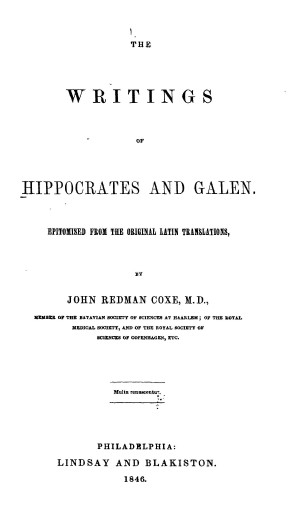
THE WORKS OF GALEN. - Hippocrates, The Writings of Hippocrates and Galen [1846]Edition used:The Writings of Hippocrates and Galen. Epitomised from the Original Latin translations, by John Redman Coxe (Philadelphia: Lindsay and Blakiston, 1846).
About Liberty Fund:Liberty Fund, Inc. is a private, educational foundation established to encourage the study of the ideal of a society of free and responsible individuals. Copyright information:The text is in the public domain. Fair use statement:This material is put online to further the educational goals of Liberty Fund, Inc. Unless otherwise stated in the Copyright Information section above, this material may be used freely for educational and academic purposes. It may not be used in any way for profit.
THE WORKS OF GALEN.The writings of Galen consist of nearly seven hundred books or treatises, of which several are lost, and they constitute a mass of materials that can scarcely be appreciated, except by direct reference to them. Originally written in the language of Greece, they have been translated into Latin by different persons; and these have passed through numerous editions, the principal and best of which may be considered to be those that have been published by the Juntas at Venice, and by Frobinius at Basil. Besides two different Greek editions, I possess in the Latin, the third of 1556; the sixth of 1586, and the ninth of 1609, all Venice copies; and the Basil edition of 1549,—from which last I have chiefly formed the following epitome. The editors of the Latin copies stated, have divided the writings differently from the Grecian. They have, however, carefully collected, not only those admitted to be from Galen, and complete, but likewise such as are spurious and imperfect.a The writings of Galen in the Latin editions, have been principally divided into seven classes, embracing all the range of medical science, as will be comprehended by a concise exposition of the plan pursued. These classes are preceded by the Prolegomena, or introductory books, denominated Libri Isagogici.b They will be found in some measure to form an epitome of the whole, giving some general ideas to the reader of what may be expected in those that follow. CLASS I.This class embraces Physiology.a —Its different books are consequently devoted to the consideration of the nature of the human body, its elements, temperaments, humours, various structure and habits, the anatomy and use or functions of the various parts, together with their respective faculties or powers; observations respecting the seminal fluid and the fœtus, as necessarily connected with the subject of generation. In this class some of the most interesting works of Galen are introduced. CLASS II.This class embraces Hygieneb —or the means of preserving health, chiefly constituted of the various so-called non-naturals; viz.: air, food, drink, sleep, wakefulness, rest and motion, repletion and abstinence; and the affections and emotions of the mind. Herein too, we find several commentaries of much value, on some of the books of Hippocrates, as for example, three, on the celebrated treatise “De Aere, Aquis, et Locis;” and on that “De Salubri Diæta.” Much is said of the powers of food; of the healthy or unhealthy state of the fluids: of the ptisan, so celebrated by the Grecian practitioners. Some mental affections are also considered; some gymnastic exercises; the influence of habits and customs, &c.; and it will be found, on the whole, a class of considerable interest. CLASS III.Is Aëtiologicalc —that is, explanatory of diseases, and of their different symptoms and causes, &c., all which are taken up in succession, and are duly considered. Some of the books of this class are commentaries on various Hippocratic writings, especially on the Epidemics, and are a valuable addition to the reader, in enabling him to comprehend them more readily. CLASS IV.Semeioticsa is the division of medicine that is connected with the symptoms which distinguish diseases and the parts affected, and by which, likewise, we are enabled to predict what is subsequently to happen; that is, the prognosis, derived from the attendant symptoms, as evinced by the pulse, by respiration, excretions, &c. In this class are several commentaries on Hippocrates, viz., his Prognostics and Prorrhetics. The subjects of crises and of critical days are also duly noticed; together with much interesting matter of a highly practical character, and which will amply repay the attentive perusal of these books. CLASS V.pharmacybor preparation, etc., of remedies. This class embraces all that is connected with simple remedies and their preparations and substitutes; purgatives, antidotes, compounding of medicines, weights, and measures. The class is of considerable interest, as giving probably the best history we possess of the various articles at that period employed in practice. We find many that have reached our own times, and which, consequently, may be deemed to have received the sanction of all the intermediate ages. Here too, we find the most particular details of the long-esteemed Theriaca, and of some other then-deemed Panaceas. CLASS VI.This, although by far the shortest of all the different classes, is yet one of the most interesting, embracing, as it does, under the title of “de cucurbitulis, scarificationibus, hirudinibus, et phlebotomia,” every thing connected with the evacuation of blood through their means. The importance of blood-letting is maintained in opposition to Erasistratus, who seems to have been nearly as violent an opponent to it as old Van Helmont in times nearer to our own. Galen likewise attacks, with equal severity, the followers of Erasistratus, and shows, that, whatever they might say, they either did not comprehend their master, or if they did, that they made no scruple to deceive on the subject. CLASS VII.therapeutics.a This class, which in its different books, is more or less diffusely considered, contains, as may be understood from the title, every thing appertaining to the practice of the profession, such as diet in acute and other diseases; remedies for each disease, &c.; the principles and practice of surgery, embracing the treatment of fractures and luxations, the description of bandages, &c., (fasciarum et laqueorum,) and of the different apparatus. We find also several commentaries on different books of Hippocrates, which serve greatly in their elucidation. CLASS EXTRAORDINARY.The above class closes the regular writings attributed chiefly to Galen. The present one is formed of those that are probably his also; but which are more of an aphoristic character. They are, however, of great interest, containing, as they do, commentaries on the Hippocratic aphorisms, as also an explanation of many obsolete words that are found in that author. Superadded to this extra-class we have a variety of those spurious writings that have been attributed to Galen. Whether spurious or not, many of them abound in interest, and deserve to be known. They amount to nearly forty distinct essays or tracts, and they are followed by numerous Fragments, appertaining to different parts of medicine, which have been considered as derived from Galen; and which, although mere fragments, possess considerable interest. In estimating the above as a mere table of contents, we may venture to state, that the writings of this great man will, without difficulty, arrange themselves under the following heads,—and amongst them, scarcely will there be found wanting a single subject, that in any way appertains to medicine.
Can it be possible that such a writer can be devoid of merit, and his works undeserving of examination in the present day, when it is remembered, that for more than one thousand years they maintained a supremacy, that has never been exceeded, perhaps not even equalled! I now proceed to present a concise notice of all the different works that are to be found in the above-mentioned classes. PROLEGOMENA,
[a ]I have lately added to my collection the edition by Kuhn, in 20 vols. 8vo., containing both the Greek and Latin texts, and which is infinitely more convenient for reference than the ponderous folio. [b ]Εισαγωγη.—Introductio, Lexicon. Hence students, as beginners, are called by Galen, εισαγομενοι, i. e. Tyrones.—Lib. de Pulsibus ad Tyrones. [a ]Φυσιολογια.—Idem est, quod Physica, vel specialiter in medicina ea dicitur pars ministra, quæ explicat tres res secundum naturam, puta sanitatem, causas ejus, et accidentia, in rebus naturalibus corporis humani fundatas.—Castelli Lexicon Medicum. [b ]ϒγιεινη.—Vocatur methodi medicinalis pars prior, quæ tractat modum sanitatem conservandi in sanis per certas indicationes et congrua media.—Castellus. [c ]Αιτιολογια.—Vocatur quibusdam medicinæ pars pathologica, in qua non solùm caussæ morborum, sed et morbi ipsi et symptomata pertractantur.—Castellus. [a ]Σημειωτιϰη.—Est pars medicinæ signorum omnium differentias et vires expendens.—Castellus. [b ]Φαρμαϰευτιϰη.—Vocatur pars ministra artis medicæ, tradens descriptionem medicamentorum et rite adhibendi modum.—Castellus. [a ]Θεϱαπευτιϰη.—Pars medicinæ curatoria;—methodus medendi.—Castellus. |

Titles (by Subject)