EconlibThe LibraryOther Sites |
Front Page Titles (by Subject) ON AIRS, WATERS, AND LOCALITIES. - The Writings of Hippocrates and Galen
Return to Title Page for The Writings of Hippocrates and GalenThe Online Library of LibertyA project of Liberty Fund, Inc.Search this Title:Also in the Library:
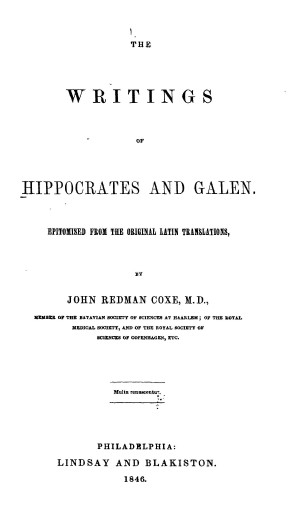
ON AIRS, WATERS, AND LOCALITIES. - Hippocrates, The Writings of Hippocrates and Galen [1846]Edition used:The Writings of Hippocrates and Galen. Epitomised from the Original Latin translations, by John Redman Coxe (Philadelphia: Lindsay and Blakiston, 1846).
About Liberty Fund:Liberty Fund, Inc. is a private, educational foundation established to encourage the study of the ideal of a society of free and responsible individuals. Copyright information:The text is in the public domain. Fair use statement:This material is put online to further the educational goals of Liberty Fund, Inc. Unless otherwise stated in the Copyright Information section above, this material may be used freely for educational and academic purposes. It may not be used in any way for profit.
ON AIRS, WATERS, AND LOCALITIES.
This book, says Haller, has always been esteemed as one of the genuine writings of Hippocrates. It has been commented on, and illustrated by Galen, and various writers since his time. Its language becomes the Father of Medicine, and its reasoning is sound. The book chiefly treats of as to what the body suffers from winds, waters, seasons, climates, and localities. It begins with a consideration of the exposure of the Grecian cities to various winds, and of their influence and effects. Next it treats of waters derived from different sources; incidentally adverting to calculus, as arising from their impurities, and as being less frequent in females, owing to the shortness of their urethra. It then proceeds to notice the diseases depending on different seasons of the year; and finally it treats of climates, as connected with the temperaments, customs, and diseases of their inhabitants. Should however this book be critically examined, it will be found, continues Haller, to contain some things [many!—Ed.] that do not tally with present experience, such as the affirmed connexion between the diseases of a people and their habits and winds. Waters from earthy sources are preferred to those of rocky origin; and some subjects are singularly admitted, that are altogether undeserving of credit, yet which are apparently fully believed by the writer; particularly respecting the effeminacy and impotency of the Scythian nobles, together with the absurd treatment of the complaint, by section of the veins behind the ears! It treats cursorily also of the Amazons, and of the custom of burning off their right breast, in infancy, together with some other curious facts and speculations. This book has been often translated, and it is incessantly quoted by medical men, when the qualities of the atmosphere are the subject of investigation. Dacier has translated it into French, but I have never seen it. Clifton has given a version of it in English, about a century ago.—Ed. Whoever desires to understand medicine thoroughly, can by no means neglect the subjects I am about to consider. The different seasons of the year, and what each is capable of effecting, will prove a source of reflection to him. They differ altogether from each other. Diversity exists in their respective constitutions, and even in their individual variations. We study the winds both as to heat and cold; those that are common to all countries, and such as are peculiar to certain regions. We ought also to examine the properties of the waters; since all are not alike in taste or gravity, so neither are they in virtues. Whoever, therefore, arrives at a town, of which he is not an inhabitant, should begin by regarding its position in relation to the winds and to the rising of the sun; he will not consider it as a matter of indifference whether its exposure is to the north, the south, the east, or the west; on the contrary, he must have a strict regard to its position, and to the nature of its waters; he must examine whether they are muddy, hard, or soft; if they pass through high and stony places; if of a saline nature, and if they set light on the stomach, and are well adapted for cooking vegetables. He should inspect the soil, and notice whether it be naked and arid, or covered and moist; if sunken and sultry, or high and airy. He should investigate the mode of living of the inhabitants, whether they are sots and gluttons, if idle or laborious, fond of exercise, moderate in eating and drinking; all these particulars are deserving of attention, and whoever makes himself with all of them fully acquainted, or at least of the greater part, will learn, when arriving at a town he has not frequented, the nature, both of the endemic diseases and of the general affections that should there be prevalent. He will not be unprepared for their treatment, nor will he commit those errors to which all are liable, who undertake to practise without these preliminaries. He can foretell what diseases ought to afflict the majority of the inhabitants in different seasons, in winter or in summer, and the danger to which they are exposed by a change of diet; for, if well acquainted with what such changes induce by the succession of the seasons, and the rising and setting of the stars, he will be enabled to foresee the constitution of the entire year. Acquiring thus a component knowledge of these different subjects, he will distinguish what is essential for the maintenance or re-establishment of health, and will prove highly successful in the practice of his profession. Should it be objected, that the information I thus require, appertains to meteorology, I reply, that a knowledge of the situation of the heavenly bodies is not one of the parts least essential to form the physician; on the contrary, it is highly useful. The succession of the seasons is accompanied with remarkable changes in all the cavities of the human body. I shall, therefore, state as clearly as I can, what regard we should have to all these circumstances, and what we may deduce therefrom. A town exposed to the hot winds that blow between the rising and setting sun of winter, viz., from the south, and which are common to it, whilst it is protected from those of the north; such town has abundance of water, slightly saline, and arising necessarily in elevated places; hence they are warm in summer, and cold in winter.a If the summer is dry, diseases are of short duration; but if wet, they are of longer continuance. From the most trifling causes, wounds degenerate into eating ulcers. If the winter is cold, the head abounds with moisture and pituita, which fall upon the bowels, and often induce gastric affections. The constitution of the inhabitants is in general relaxed. They are neither great eaters nor hearty drinkers, for they who have weak heads can never make stout topers, since wine readily overpowers them. Now the following diseases are there the most common. Women are subject to catarrhs, and many are barren, rather from disease than from nature; abortions are frequent. Children are subject to convulsions and suffocations, that are often confounded with epilepsy. The men have dysenteries, diarrhœa, and epial fevers,b eruptions like flea-bites, chronic fevers of winter, and hemorrhoids. Few pleurisies are there seen, or peripneumonies, ardent fevers, and other acute diseases; such cannot be frequent where the bowels are relaxed. There are moist ophthalmias, that are neither dangerous nor of long duration, unless a change of season renders them epidemic. After fifty years of age, they are exposed to a kind of humour coming from the brain, which, if arrested, brings on palsy, or affections from the rays of the sun, or colds in the head. Such are the usual diseases in the places I have described, independent of epidemics caused by a change of season. Places situated in an exposure directly opposite, where the winds are cold, and usually blow from between the east and west, that is, from the north; and which are free from both south and all hot winds, have this in common. The men there are strong and not very fat; with large breasts and small bellies; they abound with bile rather than with pituita; their head is sound and dry, and they are subject to hemorrhages. The following diseases are there common. Pleurisies, and all diseases called acute, as must necessarily be the case, the belly being hard and constipated: internal suppuration is not uncommon, depending on the distension of the body and dryness of the belly; this dryness co-operating with the coldness of the waters, occasions ruptures of the vessels. With such constitutions, they ought to be great eaters and moderate drinkers, for it is scarcely possible to combine both in one person. We also find there, dry and violent ophthalmias, which soon run to suppuration; hemorrhages from the nose in young people, especially in summer; a few epilepsies, but of a violent character. The term of life is in general longer than elsewhere; wounds do not inflame nor take on a bad state: the manners are rather rude. Such is the state of things, independently of diseases induced by change of seasons. Women are there subject to hard tumours, owing to the cold and crude waters. Their catamenia are irregular, small in quantity, and painful. Parturition is laborious, but abortions rare. After delivery, the mothers can rarely nourish their children; their milk fails, owing to the crudeness and hardness of the waters; and many, after delivery fall into phthisis, caused by convulsions, and rupture of vessels, the result of violence. Children whilst young, are subject to hydrocele, which disappears as they advance to maturity; puberty is, however, tardy. Thus far I have stated what has reference to towns exposed to hot winds, between the beginning and ending of winter, and those of an opposite direction, blowing between the rise and termination of summer. We are now to speak of cities located towards the east. Such ought necessarily to be more healthy than those having a north or south exposure, although lying between both; for the heat and cold are there less felt, and the waters, whose springs are exposed to the east, are quite clear, soft, inodorous, and pleasant to drink: the morning sun, by its rays, purifies them as it does the air; hence the men have a good colour, and much vigour, unless affected by sickness; their voice is clear, and they are more lively and intelligent than the inhabitants of a northern exposure. The productions of the earth moreover are superior. In a town thus situated, in which the heat and cold preserve the temperature of spring, diseases should be mild and few in number. They are chiefly of the same character with those in cities looking towards the warm winds. The women are very fruitful, and have easy labours. Such are the circumstances in such exposures. As to places looking to the west, and which feel no winds from the east, but are exposed to those from the north and south, their position beyond all others is most favourable to disease. The waters are not clear, because the morning air, usually surcharged with moisture, prevents their limpidity, the sun dissipating it only after it has advanced in its course. During summer, the early breezes cause an abundant dew, whilst during the remainder of the day, the heat scorches and oppresses the inhabitants. Hence their complexion is bad, and they have little vigour; they are liable to every disease I have mentioned, without an exception; their voice is hoarse, owing to the air, infected with the miasmata of disease, and from which it is not purified by northern winds. Those which blow, are charged with moisture, for the western winds place the atmosphere in a state resembling that of autumn; and a town thus situated, therefore, partakes of all the inconveniences which the evenings and mornings bring with them. Such are the remarks I have to make as to good or bad exposures, so far as relates to the winds. We pass to the consideration of the waters; and to the examination of such as are good or bad, as on this chiefly depends the state of our health. All waters that are stagnant, muddy, marshy, are necessarily heating. They are always thick, and smell badly in summer. As they have no current, and are maintained by the rain alone, they must naturally be of a bad colour, heavy, and bilious. Cold and frozen in winter, and disturbed, sometimes by snow or ice, they become a source of pituita and catarrh to those who employ them; they enlarge and indurate the spleen; they heat and constipate the belly; they cause a shrinking of the shoulders, the neck, and the face; the flesh seems to disappear in order to augment the spleen; hence men become thin although great eaters and drinkers; their belly is with difficulty discharged either upwards or downwards, so that they require powerful cathartics both in winter and summer. They are subject to dropsies, which are mostly fatal; and dysenteries, diarrhœas, and obstinate quartans are common in summer. These diseases naturally lead to dropsies terminating in death;—such then are the summer affections. In winter, young people are subject to peripneumonies and to diseases accompanied with delirium; and old people to ardent fevers arising from costiveness; women, to œdema and leucophlegmasia; they are not readily rendered pregnant, their labours are difficult, and their offspring gross and œdematous; they nourish them with difficulty, for suckling induces phthisis; their lochial discharges are imperfect; their children, especially the males, have hernia and varices of the legs. It is easily seen, that with such waters, long life is not to be expected, but a premature old age. I add, moreover, that females often think themselves pregnant when not so; their bellies after parturition become flabby. I esteem these waters, then, as altogether bad. Let us now advert to waters proceeding from rocky mountains: such are necessarily hard, especially if arising in places where there are warm springs, with metallic impregnations of iron, copper, silver, gold,—or of sulphur, alum, bitumen, or nitre; for all such are the products of a violent heat. In such situations the earth cannot yield pure water, but such only as are hard and sharp, passing off by urine with difficulty, and producing costiveness. They are better if they flow from high and earthy elevations; such are soft and clear, and bear to be mixed with wine. They are warm in winter, and cool in summer, as is the like case with deep springs. Those are preferable that flow towards the east: they are always clear, light, and of a pleasant odour. Saline, hard, and refractory waters, are absolutely bad for common drinking; yet there are temperaments and diseases in which they are useful, as I shall presently notice. We ought to regard as the best of these waters, those whose springs have an eastern exposure; and next to these, such as being between the east and west, are nearer to the east; and in the third set, such as rise in the south: they are bad in proportion as they look to the south, between the setting and rising sun of winter; those to the south are bad, but less so than those to the north. The mode of using them is as follows: every strong and healthy man may dispense with a choice of waters, and be satisfied with such as he can procure; but when, from disease, the most appropriate drink is requisite, the following plan is to be pursued. If the patient is easily heated, and is costive, he must employ the mildest, the lightest, and most limpid water. If the bowels are relaxed, moist, and mucose, then saline, hard, and refractory ones are useful. It is natural that waters that readily boil, should evacuate, and, as it were, melt down the belly; whilst such as boil with difficulty, and are hard and refractory, ought to bind and dry it up. Many deceive themselves as to the influence of salt waters, considering them as being laxative, whilst they possess a directly opposite power; their refractory nature and difficult coction render them much better fitted to dry than to moisten the belly. All here mentioned is correct as to spring water. Let us now consider that of rain and melted snow. Rain water is light, sweet, thin, and limpid; the sun carries off and raises the essence or lightest part of such waters, as we see demonstrated in making of salt; the dense and heavier parts remain and form salt, the lighter parts are raised by the sun, which deprives also, not only stagnant water, but also sea water of its lighter parts, as well as every thing that is usually moist. Now all bodies possess moisture; even from man himself, the sun carries off a slight dew, as we clearly perceive when he is walking or exposed to the sun; those parts of his body that are covered are moist with sweat, whilst the uncovered parts are dry, because the rays of the sun carry off the sweat as it forms, but suffer it to collect on the former, if protected by covering or in any other way: the heat of the sun forcibly abstracts the sweat, but the covering precludes evaporation. If he goes into the shade his whole body is covered with sweat, because the rays of the sun are prevented acting on it. Rain water readily corrupts and acquires a bad smell, owing to its being constituted of emanations from all sorts of bodies, whence a great disposition to putrefaction results; moreover, these vapours raised from bodies are carried to the highest parts of the atmosphere in all directions, and mix with the air; those that are thick and darkest, separate as dense clouds, the lighter parts remain suspended, and become attenuated and heated by the sun, and thereby ameliorated, diffused, and carried into the atmosphere. When thus collected together, they break when approximated by opposite winds; for it is highly probable that this happens whenever clouds, agitated and driven on by the wind, suddenly meet with others impelled in an opposite direction. They intermingle and become thicker by those succeeding; as they thicken they grow still darker, and at length break, precipitate by their weight, and fall down as rain. This rain water is very good, but requires boiling to divest it of its tendency to putrefaction and to a bad odour, and makes the voice of those who drink it thick and hoarse. Snow and ice water are always bad. When water has been frozen, it never assumes its first nature. Its limpidity, mildness, and softness are separated and dispelled, its coarser and more fixed parts remain. To be convinced of this, place, if you choose, in winter, a certain measure of water to freeze; melt it again the next day in a sheltered situation, and measure it; it will be found to be greatly diminished, and hence it results that the lightest and most attenuated parts are dissipated, for it is impossible it should be the coarser and more ponderous. We may therefore conclude such waters to be injurious, and here we leave them. Men are liable to the stone, to nephritis, colic, and strangury, to sciatic pains and hernia, when they employ as drink waters of different nature, as of large streams into which rivers empty, or of lakes which receive different rivulets; and generally from drinking water coming from a distance, for it is impossible that all waters can be alike. Some are soft, others saline, some aluminous, and some arise in places abounding in warm springs. When waters so various are mingled together, they necessarily act on each other; the strongest prevails, but it is not always the same one that is the strongest, sometimes the one, sometimes another. Besides, the winds then produce great changes; those from the north give a greater power to the one; from the south to another, and thus of the rest; they ought, consequently, from their intermixture, to deposit sand in the vessels of the bladder, and produce in those who drink of them the disease I have mentioned. Let us see why all are not thus affected. Those whose bowels are relaxed and moist, whose bladder is but little irritable, and have a large orifice, such persons pass their urine readily; but those whose belly is very hot, have the bladder necessarily in a like disposition, and when thus heated, its neck is equally so; hence the urine cannot so readily escape; it is, as it were, parboiled; the lighter and purer parts escape, the gross and thicker parts remain, consolidate, and harden. At first this is merely a small nucleus, and slowly increases. By motion in the bladder it attaches that which from time to time is deposited; thus it augments and forms a calculus. When the person makes water, the urine propels the stone to the orifice of the bladder, which arrests its flow, and causes severe pain. It is on this account that children with calculus pull forward the penis, striving thereby to displace the obstacle that prevents the urinary discharge. A proof that the stone is thus produced, is, that persons thus attacked, pass limpid urine like whey, nowise earthy nor gravelly; the thick and bilious parts remain in the bladder, and uniting, form at last a stone. It occurs also in infants, from their milk, when that is unwholesome, bilious, and heated; it induces heat of the bladder and intestines, and the urine becomes scalding. I affirm that it is better to give them wine well diluted, than such milk, for it dries the vessels less, and induces less heat. It is different in women; in them the urethra is shorter and larger, hence they make water more readily; nor do they thus violently rub the parts, as boys do, to enable it to pass, and consequently do not irritate the urethra opening in the vagina. Women having such a ready passage, generally void more urine than men; and these are probably very nearly the circumstances connected with the formation of calculus. As to the constitution of the year, we may by attention discover which will be healthy or the reverse. Whenever the signs or phenomena correspond with the setting or rising of the stars, when the autumn is rainy and winter moderate, neither too dry nor too cold, when occasional showers fall in spring and summer, such a year ought naturally to be very healthy. If the winter is dry and constantly chilled by the north wind, the spring rainy, and heated by the south winds, the summer will necessarily bring with it numerous fevers and ophthalmias. The earth, moistened by the rains of spring, and heated by the south winds; the summer heat and the moisture from the heated soil, induce humidity of the belly and brain. It is impossible that with such a spring, the body should not be overloaded with bad humours. Hence arise acute epidemic fevers, more common to those who abound in pituita. They will likewise have dysenteries, as well as those of a moist temperature. If at the risinga of the Dogstar rain should abound, and if the Etesian winds from the northeast fail not to come, it may be hoped that the diseases will terminate, and autumn prove healthy; if otherwise, there will be great mortality amongst women and children, but not amongst old people; fevers will degenerate into quartans, and terminate in dropsy. When the winter is moderate, accompanied with showers and south winds; when spring is dry and cold, with north winds, pregnant women, who expected parturition in spring, miscarry, or else the offspring are weak and unhealthy, and soon die; or should they survive, they will be small, languishing, and unhealthy. Dysenteries and dry ophthalmias will occur, and catarrhs in the head, falling upon the lungs. Men of humid temperaments and females, will have catarrhs, resulting from the pituita flowing from the brain. Bilious persons will have dry ophthalmias, owing to the heat and dryness of their flesh. Old people will have catarrhs, dependent on tumid and enlarged vessels, so that some will be carried off rapidly in a state of frenzy; others fall into palsies of the right side; for the winter being warm and rainy, neither the body nor the vessels are strengthened. The spring succeeding, with north winds, drought and cold, the brain, which at this season ought to be cleared of those gross humours producing stoppages in the head and hoarseness, becomes stuffed up and swells, so that when the summer heats arise, great and sudden changes ensue, with diseases ending in dysentery and dropsy, because the belly cannot readily become dry. When the summer is rainy, accompanied with south winds, and autumn is the same, the winter of necessity must prove sickly; especially in pituitous persons, and those above forty years of age. Ardent fevers will prevail, and the bilious will suffer from pleurisies and peripneumonies. If summer is dry, with north winds, and autumn rainy, with south winds, we shall have in winter affections of the head, paralysis, hoarsenesses, oppressive coughs, and some consumptions. When summer is dry, with north winds, without rain at the rising of the Dogstar and Arcturus, at the close of summer and beginning of autumn, it is favourable for people of moist temperament and for women, but the reverse for such as are bilious. It dries them too much, and gives rise to ophthalmias and acute fevers, to chronic fevers and to atrabilious complaints; for the more watery parts of the bile are dissipated, leaving only the thicker and more acrid parts. It is the same with the blood, and hence the source of these diseases. Such a season is however favourable to pituitous persons; they lose their excess of humidity, and are thus in a good condition at the arrival of winter. Whoever will consider all the above circumstances, and pay attention to them, may predict the greater part of the evils induced by the change of seasons. He must be guarded at the epoch of such great changes, not to give purgatives too freely, nor apply fire near any cavity, nor make incisions, until at least ten days after such changes. The two solstices are dangerous, especially that of summer;—the two equinoxes are likewise to be feared, particularly that of winter. The rising of the constellations should also be noted, particularly the Dogstar, then Bootes; and Pleiades at their setting; for on those days many diseases terminate, fatally in some, in others in health. Every thing assumes another aspect, and undergoes a change. Thus much on this subject. [a ]On the contrary, a town that has a good exposure to the sun and winds, has excellent water that is less influenced by the seasons. Where marshy and muddy waters are employed, and the exposure to the sun and winds is bad, then the change of seasons is severely felt.—Gardeil. [b ]A species of continual fever. [a ]Exortum, Hal., Fœsius; sitting, Clifton. |

Titles (by Subject)