Econlib

The Library

Other Sites

Front Page arrow Titles (by Subject) arrow SECTION II. a: THE BOOK OF PROGNOSTICS. - The Writings of Hippocrates and Galen

Return to Title Page for The Writings of Hippocrates and Galen

Search this Title:

Also in the Library:

Subject Area: Science

SECTION II. a: THE BOOK OF PROGNOSTICS. - Hippocrates, The Writings of Hippocrates and Galen [1846]

Edition used:

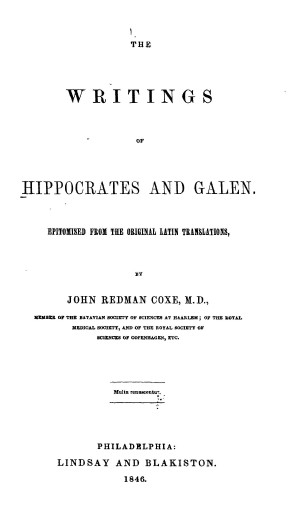
The Writings of Hippocrates and Galen. Epitomised from the Original Latin translations, by John Redman Coxe (Philadelphia: Lindsay and Blakiston, 1846).

About Liberty Fund:

Liberty Fund, Inc. is a private, educational foundation established to encourage the study of the ideal of a society of free and responsible individuals.


SECTION II.a

THE BOOK OF PROGNOSTICS.

HIPPOCRATIS PRÆNOTIONUM LIBER,FŒSIUS, Treat. i. p. 36.
HIPPOCRATIS PROGNOSTICON,HALLER, i. p. 166.
TRAITÉ DES PRONOSTICS,GARDEIL, i. p. 29.

This book is uniformly considered as one of the genuine writings of Hippocrates. In the preface to it, Haller speaks of it as “containing all the symptoms, good or bad, of diseases, as derived from every source, and arranged in a natural order, which is unusual for him. The first symptoms are drawn from the countenance, the mouth, the lips, and eyes: next, from the decubitus; then from the appearance of wounds or ulcers; from tossing about of the hands, or picking the bedclothes; from respiration, sweat, the state of the hypochondria, swelling of them, or of the belly. It next treats of suppuration; of dropsical symptoms in acute diseases; of the power of the patient in sustaining his disease; his limbs, &c., as to colour, temperature, and sense of feeling. Of sleep, alvine discharges, urine, vomiting, sputation, and of empyema from an acute disease; of auricular abscess—paraphrenitis—inflammation of the bladder; general termination of fever, acute pain of the head, and ears; ulcers of the throat, and angina; tumour of the uvula; termination of fever in abscess; prognostics of vomiting, and of nasal hemorrhage, and convulsions. Towards the conclusion, Hippocrates demonstrates the absolute necessity of the various symptoms enumerated, as the basis of a faithful prognosis. Adding that those symptoms, which in Greece are good or bad, are equally the same in every other country: that even in Scythia, whoever is acquainted with them, is capable of prognosticating. The same prognosis holds good in relation to diseases not mentioned, but which terminate on the same days. The careful observation of epidemics and of the atmospheric constitution, is enforced. The pulse alone seems to be here overlooked.”

In addition to the above from Haller, I shall introduce a few preliminary remarks from Gardeil, who, among other particulars, states that it has been well translated by M. le Febre-Villebrune—a work I have not seen. After saying that the first section of Fœsius contains none of the writings ascribed to Hippocrates, he thus proceeds: “It is unquestionably one of the most precious of the writings of the father of medicine. In it, the physician will find the foundation of the whole doctrine of crises, of urines, expectoration, hemorrhages, abscesses, &c., and every where a master’s hand is apparent, so that it appears perfect and complete. Such is not the case with the aphorisms,—and I think every physician would find it useful to commit it to memory. Its brevity is its principal defect. It is nevertheless highly probable, that many of our present race of doctors will ridicule many things that are to be found therein, more especially the statement relating to urines; for it is now beneath their dignity to examine the urine of the sick, or even their expectoration for the most part! My own constant observation of the urine, preserved in glasses for inspection, has confirmed me in my opinion of the correctness of the Hippocratic doctrines. In respect to the pulse, which Hippocrates attended to but in a very slight degree, I think we err in depending so much upon it to the exclusion of those particulars almost entirely, in which he had the greatest confidence.”—Ed.

A physician should endeavour to become acquainted with the phenomena of diseases. He who can inform the sick, not only of their present state, but of what preceded and of what may be expected, and point out what they have omitted to mention, will readily be esteemed as being perfectly acquainted with their disease, and they will therefore with confidence commit themselves to his care. A foresight of what is to be expected, enables him the better to fix upon his plan of treatment: a certain cure at all times is impossible, although of more importance than a foreknowledge of events. Some are carried off by the violence of disease before a physician is called on; others, immediately after; some survive for a day, others longer; time is not always afforded to employ fully the resources of our art. It is of consequence however in all cases, to know if the nature of the disorder transcends the power of the constitution; or if there is not in it something supernatural; (ϑειον τι. Hipp.; divinum, Hall., Fœs.) In all cases we ought to be acquainted with what may take place, as a means of acquiring a just celebrity, and of meriting the character of an experienced practitioner; for if a disease is capable of cure, he is the best qualified to effect it who can best guard against the evils anticipated: moreover, by being capable of prognosticating the event either of death or recovery, all blame is avoided.

In acute diseases, the first thing to be noticed is the countenance. Does it look like that of health? especially is it perfectly natural? The more it differs therefrom the worse. A sharp nose, hollow eyes, temples collapsed, the brows knit, ears cold and contracted, and their lobes inverted, the forehead hard, dry, and tense, the whole countenance pallid, greenish, black, livid or of a leaden hue. If at the commencement of disease such is the aspect, without other accompanying symptoms, in order to form a right judgment, it will be proper to inquire whether it may not depend on excessive want of rest, on violent purgation, or even on want of food. In either case, the state of the countenance is of less consequence, and the disordered system may be restored in twenty-four hours; but if it arises from other causes, and does not change in that space of time, we may safely affirm that death is not far distant. If the disease is of more than three or four days’ standing, and the countenance has assumed the above-described appearance, we must examine into the causes that could especially lead to it; at the same time attending to the signs that may exist in other parts of the body.

In examining the eyes, we should ascertain if the light affects them, or involuntary tears flow; if squinting attends, or one eye seems smaller than the other; if the white is of a reddish hue, or the lids of a livid tint, with the small vessels turgid with dark blood, the cornea coated with sordes, the globe of the eye turned upwards or pressed forward, or deeply ensconced in the orbit, with diminished transparency, and the whole countenance changed in colour; such symptoms should be considered of the worst character, and even mortal. The eyes sometimes are seen in sleep, from the lids not closing; if this is customary to the individual, it is less important, or when it arises from a diarrhœa, or from a purgative; otherwise it is a bad symptom, and usually portends death.

If the eyelids, the nares, or lips are convulsed, or cold, pale, or livid, accompanied by any other bad symptom, death is not far distant. So also may it be said when the lips remain flaccid, cold, and pallid.

With respect to the decubitus of the patient, that situation is best, that approaches nearest to that of health—as lying on the side, with the arms, neck, and legs slightly bended, with a gentle moisture over the surface? To lie on the back, with rigid neck and limbs, is bad; but if the patient slides from the pillow towards the foot of the bed, it is infinitely worse. The feet uncovered and cold, the legs, and arms, and neck the same, and in continual jactitation, are symptoms indicating great anxiety. Sleeping on the back, with the mouth constantly open, and the legs strongly interlocked, is fatal. Lying on the belly, if unusual in health, is symptomatic of delirium or severe pain. Sitting upright at the acme of the disease, is bad in all acute cases, but in pulmonic affections, indicates the greatest danger. Gritting of the teeth in fever, unless it be a long-existing habit, is a sign of approaching delirium and death: if occurring in the state of delirium, it is fatal.

Sores, both old and recent, should be noticed. If the disease is mortal, they become livid, dry, or pallid, and quite dry shortly before death.

My remarks as to the motions of the hands are the following. In acute fevers, pulmonary inflammation, phrenitis or headache, if the patient moves them before his face, to and fro, as if catching at flies or motes, or picks the bedclothes or the walls, his state is desperate.

Frequent respiration denotes pain or inflammation above the diaphragm; deep and very slow respiration announces delirium; cold exspiration from the nose and mouth is mostly a fatal sign. An easy breathing in acute diseases, with fever which terminates within forty days, is very salutary.

Sweats are beneficial in all acute diseases, if they occur on critical days, and remove the fever. Likewise when they are universal, and do not weaken the patient; otherwise they are injurious. Cold sweats, or, if limited to the head, the face, or neck, are bad, and if associated with violent fever, indicate death. If the fever is moderate, they indicate a long disease. If they form in drops, like millet seed, about the neck only, it is bad; but if universal over the body, it is a favourable symptom. Sweats arising from debility, or from violent inflammation, are never salutary.

The state of the hypochondria is best when no pain is felt there, and when they are equably soft. If inflammation and pain attend, with tension and inequality, danger is to be suspected. If pulsation is felt in them, it indicates great disturbance, or delirium. The eyes should be inspected, for if much agitated, madness is to be feared. Hard and painful tumours in the hypochondria, if extensive, are very bad; but if on one side only, the danger is less, particularly if in the left side. Death may be soon expected, if this state continues; or, if the fever and swelling extend beyond twenty days, suppuration ensues. A bleeding from the nose, of a salutary tendency, sometimes takes place within a week, which may be expected if the patient complains of headache and disturbed vision, and is under thirty-five years of age. Tumours, soft, and unaccompanied by pain, and yielding to the touch, are longer in duration, but less dangerous. If fever attends, and they do not recede within sixty days, an abscess may be expected. Such is the case in whatever part of the belly the tumour exists;—and all such as are large, hard, and very painful, announce the danger of speedy death. If soft and less painful, death is more remote. Abdominal tumours are less liable to form abscesses, if seated in the epigastrium, than if in the hypochondria. If below the umbilicus, suppuration seldom occurs. Hæmorrhage is more common from tumours above the umbilicus. Suppuration, however, is to be apprehended under all these circumstances,—and in considering this chance, we may conclude that tumours pointing outwards are least dangerous, even if extensive, whilst smaller ones, deeply seated, if free of pain, and the surface retains its natural appearance, are not often hazardous. When suppuration ensues, that pus is best that is white, smooth, and soft to the touch, without any offensive odour. It is bad in proportion as it varies from this standard.

Dropsies, supervening acute diseases, are all dangerous. They do not dispel the fever, but are accompanied with much pain, and are usually fatal. Some have their origin in the iliac regions, some in the lumbar, and others proceed from the liver. In the former, the feet swell, and obstinate diarrhœa attends, without diminution of the pain, or of the aqueous depositions. In the latter case, continual disposition to cough exists, which is harsh and dry; the legs swell, and costiveness ensues, with much pain and little evacuation. Swellings of the belly are occasionally seen, sometimes on one, sometimes on the other side; sometimes they are persistent, and at times disappear.

Coldness of the head, feet, and hands, conjoined with heat in the breast and belly, is a bad symptom. The best state consists in an equable and mild temperature over the whole body. An easy change of position is favourable; but a feeling of heaviness and weight in so doing is dangerous. If to this is added a lividity of the nails and fingers, death is close at hand; a dark or black appearance of those parts is less to be dreaded. All conjoined symptoms are to be noticed; for if the patient appears to bear his illness pretty well, and others equally favourable ensue, the formation of an abscess may be hoped for, that will prove beneficial, and the mortified parts may happily separate. A retraction of the testes and scrotum and penis are significative of severe pain and danger of death.

With respect to sleep, it ought to approximate to that of health, resting at night, and awake during the day. The reverse of this is bad. It is true that sleep from six to ten in the morning is less injurious than after that period; but it is far worse not to be able to sleep at all; whether arising from pain, or fatigue, it may portend delirium.

Those alvine discharges are the best, which have a due consistence, without being hard, and which take place at the accustomed time of health, and in quantity proportioned to the food taken in. Such are indicative of a healthy state of the bowels. If the stools are liquid, it is better that they should not be frequent and large, or accompanied with flatus. They disturb the patient—prevent sleep—and often, if too copious and frequent, induce fainting. According to the nature of the food, and its amount, two or three discharges by day, and one during the night may be considered as right, the largest in the morning, as usual in health. This, however, depends on habit. As a crisis approaches, the discharges ought to become more consistent, and of a yellowish tinge, without any very bad odour;—round worms discharged at the same time are deemed to be favourable.

In all diseases, a soft and un-enlarged belly, is a good sign. If the discharges are very liquid, white, green, or very red and frothy, all such are bad; so are also such as are small, tenacious, whitish, or greenish. The worst discharges are black, oily, livid, eruginous, and extremely fetid. Those of a mixed character may continue for a longer time, but are equally dangerous; also such as resemble the washings of flesh, bilious, porraceous, black; sometimes separately, at times commingled. Wind discharged with little or no noise is favourable; but it is better to be so discharged than to be retained. When passed with crepitus, it often indicates pain or delirium, unless indeed this is done at the caprice of the sick.

Swelling and pain in the præcordia, if recent, and not attended with inflammation, pass off by rumbling in those parts, especially if superadded to this, there is a fæcal discharge, with wind and urine; the gradual descent of the rumbling to the lower bowels is of itself a source of relief.

Urine, which, up to the crisis, deposits a white, light, and equable sediment, is the best, and denotes a short and not dangerous disease. If it be irregular, sometimes without, sometimes with a sediment, the disease will be longer in duration, and more uncertain. When it is red, and the sediment likewise, it will be longer, but safer. The sediment resembling coarse meal is bad; yet worse if it has the appearance of small scales. White and very tender sediment is pernicious; the worst of all is the branlike sediment. White clouds in the urine are good; black clouds are bad. As long as the urine continues red and limpid, no coction ensues in the disease; if this symptom is prolonged there is much danger lest the disease should be fatal before concoction can take place. The worst urine is that whose odour is fetid, and clear as water, or black and thick; of these the black is the most dangerous, both in man and woman, but the aqueous in children. If the urine continues thin and crude, whilst the other symptoms are more favourable, an abscess below the diaphragm may be apprehended. A greasy, web-like appearance on the surface of the urine, denotes a colliquation, and the danger of consumption. The clouds in the urine should be examined, whether they are high in it, or fall to the bottom; the latter, if of the good colours stated above, is favourable: but the reverse, if the colour is of the bad ones enumerated. In order to avoid deception in prognosis from urine, careful examination should be made whether any particular disease of the bladder exists; in such a case, the symptoms are declaratory only of the bladder, and not of the system.

Of vomiting.—The vomiting of bile and phlegm, if not too excessive, is very beneficial. Either of them, singly discharged, is less favourable. If the discharge is green, livid, or black, it is a bad sign; but dangerous in the extreme, should all of them combine. A livid-coloured discharge, of an extreme fetor, denotes death. Fetor of any kind in the discharges from vomiting is always bad.

Of sputation.—The expectoration in all diseases of the lungs and breast ought to be prompt and easy, and of a yellow uniform tinge. If after some continuance of pain, it is yellow or red, with much coughing, and not well mixed, it is a bad sign. A yellow unmixed sputation is bad. If white, viscid, and globular, this is also unfavourable, as is also that which is grayish and frothy. If not well mixed, and if black, it is highly dangerous. If nothing is discharged by coughing, but the rattling in the throat evinces the surcharge of the lungs, it is very bad. In all diseases of the lungs, coryza and sneezing, whether preceding or succeeding the attack, are dangerous; but in other, and even dangerous diseases, sneezing is a good symptom. Yellow expectoration, with a slight intermixture of blood, in the onset of peripneumonia, is salutary; but if this extends to the seventh day and more, less so. All sputation, unaccompanied by relief, is bad, especially if black. All are beneficial when they afford relief. Whenever, in these cases, relief is unobtained by expectoration, purging, bleeding, or by other remedies, or by diet, suppuration may be expected. If suppuration ensues whilst the expectoration continues bilious, whether alone or mingled with pus, it is very pernicious, especially if the pus is thus apparent with the bilious expectoration on the seventh day of the disease; for the danger of death on the fourteenth day is great, unless some favourable symptom should occur in the interval. Thus, if the patient sustains his disease with ease, breathes and expectorates with facility and with less pain, has his body of an equable temperature and softness, and is not very thirsty; if, also, the urine, stools, sleep, sweat, and other signs are favourable, as previously mentioned, every hope may be entertained of a happy termination; but if several of these good symptoms are wanting, he will not survive the fourteenth day. If, on the contrary, the disease is badly supported, the breathing quick and frequent, pain unmitigated, expectoration difficult, thirst extreme, unequal heat of the body, the belly and breast very hot, forehead, hands, and feet, cold,—sweat, sleep, urine, stools, of a bad character; all these are dangerous symptoms; for if any of them are conjoined with bilious and purulent expectoration, the patient will die on the ninth or eleventh day. In these conjunctures, such sputation must be deemed fatal, and as announcing death before the fourteenth day. By a comparative estimate of these good and bad signs, we deduce the prognosis, and thereby look into futurity.

Some of these abscesses break on the twentieth day, some on the thirtieth and fortieth, whilst a few extend to sixty days. We may presume that suppuration has commenced from the day that fever has shown itself, or previous chills, particularly if the patient complains of a great weight, instead of pain of the affected part, for such is the usual mode of an incipient suppuration. The time of the abscess breaking will be as above stated, reckoning from the beginning of the disease. In order to know on which side, or if only on one, the abscess exists, the patient should be turned on each alternately, and thereby ascertain if he suffers pain in one alone, and feels a greater heat in either; if lying on the sound side he feels as it were a weight pressing above it, the abscess exists in the side in which the weight is felt. The general diagnosis of an empyemaa is as follows. The fever is permanent, slightly remitting during the day, but augmenting at night, with copious sweat, cough, and tracheal irritation, with but trifling expectoration. The eyes become hollow, the cheeks red, the nails curved, the fingers become hot at their extremities; the feet swell, and the appetite is lost; pustules arise over all the body. In all chronic abscesses of the thorax, these symptoms appear, and may be depended upon unhesitatingly. But in recent empyema, the symptoms previously mentioned as occurring at the beginning of a suppuration, are present, to which may be added great difficulty of respiration. As to the prognosis in empyema, the following symptoms will guide us, as to the period of their rupture. If at the commencement there is severe pain and oppression, with cough unaccompanied by expectoration, it may be expected on the twentieth day or sooner; if the pain is moderate, the other symptoms existing as above, it will rupture later,—but previous to this event, the pain, oppression, and cough, will greatly augment. After the rupture of the abscess, those escape, in whom the fever terminates the same day, with a return of appetite and cessation of thirst. The fæces are small in amount and solid; expectoration is easy and without severe coughing, of well-concocted pus, of a uniform colour, and unmixed with phlegm: a cure soon follows. In proportion as the existing symptoms differ, in the same degree will health be postponed. If the fever does not cease, or if afterwards it returns with violence, attended with nausea, thirst, diarrhœa; if the matter expectorated is greenish, livid, and frothy, and pituitous, death will assuredly follow; but if only a part of these symptoms take place, some will die, whilst others recover after a long time. All these and every other symptom are to be attended to, in forming a prognosis. In pulmonic diseases, if abscesses about the ears ensue, or about the lower limbs, these depositions are favourable, and cure will follow. It is to be noticed in these cases, that when fever continues, with unmitigated pain, and expectoration is unduly small in amount; the stools neither bilious nor well mingled; the urine trifling, with little sediment, whilst other symptoms are favourable, such metastases may be looked for. Abscesses form in the lower extremities, when pain and inflammation about the hypochondria have existed; but in the upper extremities, when they have been free from those attendants, and the difficult breathing has subsided without any evident cause. Abscesses in the legs in dangerous peripneumonies, are always favourable; the most so, are those that take place at the time of a change in the expectoration. If swelling and pain take place, when the expectoration becomes purulent, and easily discharged, the patient will certainly recover, and the abscess will soon heal without pain. But if the sputation is bad, and the urine affords a bad sediment, there is danger of the abscess causing lameness, or great trouble. And should such abscesses disappear, and expectoration not follow, but the fever continuing, delirium and death are to be looked for. Internal abscesses from peripneumonies are usually fatal to old people. Young people are more in danger from abscesses elsewhere.

Fever, accompanied with pain in the loins or lower limbs, becomes dangerous by metastasis to the diaphragm. Other attendant signs are to be attended to, for if they are bad, the state of the patient is hopeless. If, on the contrary, they are favourable, an internal abscess may be anticipated. In all abscesses, opened either by cautery or incision, if the pus is white, and not offensive, health will follow; but if it be sanious and muddy, death is to be looked for.

Of Symptoms derived from the Bladder.—A hard and painful bladder is altogether dangerous and fatal, especially if accompanied with continued fever. The pains of the bladder are of themselves adequate to produce death. They induce such obstinate constipation, that the hardened mass can only be removed by force. If the urine becomes purulent, with a white and light sediment, the danger is removed; but if, notwithstanding, the pain continues, the tension of the bladder also, and the fever, there is every reason to expect a speedy death. This state is most usual in youth, between seven and fifteen years.

Of Fevers and their Crises.—The day on which fevers terminate, is ascertained, from observation, long continued, of the day of the recovery or death of the sick.

The mildest fevers, accompanied by the most favourable symptoms, usually terminate on the fourth day or sooner. Those of a worse character, and most unfavourable symptoms, end in death on or before the fourth day. Such is the shortest course they run. The second series terminate on the seventh day; the third on the eleventh; the fourth extends to fourteen days; the fifth to seventeen days; the sixth to twenty. Thus all acute diseases terminate in from four to twenty days, with intervals of about four days. An absolute accuracy cannot be attained; for neither are the years or months determined by a precision in days.a Another series then occurs, in which the first circuit extends to thirty-four days, the second to forty, the third to sixty days. To ascertain at first the crisis of diseases of long duration, is very difficult; it is equally so as to their absolute commencement. Strict observation is necessary from the first, and thenceforward by quaternary periods, in order to discover how the disease will end. The same order is observed in our judgment as to quartan fevers. It is easy to predict the event in diseases of a short course, for their character is different from the beginning. Such as tend to recovery, are accompanied with easy respiration, without pain; the patient sleeps well, and other good symptoms attend. Those tending to death are in all respects the reverse, and have delirium, with all the train of dangerous symptoms. Such being the case, we form our prognosis, near the period of their crisis, from their duration, and from every existing circumstance. In predicting the events which follow delivery in females, we are to reckon from that period.

In fever with violent and continual headache, with other dangerous symptoms, death generally ensues; but should it extend to twenty days, without other bad symptoms, a bleeding from the nose, or an abscess in the lower parts, may be expected. These may also be looked for at the commencement, if the pain is felt in the temples and forehead. Hemorrhage is more common under thirty-five years, and abscess after that age.

Acute ear-ache, with continued fever of extreme violence, is a most dangerous, symptom; it indicates delirium and death, and therefore demands particular attention to every other symptom from the very beginning. Death takes place, in youth, within seven days, but in adults at a much later period: the fever and delirium in these are much less intense, and the suppuration of the ears is enabled to take place. Relapses are more likely to carry them off. The former perish before suppuration is established, unless a flow of whitish pus ensues, when there is some hope, more especially if some favourable symptom should show itself.

Ulcers of the fauces, with fever, are very dangerous, particularly if any of the bad symptoms enumerated appear. Quinsies are most dangerous, and speedily prove fatal, whenever they are unattended by any sensible appearance in the neck or fauces, but are accompanied by violent pain and orthopnœa. Death in such cases often happens in twenty-four hours, although it may be deferred to the second, third, or even the fourth day. If a tumour and redness attends, the danger is imminent, and in proportion to the inflammation; but the termination is more distant. When the inflammation occupies both the throat and fauces, the period may be of yet further extension. Some under these circumstances escape; especially if the redness of the neck extends to the breast, and should not strike in. But if this erysipelas does not recede on the critical days, and no external tumefaction appears, if no pus is coughed up, the patient free from pain, and seeming well, death is indicated, or a retrocession of the erysipelas. It is less dangerous when the swelling and redness soon appear externally; but should the disease extend to the lungs, delirium follows, and it not unfrequently terminates in empyema.

When the uvula is red and tumid, there is danger in burning, scarifying, or cutting it, for it is followed by inflammation and hemorrhage. Other measures must therefore be duly employed to relieve it. But if it becomes paler, and the relaxation gives the round appearance at its extremity of a grape, whilst its upper part appears thin, it may then be safely removed. It is proper to purge gently before the operation, if the hazard of immediate suffocation will admit of the delay.

When fevers disappear without the accompanying favourable signs at the critical periods, a relapse may be apprehended. If they continue for a long period without any inflammation or other manifest cause of pain, an abscess with tumour and pain in some of the joints, especially of the lower extremities, may be looked for;—such occur more speedily, and more frequently in persons under thirty years of age, and rarely until the fever has continued more than twenty days. Old people seldom suffer in this way, even in fevers of the longest duration. Such abscesses occur in continued fever; but if it is erratic in its type, and comes and goes, it will, as autumn advances, be likely to assume the quartan form. And, as above stated, abscesses are more common before the age of thirty, so after that period and in old age, quartan fevers are predominant. Abscesses are more common in the winter; they are longer in healing, but are less liable to recur.

Of vomiting.—Whoever labouring under a fever that is not dangerous, complains of violent headache, with cardialgia, and nubiculæ floating before his eyes, will vomit up bile. If rigor accompanies those symptoms, and the inferior parts of the præcordia are cold, the vomiting is at hand and will be hastened by eating or drinking. Those who suffer from headache at the time of attack will have it augmented on the fourth and fifth days, and on the seventh it will terminate. It is more usual for the headache to begin on the third day; the fifth is then the worst, and the ninth or eleventh it ceases. Should it begin on the fifth day, and be in other respects as above mentioned, the disease ends on the fourteenth. Such is the case with adults, both males and females, in tertians especially. In young people also, but more so in continued fever, and those of a true tertian type. When in these sorts of fever headache occurs, and weakness of vision, or sparks appear, with tension of one or the other hypochondria, without pain or inflammation, epistaxis and not vomiting may be expected. This, especially in young people; it is not so common beyond thirty, and in advanced life: in these, vomiting may be expected.

Of convulsions.—When children have an acute fever, with costiveness, insomnia, and are readily terrified and cry, with frequent change of colour from florid to pale or yellowish, convulsions may be anticipated. These readily take place from the slightest causes in infancy to seven years; beyond that period, convulsions in fever are more uncommon, without the attendance of such dangerous symptoms as are seen in phrenitis. Our prognosis in the diseases of children, both of health and death is, as in other cases, to be deduced from all those symptoms that have been mentioned: we mean in acute diseases, and those which result from them. Now, whoever wishes to foretell whether health or death will take place, or whether the disease will be long or short, ought to make himself fully acquainted with all the symptoms and their respective strength, especially as to those derived from urine, and from expectoration in which there is a mixture of pus and bile. He must also be able to determine promptly, the nature of existing epidemics, and the constitution of the atmosphere—never forgetting, that in every year and season bad symptoms are the evidences of ensuing evil, and good ones of a fortunate issue. Such as I have described, are equally true as to Lybia, Delos, or Scythia. The verification of our prognosis in those regions will not surprise, if given with deliberate judgment, and an accurate estimate of all the symptoms. Those diseases that have not here been spoken of by name, are all to be judged of by the same indications when their crises occur in the same periods.

HIPPOCRATES ON THE HUMOURS.a

DE HUMORIBUS,FŒSIUS, Treat, ii. p. 47.
DE HUMORIBUS,HALLER, i. p. 89.
DES HUMEURS,GARDEIL, i. p. 57.

In his preface to this treatise, Haller tells us that Galen appears to have thought it genuine, since he wrote a commentary upon it, or else upon another that has been lost. Mercurialis considered it doubtful, since ancient critics mostly repudiated it. To me, says Haller, it seems genuine, and the production of the writer of the treatise, “De Locis,” for we find in it the same alternating superiority of bile and pituita, that is there depicted. It also contains some things that are to be found in the first Epidemics, a book that is undoubtedly genuine; as well as some aphorisms, the same to a word, as in the book under that title. It possesses, moreover, the brevity of Hippocrates; for we find the names of things alone, without the slightest comment. It commences with a theory of the humours, and of their various tendencies. It briefly rehearses the signs of diseases, and the common rules of practice; notices the critical days, and the power of different ages, years, and winds, and affords examples of metastases from the Epidemics.

In its general character it consists, according to Haller, of medical precepts, relating both to the sick, and to the diseases themselves, their different sources in atmospheric changes and constitution; how to foretell those different constitutions from the existing diseases, and of the preventive powers of hemorrhoidal affections.

According to Gardeil, if this treatise is compared with a commentary on it, by Galen, it will be found to be mutilated in several places. Haller has conveniently divided this treatise under eight short chapters, in which I follow him, with the heading to each one.—Ed.

CHAPTER I.

The collection of humours is to be conveyed away by appropriate channels at proper times, or must be resolved by derivation, revulsion, and other means.

The colour of the humours, unless deep-seated, is perceived, like an efflorescence on the skin. When they tend at any time to break forth, they should be directed through their appropriate excretories, with the exception of such as require time for maturation,a observing carefully, whether their tendency is outwards or internally, and taking every due precaution, by attention to the rise of symptoms, and to any difficulty they may present. The state of the hair, of the viscera, the fulness of the lower parts, and the good state of the superior; what has a tendency of its own accord, either upwards or downwards, and what appears injurious or beneficial; what is in conformity with custom, region, age; the state of the season, and nature of the disease; what is deficient, or in excess, or altogether wanting. The discharges, remedies, variation or decline of disease, or its tendency to the head or sides, or downward by revulsion from the upper parts,—or upwards, from the inferior. All these particulars require attention; so also as to what parts require desiccation, or moistening, or other means of relief. Effused fluids are to be prevented returning, and their passages are to be dried up. Disturbance in the bowels, how to cleanse them; if abscess threatens in the fundament, and if to be remedied by medicine or by suppuration; if there is a congestion, or appearance of pustules,b a discharge of flatus, or food, or worms, or great heat, or any other disease.

CHAPTER II.

What is to be regarded by the physician—Activity essential in the art of medicine—Considerations respecting irregularity of humours—Of infra-umbilical pains.

Notice is to be taken of what terminates spontaneously; if the pustular eruptions arise from heat, and if they are injurious or beneficial. So too, we are to observe the form, mobility, elevation, and depression of tumours, sleep, insomnia, anxiety, jactitation; and thus foresee what we are to do, and what to avoid. Attention is required as to vomiting, purging, expectoration, nasal mucus, cough, flatulence both up and down, singultus, sneezing, urine, tears, itching, excoriation, palpitation, thirst, hunger, repletion, dreams, facility or inaptitude to work. We are to attend to the state of the mind, as developed by its ideas, by memory, speech, and taciturnity.

In female affections, regard is to be paid to the uterine discharges; if upwards, inducing tormina; if sebaceous, uniform, unmixed, frothy, hot, acrimonious, eruginous, of different colours, feculent, bloody, not flatulent, crude, concocted, dry, and also the discharges of the parts adjoining. How all these are sustained, and when and how they are to be checked; which tend to maturation, and to be evacuated downwards; the fluctuation of such as are seated above, or are discharged from the uterus; the sordes from the ears; the maturation, rupture, discharge, heat or coldness, both internally and externally. Intestinal tormina below the umbilicus are less intense and frequent than when above.

CHAPTER III.

Alvine evacuations considered.

We are to notice the character and appearance of the alvine discharges, if, or not frothy,—whether crude or concocted, cold, fetid, dry, moist, or very offensive. Does thirst arise without great heat, or other apparent cause? Examine the urine, and nasal moisture; is there great jactitation and heat of the body, and difficulty in respiration? How are the præcordia and extremities, the eyes, the countenance, the pulse? Is there palpitation, rough cuticle? How is the state of the tendons and joints, of the voice, mind, person, hair, and nails? and how does the patient bear his sickness? All these are so many symptoms for our attention.

Other symptoms are derived from the odour of the body, or of the mouth, the stools, the ears, flatus, urine, ulcers, sweat, sputum, tears, &c. Are any of these humours saline? All these signs may be under particular circumstances good, or bad. Insomnia also affords us information, as likewise what occurs in sleep. We must ascertain if the patient hears well, and is obedient to directions, and if the majority of symptoms, and the strongest, are favourable. If the patient is perfect in his senses, and readily accommodates himself to every thing around, as odours, conversation, clothes, figures, and if he seems benefited by any of them. All these, if natural, are advantageous, especially towards a crisis. Eructations, and the urine deserve attention also, the last especially, if it is at proper times and in due amount; if the signs are adverse, we must direct our care to restrain the evil.

Those parts that are nearest to the organ affected, or which are alike in function, are the first to become influenced by it, and in a higher degree. Its nature is judged of by the primary symptoms; the crisis is estimated by the urine and all other concurrent signs, such as the change of colour of the skin, difficulty of breathing, and others associated. We must examine whether or no the excretions are natural, whether of the urine, from the uterus, the sputa, by the nostrils. Examine the eyes, and if any exudation occurs from tubercles, wounds, or pustules, compare what may be natural, and what the effect of art; what connexion exists between all these about the crisis, whether for good or evil, that you may as much as possible avert the bad, and aid those that are of a favourable nature.

We must also attend to the skin, the extremities, and joints, the præcordia, the eyes, mouth, tongue, manner of decubitus, and sleep; from all which indications are derived as to the crisis, and the measures to pursue; they aid in estimating the formation of abscesses;—we must not omit to judge of the effects produced from the different foods and drinks, and odours; from seeing, hearing, ideas, thinking; from heat and cold, moisture and aridity; and with respect to remedies, we must attend to their effects, whether they be unctions, liniments, cataplasms, plasters, or aspersions, singly or conjointly.

We must consider if the patient be accustomed to work, or inactivity; notice his sleep and watchfulness; if easily excited or depressed, and if such influence is partial or universal, or the result of the measures adopted. Also, if at or near the increase of the disease, or at its decline, and if the feet are cold. In periodic complaints, during the access, we must not give food or force it upon him. At the crisis, and even a short time before, nothing should be done, but leave all to nature. After concoction has taken place, then we may act; never whilst the humours are crude, or at the beginning, unless by their force they tend to discharge themselves, which is rarely the case. When necessary to evacuate, effect this through those channels to which a tendency is evident. The utility of evacuations is not to be estimated by their quantity, but by their fitness, and by the relief they afford. When it is necessary to induce debility and faintness, this may be effected by derivation, or by drying up, or moistening, as the case may be, that is, if the patient can bear it. This is known by parts naturally dry, becoming hot, and those that are moist, becoming cold. Alvine discharges are here generally to be restrained. If the disease is periodic, and well marked by exacerbation on uneven days, emetics are given,—and purgatives on even days; for we find spontaneous evacuations useful, unless the exacerbation occurs on even days,—in which case the treatment is to be reversed. Such, however, seldom occur, and with difficulty is a crisis produced. If such a type continues for any time, as for instance if the increase is well marked on the thirteenth or fourteenth day, then we should purge on the thirteenth, and vomit on the fourteenth, by which a crisis is assisted. In such as extend to twenty days, besides the regular stools, copious purgation should be employed before the crisis.

In acute diseases, much purgation is unnecessary in those who are worn down by them. In fevers, abscesses of the joints or parotid tumours take place near where pain has been felt, which is commonly in the superior parts. If the disease be slow, and tends downwards, the abscess will be in the inferior parts. Hot feet generally indicate its location below; and cold feet, in the upper parts. In convalescence, if the patient experiences sudden pains in his hands and feet, there the abscess will form; or if, previous to falling sick, he had pains in any part, there will the deposit take place. Such was the case in those with coughs and anginas at Perinthus, for they as well as the fevers ended in abscess. Such, too, occurs in those surcharged with humours, or by a wasting away of the body or mind. Hence it is necessary to know at what season the humours are most turgid, and to what diseases they give rise, with their appropriate symptoms. We should be acquainted likewise with the disease to which a patient may be most liable in any part,—as to an indurated spleen. And as regards other parts, what is it that produces an unhealthy colour of the skin, or shrivels up the body?—and so of the rest.

CHAPTER IV.

Of the uneasiness of the mind and body—The sudden sight of a serpent induces a pallid countenance—The earth assimilated to the stomach.

We are also to consider what are the effects of intemperance in food or drink; of too much or too little sleep; or of the passions, as of gaming; of great fatigue, whether of body or mind, and if or not of an accustomed character. The changes which take place are to be investigated, together with their causes and effects. Thus, as to what are the effects of mental labour, in deep research, thought, seeing, converse; or from sorrow, anger, avarice, and all that can exert an influence on the mind and body, through vision or hearing. The noise of a grindstone sets the teeth on edge; the sight of a precipice near to which we pass, makes the legs tremble; as do our hands, when any thing is suddenly snatched from them that we wish to retain; the unexpected sight of a snake induces paleness. Fear, modesty, pain, pleasure, anger, &c., all produce some change in some part of the body, as sweat, palpitation, and similar effects.

External agents are beneficial or hurtful, according to circumstances; as anointing, shower baths, liniments, plasters, cataplasms, bandages, and such like. They produce effects internally, just as internal remedies produce external effects; sleeping on unclean woollen fleeces, smelling the cumin called royal. We observe the effects of catarrh on the voice and speech,—the influence of age on the mammæ, the uterus, the testicles, and their secretion, inducing hysteria, cough, and difficulty of breathing. As the earth is to vegetables, so is the stomach to animals, in the production of nutrition, warmth, and cold; warmth when it is full, and cold when empty. As the ground well manured is warm in winter, so is the stomach. Trees have a dry and thin bark, but if their interior is dry and pulpy, they are healthy, lively, and not apt to decay. It is the same with animals, such as tortoises and the like, under similar ages, seasons, and years. The actions of life are all benefited by moderation. As a new cask leaks, and an old one retains its contents, so the stomach transmits its nourishment, but retains the recrements.

CHAPTER V.

Of the modes of diseases—Diseases dependent on the seasons—Seasons judged of by diseases.

The forms of disease are various. Some are congenital, and are detected by inquiry. Some are endemic, peculiar to certain regions, and attacking numbers. Others originate from a peculiar constitution, regimen, locality, or season. Unhealthy situations produce diseases corresponding to the constitution of the atmosphere that is dependent on their locality. Sudden changes of temperature bring on complaints analogous to those of autumn, and so of other changes. Some diseases arise from marsh and other exhalations; or from the nature of the water, producing calculus or affections of the spleen. The winds are also of a beneficial or hurtful character. As are the constitutions of the year, so are the diseases. If mild and not tempestuous, the diseases are not difficult to manage. Diseases peculiar to certain seasons, indicate by their appearance the approach of those seasons. According to the variation of the seasons in their constitution, diseases of a regular or irregular type appear. If the season is natural, they are of a common kind; in autumn, repeated variation in heat and cold induces jaundice. If heat predominates, the diseases are bilious, and should it be extreme, the spleen becomes affected. If similar variations take place in spring, jaundice is likewise seen. If summer has the character of spring, the fevers are accompanied by sweats; they are mild, and not very acute, and the tongue is moist; but if spring resembles winter, and the cold is long continued, the diseases resemble those of winter, and coughs, pleurisies, and sore throat are common. Again, in autumn, if the cold is tardy in appearance, the usual seasonable complaints are wanting; and when they appear, they are of anomalous character; for seasons, like diseases, have their irregularities, whether of too early, late, or sudden approach. Generally, however, the seasons and their diseases are sufficiently uniform, and it is proper to pay some attention to the state of the system at these different seasons of the year.

CHAPTER VI.

Irregularity of the seasons are productive of difficulty in crises; and also induce relapses.

A south wind affects the sight and hearing, induces headache and lassitude; if of long continuance, the discharge from wounds and ulcers is augmented, particularly those of the mouth, pudenda, &c. If the north wind prevails—coughs and sore throats ensue, with costiveness and paucity of urine, and pains in the side and breast. These are all more likely to appear as the wind predominates—and should it still continue, accompanied by drought, fevers will follow, equally as after rains, or other extremes of the atmospheric constitution, according to the state of the body during such successive constitutions, and the humour that predominates in it. The aridity of the north and south winds differs in many respects, as to the degree of dryness at different seasons of the year, and in different countries. In summer, bile is produced, and blood in spring—and thus of the other humours. All vicissitudes induce disease, and those, proportioned to such changes which occur in different seasons. The change is sometimes insensible, and the seasons are then less sickly. So with food, cold, and heat; they ought to be slowly diversified as the ages of life pass into each other. The constitution differs in relation to the season; some are improved by winter, others by the summer. They vary likewise in respect to climate, age, food, and even to disease—some constitutions are less influenced by these than others. Some readily adapt themselves to seasons, climate, diet, and disease. There are food and drinks, and regimen peculiarly adapted to the different seasons. Winter is a season of relaxation, and requires light nourishment and of easy digestion; this is of importance. The autumn is that of labour and exposure, and demands much drink, different sorts of aliment, wine, and fruit.

CHAPTER VII.

The character of diseases may be conjectured from that of the seasons; and from the character of diseases we may predict the nature of the subsequent season—Foretelling of dropsical complaints—Variation of complexion according to the seasons.

As we are capable of conjecturing the various complaints of the different seasons, so also, by the diseases that ensue, are we enabled to foretell the occurrence of drought, of rain, and the direction of the winds. Attention will confirm this remark. We observe, for example, some cutaneous affections and pains in the joints, that are affected with much itching on the approach of rain—and so in other cases. Rain occurs at times periodically, viz.: daily, every third day, or continued, or at other intervals. Certain winds likewise blow for successive days, others in opposition to them; some continue for a brief period—others, at fixed and settled times, having an apparent connexion with the constitution of the seasons, but of less duration. If a peculiar constitution of the air continues throughout a great portion of the year, the diseases to which it gives rise will also continue; and the more violent they are, so will they be more extended, and of longer duration. Humidity after extreme drought is promotive of dropsies on the coming on of rain, or when slight changes of the wind are apparent. We may hence form an idea of what diseases may be expected from the state of the winds and moisture; and endeavour to ascertain what kind of spring or summer will succeed to such or such a winter.

The complexion is not uniform, either in the seasons, or in the constitutions of the air, induced by the north or south winds; nor at the different periods of life, whether by comparison of individuals with themselves, or with others. This must be referred to causes which we know to be productive of such irregularity; age itself acting in a measure like the seasons, both as to complexion and existence.

CHAPTER VIII.

To what diseases those affected with hemorrhoids are not subjected.

Those who have hemorrhoids are not subject to pleurisy, inflammation of the lungs, to phagedenic ulcers, furunculi or tubercles; perhaps not to lepra, nor to vitiligo: but if the hemorrhoids are unseasonably healed up, they are not unfrequently attacked by some of those complaints, and sink under them. Besides hemorrhoids, other abscesses are occasionally preventive of diseases, and sometimes cure them when supervening during their actual existence; but where they are concomitants of the disease, they cannot be regarded in this salutary point of view. Parts, of which we have apprehension of danger, are at times preserved by the accession of pain and uneasiness in the parts already diseased, or elsewhere, or by some sympathetic connexion: blood, if not then any longer discharged, may be expected as near at hand from the lungs. And here, in some cases, bleeding is found proper; in others, its omission is most correct: the season, pain of side, bile, &c., will help to determine its propriety. If swellings about the ears do not suppurate at the crisis, the disease will return on the subsidence of those tumours; and if at the crisis of this relapse they are again elevated, and continue so to imitate the periodic type of the fever, it may be expected that the disease will be transferred to the joints. The urine sometimes becomes thick and white (as in the case of Archigenes), in fevers attended with great lassitude, on the fourth day, with advantage, especially if aided by copious bleeding from the nose,—by which means suppuration is prevented. A person who was afflicted with the gout, was attacked with pain of the bowels, which assuaged that of the joints; but when the pain of the bowels ceased, that of the gout returned with redoubled force.

HIPPOCRATES ON CRISES.

DE JUDICATIONIBUS,FŒSIUS, Treat. iii. p. 52.
DE JUDICATIONIBUS,HALLER, ii. 205.
DES CRISES, C’EST-A-DIRE, DES JUGEMENS DES MALADIES,GARDEIL, ii. 250.

This treatise is in an aphoristical form, and of great brevity, as if written, says Haller, by some pupil of Hippocrates, who had collected together the maxims of his master. Many of the presages appear in various other of the books, as in the Aphorisms, Prænotions, and De Locis. This contains a statement of the crises of diseases, both good and bad, as derived from the alvine discharges, the urine, sweat, abscesses, symptoms, and other circumstances; and of which are good or bad in fevers and other diseases.

In order the better to comprehend this treatise, it may not be improper to precede it by a short exposition of the subject of crises, as laid down by the ancients. By them a crisis was considered to be a sudden and unlooked-for change in a disease, pointing to recovery or death, occasioned by the contest between nature and the disease; wherein, if she was superior, the patient was preserved, otherwise death was the result. In a more limited sense, the term sometimes was applied to the secretion of some humour; but usually it was intended to convey the idea of a judgment formed on the existing disease. In this view, crises were considered as either perfect, or imperfect. The first implying a perfect and absolute liberation of the sick person from his disease, either by a restoration to health, or a termination in death. Hence it was termed salutary, or fatal. A salutary crisis required the following circumstances. 1. That it should be attended by a train of the most favourable signs or symptoms. 2. That it should be manifest and clear. 3. That it should occur on a critical day. 4. That it should be trustworthy. 5. Absolutely certain and secure; and 6. Of a character befitting both the disease and the patient. The imperfect crisis consisted in its not producing a perfect termination of the complaint, but in part only, leaving this for a future recurrence, which might be for the better or worse. If for the better, although not entirely removing the disease, yet the patient was evidently benefited by it; whilst, in the opposite case, every thing became exasperated and more dangerous. Many considered a crisis as depending upon the motions and influence of the moon and stars. Others supposed it owing to the greater or less degree of maturation of the humours, &c.; whilst others ascribed it to a difference in the constitution of patients, and to the plan of treatment that was pursued. The term crisis is derived from χρινω, judico.

I follow Haller’s division into chapters, as in the preceding treatise.—Ed.

CHAPTER I.

What sweats, alvine discharges, urines, and other important symptoms, portend a favourable change and crisis.

The symptoms which portend a speedy recovery are the same as those which, for the most part, are indicative of health.

The best sweats are such as most speedily diminish fever, which take place on critical days, and finally subdue the fever. Those are also beneficial which are universal, and relieve the patient. When they do not produce this effect, they are of no advantage.

When disease is tending to a crisis, the alvine discharges should be more consistent, slightly yellow, and not very offensive. The discharge of worms at this period is beneficial.

The best urine is that which deposits a white, light, and uniform sediment, during the progress of the disease. It indicates safety, and a short attack. If the disease ceases at the coming on of sweat, and a white sediment appears in a reddish urine, it will recur on the same day, but terminate happily on the fifth day. In those whose recovery is at hand, we find them free from pain, tranquil, with sound sleep at night, and other favourable appearances.

CHAPTER II.

Of the causes and solution of headache in fevers not of a dangerous character—Of critical days, and by what channel a crisis occurs—What a jaundice indicates in such cases.

In slight fever, accompanied with headache, with other attendant symptoms, bile predominates. When those attacked suffer much in the commencement, and the pain augments on the fourth and fifth days, the fever will subside on the seventh day.

Fevers terminate in a crisis in the same number of days in which the sick die or escape. When of the mildest character, accompanied with favourable symptoms, they finish on the fourth or sooner; but if dangerous in their nature and in their accompanying symptoms, death ensues on the fourth or before. This is the first period; the second extends to the seventh day, the third to the eleventh, the fourth to the fourteenth, the fifth to the seventeenth, the sixth to the twentieth. This order of diseases then, (acute,) extends to twenty days, by intervals of four, which however are not to be strictly and rigorously enumerated. The months and years do not exactly coincide in their subdivisions.

In ardent fevers, the best symptoms are such as approximate to those of health; those are less so that indicate a remission on the third day, &c. If after the seventh day a jaundice occurs, sweating may be expected. Usually they do not tend, per se, to sweat, or to suppuration. The heat subsiding, sweating follows, and a crisis consequently ensues, accompanied by a copious urinary or alvine discharge, or a bleeding from the nose, or copious sweat or vomiting. In females the menses sometimes appear. All these united will constitute a crisis, or a near approach to it; sometimes it is less marked and different from the above. When jaundice occurs in ardent fever, on or after the seventh day, with difficult yet abundant expectoration (and this happens in other fevers also), and the fever does not decline, it denotes that instead of terminating as above, an abscess will form in some great tumour, with severe pains, or a colliquation from the febrile heat of the humours.

CHAPTER III.

Judgment as to health, death, or long continuance, of ardent fever—Its change into a lyperia or epialis; jaundice succeeding—Good, bad, and doubtful signs—Judgment of tertian and acute fevers.

Exacerbations and remissions in ardent fever indicate its prolongation, and if of great violence, the probability of death. Other ardent fevers without remissions are less dangerous, and terminate on the seventh or fourteenth day. They sometimes change into a lyperia, continuing for forty days, and ending in an epialis. Lyperia exhibits symptoms which appear and disappear the same day, with considerable headache. When lyperia does not terminate in forty days, but headache and delirium attend it, purge freely. But in whatever manner ardent fever ends, if jaundice succeeds, sweats and abscesses rarely follow, but recovery ensues. Tertian fever usually terminates on the seventh accession. If, in violent fevers, jaundice appears on the seventh, ninth, or fourteenth day, it is favourable, provided a hardness does not occur in the right hypochondrium; if so, it is of a doubtful character. Acute diseases commonly terminate in fourteen days. Fevers are terminated by sweats, if they occur on the third, fifth, seventh, ninth, eleventh, fourteenth, twenty-first, or thirtieth day; if they do not on one of those days, much trouble may be expected. The coction of the urine by gradual maturation, if occurring on a critical day, puts an end to the disease. What respects the urine, may be compared with what we see in ulcers. If they are covered with a white pus, a speedy cure may be looked for; but if the discharge is sanious, they assume a bad character. A similar presage may be derived from the urine. If after pain it becomes clear, we should investigate the cause; and if the disease increases and it still continues clear, we must not expect the disease soon to terminate.

If in headache fever should succeed, and the pain should still continue when it ceases, it is not critical. Many symptoms, even if favourable, may yet be associated with a tardy crisis.

Small and soft tumours in the præcordia, without pain, and readily yielding to pressure, indicate a continuance of disease, but of less danger than when the lumours are opposite in character. The same may be said of other ventral swellings.

CHAPTER IV.

Judgment derived from the urine as to gouty diseases—From sweats and alvine discharges, as tending to health, to death, or to a continuance.

If the urine when evacuated is turbid, it indicates, though the sediment be white and uniform, that the crisis is distant, and not as certain as when the urine is of a more healthful character. If it is red, and the sediment also red and light, the crisis will be still more remote, but at the same time salutary. All gouty affections, unaccompanied by inflammation, terminate in forty days, the symptoms mostly improving in this slow tendency to a crisis. When death threatens, the crisis occurs in twenty-four hours; the symptoms are those of great debility, as after taking a powerful medicine that operates both up and down, with anxiety and symptoms of a similar kind. If they do not cease in twenty-four hours, the case may be esteemed fatal. Of all sweats the worst are those that are cold and arise about the neck; they announce a prolonged disease, and death. Alvine discharges of different colours continue indeed for a longer period than black ones, but are not of a less pernicious character, and they are ultimately fatal. Some of these stools have the appearance of the washings of raw flesh, some are bilious, bloody, porraceous, black, sometimes all combined, sometimes separate and distinct. Urine that is sometimes clear, and at times deposits a white and smooth sediment, indicates a longer persistence than when it is of a healthy appearance. If it continues for a long time red and clear, there is a great chance that the patient cannot bear up to the period of its maturation; but if some other favourable symptoms combine, an abscess in some part below the diaphragm may be looked for. In fevers, changes in the urine indicate a prolonged disease, and the patient will vary for better and worse. If it is irregular, from thin, becoming thick, then clear and persistent, a crisis is difficult and uncertain.

CHAPTER V.

Judgments derived from cold and copious sweats—From the heat and coldness of the body, from evacuations, from the pulsation of vessels, from the face, hypochondria, tremors of the hands, dyspnœa, watchfulness—From tetanus, jaundice, singultus, and critical days.

Cold sweats in acute fever are a fatal symptom, but if the fever is of a milder kind, they indicate a continuance of the disease. That part may be considered as the seat of disease, wherein cold and heat alternate, and when such changes are frequent. If those mutations are universal in the system, with frequent change of colour, they indicate a long disease. It is a bad sign when fever does not diminish on the coming on of sweat,—the disease will be of long continuance, accompanied with a superabundance of humours. Cold sweats occurring in fevers announce their long continuance. In health, a copious and incessant sweat denotes an approaching indisposition; milder, if in summer, more severe, if in winter. If the discharges have a deposit resembling scrapings, but in small amount, the disease is trifling; if large, then it will be more considerable, and the bowels require to be cleansed. If black bile is voided in small amount, the disease is moderate, but of more violence, if it is abundant. If the vessels pulsate, the forehead tense, the hypochondria hard and prominent, a prolonged disease is to be looked for, terminating in convulsions, epistaxis, or violent pains. Subsultus tendinum indicate a long continued fever, or an approaching crisis, followed by increased disease, and the probability of death. Such as are soon to die, have extremely violent symptoms from the very onset, such as difficult respiration, sleeplessness, and others of equal danger. If continued fever exacerbates on the fourth and seventh days, and does not finish on the eleventh, it is mostly fatal. Tetanus is commonly fatal in four days, but if that is surmounted, health is restored. If jaundice and singultus occur on the fifth day, it is fatal. Relapses happen in fevers, when obstinate insomnia or disturbed rest occur, with great debility of the body, or pain of the limbs, and when the fever has ceased on a non-critical day without any signs of crisis. Even if sweat succeeds the fever, and the urine deposits a white sediment, itself being red, a return of fever may be expected the same day. Such relapses are, however, not dangerous, and terminate on the fifth day; but if, after the crisis, a red urine deposits a red sediment, and a return of fever occurs the same day, very few of such escape. Mostly, a relapse of ardent fever is accompanied with sweat, especially if it continues as long as at first. The fever even returns a third time, unless the relapse terminates on an uneven day. If the urine is unconcocted, and no reasonable symptoms have preceded, the relapse happens on a critical day, and sometimes even when it is not the case.

CHAPTER VI.

Judgment as to relapses, abscesses—Of tetanus, melancholy, phrenitis, mania, suppuration—Of pains in the inferior parts—Of ardent fevers.

When, at the period of a crisis, tumours about the ears do not suppurate, the disease, as the tumours disappear, returns as it were, in the nature of a relapse, with a chance of an abscess forming in some other place. If the urine is thick, resembling the white appearance in the urine of those labouring under a quartan, the abscess is prevented. In some of these cases a bleeding from the nose takes place, which does not put and end to the disease; this is accomplished by an abscess forming. Hemorrhoids occurring in melancholic and phrenitic cases are beneficial. Those who at the spontaneous termination of disease become insane, are cured of this, if a pain of the feet or breast supervenes, or if a severe cough attacks them; if this should not be the case, blindness follows the cessation of the insanity. Stuttering and repetition of words, without a proper control of the lips, in disease, are followed by an imposthume, when those impediments cease. A severe pain in the lower extremities, or copious bleeding from the nose, are removed by deafness. Insanity sometimes removes violent constitutional diseases. Ardent fever is cured by ischiatic pains, or by distortion of the eyes and blindness, or swelling of the testicles or breasts, and at times by epistaxis. In such fevers, the occurrence of chilliness indicates sweating. Shiverings in such fevers end in delirium. If such fevers are not removed by deafness coming on, mania necessarily occurs, which is cured by epistaxis, by bilious stools, by dysentery, or by pains in the knees or ischium. Fever succeeded by cold, is removed thereby.

CHAPTER VII.

Judgments of unexpected pains—Of dropsy—Of leucophlegmatia—Diarrhœa—Volvulus—Cephalalgia—Ophthalmia—Convulsions—Tetanus.

In sudden pains, with swelling of the hypochondria, if the pains extend to the false ribs, bleeding and purging remove them; for fever will not attack with violence a weakened part. In dropsy, if the water finds a passage by the vessels to the intestines or bladder, a cure will result. A copious diarrhœa cures a leucophlegmasia. Such as are affected with a chronic diarrhœa, accompanied with cough, are not cured, except a severe pain in the feet attacks them. If any change in the nature of a disease is likely to happen, no diarrhœa attending, and merely flatus discharged, showing the absence of humours, you may safely administer what is proper for the patient. In iliac passion, give plenty of pure, cold wine, by small doses, until sleep, or pain of the legs ensue: fever or dysentery stops its progress. A discharge of pus from the ears or nostrils, checks headache in diseases. Whoever in health is suddenly attacked with headache, loss of speech, and snoring, will die within seven days, if fever does not come on. In severe and general headaches, apply cups to the upper parts. Should pains of the ischium or knees, or asthma take place, the headache ceases. In ophthalmia, a diarrhœa is useful. In spasm or tetanus, a fever coming on removes it. In fever, if spasm occurs, the fever is arrested within three days. In spasm of the hands and feet, if mania occurs, if the vessels of the hands beat, the face full, the hypochondria hard and swelled, the disease will be tedious, but without convulsions.

OF CRITICAL DAYS, OR OF WHAT HAS A RELATION TO CRISES.

HIPPOCRATIS DE DIEBUS JUDICATORIIS LIBER,FŒSIUS, Treat. iv. p. 56.
HIPPOCRATIS DE DIEBUS JUDICATORIIS LIBER,HALLER, ii. p. 215.
DES JOURS CRITIQUES,GARDEIL, ii. 261.

According to Haller, this treatise was not by the ancients attributed to Hippocrates, although Mercurialis considers it as containing his opinions. Haller regards it as an abbreviated transcript from the book “De Internis Adfectionibus,”—in which are contained the Gnidian sentences;—referring sundry diseases here mentioned to similar ones in that treatise. All, however, are not from that source. Diseases are by the author derived, some from bile, or from bile and pituita, or blood. The book in general treats of the judgments to be formed by the art of medicine; and of the requisites by which the physician can form a just estimate of diseases; and of the various symptoms and circumstances by which his judgments may be formed.—(Ed.)

CHAPTER I.

What is essential to be known by the physician is here pointed out, to prevent his being deceived.

I esteem it an important part of our art, to be well acquainted with the best writings that have reached us on the subject; for he who is thus informed and properly employs his knowledge, cannot, in my opinion, make many mistakes. Now, he should know the constitution of the different seasons of the year and of diseases accurately; and of diseases individually—the good or bad of each, either as depending on their own peculiar character, or on the existing state of things; the signs that announce their duration and danger; of chronic diseases, which are salutary; and if acute—which are dangerous, which safe. He should know from these how to judge of the order of critical days, and to predict from them the event; and deduce his rules as to the proper regulation of diet, as to time, amount, and quality. It is of the highest import to the welfare of a patient in ardent fever, that the disease and every thing connected with it, should be consistent with its nature; for what depends on natural laws, is salutary. A second and not less important circumstance is, the concurrence of the season with the disease; for the nature of man is not superior to the power of the universe. After this, we are to notice the general appearance of the patient; if the face is extenuated; if the vessels of the hands and in the angles of the eyes, and the eyebrows are quiescent, after having been previously active; if the voice is weaker and softer; the respiration less frequent and laborious than before;—in such a case, a remission will occur the following day; and hence the importance of attending to every circumstance connected with crises. Examine the tongue, whether its body or tip is furred or moist, and in what degree. If all these signs are but slight, a change for the better will occur probably on the third day; but if more strongly marked, the succeeding day, or even the same day, when they are of the highest grade. The white of the eye, moreover, is necessarily rendered dull when the disease is violent; when brilliant, it is a sign of health, and indicates its approach in proportion as its brilliancy is restored.

CHAPTER II.

Description, causes, signs, and symptoms of acute affections of the liver—Fanciful influences in such affections.

Acute diseases originating in an afflux of bile to the liver, and tending to the head, proceed as follows: the liver tumefies, and is pressed towards the diaphragm; immediately headache ensues, especially at the temples; hearing and sight are diminished; and chills and fever come on. These symptoms are the first observed, and vary in intensity in different cases. As the disease progresses the pains increase; the eyes wander and become obscured; if the finger is presented to them it is not perceived, as may be concluded from their not winking at its approach; yet the patient appears to see something, for he picks the bedclothes as if catching bugs; and in proportion as the liver presses against the diaphragm, he becomes delirious, thinking he sees snakes and wild beasts around him, or soldiers fighting with him,—talking at the same time in terms, as if this was truly the case. He strives to escape, and threatens those who oppose him. If raised up, his legs fail him, and he falls down; his feet are constantly cold; and when sleeping he starts, and has horrid dreams, as may be presumed from his waking suddenly in a fright; and when recovering his recollection he details his dreams, which correspond with his actions and talking during sleep. Such are his sufferings; at times he is speechless for twenty-four hours; his respiration rapid, and elevated; his reason returns at the ceasing of his flightiness, and he replies consistently to any question, and understands every thing that is said, but almost immediately relapsing into his preceding condition. Such affections are more common in long journeys across deserts, but are not confined to these.

CHAPTER III.

Three varieties of tetanus described, and the judgment respecting them.

There are two or three kinds of tetanus: when it arises from a wound, the jaws are rigid like a piece of wood, and the mouth cannot be opened. Tears flow abundantly at times, and the eyes sink. The back is stiff, and neither the legs, arms, nor spine, can be bended. Food and liquors taken previously, are frequently discharged through the nostrils. In opisthotonos, the symptoms are similar. It arises from the tendons of the back of the neck being affected from angina, or from an affection of the uvula, or other parts of the throat or tonsils. Sometimes it occurs from fevers attacking the head. That arising from wounds, affects the posterior parts; the pain renders the spine rigid, and the breast suffers; the spasms are so severe, that the patient can scarcely be prevented from being thrown from the bed. There is another variety, less fatal than the former, arising from the same causes, and affecting in like manner the whole body.

Ardent fever does not originate as tetanus. It at once shows its nature to resemble that of a great fire. It commences with a violent thirst and high fever; the tongue cracks, becomes rough and dry, and from its natural colour, turns black. If this change of colour is early in the disease, the crisis will be hastened; if later, so will be the crisis.

CHAPTER IV.

Of the distinction and judgment of sciatica and jaundice.

Sciatica commonly arises from long exposure to the sun, by which the hip joint becomes heated, and its humours are dried up; that this is the case, is apparent from the patient’s inability to turn or move his limbs, owing to the pain of the joints, and to a constriction of the spine. The pain is most severe in the loins and vertebræ adjoining the ischium, and in the knees; but it is often felt in the groin. If the patient is raised up he cannot move himself, the severity of the pain causes him to groan aloud, and not unfrequently convulsions attack him, followed by rigor and fever. Bile is the origin of sciatica, and sometimes blood, and pituita. The pains in all these diseases are pretty similar, and chills and slight fever sometimes attend. There is a species of acute jaundice that speedily terminates in death; the skin is every where of the colour of the rind of a pomegranate, verging on a green, similar to that of some lizards; the sediment of the urine is nearly of the same hue, red like orobes;a the fever and chill are inconsiderable. At times the patient cannot bear any covering; he feels in the morning internal twitchings, as if from a grater, and although the intestines are empty, there is great rumbling. If spoken to, or raised up, he complains. Death takes place usually within fourteen days; if that period is surmounted, he recovers.

CHAPTER V.

Diagnosis and critical days of peripneumony and of fevers.

Peripneumony occurs as follows: violent fever, respiration hot and impeded; anxiety, debility, and restlessness; pains about the scapula, clavicle, and breast; a sense of weight in the chest, with delirium. Sometimes there is an absence of pain, although cough has commenced; such cases are of longer duration and more dangerous. At first the cough yields only a white and frothy sputum; the tongue is yellow, but ultimately assumes a dark colour. If dark-coloured at the beginning, the changes are more rapid than when this colour ensues at a later period: the tongue finally cracks, and if the finger is applied, it adheres to it. The change in this disease and in pleurisy is announced by the state of the tongue. It continues at least fourteen and may reach to twenty-one days, during which period the cough is vehement, and the expectoration tinged with blood; at first, indeed, it is copious and frothy. On the seventh or eighth day, when the fever is at its height, the inflammation softens down, and the sputum thickens, though not invariably; on the ninth and tenth days, it changes to a palish green, intermixed with a little blood; from the twelfth to the fourteenth, it is profuse and purulent. In those of a moist temperament, the disease is very violent, but much less so in those of an opposite character.

As to critical days, I have elsewhere mentioned them. Fevers, however, have their crises on the fourth, seventh, eleventh, fourteenth, seventeenth, and twenty-first days. Some of an acute nature even, terminate on the thirtieth, fortieth, and sixtieth day, beyond which the diurnal characters are entirely lost.

PREDICTIONS OR PROGNOSTICS.

BOOK I.

HIPPOCRATIS PRÆDICTORUM, LIBER PRIMUS,FŒSIUS, Treat. v. p. 67.
HIPPOCRATIS LIBER PRIMUS DE PRÆDICTIONIBUS,HALLER, ii. p. 125.
TRAITÉ DES PRÉDICTIONS, LIVRE PREMIER,GARDEIL, ii. p. 268.

Fœsius has a preface to this treatise and its immediate successor, (the second book of Predictions,) explanatory of the two, but too long to be here inserted, and indeed not forming a part of my plan, viz., that of giving a brief view of the different treatises, without troubling either myself or reader with any extensive research as to the real author of each. It is perhaps sufficient, as in the preceding treatises, to give the short exposition of Haller, serving as a preface or head-piece, and which is to the following effect, viz.: that Galen considered this treatise as the production of one of Hippocrates’ children, but that although initiated in the art of prediction, yet it was in a degree vastly inferior to Hippocrates himself. He knew not how to deduce general axioms from particular events, and not unfrequently has given particular observations for axioms. He has not sufficiently discriminated the symptoms depending on the cause of disease, and too often exhibits as symptoms different and incoherent events. He oftentimes mentions the names of the sick, from whose diseases he derives his axioms; among them some of Cos, from which island Hippocrates is supposed to have removed at an early period. He likewise makes use of obsolete words, or else employs them in an unaccustomed sense. Nearly half the treatise is taken up with delirium and the symptoms of soporose diseases. A third part is taken up with convulsions, and the remainder with hemorrhages and abscesses, especially of those occurring behind the ears. On this treatise Galen has written a commentary. As the general argument of the treatise, Haller adds, that it consists of the enunciation of what is salutary or injurious in diseases, and of what portends good or evil; as also, what the peculiar occurrences are, which in almost all diseases happen to the sick.

It is divided into eleven chapters by Haller, and under one hundred and seventy short sentences by Fœsius. This treatise, together with Fœsius’s comments, has been very ably translated by Dr. Moffat, under the title of Prorrhetics, (πϱοϱϱητιχον, Hipp.; implying vaticinium, prædictio,) Lond. 1788, together with the Prognostics, and will compensate the reader for its full perusal. As this can be readily obtained, I have deemed it less necessary to give more than a very brief outline of the contents, although I have translated the whole.—Ed.

Presages respecting those who are attacked with coma, phrenitis, madness, melancholia, their various signs, and symptoms;—of what throbbing pains about the navel, leg, and thigh, portend; presages from pains of the loins; from the voice, thirst, mode of reply, the eyes, teeth, respiration, countenance, alvine and urinary discharges, in acute and bilious diseases; vomiting, forgetfulness, imperception, rigors and heat in the side, redness of the face, distortion of the eyes,—all of which are bad. In what circumstances purging is improper; pains in the cardia, neck, and with tumid præcordia, &c.; soporose fevers, and their concomitants; vomiting, variety of; non-discharge of puerperal lochia; apoplexy; lumbar pains, and translation of, to the stomach; pains of the fauces without swellings, but with difficult breathing, extreme danger of; various soporose and spasmodic affections, their danger; singultus; pains of the neck with sopor, sweat, tension of the abdomen; ulcerated mouth, &c.; lumbar pains, their fatal metastasis to the præcordia and head; rigors; pervigilium, involuntary discharge of urine in sleep; headache, with sopor, &c., in pregnancy; fatal signs of some anginose and other affections of the fauces; signs of convulsions; variety of alvine discharges; good, bad, indicative of convulsions, &c.; what convulsions indicate in fever and mental affections; of various convulsive states and mental emotions, especially in females; their causes and symptoms; of hemorrhages, &c., how to estimate them; presages from epistaxis; nasal stillicidium; of tumours and abscesses about the ears, &c.; suppression of urine; alvine discharges; various pains, &c., deafness, &c., all connected with parotid swellings; danger from, in various diseases; convulsions from hemorrhages from different parts, and their association and connexion with abscesses of and about the ears.

BOOK II.

HIPPOCRATIS PRÆDICTORUM, LIBER SECUNDUS,FŒSIUS, p. 83.
HIPPOCRATIS LIBER SECUNDUS DE PRÆDICTIONIBUS,HALLER, i. p. 193.
TRAITÉ DES PRÉDICTIONS,GARDEIL, i. p. 75.

This book, (says Haller,) the genuine production of a great man as we may readily perceive, from the weight, modesty, method, and continued succession of observations it evinces, is far superior to the first book.—It commences with a notice of the ostentatious predictions of some of the physicians of his time. It then speaks of the predictions in a healthy state, derived from the discharges, and from the respiration. This is followed by a notice of several diseases; dropsy, phthisis, empyema, gout, epilepsy, ulcers, wounds in general, and particularly of those of the head, the cubit, and spinal marrow; of sanguineous angina, diseases of the eyes, dysentery, diarrhœa, lientery; of easy or difficult conception, of headache, of chlorosis, nyctalopia, epistaxis, enlarged spleen, a disease closely allied to scurvy; of sciatica, leprosy, lichen, and morphew. It points out the principal events and symptoms of each, and I cannot think the first book of Predictions can possibly be referred to the same class of genuine writings. The book may be considered as adverting to the ancient modes of prediction; to the predictions of most importance in the art, together with the good and bad symptoms, from which such predictions are derived.

Hippocrates in this treatise, (says Gardeil,) seems to have principally had in view the exposure of the vanity of the diagnostics and prognostics of the gymnastic physicians, and to establish firmly the foundation of a true science of prognostics, by a copious detail in many instances.—Ed.a

We hear much of numerous surprising and wonderful predictions made by physicians, such as I must confess I have never made myself, nor seen made by others. Some of them I will here relate.

A man in the last extremity, was so considered by all around him; another physician being called in, exclaims, “This man will not die, but he will lose his sight.” In another case of equal danger he predicted that the patient would survive, but that he would lose the use of his hand. In a third, not expected to live, he declared that he would recover, but that his toe-nails would become black, and fall off from putrefaction. Many others are related of a similar nature.

Another method, in predicting to such as are engaged in business, is to announce death to some, or mania, or other disease; which they pretend to know from past events, and declare they have never been deceived. In the gymnasia, among the athletæ and others who go there for exercise and to strengthen their system, they profess to determine accurately whether any deviation has been made in their accustomary and prescribed regimen or drinks, or in their stated exercise, or if venery has been indulged in. Nothing of all this can be hidden from us, say they, however slight the fault, so perfect is our art. And all this foolery is dignified by the name of prediction.

For my part, I pretend not to such predictions; I describe merely the symptoms by which we may judge if health or death will follow; of the continuance of the disease, and whether future health or death may be expected. Elsewhere I have treated of abscesses that occur, and how to judge of each by their respective appearance. I think that those persons who have predicted lameness and such events, have made the assertion after the disease was confirmed, and when it was evident that the abscess could not be restrained; for I cannot persuade myself that their prediction could have preceded its formation; and I think the same as to their other asserted predictions. Their proceedings are by no means difficult to such as choose to follow them. Thus, who is so ignorant as not to know a dropsy, or phthisis? and as for insanity, it is easily known if a predisposition to it exists, or if they have previously suffered from it. Such persons, by excess in drinking or in eating, or privation of rest, or by imprudent exposure to the vicissitudes of temperature, are assuredly very likely to be thus attacked. So in those affected with hemorrhoids; if in winter we notice them with a high colour, and drinking freely, is it not easy to predict what so often is observed to follow, viz., that in the spring a copious hemorrhage will take place, followed by pallid countenance and dropsical effusions in the summer? He, however, who desires to excel in this kind of quackery, will do well to attend to these particulars, and also consider if he will gather laurels from it. From works already in our hands, we are enabled oftentimes to foretell both death, delirium, and recovery. Much more might be added, but I have determined to write only what is most easily to be attained; at the same time advising every one to be very prudent and reserved, not only as to their predictions, but also in every part of their profession; being well assured that, by just predictions, they will be esteemed and regarded by every intelligent person, whilst deception or failure in prediction, will cause their discredit, and very soon lead others to consider them fools. I recommend, therefore, the utmost prudence in advancing predictions or other assertions, for I daily see and hear persons of but little judgment, who erroneously relate every thing that is done, said, or written, in relation to medicine.

With respect to the predictions affirmed to have been made to those who frequent the gymnasium as a means of improvement of health, I have no faith in the statements as they have been related; yet if any one thinks fit to believe them, he has my full consent. Opinion will scarcely be set aside by probability, good or bad, or be deemed sufficient by an individual who has pinned his faith on the subject asserted; for such faith has not been the result of a strict examination. I leave every one therefore to believe as he chooses. If nevertheless there is any truth in the assertions made, or in those things which the physicians of the gymnasium profess to affirm, relative to the omissions in the regimen they may have directed; still, he who has made such divination, must have founded it on some symptom, and have spoken of it doubtfully at first, though by subsequent extension it assumes a marvellous character. It is not easily ascertained in diseases, when errors are committed in regimen; although here, the patient is confined to his bed, and his treatment is simple, so that inquiries are necessarily very limited. Many are restricted to mere liquids, others in addition employ broths, or solid food of a stronger nature. Now, in such cases, if the simple drinks are too largely taken, respiration will be impeded, and the discharge of urine increased. If broths are taken beyond due amount, or a stronger nourishment, thirst and fever are superadded, and the belly becomes distended and hard. The physician can readily by examination convince himself of these changes and of any others, by means of daily observation. By the use of his reason and of sight, when visiting a person who ought to have remained quietly at home, under a particular regimen, it is easily ascertained if any deviation has taken place; as for instance if he had been moving about, or had eaten different articles; and by the aid of his own hands, he can discover the state of the belly or of the pulse. The sense of smell, in fevers, affords him much assistance, for the odour varies greatly in them, which is not the case in health if accompanied with an appropriate diet. Even our ears enable us to judge of the voice and of respiration in diseases, differing as they do from what is perceived in health. Suppose a physician to be acquainted with the nature of diseases and the habits of the sick, yet he is not thereby qualified to form a prediction; for if the disease is as yet unsettled, the above symptoms do not authorize it, and we must await its further progress before we can safely judge of what is to follow. If the symptoms above mentioned are the mere results of some error in regimen, they will probably disappear in twenty-four hours, and if such an event is announced, it will no doubt prove true. So far I cheerfully acknowledge that we may determine wherein a patient thus confined at home, may have proved disobedient; but as to those persons who frequent the gymnasia, and commit errors in diet, &c., I listen to the reports respecting them, and laugh at the narration. When only trifling errors are committed, I know no means of assuring myself about them; but if they are considerable, I will state how we may be led to their detection.

We must, in the first place, carefully observe the individual for at least a day, in the same place and at the same hour, especially at sunrise; at that time, fasting, and empty from his evacuations, he has had nothing to tire him, save perhaps a short walk, of no injurious tendency. He who follows a good regimen, will necessarily, at this time, be of his natural standard, both as to his complexion and his whole system; whilst the observer is also then more acute in mind and in vision. He ought to consider the character, habits, and powers of the person; for some more readily than others conform to directions. If one on a restricted diet should go considerably beyond it, it will be evident from an increase of fulness of the body and of its colour, except indeed the excretions are increased in due proportion. Labour is moreover better supported; we may inquire also if wind is discharged up or down, as is usually the case from such excess in eating and drinking. If the regimen requires frequent meals, and hard work, and the proper quantity is not taken, or drunkenness is indulged in; or if, after a hearty supper, exercise is pretermitted, this state of disobedience may be thus discovered. If, after omission of his supper, his usual exercise renders him more active, agile, and fit for work. If the exercise after supper is omitted, eructations, and flatulence ab ano take place, with little or no relief of a sense of fulness. Sweating, from work is more easily induced, respiration is difficult and oppressed, and the alvine discharges are more copious and less consistent. If both supper and exercise are omitted, languor and flatulent extension are increased. Should he have been inebriated, sweating is more profuse, with a difficulty of respiration, a sense of weight, abundant urine, and, unless headache exists, an augmented gayety. If venereal desire attends, and be moderately indulged in, it is useful; but if in excess, lassitude follows, the skin becomes rigid, and of an unhealthy colour.

As to the predictions from the alvine discharges, it may be remarked, that people who work hard, with little sustenance, have such evacuations, small and hard, daily, or every three or four days, or even at longer intervals, when there is danger of an attack of fever or diarrhœa; but liquid dejections, not moulded in passing, are of a worse character. Those who work hard and eat copiously should have easy discharges, the amount of food being proportioned to their labour; hence, with equal quantity of food, in health, if the work is great, the discharge will be small; whilst if the work is inconsiderable the discharges will be greater, and this is a rule of general standing. Liquid dejections or diarrhœa without fever, and ending on the seventh day or sooner, are advantageous, provided the discharge is made at once and not repeated; but if fever attends, or the diarrhœa is frequently renewed and obstinate, they are altogether bad, whether bilious, watery, or crude. Each of these varieties requires its own particular regimen and remedies.

The urine ought to be proportioned to the fluids taken in, pass off in an equable stream and with ease emptying the bladder, having a rather greater density than the drink taken. If less so in this particular, and at the same time more abundant than the prescribed drink, it indicates that more was taken, or that the nutriment was carried off by this channel. If discharged with a slight hissing sound, purgation is indicated, or may denote the existence of some affection of the bladder. A slight discharge of blood, without pain or fever, is of little importance, and may arise from fatigue; but if it is of frequent occurrence, and is accompanied by pain and fever, it is unfavourable, and we may predict a subsequent discharge of pus with relief to the pain. A thick urine, depositing a lightish sediment, denotes tumour or pain in some of the joints. All the other sediments in the urine of those who labour, arise from vesical affections, as manifested by pains not readily removed. All this, and similar, I have noticed, and have judged it proper to detail. I have associated with those who have talked of the exact predictions elsewhere made, I have conversed with their children, and with their disciples, and have read their writings, and having thus made myself fully master of their opinions, but finding no solid grounds for them, I was thence determined to commit my own to writing.

With respect to dropsy, phthisis, gout, and epilepsy, I shall remark that this is common to them all, viz., their extreme difficulty of cure when congenital. And now of each in particular.

For the cure of dropsy, sound viscera and adequate strength, with good digestion, are very essential; good breathing, freedom from pain, equable temperature of the whole body, no emaciation of the limbs, but rather a fulness, although the absence of both is best, with natural softness and size, and the belly soft to the touch. There should be neither cough, thirst, nor dry tongue, whether after sleep, or at other times, as often is the case. The appetite should be good, and after eating no uneasiness. Purgatives should operate promptly, and at other times the stools should be soft and figured. The urine should correspond with the regimen, and with the changes of wines. Labour should be readily supported without feeling fatigued. Such is the best state for an hydropic person, to give the expectation of recovery. In proportion as it deviates therefrom are our hopes to be less sanguine; but they must entirely cease when the reverse of what is above stated is the actual condition; or only be maintained according to the existing state of things.

It is much to be feared that dropsy will succeed large discharges of blood from the stomach and bowels; when connected with fever it will be of a brief character, and few recover. A prediction to this effect may be safely made to the friends of the patient. Large œdematous swellings, disappearing, and recurring again, are more readily cured than in the preceding case. They are, however, very deceptive, inducing the patient to dismiss his physician, and thus dying without assistance.

Of phthisis, advanced to the state of cough and suppuration, I shall refer to what I have already said of empyema. If likely to recover, the expectoration is easy, and should appear white, uniform in colour and in consistence, and free from pituita. Humours from the head should flow freely by the nose; fever should be absent, so that nourishment need not be interdicted, and no thirst should attend. A daily evacuation of healthy fæces, in amount proportioned to the food taken, should take place; emaciation ought not to occur; the chest should be square and hairy; and the sternum, small and well covered with flesh, should not project. With such accompaniments, there is little danger; without them, death is not remote. In youth, when suppuration forms from congestion, or from previous ulceration, or any similar cause, or from a repetition of an abscess, a recovery is not to be looked for, unless there is a combination of nearly all the above favourable signs. Such persons commonly die in the autumn, as is usually the case in all other chronic affections. Women and girls, in whom phthisis occurs from suppressed menstruation, rarely escape. If it occasionally happens, besides the presence of the above symptoms, a perfect and regular return of the catamenia must follow, or there is no hope to be entertained. No less fatal in man, woman, and girls, is the suppuration succeeding to a profuse hæmoptysis. It is by duly attending to all the symptoms mentioned, that a prediction can be given of health or death in phthisis accompanied with suppuration. Those who after hæmoptysis experience less pain in their back and breast, are most likely to recover; for their cough is less frequent, and though fever attends, it is accompanied with but trifling thirst. Nevertheless, the hemorrhage is often renewed, or an abscess is induced with a discharge of blood. When, with pains of the breast, emaciation slowly advances, with cough, and difficult breathing, but unaccompanied by fever or discharge of pus, we must inquire if something of a compact nature and of an offensive odour is not discharged by coughing.

As to gout, my sentiments are as follows:—Old people who have tophaceous concretions of the joints, with continual suffering, and habitual costiveness, are incurable, at least by any measures known to me. They are relieved by pain in the intestines (dysentery, Hal.), and by the humours tending to the inferior parts. When the patient is young, and not affected with articular nodosities, if he leads an active life, and is very regular in his evacuations, and in a duly adapted regimen, he may hope for a cure.

Epilepsy is very difficult to cure, when arising in childhood; and it strengthens by age. Next to this, when it arises in manhood from twenty-five to forty-five years. Then those, who have a sudden attack without any previous symptoms in any part. Such as have it springing from the head, or sides, or hands, or feet, are more readily cured. Even here there is much diversity; for if arising from the head, it is most difficult, and next from the sides: it is much more easy to cure, when its origin is in the feet, or hands. The cure is to be attempted by the same means which are useful in young, vigorous, and laborious people, unless the mind is affected, or an apoplectic tendency exists; for all vehement emotions of the mind are very bad: other emotions tending downwards are useful on whatever organ they may fix, especially if a sanguineous discharge is promoted. As to epilepsy occurring in old age, it is mostly fatal; if not soon destructive, they recover spontaneously, and without any medical assistance. When children suddenly squint, or are still more changed as to their vision; if tubercles of the neck occur, or stammering in speech, or long-continued dry cough;—or, if rather older, tormina take place without discharge, and contortions in the sides, with varicose vessels on the belly, or a hernia of the omentum, swelled testicles, wasting of the hands or feet, or their complete impotency, without any apparent cause—be assured that in all such cases, there has been an attack of epilepsy. This will often be admitted by those who have the care of them. Some however have not observed it, and therefore deny that such an event has taken place.

In order to predict the termination of ulcers, it is essential previously to study carefully the constitution of the individual; for in some they readily heal up, in others they do not. Age likewise is to be had in view, for each advance of life has its peculiar ulcers, of more or less easy removal. The parts of the body are equally different in this respect. Especially is it necessary to be well informed as to the good or bad in all these cases;—and he who has made himself fully master of them, is alone qualified to predict their events; for how is it possible, if this is not the case? Now a good state of the body consists in its agility, good proportion, a healthy state of the viscera, and being neither too fat nor too meagre. The skin should be fair, brown, or of a light fleshy tint. All of these separately are good; but if intermixed with a greenish hue, or if pale or livid, this is unhealthy: in fine, every deviation from the three colours above mentioned, may be reckoned to be bad. As to the connexion of age with ulcers, children are liable to tumours, which suppurate, and to struma, which for the most part readily heal. If older, such also occur, and are less easily cured. Men are not so liable to them, but they are to tumours of an encysted, or cancerous nature, often concealed, and of a high degree of danger; sometimes to pustular eruptions and creeping ulcers, up to sixty years of age. A still more advanced period brings with it a disposition to cancers of the internal organs, or of the extremities, scarcely ceasing but by death. The most difficult of these to cure, are seated in the axilla, in the loins, and thighs, to which parts the humours are most abundantly directed, and a return of them is very usual. In affections of the joints, the thumb and great toe are the parts most liable to be attacked, especially the latter. The tongue is not unfrequently ulcerated by some adjoining decayed tooth.

Wounds are mostly fatal that are made in the large vessels; likewise in those of the neck and groins, or in the brain and liver, intestines and bladder; the danger is proportioned in a measure to the extent of the wound, as well as to its direction: the constitution is also to be considered;—in some persons, little or no fever or inflammation take place after wounds, whilst others are promptly affected thereby. If the patient becomes delirious, whilst the wound appears otherwise trifling, every attention must be paid to it that art can bestow, seeing that death occurs from all description of wounds. There are an immense number of vessels, both great and small, from which a spontaneous hemorrhage might prove fatal, but which on other occasions might be opened with advantage. Many wounds occur in parts of little importance, and which apparently have nothing formidable in them, which are, however, attended with such severe pain as to impede respiration. At times, instead of this, the pain induces delirium and fever, with death. If subject to these symptoms, it is less alarming when they occur. Nor is this surprising, considering the difference between men, both as to mind and body, and of what resistance they are capable. Should wounds happen under these circumstances of mind and body, whilst there seems from the irritation and violence of the injury, but little hope of restoration to his senses and to health, every thing must be abstained from, save only what is absolutely required to restrain the frequent faintings. As to all other wounds, especially if recent, their cure should be undertaken and persevered in, until all fever subsides, or danger of hemorrhage, or of a degeneration into eating ulcers. Always be watchful to guard against accidents, for it is of much importance. Eating ulcers, with great depth, blackness, and dryness, are fatal. The state of such as afford a blackish sanies is very dangerous. When the discharge is white and mucous, they are less fatal, but more frequent, and of longer continuance. Tetters, of all the eating ulcers, are the least fatal, but they are, like occult cancers, difficult of cure. In all these cases a fever for twenty-four hours affords relief, especially if the suppuration is white and thick. The exfoliation of a tendon or of a bone, or of both, is useful in deep and black suppurations, for it then happens that the pus improves and the putrefaction ceases.

As to wounds of the head, such are the most to be dreaded that reach the brain. All are dangerous, if accompanied by denudation of the bone, by compression, or by fracture. If the wound is small, but with extensive fissure of the bone, the danger is greater; and yet more so, if it be near the sutures and the upper part of the head. In all cases of wounds of the head deserving attention, if recent and fresh, we should inquire if the person fell from the blow at once, and became drowsy. If so, greater care is requisite, as there is reason to presume the brain is interested. Should the injury be of longer standing, other symptoms must be regarded and carefully considered. Now, it is very favourable if there be an absence of fever, hemorrhage, and inflammation, and no pain has succeeded. If any of these attend, it is better that it should have taken place immediately, and been of short duration. If pain attends, an inflammation of the edges of the wound is favourable, and after the hemorrhage, that pus should make its appearance; if fever, that the favourable signs elsewhere described in treating of acute fevers should attend; the reverse of which is unpropitious. But when the fever begins on the fourth, seventh, or eleventh day, it is a fatal symptom. It commonly has a crisis on the eleventh day, if its commencement was on the fourth; on the fourteenth or seventeenth, if it began the seventh; and on the twentieth, if it began on the eleventh, conformably to what is written on fevers arising without any manifest cause. If, at the commencement of the fever, delirium takes place, or paralysis of any part, the person will die, unless some very favourable symptom is present, or his constitution is very strong. This must be particularly attended to, for in some cases there is a hope of recovery, yet with the continued loss of the limb that had been affected, if he should survive.

In wounds of the limbs, if large, and the tendons are divided that are connected with the joints, it is evident that the use of them will be destroyed. If any doubt as to this exists, that is, of the wound of the tendons, when pierced by a dart, a direct wound is more favourable than if oblique. If the weapon inflicting the injury be heavy and blunt, the danger is equally great, and is to be estimated by the depth of the wound and other symptoms. Among these are, whether suppuration extends to the joint, which is very dangerous; whether obstinate tumours continue, producing induration of the parts, of long duration, even after the wound is healed; in which case the motion of the joint will be long in restoration, especially if the limb has been suffered to remain in a state of extension during the cure. When the probability is that the tendon will exfoliate, it is correct to predict lameness of the part, especially if in the lower extremities. The destruction of the tendon may be known by the long-continued discharge of a white, thick, purulent matter, with pain and inflammation of the joint from the onset. The same is the case when the bone separates. In fractures of the elbow, with inflammation, and ending in suppuration, incisions and cautery are required. In affections of the spinal marrow from falls or other cause, or if spontaneous, the use of the legs is lost; if the hand is placed on the belly or bladder, no sensation is felt. At the commencement, neither fæces nor urine are discharged except by medicine; but if of longer standing, they pass off involuntarily, and death soon follows.

When the fauces are filled with blood, by day and by night, unaccompanied by headache or cough, or vomiting, fever, or pain in the breast or back; the fauces and nostrils should be examined, to ascertain whether it may not arise from ulceration or from a leech.

Watery eyes are easily cured, when the swelling, tears, and sordes all commence at once; if the tears and sordes are intermixed, without much heat, if the sordes be white and soft, and the swelling light and extended, and the lids agglutinated, but without pain, little danger is to be dreaded, and the disease will be of short duration. But if the tears are abundant, hot, with a small discharge, and swelling in one eye only, it is of longer continuance, although not dangerous, and without pain. Here, it is highly necessary to attend to the crisis, which may be expected on the twentieth day; if it extends beyond this period, it occurs on the fortieth, or even proceeds to the sixtieth. During all which time the discharge should be examined, whether it is mixed with the tears, if white and soft, and this especially at the time of the crisis, as such will be the case if the disease is about to terminate. If both eyes are affected equally, there is more hazard of ulceration, and the crisis will be less prolonged. Ophthalmia, if dry, is very painful; it is not of long continuance unless ulceration ensues. If the swelling is large, dry, and without pain, it is not dangerous; but if it is painful and dry, an ulceration of the eye may be feared, and accretion of the lids. There is danger when the pain is accompanied with tears, for from such hot and salt humours ulceration of the pupil or lids may be apprehended. If the swelling continues, with discharge of tears and sordes for a long time, an eversion of the lids is to be expected in men; and the same, together with ulceration, in women and children. Should the sordes be of a greenish or livid tinge, the tears abundant and scalding, with heat of the head, and pain extending from the temples and fixed in the eye, preventing sleep, ulceration will ensue in the eye, with danger of its bursting. A fever supervening is favourable, as is also a pain about the loins. To predict in such a case, the time of the complaint must be kept in view, as well as the nature of the discharge from the eye, the pains, and the insomnia. When enabled to examine the eye, if any part is found ruptured, and through the opening any part should project, this is very unfavourable, for it is difficult to replace it. Should it be in a state of putrefaction, there is no hope of its recovery; the sight is entirely lost. The results of other ulcerations may be predicted from a consideration of their locality, and the extent and depth of the ulcer, for the cicatrix that ensues will be in proportion thereto. When the eye is ruptured and the pupil is thereby displaced, there is no further hope of the recovery of sight, either from time or from remedial means. Slight displacements may indeed be relieved in young subjects, provided nothing bad supervenes. We may anticipate in youth, if no further evil ensues, that the cicatrices, if recent, may be removed by time or by art. As to the part wounded, the most dangerous is that in which the pupil is interested,—next, when it is above the supercilia, and then according to the proximity to them. When the pupil assumes a grayish, argentine, or bluish tint, it is a bad sign. If it contracts, it is more favourable; or if it enlarges and contracts, or even assumes an angular appearance, whether spontaneously, or from some obvious cause. Obscurity of vision, clouds, and white spots, diminish and disappear, unless an ulcer should attack the part, or a previous cicatrix or pterygion had existed. If a cicatrix of the black of the eye should occur, giving to the part a whitish appearance, and in time becoming thick and rough, it will leave behind it evidence of its existence not easily eradicated.

The crises as described in fevers, are similar in these cases. In order to predict them, we must be master of the symptoms, know well the diseases of the eyes, and their differences. The greater the number of the unfavourable signs, the disease will be in the same ratio prolonged, as is explained in writings on the subject. If the symptoms are good, in the like ratio will be the period of the disease, and a crisis may be looked for on the seventh day, or shortly after, and all danger considered as past. Relapses are to be guarded against, when such changes for the better occur on non-critical days, and without the accompaniment of good symptoms. In all affections of the eyes, the urine should be inspected, and the fleeting nature of opportunity should be kept in constant remembrance.

Pains in the bowels, attended with fever, and a variety of alvine dejections, with inflammation of the liver, of the præcordia or belly, with nausea and thirst, are always bad; and the more of these there are, in the same degree are they dangerous. If few in number, the hope is the greater. The greatest danger is at about five years of age, and thus up to that of ten, after which it is much lessened. Such pains as are beneficial are unattended by the above symptoms. When accompanied with bloody stools, and such as resemble the washings of flesh, they terminate on the seventh or fourteenth, the twentieth or fortieth day, or at some intermediate period. Such discharges often give relief to other diseases. If of a chronic nature, that relief is more slow, but quicker if they are recent. Women, during pregnancy, are subject to them up to, and even after delivery. The discharges of blood and matters resembling the scraping of the bowels, and that for months, are not always the source of abortion, unless conjoined with pain and other of the enumerated symptoms of dysentery. If so, they prove fatal to the fœtus, and of great danger to the mother, until parturition and the discharge of the secundines; and afterwards, if then the dysentery does not at once cease, or soon after.

Frequent and long-continued lientery, coming on at all hours, both by day and night, with or without strepitus, with a discharge of crude and undigested or dark-coloured matters, and unformed, of offensive smell, are uniformly bad. They excite thirst, but the fluid is not conveyed away by urine. The mouth becomes ulcerated, blotches and spots of different colours appear in the face, similar to what are called freckles, and the skin of the belly becomes rough, like dough in fermentation. The appetite entirely fails, and all exercise or work is out of the question. This disease is most severe in old age; in middle life, less so; but much less so in early life. In all cases, except the two first mentioned, when the above formidable symptoms are not in great amount, it is less to be dreaded. It requires to be carefully attended to, until the urine is discharged in due amount to the drink taken in, and the system appears to derive nourishment from the food, and the skin to be liberated from its mottled appearance. The other profluvia, unaccompanied with fever, are of short duration, and generally of a mild character; they commonly cease spontaneously, or yield to lotions. We may announce the evacuations about to cease, when on applying the hand to the belly, no motion is felt, and when flatus is discharged at the close of an evacuation. Diarrhœa, in men afflicted with the hemorrhoids, occasions a prolapsus ani; and dysentery induces the same in children with calculus, and in old people who with difficulty evacuate their mucous accretions.

We may estimate the facility or difficulty of conception in the manner following. First, as to the exterior. Small women are more apt to conceive than large ones; thin women than fat; brown than pallid; white than florid; such as have prominent veins, than those in whom they are deep-seated. Excessive fleshiness is unfavourable to conception at an advanced age. Large and turgid breasts are favourable; all of which signs are apparent to view. With respect to the interior, it is necessary to know the state of the uterus, as to its health, its dryness, and softness; neither retracted nor too low down; its orifice should not be awry, nor compressed, nor too extended; for in all such cases pregnancy is impossible. So likewise we must ascertain the state of menstruation; if it duly takes place every month, in adequate quantity, and of a proper colour; at regular and equal times in a month. If so, the circumstances are favourable. When therefore conception does not occur, if the woman is pallid, free from fever, and no apparent fault of the bowels; if she complains of headache, of painful and ill-conditioned catamenia, in small amount, and at distant and irregular periods, the uterus requires to be evacuated. If the woman has a good complexion, with much flesh and fat, so that the vessels are unseen; if free from pain, and menstruation is entirely absent, or trifling and ill-conditioned, it is very difficult to promote conception. On the contrary, if the body is vigorous, the menses superabundant, and pregnancy does not occur, there is some fault of the womb; it is retracted, or too open. Other affections of that organ are connected with pain, and a bad complexion, together with emaciation. Should there be an ulcer in the womb, the result of parturition, or of some tumour or other cause, fever is the consequence, with swellings and pains in the groins: and if to this an interruption of the lochia be added, the evil is rendered worse and more obstinate; and there are, moreover, superadded, headache and pains of the præcordia. When the ulcer heals, the part is left in an indurated state, and the aptitude to conceive is diminished. When the ulcer is in the left side only, and whilst continuing, conception takes place; or if it has healed, and the state of health is otherwise good, it is most probable that the child is a male; but if it is the right side that has been affected, the probability is greater of its being a female. If pregnancy cannot take place, and fever and a cough oppress her, it is necessary to ascertain whether an ulcer of the womb exists, or any of the affections I have mentioned; and if there is not, a vomiting of blood may be anticipated, presuming that the menses have necessarily disappeared: but if they return, and the fever leaves her after the hemorrhage, pregnancy may ensue. If the bowels are greatly disordered previous to the hemorrhage, there is danger of dying before the vomiting up of the blood. Some persons imagine themselves pregnant when it is not the case, and persevere in the mistake for many months. The menses disappear, the belly enlarges, motions are felt, headache and pains of the neck and hypochondria attend; but little or no milk in the breasts, or if any, of an aqueous nature. When the belly subsides and becomes soft, if nothing else prevents, conception may occur; for such a state is calculated to promote a change in the uterus favourable thereto. All the above-mentioned pains are not felt in true pregnancy, unless from being previously accustomed to them. Headache exists and milk is secreted. In long-continued uterine fluxes, we should inquire if headache, and pains of the loins and pelvis are present; and also if there are toothache, dimness of sight, and humming of the ears. Whenever, fasting, bilious matters are vomited for many successive days, without being in a pregnant state, or having fever, ascertain whether lumbrici are not also voided at the same time. If the answer is in the negative, we may announce their probable occurrence; for it is by no means uncommon with women and virgins, but less the case with men.

They who suffer pains without fever are not in danger of death, but of a long continuance, together with metastases and relapses. Of these pains are headache, sometimes trifling, at others severe. We must notice if there is dizziness, with redness of the eyes and itching of the forehead, in which case bleeding, or a spontaneous discharge of blood, will afford relief; it is a simple case. But when headache and pain in the forehead arise from exposure to winds and cold, whilst much heated, a catarrh sometimes dissipates it. Sternutatories are useful, producing a copious discharge of mucous pituita from the nose. Catarrhs very naturally are followed by cough, and if the accompanying sneezing does not give relief, swellings and changes of complexion succeed. Where obstinate and universal headache occur, with apparent cause, if the patient is thin and exhausted, a more severe disease is to be feared. If the pains fly from the head to the neck or back, and then return, it is worse; and still more so, if at the same time all the three parts mentioned are suffering from it. An abscess occurring any where affords relief, so does a purulent expectoration, a hemorrhoidal discharge, or a crop of pustular eruptions over the body. A scaldhead sometimes cures it.

In case of drowsiness, with intolerable itching of the whole head, or some particular part, with a sense of coldness over the head at times, we should inquire if the itching extends to the end of the tongue. If so, some disease of difficult cure is forming; otherwise the cure is easy. Its mode of termination may be deduced from what has heretofore been said respecting abscesses, which however are less frequent in these cases. Should vertigo be conjoined with the pains, the disease will prove obstinate and threatens mania. Old people are more subject to this. Other affections of the head, which often attack both men and women, are less dangerous, though violent and of long duration. Boys and girls often suffer from them, particularly the latter, at the approach of menstruation. The headache of women in most particulars is similar to that of men, but with less itching and bilious affections, unless after the cessation of the menses.

All those who in early life have a bad complexion for a long continuance, not however icteritious, whether men or women, are subject to headache; they devour earth and gravel, and are affected with hemorrhoids. A bilious complexion, of an obstinate character, but not of a strongly marked icteritious nature, is accompanied with similar complaints; but in place of the unnatural appetite mentioned, they have much more pain in the præcordia. Long-continued paleness with tumid face, is accompanied with headache or pain in the bowels, or they have some disease of the rectum. In other respects the disorders mentioned are seldom single, but often remain latent and subsequently appear.

Nyctalopia is an affection indicated by seeing in the dark. It occurs in youth, both in childhood and adults; it disappears spontaneously, sometimes in forty days, at times in seven months, or even continues a year. The period of its cessation may be judged of from the degree of the affection and the age of the patient. A cure follows a formation of abscesses on the lower extremities, which is not however common in early life. Women are exempt from it, and girls also when menstruation appears. If the disease follows a long-continued flow of the tears, inquiry should be made if previously headache was common.

If without fever or an unhealthy complexion, headache and pains in the temples are customary, when no tendency to eruption in the face exists, nor hoarseness of the voice, nor toothache, we may anticipate a hemorrhage from the nose. In such cases, although apparently enjoying good health, we shall find the spleen enlarged, and headache, or sparks flying before the eyes. In most cases, affections of the spleen are accompanied with headache.

Ulceration of the gums and fetid breath are frequent attendants on enlarged spleen. When with enlarged spleen there is neither hemorrhage nor offensive breath, it will be found that there exist ill-conditioned ulcerations of the legs and livid scars. If, moreover, eruptions of the face attend, hoarse voice, and toothache, epistaxis may be looked for. The spleen is enlarged also in such as have the lower lids tumefied. If the feet swell, and appear to be anasarcous, the belly and the loins should be carefully examined.

Twitchings of the face, without the rest of the body suffering, soon disappear, either alone or by some slight remedy; otherwise there is a chance of apoplexy. And if to the loss of motion, atrophy of the limb is united, its restoration to health is not to be expected; but if it still continues to receive its nutrition, motion will be restored. In order to estimate the period of its restoration, regard must be had to the extent of the complaint, its period of commencement, the age of the patient, and the season of the year; always bearing in mind that the older the disease the more obstinate and dangerous it is, as well as more frequent in recurrence, and more particularly in old age. Autumn and winter are less favourable for its removal than spring or summer. Pains in the shoulders descending to the hands, and there inducing numbness, are not followed by abscesses, but are relieved by vomiting up black bilious matters. When the pains remain fixed in the shoulders, or extend to the back, a discharge of pus or of black bile restores health. The issue of each of the above may be conjectured by the respiration being free or difficult; if free, and the patient is thin, the presumption is in favour of the bilious vomiting; if difficult, and the countenance is florid beyond what is usual, and differing from its common hue, the probability is that pus will be discharged. We should ascertain if the feet are swelled, as this is a confirmatory symptom. This disease is more usual and violent from forty to sixty years of age, which is likewise the period at which sciatica is most prevalent.

With respect to sciatica, the following observations demand attention. In age, if subject to cramps, with coldness of the loins and legs, the penis torpid, the intestines moved only by medicine, and then principally of mucosities, the disease will be very obstinate. It may be predicted to continue for a year at least, unless relieved by spring and summer. In young people, the disease is to the full as painful, but it is of less duration; forty days will usually bring it to a termination. The cramps are less severe with them, as is likewise the coldness of the loins and legs. When the pains of the loins and thighs are not sufficiently great to keep them lying down, we must examine if in the sciatic region there is any swelling, and if the pain extends to the groin; for if either of these be the case, the disease will be of long continuance. Inquire also if there be numbness of the thigh and of the ham. If the answer is affirmative, ask if it extends to the leg and tarsus. When this is the case, it may be foretold that the thigh will have alternate accessions of heat and cold. Should the disease quit the loins for the inferior parts, we may give encouragement to the patient; but if it continues in the loins and sciatic region, and extends upwards, it may be considered as very serious.

In all intermitting pains and swellings of the joints, not having a gouty character, the viscera will be found enlarged, and a white deposit takes place in the urine. If in such cases there is tumefaction of the temples, there will likewise be much pain and night sweats. But if a white deposit does not take place in the urine, and there are no sweats, there is danger of lameness of some joint, or a formation of the kind of tumour denominated meliceris. Such occur in those persons who in childhood and youth were subject to bleeding from the nose, which had been arrested. Inquire, therefore, if such had been the case, and whether sharp itching and heat of the back and breast are present, and if also there is a sharp and constant pain of the bowels, or hemorrhoidal tumours; for these are commonly the source of the complaint. If the complexion alters, inquire if headache exists, and such will be found to be the case.

When the pain of the belly is confined to the right side, it is more severe than if on the left, particularly in those in whom the pain extends from the hypochondrium to the liver. Such pains are sometimes relieved by the discharge of wind, which is followed soon after with that of much pale urine. This disease is not fatal, but of long duration; and if very inveterate, is apt to affect the sight. We should make inquiry respecting any hemorrhages in youth, or defect of vision, respecting the colour of the urine, and of the discharge of flatus, and whether benefited thereby.

Impetigines, and vitiligo, and morphew, occurring in infancy or in youth, apparently trifling at first, ultimately augment; the abscesses and eruptions attending are not the consequence of, but constitute a part of the disease itself. In fact, when a tumour forms here suddenly, and is large, it becomes a real abscess. A species of white leprosy, called elephantiasis, is one of the most fatal diseases. All these affections arise from atrabilis. The more recent they are, the more readily are they cured in early life, and when confined to the most soft and fleshy parts.

THE COAN PROGNOSTICS.

HIPPOCRATIS COI COACARUM PRÆNOTIONES,FŒSIUS, Treat. ii. p. 115.
HIPPOCRATIS COACÆ PRÆNOTIONES,HALLER, ii. 142.
PRÉNOTIONS COAQUES,GARDEIL, ii. p. 289.

Duretus (says Haller in his preface to this treatise), like most of its commentators, divides it into several parts. Haller himself, constituting it as a single book, divides it into three sections, consisting of twenty-seven chapters. Gardeil divides it into three books, as Duretus has done; the first of which is simply subdivided into one hundred and sixty-six sentences. The second book contains twenty-six chapters, subdivided into three hundred and fifty-nine sentences; as is the case also with the third book, containing four chapters, and two hundred and forty-six sentences. The whole number of sentences is seven hundred and seventy-one. Fœsius makes six hundred and forty-nine sentences, accompanied by copious notes, and preceded by a long prefatory dissertation, of considerable interest, but scarcely embraced by my present intentions. Haller tells us that Galen considered this treatise as spurious, and that Fœsius did not much esteem it. It is admitted by all to be very obscure. Questions are propounded, to which no one can reply, and many fallacious aphorisms are given with too great precision. Many, are the same with those that are given in the preceding book (De Predictionibus, Lib. i.) The first part of the treatise is devoted to such particulars as belong to fever. The second treats of those that are connected with the various parts of the human body, as the head, neck, chest, abdomen, &c.; and the prognostics are stated in connexion with the parts from which the symptoms are derived. The third division derives the first part of its presages almost entirely from the Prognostics; a second portion is assigned to wounds of the head and other parts; and the third portion is devoted to female diseases. An addition is made of the presages derived from the various excretions, &c.

The book may be generally considered as delivering the existing and supervening symptoms of fevers, and other diseases, both febrile and non-febrile, affecting the whole system or its parts, and explained by theorems, with the predictions to be derived from them, both benefical or injurious.

In a note at the commencement of this treatise, Gardeil states, “that it is usually designated by name of the Coacæ simply, and that it is constantly referred to in medical writings. It is not considered by the learned as the work of Hippocrates, in which opinion (says he) I acquiesce.” Nevertheless it is much esteemed, for, notwithstanding its imperfections, its authority in medicine is of the highest grade. It is supposed to be the composition of some physician of the celebrated school of Cos, of which Hippocrates was the most illustrious member; but it is uncertain whether this collection of sentences was anterior or posterior to him. I have pursued, says Gardeil, the order adopted by Duretus, as being very commodious, although not always adapted to the discovery of what we are seeking, in consequence of its division in the distributed matter. It would indeed be impossible to effect this, without continued repetition of those sentences that have reference to more than one particular.

M. De Mercy, in 1815, printed at Paris a French translation of this treatise, entitled “Prognostics de Cos, D’Hippocrate, traduits sur le texte grec, d’après la collation des manuscrits de la Bibliothèque Impériale, avec une dissertation sur ces manuscrits, des variantes, des notes explicatives, et une table analytique.”

This analytical table is so excellent, that I have deemed it better to give it here, than to attempt a more full and complete translation of the whole,—omitting at the same time his references, which could only be applicable to the entire translation. As it is, this analysis extends to nearly fifty pages.

It may be further remarked, that the latter part, commencing with chap. xxviii., entitled “Prognostics common to all parts of the body,” and constituting the third book of Duretus, contains generally what is to be found with more minuteness in the Predictions, Prognostics, Aphorisms, &c. Sometimes the precision is remarkable.

It may be concisely stated, that M. De Mercy, in his prefatory observations on this treatise, divides it under five principal heads. The first, up to the one hundred and sixtieth sentence, relates to acute and epidemic fevers, and their varied and complicated symptoms, such as rigor, chills, hemorrhages, menstrual discharges, hemorrhoids, bilious vomitings, and purgings,—urine, sweat, parotids, abscesses,—crises, good and bad, as announced by various symptoms, such as insomnia, subsultus tendinum, sputation, alteration and loss of the voice, delirium, convulsions, and all that characterizes the highest grade of fever. The second part consists of inflammation of the organs and different viscera, with continual fever, such as acute headache, phrenitis, convulsions, suppuration, and sphacelus of the brain, &c., otitis and deafness, &c., as noticed in the headings of the succeeding chapters. The third part has reference to external lesions and wounds, &c. The fourth to the diseases of females; and the fifth to the different excretions, as vomiting, sweat, urine, and the dejections.

Most of the sentences here enumerated are to be found in some one or other of the Hippocratic writings, and are pointed out by M. De Mercy; such are the parts relating to the face, which he tells us are the same as in the Prognostics, and in the Prenotions also, but less correct;—the same of the eyes. Some Aphorisms are here found, and a few passages from the book, “De Morbis.” Some are alike with parts of the Predictions, &c., and his observations terminate as follows: “The intentions of the different sentences cannot be misapprehended. Many passages are extracted from other works, especially ‘De Morbis,’ which certainly is not one of Hippocrates’. We can discover no other object than that of forming a general collection of the prognosis of disease. It is easy to assure ourselves of this, even from the conclusion of the book, which is a recapitulation of all the varieties of the different excretions, of which mention is made throughout the treatise. No doubt the Coan Prognostics are a very estimable and essential part in the practice of medicine; a kind of vade mecum, but difficult from their number, to be recollected. The analysis of the chapters is intended to render the connexion of the different sentences more clear and distinct, and will in a degree subserve the purpose of an index.”

It would too much prolong this, if continued; I give, therefore only the heads of the chapters.—Ed.

COAN PROGNOSTICS.

BOOK I.

CHAP. I.a. Of Fevers.CHAP. I.d. Of Phrenitis.
b. Of Paroxysms.e. Of Compound Fevers.
c. Of Ardent Fevers.f. Of different kinds of Crises.

BOOK II.

a In this and some other partsof the Hippocratic books, various expressions would seem to indicate, that percussion of the Thorax of some character was occasionally employed.—ED.
CHAP. I.Of Headache.CHAP. XVII.Of Phthisis.
II.Of Carus, and Coma.XVIII.Of Hepatic Affections.
III.Of Diseases of the Ear.XIX.Of Dropsy.
IV.Of Parotids.XX.Of Dysentery.
V.Of Diseases of the Face.XXI.Of Lientery.
VI.Of Diseases of the Eyes.XXII.Of Diseases of the Bladder.
VII.Of the Tongue and Fauces.XXIII.Of Apoplexy, Palsy, and Paraplegia.
VIII.Of the Voice.
IX.Of Respiration.XXIV.Of Melancholy and Madness.
X.Of the Neck and Throat.XXV.Of Coldness of the Loins.
XI.Of the Hypochondria.XXVI.Of Tumours, and on Bleeding.
XII.Of the Back and Loins.
XIII.Of Hemorrhages.XXVII.A chapter of Cautions.
XIV.Of Palpitations, Shakings, Convulsions.XXVIII.Prognostics common to all parts of the Body.
XV.Of Angina.XXIX.Of Dangerous Wounds.
XVI.Of Pleurisya and Peripneumony.XXX.Of Wounds, and Fistulæ.

APPENDIX.

OF THE DISEASES INCIDENT TO DIFFERENT AGES.

CHAP. XXXI.Of the Diseases incident to Females.
XXXII.Of the various Excretions.
a. Vomiting. b. Sweats. c. Urine. d. Stools.

[a ]This section, under the head of Semeiotica, vel “Ea de quæ Signis agunt,” contains six treatises.—Σημειωτιχη,—pars medicinæ quæ signa morborum dijudicat.—Lexicon Hederici.—“Semeiosis, significatio, notatio, aut designatio dicitur. Comprehendit sub se Dignotionem et Prænotionem: et pars medicinæ doctrinam signorum diagnosticorum et prognosticorum comprehendens, vocatur Semeiotica, rectius Semiologia, estque pars medicinæ, signorum omnium differentias et vires expendens.”—Castelli Lex. Med.

[a ]Vomica, εμπυημα.

[a ]Owing to the frequent intercalation of the Greek calendar.

[a ]χυμος, succus, humor,—in a general way, may be considered as embracing all the various fluids of the body, chyle, blood, bile, &c.

[a ]“Ducere oportet quam in partem momento feruntur, per loca accommodata, nisi quorum maturationes progressu temporis contingunt, quæ vel foras, vel intro, vel alio quo expedit tendunt.”—Fœs., p. 47. It might be supposed without difficulty, that what is marked above in italics has reference to some of the exanthematous eruptions, as measles or small pox.

[b ]βλαστϰμα; pullulatio, Fœs.; pustulosa eruptio, Hal.

[a ]A leguminous plant.

[a ]Clifton has given a translation of this treatise under the head of “Hippocrates on Prognostics.” Haller has divided it under nineteen chapters, but I have followed Clifton in making no distinct parts.—Ed.