Econlib

The Library

Other Sites

Front Page arrow Titles (by Subject) arrow ON THE ART OF MEDICINE. - The Writings of Hippocrates and Galen

Return to Title Page for The Writings of Hippocrates and Galen

Search this Title:

Also in the Library:

Subject Area: Science

ON THE ART OF MEDICINE. - Hippocrates, The Writings of Hippocrates and Galen [1846]

Edition used:

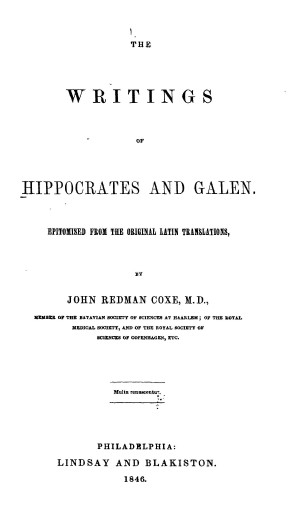
The Writings of Hippocrates and Galen. Epitomised from the Original Latin translations, by John Redman Coxe (Philadelphia: Lindsay and Blakiston, 1846).

About Liberty Fund:

Liberty Fund, Inc. is a private, educational foundation established to encourage the study of the ideal of a society of free and responsible individuals.


ON THE ART OF MEDICINE.

SECTION I.—TREATISE III.

DE ARTE,FŒSIUS, p. 2.
DE ARTE,HALLER, vol. iv. p. 155.
DE L’ART,GARDIEL, vol. ii. p. 183.

In his prefatory remarks, Haller says that Mercurialis regarded it as spurious, and unnoticed by any of the ancients except the author of the Definitions. He says it is altogether a tissue of reasoning; it enters into a defence of physicians, and regards them as free from blame when death takes place, which he considers as rather dependent on the fault of the patient, or the impotence of medicine from the insufficiency of its means, when no suspicion of the intelligence or attention of the physician can be apparent. Neither is it considered as correct, that any one is restored to health without the employment of medicine, although unattended by a physician, since every thing that is beneficial or injurious, pertains to medicine. Nor is the physician blamable who refuses attention to desperate diseases. It proceeds then to the consideration of several particulars of an obscure nature in the human body, which are to be comprehended through a process of reasoning, depending on the manifest qualities of the excretions, &c. Some notice is taken of several of the cavities, the cellular tissue, &c.

The order of the treatise is a dissertation against the calumniators of medicine, whether sophists or the common people. It refers primarily to the arts in general, and then to medicine in particular, the certainty of which, as an art, it professes to demonstrate; this is followed by a variety of topics, appertaining to the physician, to the patient, and to the disease. We give a free translation of the whole.—Ed.

Note.—“Ars, τέχνη, verum est genus medicinæ, quicquid nonnulli Arabum secuti placita regerant. Denominatio a fine petenda est ultimo. Quæcunque igitur terminantur operatione, sunt artes: quorum terminus est sola cognitio, scientiarum nomine venire debent. Imo χατ εξοχην vocab. hoc Medicinam significat., 1. aph. 1,” &c.—Castelli Lexicon Medicum.

Many undertake to decry the arts, not from any expectation of destroying them, but merely to evince their genius.a The real intention of an enlightened mind, however, is that of attempting to discover something new that may be useful, or to perfect that which is already known. To pretend to tarnish the labours of others by idle remarks without improving them, for the sole purpose of lessening their merit in the eyes of ignorance, is a proof rather of malevolence than of a good disposition. As ignorant and wicked people are naturally envious, it is of course to be expected that they will attempt to overturn what is good, or to ridicule its deficiencies: but they cannot attain their end. It is incumbent on all to uphold their profession to the best of their abilities, against insolence and temerity; and here it is my intention to defend medicine against injustice and calumny. If, in this intention, there is any presumption, considering whom I am to attack, the art I profess to defend, will render my attempt easy,—the principles on which it is based will afford ample means.

It will be admitted at once, that there can be no art, in respect to things that have no existence; it would be absurd to treat of a non-entity in any way; for how can any conceive the mode of existence of what has no existence? and if it is impossible to see what does not exist, as we see that which does, by what means shall we know it, or whether it be good or bad! Were this possible, I cannot perceive how we could discriminate between non-entities and those things that are cognizable to our senses. Existing things may always be perceived—and by this alone that existence is appreciated. Those arts which exist, are known by our seeing them, for not one exists that is not manifest in some way. Now it is the particular species of art, that has given to each its especial title. It would be absurd to suppose the particular species is owing to its name,—that is impossible. Names are merely conventional terms, whereas species are the real products. If the reader does not comprehend this sufficiently, he must have recourse to other works.

As to medicine, our present subject, I undertake to demonstrate its existence, and what it actually is,—I commence therefore with its definition, according to my apprehension.

Medicine is an art that cures the sick, or lessens their pains, and which has nothing to do with incurable diseases: for that which is irremediable, medicine knows not how to attempt its cure. And I now proceed to prove, that it performs what it promises, and that it is always capable of doing so; and I will at the same time refute the reasons of those who attack it in those parts, wherein to them it seems most weak.

My first proposition no one can deny. It will be admitted that some of those who apply for medical assistance have been cured, but not all: and it is this which has given rise to the opposition against medicine. Its enemies assert, that the larger part of those attacked by the same disease, and who are restored to health, owe it to good luck, and not to the rules of art. Now, I have no desire to rob Fortune of her just rights, and therefore I must acknowledge that all who are well attended to, are very fortunate, whilst those who are neglected or illy treated, are extremely unlucky. But how happens it that those who are cured, should prefer ascribing it to any thing rather than to art, when their cure has been actually accomplished solely by their having employed and attended to its rules? They did not commit themselves to fortune, but called in the assistance of art. Hence, they are in this respect altogether absolved from all acknowledgment to the former, but not so with respect to art. They recognise art, insomuch as they pursued its rules, and cannot deny its existence, when evinced in the effects it has produced.

But it will be said, that many sick persons have been cured without the aid of a physician. Who doubts this? It is very possible, that without having called in a physician, they, nevertheless, have fallen into the arms of medicine. Not that they knew what medicine approved of, or disapproved; but they happily employed the very means which a good physician would have himself made use of, had he been called to their assistance; and, it is a strong evidence of art and its powers, when those, who have no belief in it, yet owe their safety to its rules: for it is certain, that those who have recovered, without the aid of a physician, must have been cured, either by doing certain things, or by doing nothing. In fact, they have been saved, by food or by abstinence; by drinking or abstaining from drinks; by bathing or not bathing; by labour or rest; by watching or sleeping; or by an alternation of all these. Now, since benefit was obtained, they must of necessity admit, that there was something done, by which that benefit was obtained. On the contrary, if injury was sustained, it must equally have arisen from something. It is indeed true, that few are qualified to distinguish between what was beneficial or hurtful to them. He, however, who is capable of such a discrimination, and of justly appreciating the measures he may have adopted, will equally discover, that what has saved him, is, in fact, a part of medicine. Even the faults he may have committed, are not less striking evidences of the existence of medicine: for, that which benefited, did so, only on account of its timely employment; as, on the contrary, what was injurious, was so, only on an opposite reason. Now, wherever the good, or the bad, has its own peculiar termination, how can it appear that art has no existence? For myself, I think, that art can alone be absent, when what was done, produced neither a good nor a bad effect; and that, when either appears, the existence of art, is fully substantiated.

I admit, that if medicine and physicians effected cures by purgatives or astringents alone, our arguments would be weak;—but we see the ablest physicians cure diseases by regimen, as well as by every other kind of remedies. Now, we must admit, unless we are ignorant, or deficient in understanding, that the employment of regimen, is a dependent on art. Nothing is useless in medicine in the hands of good physicians—we see various remedies, and cures in many instances, under the operation of nature, as well as through that of human industry; and such as have been restored without the aid of a physician, can in no respect attribute their recovery to chance, with any just foundation.

Chance, when we come to examine the phrase, means absolutely nothing. Every event has a certain cause, which is, itself, the effect of some preceding one. Chance, therefore, cannot be said to have existence. It is a term employed by ignorance for what it does not comprehend. But medicine is, and always will be, seen and demonstrated in its effects, induced by causes, which necessarily are incapable of producing any others,—and this is our answer to those who attribute their recovery to chance, rather than to the art of medicine.

As to those who allege the number of deaths under the employment of medicine, I wonder what reason so evident can be given, that complaint should be made of the ignorance of the physician, rather than of the irregularity of the patient; as if it was possible for the former, alone, to practice incorrectly, and impossible for the latter, to counteract his directions! It is much more credible, that the latter is the case. In fact, when an able physician undertakes a patient, and is sound in mind and body—is he not qualified to reason on the present state of the patient, and to compare his disease with such as he had previously seen, either the same, or approaching thereto, and which he has cured by the admission of the patient himself? Whilst the patient knows neither his disease, nor its causes, he knows not its termination, or what has taken place under similar circumstances. He receives his directions under present pain, and future dread. He thinks only of his disorder, and is weakened by want of food. He desires what is agreeable, rather than what may cure him;—not that he is desirous of dying, but that he detests physic. In such a case, which is most probable? That the patient duly obeys his physician, in all his directions, or, that the latter, with the qualities above stated, should practice erroneously? Is it not more likely that the physician performs his duty correctly, and that the patient (incapable sometimes of paying obedience) does disobey, and falls a victim to his own folly? Those who incorrectly judge of events, accuse the innocent, and exculpate the guilty.

Others there are who condemn medicine, under the pretext that physicians never undertake the care of those, who are already overpowered by disease. They say, that he cheerfully attends on such as would recover without him—but not a step will he take in behalf of those who are most in need of his assistance. If there was an art of medicine, they moreover say, it ought to cure these as well as the former. Those who speak thus, would have more reason to complain of a physician who would not treat them as fools, than they have, to accuse medicine in such manner. He who requires of an artist, what belongs not to his art, or what is beyond its power, is more knave than fool. We can effect every thing that is capable of being accomplished through the means of Nature, or of the instruments of our profession; but we possess no more. When the disease is more powerful than any of these means, it cannot be expected that medicine can overcome it. Thus, we have many caustics in medicine, of various powers, of which fire is the most so. We may reasonably doubt, in such cases as require the use of caustics, whether the highest degree of evil in such case, would not resist the fire, whilst we have no doubt of its utility in an inferior grade. Now, in such cases which fire cannot reach, nothing can be expected of an art that has no power stronger than fire. It is the same with all the instruments of medicine, and I apprehend, therefore, that when employed in extreme cases without advantage, the fault is in the violence of the disease and not in the art.

Some there are who reproach us for avoiding such as are already worn down by disease: this is like requiring of any art, to do that which does not belong to it. Nominal physicians will, it is true, undertake this from a desire of admiration; but they are looked on as ridiculous by real ones. Those who are masters of their profession, care neither for the praise nor reproof of such people—they esteem those only who know how to discriminate, and discern when and wherein the operations of art are perfect or imperfect, and whether the imperfection arises from the workman or his subject.—We may, perhaps, in a future treatise, take notice of what belongs to other arts. As to medicine, we have already shown what it is, and now proceed to point out how it is to be judged of.

All who are acquainted with it, will admit that there are two classes of diseases: one, affecting the external parts, and few in number; the other is in vast amount and attacks the parts that are internal and concealed, wherein they manifestly differ from the former. They are apparent both to sight and to the touch, by tumours, redness, &c.; and evince themselves by hardness, coldness, moisture, heat, &c.,—and thus enable us to recognise the presence or absence of such or such qualities as may or may not belong to them. There ought to be no mistake as to these,—not that they are easy to be comprehended, but because they are readily discovered, at least by those who are qualified to seek for them, by industry and natural attainments. Our art abounds in resources for visible diseases,—nor are they less abundant for those of a hidden character, or which attack the cavities or bones. The human body has many cavities: thus, two exist for the reception and discharge of food, with many others, known to those who have studied the subject. All those fleshy, rounded parts, called muscles, are cavernous; all parts, in fact, in which there is defect of continuity, are cavities, whether covered by flesh or skin,—and they are filled with air (spiritus) in health, but in disease with unhealthy humours. Such fleshy parts are seen in the arms, the thighs, and legs. Even those parts that are not fleshy, have a similar structure. For instance, the liver concealed in the abdomen, the brain in the skull, the lungs in the thorax, &c., all have cavities with subordinate divisions, or vessels, filled with humours of a healthy or injurious tendency. There are, moreover, nerves and vessels innumerable, passing to the bones;—and ligaments and cartilages belonging to the joints, wherein the bones move, and which are moistened by a glairy fluid (synovial) emitted from small cavities, which sometimes discharge much sanious matter when they are opened, accompanied with extreme pain. Now, none of all these parts are apparent to our sight,—and hence the above division of diseases into concealed and apparent. It must not, however, be supposed, that those thus latent are beyond the reach of medicine. The possibility of this depends very much, nevertheless, on the accuracy of the report by the patient of his complaint, and the tact of the physician in his interrogatories. Sometimes this seems to be attained as by intuition, although more time and labour are required than in the case of external diseases. The evil experienced by the sick from the delay of making known their disease, ought not to be attributed to medicine, but to the patient, or to the actual violence of the complaint. The physician who cannot by sight detect it, nor by the imperfect statement of the patient, is obliged to recur to reasoning; for it is certain, that when describing their internal complaints, they speak more from opinion than from any certain knowledge. Were they possessed of this, they would not require the aid of the physician, since the same science which enabled them to know their disease, would equally teach them the appropriate means of cure. Hence, since the physician cannot derive from the patient’s report a certain and absolute knowledge of his complaint, he is obliged to attain it in some other mode—which necessary delay, is not the fault of art, but arises from the nature of the case itself. Medicine requires only to know the disease, in order to proceed to its cure; yet, with prudence devoid of temerity, and depending more on patient attention than on violent efforts. It is requisite also, that the disease be curable, and that time be allowed for the purpose. If then the disease is known, and is found to be too powerful, either from its nature or from delay of calling in medical aid, the patient will die; for it rarely happens that it is too powerful, if soon attended to. Disease is rarely victorious, except from being permitted to gain too great advance, which arises from its concealed character, or from delayed assistance. It is, therefore, in my opinion, more correct to praise the art of medicine for the cure of such concealed diseases, than for undertaking, what it is impossible it can perform. Is there no parallel to be found in the other hitherto known arts? Those who employ fire in their operations, must remain inactive when their fire is extinguished, and must postpone their labour until it is again relighted. Most of the arts are exercised on subjects, where the work can be corrected; such as wood, leather, brass, iron, and similar materials. Here, nevertheless, far from precipitancy in working them, all necessary time is afforded in order to perfection. Should any requisite instrument be wanting, the work is suspended, and remains imperfect. In all these cases, in which slowness is more inconvenient than useful, such delay is nevertheless approbated. Medicine is the only art, in which, although error is almost invariably irreparable, haste is required to satisfy the impatience of the sick, without due attention to its rules, although, as we have stated, it is incapable of attaining a knowledge of many diseases, by the sense of feeling or of sight. It neither perceives the diseases of the liver or of the kidneys, nor the abscess that may exist in the chest or other cavity. Here, and in like cases, it has adopted other means of conduct. Thus, it considers the voice, as to its clearness or hoarseness. It examines the discharges from certain regular channels; and drawing consequences from their odour, colour, consistence or fluidity,—he judges of the character of the disorders, and the existing state of the patient; and by the same means, medicine is even enabled, not only to ascertain the past, but likewise his future state. After having thus become acquainted with diseases, by their symptoms, if nature is unable to effect a cure, art then teaches how to excite those salutary movements, by which, without danger, the system may discharge itself of what is injurious to it.

It is in the efforts of nature that an attentive and skilful physician perceives the measures he ought to adopt. If pituita predominates, by diet and acrid drinks, he excites the natural heat, and thus discharges it. By exercise, he causes respiration to testify still further to his senses. Sometimes, he has recourse to sweating, through the agency of warm baths. In some cases, he prefers to examine the urinary evacuation; and by appropriate food and drinks, the humours are aided in their discharge, which would not otherwise be accomplished. But as the vitiations differ, so also are there different symptoms, and different remedial means, through which the physician becomes enabled to estimate the treatment he ought to pursue.

It is then by no means surprising, that the physician should be slow in forming his judgment of diseases, before he undertakes their cure; since he has, as it were, to negotiate with them, by the agency of an interpreter. It appears, then, from all I have said, that medicine has an appropriate means of discovering the mode of cure, or at least of assuaging the sufferings of disease; and that it is not deficient in substantial reasons, for declining those that are incurable, or at any rate, of overthrowing the unjust reproaches made against physicians when unsuccessful in such cases. Much more might be said in these particulars, as derived from the manifest and daily proofs afforded by skill and attention. Facts are far superior to reasoning; and instead of calling for admiration of their eloquence, such practitioners will refer you to the visible effects of their care and attention.

[a ]Ostentationem scientiæ.