EconlibThe LibraryOther Sites |
Front Page Titles (by Subject) QUESTION CLXII.: OF PRIDE. - Aquinas Ethicus: or, the Moral Teaching of St. Thomas, vol. 2 (Summa Theologica - Secunda Secundae Pt.2)
Return to Title Page for Aquinas Ethicus: or, the Moral Teaching of St. Thomas, vol. 2 (Summa Theologica - Secunda Secundae Pt.2)The Online Library of LibertyA project of Liberty Fund, Inc.Search this Title:Also in the Library:
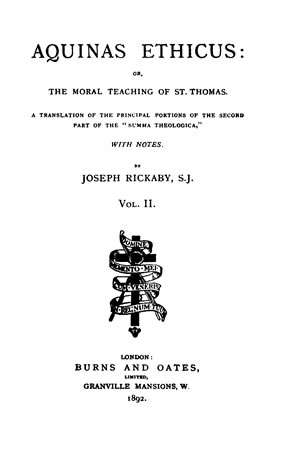
QUESTION CLXII.: OF PRIDE. - St. Thomas Aquinas, Aquinas Ethicus: or, the Moral Teaching of St. Thomas, vol. 2 (Summa Theologica - Secunda Secundae Pt.2) [1274]Edition used:Aquinas Ethicus: or, the Moral Teaching of St. Thomas. A Translation of the Principal Portions of the Second part of the Summa Theologica, with Notes by Joseph Rickaby, S.J. (London: Burns and Oates, 1892).
Part of: Aquinas Ethicus: or, the Moral Teaching of St. Thomas, 2 vols.About Liberty Fund:Liberty Fund, Inc. is a private, educational foundation established to encourage the study of the ideal of a society of free and responsible individuals. Copyright information:The text is in the public domain. Fair use statement:This material is put online to further the educational goals of Liberty Fund, Inc. Unless otherwise stated in the Copyright Information section above, this material may be used freely for educational and academic purposes. It may not be used in any way for profit.
QUESTION CLXII.OF PRIDE.Article I.—Is pride a special sin? R. The sin of pride may be considered in one way in its own proper species which it has in regard of its proper object; and in this way pride is a special sin, because it has a special object: for it is an inordinate desire to excel. In another way it may be considered as redounding upon other sins: and in this way it has a certain general agency, inasmuch as all sins may arise out of pride. That they may do in two ways: either in the regular and ordinary course, inasmuch as other sins are directed to the end of pride, which is to excel, and everything that is inordinately desired may be reduced to excellence; or again indirectly or incidentally by removal of the obstacle, inasmuch as by pride man despises the divine law by which he is restrained from sinning, according to the text: “Thou hast broken my yoke, thou hast burst my bands, and thou saidst, I will not serve.”1 We must observe, however, that the general agency of pride goes thus far, that all vices may at times arise out of pride, but not so far as that all vices always do arise out of pride. For although all the commandments of the law may be transgressed in any variety of sin by contempt, which is a piece of pride, yet the commandments are not always transgressed out of contempt, but sometimes out of ignorance, sometimes out of weakness. And hence it is that, as Augustine says, “many things are wrongly done, that are not done in pride.” § 3. A sin may spoil a virtue in one way by being directly contrary to the virtue; and in this way pride does not spoil every assignable virtue, but only humility, as every other special sin spoils the special virtue opposed to it, by working the contrary effect. There is another way in which a sin spoils a virtue, by abusing the said virtue; and in this way pride spoils every virtue, inasmuch as it takes occasion of growing proud from the virtues, as it does from all other points of excellence. Article III.—Is the irascible faculty the subject in which pride resides? R. To find the subject of any virtue or vice we must inquire after the proper object of it. For the object of any habit or act cannot be different from the object of the power wherein they both reside. But the proper object of pride is arduous matter. Hence pride must belong somehow to the irascible faculty. But the irascible faculty may be looked at in two ways. In one way properly, as it is part of the sensitive appetite, of which sensitive appetite, anger, properly understood, is a passion. In another way the irascible faculty may be taken in a wider sense of the term to extend even to the intellectual appetite; to which appetite anger is sometimes attributed, in the sense in which we ascribe anger to God and to the angels, not as a passion, but as a judgment of justice passing sentence. If then the arduous matter, which is the object of pride, were merely something sensible to which the sensitive appetite could tend, then pride would needs be in the irascible faculty, which is part of the sensitive appetite. But because the arduous matter that pride regards is found alike in sensible and in spiritual things, we must say that the subject of pride is the irascible faculty, not merely properly so called, as it is part of the sensitive appetite, but taken in a wider sense, as it is found in the intellectual appetite. Hence pride is placed also in the devils. § 1. The knowledge of truth is twofold: one purely speculative; and this knowledge pride hinders indirectly, by taking away the cause that gives it birth. For the proud man neither subjects his intellect to God, so as to gather the knowledge of truth from Him, according to the text, “Thou hast hidden these things from the wise and prudent,”1 that is, from the proud who think themselves wise and prudent, “and revealed them to little ones,” that is, to the humble; nor again does he condescend to learn from men, though it is said, “If thou wilt incline thine ear,” that is, listen humbly, “thou shalt receive instruction.”2 There is another knowledge of the truth that is practical, and such knowledge is directly hindered by pride, because proud men, delighting in their own excellence, scorn the excellence of truth. As Gregory says: “Though the proud understand and grasp sundry recondite truths, they cannot experience the sweetness of them; and though they know how the truth stands, they are ignorant of how it tastes.” Hence it is said: “Where humility is, there also is wisdom.”1 Article IV. § 1. True judgment may be corrupted in two ways. One way is in the general, and in that way true judgment on matters of faith is corrupted by unbelief. Another way in which true judgment may be corrupted is in regard of some particular object of choice: and this is no case of unbelief. Thus any one who commits fornication, judges for the time being that it is good for him to commit that sin; and yet he is not an unbeliever, as he would be if he were to say in general that fornication is a good thing. So again it is a piece of unbelief to say in general that there is any good gift that is not of God, or that grace is given to men for their deserving; but for a man to be moved by an inordinate seeking of his own excellence, so to glory in his own good parts as if he had them of himself, or of his own deserving, is a piece of pride and not of unbelief, properly speaking.2 Article V.—Is pride a mortal sin? R. Pride is opposed to humility, and humility properly regards the subjection of man to God: hence contrariwise pride properly regards the want of this subjection, in that one lifts himself up above the limit prefixed for him according to the divine rule or measure, contrary to what the Apostle says: “We will not glory beyond our measure, but according to the measure of the rule which God hath measured to us.”1 And therefore it is said: “The beginning of the pride of man is to fall off from God;”2 because the root of pride is taken to be in this, that a man somehow is not subject to God and to the rule of His guidance. But clearly this want of subjection to God bears the character of mortal sin, for that is what turning away from God comes to: consequently pride is a mortal sin of its kind. But as in other matters that are mortal sins of their kind, there are some movements which by reason of their incompleteness are only venial sins, because they get the start of the judgment of reason, and are without its consent, so also in the matter of pride it happens that some movements of pride are only venial sins, while reason consents not to them.3 Article VI.—Is pride the most grievous of sins? R. There are two elements in sin: the turning to the good that perishes, which turning to is the material element in sin; and the turning away from the good that perishes not, which turning away is the formal and completely constituent element of sin. On the side of the turning to the perishable, pride has not the attribute of being the greatest of sins: because the height which the proud man inordinately affects, has not of its own nature the greatest possible opposition to the good of virtue. But on the side of the turning from the imperishable, pride has the utmost grievousness: because in other sins man turns away from God either through ignorance, or through weakness, or through desire of some other good; but pride involves a turning away from God merely because one will not be subject to God and to His rule. Hence Boethius says, that “while all vices fly from God, pride alone sets itself against God;” on which ground it is especially said that “God resisteth the proud.”1 And therefore the turning away from God and from His commandments, which is a sort of appanage of other sins, belongs to pride as part and parcel of itself, since the act of pride is a contempt of God. And because what is part and parcel of a thing, always takes precedence over what is a mere appanage of the same, it follows that pride is of its kind the most grievous of sin, because it exceeds them all in that turning away from God, which is the formal and crowning constituent of sin. § 1. The movement of pride creeping on imperceptibly has no very great grievousness before it is overtaken by the judgment of reason. After reason has caught and found it out, then it is easily avoided, as well on the consideration of one’s own weakness, according to the text, “Why is earth and ashes proud?”1 as also on consideration of the greatness of God, according to the text, “Why doth thy spirit swell against God?”2 as also from the imperfect nature of the goods of which man is proud, according to the text, “All flesh is grass, and all the glory thereof as the flower of the field;”3 and again, “All our works of justice are as filthy rags.”4 § 2. In respect of what it turns to, pride is not the greatest of sins, as neither is humility the greatest of virtues. But in respect of what it turns away from, it is the greatest of sins, as adding greatness to other sins; for it is precisely by its proceeding from pride, that the sin of unbelief is rendered more grievous than it would be if it arose from ignorance or infirmity. § 3. As in syllogisms leading to an impossible conclusion, sometimes the error is brought home to one by his being landed in a more manifest absurdity; so also to bring their pride home to them, God punishes some by letting them fall into sins of the flesh, which, though they are less sins, yet contain a more manifest unsightliness. Hence again appears the grievousness of pride. For as a wise physician suffers his patient to fall into a disease of milder type for the cure of a more grievous malady, so the greater grievousness of the sin of pride is shown by the fact that, for the cure of it, God permits men to rush headlong into other sins. Article VII. § 3. There need not be the same order of progress in virtues as in vices. For vice is the corrupter of virtue; and what is first in generation is last in corruption. And therefore as faith is the first of virtues, so unbelief is the last of sins, to which man is brought at times by other sins. Hence on the text, “Rase it, rase it, even to the foundation thereof;”1 the gloss says, that by the heaping up of vices loss of faith gradually comes on; and the Apostle says, that “some rejecting a good conscience have made shipwreck concerning the faith.”2 § 4. Pride is the cause of the grievousness of other sins. We find accordingly, prior to pride, some lighter sins committed out of ignorance or weakness; but among grievous sins pride is the first, as being the cause that makes other sins grievous. Article VIII.—Should pride be set down for a capital vice? R. Considering the universal influence of pride upon all vices, Gregory has not numbered it among the other capital sins, but has ranked it as queen and mother of vices. Hence he says: “When the queen of vices, pride, has fully overcome and captured a heart, she presently hands it over to be laid waste by her generals, the seven principal vices, whence multitudes of other vices have their origin.” § 2. Pride is not the same thing as vainglory, but is the cause of vainglory. For pride seeks inordinately after excellence; but vainglory seeks the manifestation of that excellence. [1 ]Jerem. ii. 20. [1 ]St. Matt. xi. 25. [2 ]Ecclus. vi. 34. [1 ]Prov. xi. 2. [2 ]Cf. I-II. q. 77. art. 2. (Trl.) [1 ]2 Cor. x. 13. [2 ]Ecclus. x. 14. [3 ]Understand this of the absence of perfect consent: for without some sort of consent or voluntary negligence of the reason, that is, of the rational appetite, or will, there can be no actual sin whatever, not even venial: for “the will, which is the origin of voluntary acts good and bad, is the origin of sins.” I-II. q. 74. art. 1. Cf. I-II. q. 74. art. 10. note; II-II. q. 154. art. 5. beginning. (Trl.) [1 ]St. James iv. 6. [1 ]Ecclus. x. 9. [2 ]Job xv. 13. [3 ]Isaias xl. 6. [4 ]Isaias lxiv. 6. [1 ]Psalm cxxxvi. 7. [2 ]1 Timothy i. 19. |

Titles (by Subject)