Econlib

The Library

Other Sites

Front Page arrow Titles (by Subject) arrow QUESTION CLIX.: OF CRUELTY. - Aquinas Ethicus: or, the Moral Teaching of St. Thomas, vol. 2 (Summa Theologica - Secunda Secundae Pt.2)

Return to Title Page for Aquinas Ethicus: or, the Moral Teaching of St. Thomas, vol. 2 (Summa Theologica - Secunda Secundae Pt.2)

Search this Title:

Also in the Library:

Subject Area: Philosophy
Subject Area: Religion

QUESTION CLIX.: OF CRUELTY. - St. Thomas Aquinas, Aquinas Ethicus: or, the Moral Teaching of St. Thomas, vol. 2 (Summa Theologica - Secunda Secundae Pt.2) [1274]

Edition used:

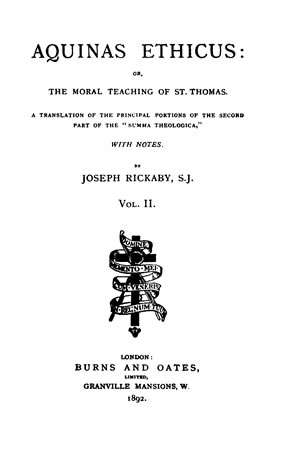
Aquinas Ethicus: or, the Moral Teaching of St. Thomas. A Translation of the Principal Portions of the Second part of the Summa Theologica, with Notes by Joseph Rickaby, S.J. (London: Burns and Oates, 1892).

Part of: Aquinas Ethicus: or, the Moral Teaching of St. Thomas, 2 vols.

About Liberty Fund:

Liberty Fund, Inc. is a private, educational foundation established to encourage the study of the ideal of a society of free and responsible individuals.


QUESTION CLIX.

OF CRUELTY.

Article I.

“The opposite of clemency is cruelty, which is nothing else than sternness in the exaction of penalties.”1

§ 1. Rational abatement of penalties is an act of equity, but the sweetness of disposition that prompts such abatement belongs to clemecy: so also excess of punishment, so far as the outward act goes, is an act of injustice; but as for the austerity of temper that makes one forward to lay on increase of punishment, that excess belongs to cruelty.

§ 2. Mercy and clemency agree in both of them shrinking from and abhorrin the making of another miserable: but to mercy it belongs to relieve misery by the bestowal of kindness; to clemency to diminish misery by abatement of penalties. And because cruelty means excess in the exaction of penalties, cruelty is more directly opposed to clemency than to mercy.

Article II.—Does cruelty differ from savagery, or brutality?

R. The name of savagery, or brutality, is so called from the likeness that it bears to wild beasts, who are also called savage. For these sort of animals do hurt to men in order to feed on their bodies, not for any cause of justice, since the consideration of that belongs to reason only. And therefore, properly speaking, it is called brutality, or savagery, when in inflicting punishments a man considers not any fault of the person who is punished, but has regard merely to his own delight in the torture of his fellows. This is clearly a case of brutality: for such delight is not human but brutal, coming either from evil custom or from corruption of nature, as do other similar bestial proclivities. Cruelty, on the other hand, has regard to the fault that is in the party that is punished, but exceeds due measure in punishing. And therefore cruelty differs from savagery, or brutality, as human malice differs from that which is bestial.

[1 ]Seneca, De Clementia, ii. 4.