EconlibThe LibraryOther Sites |
Front Page Titles (by Subject) QUESTION CLII.: OF VIRGINITY. - Aquinas Ethicus: or, the Moral Teaching of St. Thomas, vol. 2 (Summa Theologica - Secunda Secundae Pt.2)
Return to Title Page for Aquinas Ethicus: or, the Moral Teaching of St. Thomas, vol. 2 (Summa Theologica - Secunda Secundae Pt.2)The Online Library of LibertyA project of Liberty Fund, Inc.Search this Title:Also in the Library:
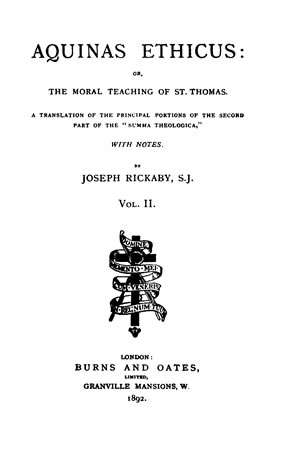
QUESTION CLII.: OF VIRGINITY. - St. Thomas Aquinas, Aquinas Ethicus: or, the Moral Teaching of St. Thomas, vol. 2 (Summa Theologica - Secunda Secundae Pt.2) [1274]Edition used:Aquinas Ethicus: or, the Moral Teaching of St. Thomas. A Translation of the Principal Portions of the Second part of the Summa Theologica, with Notes by Joseph Rickaby, S.J. (London: Burns and Oates, 1892).
Part of: Aquinas Ethicus: or, the Moral Teaching of St. Thomas, 2 vols.About Liberty Fund:Liberty Fund, Inc. is a private, educational foundation established to encourage the study of the ideal of a society of free and responsible individuals. Copyright information:The text is in the public domain. Fair use statement:This material is put online to further the educational goals of Liberty Fund, Inc. Unless otherwise stated in the Copyright Information section above, this material may be used freely for educational and academic purposes. It may not be used in any way for profit.
QUESTION CLII.OF VIRGINITY.Article II.—Is virginity unlawful? R. In human acts, that is vicious which is against right reason. Now right reason carries this with it, that a man should use means to the end in the measure that suits the end. But the good of man is threefold: one sort consisting in exterior goods; another in the goods of the body; and the third in the goods of the soul, among which the goods of the contemplative life are better than the goods of the active life, as the Philosopher proves.1 Of these goods, exterior goods are referred to goods of the body; goods of the body to goods of the soul; and furthermore the goods of the active life to the goods of the contemplative life. It belongs therefore to rightness of reason that one should use exterior goods in the measure that suits the body; and so of the rest. Hence if one were to abstain from having certain possessions, which he otherwise might lawfully hold, practising this abstinence for the good of his bodily health, or even for the better contemplation of truth, that is no vicious abstinence, but quite in keeping with right reason. And in like manner, supposing one abstains from bodily pleasures to have more freedom for the contemplation of truth, that again belongs to rightness of reason. But it is for this that religious virginity abstains from all sexual pleasure, that it may more freely apply itself to divine contemplation. For the Apostle says: “The unmarried woman and the virgin thinketh on the things of the Lord, that she may be holy both in body and spirit.”1 Hence it remains that virginity is not anything vicious, but rather commendable. § 1. A commandment has the character of a debt. But there are two sorts of debts: one debt that must be paid by one individual; and a debt of that sort cannot be ignored without sin; another debt that has to be paid by a community: and to the payment of that debt not every individual in the community is bound. For there are many needs in a community, and one individual cannot meet them all; but they are met by the community in this way, that one meets one need and another another. So then the precept of the law of nature given to man about eating must needs be fulfilled by every individual: otherwise the individual could not be maintained. But the precept given about generation, “Increase and multiply,”2 regards the whole community of mankind. Now this community has need, not only of corporal multiplication, but also of spiritual increase. And therefore it is sufficient provision for human society, if some lay out their strength in carnal generation, while others, abstaining from that, apply themselves to the contemplation of divine things, for the beauty and welfare of the whole human race: even as in an army some guard the camp, some carry the standards, some fight with swords, all which offices are so many debts to the community, but debts that cannot be discharged all by one man.1 Article III.—Is virginity a virtue? R. The formal and completely constituting element in virginity is the purpose of perpetual abstinence from sexual pleasure; which purpose is rendered praiseworthy by the end in view, inasmuch as it is taken up to find free scope for divine things. But the material element in virginity is the integrity of the flesh, void of all experience of sexual pleasure. But where there is a special matter of goodness, having a special excellence, there is found there a special character of virtue: as appears in munificence, which has to do with large expenditure, and is thereby a special virtue distinct from liberality, which deals in general with all use of money. But the keeping oneself void of experience of sexual pleasure has a degree of excellence and praise above keeping oneself free of the inordinate enjoyment of sexual pleasure. And therefore virginity is a special virtue, standing to chastity as munificence to liberality. § 1. Men have from their birth what is the material element in virginity, namely, the integrity of the flesh void of experience of sexual acts, but they have not what is the formal element in virginity, namely, the purpose of preserving this virginity for God’s sake;1 from which purpose it is that virginity derives its character of virtue. Hence Augustine says: “We do not extol in virgins the fact of their being virgins, but the fact of their being virgins dedicated to God by religious continence.” § 3. Virtue may be repaired by penance so far as the formal element of the virtue goes, but not for the material element. For if a munificent man has wasted his riches, penance for his sin does not restore them to him again; and in like manner he who has lost his virginity by sin does not recover by penance the matter of virginity, but he recovers the purpose of virginity. As for the matter of it, there is one thing that cannot be restored, not even by miracle, namely, it cannot be that he who once has experienced sexual pleasure should come to the condition of never having experienced it: for God cannot make what is done undone. § 4. Virginity, as it is a virtue, means a purpose, strengthened by vow, of perpetually preserving one’s integrity. For Augustine says: “By virginity the integrity of the flesh is vowed, consecrated, and preserved to the Creator of the soul and of the flesh.” Hence virginity as a virtue is never lost except by sin.2 Article IV.—Is virginity more excellent than marriage? R. Divine good is better than human good: as well because the good of the soul is preferable to the good of the body, as also because the good of the contemplative life is preferable to the good of the active. But virginity is ordained to the good of the soul in the contemplative life, which is to “think on the things of the Lord:” whereas marriage is ordained to the good of the body, the bodily multiplication of the human race, and belongs to the active life, because husband and wife, living in the married state, are under necessity to think of “the things of the world.”1 And therefore beyond doubt virginity is to be preferred to conjugal continence. § 2. Though virginity is better than conjugal continence, still it may be that a married person is better than a virgin for two reasons. First, in regard of chastity itself, if the married person is more ready at heart to keep his virginity, if it were proper for him to do so, than the person who is actually a virgin. Hence Augustine instructs a virgin to say: “I am not better than Abraham, but better is the chastity of the unmarried than the chastity of the married.” And he adds the explanation: “For what I do now, Abraham would have done better, if it had had to be done then; and what those saints of old did, that would I do now, if it were to be done.” Secondly, because perchance he who is not a virgin has some virtue more excellent than virginity. Hence Augustine says: “Whence does the virgin know, all solicitous as she be for the things that belong to the Lord, whether perchance through some weakness of purpose, unknown to herself, she be yet unripe for martyrdom, while that married woman, to whom she was forward to prefer herself, is already capable of drinking the chalice of the Lord’s Passion?” Article V.—Is virginity the greatest of virtues? R. When we call a thing most excellent, we may mean in one way that it is most excellent of its kind; and in that way virginity is most excellent of the kind of chastity: for it transcends the chastity both of the widowed and of the married state. And because beauty is eminently the attribute of chastity, therefore to virginity is attributed the most excellent beauty. Hence Ambrose says: “Who can conceive greater beauty than that of the virgin, who is loved by the King, approved by the Judge, dedicated to the Lord, consecrated to God?” In another way a thing is called most excellent absolutely; and in that way virginity is not the most excellent of virtues. For the end always excels the means to the end; and the more effectually a thing bears on the end, the better it is. But the end that renders virginity commendable is application to divine things. Hence the theological virtues, and even the virtue of religion, the act whereof is occupation with divine things, are preferred to virginity. Again, they put forth more energy in striving to adhere to God, who lay down their lives for that purpose, as the martyrs do; or who sacrifice their own will and all that they can have, as they do who live in monasteries, rather than virgins who sacrifice to this end sexual enjoyment. § 3. The virgins “follow the Lamb wheresoever he goeth,”1 because they imitate Christ, not only in integrity of mind, but also in integrity of flesh; and therefore they follow the Lamb in more things than others do. Still it is not necessary that they should follow Him closer than others, because other virtues than virginity make a closer adherence to God by imitation of Him in the qualities of the mind. The “new canticle” that the virgins alone sing, is the joy that they have for having kept the integrity of their flesh. [1 ]See Ethics and Natural Law, pp. 9, 10. (Trl.) [1 ]1 Cor. vii. 34. [2 ]Genesis i. 28. [1 ]Ethics and Natural Law, pp. 264—266. (Trl.) [1 ]Cf. the difference between the fast of fasting and the fast of the faster, q. 147 art. 1. § 3. (Trl.) [2 ]That is, supposing the vow to be indispensable, which as a fact, no vow is, though this point was not made out in St. Thomas’s day. (Trl.) [1 ]1 Cor. vii. 34. [1 ]Apoc. xiv. 4. |

Titles (by Subject)