Econlib

The Library

Other Sites

Front Page arrow Titles (by Subject) arrow QUESTION CL.: OF DRUNKENNESS. - Aquinas Ethicus: or, the Moral Teaching of St. Thomas, vol. 2 (Summa Theologica - Secunda Secundae Pt.2)

Return to Title Page for Aquinas Ethicus: or, the Moral Teaching of St. Thomas, vol. 2 (Summa Theologica - Secunda Secundae Pt.2)

Search this Title:

Also in the Library:

Subject Area: Philosophy
Subject Area: Religion

QUESTION CL.: OF DRUNKENNESS. - St. Thomas Aquinas, Aquinas Ethicus: or, the Moral Teaching of St. Thomas, vol. 2 (Summa Theologica - Secunda Secundae Pt.2) [1274]

Edition used:

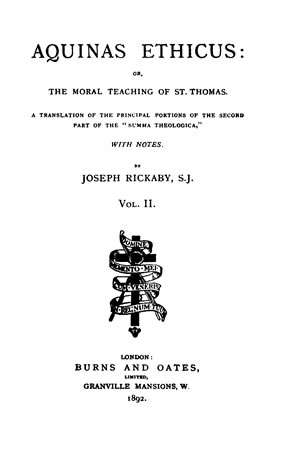
Aquinas Ethicus: or, the Moral Teaching of St. Thomas. A Translation of the Principal Portions of the Second part of the Summa Theologica, with Notes by Joseph Rickaby, S.J. (London: Burns and Oates, 1892).

Part of: Aquinas Ethicus: or, the Moral Teaching of St. Thomas, 2 vols.

About Liberty Fund:

Liberty Fund, Inc. is a private, educational foundation established to encourage the study of the ideal of a society of free and responsible individuals.


QUESTION CL.

OF DRUNKENNESS.

Article I.—Is drunkenness a sin?

R. Drunkenness, meaning the mere loss of reason that comes of drinking much wine, does not denote any guilt, but a penal loss consequent on guilt. Taken in another way, drunkenness may mean the act by which one incurs this loss. That act may cause drunkenness from the excessive strength of the wine beyond what the drinker looked for. Thus understood again, drunkenness may happen without sin. But the act may cause drunkenness in another way, from the inordinate desire and use of wine; and in that way drunkenness is set down to be a sin, and is contained under gluttony as the species under the genus.

Article II.—Is drunkenness a mortal sin?

R. The guilt of drunkenness consists in an immoderate use and desire of wine. This may come into operation in three ways: in one way, without the person knowing that the drink is immoderate and intoxicating; and at that rate drunkenness may be without sin. In another way, when the person perceives the drink to be immoderate, but does not reckon it strong enough to make him drunk; and in that way drunkenness may be with venial sin. In a third way, it may happen that the person perceives very well that his drink is immoderate and intoxicating, and yet had rather get drunk than abstain from drink. Such a man is properly called a drunkard; because mortal sins receive their species, not from what happens incidentally beside the intention of the agent, but from what is of itself intended.1 And thus drunkenness is a mortal sin, because thereby a man willingly and knowingly deprives himself of the use of reason, by which he acts according to virtue and avoids sin; and so he sins mortally by putting himself in the danger of sinning. For Ambrose says: “We say that drunkenness is a thing to be avoided, as putting it out of our power to guard ourselves against the commission of crime: for the things that we are on our guard against when sober, we do in ignorance through drink.” Hence, ordinarily speaking, drunkenness is a mortal sin.

§ 1. The circumstance of its being habitual makes drunkenness a mortal sin, not by the mere iteration of the act, but because it is impossible for a man to be an habitual drunkard without getting drunk knowingly and willingly, as he has frequent experience of the strength of the liquor and of his own liability to intoxication.

§ 3. The measure of meat and drink is to be fixed to suit the health of the body; and therefore as what is the right measure for a man in health is often too much for a sick man, so also it may be that what is too much for a man in health is the right measure for one that is sick. And thus when one eats or drinks a great quantity by medical advice for the purposes of an emetic, the food or drink so taken is not to be considered to be in excess. Still it is not necessary for the drink to be intoxicating to act as an emetic, because even warm water will serve that purpose: and therefore this would furnish no excuse for drunkenness.1

Article III.—Is drunkenness the most grievous of sins?

R. A thing is said to be evil as being a taking away of good. Hence the greater the good taken away, the more grievous the evil. But divine good is greater than human good. And therefore the sins that are directly against God are more grievous than the sin of drunkenness, which is directly opposed to the good of human reason.

§ 1. Man has a special proneness to sins of intemperance, because desires and delights of this sort are connatural to us; and in this respect sins of this sort are particularly dear to the devil, as Chrysostom says, “Nothing is so dear to the devil as drunkenness and dissipation:” not because they are more grievous than other sins, but because they are more frequent among men.

§ 2. The good of reason is hindered in two ways: in one way by what is contrary to reason; in another way by what takes away the use of reason. But there is more evil in what is contrary to reason than in what takes away for a time the use of reason.

Article IV.—Does drunkenness excuse from sin?

R. There are two elements in drunkenness, the loss ensuing and the act preceding. On the part of the loss ensuing, which is a loss of the free use of reason, drunkenness has the quality of excusing from sin, as causing involuntariness by ignorance. But on the part of the act preceding there seems need of a distinction. For if from that act drunkenness ensued without sin, then the further sin that ensues is totally excused from guilt. But if the act preceding was culpable, at that rate one is not totally excused from the ensuing sin, as that is made voluntary by the voluntariness of the preceding act, inasmuch as the agent was engaged on an unlawful action at that time, and thence came to fall into the sin that ensued. Still the sin that ensues is diminished with the diminution of its voluntary character.

[1 ]Cf. I-II. q. 78. art. i. § 2. (Trl.)

[1 ]It looks as though St. Thomas would allow drinking even to intoxication for medical purposes, if it were necessary, but can see no such necessity. By implication here he justifies the use of anæsthetics, allowing one to lose his reason for a time with a grave cause where there is no danger of sin. (Trl.)