Econlib

The Library

Other Sites

Front Page arrow Titles (by Subject) arrow QUESTION CXLVIII.: OF GLUTTONY. - Aquinas Ethicus: or, the Moral Teaching of St. Thomas, vol. 2 (Summa Theologica - Secunda Secundae Pt.2)

Return to Title Page for Aquinas Ethicus: or, the Moral Teaching of St. Thomas, vol. 2 (Summa Theologica - Secunda Secundae Pt.2)

Search this Title:

Also in the Library:

Subject Area: Philosophy
Subject Area: Religion

QUESTION CXLVIII.: OF GLUTTONY. - St. Thomas Aquinas, Aquinas Ethicus: or, the Moral Teaching of St. Thomas, vol. 2 (Summa Theologica - Secunda Secundae Pt.2) [1274]

Edition used:

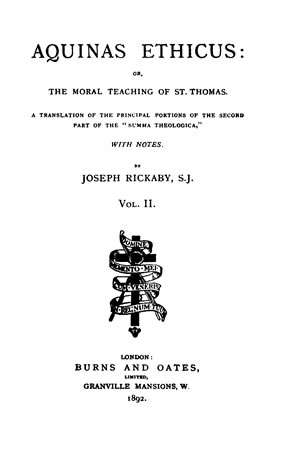
Aquinas Ethicus: or, the Moral Teaching of St. Thomas. A Translation of the Principal Portions of the Second part of the Summa Theologica, with Notes by Joseph Rickaby, S.J. (London: Burns and Oates, 1892).

Part of: Aquinas Ethicus: or, the Moral Teaching of St. Thomas, 2 vols.

About Liberty Fund:

Liberty Fund, Inc. is a private, educational foundation established to encourage the study of the ideal of a society of free and responsible individuals.


QUESTION CXLVIII.

OF GLUTTONY.

Article I.

§ 2. The vice of gluttony does not reside in the substance of the food, but in the appetite ill-regulated by reason. And therefore if one exceed in quantity of food, not through appetite, but thinking it necessary for oneself, that is not a piece of gluttony, but of inexperience.

Article III.—Is gluttony the greatest of sins?

R. The gravity of a sin may be considered in three ways. First and foremost, according to the matter of the sin; and in this way sins in the matter of the things of God are the greatest. Secondly, on the part of the sinner; and in this way the sin of gluttony is rather extenuated than aggravated, as well in consideration of the necessity of taking food, as also on account of the difficulty of discerning and regulating what is suitable on such occasions. Thirdly, on the part of the effect consequent; and in this respect the vice of gluttony has some magnitude, inasmuch as divers sins are occasioned thereby.

Article IV.—Are the species of gluttony distinguished according to these five conditions: too soon, too expensively, too much, too eagerly, too daintily?

R. Gluttony means inordinate appetite in eating. Now in eating there are two things to consider, the food that is eaten, and the eating thereof. And consequently there may be a twofold inordinateness of appetite: one in respect of the food itself that is taken; and thus in respect of the substance or species of the food one seeks dishes that are expensive; in respect of the quality one seeks dishes too elaborately prepared, that is, daintily; in respect of quantity one exceeds in eating too much. The other inordinateness is in the taking of the food, either by anticipating the due time of eating, which is too soon; or by not observing due mode and manner in eating, which is too eagerly.

Article VI.—Are the daughters of gluttony duly assigned as five: inept mirth, buffoonery, uncleanness, much talking, and dulness of mind for intellectual things?

R. Those vices are counted among the daughters of gluttony, that follow from immoderate delight in eating and drinking. And they may be either on the part of the soul or on the part of the body. On the part of the soul they come in four ways: and first on the part of the reason, the edge of which is dulled by immoderation in meat and drink; and in this respect dulness of perception in intellectual things is put down as a daughter of gluttony; as, on the contrary, abstinence helps to the gathering of wisdom, according to the text: “I thought in my heart to withdraw my flesh from wine, that I might turn my mind to wisdom.”1 Secondly, in respect of the appetite, which is in many ways disordered, the guidance of reason slumbering under the immoderate load of meat and drink; and in this respect is set down inept mirth. Thirdly, for inordinateness of word; and for that is set down much talking. Fourthly, for inordinateness of action; and for that is set down buffoonery, that is, jocularity springing from defect of reason, which cannot restrain its words, nor its exterior gestures either. On the part of the body there is ranked uncleanness.

[1 ]Eccles. ii. 3.