Econlib

The Library

Other Sites

Front Page arrow Titles (by Subject) arrow QUESTION CXXXIII.: OF PUSILLANIMITY. - Aquinas Ethicus: or, the Moral Teaching of St. Thomas, vol. 2 (Summa Theologica - Secunda Secundae Pt.2)

Return to Title Page for Aquinas Ethicus: or, the Moral Teaching of St. Thomas, vol. 2 (Summa Theologica - Secunda Secundae Pt.2)

Search this Title:

Also in the Library:

Subject Area: Philosophy
Subject Area: Religion

QUESTION CXXXIII.: OF PUSILLANIMITY. - St. Thomas Aquinas, Aquinas Ethicus: or, the Moral Teaching of St. Thomas, vol. 2 (Summa Theologica - Secunda Secundae Pt.2) [1274]

Edition used:

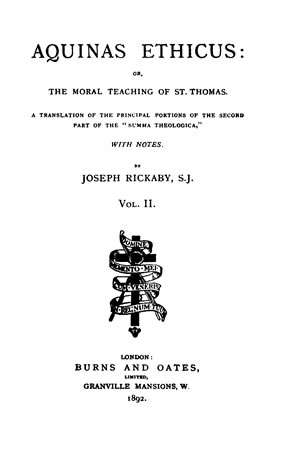
Aquinas Ethicus: or, the Moral Teaching of St. Thomas. A Translation of the Principal Portions of the Second part of the Summa Theologica, with Notes by Joseph Rickaby, S.J. (London: Burns and Oates, 1892).

Part of: Aquinas Ethicus: or, the Moral Teaching of St. Thomas, 2 vols.

About Liberty Fund:

Liberty Fund, Inc. is a private, educational foundation established to encourage the study of the ideal of a society of free and responsible individuals.


QUESTION CXXXIII.

OF PUSILLANIMITY.

Article I.—Is pusillanimity a sin?

R. Everything that is contrary to natural inclination is a sin, because it is contrary to the law of nature.1 Now there is a natural inclination in every agent to put forth action commensurate with its power. But as by presumption one exceeds the proportion of his power, aiming at greater things than he can accomplish, so the pusillanimous man on the other hand falls short of the proportion of his power, and refuses to bend his efforts to what is quite within the measure of his ability. Hence as presumption is a sin, so is pusillanimity. Hence the servant who has buried in the earth the money that he has received of his lord, and done no work with it, through a certain pusillanimous fear, is punished by his lord.2

§ 3. Even pusillanimity may arise in some way from pride, in this that a man rests too much on his own judgment in pronouncing himself incompetent for things for which he is competent. Hence it is said: “The sluggard is wiser in his own conceit than seven men who speak sentences.”1 It is quite possible for man unduly to abase himself on some points, and lift himself aloft on others. Hence Gregory says of Moses: “He would be guilty of pride perhaps, if he took up the leadership of a countless people without trembling; and again guilty of pride, if he refused to obey his Creator’s command.”

[1 ]Ethics and Natural Law, pp. 111, 112. (Trl.)

[2 ]St. Matt. xxv.; St. Luke xix.

[1 ]Prov. xxvii. 16.