EconlibThe LibraryOther Sites |
Front Page Titles (by Subject) QUESTION XIX.: OF THE GIFT OF FEAR. - Aquinas Ethicus: or, the Moral Teaching of St. Thomas, vol. 1 (Summa Theologica - Prima Secundae, Secunda Secundae Pt.1)
Return to Title Page for Aquinas Ethicus: or, the Moral Teaching of St. Thomas, vol. 1 (Summa Theologica - Prima Secundae, Secunda Secundae Pt.1)The Online Library of LibertyA project of Liberty Fund, Inc.Search this Title:Also in the Library:
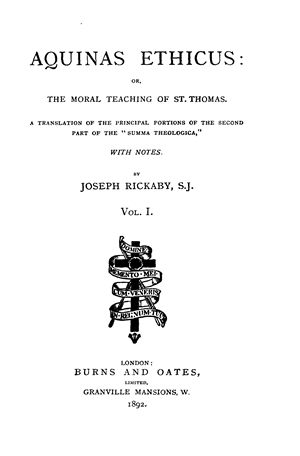
QUESTION XIX.: OF THE GIFT OF FEAR. - St. Thomas Aquinas, Aquinas Ethicus: or, the Moral Teaching of St. Thomas, vol. 1 (Summa Theologica - Prima Secundae, Secunda Secundae Pt.1) [1274]Edition used:Aquinas Ethicus: or, the Moral Teaching of St. Thomas. A Translation of the Principal Portions of the Second part of the Summa Theologica, with Notes by Joseph Rickaby, S.J. (London: Burns and Oates, 1892).
Part of: Aquinas Ethicus: or, the Moral Teaching of St. Thomas, 2 vols.About Liberty Fund:Liberty Fund, Inc. is a private, educational foundation established to encourage the study of the ideal of a society of free and responsible individuals. Copyright information:The text is in the public domain. Fair use statement:This material is put online to further the educational goals of Liberty Fund, Inc. Unless otherwise stated in the Copyright Information section above, this material may be used freely for educational and academic purposes. It may not be used in any way for profit.
QUESTION XIX.OF THE GIFT OF FEAR.Article I.—Can God be feared? R. Fear may have a double object: one object is the evil itself that the man shrinks from, the other is the object from whence the evil may come. In the first way God, who is goodness itself, cannot be an object of fear; but He may be an object of fear in the second way, inasmuch as evil may threaten us from Him, or in relation to Him. From Him we may be threatened with the evil of punishment, which is not evil absolutely, but in a restricted sense, while absolutely it is good. For since good is so called in reference to the end and aim of being, while evil implies a privation of this reference, that is evil absolutely which excludes reference to the last end: and such is the evil of sin. But the evil of punishment is evil indeed as being the privation of some particular good: at the same time it is good absolutely, inasmuch as it is in keeping with the last end. In relation to God again there may come upon us the evil of fault, if we are separated from Him: and in this way God may and ought to be feared. Article II.—Is that a good division of fear into filial, initial, servile, and mundane? R. We are dealing with fear now inasmuch as by it we are in any way either turned to God or turned away from Him. Sometimes man for the evil that he fears withdraws from God; and this is called human or mundanc fear. Sometimes again man for the evil that he fears turns to God and cleaves to Him. The evil in this latter case is twofold, the evil of punishment and the evil of fault. If then one turns to God and cleaves to Him for fear of punishment, it will be servile fear; but if for fear of fault, it will be filial fear, for it is proper to sons to fear offending their father. But if it is for fear of both, it is initial fear, which is a mean between the two. Article IV. § 1. The saying of Augustine, “He who does a thing through fear, though what he does be good, still does not do well,” is to be understood of him who does a thing out of servile fear, inasmuch as it is servile, that is, in such a way as not to love justice, but only to fear punishment. Article VI.—Can servile fear abide with charity? R. Servile fear is caused by love of self, because it is fear of punishment or loss of one’s own good. Hence servile fear can stand with charity on the same terms as love of self does; for it is on the same principle that man desires his own good and fears to be deprived of it. Now love of self may stand to charity in three different relations. In one way it is contrary to charity, when it comes to this, that a man places his last end in the love of his own good. In another way it is included in charity, when it means that a man loves himself in God and for God. In a third way it is distinct from charity but not contrary to it, as when a man loves himself with an eye to his own good, yet so as not to place his last end in this good of his own; in the same way that for our neighbour we may have some special love besides the love of charity that is founded in God, loving our neighbour on the ground of suitableness of temper, blood relationship, or some other human condition, which nevertheless is referable to charity. Thus then also fear of punishment is in one way included in charity: for to be separated from God is a punishment, and that which charity most of all shrinks from: hence this is a point of chaste fear. In another way it is contrary to charity, when, flying from punishment as contrary to his natural good, a man takes that punishment for the chiefest of evils, and the contrary of the good that he loves as his last end; and at this rate the fear of punishment does not go with charity. In another way the fear of punishment is distinct indeed in substance from chaste fear, because the man fears the penal evil, not on account of the separation from God, but because it is hurtful to his own good; and yet his last end is not set in that good, nor consequently is that evil dreaded as the chiefest of evils; and such fear of punishment can go with charity. But the fear of punishment is then only said to be servile when punishment is feared as the chiefest of evils.1 And therefore fear as servile abides not with charity; but the substance of servile fear can abide with charity, as the love of self can so abide. Article X.—Does fear grow less as charity grows greater? R. There is a filial fear whereby one fears offence to one’s father or separation from him, and a servile fear whereby one fears punishment. Filial fear must necessarily increase with the increase of charity, as the effect with the increase of the cause, for the more we love another, the more we fear to offend him or to be separated from him. But servile fear in respect of its servility is altogether taken away by the advent of charity. The fear of punishment remains however in substance; and this fear is diminished by the increase of charity, especially as to the active exercise of such fear, because the more we love God, the less we fear punishment, first, because we attend less to our own good, which is defeated by punishment; secondly, because adhering more firmly to God we have more confidence of reward, and thereby less fear of punishment. [1 ]What St. Thomas here calls servile fear, is marked by modern writers as servilely servile fear. Otherwise St. Thomas’s doctrine in substance quite accords with the last words of St. Ignatius’s Spiritual Exercises: “Not only is filial fear a thing pious and most holy, but even servile fear, where a man does not attain to anything better and more useful, is a great help to lift his head above mortal sin; and when he has come out of that, he easily arrives to filial fear which is wholly acceptable and pleasing to God our Lord, because it goes along with divine love.” (Trl.) |

Titles (by Subject)