EconlibThe LibraryOther Sites |
Front Page Titles (by Subject) 1811 - To the Senate and House of Representatives of the United States: - The Writings, vol. 8 (1808-1819)
Return to Title Page for The Writings, vol. 8 (1808-1819)The Online Library of LibertyA project of Liberty Fund, Inc.Search this Title:Also in the Library:
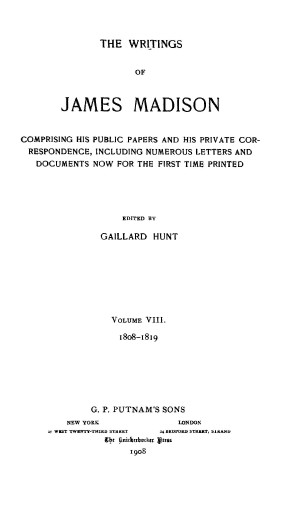
1811 - To the Senate and House of Representatives of the United States: - James Madison, The Writings, vol. 8 (1808-1819) [1908]Edition used:The Writings of James Madison, comprising his Public Papers and his Private Correspondence, including his numerous letters and documents now for the first time printed, ed. Gaillard Hunt (New York: G.P. Putnam’s Sons, 1900). Vol. 8.
Part of: The Writings of James Madison, 9 vols.About Liberty Fund:Liberty Fund, Inc. is a private, educational foundation established to encourage the study of the ideal of a society of free and responsible individuals. Copyright information:The text is in the public domain. Fair use statement:This material is put online to further the educational goals of Liberty Fund, Inc. Unless otherwise stated in the Copyright Information section above, this material may be used freely for educational and academic purposes. It may not be used in any way for profit.
To the Senate and House of Representatives of the United States:Washington, January 3, 1811. I communicate to Congress, in confidence, a letter of the 2d of December from Governor Folch, of West Florida, to the Secretary of State, and another of the same date from the same to John McKee. I communicate in like manner a letter from the British chargé d’affaires to the Secretary of State, with the answer of the latter. Although the letter can not have been written in consequence of any instruction from the British Government founded on the late order for taking possession of the portion of West Florida well known to be claimed by the United States; although no communication has ever been made by that Government to this of any stipulation with Spain contemplating an interposition which might so materially affect the United States, and although no call can have been made by Spain in the present instance for the fulfillment of any such subsisting engagement, yet the spirit and scope of the document, with the accredited source from which it proceeds, required that it should not be withheld from the consideration of Congress. Taking into view the tenor of these several communications, the posture of things with which they are connected, the intimate relation of the country adjoining the United States eastward of the river Perdido to their security and tranquillity, and the peculiar interest they otherwise have in its destiny, I recommend to the consideration of Congress the seasonableness of a declaration that the United States could not see without serious inquietude any part of a neighboring territory in which they have in different respects so deep and so just a concern pass from the hands of Spain into those of any other foreign power. I recommend to their consideration also the expediency of authorizing the Executive to take temporary possession of any part or parts of the said Territory, in pursuance of arrangements which may be desired by the Spanish authorities, and for making provision for the government of the same during such possession. The wisdom of Congress will at the same time determine how far it may be expedient to provide for the event of a subversion of the Spanish authorities within the Territory in question, and an apprehended occupancy thereof by any other foreign power. VETO MESSAGES.To the House of Representatives of the United States:February 21, 1811. Having examined and considered the bill entitled “An Act incorporating the Protestant Episcopal Church in the town of Alexandria, in the District of Columbia,” I now return the bill to the House of Representatives, in which it originated, with the following objections: Because the bill exceeds the rightful authority to which governments are limited by the essential distinction between civil and religious functions, and violates in particular the article of the Constitution of the United States which declares that “Congress shall make no law respecting a religious establishment.” The bill enacts into and establishes by law sundry rules and proceedings relative purely to the organization and polity of the church incorporated, and comprehending even the election and removal of the minister of the same, so that no change could be made therein by the particular society or by the general church of which it is a member, and whose authority it recognizes. This particular church, therefore, would so far be a religious establishment by law, a legal force and sanction being given to certain articles in its constitution and administration. Nor can it be considered that the articles thus established are to be taken as the descriptive criteria only of the corporate identity of the society, inasmuch as this identity must depend on other characteristics, as the regulations established are generally unessential and alterable according to the principles and canons by which churches of that denomination govern themselves, and as the injunctions and prohibitions contained in the regulations would be enforced by the penal consequences applicable to a violation of them according to the local law. Because the bill vests in the said incorporated church an authority to provide for the support of the poor and the education of poor children of the same, an authority which, being altogether superfluous if the provision is to be the result of pious charity, would be a precedent for giving to religious societies as such a legal agency in carrying into effect a public and civil duty. To the House of Representatives of the United States:February 28, 1811. Having examined and considered the bill entitled “An act for the relief of Richard Tervin, William Coleman, Edwin Lewis, Samuel Mims, Joseph Wilson, and the Baptist Church at Salem Meeting House, in the Mississippi Territory,” I now return the same to the House of Representatives, in which it originated, with the following objection: Because the bill in reserving a certain parcel of land of the United States for the use of said Baptist Church comprises a principle and precedent for the appropriation of funds of the United States for the use and support of religious societies, contrary to the article of the Constitution which declares that “Congress shall make no law respecting a religious establishment.” TO THOMAS JEFFERSON.mad. mss.Washington, Mar. 18, 1811. Dear Sir,—I have recd. yours inclosing two letters improperly addressed to you. A sketch, in manuscript was brought by yesterday’s mail from N. York, saying that a vessel just arrived, stated that the Prince Regent had appointed his Cabinet; that Lord Holland was prime Minister, Grenville Secretary of State, Moira Commander in Chief &c, and that a new Parliament was to be called. Whether these details be correct or not, it is highly probable that some material change in the general policy of the Government, in relation to this Country as well as in other respects, will result from the change of the men in power. Nor is it improbable that a repeal of the Orders in Council will be accompanied by a removal in some form or other, of the other condition required by the Act of May last. Still the attachment to maritime usurpations on public law, and the jealousy of our growing commerce, are sources from which serious difficulties must continue to flow, unless controuled by the distress of the Nation, or by a magnanimity not to be expected even from the personification of Fox in Lord Holland. Grenville is known to be very high in his notions of British rights on the Ocean; but he has never contended for more, on the subject of blockades than that cruising squadrons, creating a manifest danger in entering particular ports, was equivalent to a stationary force, having the same effect. His principle however tho’ construable into an important restriction of that modern practice, may be expanded so as to cover this abuse. It is, as you remark difficult to understand the meaning of Bonaparte towards us. There is little doubt, that his want of money, and his ignorance of commerce have had a material influence. He has also distrusted the stability & efficacy of our pledge to renew the non-intercourse agst. G. B. and has wished to execute his in a manner that would keep pace only with the execution of ours; and at the same time leave no interval for the operation of the British orders, without a counter operation in either his or our measures. In all this, his folly is obvious. Distrust on one side produces & authorizes it on the other; and must defeat every arrangement between parties at a distance from each other or which is to have a future or a continued execution. On the whole our prospects are far from being very flattering; yet a better chance seems to exist than, with the exception of the adjustment with Erskine, has presented itself, for closing the scene of rivalship in plundering & insulting us, & turning it into a competition for our commerce & friendship. In the midst of other perplexities, foreign & internal. a source has been opened very near me, and where co-operation agst. them was to have been rightfully expected, from personal obligations, as well as public duty. I find also that the appointment of Warden1 is to draw forth the keenest resentments of Armstrong. I have no doubt however that the ground on which we stand is sufficiently firm to support us with the Nation, agst individual efforts of any sort, or from any quarter. Be assured always of my highest esteem and sincerest attachment. TO JAMES MONROE.chic. hist. soc. mss.March 31, 1811. Dear Sir, I have the pleasure this moment of receiving yours of the 29th.1 I am particularly glad to find that you will be able to set out at so early a day for Washington. To the advantage of preventing an inconvenient chasm in the public business, will be added the opportunity of a provident attention to the accomodations required by your establishment here. The House occupied by Mr. Smith is the best in the place, and I believe is not yet out of reach. He means also to dispose of certain portions of his furniture which might suit your purpose. These considerations taken together recommend strongly that you should not wait for the receipt of your commission, but consider what has passed between us, as sufficient ground for a communication to the council. The actual receipt of the commission cannot be a necessary preliminary. As well as I recollect I did not receive mine, as Secretary of State till it was handed to me on the spot, by Mr. Jefferson. In case of appointments at a great distance, it might be extremely inconvenient for any other course to be observed. It is the more desireable that you should not wait for your commission, as I find that it will be tuesday morning before its date will be consistent with the understanding & arrangement here, & that your arrival would of consequence be thrown forward till the beginning of the next week. I might indeed, as the law authorizes, provide an interim Functionary, for the current business requiring his signature, & not admitting delay; but there are objections to this resort where it can be avoided. I hope therefore you will find no difficulty in the mode of anticipation recommended; the more especially as your communication to the council may be delayed till tuesday morning the time proposed for your setting out, and at which time your commission will have been formally consummated, & ready to be delivered. Accept assurances of my sincere esteem & friendship MEMORANDUM AS TO ROBERT SMITH.1mad. mss.(April, 1811). Having seen in the Aurora of the 5th inst. [April, 1811], & since copied into other Gazettes, an explanation which the Editor says he was authorized to make “of the rupture which has taken place between Mr. Madison, and Mr. R. Smith” I have thought it proper, whilst the circumstances are fresh in remembrance, to preserve them in the following memorandum: On the — day of March Mr. S. called on me, as was common, on some point of official business. In the conversation, he alluded to the account in the Newspapers of the dismission of Mr. Pickering by Mr. Adams, as just published for the first time by the former. Altho’ the manner of Mr. S. did not denote any purpose beyond the ordinary conversation incident to such a topic, it happened to be the very day on which I meant to have sent for him in order to communicate the necessity of making a change in the head of the Department of State. Dropping therefore the case of Mr. Pickering, and breaking its apparent relation to his own by the interposition of other subjects, I intimated that in coming over, he had anticipated my intention of sending for him, with a view to a conversation, which would be as candid & explicit on my part as it was in some respects delicate and disagreeable in itself. After remarking that I had delayed the execution of my purpose for some time after I had formed it, in order that my communication might have the character of being not the result of any sudden impulse, but of a deliberate regard to public considerations and official duty, I proceeded to state to him, that it had long been felt, and had at length become notorious, that the administration of the Executive Department laboured under a want of the harmony & unity, which were equally essential to its energy and its success; that I did not refer to the evil as infecting our Cabinet consultations, where there had always been an apparent cordiality, even a sufficient concurrence of opinion; but as shewing itself in language and conduct out of doors, counteracting what had been understood within to be the course of the administration, and the interest of the Public; that truth obliged me to add, that this practice, as brought to my view, was exclusively chargeable on him; and that he had not only counteracted what had been the result of consultations apparently approved by himself, but had included myself in representations calculated to diminish confidence in the administration committed to me. He expressed surprise that I should have yielded to such impressions, declared that he had given no cause for them; observing that it was not to be conceived that a motive could be felt by him, to be otherwise than friendly personally, as well as to the credit of my administration. I told him that I had long resisted such impressions, well knowing that my conduct to him had merited a very different return. But that they were the result of facts and circumstances brought to my knowledge from so many sources and with so many corroborations, that it was impossible to shut my mind against them. I assured him that I had struggled agst. the belief as long as I could; that it was painful as well as difficult for me to suppose, that conscious as he must be of the friendship he had experienced in my nomination of him to the Department of State, and in the constant aids I had given him, in discharging its duties, he should privately set himself agst. me in any respect; but that what had harassed my feelings in a degree equalled by no occurrence in a long political life, was the reflection that there were among those most nearly connected with him, a number of individuals whom I had always felt a gratification in classing among the best of my friends political & personal, & for whom I felt the highest esteem & sincerest affection; and that the idea of distressing them was most severely so to myself. He repeated his solemn denial of unfriendly conduct in any way towards me, or having done any thing tending to obstruct or embarrass the administration; that on the contrary, he had been always personally my friend, and had contributed, as far as he could to the credit & support of the administration: What motive could he have to be otherwise, being himself a member of it, and having neither pretensions nor expectations of any higher sort? What could have given rise to the unfavorable sentiments I had expressed, he was at a loss even to conjecture. I told him I was aware of the awkwardness of my situation, in being obliged to refer to information and evidence which had come to me in ways not permitting me to name to him the sources; but I could assure him that the sources were such as made it my duty not to disregard them; and that unquestionably, he would himself, in my situation yield to the accumulated statements which had their effect on me. In what instances had he set himself agst. me, or against measures espoused by the administration? I reminded him of a conversation with Mr. — reported by the latter, in which he had indulged himself in disparaging remarks on my official character, & that of others in the Cabinet; on the general course of my Policy, which he signified he disapproved; and in which he had communicated certain Cabinet proceedings, some of which were of so confidential a nature that the gentleman did not consider himself at liberty to repeat them. I had taken occasion before to drop him a hint that such a conversation had been given out, observing at the time, that I did it not because I lent an ear to it, but that it might suggest circumspection. He slighted then the report as proceeding from a source not likely to be listened to; and now repeated the denial of the conversation, with an allusion to a report from the same source, as to a conversation with another member of the Cabinet, where it appeared, that no interview could have taken place. I admitted that if this had been a solitary case, it would have been entirely dismissed from my recollection; but this was far from being the fact, altho’ I could not equally enter into a specification of other cases. For examples in which he had counteracted what he had not himself disapproved in the Cabinet, I referred to the Bills called Macon’s bills, and the non-intercourse bill, on the consultations on which he appeared to concur in their expediency; that he well knew the former, in its outline, at least, had originated in the difficulty of finding measures that would prevent what Congress had solemnly protested agst., to wit, a compleat submission to the belligerent Edicts; that the measure was considered as better than nothing, which seemed to be the alternative, and as part only of whatever else might in the progress of the business be found attainable; and that he neither objected to what was done in the Cabinet, (the time & place for the purpose,) nor offered any thing in the place of it; yet it was well understood that his conversations & conduct out of doors, had been entirely of a counteracting nature; that it was generally believed that he was in an unfriendly disposition personally and officially; and that, altho’ in conversations with different individuals he might not hold the same unfavorable language, yet with those of a certain temper, it was no secret that he was very free in the use of it; and had gone so far as to avow a disapprobation of the whole policy of commercial restrictions, from the Embargo throughout. I intimated to him also that it was a complaint among our friends in Congs that the Federalists frequently quoted him for communications from our Ministers abroad, which were unknown to others, the disclosures being sometimes such as to be deemed confidential, and to be turned agst the administration. I glanced also at the report of his conversation with Mr. Morier, in which he (Mr. S) had expressed his disapprobation of the whole course of policy observed by the U. States towards G. B. All these facts he repelled by a repetition of what he had before said. With respect to his motives for dissatisfaction, I acknowledged that I had been, for the reasons given by him, much puzzled to divine any natural ones, without looking deeper into human nature than I was willing to do; and it was on this account that I had so long resisted the impression which had at length been made on me; that instead of having any just motives to become an adversary, I knew, and he must be conscious, that in my confidential intercourse with him, in my kindness in general, and, above all, in the labor I had taken upon myself in behalf of his official duties, and for his credit, as well as that of the administration, I ought to have found an opposite return. On this subject as well as every other, I told him, I meant as I ought to be entirely frank, and must therefore say, that it was an imperious consideration for a change in the Departmt. of State, that whatever talents he might possess, he did not as he must have found by experience, possess those adapted to his station; that this had thrown the business more into my hands than was proper, or consistent with my own duties; that as long as I considered him in the light I once did, I had cheerfully given him my aid, but that it was too much to be expected under actual circumstances, and that moreover, the increase of the public business had put it out of my power to do his share as well as my own; and that indeed throughout it was not done as well as might have been by a mind appropriated thereto. I observed that I could appeal to himself for the fact that the business of the Dept. had not been conducted in the systematic and punctual manner which was necessary, particularly in the foreign correspondence, and that I had become daily more dissatisfied with it. He did not admit that complaint was well founded; intimating that I had a particular way of thinking on this subject, and that his conduct of the business would fully justify itself on examination. I told him he could not but be in a great error; reminding him of the condition in which his correspondence, more particularly, was brought to me; which was almost always so crude & inadequate, that I was in the more important cases generally obliged to write them anew myself, under the disadvantage sometimes of retaining, thro’ delicacy some mixture of his draft; that he must recollect that in the cases of Erskine & Jackson, the correspondence on his part had in a manner, fallen entirely on my hands. I reminded him also of important failures to make seasonable communications to our foreign Agents; particularizing the case of neglecting, tho’ repeatedly desired, to make known to our Minister at Paris, as was done to our Minister at London, that in case the letter of the Duke de Cadore of Aug. 5, to Genl. Armstrong as reaching us through English newspapers, should be officially confirmed, it would be the ground of a Proclamation as authorized by the Act of May, 1810, and the case of not keeping Mr. Shaler at the Havanna, duly informed of the state of our foreign relations, in consequence of which, as appeared by Mr. Shaler’s letters, he was unable to pursue the object of his mission with advantage. I observed that if he had transmitted at once, in multiplied copies, & thro’ different channels, the same information for the French Govt. as to the B. Govt. as to the light in which the letter of the D. de Cadore was viewed, it might, by removing uncertainty & distrust as to the course here, have prevented the delay & embarrassment resulting from the course there. The impression made by these remarks was shewn rather by his manner, than his comment which was limited to a general disclaimer of the justness of them; & to allusions to a report that he had expressed to Mr. — Ingersoll lately in Washington, a disapprobation of the Proclamation putting in force the non-importation act agst. G. B. which he denied to be fact, & said that he had sought out that gentleman, and had obtained from him a satisfactory explanation. In this stage of the conversation, but in what particular connection is not recollected, it was noticed as a mark of his disinclination to co-operate in promoting measures for the better fulfilling of the Executive trust, that altho’ the Act of Congrs at the session preceding that just closed, relating to our diplomatic establishment, & of course particularly affecting his dept, had been found so very inconvenient, and it had been so often suggested to him; as desirable that some active member of Congress, should be apprized of the expediency of amending or repealing the act, yet no such hint had been ever given, till at length I had availed myself of an opportunity of explaining the matter to a member of the Senate, who readily introduced it to the Senate, but too late in the session to receive an effectual attention. He signified that he had not been in the habit of proceeding in such a way with business belonging to the Legislature, and seemed to disapprove or doubt the propriety of it. I remarked that where the intention was honest & the object useful, the conveniency of facilitating business in that way was so obvious that it had been practised under every past administration, & wd. be so under every future one; that Executive experience wd. frequently furnish hints & lights for the Legislature; that nothing was more common than for members of Congs. to apply for them; and that in fact, such communications, in cases not calling for formal messages, were indispensable to the advantageous conduct of the public business. A resort to formal messages on every occasion where executive information might be useful, was liable to obvious objections. He made no particular reply, but did not seem to acquiesce. Returning to the necessity of harmony & unity in the Executive Councils, in providing for which I expressed a disposition to wound feelings any where as little as possible, he said he had himself regretted my situation, in reference to the want of cordiality among members of the Cabinet, declaring, at the same time, that whilst he was aware of intrigues & hostilities carried on agst. himself, he had abstained from everything of that sort agst. others, disdaining, at all times, to stoop to such practices. I told him it was unnecessary to repeat observations which I had already made; that such was the state of things that a remedy had become essential in the view of the most considerate friends of the administration, and that I wished for the reasons given, to make it as lenient as would answer the purpose. It had occurred to me that he might not be disinclined to serve his Country in a foreign mission, and that St. Petersburg, where there was a vacancy, might be an eligible as it certainly was an important situation. London more so, he remarked quickly. For London, I replied, another arrangement was thought of; adding, with a view to repress miscalculations, that it was a place of discussions & negotiations, calling for appropriate talents & habits of business. He said he had for a considerable time entertained thoughts of retiring from the Department of State, and had looked towards a vacancy on the Bench of the Supreme Court, likely to be produced ere long, by death in Baltimore (alluding to Judge Chase). I observed that in that event it might be found most proper to seek a successor elsewhere, intimating also that he had been long out of the practice & study of the law, and that the Senate would probably be hard to please in such a case. He made light of that consideration, with an expression of confidence in his standing there, which led me to remark that he was not aware how much room there was for a different estimate, that he had assuredly lost ground extremely with the members of both Houses of Congress, in so much that the prevailing sentiment, as brought to my knowledge in the most direct manner, and from some quarters not unfriendly to himself, called for some arrangement that would at least vary the composition of the Cabinet. He ascribed unfavorable impressions agst him as far as they might exist to intrigues & calumnies; signifying that there was however a body of firm friends personal & political, who would not desert him whatever course things might take. I did not admit that any considerable body of the Republicans, would in any event, take side agst the administration, that on the contrary, many on whom he might perhaps count, had become dissatisfied with the course he had pursued; that it was not so much therefore the consideration alluded to by him, which weighed with me, tho’ not without weight especially at the present crisis in Maryland, (the approaching elections of Senatorial Electors,) as the one I had before mentioned namely the personal friends common to both of us, that made me desirous of smoothing the change become necessary, by proposing a Mission to Russia, which I sincerely wished him to accept. I remarked that the services there tho’ neither difficult nor laborious, might be important; that the station was respectable, and that it was desirable to find a minister whose political grade here had been such as would satisfy the expectations of the Emperor, and whose private resources would also aid his salary in bearing the expensiveness of that Metropolis & Court. He admitted an inclination towards a trip to Europe as more eligible than his situation here; and, after a few uninteresting observations, concurred in the measure with a mutual understanding that the appointment would be postponed for some days, till he could wind up the business of his Department, and prepare for his departure from Washington. I observed that as the 1st of April, closed a quarter it might be a convenient epoch, for the date of his Commission, in which he acquiesced. He said he supposed there would be no impropriety in letting it be known that the mission was on foot; none at all. After a short pause, May I say that the appointment is offered to me. I have no objection, it being of course understood that it is to take place on the 1st of April; and that you will let me be at liberty as many days previous as may be convenient, to take overt measures for supplying the vacancy, which he promised. The conversation closed with his proposal that it should be considered as entirely confidential, & my acquiescence in it. From his conversations & conduct for several days, in his office & elsewhere, it was not doubted that he persisted in his intention to accept the Mission, and was making preparations accordingly. Circumstances soon however began to denote & strengthen doubts, particularly his declining, after accepting my invitation, to dine with a party, including the Russian Legation; and as I did not hear from him as was expected and the 1st of April approached I sent for him. On his arrival, I told him my object, and that I had, according to the understanding between us, caused a Commission to be made out for him. He said he was himself on the point of coming over to me, with the view of returning into my hands his Commission of Secretary of State, (handing it to me at the same time) and to inform me that he had determined to decline the other which had been proffered to him. However disposed he might have been to accept it under other circumstances, it was impossible he could do so under such as would give it the appearance of a mere expedient to get rid of him as Secretary of State. He had learned from Baltimore that a removal of him was believed to have been determined on, under the influence of intrigues agst him, and that this intention was known even to federal members of Congress, as was evinced by their language on their return home, that the same impression existed elsewhere; that he had, in fact, recd. letters from his friends not only in Baltimore, but in Penna & N. York, advising him by no means to make himself a party to the transaction by accepting the Russian Mission, which would be regarded as a mere cover for his removal. I told him I could not be answerable for the reports or assertions that might be propagated; that the course I had pursued was the one deemed proper in the circumstances which had resulted from that pursued by him, and had been as delicate and favorable to him as could be reconciled with what I owed to the Public & to myself; that in tendering him the Commission for Russia, I wished him to accept it for the reasons explained to him; that what the Federalists said on the occasion, must have grown out of the conversations which had, as was well known, been frequent & free among the friends of the administration, on the necessity of a change in the Department of State. I availed myself of this turn of the conversation, to allude anew to the reports & complaints, that the Federalists were the first to get from him information of our foreign Affairs; and to its being understood that he had told Mr. Morier that the whole policy of the Government towards G. B. had been contrary to his opinion & advice. This he denied. I assured him there was full evidence that Morier had said so; that this was known to and believed by sundry members of Congs, and had contributed, with other causes, to strengthen the current running agst him. I reminded him of the official letter from Mr. Morier to him, complaining of the non-intercourse being enforced against G. B. during the actual conduct of France in which he (M) referred to a conversation in which he (S.) admitted that G. B. had a right to complain; I told him I had been surprised, when he communicated the letter to me, to find no apparent intention of a formal disavowal of that circumstance till I had pressed it on him as material to himself in case the correspondence should be brought before the public or Congress; and that I did not approve of the course finally taken by him, of getting Morier to withdraw the letter and substitute another omitting the passage; a course less eligible than the one I had suggested, of a written disavowal, as Morier’s communications to his Govt. might correspond with his first letter, and might find their way to the public thro’ a Call for papers by the British Parliament, in which case the statement would be without his contradiction. These I observed were disagreeable topics, and I willingly turned from them, to repeat to him, that with a wish to consult the sensibility of common friends, I had been ready to give him in exchange for an office which he professed no longer to relish, a foreign Mission which in itself did not appear to be unacceptable to him; and that it was still in his option, & would remain so for a short time longer, if he wished to deliberate further on the subject. He said he had made up his mind, & meant to be understood as having given his final answer to the proposal. He recurred to the aspect it wore of an indirect removal of him from the department of State, and to the allegation of intrigues agst him, which had been mistaken for a loss of Confidence with the public & with Congs; regretted the tendency of what was taking place to injure the Republican cause, observing again that he should be supported by a Body of friends, and that he knew he could stand on good ground in justifying himself to his Country. I assured him that neither my sentiments nor conduct in relation to him were in the least the effect of intrigues, to which I should never listen, but of the facts & considerations I had unfolded to him; that I did not doubt the friendship for him of a number of respectable & weighty characters, but it was not less true, however disagreeable it might be to dwell on the circumstance, that with the Public, as well as among the members of Congs in both Houses, the tide was setting strongly & extensively agst him; that I regretted as much as himself a tendency in any occurrence to impair harmony among the Republicans, more especially at this time & in this State, but that I believed this was not likely to be much the case; conceiving that the administration rested on ground as solid as at any preceding period; & that for myself, I was entirely confident that what I had done in relation to him, could be justified not only to the public, if it should become there necessary, but even to the most partial of his personal friends; that I cd have no personal objection therefore to any step he might take which would call the public attention to it. He said it was not his wish, however confident he might be of the ground on which he stood, to introduce any public discussion. The conversation being at an end, he took his leave with a cold formality, and I did not see him afterwards. On reading over the above, I recollect nothing worth mentioning which is omitted; unless it be thought an exception, that in some stage of the conversation I alluded to the pretty general opposition made by his brother in the Senate to the measures proposed or supposed to be approved, by the Executive, and its effect in strengthening the presumption with many of a like spirit in the Secretary of State; explicitly declaring, at the same time, that however I might be sometimes disappointed at the part taken by his brother, or regret it on account of his talents & his weight, I had always considered myself bound to suppose him actuated by a just respect for the independence of his station & his character; and that as he stood in no official connection with the Executive rendering him anywise responsible for his political conduct, I had never permitted myself to complain of it. J. M. April, 1811. TO THOMAS JEFFERSON.mad. mss.W. May 3, 1811. Dear Sir I have recd. yours of the 24 Apl1 and return the letter inclosed in it; after having made the communication intended for Mr. Gallatin. Your expostulations with Duane could not be improved; but he gives proofs of a want of candor, as well as of temperance, that will probably repel advice, however rational or friendly. The great fulcrum of his attacks on Mr. Gallatin is Erskine’s statement of his favorable dispositions toward England; and these attacks he obstinately reiterates and amplifies, notwithstanding the public & solemn denial of Mr. G: whilst Mr. Smith & myself, tho’ included in a like statement, under which we have both remained silent, have not been reproached on that account, and Mr. S. is become an object even of favor. A like want of candor is seen in the comments of the Aurora, on the putative explanation of the rupture between Mr. S. & myself. Of the alledged points of difference, the main one, viz: the non-intercourse, it appears as his opinion on my side; yet he takes the other side generally without alluding to the exception; and of late, restricts his comments to Macon’s bills, or smothers the “non-intercourse” under an &c, or confounds the measure with the manner of its execution. Again, Whilst he admits occasionally that the non-intercourse, or rather non-importation now in force, is the best and the only adequate resort agst. the aggressions of G. B. he continues his abuse on the Government, for abandoning the interests & rights of the Nation. I have always regarded Duane, & still regard him as a sincere friend of liberty, and as ready to make every sacrifice to its cause, but that of his passions. Of these he appears to be compleatly a slave. Our expected frigate is not yet arrived from Europe; nor is there any acct. of the departure either of Pinkney or Foster from G. B. The last account from P. was of Mar. 13, when he was packing up for his passage in the Frigate. Whether the delays, proceed from the approach of the Equinox, the posture of the Regency, or a wish to learn the result of things in Congress, or from some other cause, is unknown. From the jumble of accts. from France, it is probable, that the repeal of the Decrees is professedly adhered to; and that an exchange of the productions of the U. S. & F. with an exception of certain articles, is permitted by the Municipal laws, under vexatious precautions agst British forgeries & American collusions; and perhaps under some distrust of the views of this Government. Accept my high esteem & best affections. TO THE INHABITANTS OF THE TOWN OF NEW HAVEN.mad. mss.I have recd., fellow Citizens, the petition which you have addressed to me, representing the inconveniences experienced from the existing non-importation law, and soliciting that the National Legislature may be speedily convened. It is known to all that the Commerce of the U. S. has, for a considerable period, been greatly abridged & annoyed by Edicts of the Belligerent powers; each professing retaliation only on the other; but both violating the clearest rights of the U. S. as a neutral nation. In this extraordinary state of things, the Legislature, willing to avoid a resort to war, more especially during the concurrent aggressions of two great Powers, themselves at war, the one with the other, and determined on the other hand agst. an unqualified acquiescence, have endeavored by successive and varied regulations affecting the commerce of the parties, to make it their interest to be just. In the Act of Congress out of which the existing non-importation has grown, the state of Commerce was no otherwise qualified than by a provision, that in case either of the Belligerents should revoke its unlawful Edicts, and the other should fail to do the same, our ports should be shut to the vessels & Merchandize of the latter. This provision which, like our previous offers, repelled the very pretext set up by each, that its Edicts agst. our trade with the other, was required by our acquiescence in like Edicts of the other, was equally presented to the attention of both. In consequence of the communication the French Government declared that its Decrees were revoked. As the British Government had expressed reluctance in issuing its orders, and repeatedly signified a wish to find in the example of its adversary an occasion for putting an end to them, the expectation was the more confident that the occasion would be promptly embraced. This was not done; and the period allowed for the purpose having elapsed, our ports became shut to British Ships and merchandize. Whether the conduct of the French Government has been, and will be such as to satisfy the authorized expectations of the U. States; or whether the British Government may have opened, or will open the way for the Executive removal of the restrictions on British commerce with the U. States, which it continues in its power to do, by revoking its own unlawful restrictions on our commerce, is to be ascertained by further information, which will be received & employed by the Executive with the strict impartiality, which has been invariably maintained towards the two Belligerents. Whatever may be the inconveniences resulting in the mean time, from the non-importation Act, it was not to have been supposed, that whilst it falls within the necessary power, and Practice of regulating our commercial intercourse with foreign Countries, according to circumstances, the act would be regarded as not warranted by the Constitution; or that whilst it was a partial restriction only, and had for its object, an entire freedom of our commerce, by a liberation of it from foreign restrictions unlawfully imposed, it could be viewed as destroying commerce; and least of all that a likeness could be seen between a law enacted by the representatives of the Country, with a view to the interest of the Country, and Acts of a Government in which the Country was not represented, framed with a view to the interest of another Country at the expence of this. If appeals to the justice of the Belligerents, through their interests, involve privations on our part also, it ought to be recollected that this is an effect inseperable from every resort by which one nation can right itself agst. the injustice of others. If sacrifices made for the sake of the whole, result more to some than to other districts or descriptions of Citizens, this also is an effect which tho’ always to be regretted, can never be entirely avoided. Whether the appeal be to the sword, or to interruptions or modifications of customary intercourse, an equal operation on every part of the Community can never happen. Nor would an unqualified acquiescence in belligerent restrictions on our Commerce, if that could be reconciled with what the Nation owes to itself, be less unequal in its effect on different local situations & interests. In estimating the particular measure which has been adopted by the National Councils, it may be reasonably expected therefore, from the candor of enlightened Citizens, that with the peculiarity of the public situation, they will be impressed also with the difficulty of selecting the course most satisfactory, and best suited to diminish its evils or shorten their duration; that they will keep in mind that a resort to war must involve necessary restrictions on commerce; and that were no measure whatever opposed to the Belligerent Acts against our Commerce, it would not only remain under the severe restrictions now imposed by foreign hands, but new motives would be given for prolonging and invigorating them. These observations are not meant to anticipate the policy which the Legislature may henceforward find best adapted to support the honor or promote the interest of the Nation; or to prejudge questions relative to particular changes which may be pointed out by experience, or be called for by the state of our foreign relations. Neither do they imply any predetermination as to the measure of convening the Legislature, which it will be a duty to adopt or decline as our national affairs may appear to require. The view of our situation presented to your patriotic reflections, has been suggested by that contained in your address; And it will have its desired effect, if it recalls your attention to the peculiar embarrassments with which the National Councils have had to contend, and enforces the importance of manifesting that union of all in supporting the measures of the Constituted Authorities whilst actually in force, which is as necessary to their effect at home and abroad, as it is consistent with the right and with the legitimate modes, of seeking a revisal of them. In the mode which the Town of New Haven has employed I witness with satisfaction, that in exercising the right of freemen, the obligation of Citizens has not been forgotten; and that it affords a pledge and an example which I am far from undervaluing. I tender you my respects and my friendly wishes. Washington, May 24, 1811. TO THOMAS JEFFERSON.mad. mss.Washington June 7, 1811. Dear Sir I return the letter from you to Duane, on the subject of Mr. Gallatin he seems to be incorrigible. If I am not misinformed, his eyes are opening to the conduct & character of Mr. S. with respect to both of which he has suffered himself to be misled partly by his own passions, partly by those who took advantage of them. You see the new shapes our foreign relations are taking. The occurrence between Rogers & the British ship of war, not unlikely to bring on repetitions, will probably end in an open rupture, or a better understanding, as the calculations of the B. Govt. may prompt or dissuade from war.1 Among the items in these will be the temper here, as reported by its partizans. The state of parties in Massts. is in this view important, especially as it will attract particular notice by its effects in degrading Pickering, who has made himself so conspicuous in the British service.2 On the other hand much impatience is shewing itself in the Eastn. States, under the non-importation. The little embarrassment which occurs in procuring returns for the apples & onions sent from Connecticut to the W. Indies, is generating remonstrances as in the case of the Embargo. I have been obliged to answer one from N. Haven headed by Hillhouse, which they have not yet published. The protracted delay of the Essex still leaves us a prey to the ignorance & interested falsehoods which fill our newspapers. It would seem that G. B. is determined agst. repealing her orders, and that Bonaparte is equally so on the destruction of her commerce, to which he readily sacrifices his own commerce with the U. S. As to the blockade of England, (the decree to which alone the Act of Congs & the Proclamation have reference) there is no evidence of its being continued in force. All the Official evidence is on the other side. And yet by a confusion of ideas or artifice of language, the appearance is kept up that the ground of the non-importation has failed, and that it is consequently a wrong to G. B. After all, we must remain somewhat in the dark till we hear more on the subject; probably till the return of the vessel that carried to France the Act of Congs. putting in force the non-importation, for wch Bonape. seems to be waiting. After a severe drought, we have had a copious rain. I hope you have shared it & that it will have aided the Wheatfields in their conflict with the Hessian fly. Be assured of my constant & truest affection. THIRD ANNUAL MESSAGE.Washington, November 5, 1811. Fellow-Citizens of the Senate and of the House of Representatives:In calling you together sooner than a separation from your homes would otherwise have been required I yielded to considerations drawn from the posture of our foreign affairs, and in fixing the present for the time of your meeting regard was had to the probability of further developments of the policy of the belligerent powers toward this country which might the more unite the national councils in the measures to be pursued. At the close of the last session of Congress it was hoped that the successive confirmations of the extinction of the French decrees, so far as they violated our neutral commerce, would have induced the Government of Great Britain to repeal its orders in council, and thereby authorize a removal of the existing obstructions to her commerce with the United States. Instead of this reasonable step toward satisfaction and friendship between the two nations, the orders were, at a moment when least to have been expected, put into more rigorous execution; and it was communicated through the British envoy just arrived that whilst the revocation of the edicts of France, as officially made known to the British Government, was denied to have taken place, it was an indispensable condition of the repeal of the British orders that commerce should be restored to a footing that would admit the productions and manufactures of Great Britain, when owned by neutrals, into markets shut against them by her enemy, the United States being given to understand that in the meantime a continuance of their non-importation act would lead to measures of retaliation. At a later date it has indeed appeared that a communication to the British Government of fresh evidence of the repeal of the French decrees against our neutral trade was followed by an intimation that it had been transmitted to the British plenipotentiary here in order that it might receive full consideration in the depending discussions. This communication appears not to have been received; but the transmission of it hither, instead of founding on it an actual repeal of the orders or assurances that the repeal would ensue, will not permit us to rely on any effective change in the British cabinet. To be ready to meet with cordiality satisfactory proofs of such a change, and to proceed in the meantime in adapting our measures to the views which have been disclosed through that minister will best consult our whole duty. In the unfriendly spirit of those disclosures indemnity and redress for other wrongs have continued to be withheld, and our coasts and the mouths of our harbors have again witnessed scenes not less derogatory to the dearest of our national rights than vexatious to the regular course of our trade. Among the occurrences produced by the conduct of British ships of war hovering on our coasts was an encounter between one of them and the American frigate commanded by Captain Rodgers, rendered unavoidable on the part of the latter by a fire commenced without cause by the former, whose commander is therefore alone chargeable with the blood unfortunately shed in maintaining the honor of the American flag. The proceedings of a court of inquiry requested by Captain Rodgers are communicated, together with the correspondence relating to the occurrence, between the Secretary of State and His Britannic Majesty’s envoy. To these are added the several correspondences which have passed on the subject of the British orders in council, and to both the correspondence relating to the Floridas, in which Congress will be made acquainted with the interposition which the Government of Great Britain has thought proper to make against the proceeding of the United States. The justice and fairness which have been evinced on the part of the United States toward France, both before and since the revocation of her decrees, authorized an expectation that her Government would have followed up that measure by all such others as were due to our reasonable claims, as well as dictated by its amicable professions. No proof, however, is yet given of an intention to repair the other wrongs done to the United States, and particularly to restore the great amount of American property seized and condemned under edicts which, though not affecting our neutral relations, and therefore not entering into questions between the United States and other belligerents, were nevertheless founded in such unjust principles that the reparation ought to have been prompt and ample. In addition to this and other demands of strict right on that nation, the United States have much reason to be dissatisfied with the rigorous and unexpected restrictions to which their trade with the French dominion has been subjected, and which, if not discontinued, will require at least corresponding restrictions on importations from France into the United States. On all those subjects our minister plenipotentiary lately sent to Paris has carried with him the necessary instructions, the result of which will be communicated to you, and, by ascertaining the ulterior policy of the French Government toward the United States, will enable you to adapt to it that of the United States toward France. Our other foreign relations remain without unfavorable changes. With Russia they are on the best footing of friendship. The ports of Sweden have afforded proofs of friendly dispositions toward our commerce in the councils of that nation also, and the information from our special minister to Denmark shews that the mission had been attended with valuable effects to our citizens, whose property had been so extensively violated and endangered by cruisers under the Danish flag. Under the ominous indications which commanded attention it became a duty to exert the means committed to the executive department in providing for the general security. The works of defense on our maritime frontier have accordingly been prosecuted with an activity leaving little to be added for the completion of the most important ones, and, as particularly suited for co-operation in emergencies, a portion of the gunboats have in particular harbors been ordered into use. The ships of war before in commission, with the addition of a frigate, have been chiefly employed as a cruising guard to the rights of our coast, and such a disposition has been made of our land forces as was thought to promise the services most appropriate and important. In this disposition is included a force consisting of regulars and militia, embodied in the Indiana Territory and marched toward our northwestern frontier. This measure was made requisite by several murders and depredations committed by Indians, but more especially by the menacing preparations and aspect of a combination of them on the Wabash, under the influence and direction of a fanatic of the Shawanese tribe. With these exceptions the Indian tribes retain their peaceable dispositions toward us, and their usual pursuits. I must now add that the period is arrived which claims from the legislative guardians of the national rights a system of more ample provisions for maintaining them. Notwithstanding the scrupulous justice, the protracted moderation, and the multiplied efforts on the part of the United States to substitute for the accumulating dangers to the peace of the two countries all the mutual advantages of re-established friendship and confidence, we have seen that the British cabinet perseveres not only in withholding a remedy for other wrongs, so long and so loudly calling for it, but in the execution, brought home to the threshold of our territory, of measures which under existing circumstances have the character as well as the effect of war on our lawful commerce. With this evidence of hostile inflexibility in trampling on rights which no independent nation can relinquish, Congress will feel the duty of putting the United States into an armor and an attitude demanded by the crisis, and corresponding with the national spirit and expectations. I recommend, accordingly, that adequate provision be made for filling the ranks and prolonging the enlistments of the regular troops; for an auxiliary force to be engaged for a more limited term; for the acceptance of volunteer corps, whose patriotic ardor may court a participation in urgent services; for detachments as they may be wanted of other portions of the militia, and for such a preparation of the great body as will proportion its usefulness to its intrinsic capacities. Nor can the occasion fail to remind you of the importance of those military seminaries which in every event will form a valuable and frugal part of our military establishment. The manufacture of cannon and small arms has proceeded with due success, and the stock and resources of all the necessary munitions are adequate to emergencies. It will not be inexpedient, however, for Congress to authorize an enlargement of them. Your attention will of course be drawn to such provisions on the subject of our naval force as may be required for the services to which it may be best adapted. I submit to Congress the seasonableness also of an authority to augment the stock of such materials as are imperishable in their nature, or may not at once be attainable. In contemplating the scenes which distinguish this momentous epoch, and estimating their claims to our attention, it is impossible to overlook those developing themselves among the great communities which occupy the southern portion of our own hemisphere and extend into our neighborhood. An enlarged philanthropy and an enlightened forecast concur in imposing on the national councils an obligation to take a deep interest in their destinies, to cherish reciprocal sentiments of good will, to regard the progress of events, and not to be unprepared for whatever order of things may be ultimately established. Under another aspect of our situation the early attention of Congress will be due to the expediency of further guards against evasions and infractions of our commercial laws. The practice of smuggling, which is odious everywhere, and particularly criminal in free governments, where, the laws being made by all for the good of all, a fraud is committed on every individual as well as on the state, attains its utmost guilt when it blends with a pursuit of ignominious gain a treacherous subserviency, in the transgressors, to a foreign policy adverse to that of their own country. It is then that the virtuous indignation of the public should be enabled to manifest itself through the regular animadversions of the most competent laws. To secure greater respect to our mercantile flag, and to the honest interests which it covers, it is expedient also that it be made punishable in our citizens to accept licenses from foreign governments for a trade unlawfully interdicted by them to other American citizens, or to trade under false colors or papers of any sort. A prohibition is equally called for against the acceptance by our citizens of special licenses to be used in a trade with the United States, and against the admission into particular ports of the United States of vessels from foreign countries authorized to trade with particular ports only. Although other subjects will press more immediately on your deliberations, a portion of them can not but be well bestowed on the just and sound policy of securing to our manufactures the success they have attained, and are still attaining, in some degree, under the impulse of causes not permanent, and to our navigation, the fair extent of which is at present abridged by the unequal regulations of foreign governments. Besides the reasonableness of saving our manufacturers from sacrifices which a change of circumstances might bring on them, the national interest requires that, with respect to such articles at least as belong to our defense and our primary wants, we should not be left in unnecessary dependence on external supplies. And whilst foreign governments adhere to the existing discriminations in their ports against our navigation, and an equality or lesser discrimination is enjoyed by their navigation in our ports, the effect can not be mistaken, because it has been seriously felt by our shipping interests; and in proportion as this takes place the advantages of an independent conveyance of our products to foreign markets and of a growing body of mariners trained by their occupations for the service of their country in times of danger must be diminished. The receipts into the Treasury during the year ending on the 30th of September last have exceeded $13,500,000, and have enabled us to defray the current expenses, including the interest on the public debt, and to reimburse more than $5,000,000 of the principal without recurring to the loan authorized by the act of the last session. The temporary loan obtained in the latter end of the year 1810 has also been reimbursed, and is not included in that amount. The decrease of revenue arising from the situation of our commerce, and the extraordinary expenses which have and may become necessary, must be taken into view in making commensurate provisions for the ensuing year; and I recommend to your consideration the propriety of insuring a sufficiency of annual revenue at least to defray the ordinary expenses of Government, and to pay the interest on the public debt, including that on new loans which may be authorized. I cannot close this communication without expressing my deep sense of the crisis in which you are assembled, my confidence in a wise and honorable result to your deliberations, and assurances of the faithful zeal with which my cooperating duties will be discharged, invoking at the same time the blessing of Heaven on our beloved country and on all the means that may be employed in vindicating its rights and advancing its welfare. TO J. Q. ADAMS.mad. mass.(Private.) Washington Novr 15, 1811. Dear Sir I have received your several favors of Feby 8, Apl 19, June 3,1 and Aug. 17, all of them in triplicates or duplicates. I need not say how agreeable it would have been to me, and I am persuaded satisfactory to the public, if your inclination & circumstances had favored the new allotment of your services. Being ignorant of the obstacle arising from the particular state of your family, and inferring from considerations known to you, that such an exchange might not be unwelcome, I had proceeded so far in anticipating a decision different from that which took place in your mind, as to hold out the station at St Petersburg to another. It has happened that no disappointment of any sort ensued to your contemplated successor. But I ought not to omit, that I did not so far lose sight of the possibility that you might be induced to decline the new appointment, as not to have meditated a provision for that event which wd. have probably deprived it of its embarrassments. In the present state of things, I have only to wish that your diplomatic situation may continue to be less incommodious than it was at first found; and that opportunities of rendering it useful to your Country may equal her confidence in the fidelity and ability which you will apply to them. Count Pahlen has just delivered his letter of leave, in pursuance of the order of the Emperor which translates him to Rio Janeiro. His excellent dispositions, and amicable deportment, have justly rendered him so highly & universally agreeable here, that we take for granted that no doubt on that point can have been among the reasons of his sovereign for this change of his destination. You will receive by this conveyance from the Department of State, the late communications to Congress, including the adjustment of the rusty and corrosive affair of the Chesapeake.1 The pretension of G. B. which requires us as neutral nation to assert agst. one belligerent an obligation to open its markets to the products of the other, shews a predetermination to make her orders in Council codurable with the war, for she cannot be unaware that nothing but a termination of the war if even that, will fulfill the condition annexed to their repeal. The question to be decided, therefore, by Congress, according to present appearances, simply is, whether all the trade to which the orders are and shall be applied, is to be abandoned, or the hostile operation of them, be hostilely resisted. The apparent disposition is certainly not in favor of the first alternative, though it is more than probable, that if the second should be adopted, the execution of it will be put off till the close of the Session approaches; with the exception perhaps of a licence to our Merchantmen to arm in self-defence, which can scarcely fail to bring on war in its full extent unless such an evidence of the disposition of the U. S. to prefer war to submission should arrest the cause for it. The reparation made for the attack on the American frigate Chesapeake, takes one splinter out of our wounds; but besides the provoking tardiness of the remedy, the moment finally chosen deprives it of much of its effect, by giving it the appearance of a mere anadyne to the excitements in Congs. & the nation produced by the cotemporary disclosures. It will afford you pleasure to know that the aggregate of our Crops was never greater than for the present year. The grain part of them is particularly abundant. I tender you assurances of my great esteem and friendly respects. TO JOEL BARLOW.1mad. mss.(Private.) Washington Novr 17, 1811. Dear Sir You will receive by this conveyance the proper communications from the Dept. of State. You will see in them, the ground now avowed for the B. Orders in Council. It must render them codurable with the war; for nothing but a termination of it will re-open the continental market to British products. Nor is it probable that peace will do it in its former extent. The pretension which requires the U. S. as a neutral power to assert an obligation on one belligerent, to favor, by its internal regulations, the manufactures of another, is a fitter subject for ridicule than refutation. It accordingly has no countenance here even among the most devoted champions of G. B. Whether some of them, by arming themselves with simulated facts & sophistical distinctions, may not be emboldened to turn out in her defence, will soon be seen. Nothing has yet passed in Congs. disclosing the sense of that Body, with respect to the moment & manner of meeting the conduct of G. B. in its present hostile shape. A disposition appears to enter at once on preparations, which will probably be put in force or not, as the effect of them on the British Councils, shall be ascertained in the course of the session. In the mean time it is not improbable that the merchant vessels may be permitted to arm for self-defence. This can scarcely fail to bring on maritime reprisals; and to end in the full extent of war, unless a change in the British system should arrest the career of events. All proceedings however relating to G. Britain, will be much influenced by the conduct of France not only as it relates to a violation of our neutral rights; but of our national ones also, and to justice for the past as well as for the future and that too not only in cases strictly French, but in those in Naples & elsewhere indirectly so. Altho’ in our discussions with G. B. we have been justified in viewing the repeal of the French Decrees as sufficiently substantiated to require a fulfilment of the pledge to repeal the orders in Council; yet the manner in which the F. Govt. has managed the repeal of the decrees, and evaded a correction of other outrages, has mingled with the conciliatory tendency of the repeal, as much of irritation and disgust as possible. And these sentiments are not a little strengthened by the sarcastic comments on that management, with which we are constantly pelted in our discussions with the B. Govt. and for which the F. Govt. ought to be ashamed to furnish the occasion. In fact without a systematic change from an appearance of crafty contrivance, and insatiate cupidity, for an open manly, & upright dealing with a nation whose example demands it, it is impossible that good will can exist; and that the ill-will which her policy aims at directing against her enemy, should not, by her folly and iniquity, be drawn off against herself. The late licentiousness of the F. privateers in the Baltic, the ruinous transmission of their cases to Paris, and the countenance said to be there given to such abuses, are kindling a fresh flame here; And if a remedy be not applied, & our merchantmen should arm, hostile collisions will as readily take place with one nation as the other. Were it not that our frigates would be in danger of rencounters with British ships of superior force in that quarter, there could be no scruple at sending thither some of them, with orders to suppress by force the French and Danish depredations. I am aware that a pretext for these has been sought in the practice of our vessels in accepting British Convoy; but have they not in many instances at least been driven to this irregular step by the greater irregularities practised agst. them? We await the return of the Constitution not without a hope of finding the good effect of your remonstrances in a radical change of the French policy towards this Country. The reparation for the outrage on the Chesapeake frigate, which you will find in the correspondence between Mr. Foster and Mr. Monroe, tho’ in a stile & extent sufficiently admissible under actual circumstances, has been so timed as to lose its conciliatory effect, by wearing the appearance of a diplomatic ruse. Those who value it most, do so on the calculation that Mr. F. is authorized to go forward in the road from which he has removed the stumbling-block. In this they allow their wishes to mislead their judgments. From a late communication of Mr. Russell, to the Secretary of State it appears that the F. Emperor has very wisely made up his mind for the Independence of Spanish America; and for the possession of E. as well as W. Florida by the U. S. It is to be hoped that no unworthy attempt will be made to extract money from the occasion: 1. because it is incompatible with the assumed idea that Sp: Ama must be independent. 2. because, without our occupancy, that of G. B. would be interposed. 3. & essentially, because the pecuniary value of the territory is due from Spain to the U. S. You ought to know that there is good reason to believe that an agent (Keene) for certain grasping land Jobbers of N. Orleans & possibly elsewhere, has been treating with the Cortes for the vacant lands in E. Florida, and it may be counted on that equal art & avarice will mingle themselves with every opportunity for corrupt speculations. Hitherto the Continental Colonies of S. America have masked their views of independence, under a nominal adherence to Ferdinand, as the head of the whole empire, in contradistinction to the Cortes governing the European part of it only. Venezuela however has thrown off this mask, has communicated to us its declaration of Independence, and solicits our acknowledging it by receiving a Pub. Minister &c. Mexico, according to our intelligence, wch is difficult & obscure, is still in the struggle between the revolutionary & royal parties. In what manner G. B. will proceed in the case of Venezuela, & other districts following its example does not yet appear. Whilst Ferdinand was acknowledged, it was less difficult to steer between the Cortes and the Colonies. It will require more dexterity to reconcile her political connections with the former, and her commercial views towards the latter. If our information from Cadiz be not very erroneous, she is doing us all the mischief there which her influence can effect. What her conduct may be in the event of our taking possession of E. Florida, cannot yet be said. The game she will play with Cuba, may more readily be conjectured. But like most of her others it may in the end be a losing one. You will receive from the Dept. of State a set of Newspapers, & will see the pub. countenance as reflected in that Mirror. I add one or two which happen to be at hand, and to contain some things worth perusal. Accept my great esteem & most friendly respects. SPECIAL MESSAGE TO CONGRESS.To the Senate and House of Representatives of the United States:Washington, December 23, 1811. I communicate to Congress copies of an act of the legislature of New York relating to a canal from the Great Lakes to Hudson River. In making the communication I consult the respect due to that State, in whose behalf the commissioners appointed by the act have placed it in my hands for the purpose. The utility of canal navigation is universally admitted. It is no less certain that scarcely any country offers more extensive opportunities for that branch of improvements than the United States, and none, perhaps, inducements equally persuasive to make the most of them. The particular undertaking contemplated by the State of New York, which marks an honorable spirit of enterprise and comprises objects of national as well as more limited importance, will recall the attention of Congress to the signal advantages to be derived to the United States from a general system of internal communication and conveyance, and suggest to their consideration whatever steps may be proper on their part toward its introduction and accomplishment. As some of those advantages have an intimate connection with the arrangements and exertions for the general security, it is at a period calling for those that the merits of such a system will be seen in the strongest lights. TO THE HOUSE OF REPRESENTATIVES OF THE STATE OF SOUTH CAROLINA.mad. mss.I have recd fellow Citizens your address, transmitted on the 22 of December, 1811.1 Under the circumstances which impose on the National Councils, the duty of resorting to other means for obtaining respect to the national rights, than a continuation of the unavailing appeals to the justice of the aggressors, it is an animating consideration that the great body of the Nation appear to be united, in the convictions & feelings which you have expressed. Our Country faithful to the principles which it professed & studious of the blessings of peace, omitted no pacific effort to engage the Belligerents to abandon their anti-neutral systems; persevering in the authorized expectation that if the example should be given by either, it would be followed by the other. When the repeal of the French Edicts, therefore, was officially declared, it was reasonably inferred that the occasion would be seized by G. Britain to demonstrate the sincerity of her professions, and to remove the obstructions to our commercial intercourse with her which had resulted from the obstructions of our commerce with her adversary. Far from making good the pledge to proceed even step by step with France, in returning to a respect for our neutral rights, her Government contended for formalities in the French proceeding, not observed even in her own practice; and disputed an evidence of facts, which any other than a reluctant party would have promptly embraced; untill, forced into a distrust of these pretexts for adhering to her orders she has at length made it a condition of their repeal, that the markets shut by her Enemy, shall be opened to her productions and manufactures; a condition, which being equally beyond our right to demand, and our means to effect, involves a continuance of the system levelled against our lawful trade, during a war itself of indefinite duration. The alternative thus presented to the American Nation is rallying it to a vindication of its violated rights, and it would be injustice to its character to doubt that its energy and perseverance, when rendered necessary, will be proportioned to the justice and moderation, by which that necessity ought to have been prevented. Acquiescence in the practice and pretensions of the British Govt. is forbidden by every view that can be taken of the subject. It would be a voluntary surrender of the persons and property of our Citizens sailing under the neutral guaranty of an Independent flag. It would recolonize our commerce by subjecting it to a foreign Authority; with the sole difference that the regulations of it formerly were made by Acts of Parliament and now, by orders in Council. And whatever benefits might be reaped by particular portions of the Community, whose products are favored by contingent demands, but whose patriotism will not the less make a common cause with every other portion, experience warns us of the fatal tendencies of a commerce unrestricted with G. B., and restricted by her pleasure and policy elsewhere. Whilst the limited Market would continue overcharged with our exports, the disproportionate imports from it, would drain from us the precious metals, endanger our monied Institutions; arrest our internal improvements, and would strangle in the cradle, the manufactures which promise so vigorous a growth. Nor would the evil be confined to our commerce, our agriculture, or our manufactures. The Ship owners & Shipbuilders and mariners must be equally sufferers. Should the regulating power submitted to afford no new preferences to British Navigation, those derived from existing laws & orders would exclude American vessels from the carriage of the products of their own Country, from its own ports. Finally, an acquiescence in the regulation of our Commerce, by the Belligerent having the command of the sea, would be the surest method of perpetuating its destructive Edicts. In a state of things so favorable to its interests, and so flattering to its power, the motives to a change would cease, if a change were otherwise likely to take place. It is with a just discernment therefore that you have regarded a dereliction of our National rights as not less ruinous than dishonorable; and, with an exemplary patriotism that you have unanimously resolved to co-operate in maintaining them. Washington Jany. 8th 1812. [1 ]David Bailie Warden was appointed Consul at Paris, March 3, 1811, and held the office for many years. [1 ]Madison caused Richard Brent, Senator from Virginia, to write to Monroe and ask him if he would accept the Secretaryship of State. March 18th Monroe replied favorably. (Writings of Monroe, v., 178.) Madison wrote to Jefferson April 1: “You will have inferred the change which is taking place in the Dept. of State. Col. Monroe agrees to succeed Mr. Smith, who declines however the mission to Russia, at first not unfavorably looked at. I was willing, notwithstanding many trying circumstances, to have smoothed the transaction as much as possible, but it will be pretty sure to end in secret hostility, if not open warfare. On account of my great esteem & regard for common friends such a result is truly painful to me. For the rest, I feel myself on firm ground, as well in the public opinion as in my own consciousness. [1 ]Endorsed by Madison: “(Quere: if necessary to become public?) Memorandum as to R. Smith.” It was not made public. [1 ]See Jefferson’s correspondence with and concerning Duane in Writings of Jefferson (Ford), ix., 310 et seq. [1 ]May 16 Commodore John Rodgers with The President engaged the British corvette Little Belt. [2 ]The State now had a Republican majority and Timothy Pickering was retired from the Senate, Joseph B. Varnum being elected to succeed him. [1 ]John Quincy Adams wrote to Madison June 3, 1811, from St. Petersburg, declining the commission sent him as Associate Justice of the Supreme Court. The study of law had never been congenial to him, and he had formerly declined a similar appointment in Massachusetts. He recommended in his place John Davis, of Massachusetts.—Chicago Hist. Soc. Mss. [1 ]November 1, the British Minister wrote to Monroe formally disavowing Admiral Berkeley’s act and offering to restore the men taken from the Chesapeake to that vessel and make compensation for their injuries. The two surviving seamen were accordingly brought from Halifax, where they were in jail, and restored to the deck of the Chesapeake in Boston Harbor.—Henry Adams, vi., 122. [1 ]Joel Barlow was appointed consul at Algiers March 3, 1797, and Minister to France, February 27, 1811, and left for Paris July, 1811, arriving in Paris Sept. 19th. [1 ]The address was drawn up by Charles Pinckney and an advance copy sent by him to Monroe for the President December 15. It praised Madison and promised him the support of South Carolina.—D. of S. Mss. Miscellaneous Letters. |

Titles (by Subject)