Econlib

The Library

Other Sites

Front Page arrow Titles (by Subject) arrow CHAPTER III.: VAGUE GENERALITIES—( ad judicium. ) - The Works of Jeremy Bentham, vol. 2

Return to Title Page for The Works of Jeremy Bentham, vol. 2

Search this Title:

Also in the Library:

Subject Area: Economics
Subject Area: Political Theory
Subject Area: Law
Topic: Property

CHAPTER III.: VAGUE GENERALITIES—( ad judicium. ) - Jeremy Bentham, The Works of Jeremy Bentham, vol. 2 [1843]

Edition used:

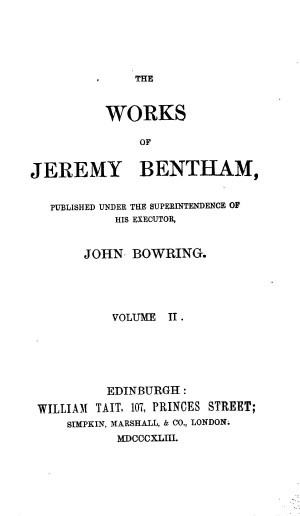
The Works of Jeremy Bentham, published under the Superintendence of his Executor, John Bowring (Edinburgh: William Tait, 1838-1843). 11 vols. Vol. 2.

Part of: The Works of Jeremy Bentham, 11 vols.

About Liberty Fund:

Liberty Fund, Inc. is a private, educational foundation established to encourage the study of the ideal of a society of free and responsible individuals.


CHAPTER III.

VAGUE GENERALITIES—(ad judicium.)

Exposition.—Vague generalities comprehend a numerous class of fallacies, resorted to by those who, in preference to the most particular and determinate terms and expressions which the nature of the case in question admits of, employ others more general and indeterminate.

As expression is vague and ambiguous when it designates, by one and the same appellative, an object which may be good or bad, according to circumstances; and if, in the course of an inquiry touching the qualities of such an object, such an expression is employed without a recognition of this distinction, the expression operates as a fallacy.

Take, for instance, the terms, government, laws, morals, religion. The genus comprehended in each of these terms may be divided into two species—the good and bad; for no one can deny that there have been and still are in the world, bad governments, bad laws, bad systems of morals, and bad religions. The bare circumstance, therefore, of a man’s attacking government or law, morals or religion, does not of itself afford the slightest presumption that he is engaged in anything blameable: if his attack is only directed against that which is bad in each, his efforts may be productive of good to any extent.

This essential distinction the defender of abuse takes care to keep out of sight, and boldly imputes to his antagonist an intention to subvert all governments, laws, morals or religion.

But it is in the way of insinuation, rather than in the form of direct assertion, that the argument is in this case most commonly brought to bear. Propose anything with a view to the improvement of the existing practice in relation to government at large, to the law, or to religion, he will treat you with an oration on the utility and necessity of government, of law, or of religion. To what end? To the end that of your own accord you may draw the inference which it is his desire you should draw, even that what is proposed has in its tendency something which is prejudicial to one or other or all of these objects of general regard. Of the truth of the intimation thus conveyed, had it been made in the form of a direct assertion or averment, some proof might naturally have been looked for: by a direct assertion, a sort of notice is given to the hearer or reader to prepare himself for something in the shape of proof; but when nothing is asserted, nothing is on the one hand offered, nothing on the other expected, to be proved.

1.

Order.

Exposure.—Among the several cloudy appellatives which have been commonly employed as cloaks for misgovernment, there is none more conspicuous in this atmosphere of illusion than the word Order.

The word order is in a peculiar degree adapted to the purpose of a cloak for tyranny—the word order is more extensive than law, or even than government.

But, what is still more material, the word order is of the eulogistic cast; whereas the words government and law, howsoever the things signified may have been taken in the lump for subjects of praise, the complexion of the signs themselves is still tolerably neutral: just as is the case with the words constitution and institutions.

Thus, whether the measure or arrangement be a mere transitory measure or a permanent law—if it be a tyrannical one, be it ever so tyrannical, in the word order you have a term not only wide enough, but in every respect better adapted than any other which the language can supply, to serve as a cloak for it. Suppose any number of men, by a speedy death or a lingering one, destroyed for meeting one another for the purpose of obtaining a remedy for the abuses by which they are suffering—what nobody can deny is, that by their destruction, order is maintained; for the worst order is as truly order as the best. Accordingly, a clearance of this sort having been effected, suppose in the House of Commons a Lord Castlereagh, or in the House of Lords a Lord Sidmouth, to stand up and insist, that by a measure so undeniably prudential order was maintained, with what truth could they be contradicted? And who is there that would have the boldness to assert that order ought not to be maintained?

To the word order, and the word good, the strength of the checks, if any there were, that were thus applied to tyranny, would be but little if at all increased. By the word good, no other idea is brought to view than that of the sentiment of approbation, as attached by the person by whom it is employed to the object designated by the substantive to which this adjunct is applied. Order is any arrangement which exists with reference to the object in question;—good order is that order, be it what it may, which it is my wish to be thought to approve of.

Take the state of things under Nero, under Caligula: with as indisputable propriety might the word order be applied to it, as to the state of things at present in Great Britain or the American United States.

What in the eyes of Bonaparte was good order? That which it had been his pleasure to establish.

By the adjunct social, the subject order is perhaps rendered somewhat the less fit for the use of tyrants, but not much. Among the purposes to which the word social is employed, is indeed that of bringing to view a state of things favourable to the happiness of society: but a purpose to which it is also employed, is that of bringing to view a state of things no otherwise considered than as having place in society. By the war which in the Roman history bears the name of the social war, no great addition to the happiness of society was ever supposed to be made; yet it was not the less a social one.

As often as any measure is brought forward having for its object the making any the slightest defalcation from the amount of the sacrifice made of the interest of the many to the interest of the few, social is the adjunct by which the order of things to which it is pronounced hostile, is designated.

By a defalcation made from any part of the mass of factitious delay, vexation, and expense, out of which, and in proportion to which, lawyers’ profit is made to flow—by any defalcation made from the mass of needless and worse than useless emolument to office, with or without service or pretence of service—by any addition endeavoured to be made to the quantity, or improvement in the quality of service rendered, or time bestowed in service rendered in return for such emolument—by every endeavour that has for its object the persuading the people to place their fate at the disposal of any other agents than those in whose hands breach of trust is certain, due fulfilment of it morally and physically impossible,—social order is said to be endangered, and threatened to be destroyed.

Proportioned to the degree of clearness with which the only true and justifiable end of government is held up to view in any discourse that meets the public eye, is the danger and inconvenience to which those rulers are exposed, who, for their own particular interest, have been engaged in an habitual departure from that only legitimate and defensible course. Hence it is, that, when compared with the words order, maintenance of order, the use even of such words as happiness, welfare, well-being, is not altogether free from danger, wide-extending and comparatively indeterminate as the import of them is: to the single word happiness, substitute the phrase greatest happiness of the greatest number, the description of the end becomes more determinate and even instructive, the danger and inconvenience to misgovernment and its authors and its instruments still more alarming and distressing; for then, for a rule whereby to measure the goodness or badness of a government, men are referred to so simple and universally apprehensible a standard as the numeration table. By the pointing men’s attentions to this end, and the clearness of the light thus cast upon it, the importance of such words as the word order, which by their obscurity substitute to the offensive light the useful and agreeable darkness, is more and more intimately felt.

2.

Establishment.

In the same way, again, Establishment is a word in use, to protect the bad parts of establishments, by charging those who wish to remove or alter them, with the wish to subvert all establishments, or all good establishments.*

3.

Matchless Constitution.

The constitution has some good points; it has some bad ones: it gives facility, and, until reform—radical reform—shall have been accomplished, security and continual increase to waste, depredation, oppression, and corruption in every department, and in every variety of shape.

Now, in their own name respectively, waste depredation, oppression, corruption, cannot be toasted: gentlemen would not cry, Waste for ever! Depredation for ever! Oppression for ever! Corruption for ever! But The constitution for ever! this a man may cry, and does cry, and makes a merit of it.

Of this instrument of rhetoric, the use is at least as old as Aristotle. As old as Aristotle is even the receipt for making it; for Aristotle has himself given it: and of how much longer standing the use of it may have been, may baffle the sagacity of a Mitford to determine. How sweet are gall and honey! how white are soot and snow!

Matchless Constitution! there’s your sheet-anchor! there’s your true standard!—rally round the constitution;—that is, rally round waste, rally round depredation, rally round oppression, rally round corruption, rally round election terrorism, rally round imposture—imposture on the hustings, imposture in Honourable House, imposture in every judicatory.

Connected with this toasting and this boasting, is a theory, such as a Westminster or Eton boy on the sixth form, aye, or his grandmother, might be ashamed of. For among those who are loudest in crying out theory (as often as any attempt is made at reasoning, any appeal made to the universally known and indisputable principles of human nature,) always may some silly sentimental theory be found.

The constitution,—why must it not be looked into?—why is it, that under pain of being ipso facto anarchist convict, we must never presume to look at it otherwise than with shut eyes? Because it was the work of our ancestors,—of ancestors, of legislators, few of whom could so much as read, and those few had nothing before them that was worth the reading. First theoretical supposition, wisdom of barbarian ancestors.

When from their ordinary occupation, their order of the day, the cutting of one another’s throats, or those of Welchmen, Scotchmen, or Irishmen, they could steal now and then a holiday, how did they employ it? In cutting Frenchmen’s throats in order to get their money: this was active virtue:—leaving Frenchmen’s throats uncut, was indolence, slumber, inglorious ease. Second theoretical supposition, virtue of barbarian ancestors.

Thus fraught with habitual wisdom and habitual virtue, they sat down and devised; and setting before them the best ends, and pursuing those best ends by the best means, they framed—in outline at any rate—they planned and executed our Matchless Constitution—the constitution as it stands: and may it for ever stand!

Planned and executed? On what occasion? on none. At what place? at none. By whom? by nobody.

At no time? Oh yes, says everything-as-it-should-be Blackstone. Oh yes, says Whig after Whig, after the charming commentator; anno Domini 1660, then it is that it was in its perfection, about fourteen years before James the Second mounted the throne with a design to govern in politics as they do in Morocco, and in religion as they do at Rome; to govern without parliament, or in spite of parliament: a state of things for which, at this same era of perfection, a preparation was made by a parliament, which being brought into as proper a state of corruption as if Lord Castlereagh had had the management of it, was kept on foot for several years together, and would have been kept a-foot till the whole system of despotism had been settled, but for the sham popish plot by which the fortunate calumny and subornation of the Whigs defeated the bigotry and tyranny of the Tories.

What, then, says the only true theory—that theory which is uniformly confirmed by all experience?

On no occasion, in no place, at no time, by no person possessing any adequate power, has any such end in view as the establishing the greatest happiness of the greatest number, been hitherto entertained: on no occasion, on the part of any such person, has there been any endeavour, any wish for any happiness other than his own and that of his own connexions, or any care about the happiness or security of the subject-many, any further than his own has been regarded as involved in it.

Among men of all classes, from the beginning of those times of which we have any account in history—among all men of all classes, an universal struggle and contention on the part of each individual for his own security and the means and instruments of his own happiness—for money, for power, for reputation natural and factitious, for constant ease, and incidental vengeance. In the course of this struggle, under favourable circumstances connected with geographical situation, this and that little security has been caught at, obtained, and retained by the subject-many, against the conjoined tyranny of the monarch and his aristocracy. No plan pursued by anybody at any time—the good established, as well as the bad remaining, the result of an universal scramble, carried on in the storm of contending passions under favour of opportunity—at each period, some advantages which former periods had lost, others, which they had not gained.

But the only regular and constant means of security being the influence exercised by the will of the people on the body which in the same breath admit themselves and deny themselves to be their agents, and that influence having against it and above it the corruptive and counter-influence of the ruling few, the servants of the monarchy and the members of the aristocracy—and the quantity of the corruptive matter by which that corruptive influence operates, being every day on the increase; hence it is, that while all names remain unchanged, the whole state of things grows every day worse and worse, and so will continue to do, till even the forms of parliament are regarded as a useless incumbrance, and pure despotism, unless arrested by radical reform, takes up the sceptre without disguise.

While the matter of waste and corruption is continually accumulating—while the avalanche composed of it is continually rolling on—that things should continue long in their present state seems absolutely impossible. Three states of things contend for the ultimate result:—despotic monarchy undisguised by form; representative democracy under the form of monarchy; representative democracy under its own form.

In this, as in every country, the government has been as favourable to the interests of the ruling few, and thence as unfavourable to the general interests of the subject-many,—or, in one word, as bad—as the subject-many have endured to see it,—have persuaded themselves to suffer it to be. No abuse has, except under a sense of necessity, been parted with—no remedy, except under the like pressure, applied. But under the influence of circumstances in a great degree peculiar to this country, at one time or another the ruling few have found themselves under the necessity of sacrificing this or that abuse—of instituting, or suffering to grow up, this or that remedy.

It is thus, that under favour of the contest between Whigs and Tories, the liberty of the press, the foundation of all other liberties, has been suffered to grow up and continue. But this liberty of the press is not the work of institution, it is not the work of law: what there is of it that exists, exists not by means but in spite, of law. It is all of it contrary to law: by law there is no more liberty of the press in England, than in Spain or Morocco. It is not the constitution of the government, it is not the force of the law; it is the weakness of the law we have to thank for it. It is not the Whigs that we have to thank for it, any more than the Tories. The Tories—that is, the supporters of monarchy—would destroy it, simply assured of their never being in a condition to have need of it: the Whigs would with equal readiness destroy it, or concur in destroying it, could they possess that same comfortable assurance. But it has never been in their power; and to that impotence is it that we are indebted for their zeal for the liberty of the press and the support they have given to the people in the exercise of it. Without this arm they could not fight their battles; without this for a trumpet, they could not call the people to their aid.

Such corruption was not, in the head of any original framer of the constitution, the work of design: but were this said without explanation, an opinion that would naturally be supposed to be implied in it, is, that the constitution was originally in some one head, the whole, or the chief part of it, the work of design. The evil consequence of a notion pronouncing it the work of design would be, that, such a design being infinitely beyond the wisdom and virtue of any man in the present times, a planner would be looked out for in the most distant age that could be found;—thus the ancestor-wisdom fallacy would be the ruling principle, and the search would be fruitless and endless. But the non-existence of any determinate design in the formation of the constitution may be proved from history. The House of Commons is the characteristic and vital principle. Anno 1265, the man by whom the first germ was planted was Simon de Montfort, Earl of Leicester, a foreigner and a rebel. In this first call to the people, there was no better nor steadier design than that of obtaining momentary support for rebellion. The practice of seeing and hearing deputies from the lower orders before money was attempted to be taken out of their pockets, having thus sprung up, in the next reign Edward the First saw his convenience in conforming to it. From this time till Henry the Sixth’s, instances in which laws were enacted by kings, sometimes without consulting Commons—sometimes without consulting them or Lords, are not worth looking out. Henry the Sixth’s was the first reign in which the House of Commons had really a part in legislation: till then, they had no part in the penning of any laws; no law was penned till after they were dissolved. Here, then, so late as about 1450 (between 1422 and 1461,) the House of Commons, as a branch of the legislature, was an innovation: till then (anno 1450,) constitution (if the House of Commons be a part of it,) there was none, Parliament? Yes: consisting of king and lords, legislators; deputies of commons, petitioners. Even of this aristocratical parliament, the existence was precarious: indigence or weakness produced its occasional reproduction; more prudence and good fortune would have sufficed for throwing it into disuse and oblivion: like the obsolete legislative bodies of France and Spain, it would have been reduced to a possibility. All this while, and down to the time when the reassembling of parliaments was imperfectly secured by indeterminate laws, occasioned by the temporary nature of pecuniary supplies, and the constant cravings of royal paupers, had the constitution been a tree, and both Houses branches, either or both might have been lopped off, and the tree remain a tree still.*

After the bloody reigns of Henry the Eighth and Mary, and the too short reign of Edward the Sixth, comes that of Elizabeth, who openly made a merit of her wish to govern without parliament: members presuming to think for themselves, and to speak as they thought, were sent to prison for repentance. After the short parliaments produced in the times of James the First and Charles the First by profusion and distress, came the first long parliament. Where is now the constitution? Where the design?—the wisdom? The king having tried to govern without lords or commons, failed: the commons having extorted from the king’s momentary despair, the act which converted them into a perpetual aristocracy, tried to govern without king or lords, and succeeded. In the time of Charles the Second, no design but the king’s design of arbitrary government executed by the instrumentality of seventeen years long parliament. As yet, for the benefit of the people, no feasible design but in the seat of supreme power; and there, conception of any such design scarce in human nature.

The circumstance to which the cry of Matchless Constitution is in a great degree indebted for its pernicious efficiency, is—that there was a time in which the assertion contained in it was incontrovertibly true: till the American colonies threw off the yoke, and became independent states; no political state possessed of a constitution equalling it or approaching it in goodness, was anywhere to be found.

But from this its goodness in a comparative state, no well-grounded argument could at any time be afforded against any addition that could at any time be made to its intrinsic goodness. Persons happier than myself are not to be found anywhere: in this observation, supposing it true, what reason is there for my forbearing to make myself as much happier than I am at present, as I can make myself?

This pre-eminence is therefore nothing to the purpose; for of the pains taken in this way to hold it up to view, the design can be no other than to prevent it from being ever greater than it is.

But another misfortune is, that it is every day growing less and less: so that while men keep on vaunting this spurious substitute to positive goodness, sooner or later it will vanish altogether.

The supposition always is, that it is the same one day as another. But never for two days together has this been true. Since the Revolution took place, never, for two days together, has it been the same: every day it has been worse than the preceding; for by every day, in some way or other, addition has been made to the quantity of the matter of corruption—to that matter by which the effect of the only efficient cause of good government, the influence of the people, has been lessened.

A pure despotism may continue in the same state from the beginning to the end of time: by the same names, the same things may be always signified. But a mixed monarchy, such as the English, never can continue the same: the names may continue in use for any length of time; but by the same names, the same state of things is never for two days together signified. The quantity of the matter of corruption in the hands of the monarch being every day greater and greater, the practice in the application of it to its purpose, and thence the skill with which application is made of it on the one hand, and the patience and indifference with which the application of it is witnessed, being every day greater and greater, the comparative quantity of the influence of the people, and of the security it affords, is every day growing less and less.

While the same names continue, no difference in the things signified is ever perceived, but by the very few, who having no interest in being themselves deceived, nor in deceiving others, turn their attention to the means of political improvement. Hence it was, that with a stupid indifference or acquiescence the Roman people sat still, while their constitution, a bad and confused mixture of aristocracy and democracy, was converted into a pure despotism.

With the title of representatives of the people, the people behold a set of men meeting in the House of Commons, originating the laws by which they are taxed, and concurring in all the other laws by which they are oppressed. Only in proportion as these their nominal representatives are chosen by the free suffrages of the people, and, in case of their betraying the people, are removable by them, can such representatives be of any use. But except in a small number of instances—too small to be on any one occasion soever capable of producing any visible effect—neither are these pretended representatives ever removable by them, nor have they ever been chosen by them. If, instead of a House of Commons and a House of Lords, there were two Houses of Lords and no House of Commons, the ultimate effect would be just the same. If it depended on the vote of a reflecting man, whether, instead of the present House of Commons, there should be another House of Lords, his vote would be for the affirmative: the existing delusion would be completely dissipated, and the real state of the nation be visible to all eyes; and a deal of time and trouble which is now expended in those debates, which, for the purpose of keeping on foot the delusion, are still suffered, would be saved.

As to representation, no man can even now be found so insensible to shame, as to affirm that any real representation has place: but though there is no real representation, there is, it is said, a virtual one; and with this, those who think it worth their while to keep up the delusion, and those who are, or act and speak as if they were deluded, are satisfied. If those who are so well satisfied with a virtual representation, which is not real, would be satisfied with a like virtual receipt of taxes on the one part, and a virtual payment of taxes on the other, all would be well. But this unfortunately is not the case: the payment is but too real, while the falsity of the only ground on which the exaction of it is so much as pretended to be justified, is matter of such incontestable verity, and such universal notoriety, that the assertion of its existence is a cruel mockery.

4.

Balance of Power.

In general, those by whom this phrase has been used, have not known what they means by it: it has had no determinate meaning in their minds. Should any man ever find for it any determinate meaning, it will be this—that of the three branches between which, in this constitution, the aggregate powers of government are divided, it depends upon the will of each to prevent the two others from doing anything—from giving effect to any proposed measure. How, by such arrangement, evil should be produced, is easy enough to say; for of this state of things one sure effect is—that whatsoever is in the judgment of any one of them contrary to its own sinister interest, will not be done; on the other hand, notwithstanding the supposed security, whatsoever measure is by them all seen or supposed to be conducive to the aggregate interest of them all, will be carried into effect, how plainly soever it may be contrary to the universal interest of the people. No abuse, in the preservation of which they have each an interest, will ever, so long as they can help it, be removed—no improvement, in the prevention of which any one of them has an interest, will ever be made.

The fact is, that wherever on this occasion the word balance is employed, the sentence is mere nonsense. By the word balance in its original import, is meant a pair of scales. In an arithmetical account, by an ellipsis to which, harsh as it is, custom has given its sanction, it is employed to signify that sum by which the aggregate of the sums that stand on one side of an account, exceeds the aggregate of the sums that stand on the other side of that same account. To the idea which, on the sort of occasion in question, the word balance is employed to bring to view, this word corresponds not in any degree in either of these senses. To accord with the sort of conception which, if any, it seems designed to convey, the word should be, not balance, but equipoise. When two bodies are so connected, that whenever the one is in motion, the other is in motion likewise, and that in such sort, that in proportion as one rises the other falls, and yet at the moment in question no such motion has place, the two bodies may be said to be in equipoise; one weighs exactly as much as the other. But of the figure of speech here in question, the object is not to present a clear view of the matter, but to prevent any such view of it from being taken: to this purpose, therefore the non-sensical expression serves better than any significant one. The ideas belonging to the subject are thrown into confusion—the mind’s eye, in its endeavours to see into it is bewildered; and this is what is wanted.

It is by a series of simultaneous operations that the business of government is carried on—by a series of actions: action ceasing, the body-politic, like the body-natural, is at an end. By a balance, if anything, is meant a pair of scales with a weight in each: the scales being even, if the weights are uneven, that in which is the heaviest weight begins to move; it moves downward, and at the same time the other scale with the weight in it moves upwards. All the while this motion is going on, no equipoise has place—the two forces do not balance each other: if the wish is that they should balance each other, then into the scale which has in it the lighter weight, must be put such other weight as shall make it exactly equal to the heavier weight; or, what comes to the same thing, a correspondent weight taken from that scale which has in it the heavier weight.

The balance is now restored. The two scales hang even: neither of the two forces preponderates over the other. But with reference to the end in view, or which ought to be in view—the use to be derived from the machine—what is the consequence?—All motion is at an end.

In the case in question, instead of two, as in a common pair of scales, there are three forces, which are supposed, or said to be, antagonizing with one another. But were this all the difference, no conclusive objection to the metaphor could be derived from it; for, from one, and the same fulcrum or fixed point you might have three scales hanging with weights in them, if there were any use in it. In the expression, the image would be more complicated, but in substance it would be still the same.

Pre-eminently indeterminate, indistinct, and confused on every occasion, is the language in which, to the purpose in question, application is made to this image of a balance; and on every occasion, when thus steadily looked into, it will be found to be neither better nor worse than so much nonsense: nothing can it serve for the justification of—nothing can it serve for the explanation of.

The fallacy often assumes a more elaborate shape:—“The constitution is composed of three forces, which, antagonizing with each other, cause the business of government to be carried on in a course which is different from the course in which it would be carried on if directed solely by any one, and is that which results from the joint influence of them all, each one of them contributing in the same proportion to the production of it.”

Composition and resolution of forces: this image, though not so familiar as the other, is free from the particular absurdity which attaches upon the other: but upon the whole, the matter will not be found much mended by it. In proportion as it is well conducted, the business of government is uniformly carried on in a direction tending to a certain end—the greatest happiness of the greatest number:—in proportion as they are well conducted, the operations of all the agents concerned, tend to that same end. In the case in question, here are three forces, each tending to a certain end: take any one of these forces; take the direction in which it acts; suppose that direction tending to the same exclusively legitimate end, and suppose it acting alone, undisturbed, and unopposed, the end will be obtained by it: add now another of these forces; suppose it acting exactly in the same direction, the same end will be attained with the same exactness, and attained so much the sooner: and so again, if you add the third. But that second force—if the direction in which it acts be supposed to be ever so little different from that exclusively legitimate direction in which the first force acts, the greater the difference, the further will the aggregate or compound force be from attaining the exact position of that legitimate end.

But in the case in question, how is it with the three forces? So far from their all tending to that end, the end they tend to is in each instance as opposite to that end as possible. True it is, that amongst these three several forces, that sort of relation really has place by which the sort of compromise in question is produced: a sort of direction which is not exactly the same as that which would be taken on the supposition that any one of the three acted alone, clear of the influence of both the others. But with all this complication, what is the direction taken by the machine? Not that which carries it to the only legitimate end, but that which carries it to an end not very widely distant from the exact opposite one.

In plain language, here are two bodies of men, and one individual more powerful than the two bodies put together—say three powers—each pursuing its own interest, each interest a little different from each of the two others, and not only different from, but opposite to, that of the greatest number of the people. Of the substance of the people, each gets to itself and devours as much as it can: each of them, were it alone, would be able to get more of that substance, and accordingly would get more of that substance, than it does at present; but in its endeavours to get that more, it would find itself counter-acted by the two others; each, therefore, permits the two others to get their respective shares, and thus it is that harmony is preserved.

Balance of forces.—A case there is, in which this metaphor, this image, may be employed with propriety: this is the case of international law and international relations. Supposing it attainable, what is meant by a balance of forces, or a balance of power, is a legitimate object—an object, the effectuation of which is beneficial to all the parties interested. What is that object? It is, in one word, rest—rest, the absence of all hostile motion, together with the absence of all coercion exercised by one of the parties over another—that rest, which is the fruit of mutual and universal independence. Here then, as between nation and nation, that rest which is the result of well-balanced forces is peace and prosperity. But on the part of the several official authorities and persons by whose operations the business of government in its several departments is carried on, is it prosperity that rest has for its consequence? No: on the contrary, of universal rest, in the forces of the body-politic as in those of the body-natural, the consequence is death. No action on the part of the officers of government, no money collected in their hands—no money, no subsistence; no subsistence, no service;—no service, everything falls to pieces, anarchy takes the place of government, government gives place to anarchy.

The metaphor of the balance, though so far from being applicable to the purpose in question, is in itself plain enough: it presents an image. The metaphor of the composition of forces is far from being so: it presents not any image. To all but the comparatively few, to whom the principles of mechanics, together with those principles of geometry that are associated with them, are thus far familiar, they present no conception at all: the conversion of the two tracts described by two bodies meeting with one another at an angle formed by the two sides of a parallelogram, into the tract described by the diagonal of the parallelogram, is an operation never performed for any purpose of ordinary life, and incapable of being performed otherwise than by some elaborate mechanism constructed for this and no other purpose.

When the metaphor here in question is employed, the three forces in question—the three powers in question, are, according to the description given of them, the power of the Monarch, the power of the House of Lords, and the power of the People. Even according to this statement, no more than as to a third part of it would the interest of the people be promoted: as to two thirds, it would be sacrificed. For example: out of every £300 raised upon the whole people, one hundred would be raised for the sake, and applied to the use of the whole people; the two other thirds, for the sake and to the use of the two confederative powers—to wit, the monarch and the House of Lords.

Not very advantageous to the majority of the people, not very eminently conducive to good government, would be this state of things; in a prodigious degree, however, more conducive would it be, than is the real state of things. For, in the respect in question, what is this real state of things? The power described as above by the name of the power of the people, is, instead of being the power of the people, the power of the monarch, and the power of the House of Lords, together with that of the rest of the aristocracy under that other name.

5.

Glorious Revolution.

This is a Whig’s cry, as often as it is a time to look bold, and make the people believe that he had rather be hanged than not stand by them. What? a revolution for the people? No: but, what is so much better, a revolution for the Whigs—a revolution of 1688. There is your revolution—the only one that should ever be thought of without horror. A revolution for discarding kings? No: only a revolution for changing them. There would be some use in changing them—there would be something to be got by it. When their forefathers of 1688 changed James for William and Mary, William got a good slice of the cake, and they got the rest among them. If, instead of being changed, kings were discarded, what would the Whigs get by it? They would get nothing;—they would lose not a little: they would lose their seats, unless they really sat and did the business they were sent to do, and then they would lose their ease.

The real uses of this revolution were the putting an end to the tyranny, political and religious, of the Stuarts:—the political, governing without parliament, and forcing the people to pay taxes without even so much as the show of consenting to them by deputies chosen by themselves:—the religious, forcing men to join in a system of religion which they believed not to be true.

But the deficiencies of the revolution were, leaving the power of governing, and in particular that of taxing, in the hands of men whose interest it was to make the amount of the taxes excessive, and to exercise misrule to a great extent in a great variety of other ways.

So far as by security given to all, and thence, by check put to the power of the crown, the particular interest of the aristocratical leaders in the revolution promised to be served, such security was established, such check was applied. But where security could not be afforded to the whole community without trenching on the power of the ruling few, there it was denied. Freedom of election, as against the despotic power of the monarch, was established;—freedom of election, as against the disguised despotism of the aristocracy, Tories and Whigs together, remained excluded.

[* ]In the church establishment, the bad parts are—

1. Quantity and distribution of payment;—its inequality creating opposite faults—excess and deficiency. The excessive part calling men off from their duty, and, as in lotteries, tempting an excessive number of adventurers: the defect deterring men from engaging in the duty, or rendering them unable to perform it as it ought to be performed.

2. Mode of payment;—tithes, a tax on food, which discourages agricultural improvements, and occasions dissension between the minister and his parishioners.

3. Forms of admission, compelling insincerity, subversive of the basis of morality. As to purely speculative points, no matter which side a man embraces, so he be sincere, but highly mischievous that he should maintain even the right side (where there happens to be any) when he is not sincere.

[* ]Between Henry the Third, and Henry the Sixth (anno 1265 to 1422) it is true there were frequent acts ordaining annual, and even oftener than annual parliaments.a Still these were but vague promises, made only by the king, with two or three petty princes: the Commons were not legislators, but petitioners: never seeing, till after enactment the acts to which their assent was recorded.

[* ]Between Henry the Third, and Henry the Sixth (anno 1265 to 1422) it is true there were frequent acts ordaining annual, and even oftener than annual parliaments.a Still these were but vague promises, made only by the king, with two or three petty princes: the Commons were not legislators, but petitioners: never seeing, till after enactment the acts to which their assent was recorded.

[a]See Christian on Blackstone.