EconlibThe LibraryOther Sites |
Front Page Titles (by Subject) LIBERTY OF THE PRESS, AND PUBLIC DISCUSSION. - The Works of Jeremy Bentham, vol. 2
Return to Title Page for The Works of Jeremy Bentham, vol. 2The Online Library of LibertyA project of Liberty Fund, Inc.Search this Title:Also in the Library:
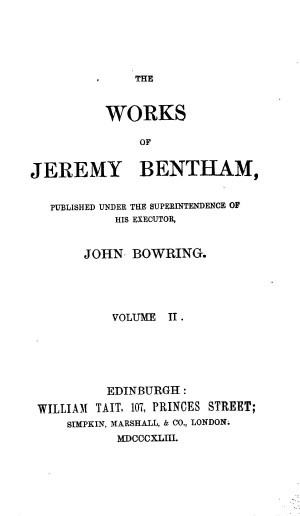
LIBERTY OF THE PRESS, AND PUBLIC DISCUSSION. - Jeremy Bentham, The Works of Jeremy Bentham, vol. 2 [1843]Edition used:The Works of Jeremy Bentham, published under the Superintendence of his Executor, John Bowring (Edinburgh: William Tait, 1838-1843). 11 vols. Vol. 2.
Part of: The Works of Jeremy Bentham, 11 vols.About Liberty Fund:Liberty Fund, Inc. is a private, educational foundation established to encourage the study of the ideal of a society of free and responsible individuals. Copyright information:The text is in the public domain. Fair use statement:This material is put online to further the educational goals of Liberty Fund, Inc. Unless otherwise stated in the Copyright Information section above, this material may be used freely for educational and academic purposes. It may not be used in any way for profit.
LIBERTY OF THE PRESS, AND PUBLIC DISCUSSION.ADVERTISEMENT.The lot of the present Tract has hitherto been rather unfortunate. It was begun, continued, and ended, for the purpose, and under the full assurance of its being translated into Spanish, and published at Madrid: it was sent, in the hope of its reaching that capital time enough to be before the public antecedently to the day on which the proposed law, which was the subject of it, would come under final discussion. The person, by whom it was to have been translated and published, was Mr. Mora, at that time editor of El Constitucional, the most popular, the most ably conducted, and the most distinguished of the Madrid daily papers. Had they gone according to the course of the post, the letters in question (four in number) would, even the last of them, have arrived in time. But in the first instance, in a proportion which has never been ascertained, some or all of them miscarried. As the miscarriages became ascertained or suspected, other copies were sent; and, at last, the complete series were received. In the meantime, the law, the prevention of which they had in view, passed. But, though the only individual object which they had in view was thus at an end, and the design of them thus far frustrated, the more extensive object which they had in view—more extensive in place as well as time—was neither at an end, nor in its nature capable of being put to an end. That object was—the rendering it manifest, how indispensable, at all times and everywhere, those two intimately-connected liberties—the liberty of the press, and the liberty of public discussion by word of mouth—are to everything that can with any propriety be termed good government. Thus it is, that in respect of this its major object, the work, small as it is, belongs not with less propriety to the country in the language of which it was written, than to that for the language of which it was designed—to the present month of July 1821, in which it is now published, than to the months of September and October 1820, in which it was written: to these countries, not to speak of other countries—to the present month and year, not to speak of future ones. The law against which these Letters were directed, was passed: but the effects, at the production of which it aimed, have not been produced. The Spanish press has not been enslaved: Spaniards have not, like Englishmen, submitted to be gagged: Spanish, instead of being like English and French ministers, absolute, have been expelled. As to massacres, the authors of that of Cadiz, though they enjoy not the same triumph, nor have obtained the same rewards, have as yet, it is believed, enjoyed nearly the same impunity with those of the Manchester massacre. But the punishment of those who showed what legitimacy and social order is at Cadiz, is yet to come, and may even yet not improbably come: in that country punishment may yet be for the authors of misrule and massacre; while, in this country, it is reserved for the victims of misrule—for those who have escaped from massacre. Of the reception experienced at Madrid by subsequent addresses of the same author to the same people, something may come to be said, in another publication which is in readiness to pass through these same hands.* As to the present Tract, its lot at Madrid remains still in abeyance. It had been about half translated, when, by an act of the sort here protested against, the translator was thrown into a prison. The illegality of that act has since been recognized, and his enlargement has been the consequence. But, under the extraordinary weight of the business which presses upon him in these eventful times, whether the translation has as yet been published, or so much as completed, is not at present known: if not by his, it will, however, ere long, be laid before the Spanish public by some other hand. The situation of that distinguished publicist is, at this moment, an altogether curious one. A ministry has lately been expelled; and in this expulsion he has borne a leading, not to say the principal, part. To have been, and to continue to be, in a pre-eminent, not to say a peculiar degree, the object of the monarch’s confidence, has been, at the same time, matter of public and vehement accusation against him. Far from denying the fact, he openly avows it. “You know,” says he, “what my opinions, what my affections are; you know that they are all liberal ones: your wish is, that the opinions—that the affections—communicated to your monarch, should be liberal ones; by whom can they be communicated, but by those by whom they are entertained? What would you be gainers, if your monarch communicated with none that were not your enemies?” JEREMY BENTHAM TO THE SPANISH PEOPLE.LETTER I.On the Liberty of the Press—the approaching Eight Months’ sleep of the Cortes—and the Exclusion of Experience from the succeeding Cortes.London, 7th October 1820. Spaniards!—The Madrid intelligence of the prosecution of a newspaper editor, for comments on the Madrid system of police, and of the introduction of the proposed law against political meetings, has just reached me. I am astounded!—What? is it come to this?—so soon come to this? The men being men, of their disposition to do this, and more, there could not be any room for doubt. But that this disposition should so soon ripen into act, this (I must confess) is more than I anticipated. Neither of the issue of the prosecution, nor of the fate of the proposed law, has the intelligence yet reached me. But that any such prosecution should have been instituted—any such proposed law introduced—that the impatience of contradiction, not to say the thirst for arbitrary power, should so soon have ventured thus far,—these, in my view, are of themselves highly alarming symptoms. By the prosecution, if successful, unless the alleged offence have features in it such as I do not expect to find in it, I see the liberty of the press destroyed: by the proposed law, if established, I see the almost only remaining check to arbitrary power destroyed. Taken together, they form a connected system—these two measures. By the authors of this system, you have of course been told, that it is indispensably necessary—necessary to order, to goodorder, to tranquillity—and, perhaps, honourable gentlemen may have ventured so far into the region of particulars and intelligibles, as to say—to good government, and some other good things.—Spaniards! it is neither necessary, nor conducive to, nor other than exclusive of, any of those good things. What says experience? In the Anglo-American United States, of the two parts of this system, neither the one nor the other will you see. No prosecution can there have place, for anything written against the government, or any of its functionaries as such. No restriction whatever is there on public meetings—on public meetings held for any such purpose as that of sitting in judgment on the constitution—on any measures of the government—or on any part of the conduct of any of its functionaries. Yet, if there were a country in which these restraints, or either of them, would be necessary or conducive to good government, it would be that; for, in that country the people are all armed: armed, at all times, in much greater proportion than in any other country—armed, at any time they please, every one of them. No: in that only seat of real and established good government (for yours, alas! is not yet established)—in that country, in which, ever since that good government was established—in which, for the forty years that it has been in existence, public tranquillity has not known what disturbance is,—there is no more restriction upon men’s speaking together in public, than upon their eating together in private. People of Spain! do you know this? You scarcely do. But is it not high time you should?* Both these lessons of experience you shall see more particularly in time and place: you will on that occasion see, in the same manner, a passage in history, an allusion to which is all that room can be found for here. A law had been passed, authorizing prosecution for the sort of offence, prosecuted for, as above, among you. Under it, one single prosecution took place—it failed: the law was repealed—the authors of it lost the public confidence, and with it their political influence. I. As to the restraints on constitutional liberty, that my conception of the matter may at once be seen in its utmost extent, I shall, in the present letter, state at once the measures which I would venture to recommend for examination. But, in the meantime, it may be some satisfaction to you, to see before you an outline of the considerations by which the wish to see some such measures carried into effect has been produced. First, as to the liberty of the press. Every expression betokening disapprobation of the texture of the government, or of the conduct of any person bearing a part in the exercise of the powers of government, conveys an imputation on reputation—on the reputation of the persons at the head of the government. This cannot be denied: for as at all times the texture depends upon the person so situated, in proportion as the texture is ill adapted to the only proper end of government, so are they to their situations: and between one degree of disapprobation and another, it is not possible to draw a line. Accordingly, any such expression is, at pleasure, commonly considered by them in this light, and punished. If the imputation is to a certain degree, particular,—imputing an individual act legally punishable, or at least disreputable,—it constitutes the sort of act expressible by the term defamation: if to a certain degree vague and general, vituperation. But these sorts of acts are, both of them, commonly treated on the footing of offences: and this, too, even where the person who is the subject of the imputation is a private individual, not bearing a part in the exercise of any of those powers. On this subject, the following are the assumptions that, in governments in general, seem commonly to have been made:— Whatsoever be the treatment of an offender, in the case where the party offended is but a private individual, in the case where he is a public functionary—especially if spoken of as such, much more if the whole body of the rulers, or those at the head of it, are the parties offended,—the offence is more mischievous, or, on some other account, creative of a demand for a stronger repressive force, in the shape of punishment, as well as in all other shapes: and this force ought to rise in magnitude as the rank of the person offended rises; and the judicatory, by which cognizance is taken of the offence, should in this case be different; as also the forms of procedure different. My notion, as confirmed by the practice of the Anglo-American United States, is, in all those particulars, the reverse. In the case of the public functionary, for vituperation, how gross soever, there should be no punishment at all: for defamation, no punishment unless the imputation be false and groundless; nor even then, unless the false assertion, or insinuation, be the result of wilful mendacity, accompanied with the consciousness of its falsity, or else with culpable rashness—namely, with that which is exemplified by the giving credence and currency to an injurious notion, adopted without any, or on palpably insufficient grounds: no separate judicatory: no separate form of procedure, styled penal or criminal, while, in the other case, it is styled civil; and, in the case of defamation, in disproof of rashness of assertion, as well as of wilful falsehood, the defendant should be at liberty to make proof of the truth of the imputation; and, for that purpose, to extract evidence from the person who is the subject of it, as he might from any other person at large. For these notions, speaking in general terms, my reason is—that to place on any more advantageous looting the official reputation of a public functionary, is to destroy, or proportionably to weaken, that liberty, which, under the name of the liberty of the press, operates as a check upon the conduct of the ruling few; and in that character constitutes a controuling power, indispensably necessary to the maintenance of good government. Speaking more particularly, whatsoever evil can ever result from this liberty, is everywhere, and at all times, greatly outweighed by the good. 1. The good, consisting, as it does, in the security thus afforded for good government; and covering, as it does, the whole field of government, is plainly infinite. 2. In comparison with this good, the utmost evil that from this cause can result to any person, or to any number of persons, however situated, would, even if altogether unaccompanied with compensation, be comparatively minute. 3. In the elevated situation in question, whether the imputation be unmerited or merited, the nature of his situation furnishes a man with means of support and defence,—and in so far as the imputation is false, means of disproof and refutation,—increasing with the height of his situation: and, at any rate, much beyond any which can be within the reach of an individual not so situated. 4. In every such situation, immediately upon his advancement into it, and therefore antecedently to his becoming the object of any such imputation, a man finds, in the advantages attached to such his situation, a compensation for all the evil to which, in this, and all other shapes taken together, he stands exposed by it. 5. The higher the situation, the more abundant the antecedent compensation it thus puts him in possession of. Against the allowance of this liberty, considered with a view to its effect on the goodness of the government, no arguments that have been or may be adduced, will bear the test of examination. 1. First comes dangerousness. Dangerous, it always and everywhere is: for it may lead to insurrection, and thus to civil war; and such is its continual tendency. Answer: In all liberty there is more or less of danger: and so there is in all power. The question is—in which there is most danger—in power limited by this check, or in power without this check to limit it. In those political communities in which this check is in its greatest vigour, the condition of the members, in all ranks and classes taken together, is, by universal acknowledgment, the happiest. These are the Anglo-American United States, and the kingdom of Great Britain and Ireland. In the republic, this liberty is allowed by law, and exists in perfection: in the kingdom it is proscribed by law, but continues to have place, in considerable degree, in spite of law. Take away this check, there remains no other but the exercise of this same liberty by speeches in public meetings: and in that shape, besides that it is not applicable with nearly equal advantage, it is much more dangerous. II. Next comes needlessness. To the prevention of misgovernment, the other remedies that government itself affords, are adequate. The rulers in chief, whoever they are, have nothing so much at heart as the happiness of all over whom they rule: and that wisdom by which they are informed of the means most conducive to that end, is in them perfect; or, if not absolutely free from all imperfection, that endowment is in their situation much more so, than in that of the subject-many. This being assumed,—in this union of all the elements of official aptitude—(appropriate probity, appropriate intellectual aptitude, and appropriate active talent)—with uncontrouled power in the persons of the rulers in chief, the subject-many possess an adequate security against any want of correspondent aptitude in the persons of their several subordinates. In case of simple inaptitude, removal will follow: in the case of inaptitude, coupled with delinquency, prosecution, and thence punishment, will follow. Answer: The rulers in chief, whoever they are, if they are men, have their own happiness more at heart than that of all over whom they rule put together: the very existence of man will in every situation be found to depend upon this general and habitual self-preference. As to wisdom, it can never be so near to perfection without, as with these all-comprehensive means of information, which nothing but the liberty here in question can give. Upon exertion depends the possession of all the several elements of official aptitude above mentioned, and in particular the acquirement of the appropriate information, as above. But the higher the situation, the less is the exertion which he who is in it is disposed to apply to the functions of it. For the higher the situation, the less he has to apprehend for himself in case of demonstrated inaptitude in any shape. Without this liberty, the rulers in chief will not be sufficiently either disposed, or enabled to apply, so much as simple removal, much less punishment, for remedy against inaptitude on the part of their subordinates. Beholding in those subordinates, so many ever-obsequious instruments in their hands—instruments continually applicable to their own personal purposes—the rulers will naturally and generally feel more sympathy for them than for the people at large: they will not be disposed to remove or punish them, merely for acting against the people’s interest; much less for acting in favour of the separate and sinister interest of these same rulers: as where the rulers themselves engross or share the profit of the offence. To the formal prosecution at the suit of rulers,—and, where allowed, at the suit of subjects,—the informal informations, which it is the property of this liberty to supply, constitute, in one case, an assisting support—on the other, a succedaneum and substitute. Destitute of this assistance and this substitute, prosecution, even when not refused, is at once insufficient and over expensive. So small as is the number of prosecutions, compared with that of delinquencies, the delay, vexation, and expense attendant on them, compose no inconsiderable evil. What, if such prosecutions were as numerous in proportion to delinquencies, as under the liberty in question these informations are, that are given by the exercise of it? Under the least bad systems of judicial procedure extant, the prosecutions teem with factitious delay, vexation, and expense, over and above what is natural and necessary. Attendant on informations, there is neither factitious expense, nor factitious delay: vexation, there is comparatively little—none but what is proportioned to delinquency, and stands in lieu of punishment. For the establishment of the truth or falsity of the imputation—for the establishment of the guilt or innocence of the party suspected of delinquency—the utmost stock of relevant and applicable facts and arguments that can be secured by prosecution, is very imperfect without the addition of those which this liberty and nothing else is capable of supplying. II. So much as to the liberty of the press. Now as to the liberty of public meetings. Without much variation, the arguments that apply to the former of these two branches of personal liberty and constitutional security, apply to this. But of this branch the extinction is already known to have been taken for the object, as well as subject, of an already proposed law: and, ere this, the object may have been effected by an established law. In support of this extinction, the English newspapers have brought to my view a system of argument, stated as having been employed by various public functionaries. To these, after holding up to view the proposed law in what seems to me its proper colours, I propose to give a distinct consideration in another letter. From one who, in regard to the individual facts of the case, has no other information than what is above alluded to, any observations made in such circumstances are not altogether out of all danger of being regarded as ungrounded; and to such a degree, as to be destitute of all claim to notice. But—such is the nature of man when clothed with power—in that part of the field of government which is here in question, whatever mischief has not yet been actually done by him to-day, he is sure to be meditating to-day, and unless restrained by the fear of what the public may think and do, it may actually be done by him to-morrow. Of the documents which form the subject of the ensuing remarks, it is impossible for me to say to what extent the accounts that have reached me may not be incorrect. So far as regards individuals, these remarks must therefore from first to last be considered as no other than hypothetical, depending for their appositeness upon the correctness of the reports respectively given of these arguments. But if, considered as applied to the arguments themselves, the remarks should be found justly applicable, the fact, that on the particular occasion in question, the arguments were not actually employed by the persons to whom they stand ascribed, will not detract much from the value of any information which the remarks may be thought to afford. Ungrounded in the character of a censure, in that of a warning, the remark may not the less have issue. MEASURES PROPOSED.1. In regard to liberty of writing and speech on political subjects, repealing what requires to be repealed, place matters exactly on the same footing as that in which they are in the Anglo-American United States. And, to narrow the inquiry, let the footing be that on which they are in the territory immediately under the government of Congress, and where the subject of discussion is the conduct of the members of the ruling body, so denominated, or any of the official persons subject to their controul. 2. In regard to assemblies in particular, insert a declaration, giving the people the assurance that, forasmuch as there exists not any law to the contrary, they remain at liberty, at all times, and in all places from which they are not excluded by special ownership, to meet, for the purpose of delivering their opinions, in the freest manner, on the conduct and character of their rulers;—at any rate, of all such of their rulers as are, or may be, the objects of their choice, in the character of representatives, as also of all such other persons as are subject to the controul of such their representatives. And let it not be forgotten, that all persons thus chosen are thereby not their masters but their servants. In regard to secresy, insert, moreover, a declaration that, for keeping their proceedings as secret as they please, they may take what precautions they please, so that no engagement, wearing the form of a religious oath, be employed: nor any scheme entered into, for the performance of any act importing bodily or other injury to any individual, or on any other account forbidden or made punishable by law, be in the number of their objects. And note that, in regard to secresy, on this footing stands, in England, the unreproached, and irreproachable society of Free Masons. In the United states, whoever thought, either of instituting secret societies, or of being jealous of them if instituted? Of secresy under such a government, what could be the object? Secresy in subjects, supposes tyranny in rulers. Under these circumstances, what fills me with apprehension is—the approaching nonentity of the Cortes. The only bridle to ministerial despotism taken out of its mouth, without a possibility of being replaced for eight months to come! Now, if they had but the possibility of existence, now then would be the time for meetings of the people for petitioning the Cortes not to desert its post.* Now would be the time for saying to them, “Do not, in deference to the rash and ill-judged—the suicide letter of the constitution, risk the destruction of the constitution itself, or at least of the most essential portion of what is good in it!” True it is, that in the Cortes I see an authority, under the eye of which the liberty of the press has, I much fear to find, been sadly weakened, and perhaps destroyed. True it is, that in the Cortes I see, at any rate, an authority by which the liberty of public discussion has without reserve been taken away. True. But in the Cortes I see an assembly in which, so long as it is sitting, it is at all times in the power of any one member to use his endeavours for the restoration of the banished liberties, and to spread over the whole kingdom the arguments on which these endeavours are grounded. By this strange article of the constitutional code, the Cortes, the only assembly in which, should misrule reasume its recent enormity, the voice of complaint can be heard, is laid asleep, is reduced to a state of nonentity for eight months. And, during these eight months, what are the hands in which all the powers of government are lodged? The self-same hands in which till t’other day they were employed—it is needless to say how. By article 171 (power the 5th,) to the king it belongs “to fill up all civil and military employments:” amongst others, therefore, the employments of the seven “Ministers of State and of Public Affairs;” those seven ministers, by whom taken collectively, during this long sleep, as well as after the death of the Cortes, the whole mass of the powers of government is exercised. These powers the king may at all times collectively and individually take, and at each moment lodge in any hands he pleases. To this choice I am unable to find any the smallest check. I see, indeed, a council of state, which in art. 237, by a provision not very consistent in its terms with the terms of that same 171st article, shares with the king the power of conferring ecclesiastical benefices and offices of judicature: as if offices of judicature were not civil employments—as it this were not enough, supposing the unofficial advisers of the crown to be again what they were so lately, and suppose at the same time, that in the whole court and country, persons in so large a number as seven are not to be found suitable to the purpose of giving to the whole power of government an exercise similar to that which was so lately given to it—one single minister, unless prevented by some regulation, no tidings of which have reached me, may, under this same constitution, be made sufficient. For, by art. 224, “By a particular regulation approved by the Cortes will be pointed out,” it is said, “the business peculiarly appertaining to each minister.” But till such demarcation has been made by the Cortes, everything is left at large, and to any one or more of the seven, as much of the power of all seven may be given as those same irresponsible advisers shall advise: and amongst the rest, the filling up, and for aught appears, after having emptied them for the purpose, “all civil and military employments:” under civil, ecclesiastical, and judicial, being respectively included, or not included: let those who are sure, say which. “What?”—says some one—“have you then really any such fear, as that of this eight months’ sleep of the Cortes, the restoration of the recent habits of government will be the consequence?” No; I have not: for, how small soever may be the regard of the men in question for the security of the subject-many, their regard for their own security will be not the less; and I see not by what means any tolerably effective provision can be made for it, unless it be such by which, along with the ruling few, the subject-many will be secured, at least against any condition equally disastrous with that from which they have so lately emerged. But, knowing little more of them than that they are men, what I am afraid of is this—namely, that in the situations in question, men will do what all men would be disposed to do in their places:—that they will embrace every opportunity for sacrificing the interest of the whole community to their own particular interests: that in particular, they will give the utmost magnitude possible to the mass of useless and needless offices, and to the emolument of those same offices, as well as to that of useful and needful ones: that they will dispose of offices for their own profit, either in a direct way by selling them, or,—in a way not less effectual by being indirect,—by giving them to persons in dependencies, or otherwise in private connexion with them, be the persons ever so apt or ever so inapt, for the functions of those same offices: and that, to the same end, they will give and secure to every other branch of expenditure every practicable increase, and to retrenchment every practicable diminution: that, with or without just cause, should there be any persons to whom it has happened to incur their displeasure, they will let slip no opportunities of allaying it by vengeance: and that, in a word, they will do as those do and have been used to do, under whom it has hitherto been my good hap to live unhanged, unsabred, unimprisoned, unbanished, and unruined. This is not all. For giving permanency to a system of this sort, these instruments of monarchy would scarcely feel sufficient confidence in their own force: they would look out for coadjutors in the aristocracy; and thus, in the union of the monarchical with the aristocratical interest, you would see and feel, as here, an alliance defensive and offensive against the interest of the people—of the ruling one and the sub-ruling few, against the subject-many. They would call to their aid the landed proprietors of the country as such, and in particular the proprietors of the vast overgrown properties. In these they will find not only natural allies, but sure, and perpetual, and steady, and in every respect matchless ones. The possessor of an office, howsoever abundant in power, may be removed out of it at any time, and without so much as the imputation of injustice. Not so the great landholder—the proprietor of a tenth part, an eighth part, or a fourth part of the land of a whole province; and with it of a proportionable mass of political influence. But neither time nor space will here permit me to enter into any detail of the mischiefs with which such a confederacy is pregnant: except to conclude with saying—that the last, though not the least of my fears is—that, to give completeness to the system, the measures which, at the instance as it seems of these same ministers, have, I fear, already been taken by the majority of the Cortes for the extinction of all power of controul in the hands of the people, may, by means of such an alliance, be carried into full execution, and perfected and perpetuated. Another set of fears, though not quite so intense as the foregoing, remains still behind—that they will give to those natural enemies of the people the fullest security that can be given to them against any idea so intolerable, as that their as yet unhorn descendants will find themselves unloaded with wealth, no prospect of which can ever have entered into their minds: that they will secure them against so cruel an apprehension as that all their children but one should not always be impoverished for the benefit of that one; and against the still more intolerable apprehension, lest their creditors should receive any part of the amount of their just debts: that, in atonement for the injury thus done to their thus impoverished children, they will secure to them, at the expense of the still more impoverished lower orders, a stock of sinecures of all classes: matter of emolument granted at the expense of the State, on pretence of rendering to man some service never rendered, or on pretence of rendering some pretended service to that Being to whom all service is unprofitable: and, to crown all, that having with such efficient anxiety provided for keeping them stocked as richly as may be with the benefits of political society, they will join in securing to them an exemption as extensive as may be from its burthens.* No: nothing can be more inconceivable to me than the grounds, if they were good and avowable ones, on which, for two-thirds of every year, the power in which you, the people, see your only hope, should be reduced to perfect nullity;† and of all times, this too at the very commencement of the system on which all hope of salvation rested: as if, for eight months in the year, all sheep dogs were to be kept locked up, and the sheep committed during that time to the guardianship of the wolves. At no time, surely, nor in any nation, can there have been, or can there be, so much work to be done: and at this time it is, that, of the quantity that might have been employed in work, two-thirds are taken off; and taken off with every mark of anxiety,—consecrated to idleness. With us in England, where everything, how ill soever, is so fully and permanently, and for so vast a length of time has been, established, the whole year may, if so the king pleases, be employed in doing (with the exception of giving him a new wife) whatever else he pleases. Strange as it is, the article by which, at the time when the demand for experience, and for the talents formed by it, stands at its highest pitch, the next succeeding Cortes is so anxiously deprived of all the experience and talent acquired in the present, is not quite so strange. In a jealousy entertained of the probity of these first objects of the people’s choice, I can conceive a possible, howsoever indefensible cause of it. But while the jealousy, of which the persons chosen by the people are the objects, is so broad awake,—that all jealousy of those against whose power these same objects of the people’s choice are to afford the sole security, should be so perfectly asleep,—this is the thing that astonishes me: that such jealousy and such confidence should at the same time have found place in the same bosoms. No: it is not so much of a monarch that I am afraid, for he is mutable: it is of the aristocracy that I am so much afraid; for that is immutable. It is itself immutable: and no less immutably adverse is its interest to the interest of the people. Postscript. This moment, comes information of the decision of the Cortes, in relation to the Persas; and, of the whole number of 69, not more than one is to be so much as prosecuted. At their own homes they are to continue; and there, should his Majesty have any fresh occasion for their services, there he knows where he may be sure to find them. Nothing can be more merciful—nothing more convenient. Now, if from this mercy no mischief to the people shall ensue, whosoever else may be dissatisfied with it, I shall not be so. It is not for any pleasure I can take in the contemplation of what he suffers, that I would punish the most mischievous of criminals. But a question I cannot help putting to myself is,—If, under the Constitution, those who seek the forcible destruction of it have nothing to fear, while he who seeks the preservation of it by means not acceptable to those by whom this impunity has been granted has much to fear, what chance has it for continuance? Any leading member, in gratitude for all this mercy,—has it happened to him to have received, or to be about to receive, a requital in any shape from any of those who have been preserved by it? If any such gratitude has been manifested, so much the better, and it cannot be too extensively known; for, the more expensive the gratitude, and the more extensive the knowledge of it, the more extensive will be the assurance, that should any such attempt to destroy the constitution be repeated, and success fail of crowning the attempt, the impunity will not be entire. LETTER II.On the Liberty of Public Discussion in Free Meetings.18th Oct. 1820. Spaniards!I continue.—My former letter was principally allotted to the liberty of the press. Intimation was there given, that the arguments pleading in favour of that branch of personal liberty and constitutional security apply with little variation to that which forms exclusively the subject of the present letter. The proposed law, as it stood in four articles, together with the speeches by which I found it supported, will constitute the text of this discourse. I commence with the proposed law itself: the text of it, in the state in which, on the 21st of September 1820, according to the English translation, it came out of the hands of Mr. Goreli—(Traveller, Oct. 6, 1820.) “The law regarding public societies,” I see it termed. The law for the prevention of popular assemblies, it might have been termed; for, of this law, what is the object? what the declaredly intended effect? In respect of this security against misrule, to place the people of Spain exactly upon the same footing as the people of Morocco. Yes; exactly upon the same footing as the people of Morocco: this you will see. Four, and no more, is the number of its articles: these are quite sufficient. Give but to language the extent it is susceptible of, the fewer the words, the greater the effect. Think of this, ye who, to make display of your humanity, complain of the multitude, nothing but the multitude, of penal laws. Draco made but one: Death is for him who breaks any one of my laws. “Art. 1. All Spaniards will have the right of speaking on political affairs by conforming to the disposition of the law.” Good: and so have all the Moroccans. What is it, this same disposition of the law? Wait to the next article but one, and you will see it. “Art. 2. Every assembly not authorized by law will immediately cease.” If so, and without revival, then will, ere long, the constitution itself cease, or at least everything that is good in it. “Art. 3. Meetings shall not take place but in virtue of the permission of the local authority, who will take the necessary measures to guarantee the public tranquillity.” The person or persons in whose hands the local authority is: suppose, then, his own conduct among the proposed subjects of complaint—his own conduct, or that of any person or persons to whose power or influence he stands subjected, or that of any person or persons who stand subject to his power or influence, unless they happen to have incurred his displeasure: this indispensable permission when and how often will it be given to it? In the whole kingdom, or in this or that part of it, suppose these functionaries, all or any of them, in a league to betray their trust, and abolish or otherwise render of no effect all that is good in the constitution, how many of these assemblies will respectively be permitted to be held? Take the necessary measures? O yes, that he will. Of those who would have attended the meeting, he will exclude one part—he will keep the rest under a guard. By this means, those, and those only, will be there, who are of the same way of thinking, or at least of speaking. “Measures to guarantee the public tranquillity.” O yes: doubt not but that by measures such as these, the public tranquillity will be preserved. As to permission,—in every case in which there is neither need of, nor use in, any such public meeting, permission will be ready for it: in every case in which there is need of it, or use in it, punishment will be ready for it. “Art. 4. Nevertheless these societies, authorized by the competent authority, will not be regarded as corporations.” So then, according to the honourable gentleman, if men, in any number, however great or ever small, are but suffered to meet together, whether at stated times or by accident, for the purpose of conversing, and conversing accordingly, on the state of the nation, there needs no more to constitute them a corporation: to constitute them a corporation—or at least to give to the assembly an appearance so near to that of a corporation, as to produce a danger of its being taken for such, and that with mischievous effect. Lawyer or non-lawyer, in the mind of the honourable gentleman, can it really have been a subject of belief, that, by any such means, in the sense put upon the word corporation by the law of his country—by the Rome-bred law, or by any other sort of law—a corporation would or could thus be constituted, or that to any other reflecting mind it could be taken to be so? I have tried hard, but I have not as yet been able to find in any such supposition the faintest colour of probability. But if not,—I grieve to think of it—what is the consequence? That, on the occasion of the insinuation thus conveyed for the purpose of gaining his point, and deluding into an acquiescence with a liberticide law his colleagues of the Cortes and the Spanish people their constituents, he had recourse to misrepresentation, wilful and studied misrepresentation. To the people, to induce them to sit still, and, without previous remonstrance or subsequent complaint, see themselves deprived of a real and indispensable security, he held up to view a danger purely imaginary, and known by himself to be so: at the same time, to effect this liberticide purpose, he scrupled not to use his endeavours to cause those whom he was depriving of their liberty to be regarded as a set of conspirators and usurpers, conspiring to assume and exercise an illegal power, for the purpose of employing it in acts of hostility against the government. Oh but, as often as it pleases the local authority that any such assemblies shall be held, and to give permission accordingly, held they will be, or at least may be. Oh yes, that they may; held in Spain they may be, and so they may be in Morocco. The Emperor of Morocco,—is he in want of a prime minister? Let Mr. Goreli tender his services. But, perhaps, he may be provided nearer home. But the law is Mr. Goreli’s, and he has given us his reasons for it. Let us see them. [From the Traveller, 21st September 1820: Madrid, Sept. 6.—The Cortes—Sittings of the 4th.] “M. Goreli allowed that the members of the societies and their objects deserved respect and confidence;—2. That they took every precaution to admit none but persons of upright intentions and devoted to the constitution;—3. But that they were exposed to be taken by surprise by some, who, under the appearance of patriotism, might lead them to impolitic conduct.” Such are the premises: and his conclusion is what has just been seen. And is it come to this? And did such logic then come from Spaniards?—and without fear of universal indignation, could it thus be presented to Spaniards? And so it is from these premises, that this same practical conclusion has been derived! These societies are to be annihilated! All societies of this description—all that now exist, and all that would otherwise have existed, plunged together, and forever, into one and the same bottomless pit—consigned for ever to annihilation!—People of Spain! this same logic—would you see it in its true character? This you may do, and without much difficulty. Apply it wherever else it is equally applicable, and observe the effect of it. Apply it then to the Ministry,—you annihilate the Ministry: apply it to the Cortes,—you annihilate the Cortes: apply it to the Monarchy,—you annihilate the Monarchy. Yes, the Monarchy; for was there not a monarch once, who was not merely “exposed to be taken,” but actually “taken by surprise?” But why thus spend time in taking men one by one? Apply it to human kind, you annihilate human kind. Would you give a top to the climax—apply this same logic to the maker of it: apply it to Mr. Goreli, you annihilate Mr. Goreli. For is not even Mr. Goreli exposed at least to be “taken by surprise,” and “led into impolitie conduct?” Ah! why was it not applied to him—this logic of his—and applied with somewhat more than logical effect, before he introduced this law? Was it that even he was taken by surprise, when he was “led into the conduct” manifested by the framing and proposing of such a law? Ah no! I see but too much of reflection in it—but too little of surprise. “Deserving of respect and confidence,”—themselves as well as “their objects:”—“careful to admit none but persons of upright intentions, and devoted to the constitution:”—“exposed,” but only exposed “to be led to impolitic conduct:”—led by some, but only by some, “among them,” and by them no otherwise than by being “taken by surprise:”—such, according to Mr. Goreli, is the general character—not only of the societies, but in each society, that of the members! Such their character, and, notwithstanding their being all this—if not for their being all this—for this it is that they are annihilated! What had their characters been the very opposite of all this?—what worse could, even in that case, have been done to them? And because in—it is not said how small—a number, they are exposed to be taken by surprise, their general excellence being at the same time thus admitted and proclaimed—it is for this, that not only all that exist are at once to be consigned to nihility, but all that otherwise would have existed. Well, then, the “impolitic conduct” they are exposed to be led into, together with whatever mischief might have been the result of it—what would have been the cause of it? “Surprise,” answers Mr. Goreli himself—their “being taken by surprise.” Well; and suppose them not so taken, what would have been the mischief? I answer—there would not have been any: even Mr. Goreli does not say there would. Against surprise, then, is there no other remedy—no remedy less drastic—than annihilation? Under the name of warning, does not the nature of the case present a somewhat better known and better approved, as well as milder remedy? Thinking as Mr. Goreli declares he thinks of them, some men in his place would have preferred giving warning. Mr. Goreli applies annihilation. On this occasion, as on all similar ones, behold the same inexorable passion, and the same course taken by it: the elevation gained, at the first opportunity the ladder by which it was gained, is kicked down. On this same occasion, this is more explicitly confessed by other speakers. Excellent things those same societies, while occupied in laying the foundation of our power: deserving of annihilation, the moment it is perceived that, from the same useful and so lately necessary instrument, that same power is exposed to feel a check. Take warning, Neapolitans! take warning, Portuguese! for warning you shall have; and for your beacon, you shall have the Spanish Cortes, with Mr. Goreli speaking the sense of it. Take warning—I know not whether to say, Spaniards!—for, alas! for you, I fear, it is too late: unless, by favour of Spanish dispatch, some of the elements of the La Isla army should still continue undissolved. Still the same division—the same most simple and commodious division—of human kind into two classes: the good, those by whom our purposes are served; the bad, those by whom they are thwarted: and, no sooner is it seen or thought, that the good creatures, who till this moment served our purposes, thwart them, than their essence is changed, and they are become bad ones. Yes: this is the division you may see made by legitimacy all the world over. Above, all excellence; beneath, all depravity. Such is the arrangement—the systematical arrangement—of which Despotism is the Linnæus. In the English statute book, not a page in which it is not assumed and acted upon. Most excellent Majesty! O yes! most excellent: but Most Excellent in what? And from Majesty down to simple Knighthood runs the scale of excellence. Spaniards! would you wish to see the difference between a despotic government and an undespotic one? You shall see it in few words. It was not made for this purpose; it was not made for a purpose; it was made for all purposes. Be this as it may, if it be admitted (the account thus given of this difference,) the sort of government which, by this law of his, Mr. Goreli has been endeavouring to establish—and, I much fear, has ere now established—is a despotic one. Yes: notwithstanding everything that is to be found in your constitutional code, a despotic one. The letter of that code may be left to you, and still the government may be a despotic government. Would it be agreeable to you, moreover, to have at hand a test, by which the partisan of a despotic government and the partisan of an undespotic government, or (to use a more common phrase) a lover and a hater of liberty may be distinguished? Such a test you shall see: and if you approve of it, occasions will not be wanting for making application of it. Time presses, space is wanting. The form I give it in must be as compressed as possible. It will not be a substitute to thinking, but an excitement. Be indulgent: be expectant: I cannot, in so narrow a space, do the argument anything like full justice. Spaniards! behold, then, the distinction between a government that is despotic, and one that is not so. In an undespotic government, some eventual faculty of effectual resistance, and consequent change in government, is purposely left, or rather given, to the people. Not inconsistent with government—on the contrary, indispensable to good government, is the existence of this faculty. Not inconsistent: for so experience, as you will see, proves. Next to nothing is the danger from the existence, in comparison with that from the non-existence of this faculty. Everywhere, and at all times, on the part of the subject-many, howsoever treated, exists the disposition to obsequiousness. Birth, observation of the direction taken by rewards and punishments, by praise and dispraise, of the habit and language of all around;—by the concurrence of all these causes is the disposition produced, and kept up. To alter or weaken this disposition, in such sort as to produce revolution in government, or considerable mischief to person or property of individuals, nothing ever has sufficed, or ever can suffice, short of the extremity of misrule. Upon this principle alone could, or can, the English revolution be justified. Upon this principle alone can the like change in Spain be justified. No such past change can be justified, but by a principle by which the justification of all future change in like circumstances is already made. Of a government that is not despotic, it is therefore the essential character even to cherish the disposition to eventual resistance. On some other occasions you shall see—such of you as will honour my pages with a glance—how effectually and pointedly that indispensable element of security has been cherished; cherished by the only government that stands upon a rock—the government of the Anglo-American United States. Meantime see to this purpose—such, if any of you, as have in hand the means—the liberticide Act of Congress, approved July 14, 1798; not forgetting the marginal note indicating the glorious expiration of it. Instruments necessary to the existence of such a disposition, in a state adequate to the production of the effect, are instruction, excitation, correspondence. To the understanding applies instruction; to the will, excitation: both are necessary to appropriate action and correspondent effect; instruction and excitation, in the case of each individual taken separately; correspondence, for the sake of concert amongst the number of individuals requisite and sufficient for the production of the ultimate effect. Co-extensive with the instruction and excitation must be the correspondence: and therefore, as far as depends upon the government, under the government, if not a despotic one, will be the facility allowed and afforded to correspondence. When, to a national purpose, exertions on a national scale are necessary, exertions made without concert (need it be said) are made without effect. By instruction, excitation, and faculty of correspondence—by these three instruments in conjunction, and not by any one or two of them alone—can the national mind be kept in a state of appropriate preparation—a state of preparation for eventual resistance. It is by the conjunct application of all these instruments, that minds are put and kept in a proper state of discipline, as bodies are by the military exercise. From this state of full and constant preparation, result two perfectly distinct, though so intimately connected uses:—1. Effecting a change in government, if ever, and when necessary; 2. In the meantime, preventing, or at least retarding, the necessity, by the constant application of a check to misrule as applied to individual cases—to misrule in all its several shapes. Necessary to instruction—to excitation—in a word, to a state of preparation directed to this purpose,—is (who does not see it?) the perfectly unrestrained communication of ideas on every subject within the field of government; the communication, by vehicles of all sorts—by signs of all sorts; signs to the ear—signs to the eye—by spoken language—by written, including printed language—by the liberty of the tangue, by the liberty of the writing-desk, by the liberty of the post-office—by the liberty of the press. The characteristic, then, of an undespotic government—in a word, of every government that has any tenable claim to the appellation of a good government—is, the allowing, and giving facility to this communication; and this not only for instruction, but for excitation—not only for instruction and excitation, but also for correspondence; and this, again, for the purpose of affording and keeping on foot every facility for eventual resistance—for resistance to government, and thence, should necessity require, for a change in government. In all this there is nothing new: nothing that is new, either in theory or in practice. Look around you, my friends, you will see it in theory, and at the same time in correspondent practice. In the Anglo-American United States, everybody sees it is in practice. In that declaration of independence, which stands at the head of their constitutional code, anybody may see it plainly and openly avowed. Not that I wish to be understood as holding up as a pattern, the logic of that document. But, at any rate, there is thus much in it of good politics. After speaking of certain “ends,”—meaning, beyond dispute, though not very appositely expressing, the greatest happiness of the greatest number, (a phrase for which, upwards of fifty years ago, I became indebted to a pamphlet of Dr. Priestley’s,) it proceeds to say—“Whenever any form of government becomes destructive of these ends, it is the right of the people to alter or abolish it, and to institute a new government.” Thus it is, that in express terms, and with the most direct and deliberative intention,—thus it is, that with discernment as well as magnanimity till then unexampled—that government—(a government under which, during the forty years that it has been in existence, there has been more felicity—more undisturbed tranquillity, than during the same period under any other,) that government, let it never be out of your minds, has, with its eyes open, and with its own hands, laid the foundation of eventual resistance to itself. Even in England, even in the records of the English parliament, may be seen something of a show of it. At the time of the revolution, those who bore a part in that change saw their convenience in holding a sort of language from which the same conclusion was drawn; namely, that a state of things had at that time already taken place, and was therefore capable of taking place,—was then in contemplation, and therefore might and ought to be, upon occasion, taken again into contemplation—in which it might be right that the people should take the government into their own hands: an operation which, of course, could not be performed without resistance to the government then in existence. The logic, indeed, was in this case still worse than in the American case. For a falsehood was asserted: and that a notorious one; namely, that the king had entered into a contract with the people: whereas, to the perfect knowledge of all who said he had, he had never done any such thing: that having entered into such contract, he had broken it: and that by so doing he had abdicated the government: while, as everybody knows, he was clinging to it with all his might. Thus (as may be seen in their journals) said the House of Commons: and thus, after kicking against the lie in vain, said at length the House of Lords. The lie was the work of lawyers; for without a lie in his mouth, an English lawyer knows not how to open it. But though being, as it was, an untruth, the antecedent in this argument was unable to give any just support to its consequent, or to anything else; the consequent was in itself good: and in that we have all that is to the present purpose. So much for the difference, or distinguishing criterion, between a free government (or, to speak more clearly though less familiarly,) a non-despotic government, and a despotic one. Now for the promised test, by which, when applied to a man, it may be seen whether the government he means to give his support to is of the one sort or of the other. Put to him this question.—Will you, sir, or will you not, concur in putting matters on such a footing, in respect to the liberty of the press, and the liberty of public discussion, that, at the hands of the persons exercising the powers of government, a man shall have no more to fear from speaking and writing against them, than from speaking and writing for them? If his answer be yes, the government he declares in favour of, is an undespotic one; if his answer be no, the government he declares in favour of, is a despotic one: if yes, his principles as to this matter, are those of the Anglo-American United States, and, as you will see, if you have not seen already, those of the Spanish constitutional code: if no, they are those of—, and of the Emperor of Morocco. Various are the modifications of which meetings for the purpose of political discussion are susceptible. All of them are more or less contributory to both purposes at once—to instruction and to excitation; but some of them are more particularly suitable to the one purpose, others to the other: some have more, some less, of the colour of dangerousness upon the face of them. If, at the expense of general utility, particular anxieties were to be conceded to—if a door were, in that case, found necessary to be left open to compromise, it night be worth while to bring to view the circumstances by which these several modes of communication stand distinguished: it might be worth while to propose this or that succedaneum, by which the anxieties might be calmed, without quite so costly a sacrifice, as the sacrifice of liberty on the altar of despotism. But Mr. Goreli is inexorable: the principle he has displayed excludes all compromise Whenever he sees either excitation or instruction, there he sees an enemy. Meetings? Oh yes—in any number, and everywhere. Meetings? Oh yes: but on what terms? on condition of their being everywhere under the yoke of a licence—on condition, that is to say, that, on all occasions, the instruction and the excitation shall be all on one side; all on one side, and that, of course, the side of the ruling few—the side which calls for passive obedience and non-resistance—the side, in a word, that stands in constant opposition to the only side, on which it is in the nature of the case that they should be of any use—to the only purpose for which they are in demand. Not but that in all this Mr. Goreli is perfectly consistent; nothing can be more so. The government he has in view—the government, the establishment of which is the object of these his endeavours, is of the despotic species. Spaniards! see whether I do him wrong;—see whether the object of these his endeavours be not to exclude all possibility of change, unless it be such as the people, seeing it to be for the interest of their rulers, and against theirs, would, if left at liberty, manifest their disapprobation of;—see whether it be not to exclude from misrule, how consummate soever, all means, and thereby all possibility of correction—from misery, how excruciating soever, all possibility of relief. Not yet has he proposed the abolition of election meetings in their earliest stage—of those meetings of the subject-many in all their number, and, to outward appearance, in all their force. No: nor is any such change needful for the accomplishment of his purposes. Destitute of that necessary mental discipline which has just been brought to view—strangers to all instruction, to all excitation, to all political correspondence—meeting, the electors will meet and act like puppets, obsequious to this or that official showman’s hand. At the time of giving their votes, the code itself inhibits all discussion, and with it all instruction and excitation: and now it is that Mr. Goreli, coming upon them with this law of his, deprives men of all other opportunities of learning the mental exercise—that instrument of independence by which alone the man is distinguished from the puppet. LETTER III.On the Liberty of Public Discussion in Free Meetings—Continuation from Letter II.Spaniards!I continue.—The subject is of too great importance to be dismissed, while the mass of documents with which it has furnished me, remains in any part unexamined. In my last you had some remarks of mine on the proposed law itself—“the law regarding public societies,” as proposed to the Cortes on the 21st September by Mr. Goreli, in the name of the commission charged with that subject; those remarks being followed by some others of mine on a speech of that same honourable gentleman, which, though delivered so long before as the 4th of that same month, exhibits the considerations which, in the character of reasons, had been employed by him to pave the way for the reception of this same proposed law. On that same occason, namely, that of September 4th, I see exhibited, for that same purpose, reasons from two other public functionaries; viz. one of the king’s seven ministers—the minister of the colonies (so I see him styled) and Count Toreno, then and now a member of the Cortes, and since then president. I begin with the Minister of the Colonies. By this official name I find him designated, and not by his proper name. This mode of designation is a real relief to me. It would have been no small one, to have found Mr. Goreli thus anonymous. This relief is, with great prudence, provided for debaters by the tactics of the English parliament. The sound of a man’s name, from the mouth of an antagonist, whose utmost powers are at that moment put to the stretch in the endeavour to sink his reputation, is a cause of irritation against which neither habit nor philosophy, nor both together, can sufficiently arm his patience. Next in order to the proposer of the proposed law, to which, at the end of seventeen days, this debate gave rise—next in order in the debate to Mr. Goreli, but much more abundant (as will be seen) in length and detail, comes the so happily unnamed minister of the colonies. 1. He too is “anxious”—manifestly not less anxious than Mr. Goreli—“that every Spaniard should enjoy full liberty.” Yes: but what sort of full liberty? That sort, of course, which is, or is to be, “founded on the law.” On the law? Good. But on what law? On that which we have seen already: on the law, which, in embryo, that representative of the people, and this minister of the king, bore each of them, in his breast: the law which I had to lay before you in my last: the very proposed law by which, as you have seen, that same full liberty is proposed to be so fully destroyed. 2. Notwithstanding such anxiety, the anxious gentleman “could not admit the existence of political associations without dependence on the government, and without responsibility of their members.” Could not admit of this? No: that I will be bound for him he could not: just as little as I myself could, were I in his place. But what is this to the purpose? As much as if he said he could not admit of rape or robbery. But his inability to admit of rape and robbery could not have afforded a passport to an insinuation which, if produced in the shape of a direct assertion, would have been seen to have been as completely groundless as it was false; it would not have afforded a passport to the assertion: no, nor so much as a cover to the falsity of it. What! by meeting and talking together—let the subject of their talk be what it will, in a room or out of a room, in any number, small or great—do a company of unarmed men become, or it is possible they should fancy themselves to be, independentof the government under which they thus meet? independent of that same government, and exempt from being “responsible” to it? Any one of the societies in question, on any charge of specific delinquency,—would an officer of justice have found any greater difficulty in obtaining entrance into it, than if the subject of their conversation had been confined to plays or bull feasts? 3. The candour of this faithful servant of his Majesty is truly admirable: not less so than that of the representative of the people. “I know well,” he added, says the report, “I know well that these associations owe their origin to a laudable object.” 4. “And that to them,” continues the speech, “we owe the acquisition of the good we enjoy.” Is it in the power of words to wind up candour to a higher pitch? But, my friends, you have seen already what is at the bottom of it. Such being the grounds made for gratitude, see, in the next place, the grounds made for annihilation, in proof of gratitude. 5. “But the means,” it continues, “which have been employed to acquire it” (to acquire that same good,) “far from being conducive to its preservation, would be the great obstacle to its consolidation.” Well: here is assertion; and assertion directly to the point: this is the very thing which, to afford a justifying reason for the proposed law, required to be proved. But the proof, where is it? Go on a little further, and you will see—if not a proof, that which it has been gentlemen’s endeavour to cause you to accept for proof. As to probable mischief, in any determinate shape, not any the slightest attempt is made to prove it. Instead of listening to a proof, what he depends upon your doing is, the taking the thing for granted, without so much as an attempt at proof. Why no such attempt? For a perfectly plain reason: because success was, in every eye, impossible. But if no such proof was brought by him (and you will see whether there was any,) mind the logic of this his argument. By these societies it is that all the good that has been done, has been done. Till this moment, by these same societies, nothing but good has been done. Now for the conclusion—left as it is to be collected from the proposed law: therefore, says this conclusion, by these same societies, if suffered to subsist, nothing will be done but what is bad,—absolutely bad, or at least, when weighed against the good, preponderately bad, in future. But he does not end here. For now comes a tissue of irrelevancies, in which, in virtue of the confusion in which it promised to involve men’s minds, he evidently puts his trust. Mark well the suspicions which by means of it he seeks to infuse into them: mark whether for any of these suspicions he has been able to make so much as the smallest ground. 6. “What comparison is there,” continues the speech—“what comparison is there between individual liberty, and that which may be arrogated to themselves by permanent juntas, with peculiar constitutions, secret sittings, dignities, offices, and funds?” “What comparison?” What means he by comparison? What has it to do with the question? Who ever made any such comparison? If there were any meaning to the word, these are the questions, by the answers to which it might be brought to light. But meaning it has none. If individual liberty must be spoken of, that which the societies in question had been doing with it was, the applying it to that constitutional purpose, of the goodness of which his testimony has been so explicit. Does he think, by this question—does he think to make you believe, that by preventing you from meeting in societies with these good things in them, no restraint upon your individual liberty will be imposed? If not, then by what else can any restraint be imposed upon it? Mistake me not, my friends, so far as to suppose me passing condemnation on a law, as some have done, on no other ground than that of its being a restraint upon individual liberty: it is only by being such, that laws can be laws. Putting aside these inanities, in the production of which there is no saying in what degree the reporter and the translator may not have had their share—putting aside these debatable points, let us take up the argument:—it is this. “The societies in question have in themselves permanent juntas, with peculiar constitutions, secret sittings, dignities, offices, and funds.” Here we have the antecedent. Therefore, says he, they would, if suffered to exist, “be the great obstacle to the consolidation . . . of the good we enjoy.” Here we have the consequent. Here, then, we have so many elements, of an unnamed something, by the instrumentality of which, the mischief to which he thus makes allusion would, but for his remedy (he would have you to think) be produced. To this unnamed and undescribed something, by which such prodigious effects would have been produced, I will, under correction, for the purpose of considering whether it be in the nature of the case that it should be composed of such elements, any or all of them, give the name of power: political power, if of itself the name of power be not sufficiently explicit. I beg his pardon. Looking out for substantial political meaning, I have overlooked that which is presented by grammatical rules. True it is, that for its indisputable proper grammatical antecedent, the relative pronoun-adjective “that” has the noun-substantive “liberty,” as modified by its noun-adjective “individual.” But it was by my too good opinion of his logic, that my attention was then called off from his grammar. “What comparison is there between individual liberty?” says he—(he means individual liberty at large)—“what comparison between it, and that which may be arrogated,” &c.?—What comparison? My answer is, that comparison which there is between a genus, and a species of that same genus: if by comparison he means relation—as I suppose he does, if he means anything—taking this for his meaning, his argument stands thus:—“In your opinion,” says he, speaking to the Cortes—“in your opinion, all restraints upon individual liberty are bad things.” And so they are in mine. But it does not follow, that a restraint upon this individual liberty which I am restraining, is a bad thing: for a restraint upon individual liberty in this shape, is not a restraint upon individual liberty in any shape. But, putting aside nonsense, and determined to have sense to argue with if possible, I put aside individual liberty, and return to the word power: political power. As to this matter,—power, and that pure from all responsibility, and from all dependence on the government,—this is what, according to him, these societies were thus arrogating to themselves. The essence of this sophistry consists in a name—in the name given by him to the one first mentioned by him of these his pretended elements of “independent” and “irresponsible” power, arrogated to themselves, if you will believe him, by these societies. Permanent Juntas is the name he, on this occasion, gives to them. For what purpose? I answer (as you, many of you, cannot but have answered already,) for the purpose of assuming as proved, and causing you to regard as already proved, the very thing which he was professing to prove: and thus causing you to regard as proved, that which neither by him had been, nor by anybody else could be, proved. In your constitutional language, Junta is a name given to societies by which power is really exercised: Junta is a name which I have observed given to societies, by which, for a time, even the supreme power in the state has been exercised. In the ambiguity of this appellative—in the misrepresentation conveyed by the use here made of it—consists the sophism, in which the main strength of his argument lies. This irrelevant sense set aside—what, in its original sense, means “Junta?” A set of men who, for any purpose whatsoever, are joined together. This is its generical and widest sense. But, by omission or abridgment, it has come to be used moreover in a limited sense—in that limited sense in which it designates a set of men joined together for the purpose of exercising power. In this one word, then, behold here the whole strength of his argument—of this argument which he thus insinuated—and for the absurdity of which he seeks a cover in the use he makes of this ambiguous word. The persons in question are joined together; therefore, they are joined together for the exercise of power, and that power, as he had before insinuated, “independent” and “irresponsible.” Still there remains the word permanent. If, by constituting themselves juntas, the societies in question did not constitute themselves “juntas arrogating to themselves power independent of government, and irresponsible,” let us see whether they did so by constituting themselves permanent juntas. A junta which, after meeting once, has not met a second time, has not been a permanent junta. But a junta which, after meeting once, has met a second time, has been a permanent junta. This indeed has been but a small degree of permanence: it has been even the very smallest degree; but still it has been permanence: and whether, by the smallest degree of permanence having place in a junta which, at its first meeting, arrogated to itself no power, any power is arrogated, any one may be left to judge. And so, if instead of two meetings, it has had two thousand. As to “peculiar constitution, funds, and offices,” to say of these societies that they had these things, is nothing more than to say that they were societies. 2. “Peculiar Constitution.”—If the society have an object, be that object ever so perfectly innoxious, some mark or other must the society have to express the object, and to distinguish the members of the society from the same number of men taken at random as they pass along the street; as also from other societies, whatever these may be. Having this, every society must, on pain of not being a society, have a peculiar constitution. Here, then, the right honourable gentleman sees that element of independent power which he calls peculiar constitution. 3. “Funds.”—If, in the society, a memorandum is to be made of anything that has passed,—it follows, that for making the memorandum there must be pen, ink, and paper, or something equivalent. But neither pen, nor ink, nor paper, are to be had for nothing. Here, then, the right honourable gentleman sees the element of independent power called funds. 4. Offices:—collector’s, treasurer’s, receiver’s, secretary’s, president’s.—If to obtain the purchase-money for the pen, ink, and paper, a quarto from each member be requisite, and the quartos are not all paid at the same moment, here must be a Collector: if there be any person by whom the money, when collected, is kept till it is employed in the purchase, here we have a Treasurer: if there be any person, who receives it, or any part of it, on its way from the collector to the treasurer, here we have a Receiver: if there be any person whose more particular business it is to make use of the pen, and ink, and paper, for taking the memorandums, or for any other purpose, here we have a Secretary: if there be any person whose more particular business it is to prevent disorder in the conversation, here we have a President: if neither these nor any other denominations are employed, the functions are not the less exercised. Here, and in most formidable abundance, the right honourable gentleman sees the element of independent power called Offices. 5. Dignities.—What the dignities may have been, which the right honourable minister had in view, I cannot pretend to say. In the four preceding articles, I have indicated so many ingredients necessary to the composition of every society for public discussion, be the topic what it may, on pain of its not being a society. Of dignities, this is more than I can pretend to say, without the help of a distinction. If, and in so far as the office, be it what it may, is regarded as a mark of illustration, causing the owner of it, as such, to be regarded with more respect than if he were not so,—on this supposition, indeed, so many offices, so many dignities. All this while, true it is, for aught I can pretend to say, in this or that society there may have been this or that individual, bearing or not bearing an office—there may have been one, or even more, by whom, at the desire of the rest, this or that mark of illustration has been possessed. But with regard to the present purpose, by any such mark of illustration how is the case varied? If by the possession of it, so it were that a man possessed anything that could be called power, the persons over whom, and in relation to whom, it was exercised, would be the members of the society: but even over them, how is it, that by the bare possession of this dignity, whatever it be, anything that can be called power is or can be exercised? It cannot, then, give power even when applied to them: how much further, then, must it not be from giving any such thing, when applied to anybody else? Here, however, may be seen all that the right honourable gentleman has for his element of independent power called dignities. 6. Secret Sittings.—As little do I know—and I care almost as little as I know—whether, in the instance of any one of the societies by which such alarms were produced in so many right honourable breasts, there were any sittings that could with propriety be called secret. Here, however, a distinction requires to be made: not a little depends on the circumstance of time—relative time. Secresy imports fear: it is even conclusive evidence of it. Where the secresy has for its accompaniment a design, whether good or bad, it at any rate imports fear of miscarriage, supposing that known which is endeavoured to be kept secret. Now then, if it was only while the society in question was engaged in the pursuit of the object which he had in view when he was honouring it with the epithet of “laudable,” it was while they were engaged in the endeavour to free him as well as themselves from the yoke of that oppressive power, to which that milder power, in the exercise of which he is bearing a part, and which he is making this use of, has succeeded. On this supposition, the secresy had for its cause fear of oppression, fear of being oppressed by the hands which were at the same time inspiring him with the same fear. On the other hand, if the time was no other than that during which the power was wielded by him and those with whom he acts, the fear had for its object oppression by the hand of himself and colleagues. If, then, during this latter period, any such secresy in the sitting of any society for political discussion had place, the secresy having necessarily fear for its cause—this being supposed, if I were to learn, that of that fear he had been the object, and his conduct the source,—if I were to learn this,—judging him from all I know of him, which is this speech, and the proposed law in the support of which it was employed,—my wonder, I must confess, would not be great. On the one supposition, he inflicts punishment for benefits received by him: on the other supposition, he first makes the crime, and then punishes it. Be this as it may—supposing him really alarmed, and the secresy, and nothing but the secresy, the object of his alarm, the way to quiet it was, to put an end to the secresy. But his object was, not the putting an end to the secret sittings of the societies, but the putting an end to the societies themselves: and this his proposed law but too sufficiently proves. His object was the putting an end to all societies in which any such “individual liberty” should be exercised, as that of representing his measures and designs in any such light as that in which they have presented themselves to the eyes of an impartial observer, viewing them at this distance. For, of everything of that sort, the tendency, how faint soever—the tendency, if it has any, is to oppose an “obstacle” to what he calls “the consolidation of the good” of which he and his colleagues are in the enjoyment—the good of which, by the means that you have here a sample of, they are thus labouring for the increase. “All these criticisms,” some will be forward enough to say—“all these criticisms are minute and trifling: criticisms on logic, criticisms on grammar: mere criticisms upon words.” Yes: considered merely in themselves, and without regard to the result indicated, they are as trifling as you please. But if the result be regarded, few things can be further from being trifling. For the result indicated,—is it not that the functionaries in question had for their object the substitution of a despotic government to the indespotic government, of which your Constitutional Code affords so well-grounded a promise?—that they were not themselves in an error, but occupied in the endeavours to deceive their colleagues, and to deceive you?—and that in this design it was, that they wove and employed this web of sophistry, which, otherwise than by such verbal criticisms, the nature of the case did not allow to be unravelled? Gratified, my friends—most sincerely gratified should I be, to find these my remarks as groundless as, in my present view of it, that conduct is to which you have been seeing them thus sincerely and anxiously, howsoever mistakenly, applying themselves. My friends, I have not yet quite done with this proposed law and its supporters. The messenger presses. But even already I can venture to propose two subjects for your consideration:—Whether, under a government professing not to be despotic, a law more mischievous in its complexion as well as tendency was ever proposed: and whether any law could be proposed on grounds more consummately frivolous. Looking for the authority of example to supply the deficiency of reason, the right honourable gentleman gives you an account of England. A more complete misrepresentation has not been often given. This I hope to show you in my next. LETTER IV.On the Liberty of Public Discussion in Free Meetings—Continuation of the subject from Letter III.Spaniards!I continue, and (I hope) conclude.—In my last on this subject, I left unexamined so much of the speech of the Minister of the Colonies as regards England: this together with the speech that bears the respected name of the Conde de Toreno:— “In representative governments,” adds the Minister of the Colonies—“England, for instance, there are also societies; but they meet for one determined object, and when that is finished, they are dissolved. But permanent societies are unknown, unless authorized by the law, and when they have this character, the government will be the first to support them.” 1. “In representative governments,” says he—“England for instance.” But why take England for his instance? Spaniards, I will tell you. Because, if it be the object of a minister to put or keep in the condition of a despotic one, the government of which he forms a part, England, with its government, is the country which, at this moment, will in a more particular manner suit his purpose. Oh yes: it will give him a model, and as complete and serviceable a one as if he himself had the making of it. England a representative government indeed! Oh yes, that it is. But a representive of what? of the people? No: but of the Monarch and of the House of Lords. For in this government, divided, as the supreme power of it is, into three branches—the concurrence of which is necessary indeed, but at the same time sufficient for every considerable permanent measure,—the Monarch alone has one branch; the Lords’ House another; the Commons’ House the third. This being the state of things, if by the representative government he means a government containing in it a branch in which the people are represented,—in the English government there is no such branch. For in that last-mentioned House, little less than a majority of those who have a right to sit in it, are seated either by the Monarch or by some member of the House of Lords:—one Lord, for example, seats nine Members; and an overwhelming majority is composed of men seated by individuals whose particular interest, completely identified as it is with the joint sinister interest of the Monarch and the Lords, is decidedly and inexorably hostile to the interest of the great body of the people. Thus it is as to those who have a right to sit: but as to those who on the several occasions actually sit, the disproportion is always much greater: for, even of the few who might be honest if they were not idle, the greater part are, on each occasion, kept from being honest by their idleness. Nor, when they do sit, do they sit, any of them, but in the atmosphere of a corruptive influence, by which their particular interest is identified with the particular and sinister interest of the Monarch and the Lords. Yes, and that still more effectually than if they had merely been seated by them: all, with scarce one exception, being in the condition of men with bribes in their hands, given them by the Monarch, and capable of being taken back by him at pleasure, or else upon the look-out for such bribes. This state of things is just as notorious as the existence of the two Houses themselves: nor does any one, even of those most interested in denying it, so much as attempt to deny it. For what purpose should be? The books in which the facts are manifested—manifested in names, numbers, and proportions—being in everybody’s hands. In favour of it, all that is ever said is contained in this:—“So it has been and is; therefore so it ought to be.” All this while, what I cannot but confess, is—that in law fiction—that is, in liar’s language—the government is a government representative of the people: and English lawyer’s fiction, to which the character of lying belongs, or it does not belong to anything, is the acknowledged foundation of everything with us that is called law. In the language of lies, the government, then, does continue a body representative of the people: and, as the state of the case is scarce ever brought to view but by the misrepresentation made of it by this lie, and the vast majority of those who have faculty and leisure to make the distinction on such a subject between lies and truths, are paid for giving currency to this and other such lies, and for pretending to take them for truths (for scarce ever does a judge pronounce a decision, and never does a man go to church, without some notorious lie in his mouth;)—thus it is that the right honourable minister of ultramaria had really a colourable pretence for giving, on this occasion, the government of England as an instance of a representative government. If (as is the case, if I misrecollect not, in the government of the Netherlands, in regard to all the representatives)—if (I say) in England, the Monarch, openly, and in a direct form, did nominate five-sixths of the House of Commons,—even thus, if he left the remaining sixth to be elected by the people, so it were upon your principles of universality, secresy of suffrage, practical equality and bienniality, this would be no small improvement, and I would gladly vote for it. For, in this case, the habit of knowingly uttering and knowingly receiving lies as truths, would thus far be narrowed, and dishonest men could no longer join in assuring honest ones that the government is a government representative of the people, as, in so shameless a manner, they do now. Even if the Monarch did by the members of the House of Commons as he does by the Bishops—even if, after having appointed a junta for the purpose, he sent them a licence to elect whom they pleased, and along with it the name of a man, whom, on pain that should follow, they were to elect: this, even this, would be an improvement; for nowhere exists there any such impudence as to pretend to believe, that in this case it is by any such junta that the priest is put into a palace and made a lord of; that it is by the members of any such junta that he was thus made; or, in short, by anybody but the Monarch by whom they were made. The government would thus be more universally seen than at present to be what it is—a government uniformly determined by a particular and thence sinister interest,—an interest opposite to the interest of the people and to which the interest of the people is thus necessarily, and on every occasion, sacrificed. “In representative government” indeed. No, my friends: if it had been a government really representative that it had been his interest to direct you to an instance of, he know well enough where to find one. He would have directed you to those rulers, by whose long-suffering and regard for the interests of their fellow-citizens (not to speak of your’s) you have for so many years been saved from the additional miseries of an additional war: to a government, in which the interests of the ruling few and the subject-many are so nearly identified, that (were it not for slave-holding—the monster they are actually employed in combating, and the deceit put upon the people by their lawyers; with the English common-law and its lying fictions in their mouths,) misrule in any shape would be a thing utterly unexperienced: and, in what state the societies in question are under that government, I have already had occasion to inform or remind you in the first of these my letters. But since the English is the government, for the practice of which he has actually referred you as affording an authority for his support in the course taken by him in the proposing of such a law,—follow him, my friends, to England, and see how far his account of the state of the law in that country quadrates with the truth. “In England,” says he, “there are also societies; but they meet for one determined object, and when that is finished, they are dissolved.” My friends, look twice at this assertion, and then see whether it even stands in need of any external evidence to convince you of the incorrectness of it. In England, there exist not any societies—any societies whatever, existing for any purpose whatsoever—political or non-political (for thus all-comprehensive and unrestricted is the assertion,) that have any more than that degree of permanence, if permanence it can be called. Consider whether, in the nature of things, this can be true. But lest that should not be sufficient—lest the assertion should not yet be broad enough, he goes on and says—“But permanent societies are unknown, unless authorized by the law.” Unknown, then, in England, if he is to be believed—not only unexisting but unknown—are all permanent societies: those included that have any beyond the smallest possible degree of permanence. Permanent societies unknown in England! Even had he so far narrowed his assertion as to make it applicable to the purpose—even had he said “permanent societies occupied in political discussions, are unknown in England”—as well might he have said—sunshine is unknown in England. To render intelligible the relation between the truth of the case, and the right honourable minister’s account of it, I must beg your notice, my friends, for a distinction, which he knew better (it should seem) than to bring to view. This is—the distinction between the state of the government in question antecedently to the enactment of certain recent laws, and the state into which it has been put by means of them. Applied to the recent state, you will find his account possessing in part a colour of truth: applied to the anterior state, you will find it wholly destitute of all colour of truth. In doing this, I must begin with giving a determinate import to a phrase of his:—“authorized by law.” Speaking of England, “Permanent societies,” he says, “are unknown unless authorized by law.” Now, by authorized by law, what he means is—existing no otherwise than under a licence which the law necessitates; that is, to use the words of his proposed law, “under the permission of the local authority:” for as to the being authorized by law—meaning real, and not imaginary ex post facto law,—everything is left authorized by law, until it stands prohibited. This being the case, to constitute what he means by “authorized by the law,” requires in the first place a prohibition—a general prohibition, and upon the back of that a special permission, exempting out of that general prohibition the special objects to which the permission applies. This explained, England being the country in question, how stands the fact? Before the year 1817, the things “unknown” were—not the unlicensed permanent societies, which he says were unknown, but the licensed ones, which his endeavour is—to make you regard as being coeval with the constitution: for till March 31st in that year, licences for meeting to talk politics in public were no more known in England than licences for meeting together to dine: and whether by ceasing to be permitted, societies such as those in question can in three and a half years cease to be “known”—of this, my friends, you will judge. Thus much as to the being “unknown:” Now as to the being in existence. Even as to this point, the fact does not bear him out in his assertion, regard being had to the breadth he has given to it. Permanent societies being here in question, and not ephemeral ones (they forming the subject of another mode of regulation) the prohibition of permanent societies without licence is confined* to “places used for the purpose of delivering lectures or of holding debates.” Thus stands English law: while, according to his account of it, the prohibition of meeting without licence extends to all “permanent societies” without exception. Bad as it is—bad enough for the establishment of finished despotism—the English liberticide innovation, thus introduced into the English government by the professed abhorrers of all innovation, is not yet bad enough for his purpose: to raise it up to his purpose, you see how he gives to it an extent that does not belong to it. In the breasts of the organizers of this English despotism, there was a something that put a restraint upon it as to time. In the first seditious meetings act, as above—the earliest commencement of the act being the 31st of March 1817—the duration of it was not longer than till the 24th of July 1818; not so much as 16 months: in the second seditious meetings act (the other being expired,) the earliest commencement being the 24th of December 1819, the duration of it was not made longer than five years from that time; five years, with no other addition than that of an indeterminate fraction, extending however no longer than to the “end of the then next session of parliament.” This for the present satisfied English despotism: but this minister of your king, nothing less than an eternity of such despotism would satisfy him, or at least his supporter in the Cortes, Mr. Goreli. “And when they have this character,” concludes this speech, “the government will be the first to support them;” namely, permanent societies, without exception: this character; namely, the character of being, in the language of English law, licensed—in the language of the proposed Spanish law, in possession of “a permission from the local authority.” My friends, in this clause, short as it is, I see three erroneous notions presented for acceptance. One is, that societies of the sort in question are capable of standing in need of support, in some shape or other, from government. Another is, that government has it in its power to render service in some shape or other to the public, by means of support given in some shape or other to these societies. A third is, that, in some shape or other, support, meaning special support, may be capable of being given by government to the sort of societies in question, without being pernicious. 1. First, as to the need of support. Antecedently to any licence, they have for their support, the natural, original, unrestricted individual liberty. The members, as such, have no need of any other: as men they have indeed need of, but of course have, that protection, whatever it be, which the law affords to all other men. This is support, but not special support. Invade this liberty—narrow it by a prohibition—you thus indeed create in them the need of the permission, whatever it be, with which you will vouchsafe to narrow the prohibition. But when you have done this for them, you have done all they have need of, unless it be the easing them of the prohibition, of which, by the supposition, you will not ease them: do this, you have thus far replaced them in that original situation, in which, as above, no support was either needful to them, or of use. 2. Secondly, as to government’s having it in its power to render any service to the public at large, by means of special support, given in any shape, to these societies. 3. Thirdly, as to the disservice, which government would do to the public at large, by means of, and in proportion to, support given in any shape, to these societies. For these two points, one consideration may suffice. By support, in any shape, no service, I say, could government render to the public at large. Of support given to them in any shape, the effects, if any, with reference to the public at large, could not, I say, fail of being pernicious: for, according to the value of the support, the effect would be to diminish whatever service they might be capable of rendering to the public, if they were let alone. Such is my notion of the matter: the following are the grounds of it:— All the service capable of being rendered to the public by these instruments, is, as above observed, comprised in the two words instruction and excitation;—the excitation being no otherwise serviceable than as the instruction is so too. But, of the matter of instruction, what is it, the dissemination of which, by any such means, is, or can be, of a nature serviceable to the public? This, too, has been already mentioned: indication of what is amiss, either in the texture of the government, or in the conduct of those to whom the exercise of it powers belongs. This, and nothing else. “What! nothing else?” says somebody—“by the indication of what is right in both places, is no service rendered to the public?” I answer, No: none that can be rendered by these societies, over and above what would be sufficiently rendered without them. Whatsoever there is right in either place, there are always men in abundance to hold up to view. Mankind must change its nature, ere anything that is said in commendation either of government or of rulers, can fail to be generally acceptable to the aggregate composed of those same rulers. But, without need of being expressly offered, a mass of reward, composed of all the good things that are at the disposal of government, is, by every man, seen stationed over his head, ready to drop, in appropriate and adequate morsels, into the mouth of every man who will be at the pains of earning it, by signalizing himself in the defence of everything or anything, and every person or any person he sees established. Of these ready defenders, there never can be a deficiency, supposing no such societies in existence: of these same defenders, as little can there be a deficiency, supposing any number of these societies in existence. Thus it is, that even without the advantage given them by the restraint imposed upon their adversaries by the licence, and the fear of forfeiting it, things and persons that are established are, by the mere circumstance of being established, put into possession of an undue advantage: an advantage which the nature of their situation secures to them, how opposite soever their character may be to what it should be. As to everything that happens to be wrong in those same high places, for the indication of it there is no such reward; while for defence of it, there is, as we have seen, in prospect and expectancy at least, an infinity of reward. Thus stands the matter, even without the licence. As if that were not enough, comes the licence, and, in endeavour at least, not only leaves the evidence on one side of the cause without motives for bringing it forward, but, by an artificial door thus shut against it, superadds the forcible exclusion of it. Such is the system of procedure, according to which, at the bar of the public, its functionaries, while their adversaries are under the yoke of a licence, are tried. “Government,” concludes the speech, “will be the first to support them”—these same societies. Under this phrase lurks yet another fallacy as yet unexposed; namely, that even when the societies are thus licensed, thus corrupted, thus depraved, thus filled with the defenders, to the exclusion of the indicators, of abuse, government will be at the pains of taking any such active measures for their support. Of all such active measures, it has just been seen that they are altogether needless. There, upon a shelf just over their heads, in goodly order—there, in men’s imagination, stand the rewards;—there, without any need of special invitation, hands enough will be ready enough to grasp them. All this while, that which, in speaking of the corruptive influence of licences in this case, is here said, should, it must be confessed, be understood as applying more perfectly to what it is in the conception of those by whom the yoke is imposed, than of the actual effect on those on whom it is imposed. What is scarcely possible is, that by the repressive influence of the licence, every manifestation of disapprobation, towards the conduct of those by whom the yoke is imposed, should, in every shape, be prevented. By degrees, a sort of language will come into use; a language that will be sufficiently understood for any such purpose as that of giving expression to complaint and indignation, yet will not be sufficiently understood for any such purpose as that of affording a tenable ground for the infliction of punishment. Yes: in every apartment defiled by this liberticide yoke, the instrument of thraldom, the parchment or paper on which it is written, should be hung up on high—hung up in some spot universally conspicuous, with an appropriate accompaniment for pointing men’s attention to it. By a single glance directed to this instrument of tyranny, eulogy might thus be converted into satire,—satire which, be it what it may, can never be too severe. [* ]See “Three Tracts relative to Spanish and Portuguese affairs” in this Collection. [* ]May 31, 1821.—People of England! is it not high time that you too should know it? Well, then, so you shall, in so far as it is in my power to make you know it. [* ]In fact, the Cortes did not desert its post. In deference to the constitutional code, the members forbore to promulgate acts in their corporate character, but, consenting to the return of the smaller part of their number to their constituents, a considerable majority remained in the capital, continuing their consultations: and it was by their interposition that it was preserved from the hands of a governor, nominated—not less pointedly against the letter than against the spirit of that code, by the monarch alone, without the concurrence of any other constituted authority in that behalf appointed. [* ]Before this letter was sent off, grounds were received for the hope, since confirmed, that this set of fears might, for the present at least, escape being realized. In the copy that went to Madrid, this paragraph was accordingly omitted. But under the Matchless Constitution, the envy and admiration of the world, let English readers, especially those by whom the endeavours of Romilly were followed by sympathizing eyes, say whether there are any of these fears on which the impatation of being imaginary can be fastened. [† ]In its corporate capacity, accordingly, so it was: in consequence, the constitution would have been destroyed, had not the members of the Cortes, in their individual capacity, continued at their post, and saved it and themselves in the manner mentioned in a former note. [* ]Seditious meeting act, passed December 24, 1819, 60 Geo. III. & 1 Geo. IV. c. 6, § 26. [* ]May 31, 1821.—People of England! is it not high time that you too should know it? Well, then, so you shall, in so far as it is in my power to make you know it. [a]Expired. See Orig. Act of 30th April 1790, chap. 36, page 92, vol. ii. [b]See the Constitution, Amendments, art. 1. page 72, vol. i. |

Titles (by Subject)