Econlib

The Library

Other Sites

Front Page arrow Titles (by Subject) arrow The Significance of the Pacificus-Helvidius Debates: Toward the Completion of the American Founding - The Pacificus-Helvidius Debates of 1793-1794: Toward the Completion of the American Founding

Return to Title Page for The Pacificus-Helvidius Debates of 1793-1794: Toward the Completion of the American Founding

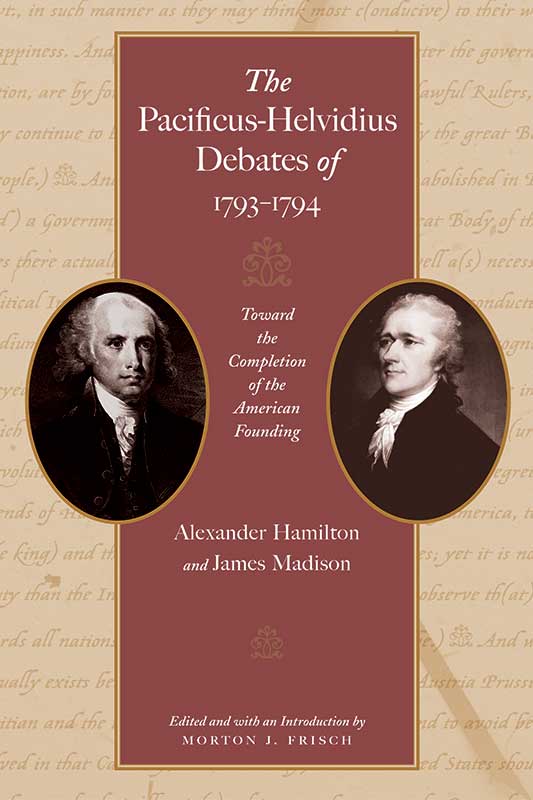
The Significance of the Pacificus-Helvidius Debates: Toward the Completion of the American Founding - Alexander Hamilton, The Pacificus-Helvidius Debates of 1793-1794: Toward the Completion of the American Founding [1793]

Edition used:

The Pacificus-Helvidius Debates of 1793-1794: Toward the Completion of the American Founding, edited with and Introduction by Morton J. Frisch (Indianapolis: Liberty Fund, 2007).

About Liberty Fund:

Liberty Fund, Inc. is a private, educational foundation established to encourage the study of the ideal of a society of free and responsible individuals.


The Significance of the Pacificus-Helvidius Debates: Toward the Completion of the American Founding

Washington’s Neutrality Proclamation of 1793 had the effect of annulling the eleventh article of America’s Treaty of Alliance with France of 1778. It involved a repudiation of obligations assumed by that treaty in response to France’s declaration of war on Great Britain and Holland. That proclamation was criticized by the Jeffersonian faction in Congress as an encroachment on the powers of the Senate because the Senate has a right to be consulted in matters of foreign policy, and as an encroachment on the powers of Congress because it could, in effect, commit the nation to war without the consent of Congress. The Constitutional Convention had left largely undefined the precise manner in which legislative and executive authorities would share their divided responsibilities in the conduct of foreign relations; furthermore, the relation between executive power and republican government was not fully thought through and hence not completely worked out at that time.

The American Constitution was left uncompleted in 1789, for it needed additional making or doing. The most remarkable and perhaps least remarked-upon fact about that constitution at the time of its ratification was its unfinished character. In that uncertain founding, there was considerable debate about the limits of a limited constitution. It is in relation to the imbalances of the unfinished constitution (an unfinished constitution is neither an endlessly flexible constitution nor a constitution devoid of essential meaning) that Alexander Hamilton, James Madison, and Thomas Jefferson set their courses to remodel the institutions of government in order to better secure the equilibrium which, in their view, that constitution intended. The controversies of the first Washington administration, which focused on the kinds of power that had been exercised (legislative and executive) and the degree to which power could be legitimately exercised, took the form of disputes over the way the Constitution should be construed.

When Jefferson read Hamilton’s defense of Washington’s Neutrality Proclamation in the newspapers, he virtually implored Madison to attack it. Although he had previously acquiesced in its issuance, it now became clear to him that Hamilton was using the neutrality issue to extend the area of executive control over foreign affairs. He wrote to Madison: “Nobody answers him, & his doctrine will therefore be taken for confessed. For God’s sake, my dear Sir, take up your pen, select the most striking heresies, and cut him to pieces in the face of the public. There is nobody else who can & will enter the lists with him.”1 Madison, acting as Jefferson’s surrogate, was in constant correspondence with him while composing his attack on Hamilton. We can therefore assume that Jefferson was in substantial agreement with the Madisonian arguments, arguments which were directed almost solely against the broad reach of executive power in foreign affairs. It was not the Neutrality Proclamation itself so much as the constitutional interpretation Hamilton advanced in its defense that was the object of their very great concern. Jefferson regarded it as particularly unfortunate that the Constitution left unresolved questions concerning the extent of executive power, especially in foreign affairs, and hence we can better understand why he reacted so strongly against Hamilton’s broad construction of executive power. Madison, like Jefferson, favored the creation of an executive with vigorously limited powers, emphasizing that the president had not been given any specific power to declare neutrality as a policy. His alliance with Jefferson was formed, at least in part, to put an end to what was perceived as the monarchizing tendencies in the Hamiltonian programs and policies. They were convinced that it was his intention to create a virtually unlimited executive.

In the Pacificus letters Hamilton argued in support of Washington’s proclamation that the president’s power to make such a proclamation issues from the general grant of executive power in Article II of the Constitution, which (as he outlined it) includes conducting foreign relations; from the president’s primary responsibility in the formation of treaties; and from the power of the execution of the laws, of which treaties form a part. He pointed out in Pacificus I that the first sentence of Article II of the Constitution, which declares that, “the executive power shall be vested in a President,” was meant as a general grant of power, not merely a designation of office, despite the enumeration of executive powers in other sections of Article II, and that moreover this general grant leaves the full range of executive powers to be discovered by interpreting it “in conformity to other parts <of> the constitution and to the principles of free government.”2

It would have been difficult for the Constitution to have contained “a complete and perfect specification of all the cases of Executive authority,” Hamilton reasoned, and therefore it left a set of unspecified executive powers that must be determined by inference from the more comprehensive grant (Pacificus no. I, June 29, 1793, Hamilton Papers, 15 : 39; and below, p. 12). He maintained that the control over foreign affairs is, in its nature, an executive function and one which therefore belongs exclusively to the president in the absence of specific provisions to the contrary. He further argued that the power to declare war which the Constitution grants to Congress is an exception from the general grant of executive power, and as an exception, cannot diminish the president’s authority in the exercise of those powers constitutionally granted to him.

Madison, the leader of the Jeffersonian faction in the Congress, objected that Hamilton’s construction of Washington’s proclamation as a neutrality proclamation constituted an infringement of the legislative power since a proclamation of neutrality might practically foreclose Congress’s option to wage war or not. Although Congress has the right to declare war, he argued that the president’s claim of the right to judge national obligations under treaties could put Congress in a position in which it would find it difficult to exercise that right. Hamilton’s answer was that the truth of this inference does not exclude the executive from a right of judgment in the execution of his own constitutional functions (Pacificus no. I, June 29, 1793, Hamilton Papers, 15 : 40; and below, p. 13). He admitted that the right of the executive, in certain cases, to determine the condition of the nation, by issuing a proclamation of neutrality, may affect the power of the legislature to declare war, but he saw that as no argument for constraining the executive in the carrying out of its functions (Pacificus no. I, June 29, 1793, Hamilton Papers, 15 : 42; and below, pp. 15–16). His argument was that the executive has broad authority in conducting foreign affairs, including the right to interpret treaties, declare peace or neutrality, and take actions that might later limit congressional options in declaring war.

But what about the Senate’s involvement in treaties? This provision would seem to indicate that, at least with respect to one of the government’s most important powers, the Constitution does not establish a government of simply separated powers, but a separation consistent with some mixture of legislating, executing, and judging—not too great a mixture, and only to prevent the abuses of power. The Constitution surely qualifies the separation of powers principle, for example, by qualifiedly granting the treaty-making power to the president. A qualified power is a power possessed by one official or one body which may be checked by another. But this does not suggest a constitutional intention of equal sharing; rather, it suggests the intention of qualifying the treaty-making power. In a very real sense, this power is not equally shared by the president and Senate, since the president is given the power of making treaties, whereas the Senate merely serves as check on the presidential power by virtue of the “advice and consent” provision. As a matter of fact, the treaty-making power is mentioned only in Article II; thus it is clearly executive despite the Senate’s power to ratify treaties. Though the Senate is authorized to check the exercise of that power, the president remains responsible for its proper exercise.

In his Helvidius response, Madison referred to Hamilton’s alleged admission in Federalist 75 that the treaty-making power was not essentially an executive power (Helvidius no. I, August 24, 1793, Madison Papers, 15 : 72–73; and below, pp. 63–64). Hamilton actually said that the treaty-making power is neither executive nor legislative in character, but seems to form a distinct department, what John Locke called the “federative power.” But more important, Hamilton indicated that the executive is “the most fit agent” in “the management of foreign negotiations.” He made it perfectly clear that the only reason for the Senate’s participation in treaty making is that as the least numerous part of the legislative body, it provides a greater prospect for security; however, it has nothing to do with the actual exercise of negotiations. The Senate is given a very limited role in the formation of treaties—advice and consent—but not their negotiation, with the executive being in a position to determine the type and amount of advice it wishes to accept. In Federalist 75 Hamilton revealed the difficulty of classifying the treaty-making power as either an executive or legislative power. He suggested that the treaty-making power is federative, and that that, moreover, does not preclude the primacy of executive responsibility in exercising that function. Although that power is not primarily an executive function, the Constitution wisely places it in the class of executive authorities. Surely executive energy would not be impaired by legislative participation in the power of making treaties, since the Senate restrains only by virtue of concurring or not concurring with the executive’s action.

Hamilton appeared to be much more a spokesman of limited government in Federalist 75, where he was discussing the participation of the Senate in treaty making, than in Pacificus I, where he was defending the president’s exclusive authority to issue a neutrality proclamation. But the defense of the issuance of that proclamation, as previously indicated, is that the Senate’s participation in treaty making is simply a qualification of the general grant of executive power to the president, that the Senate cannot claim an equal share in the exercise of that power, and that therefore the president has the exclusive right to determine the nature of the obligations which treaties impose upon the government, the Senate’s power of advice and consent to the contrary notwithstanding. The president exercises the treaty-making power even though the Senate is provided with some check on that power.

Madison stressed the inconveniences and confusion likely to result from Hamilton’s view of concurrent powers in the hands of different departments. He argued that “a concurrent authority in two independent departments to perform the same function with respect to the same thing, would be as awkward in practice, as it is unnatural in theory. If the legislature and executive have both a right to judge of the obligations to make war or not, it must sometimes happen, though not at present, that they will judge differently” (Helvidius no. II, August 31, 1793, Madison Papers, 15 : 83; and below, p. 69). Hamilton not only foresaw and expected clashes between the legislative and executive branches; he thought them beneficial. He would argue that these clashes arise not because the president and Congress share executive power as Madison had contended but because they disagree over policy and clash in the exercise of their concurrent authorities (Pacificus no. I, June 29, 1793, Hamilton Papers, 15 : 42; and below, p. 15). Hamilton intimates the possibility or even the likelihood of permanent constitutional clashes over matters of policy which must be settled politically because the Constitution, due to its absence of specificity, simply cannot resolve them. He recognized the essential limitation of law as law in dealing with foreign policy, but Madison did not, at least not in this instance.

In the debate over the president’s removal power in the First Congress, Madison had argued that the appointing power was executive in nature, that Senate participation in the appointing power was an exception to the general executive power of the president, and that the president had the exclusive power to remove any officer he appointed by virtue of his general executive power (Removal Power of the President, June 17, 1789, Madison Papers, 12 : 233). But in the debate over neutrality later on, he denied that Senate participation in the treaty-making power constituted a similar exception to the general executive power of the president, and that was because treaty making was more legislative than executive in character: “. . . no analogy, or shade of analogy, can be traced between a power in the supreme officer responsible for the faithful execution of the laws, to displace a subaltern officer employed in the execution of the laws; and a power to make treaties” for “there are sufficient indications that the power of treaties is regarded by the constitution as materially different from mere executive power, and as having more affinity to the legislative than to the executive character” (Helvidius no. I, August 24, 1793, Madison Papers, 15 : 72, 70; and below, pp. 63 and 61). Despite the position Madison had taken in defense of the president’s exclusive control over removals in 1789, he now maintained that Senate participation in treaty making extended to interpretation as well as advice and consent.

Madison claimed in the Pacificus-Helvidius debates that Hamilton’s reading of executive power introduced “new principles and new constructions” into the Constitution that were intended to remove “the landmarks of power” (Helvidius no. IV, September 14, 1793, Madison Papers, 15 : 107; and below, p. 85). He was, theoretically speaking, a purist, attached to the purity of republican theory, following what he believed to be a fair construction of the Constitution consistent with liberty rather than a liberal construction of executive power. It was the violation of the Constitution issuing from the introduction of “new principles and constructions” into that document that most concerned Madison as well as Jefferson, who saw it as in effect undermining the very sanctity of the constitutional document. Hamilton was arguing that the direction of foreign policy is essentially an executive function, whereas Madison was arguing that the direction of foreign policy is essentially a legislative function by virtue of the Senate’s treaty-making and war powers. Hamilton construed the Senate’s treaty-making and war powers as exceptions out of the general executive power vested in the president. Although neutrality has since become a congressional prerogative, the Hamiltonian reasoning has established the constitutional basis for the broad exercise of executive powers in foreign affairs, an emphasis which was not at all clear prior to the neutrality debates. In other words, that debate had far wider implications than the neutrality issue itself.

The Neutrality Proclamation represents America’s finest hour in the arena of foreign policy. This is highlighted by Hamilton’s defense of that proclamation in which the foreign policy powers of the president are elaborated as part of a more complete Constitution, an elaboration which added a dimension that had not previously existed in the original document. The debates clarified certain constitutional principles that we now associate with executive power generally: (1) that the direction of foreign policy is essentially an executive function; (2) that, beyond the enumeration of specific powers in Article II, other powers were deposited in the general grant of executive power in that article; and (3) that the overlapping spheres of power created by the Constitution are necessary for the more effective operation of separation of powers so that the powers themselves can fall within one another’s boundaries and at the same time be kept independent of each other.

It can be reasonably inferred from the language of the Constitution that the president receives an undefined, nonenumerated reservoir of power from the clause of Article II containing the general grant of executive power over and above the powers expressed or specifically enumerated in that article. Hamilton sensed that the final structure of the unfinished Constitution might well be determined by the way he would advance his broad construction of certain clauses in that document during his tenure of office, a construction which would give the president a field of action much wider than that outlined by the enumerated powers. Hamilton was not moved to introduce fundamental changes in the Constitution itself, but rather to clarify the necessary and proper role of executive power in foreign affairs. We are sufficiently familiar with written constitutions to know that their essential defect is inflexibility, but whatever defects adhere to what is committed to writing are made up for in part, in the case of our Constitution, by the open-endedness that its leading draftsmen worked into its overall design. We have no difficulty in recognizing therefore that much of the meaning of the Constitution would come through inference or construction. It was apparent that the open-ended character of some of the constitutional provisions afforded opportunities for extending the powers of government beyond their specified limits. Although not given prior sanction by the Constitutional Convention, such additions served to provide a more complete definition of powers without actually changing the ends of government.

ADDENDUM

In the George F. Hopkins edition of 1802, which must be taken as Hamilton’s final version of the Federalist Papers, he insisted that the edition include his Pacificus. He remarked to Hopkins that “some of his friends had pronounced [it] . . . his best performance,” apparently feeling that this was a natural supplement to what he had already written in his commentary on the United States Constitution.

Morton J. Frisch

NOTE ON THE TEXT

Hamilton’s and Madison’s notes are referenced with symbols. The bracketed supplements to these notes include my own additions as well as those retained from the Columbia University Press and University Press of Virginia editions of Hamilton’s and Madison’s Papers, respectively. Bracketed material in the numbered footnotes is mine; unbracketed material is from the Columbia and Virginia editions. Bracketed material within the text itself, i.e., not in footnotes, has been supplied.

[1. ]Jefferson to Madison, July 7, 1793, The Papers of James Madison, ed. Thomas A. Mason, Robert A. Rutland, and Jeanne K. Sisson, vol. 15 (Charlottesville: University Press of Virginia, 1985), 43; and below, p. 54.

[2. ]Pacificus no. I, June 29, 1793, The Papers of Alexander Hamilton, ed. Harold Syrett et al., vol. 15 (New York: Columbia University Press, 1969), 38–39; and below, pp. 12–13.