Econlib

The Library

Other Sites

Front Page arrow Titles (by Subject) arrow The second rule.: Chap. x. - The Manual of a Christian Knight

Return to Title Page for The Manual of a Christian Knight

Search this Title:

Also in the Library:

Subject Area: Religion
Collection: Banned Books

The second rule.: Chap. x. - Desiderius Erasmus, The Manual of a Christian Knight [1501]

Edition used:

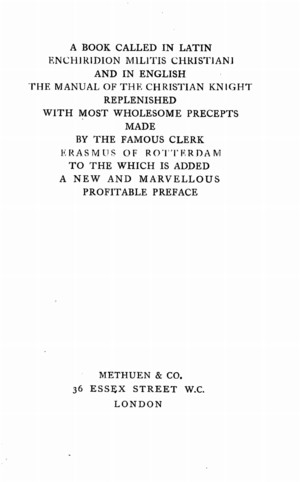
A Book Called in Latin Enchiridion Militis Christiani and in English The Manual of the Christian Knight, replenished with the most wholesome precepts made by the famous clerk Erasmus of Rotterdam, to which is added a new and marvellous profitable Preface (London: Methuen and Co., 1905).

About Liberty Fund:

Liberty Fund, Inc. is a private, educational foundation established to encourage the study of the ideal of a society of free and responsible individuals.


The second rule.

Chap. x.

Let the first point be therefore that thou doubt in no wise of the promises of God. We must enter into the way of health or salvation boldly and with a jocund courage. The next that thou go unto the way of life, not slothfully, not fearfully: but with sure purpose, with all thy heart, with a confident mind, and (if I may so say) with such mind as he hath that would rather fight than drink: so that thou be ready at all hours for Christ’s sake to lose both life and goods. A slothful man will and will not. The kingdom of heaven is not gotten of negligent and reckless persons, but plainly rejoiceth to suffer violence: and violent persons violently obtain it. Suffer not the affection of them whom thou lovest singularly to hold thee back hasting thither ward: Egypt signifieth bondage, affliction, vices, and blindness. let not the pleasures of this world call thee back again: let not the care of thy household be any hindrance to thee. The chain of worldly business must be cut asunder, for surely it cannot otherwise be loosed. The Israelytes being a-hungered in desert wished to go back again to Egypt, saying to Moses, How happy were we when we sat there by the pots of flesh. Egypt must be forsaken in such a manner that thou turn not again in thy mind at any time unto the pots of the flesh. Sodoma must be forsaken utterly hastily, yea, and at once: it is not lawful to look back. The woman looked back and she was turned into the image of a stone. The man had no leisure anywhere to abide in any region, but was commanded to haste into the mountain, unless that he had liefer to have perished. Lot was commanded to depart hastily out of Sodoma and not to look back. His wife looked back and was turned into a salt stone. So we may neither with the Israelytes desire to go back again to the pleasures of Egypt, of vices and sin: neither with the wife of Lot may look back again to our old conversation. The prophet crieth out that we should flee out of the midst of Babylon. The departing of the Israelytes from Egypt is called flight or running away. We be commanded to flee out of Babylon hastily, and not to remove a little and a little slowly. Thou mayst see the most part of men prolong the time, and with very slow purpose go about to flee from vices. When I have once rid myself out of such and such matters, say they, yea when I have brought that and that business to pass. Oh fool, what and if God this same day take again thy soul from thee? Perceivest thou not one business to rise of another, and one vice to call in another? Why rather doest thou not to-day that thing which the sooner thou doest, the easier shall it be done? Be diligent some other where. In this matter to do rashly, to run headlong and suddenly, is chiefest of all and most profitable. There may be no prolonging time in fleeing vices. Regard not nor ponder how much thou forsakest, but be sure Christ only shall be sufficient for all things: Confidence in God. only be bold to commit thyself to him with all thine heart: set thou mistrust in thine own self, adventure to put unto him all the governance of thyself: trust to thyself no longer, but with full confidence cast thyself from thyself to him, and he shall receive thee: commit thy care and thought to the Lord Serve Christ altogether and no man else., and he shall nourish thee up, that thou mayst sing the song of the same prophet. The Lord is my governor, and I shall lack nothing. In a place of pasture he hath set me, by the water side of comfort he hath brought up me: he hath converted my soul. Be not minded to part thyself into two, to the world and to Christ: thou canst not serve two masters: there is no fellowship between God and Belial. God cannot away with them which halt on both their legs: his stomach abhorreth them which be neither hot nor cold, but lukewarm. God is a very jealous lover of souls: he will possess only and altogether that thing which he redeemed with his blood: he cannot suffer the fellowship of the devil, whom he once overcame with death. Two ways only. The one of salvation the other of perdition. There be but two ways only, the one which by obedience of the affections leadeth to perdition: the other which through mortifying of the flesh, leadeth to life. Why doubtest thou in thyself, there is no third way, into one of these two thou must needs enter, wilt thou or wilt thou not, whatsoever thou art, or of what degree, thou must needs enter into this strait way, in which few mortal men walk? But this way Christ himself hath trod, and have trodden since the world began whosoever pleased God. Adrastia, Nemesis, or Rhamnusia is a goddess which punisheth insolence. She forbiddeth that any man look too high. If any so do he escapeth not unpunished though it be never so late. If any be too full of insolence we say: Take heed, Rhamnusia seeth thee well enough. This is doubtless the inevitable necessity of the goddess Adrastia, otherwise called Nemesis or Rhamnusia, that is to say, it cannot be chosen but that thou be crucified with Christ as touching the world, if thou purpose to live with Christ. Why like fools flatter we ourselves, why in so weighty a matter deceive we ourselves? One saith, I am not of the clergy or a spiritual man, I am of the world, I cannot but use the world. Another thinketh, though I be a priest yet am I no monk, let him look upon it. And the monk also hath found a thing to flatter himself withal, though I be a monk yet am I not of so strait an order as such and such. Another saith, I am a young man, I am a gentleman, I am rich, I am a courtier, and to be short, a prince, those things pertain not to me which were spoken to the apostles. Every man putteth to another the life of Christ and sayings of his apostles. Oh wretch, then appertaineth it nothing to thee that thou shouldst live in Christ? If thou be in the world, in Christ thou art not: if thou call the sky, the earth, the sea and this common air the world: so is there no man which is not in the world: The world. but and if thou call the world ambition, that is to say, desire of honour, promotion, or authority: if thou call the world pleasures, covetousness, bodily lust: certainly if thou be worldly, thou art not a christian man. Christ spake indifferently to all men: whosoever would not take his cross and follow him, could be no meet man for him, or be his disciple: The reward is given to him that laboureth. to die with Christ as touching the flesh is nothing to thee, if to live by his spirit pertaineth nothing to thee: to be crucified as touching the world pertaineth nothing to thee, if to live godly or in God, pertain nothing to thee: to be buried together with Christ belongeth nothing to thee, if to arise again to eternal glory belong nothing to thee: the humility, poverty, tribulation, vile reputation, the laborious agonies and sorrows of Christ, pertain nothing at all unto thee, if the kingdom of him pertain nothing unto thee. What can be more lewd than to think the reward to be common as well to thee as to other: and yet nevertheless to put the labours whereby the reward is obtained, from thee, to a certain few persons? What can be more a wanton thing than to desire to reign with the Head, and yet wilt thou take no pain with him? Therefore, my brother, look not so greatly what other men do, and in comparison of them flatter or please thyself. To die as touching sin: to die as touching carnal desires: to die as touching the world is a certain hard thing and known to very few, yea though they be monks Monks., and yet this is the common or general profession of all christian men. This thing a great while agone thou hast sworn and holily promised in the time of baptism: than which vow what other thing can there be either more holy or religious? Either we must perish, or else without exception we must go this way to health, whether we be knights or ploughmen. Notwithstanding though it fortune not to all men to attain the perfect counterfeiting or following of the Head, yet all must enforce with feet and hands to come thereto. He hath a great part of a christian man’s living, which with all his heart, with a sure and steadfast purpose, hath determined to be a christian man.