EconlibThe LibraryOther Sites |
Front Page Titles (by Subject) 5: Liberty and Western Civilization - The Anti-capitalistic Mentality
Return to Title Page for The Anti-capitalistic MentalityThe Online Library of LibertyA project of Liberty Fund, Inc.Search this Title:Also in the Library:
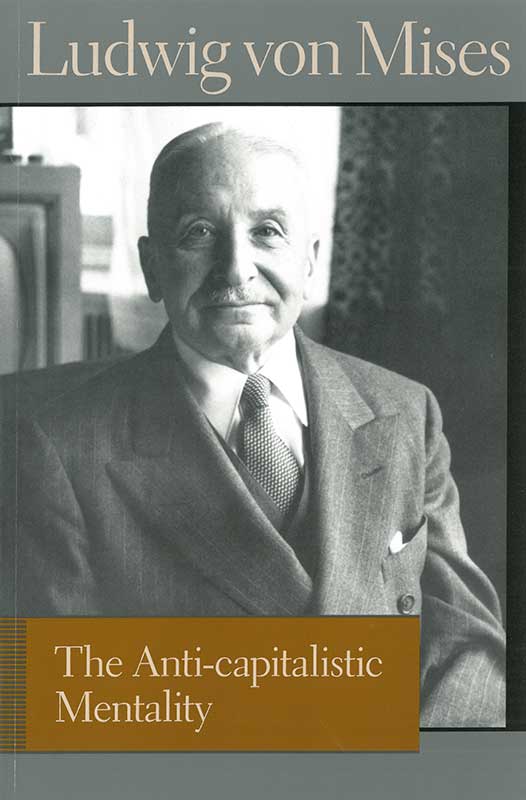
5: Liberty and Western Civilization - Ludwig von Mises, The Anti-capitalistic Mentality [1956]Edition used:The Anti-capitalist Mentality, edited and with a preface by Bettina Bien Greaves (Indianapolis: Liberty Fund, 2006).
About Liberty Fund:Liberty Fund, Inc. is a private, educational foundation established to encourage the study of the ideal of a society of free and responsible individuals. Copyright information:The copyright to this edition, in both print and electronic forms, is held by Liberty Fund, Inc. Fair use statement:This material is put online to further the educational goals of Liberty Fund, Inc. Unless otherwise stated in the Copyright Information section above, this material may be used freely for educational and academic purposes. It may not be used in any way for profit.
5Liberty and Western CivilizationThe critics of the legal and constitutional concept of liberty and the institutions devised for its practical realization are right in their assertion that freedom from arbitrary action on the part of the officeholders is in itself not yet sufficient to make an individual free. But in emphasizing this indisputable truth they are running against open doors. For no advocate of liberty ever contended that to restrain the arbitrariness of officialdom is all that is needed to make the citizens free. What gives to the individuals as much freedom as is compatible with life in society is the operation of the market economy. The constitutions and bills of rights do not create freedom. They merely protect the freedom that the competitive economic system grants to the individuals against encroachments on the part of the police power. In the market economy people have the opportunity to strive after the station they want to attain in the structure of the social division of labor. They are free to choose the vocation in which they plan to serve their fellow men. In a planned economy they lack this right. Here the authorities determine each man’s occupation. The discretion of the superiors promotes a man to a better position or denies him such promotion. The individual depends entirely on the good graces of those in power. But under capitalism everybody is free to challenge the vested interests of everybody else. If he thinks that he has the ability to supply the public better or more cheaply than other people do, he may try to demonstrate his efficiency. Lack of funds cannot frustrate his projects. For the capitalists are always in search of men who can utilize their funds in the most profitable way. The outcome of a man’s business activities depends alone on the conduct of the consumers who buy what they like best. Neither does the wage earner depend on the employer’s arbitrariness. An entrepreneur who fails to hire those workers who are best fitted for the job concerned and to pay them enough to prevent them from taking another job is penalized by a reduction of net revenue. The employer does not grant to his employees a favor. He hires them as an indispensable means for the success of his business in the same way in which he buys raw materials and factory equipment. The worker is free to find the employment which suits him best. The process of social selection that determines each individual’s position and income is continuously going on in the market economy. Great fortunes are shrinking and finally melting away completely while other people, born in poverty, ascend to eminent positions and considerable incomes. Where there are no privileges and where governments do not grant protection to vested interests threatened by the superior efficiency of newcomers, those who have acquired wealth in the past are forced to acquire it every day anew in competition with all other people. Within the framework of social cooperation under the division of labor everybody depends on the recognition of his services on the part of the buying public of which he himself is a member. Everybody in buying or abstaining from buying is a member of the supreme court which assigns to all people—and thereby also to himself—a definite place in society. Everybody is instrumental in the process that assigns to some people a higher, and to others a smaller, income. Everybody is free to make a contribution which his fellow men are prepared to reward by the allocation of a higher income. Freedom under capitalism means not to depend more on other people’s discretion than these others depend on one’s own. No other freedom is conceivable where production is performed under the division of labor, and there is no perfect economic autarky of everybody. There is no need to stress the point that the essential argument advanced in favor of capitalism and against socialism is not the fact that socialism must necessarily abolish all vestiges of freedom and convert all people into slaves of those in power. Socialism is unrealizable as an economic system because a socialist society would not have any possibility of resorting to economic calculation. This is why it cannot be considered as a system of society’s economic organization. It is a means to disintegrate social cooperation and to bring about poverty and chaos. In dealing with the liberty issue one does not refer to the essential economic problem of the antagonism between capitalism and socialism. One rather points out that Western man as different from the Asiatics is entirely a being adjusted to life in freedom and formed by life in freedom. The civilizations of China, Japan, India and the Mohammedan countries of the near East as they existed before these nations became acquainted with Western ways of life certainly cannot be dismissed as barbarism. These peoples, already many hundreds, even thousands of years ago, brought about marvelous achievements in the industrial arts, in architecture, in literature and philosophy and in the development of educational institutions. They founded and organized powerful empires. But then their effort was arrested, their cultures became numb and torpid, and they lost the ability to cope successfully with economic problems. Their intellectual and artistic genius withered away. Their artists and authors bluntly copied traditional patterns. Their theologians, philosophers and lawyers indulged in unvarying exegesis of old works. The monuments erected by their ancestors crumbled. Their empires disintegrated. Their citizens lost vigor and energy and became apathetic in the face of progressing decay and impoverishment. The ancient works of oriental philosophy and poetry can compare with the most valuable works of the West. But for many centuries the East has not generated any book of importance. The intellectual and literary history of modern ages hardly records any name of an oriental author. The East has no longer contributed anything to the intellectual effort of mankind. The problems and controversies that agitated the West remained unknown to the East. In Europe there was commotion; in the East there was stagnation, indolence and indifference. The reason is obvious. The East lacked the primordial thing, the idea of freedom from the state. The East never raised the banner of freedom, it never tried to stress the rights of the individual against the power of the rulers. It never called into question the arbitrariness of the despots. And, consequently, it never established the legal framework that would protect the private citizens’ wealth against confiscation on the part of the tyrants. On the contrary, deluded by the idea that the wealth of the rich is the cause of the poverty of the poor, all people approved of the practice of the governors of expropriating successful businessmen. Thus big-scale capital accumulation was prevented, and the nations had to miss all those improvements that require considerable investment of capital. No “bourgeoisie” could develop, and consequently there was no public to encourage and to patronize authors, artists and inventors. To the sons of the people all roads toward personal distinction were closed but one. They could try to make their way in serving the princes. Western society was a community of individuals who could compete for the highest prizes. Eastern society was an agglomeration of subjects entirely dependent on the good graces of the sovereigns. The alert youth of the West looks upon the world as a field of action in which he can win fame, eminence, honors and wealth; nothing appears too difficult for his ambition. The meek progeny of Eastern parents know of nothing else than to follow the routine of their environment. The noble self-reliance of Western man found triumphant expression in such dithyrambs as Sophocles’ choric Antigone-hymn upon man and his enterprising effort and Beethoven’s Ninth Symphony. Nothing of the kind has been ever heard in the Orient. Is it possible that the scions of the builders of the white man’s civilization should renounce their freedom and voluntarily surrender to the suzerainty of omnipotent government? That they should seek contentment in a system in which their only task will be to serve as cogs in a vast machine designed and operated by an almighty planmaker? Should the mentality of the arrested civilizations sweep the ideals for the ascendancy of which thousands and thousands have sacrificed their lives? Ruere in servitium, they plunged into slavery, Tacitus sadly observed in speaking of the Romans of the age of Tiberius. CHAPTER 5“Anticommunism” versus CapitalismIn the universe there is never and nowhere stability and immobility. Change and transformation are essential features of life. Each state of affairs is transient; each age is an age of transition. In human life there is never calm and repose. Life is a process, not a perseverance in a status quo. Yet the human mind has always been deluded by the image of an unchangeable existence. The avowed aim of all utopian movements is to put an end to history and to establish a final and permanent calm. The psychological reasons for this tendency are obvious. Every change alters the external conditions of life and well-being and forces people to adjust themselves anew to the modification of their environments. It hurts vested interests and threatens traditional ways of production and consumption. It annoys all those who are intellectually inert and shrink from revising their modes of thinking. Conservatism is contrary to the very nature of human acting. But it has always been the cherished program of the many, of the inert who dully resist every attempt to improve their own conditions which the minority of the alert initiate. In employing the term reactionary one mostly refers only to the aristocrats and priests who called their parties conservative. Yet the outstanding examples of the reactionary spirit were provided by other groups: by the guilds of artisans blocking entrance into their field to newcomers; by the farmers asking for tariff protection, subsidies and “parity prices”; by the wage earners hostile to technological improvements and fostering featherbedding and similar practices. The vain arrogance of the literati and the Bohemian artists dismisses the activities of the businessmen as unintellectual moneymaking. The truth is that the entrepreneurs and promoters display more intellectual faculties and intuition than the average writer and painter. The inferiority of many self-styled intellectuals manifests itself precisely in the fact that they fail to recognize what capacity and reasoning power are required to develop and to operate successfully a business enterprise. The emergence of a numerous class of such frivolous intellectuals is one of the least welcome phenomena of the age of modern capitalism. Their obtrusive stir repels discriminating people. They are a nuisance. It would not directly harm anybody if something would be done to curb their bustle or, even better, to wipe out entirely their cliques and coteries. However, freedom is indivisible. Every attempt to restrict the freedom of the decadent troublesome literati and pseudo-artists would vest in the authorities the power to determine what is good and what is bad. It would socialize intellectual and artistic effort. It is questionable whether it would weed out the useless and objectionable persons; but it is certain that it would put insurmountable obstacles in the way of the creative genius. The powers that be do not like new ideas, new ways of thought and new styles of art. They are opposed to any kind of innovation. Their supremacy would result in strict regimentation; it would bring about stagnation and decay. The moral corruption, the licentiousness and the intellectual sterility of a class of lewd would-be authors and artists is the ransom mankind must pay lest the creative pioneers be prevented from accomplishing their work. Freedom must be granted to all, even to base people, lest the few who can use it for the benefit of mankind be hindered. The license which the shabby characters of the quartier Latin enjoyed was one of the conditions that made possible the ascendance of a few great writers, painters and sculptors. The first thing a genius needs is to breathe free air. After all, it is not the frivolous doctrines of the Bohemians that generate disaster, but the fact that the public is ready to accept them favorably. The response to these pseudo-philosophies on the part of the molders of public opinion and later on the part of the misguided masses is the evil. People are anxious to endorse the tenets they consider as fashionable lest they appear boorish and backward. The most pernicious ideology of the last sixty years was George Sorel’s syndicalism and his enthusiasm for the action directe. Generated by a frustrated French intellectual, it soon captivated the literati of all European countries. It was a major factor in the radicalization of all subversive movements. It influenced French royalism, militarism and anti-Semitism. It played an important role in the evolution of Russian Bolshevism, Italian Fascism and the German youth movement which finally resulted in the development of Nazism. It transformed political parties intent upon winning through electoral campaigns into factions which relied upon the organization of armed bands. It brought into discredit representative government and “bourgeois security,” and preached the gospel both of civil and of foreign war. Its main slogan was violence and again violence. The present state of European affairs is to a great extent an outcome of the prevalence of Sorel’s teachings. The intellectuals were the first to hail the ideas of Sorel; they made them popular. But the tenor of Sorelism was obviously anti-intellectual. He was opposed to cool reasoning and sober deliberation. What counts for Sorel is solely the deed, viz., the act of violence for the sake of violence. Fight for a myth whatever this myth may mean, was his advice. “If you place yourself on this ground of myths, you are proof against any kind of critical refutation.”* What a marvelous philosophy, to destroy for the sake of destruction! Do not talk, do not reason, kill! Sorel rejects the “intellectual effort” even of the literary champions of revolution. The essential aim of the myth is “to prepare people to fight for the destruction of what exists.”† Yet the blame for the spread of the destructionist pseudophilosophy rests neither with Sorel nor with his disciples, Lenin, Mussolini and Rosenberg, nor with the hosts of irresponsible literati and artists. The catastrophe came because, for many decades, hardly anybody ventured to examine critically and to explode the trigger-consciousness of the fanatical desperadoes. Even those authors who refrained from unreservedly endorsing the ideas of reckless violence were eager to find some sympathetic interpretation of the worst excesses of the dictators. The first timid objections were raised only when—very late, indeed—the intellectual abettors of these policies began to realize that even enthusiastic endorsement of the totalitarian ideology did not guarantee immunity from torture and execution. There exists today a sham anticommunist front. What these people who call themselves “anticommunist liberals” and whom sober men more correctly call “anti-anticommunists” are aiming at is communism without those inherent and necessary features of communism which are still unpalatable to Americans. They make an illusory distinction between communism and socialism and—paradoxically enough—look for a support of their recommendation of noncommunist socialism to the document which its authors called the Communist Manifesto. They think that they have proved their case by employing such aliases for socialism as planning or the welfare state. They pretend to reject the revolutionary and dictatorial aspirations of the “Reds” and at the same time they praise in books and magazines, in schools and universities, Karl Marx, the champion of the communist revolution and the dictatorship of the proletariat, as one of the greatest economists, philosophers and sociologists and as the eminent benefactor and liberator of mankind. They want to make us believe that untotalitarian totalitarianism, a kind of a triangular square, is the patent medicine for all ills. Whenever they raise some mild objection to communism, they are eager to abuse capitalism in terms borrowed from the objurgatory vocabulary of Marx and Lenin. They emphasize that they abhor capitalism much more passionately than communism, and they justify all the unsavory acts of the communists by referring to the “unspeakable horrors” of capitalism. In short: they pretend to fight communism in trying to convert people to the ideas of the Communist Manifesto. What these self-styled “anticommunist liberals” are fighting against is not communism as such, but a communist system in which they themselves are not at the helm. What they are aiming at is a socialist, i.e., communist, system in which they themselves or their most intimate friends hold the reins of government. It would perhaps be too much to say that they are burning with a desire to liquidate other people. They simply do not wish to be liquidated. In a socialist commonwealth, only the supreme autocrat and his abettors have this assurance. An “anti-something” movement displays a purely negative attitude. It has no chance whatever to succeed. Its passionate diatribes virtually advertise the program that they attack. People must fight for something that they want to achieve, not simply reject an evil, however bad it may be. They must, without any reservations, endorse the program of the market economy. Communism would have today, after the disillusionment brought by the deeds of the Soviets and the lamentable failure of all socialist experiments, but little chance of succeeding in the West if it were not for this faked anticommunism. What alone can prevent the civilized nations of Western Europe, America and Australia from being enslaved by the barbarism of Moscow is open and unrestricted support of laissez-faire capitalism. The typeface used in setting this book is Electra, designed in 1935 by the great American typographer William Addison Dwiggins. Dwiggins was a student and associate of Frederic Goudy and served for a time as acting director of Harvard University Press. In his illustrious career as typographer and book designer (he coined the term “graphic designer”), Dwiggins created a number of typefaces, including Metro and Caledonia, and designed as well many of the typographic ornaments or “dingbats” familiar to readers. Electra is a crisp, elegant, and readable typeface, strongly suggestive of calligraphy. The contrast between its strokes is relatively muted, and it produces an even but still “active” impression in text. Interestingly, the design of the italic form—called “cursive” in this typeface—is less calligraphic than the italic form of many faces, and more closely resembles the roman. This book is printed on paper that is acid-free and meets the requirements of the American National Standard for Permanence of Paper for Printed Library Materials, z39.48–1992.(archival) Book design adapted by Erin Kirk New, Watkinsville, Georgia, after a design by Martin Lubin Graphic Design, Jackson Heights, New York Typography by G & S Typesetters, Inc., Austin, Texas Printed and bound by Worzalla Publishing Company, Stevens Point, Wisconsin [† ]Cf. G. Sorel, Réflexions sur la violence, 3d ed. (Paris, 1912), p. 49. [† ]Cf. Sorel, op. cit., p. 46. |

Titles (by Subject)