Econlib

The Library

Other Sites

Front Page arrow Titles (by Subject) arrow V.: Majoritarian Democracy in the Noncontractarian Paradigm - The Collected Works of James M. Buchanan, Vol. 10 (The Reason of Rules: Constitutional Political Economy)

Return to Title Page for The Collected Works of James M. Buchanan, Vol. 10 (The Reason of Rules: Constitutional Political Economy)

Search this Title:

Also in the Library:

Subject Area: Economics
Subject Area: Political Theory
Subject Area: Law
Collection: Books Published by Liberty Fund
Topic: Property
E-Books: Liberty Fund E-Books
Order this book from Liberty Fund

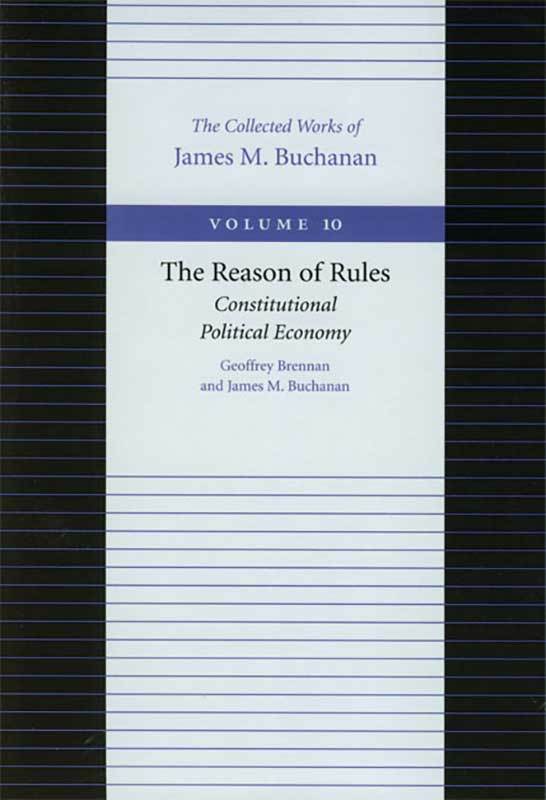
V.: Majoritarian Democracy in the Noncontractarian Paradigm - Geoffrey Brennan, The Collected Works of James M. Buchanan, Vol. 10 (The Reason of Rules: Constitutional Political Economy) [1985]

Edition used:

The Collected Works of James M. Buchanan, Vol. 10 (The Reason of Rules: Constitutional Political Economy) Foreword by Robert D. Tollison (Indianapolis: Liberty Fund, 1999).

Part of: The Collected Works of James M. Buchanan in 20 vols.

About Liberty Fund:

Liberty Fund, Inc. is a private, educational foundation established to encourage the study of the ideal of a society of free and responsible individuals.


V.

Majoritarian Democracy in the Noncontractarian Paradigm

We have suggested that the noncontractarian position sketched in this chapter is authoritarian and antiindividualistic. We have not, to this point, classified the position as nondemocratic, because vociferous advocates of “democracy,” particularly of its majoritarian variants, are among those who most strongly oppose constitutional change. The paradigm in which politics is analogous to science seems to allow the development of an argument supporting democratic institutions of collective decision making. Such institutions, perhaps best exemplified by majority voting rules in elected legislative assemblies, are defended, however, on grounds that are totally different from those that might be adduced from the contractarian paradigm.

The electoral machinery of democracy, considered as an institutional structure that generates collective outcomes, is conceptualized in a manner fully analogous to the conceptualization of a jury operating under unanimity or qualified majority voting rules. The machinery of democracy is supported because of its alleged efficacy in discovering “public good.” Proponents of this position may, of course, acknowledge that democratic electoral processes, including plurality and majority voting rules, seem grossly imperfect when judged against some ideal standard. The plausible defense of democracy requires, however, only that these institutions be estimated to be less imperfect than suggested alternative arrangements.

In this context, majoritarian democracy may, indeed, find stout defenders, as the historical record surely suggests. Nonetheless, it should be evident that the intellectual foundations of democratic institutions in this noncontractarian perspective are weaker by an order of magnitude than those in the contractarian perspective. Democratic institutions stand or fall on their alleged superiority in generating the attainment of an independently existing “public good.” The whole defense is necessarily based on efficiency. At a secondary level of argument, proponents of democracy in the noncontractarian paradigm acknowledge that majority rule is less imperfect than its alternatives in part because “public good” is not readily discernible. And, indeed, these very proponents may argue that nondemocratic methods of reaching collective decisions are more efficient when “public good” is more clearly outlined, as, for example, in war emergency.

By dramatic contrast with the defense of democracy in the noncontractarian perspective, the contractarian defense of democratic institutions, as constitutionally derived, is based on their ability to facilitate the expression of individual values. These institutions are not understood to be “discovering public good,” even if at some deeper philosophical level the existence or nonexistence of such “public good” may be a subject of further inquiry. Since there is no external standard against which institutions can be evaluated in efficiency terms, any evaluative criteria must be applied directly to the institutional processes themselves. In such perspective, constitutional democracy, which may embody majoritarian voting rules in specified circumstances, is categorically distinct from all other governmental-political forms of authority. For the noncontractarian, on the other hand, there can be no categorical difference between, say, majoritarian democracy and hereditary monarchy. These are simply alternative forms of politics, both aimed at finding “public good”; the former is preferred to the latter only because it is more effective in achieving the purpose.

To the extent that a prejudgment has been made to the effect that majoritarian voting rules are more efficient in generating “public good” than are any of the alternative forms of political authority (for example, hereditary monarchy, aristocracy, oligarchy, rule by committee of a single party, or dictatorship by a military junta), any constitutional constraints on the “will of the majority” will tend to be opposed. Such opposition need not be based on any notion that the majority is always right; the notion is that the majority is more likely to be right than any other instrument for making collective judgments. To impose constitutional limits on the exercise of majority will must, therefore, imply that a majority in one period can claim superior wisdom to a majority in subsequent periods. Such a claim finds no reasonable basis for support in the noncontractarian framework of argument. Hence, majorities must be allowed to work their wills. The task of education remains one of informing political leaders and citizens about the content of “public good.”