Econlib

The Library

Other Sites

Front Page arrow Titles (by Subject) arrow THE TESTAMENT OF FORTUNE RICARD - Observations on the Importance of the American Revolution, and the Means of Making it a Benefit to the World

Return to Title Page for Observations on the Importance of the American Revolution, and the Means of Making it a Benefit to the World

Search this Title:

Also in the Library:

Subject Area: Economics
Subject Area: Political Theory
Subject Area: War and Peace
Topic: The American Revolution and Constitution

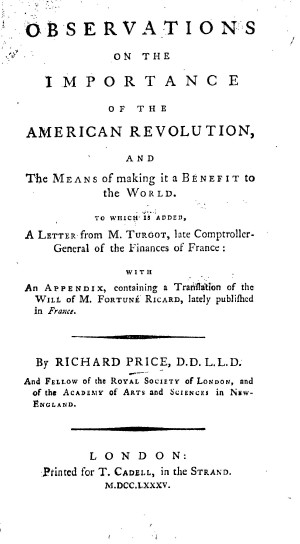
THE TESTAMENT OF FORTUNE RICARD - Richard Price, Observations on the Importance of the American Revolution, and the Means of Making it a Benefit to the World [1784]

Edition used:

Observations on the Importance of the American Revolution, and the Means of Making it a Benefit to the World. To which is added, a Letter from M. Turgot, late Comptroller-General of the Finances of France: with an Appendix, containing a Translation of the Will of M. Fortuné Ricard, lately published in France (London: T. Cadell, 1785).

About Liberty Fund:

Liberty Fund, Inc. is a private, educational foundation established to encourage the study of the ideal of a society of free and responsible individuals.


THE TESTAMENT, &c.

IN the name of God, I Fortuné Ricard, Teacher of Arithmetic at D—, invoking the Holy Virgin and Saint Fortune my patron, do make this my last Will as follows—

[“The Executors, who have caused this Will to be printed in order to fulfil the intentions of the late M. Fortuné Ricard, do not think it necessary to publish those particular bequests which concern only his own family.—After having disposed of his patrimony among them with wisdom, he proceeds in the following manner.”]

It remains now for me to declare my intentions with regard to the promise of 500 livres* , subscribed on my behalf by M. P. banker of this town. This sum proceeded originally from a present which was made me by Prosper Ricard, my much honoured grandfather, when I entered the eighth year of my age. At that age he had taught me the principles of writing and calculation. After having shewn me that a capital, with its accumulating interest at five per cent. would amount at the end of 100 years to more than 131 times the original sum* , and seeing that I listened to this lecture with the greatest attention, he took 24 livres out of his pocket, and addressed me with an enthusiasm which is still present to my mind—“My child, said he, remember while thou livest, that with œconomy and calculation nothing is impossible for man. Here are 24 livres which I give thee. Take them to a merchant in our neighbourhood, who will place them in trade out of regard to me. Every year thou shalt add the interest to the principal. At thy death thou shalt employ the produce in good works for the repose of thy soul and my own.”—I have executed this order with fidelity, and in the course of my life I have planned many projects for employing this money. Having reached the 71st year of my age, it amounts to 500 livres; but as I must some time or other set bounds to myself, I now desire that it may be divided into five portions of 100 livres each; to which the interests shall be annually added, and the accumulated sums shall be successively applied to the following uses.

1. In a hundred years the first sum of 100 livres will amount to more than 13,100 livres§ , (5822l.). From this sum a prize of 4000 livres shall be given for the best theological dissertation, to prove the lawfulness of putting out money to interest. Three medals, of 600 livres each, shall also be given for the three dissertations which shall be adjudged the next in merit to the prize-dissertation. The remainder of the 13,100 livres shall be expended in printing the prize dissertation and extracts from the others. Copies of these shall be sent, gratis, to all the bishops, clergy, and confessors of the kingdom. I had intended to have sent them also into foreign countries; but I observe that all the universities of the christian world, excepting those of France, have solemnly recognized the lawfulness of putting money to interest* ; and that it continues necessary only in this kingdom to explain a question in morals so interesting to the welfare of the State.

2. After two hundred years a second sum of 100 livres, amounting, with its accumulated interest, to more than 1,700,000 livres , (756,500l.) shall be employed in establishing a perpetual fund for fourscore prizes of 1000 livres each, to be distributed annually by the different academies of the kingdom, as follows:—Fifteen prizes for the most distinguished virtuous actions—fifteen for works of science and literature—ten for solutions of questions in arithmetic and calculation—ten for such new processes in agriculture as shall produce the best crops—ten for master-pieces in the fine arts—and ten to encourage races and other exercises proper to display the force and agility of the body, and to restore amongst us a taste for the gymnasium which was in such great esteem among the Greeks, and which formerly made so many heroes.

After three hundred years, from another sum of 100 livres, increased in that time to more than two hundred and twenty-six millions, (10,057,000 l.) there shall be appropriated 196 millions towards establishing, in the most considerable places in France, 500 patriotic banks for lending money without interest; the largest of which shall have a fund of ten millions of livres, and the smallest a fund of 100,000 livres. These banks shall be managed by a committee of the most upright citizens in each place, and the money shall be employed in loans to succour the unfortunate, or advanced towards promoting agriculture, trade, and industry. The remaining thirty millions shall be expended in sounding twelve museums in the cities of Paris, Lyons, Rouen, Bourdeaux, Rennes, Lisle, Nancy, Tours, Dijon, Thoulouse, Aix, and Grenoble. Each of these museums shall be placed at the most agreeable end of the city. Five hundred thousand livres shall be expended upon each building, and in the purchase of grounds which shall belong to them, and be laid out into botanical and fruit gardens, and also into kitchen gardens and extensive walks. To each museum shall be annexed an income of 100,000 livres; and there shall be lodged and boarded in it forty literary men and artists of superior merit, who, at the time of meals shall be divided into four tables, that their repasts may be chearful without being too noisy. Each museum shall be provided with six Secretaries, a designer and engraver, and four carriages. There shall be also a hall for concerts, a theatre, a chymical laboratory, a cabinet of natural history, a hall for experimental philosophy, and a grand gallery for a common library. A hundred thousand livres shall be expended on a separate library for each of these establishments. The same sum shall be employed in providing them with separate cabinets of natural history and with philosophical instruments. And 10,000 livres shall be reserved annually for keeping up and increasing these cabinets and philosophical instruments.*

The libraries shall always be open to the public. Twenty members of the museum shall be engaged in giving public and gratuitous courses of lectures upon the foreign languages, and upon all the arts and sciences. The other twenty shall be engaged in such other employments as may be most useful. No one shall be admitted a member till he has previously given proof, not of his rank, descent, or nobility, but of his morals, and of his never having dishonoured his pen by writing against religion and government, or by satirising any member of the community. On being admitted he shall make oath, “That he will prefer virtue, truth, and his country to every thing; and the general good of literature to his own fame.” The works of the members of the museum shall be printed at the expence of the establishment, and when those expences are reimbursed, the profits shall belong to the authors.

4. After four hundred years the fourth sum of 100 livres, amounting, with interest, to near 30,000 millions, (1,330,000,000l.) shall be employed in building 100 towns, each containing 150,000 souls* , in the most agreeable situations which can be found in France. The means of peopling these towns, of governing and making them flourish, are explained in a memorial annexed to this will . In a short time there will result from hence an addition of 15 millions of inhabitants to the kingdom, and its consumption will be doubled, for which service I hope the œconomists will think themselves obliged to me.

I am sensible that all the specie in Europe is not equal to these 30,000 millions, and that it will be impossible to make provision in money for such immense sums. For this reason I leave it to the discretion of my executors to exchange cash at convenient seasons for landed and other real possessions. The revenue arising from those possessions shall either be laid out in cash, or realized by further purchases, so that my bequests may be fulfilled in their due time without any difficulty.

I am convinced, by the most accurate calculations, that my arrangements instead of clogging will give activity to the circulation of specie. Laying out the money I have ordered in the purchase of estates, will soon increase their value; and when these accumulating riches shall have so produced their effect as that there can no longer be found in France a landholder who will sell his estate, purchases must be sought for among the neighbouring nations.

5. Finally, with regard to the last sum of 100 livres, amounting nearly, by the accumulation of five hundred years, to four millions of millions of livres,* it shall be disposed of as follows.

Six thousand millions shall be appropriated towards paying the national debt of France, upon condition that the Kings, our good lords and masters, shall be entreated to order the comptrollers general of the finances to undergo in future an examination in arithmetic before they enter upon their office.

Twelve thousand millions shall likewise be employed in paying the public debts of England.—It may be seen that I reckon that both those national debts will be doubled in this period; not that I have any doubts of the talents of certain ministers to increase them much more, but their operations in this way are opposed by an infinity of circumstances which lead me to presume that those debts cannot be more than doubled. Besides, if they amount to a few thousands of millions more, I declare that it is my intention that they should be entirely paid off, and that a project so laudable should not remain unexecuted for a trifle more or less. I beg that the English would not refuse this slight mark of the remembrance of a man, who was indeed born a Frenchman, but who sincerely esteemed their nation, and always was a particular admirer of that magnificent work which Newton, their countryman, has entitled Universal Arithmetic. I earnestly desire that, as an acknowledgment for this legacy, the English nation will consent to call the French their neighbours* and not their natural enemies; that they be assured that nature never made man an enemy to man; and that national hatreds, commercial prohibitions, and, above all, wars constantly produce a monstrous error in calculations. But I dare not, in this instance, require any thing. We must hope for all we desire from time; and when we have the happiness of rendering a service, we must not destroy its value by annexing conditions to it which may encumber those whom we wish to serve.

Thirty thousand millions shall be formed into a fund for producing an annual revenue of 15 hundred millions to be divided in times of peace among all the powers of Europe. In time of war the share of the aggressor or aggressors shall be given to those who have been attacked unjustly, in order to engage sovereigns, if possible, to reflect a little before they commence unjust hostilities. This revenue shall be distributed among the different nations in proportion to their population. Every ten years an exact numeration shall be taken with a view to this distribution, which shall be made by a diet composed of deputies from all the different nations; but I direct that a larger proportion shall be distributed to those sovereigns who shall apply for it and appear to desire it with no other view than to encourage population among their subjects.

I leave to the wisdom of my executors the care of extending the benefits of this bequest to the other parts of the world; and if, by this means, they should hope to succeed in extinguishing throughout the world the absurd and barbarous rage of war, I willingly consent that they appropriate for this purpose the further sum of one hundred thousand millions. I wish that six thousand millions may be offered to his Majesty, the King of France; namely, a thousand millions to supersede the necessity of lotteries, a sort of tax imposed upon wicked men which infallibly renders them a great deal more wicked; a thousand millions to buy in all useless offices which are attended with the sad inconvenience of persuading many persons that it is a sufficient discharge of their duty to their country to occupy an office without functions, and that an honour may be derived from bearing a senseless title; a thousand millions to buy in offices which, on the contrary, are too important to be left exposed to the danger of venality; a thousand millions to purchase a domain for his Majesty worthy of his crown, and sufficient for the expences of his court, so that the nation may clearly perceive that the taxes imposed upon them are applicable only to the expenditures of the state. The remaining two thousand millions shall form a fund, whose annual produce shall be employed by his Majesty in pensions and gratuities. By these means, if sometimes those favours should be conferred upon intriguing and undeserving persons, the nation will have no cause to complain of the improper use of money drawn from taxes and the labours of the husbandman.

I appoint a thousand millions towards adding a thousand livres to the settled income of all the clergy in the kingdom, and 600 livres to that of their vicars, upon condition that they no longer demand fees for saying masses. I had also some thoughts of proposing to them the suppression of fees for baptisms, marriages, and burials; but I have considered those functions to be of a civil as well as religious nature; and that on this account the clergy may, without impropriety, be allowed to receive a pay which is, in fact, more moderate than would be required by any other public officers in their places. Besides, this pay, perhaps, renders the service more exact, more speedy on their part, and less irksome to the delicacy of some of those who receive it.

I appoint two thousand millions towards forming an income of ten livres a month to all the children which shall be born in the kingdom till they are three years of age; and I desire this legacy to be increased to thirty livres a month to those children which shall be nursed by their own mothers. I do not except even the children of the rich; on the contrary, I invite rich parents to accept this donation without reluctance, as an honorary prize awarded to paternity and the cares of maternal love. They may, if they please, apply it to acts of charity and benevolence.

I appoint four thousand millions towards purchasing the waste lands of the kingdom. These shall be divided into 500 thousand little farms or tenements of four or five acres each, on which shall be erected as many commodious cottages. These 500 thousand farms shall be given as freeholds to an equal number of married peasants, chosen in each parish by a vestry composed of ten of the most aged inhabitants. The possessors of these freeholds shall be obliged to make them their only residence, to cultivate them with their own hands and those of their families, and to report every year the improvements of them which they have made. These freeholds shall be hereditary, but only upon condition that they shall neither be divided, nor any two of them engrossed by one person. When a freeholder dies without leaving behind him either wife, children, brothers, sisters, nephews, or nieces, who have lived and laboured with him for three years prior to his decease, the freehold shall be declared vacant, and given anew by the vestry of the parish to that peasant who shall appear to deserve it best.

I desire that two thousand millions be laid out in purchasing all the manors of which there shall be sellers, and that the vassals thereon be for ever afterwards exempted from all servitude and fealty.

Six thousand millions shall be employed in founding houses of education in all the country parishes, agreeable to the plan of the author of a work entitled, Patriotic Views respecting the Education of the People. If in executing this plan of a man of genius and an excellent citizen it should appear to want some little amendments and alterations, I direct that they shall be adopted.

I appoint 20,000 millions towards erecting in the kingdom 40,000 houses of labour, or public work-houses; to each of which shall be appropriated from 10,000 to 50,000 livres annual income. Every man and woman shall have a right to offer themselves at any time to be maintained and employed in them. I chuse to say nothing of any other particulars in the government and management of these houses; hoping that the ideas which begin to be formed concerning establishments of this kind will be perfected before the period fixed for these shall arrive; and that it will at length be universally acknowledged, that though it is dangerous and foolish to give alms in money to a strong beggar, yet that society has no right to deprive him of his liberty and inflict punishments upon him, while it does not hold out to him any other means of subsistence, or at least point out to him a method of discovering what means he is capable of using.

I intreat the managers of these public work-houses to give the greatest encouragement to such trades as can be performed by women. This sex, so dear to all sensible minds, has been neglected or oppressed by all our institutions.—Seductions of all kinds seem to conspire against their virtue—Necessity precipitates them involuntarily into an abyss of infamy and misery.—The low price which is set upon the labour of women is out of all proportion to the inferiority of their bodily strength. Let the public workhouses set the example of paying them better.

There are in France many houses of correction where the misconduct of women is severely punished, but where in reality it is only suspended, mere consinement having no tendency to eradicate vice. Why should there not be one establishment where a young woman, conquered by temptation and on the brink of despair, might present herself, and say—“Vice offers me gold: I only ask for labour and bread. In compassion to my remorse assist and strengthen me. Open an asylum for me where I may weep without being seen, expiate those faults which pursue and overwhelm me, and recover a shadow of peace.”—Such an institution exists no where—I appoint, therefore, a thousand millions towards establishing one.

The snares which are laid by vice for women without fortunes, would make fewer victims if more assistance was given them. We have an infinity of establishments for persons in the higher ranks of life which do honour to the generosity of our forefathers. Why have we none for this purpose?—I desire, therefore, that two thousand millions be employed in establishing in the kingdom a hundred hospitals, which shall be called Hospitals of Angels. There shall be admitted into each a hundred females of the age of seven or eight years, and of the most engaging forms. They shall receive the most perfect education in regard to morals, useful knowledge, and agreeable accomplishments. At the age of eighteen they may quit the hospital in order to be married; at which period they shall each be paid a portion of 40,000 livres. I mention this moderate sum because it is my wish that they be neither reproached for want of fortune, nor espoused from interest. An annual income of 2000 livres shall be given also to their parents. * * * * Except once in the year at a solemn and splendid procession, they shall rarely appear in public, but shall be constantly employed in their asylum in learning all that can render them one day excellent wives and mothers.

In order to fit them, in particular, for domestic œconomy, I desire that after they have been taught the most accurate ideas of expences of all kinds, questions be proposed to them from time to time to which they shall be obliged to give answers by word of mouth, and also in writing; as for example—“If you had such or such an income, under such or such circumstances, how much would you appropriate to your table, your house-rent, your maintenance, and the education of your children? How many servants would you keep? How much would you reserve for sickness and unforeseen expences? How much would you consecrate to the relief of the unfortunate and the public good?—If your income depended either entirely or in part upon a transient advantage or a place which was not assured to you, how much would you expend annually? What sum would you reserve for forming a capital?” &c. &c. Prizes publicly given to the best answers to questions of this kind would constitute, in my opinion, an exercise equally engaging and more useful than the little comedies and novels with which young persons in the higher stations are generally entertained.

The honours conferred upon great men have always appeared to me the most effectual means of producing great men. I appoint, therefore, a thousand millions towards striking medals, and placing in the halls of all towns, or in any other convenient places, statues and busts in honour of such great men as shall hereafter rise up. I desire further that these honours be not paid them till ten years after their decease; and that they be decreed and proportioned by a tribunal composed of such upright, enlightened, and worthy citizens, as shall be most likely not to be dazzled by false virtues.—It has been once reckoned, that founding hospitals for the sick is one of the best public services. For some years a conviction has been gaining ground, that breathing the pestilential air of hospitals doubles the danger of diseases; and that on this and other accounts they probably destroy more lives than they save. I desire, therefore, that 10,000 millions be employed in establishing in each parish of the kingdom houses of health, in which shall be maintained a physician, a surgeon, and a convenient number of sisters of charity and nurses. These houses shall supply the sick gratis in their own houses with every assistance in food and medicine, and none shall be taken to the house of health excepting those whom it shall be impossible to assist at home.

I have hitherto only directed the employment of about two hundred thousand millions. There remain still near four millions of millions, the appropriation of which I leave to the discretion of my executors. I wish them to purchase and pull down all such houses as incommode the public way in all towns; to multiply squares, quays, fountains, gardens, &c. in order to give salubrity to the air of towns; to empty ponds; to clear heaths; to deepen the beds of rivers so as to render them navigable, and to unite them by means of canals;—in a word, I wish them to co-operate in every possible method with nature, which seems to have designed France* to be the most delightful country under heaven.

I hope that all good citizens will assist my executors in the choice of such useful establishments as shall yet remain to be formed. I call upon them to publish the ideas with which patriotic zeal may inspire them, since now they are encouraged by the consoling certainty that funds for executing them cannot be wanting.

I name for executors my dearest and best friends M. M. - - - - - - - - - - - [Here the testator names six executors, who do not think proper at present to reveal themselves, and then goes on as follows].

I beg of them to meet as often as the affairs of my executorship shall require. In case of an equal division of opinions, the oldest shall have the casting vote. When one of them dies, I desire the survivors to fill the vacancy, as soon as may be, with the most honest, zealous, and disinterested citizen of their acquaintance, and to proceed in this manner for ever. I hope that during the first years of their executorship, when the operations of the fund will be easy, they will transact in this business out of regard to me and to the public. I foresee that, in process of time, the sums to be laid out will become so immensely great, as to render necessary voyages and other considerable expences, which will be productive of no profit. For this reason I have left 125,000 livres of the second sum unappropriated; of the third 711,000; and of the fourth thirty-two millions. These sums I request them to accept as a compensation for their expences and trouble. I charge them always, as far as they can, without hazarding the security of the fund, to prefer those ways of laying out the accumulating sums which shall be most serviceable to individuals and the public.

If a reduction in the rate of interest, or any unforeseen losses, should injure the fund, so as to retard its increase, the execution of my desires need only be postponed in proportion to the interruption that shall happen.

May the success of these establishments cause one day a few tears to be shed on my grave. But above all, may the example of an obscure individual* kindle the emulation of patriots, princes, and public bodies; and engage them to give attention to this new but powerful and infallible means of serving posterity, and contributing to the future improvement and happiness of the world.

[* ]22 l. 4 s. 6 d.

[* ]See table 1st annexed to this Will.

[]Nearly a guinea.

[]Four pounds nine shillings.

[§ ]See table 1st and 2d.

[* ]See the approbations of the Universities of Alcala, Salamanca, Ingolstadt, Fribourg in Brisgaw, Mayence, Cologne and Treves, printed at the end of a Treatise upon Usury and Interest, Lyon, Bruysel-Ponthus, 1776, in 12mo. The first five of these approbations have been deposited in the archives of the consulship of the town of Lyons.

[]See table 2d and 4th.

[* ]See table 5th.

[]No good men will ever write against religion and government. On the contrary; they will do all they can to render them greater blessings, by spreading just notions of them, and clearing them from those abuses and corruptions by which usurpers and hypocrites have made them the means of enslaving and debasing mankind.

[* ]See table 6th.

[]The Executors have not yet determined whether they shall publish this Memorial, which is very copious, and contains some ideas that may claim originality. The more immediate concerns of their executorship have not yet afforded them time for examining the whole of it. Besides, there can be no necessity of hurrying the publication, inasmuch as the towns of which it treats are not to be built till the end of four centuries.

[* ]176 thousands of millions sterling.—See tables 2d and 7th.

[]There have been, it is said, even in England Lords of the Admiralty who could not count, and Chancellors of the Exchequer who could not read figures.

[* ]The parable of the good Samaritan directs every man to look upon every man as his neighbour, without regarding his country or religion. M. Ricard appears to have attended to this divine instruction. But Englishmen probably forget it, when, in their public devotions, they pray that God would abate the pride and assuage the malice of their enemies.

[* ]France, undoubtedly, possesses some of the best natural advantages, and is a great kingdom. But it wants the first of all advantages. It wants a free constitution of government. It wants civil and religious liberty. Britain enjoys these blessings; and this, though less than a fourth of France in extent and population, gives it a vast preeminence. May these blessings he soon recovered by one of these countries, and never lost by the other.—Translator’s note.

[* ]During the printing of this Will, the Gazette de France announced a legacy of the same kind, which will prove to our readers that those ideas may sometimes be realized. “We read in some of our papers a very singular fact. Judge Normand, of Norwich, who died 1724, made a will, in which he bequeathed 4000l, sterling towards building in 60 years, from that time, a charity school, to the founding of which the principal, and its accumulating interest, during this period, should be appropriated. His further dispositions fix the number of scholars to 120, regulates their meals for every day in the week, each to have for dinner on Sunday a pound of roast beef, and in the evening ten ounces of plum-pudding. He invests the management of this school in the Bishop, the Chancellor, the Dean, the four members for the city and county, and eight clergymen. The period determined upon for the execution of this Will expired in the month of May, and the accumulated sum amounts to 74,000l. sterling.”

Gazette de France, Friday, Aug. 13, 1784. No. 65.