Econlib

The Library

Other Sites

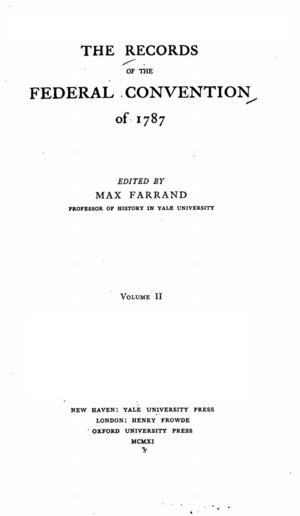
Front Page arrow Titles (by Subject) arrow SATURDAY, SEPTEMBER 15, 1787. - The Records of the Federal Convention of 1787, vol. 2

Return to Title Page for The Records of the Federal Convention of 1787, vol. 2

Search this Title:

Also in the Library:

Subject Area: Political Theory
Subject Area: History
Topic: The American Revolution and Constitution

SATURDAY, SEPTEMBER 15, 1787. - Max Farrand, The Records of the Federal Convention of 1787, vol. 2 [1911]

Edition used:

The Records of the Federal Convention of 1787, ed. Max Farrand (New Haven: Yale University Press, 1911). Vol. 2.

Part of: The Records of the Federal Convention of 1787, 3 vols.

About Liberty Fund:

Liberty Fund, Inc. is a private, educational foundation established to encourage the study of the ideal of a society of free and responsible individuals.


SATURDAY, SEPTEMBER 15, 1787.

JOURNAL

Saturday September 15. 1787.1

DETAIL OF AYES AND NOES
New HampshireMassachusettsRhode IslandConnecticutNew YorkNew JerseyPennsylvaniaDelawareMarylandVirginiaNorth CarolinaSouth CarolinaGeorgiaQuestionsayesnoesdivided
[541]nonononoayeayeayeayenonoTo address the People46
[542]ayenoayenoddayeayeayeayeayeayeTo reconsider the 3rd clause, 2nd sect. 1st Article.821
[543]ayenonononoayeayenoayenoayeTo add a Member to Rhode Island56
[544]nonononononoayeayeayeayeayeTo add a Member to North Carolina
[545]ayeayeayeayeayeayeayenoayeayeaye101
[546]nonononoddnonoayeayenoaye371
[547]ayeayeddayenoayeayenonoayenoTonnage Tonnage641
[548]ayeayenonoayenoayeayenoayeaye
[549]nonoddnonononoayenonoaye281
[550]ayenoayeayeayenoddnoayenono
[551]ddnoayenonoddayeayeayenoaye
[552]nonoayenoayeayeayeayeayeayeaye
[553]nononononononononoayeno110
[554]nonononononononononono
[Page 3]
[555]noayenononoayenonononono
[556]ddayeayeayenonononononono
[557]nonoayenononononononono110
[558]nonoayeayenoayenonononono38
[559]nonoayeayenoddnonononono281
[560]ddnonononoayeayenoayenono371
[561]nononononoayenononono
[562]ddnonoayenoayeayenonono
[563]nonononononoayeayenoaye37
[564]nononononononononono
[565]ayeayeayeayeayeayeayeayeayeaye
[566]ayeayeayeayeayeayeayeayeayeayeThe Constitution unanimously agreed to

MADISON

Saturday Sepr 15th. 1787. In Convention

Mr. Carrol reminded the House that no address to the people had yet been prepared. He considered it of great importance that such an one should accompany the Constitution. The people had been accustomed to such on great occasions, and would expect it on this— He moved that a Committee be appointed for the special purpose of preparing an Address.

Mr Rutledge objected on account of the delay it would produce and the impropriety of addressing the people before it was known whether Congress would approve and support the plan— Congress, if an address be thought proper can prepare as good a one— The members of the Convention can also explain the reasons of what has been done to their respective Constituents.

Mr Sherman concurred in the opinion that an address was both unnecessary and improper.

On the motion of Mr. Carrol

N— H. no. Mas. no— Ct. no. N— J— no. Pa ay. Del. ay. Md. ay— Va. ay. N— C.* abst. S. C. no.* Geo. no— [Ayes — 4; noes — 6; absent — 1.]

Mr. Langdon. Some gentlemen have been very uneasy that no increase of the number of Representatives has been admitted. It has in particular been thought that one more ought to be allowed to N. Carolina. He was of opinion that an additional one was due both to that State & to Rho: Island. & moved to reconsider for that purpose.

Mr. Sherman. When the Committee of eleven reported the apportionment— five Representatives were thought the proper share of N— Carolina. Subsequent information however seemed to entitle that State to another—

On the motion to reconsider

N— H— ay— Mas— no. Ct ay— N— J. no— Pen. divd. Del. ay. Md. ay. Va. ay— N. C. ay. S— C. ay. Geo. ay. [Ayes — 8; noes — 2; divided — 1.]

Mr Langdon moved to add 1 member to each of the Representations of N— Carolina & Rho: Island.

Mr. King was agst. any change whatever as opening the door for delays. There had been no official proof that the numbers of N— C are greater than before estimated. And he never could sign the Constitution if Rho: Island is to be allowed two members that is, one fourth of the number allowed to Massts, which will be known to be unjust.

Mr. Pinkney urged the propriety of increasing the number of Reps allotted to N. Carolina.

Mr. Bedford contended for an increase in favor of Rho: Island, and of Delaware also

On the question for allowing two Reps. to Rho: Island 〈it passed in the negative〉

N. H— ay. Mas. no. Ct. no. N. J. no. Pa. no. Del. ay. Md. ay. Va. no. N. C— ay. S. C. no— Geo— ay. [Ayes — 5; noes — 6.]

On the question for allowing six to N. Carolina, 〈it passed in the negative〉

N.H. no. Mas. no. Ct. no—N. J. no. Pa. no. Del— no—Md. ay. Va. ay. N—C. ay. S— C. ay. Geo. ay. [Ayes — 5; noes — 6.]

Art 1. sect. 10. (paragraph) 2) “No State shall, without the consent of Congress lay imposts or duties on imports or exports; nor with such consent, but to the use of the Treasury of the U. States” —

In consequence of the proviso moved by Col: Mason: and agreed to on the 13 Sepr, this part of the section was laid aside in favor of the following substitute viz. “No State shall, without the consent of Congress, lay any imposts or duties on imports or exports, except what may be absolutely necessary for executing its Inspection laws; and the nett produce of all duties and imposts, laid by any State on imports or exports, shall be for the use of the Treasury of the U— S—; and all such laws shall be subject to the revision and controul of the Congress”

On a motion to strike out the last part “and all such laws shall be subject to the revision and controul of 〈the〉 Congress” 〈it passed in the Negative.〉

N. H. no. Mas. no. Ct no— N. J. no. Pa divd. Del. no. Md. no Va ay— N— C— ay. S. C. no Geo. ay. [Ayes — 3; noes — 7; divided — 1.]

The substitute was then agreed to: 〈Virga. alone being in the Negative.〉2

The remainder of the paragraph being under consideration — viz — “nor keep troops nor ships of war in time of peace, nor enter into any agreement or compact with another State, nor with any foreign power. Nor engage in any war, unless it shall be actually invaded by enemies, or the danger of invasion be so imminent as not to admit of delay, until Congress can be consulted”

Mr. Mc.Henry & Mr. Carrol moved that “no State shall be restrained from laying duties of tonnage for the purpose of clearing harbours and erecting light-houses”.

Col. Mason in support of this explained and urged the situation of the Chesapeak which peculiarly required expences of this sort.

Mr. Govr. Morris. The States are not restrained from laying tonnage as the Constitution now Stands. The exception proposed will imply the Contrary, and will put the States in a worse condition than the gentleman (Col Mason) wishes.

Mr. Madison. Whether the States are now restrained from laying tonnage duties depends on the extent of the power “to regulate commerce”. These terms are vague but seem to exclude this power of the States— They may certainly be restrained by Treaty. He observed that there were other objects for tonnage Duties as the support of Seamen &c. He was more & more convinced that the regulation of Commerce was in its nature indivisible and ought to be wholly under one authority.3

Mr. Sherman. The power of the U. States to regulate trade being supreme can controul interferences of the State regulations 〈when〉 such interferences happen; so that there is no danger to be apprehended from a concurrent jurisdiction.

Mr. Langdon insisted that the regulation of tonnage was an essential part of the regulation of trade, and that the States ought to have nothing to do with it. On motion “that no State shall lay any duty on tonnage without the Consent of Congress”

N. H— ay— Mas. ay. Ct. divd. N. J. ay. Pa. no. Del. ay. Md. ay. Va. no. N— C. no. S— C. ay. Geo. no. [Ayes — 6; noes — 4; divided — 1.]

The remainder of the paragraph was then remoulded and passed as follows viz— “No State shall without the consent of Congress, lay any duty of tonnage, keep troops or ships of war in time of peace, enter into any agreement or compact with another State, or with a foreign power, or engage in war, unless actually invaded, or in such imminent danger as will not admit of delay”

Art II. sect. 1. (paragraph 6) “or the period for chusing another president arrive” was changed into “or a President 〈shall〉 be elected” comformably to a vote of theNA day of

Mr. Rutlidge and Docr Franklin moved to annex to the end paragraph 7. sect. 1. art II— “and he (the President) shall not receive, within that period, any other emolument from the U. S. or any of them.” on which question

N— H. ay— Mas. ay. Ct. no. N. J. no. Pa ay. Del. no. Md. ay— Va. ay. N. C. no. S— C. ay. Geo— ay. [Ayes — 7; noes — 4.]

Art: II. sect. 2. “he shall have power to grant reprieves and pardons for offences against the U. S. &c”

Mr Randolph moved to “except cases of treason”. The prerogative of pardon in these cases was too great a trust. The President may himself be guilty. The Traytors may be his own instruments.

Col: Mason supported the motion.

Mr Govr Morris had rather there should be no pardon for treason, than let the power devolve on the Legislature.

Mr Wilson. Pardon is necessary for cases of treason, and is best placed in the hands of the Executive. If he be himself a party to the guilt he can be impeached and prosecuted.

Mr. King thought it would be inconsistent with the Constitutional separation of the Executive & Legislative powers to let the prerogative be exercised by the latter — A Legislative body is utterly unfit for the purpose. They are governed too much by the passions of the moment. In Massachusetts, one assembly would have hung all the insurgents in that State: the next was equally disposed to pardon them all. He suggested the expedient of requiring the concurrence of the Senate in Acts of Pardon.

Mr. Madison admitted the force of objections to the Legislature, but the pardon of treasons was so peculiarly improper for the President that he should acquiesce in the transfer of it to the former, rather than leave it altogether in the hands of the latter. He would prefer to either an association of the Senate as a Council of advice, with the President.

Mr Randolph could not admit the Senate into a share of the Power. the great danger to liberty lay in a combination between the President & that body —

Col: Mason. The Senate has already too much power — There can be no danger of too much lenity in legislative pardons, as the Senate must con concur, & the President moreover can require ⅔ of both Houses4

On the motion of Mr. Randolph

N. H. no— Mas. no— Ct. divd. N— J— no. Pa. no— Del. no. Md no— Va ay— N— C. no— S. C. no. Geo— ay. [Ayes — 2; noes — 8; divided — 1.]

Art II. sect. 2. (paragraph 2) To the end of this, Mr Governr. Morris moved to annex “but the Congress may by law vest the appointment of such inferior Officers as they think proper, in the President alone, in the Courts of law, or in the heads of Departments.” Mr Sherman 2ded. the motion

Mr. Madison. It does not go far enough if it be necessary at all — Superior Officers below Heads of Departments ought in some cases to have the appointment of the lesser offices.

Mr Govr Morris There is no necessity. Blank Commissions can be sent —

On the motion

N. H. ay. Mas— no— Ct ay. N. J. ay. Pa. ay. Del. no. Md. divd Va no. N. C. ay— S C no. Geo— no— [Ayes — 5; noes — 5; divided — 1.]

The motion being lost by the equal division 〈of votes,〉 It was urged that it be put a second time, some such provision being too necessary, to be omitted. and on a second question it was agreed to nem. con.

〈Art II Sect. 1. The words, “and not per capita” — were struck out as superfluous — and the words “by the Representatives” also — as improper, the choice of President being in another mode as well as eventually by the House of Reps—

Art: II. Sect. 2. After “Officers of the U. S. whose appointments are not otherwise provided for,” were added the words “and which shall be established by law”.〉5

Art III. sect. 2. parag: 3. . Mr. Pinkney & Mr. Gerry moved to annex to the end. “And a trial by jury shall be preserved as usual in civil cases.”

Mr. Gorham. The constitution of Juries is different in different States and the trial itself is usual in different cases in different States,

Mr. King urged the same objections

Genl. Pinkney also. He thought such a clause in the Constitution would be pregnant with embarassments

The motion was disagreed to nem: con:

Art. IV. sect 2. parag: 3. the term “legally” was struck out, and “under the laws thereof” inserted 〈after the word “State,”〉6 in compliance with the wish of some who thought the term 〈legal〉 equivocal, and favoring the idea that slavery was legal in a moral view—

Art. IV. sect 3. “New States may be admitted by the Congress into this Union: but no new State shall be formed or erected within the jurisdiction of any other State; nor any State be formed by the junction of two or more States, or parts of States, without the consent of the Legislatures of the States concerned as well as of the Congs.”

Mr Gerry moved to insert after “or parts of States” the words “or a State and part of a State” which was disagreed to by a large majority; it appearing to be supposed that the case was comprehended in the words of the clause as reported by the Committee.

〈Art. IV. sect. 4. After the word “Executive” were inserted the words “when the Legislature cannot be Convened”〉7

Art— V. “The Congress, whenever two thirds of both Houses shall deem necessary, or on the application of two thirds of the Legislatures of the several States shall propose amendments to this Constitution, which shall be valid to all intents and purposes as part thereof, when the same shall have been ratified by three fourths at least of the Legislatures of the several States, or by Conventions in three fourths thereof, as the one or the other mode of ratification may be proposed by the Congress: Provided that no amendment which may be made prior to the year 1808 shall in any manner affect theNA 〈1 & 4 clauses in the 9.〉NA section of article INA .”

Mr. Sherman expressed his fears that three fourths of the States might be brought to do things fatal to particular States, as abolishing them altogether or depriving them of their equality in the Senate. He thought it reasonable that the proviso in favor of the States importing slaves should be extended so as to provide that no State should be affected in its internal police, or deprived of its equality in the Senate.

Col: Mason thought the plan of amending the Constitution exceptionable & dangerous. As the proposing of amendments is in both the modes to depend, in the first immediately, and in the second, ultimately, on Congress, no amendments of the proper kind would ever be obtained by the people, if the Government should become oppressive, as he verily believed would be the case.8

Mr. Govr. Morris & Mr. Gerry moved to amend the article so as to require a Convention on application of ⅔ of the Sts

Mr Madison did not see why Congress would not be as much bound to propose amendments applied for by two thirds of the States as to call a call a Convention on the like application. He saw no objection however against providing for a Convention for the purpose of amendments, except only that difficulties might arise as to the form, the quorum &c. which in Constitutional regulations ought to be as much as possible avoided.

The motion of Mr. Govr Morris and Mr. Gerry was agreed to nem: con (see: the first part of the article as finally past)

Mr Sherman moved to strike out of art. V. after “legislatures” the words “of three fourths” and so after the word “Conventions” leaving future Conventions to act in this matter, like the present Conventions according to circumstances.

On this motion

N— H— divd. Mas— ay— Ct ay. N— J. ay— Pa no. Del— no. Md no. Va no. N. C. no. S— C. no. Geo— no. [Ayes — 3; noes — 7; divided — 1.]

Mr Gerry moved to strike out the words “or by Conventions in three fourths thereof”

On this motion

N— H— no. Mas. no— Ct. ay. N— J. no. Pa no— Del— no. Md no. Va. no. N— C. no. S. C. no— Geo— no. [Ayes — 1; noes — 10.]

M— Sherman moved according to his idea above expressed to annex to the end of the article a further proviso “that no State shall without its consent be affected in its internal police, or deprived of its equal suffrage in the Senate”,

Mr. Madison. Begin with these special provisos, and every State will insist on them, for their boundaries, exports &c.

On the motion of Mr. Sherman

N. H— no. Mas. no. Ct ay. N. J. ay— Pa no. Del— ay. Md. no. Va. no N. C. no. S. C. no. Geo. no. [Ayes — 3; noes — 8.]

Mr. Sherman then moved to strike out art V altogether

Mr Brearley 2ded. the motion, on which

N. H. no. Mas. no. Ct. ay. N. J. ay. Pa. no. Del. divd. Md. no. Va. no. N. C. no. S. C. no. Geo. no [Ayes — 2; noes — 8; divided — 1.]

Mr. Govr Morris moved to annex a further proviso— “that no State, without its consent shall be deprived of its equal suffrage in the Senate”

This motion being dictated by the circulating murmurs of the small States was agreed to without debate, no one opposing it, or on the question, saying no.9

Col: Mason expressing his discontent at the power given to Congress by a bare majority to pass navigation acts, which he said would not only enhance the freight, a consequence he did not so much regard — but would enable a few rich merchants in Philada N. York & Boston, to monopolize the Staples of the Southern States & reduce their value perhaps 50 Per Ct — moved a further proviso “that no law in nature of a navigation act be passed before the year 1808, without the consent of ⅔ of each branch of the Legislature10

On this motion

N. H. no. Mas— no. Ct no. N— J. no— Pa no. Del. no. Md ay. Va. ay. N. C abst S. C. no— Geo— ay. [Ayes — 3; noes — 7; absent — 1.]

Mr Randolph animadverting on the indefinite and dangerous power given by the Constitution to Congress, expressing the pain he felt at differing from the body of the Convention, on the close of the great & awful subject of their labours, and anxiously wishing for some accommodating expedient which would relieve him from his embarrassments, made a motion importing “that amendments to the plan might be offered by the State Conventions, which should be submitted to and finally decided on by another general Convention”11 Should this proposition be disregarded, it would he said be impossible for him to put his name to the instrument. Whether he should oppose it afterwards he would not then decide but he would not deprive himself of the freedom to do so in his own State, if that course should be prescribed by his final judgment—

Col: Mason 2ded. & followed Mr. Randolph in animadversions on the dangerous power and structure of the Government, concluding that it would end either in monarchy, or a tyrannical aristocracy; which, he was in doubt. but one or other, he was sure. This Constitution had been formed without the knowledge or idea of the people. A second Convention will know more of the sense of the people, and be able to provide a system more consonant to it. It was improper to say to the people, take this or nothing. As the Constitution now stands, he could neither give it his support or vote in Virginia; and he could not sign here what he could not support there. With the expedient of another Convention as proposed, he could sign.12

Mr. Pinkney. These declarations from members so respectable at the close of this important scene, give a peculiar solemnity to the present moment. He descanted on the consequences of calling forth the deliberations & amendments of the different States on the subject of Government at large. Nothing but confusion & contrariety could spring from the experiment. The States will never agree in their plans— And the Deputies to a second Convention coming together under the discordant impressions of their Constituents, will never agree. Conventions are serious things, and ought not to be repeated— He was not without objections as well as others to the plan. He objected to the contemptible weakness & dependence of the Executive. He objected to the power of a majority only of Congs over Commerce. But apprehending the danger of a general confusion, and an ultimate decision by the Sword, he should give the plan his support.13

Mr. Gerry, stated the objections which determined him to withhold his name from the Constitution.14 1. the duration and re-eligibility of the Senate. 2. the power of the House of Representatives to conceal their journals. 3— the power of Congress over the places of election. 4 the unlimited power of Congress over their own compensations. 5 Massachusetts has not a due share of Representatives allotted to her. 6. ⅗ of the Blacks are to be represented as if they were freemen 7. Under the power over commerce, monopolies may be established. 8. The vice president being made head of the Senate. He could however he said get over all these, if the rights of the Citizens were not rendered insecure 1. by the general power of the Legislature to make what laws they may please to call necessary and proper. 2. raise armies and money without limit. 3. to establish a tribunal without juries, which will be a Star-chamber as to Civil cases. Under such a view of the Constitution, the best that could be done he conceived was to provide for a second general Convention.

On the question on the proposition of Mr Randolph. All the States answered- no

On the question to agree to the Constitution. as amended.15 All the States ay.

The Constitution was then ordered to be engrossed.

And the House adjourned16

McHENRY

15 Sepr.

Maryland moved.

No State shall be prohibited from laying such duties of tonnage as may be sufficient for improving their harbors and keeping up lights, but all acts laying such duties shall be subject to the approbation or repeal of Congress.

Moved to amend it viz. No State without the consent of Congress shall lay a duty of tonnage. Carryed in the affirmative

6 ays 4 Noes, 1 divided.

Made several verbal amendment in the progression on the system.

Added to the V article amended “No State without its consent shall be deprived of its equal suffrage in the Senate.

Mr. Mason moved in substance that no navigation act be passed without the concurrence of ⅔ of the members present in each house.

Negatived.

Mr. Randolp moved that it be recommended to appoint a second convention with plenary powers to consider objections to the system and to conclude one binding upon the States.

rejected unanimously—

The question being taken on the system agreed to unanimously—

Ordered to be engrossed and 500 copies struck— Adjourned till monday the 17th.

provided17 that any state may lay additional duties on shipping for the support of Lights, piers marks or Buoys or for the deepening or improvement of Harbours.

The legislature shall have power to erect piers buoys or marks and to deepen or clean harbours for facilitating or improving navigation—

No State shall be prohibited from laying such duties of tonnage as may be sufficient for improving their harbours and keeping up lights or buoys, but all acts laying such duties shall be subject to the approbation or repeal of Congress. Amended. 6 ay. 4 noes. 1 divided.

KING

Mr. Gerry’s objections

The appointment of the Senate for six years — and no rotation

The Power given to the Legislature over their Journals

The Power given to the Legislators to pay themselves

Massachusetts has not her propo. of reptives.

Three fifths of the Blacks, being classed as Taxables

The Power given respectg. Commerce will enable the Legislature to create corporations and monopolies

The V. P destroys the Independce. of the Legislature

Freemen giving up certain rights should be secured in others

The Legislature allowed to make any laws they please

The Constitution has given away every mode of revenue from the States

The Judiciary will be a Star Chamber

Many other objections which he would not enumerate18

GERRYS OBJECTIONS.19
19This document in Gerry’s handwriting was found among the King MSS. with the other notes on the Convention.
20[Endorsed:] Reasons of Gerry’s Dissent from Consn.
1The Army, the Militia, the power in the last clause to make any laws pursut. to ye Conn. to carry the same into Effect — The Sovereignty or Liberty of the States will be destroyed, and the Judicial will be oppressive — The foregoing are the reasons of my Dissent20
Duration & no rotation of Senators
2
Secrecy of Journals
3
The Times places & manner of choosing Representatives subjected to ye G. Govt.
4
Senate & Reps. pay ym selves from the general Treasury —
5
Mass. has not her proportn. of Reps. and ⅗ of the Negroes are Represented
6
Commercial powers authorise monopolies & Companys —
7
Vice president dangerous The foregoing I give up

MASON20a

[In addition to the items noted above in the Records, Mason had made the following notes on his copy of the draft of September 12:]

In the beginning of the 4th clause of the 3rd section of the 1st Article, strike out the words — the vice-president of the United States, and instead of them insert — a vice-president of the United States shall be chosen in the manner hereinafter directed whoNA refused

In the 1st clause of the 10th section of the same Article strike out ex post facto laws — and after the words obligation of insert — previous.NA refused

In the latter end of the 3rd clause of the 2nd Article — enquire of the committee about the senate chusing the vice president

In the 7th clause of the 1st section of the 2nd Article — strike out the words during the period for which he shall have been elected — and instead of them insert — so as in any manner to affect the person in office at the time of such increase or diminution.

At the end of the 1st clause of the 2nd section of the 2nd Article add the words — or Treason; but he may grant reprieves in cases of treason, until the end of the next ensuing session of Congress.

Section 4th of the same Article — Inconsistency between this and the 7th clause of the 3rd section of the 1st Article — amend by inserting after the word office the words — and disqualified from holding or enjoying — any office of honor, trust or profit under the United States.

Article 3rd, section 1 — before the word diminished — insert — encreased or —

In the 2nd clause of the 2nd section of the 3rd Article — strike out the word Fact — and insert — Equity.

In the 3rd section of 3rd Article — corruption of blood inaccurately expressed; and no exception or provision for the wife, who may be innocent, and ought not to be involved in ruin from the guilt of the husband.

Section 2nd, Article 4th — The citizens of one State having an estate in another, have not secured to them the right of removing their property as in the 4th Article of the Confederation — amend by adding the following clause: and every citizen having an estate in two or more States shall have a right to remove his property from one State to another.

(not proposed)

Objections to this Constitution of Government.21

There is no Declaration of Rights, and the laws of the general government being paramount to the laws and constitution of the several States, the Declaration of Rights in the separate States are no security. Nor are the people secured even in the enjoyment of the benefit of the common law 〈which stands here upon no other foundation than its having been adopted by the respective acts forming the constitutions of the several States〉.

In the House of Representatives there is not the substance but the shadow only of representation; which can never produce proper information in the legislature, or inspire confidence in the people; the laws will therefore be generally made by men little concerned in, and unacquainted with their effects and consequences. 〈This objection has been in some degree lessened by an amendment, often before refused and at last made by an erasure, after the engrossment upon parchment of the word forty and inserting thirty, in the third clause of the second section of the first article.〉

The Senate have the power of altering all money bills, and of originating appropriations of money, and the salaries of the officers of their own appointment, in conjunction with the president of the United States, although they are not the representatives of the people or amenable to them.

These with their other great powers, viz.: their power in the appointment of ambassadors and all public officers, in making treaties, and in trying all impeachments, their influence upon and connection with the supreme Executive from these causes, their duration of office and their being a constantly existing body, almost continually sitting, joined with their being one complete branch of the legislature, will destroy any balance in the government, and enable them to accomplish what ursurpations they please upon the rights and liberties of the people.

The Judiciary of the United States is so constructed and extended, as to absorb and destroy the judiciaries of the several States; thereby rendering law as tedious, intricate and expensive, and justice as unattainable, by a great part of the community, as in England, and enabling the rich to oppress and ruin the poor.

The President of the United States has no Constitutional Council, a thing unknown in any safe and regular government. He will therefore be unsupported by proper information and advice, and will generally be directed by minions and favorites; or he will become a tool to the Senate — or a Council of State will grow out of the principal officers of the great departments; the worst and most dangerous of all ingredients for such a Council in a free country; 〈for they may be induced to join in any dangerous or oppressive measures, to shelter themselves, and prevent an inquiry into their own misconduct in office. Whereas, had a constitutional council been formed (as was proposed) of six members, viz.: two from the Eastern, two from the Middle, and two from the Southern States, to be appointed by vote of the States in the House of Representatives, with the same duration and rotation of office as the Senate, the executive would always have had safe and proper information and advice; the president of such a council might have acted as Vice-President of the United States pro tempore, upon any vacancy or disability of the chief magistrate; and long continued sessions of the Senate, would in a great measure have been prevented.〉 From this fatal defect has arisen the improper power of the Senate in the appointment of public officers, and the alarming dependence and connection between that branch of the legislature and the supreme Executive.

Hence also sprung that unnecessary 〈and dangerous〉 officer the Vice-President, who for want of other employment is made president of the Senate, thereby dangerously blending the executive and legislative powers, besides always giving to some one of the States an unnecessary and unjust preeminence over the others.

The President of the United States has the unrestrained power of granting pardons for treason, which may be sometimes exercised to screen from punishment those whom he had secretly instigated to commit the crime, and thereby prevent a discovery of his own guilt.

By declaring all treaties supreme laws of the land, the Executive and the Senate have, in many cases, an exclusive power of legislation; which might have been avoided by proper distinctions with respect to treaties, and requiring the assent of the House of Representatives, where it could be done with safety.

By requiring only a majority to make all commercial and navigation laws, the five Southern States, whose produce and circumstances are totally different from that of the eight Northern and Eastern States, may 〈will〉 be ruined, for such rigid and premature regulations may be made as will enable the merchants of the Northern and Eastern States not only to demand an exhorbitant freight, but to monopolize the purchase of the commodities at their own price, for many years, to the great injury of the landed interest, and 〈the〉 impoverishment of the people; and the danger is the greater as the gain on one side will be in proportion to the loss on the other. Whereas requiring two-thirds of the members present in both Houses would have produced mutual moderation, promoted the general interest, and removed an insuperable objection to the adoption of this 〈the〉 government.

Under their own construction of the general clause, at the end of the enumerated powers, the Congress may grant monopolies in trade and commerce, constitute new crimes, inflict unusual and severe punishments, and extend their powers 〈power〉 as far as they shall think proper; so that the State legislatures have no security for the powers now presumed to remain to them, or the people for their rights.

There is no declaration of any kind, for preserving the liberty of the press, or the trial by jury in civil causes 〈cases〉; nor against the danger of standing armies in time of peace.

The State legislatures are restrained from laying export duties on their own produce.

Both the general legislature and the State legislature are expressly prohibited making ex post facto laws; though there never was nor can be a legislature but must and will make such laws, when necessity and the public safety require them; which will hereafter be a breach of all the constitutions in the Union, and afford precedents for other innovations.

This government will set out 〈commence〉 a moderate aristocracy: it is at present impossible to foresee whether it will, in its operation, produce a monarchy, or a corrupt, tyrannical 〈oppressive〉 aristocracy; it will most probably vibrate some years between the two, and then terminate in the one or the other.

The general legislature is restrained from prohibiting the further importation of slaves for twenty odd years; though such importations render the United States weaker, more vulnerable, and less capable of defence.

[1 ]Crossed out “It was moved and seconded to appoint a Committee to prepare an address to the People of the United States to accompany the Constitution which passed in the negative. It was moved and seconded to reconsider the 3rd clause, 2nd sect, 1st article. which passed in the affirmative It was moved and seconded to —”

See further Votes 541-566, Detail of Ayes and Noes.

Journal (pp. 383-385) adds the following amendments, evidently compiled from the interlineations of the Brearley copy: —

Article second, section first, clause first. Strike out the words “in the following manner,” and insert in their stead the words “as follows.”

Section first, clause second. Transpose the words “shall be appointed an elector,” to the end of the clause; and instead of the word “nor” read “or.”

Section first, clause third. Strike out the words “and not per capita,” and the words “by the representatives.”

Section first, clause fourth. Strike out the words “time in,” and insert the words “day on;” strike out “but the election shall be on the same day,” and insert “which day shall be the same.”

Section first, clause seventh. Instead of “receive a fixed compensation for his services,” read “receive for his services a compensation.”

In the oath to be taken by the president, strike out the word “judgment,” and insert “abilities.”

Section second, clause first. After the words “militia of the several states,” add the words “when called into the actual service of the United States.”

Section second, clause second. After the words “provided for,” add “and which shall be established by law.”

Article third, section first. Strike out the words “both in law and equity.”

Section second, clause first. Strike out the word “both.” . . .

Article fourth, section second, clause second. Instead of “and removed,” read “to be removed.”

Section second, clause third. For “of regulations subsisting,” read “of any law or regulation.” . . .

Article fourth, section fourth. After the word “executive,” insert “when the legislature cannot be convened.”

[* ]〈In the printed Journal N. Carolina— no & S. Carol: omitted.〉

[2 ]Taken from Journal, which ascribes Vote 545, Detail of Ayes and Noes, to this question. The correctness of this is doubtful.

[3 ]See Appendix A, CCCLXVI.

[4 ]See also Appendix A, CLVIII (79).

[5 ]Based upon Journal (p. 383). See above note 1.

[6 ]Crossed out “in another place”. Change accords with Journal, p. 384.

[7 ]Taken from Journal, see above note 1.

[8 ]In the margin of his copy of the draft of September 12, Mason had written:

“Article 5th —By this article Congress only have the power of proposing amendments at any future time to this constitution and should it prove ever so oppressive, the whole people of America can’t make, or even propose alterations to it; a doctrine utterly subversive of the fundamental principles of the rights and liberties of the people.”

See also Appendix A, CCLXIX.

[9 ]See Appendix A, CCC.

[10 ]See Appendix A, CLI.

[11 ]Upon this proposal, see above August 31 and September 10, and Appendix A, CXXXI, CLXIV, CCXXXV.

[12 ]For Mason’s objections, see below (with references under note 21).

[13 ]See Appendix A, CLXX.

[14 ]See King’s copy of these below, also Appendix A, CXXVIII, CXXXIII, CLVII, CLXXV.

[15 ]In addition to the changes noted above in the Records, September 13-15, the following have been compiled from the Baldwin, Brearley and Washington copies of the draft of September 12:—

Article 1, Section 7, paragraph 1 — “The enacting stile . . . ” struck out.

Article II, Section 1, paragraph 3 — “government of the United States” substituted for “general government”.

Article II, Section 1, paragraph 8 — the dash “—” after “I” struck out.

Article III, Section 3, paragraph 2 — “or” substituted for “nor” before “forfeiture” and the comma “,” after “forfeiture” struck out.

[16 ]The session continued until 6 p.m. See Appendix A, CIX.

[17 ]On a loose scrap of paper among the McHenry MSS.

[18 ][On back of sheet:] no no no no | aye aye aye aye aye aye

[20a]Taken from K. M. Rowland, Life of George Mason, II, 383-385.

[21 ]This was written by Mason on the blank pages of his copy of the draft of September 12. Mason supplied copies of this in one form or another to several people, and it was finally printed in pamphlet form. Angle brackets indicate additions or changes made before printing. (It is reprinted here from Rowland’s Life of George Mason, II, 387-390).

See above August 31, and Appendix A, CXXVI, CXXXIV, CXXXVII, CLI, CLV, CXCIV, CCII.