Econlib

The Library

Other Sites

Front Page arrow Titles (by Subject) arrow TUESDAY, AUGUST 28, 1787. - The Records of the Federal Convention of 1787, vol. 2

Return to Title Page for The Records of the Federal Convention of 1787, vol. 2

Search this Title:

Also in the Library:

Subject Area: Political Theory
Subject Area: History
Topic: The American Revolution and Constitution

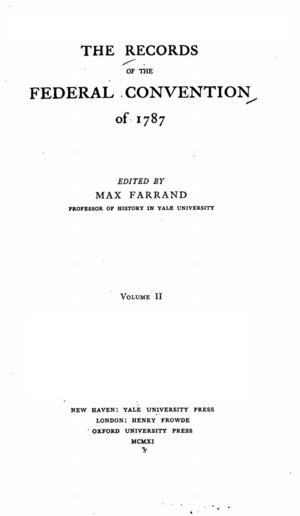
TUESDAY, AUGUST 28, 1787. - Max Farrand, The Records of the Federal Convention of 1787, vol. 2 [1911]

Edition used:

The Records of the Federal Convention of 1787, ed. Max Farrand (New Haven: Yale University Press, 1911). Vol. 2.

Part of: The Records of the Federal Convention of 1787, 3 vols.

About Liberty Fund:

Liberty Fund, Inc. is a private, educational foundation established to encourage the study of the ideal of a society of free and responsible individuals.


TUESDAY, AUGUST 28, 1787.

JOURNAL

Tuesday August 28. 1787

The honorable Mr Sherman from the Committee to whom were referred several propositions entered on the Journal of the 25 instant informed the House that the Committee were prepared to report — The report was then delivered in at the Secretary’s table, was read, and is as follows.

The Committee report that the following be inserted after the 4 clause of the 7 section

“Nor shall any regulation of commerce or revenue give preference to the ports of one State over those of another or oblige Vessels bound to or from any State to enter, clear, or pay duties in another.

And all tonnage, duties, imposts, and excises, laid by the “Legislature shall be uniform throughout the United States”

It was moved and seconded to strike out the words

“it shall be appellate” and to insert the words “the Supreme Court shall have appellate jurisdiction” 3 sect. 11 article

which passed in the affirmative [Ayes — 9; noes — 1.]1

It was moved and seconded to amend the 4th section of the 11th article to read as follows.

“The trial of all crimes (except in cases of impeachment) shall be by Jury — and such trial shall be held in the State where the said crimes shall have been committed; but when not committed within any State then the trial shall be at such place or places as the Legislature may direct.”

which passed in the affirmative

It was moved and seconded to add the following amendment to the 4 sect. 11 article

“The privilege of the writ of Habeas Corpus shall not be suspended; unless where in cases of rebellion or invasion the public safety may require it.”

which passed in the affirmative [Ayes — 7; noes — 3.]2

On the question to agree to the 5. section 11 article as reported

it passed in the affirmative.

It was moved and seconded to insert the words “nor emit bills of credit” after the word “money” in the 12 article

which passed in the affirmative. [Ayes — 8; noes — 1; divided — 1.]3

It was moved and seconded to insert the following clause after the last amendment.

“nor make any thing but gold and silver coin a tender in payment of debts”

which passed in the affirmative [Ayes — 11; noes — 0.]4

It was moved and seconded to add the following clause to the last amendment.

“nor pass any bill of attainder or ex post facto laws”

which passed in the affirmative [Ayes — 7; noes — 3.]5

It was moved and seconded to insert after the word “reprisal” the words “nor lay embargoes”

which passed in the negative. [Ayes — 3; noes — 8.]

It was moved and seconded to transfer the following words from the 13 to the 12 article

“nor lay imposts or duties on imports”

which passed in the negative. [Ayes — 4; noes — 7.]

Separate questions being taken on the several clauses of the 12 article, as amended,

they passed in the affirmative.

It was moved and seconded to insert after the word “imports” in the 13th article the words “or exports”

which passed in the affirmative [Ayes — 6; noes — 5.]

DETAIL OF AYES AND NOES
6This vote is not accounted for.
7This vote probably belongs to the Records of September 5 (see note 1a of that date).
New HampshireMassachusettsRhode IslandConnecticutNew YorkNew JerseyPennsylvaniaDelawareMarylandVirginiaNo CarolinaSo CarolinaGeorgiaQuestionsayesnoesdivided
[385]ayeayeayeayeayenoayeayeayeayeThe supreme Court shall have appellate jurisd91
[386]ayeayeayeayeayeayeayenononounless where in cases of rebellion &ca Ha Cor:73
[387]ayeayeayeayeayeddnoayeayeayenor emit bills of credit811
[388]6ayeayenonoayeayeayeayeayeayeaye92
[389]7ayenoayeayeayeayeayenoayeayeaye
[page 14]
[390]ayeayeayeayeayeayeayeayeayeayeayenor make any thing but gold or silver coin a tender in payment of debts11
[391]ayenoayeayeayenonoayeayeayenor pass any bill of attainder or ex post facto laws.
[392]noayenononoayenononoayeno“nor lay embargoes.”38
[393]ayenonoayenoayenonoayenonolay imposts or dues on imports47
[394]ayeayenoayeayeayenonoayenono“or exports” 13 article.65
[395]ayenoayeayeayeayenoayeayeayeaye“nor wh such consent but for the use of the Treasy of the U S.
[396]ayenoayeayeayeayenoayeayeayeayeon the first clause 13 article92
[397]ayeayeayeayeayeayeayeayeayenoddTo agree to ye 14 article911

It was moved and seconded to add after the word “exports” in the 13th article the words “nor with such consent but for the use of the treasury of the United States”

which passed in the affirmative [Ayes — 9; noes — 2.] [on the first clause 13 articleNA Ayes — 9; noes — 2.]8 Separate questions being taken on the several clauses of the 13th article, as amended,

they passed in the affirmative

On the question to agree to the 14 article as reported it passed in the affirmative [Ayes — 9; noes — 1; divided — 1.] It was moved and seconded to strike out the words “high misdemeanor,” and to insert the words “other crime”

which passed in the affirmative

On the question to agree to the 15th article as amended

it passed in the affirmative

The House adjourned.

MADISON

Tuesday August 28. 1787— In Convention

Mr. Sherman from the Committee to whom were referred several propositions on the 25th. instant, made the following report —

That there be inserted after the 4 clause of 7th. section

“Nor shall any regulation of commerce or revenue give preference to the ports of one State 〈over〉9 those of another, or oblige vessels bound to or from any State to enter clear or pay duties in another and all tonnage, duties, imposts & excises laid by the Legislature shall be uniform throughout the U. S-” Ordered to lie on the table.

Art XI sect. 3. “It was moved to strike out the words “it shall be appellate” & to insert the words “the supreme Court shall have appellate jurisdiction”, — in order to prevent uncertainty whether “it” referred to the supreme Court, or to the Judicial power.

On the question

N. H. ay. Mas. ay. Ct. ay. N. J. abst. Pa. ay. Del. ay. Md. no. Va. ay. N C ay. S. C. ay. Geo. ay. [Ayes — 9; noes — 1; absent — 1.]10

Sect. 4— was so amended nem: con: as to read “The trial of all crimes (except in cases of impeachment) shall be by jury, and such trial shall be held in the State where the said crimes shall have been committed; but when not committed within any State, then the trial shall be at such place or places as the Legislature may direct”. The object of this amendment was to provide for trial by jury of offences committed out of any State.

Mr. Pinkney, urging the propriety of securing the benefit of the Habeas corpus in the most ample manner, moved “that it should not be suspended but on the most urgent occasions, & then only for a limited time not exceeding twelve months”11

Mr. Rutlidge was for declaring the Habeas Corpus inviolable— He did 〈not〉 conceive that a suspension could ever be necessary at the same time through all the States—

Mr. Govr Morris moved that “The privilege of the writ of Habeas Corpus shall not be suspended, unless where in cases of Rebellion or invasion the public safety may require it”.

Mr. Wilson doubted whether in any case 〈a suspension〉 could be necessary, as the discretion now exists with Judges, in most important cases to keep in Gaol or admit to Bail.

The first part of Mr. Govr. Morris’ 〈motion,〉 to the word “unless” was agreed to nem: con: — on the remaining part;

N. H. ay. Mas. ay. Ct. ay. Pa. ay. Del. ay. Md. ay. Va. ay. N. C. no. S. C. no. Geo. no. [Ayes — 7; noes — 3.]

Sect. 5. of art: XI.12 was agreed to nem: con:*

Art: XII being taken up.14

Mr. Wilson & Mr. Sherman moved to insert after the words “coin money” the words “nor emit bills of credit, nor make any thing but gold & silver coin a tender in payment of debts” making these prohibitions absolute, instead of 〈making the measures allowable〉 (as in the XIII art:) with the consent of the Legislature of the U. S.15

Mr. Ghorum thought the purpose would be as well secured by the provision of art: XIII which makes the consent of the Genl. Legislature necessary, and that in that mode, no opposition would be excited; whereas an absolute prohibition of paper money would rouse the most desperate opposition from its partizans—16

Mr. Sherman thought this a favorable crisis for crushing paper money. If the consent of the Legislature could authorize emissions of it, the friends of paper money would make every exertion to get into the Legislature in order to license it.

The question being divided: on the 1st. part — “nor emit bills of credit”

N. H. ay. Mas. ay. Ct. ay. Pa. ay— Del. ay. Md divd.17 Va. no. N— C— ay— S— C. ay. Geo. ay. [Ayes — 8; noes — 1; divided — 1.]

The remaining part of Mr. Wilson’s & Sherman’s motion, was agreed to nem: con:

Mr King moved to add, in the words used in the Ordinance of Congs establishing new States, a prohibition on the States to interfere in private contracts.

Mr. Govr. Morris. This would be going too far. There are a thousand laws relating to bringing actions — limitations of actions & which affect contracts— The Judicial power of the U— S— will be a protection in cases within their jurisdiction; and within the State itself a majority must rule, whatever may be the mischief done among themselves.

Mr. Sherman. Why then prohibit bills of credit?

Mr. Wilson was in favor of Mr. King’s motion.

Mr. Madison admitted that inconveniences might arise from such a prohibition but thought on the whole it would be overbalanced by the utility of it. He conceived however that a negative on the State laws could alone secure the effect. Evasions might and would be devised by the ingenuity of the Legislatures—

Col: Mason. This is carrying the restraint too far. Cases will happen that can not be foreseen, where some kind of interference will be proper, & essential— He mentioned the case of limiting the period for bringing actions on open account — that of bonds after a certain 〈lapse of time,〉 — asking whether it was proper to tie the hands of the States from making provision in such cases?

Mr. Wilson. The answer to these objections is that retrospective interferences only are to be prohibited.

Mr. Madison. Is not that already done by the prohibition of ex post facto laws, which will oblige the Judges to declare such interferences null & void.

Mr. Rutlidge moved instead of Mr. King’s Motion to insert — “nor pass bills of attainder nor retrospective* laws” on which motion

N. H. ay— Ct. no. N. J. ay. Pa. ay. Del. ay. Md. no. Virga. no. N— C. ay. S. C. ay. Geo. ay. [Ayes — 7; noes — 3.]18

Mr. Madison moved to insert after the word “reprisal” (art. XII) the words “nor lay embargoes”. He urged that such acts 〈by the States〉 would be unnecessary — impolitic — & unjust—

Mr. Sherman thought the States ought to retain this power in order to prevent suffering & injury to their poor.

Col: Mason thought the amendment would be not only improper but dangerous, as the Genl. Legislature would not sit constantly and therefore could not interpose at the necessary moments— He enforced his objection by appealing to the necessity of sudden embargoes during the war, to prevent exports, particularly in the case of a blockade—

Mr Govr. Morris considered the provision as unnecessary; the power of regulating trade between State & State, already vested in the Genl— Legislature, being sufficient.

On the question

N. H. no. Mas. ay. Ct. no. N. J. no. Pa. no. Del. ay. Md. no. Va. no. N. C. no. S. C. ay. Geo. no. [Ayes — 3; noes — 8.]

Mr Madison moved that the words “nor lay imposts or duties on imports” be transferred from art: XIII where the consent of20 the Genl. Legislature may license the act — into art: XII which will make the prohibition on the States absolute. He observed that as the States interested in this power by which they could tax the imports of their neighbours passing thro’ their markets, were a majority,21 they could give the consent of the Legislature, to the injury of N. Jersey, N. Carolina &c —22

Mr. Williamson 2ded. the motion

Mr. Sherman thought the power might safely be left to the Legislature23 of the U. States.

Col: Mason, observed that particular States might wish to encourage by impost duties certain manufactures for which they enjoyed natural advantages, as Virginia, the manufacture24 of Hemp &c.

Mr. Madison— The encouragment of Manufacture in that mode requires duties not only on imports directly from foreign Countries, but from the other States in the Union, which would revive all the mischiefs experienced from the want of a Genl. Government over commerce.

On the question

N. H. ay. Mas. no. Ct. no. N. J— ay. Pa. no. Del: ay. Md. no. Va. no N. C. ay. S. C. no. Geo. no. [Ayes — 4; noes — 7.]

Art: XII as amended agreed to nem: con:25

Art: XIII being taken up.26 Mr. King moved to insert after the word “imports” the words “or exports” so as to prohibit the States from taxing either. — & on this question 〈it passed in the affirmative.〉

N. H— ay. Mas. ay. Ct no. N. J. ay. P. ay. Del. ay. Md no. Va. no. N. C. ay. S. C. no. Geo. no. [Ayes — 6; noes noes — 5.]

Mr. Sherman moved to add, after the word “exports” — the words “nor with such consent but for the use of the U. S.” — so as to carry the proceeds of all State duties on imports & exports, into the common Treasury.27

Mr. Madison liked the motion as preventing all State imposts — but lamented the complexity we were giving to the commercial system.

Mr. Govr. Morris thought the regulation necessary to prevent the Atlantic States from endeavouring to tax the Western States — & promote their interest by opposing the navigation of the Mississippi which would drive the Western people into the arms of G. Britain.

Mr. Clymer thought the encouragement of the Western Country was suicide on the old States— If the States have such different interests that they can not be left to regulate their own manufactures without encountering the interests of other States, it is a proof that they are not fit to compose one nation.

Mr. King was afraid that the regulation moved by Mr Sherman would too much interfere with a policy of States respecting their manufactures, which may be necessary. Revenue he reminded the House was the object of the general Legislature.

On Mr. Sherman’s motion

N. H. ay. Mas. no. Ct. ay. N. J. ay. Pa. ay. Del. ay. Md. no. Va. ay. N. C. ay. S. C. ay. Geo. ay. [Ayes — 9; noes — 2.]

Art XIII was then agreed to as amended.

Art. XIV was taken up.28

Genl. Pinkney was not satisfied with it. He seemed to wish some provision should be included in favor of property in slaves.

On the question 〈on art: XIV.〉

N. H. ay. Mas. ay. Ct. ay. N. J. ay— Pa. ay. Del. ay. Md. ay— Va. ay. N— C— ay. S— C. no. Geo. divided [Ayes — 9; noes — 1; divided — 1.]

Art: XV. being taken up.29 the words “high misdemesnor,” were struck out, and “other crime” inserted, in order to comprehend all proper cases: it being doubtful whether “high misdemeanor” had not a technical meaning too limited.

Mr. Butler and Mr Pinkney moved “to require fugitive slaves and servants to be delivered up like criminals.”

Mr. Wilson. This would oblige the Executive of the State to do it, at the public expence.

Mr Sherman saw no more propriety in the public seizing and surrendering a slave or servant, than a horse.

Mr. Butler withdrew his proposition in order that some particular provision might be made apart from this article.

Art XV as amended was then agreed to nem: con:

Adjourned30

McHENRY

Augt. 28.

4 Sect. Amended. 5 sect. agreed to.

XII article amended by adding that no State shall emit bills of credit, nor make any thing but specie a tender in debts.

XIII amended so [th]at all duties laid by a State shall accrue to the use of the U. S.

[1 ]Vote 385, Detail of Ayes and Noes. In this and the four votes following the vote of Massachusetts is recorded in the Rhode Island column.

[2 ]Vote 386, Detail of Ayes and Noes. Journal (p. 302) mistakenly ascribes this vote to the next question.

[3 ]Vote 387, Detail of Ayes and Noes.

[4 ]Vote 390, Detail of Ayes and Noes.

[5 ]Vote 391, Detail of Ayes and Noes. See below note 19.

[8 ]Vote 396, Detail of Ayes and Noes.

[9 ]Crossed out: “to”.

[10 ]See Appendix A, CLXXXIX, CXCII, CXCIX.

[11 ]Upon this question, see Appendix A, CLVIII (65-66), CXCII.

[12 ]Article XI, Sect. 5 “Judgment, in cases of Impeachment, shall not extend further than to removal from Office, and disqualification to hold and enjoy any office of honour, trust or profit, under the United States. But the party convicted shall, nevertheless be liable and subject to indictment, trial, judgment and punishment according to law.”

[* ]〈The vote on this section as stated in the printed journal is not unanimous: The statement here probably the right one.〉13

[14 ]Article XII. “No state shall coin money; nor grant letters of marque and reprisals; nor enter into any treaty, alliance, or confederation; nor grant any title of Nobility.”

[15 ]Upon this question, see Appendix A, CXXIII, CLVIII (70-72), CCXXIX, CCCLXXV.

[16 ]Crossed out “of that expedient sort of medicines”.

[17 ]Martin voted in the negative, see Appendix A, CLVIII (69).

[* ]〈In the printed Journal “ex post facto”〉19

[18 ]See Appendix A, CLVIII (70-72).

[20 ]Crossed out “Congress may authorize them”.

[21 ]Crossed out: “of the consent of Congress might be given”.

[22 ]See Appendix A, CCXII.

[23 ]Crossed out “Govt.”

[24 ]Crossed out “culture and”.

[25 ]See Appendix A, CCXII.

[26 ]Article XIII. “No State, without the consent of the Legislature of the United States, shall emit bills of credit, or make any thing but specie a tender in payment of debts; nor lay imposts or duties on imports; nor keep troops or ships of war in time of peace; nor enter into any agreement or compact with another State, or with any foreign power; nor engage in any war, unless it shall be actually invaded by enemies, or the danger of invasion be so imminent, as not to admit of delay, until the Legislature of the United States can be consulted.”

[27 ]Upon this question see Appendix A, CCCXC.

[28 ]Article XIV. “The Citizens of each State shall be entitled to all privileges and immunities of citizens in the several States.”

[29 ]Article XV. “Any person charged with treason, felony or high misdemeanor in any State, who shall flee from justice, and shall be found in any other State, shall, on demand of the Executive power of the State from which he fled, be delivered up and removed to the State having jurisdiction of the offence.”

[30 ]See further, Appendix A, XCVI.

[* ]〈The vote on this section as stated in the printed journal is not unanimous: The statement here probably the right one.〉13

[* ]〈In the printed Journal “ex post facto”〉19

[13]See above note 2.

[19]The Journal is correct, according to marginal notes in the Washington and Brearley copies of the Report of the Committee of Detail.