Econlib

The Library

Other Sites

Front Page arrow Titles (by Subject) arrow SATURDAY, AUGUST 18, 1787. - The Records of the Federal Convention of 1787, vol. 2

Return to Title Page for The Records of the Federal Convention of 1787, vol. 2

Search this Title:

Also in the Library:

Subject Area: Political Theory
Subject Area: History
Topic: The American Revolution and Constitution

SATURDAY, AUGUST 18, 1787. - Max Farrand, The Records of the Federal Convention of 1787, vol. 2 [1911]

Edition used:

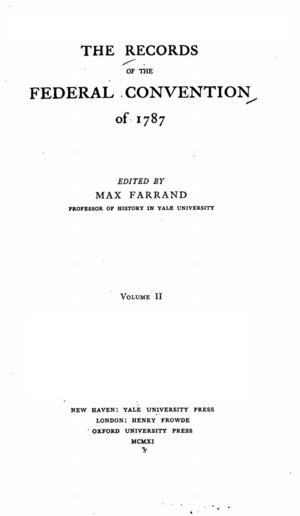
The Records of the Federal Convention of 1787, ed. Max Farrand (New Haven: Yale University Press, 1911). Vol. 2.

Part of: The Records of the Federal Convention of 1787, 3 vols.

About Liberty Fund:

Liberty Fund, Inc. is a private, educational foundation established to encourage the study of the ideal of a society of free and responsible individuals.


SATURDAY, AUGUST 18, 1787.

JOURNAL

Saturday August 18. 1787.

The following additional powers proposed to be vested in the Legislature of the United States having been submitted to the consideration of the Convention — It was moved and seconded to refer them to the Committee to whom the proceedings of the Convention were referred

which passed in the affirmative

The propositions are as follows

To dispose of the unappropriated lands of the United States

To institute temporary governments for new States arising thereon

To regulate affairs with the Indians as well within as without the limits of the United States

To exercise exclusively Legislative authority at the seat of the general Government, and over a district around the same, not exceedingNA square miles: the consent of the Legislature of the State or States comprising such district being first obtained

To grant charters of incorporation in cases where the public good may require them, and the authority of a single State may be incompetent

To secure to literary authors their copy rights for a limited time

To establish an University

To encourage, by proper premiums and provisions, the advancement of useful knowledge and discoveries

To authorise the Executive to procure and hold for the use of the United States landed property for the erection of forts, magazines, and other necessary buildings

To fix and permanently establish the seat of Government of the United-States in which they shall possess the exclusive right of soil and jurisdiction

To establish seminaries for the promotion of literature and the arts and sciences

To grant charters of incorporation

To grant patents for useful inventions

To secure to authors exclusive rights for a certain time

To establish public institutions, rewards and immunities for the promotion of agriculture, commerce, trades, and manufactures.

That Funds which shall be appropriated for payment of public Creditors shall not during the time of such appropriation be diverted or applied to any other purpose — and to prepare a clause or clauses for restraining the Legislature of the United States from establishing a perpetual revenue

To secure the payment of the public debt.

To secure all Creditors, under the new Constitution, from a violation of the public faith. when pledged by the authority of the Legislature

To grant letters of marque and reprisal

To regulate Stages on the post-roads.

It was moved and seconded That a Committee to consist of a Member from each State be appointed to consider the necessity and expediency of the debts of the several States being assumed by the United States

which passed in the affirmative [Ayes — 6; noes — 4; divided — 1.]1

and a Committee was appointed by ballot of the honorable Mr Langdon, Mr King, Mr Sherman, Mr Livingston, Mr Clymer, Mr Dickinson, Mr Mc Henry, Mr Mason, Mr Williamson, Mr C. C. Pinckney, and Mr Baldwin.

It was moved and seconded to agree to the following resolution, namely

Resolved That this Convention will meet punctually at 10 o’clock every morning (Sundays excepted) and sit till four o’clock in the afternoon, at which time the President shall adjourn the Convention and that no motion for adjournment be allowed.

which passed in the affirmative [Ayes — 9; noes — 2.]

It was moved and seconded to insert the words “and support” between the word “raise” and the word “armies” in the 14. clause, 1 sect, 7 article

which passed in the affirmative

It was moved and seconded to strike out the words “build and equip” and to insert the words “provide and maintain” in the 15 clause, 1 sect. 7 article

which passed in the affirmative

It was moved and seconded to insert the following as a 16th clause, in the 1 sect. of the 7. article

“To make rules for the government and regulation of the land and naval forces”

which passed in the affirmative

It was moved and seconded to annex the following proviso to the last clause

“provided that in time of peace the army shall not consist of more thanNA thousand men”

which passed2 in the negative.

It was moved and seconded to insert the following as a clause in the 1 sect. of the 7 article

“to make laws for regulating and disciplining the militia of the several States, reserving to the several States the appointment of their militia Officers”

It was moved and seconded to postpone the last clause in order to take up the following

“To establish an uniformity of exercise and arms for the militia — and rules for their government when called into service under the authority of the United States: and to establish and regulate a militia in any State where it’s Legislature shall neglect to do it”

It was moved and seconded to refer the last two motions to a Committee

which passed in the affirmative

and they were referred to the Committee of eleven. [Ayes — 8; noes — 2; divided — 1.]

And then the House adjourned till monday next at 10 o’clock A. M.

DETAIL OF AYES AND NOES.
New HampshireMassachusettsRhode IslandConnecticutNew YorkNew JerseyPennsylvaniaDelawareMarylandVirginiaNo CarolinaSo CarolinaGeorgiaQuestionsayesnoesdivided
[316]noayeayenoddnonoayeayeayeayeTo refer Mr Rutledge’s proposition respecting the public debt to a Committee of a Member from each State641
[317]ayeayeayeayenoayenoayeayeayeayeTo meet at 10 o’clock to adjourn at 4.92
[318]ayeayenonoayeayeddayeayeayeayeTo commit the two motions respectg militia to the Committee of 11.821

MADISON

Saturday August 18. in Convention

〈Mr- Madison3 submitted in order to be referred to the Committee of detail the following powers as proper to be added to those of the General Legislature

“To dispose of the unappropriated lands of the U. States”

“To institute temporary Governments for New States arising therein”

“To regulate affairs with the Indians as well within as without the limits of the U. States

“To exercise exclusively Legislative authority at the seat of the General Government, and over a district around the same not, exceedingNA square miles; the Consent of the Legislature of the State or States comprising the same, being first obtained”

“To grant charters of incorporation in cases where the Public good may require them, and the authority of a single State may be incompetent”

“To secure to literary authors their copyrights for a limited time”

“To establish an University”

“To encourage by premiums & provisions, the advancement of useful knowledge and discoveries”

“To authorize the Executive to procure and hold for the use of the U — S. landed property for the erection of Forts, Magazines, and other necessary buildings”

These propositions were referred to the Committee of detail which had prepared the Report and at the same time the following which were moved by Mr. Pinkney:4 — in both cases unanimously.

“To fix and permanently establish the seat of Government of the U. S. in which they shall possess the exclusive right of soil & jurisdiction”

“To establish seminaries for the promotion of literature and the arts & sciences”

“To grant charters of incorporation”

“To grant patents for useful inventions”

“To secure to Authors exclusive rights for a certain time”

“To establish public institutions, rewards and immunities for the promotion of agriculture, commerce, trades and manufactures”

“That funds which shall be appropriated for the payment of public Creditors, shall not during the time of such appropriation, be diverted or applied to any other purpose- and that the Committee prepare a clause or clauses for restraining the Legislature of the U. S. from establishing a perpetual revenue”

“To secure the payment of the public debt”

“To secure all creditors under the New Constitution from a violation of the public faith when pledged by the authority of the Legislature”

“To grant letters of mark and reprisal”

“To regulate Stages on the post roads”〉

Mr Mason introduced the subject of regulating the militia.5 He thought such a power necessary to be given to the Genl. Government. He hoped there would be no standing army in time of peace, unless it might be for a few garrisons. The Militia ought therefore to be the more effectually prepared for the public defence. Thirteen States will never concur in any one system, if the displining of the Militia be left in their hands. If they will not give up the power over the whole, they probably will over a part as a select militia. He moved as an addition to the propositions just referred to the Committee of detail, & to be referred in like manner, “a power to regulate the militia”.

Mr. Gerry remarked that some provision ought to be made in favor of public Securities,6 and something inserted concerning letters of marque, which he thought not included in the power of war. He proposed that these subjects should also go to a Committee.

Mr. Rutlidge moved to refer a clause “that funds appropriated to public creditors should not be diverted to other purposes.”

Mr. Mason was much attached to the principle, but was afraid such a fetter might be dangerous in time of war. He suggested the necessity of preventing the danger of perpetual revenue which must of necessity subvert the liberty of any Country. If it be objected to on the principal of Mr. Rutlidge’s motion that Public Credit may require perpetual provisions, that case might be excepted; it being declared that in other cases, no taxes should be laid for a longer term thanNA years. He considered the caution observed in Great Britain on this point as the paladium of the public liberty.

Mr. Rutlidge’s motion was referred — He then moved that a Grand Committee 〈be appointed to〉 consider the necessity and expediency of the U- States assuming all the State debts — A regular settlement between the Union & the several States would never take place. The assumption would be just as the State debts were contracted in the common defence. It was necessary, as the taxes on imports the only sure source of revenue were to be given up to the Union. It was politic, as by disburdening the people of the State debts it would conciliate them to the plan.

Mr. King and Mr Pinkney seconded the motion

(Col. Mason interposed a motion that the Committee prepare a clause for restraining perpetual revenue, which was agreed to nem- con.)

Mr. Sherman thought it would be better to authorize the Legislature to assume the State debts, than to say positively it should be done. He considered the measure as just and that it would have a good effect to say something about the Matter.

Mr. Elseworth differed from Mr. Sherman — As far as the State debts ought in equity to be assumed, he conceived that they might and would be so.

Mr. Pinkney observed that a great part of the State debts were of such a nature that although in point of policy and true equity 〈they ought〉, yet would they not be viewed in the light of fœderal expenditures.

Mr. King thought the matter of more consequence than Mr Elseworth seemed to do; and that it was well worthy of commitment. Besides the considerations of justice and policy which had been mentioned. it might be remarked that the State Creditors an active and formidable party would otherwise be opposed to a plan which transferred to the Union the best resources of the States without transferring the State debts at the same time. The State Creditors had generally been the strongest foes to the impost-plan. The State debts probably were of greater amount than the fœderal. He would not say that it was practicable to consolidate the debts, but he thought it would be prudent to have the subject considered by a Committee.

On Mr. Rutlidge’s motion, that Come be appointed to consider of the assumption &c

N. H. no. Mas. ay- Ct ay. N- J. no. Pa divd. Del. no. Md no. Va. ay. N. C. ay. S. C ay. Geo- ay. [Ayes — 6; noes — 4; divided — 1.]

Mr. Gerry’s motion to provide for7 〈public securities〉 for stages on post-roads, and for letters of marque and reprisal, were committed nem. con.

Mr. King suggested that all unlocated lands of particular States ought to be given up if State debts were to be assumed. — Mr Williamson concurred in the idea.

A Grand Committee was appointed consisting of 〈(The Come. appointed by ballot were — Mr. Langdon, Mr. King, Mr. Sharman. Mr. Livingston. Mr. Clymer, Mr. Dickenson, Mr. McHenry, Mr. Mason, Mr- Williamson, Mr. C. C. Pinkney, Mr. Baldwin.)〉8

Mr. Rutlidge remarked on the length of the Session, the probable impatience of the public and the extreme anxiety of many members of the Convention to bring the business to an end; concluding with a motion that the Convention meet henceforward, precisely at 10 oC. A. M. and that precisely at 4 oC. P. M., the President adjourn the House without motion for the purpose. and that no motion to adjourn sooner be allowed9

On this question

N- H. ay. Mas- ay. Ct ay. N. J- ay. Pa. no- Del. ay. Md no. Va. ay. N- C- ay. S. C. ay- Geo. ay.

[Ayes — 9; noes — 2.]

Mr. Elseworth observed that a Council had not yet been provided for the President. He conceived there ought to be one. His proposition was that it should be composed of the President of the Senate- the Chief-Justice, and the Ministers as they might be estabd. for the departments of foreign & domestic affairs, war finance, and marine, who should advise but not conclude the President.

Mr Pinkney wished the proposition to lie over, as notice had been given for a like purpose by Mr. Govr. Morris who was not then on the floor. His own idea was that the President shd. be authorized to call for advice or not as he might chuse. Give him an able Council and it will thwart him; a weak one and he will shelter himself under their sanction.

Mr Gerry was agst. letting the heads of the departments, particularly of finance have any thing to do in business connected with legislation. He mentioned the Chief Justice also as particularly exceptionable. These men will also be so taken up with other matters as to neglect their own proper duties.

Mr. Dickenson urged that the great appointments should be made by the Legislature, in which case they might properly be consulted by the Executive — but not if made by the Executive himself — This subject by general Consent lay over; & the House proceeded to the clause “To raise armies”.

Mr. Ghorum moved to add “and support” after “raise”. Agreed to nem. con. and then the clause agreed to nem- con- as amended

Mr Gerry took notice that there was 〈no〉 check here agst. standing armies in time of peace. The existing Congs. is so constructed that it cannot of itself maintain an army. This wd. not be the case under the new system. The people were jealous on this head, and great opposition to the plan would spring from such an omission. He suspected that preparations of force were now making agst. it. (he seemed to allude to the activity of the Govr. of N. York at this crisis in disciplining the militia of that State.) He thought an army dangerous in time of peace & could never consent to a power to keep up an indefinite number. He proposed that there shall not be kept up in time of peace more thanNA thousand troops. His idea was that the blank should be filled with two or three thousand.

Instead of “to build and equip fleets” — “to provide & maintain a navy” agreed to nem. con as a more convenient definition of the power.

“To make rules for the Government and regulation of the land & naval forces,” — added from the existing Articles of Confederation.

Mr. L. Martin and Mr. Gerry now regularly moved “provided that in time of peace the army shall not consist of more thanNA thousand men.”10

Genl. Pinkney asked whether no troops were ever to be raised untill an attack should be made on us?

Mr. Gerry. if there be no restriction, a few States may establish a military Govt.

Mr. Williamson, reminded him of Mr. Mason’s motion for limiting the appropriation of revenue as the best guard in this case.

Mr. Langdon saw no room for Mr. Gerry’s distrust of the Representatives of the people.

Mr. Dayton. preparations for war are generally made in peace; and a standing force of some sort may, for ought we know, become unavoidable. He should object to no restrictions consistent with these ideas.

The motion of Mr. Martin & Mr. Gerry was disagreed to nem. con.

Mr. Mason moved as an additional power “to make laws for the regulation and discipline of the Militia of the several States reserving to the States the appointment of the Officers”. He considered uniformity as necessary in the regulation of the Militia throughout the Union.

Genl Pinkney mentioned a case during the war in which a dissimilarity in the militia of different States had produced the most serious mischiefs. Uniformity was essential. The States would never keep up a proper discipline of their militia.

Mr. Elseworth was for going as far in submitting the militia to the Genl Government as might be necessary, but thought the motion of Mr. Mason went too far. He 〈moved〉 that the militia should have the same arms 〈& exercise and be under rules established by the Genl Govt. when in actual service of the U. States and when States neglect to provide regulations for militia, it shd. be regulated & established by the Legislature of U. S.〉11 The whole authority over the Militia ought by no means to be taken away from the States whose consequence would pine away to nothing after such a sacrifice of power. He thought the Genl Authority could not sufficiently pervade the Union for such a purpose, nor could it accommodate itself to the local genius of the people. It must be vain to ask the States to give the Militia out of their hands.

Mr Sherman 2ds. the motion.

Mr Dickenson. We are come now to a most important matter, that of the sword. His opinion was that the States never would nor ought to give up all authority over the Militia. He proposed to restrain the general power to one fourth part at a time, which by rotation would discipline the whole Militia.

Mr. Butler urged the necessity of submitting the whole Militia to the general Authority, which had the care of the general defence.

Mr. Mason- had suggested the idea of a select militia. He was led to think that would be in fact as much as the Genl. Govt could advantageously be charged with. He was afraid of creating insuperable objections to the plan. He withdrew his original motion, and moved a power “to make laws for regulating and disciplining the militia, not exceeding one tenth part in any one year, and reserving the appointment of officers to the States.”

Genl Pinkney, renewed Mr. Mason’s original motion. For a part to be under the genl. and a part under the State Govts. wd be an incurable evil. he saw no room for such distrust of the Genl Govt.

Mr. Langdon 2ds. Genl. Pinkney’s renewal. He saw no more reason to be afraid of the Genl. Govt than of the State Govts. He was more apprehensive of the confusion of the different authorities on this subject, than of either.

Mr Madison thought the regulation of the Militia naturally appertaining to the authority charged with the public defence. It did not seem in its nature to be divisible between two distinct authorities. If the States would trust the Genl. Govt. with a power over the public treasure, they would from the same consideration of necessity grant it the direction of the public force. Those who had a full view of the public situation wd. from a sense of the danger, guard agst. it: the States would not be separately impressed with the general situation, nor have the due confidence in the concurrent exertions of each other.

Mr. Elseworth- considered the idea of a select militia as impracticable; & if it were not it would be followed by a ruinous declension of the great body of the Militia. The States will never submit to the same militia laws. Three or four shilling’s as a penalty will enforce obedience better in New England, than forty lashes in some other places.

Mr. Pinkney thought the power such an one as could not be abused, and that the States would see the necessity of surrendering it. He had however but a scanty faith in Militia. There must be 〈also〉 a real military force — This alone can 〈effectually answer the purpose.〉 The United States had been making an experiment without it, and we see the consequence in their rapid approaches toward anarchy.*

Mr Sherman, took notice that the States might want their Militia for defence agst invasions and insurrections, and for enforcing obedience to their laws. They will not give up this point- In giving up that of taxation, they retain a concurrent power of raising money for their own use.

Mr. Gerry thought this the last point remaining to be surrendered. If it be agreed to by the Convention, the plan will have as black a mark as was set on Cain. He had no such confidence in the Genl. Govt. as some Gentlemen possessed, and believed it would be found that the States have not.

Col. Mason. thought there was great weight in the remarks of Mr. Sherman- and moved an exception to his motion “of such part of the Militia as might be required by the States for their own use.”

Mr. Read doubted the propriety of leaving the appointment of the Militia officers in the States. In some States they are elected by the legislatures; in others by the people themselves. He thought at least an appointment by the State Executives ought to be insisted on.

On committing to the grand Committee last appointed, the latter motion of Col. Mason, & the original one revived by Gel Pinkney

N. H- ay. Mas. ay. Ct no. N- J. no. Pa ay. Del. ay. Md. divd. Va ay. N. C. ay- S. C. ay. Geo. ay. [Ayes — 8; noes — 2; divided — 1.]

Adjourned12

McHENRY

Augt. 18.

To make war, to raise armies “to build and equip fleets amended to “declare war, to raise and support armies, to provide and maintain fleets” to which was added “to make rules for the government and regulation of the land and naval forces.

The next clause postponed.

[1 ]Vote 316, Detail of Ayes and Noes, which notes that it was “Mr. Rutledge’s proposition”.

[2 ]Crossed out “nem con”.

[3 ]Madison’s original record stood: — “Mr. Pinkney proposed for consideration several additional powers which had occurred to him. Mr. M. proposed the following, to be referred to a committee.” Then follow ten numbered powers. This was all stricken out and the record as here given taken from the printed Journal. Madison’s original list corresponds with this, except: in the 2d he had “thereon” instead of “therein” (the Journal also has “thereon”); in the 4th he had “comprehending” instead of “comprising”; and there was one in addition, — “7 To secure to the inventors of useful machines and implements the benefits thereof for a limited time.”

[4 ]It is hardly possible that all of these could have been suggested by Pinckney alone. The last five would seem to have been suggested by Gerry, Rutledge and Mason, see below.

[5 ]Upon this subject see August 21, August 22, and August 23 (with references under note 4.)

[6 ]Charges as to Gerry’s motives in making this proposal, and Gerry’s defense, will be found in Appendix A, CLVII, CLXII, CLXXV, CLXXXIX, CXCIX, see also August 25. On the subject of the indebtedness of the Confederation, see below August 21-24, and August 25 (with references under note 5.)

[7 ]Crossed out “securing public debts”.

[8 ]Taken from Journal.

[9 ]See May 25 note 1, and Appendix A, LXXXVIII, XC, CXLI.

[10 ]On this motion see Appendix A, CLVIII (51), CXCII.

[11 ]Revised from Journal.

[* ]〈This had reference to the disorders particularly which had occurred in Massachts. which had called for the interposition of the federal troops.〉

[12 ]In the New York Daily Advertiser of this date a report was mentioned that a project was in embryo for the establishment of a monarchy, at the head of which it was contemplated to place the Bishop of Osnaburgh (J. C. Hamilton, History of the Republic of the United States, III, 330). See further Appendix A, XLI, LXXXIX, XCII, CVII, CXVI.