EconlibThe LibraryOther Sites |
Front Page Titles (by Subject) TUESDAY, AUGUST 7, 1787. - The Records of the Federal Convention of 1787, vol. 2
Return to Title Page for The Records of the Federal Convention of 1787, vol. 2The Online Library of LibertyA project of Liberty Fund, Inc.Search this Title:Also in the Library:
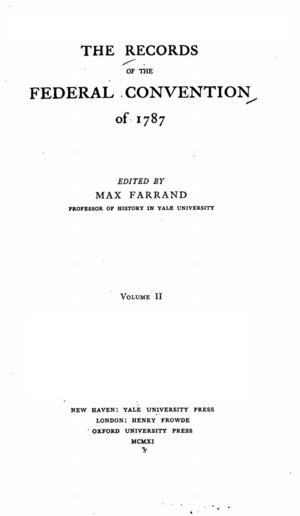
TUESDAY, AUGUST 7, 1787. - Max Farrand, The Records of the Federal Convention of 1787, vol. 2 [1911]Edition used:The Records of the Federal Convention of 1787, ed. Max Farrand (New Haven: Yale University Press, 1911). Vol. 2.
Part of: The Records of the Federal Convention of 1787, 3 vols.About Liberty Fund:Liberty Fund, Inc. is a private, educational foundation established to encourage the study of the ideal of a society of free and responsible individuals. Copyright information:The text is in the public domain. Fair use statement:This material is put online to further the educational goals of Liberty Fund, Inc. Unless otherwise stated in the Copyright Information section above, this material may be used freely for educational and academic purposes. It may not be used in any way for profit.
TUESDAY, AUGUST 7, 1787.JOURNAL
[To refer the report to a Committee of the whole Ayes — 5; noes — 4. Delaware being represented during the Debate a question was again taken on ye Committee of ye whole Ayes — 3; noes — 6.]1 On the question to agree to the Preamble to the constitution as reported from the committee to whom were referred the Proceedings of the Convention — it passed unan: in the affirmative [Ayes — 10; noes — 0.]2 On the question to agree to the first article, as reported, it passed in the affirmative On the question to agree to the second article, as reported, it passed in the affirmative It was moved and seconded to alter the second clause of the third article so as to read “each of which shall in all cases have a negative on the legislative acts of the other” which passed in the negative [Ayes — 5; noes — 5.] On the question to strike the following clause out of the third article namely “each of which shall, in all cases, have a negative on the other” it passed in the affirmative. [Ayes — 7; noes — 3.] It was moved and seconded to add the following words to the last clause of the third article “unless a different day shall be appointed by law” which passed in the affirmative [Ayes — 8; noes — 2.]3 It was moved and seconded to strike out the word “December” and to insert the word “May” in the third article which passed in the negative. [Ayes — 2; noes — 8.] It was moved and seconded to insert after the word “Senate” in the third article, the following words, namely “subject to the negative hereafter mentioned” which passed in the negative. [Ayes — 1; noes — 9.] It was moved and seconded to amend the last clause of the third article so as to read as follows namely “The Legislature shall meet at least once in every year; and such meeting shall be on the first monday in December unless a different day shall be appointed by law” which passed in the affirmative It was moved and seconded to strike out the last clause in the first section of the fourth article which passed in the negative. [Ayes — 1; noes — 7; divided — 1.] [To adjourn Ayes — 4; noes — 5.]4 It was moved and seconded to adjourn till to-morrow morning at 10 o’clock which passed in the negative [Ayes — 3; noes — 5; divided — 1.] The House then adjourned till to-morrow morning at 11 o’clock [Ayes — 7; noes — 2.]5
MADISON
The Report of the Committee 〈of detail being〉 taken up, Mr. Pinkney moved that it be referred to a Committee of the whole. This was strongly opposed by Mr Ghorum and several others, as likely to produce unnecessary delay; and was negatived. 〈Delaware Maryd. & Virga. only being in the affirmative.〉6 The 〈preamble〉7 of the Report was agreed to nem. con. So were Art: I & II.8 Art: III.9 considered. Col. Mason doubted the propriety of giving each branch a negative on the other “in all cases”. There were some cases in which it was he supposed not intended to be given as in the case of balloting for appointments. Mr. Govr. Morris moved to 〈insert〉 “legislative acts” instead of “all cases” Mr Williamson 2ds. him. Mr. Sherman. This will restrain the operation of the clause too much. It will particularly exclude a mutual negative in the case of ballots, which he hoped would take place. Mr. Ghorum contended that elections ought to be made by joint ballot. If separate ballots should be made for the President, and the two branches should be each attached to a favorite, great delay, contention & confusion may ensue. These inconveniences have been felt in Masts. in the election of officers of little importance compared with the Executive of the U. States. The only objection agst. a joint ballot is that it may deprive the Senate of their due weight; but this ought not to prevail over the respect due to the public tranquility & welfare. Mr. Wilson was for a joint ballot in several cases at least; particularly in the choice of the President, and was therefore for the amendment. Disputes between the two Houses, during & concerng the vacancy of the Executive, might have dangerous consequences. Col. Mason thought the amendment of Govr. Morris extended too far. Treaties are in a subsequent part declared to be laws, they will be therefore subjected to a negative; altho’ they are to be made as proposed by the Senate alone. He proposed that the mutual negative should be restrained to “cases requiring the distinct assent” of the two Houses. Mr. Govr. Morris thought this but a repetition of the same thing; the mutual negative and distinct assent, being equavalent expressions. Treaties he thought were not laws. Mr 〈Madison〉10 moved to strike out the words “each of which shall in all cases, have a negative on the other; the idea being sufficiently expressed in the preceding member of the Article; vesting the “legislative power” in “distinct bodies”. especially as the respective powers and mode of exercising them were fully delineated in a subsequent article. Genl. Pinkney 2ded. the motion On a question for inserting legislative Acts as moved by Mr Govr. Morris N. H. ay. Mas. ay. Ct. ay. Pa. ay. Del. no. Md no. Va. no. N. C. ay. S. C. no. Geo. no. [Ayes — 5; noes — 5.] On question for agreeing to’ Mr M’s motion to strike out &c — N. H. ay. Mas. ay. Ct. no. Pa. ay. Del. ay. Md. no. Va. ay. N- C- no. S. C. ay. Geo. ay. [Ayes — 7; noes — 3.] Mr 〈Madison〉 wished to know the reasons of the Come for fixing by ye. Constitution the time of Meeting for the Legislature; and suggested, that it be required only that one meeting at least should be held every year leaving the time to be fixed or varied by law. Mr. Govr. Mor moved to strike out the sentence. It was improper to tie down the Legislature to a particular time, or even to require a meeting every year. The public business might not require it. Mr. Pinckney concurred with Mr 〈Madison〉 Mr. Ghorum. If the time be not fixed by the Constition, disputes will arise in the Legislature; and the States will be at a loss to adjust thereto, the times of their elections. In the N. England States, the annual time of meeting had been long fixed by their Charters and Constitutions, and no inconveniency had resulted. He thought it necessary that there should be one meeting at least every year as a check on the Executive department. Mr. Elseworth was agst. striking out the words. The Legislature will not know till they are met whether the public interest required their meeting or not. He could see no impropriety in fixing the day, as the Convention could judge of it as well as the Legislature. Mr. Wilson thought on the whole it would be best to fix the day. Mr. King could not think there would be a necessity for a meeting every year. A great vice in our system was that of legislating too much. The most numerous objects of legislation belong to the States. Those of the Natl. Legislature were but few. The chief of them were commerce & revenue. When these should be once settled, alterations would be rarely necessary & easily made. Mr 〈Madison〉 thought if the time of meeting should be fixed by a law it wd. be sufficiently fixed & there would be no difficulty 〈then〉 as had been suggested, on the part of the States in adjusting their elections to it. One consideration appeared to him to militate strongly agst. fixing a time by the Constitution. It might happen that the Legislature might be called together by the public exigencies & finish their Session but a short time before the annual period. In this case it would be extremely inconvenient to reassemble so quickly & without the least necessity. He thought one annual meeting ought to be required; but did not wish to make two unavoidable. Col. Mason thought the objections against fixing the time insuperable; but that an annual meeting ought to be required as essential to the preservation of the Constitution. The extent of the Country will supply business. And if it should not, the Legislature, besides legislative, is to have inquisitorial powers, which can not safely be long kept in a State of suspension. Mr. Sherman was decided for fixing the time, as well as for frequent meetings of the Legislative body. Disputes and difficulties will arise between the two Houses, & between both & the States, if the time be changeable — frequent meetings of Parliament were required at the Revolution in England as an essential safeguard of liberty. So also are annual meetings in most of the American charters and constitutions. There will be business eno’ to require it. The Western Country, and the great extent and varying state of our affairs in general will supply objects. Mr. Randolph11 was agst. fixing any day irrevocably; but as there was no provision made any where in the Constitution for regulating the periods of meeting, and some precise time must be fixed, untill the Legislature shall make provision, he could not agree to strike out the words altogether. Instead of which he moved 〈to add the words following — “unless a different day shall be appointed by law.”〉12 Mr. 〈Madison〉 2ded. the motion, & on the question N. H. no. Mas. ay. Ct. no. Pa. ay. Del. ay. Md. ay. Va. ay. N. C. ay. S. C. ay. Geo. ay. [Ayes — 8; noes — 2.] Mr. Govr. Morris moved to strike out Decr. & insert May. It might frequently happen that our measures ought to be influenced by those in Europe, which were generally planned during the Winter and of which intelligence would arrive in the Spring. Mr. 〈Madison〉 2ded. the motion. he preferred May to Decr. because the latter would require the travelling to & from the Seat of Govt. in the most inconvenient seasons of the year. Mr. Wilson. The Winter is the most convenient season for business. Mr. Elseworth. The summer will interfere too much with private business, that of almost all the probable members of the Legislature being more or less connected with agriculture. Mr Randolph. The time is of no great moment now, as the Legislature can vary it. On looking into the Constitutions of the States, he found that the times of their elections with which the elections of the Natl. Representatives would no doubt be made to co-incide, would suit better with Decr than May. And it was advisable to render our innovations as little incommodious as possible. On question for “May” instead of “Decr.” N- H. no. Mas. no. Ct. no. Pa. no. Del. no. Md. no. Va. no. N. C. no. S. C. ay. Geo. ay. [Ayes — 2; noes — 8.] Mr. Read moved to insert 〈after the word “Senate” the words “subject〉13 to the Negative to be hereafter provided”. His object was to give an absolute negative to the Executive — He considered this as so essential to the Constitution, to the preservation of liberty, & to the public welfare, that his duty compelled him to make the motion. Mr. Govr. Morris 2ded. him. And on the question N. H. no. Mas. no. Ct. no. Pa. no. Del. ay. Md. no. Va. no. N. C. no. S. C. no. Geo. no. [Ayes — 1; noes — 9.] Mr. Rutlidge. Altho’ it is agreed on all hands that an annual meeting of the Legislature should be made necessary, yet that point seems not to be freed from doubt as the clause stands. On this suggestion. “Once at least in every year.” were inserted, nem. con. Art. III with the foregoing alterations was agd. to nem. con. 〈and is as follows “The Legislative power shall be vested in a Congress to consist of 2 separate & distinct bodies of men; a House of Reps. & a Senate. The Legislature shall meet at least once in every year, and such meeting shall be on the 1st. monday in Decr. unless a different day shall be appointed by law”.〉13 “Art IV. Sect. 1.14 taken up.” Mr. Govr. Morris moved to strike out the last member of the section 〈beginning with the words〉 “qualifications” of Electors.” in order that some other provision might be substituted which wd. restrain the right of suffrage to freeholders. Mr. Fitzsimmons 2ded. the motion Mr. Williamson was opposed to it. Mr. Wilson. This part of the Report was well considered by the Committee, and he did not think it could be changed for the better. It was difficult to form any uniform rule of qualifications for all the States. Unnecessary innovations he thought too should be avoided. It would be very hard & disagreeable for the same persons, at the same time, to vote for representatives in the State Legislature and to be excluded from a vote for those in the Natl. Legislature. Mr. Govr. Morris. Such a hardship would be neither great nor novel. The people are accustomed to it and not dissatisfied with it, in several of the States. In some the qualifications are different for the choice of the Govr. & Representatives; In others for different Houses of the Legislature. Another objection agst. the clause as it stands is that it makes the qualifications of the Natl. Legislature depend on the will of the States, which he thought not proper. Mr. Elseworth. thought the qualifications of the electors stood on the most proper footing. The right of suffrage was a tender point, and strongly guarded by most of the 〈State〉 Constitutions. The people will not readily subscribe to the Natl. Constitution, if it should subject them to be disfranchised. The States are the best Judges of the circumstances and temper of their own people. Col. Mason. The force of habit is certainly not attended to by those gentlemen who wish for innovations on this point. Eight or nine States have extended the right of suffrage beyond the freeholders. What will the people there say, if they should be disfranchised. A power to alter the qualifications would be a dangerous power in the hands of the Legislature. Mr. Butler. There is no right of which the people are more jealous than that of suffrage Abridgments of it tend to the same revolution as in Holland, where they have at length thrown all power into the hands of the Senates, who fill up vacancies themselves, and form a rank aristocracy. Mr. Dickenson. had a very different idea of the tendency of vesting the right of suffrage in the freeholders of the Country. He considered them as the best guardians of liberty; And the restriction of the right to them as a necessary defence agst. the dangerous influence of those multitudes without property & without principle, with which our Country like all others, will in time abound. As to the unpopularity of the innovation it was in his opinion chemirical. The great mass of our Citizens is composed at this time of freeholders, and will be pleased with it. Mr Elseworth. How shall the freehold be defined? Ought not every man who pays a tax to vote for the representative who is to levy & dispose of his money? Shall the wealthy merchants and manufacturers, who will bear a full share of the public burdens be not allowed a voice in the imposition of them — 〈taxation and representation ought to go together.〉 Mr. Govr. Morris. He had long learned not to be the dupe of words. The sound of Aristocracy therefore, had no effect on him. It was the thing, not the name, to which he was opposed, and one of his principal objections to the Constitution as it is now before us, is that it threatens this Country with an Aristocracy. The aristocracy will grow out of the House of Representatives. Give the votes to people who have no property, and they will sell them to the rich who will be able to buy them. We should not confine our attention to the present moment. The time is not distant when this Country will abound with mechanics & manufacturers who will receive their bread from their employers. Will such men be the secure & faithful Guardians of liberty? Will they be the impregnable barrier agst. aristocracy? — He was as little duped by the association of the words, “taxation & Representation” — The man who does not give his vote freely is not represented. It is the man who dictates the vote. Children do not vote. Why? because they want prudence. because they have no will of their own. The ignorant & the dependent can be as little trusted with the public interest. He did not conceive the difficulty of defining “freeholders” to be insuperable. Still less that the restriction could be unpopular. of the people are at present freeholders and these will certainly be pleased with it. As to Merchts. &c. if they have wealth & value the right they can acquire it. If not they don’t deserve it. Col. Mason. We all feel too strongly the remains of antient prejudices, and view things too much through a British Medium. A Freehold is the qualification in England, & hence it is imagined to be the only proper one. The true idea in his opinion was that every man having evidence of attachment to & permanent common interest with the Society ought to share in all its rights & privileges. Was this qualification restrained to freeholders? Does no other kind of property but land evidence a common interest in the proprietor? does nothing besides property mark a permanent attachment. Ought the merchant, the monied man, the parent of a number of children whose fortunes are to be pursued in their own 〈Country〉, to be viewed as suspicious characters, and unworthy to be trusted with the common rights of their fellow Citizens Mr. 〈Madison.〉 the right of suffrage is certainly one of the fundamental articles of republican Government, and ought not to be left to be regulated by the Legislature. A gradual abridgment of this right has been the mode in which Aristocracies have been built on the ruins of popular forms. Whether the Constitutional qualification ought to be a freehold, would with him depend much on the probable reception such a change would meet with in States where the right was now exercised by every description of people. In several of the States a freehold was now the qualification. Viewing the subject in its merits alone, the freeholders of the Country would be the safest depositories of Republican liberty. In future times a great majority of the people will not only be without landed, but any other sort of, property. These will either combine under the influence of their common situation; in which case,15 the rights of property & the public liberty,16 〈will not be secure in their hands:〉 or which is more probable, they will become the tools of opulence & ambition, in which case there will be equal danger on another side. The example of England has been misconceived (by Col Mason). A very small proportion of the Representatives are there chosen by freeholders. The greatest part are chosen by the Cities & boroughs, in many of which the qualification of suffrage is as low as it is in any one of the U. S. and it was in 〈the boroughs & Cities〉 rather than the Counties, that bribery most prevailed, & the influence of the Crown on elections was most dangerously exerted.17 Docr. Franklin. It is of great consequence that we shd. not depress the virtue & public spirit of our common people; of which they displayed a great deal during the war, and which contributed principally to the favorable issue of it. He related the honorable refusal of the American seamen who were carried in great numbers into the British Prisons during the war, to redeem themselves from misery or to seek their fortunes, by entering on board the Ships of the Enemies to their Country; contrasting their patriotism with a contemporary instance in which the British seamen made prisoners by the Americans, readily entered on the ships of the latter on being promised a share of the prizes that might be made out of their own Country. This proceeded he said, from the different manner in which the common people were treated in America & G. Britain. He did not think that the elected had any right in any case to narrow the privileges of the electors. He quoted as arbitrary the British Statute setting forth the danger of tumultuous meetings, and under that pretext, narrowing the right of suffrage to persons having freeholds of a certain value; observing that this Statute was soon followed by another under the succeeding Parliamt. subjecting the people who had no votes to peculiar labors & hardships. He was persuaded also that such a restriction as was proposed would give great uneasiness in the populous States. The sons of a substantial farmer, not being themselves freeholders, would not be pleased at being disfranchised, and there are a great many persons of that description. Mr. Mercer. The Constitution is objectionable in many points, but in none more than the present. He objected to the footing on which the qualification was put, but particularly to the mode of election by the people. The people can not know & judge of the characters of Candidates. The worse possible choice will be made. He quoted the case of the Senate in Virga. as an example in point- The people in Towns can unite their votes in favor of one favorite; & by that means always prevail over the people of the Country, who being dispersed will scatter their votes among a variety of candidates. Mr. Rutlidge thought the idea of restraining the right of suffrage to the freeholders a very unadvised one. It would create division among the people & make enemies of all those who should be excluded. On the question for striking out as moved by Mr. Govr. Morris, from the word “qualifications” to the end of the III article N. H. no. Mas. no. Ct. no. Pa. no. Del. ay. Md. divd. Va. no. N. C. no. S. C. no. Geo. not prest. [Ayes — 1; noes — 7; divided — 1; absent — 1.] Adjourned18 KING
3A — a. in all cases have a negative &c — proposed to be altered so that the negative extend only to those legislative acts in the passage whereof each Br. has concurrent authority — It was remarked by Madison yt. the whole clause “each of which shall in all cases have a negative on the other.” might be struck out, and the Legislature wd. be well organised — This motion was agreed to, & the words stricken out. — B. Madison proposed omitting in the Constitution the Time when the Legislature shd. meet — G. Morris in favor of leaving the Time of meeting to the Legislature — He remarked yt. if the Time was fixed in the Constitution, when the Legisl. shd. meet, it wd. be broken for yy wd. not meet at the Time fixed — Gorham — in favor of meeting once a year and fixing the period — he was for meeting to superintend the conduct of the executive — Mason — In favor of an annual meeting — They are not only Legislators but they possess inquisitorial powers. They must meet frequently to inspect the Conduct of the public offices — 4. Art. — S. 1 — c. The clause of Qualifications of Electors — G. Morris proposed to strike out the Clause — and to leave it to the Legislature to establish the Qualifications of Electors & Elected — or to add a Clause that the Legislat. may hereafter alter the Qualifications — Elsworth — If the Legislature can alter the Qualifications, they may disqualify ¾ or any greater proportion from being Electors — This wd. go far in favor of Aristocracy — we are safe as it is — because the States have staked yr. Liberties on the Qualifications as yy now stand — Dickenson — It is said yr. restraining by ye Constitution the rights of Election to Freeholders, is a step towards aristocracy — is this true, No. — we are safe by trusting the owners of the soil — the Owners of the Country — it will not be unpopular — because the Freeholders are the most numerous at this Time — The Danger to Free Governments has not been from Freeholders, but those who are not Freeholders — there is no Danger — because our Laws favor the Division of property — The Freehold will be parcelled among all the worthy men in the State — The Merchants & Mechanicks are safe — They may become Freeholders besides they are represented in ye State Legislatures, which elect the Senate of the US — Elsuorth — Why confine Elections to Freeholders — The rule is this — he who pays and is governed ought to have a right to vote — there is no justice in supposing that Virtue & Talents, are confined to Freeholders — G. Morris — I disregard sounds — I am not alarmed with the word Aristocracy — but I dread the thing — I will oppose it — and for that reason I think I shall oppose this Constitution, because I think this constitution establishes an Aristocracy — there can be no Aristocracy if the Freeholders are Electors — but there will be, when a great & rich man shall bring his indigent Dependents to vote in Elections — if you don’t establish a qualification of property, you will have an Aristocracy — Confing. ye. Electn. to Freeholders will not be unpopular because th of the Inhabs. are Freeholders — Mason — I think every person of full age and who can give evidence of a common Interest with the community shd. be an Elector — under this definition has a Freeholder alone ys. common Interest —? I think the Father of a Family has this interest — his Children will remain — this is a natural Interest — a Farm & other property is an artificial interest — we are governed by our prejudices in favr. of Engd — there a Twig, a Turf is the Elector — Madison — I am in favr. of the rigt. of Election being confind. to Freeholders — we are not governed by British Attachments — because the Knights of Shires are elected by Freeholders, but the Members from the Cities & Boroughs are elected by persons qualified by as small property as in any country and wholly without Freeholds — where is the Corruption in England: where is the Crown Influence seen — in the Cities & Boroughs & not in the Counties — 4 A. S. 1 Franklin — I am afraid by depositing the rights of Elections in the Freeholders it will be injurious to the lower class of Freemen — this class have hardy Virtues and gt. Integrity — the late war is a glorious Testimony in favor of plebian Virtue — Military men are sensible of this Truth — I know yt our Seamen prisoners in England refused all Allurements to draw them from yr. Allegiance — they were threatened with Halters but refused — this was not the case with the Brith. Seamen — they entered the American service & pointed out where they might make more marine prisoners — This is the reason — the Americans were all free and equal to any of yr. fellow Citizens — the British once were so — in antient Times every freeman was an Elector — but finally they made a law requiring an Elector to be a Freeholder — this was only in the Shires — The consequence was that the residue of Inhabitants were disgraced — in the next parliament they made a law authorising the Justices to fix the price of Labor — to compel any person not an Elector or Freeholder to labor for a Freeholder at the stated price or to be imprisoned — the English common people from that period lost a large portion of patriotism —19 McHENRY
Mr. Martin set out for New York on this day so we were without his concurrence in the propositions.20 Shewed these propositions to Mr. Carroll Mr. Jenifer and Mr. Mercer in convention. They said in general terms that they believed they should accord with them. I observed to Mr. Carrol that we would meet again in the evening and talk over the subject.21 The business of the Convention proceeded. The preamble or caption and the 1. and 2. article passed without debate, the 3 article was amended so as to leave it with the legislature to appoint after the first meeting, the day for the succeeding meetings. The IV article gave rise to a long debate, respecting the qualifications of the electors. Mr. Dickinson contended for confining the rights of election in the first branch to free holders. No one could be considered as having an interest in the government unless he possessed some of the soil. The fear of an aristocracy was a theoretical fiction. The owners of the soil could have no interest distinct from the country. There was no reason to dread a few men becoming lords of such an extent of territory as to enable them to govern at their pleasure. Governeur Morris — thought that wise men should not suffer themselves to be misguided by sound. If the suffrage was to be open to all freemen — the government would indubitably be an aristocracy. The system was a system of Aristocracy. It put it in the power of opulent men whose business created numerous dependents to rule at all elections. Hence so soon as we erected large manufactories and our towns became more populous — wealthy merchants and manufacturers would elect the house of representatives. This was an aristocracy. This could only be avoided by confining the suffrage to free holders. Mr. Maddison supported similar sentiments. The old ideas of taxation and representation were opposed to such reasoning.22 Doctor Franklin spoke on this occasion. He observed that in time of war a country owed much to the lower class of citizens. Our late war was an instance of what they could suffer and perform. If denied the right of suffrage it would debase their spirit and detatch them from the interest of the country. One thousand of our seamen were confined in English prisons — had bribes offered them to go on board English vessels which they rejected. An English ship was taken by one of our men of war. It was proposed to the English sailors to join ours in a cruise and share alike with thm in the captures. They immediately agreed to the proposal. This difference of behavior arises from23 the operation of freedom in America, and the laws in England. One British Statute excluded a number of subjects from a suffrage — These immediately became slaves — At thee o’clock the house adjourned without coming to any issue. At five o’clock in the evening I went to Mr. Carrolls lodging to confer with my colleagues on the points I had submitted to their consideration. I found Mr. Carroll alone when We entered upon their merits. He agreed with me that the deputation should oppose a resolute face to the 5 sect of the IV article,24 and that they ought to reject it. He appeared fully sensible of its tendency — That lodging in the house of representatives the sole right of raising and appropriating money, upon which the Senate had only a negative, gave to that branch an inordinate power in the constitution, which must end in its destruction. That without equal powers they were not an equal check upon each other — and that this was the chance that appeared for obtained an equal suffrage, or a suffrage equal to wht we had in the present confedn. We accorded also that the deputation should in no event consent to the 6 sect. of VII article.25 He saw plainly that as a quorum consisted of a majority of the members of each house — that the dearest interest of trade were under the controul of four States or of 17 membes in one branch and 8 in the other branch.26 We adverted also to the 1st sect of the VII article which enabled the legislature to lay and collect taxes, duties, imposts and excises, and to regulate commerce among the several States. We almost shuddered at the fate of the commerce of Maryland should we be unable to make any change in this extraordinary power. We agreed that our deputation ought never to assent to this article in its present form or without obtaining such a provision as I proposed. I now begged his particular attention to my last proposition.27 By the XXII article we were called upon to agree that the system should be submitted to a convention chosen in each State under the recommendation of its legislature. And that a less number of conventions than the whole agreeing to the system should be sufficient to organise the constitution. We had taken an oath to support our constitution and frame of government. We had been empowered by a legislature legally constituted to revise the confederation and fit it for the exigencies of government, and preservation of the union. Could we do this business in a manner contrary to our constitution? I feared (This28 was said first I thought — then I feared29 ) we could not. If we relinquished any of the rights or powers of our government to the U. S. of America, we could no otherwise agree to that relinquishment than in the mode our constitution prescribed for making changes or alterations in it. Mr. Carrol said he had felt his doubts respecting the propriety of this article as it respected Maryland; but he hoped we should be able to get over this difficulty. Mr. Jenifer now came in to whom Mr. Carroll repeated what we had said upon my propositions and our determinations. Mr. Jenifer agreed to act in unison with us but seemed to have vague ideas of the mischiefs of the system as it stood in the report. I wished to impress him with the necessity to support us, and touched upon some popular points. I suggested to him the unfavorable impression it would make upon the people on account of its expence — An army and navy was to be raised and supported, expensive courts of judicature to be maintained, and a princely president to be provided for etc — That it was plain that the revenue for these purposes was to be chiefly drawn from commerce. That Maryland in this case would have this resource taken from her, without the expences of her own government being lessened. — That what would be raised from her commerce and by indirect taxation would far exceed the proportion she would be called upon to pay under the present confederation. An increase of taxes, and a decrease in the objects of taxation as they respected a revenue for the State would not prove very palatable to our people, who might think that the whole objects of taxation were hardly sufficient to discharge the States obligations. Mr. Mercer came in, and said he would go with the deputation on the points in question. He would wish it to be understood however, that he did not like the system, that it was weak — That he would produce a better one since the convention had undertaken to go radically to work, that perhaps he would not be supported by any one, but if he was not, he would go with the stream — [1 ]Votes 233, 234, Detail of Ayes and Noes. [2 ]Vote 235, Detail of Ayes and Noes, but this might be assigned to either of the two questions following. [3 ]Vote 238, Detail of Ayes and Noes, which states that the amendment was “offered by Mr Randolph”. [4 ]Vote 242, Detail of Aye and Noes. [5 ]Vote 244, Detail of Ayes and Noes. It is not certain that this vote belongs here. [6 ]Taken from Journal. [7 ]Crossed out: “Caption”. [8 ]Article 1. “The stile of the Government shall be. ‘The United States of America’.” [9 ]Article III. “The legislative power shall be vested in a Congress, to consist of two separate and distinct bodies of men, a House of Representatives and a Senate; each of which shall in all cases have a negative on the other. The Legislature shall meet on the first Monday in December every year.” [10 ]Crossed out: “Mr. Pinkney”. [11 ]Crossed out: “Mr. Pinckney was opposed to”. [12 ]Revised from Journal. [13 ]Revised from Journal. [14 ]Article IV, Sect. 1. “The members of the House of Representatives shall be chosen every second year, by the people of the several States comprehended within this Union. The qualifications of the electors shall be the same, from time to time, as those of the electors in the several States, of the most numerous branch of their own legislatures.” [15 ]Crossed out: “if the authority be in their hands by the rule of suffrage”. [16 ]Crossed out: “good, will not he thought bid fair to be very secure”. [17 ]“Note to Speech of J. Madison of August 7th, 1787. [18 ]See further Appendix A, LXXX. [19 ][Endorsed:] 7 & 8 Augt | Qualifications of electors | Ellsworth Mason Gorham Franklin — agt. confing. of the Qual. to Freeholders | Madison Gov. Mor Dickinson — in favour of it. [20 ]See McHenry’s notes of August 6. [21 ]Crossed out: “that I had my doubt whether the gentlemen had given themselves time to consider the effect of the propositions or the part we ought to take respecting them.” [22 ]This is apparently McHenry’s comment. What follows, from “Doctor Franklin” to “became slaves” is written on the opposite page of the manuscript, and marked to be inserted. [23 ]Crossed out: “this description of men having a right of suffrage.” [24 ]That money-bills should originate in the House of Representatives alone, and that the Senate should have no right to alter or amend them. [25 ]“No navigation act shall be passed without the assent of two-thirds of the members present in each house.” [26 ]Marginal note: “33, 17 and 14, 8.” [27 ]As to ratification by nine states. [28 ]Note by McHenry. [29 ]The word “feared” is substituted for a word erased. |

Titles (by Subject)