EconlibThe LibraryOther Sites |
Front Page Titles (by Subject) COMMITTEE OF DETAIL - The Records of the Federal Convention of 1787, vol. 2
Return to Title Page for The Records of the Federal Convention of 1787, vol. 2The Online Library of LibertyA project of Liberty Fund, Inc.Search this Title:Also in the Library:
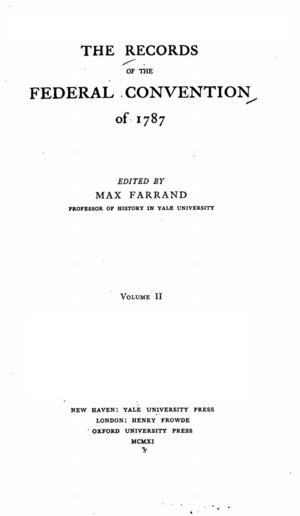
COMMITTEE OF DETAIL - Max Farrand, The Records of the Federal Convention of 1787, vol. 2 [1911]Edition used:The Records of the Federal Convention of 1787, ed. Max Farrand (New Haven: Yale University Press, 1911). Vol. 2.
Part of: The Records of the Federal Convention of 1787, 3 vols.About Liberty Fund:Liberty Fund, Inc. is a private, educational foundation established to encourage the study of the ideal of a society of free and responsible individuals. Copyright information:The text is in the public domain. Fair use statement:This material is put online to further the educational goals of Liberty Fund, Inc. Unless otherwise stated in the Copyright Information section above, this material may be used freely for educational and academic purposes. It may not be used in any way for profit.
COMMITTEE OF DETAIL[Among the Wilson Papers in the Library of the Historical Society of Pennsylvania are found a number of documents evidently relating to the work of the Committee of Detail. With a few additions from other sources, it is possible to present a nearly complete series of documents representing the various stages of the work of the Committee. All documents obtainable are here given.] I1 [Proceedings of the Convention, June 19 — July 23.]
II2 [Proceedings of the Convention, July 24-July 26.]Resolved That a National Executive be instituted
with power to carry into execution the national Laws
Resolved That it be an instruction to the Committee to whom were referred the proceedings of the Convention for the establishment of a national government, to receive a clause or clauses, requiring certain qualifications of property and citizenship in the United States for the Executive, the Judiciary, and the Members of both branches of the Legislature of the United States. III31. A Confederation between the free and independent States of N. H. &c. is hereby solemnly made uniting them together under one general superintending Government for their common Benefit and for their Defense and Security against all Designs and Leagues that may be injurious to their Interests and against all Forc[e]4 and Attacks offered to or made upon them or any of them 2 The Stile 3 Mutual Intercourse — Community of Privileges — Surrender of Criminals — Faith to Proceedings &c. 4 Two Branches of the Legislature — Senate — House of Delegates — together the U. S. in Congress assembled H. D. to consist of one Member for everyNA thousand Inhabitants of Blacks included Senate to be elected from four Districts — to serve by Rotation of four Years — to be elected by the H. D. either from among themselves or the People at large 5 The Senate and H. D. shall by joint Ballot annually chuse the Presidt. U. S. from among themselves or the People at large. — In the Presidt. the executive Authority of the U. S. shall be vested. — His Powers and Duties — He shall have a Right to advise with the Heads of the different Departments as his Council 6 Council of Revision, consisting of the Presidt. S. for for. Affairs, S. of War, Heads of the Departments of Treasury and Admiralty or any two of them togr wt the Presidt. 7 The Members of S. & H. D. shall each have one Vote, and shall be paid out of the common Treasury. 8 The Time of the Election of the Members of the H. D. and of the Meeting of U. S. in C. assembled. 9 No State to make Treaties — lay interfering Duties — keep a naval or land Force (Militia excepted to be disciplined &c according to the Regulations of the U. S. 10. Each State retains its Rights not expressly delegated — But no Bill of the Legislature of any State shall become a law till it shall have been laid before S. &. H. D. in C. assembled and received their Approbation. 11. The exclusive Power of S & H. D. in C. Assembled 12. The S. & H. D. in C. ass. shall have the exclusive Power of regulating Trade and levying Imposts — Each State may lay Embargoes in Time of Scarcity 13 ——— of establishing Post-Offices 14. S. & H. D. in C. ass. shall be the last Resort on Appeal in Disputes between two or more States; which Authority shall be exercised in the following Manner &c 15. S. & H. D. in C. ass. shall institute Offices and appoint Officers for the Departments of for. Affairs, War, Treasury and Admiralty — They shall have the exclusive Power of declaring what shall be Treason & Misp. of Treason agt. U. S. — and of instituting a federal judicial Court, to which an Appeal shall be allowed from the judicial Courts of the several States in all Causes wherein Questions shall arise on the Construction of Treaties made by U. S. — or on the Law of Nations — or on the Regulations of U. S. concerning Trade & Revenue — or wherein U. S. shall be a Party — The Court shall consist ofNA Judges to be appointed during good Behaviour — S. & H. D. in C. ass shall have the exclusive Right of instituting in each State a Court of Admiralty, and appointing the Judges &c of the same for all maritime Causes which may arise therein respectively. 16. S & H. D. in C. ass. shall have the exclusive Right of coining Money — regulating its Alloy & Value — fixing the Standard of Weights and Measures throughout U. S. 17. Points in which the Assent of more than a bare Majority shall be necessary. 18 Impeachments shall be by the H. D. before the Senate and the judges of the federal judicial Court. 19. S. & H. D. in C. ass. shall regulate the Militia thro’ the U. S. 20. Means of enforcing and compelling the Payment of the Quota of each State. 21. Manner and Conditions of admiting new States. 22. Power of dividing annexing and consolidating States, on the Consent and Petition of such States. 23. The assent of the Legislature ofNA States shall be sufficient to invest future additional Powers in U. S. in C. ass. and shall bind the whole Confederacy. 24. The Articles of Confederation shall be inviolably observed,× and the Union shall be perpetual; ×unless altered as before directed5 25 The said States of N. H. &c guarantee mutually each other and their Rights against all other Powers and against all Rebellions &c. IV6In the draught of a fundamental constitution, two things deserve attention:
1. A preamble seems proper not for the purpose of designating the ends of government and human polities — This (business, if not fitter for the schools, is at least sufficiently exausted) display of theory, howsoever proper in the first formation of state governments, (seems) is unfit here; since we are not working on the natural rights of men not yet gathered into society, but upon those rights, modified by society, and (supporting) interwoven with what we call (states) the rights of states — Nor yet is it proper for the purpose of mutually pledging the faith of the parties for the observance of the articles — This may be done more solemnly at the close of the draught, as in the confederation — But the object of our preamble ought to be briefly to (represent) declare, that the present foederal government is insufficient to the general happiness, that the conviction of this fact gave birth to this convention; and that the only effectual (means) 〈mode〉 which they (could) 〈can〉 devise, for curing this insufficiency, is the establishment of a supreme legislative executive and judiciary — (In this manner we may discharge the first resolution. We may then proceed to establish)6a Let it be next declared, that the following are the constitution and fundamentals of government for the United States6b — After this introduction, let us proceed to the 2. First resolution — This resolution involves three particulars
In the next place, treat of the legislative, judiciary and executive in their order, and afterwards, of the miscellaneous subjects, as they occur, bringing together all the resolutions, belonging to the same point, howsoever they may be scattared about and leaving to the last the steps necessary to introduce the government — (Tak) The following plan is therefore submitted I The Legislative
11. The qualification of electors shall be the same (throughout the states; viz.) with that in the particular states unless the legislature shall hereafter direct some uniform qualification to prevail through the states. (citizenship: previous residence for one year, or possession of real property within the state for the whole of one year, or inrolment in the militia for the whole of a years.)8 (12. All persons who are may be elected)
4 b) The Senate —
The following are
agrd. 1. To raise money by taxation, unlimited as to sum, for the (future) past (or) 〈&〉 future debts and necessities of the union and to establish rules for collection Exception(s) agrd. No Taxes on exports. — Restrictions 1. direct taxation proportioned to representation 2. No (headpost) capitation-tax which does not apply to all inhabitants under the above limitation (& to be levied uniform) 3. no (other) indirect tax which is not common to all 4. (Delinquencies shall be be distress — [illegible words]) 5. To regulate commerce 〈both foreign & domestic〉
Restrictions
〈Insert the 11 Article〉 (All laws of a particular state, repugnant hereto, shall be void, and in the decision thereon, which shall be vested in the supreme judiciary, all incidents without which the general principles cannot be satisfied shall be considered, as involved in the general principle.) 〈That Trials for Criml. Offences be in the State where the Offe was comd — by Jury — and a right to make all Laws necessary to carry the foregoing Powers into Execu —〉
Miscellaneous provisions
The object of an address is to satisfy the people of the propriety of the proposed reform. To this end the following plan seems worthy of adoption
This is the shortest scheme, which can be adopted. For it would be strange to ask (for) new powers, without assigning some reason — it matters not how general soever — which may apply to all of them Besides we ought to furnish the advocates of the plan in the country with some general topics. Now I conceive, that these heads do not more, than comprehend the necessary points. V13
The Continuation of the Scheme
Miscellaneous Resolutions
to be added
VI14We the People of (and) the States of New Hampshire, Massachusetts, Rhode Island and Providence Plantations, Connecticut, New. York, New. Jersey, Pennsylvania, Delaware, Maryland, Virginia, North. Carolina, South. Carolina and Georgia do ordain declare and establish the following Constitution for the Government of ourselves and of our Posterity. 1.The Stile of this Government shall be the “United People and States of America.” 2.The Government shall consist of supreme legislative, executive and judicial Powers. 3.The (Supreme) legislative Power shall be vested in a Congress to consist of two separate and distinct Bodies of Men, (one to be called the) a House of Representatives, (the other to be called the) and a Senate (of) each of which shall in all Cases have a Negative on the other (in all cases not otherwise provided for in this Constitution) 4.The Members of the House of Representatives shall be chosen every second Year (in the Manner following) by the People of the several States comprehended within this Union (the Time and Place and the Manner and the of holding the Elections and the Rules) The Qualifications of the Electors shall be (appointed) prescribed by the Legislatures of the several States; but their provisions (which they shall make concerning them shall be subject to the Control of) concerning them may at any Time be altered and superseded by the Legislature of the United States. (No person shall be capable of being chosen) Every Member of the House of Representatives shall be (twenty-five Years of Age) of the Age of twenty five Years at least; shall have been a Citizen in the United States for at least three Years before his Election, and shall be, at the Time of his Election, a Resident of the State, (from) in which he shall be chosen. The House of Representatives shall, at its first Formation and until the Number of Citizens and Inhabitants shall be taken in the Manner hereinafter described consist of 65 Members, of whom three shall be chosen in New-Hampshire, eight in Massachusetts, &c. As the (present) Proportions of Numbers in the different States will alter from Time to Time; as some of the States may be hereafter divided; as others may be enlarged by Addition of Territory, or two or more States may be united; and as new States will be erected within the Limits of the United States; the Legislature shall, in each of these cases, possess Authority to regulate the Number of Representatives by the Number of Inhabitants according to the provisions herein after made. (Representation) Direct Taxation shall always be in Proportion to (direct Taxation.) Representation in the House of Representatives. (In order to ascertain and regulate the Proportions of direct Taxation from Time to Time, the Legislature of the United States shall, within six Years after its first Meeting and within the Term of every ten Years afterwards, cause) The Proportions of direct Taxation shall be regulated by the whole Number of white and other Free Citizens and Inhabitants of every &c. which Number (shall) shall, (be taken) within six Years after the first Meeting of the Legislature (of the United States,) and within the Term of every ten Years afterwards, be taken in such Manner as the said Legislature shall direct (and appoint). From the first Meeting of the Legislature until the Number of Citizens and Inhabitants shall be taken (in the Manner beforementioned) as aforesaid, direct Taxation shall be in Proportion to the Number of (Inhabitants) Representatives chosen in each State. All Bills for raising or appropriating Money and for fixing the Salaries of the Officers of Government shall originate in the House of Representatives, and shall not be altered or amended by the Senate. No money shall be drawn from the public Treasury, but in Pursuance of Appropriations that shall originate in the House of Representatives. The House of Representatives shall be the grand Inquest of this Nation; and all Impeachments shall be made by them. Vacancies in the House of Representatives shall be supplied by Writs of Election from the (Supr) Executive (Pow) Authority of the State in the Representation (of) from which they shall happen. The House of Representatives shall chuse its own Speaker and other Officers The (Members of the) Senate of the United States shall be chosen (every sixth year) by the Legislatures of the several States; Each (of which) Legislature shall chuse two Members. (The votes shall not be given by States, but by the Members separately from each State.) Each Member shall have one Vote. The Members of the Senate shall be chosen for six Years; provided that immediately after the first Election they (Members of the Senate) shall (by) be divided by Lot into three Classes as nearly as may be, and numbered one, two and three. The Seats of the Members of the first Class shall be vacated at the Expiration of the second Year, (th) of the second Class at the Expiration of the fourth Year, of the third Class at the (End) Expiration of the sixth Year, (that a) and so on continually, that a third Part of the Members of the Senate may be (biennially) chosen every second Year. Every Member of the Senate shall be of the Age of thirty Years at least (thirty Years of Age), shall have been a citizen in the United States for at least four Years before his Election, and shall be, at the Time of his Election a Resident of the State for which he shall be chosen The Senate (shall be empowered) of the United States shall have Power to make Treaties of (Peace, of Alliance, and of Commerce,) to send Ambassadors, and to appoint the Judges of the Supreme national Court Each House of the Legislature shall possess the right of originating (Acts) Bills, except in Cases beforementioned
VII15An Appeal for the Correction of all Errors both in Law and Fact That the United States in Congress be authorised — to pass Acts for raising a Revenue, — by levying Duties on all Goods and Merchandise of foreign Growth or Manufacture imported into any Part of the United States — by Stamps on Paper Vellum or Parchment — and by a Postage on all Letters and Packages passing through the general Post-Office, to be applied to such foederal Purposes as they shall deem proper and expedient — to make Rules and Regulations for the Collection thereof — to pass Acts for the Regulation of Trade and Commerce as well with foreign Nations as with each other to lay and collect Taxes That the Executive direct all military Operations That the Judiciary have authority to hear and determine all Impeachments of foederal Officers; and, by Way of Appeal, in all Cases touching the Rights of Ambassadors — in all Cases of Capture from an Enemy — in all Cases of Piracies and Felonies on the high Seas — in all Cases of Revenue — in all Cases in which Foreigners may be interested in the Construction of any Treaty, or which may arise on any Act for regulating Trade or collecting Revenue or on the Law of Nations, or general commercial or marine Laws If any State, or any Body of Men in any State, shall oppose or prevent the carrying into Execution the Acts or Treaties of the United States; the Executive shall be authorised to enforce and compel Obedience by calling forth the Powers of the United States. That the Rule for Naturalization ought to be the same in every State The Legislature shall consist of two distinct Branches — a Senate and a House of Delegates, each of which shall have a Negative on the other, and shall be stiled the U. S. in Congress assembled. Each House shall appoint its own Speaker and other Officers, and settle its own Rules of Proceeding; but neither the Senate nor H. D. shall have the power to adjourn for more thanNA Days, without the (other) Consent of both. There shall be a President, in which the Ex. Authority of the U. S. shall be vested. It shall be his Duty to inform the Legislature of the Condition of U. S. so far as may respect his Department — to recommend Matters to their Consideration — to correspond with the Executives of the several States — to attend to the Execution of the Laws of the U. S. — to transact Affairs with the Officers of Government, civil and military — to expedite all such Measures as may be resolved on by the Legislature — to inspect the Departments of foreign Affairs — War — Treasury — Admiralty — to reside where the Legislature shall sit — to commission all Officers, and keep the Great Seal of U. S. — He shall, by Virtue of his Office, be Commander in chief of the Land Forces of U. S. and Admiral of their Navy — He shall have Power to convene the Legislature on extraordinary Occasions — to prorogue them, provided such Prorogation shall not exceedNA Days in the space of anyNA — He may suspend Officers, civil and military The Legislature of U. S. shall have the exclusive Power — of raising a military Land Force — of equiping a Navy — of rating and causing public Taxes to be levied — of regulating the Trade of the several States as well with foreign Nations as with each other — of levying Duties upon Imports and Exports — of establishing Post-Offices, and raising a Revenue from them — of regulating Indian Affairs — of coining Money — fixing the Standard of Weights and Measures — of determining in what Species of Money the public Treasury shall be supplied. The foederal judicial Court shall try Officers of the U. S. for all Crimes &C in their Offices — (and to this Court an Appeal shall be allowed from the Courts of) The Legislature of U. S. shall have the exclusive Right of instituting in each State a Court of Admiralty for hearing and determining maritime Causes. The power of impeaching shall be vested in the H. D. — The Senators and Judges of the foederal Court, be a Court for trying Impeachments. The Legislature of U. S. shall possess the exclusive Right of establishing the Government and Discipline of the Militia of — and of ordering the Militia of any State to any Place within U. S. VIII16mitted on the same Terms with the original States: But the Legislature may make Conditions with the new States (with Respect to) concerning the (then subsisting) public Debt (of the United States) which shall be then subsisting The United States shall guaranty to each State a (A) Republican Form of Government (shall be guarantied to each State by the United States); and (the) shall protect each State (from) against (domestic Violence) foreign Invasion and, on the Application of its Legislature (from foreign Invasions) against domestic Violence. This Constitution ought to be amended whenever such Amendment shall become necessary; and on the Application of the Legislatures of two thirds of the States in the Union, the Legislature of the United States shall call a Convention for that Purpose. The Members of the Legislature, and the executive and judicial Officers of the United States and of the several States shall be bound by Oath to support this Constitution. Resolved, That the Constitution proposed by this Convention, to the People (and States) of the Uni(on)ted States for their approbation (should, as soon as may be laid) be (to) laid before the United States in Congress assembled for their Agreement and Recommendation and (should) be afterwards (be) submitted to a Convention chosen in each State under the Recommendation of its Legislature, in order to receive the Ratification of such Convention. Resolved, That the Ratification of the Conventions ofNA States shall be sufficient for organizing this Constitution: That each assenting (State) Convention shall notify its Assent and Ratification to the United States in Congress assembled: That the United States in Congress assembled, after receiving the Assent and Ratification of the Conventions ofNA States shall appoint and publish a Day, as early as may be, and appoint a Place for (organizing and) commencing (Oper) Proceedings under this Constitution: That after such Publication or, — in case it shall not be made, — (after on) after the Expiration ofNA Days (after) from the Time when the Ratification of the Convention of theNA State shall have been notified to Congress the Legislatures of the several States shall (chuse) elect Members of the Senate, and direct the Election of Members of the House of Representatives, and shall provide for their support: That the Members of the Legislature shall meet at the Time and Place assigned by Congress or, — if Congress shall have assigned not Time and Place, — at such Time and Place as shall have been agreed on by the Majority of the Members elected for each House, and shall as soon as may be after their Meeting chuse the (Governour) President of the United States and proceed to (carry) execute this Constitution.
IX17We the People of the States of New Hampshire, Massachusetts, Rhode-Island and Providence Plantations, Connecticut, New-York, New-Jersey, Pennsylvania, Delaware, Maryland, Virginia, North-Carolina, South-Carolina and Georgia, do ordain, declare and establish the following Constitution for the Government of ourselves and our Posterity. 1.The Stile of this Government shall be. “the United States of America”. 2.The Government shall consist of supreme legislative, executive, and judicial Powers. 3.The legislative Power shall be vested in a Congress, to consist of two separate and distinct Bodies of Men, a House of Representatives, and a Senate; each of which shall in all Cases, have a Negative on the other 〈To meet on the 1st Monday every December —〉 4.The Members of the House of Representatives shall be chosen every second Year, by the People of the several States comprehended within this Union. The Qualifications of the Electors shall be (prescribed by the Legislatures of the several States; but these Provisions concerning them may, at any Time be altered and superseded by the Legislature of the United States) the same from Time to Time as those of the Electors, in the several States, of the most numerous Branch of their own Legislatures. Every Member of the House of Representatives shall be of the Age of twenty five Years at least; shall have been a Citizen in the United States for at least three Years before his Election; and shall be, at the Time of his Election, a Resident of the State in which he shall be chosen. The House of Representatives shall, at its first Formation, and until the Number of Citizens and Inhabitants shall be taken in the Manner herein after described, consist of sixty five Members, of whom three shall be chosen in New-Hampshire, eight in Massachusetts, one in Rhode-Island and Providence Plantations, five in Connecticut, six in New-York, four in New-Jersey, eight in Pennsylvania, one in Delaware, six in Maryland, ten in Virginia, five in North-Carolina, five in South-Carolina, and three in Georgia. As the Proportions of Numbers in different States will alter from Time to Time; as some of the States may be hereafter divided; as others may be enlarged by Addition of Territory; as two or more States may be united; and as new States will be erected within the Limits of the United States, the Legislature shall, in each of these Cases (possess authority to) regulate the Number of Representatives by the Number of Inhabitants, according to the Provisions herein after made. All Bills for raising or appropriating Money, and for fixing the Salaries of the Officers of Government, shall originate in the House of Representatives, and shall not be altered or amended by the Senate. No money shall be drawn from the public Treasury, but in Pursuance of Appropriations that shall originate in the House of Representatives. The House of Representatives shall (be the grand Inquest of the Nation; and all) 〈have the sole Power of〉 Impeachment(s shall be made by them). Vacancies in the House of Representatives shall be supplied by Writs of Election from the Executive Authority of the State, in the representation from which they shall happen. The House of Representatives shall chuse its (own) Speaker and other Officers. 5.The Senate of the United States shall be chosen by the Legislatures of the several States. Each Legislature shall chuse two Members. Each Member shall have one Vote. The Senators shall be chosen for six Years; but immediately after the first Election they shall be divided, by Lot, into three Classes, as nearly as may be, numbered one, two and three. The Seats of the Members of the first Class shall be vacated at the Expiration of the second Year, of the second Class at the Expiration of the fourth Year, of the third Class at the Expiration of the sixth Year, (and so continually) 〈so〉 that a third Part of the Members (of the Senate) may be chosen every second Year. Every Member of the Senate shall be of the Age of thirty Years at least; shall have been a Citizen in the United States for at least four Years before his Election; and shall be, at the time of his Election, a Resident of the State for which he shall be chosen. The Senate shall (be comp) chuse its own President and other Officers 6.(Each House of the Legislature shall possess the Right of originating Bills, except in the Cases beforementioned.) The Times and Places and the Manner of holding the Elections of the Members of each House shall be prescribed by the Legislature of each State; but their Provisions concerning them may, at any Time, be altered (or superseded) by the Legislature of the United States. The Legislature of the United States shall have Authority to establish such 〈uniform〉 Qualifications of the Members of each House, with Regard to Property, as to the said Legislature shall seem (proper and 〈fit〉) expedient. In each House a Majority of the Members shall constitute a Quorum to do Business; but a smaller Number may adjourn from Day to Day. Each House shall be the Judge of the Elections, Returns and Qualifications of its own Members. Freedom of Speech and Debate in the Legislature shall not be impeached or questioned in any Court or Place out of the Legislature; and the Members of each House shall, in all Cases, except Treason, Felony and Breach of the Peace, be privileged from Arrest during their Attendance at Congress, and in going to and returning from it. Each House (shall have Authority to) may determine the Rules of its Proceedings, (and to) may punish its (own) Members for disorderly Behaviour. (Each House) and may expel a Member, (but not a second Time for the same Offence). The House of Representatives, and the Senate, when it shall be acting in a legislative Capacity, (Each House) shall keep a Journal of their Proceedings, and shall, from Time to Time, publish them: and the Yeas and Nays of the Members of each House, on any Question, shall at the Desire of (any) 〈⅕th. of the〉 Member〈s〉 be entered on the Journal. Neither House (shall adjourn for more than three Days;) without the Consent of the other 〈shall adjourn for more than three Days〉; nor (without such Consent,) to any other Place than that, at which the two Houses are sitting. But this Regulation shall (be applied) 〈not extend〉 to the Senate (only in its legislative Capacity.) 〈when it shall exercise the Powers mentd. in theNA Article.〉 The Members of each House shall be ineligible to, and incapable of holding any Office under the Authority of the United States during the Time, for which they shall be respectively elected: And the Members of the Senate shall be ineligible to, and incapable of holding any such Office for one Year afterwards. The Members of each House shall receive a Compensation for their Services, to be ascertained and paid by the State, in which they shall be chosen. The enacting Stile of the Laws of the United States shall be “be it enacted and it is hereby enacted by the House of Representatives and by the Senate of the United States in Congress assembled”. Each House shall possess the Right of Originating Bills, except in the Cases beforementioned. 7.Every Bill, which shall have passed the House of Representatives and the Senate, shall, before it become a Law, be presented to the (Governour) 〈President〉 of the United States for his Revision: If, upon such Revision, he approve of it; he shall signify his Approbation by signing it: But if, upon such Revision, it shall appear to him improper for being passed into a Law; he shall return it, together with his Objections against it, to that House, in which it shall have originated, who shall enter the Objections at large on their Journal, and proceed to reconsider the Bill. But if after such Reconsideration, two thirds of that House shall, notwithstanding the Objections of the (Governour) 〈President〉, agree to pass it, it shall, together with his Objections, be sent to the other House, by which it shall likewise be reconsidered, and, if approved by two thirds of the other House also; it shall be a Law. But in all such Cases, the Votes of both Houses shall be determined by Yeas and Nays; and the Names of the Persons voting for or against the Bill shall be entered in the Journal of each House respectively. If any bill shall not be returned by the (Governour) 〈President〉 within 〈seven〉 days after it shall have been presented to him, it shall be a Law, unless the Legislature by their Adjournment prevent its Return; in which Case it shall (be returned on the first Day of the next Meeting of the Legislature) 〈not〉. 8The Legislature of the United States shall have the (Right and) Power to lay and collect Taxes, Duties, Imposts and Excises; to regulate (Naturalization and) Commerce 〈with foreign Nations & amongst the several States〉; to establish an uniform Rule for Naturalization throughout the United States; to coin Money; to regulate the (Alloy and) Value of 〈foreign〉 Coin; to fix the Standard of Weights and Measures; to establish Post-offices; to borrow Money, and emit Bills on the Credit of the United States; to appoint a Treasurer by Ballott; to constitute Tribunals inferior to the Supreme (national) Court; to make Rules concerning Captures on Land or Water; to declare the Law and Punishment of Piracies and Felonies committed on the high Seas, and the Punishment of counterfeiting the 〈Coin〉 (and) 〈of the U. S. &〉 of Offences against the Law of Nations; (to declare what shall be Treason against the United States;) 〈& of Treason agst the U: S: or any of them; not to work Corruption of Blood or Forfeit except during the Life of the Party;〉 to regulate the Discipline of the Militia of the several States; to subdue a Rebellion in any State, on the Application of its Legislature; to make War; to raise Armies; to build and equip Fleets, to (make laws for) call(ing) forth the Aid of the Militia, in order to execute the Laws of the Union, (to) enforce Treaties, (to) suppress Insurrections, and repel invasions; and to make all Laws that shall be necessary and proper for carrying into (full and complete) Execution (the foregoing Powers, and) all other powers vested, by this Constitution, in the Government of the United States, or in any Department or Officer thereof; (Representation shall) (Direct Taxation shall always be in Proportion to Representation in the House of Representatives.) The proportions of direct Taxation shall be regulated by the whole Number of white and other free Citizens and Inhabitants, of every Age, Sex and Condition, including those bound to Servitude for a Term of Years, and three fifths of all other Persons not comprehended in the foregoing Description; which Number shall, within six Years after the first Meeting of the Legislature, and within the Term of every ten Years afterwards, be taken in such Manner as the said Legislature shall direct. From the first Meeting of the Legislature until the Number of Citizens and Inhabitants shall be taken as aforesaid, direct Taxation shall be in Proportion to the Number of Representatives chosen in each State. No Tax or Duty shall be laid by the Legislature, on Articles exported from any State; nor on the emigration or Importation of such Persons as the several States shall think proper to admit; nor shall such emigration or Importation be prohibited. No Capitation Tax shall be laid, unless in Proportion to the Census herein before directed to be taken. No Navigation Act shall be passed without the Assent of two thirds of the Members present in each House. The United States shall not grant any Title of Nobility. 9The Acts of the Legislature of the United States made in Pursuance of this Constitution, and all Treaties made under the Authority of the United States shall be the supreme Law of the several States, and of their Citizens and Inhabitants; and the Judges in the several States shall be bound thereby in their Decisions, any Thing in the Constitutions or Laws of the several States to the Contrary notwithstanding. 10No State shall enter into any (Al) Treaty, Alliance (or) Confederation 〈with any foreign Power nor witht. Const. of U. S. into any agreemt. or compact wh (any other) another State or Power〉; nor lay any Imposts or Duties on Imports;18 nor keep Troops or Ships of War in Time of Peace;18 nor grant Letters of Marque and Reprisal; nor coin Money; nor (emit Bills of Credit), without the Consent of the Legislature of the United States, 〈emit Bills of Credit.〉 No State shall, without such Consent engage in any War, unless it shall be actually invaded by Enemies, or the Danger of Invasion be so imminent as not to admit of a Delay, until the Legislature of the United States can be consulted. No State shall grant any Title of Nobility. 11.The Senate of the United States shall have Power to make Treaties; to send Ambassadors; and to appoint the Judges of the Supreme (national) Court. In all Disputes and Controversies now subsisting, or that may hereafter subsist between two or more States 〈respecting (Territory) Jurisdn or Territory〉, the Senate shall possess the following Powers. Whenever the Legislature, or the Executive Authority, or the lawful Agent of any State, in controversy with another, shall, by Memorial to the Senate, state the Matter in Question, and apply for a Hearing, Notice of such Memorial and Application shall be given, by Order of the Senate, to the Legislature, or the Executive Authority of the other State in Controversy. The Senate shall also assign a Day for the Appearance of the Parties, by their Agents before that House. The Agents shall be directed to appoint, by joint Consent, Commissioners or Judges to constitute a Court for hearing and determining the Matter in Question. But if the Agents cannot agree, the Senate shall name three Persons out of each of the several States; and from the List of such Persons each Party shall alternately strike out one, until the Number shall be reduced to thirteen; and from that Number not less than seven, nor more than nine names, as the Senate shall direct, shall in their Presence, be drawn out by Lot; and the Persons whose Names shall be so drawn, or any five of them shall be Commissioners or Judges to hear and finally determine the Controversy, provided a majority (Part) of the Judges, who shall hear the Cause, agree in the Determination. If either Party shall neglect to attend at the Day assigned, without shewing sufficient Reasons for not attending; or being present, shall refuse to strike, the Senate shall proceed to nominate three Persons out of each State, and the (Secretary or) Clerk of the Senate shall strike in Behalf of the Party absent or refusing. If any of the Parties shall refuse to submit to the Authority of such Court, or shall not appear to prosecute or defend their Claim or Cause; the Court shall nevertheless proceed to pronounce Judgment. The Judgment shall be final and conclusive. The Proceedings shall be transmitted to the President of the Senate, and shall be lodged among the public Records for the Security of the Parties concerned. Every Commissioner shall, before he sit in Judgment, take an Oath, to be administered by one of the Judges of the Supreme or Superior Court of the State where the Cause shall be tried, “well and truly to hear and determine the Matter in Question according to the best of his Judgment, without Favor, Affection or Hope of Reward.” All controversies concerning Lands claimed under different Grants of two or more States, whose Jurisdictions as they respect such Lands, shall have been decided or adjusted subsequent to such Grants 〈or any of them〉 shall, on Application to the Senate, be finally determined, as near as may be, in the same manner as is before prescribed for deciding Controversies between different States. 12.The Executive Power of the United States shall be vested in a single Person. His Stile shall be, “The President of the United States of America;” and his Title shall be, “His Excellency”. He shall be elected by Ballot by the Legislature. He shall hold his Office during the term of seven Years; but shall not be elected a second Time. He shall from Time to Time give information 〈to the Legislature〉 of the State of the (Nation to the Legislature) 〈Union〉; he may recommend (Matters) 〈such measures as he shall judge nesy. & expedt.〉 to their Consideration, and (he) may convene them on extraordinary Occasions 〈& in Case of a disagreement between the 2 Houses with regard to the Time of Adj. he may adjourn them to such Time as he shall think proper.〉19 (He shall take Care to the best of his Ability, that the Laws) 〈It shall be his duty to provide for the due & faithful exec — of the Laws〉 of the United States (be faithfully executed) 〈to the best of his ability〉. He shall commission all the Officers of the United States and (shall) appoint (Officers in all Cases) (〈such of them whose appts.) them in all cases〉 not otherwise provided for by this Constitution. He shall receive Ambassadors, and shall correspond with the (Governours and other) 〈Supreme〉 Executives (Officers) of the several States. He shall have power to grant Reprieves and Pardons; but his Pardon shall not be pleadable in Bar of an Impeachment. He shall be Commander in Chief of the Army and Navy of the United States, and of the Militia of the Several States. He shall, at stated Times, receive for his Services, a fixed Compensation, which shall neither be encreased nor diminished during his Continuance in Office. Before he shall enter on the Duties of his Department, he shall take the following Oath or Affirmation, “I—solemnly swear, — or affirm, — that I will faithfully execute the Office of President of the United States of America.” He shall be (dismissed) removed from his Office on Impeachment by the House of Representatives, and Conviction in the Supreme (National) Court, of Treason (or) Bribery or Corruption. In Case of his Impeachment, (Dismission) Removal, Death, Resignation or Disability to discharge the Powers and Duties of his (Department) Office; the President of the Senate shall exercise those Powers and Duties, until another President of the United States be chosen, or until the President impeached or disabled be acquitted, or his Disability be removed. 13.All Commissions, Patents and Writs shall be in the Name of “the United (People and) States of America.” 14.The Judicial Power of the United States shall be vested in one Supreme (National) Court, and in such (other) 〈inferior〉 Courts as shall, from Time to Time, be constituted by the Legislature of the United States. The Judges of the Supreme (National) Court shall (be chosen by the Senate by Ballott). (They shall) hold their Offices during good Behaviour. They shall, at stated Times, receive for their Services, a Compensation, which shall not be diminished during their Continuance in Office. The Jurisdiction of the Supreme (National) Court shall extend to all Cases arising under Laws passed by the Legislature of the United States; to all Cases affecting Ambassadors (and other) 〈other〉 public Ministers 〈& Consuls〉, to the Trial of Impeachments of Officers of the United States; to all Cases of Admiralty and Maritime Jurisdiction; to Controversies between 〈States, — except those wh. regard Jurisdn or Territory, — betwn〉 a State and a Citizen or Citizens of another State, between Citizens of different States and between 〈a State or the〉 Citizens (of any of the States) 〈thereof〉 and foreign States, Citizens or Subjects. In Cases of Impeachment, (those) 〈Cases〉 affecting Ambassadors (and) other public Ministers 〈& Consuls〉, and those in which a State shall be (one of the) 〈a〉 Part(ies)〈y〉, this Jurisdiction shall be original. In all the other Cases beforementioned, it shall be appellate, with such Exceptions and under such Regulations as the Legislature shall make. The Legislature may (distribute) 〈assign any part of〉 th(is)e Jurisdiction 〈above mentd., — except the Trial of the Executive —〉, in the Manner and under the Limitations which it shall think proper (among) 〈to〉 such (other) 〈inferior〉 Courts as it shall constitute from Time to Time. (Crimes shall be tried) 〈&〉 in the State, (in which) 〈where〉 they shall be committed; (and) The Trial of (them) 〈all Criml Offences, — except in Cases of Impeachment —〉 shall be by Jury. 〈Judgmts. in Cases of Impeachmt. shall not extend further than to removal from Office & disqualifn. to hold & enjoy any place of Honr. Trust or Profit under the U. S. But the party convicted shall nevertheless be liable & subject to Judl. Trial Judt & Punishment according to (the) Law of (the Land)〉 New States lawfully constituted or established within the Limits of the United States may be admitted, by the Legislature, into this Government; but to such Admission the Consent of two thirds of the Members present in each House shall be necessary. If a new State shall arise within the Limits of any of the present States; the consent of the Legislatures of such States shall be also necessary to its Admission. If (such) the Admission be consented to, the new States shall be admitted on the same Terms with the original States. But the Legislature may make Conditions with the new States concerning the public Debt, which shall be then subsisting. 〈The free (inhabs) Citizens of each State shall be intitled to all Privileges & Immunities of free Citizens in the sevl States20 Any person charged with Treason Felony or high Misdemeanor who shall flee from Justice & be found in any of the U States shall on demd of the executive power of the State from wh. he fled be delivd. up & removed to the State havg Jurisdn of (the tr) the Offence. — Full Faith & Credit &c〉 The United States shall guaranty to each State a Republican form of Government; and shall protect each State against foreign Invasions, and, on the Application of its Legislature, against domestic Violence. This Constitution ought to be amended whenever such amendment shall become necessary; and on the Application of (two thirds) the Legislatures of two thirds of the States of the Union, the Legislature of the United States shall call a Convention for that Purpose. The Members of the Legislatures, and the executive and judicial Officers of the United States, and of the several States, shall be bound by Oath to support this Constitution. (〈In order to introduce this Governnt〉) (Resolved) (That) this Constitution proposed (by this Convention to the People of the United States for their Approbation should) 〈shall〉 be laid before the United States in Congress assembled for their (Agreement and Recommendation) 〈Approbation〉 and 〈that in the opinn. of this Conventn. it shd〉 be afterwards submitted to a Convention chosen in each State, under the Recommendations of its Legislature in Order to receive the Ratification of such Convention. Resolved 〈In order to introde. this Govt it is the opinn of this Convn that〉 That the Ratification of the Conventions ofNA States shall be sufficient for organizing this Constitution. (That each) each assenting Convention (in each) (shall) 〈shd.〉 notify its Assent and Ratification to the United States in Congress assembled: (That the United States in) that Congress (assembled), after receiving the Assent and Ratification of the Conventions ofNA States, (shall) 〈shd.〉 appoint and publish a Day, as early as may be, and appoint a Place for commencing Proceedings under this Constitution: That after such Publication (or, — in Case it shall not be made — after the expiration ofNA Days from the Time when the Ratification of the Convention of theNA State shall have been notified to Congress,) the Legislatures of the several States (shall) shd. elect Members of the Senate, and direct the Election of Members of the House of Representatives (and shall provide for their support). That the Members of the Legislature (shall) shd. meet at the Time and Place assigned by Congress, (or, — if Congress shall have assigned no Time and Place — at such Time and Place as shall have been agreed on by the Majority of the Members elected for each House;) and (shall) 〈shd.〉 as soon as may be, after their Meeting, choose the President of the United States, and proceed to execute this Constitution. McHENRY
Returned to Philada. The committee of Convention ready to report. Their report in the hands of Dunlop the printer to strike off copies for the members. MONDAY, AUGUST 6, 1787.JOURNAL
The House met agreeably to adjournment. The honorable John Francis Mercer Esq, One of the Deputies from the State of Maryland, attended and took his seat. The honorable Mr Rutledge, from the Committee to whom were referred the Proceedings of the Convention for the purpose of reporting a Constitution for the establishment of a national Government conformable to these Proceedings, informed the House that the Committee were prepared to report — The report was then delivered in at the Secretary’s table, and being read once throughout and copies thereof given to the members — It was moved and seconded to adjourn till wednesday morning which passed in the negative. [Ayes — 3; noes — 5.] The house then adjourned till to-morrow morning at 11 o’Clock A. M.
MADISON
〈Mr. John Francis Mercer from Maryland took his seat.〉1 Mr. Rutlidge 〈delivered in〉 the Report of the Committee of detail as follows;2 〈a printed copy being at the same time furnished to each member.〉3 “We the people of the States of New Hampshire, Massachusetts, Rhode-Island and Providence Plantations, Connecticut, New-York, New-Jersey, Pennsylvania, Delaware, Maryland, Virginia, North-Carolina, South-Carolina, and Georgia, do ordain, declare, and establish the following Constitution for the Government of Ourselves and our Posterity. Article IThe stile of the [this] Government shall be. “The United States of America” IIThe Government shall consist of supreme legislative, executive, and judicial powers. IIIThe legislative power shall be vested in a Congress, to consist of two separate and distinct bodies of men, a House of Representatives and a Senate; each of which shall [,] in all cases [,] have a negative on the other. The Legislature shall meet on the first Monday in December [in] every year. IVSect. 1. The members of the House of Representatives shall be chosen every second year, by the people of the several States comprehended within this Union. The qualifications of the electors shall be the same, from time to time, as those of the electors in the several States, of the most numerous branch of their own legislatures. Sect. 2. Every member of the House of Representatives shall be of the age of twenty five years at least; shall have been a citizen of [in] the United States for at least three years before his election; and shall be, at the time of his election, a resident of the State in which he shall be chosen. Sect. 3. The House of Representatives shall, at its first formation, and until the number of citizens and inhabitants shall be taken in the manner herein after described, consist of sixty five Members, of whom three shall be chosen in New Hampshire, eight in Massachusetts, one in Rhode-Island and Providence Plantations, five in Connecticut, six in New-York, four in New-Jersey, eight in Pennsylvania, one in Delaware, six in Maryland, ten in Virginia, five in North-Carolina, five in South-Carolina, and three in Georgia. Sect. 4. As the proportions of numbers in [the] different States will alter from time to time; as some of the States may hereafter be divided; as others may be enlarged by addition of territory; as two or more States may be united; as new States will be erected within the limits of the United States, the Legislature shall, in each of these cases, regulate the number of representatives by the number of inhabitants, according to the provisions herein after made, at the rate of one for every forty thousand. Sect. 5. All bills for raising or appropriating money, and for fixing the salaries of the officers of the Government, shall originate in the House of Representatives, and shall not be altered or amended by the Senate. No money shall be drawn from the public Treasury, but in pursuance of appropriations that shall originate in the House of Representatives. Sect. 6. The House of Representatives shall have the sole power of impeachment. It shall choose its Speaker and other officers. Sect. 7. Vacancies in the House of Representatives shall be supplied by writs of election from the executive authority of the State, in the representation from which it shall happen. VSect. 1. The Senate of the United States shall be chosen by the Legislatures of the several States. Each Legislature shall chuse two members. Vacancies may be supplied by the Executive until the next meeting of the Legislature. Each member shall have one vote. Sect. 2. The Senators shall be chosen for six years; but immediately after the first election they shall be divided, by lot, into three classes, as nearly as may be, numbered one, two and three. The seats of the members of the first class shall be vacated at the expiration of the second year, of the second class at the expiration of the fourth year, of the third class at the expiration of the sixth year, so that a third part of the members may be chosen every second year. Sect. 3. Every member of the Senate shall be of the age of thirty years at least; shall have been a citizen in the United States for at least four years before his election; and shall be, at the time of his election, a resident of the State for which he shall be chosen. Sect. 4. The Senate shall chuse its own President and other officers. VISect. 1. The times and places and [the] manner of holding the elections of the members of each House shall be prescribed by the Legislature of each State; but their provisions concerning them may, at any time, be altered by the Legislature of the United States. Sect. 2. The Legislature of the United States shall have authority to establish such uniform qualifications of the members of each House, with regard to property, as to the said Legislature shall seem expedient. Sect. 3. In each House a majority of the members shall constitute a quorum to do business; but a smaller number may adjourn from day to day. Sect. 4. Each House shall be the judge of the elections, returns and qualifications of its own members. Sect. 5. Freedom of speech and debate in the Legislature shall not be impeached or questioned in any Court or place out of the Legislature; and the members of each House shall, in all cases, except treason [,] felony and breach of the peace, be privileged from arrest during their attendance at Congress, and in going to and returning from it. Sect. 6. Each House may determine the rules of its proceedings; may punish its members for disorderly behaviour; and may expel a member. Sect. 7. The House of Representatives, and the Senate, when it shall be acting in a legislative capacity, shall keep a Journal of their proceedings, and shall, from time to time, publish them: and the yeas and nays of the members of each House, on any question, shall [,] at the desire of one-fifth part of the members present, be entered on the journal. Sect. 8. Neither House, without the consent of the other, shall adjourn for more than three days, nor to any other place than that at which the two Houses are sitting. But this regulation shall not extend to the Senate, when it shall exercise the powers mentioned in theNA article. Sect. 9. The members of each House shall be ineligible to, and incapable of holding any office under the authority of the United States, during the time for which they shall respectively be elected: and the members of the Senate shall be ineligible to, and incapable of holding any such office for one year afterwards. Sect. 10. The members of each House shall receive a compensation for their services, to be ascertained and paid by the State, in which they shall be chosen, Sect. 11. The enacting stile of the laws of the United States shall be, “Be it enacted by the Senate and Representatives in Congress assembled”.4 Sect. 12. Each House shall possess the right of originating bills, except in the cases beforementioned. Sect. 13. Every bill, which shall have passed the House of Representatives and the Senate, shall, before it become a law, be presented to the President of the United States for his revision: if, upon such revision, he approve of it, he shall signify his approbation by signing it: But if, upon such revision, it shall appear to him improper for being passed into a law, he shall return it, together with his objections against it, to that House in which it shall have originated, who shall enter the objections at large on their journal and proceed to reconsider the bill. But if after such reconsideration, two thirds of that House shall, notwithstanding the objections of the President, agree to pass it, it shall together with his objections, be sent to the other House, by which it shall likewise be reconsidered, and [,] if approved by two thirds of the other House also, it shall become a law. But in all such cases, the votes of both Houses shall be determined by yeas and nays; and the names of the persons voting for or against the bill shall be entered on the journal of each House respectively. If any bill shall not be returned by the President within seven days after it shall have been presented to him, it shall be a law, unless the legislature by their adjournment, prevent its return; in which case it shall not be a law. VII [VI]5Sect. 1. The Legislature of the United States shall have the power to lay and collect taxes, duties, imposts and excises; To regulate commerce with foreign nations, and among the several States; To establish an uniform rule of naturalization throughout the United States; To coin money; To regulate the value of foreign coin; To fix the standard of weights and measures; To establish Post-offices; To borrow money, and emit bills on the credit of the United States; To appoint a Treasurer by ballot; To constitute tribunals inferior to the Supreme Court; To make rules concerning captures on land and water; To declare the law and punishment of piracies and felonies committed on the high seas, and the punishment of counterfeiting the coin of the United States, and of offences against the law of nations; To subdue a rebellion in any State, on the application of its legislature; To make war; To raise armies; To build and equip fleets; To call forth the aid of the militia, in order to execute the laws of the Union, enforce treaties, suppress insurrections, and repel invasions; And to make all laws that shall be necessary and proper for carrying into execution the foregoing powers, and all other powers vested, by this Constitution, in the government of the United States, or in any department or officer thereof; Sect. 2. Treason against the United States shall consist only in levying war against the United States, or any of them; and in adhering to the enemies of the United States, or any of them. The Legislature of the United States shall have power to declare the punishment of treason. No person shall be convicted of treason, unless on the testimony of two witnesses. No attainder of treason shall work corruption of bloods nor forfeiture, except during the life of the person attainted. Sect. 3. The proportions of direct taxation shall be regulated by the whole number of white and other free citizens and inhabitants, of every age, sex and condition, including those bound to servitude for a term of years, and three fifths of all other persons not comprehended in the foregoing description, (except Indians not paying taxes) which number shall, within six years after the first meeting of the Legislature, and within the term of every ten years afterwards, be taken in such manner as the said Legislature shall direct. Sect. 4. No tax or duty shall be laid by the Legislature on articles exported from any State; nor on the migration or importation of such persons as the several States shall think proper to admit; nor shall such migration or importation be prohibited. Sect- 5. No capitation tax shall be laid, unless in proportion to the Census hereinbefore directed to be taken. Sect- 6. No navigation act shall be passed without the assent of two thirds of the members present in each House. Sect. 7. The United States shall not grant any title of Nobility. VIII [VII]The Acts of the Legislature of the United States made in pursuance of this Constitution, and all treaties made under the authority of the United States shall be the supreme law of the several States, and of their citizens and inhabitants; and the judges in the several States shall be bound thereby in their decisions; anything in the Constitutions or laws of the several States to the contrary notwithstanding. IX [VIII]Sect. 1. The Senate of the United States shall have power to make treaties, and to appoint Ambassadors, and Judges of the supreme Court. Sect. 2. In all disputes and controversies now subsisting, or that may hereafter subsist between two or more States, respecting jurisdiction or territory, the Senate shall possess the following powers. Whenever the Legislature, or the Executive authority, or lawful Agent of any State, in controversy with another, shall by memorial to the Senate, state the matter in question, and apply for a hearing; notice of such memorial and application shall be given by order of the Senate, to the Legislature or the Executive authority of the other State in Controversy. The Senate shall also assign a day for the appearance of the parties, by their agents, before the House. The Agents shall be directed to appoint, by joint consent, commissioners or judges to constitute a Court for hearing and determining the matter in question. But if the Agents cannot agree, the Senate shall name three persons out of each of the several States; and from the list of such persons each party shall alternately strike out one, until the number shall be reduced to thirteen; and from that number not less than seven nor more than nine names, as the Senate shall direct, shall in their presence, be drawn out by lot; and the persons whose names shall be so drawn, or any five of them shall be commissioners or Judges to hear and finally determine the controversy; provided a majority of the Judges, who shall hear the cause, agree in the determination. If either party shall neglect to attend at the day assigned, without shewing sufficient reasons for not attending, or being present shall refuse to strike, the Senate shall proceed to nominate three persons out of each State, and the Clerk of the Senate shall strike in behalf of the party absent or refusing. If any of the parties shall refuse to submit to the authority of such Court; or shall not appear to prosecute or defend their claim or cause, the Court shall nevertheless proceed to pronounce judgment. The judgment shall be final and conclusive. The proceedings shall be transmitted to the President of the Senate, and shall be lodged among the public records, for the security of the parties concerned. Every Commissioner shall, before he sit in judgment, take an oath, to be administred by one of the Judges of the Supreme or Superior Court of the State where the cause shall be tried, “well and truly to hear and determine the matter in question according to the best of his judgment, without favor, affection, or hope of reward.” Sect. 3. All controversies concerning lands claimed under different grants of two or more States, whose jurisdictions, as they respect such lands shall have been decided or adjusted subsequent to such grants, or any of them, shall, on application to the Senate, be finally determined, as near as may be, in the same manner as is before prescribed for deciding controversies between different States. X [IX]Sect. 1. The Executive Power of the United States shall be vested in a single person. His stile shall be “The President of the United States of America;” and his title shall be, “His Excellency”. He shall be elected by ballot by the Legislature. He shall hold his office during the term of seven years; but shall not be elected a second time. Sect. 2. He shall, from time to time, give information to the Legislature, of the state of the Union: he may recommend to their consideration such measures as he shall judge necessary, and expedient: he may convene them on extraordinary occasions. In case of disagreement between the two Houses, with regard to the time of adjournment, he may adjourn them to such time as he thinks proper: he shall take care that the laws of the United States be duly and faithfully executed: he shall commission all the officers of the United States; and shall appoint officers in all cases not otherwise provided for by this Constitution. He shall receive Ambassadors, and may correspond with the supreme Executives of the several States. He shall have power to grant reprieves and pardons; but his pardon shall not be pleadable in bar of an impeachment. He shall be commander in chief of the Army and Navy of the United States, and of the Militia of the Several States. He shall, at stated times, receive for his services, a compensation, which shall neither be increased nor diminished during his continuance in office. Before he shall enter on the duties of his department, he shall take the following oath or affirmation, “I — solemnly swear, (or affirm) that that I will faithfully execute the office of President of the United States of America.” He shall be removed from his office on impeachment by the House of Representatives, and conviction in the supreme Court, of treason, bribery, or corruption. In case of his removal as aforesaid, death, resignation, or disability to discharge the powers and duties of his office, the President of the Senate shall exercise those powers and duties, until another President of the United States be chosen, or until the disability of the President be removed. XI [X]Sect. 1. The Judicial Power of the United States shall be vested in one Supreme Court, and in such inferior Courts as shall, when necessary, from time to time, be constituted by the Legislature of the United States. Sect. 2. The Judges of the Supreme Court, and of the Inferior Courts, shall hold their offices during good behaviour. They shall, at stated times, receive for their services, a compensation, which shall not be diminished during their continuance in office. Sect. 3. The Jurisdiction of the Supreme Court shall extend to all cases arising under laws passed by the Legislature of the United States; to all cases affecting Ambassadors, other Public Ministers and Consuls; to the trial of impeachments of Officers of the United States; to all cases of Admiralty and maritime jurisdiction; to controversies between two or more States, (except such as shall regard Territory or Jurisdiction) between a State and Citizens of another State, between Citizens of different States, and between a State or the Citizens thereof and foreign States, citizens or subjects. In cases of impeachment, cases affecting Ambassadors, other Public Ministers and Consuls, and those in which a State shall be party, this jurisdiction shall be original. In all the other cases before mentioned, it shall be appellate, with such exceptions and under such regulations as the Legislature shall make. The Legislature may assign any part of the jurisdiction above mentioned (except the trial of the President of the United States) in the manner, and under the limitations which it shall think proper, to such Inferior Courts, as it shall constitute from time to time. Sect. 4. The trial of all criminal offences (except in cases of impeachments) shall be in the State where they shall be committed; and shall be by Jury. Sect. 5. Judgment, in cases of Impeachment, shall not extend further than to removal from Office, and disqualification to hold and enjoy any office of honour, trust or profit, under the United States. But the party convicted shall, nevertheless be liable and subject to indictment, trial, judgment and punishment according to law. XII [XI]No State shall coin money; nor grant letters of marque and reprisals; nor enter into any treaty, alliance, or confederation; nor grant any title of Nobility. XIII [XII]No State, without the consent of the Legislature of the United States, shall emit bills of credit, or make any thing but specie a tender in payment of debts; nor lay imposts or duties on imports; nor keep troops or ships of war in time of peace; nor enter into any agreement or compact with another State, or with any foreign power; nor engage in any war, unless it shall be actually invaded by enemies, or the danger of invasion be so imminent, as not to admit of delay, until the Legislature of the United States can be consulted. XIV [XIII]The Citizens of each State shall be entitled to all privileges and immunities of citizens in the several States. XV [XIV]Any person charged with treason, felony or high misdemeanor in any State, who shall flee from justice, and shall be found in any other State, shall, on demand of the Executive power of the State from which he fled, be delivered up and removed to the State having jurisdiction of the offence. XVI [XV]Full faith shall be given in each State to the acts of the Legislatures, and to the records and judicial proceedings of the Courts and Magistrates of every other State. XVII [XVI]New States lawfully constituted or established within the limits of the United States may be admitted, by the Legislature, into this Government; but to such admission the consent of two thirds of the members present in each House shall be necessary. If a new State shall arise within the limits of any of the present States, the consent of the Legislatures of such States shall be also necessary to its admission. If the admission be consented to, the new States shall be admitted on the same terms with the original States. But the Legislature may make conditions with the new States, concerning the public debt which shall be then subsisting. XVIII [XVII]The United States shall guaranty to each State a Republican form of Government; and shall protect each State against foreign invasions, and, on the application of its Legislature, against domestic violence. XIX [XVIII]On the application of the Legislatures of two thirds of the States in the Union, for an amendment of this Constitution, the Legislature of the United States shall call a Convention for that purpose. XX [XIX]The members of the Legislatures, and the Executive and Judicial officers of the United States, and of the several States, shall be bound by oath to support this Constitution. XXI [XX]The ratifications of the Conventions ofNA States shall be sufficient for organizing this Constitution. XXII [XXI]This Constitution shall be laid before the United States in Congress assembled, for their approbation; and it is the opinion of this Convention, that it should be afterwards submitted to a Convention chosen, under the recommendation of its legislature, in order to receive the ratification of such Convention. XXIII [XXII]To introduce this government, it is the opinion of this Convention, that each assenting Convention should notify its assent and ratification to the United States in Congress assembled; that Congress, after receiving the assent and ratification of the Conventions ofNA States, should appoint and publish a day, as early as may be, and appoint a place for commencing proceedings under this Constitution; that after such publication, the Legislatures of the several States should elect members of the Senate, and direct the election of members of the House of Representatives; and that the members of the Legislature should meet at the time and place assigned by Congress, and should, as soon as may be, after their meeting, choose the President of the United States, and proceed to execute this Constitution.” 〈A motion was made to adjourn till Wednesday, in order to give leisure to examine the Report; which passed in the Negative — N. H. no. Mas — no. Ct. no. Pa. ay Md. ay. Virg. ay. N. C. no. S — C. no6 The6 House then adjourned till tomorrow 11 OC.〉7 McHENRYAugt. 6. Convention met. present 8 States. Report delivered in by Mr. Rutledge. read. Convention adjourned till to-morrow to give the members an opportunity to consider the report. Proposed to Mr. D. Carrol, Mr. Jenifer — Mr. Mercer and Mr. Martin, to meet to confer on the report, and to p[r]epare ourselves to act in unison.8 Met at Mr. Carrolls lodgings in the afternoon. I repeated the object of our meeting, and proposed that we should take the report up by paragraphs and give our opinions thereon. Mr. Mercer wished to know of me whether I thought Maryland would embrace such a system. I told him I did not know, but I presumed the people would not object to a wise system. He extended this idea to the other gentlemen. Mr. Martin said they would not; That he was against the system, that a compromise only had enabled its abettors to bring it into its present stage — that had Mr. Jenifer voted with him, things would have taken a different turn. Mr. Jenifer said he voted with him till he saw it was in vain to oppose its progress. I begged the gentlemen to observe some order to enable us to do the business we had convened upon. I wished that we could be unanimous — and would make a proposition to effect it. — I would join the deputation in bringing on a motion to postpone the report, to try the affections of the house to an amendment of the confederation without altering the sovereignty of suffrage; which failing we should then agree to render the system reported as perfect as we could, in the mean while to consider our motion to fail and proceed to confer upon the report agreeably to the intention of our meeting. I. E. That we should now and at our future meetings alter the report to our own judgement to be able to appear unanimous in case our motion failed. — Mr. Carrol could not agree to this proposition, because he did not think the confederation could be amended to answer its intentions. I thought that it was susceptable of a revision which would sufficiently invigorate it for the exigencies of the times. Mr. Mercer thought otherwise as did Mr. Jenifer. This proposition to conciliate the deputation was rejected. Mr. Martin in the course of the conversation observed that he was against two branches — that we was against the people electing the representatives of the national government. That he wished to see the States governments rendered capable of the most vigorous exertions, and so knit together by a confederation as to act together on national emergencies. Finding that we could come to no conclusions I recommended meeting again to-morrow, for unless we could appear in the convention with some degree of unanimity it would be unnecessary to remain in it, sacrificing time and money without being able to render any service. They agreed to meet to-morrow, except Mr. Martin who said he was going to New York and would not be back till monday following. It being of importance to know and to fix the opinions of my colleagues on the most consequential articles of the new system; I prepared the following propositions, for that purpose viz. Art. IV. Sec. 5. Will you use your best endeavours to obtain for the senate an equal authority over money bills with the house of representatives.? Art. VII. Sect. 6. Will you use your best endeavours to have it made a part of the system that “no navigation act shall be passed without the assent of two thirds of the representation from each State? In case these alterations cannot be obtained will you give your assent to the 5 sect. of the IV article and 6 sect. of the VII. article as they stand in the report? Will you also, (in case these alterations are not obtained) agree that the ratification of the conventions of nine States shall be sufficient for organizing the new constitutions? N. B.9 Saw Mr. Mercer make out a list of the members names who had attended or were attending in convention with for and against marked opposite most of them — asked carelessly what question occasioned his being so particular upon which he told me laughing that it was no question but that those marked with a for were for a king. I then asked him how he knew that to which he said no matter the thing is so. I took a copy with his permission, and Mr. Martin seeing me about it asked What it was. I told him, in the words Mr. Mercer had told me, when he begged me to let him copy the list which I did.10 TUESDAY, AUGUST 7, 1787.JOURNAL
[To refer the report to a Committee of the whole Ayes — 5; noes — 4. Delaware being represented during the Debate a question was again taken on ye Committee of ye whole Ayes — 3; noes — 6.]1 On the question to agree to the Preamble to the constitution as reported from the committee to whom were referred the Proceedings of the Convention — it passed unan: in the affirmative [Ayes — 10; noes — 0.]2 On the question to agree to the first article, as reported, it passed in the affirmative On the question to agree to the second article, as reported, it passed in the affirmative It was moved and seconded to alter the second clause of the third article so as to read “each of which shall in all cases have a negative on the legislative acts of the other” which passed in the negative [Ayes — 5; noes — 5.] On the question to strike the following clause out of the third article namely “each of which shall, in all cases, have a negative on the other” it passed in the affirmative. [Ayes — 7; noes — 3.] It was moved and seconded to add the following words to the last clause of the third article “unless a different day shall be appointed by law” which passed in the affirmative [Ayes — 8; noes — 2.]3 It was moved and seconded to strike out the word “December” and to insert the word “May” in the third article which passed in the negative. [Ayes — 2; noes — 8.] It was moved and seconded to insert after the word “Senate” in the third article, the following words, namely “subject to the negative hereafter mentioned” which passed in the negative. [Ayes — 1; noes — 9.] It was moved and seconded to amend the last clause of the third article so as to read as follows namely “The Legislature shall meet at least once in every year; and such meeting shall be on the first monday in December unless a different day shall be appointed by law” which passed in the affirmative It was moved and seconded to strike out the last clause in the first section of the fourth article which passed in the negative. [Ayes — 1; noes — 7; divided — 1.] [To adjourn Ayes — 4; noes — 5.]4 It was moved and seconded to adjourn till to-morrow morning at 10 o’clock which passed in the negative [Ayes — 3; noes — 5; divided — 1.] The House then adjourned till to-morrow morning at 11 o’clock [Ayes — 7; noes — 2.]5
MADISON
The Report of the Committee 〈of detail being〉 taken up, Mr. Pinkney moved that it be referred to a Committee of the whole. This was strongly opposed by Mr Ghorum and several others, as likely to produce unnecessary delay; and was negatived. 〈Delaware Maryd. & Virga. only being in the affirmative.〉6 The 〈preamble〉7 of the Report was agreed to nem. con. So were Art: I & II.8 Art: III.9 considered. Col. Mason doubted the propriety of giving each branch a negative on the other “in all cases”. There were some cases in which it was he supposed not intended to be given as in the case of balloting for appointments. Mr. Govr. Morris moved to 〈insert〉 “legislative acts” instead of “all cases” Mr Williamson 2ds. him. Mr. Sherman. This will restrain the operation of the clause too much. It will particularly exclude a mutual negative in the case of ballots, which he hoped would take place. Mr. Ghorum contended that elections ought to be made by joint ballot. If separate ballots should be made for the President, and the two branches should be each attached to a favorite, great delay, contention & confusion may ensue. These inconveniences have been felt in Masts. in the election of officers of little importance compared with the Executive of the U. States. The only objection agst. a joint ballot is that it may deprive the Senate of their due weight; but this ought not to prevail over the respect due to the public tranquility & welfare. Mr. Wilson was for a joint ballot in several cases at least; particularly in the choice of the President, and was therefore for the amendment. Disputes between the two Houses, during & concerng the vacancy of the Executive, might have dangerous consequences. Col. Mason thought the amendment of Govr. Morris extended too far. Treaties are in a subsequent part declared to be laws, they will be therefore subjected to a negative; altho’ they are to be made as proposed by the Senate alone. He proposed that the mutual negative should be restrained to “cases requiring the distinct assent” of the two Houses. Mr. Govr. Morris thought this but a repetition of the same thing; the mutual negative and distinct assent, being equavalent expressions. Treaties he thought were not laws. Mr 〈Madison〉10 moved to strike out the words “each of which shall in all cases, have a negative on the other; the idea being sufficiently expressed in the preceding member of the Article; vesting the “legislative power” in “distinct bodies”. especially as the respective powers and mode of exercising them were fully delineated in a subsequent article. Genl. Pinkney 2ded. the motion On a question for inserting legislative Acts as moved by Mr Govr. Morris N. H. ay. Mas. ay. Ct. ay. Pa. ay. Del. no. Md no. Va. no. N. C. ay. S. C. no. Geo. no. [Ayes — 5; noes — 5.] On question for agreeing to’ Mr M’s motion to strike out &c — N. H. ay. Mas. ay. Ct. no. Pa. ay. Del. ay. Md. no. Va. ay. N- C- no. S. C. ay. Geo. ay. [Ayes — 7; noes — 3.] Mr 〈Madison〉 wished to know the reasons of the Come for fixing by ye. Constitution the time of Meeting for the Legislature; and suggested, that it be required only that one meeting at least should be held every year leaving the time to be fixed or varied by law. Mr. Govr. Mor moved to strike out the sentence. It was improper to tie down the Legislature to a particular time, or even to require a meeting every year. The public business might not require it. Mr. Pinckney concurred with Mr 〈Madison〉 Mr. Ghorum. If the time be not fixed by the Constition, disputes will arise in the Legislature; and the States will be at a loss to adjust thereto, the times of their elections. In the N. England States, the annual time of meeting had been long fixed by their Charters and Constitutions, and no inconveniency had resulted. He thought it necessary that there should be one meeting at least every year as a check on the Executive department. Mr. Elseworth was agst. striking out the words. The Legislature will not know till they are met whether the public interest required their meeting or not. He could see no impropriety in fixing the day, as the Convention could judge of it as well as the Legislature. Mr. Wilson thought on the whole it would be best to fix the day. Mr. King could not think there would be a necessity for a meeting every year. A great vice in our system was that of legislating too much. The most numerous objects of legislation belong to the States. Those of the Natl. Legislature were but few. The chief of them were commerce & revenue. When these should be once settled, alterations would be rarely necessary & easily made. Mr 〈Madison〉 thought if the time of meeting should be fixed by a law it wd. be sufficiently fixed & there would be no difficulty 〈then〉 as had been suggested, on the part of the States in adjusting their elections to it. One consideration appeared to him to militate strongly agst. fixing a time by the Constitution. It might happen that the Legislature might be called together by the public exigencies & finish their Session but a short time before the annual period. In this case it would be extremely inconvenient to reassemble so quickly & without the least necessity. He thought one annual meeting ought to be required; but did not wish to make two unavoidable. Col. Mason thought the objections against fixing the time insuperable; but that an annual meeting ought to be required as essential to the preservation of the Constitution. The extent of the Country will supply business. And if it should not, the Legislature, besides legislative, is to have inquisitorial powers, which can not safely be long kept in a State of suspension. Mr. Sherman was decided for fixing the time, as well as for frequent meetings of the Legislative body. Disputes and difficulties will arise between the two Houses, & between both & the States, if the time be changeable — frequent meetings of Parliament were required at the Revolution in England as an essential safeguard of liberty. So also are annual meetings in most of the American charters and constitutions. There will be business eno’ to require it. The Western Country, and the great extent and varying state of our affairs in general will supply objects. Mr. Randolph11 was agst. fixing any day irrevocably; but as there was no provision made any where in the Constitution for regulating the periods of meeting, and some precise time must be fixed, untill the Legislature shall make provision, he could not agree to strike out the words altogether. Instead of which he moved 〈to add the words following — “unless a different day shall be appointed by law.”〉12 Mr. 〈Madison〉 2ded. the motion, & on the question N. H. no. Mas. ay. Ct. no. Pa. ay. Del. ay. Md. ay. Va. ay. N. C. ay. S. C. ay. Geo. ay. [Ayes — 8; noes — 2.] Mr. Govr. Morris moved to strike out Decr. & insert May. It might frequently happen that our measures ought to be influenced by those in Europe, which were generally planned during the Winter and of which intelligence would arrive in the Spring. Mr. 〈Madison〉 2ded. the motion. he preferred May to Decr. because the latter would require the travelling to & from the Seat of Govt. in the most inconvenient seasons of the year. Mr. Wilson. The Winter is the most convenient season for business. Mr. Elseworth. The summer will interfere too much with private business, that of almost all the probable members of the Legislature being more or less connected with agriculture. Mr Randolph. The time is of no great moment now, as the Legislature can vary it. On looking into the Constitutions of the States, he found that the times of their elections with which the elections of the Natl. Representatives would no doubt be made to co-incide, would suit better with Decr than May. And it was advisable to render our innovations as little incommodious as possible. On question for “May” instead of “Decr.” N- H. no. Mas. no. Ct. no. Pa. no. Del. no. Md. no. Va. no. N. C. no. S. C. ay. Geo. ay. [Ayes — 2; noes — 8.] Mr. Read moved to insert 〈after the word “Senate” the words “subject〉13 to the Negative to be hereafter provided”. His object was to give an absolute negative to the Executive — He considered this as so essential to the Constitution, to the preservation of liberty, & to the public welfare, that his duty compelled him to make the motion. Mr. Govr. Morris 2ded. him. And on the question N. H. no. Mas. no. Ct. no. Pa. no. Del. ay. Md. no. Va. no. N. C. no. S. C. no. Geo. no. [Ayes — 1; noes — 9.] Mr. Rutlidge. Altho’ it is agreed on all hands that an annual meeting of the Legislature should be made necessary, yet that point seems not to be freed from doubt as the clause stands. On this suggestion. “Once at least in every year.” were inserted, nem. con. Art. III with the foregoing alterations was agd. to nem. con. 〈and is as follows “The Legislative power shall be vested in a Congress to consist of 2 separate & distinct bodies of men; a House of Reps. & a Senate. The Legislature shall meet at least once in every year, and such meeting shall be on the 1st. monday in Decr. unless a different day shall be appointed by law”.〉13 “Art IV. Sect. 1.14 taken up.” Mr. Govr. Morris moved to strike out the last member of the section 〈beginning with the words〉 “qualifications” of Electors.” in order that some other provision might be substituted which wd. restrain the right of suffrage to freeholders. Mr. Fitzsimmons 2ded. the motion Mr. Williamson was opposed to it. Mr. Wilson. This part of the Report was well considered by the Committee, and he did not think it could be changed for the better. It was difficult to form any uniform rule of qualifications for all the States. Unnecessary innovations he thought too should be avoided. It would be very hard & disagreeable for the same persons, at the same time, to vote for representatives in the State Legislature and to be excluded from a vote for those in the Natl. Legislature. Mr. Govr. Morris. Such a hardship would be neither great nor novel. The people are accustomed to it and not dissatisfied with it, in several of the States. In some the qualifications are different for the choice of the Govr. & Representatives; In others for different Houses of the Legislature. Another objection agst. the clause as it stands is that it makes the qualifications of the Natl. Legislature depend on the will of the States, which he thought not proper. Mr. Elseworth. thought the qualifications of the electors stood on the most proper footing. The right of suffrage was a tender point, and strongly guarded by most of the 〈State〉 Constitutions. The people will not readily subscribe to the Natl. Constitution, if it should subject them to be disfranchised. The States are the best Judges of the circumstances and temper of their own people. Col. Mason. The force of habit is certainly not attended to by those gentlemen who wish for innovations on this point. Eight or nine States have extended the right of suffrage beyond the freeholders. What will the people there say, if they should be disfranchised. A power to alter the qualifications would be a dangerous power in the hands of the Legislature. Mr. Butler. There is no right of which the people are more jealous than that of suffrage Abridgments of it tend to the same revolution as in Holland, where they have at length thrown all power into the hands of the Senates, who fill up vacancies themselves, and form a rank aristocracy. Mr. Dickenson. had a very different idea of the tendency of vesting the right of suffrage in the freeholders of the Country. He considered them as the best guardians of liberty; And the restriction of the right to them as a necessary defence agst. the dangerous influence of those multitudes without property & without principle, with which our Country like all others, will in time abound. As to the unpopularity of the innovation it was in his opinion chemirical. The great mass of our Citizens is composed at this time of freeholders, and will be pleased with it. Mr Elseworth. How shall the freehold be defined? Ought not every man who pays a tax to vote for the representative who is to levy & dispose of his money? Shall the wealthy merchants and manufacturers, who will bear a full share of the public burdens be not allowed a voice in the imposition of them — 〈taxation and representation ought to go together.〉 Mr. Govr. Morris. He had long learned not to be the dupe of words. The sound of Aristocracy therefore, had no effect on him. It was the thing, not the name, to which he was opposed, and one of his principal objections to the Constitution as it is now before us, is that it threatens this Country with an Aristocracy. The aristocracy will grow out of the House of Representatives. Give the votes to people who have no property, and they will sell them to the rich who will be able to buy them. We should not confine our attention to the present moment. The time is not distant when this Country will abound with mechanics & manufacturers who will receive their bread from their employers. Will such men be the secure & faithful Guardians of liberty? Will they be the impregnable barrier agst. aristocracy? — He was as little duped by the association of the words, “taxation & Representation” — The man who does not give his vote freely is not represented. It is the man who dictates the vote. Children do not vote. Why? because they want prudence. because they have no will of their own. The ignorant & the dependent can be as little trusted with the public interest. He did not conceive the difficulty of defining “freeholders” to be insuperable. Still less that the restriction could be unpopular. of the people are at present freeholders and these will certainly be pleased with it. As to Merchts. &c. if they have wealth & value the right they can acquire it. If not they don’t deserve it. Col. Mason. We all feel too strongly the remains of antient prejudices, and view things too much through a British Medium. A Freehold is the qualification in England, & hence it is imagined to be the only proper one. The true idea in his opinion was that every man having evidence of attachment to & permanent common interest with the Society ought to share in all its rights & privileges. Was this qualification restrained to freeholders? Does no other kind of property but land evidence a common interest in the proprietor? does nothing besides property mark a permanent attachment. Ought the merchant, the monied man, the parent of a number of children whose fortunes are to be pursued in their own 〈Country〉, to be viewed as suspicious characters, and unworthy to be trusted with the common rights of their fellow Citizens Mr. 〈Madison.〉 the right of suffrage is certainly one of the fundamental articles of republican Government, and ought not to be left to be regulated by the Legislature. A gradual abridgment of this right has been the mode in which Aristocracies have been built on the ruins of popular forms. Whether the Constitutional qualification ought to be a freehold, would with him depend much on the probable reception such a change would meet with in States where the right was now exercised by every description of people. In several of the States a freehold was now the qualification. Viewing the subject in its merits alone, the freeholders of the Country would be the safest depositories of Republican liberty. In future times a great majority of the people will not only be without landed, but any other sort of, property. These will either combine under the influence of their common situation; in which case,15 the rights of property & the public liberty,16 〈will not be secure in their hands:〉 or which is more probable, they will become the tools of opulence & ambition, in which case there will be equal danger on another side. The example of England has been misconceived (by Col Mason). A very small proportion of the Representatives are there chosen by freeholders. The greatest part are chosen by the Cities & boroughs, in many of which the qualification of suffrage is as low as it is in any one of the U. S. and it was in 〈the boroughs & Cities〉 rather than the Counties, that bribery most prevailed, & the influence of the Crown on elections was most dangerously exerted.17 Docr. Franklin. It is of great consequence that we shd. not depress the virtue & public spirit of our common people; of which they displayed a great deal during the war, and which contributed principally to the favorable issue of it. He related the honorable refusal of the American seamen who were carried in great numbers into the British Prisons during the war, to redeem themselves from misery or to seek their fortunes, by entering on board the Ships of the Enemies to their Country; contrasting their patriotism with a contemporary instance in which the British seamen made prisoners by the Americans, readily entered on the ships of the latter on being promised a share of the prizes that might be made out of their own Country. This proceeded he said, from the different manner in which the common people were treated in America & G. Britain. He did not think that the elected had any right in any case to narrow the privileges of the electors. He quoted as arbitrary the British Statute setting forth the danger of tumultuous meetings, and under that pretext, narrowing the right of suffrage to persons having freeholds of a certain value; observing that this Statute was soon followed by another under the succeeding Parliamt. subjecting the people who had no votes to peculiar labors & hardships. He was persuaded also that such a restriction as was proposed would give great uneasiness in the populous States. The sons of a substantial farmer, not being themselves freeholders, would not be pleased at being disfranchised, and there are a great many persons of that description. Mr. Mercer. The Constitution is objectionable in many points, but in none more than the present. He objected to the footing on which the qualification was put, but particularly to the mode of election by the people. The people can not know & judge of the characters of Candidates. The worse possible choice will be made. He quoted the case of the Senate in Virga. as an example in point- The people in Towns can unite their votes in favor of one favorite; & by that means always prevail over the people of the Country, who being dispersed will scatter their votes among a variety of candidates. Mr. Rutlidge thought the idea of restraining the right of suffrage to the freeholders a very unadvised one. It would create division among the people & make enemies of all those who should be excluded. On the question for striking out as moved by Mr. Govr. Morris, from the word “qualifications” to the end of the III article N. H. no. Mas. no. Ct. no. Pa. no. Del. ay. Md. divd. Va. no. N. C. no. S. C. no. Geo. not prest. [Ayes — 1; noes — 7; divided — 1; absent — 1.] Adjourned18 KING
3A — a. in all cases have a negative &c — proposed to be altered so that the negative extend only to those legislative acts in the passage whereof each Br. has concurrent authority — It was remarked by Madison yt. the whole clause “each of which shall in all cases have a negative on the other.” might be struck out, and the Legislature wd. be well organised — This motion was agreed to, & the words stricken out. — B. Madison proposed omitting in the Constitution the Time when the Legislature shd. meet — G. Morris in favor of leaving the Time of meeting to the Legislature — He remarked yt. if the Time was fixed in the Constitution, when the Legisl. shd. meet, it wd. be broken for yy wd. not meet at the Time fixed — Gorham — in favor of meeting once a year and fixing the period — he was for meeting to superintend the conduct of the executive — Mason — In favor of an annual meeting — They are not only Legislators but they possess inquisitorial powers. They must meet frequently to inspect the Conduct of the public offices — 4. Art. — S. 1 — c. The clause of Qualifications of Electors — G. Morris proposed to strike out the Clause — and to leave it to the Legislature to establish the Qualifications of Electors & Elected — or to add a Clause that the Legislat. may hereafter alter the Qualifications — Elsworth — If the Legislature can alter the Qualifications, they may disqualify ¾ or any greater proportion from being Electors — This wd. go far in favor of Aristocracy — we are safe as it is — because the States have staked yr. Liberties on the Qualifications as yy now stand — Dickenson — It is said yr. restraining by ye Constitution the rights of Election to Freeholders, is a step towards aristocracy — is this true, No. — we are safe by trusting the owners of the soil — the Owners of the Country — it will not be unpopular — because the Freeholders are the most numerous at this Time — The Danger to Free Governments has not been from Freeholders, but those who are not Freeholders — there is no Danger — because our Laws favor the Division of property — The Freehold will be parcelled among all the worthy men in the State — The Merchants & Mechanicks are safe — They may become Freeholders besides they are represented in ye State Legislatures, which elect the Senate of the US — Elsuorth — Why confine Elections to Freeholders — The rule is this — he who pays and is governed ought to have a right to vote — there is no justice in supposing that Virtue & Talents, are confined to Freeholders — G. Morris — I disregard sounds — I am not alarmed with the word Aristocracy — but I dread the thing — I will oppose it — and for that reason I think I shall oppose this Constitution, because I think this constitution establishes an Aristocracy — there can be no Aristocracy if the Freeholders are Electors — but there will be, when a great & rich man shall bring his indigent Dependents to vote in Elections — if you don’t establish a qualification of property, you will have an Aristocracy — Confing. ye. Electn. to Freeholders will not be unpopular because th of the Inhabs. are Freeholders — Mason — I think every person of full age and who can give evidence of a common Interest with the community shd. be an Elector — under this definition has a Freeholder alone ys. common Interest —? I think the Father of a Family has this interest — his Children will remain — this is a natural Interest — a Farm & other property is an artificial interest — we are governed by our prejudices in favr. of Engd — there a Twig, a Turf is the Elector — Madison — I am in favr. of the rigt. of Election being confind. to Freeholders — we are not governed by British Attachments — because the Knights of Shires are elected by Freeholders, but the Members from the Cities & Boroughs are elected by persons qualified by as small property as in any country and wholly without Freeholds — where is the Corruption in England: where is the Crown Influence seen — in the Cities & Boroughs & not in the Counties — 4 A. S. 1 Franklin — I am afraid by depositing the rights of Elections in the Freeholders it will be injurious to the lower class of Freemen — this class have hardy Virtues and gt. Integrity — the late war is a glorious Testimony in favor of plebian Virtue — Military men are sensible of this Truth — I know yt our Seamen prisoners in England refused all Allurements to draw them from yr. Allegiance — they were threatened with Halters but refused — this was not the case with the Brith. Seamen — they entered the American service & pointed out where they might make more marine prisoners — This is the reason — the Americans were all free and equal to any of yr. fellow Citizens — the British once were so — in antient Times every freeman was an Elector — but finally they made a law requiring an Elector to be a Freeholder — this was only in the Shires — The consequence was that the residue of Inhabitants were disgraced — in the next parliament they made a law authorising the Justices to fix the price of Labor — to compel any person not an Elector or Freeholder to labor for a Freeholder at the stated price or to be imprisoned — the English common people from that period lost a large portion of patriotism —19 McHENRY
Mr. Martin set out for New York on this day so we were without his concurrence in the propositions.20 Shewed these propositions to Mr. Carroll Mr. Jenifer and Mr. Mercer in convention. They said in general terms that they believed they should accord with them. I observed to Mr. Carrol that we would meet again in the evening and talk over the subject.21 The business of the Convention proceeded. The preamble or caption and the 1. and 2. article passed without debate, the 3 article was amended so as to leave it with the legislature to appoint after the first meeting, the day for the succeeding meetings. The IV article gave rise to a long debate, respecting the qualifications of the electors. Mr. Dickinson contended for confining the rights of election in the first branch to free holders. No one could be considered as having an interest in the government unless he possessed some of the soil. The fear of an aristocracy was a theoretical fiction. The owners of the soil could have no interest distinct from the country. There was no reason to dread a few men becoming lords of such an extent of territory as to enable them to govern at their pleasure. Governeur Morris — thought that wise men should not suffer themselves to be misguided by sound. If the suffrage was to be open to all freemen — the government would indubitably be an aristocracy. The system was a system of Aristocracy. It put it in the power of opulent men whose business created numerous dependents to rule at all elections. Hence so soon as we erected large manufactories and our towns became more populous — wealthy merchants and manufacturers would elect the house of representatives. This was an aristocracy. This could only be avoided by confining the suffrage to free holders. Mr. Maddison supported similar sentiments. The old ideas of taxation and representation were opposed to such reasoning.22 Doctor Franklin spoke on this occasion. He observed that in time of war a country owed much to the lower class of citizens. Our late war was an instance of what they could suffer and perform. If denied the right of suffrage it would debase their spirit and detatch them from the interest of the country. One thousand of our seamen were confined in English prisons — had bribes offered them to go on board English vessels which they rejected. An English ship was taken by one of our men of war. It was proposed to the English sailors to join ours in a cruise and share alike with thm in the captures. They immediately agreed to the proposal. This difference of behavior arises from23 the operation of freedom in America, and the laws in England. One British Statute excluded a number of subjects from a suffrage — These immediately became slaves — At thee o’clock the house adjourned without coming to any issue. At five o’clock in the evening I went to Mr. Carrolls lodging to confer with my colleagues on the points I had submitted to their consideration. I found Mr. Carroll alone when We entered upon their merits. He agreed with me that the deputation should oppose a resolute face to the 5 sect of the IV article,24 and that they ought to reject it. He appeared fully sensible of its tendency — That lodging in the house of representatives the sole right of raising and appropriating money, upon which the Senate had only a negative, gave to that branch an inordinate power in the constitution, which must end in its destruction. That without equal powers they were not an equal check upon each other — and that this was the chance that appeared for obtained an equal suffrage, or a suffrage equal to wht we had in the present confedn. We accorded also that the deputation should in no event consent to the 6 sect. of VII article.25 He saw plainly that as a quorum consisted of a majority of the members of each house — that the dearest interest of trade were under the controul of four States or of 17 membes in one branch and 8 in the other branch.26 We adverted also to the 1st sect of the VII article which enabled the legislature to lay and collect taxes, duties, imposts and excises, and to regulate commerce among the several States. We almost shuddered at the fate of the commerce of Maryland should we be unable to make any change in this extraordinary power. We agreed that our deputation ought never to assent to this article in its present form or without obtaining such a provision as I proposed. I now begged his particular attention to my last proposition.27 By the XXII article we were called upon to agree that the system should be submitted to a convention chosen in each State under the recommendation of its legislature. And that a less number of conventions than the whole agreeing to the system should be sufficient to organise the constitution. We had taken an oath to support our constitution and frame of government. We had been empowered by a legislature legally constituted to revise the confederation and fit it for the exigencies of government, and preservation of the union. Could we do this business in a manner contrary to our constitution? I feared (This28 was said first I thought — then I feared29 ) we could not. If we relinquished any of the rights or powers of our government to the U. S. of America, we could no otherwise agree to that relinquishment than in the mode our constitution prescribed for making changes or alterations in it. Mr. Carrol said he had felt his doubts respecting the propriety of this article as it respected Maryland; but he hoped we should be able to get over this difficulty. Mr. Jenifer now came in to whom Mr. Carroll repeated what we had said upon my propositions and our determinations. Mr. Jenifer agreed to act in unison with us but seemed to have vague ideas of the mischiefs of the system as it stood in the report. I wished to impress him with the necessity to support us, and touched upon some popular points. I suggested to him the unfavorable impression it would make upon the people on account of its expence — An army and navy was to be raised and supported, expensive courts of judicature to be maintained, and a princely president to be provided for etc — That it was plain that the revenue for these purposes was to be chiefly drawn from commerce. That Maryland in this case would have this resource taken from her, without the expences of her own government being lessened. — That what would be raised from her commerce and by indirect taxation would far exceed the proportion she would be called upon to pay under the present confederation. An increase of taxes, and a decrease in the objects of taxation as they respected a revenue for the State would not prove very palatable to our people, who might think that the whole objects of taxation were hardly sufficient to discharge the States obligations. Mr. Mercer came in, and said he would go with the deputation on the points in question. He would wish it to be understood however, that he did not like the system, that it was weak — That he would produce a better one since the convention had undertaken to go radically to work, that perhaps he would not be supported by any one, but if he was not, he would go with the stream — WEDNESDAY, AUGUST 8, 1787.JOURNAL
On the question to agree to the first section of the fourth article as reported it passed unanimously in the affirmative It was moved and seconded to strike out the word “three” and to insert the word “seven” in the second section of the fourth article which passed in the affirmative [Ayes — 10; noes — 1.] It was moved and seconded to amend the second section of the fourth article by inserting the word “of” instead of “in” after the word “citizen” and the words “an inhabitant” instead of the words “a resident” which passed in the affirmative [To strike out the word “of” and to substitute “in” after resident in the 2 sect. 4 article Ayes — 4; noes — 7. To postpone MrNA motion in order to take up Mr DickinsonsNA Ayes — 3; noes — 8. To insert the word “three” Ayes — 2; noes — 9. To add One year residence before the election Ayes — 4; noes 6; divided — 1.]1 On the question to agree to the second section of the fourth article as amended it passed in the affirmative [Ayes — 11; noes — 0.] It was moved and seconded to strike out the word “five” and to insert the word “six” before the words “in South Carolina” in the third section of the fourth article which passed in the negative [Ayes — 4; noes — 7.] On the question to agree to the third section of the fourth article as reported it passed in the affirmative It was moved and seconded to alter the latter clause of the fourth section of the fourth article so as to read as follows namely “according to the rule herein after made for direct taxation not exceeding the rate of One for every forty thousand” which passed in the affirmative [Ayes — 9; noes — 2.] It was moved and seconded to add the following clause to the fourth section of the fourth article namely “Provided that every State shall have at least one representative” which passed in the affirmative It was moved and seconded to insert the word “free” before the word “inhabitants” in the fourth section of the fourth article which passed in the negative. [Ayes — 1; noes — 10.] On the question to agree to the fourth section of the fourth article as amended it passed in the affirmative It was moved and seconded to strike out the fifth section of the fourth article which passed in the affirmative [Ayes — 7; noes — 4.] And then the House adjourned till to-morrow at 11 o’clock A. M.
MADISON
Art: IV. Sect. 1. — Mr. Mercer expressed his dislike of the whole plan, and his opinion that it never could succeed.2 Mr. Ghorum. He had never seen any inconveniency from allowing such as were not freeholders to vote, though it had long been tried. The elections in Phila. N. York & Boston where the Merchants, & Mechanics vote are at least as good as those made by freeholders only. The case in England was not accurately stated yesterday (by Mr. Madison) The Cities & large towns are not the seat of Crown influence & corruption. These prevail in the Boroughs, and not on account of the right which those who are not freeholders have to vote, but of the smallness of the number who vote. The people have been long accustomed to this right in various parts of America, and will never allow it to be abridged. We must consult their rooted prejudices if we expect their concurrence in our propositions. Mr. Mercer did not object so much to an election by the people at large including such as were not freeholders, as to their being left to make their choice without any guidance. He hinted that Candidates ought to be nominated by the State Legislatures. On question for agreeing to Art: IV- Sect. 1 it passd. nem. con. Art. IV. Sect. 2. taken up.3 Col. Mason was for opening a wide door for emigrants; but did not chuse to let foreigners and adventurers make laws for us & govern us. Citizenship for three years was not enough for ensuring that local knowledge which ought to be possessed by the Representative. This was the principal ground of his objection to so short a term. It might also happen that a rich foreign Nation, for example Great Britain, might send over her tools who might bribe their way into the Legislature for insidious purposes. He moved that “seven” years instead of “three,” be inserted.4 Mr. Govr. Morris 2ded. the motion, & on the question, All the States agreed to it except Connecticut. Mr. Sherman moved to strike out the word “resident” and insert “inhabitant,” as less liable to misconstruction. Mr M〈adison〉 2ded. the motion. both were vague, but the latter least so in common acceptation, and would not exclude persons absent occasionally for a considerable time on public or private business. Great disputes had been raised in Virga. concerning the meaning of residence as a qualification of Representatives which were determined more according to the affection or dislike to the man 〈in question〉, than 〈to〉 any fixt interpretation of the word. Mr. Wilson preferred “inhabitant.” Mr. Govr. Morris was opposed to both and for requiring nothing more than a freehold. He quoted great disputes in N. York occasioned by these terms, which were decided by the arbitrary will of the majority. Such a regulation is not necessary. People rarely chuse a nonresident — It is improper as in the 1st. branch, the people at large,5 not the States5 are represented. Mr. Rutlidge urged & moved that a residence of 7 years shd. be required in the State Wherein the Member shd. be elected. An emigrant from N. England to S. C. or Georgia would know little of its affairs and could not be supposed to acquire a thorough knowledge in less time. Mr. Read reminded him that we were now forming a Natil Govt and such a regulation would correspond little with the idea that we were one people. Mr. Wilson — enforced the same consideration. Mr. 〈Madison〉 suggested the case of new States in the West, which could have perhaps no representation on that plan. Mr. Mercer. Such a regulation would present a greater alienship among the States than existed under the old federal system. It would interweave local prejudices & State distinctions in the very Constitution which is meant to cure them. He mentioned instances of violent disputes raised in Maryland concerning the term “residence” Mr Elseworth thought seven years of residence was by far too long a term: but that some fixt term of previous residence would be proper. He thought one year would be sufficient, but seemed to have no objection to three years. Mr. Dickenson proposed 〈that it should read〉 “inhabitant actually resident for — year.” This would render the meaning less indeterminate. Mr. Wilson. If a short term should be inserted in the blank, so strict an expression might be construed to exclude the members of the Legislature, who could not be said to be actual residents in their States whilst at the Seat of the Genl. Government. Mr. Mercer. It would certainly exclude men, who had once been inhabitants, and returning from residence elswhere to resettle in their original State; although a want of the necessary knowledge could not in such case be presumed. Mr. Mason thought 7 years too long, but would never agree to part with the principle. It is a valuable principle. He thought it a defect in the plan that the Representatives would be too few to bring with them all the local knowledge necessary. If residence be not required, Rich men of neighbouring States, may employ with success the means of corruption in some particular district and thereby get into the public Councils after having failed in their own State. This is the practice in the boroughs of England. On the question for postponing in order to consider Mr Dickinsons motion N. H. no. Mas. no. Ct. no. N. J. no. Pa. no. Del. no. Md. ay. Va. no. N. C. no. S. C. ay. Geo. ay. [Ayes — 3; noes — 8.] On the question for inserting “inhabitant” in place of “resident” — Agd. to nem. con. Mr. Elseworth & Col. Mason move to insert “one year” for previous inhabitancy Mr. Williamson liked the Report as it stood. He thought “resident” a good eno’ term. He was agst requiring any period of previous residence. New residents if elected will be most zealous to Conform to the will of their constituents, as their conduct will be watched with a more jealous eye. Mr. Butler & Mr. Rutlidge moved “three years” instead of “one year” 〈for previous inhabitancy〉 On the question for 3 years. N. H. no. Mas. no. Ct. no. N. J. no. Pa. no. Del. no. Md. no. Va. no. N. C. no. S. C. ay. Geo. ay [Ayes — 2; noes — 9.] On the question for “1 year” N. H. no — Mas — no. Ct. no. N. J. ay. Pa. no. Del. no. Md. divd. Va. no- N- C. ay- S. C. ay. Geo — ay [Ayes — 4; noes — 6; divided — 1.] Art. IV- Sect. 2. As amended in manner preceding, was agreed to nem. con. Art: IV. Sect. 3. “taken up.6 Genl. Pinkney & Mr. Pinkney moved that the number of representatives allotted to S. Carola. be “six” On the question. N. H. no. Mas. no. Ct. no. N. J. no. Pa. no. 〈Delaware ay〉7 Md. no. Va. no. N. C. ay. S. C. ay. Geo. ay. [Ayes — 4; noes — 7.] 〈The 3. Sect of Art: IV was then agreed to.〉7 Art: IV. Sect. 4. taken up.8 Mr. Williamson moved to strike out “according to the provisions hereinafter made” and to insert 〈the〉 words 〈“according〉 “to the rule hereafter to be provided for direct taxation” — See Art VII. sect. 3. On the question for agreeing to Mr. Williamson’s amendment N. H- ay. Mas. ay. Ct. ay. N. J. no. Pa. ay. Del. no. Md. ay. Va ay. N. C. ay. S. C. ay. Geo. ay. [Ayes — 9; noes — 2.] Mr. King wished to know what influence the vote just passed was meant have on the succeeding part of the Report, concerning the admission of slaves into the rule of Representation. He could not reconcile his mind to the article if it was to prevent objections to the latter part. The admission of slaves was a most grating circumstance to his mind, & he believed would be so to a great part of the people of America. He had not made a strenuous opposition to it heretofore because he had hoped that this concession would have produced a readiness which had not been manifested, to strengthen the Genl. Govt. and to mark a full confidence in it. The Report under consideration had by the tenor of it, put an end to all these hopes. In two great points the hands of the Legislature were absolutely tied. The importation of slaves could not be prohibited — exports could not be taxed. Is this reasonable? What are the great objects of the Genl. System? 1. difence agst. foreign invasion. 2. agst. internal sedition. Shall all the States then be bound to defend each; & shall each be at liberty to introduce a weakness which will render defence more difficult? Shall one part of the U. S. be bound to defend another part, and that other part be at liberty not only to increase its own danger, but to withhold the compensation for the burden? If slaves are to be imported shall not the exports produced by their labor, supply a revenue the better to enable the Genl. Govt. to defend their Masters? — There was so much inequality & unreasonableness in all this, that the people of the N〈orthern〉 States could never be reconciled 〈to it〉. No candid man could undertake to justify it to them. He had hoped that some accommodation wd. have taken place on this subject; that at least a time wd. have been limited for the importation of slaves. He never could agree to let them be imported without limitation & then be represented in the Natl. Legislature. Indeed he could so little persuade himself of the rectitude of such a practice, that he was not sure he could assent to it under any circumstances. At all events, either slaves should not be represented, or exports should be taxable. Mr. Sherman regarded the slave-trade as iniquitous; but the point of representation having been Settled after much difficulty & deliberation, he did not think himself bound to make opposition; especially as the present article as amended did not preclude any arrangement whatever on that point in another place of the Report.9 Mr. 〈Madison〉 objected to 1 for every 40,000 inhabitants 〈as a perpetual rule〉.10 The future increase of population if the Union shd. be permanent, will render the number of Representatives excessive.11 Mr. Ghorum. It is not to be supposed that the Govt will last so long as to produce this effect. Can it be supposed that this vast Country including the Western territory will 150 years hence remain one nation? Mr. Elseworth. If the Govt. should continue so long, alterations may be made in the Constitution in the manner proposed in a subsequent article. Mr Sherman & Mr. 〈Madison〉 moved to insert the words “not exceeding” before the words “1 for every 40,000, which was agreed to nem. con. Mr Govr. Morris moved to insert “free” before the word “inhabitants.” Much he said would depend on this point. He never would concur in upholding domestic slavery. It was a nefarious institution — It was the curse of heaven on the States where it prevailed. Compare the free regions of the Middle States, where a rich & noble cultivation marks the prosperity & happiness of the people, with the misery & poverty which overspread the barren wastes of Va. Maryd. & the other States having slaves. 〈Travel thro’ ye whole Continent & you behold the prospect continually varying with the appearance & disappearance of slavery. The moment you leave ye E. Sts. & enter N. York, the effects of the institution become visible; Passing thro’ the Jerseys and entering Paevery criterion of superior improvement witnesses the change. Proceed Southwdly, & every step you take thro’ ye great regions of slaves, presents a desert increasing with ye increasing proportion of these wretched beings.〉12 Upon what principle is it that the slaves shall be computed in the representation? Are they men? Then make them Citizens & let them vote? Are they property? Why then is no other property included? The Houses in this City (Philada.) are worth more than all the wretched slaves which cover the rice swamps of South Carolina. The admission of slaves into the Representation when fairly explained comes to this: that the inhabitant of Georgia and S. C. who goes to the Coast of Africa, and in defiance of the most sacred laws of humanity tears away his fellow creatures from their dearest connections & dam〈n〉s them to the most cruel bondages, shall have more votes in a Govt. instituted for protection of the rights of mankind, than the Citizen of Pa or N. Jersey who views with a laudable horror, so nefarious a practice. He would add that Domestic slavery is the most prominent feature in the aristocratic countenance of the proposed Constitution. The vassalage of the poor has ever been the favorite offspring of Aristocracy. And What is the proposed compensation to the Northern States for a sacrifice of every principle of right, of every impulse of humanity. They are to bind themselves to march their militia for the defence of the S. States; for their defence agst those very slaves of whom they complain. They must supply vessels & seamen, in case of foreign Attack. The Legislature will have indefinite power to tax them by excises, and duties on imports: both of which will fall heavier on them than on the Southern inhabitants; for the bohea tea used by a Northern freeman, will pay more tax than the whole consumption of the miserable slave, which consists of nothing more than his physical subsistence and the rag that covers his nakedness. On the other side the Southern States are not to be restrained from importing fresh supplies of wretched Africans, at once to increase the danger of attack, and the difficulty of defence; nay they are to be encouraged to it by an assurance of having their votes in the Natl Govt increased in proportion. and are at the same time to have their exports & their slaves exempt from all contributions for the public service. Let it not be said that direct taxation is to be proportioned to representation. It is idle to suppose that the Genl Govt. can stretch its hand directly into the pockets of the people scattered over so vast a Country. They can only do it through the medium of exports imports & excises. For what then are all these sacrifices to be made? He would sooner submit himself to a tax for paying for all the Negroes in the U. States. than saddle posterity with such a Constitution. Mr. Dayton 2ded. the motion. He did it he said that his sentiments on the subject might appear whatever might be the fate of the amendment. Mr. Sherman. did not regard the admission of the Negroes into the ratio of representation, as liable to such insuperable objections. It was the freemen of the Southn. States who were in fact to be represented according to the taxes paid by them, and the Negroes are only included in the Estimate of the taxes. This was his idea of the matter. Mr Pinkney, considered the fisheries & the Western frontier as more burdensome to the U. S. than the slaves — He thought this could be demonstrated if the occasion were a proper one. Mr Wilson. thought the motion premature — An agreement to the clause would be no bar to the object of it. Question On Motion to insert “free” before “inhabitants.” N. H- no. Mas. no. Ct. no. N. J. ay. Pa. no. Del. no. Md. no. Va. no. N. C. no. S. C. no. Geo. no. [Ayes — 1; noes — 10.] On the suggestion of Mr. Dickenson 〈the words〉, “provided that each State shall have one representative at least.” — were added nem. con. Art. IV. sect. 4. as amended was Agreed to nem. con. Art. IV. sect. 5. taken up13 Mr. Pinkney moved to strike out Sect. 5, As giving no peculiar advantage to the House of Representatives, and as clogging the Govt. If the Senate can be trusted with the many great powers proposed, it surely may be trusted with that of originating money bills. Mr. Ghorum. was agst. allowing the Senate to originate; but 〈only〉 to amend. Mr. Govr. Morris. It is particularly proper that the Senate shd. have the right of originating money bills. They will sit constantly. will consist of a smaller number. and will be able to prepare such bills with due correctness; and so as to prevent delay of business in the other House. Col. Mason was unwilling to travel over this ground again. To strike out the section, was to unhinge the compromise of which it made a part. The duration of the Senate made it improper. He does not object to that duration. On the Contrary he approved of it. But joined with the smallness of the number, it was an argument 〈against〉 adding this to the other great powers vested in that body. His idea of an Aristocracy was that it was the governt. of the few over the many. An aristocratic body, like the screw in mechanics, workig. its way by slow degrees, and holding fast whatever it gains, should ever be suspected of an encroaching tendency — The purse strings should never be put into its hands. Mr Mercer, considered the exclusive power of originating Money bills as so great an advantage, that it rendered the equality of votes in the Senate ideal & of no consequence. Mr. Butler was for adhering to the principle which had been settled. Mr. Wilson was opposed to it on its merits, with out regard to the compromise Mr. Elseworth did not think the clause of any consequence, but as it was thought of consequence by some members from the larger States, he was willing it should stand. Mr. 〈Madison〉 was for striking it out: considering it as of no advantage to the large States as fettering the Govt. and as a source of injurious altercations between the two Houses. On the question for striking out “Sect. 5. art. IV” N. H. no. Mas. no. Ct. no. N. J. ay. Pa. ay. Del. ay. Md. ay. Va. ay. N. C. no. S. C. ay. Geo. ay. [Ayes — 7; noes — 4.] Adjd. KING
4. A. 1 — c. The Qualifications of Electors — Gorham, The Qualifications stand well — Gentlemen who say that the Elections in the Cities are unsafe are in an Error — The Members of London, Bristol & Liverpool are as independent as any of the Members of the Shires — The King has no Influence in ye. City Elections — He buys the boroughs and he buys them of the Freeholders — there will be no Danger in allowing the Merchants & Mechanicks to be Electors — they have been Electors Time immemorial in this country as well as in England — We must regard the Habits & prejudices of the people — if you propose a window Tax in N. Eng. you wd. offend the people — If the minister in England shd. propose a poll-Tax he wd. also offend the People — so if you deprive the Mercht. & Mechank. of the Rights of Election you will offend them — — 2d. Resident — proposed to change the word to Inhabitant — Morris G. proposed Freeholder — Rutledge — Resident for seven years in the State where he is elected — Mason — I am in favor of Residency — if you do not require it — a rich man may send down to the Districts of a state in wh. he does not reside and purchase an Election for his Dependt. We shall have the Eng. Borough corruption — a question was put & negatived by 8 of 11 states to insert Inhabitant for 3 yrs14 — afterwards the question for One yr. before Election was negatived by 6 of 11 — finally the wd. was established as it stands unanimously —15 McHENRY
The 2 sect. of the IV. article was amended to read 7 insted of three years. It was proposed to add to the section “at least one year preceding his election”. negatived. Maryland divided. Mrs. Mercer and Carrol neg. Mr. Jenifer and myself aff. The fifth section giving the sole power of raising and appropriating money to the house of representatives expunged. THURSDAY, AUGUST 9, 1787.JOURNAL
On the question to agree to the 6 section of the 4. article as reported. it passed in the affirmative On the question to agree to the 7. section of the 4 article as reported it passed in the affirmative It was moved and seconded to insert the following words in the third clause of the 5 article after the word “executive” “of the State, in the representation of which the vacancies shall happen” which passed in the affirmative It was moved and seconded to strike out the 3rd clause of the 1st section of the 5. article which passed in the affirmative [Ayes — 1; noes — 8; divided — 1.]1 It was moved and seconded to add the following words to the 3rd clause of the 1st section of the 5 article, namely “unless other provision shall be made by the Legislature” which passed in the negative [Ayes — 4; noes — 6.] It was moved and seconded to alter the 3rd. clause in the 1st section of the 5. article so as to read as follows, namely “vacancies happening by refusals to accept resignations or otherwise may be supplied by the Legislature of the State in the representation of which such vacancies shall happen or by the executive thereof until the next meeting of the Legislature” Which passed in the affirmative On the motion to agree to the three first clauses of the 1st section of the 5th article it passed in the affirmative [Ayes — 8; noes — 2; divided — 1.] It was moved and seconded to postpone the consideration of the last clause in the first section of the 5. article which was passed in the negative [Ayes — 2; noes — 8; divided — 1.] On the question to agree to the last clause in the 1st section of the 5. article it passed in the affirmative It was moved and seconded to insert the following words after the word “after” in the 2nd section of the 5 article namely “they shall be assembled in consequence of” which passed in the affirmative On the question to agree to the 2nd section of the 5. article as amended. it passed in the affirmative It was moved and seconded to strike out the word “four” and to insert the word “fourteen” in the 3 section of the 5 article which passed in the negative [Ayes — 4; noes — 7.] It was moved and seconded to strike out the word “four” and to insert the word “fourteen”2 in the 3 section of the 5 article which passed in the negative [Ayes — 4; noes — 7.] It was moved and seconded to strike out the word “four” and to insert the word “Ten” in the 3 section of the 5 article which passed in the negative [Ayes — 4; noes — 7.] It was moved and seconded to strike out the word “four” and to insert the word “nine” in the 3rd section of the 5 article which passed in the affirmative [Ayes — 6; noes — 4; divided — 1.] It was moved and seconded to amend the 3rd section of the 5 article by inserting the word “of” after the word “citizen” and the words “an inhabitant” instead of the words “a resident” which passed in the affirmative On the question to agree to the 3rd section of the 5 article as amended it passed in the affirmative On the question to agree to the 4th section of the 5. article as reported it passed in the affirmative It was moved and seconded to strike out the words “each House” and to insert the words “the House of representatives” in the 1st section of the 6th article which passed in the negative [Ayes — 1; noes — 10.] It was moved and seconded to insert the word “respectively” after the word “State” in the 1st section of the 6. article which passed in the affirmative It was moved and seconded to alter the second clause in the first section of the 6th article so as to read as follows namely “but regulations in each of the foregoing cases may, at any time, be made or altered by the Legislature of the United States” which passed in the affirmative On the question to agree to the 1st section of the 6th article as amended it passed in the affirmative. And then the House adjourned till to-morrow at 11 o’Clock A. M.
MADISON
Art: IV. sect. 6. Mr. Randolph expressed his dissatisfaction at the disagreement yesterday to sect 5. concerning money bills, as endangering the success of the plan, and extremely objectionable in itself; and gave notice that he should move for a reconsideration of the vote. Mr. Williamson said he had formed a like intention. Mr. Wilson, gave notice that he shd. move to reconsider the vote, requiring seven instead of three years of Citizenship as a qualification of candidates for the House of Representatives. Art. IV. sect. 6 & 7.3 Agreed to nem. con. Art. V. sect. 1. taken up.4 Mr. Wilson objected to vacancies in the Senate being supplied by the Executives of the States. It was unnecessary as the Legislatures will meet so frequently. It removes the appointment too far from the people; the Executives in most of the States being elected by the Legislatures. As he had always thought the appointment of the Executives by the Legislative department wrong: so it was still more so that the Executive should elect into the Legislative department. Mr. Randolph though it necessary 〈in order〉 to prevent inconvenient chasms in the Senate. In some States the Legislatures meet but once a year. As the Senate will have more power & consist of a smaller number than the other House, vacancies there will be of more consequence. The Executives might be safely trusted 〈he thought with the appointment for so short a time.〉 Mr. Elseworth. It is only said that the Executive may supply vacancies. When the Legislative meeting happens to be near, the power will not be exerted. As there will be but two members from a State vacancies may be of great moment. Mr. Williamson. Senators may resign or not accept. This provision is therefore absolutely necessary. On the question for striking out “vacancies shall be supplied by Executives N. H. no. Mas. no. Ct. no. N. J. no. Pa. ay. Md. divd. Va. no. N. C. no. S. C. no. Geo. no. [Ayes — 1; noes — 8; divided — 1.] Mr. Williamson moved to insert after “vacancies shall be supplied by the Executives”, the following words “unless other provision shall be made by the Legislature” (of the State). Mr. Elseworth. He was willing to trust the Legislature, or the Executive of a State, but 〈not〉 to give the former a discretion to refer appointments for the Senate to whom they pleased. Question on Mr Williamson’s motion N. H. no. Mas. no. Ct. no. N. J. no. Pa. no. Md. ay. Va. no. N- C. ay. S. C. ay- Geo. ay. [Ayes — 4; noes — 6.] Mr. 〈Madison〉 in order to prevent doubts whether resignations could be made by Senators, or whether they could refuse to accept, moved to 〈strike out the words〉 after “vacancies”. 〈& insert〉 the words “happening by refusals to accept, resignations 〈or otherwise may be supplied by the Legislature of the State in the representation of which such vacancies shall happen, or by the Executive thereof until the next meeting of the Legislature”〉5 Mr. Govr. Morris this is absolutely necessary. otherwise, as members chosen into the Senate are disqualified from being appointed to any office by sect. 9. of this art: it will be in the power of a Legislature by appointing a man a Senator agst. his consent, to deprive the U. S. of his services. The motion of Mr. 〈Madison〉 was agreed to nem. con. Mr. Randolph called for a division of the Section, so as to leave a distinct question on the last words, “each 〈member〉6 shall have one vote”. He wished this last sentence to be postponed until the reconsideration should have taken place on sect. 5. Art. IV. concerning money bills. If that section should not be reinstated his plan would be to vary the representation in the Senate. Mr. Strong concurred in Mr. Randolphs ideas on this point Mr. Read did not consider the section as to money bills of any advantage to the larger States and had voted for striking it out as 〈being〉 viewed in the same light by the larger States. If it was considered by them as of any value, and as a condition of the equality of votes in the Senate, he had no objection to its being re-instated. Mr. Wilson — Mr. Elseworth & Mr. — 〈Madison〉 urged that it was of 〈no〉 advantage to the larger States. and that it might be a dangerous source of contention between the two Houses. All the principal powers of the Natl. Legislature had some relation to money. Docr. Franklin, considered the two clauses, the originating of money bills, and the equality of votes in the Senate, as essentially connected by the compromise which had been agreed to. Col. Mason said this was not the time for discussing this point. When the originating of money bills shall be reconsidered, he thought it could be demonstrated that it was of essential importance to restrain the right to the House of Representatives the immediate choice of the people. Mr. Williamson. The State of N. C. had agreed to an equality in the Senate, merely in consideration that money bills should be confined to the other House: and he was surprised to see the smaller States forsaking the condition on which they had received their equality. Question on the Section 1. down to the last sentence N. H ay. Mas. no. Ct. ay. N. J. ay. Pa. no-* Del. ay. Md. ay. 〈Virga ay〉 N. C. no. S. C. divd. Geo. ay. [Ayes — 7; noes — 3; divided — 1.] Mr. Randolph moved that the last sentence “each 〈member〉7 shall have one vote.” be postponed It was observed that this could not be necessary; as in case the section as to originating bills should not be reinstated, and a revision of the Constitution should ensue, it wd. still be proper that the members should 〈vote〉 per capita. A postponement of the preceding sentence allowing to each State 2 members wd. have been more proper. Mr. Mason, did not mean to propose a change of this mode of voting per capita in any event. But as there might be other modes proposed, he saw no impropriety in postponing the sentence. Each State may have two members, 〈and〉 yet may have 〈unequal〉8 votes. He said that unless the exclusive originating of money bills should be restored to the House of Representatives, he should, not from obstinacy, but duty and conscience, oppose throughout the equality of Representation in the Senate. Mr. Govr. Morris. Such declarations were he supposed, addressed to the smaller States in order to alarm them for their equality in the Senate, and induce them agst. their judgments, to concur in restoring the section concerning money bills. He would declare in his turn that as he saw no prospect of amending the Constitution of the Senate & considered the Section 〈relating to money bills〉 as intrinsically bad, he would adhere to the section establishing the equality at all events. Mr. Wilson. It seems to have been supposed by some that the section concerning money bills is desirable to the large States. The fact was that two of those States (Pa. & Va) had uniformly voted agst. it without reference to any other part of the system. Mr. Randolph, urged as Col. Mason had done that the sentence under consideration was connected with that relating to money 〈bills〉, and might possibly be affected by the result of the motion for reconsidering the latter. That the postponement was therefore 〈not〉 improper. Question for postponing “each member shall have one vote.” N. H. divd. Mas. no. Ct. no. N. J. no. Pa. no. Del. no. Md. no. Va. ay. N. C. ay. S. C. no. Geo. no. [Ayes — 2; noes — 8; divided — 1.] 〈The words were then agreed to as part of the section.〉9 Mr. Randolph then gave notice that he should move to reconsider this whole Sect: 1. Art. V. as connected with the 5. Sect. art. IV. as to which he had already given such notice. Art. V. sect. 2d. taken up.10 Mr. Govr. Morris moved to insert after the words “immediately after”, the following “they shall be assembled in consequence of” which was agreed to nem. con. as was then the whole sect 2. Art: V. sect. 3. taken up.11 Mr. Govr. Morris moved to insert 14 instead of 4 years citizenship as a qualification for Senators; urging the danger of admitting strangers into our public Councils. Mr. Pinkney 2ds. him Mr. Elseworth. was opposed to the motion as discouraging meritorious aliens from emigrating to this Country. Mr. Pinkney. As the Senate is to have the power of making treaties & managing our foreign affairs, there is peculiar danger and impropriety in opening its door to those who have foreign attachments. He quoted the jealousy of the Athenians on this subject who made it death for any stranger to intrude his voice into their legislative proceedings. Col. Mason highly approved of the policy of the motion. Were it not that many not natives of this Country had acquired great merit during the revolution, he should be for restraining the eligibility into the Senate, to natives. Mr. 〈Madison〉 was not averse to some restrictions on this subject; but could never agree to the proposed amendment. He thought any restriction 〈however〉 in the Constitution12 unnecessary, and improper. unnecessary; because the Natl. Legislre. is to have the right of regulating naturalization, and can by virtue thereof fix different periods of residence as conditions of enjoying different privileges of Citizenship: Improper: because it will give a tincture of illiberality to the Constitution: because it will put it out of the power of the Natl Legislature even by special acts of naturalization to confer the full rank of Citizens on meritorious strangers & because it will discourage the most desirable class of people from emigrating to the U. S. Should the proposed Constitution have the intended effect of giving stability & reputation to our Govts. great numbers of respectable Europeans; men who love liberty and wish to partake its blessings, will be ready to transfer their fortunes hither. All such would feel the mortification of being marked with suspicious incapacitations though they sd. not covet the public honors He was not apprehensive that any dangerous number of strangers would be appointed by the State Legislatures, if they were left at liberty to do so: nor that foreign powers would make use of strangers as instruments for their purposes. Their bribes would be expended on men whose circumstances would rather stifle than excite jealousy & watchfulness in the public. Mr. Butler was decidely opposed to the admission of foreigners without a long residence in the Country. They bring with them, not only attachments to other Countries; but ideas of Govt. so distinct from ours that in every point of view they are dangerous. He acknowledged that if he himself had been called into public life within a short time after his coming to America, his foreign habits opinions & attachments would have rendered him an improper agent in public affairs. He mentioned the great strictness observed in Great Britain on this subject. Docr. Franklin was not agst. a reasonable time, but should be very sorry to see any thing like illiberality inserted in the Constitution. The people in Europe are friendly to this Country. Even in the Country with which we have been lately at war, We have now & had during the war, a great many friends not only among the people at large but in both Houses of Parliament. In every other Country in Europe all the people are our friends. We found in the Course of the Revolution, that many strangers served us faithfully — and that many natives took part agst. their Country. When foreigners after looking about for some other Country in which they can obtain more happiness, give a preference to ours, it is a proof of attachment which ought to excite our confidence & affection. Mr. Randolph did not know but it might be problematical whether emigrations to this Country were on the whole useful or not: but he could never agree to the motion for disabling them for 14 years to participate in the public honours. He reminded the Convention of the language held by our patriots during the Revolution, and the principles laid down in all our American Constitutions. Many foreigners may have fixed their fortunes among us under the faith of these invitations. All persons under this description with all others who would be affected by such a regulation, would enlist themselves under the banners of hostility to the proposed System. He would go as far as seven years, but no further. Mr. Wilson said he rose with feelings which were perhaps peculiar; mentioning the circumstance of his not being a native, and the possibility, if the ideas of some gentlemen should be pursued, of his being incapacitated from holding a place under the very Constitution which he had shared in the trust of making. He remarked the illiberal complexion which the motion would give to the System, & the effect which a good system would have in inviting meritorious foreigners among us, and the discouragement & mortification they must feel from the degrading discrimination, now proposed. He had himself experienced this mortification. On his removal into Maryland, he found himself, from defect of residence, under certain legal incapacities, which never ceased to produce chagrin, though he assuredly did not desire & would not have accepted the offices to which they related. To be appointed to a place may be matter of indifference. To be incapable of being appointed, is a circumstance grating, and mortifying. Mr. Govr. Morris. The lesson we are taught is that we should be governed as much by our reason, and as little by our feelings as possible. What is the language of Reason on this subject? That we should not be polite at the expense of prudence. There was a moderation in all things. It is said that some tribes of Indians, carried their hospitality so far as to offer to strangers their wives and daughters. Was this a proper model for us? He would admit them to his house, he would invite them to his table, would provide for them comfortable lodgings; but would not carry the complaisance so far as, to bed them with his wife. He would let them worship at the same altar, but did not choose to make Priests of them. He ran over the privileges which emigrants would enjoy among us, though they should be deprived of that of being eligible to the great offices of Government; observing that they exceeded the privileges allowed to foreigners in any part of the world; and that as every Society from a great nation down to a club had the right of declaring the conditions on which new members should be admitted, there could be no room for complaint. As to those philosophical gentlemen, those Citizens of the World, as they called themselves, He owned he did not wish to see any of them in our public Councils. He would not trust them. The men who can shake off their attachments to their own Country can never love any other. These attachments are the wholesome prejudices which uphold all Governments, Admit a Frenchman into your Senate, and he will study to increase the commerce of France: An Englishman, he will feel an equal bias in favor of that of England. It has been said that The Legislatures will not chuse foreigners, at least improper ones. There was no knowing what Legislatures would do. Some appointments made by them, proved that every thing ought to be apprehended from the cabals practised on such occasions. He mentioned the case of a foreigner who left this State in disgrace, and worked himself into an appointment from 〈another〉13 to Congress. Question on the motion of Mr. Govr. Morris to insert 14 in place of 4 years N. H. ay. Mas. no. Ct. no. N. J. ay. Pa. no. Del. no. Md. no. Va. no. N. C. no. S. C. ay. Geo. ay. [Ayes — 4; noes — 7.] On 13 years, moved Mr. Govr. Morris N. H. ay. Mas. no. Ct. no. N. J. ay. Pa. no Del. no. Md. no. Va. no. N. C. no. S. C. ay. Geo. ay. [Ayes — 4; noes — 7.] On 10 years moved by Genl Pinkney N. H. ay. Mas. no. Ct. no. N. J. ay. Pa. no. Del. no. Md. no. Va. no. N. C. no. S. C. ay. Geo. ay. [Ayes — 4; noes — 7.] Dr. Franklin reminded the Convention that it did not follow from an omission to insert the restriction in the Constitution that the persons in question wd. be actually chosen into the Legislature. Mr. Rutlidge. 7 years of Citizenship have been required for the House of Representatives. Surely a longer time is requisite for the Senate, which will have more power. Mr. Williamson. It is more necessary to guard the Senate in this case than the other House. Bribery & Cabal can be more easily practised in the choice of the Senate which is to be made by the Legislatures composed of a few men, than of the House of Represents. who will be chosen by the people. Mr. Randolph will agree to 9 years with the expectation that it will be reduced to seven if Mr. Wilson’s motion to reconsider the vote fixing 7 years for the House of Representatives should produce a reduction of that period. On a question for 9 years N. H. ay. Mas. no. Ct. no. N. J. ay. Pa. no. Del. ay. Md. no. Va. ay. N. C. divd. S. C. ay. Geo. ay. [Ayes — 6; noes — 4; divided — 1.] The term “Resident” was struck out, & “inhabitant” inserted nem. con. Art. V Sect. 3. as amended agreed to nem. con. Sect. 4. agreed to nem. con.14 Art. VI. sect. 1. taken up.15 Mr. 〈Madison〉 — & Mr. Govr. Morris moved to strike out “each House” & 〈to insert “the House of Representatives”;〉16 the right of the Legislatures to regulate the times & places &c. in 〈the election of Senators〉 being involved in the right of appointing 〈them〉, which was 〈disagreed to.〉17 Division of the question being called, it was taken on the first part down to “but their provisions concerning &c” The first part was agreed to nem. con. Mr. Pinkney & Mr. Rutlidge moved to strike out the remaining part viz but their provisions concerning them may at any time be altered by the Legislature of the United States.”18 The States they contended could & must be relied on in such cases. Mr Ghorum. It would be as improper take this power from the Natl. Legislature, as to Restrain the British Parliament from regulating the circumstances of elections, leaving this business to the Counties themselves — Mr 〈Madison〉. The necessity of a Genl. Govt. supposes that the State Legislatures will sometimes fail or refuse to consult the common interest at the expense of their local conveniency or prejudices. The policy of referring the appointment of the House of Representatives to the people and not to the Legislatures of the States, supposes that the result will be somewhat influenced by the mode, This view of the question seems to decide that the Legislatures of the States ought not to have the uncontrouled right of regulating the times places & manner of holding elections. These were words of great latitude. It was impossible to foresee all the abuses that might be made of the discretionary power. Whether the electors should vote by ballot or vivâ voce, should assemble at this place or that place; should be divided into districts or all meet at one place, shd all vote for all the representatives; or all in a district vote for a number allotted to the district; these & many other points would depend on the Legislatures. and might materially affect the appointments. Whenever the State Legislatures had a favorite measure to carry, they would take care so to mould their regulations as to favor the candidates they wished to succeed. Besides, the inequality of the Representation in the Legislatures of particular States, would produce a like inequality in their representation in the Natl. Legislature, as it was presumable that the Counties having the power in the former case would secure it to themselves in the latter. What danger could there be in giving a controuling power to the Natl. Legislature? Of whom was it to consist? 1. of a Senate to be chosen by the State Legislatures. If the latter therefore could be trusted, their representatives could not be dangerous. 2. of Representatives elected by the same people who elect the State Legislatures; surely then if confidence is due to the latter, it must be due to the former. It seemed as improper in principle — though it might be less inconvenient in practice, to give to the State Legislatures this great authority over the election of the Representatives of the people in the Genl. Legislature, as it would be to give to the latter a like power over the election of their Representatives in the State Legislatures. Mr. King. If this power be not given to the Natl. Legislature, their right of judging of the returns of their members may be frustrated. No probability has been suggested of its being abused by them. Altho this scheme of erecting the Genl. Govt. on the authority of the State Legislatures has been fatal to the federal establishment, it would seem as if many gentlemen, still foster the dangerous idea. Mr. Govr. Morris — observed that the States might make false returns and then make no provisions for new elections Mr. Sherman did not know but it might be best to retain the clause, though he had himself sufficient confidence in the State Legislatures. 〈The motion of Mr. P. & Mr. R. did not prevail〉 〈The word “respectively” was inserted after the word “State”〉19 On the motion of Mr Read the word “their” was struck out, & “regulations in such cases” inserted in place of “provisions concerning them”. 〈the clause then reading — “but regulations, in each of the foregoing cases may at any time, be made or altered by the Legislature of the U. S.〉20 This was meant to give the Natl. Legislature a power not only to alter the provisions of the States, but to make regulations in case the States should fail or refuse altogether. Art. VI. Sect. 1 — as thus amended was agreed to nem. con. Adjourned. KING5. Art. S. 1 — Wilson moves to strike out the clause authorising the State Executives to supply Vacancies in the Senate observing that the case may be safely lodged with the Senate — Randolph agt. the motion — because the Senate is the Br. where the Interest of the States will be deposited — They ought then to be constantly represented — in case of Treaty, or the election of Ambassadors, each state ought to be present — the State Legislatures may be in recess at the Time of a vacancy in the senate — If the place is not supplied the state may suffer a very great Inconvenience — Wilson — I think Legislators are improper Electors of the Executive — and so the Executive is an unqualified Elector of the Legislators — G Morris Liberal & illiberal — The terms are indefinite — The Indians are the most liberal, because when a Stranger comes among them they offer him yr. wife & Daughters for his carnal amusement — It is said yt. we threw open our Doors — invited the oppressed of all Countries to come & find an Asylum in America — This is true we invited them to come and worship in our Temple but we never invited them to become Priests at our Altar — We shd. cherish the love of our country — This is a wholesome prejudice and is in favor of our Country — Foreigners will not learn our laws & Constitution under 14 yrs. — 7 yrs must be applied to learn to be a Shoe Maker — 14 at least are necessary to learn to be an Amer. Legislator — Again — that period will be requisite to eradicate the Affections of Education and native Attachments — Franklin — I am agt. the Term of 14 yrs — it looks illiberal — we have many good Friends in Engld. & other parts of Europe — they ought not to be excluded — Wilson — agt. the motion for 14 yrs —21 McHENRY
6 and 7 sects. agreed to without amendment. The 1 section of the V article underwent an emendatory alteration. The last clause — “each member shall have one vote” — opposed by Mr. Mason, Randolph and a few others on account of the Senate by the loss of the 5 sect of the IV article having the same powers over money bills as the house of representatives. — The whole however was agreed to. Sect. 2. agreed to after an emendatory addition. Sect. 3 agreed to after inserting inhabitant for resident, as being less equivocal, and 9 years for 4 years. Governeur Morris proposed insted of 4 years 14. He would have confined the members he said to natives — but for its appearance and the effects it might have against the system. Mr. Mason had the same wishes, but he could not think of excluding those foreigners who had taken a part and borne with the country the dangers and burdenths of the war. Mr. Maddison was against such an invidious distinction. The matter might be safely intrusted to the respective legislatures. Doctor Franklin was of the same opinion. Mr. Willson expressed himself feelingly on the same side. It might happen, he said, that he who had been thought worthy of being trusted with the framing of the Constitution, might be excluded from it. He had not been born in this country. He considered such exclusing as one of the most galling chains which the human mind could experience, It was wrong to deprive the government of the talents virtue and abilities of such foreigners as might chuse to remove to this country. The corrup of other countries would not come here. Those who were tired in opposing such corruptions would be drawn hither, etc. etc. Sect. 4 agreed to. Article VI.Sect. 1. Agreed to with this amendment insted of “but their provisions concerning them.” adjourned FRIDAY, AUGUST 10, 1787.JOURNAL
It was moved and seconded to strike out 2nd sect. of the 6. article in order to introduce the following namely “That the qualifications of the members of the Legislature be as follows. “The members of the House of representatives shall possess a clear and unincumbered property of “The Members of the Senate” which passed in the negative It was moved and seconded to strike the following words out of the 2nd sect. of the 6. article, namely “with regard to property” which passed in the negative. [Ayes — 4; noes — 6.] On the question to agree to the 2nd sect. of the 6. article as reported. it passed in the negative. [Ayes — 3; noes — 7.] It was moved and seconded to reconsider the 2nd sect. of the 4th article which passed in the affirmative [Ayes — 6; noes — 5.] and monday next was assigned for the reconsideration [Ayes — 9; noes — 2.] It was moved and seconded to amend the 3rd sect. of the 6. article to read as follows, namely. “not less than 33 members of the House of representatives, nor less that 14 members of the Senate, shall constitute a quorum to do business; a smaller number in either House may adjourn from day to day, but the number necessary to form such quorum may be encreased by an act of the Legislature on the addition of members in either branch” which passed in the negative [Ayes — 2; noes — 9.]1 It was moved and seconded to add the following amendment to the 3rd sect. of the 6. article “and may be authorised to compel the attendance of absent members in such manner and under such penalties as each House may provide” which passed in the affirmative [Ayes — 10; noes — 0; divided — 1.]2 On the question to agree to the 3rd sect. of the 6. article as amended it passed in the affirmative On the question to agree to the 4 sect of the 6 article as reported it passed in the affirmative On the question to agree to the 5. sect. of the 6 article as reported it passed in the affirmative It was moved and seconded to amend the last clause in the 6 sect. of the 6. article by adding the following words “with the concurrence of two thirds” which passed in the affirmative [Ayes — 10; noes — 0; divided — 1.] On the question to agree to the 6 sect. of the 6 article as amended it passed in the affirmative It was moved and seconded to strike out the words “one fifth part” and to insert the words “of every one Member present” in the latter clause of the 7. sect. of the 6 article which passed in the negative.3 It was moved and seconded to strike out the words “each House” and to insert the words “the House of representatives” in the second clause of the 7 sect of the 6 article — and to add the following words to the section, namely “and any member of the Senate shall be at liberty to enter his dissent” which passed in the negative [Ayes — 3; noes — 8.]4 It was moved and seconded to strike the following words out of the 7 sect of the 6 article, namely “when it shall be acting in a legislative capacity” and to add the following words to the section “except such parts thereof as in their judgment require secrecy” which passed in the affirmative. [Ayes — 7; noes — 3; divided — 1.]5 And then the House adjourned till to-morrow at 11 o’clock A. M.
MADISON
Art. VI. sect. 2. taken up.6 Mr. Pinkney — The Committee as he had conceived were instructed to report the proper qualifications of property for the members of the Natl. Legislature; instead of which they have referred the task to the Natl. Legislature itself. Should it be left on this footing, the first Legislature will meet without any particular qualifications of property; and if it should happen to consist of rich men they might fix such such qualifications as may be too favorable to the rich; if of poor men, an opposite extreme might be run into. He was opposed to the establishment of an undue aristocratic influence in the Constitution but he thought it essential that the members of the Legislature, the Executive, and the Judges — should be possessed of competent property to make them independent & respectable. It was prudent when such great powers were to be trusted to connect the tie of property with that of reputation in securing a faithful administration. The Legislature would have the fate of the Nation put into their hands. The President would also have a very great influence on it. The Judges would have not only important causes between Citizen & Citizen but also where foreigners are concerned. They will even be the Umpires between the U. States and individual States as well as between one State & another. Were he to fix the quantum of property which should be required, he should not think of less than one hundred thousand dollars for the President, half of that sum for each of the Judges, and in like proportion for the members of the Natl. Legislature. He would however leave the sums blank. His motion was that the President of the U. S. the Judges, and members of the Legislature should be required to swear that they were respectively possessed of a clear unincumbered Estate to the amount of ——— in the case of the President, &c &c — Mr. Rutlidge seconded the motion; observing, that the Committee had reported no qualifications because they could not agree on any among themselves, being embarrassed by the danger on 〈one〉 side of displeasing the people by making them 〈high〉, and on the other of rendering them nugatory by making them low. Mr. Elseworth. The different circumstances of different parts of the U. S. and the probable difference between the present and future circumstances of the whole, render it improper to have either uniform or fixed qualifications. Make them so high as to be useful in the S. States, and they will be inapplicable to the E. States. Suit them to the latter, and they will serve no purpose in the former. In like manner what may be accommodated to the existing State of things among us, may be very inconvenient in some future state of them. He thought for these reasons that it was better to leave this matter to the Legislative discretion than to attempt a provision for it in the Constitution. Doctr Franklin expressed his dislike of every thing that tended to debase the spirit of the common people. If honesty was often the companion of wealth, and if poverty was exposed to peculiar temptation, it was not less true that the possession of property increased the desire of more property- Some of the greatest rogues he was ever acquainted with, were the richest rogues. We should remember the character which the Scripture requires in Rulers, that they should be men hating covetousness- This Constitution will be much read and attended to in Europe, and if it should betray a great partiality to the rich- will not only hurt us in the esteem of the most liberal and enlightened men there, but discourage the common people from removing to this Country. The Motion of Mr. Pinkney was rejected by so general a no, that the States were not called. Mr 〈Madison〉 was opposed to the Section as vesting an improper & dangerous power in the Legislature. The qualifications of electors and elected were fundamental articles in a Republican Govt. and ought to be fixed by the Constitution. If the Legislature could regulate those of either, it can by degrees subvert the Constitution. A Republic may be converted into an aristocracy or oligarchy as well by limiting the number capable of being elected, as the number authorised to elect. In all cases where the representatives of the people will have a personal interest distinct from that of their Constituents, there was the same reason for being jealous of them, as there was for relying on them with full confidence, when they had a common interest. This was one of the former cases. It was as improper as to allow them to fix their own wages, or their own privileges. It was a power also, which might be made subservient to the views of one faction agst. another. Qualifications founded on artificial distinctions may be devised,7 by the stronger in order to keep out partizans of 〈a weaker〉8 faction. Mr. Elseworth, admitted that the power was not unexceptionable; but he could not view it as dangerous. Such a power with regard to the electors would be dangerous because it would be much more liable to abuse. Mr. Govr. Morris moved to strike out “with regard to property” in order to leave the Legislature entirely at large. Mr. Williamson. This could surely never be admitted. Should a majority of the Legislature be composed of any particular description of men, of lawyers for example, which is no improbable supposition, the future elections might be secured to their own body. Mr. 〈Madison〉 observed that the British Parliamt. possessed the power of regulating the qualifications both of the electors, and the elected; and the abuse they had made of it was a lesson worthy of our attention. They had made the changes in both cases subservient to their own views, or to the views of political or Religious parties. Question on the motion to strike out with regard to property N. H. no. Mas. no. Ct. ay. N. J. ay. Pa. ay. Del. no.* Md. no. Va. no. N. C. no. S. C. no. Geo- ay. [Ayes — 4; noes — 7.] Mr Rutlidge was opposed to leaving the power to the Legislature- He proposed that the qualifications should be the same as for members of the State Legislatures. Mr. Wilson thought it would be best on the whole to let the Section go out. A uniform rule would probably be never fixed by the Legislature. and this particular power would constructively exclude every other power of regulating qualifications- On the question for agreeing to Art- VI- sect- 2d N. H. ay. Mas. ay. Ct. no. N. J. no. Pa. no. Md. no. Va. no. 〈N. C. no〉 S. C. no. Geo. ay- [Ayes — 3; noes — 7.] On Motion of Mr Wilson to reconsider Art: IV. sect. 2. so as to restore 3 in place of seven years of citizenship as a qualification for being elected into the House of Represents. N. H- no. Mas- no. Ct. ay. N. J. no. Pa. ay. Del. ay. Md. ay. Va. ay. N. C. ay. S. C. no. Geo. no. [Ayes — 6; noes — 5.] 〈Monday next was then assigned for the reconsideration: all the States being ay- except Massts. & Georgia〉9 Art: VI. sect. 3. taken up.10 Mr. Ghorum contended that less than a Majority 〈in each House〉 should be made of Quorum, otherwise great delay might happen in business, and great inconvenience from the future increase of numbers. Mr. Mercer was also for less than a majority. So great a number will put it in the power of a few by seceding at a critical moment to introduce convulsions, and endanger the Governmt. Examples of secession have already happened in some of the States. He was for leaving it to the Legislature to fix the Quorum, as in Great Britain, where the requisite number is small & no inconveniency has been experienced. Col. Mason. This is a valuable & necessary part of the plan. In this extended Country, embracing so great a diversity of interests, it would be dangerous to the distant parts to allow a small number of members of the two Houses to make laws. The Central States could always take care to be on the Spot and by meeting earlier than the distant ones, or wearying their patience, and outstaying them, could carry such measures as they pleased. He admitted that inconveniences might spring from the secession of a small number: But he had also known good produced by an apprehension of it. He had known a paper emission prevented by that cause in Virginia. He thought the Constitution as now moulded was founded on sound principles, and was disposed to put into it extensive powers. At the same time he wished to guard agst abuses as much as possible. If the Legislature should be able to reduce the number at all, it might reduce it as low as it pleased & the U. States might be governed by a Juncto- A majority of the number which had been agreed on, was so few that he feared it would be made an objection agst. the plan. Mr. King admitted there might be some danger of giving an advantage to the Central States; but was of opinion that the public inconveniency on the other side was more to be dreaded. Mr. Govr. Morris moved to fix the quorum at 33 members in the H. of Reps. & 14 in the Senate. This is a majority of the present number, and will be a bar to the Legislature: fix the number low and they will generally attend knowing that advantage may be taken of their absence. the Secession of a small number ought not to be suffered to break a quorum. Such events in the States may have been of little consequence. In the national Councils, they may be fatal. Besides other mischiefs, if a few can break up a quorum, they may sieze a moment when a particular 〈part〉 of the Continent may be in need of immediate aid, to extort, by threatening a secession, some unjust & selfish measure. Mr. Mercer 2ded. the motion Mr. King said he had just prepared a motion11 which instead of fixing the numbers proposed by Mr. Govr Morris as Quorums, made those the lowest numbers, leaving the Legislature at liberty to increase them or not. He thought the future increase of members would render a majority of the whole extremely cumbersome. Mr. Mercer agreed to substitute Mr. Kings motion in place of Mr. Morris’s. Mr. Elseworth was opposed to it. It would be a pleasing ground of confidence to the people that no law or burden could be imposed on them, by a few men. He reminded the movers that the Constitution proposed to give such a discretion with regard to the number of Representatives that a very inconvenient number was not to be apprehended. The inconveniency of secessions may be guarded agst by giving to each House an authority to require the attendance of absent members. Mr. Wilson concurred in the sentiments of Mr. Elseworth. Mr. Gerry seemed to think that some further precautions than merely fixing the quorum might be necessary. He observed that as 17 wd. be a majority of a quorum of 33, and 8 of 14, questions might by possibility be carried in the H. of Reps. by 2 large States, and in the Senate by the same States with the aid of two small ones. — He proposed that the number for a quorum in the H. of Reps. should not exceed 50 〈nor be less than 33〉. leaving the intermediate discretion to the Legislature. Mr. King. as the quorum could not be altered witht. the concurrence of the President by less than ⅔ of each House, he thought there could be no danger in trusting the Legislature. Mr Carrol this will be no security agst. a continuance of the quorums at 33 & 14. when they ought to be increased. On question on Mr. Kings motion 〈“that not less than 33 in the H. of Reps. nor less than 14 in the Senate shd. constitute a Quorum, which may be increased by a law, on additions of members in either House.〉12 N. H. no. Mas. ay. Ct. no. N. J. no. Pa. no. Del. ay. Md. no. Va. no. N. C. no. S. C. no. Geo. no. [Ayes — 2; noes — 9.] Mr. Randolph & Mr. — 〈Madison〉 moved to add to the end of Art. VI Sect 3, “and 〈may〉 be authorized to compel the attendance of absent members in such manner & under such penalties as each House may provide.” Agreed to 〈by all except Pena — which was divided〉13
Mr. 〈Madison〉 observed that the right of expulsion (Art. VI. Sect. 6.)15 was too important to be exercised by a bare majority of a quorum: and in emergencies of faction might be dangerously abused. He moved that “with the concurrence of ⅔” might be inserted between may & expel. Mr. Randolph & Mr. Mason approved the idea. Mr Govr Morris. This power may be safely trusted to a majority. To require more may produce abuses on the side of the minority. A few men from factious motives may keep in a member who ought to be expelled. Mr. Carrol thought that the concurrence of ⅔ at least ought to be required. On the question for requiring ⅔ in cases of expelling a member. N. H. ay- Mas. ay. Ct. ay- N. J- ay. Pa. divd. Del. ay. Md. ay. Va. ay. N- C. ay- S. C. ay. Geo. ay. [Ayes— 10; noes — 0; divided — 1.] Art. VI- Sect- 6- as thus amended agreed to nem. con. Art: VI. Sect. 7. taken up.16 Mr. Govr Morris urged that if the yeas & nays were proper at all any individual ought to be authorized to call for them: and moved an amendment to that effect. — The small States may otherwise be under a disadvantage, and find it difficult. to get a concurrence of ⅙ Mr. Randolph 2ded. ye motion. Mr. Sherman had rather strike out the yeas & nays altogether. they never have done any good, and have done much mischief. They are not proper as the reasons governing the voter never appear along with them. Mr Elseworth was of the same opinion Col. Mason liked the Section as it stood. it was a middle way between two extremes. Mr Ghorum was opposed to the motion for allowing a single member to call the yeas & nays, and recited the abuses of it, in Massts. 1 in stuffing the journals with them on frivolous occasions. 2 in misleading the people who never know the reasons determining the votes. The motion for allowing a single member to call the yeas & nays was disagd. to nem- con- Mr. Carrol & Mr. Randolph moved 〈to strike out the words “each House” and to insert the words “the House of Representatives” in sect- 7. art- 6. and to add to the Section the words “and any member of the Senate shall be at liberty to enter his dissent”〉17 Mr. Govr Morris & Mr Wilson observed that if the minority were to have a right to enter their votes & reasons, the other side would have a right to complain, if it were not extended to them: & to allow it to both, would fill the Journals, like the records of a Court, with replications, rejoinders &c- Question on Mr Carrols motion to allow a member to 〈enter his〉 dissent N. H- no. Mas. no. Cont. no. N. J. no. Pa. no. Del. no. Md. ay. Va. ay. N. C. no. S. C. ay. Geo. no. [Ayes — 3; noes — 8.] Mr Gerry moved to strike out the words “when it shall be acting in its legislative capacity” in order to extend the provision to the Senate when exercising its peculiar authorities 〈and to insert “except such parts thereof as in their judgment require secrecy” after the words “publish them”〉. — (It was thought by others that provision should be made with respect to these when that part came under consideration which proposed to vest those 〈additional〉 authorities in the Senate.) On this question for striking out the words “when acting in its Legislative capacity” N. H. divd. Mas ay. Ct. no. N. J. no. Pa. no. Del. ay. Md. ay. Va. ay- N. C. ay. S. C- ay. Geo. ay- [Ayes—7; noes—3; divided — 1.] Adjourned McHENRY
Sect. 2. dissented to. Sects. 3. 4 5 and 6 agreed to.18 SATURDAY, AUGUST 11, 1787.JOURNAL
It was moved and seconded to amend the first clause of the 7 sect. of the 6 article to read as follows namely “Each House shall keep a Journal of it’s proceedings, and shall from time to time publish the same; except such part of the proceedings of the Senate when acting not in it’s Legislative capacity as may be judged by that House to require secrecy” which passed in the negative. [Ayes — 1; noes — 10.]1 It was moved and seconded to insert in the first clause of the 7 sect of the 6 article after the word “thereof” the following words “relative to Treaties and military operations” which passed in the negative. [Ayes — 2; noes — 9.]2 [On the 1st clause of the 7 sect. of the 6 article as reported Ayes — 11; noes 0. except such parts thereof as in their judgment require secrecy. Ayes — 6; noes — 4; divided — 1. To agree to the last clause of the 7 sect of the 6 art. Ayes — 11; noes — 0.]3 On the question to agree to the 7. sect. of the 6 article as amended it passed in the affirmative [To commit the 2nd clause of the 7 sect. 6 art. Ayes —4; noes — 7. “nor to any other place than that at which the two Houses are sitting” 8 sect. 6 articleNA Ayes — 10; noes — 1.]4 It was moved and seconded to alter the 8th sect. of the 6. article to read as follows, namely, “The Legislature shall at their first assembling determine on a place at which their future Sessions shall be held: neither House shall afterwards, during the Session of the House of Representatives, without the consent of the other, adjourn for more than three days, nor shall they adjourn to any other place than such as shall have been fixed by law” which passed in the negative It was moved and seconded to prefix the following words to the 8 sect. of the 6 article, namely “During the session of the Legislature”5 and to strike out the last clause of the section which passed in the affirmative On the question to agree to the 8 sect. of the 6 article as amended. it passed in the affirmative It was moved and seconded to reconsider the 5. sect. of the 4. article which passed in the affirmative [Ayes — 8; noes — 2; divided — 1.] and monday next was assigned for the reconsiderationNA And then the House adjourned till Monday next at 11 o’Clock A. M.
MADISON
Mr 〈Madison〉 & Mr. Rutlidge moved “that each House shall keep a journal of its proceeding, & 〈shall〉 publish the same from time to time; except such 〈part〉 of the proceedings of the Senate, when acting not in its Legislative capacity as may 〈be judged by〉 that House 〈to〉 require secrecy.” Mr. Mercer. This implies that other powers than legislative will be given to the Senate which he hoped would not be given. Mr. M〈adison〉 & Mr. R’s motion. was disagd. to by all the States except Virga. Mr. Gerry & Mr. Sharman moved to insert after the words “publish them” the following “except such as relate to treaties & military operations.” Their object was to give each House a discretion in such cases. — On this question N. H- no. Mas- ay. Ct. ay. N- J. no. Pa. no. Del- no. Va. no. N. C. no. S. C. no. Geo. no. [Ayes — 2; noes — 8.]6 Mr. Elseworth. As the clause is objectionable in so many shapes, it may as well be struck out altogether.7 The Legislature will not fail to publish their proceedings from time to time — The 〈people〉 will call for it if it should be improperly omitted. Mr. Wilson thought the expunging of the clause would be very improper. The people have a right to know what their Agents are doing or have done, and it should not be in the option of the Legislature to conceal their proceedings. Besides as this is a clause in the existing confederation, the not retaining it would furnish the adversaries of the reform with a pretext by which weak & suspicious minds may be easily misled. Mr. Mason thought it would give a just alarm to the people, to make a conclave of their Legislature. Mr. Sherman thought the Legislature might be trusted in this case if in any. Question on 1st. part of the Section, down to “publish them” inclusive: Agreed to nem. con. Question on the words to follow, to wit except such parts thereof as may in their Judgment require secrecy.”8 N. H. divd. Mas. ay. Ct. ay. N. J- ay. Pa. no. Del- no. Md. no. Va. ay- N. C. ay. S. C. no. Geo. ay — [Ayes — 6; noes — 4; divided — 1.] The remaining part as to yeas and nays. — agreed to nem. con. Art VI. sect. 8. taken up.9 Mr. King remarked10 that the section authorized the 2 Houses to adjourn to a new place. He thought this inconvenient. The mutability of place had dishonored the federal Govt. and would require as strong a cure as we could devise. He thought a law at least should be 〈made〉 necessary to a removal of the Seat of Govt. Mr 〈Madison〉 viewed the subject in the same light, and joined with Mr. King in a motion requiring a law. Mr. Governr. Morris proposed the additional alteration by inserting the words “during the Session” &c”. Mr. Spaight. this will fix the seat of Govt at N. Y. 〈The present〉 Congress will convene them there in the first instance, and they will never be able to remove; especially if the Presidt. should be Northern Man. Mr Govr Morris. such a distrust is inconsistent with all Govt. Mr. 〈Madison〉 supposed that a central place for the Seat of Govt. was so just and wd. be so much insisted on by the H. of Representatives, that though a law should 〈be made requisite for〉11 the purpose, it could & would be attained. The necessity of a central residence of the Govt wd be much greater under the new than old Govt The members of the 〈new〉 Govt wd. be more numerous. They would be taken more from the interior parts of the States: they wd. not, like members of 〈ye present〉 Congs. come so often from the distant States by water. As the powers & objects of the new Govt. would be far greater 〈yn. heretofore〉, more private individuals wd. have business calling them to the seat of it, and it was more necessary that the Govt should be in that position from which it could contemplate, with the most equal eye, and sympathize most equally with, every part of the nation. These considerations he supposed would extort a removal even if a law were made necessary. But in order to quiet suspicions both within & without doors, it might not be amiss to authorize the 2 Houses by a concurrent vote to adjourn at their first meeting to the most proper place, and to require thereafter, the sanction of a law to their removal. 〈The motion was accordingly moulded into the following form:12 “the Legislature shall at their first assembling determine on a place at which their future sessions shall be held; neither House shall afterwards, during the session of the House of Reps. without the consent of the other, adjourn for more than three days, nor shall they adjourn to any other place than such as shall have been fixt by law”〉 Mr. Gerry thought it would be wrong to let the Presidt check the will of the 〈2〉 Houses on this subject 〈at all.〉 Mr Williamson supported the ideas of Mr. Spaight Mr Carrol was actuated by the same apprehensions Mr. Mercer. it will serve no purpose to require the two Houses at their first Meeting to fix on a place. They will never agree. After some further expressions from others denoting an apprehension that the seat of Govt. might be continued at an improper place if a law should be made necessary to a removal, and 〈the〉 motion 〈above stated with another〉 for recommitting the section 〈had been〉 negatived, the Section was left in the shape it 〈which it was reported, as to this point. The words “during the session of the legislature were prefixed to the 8th section — and the last sentence “But this regulation shall not extend to the Senate when it shall exercise the powers mentioned in theNA article” struck out. The 8th. section as amended was then agreed to.〉13 Mr. Randolph moved according to notice to reconsider Art: IV: Sect. 5. concerning money-bills which had been struck out. He argued14 1. that he had not wished for this privilege whilst a proportional Representation in the Senate was in contemplation. but since an equality had been fixed in that house, the large States would require this compensation at least. 2. that it would make the plan more acceptable to the people, because they will consider the Senate as the more aristocratic body, and will expect that the usual guards agst its influence be provided according to the example in G. Britain. 3. the privilege will give some advantage to the House of Reps. if it extends to the originating only — but still more, if it restrains the Senate 〈from〉 amend〈g〉15 4. he called on the smaller States to concur in the measure, as the condition by which alone the compromise had entitled them to an equality in the Senate. He signified that he should propose instead of the original Section, a clause specifying that the bills in question should be for the purpose of Revenue, in order to repel ye. objection agst. the extent of the words “raising money,” which might happen incidentally, and that the Senate should not so amend or alter as to increase or diminish the sum; in order to obviate the inconveniences urged agst. a restriction of the Senate to a simple affirmative or negative. Mr. Williamson 2ded. the motion Mr. Pinkney was sorry to oppose the opportunity gentlemen asked to have the question again opened for discussion, but as he considered it a mere waste of time he could not bring himself to consent to it. He said that notwithstanding what had been said as to the compromise, he always considered this section as making no part of it. The rule of Representation in the 1st. branch was the true condition of that in the 2d. branch. — Several others spoke for & agst the reconsideration, but without going into the merits — on the Question to reconsider N. H. ay. Mas. ay. Ct. ay. N. J. ay.* Pa. ay. Del. ay. Md. no. Va. ay. N. C. ay. S. C. divd. Geo. ay. [Ayes — 9; noes — 1; divided — 1.] — Monday was then assigned — Adj’d.16 McHENRY
Sect. 7 agreed to after expunging the words “when it shall be acting in a legislative capacity” and inserting after the words “publish them” except such parts as in their judgement require secrecy — After much debate agreed to reconsider on monday the 5 sect. of the 4 article. MONDAY, AUGUST 13, 1787.JOURNAL
It was moved and seconded to strike out the word “seven” and to insert the word “four” in the 2nd sect. of the 4 article It was moved and seconded to strike out the word “seven” and to insert the word “nine” in the 2nd sect. of the 4 article It was moved and seconded to strike out the words “shall have been a citizen of the United States for at least seven years before his election” and to insert between the words “an” and “inhabitant” the words “Citizen and” in the 2nd sect. of the 4 article which passed in the negative. [Ayes — 4; noes — 7.]1 On the question to agree to the amendment of “nine” it passed in the negative. [Ayes — 3; noes — 8.] On the question to agree to the amendment of “four” it passed in the negative. [Ayes — 3; noes — 8.] It was moved and seconded to add the following clause to the 2nd sect. of the 4 article, namely, “Provided always that the above limitation of seven years shall not be construed to affect the rights of those who are now Citizens of the United States” which passed in the negative. [Ayes — 5; noes — 6.]2 It was moved and seconded to strike out the word “seven” and to insert the word “five” in the 2nd sect. of the 4. article which passed in the negative [Ayes — 3; noes — 7; divided — 1.] On the question to agree to the 2nd sect. of the 4. article as formerly amended it passed in the affirmative. On the question shall the word “nine” in the 3rd sect. of the 5. article stand part of the said section it passed in the affirmative [Ayes — 8; noes — 3.] [To adjourn. —NA Ayes — 5; noes — 5; divided — 1.]3 It was moved and seconded to amend the 5. sect of the 4. article to read as follows, namely, “all bills for raising money for the purposes of revenue, or for appropriating the same, shall originate in the House of representatives; and shall not be so altered or amended by the Senate, as to encrease or diminish the sum to be raised, or change the mode of raising or the objects of it’s appropriation” which passed in the negative. [Ayes — 4; noes — 7.]4 On the question to agree to the 5 sect. of the 4. article as reported it passed in the negative. [Ayes — 3; noes — 8.] [last clause 5 section 4. articleNA Ayes — 1; noes — 10.]5 And then the House adjourned till to-morrow at 11 o’Clock A. M.
MADISON
Art. IV. Sect. 2. reconsidered —6 Mr. Wilson & Mr. Randolph moved to strike out “7 years” and insert “4 years,” as the requisite term of Citizenship to qualify for the House of Reps. Mr. Wilson said it was very proper the electors should govern themselves by this consideration; but unnecessary & improper that the Constitution should chain them down to it. Mr. Gerry wished that in future the eligibility might be confined to Natives. Foreign powers will intermeddle in our affairs, and spare no expence to influence them. Persons having foreign attachments will be sent among us & insinuated into our councils, in order to be made instruments for their purposes. Every one knows the vast sums laid out in Europe for secret services — He was not singular in these ideas. A great many of the most influential men in Massts. reasoned in the same manner. Mr. Williamson moved to insert 9 years instead of seven. He wished this Country to acquire as fast as possible national habits. Wealthy emigrants do more harm by their luxurious examples, than good, by the money, they bring with them. Col. Hamilton was in general agst. embarrassing the Govt. with minute restrictions. There was on one side the possible danger that had been suggested — on the other side, the advantage of encouraging foreigners was obvious & admitted. Persons in Europe of moderate fortunes will be fond of coming here where they will be on a level with the first Citizens. He moved that the section be so altered as to require merely Citizenship & inhabitancy. The right of determining the rule of naturalization will then leave a discretion to the Legislature on this subject which will answer every purpose. Mr 〈Madison〉 seconded the motion. He wished to maintain the character of liberality which had been professed in all the Constitutions & publications of America. He wished to invite foreigners of merit & republican principles among us. America was indebted to emigration for her settlement & Prosperity. That part of America which had encouraged them most had advanced most rapidly in population, agriculture & the arts. There was a possible danger he admitted that men with foreign predilections might obtain appointments but it was by no means probable that it would happen in any dangerous degree. For the same reason that they would be attached to their native Country, our own people wd. prefer natives of this Country to them. Experience proved this to be the case. Instances were rare of a foreigner being elected by the people within any short space after his coming among us — If bribery was to be practised by foreign powers, it would not be attempted among the electors, but among the elected; and among natives having full Confidence of the people not among strangers who would be regarded with a jealous eye. Mr. Wilson. Cited Pennsylva. as a proof of the advantage of encouraging emigrations. It was perhaps the youngest (except Georgia) settlemt. on the Atlantic; yet it was at least among the foremost in population & prosperity. He remarked that almost all the Genl. officers of 〈the〉 Pena. line 〈of the late army〉 were foreigners. And no complaint had ever been made against their fidelity or merit. Three of her deputies to the Convention (Mr. R. Morris, Mr. Fitzsimmons & himself) were also not natives. He had no objection to Col. Hamiltons motion & would withdraw the one made by himself.7 Mr. Butler was strenuous agst. admitting foreigners into our public Councils. Question on Col. Hamilton’s Motion N. H. no. Mas. no. Ct. ay. N. J. no. Pa. ay. Del. no. Md. ay. Va. ay. N. C. no. S. C. no. Geo. no. [Ayes — 4; noes — 7.] Question on Mr. Williamson’s moution, to insert 9 years instead of seven. N. H. ay. Masts. no. Ct. no. N. J. no. Pa. no. Del. no. Md. no. Va no. N- C. no. S. C. ay. Geo. ay. [Ayes — 3; noes — 8.] Mr. Wilson’s renewed the motion for 4 years instead of 7. & on question N. H. no Mas. no. Ct. ay. N. J. no. Pa. no. Del. no. Md. ay. Va. ay. N. C. no. S. C. no Geo. no. [Ayes — 3; noes — 8.] Mr. Govr. Morris moved to add to the end of the section (art IV. s. 2) a proviso that the limitation 〈of seven years〉 should not affect 〈the rights of〉 any person now a Citizen.8 Mr. Mercer 2ded. the motion. It was necessary he said to prevent a disfranchisement of persons who had become Citizens under the faith 〈& according to〉 — the laws & Constitution 〈from〉 being on a level in all respects with natives. Mr. Rutlidge. It might as well be said that all qualifications are disfranchisemts. and that to require the age of 25 years was a disfranchisement. The policy of the precaution was as great with regard to foreigners now Citizens; as to those who are to be naturalized in future. Mr Sherman. The U. States have not invited foreigners nor pledged their faith that they should enjoy equal privileges with native Citizens. The Individual States alone have done this. The former therefore are at liberty to make any discriminations they may judge requisite. Mr. Ghorum. When foreigners are naturalized it wd. seem as if they stand on an equal footing with natives. He doubted then the propriety of giving a retrospective force to the restriction. Mr. 〈Madison〉 animadverted on the peculiarity of the doctrine of Mr. Sharman. It was 〈a subtilty〉 by which every national engagement might be evaded. By parity of reason, Whenever our public debts, or foreign treaties become inconvenient nothing 〈more〉 would be necessary to relieve us from them, than to9 new model the Constitution. It was said that the U. S. as such have not pledged their faith to the naturalized foreigners, & therefore are not bound. Be it so, & that the States alone are bound. Who are to form the New Constitution by which the condition of that class of citizens is to be made worse than the other class? Are not the States ye agents? will they not be the members of it? Did they not appoint this Convention? Are not they to ratify its proceedings? Will not the new Constitution be their Act? If the new Constitution then violates the faith pledged to any description of people will not the makers of it, will not the States, be the violators. To justify the doctrine it must be said that the States can get rid of their obligation by revising the Constitution, though they could not do it by repealing the law under which foreigners held their privileges. He considered this a matter of real importance. It would expose us to the reproaches of all those who should be affected by it, reproaches which wd. soon be echoed from the other side of the Atlantic; and would unnecessarily enlist among the Adversaries of the reform a very considerable body of Citizens: We should moreover reduce every State to the dilemma of rejecting it or of violating the faith pledged to a part of its citizens. Mr. Govr. Morris10 considered the case of persons under 25 years, as very different from that of foreigners. No faith could be pleaded by the former in bar of the regulation. No assurance had ever been given that persons under that age should be in all cases on a level with those above it. But with regard to foreigners among us, the faith had been pledged that they should enjoy the privileges of Citizens. If the restriction as to age had been confined to natives, & had left foreigners under 25 years, eligible in this case, the discrimination wd. have been an equal injustice on the other side. Mr. Pinkney remarked that the laws of the States had varied much the terms of naturalization in different parts of America; and contended that the U. S. could not be bound to respect them on such an occasion as the present. It was a sort of recurrence to first principles. Col- Mason was struck not like (Mr. 〈Madison〉), with the peculiarity,11 but the propriety11 of the doctrine of Mr. Sharman. The States have formed different qualifications themselves, for enjoying different rights of citizenship. Greater caution wd. be necessary in the outset of the Govt. than afterwards. All the great objects wd. be then provided for. Every thing would be then set in Motion. If persons among us attached to G- B. should work themselves into our Councils, a turn might be given to our affairs & particularly to our Commercial regulations which might have pernicious consequences. The great Houses of British Merchants would spare no pains to insinuate the instruments of their views 〈into the Govt —〉 Mr. Wilson read the clause in the Constitution of Pena. giving to foreigners after two years residence all the rights whatsoever of Citizens, combined it with the Article of Confederation making the Citizens of one State Citizens of all, inferred the obligation Pena. was under to maintain the faith thus pledged to her citizens of foreign birth, and the just complaints which her failure would authorize: He observed likewise that the Princes & States of Europe would avail themselves of such breach 〈of faith〉 to deter their subjects from emigrating to the U. S.12 Mr. Mercer enforced the same idea of a breach of faith. Mr. Baldwin could 〈not〉 enter into the force of the arguments agst. extending the disqualification to foreigners now Citizens. The discrimination of the place of birth, was not more objectionable than that of age which all had concurred in the propriety of. Question on the proviso of Mr Govr. Morris in favor of foreigners now Citizens N. H. no. Mas. no. Ct. ay. N. J. ay. Pa. ay. Del. no. Maryd. ay. Va. ay. N- C. no. S. C. no. Geo. no. [Ayes — 5; noes — 6.] Mr. Carrol moved to 〈insert〉 “5 years” instead “of seven,” 〈in section 2d. Art: IV〉13 N- H. no. Mas. no. Ct. ay. N. J. no. Pa. divd. Del. no. Md. ay. Va. ay. N. C. no. S. C. no. Geo. no. [Ayes — 3; noes — 7; divided — 1.] The Section (Art IV. Sec. 2.) 〈as formerly amended was〉13 then agreed to nem. con. Mr. Wilson moved that (in Art: V. sect. 3)14 9 years be reduced to seven. 〈which was disagd. to and the 3d. Section (art. V.) confirmed by the following vote.〉15 N. H. ay. Mas. ay. Ct. no. N. J. ay. Pa. no. Del. ay. Md. no. Va. ay. N. C. ay. S. C. ay. Geo. ay. [Ayes —8; noes — 3.] Art. IV. 〈Sec.〉 5. 〈being〉 reconsidered. Mr. Randolph moved that the clause be altered so as to read — “Bills for raising money for the purpose of revenue 〈or for appropriating the same shall originate in the House of Representatives〉 and shall not be 〈so〉 amended or altered by the Senate as to increase or diminish the sum to be raised, or change the mode of levying it, or the object of its appropriation.”15a — He would not repeat his reasons, but barely remind the members from the smaller States of the compromise by which the larger States were entitled to this privilege. Col. Mason. This amendment removes all the objections urged agst. the section as it stood at first. By specifying purposes of revenue, it obviated the objection that the Section extended to all bills under which money might incidentally arise. By authorizing amendments in the Senate it got rid of the objections that the Senate could not correct errors of any sort, & that it would introduce into the House of Reps. the practice of tacking foreign matter to money bills: These objections being removed, the arguments in favor of the proposed restraint on the Senate ought to have their full force. 1. the Senate did not represent the people, but the States in their political character. It was improper therefore that it should tax the people. The reason was the same agst. their doing it; as it had been agst. Congs. doing it. Nor was it in any respect necessary in order to cure the evils of our Republican system. He admitted that notwithstanding the superiority of the Republican form over every other, it had its evils. The chief ones, were the danger of the majority oppressing the minority, and the mischievous influence of demagogues. The Genl. Government of itself will cure these. As the States will not concur at the same time in their unjust & oppressive plans, the general Govt. will be able to check & defeat them, whether they result from the wickedness of the majority, or from the misguidance of demagogues. Again, the Senate is not like the H. of Reps. chosen frequently and obliged to return frequently among the people. They are to be chosen by the Sts for 6 years, will probably settle themselves at the seat of Govt. will pursue schemes for their own aggrandizement — will be able by wearyg out the H. of Reps and taking advantage of their impatience at the close of a long Session, to extort measures for that purpose. If they should be paid as he expected would be yet determined & wished to be so, out of the Natl. Treasury, they will particularly extort an increase of their wages. A bare negative was a very different thing from that of originating bills. The practice in Engld was in point. The House of Lords does not represent nor tax the people, because not elected by the people. If the Senate can originate, they will in the recess of the Legislative Sessions, hatch their mischievous projects, for their own purposes, and have their money bills ready cut & dried, (to use a common phrase) for the meeting of the H. of Reps. He compared the case to Poyning’s law — and signified that the House of Reps. might be rendered by degrees like the Parliament of Paris, the mere depository of the decrees of the Senate. As to the compromise so much had passed on that subject that he would say nothing about it. He did not mean by what he had said to oppose the permanency of the Senate. On the contrary he had no repugnance to an increase of it — nor to allowing it a negative, though the Senate was not by its present constitution entitled to it. But in all events he would contend that the pursestrings should be in the hands of the Representatives of the people. Mr. Wilson was himself directly opposed to the equality of votes granted to the Senate by its present Constitution. At the same time he wished not to multiply the vices of the system. He did not mean to enlarge on a subject which had been so much canvassed, but would remark as an insuperable objection agst. the proposed restriction of money bills to the H. of Reps. that it would be a source of perpetual contentions where there was no mediator to decide them. The Presidt. here could not like the Executive Magistrate in England interpose by a prorogation, or dissolution. This restriction had been found pregnant with altercation in every State where the Constitution had established it. The House of Reps. will insert the other things in money bills, and by making them conditions of each other, destroy the deliberate liberty of the Senate. He stated the case of a Preamble to a money bill sent up by the House of Commons in the reign of Queen Anne, to the H. of Lords, in which the conduct of the displaced Ministry, who were to be impeached before the Lords, was condemned; the Commons thus extorting a premature judgmt. without any hearing of the Parties to be tried, and the H. of Lords being thus reduced to the poor & disgraceful expedient of opposing to the authority of a law a protest on their Journals agst. its being drawn into precedent. If there was any thing like Poynings law in the present case, it was in the attempt to vest the exclusive right of originating in the H. of Reps. and so far he was agst it. He should be equally so if the right were to be exclusively vested in the Senate. With regard to the pursestrings, it was to be observed that the purse was to have two strings, one of which was in the hands of the H. of Reps. the other in those of the Senate. Both houses must concur in untying, and of what importance could it be which untied first, which last. He could not conceive it to be any objection to the senate’s preparing the bills, that they would have leisure for that purpose and would be in the habits of business. War, Commerce, & Revenue were the great objects of the Genl. Government. All of them are connected with money. The restriction in favor of the H. of Represts. would exclude the Senate from originating any important bills whatever — Mr. Gerry. considered this as a part of the plan that would be much scrutinized. Taxation & representation are strongly associated in the minds of the people, and they will not agree that any but their immediate representatives shall meddle with their purses. In short the acceptance of the plan will inevitably fail, if the Senate be not restrained from originating Money bills. Mr. Govermr. Morris All the arguments suppose the right to originate & to tax, to be exclusively vested in the Senate. — The effects commented on may be produced by a Negative only in the Senate. They can tire out the other House, and extort their concurrence in favorite measures, as well by withholding their negative, as by adhering to a bill introduced by themselves. Mr. 〈Madison thought〉 If the substitute offered by Mr. Randolph for the original section is to be adopted it would be proper to allow the Senate at least so to amend as to diminish the sums to be raised. Why should they be restrained from checking the extravagance of the other House? — One of the greatest evils incident to Republican Govt. was the spirit of contention & faction. The proposed substitute, which in some respects lessened the objections agst. the section, had a contrary effect with respect to this particular. It laid a foundation for new difficulties and disputes between the two houses. The word revenue was ambiguous. In many acts, particularly in the regulations of trade, the object would be twofold. The raising of revenue would be one of them. How could it be determined which was the primary or predominant one; or whether it was necessary that revenue shd: be the sole object, in exclusion even of other incidental effects. When the Contest was first opened with G. B. their power to regulate trade was admitted. Their power to raise revenue rejected. An accurate investigation of the subject afterward proved that no line could be drawn between the two cases. The words amend or alter, form an equal source of doubt & altercation. When an obnoxious paragraph shall be sent down from the Senate to the House of Reps it will be called an origination under the name of an amendment. The Senate may actually couch extraneous matter under that name. In these cases, the question will turn on the degree of connection between the matter & object of the bill and the 〈alteration or〉 amendment offered to it. Can there be a more fruitful source of dispute, or a kind of dispute more difficult to be settled? His apprehensions on this point were not conjectural. Disputes had actually flowed from this source in Virga. where the Senate can originate no bill. The words “so as to increase or diminish the sum to be raised,” were liable to the same objections. In levying indirect taxes, which it seemed to be understood were to form the principal revenue of the new Govt. the sum to be raised, would be increased or diminished by a variety of collateral circumstances influencing the consumption, in general, the consumption of foreign or of domestic articles — of this or that particular species of articles, and even by the mode of collection which may be closely connected with the productiveness of a tax. — The friends of the section had argued its necessity from the permanency of the Senate. He could not see how this argumt. applied. The Senate was not more permanent now than in the form it bore in the original propositions of Mr. Randolph and at the time when no objection whatever was hinted agst. its originating money bills. Or if in consequence of a loss of the present question, a proportional vote in the Senate should be reinstated as has been urged as the indemnification the permanency of the Senate will remain the same. — If the right to originate be vested exclusively in the House of Reps. either the Senate must yield agst. its judgment to that House, in which 〈case〉 the Utility of the check will be lost — or the Senate will be inflexible & the H. of Reps must adapt its Money bill to the views of the Senate, in which case, the exclusive right will be of no avail. — As to the Compromise of which so much had been said, he would make a single observation. There were 5 States which had opposed the equality of votes in the Senate. viz. Masts. Penna. Virga. N. Carolina & S. Carola. As a compensation for the sacrifice extorted 〈from them〉 on this head, the exclusive origination of money bills in the other House had been tendered. Of the five States a majority viz. Penna. Virga. & S. Carola. have uniformly voted agst. the proposed compensation, on its own merits, as rendering the plan of Govt. still more objectionable- Massts has been divided. N. Carolina alone has set a value on the compensation, and voted on that principle. What obligation then can the small States be under to concur agst. their judgments in reinstating the section? Mr. Dickenson. Experience must be our only guide. Reason may mislead us. It was not Reason that discovered the singular & admirable mechanism of the English Constitution. It was not Reason that discovered or ever could have discovered the odd & in the eye of those who are governed by reason, the absurd mode of trial by Jury. Accidents probably produced these discoveries, and experience has give a sanction to them. This is then our guide. And has not experience verified the utility of restraining money bills to the immediate representatives of the people. Whence the effect may have proceeded he could not say; whether from the respect with which this privilege inspired the other branches of Govt. to the H. of Commons, or from the turn of thinking it gave to the people at large with regard to their rights, but the effect was visible & could not be doubted Shall we oppose to this long experience, the short experience of 11 years which we had ourselves, on this subject — As to disputes, they could not be avoided any way. If both Houses should originate, each would have a different bill to which it would be attached, and for which it would contend. — He observed that all the prejudices of the people would be offended by refusing this exclusive privilege to the H. of Repress. and these prejudices shd. never be disregarded by us when no essential purpose was to be served. When this plan goes forth, it will be attacked by the popular leaders. Aristocracy will be the watchword; the Shibboleth among its adversaries. Eight States have inserted in their Constitutions the exclusive right of originating money bills in favor of the popular branch of the Legislature. Most of them however allowed the other branch to amend. This he thought would be proper for us to do. Mr Randolph regarded this point as of such consequence, that as he valued the peace of this Country, he would press the adoption of it. We had numerous & monstrous difficulties to combat. Surely we ought not to increase them. When the people behold in the Senate, the countenance of an aristocracy; and in the president, the form at least of a little monarch, will not their alarms be sufficiently raised without taking from their immediate representatives, a right which has been so long appropriated to them. — The Executive will have more influence over the Senate, than over the H. of Reps — Allow the Senate to originate in this case, & that influence will be sure to mix itself in their deliberations & plans. The Declaration of War he conceived ought not to be in the Senate composed of 26 men only, but rather in the other House. In the other House ought to be placed the origination of the means of war. As to Commercial regulations which may involve revenue, the difficulty may be avoided by restraining the definition to bills for the mere or sole, purpose of raising revenue. The Senate will be more likely to be corrupt than the H. of Reps and should therefore have less to do with money matters. His principal object however was to prevent popular objections against the plan, and to secure its adoption. Mr. Rutlidge. The friends of this motion are not consistent in their reasoning. They tell us, that 〈we ought to be guided by〉 the long experience of G. B. & not our own experience of 11 years: and yet they themselves propose to depart from it. The H. of Commons not only have the exclusive right of originating, but the Lords are not allowed to alter or amend a money bill. Will not the people say that this restriction is but a mere tub to the whale. They cannot but see that it is of no real consequence; and will be more likely to be displeased with it as an attempt to bubble them, than to impute it to a watchfulness over their rights. For his part, he would prefer giving the exclusive right to the Senate, if it was to be given 〈exclusively〉 at all. The Senate being more conversant in business, and having more leisure, will digest the bills much better, and as they are to have no effect, till examined & approved by the H. of Reps there can be no possible danger. These clauses in the Constitutions of the States had been put in through a blind adherence to the British model. If the work was to be done over now, they would be omitted. The experiment in S. Carolina- where the Senate cannot originate or amend money bills, has shown that it answers no good purpose; and produces the very bad one of continually dividing & heating the two houses. Sometimes indeed if the matter of the amendment of the Senate is pleasing to the other House they wink at the encroachment; if it be displeasing, then the Constitution is appealed to. Every Session is distracted by altercations on this subject. The practice now becoming frequent is for the Senate not to make formal amendments; but to send down a schedule of the alterations which will procure the bill their assent. Mr. Carrol. The most ingenious men in Maryd. are puzzled to define the case of money bills, or explain the Constitution on that point; tho’ it seemed to be worded with all possible plainness & precision. It is a source of continual difficulty & squabble between the two houses. Mr. McHenry mentioned an instance of extraordinary subterfuge, to get rid of the apparent force of the Constitution On Question on the first part of the motion as to the exclusive originating of Money bills in the H. of Reps. N. H. ay. Mas. ay. Ct. no. N. J. no. Pa. no. Del. no. Md. no. Virga. ay. Mr. Blair & Mr. M. no- Mr. R. Col. Mason and * Genl. Washington ay. N. C. ay. S. C. no. Geo. no [Ayes — 4; noes — 7.] Question on Originating by H. of Reps & amending by Senate. 〈as reported, Art IV. Sect. 5.〉16 N. H. ay. Mas. ay. Ct. no. N J. no. Pa. no. Del. no. Md. no Va.† ay. 〈N. C. ay〉 S. C. no. Geo. no [Ayes — 4; noes — 7.] 〈Question on the last clause of sect: 5 — Art: IV — viz “No money shall be drawn from the Public Treasury, but in pursuance of appropriations that shall originate in the House of Reps. It passed in the negative N. H. no. Mas. ay Con. no N. J no. Pa. no Del no. Md no Va no. N. C. no. S. C. no. Geo. no.〉17 [Ayes — 1; noes — 10.] Adjd.18 McHENRY
The 2 sect. of the 4 article and the 3 sect. of the 5 article was reconsidered and lengthily debated. The 7 years however in the first and the 9 years in the latter remained and the articles stood as before reconsideration. TUESDAY, AUGUST 14, 1787.JOURNAL
It was moved and seconded to postpone the consideration of the 9. section of the 6 article in order to take up the following “The members of each House shall be incapable of holding any Office under the United States for which they, or any other for their benefit, receive any salary, fees, or emoluments of any kind — and the acceptance of such office shall vacate their seats respectively” which passed in the negative. [Ayes — 5; noes — 5; divided — 1.] It was moved and seconded to amend the 9 section of the 6 article by adding the following clause after the words “be elected” “except in the army or navy thereof, but in that case their seats shall be vacated” Before the question was taken on the last amendment It was moved and seconded to postpone the consideration of the 9th section of the 6 article until the powers to be vested in the Senate are ascertained which passed unanimously in the affirmative It was moved and seconded to strike out the latter clause of the 10 sect. of the 6 article and to insert the following “to be paid out of the Treasury of the United States” which passed in the affirmative [Ayes — 9; noes — 2.] It was moved and seconded to agree to the following amendment to the 10 sect. of the 6 article “five dollars or the present value thereof per diem during their attendance & for every thirty miles travel in going to and returning from Congress” which passed in the negative [Ayes — 2; noes — 9.] It was moved and seconded to agree to the following amendment to the 10th sect. of the 6 article “to be ascertained by law” which passed in the affirmative On the question to agree to the 10 section of the 6 article as amended it passed in the affirmative — and then the House adjourned till to-morrow at 11 o’Clock A M
MADISON
Article VI. sect. 9. taken up.1 Mr. Pinkney argued that the making the members ineligible to offices was degrading to them, and the more improper as their election into the Legislature implied that they had the confidence of the people; that it was inconvenient, because the Senate might be supposed to contain the fittest men. He hoped to see that body become a School of Public Ministers, a nursery of Statesmen: that it was impolitic, because the Legislature would cease to be a magnet to the first talents and abilities. He moved 〈to postpone the section in order to take up the following proposition viz — “the members of each House shall be incapable of holding any office under the U. S. for which they or any of others for their benefit receive any salary, fees, or emoluments of any kind — and the acceptance of such office shall vacate their seats respectively”〉2 Genl. Mifflin 2ded. the motion Col. Mason ironically proposed to strike out the whole section, as a more effectual expedient for encouraging that exotic corruption which might not otherwise thrive so well in the American Soil — for compleating that Aristocracy which was probably in the contemplation of some among us. and for inviting into the Legislative service, those generous & benevolent characters who will do justice to each other’s merit, by carving out offices & rewards for it. In the present state of American morals & manners, few friends it may be thought will be lost to the plan, by 〈the opportunity〉 of giving premiums to a mercenary & depraved ambition. Mr Mercer. It is a first principle in political science, that whenever the rights of property are secured, an aristocracy will grow out of it. Elective Governments also necessarily become aristocratic, because the rulers being few can & will draw emoluments for themselves from the many. The Governments of America will become aristocracies. They are so already. The public measures are calculated for the benefit of the Governors, not of the people. The people are dissatisfied & complain. They change their rulers, and the public measures are changed, but it is only a change of one scheme of emolument to the rulers, for another. The people gain nothing by it, but an addition of instability & uncertainty to their other evils. — Governmts. can only be maintained by force or influence. The Executive has not force, deprive him of influence by rendering the members of the 〈Legislature〉 ineligible to Executive offices, and he becomes a mere phantom of authority. The Aristocratic part will not even let him in for a share of the plunder. The Legislature must & will be composed of wealth & abilities, and the people will be governed by a Junto. The Executive ought to have a Council, being members of both Houses. Without such an influence, the war will be between the aristocracy & the people. He wished it to be between the Aristocracy & the Executive. Nothing else can protect the people agst. those speculating Legislatures which are now plundering them throughout the U. States. Mr. Gerry read a Resolution of the Legislature of Massts. passed before the Act of Congs. recommending the Convention, in which her deputies were instructed not to depart from the rotation established in the 5th. art: of Confederation, nor to agree in any case to give to the members of Congs. a capacity to hold offices under the Government. This he said was repealed in consequence of the Act of Congs. with which the State thought it proper to comply in an unqualified manner. The Sense of the State however was still the same. He could not think with Mr. Pinkney that the disqualification was degrading. Confidence is the road to tyranny. As to Ministers & Ambassadors few of them were necessary. It is the opinion of a great many that they ought to be discontinued, on our part; that none may be sent among us, & that source of influence be shut up. If the Senate were to appoint Ambassadors as seemed to be intended, they will multiply embassies for their own sakes. He was not so fond of those productions as to wish to establish nurseries for them. If they are once appointed, the House of Reps. will be obliged to provide salaries for them, whether they approve of the measures or not. If men will not serve in the Legislature without a prospect of such offices, our situation is deplorable indeed. If our best Citizens are actuated by such mercenary views, we had better chuse a single despot at once. It will be more easy to satisfy the rapacity of one than of many. According to the idea of one Gentleman (Mr. Mercer) our Government it seems is to be a Govt. of plunder. In that case it certainly would be prudent to have but one rather than many to be employed in it. We cannot be too circumspect in the formation of this System. It will be examined on all sides and with a very suspicious eye. The People who have been so lately in arms agst. G. B. for their liberties, will not easily give them up. He lamented the evils existing at present under our Governments, but imputed them to the faults of those in office, not to the people. The misdeeds of the former will produce a critical attention to the opportunities afforded by the new system to like or greater abuses. As it now stands it is as compleat an aristocracy as ever was framed If great powers should be given to the Senate we shall be governed in reality by a Junto as has been apprehended. He remarked that it would be very differently constituted from Congs 1. there will be but 2 deputies from each State, in Congs. there may be 7. and are generally 5. — 2. they are chosen for six years. those of Congs. annually. 3. they are not subject to recall; those of Congs. are. 4. In Congs. 9 states are necessary for all great purposes — here 8 persons will suffice. Is it to be presumed that the people will ever agree to such a system? He moved to render the members of the H. of Reps. as well as of the Senate ineligible not only during, but for one year after the expiration of their terms. — If it should be thought that this will injure the Legislature by keeping out of it men of abilities who are willing to serve in other offices it may be required as a qualification for other offices, that the Candidate shall have served a certain time in the Legislature. Mr Govr. Morris. Exclude the officers of the army & navy, and you form a band having a different interest from & opposed to the civil power: you stimulate them to despise & reproach those “talking Lords who dare not face the foe”. Let this spirit be roused at the end of a war, before your troops shall have laid down their arms, and though the Civil authority be “entrenched in parchment to the teeth” they will cut their way to it. He was agst. rendering the members of the Legislature ineligible to offices. He was for rendering them eligible agn. after having vacated their Seats by accepting office. Why should we not avail ourselves of their services if the people chuse to give them their confidence. There can be little danger of corruption either among the people or the Legislatures who are to be the Electors. If they say, we see their merits, we honor the men, we chuse to renew our confidence in them, have they not a right to give them a preference; and can they be properly abridged of it. Mr. Williamson; introduced his opposition to the motion by referring to the question concerning “money bills”. That clause he said was dead. Its ghost he was afraid would notwithstanding haunt us. It 〈had been〉 a matter of conscience with him, to insist upon it as long as there was hope of retaining it. He had swallowed the vote of rejection, with reluctance. He could not digest it. All that was said on the other side was that the restriction was not convenient. We have now got a House of Lords which is to originate money-bills. To avoid another inconveniency, we are to have a whole Legislature at liberty to cut out offices for one another. He thought a self-denying ordinance for ourselves would be more proper. Bad as the Constitution has been made by expunging the restriction on the Senate concerning money bills he did not wish to make it worse by expunging the present Section. He had scarcely seen a single corrupt measure in the Legislature of N- Carolina, which could not be traced up to office hunting. Mr Sherman. The Constitution shd. lay as few temptations as possible in the way of those in power. Men of abilities will increase as the Country grows more populous and, and the means of education are more diffused. Mr. Pinkney- No State has rendered the members of the Legislature ineligible to offices. In S- Carolina the Judges are eligible into the Legislature. It cannot be supposed then that the motion will be offensive to the people. If the State Constitutions should be revised he believed restrictions of this sort wd be rather diminished than multiplied. Mr. Wilson could not approve of the Section as it stood, and could not give up his judgment to any supposed objections that might arise among the people. He considered himself as acting & responsible for the welfare of millions not immediately represented in this House. He had also asked himself the serious question what he should say to his constituents in case they should call upon him to tell them why he sacrificed his own Judgment in a case where they authorized him to exercise it? Were he to own to them that he sacrificed it in order to flatter their prejudices, he should dread the retort: did you suppose the people of Penna. had not good sense enough to receive a good Government? Under this impression he should certainly follow his own Judgment which disapproved of the section. He would remark in addition to the objections urged agst. it. that as one branch of the Legislature was to be appointed by the Legislatures of the States, the other by the people of the States, as both are to be paid by the States, and to be appointable to State offices; nothing seemed to be wanting to prostrate the Natl. Legislature, but to render its members ineligible to Natl offices, & by that means take away its power of attracting those talents which were necessary to give weight to the Governt. and to render it useful to the people. He was far from thinking the ambition which aspired to Offices of dignity and trust, an ignoble or culpable one. He was sure it was not politic to regard it in that light, or to withhold from it the prospect of those rewards, which might engage it in the career of public service. He observed that the State of Penna. which had gone as far as any State into the policy of fettering power, had not rendered the members of the Legislature ineligible to offices of Govt. Mr Elsworth did not think the mere postponement of the reward would be any material discouragement of merit. Ambitious minds will serve 2 years or 7 years in the Legislature for the sake of qualifying themselves for other offices. This he thought a sufficient security for obtaining the services of the ablest men in the Legislature, although whilst members they should be ineligible to Public offices. Besides, merit will be most encouraged, when most impartially rewarded. If rewards are to circulate only within the Legislature, merit out of it will be discouraged. Mr. Mercer was extremely anxious on this point. What led to the appointment of this Convention? The corruption & mutability of the Legislative Councils of the States. If the plan does not remedy these, it will not recommend itself: and we shall not be able in our private capacities to support & enforce it: nor will the best part of our Citizens exert themselves for the purpose. — It is a great mistake to suppose that the paper we are to propose will govern the U. States? It is The men whom it will bring into the Governt. and interest in maintaining it that is to govern them. The paper will only mark out the mode & the form- Men are the substance and must do the business. All Govt. must be by force or influence. It is not the King of France — but 200,000 janisaries of power that govern that Kingdom. There will be no such force here; influence then must be substituted; and he would ask whether this could be done, if the members of the Legislature should be ineligible to offices of State; whether such a disqualification would not determine all the most influential men to stay at home, and & prefer appointments within their respective States. Mr. Wilson was by no means satisfied with the answer given by Mr. Elseworth to the argument as to the discouragement of merit. The members must either go a second time into the Legislature, and disqualify themselves — or say to their Constituents, we served you before only from the mercenary view of qualifying ourselves for offices, and haveg answered this purpose we do not chuse to be again elected. Mr. Govr. Morris put the case of a war, and the Citizen the most capable of conducting it, happening to be a member of the Legislature. What might have been the consequence of such a regulation at the commencement, or even in the Course of the late contest for our liberties? On question for postponing in order to take up Mr. Pinkneys motion, 〈it was lost.〉 N- H- ay- Mas. no. Ct no. N. J- no. Pa ay. Del. ay. Md. ay. Va. ay. N. C. no. S- C. no. Geo. 〈divd.〉 [Ayes — 5; noes — 5; divided — 1.]3 Mr Govr Morris moved to insert, after “office”, except offices in the army or navy: 〈but in that case their offices shall be vacated〉4 Mr. Broome 2ds. him M. Randolph had been & should continue uniformly opposed to the striking out of the clause; as opening a door for influence & corruption. No arguments had made any impression on him, but those which related to the case of war, and a co-existing incapacity of the fittest commanders to be employed. He admitted great weight in these, and would agree to the exception proposed by Mr. Govr. Morris. Mr. Butler & Mr Pinkney urged a general postponemt. 〈of 9 Sect. art. VI〉5 till it should be seen what powers would be vested in the Senate, when it would be more easy to judge of the expediency of allowing the Officers of State to be chosen out of that body. — A general postponement was agreed to nem. con.6 Art: VI. sect. 10. taken up — “that members be paid by their respective States.”7 Mr. Elseworth said that in reflecting on this subject he had been satisfied that too much dependence on the States would be produced by this mode of payment. He moved 〈to strike out and insert〉 “that they should” be paid out of the Treasury 〈of the U. S.〉 an allowance not exceeding 〈(blank)〉8 dollars per day or the present value thereof, Mr. Govr Morris. remarked that if the members were to be paid by the States it would throw an unequal burden on the distant States, which would be unjust as the Legislature was to be a national Assembly. He moved that the payment be out of the Natl. Treasury; leaving the quantum to the discretion of the Natl. Legislature. There could be no reason to fear that they would overpay themselves. Mr. Butler contended for payment by the States; particularly in the case of the Senate, who will be so long out of their respective States, that they will lose sight of their Constituents unless dependent on them for their support. Mr Langdon was agst. payment by the States. There would be some difficulty in fixing the sum; but it would be unjust to oblige the distant States to bear the expence of their members in travelling to and from the Seat of Govt. Mr 〈Madison.〉 If the H. of Reps. is to be chosen biennially — and the Senate to be constantly dependent on the Legislatures which are chosen annually, he could not see any chance for that stability in the Genl Govt. the want of which was a principal evil in the State Govts. His fear was that the organization of the Govt supposing the Senate to be really independt. for six years, would not effect our purpose. It was nothing more than a combination of the peculiarities of two of the State Govts. which separately had been found insufficient. The Senate was formed on the model of that of Maryld. The Revisionary check, on that of N. York. What the effect of A union of these provisions might be, could not be foreseen. The enlargement of the sphere of the Government was indeed a circumstance which he thought would be favorable as he had on several occasions undertaken to show. He was however for fixing at least two extremes not to be exceeded by the Natl. Legislre. in the payment of themselves. Mr. Gerry. There are difficulties on both sides. The observation of Mr. Butler has weight in it. On the other side, the State Legislatures may turn out the Senators by reducing their salaries. Such things have been practised. Col. Mason. It has not yet been noticed that the clause as it now stands makes the House of Represents. also dependent on the State Legislatures; so that both Houses will be made the instruments of the politics of the States whatever they may be. Mr. Broom could see no danger in trusting the Genl. Legislature with the payment of themselves. The State Legislatures had this power, and no complaint had been made of it- Mr. Sherman was not afraid that the Legislature would make their own wages too high; but too low, so that men ever so fit could not serve unless they were at the same time rich. He thought the best plan would be to fix a moderate allowance to be paid out of the Natl. Treasy. and let the States make such additions as they might judge fit. He moved that 5 dollars per day be the sum, any further emoluments to be added by the States. Mr. Carrol had been much surprised at seeing this clause in the Report. The dependence of both houses on the State Legislatures is compleat; especially as the members of the former are eligible to State offices. The States can now say: if you do not comply with our wishes, we will starve you: if you do we will reward you. The new Govt. in this form was nothing more than a second edition of Congress in two volumes, instead of one, and perhaps with very few amendments — Mr Dickenson took it for granted that all were convinced of the necessity of making the Genl. Govt. independent of the prejudices, passions, and improper views of the State Legislatures. The contrary of This was effected by the section as it stands. On the other hand, there were objections agst taking a permanent standard as Wheat which had been suggested on a former occasion, as well as against leaving the matter to the pleasure of the Natl. Legislature. He proposed that an Act should be passed every 12 years by the Natl. Legislre settling the quantum of their wages. If the Genl. Govt. should be left dependent on the State Legislatures, it would be happy for us if we had never met in this Room. Mr. Elseworth was not unwilling himself to trust the Legislature with authority to regulate their own wages, but well knew that an unlimited discretion for that purpose would produce strong, tho’ perhaps not insuperable objections. He thought changes in the value of money, provided for by his motion in the words, “or the present value thereof.” Mr. L. Martin. As the Senate is to represent the States, the members of it ought to be paid by the States — Mr. Carrol. The Senate was to represent & manage the affairs of the whole, and not to be the advocates of State interests. They ought then not to be dependent on nor paid by the States. On the question for paying the Members of the Legislature out of the Natl Treasury, ÷ N. H. ay. Mas. no. Ct. ay. N. J. ay. Pa. ay. Del. ay. Md. ay. Va. ay. N. C. ay. S. C. no. Geo. ay. [Ayes — 9; noes —2.] Mr. Elsworth moved that the pay be fixed at 5 dollrs. 〈or the present value thereof per day during their attendance & for every thirty miles in travelling to & from Congress.〉9 Mr. Strong preferred 4 dollars, leaving the Sts at liberty to make additions On question for fixing the pay at 5 dollars. N. H. no. Mas. no. Ct. ay. N. J. no. Pa. no. Del. no. Md. no. Va. ay. N. C. no. S. C. no. Geo. no. [Ayes — 2; noes — 9.] Mr. Dickenson proposed that the wages of the members of both houses sd. be required to be the same. Mr. Broome seconded him. Mr Ghorum. this would be unreasonable. The Senate will be detained longer from home, will be obliged to remove their families, and in time of war perhaps to sit constantly. Their allowance should certainly be higher. The members of the Senates in the States are allowed more, than those of the other house. Mr Dickenson withdrew his motion 〈It was moved & agreed to amend the Section by adding- “to be ascertained by law”〉9 The Section (Art VI. sec. 10) as amended- agreed to nem. con. Adjd. McHENRY
Sect. 8 agreed to, premising the words “during the session of the legislature”.10 Sect. 9. postponed. Sect. 10. altered, that the members of both branches be paid out of the treasury of the United States, their pay to be ascertained by law. WEDNESDAY, AUGUST 15, 1787.JOURNAL
On the question to agree to the 11 Sect. of the 6 article as reported1 it passed in the affirmative It was moved and seconded to strike out the latter part of the 12 Sect. of the 6 article, which passed in the affirmative2 It was moved and seconded to amend- the 12. sect. of the 6 article as follows “Each House shall possess the right of originating all Bills except Bills for raising money for the purposes of revenue or for appropriating the same and for fixing the salaries of the Officers of Government which shall originate in the House of representatives; but the Senate may propose or concur with amendments as in other cases” It was moved and seconded to postpone the consideration of the last amendment which passed in the affirmative. [Ayes — 6; noes — 5.] It was moved and seconded to agree to the following amendmt of the 13th sect. of the 6 article. “Every bill which shall have passed the two Houses, shall, before it become a law, be severally presented to the President of the United States and to the Judges of the supreme court, for the revision of each — If, upon such revision, they shall approve of it, they shall respectively signify their approbation by signing it — But, if upon such revision, it shall appear improper to either or both to be passed into a law; it shall be returned, with the objections against it, to that House in which it shall have originated, who shall enter the objections at large on their Journal, and proceed to reconsider the bill: But, if, after such reconsideration, two thirds of that House, when either the President or a Majority of the Judges shall object, or three fourths, where both shall object, shall agree to pass it, it shall, together with the objections, be sent to the other House, by which it shall likewise be reconsidered and, if approved by two thirds, or three fourths of the other House, as the case may be, it shall become a law” which passed in the negative [Ayes — 3; noes — 8.]3 It was moved and seconded to postpone the consideration of the 13th sect. of the 6th article which passed in the negative [Ayes — 2; noes — 9.] It was moved and seconded to strike out the words “two thirds” and to insert the words “three fourths” in the 13th sect. of the 6 article which passed in the affirmative [Ayes — 6; noes — 4; divided — 1.] It was moved and seconded to amend the first clause of the 13 sect. of the 6 article as follows “No Bill or resolve of the Senate and House of representatives shall become a Law, or have force until it shall have been presented to the President of the United States for his revision” which passed in the negative. [Ayes — 3; noes — 8.] [No money shall be drawn from the Treasy of the U. S. but in conseq. of approns by law. withdrawn. To adjournNA Ayes — 3; noes — 7.]4 It was moved and seconded to strike out the word “seven” and to insert the words “ten (“sundays excepted”) in the 13th sect. of the 6 article which passed in the affirmative [Ayes — 9; noes — 2.] On the question to agree to the 13 sect. of the 6 article as amended it passed in the affirmative MADISON
〈Art: VI.〉 sect. 11.5 Agreed to nem. con. 〈Art: VI〉 Sect- 12. taken up.6 Mr. Strong move〈d〉7 to amend 〈the article so as to read — “Each House shall possess the right of originating all bills, except bills for raising money for the purposes of revenue, or for appropriating the same and for fixing the salaries of the officers of the Govt. which shall originate in the House of Representatives; but the Senate may propose or concur with amendments as in other cases”〉8 Col. Mason. 2ds. the motion. He was extremely earnest to take this power from the Senate, who he said could already sell the whole Country by means of Treaties. Mr Ghorum urged the amendment as of great importance. The Senate will first acquire the habit of preparing money bills, and then the practice will grow into an exclusive right of preparing them. Mr. Gouvernr. Morris opposed it as unnecessary and inconvenient. Mr. Williamson- some think this restriction on the Senate essential to liberty — others think it of no importance. Why should not the former be indulged. he was for an efficient and stable Govt: but many would not strengthen the Senate if not restricted in the case of money bills. The friends of the Senate would therefore lose more than they would gain by refusing to gratify the other side. He moved to postpone the subject till the powers of the Senate should be gone over. Mr. Rutlidge 2ds. the motion. Mr. Mercer should hereafter be agst. returning to a reconsideration of this section. He contended, (alluding to Mr. Mason’s observations) that the Senate ought not to have the power of treaties. This power belonged to the Executive department; adding that Treaties would not be final so as to alter the laws of the land, till ratified by legislative authority. This was the case of Treaties in Great Britain; particularly the late Treaty of Commerce with France. Col. Mason. did not say that a Treaty would repeal a law; but that the Senate by means of treaty might alienate territory &c. without legislative sanction. The cessions of the British Islands in W- Indies by Treaty alone were an example - If Spain should possess herself of Georgia therefore the Senate might by treaty dismember the Union. He wished the motion to be decided now, that the friends of it might know how to conduct themselves. On question for postponing Sect: 12. 〈it passed in the affirmative.〉 N. H. ay. Mas. ay Ct. no. 〈N. J. no〉 Pena no. 〈Del. no〉 Maryd. no. Va. ay. N. C. ay. S. C. ay- Geo. ay. — [Ayes — 6; noes — 5.]9 Mr. Ma〈dison〉 moved that all acts before they become laws should be submitted both to the Executive and Supreme Judiciary Departments, that if either of these should object ⅔ of each House, if both should object, ¾ of each House, should be necessary to overrule the objections and give to the acts the force of law. — 〈See the motion at large in the Journal of this date, page 258 [253]. & insert it here.〉 Mr. Wilson seconds the motion Mr. Pinkney opposed the interference of the Judges in the Legislative business: it will involve them in parties, and give a previous tincture to their opinions. Mr. Mercer heartily approved the motion. It as an axiom that the Judiciary ought to be separate from the Legislative: but equally so that it ought to be independent of that department. The true policy of the axiom is that legislative usurpation and oppression may be obviated. He disapproved of the Doctrine that the Judges as expositors of the Constitution should have authority to declare a law void. He thought laws ought to be well and cautiously made, and then to be uncontroulable. Mr. Gerry. This motion comes to the same thing with what has been already negatived. Question on the motion of Mr M〈adison〉 N- H. no. Mass. no. Ct. no. N. J. no. Pa. no. Del. ay. Maryd. ay. Virga. ay. N. C. no. S. C. no. Geo. no. [Ayes — 3; noes — 8.] Mr. Govr. Morris regretted that something like the proposed check could not be agreed to. He dwelt on the importance of public Credit, and the difficulty of supporting it without some strong barrier against the instability of legislative Assemblies. He suggested the idea of requiring three fourths of each house to repeal laws where the President should not concur. He had no great reliance on the revisionary power as the Executive was now to be constituted (elected by the Congress). The legislature will contrive to soften down the President. He recited the history of paper emissions, and the perseverance of the legislative assemblies in repeating them, with all the distressing effects 〈of such measures〉 before their eyes. Were the National legislature formed, and a war was now to break out, this ruinous expedient would be again resorted to, if not guarded against. The requiring ¾ to repeal would, though not a compleat remedy, prevent the hasty passage of laws, and the frequency of those repeals which destroy faith in the public, and which are among our greatest calamities. — Mr Dickenson was strongly impressed with the remark of Mr. Mercer as to the power of the Judges to set aside the law. He thought no such power ought to exist. He was at the same time at a loss what expedient to substitute. The Justiciary of Aragon he observed became by degrees the lawgiver. Mr. Govr. Morris, suggested the expedient of an absolute negative in the Executive. He could not agree that the Judiciary which was part of the Executive, should be bound to say that a direct violation of the Constitution was law. A controul over the legislature might have its inconveniences. But view the danger on the other side. The most virtuous citizens will often as members of a legislative body concur in measures which afterwards in their private capacity they will be ashamed of. Encroachments of the popular branch of the Government ought to be guarded agst. The Ephori at Sparta became in the end absolute. The Report of the Council of Censors in Pennsylva points out the many invasions of the legislative department on the Executive numerous as the latter* is, within the short term of seven years, and in a State where a strong party is opposed to the Constitution, and watching every occasion of turning the public resentments agst. it. If the Executive be overturned by the popular branch, as happened in England, the tyranny of one man will ensue - In Rome where the Aristocracy overturned the throne, the consequence was different. He enlarged on the tendency of the legislative Authority to usurp on the Executive and wished the section to be postponed, in order to consider of some more effectual check than requiring ⅔ only to overrule the negative of the Executive. Mr Sherman. Can one man be trusted better than all the others if they all agree? This was neither wise nor safe. He disapproved of Judges meddling in politics and parties. We have gone far enough in forming the negative as it now stands. Mr. Carrol- when the negative to be overruled by ⅔ only was agreed to, the quorum was not fixed. He remarked that as a majority was now to be the quorum, 17, in the larger, and 8 in the smaller house might carry points. The Advantage that might be taken of this seemed to call for greater impediments to improper laws. He thought the controuling power however of the Executive could not be well decided, till it was seen how the formation of that department would be finally regulated. He wished the consideration of the matter to be postponed. Mr. Ghorum saw no end to these difficulties and postponements. Some could not agree to the form of Government before the powers were defined. Others could not agree to the powers till it was seen how the Government was to be formed. He thought a majority as large a quorum as was necessary. It was the quorum almost every where fixt in the U. States. Mr. Wilson; after viewing the subject with all the coolness and attention possible was most apprehensive of a dissolution of the Govt from the legislature swallowing up all the other powers. He remarked that the prejudices agst the Executive resulted from a misapplication of the adage that the parliament was the palladium of liberty. Where the Executive was really formidable, King and Tyrant, were naturally associated in the minds of people; not legislature and tyranny. But where the Executive was not formidable, the two last were most properly associated. After the destruction of the King in Great Britain, a more pure and unmixed tyranny sprang up in the parliament than had been exercised by the monarch. He insisted that we had not guarded agst. the danger on this side by a sufficient self-defensive power either to the Executive or Judiciary department- Mr Rutlidge was strenuous agst postponing; and complained much of the tediousness of the proceedings. Mr Elseworth held the same language. We grow more & more skeptical as we proceed. If we do not decide soon, we shall be unable to come to any decision. The question for postponement passed in the negative: 〈Del: & Maryd only being in the affirmative.〉10 Mr. Williamson moved to change “⅔ of each house” into “¾” as requisite to overrule the dissent of the President. He saw no danger in this, and preferred giving the power to the Presidt. alone, to admitting the Judges into the business of legislation. Mr. Wilson 2ds. the motion; referring to and repeating the ideas of Mr. Carroll. On this motion for ¾. 〈instead of two thirds; it passed in the affirmative〉11 N- H- no- Mas. no. Ct. 〈ay〉 N- J. no. Pena. divd. Del- ay. Md. ay. Va. ay. N. C. ay. S. C. ay. Geo. no. [Ayes — 6; noes — 4; divided — 1.]12 Mr. 〈Madison,〉 observing that if the negative of the President was confined to bills; it would be evaded by acts under the form and name of Resolutions, votes &c — proposed that or resolve should be added after “bill” in the beginning of sect 13. with an exception as to votes of adjournment &c. — after a short and rather confused conversation on the subject, the question was put & rejected, the States being as follows, N. H. no- Mas. ay- Ct. no. N- J. no- Pena. no. Del ay. Md. no. Va. no. N. C. ay. S. C. no. Geo. no. [Ayes — 3; noes — 8.] “Ten days (Sundays excepted)” instead of “seven” were allowed to the President for returning bills with his objections 〈N. H. & Mas: only voting agst. it. The 13 sect: of art. VI as amended was then agreed to.〉13 Adjourned.14 McHENRY
Sect. 11. agreed to. Sect. 12 postponed. Sect. 13. Agreed to with the alteration of ¾ of each house instead of two thirds. THURSDAY, AUGUST 16, 1787.JOURNAL
It was moved and seconded to agree to the following as the 14 section of the 6. article. “every order, resolution or vote, to which the concurrence of the Senate and House of representatives may be necessary (except on a question of adjournment, and in the cases hereinafter mentioned) shall be presented to the President for his revision; and before the same shall have force, shall be approved by him, or, being disapproved by him, shall be repassed by the Senate and House of representatives, according to the rules and limitations prescribed in the case “of a bill” which passed in the affirmative. [Ayes — 9; noes — 1]1 It was moved and seconded to insert the following proviso after the first clause of the 1st section of the 7-article. “Provided that no Tax, Duty or Imposition shall be laid by the Legislature of the United States on articles exported from any State” It was moved and seconded to postpone the consideration of the Proviso which passed in the affirmative. [Ayes — 10; noes — 1.] It was moved and seconded to add the words “and post roads” after the words “post offices” in the 7 clause of the 1st sect of the 7. article which passed in the affirmative. [Ayes — 6; noes — 5.] It was moved and seconded to strike the words “and emit bills” out of the 8. clause of the 1 section of the 7 article which passed in the affirmative. [Ayes — 9; noes — 2.] [To adjournNA Ayes — 4; noes — 7.]2 separate questions being taken on the 1, 2, 3, 4, 5, 6, 7 and 8 clauses of the 1. sect. of the 7 article as amended They passed in the affirmative. MADISON
Mr. Randolph, having thrown into a new form the motion, putting votes, Resolutions &c. on a footing with Bills, renewed it 〈as follows. “Every order resolution or vote, to which the concurrence of the Senate & House of Reps. may be necessary (except on a question of adjournment and in the cases hereinafter mentioned) shall be presented to the President for his revision; and before the same shall have force shall be approved by him, or being disapproved by him shall be repassed by the Senate & House of Reps according to the rules & limitations prescribed in the case of a Bill”〉4 Mr. Sherman thought it unnecessary, except as to votes taking money out of the Treasury which might be provided for in another place. On Question as moved by Mr Randolph N- H. ay. Mas: not present, Ct. ay. N. J. no. Pa. ay. Del. ay. Md. ay. Va. ay. N - C. ay. S. C. ay. Geo. ay. [Ayes — 9; noes — 1; absent — 1.] 〈The Amendment was made a Section 14. of Art VI.〉4 Art: VII. Sect. 1. taken up.5 Mr. L. Martin asked what was meant by the Committee of detail 〈in the expression〉 “duties” and “imposts”.6 If the meaning were the same, the former was unnecessary; if different, the matter ought to be made clear. Mr Wilson, duties are applicable to many objects to which the word imposts does not relate. The latter are appropriated to commerce; the former extend to a variety of objects, as stamp duties &c. Mr. Carroll reminded the Convention of the great difference of interests among the States, and doubts the propriety in that point of view of letting a majority be a quorum. Mr. Mason urged the necessity of connecting with the power of levying taxes duties &c, 〈the prohibition in Sect 4 of art VI7 〉 that no tax should be laid on exports. He was unwilling to trust to its being done in a future article. He hoped the Northn. States did not mean to deny the Southern this security. It would hereafter be as desirable to the former when the latter should become the most populous. He professed his jealousy for the productions of the Southern or as he called them, the staple States. 〈He moved to insert the following amendment: “provided that no tax duty or imposition, shall be laid by the Legislature of the U. States on articles exported from any State”〉8 Mr Sherman had no objection to the proviso here, other than it would derange the parts of the report as made by the Committee, to take them in such an order. Mr. Rutlidge. It being of no consequence in what order points are decided, he should vote for the clause as it stood, but on condition that the subsequent part relating to negroes should also be agreed to. Mr. Governeur Morris considered such a proviso as inadmissible any where. It was so radically objectionable, that it might cost the whole system the support of some members. He contended that it would not in some cases be equitable to tax imports without taxing exports; and that taxes on exports would be often the most easy and proper of the two. Mr. 〈Madison〉 1. the power of taxing exports is proper in itself, and as the States cannot with propriety exercise it separately, it ought to be vested in them collectively. 2. it might with particular advantage be exercised with regard to articles in which America was not rivalled in foreign markets, as Tobo. &c. The contract between the French Farmers Genl. and Mr. Morris stipulating that if taxes sd. be laid in America on the export of Tobo. they sd. be paid by the Farmers, shewed that it was understood by them, that the price would be thereby raised in America, and consequently the taxes be paid by the European Consumer. 3. it would be unjust to the States whose produce was exported by their neighbours, to leave it subject to be taxed by the latter. This was a grievance which had already filled N. H. Cont. N. Jery. Del: and N. Carolina with loud complaints, as it related to imports, and they would be equally authorized by taxes 〈by the States〉 on exports. 4. The Southn. States being most in danger and most needing naval protection, could the less complain if the burden should be somewhat heaviest on them. 5. we are 〈not〉 providing for the present moment only, and time will equalize the situation of the States in this matter. 〈He was for these reasons, agst the motion〉 Mr. Williamson considered the clause proposed agst taxes on exports as reasonable and necessary. Mr. Elseworth was agst. Taxing exports; but thought the prohibition stood in the most proper place, and was agst. deranging the order reported by the Committee Mr. Wilson was decidedly agst prohibiting general taxes on exports. He dwelt on the injustice and impolicy of leaving N. Jersey Connecticut &c any longer subject to the exactions of their commercial neighbours. Mr Gerry thought the legislature could not be trusted with such a power. It might ruin the Country. It might be exercised partially, raising one and depressing another part of it. Mr Govr Morris. However the legislative power may be formed, it will if disposed be able to ruin the Country — He considered the taxing of exports to be in many cases highly politic. Virginia has found her account in taxing Tobacco. All Countries having peculiar articles tax the exportation of them; as France her wines and brandies. A tax here on lumber, would fall on the W. Indies & punish their restrictions on our trade. The same is true of live-stock and in some degree of flour. In case of a dearth in the West Indies, we may extort what we please. Taxes on exports are a necessary source of revenue. For a long time the people of America will not have money to pay direct taxes. Seize and sell their effects and you push them into Revolts — Mr. Mercer was strenuous against giving Congress power to tax exports. Such taxes were impolitic, as encouraging the raising of articles not meant for exportation. The States had now a right where their situation permitted, to tax both the imports and exports of their uncommercial neighbours. It was enough for them to sacrifice one half of it. It had been said the Southern States had most need of naval protection. The reverse was the case. Were it not for promoting the carrying trade of the Northn States, the Southn States could let their trade go into foreign bottoms, where it would not need our protection. Virginia by taxing her tobacco had given an advantage to that of Maryland. Mr. Sherman. To examine and compare the States in relation to imports and exports will be opening a boundless field. He thought the matter had been adjusted, and that imports were to be subject, and exports not, to be taxed. He thought it wrong to tax exports except it might be such articles as ought not to be exported. The complexity of the business in America would render an equal tax on exports impracticable. The oppression of the uncommercial States was guarded agst. by the power to regulate trade between the States. As to compelling foreigners, that might be done by regulating trade in general. The Government would not be trusted with such a power. Objections are most likely to be excited by considerations relating to taxes & money. A power to tax exports would shipwreck the whole. Mr. Carrol was surprised that any objection should be made to an exception of exports from the power of taxation. It was finally agreed that the question concerning exports shd. lie over for the place in which the exception stood in the report.9 〈Maryd. alone voting agst it〉10 Sect: 1. (art. VII) agreed to: Mr. Gerry alone answering no. Clause for regulating commerce with foreign nations &c. agreed to nem. con.
“To establish post-offices”. Mr Gerry moved to add, and post-roads. Mr. Mercer 2ded. & on question N- H- no- Mas- ay- Ct. no. N. J- no. Pena, no. Del. ay. Md. ay. Va. ay. N. C. no. S. C. ay. Geo. ay. [Ayes 6; noes — 5.] Mr. Govr Morris moved to strike out “and emit bills on the credit of the U. States”12 — If the United States had credit such bills would be unnecessary: if they had not unjust & useless. Mr Butler, 2ds. the motion. Mr. Madison, will it not be sufficient to prohibit the making them a tender? This will remove the temptation to emit them with unjust views. And promissory notes in that shape may in some emergencies be best. Mr. Govr. Morris. striking out the words will leave room still for notes of a responsible minister which will do all the good without the mischief. The Monied interest will oppose the plan of Government, if paper emissions be not prohibited. Mr. Ghorum was for striking out, without inserting any prohibition. if the words stand they may suggest and lead to the measure. Col Mason had doubts on the subject. Congs. he thought would not have the power unless it were expressed. Though he had a mortal hatred to paper money, yet as he could not foresee all emergences, he was unwilling to tie the hands of the Legislature. He observed that the late war could not have been carried on, had such a prohibition existed. Mr. Ghorum- The power as far as it will be necessary or safe, is involved in that of borrowing. Mr Mercer was a friend to paper money, though in the present state & temper of America, he should neither propose nor approve of such a measure. He was consequently opposed to a prohibition of it altogether. It will stamp suspicion on the Government to deny it a discretion on this point. It was impolitic also to excite the opposition of all those who were friends to paper money. The people of property would be sure to be on the side of the plan, and it was impolitic to purchase their further attachment with the loss of the opposite class of Citizens Mr. Elseworth thought this a favorable moment to shut and bar the door against paper money. The mischiefs of the various experiments which had been made, were now fresh in the public mind and had excited the disgust of all the respectable part of America. By withholding the power from the new Governt. more friends of influence would be gained to it than by almost any thing else- Paper money can in no case be necessary- Give the Government credit, and other resources will offer- The power may do harm, never good. Mr. Randolph, nothwithstanding his antipathy to paper money, could not agree to strike out the words, as he could not foresee all the occasions that might arise. Mr Wilson. It will have a most salutary influence on the credit of the U. States to remove the possibility of paper money. This expedient can never succeed whilst its mischiefs are remembered. And as long as it can be resorted to, it will be a bar to other resources. Mr. Butler. remarked that paper was a legal tender in no Country in Europe. He was urgent for disarming the Government of such a power. Mr Mason was still averse to tying the hands of the Legislature altogether. If there was no example in Europe as just remarked it might be observed on the other side, that there was none in which the Government was restrained on this head. Mr. Read, thought the words, if not struck out, would be as alarming as the mark of the Beast in Revelations. Mr. Langdon had rather reject the whole plan than retain the three words “(and emit bills”).13 On the motion for striking out N. H. ay- Mas. ay. Ct. ay. N-J. no. Pa. ay. Del. ay. Md. no. Va. ay.* N. C- ay. S. C. ay. Geo. ay. [Ayes — 9; noes — 2.] The clause for borrowing money, agreed to nem. con. Adjd McHENRY
Agreed to Article VII from Sec: 1. to the paragraph “borrow money and emit bills on the credit of the united States inclusive, with the addition of the words “and post roads” and the omission of “and emit bills”. Mr. Martin appeared in convention. FRIDAY, AUGUST 17, 1787.JOURNAL
It was moved and seconded to insert the word “joint” before the word “ballot” in the 9 clause of the 1 sect. 7 article which passed in the affirmative [Ayes — 7; noes — 3.] It was moved and seconded to strike out the 9 clause of the 1. sect. of the 7 article which passed in the negative [Ayes — 4; noes — 6.] [To strike out the words “and punishmtNA 11 [12] clause 1 sect 7 artNA Ayes — 7; noes — 3.]1 It was moved and seconded to alter the first part of the 12th clause 1 sect. 7 article to read as follows “To punish piracies and felonies committed on the high seas” which passed in the affirmative [Ayes — 7; noes — 3.] It was moved and seconded to insert the words “define and” between the word “To” and the word “punish” in the 12 clause which passed in the affirmative It was moved and seconded to amend the second part of the 12 clause as follows “To punish the counterfeiting of the securities and current coin of the United States, and offences against the law of nations” which passed in the affirmative [“or without, when the Legislature cannot. Ayes — 5; noes — 3; divided — 2.]2 On the question to agree to the 13 clause of the 1st sect. 7 article amended as follows “To subdue a rebellion in any State against the government thereof on the application of it’s Legislature, or without when the Legislature cannot meet” it passed in the negative [Ayes — 4; noes — 5.] [“To subdue rebellion” Ayes — 2; noes — 4; divided — 1.]3 It was moved and seconded to strike out the word “make” and to insert the word “declare” in the 14th clause which passed in the negative [Ayes — 4; noes — 5.] It was moved and seconded to strike out the 14 clause which passed in the negative. The question being again taken to strike out the word “make” and to insert the word “declare” in the 14. clause it passed in the affirmative [Ayes — 8; noes — 1.] It was moved and seconded to add the words “and to make peace” to the 14 clause which passed in the negative [Ayes — 0; noes — 10.] Separate questions having been taken on the 9, 10, 11, 12, and 14 clauses of the 1st section, 7 article as amended. They passed in the affirmative And the House adjourned till to-morrow at 11 o’Clock A. M.
MADISON
Art VII. sect. 1. resumed. On the clause “to appoint Treasurer by ballot”. Mr Ghorum moved to insert “joint” before ballot, as more convenient as well as reasonable, than to require the separate concurrence of the Senate. Mr. Pinkney 2ds. the motion. Mr Sherman opposed it as favoring the larger States. Mr. Read moved to strike out the clause, leaving the appointment of the Treasurer as of other officers to the Executive. The Legislature was an improper body for appointments. Those of the State legislatures were a proof of it— The Executive being responsible would make a good choice. Mr Mercer 2ds. the motion of Mr Read. On the motion for inserting the word “joint” before ballot N. H- ay. Mas. ay. Ct. no. N. J. no. Pa. ay. Md. no. Va. ay- N- C. ay. S. C. ay. Geo- ay- [Ayes — 7; noes — 3.] Col. Mason in opposition to Mr. Reads motion desired it might be considered to whom the money would belong; if to the people, the legislature representing the people ought to appoint the keepers of it. On striking out the clause as amended by inserting “Joint” N. H. no- Mas. no. Ct. no. Pa. ay- Del- ay. Md. ay. Va. no. N. C. no. S- C- ay. Geo. no- [Ayes — 4; noes — 6.] “To constitute inferior tribunals” agreed to nem. con. “To make rules as to captures on land & water”- do do “To declare the law and punishment of piracies and felonies &c” &c considered. Mr. 〈Madison〉 moved to strike out “and punishment” &c- Mr. Mason doubts the safety of it, considering the strict rule of construction in criminal cases. He doubted also the propriety of taking the power in all these cases wholly from the States. Mr Governr Morris thought it would be necessary to extend the authority farther, so as to provide for the punishment of counterfeiting in general. Bills of exchange for example might be forged in one State and carried into another: It was suggested by some other member that foreign paper might be counterfeited by Citizens; and that it might be politic to provide by national authority for the punishment of it. Mr Randolph did not conceive that expunging “the punishment” would be a constructive exclusion of the power. He doubted only the efficacy of the word “declare”. Mr Wilson was in favor of the motion- Strictness was not necessary in giving authority to enact penal laws; though necessary in enacting & expounding them. On motion for striking out “and punishment” as moved by Mr 〈Madison〉 N. H. no. Mas. ay. Ct no. Pa ay. Del. ay- Md no. Va. ay. N- C- ay. S- C. ay- Geo. ay. [Ayes — 7; noes — 3.] Mr Govr Morris moved to strike out “declare the law” and insert “punish” before “piracies”. and on the question N- H- ay. Mas- ay. Ct. no. Pa. ay. Del. ay. Md ay. Va. no. N. C- no. S. C- ay. Geo- ay. [Ayes — 7; noes — 3.] Mr. M〈adison,〉 and Mr. Randolph moved to insert, “define &.” before “punish”. Mr. Wilson thought “felonies” sufficiently defined by Common law. Mr. Dickenson concurred with Mr Wilson Mr Mercer was in favor of the amendment. Mr M〈adison.〉 felony at common law is vague.4 It is also defective. One defect is supplied by Stat: of Anne as to running away with vessels which at common law was a breach of trust only. Besides no foreign law should be a standard farther than is expressly adopted — If the laws of the States were to prevail on this subject, the citizens of different States would be subject to different punishments for the same offence at sea — There would be neither uniformity nor stability in the law — The proper remedy for all these difficulties was to vest the power proposed by the term “define” in the Natl. legislature. Mr Govr. Morris would prefer designate to define, the latter being as he conceived, limited to the preexisting meaning. —— It was said by others to be applicable to the creating of offences also, and therefore suited the case both of felonies & of piracies. 〈The motion of Mr. M. & Mr. R was agreed to.〉5 Mr. Elseworth enlarged the motion so as to read “to define and punish piracies and felonies committed on the high seas, counterfeiting the securities and current coin of the U. States, and offences agst. the law of Nations” which was agreed to, nem con. “To subdue a rebellion in any State, on the application of its legislature” Mr Pinkney moved to strike out “on the application of its legislature” Mr Govr. Morris 2ds. Mr L- Martin opposed it as giving a dangerous & unnecessary power. The consent of the State ought to precede the introduction of any extraneous force whatever. Mr. Mercer supported the opposition of Mr. Martin. Mr Elseworth proposed to add after “legislature” “or Executive”. Mr Govr Morris. The Executive may possibly be at the head of the Rebellion. The Genl Govt. should enforce obedience in all cases where it may be necessary. Mr. Ellsworth. In many cases The Genl. Govt. ought not to be able to interpose unless called upon. He was willing to vary his motion so as to read, “〈or without it〉6 when the legislature cannot meet.” Mr. Gerry was agst. letting loose the myrmidons of the U. States on a State without its own consent. The States will be the best Judges in such cases. More blood would have been spilt in Massts in the late insurrection, if the Genl. authority had intermeddled. Mr. Langdon was for striking out as moved by Mr. Pinkney. The apprehension of the national force, will have a salutary effect in preventing insurrections. Mr Randolph- If the Natl. Legislature is to judge whether the State legislature can or cannot meet, that amendment would make the clause as objectionable as the motion of Mr Pinkney. Mr. Govr. Morris. We are acting a very strange part. We first form a strong man to protect us, and at the same time wish to tie his hands behind him, The legislature may surely be trusted with such a power to preserve the public tranquillity. On the motion to add “or without it (application) when the legislature cannot meet” N. H. ay. Mas. no. Ct ay. Pa. divd. Del. no. Md. no. Va. ay. N- C. divd. S. C. ay. Geo. ay. [Ayes — 5; noes — 3; divided — 2.] so agreed to — Mr. 〈Madison〉 and Mr. Dickenson moved 〈to insert as explanatory,〉 after “State” — “against the Government thereof” There might be a rebellion agst the U- States. — 〈which was〉 Agreed to nem- con. On the clause as amended N. H. ay. Mas-* abst. Ct ay. Pen. abst. Del. no. Md. no. Va. ay. N- C. no. S. C. no- Georg. ay — 〈so it was〉 lost [Ayes — 4; noes — 4; absent — 2.] “To7 make war” Mr Pinkney opposed the vesting this power in the Legislature.8 Its proceedings were too slow. It wd. meet but once a year. The Hs. of Reps. would be too numerous for such deliberations. The Senate would be the best depositary, being more acquainted with foreign affairs, and most capable of proper resolutions. If the States are equally represented in Senate, so as to give no advantage to large States, the power will notwithstanding be safe, as the small have their all at stake in such cases as well as the large States. It would be singular for one- authority to make war, and another peace. Mr Butler. The Objections agst the Legislature lie in a great degree agst the Senate. He was for vesting the power in the President, who will have all the requisite qualities, and will not make war but when the Nation will support it. Mr. M〈adison〉 and Mr Gerry moved to insert “declare,” striking out “make” war; leaving to the Executive the power to repel sudden attacks. Mr Sharman thought it stood very well. The Executive shd. be able to repel and not to commence war. “Make” better than “declare” the latter narrowing the power too much. Mr Gerry never expected to hear in a republic a motion to empower the Executive alone to declare war. Mr. Elseworth. there is a material difference between the cases of making war, and making peace. It shd. be more easy to get out of war, than into it. War also is a simple and overt declaration. peace attended with intricate & secret negociations. Mr. Mason was agst giving the power of war to the Executive, because not 〈safely〉 to be trusted with it; or to the Senate, because not so constructed as to be entitled to it. He was for clogging rather than facilitating war; but for facilitating peace. He preferred “declare” to “make”. On the Motion to insert declare — in place of Make, 〈it was agreed to.〉 N. H. no. Mas. abst. Cont. no.* Pa ay. Del. ay. Md. ay. Va. ay. N. C. ay. S. C. ay. Geo- ay. [Ayes — 7; noes —2; absent — 1.] Mr. Pinkney’s motion to strike out whole clause, disagd. to without call of States. Mr Butler moved to give the Legislature power of peace, as they were to have that of war. Mr Gerry 2ds. him. 8 Senators may possibly exercise the power if vested in that body, and 14 if all should be present; and may consequently give up part of the U. States. The Senate are more liable to be corrupted by an Enemy than the whole Legislature. On the motion for adding “and peace” after “war” N. H. no. Mas. no. Ct. no. Pa. no. Del. no. Md. no. Va. no. N. C. 〈no〉9 S. C no. Geo. no. [Ayes — o; noes — 10.] Adjourned McHENRY
Agreed “to appoint a treasurer by joint Ballot; To constitute tribunals inferior to the supreme court; To make rules concerning captures on land and water; expunged the next section and inserted To define and punish piracies and felonies committed on the high seas; To punish counterfeiting the securities and the current coin of the United States. Struck out the clause To subdue a rebellion etc. Debated the difference between a power to declare war, and to make war — amended by substituting declare — adjourned without a question on the clause. SATURDAY, AUGUST 18, 1787.JOURNAL
The following additional powers proposed to be vested in the Legislature of the United States having been submitted to the consideration of the Convention — It was moved and seconded to refer them to the Committee to whom the proceedings of the Convention were referred which passed in the affirmative The propositions are as follows To dispose of the unappropriated lands of the United States To institute temporary governments for new States arising thereon To regulate affairs with the Indians as well within as without the limits of the United States To exercise exclusively Legislative authority at the seat of the general Government, and over a district around the same, not exceedingNA square miles: the consent of the Legislature of the State or States comprising such district being first obtained To grant charters of incorporation in cases where the public good may require them, and the authority of a single State may be incompetent To secure to literary authors their copy rights for a limited time To establish an University To encourage, by proper premiums and provisions, the advancement of useful knowledge and discoveries To authorise the Executive to procure and hold for the use of the United States landed property for the erection of forts, magazines, and other necessary buildings To fix and permanently establish the seat of Government of the United-States in which they shall possess the exclusive right of soil and jurisdiction To establish seminaries for the promotion of literature and the arts and sciences To grant charters of incorporation To grant patents for useful inventions To secure to authors exclusive rights for a certain time To establish public institutions, rewards and immunities for the promotion of agriculture, commerce, trades, and manufactures. That Funds which shall be appropriated for payment of public Creditors shall not during the time of such appropriation be diverted or applied to any other purpose — and to prepare a clause or clauses for restraining the Legislature of the United States from establishing a perpetual revenue To secure the payment of the public debt. To secure all Creditors, under the new Constitution, from a violation of the public faith. when pledged by the authority of the Legislature To grant letters of marque and reprisal To regulate Stages on the post-roads. It was moved and seconded That a Committee to consist of a Member from each State be appointed to consider the necessity and expediency of the debts of the several States being assumed by the United States which passed in the affirmative [Ayes — 6; noes — 4; divided — 1.]1 and a Committee was appointed by ballot of the honorable Mr Langdon, Mr King, Mr Sherman, Mr Livingston, Mr Clymer, Mr Dickinson, Mr Mc Henry, Mr Mason, Mr Williamson, Mr C. C. Pinckney, and Mr Baldwin. It was moved and seconded to agree to the following resolution, namely Resolved That this Convention will meet punctually at 10 o’clock every morning (Sundays excepted) and sit till four o’clock in the afternoon, at which time the President shall adjourn the Convention and that no motion for adjournment be allowed. which passed in the affirmative [Ayes — 9; noes — 2.] It was moved and seconded to insert the words “and support” between the word “raise” and the word “armies” in the 14. clause, 1 sect, 7 article which passed in the affirmative It was moved and seconded to strike out the words “build and equip” and to insert the words “provide and maintain” in the 15 clause, 1 sect. 7 article which passed in the affirmative It was moved and seconded to insert the following as a 16th clause, in the 1 sect. of the 7. article “To make rules for the government and regulation of the land and naval forces” which passed in the affirmative It was moved and seconded to annex the following proviso to the last clause “provided that in time of peace the army shall not consist of more thanNA thousand men” which passed2 in the negative. It was moved and seconded to insert the following as a clause in the 1 sect. of the 7 article “to make laws for regulating and disciplining the militia of the several States, reserving to the several States the appointment of their militia Officers” It was moved and seconded to postpone the last clause in order to take up the following “To establish an uniformity of exercise and arms for the militia — and rules for their government when called into service under the authority of the United States: and to establish and regulate a militia in any State where it’s Legislature shall neglect to do it” It was moved and seconded to refer the last two motions to a Committee which passed in the affirmative and they were referred to the Committee of eleven. [Ayes — 8; noes — 2; divided — 1.] And then the House adjourned till monday next at 10 o’clock A. M.
MADISON
〈Mr- Madison3 submitted in order to be referred to the Committee of detail the following powers as proper to be added to those of the General Legislature “To dispose of the unappropriated lands of the U. States” “To institute temporary Governments for New States arising therein” “To regulate affairs with the Indians as well within as without the limits of the U. States “To exercise exclusively Legislative authority at the seat of the General Government, and over a district around the same not, exceedingNA square miles; the Consent of the Legislature of the State or States comprising the same, being first obtained” “To grant charters of incorporation in cases where the Public good may require them, and the authority of a single State may be incompetent” “To secure to literary authors their copyrights for a limited time” “To establish an University” “To encourage by premiums & provisions, the advancement of useful knowledge and discoveries” “To authorize the Executive to procure and hold for the use of the U — S. landed property for the erection of Forts, Magazines, and other necessary buildings” These propositions were referred to the Committee of detail which had prepared the Report and at the same time the following which were moved by Mr. Pinkney:4 — in both cases unanimously. “To fix and permanently establish the seat of Government of the U. S. in which they shall possess the exclusive right of soil & jurisdiction” “To establish seminaries for the promotion of literature and the arts & sciences” “To grant charters of incorporation” “To grant patents for useful inventions” “To secure to Authors exclusive rights for a certain time” “To establish public institutions, rewards and immunities for the promotion of agriculture, commerce, trades and manufactures” “That funds which shall be appropriated for the payment of public Creditors, shall not during the time of such appropriation, be diverted or applied to any other purpose- and that the Committee prepare a clause or clauses for restraining the Legislature of the U. S. from establishing a perpetual revenue” “To secure the payment of the public debt” “To secure all creditors under the New Constitution from a violation of the public faith when pledged by the authority of the Legislature” “To grant letters of mark and reprisal” “To regulate Stages on the post roads”〉 Mr Mason introduced the subject of regulating the militia.5 He thought such a power necessary to be given to the Genl. Government. He hoped there would be no standing army in time of peace, unless it might be for a few garrisons. The Militia ought therefore to be the more effectually prepared for the public defence. Thirteen States will never concur in any one system, if the displining of the Militia be left in their hands. If they will not give up the power over the whole, they probably will over a part as a select militia. He moved as an addition to the propositions just referred to the Committee of detail, & to be referred in like manner, “a power to regulate the militia”. Mr. Gerry remarked that some provision ought to be made in favor of public Securities,6 and something inserted concerning letters of marque, which he thought not included in the power of war. He proposed that these subjects should also go to a Committee. Mr. Rutlidge moved to refer a clause “that funds appropriated to public creditors should not be diverted to other purposes.” Mr. Mason was much attached to the principle, but was afraid such a fetter might be dangerous in time of war. He suggested the necessity of preventing the danger of perpetual revenue which must of necessity subvert the liberty of any Country. If it be objected to on the principal of Mr. Rutlidge’s motion that Public Credit may require perpetual provisions, that case might be excepted; it being declared that in other cases, no taxes should be laid for a longer term thanNA years. He considered the caution observed in Great Britain on this point as the paladium of the public liberty. Mr. Rutlidge’s motion was referred — He then moved that a Grand Committee 〈be appointed to〉 consider the necessity and expediency of the U- States assuming all the State debts — A regular settlement between the Union & the several States would never take place. The assumption would be just as the State debts were contracted in the common defence. It was necessary, as the taxes on imports the only sure source of revenue were to be given up to the Union. It was politic, as by disburdening the people of the State debts it would conciliate them to the plan. Mr. King and Mr Pinkney seconded the motion (Col. Mason interposed a motion that the Committee prepare a clause for restraining perpetual revenue, which was agreed to nem- con.) Mr. Sherman thought it would be better to authorize the Legislature to assume the State debts, than to say positively it should be done. He considered the measure as just and that it would have a good effect to say something about the Matter. Mr. Elseworth differed from Mr. Sherman — As far as the State debts ought in equity to be assumed, he conceived that they might and would be so. Mr. Pinkney observed that a great part of the State debts were of such a nature that although in point of policy and true equity 〈they ought〉, yet would they not be viewed in the light of fœderal expenditures. Mr. King thought the matter of more consequence than Mr Elseworth seemed to do; and that it was well worthy of commitment. Besides the considerations of justice and policy which had been mentioned. it might be remarked that the State Creditors an active and formidable party would otherwise be opposed to a plan which transferred to the Union the best resources of the States without transferring the State debts at the same time. The State Creditors had generally been the strongest foes to the impost-plan. The State debts probably were of greater amount than the fœderal. He would not say that it was practicable to consolidate the debts, but he thought it would be prudent to have the subject considered by a Committee. On Mr. Rutlidge’s motion, that Come be appointed to consider of the assumption &c N. H. no. Mas. ay- Ct ay. N- J. no. Pa divd. Del. no. Md no. Va. ay. N. C. ay. S. C ay. Geo- ay. [Ayes — 6; noes — 4; divided — 1.] Mr. Gerry’s motion to provide for7 〈public securities〉 for stages on post-roads, and for letters of marque and reprisal, were committed nem. con. Mr. King suggested that all unlocated lands of particular States ought to be given up if State debts were to be assumed. — Mr Williamson concurred in the idea. A Grand Committee was appointed consisting of 〈(The Come. appointed by ballot were — Mr. Langdon, Mr. King, Mr. Sharman. Mr. Livingston. Mr. Clymer, Mr. Dickenson, Mr. McHenry, Mr. Mason, Mr- Williamson, Mr. C. C. Pinkney, Mr. Baldwin.)〉8 Mr. Rutlidge remarked on the length of the Session, the probable impatience of the public and the extreme anxiety of many members of the Convention to bring the business to an end; concluding with a motion that the Convention meet henceforward, precisely at 10 oC. A. M. and that precisely at 4 oC. P. M., the President adjourn the House without motion for the purpose. and that no motion to adjourn sooner be allowed9 On this question N- H. ay. Mas- ay. Ct ay. N. J- ay. Pa. no- Del. ay. Md no. Va. ay. N- C- ay. S. C. ay- Geo. ay. [Ayes — 9; noes — 2.] Mr. Elseworth observed that a Council had not yet been provided for the President. He conceived there ought to be one. His proposition was that it should be composed of the President of the Senate- the Chief-Justice, and the Ministers as they might be estabd. for the departments of foreign & domestic affairs, war finance, and marine, who should advise but not conclude the President. Mr Pinkney wished the proposition to lie over, as notice had been given for a like purpose by Mr. Govr. Morris who was not then on the floor. His own idea was that the President shd. be authorized to call for advice or not as he might chuse. Give him an able Council and it will thwart him; a weak one and he will shelter himself under their sanction. Mr Gerry was agst. letting the heads of the departments, particularly of finance have any thing to do in business connected with legislation. He mentioned the Chief Justice also as particularly exceptionable. These men will also be so taken up with other matters as to neglect their own proper duties. Mr. Dickenson urged that the great appointments should be made by the Legislature, in which case they might properly be consulted by the Executive — but not if made by the Executive himself — This subject by general Consent lay over; & the House proceeded to the clause “To raise armies”. Mr. Ghorum moved to add “and support” after “raise”. Agreed to nem. con. and then the clause agreed to nem- con- as amended Mr Gerry took notice that there was 〈no〉 check here agst. standing armies in time of peace. The existing Congs. is so constructed that it cannot of itself maintain an army. This wd. not be the case under the new system. The people were jealous on this head, and great opposition to the plan would spring from such an omission. He suspected that preparations of force were now making agst. it. (he seemed to allude to the activity of the Govr. of N. York at this crisis in disciplining the militia of that State.) He thought an army dangerous in time of peace & could never consent to a power to keep up an indefinite number. He proposed that there shall not be kept up in time of peace more thanNA thousand troops. His idea was that the blank should be filled with two or three thousand. Instead of “to build and equip fleets” — “to provide & maintain a navy” agreed to nem. con as a more convenient definition of the power. “To make rules for the Government and regulation of the land & naval forces,” — added from the existing Articles of Confederation. Mr. L. Martin and Mr. Gerry now regularly moved “provided that in time of peace the army shall not consist of more thanNA thousand men.”10 Genl. Pinkney asked whether no troops were ever to be raised untill an attack should be made on us? Mr. Gerry. if there be no restriction, a few States may establish a military Govt. Mr. Williamson, reminded him of Mr. Mason’s motion for limiting the appropriation of revenue as the best guard in this case. Mr. Langdon saw no room for Mr. Gerry’s distrust of the Representatives of the people. Mr. Dayton. preparations for war are generally made in peace; and a standing force of some sort may, for ought we know, become unavoidable. He should object to no restrictions consistent with these ideas. The motion of Mr. Martin & Mr. Gerry was disagreed to nem. con. Mr. Mason moved as an additional power “to make laws for the regulation and discipline of the Militia of the several States reserving to the States the appointment of the Officers”. He considered uniformity as necessary in the regulation of the Militia throughout the Union. Genl Pinkney mentioned a case during the war in which a dissimilarity in the militia of different States had produced the most serious mischiefs. Uniformity was essential. The States would never keep up a proper discipline of their militia. Mr. Elseworth was for going as far in submitting the militia to the Genl Government as might be necessary, but thought the motion of Mr. Mason went too far. He 〈moved〉 that the militia should have the same arms 〈& exercise and be under rules established by the Genl Govt. when in actual service of the U. States and when States neglect to provide regulations for militia, it shd. be regulated & established by the Legislature of U. S.〉11 The whole authority over the Militia ought by no means to be taken away from the States whose consequence would pine away to nothing after such a sacrifice of power. He thought the Genl Authority could not sufficiently pervade the Union for such a purpose, nor could it accommodate itself to the local genius of the people. It must be vain to ask the States to give the Militia out of their hands. Mr Sherman 2ds. the motion. Mr Dickenson. We are come now to a most important matter, that of the sword. His opinion was that the States never would nor ought to give up all authority over the Militia. He proposed to restrain the general power to one fourth part at a time, which by rotation would discipline the whole Militia. Mr. Butler urged the necessity of submitting the whole Militia to the general Authority, which had the care of the general defence. Mr. Mason- had suggested the idea of a select militia. He was led to think that would be in fact as much as the Genl. Govt could advantageously be charged with. He was afraid of creating insuperable objections to the plan. He withdrew his original motion, and moved a power “to make laws for regulating and disciplining the militia, not exceeding one tenth part in any one year, and reserving the appointment of officers to the States.” Genl Pinkney, renewed Mr. Mason’s original motion. For a part to be under the genl. and a part under the State Govts. wd be an incurable evil. he saw no room for such distrust of the Genl Govt. Mr. Langdon 2ds. Genl. Pinkney’s renewal. He saw no more reason to be afraid of the Genl. Govt than of the State Govts. He was more apprehensive of the confusion of the different authorities on this subject, than of either. Mr Madison thought the regulation of the Militia naturally appertaining to the authority charged with the public defence. It did not seem in its nature to be divisible between two distinct authorities. If the States would trust the Genl. Govt. with a power over the public treasure, they would from the same consideration of necessity grant it the direction of the public force. Those who had a full view of the public situation wd. from a sense of the danger, guard agst. it: the States would not be separately impressed with the general situation, nor have the due confidence in the concurrent exertions of each other. Mr. Elseworth- considered the idea of a select militia as impracticable; & if it were not it would be followed by a ruinous declension of the great body of the Militia. The States will never submit to the same militia laws. Three or four shilling’s as a penalty will enforce obedience better in New England, than forty lashes in some other places. Mr. Pinkney thought the power such an one as could not be abused, and that the States would see the necessity of surrendering it. He had however but a scanty faith in Militia. There must be 〈also〉 a real military force — This alone can 〈effectually answer the purpose.〉 The United States had been making an experiment without it, and we see the consequence in their rapid approaches toward anarchy.* Mr Sherman, took notice that the States might want their Militia for defence agst invasions and insurrections, and for enforcing obedience to their laws. They will not give up this point- In giving up that of taxation, they retain a concurrent power of raising money for their own use. Mr. Gerry thought this the last point remaining to be surrendered. If it be agreed to by the Convention, the plan will have as black a mark as was set on Cain. He had no such confidence in the Genl. Govt. as some Gentlemen possessed, and believed it would be found that the States have not. Col. Mason. thought there was great weight in the remarks of Mr. Sherman- and moved an exception to his motion “of such part of the Militia as might be required by the States for their own use.” Mr. Read doubted the propriety of leaving the appointment of the Militia officers in the States. In some States they are elected by the legislatures; in others by the people themselves. He thought at least an appointment by the State Executives ought to be insisted on. On committing to the grand Committee last appointed, the latter motion of Col. Mason, & the original one revived by Gel Pinkney N. H- ay. Mas. ay. Ct no. N- J. no. Pa ay. Del. ay. Md. divd. Va ay. N. C. ay- S. C. ay. Geo. ay. [Ayes — 8; noes — 2; divided — 1.] Adjourned12 McHENRY
To make war, to raise armies “to build and equip fleets amended to “declare war, to raise and support armies, to provide and maintain fleets” to which was added “to make rules for the government and regulation of the land and naval forces. The next clause postponed. MONDAY, AUGUST 20, 1787.JOURNAL
It was moved and seconded to refer the following propositions to the Committee of five. which passed in the affirmative. Each House shall be the Judge of it’s own privileges, and shall have authority to punish by imprisonment every person violating the same: or who, in the place where the Legislature may be sitting and during the time of it’s session, shall threaten any of it’s members for any thing said or done in the House: or who shall assault any of them therefor — or who shall assault, or arrest any witness or other person ordered to attend either of the House in his way going or returning; or who shall rescue any person arrested by their order. Each Branch of the Legislature, as well as the supreme Executive shall have authority to require the opinions of the supreme Judicial Court upon important questions of law, and upon solemn occasions The privileges and benefit of the writ of habeas corpus shall be enjoyed in this government in the most expeditious and ample manner: and shall not be suspended by the Legislature except upon the most urgent and pressing occasions, and for a limited time not exceedingNA months. The liberty of the Press shall be inviolably preserved. No Troops shall be kept up in time of peace, but by consent of the Legislature The military shall always be subordinate to the civil power, and no grants of money shall be made by the Legislature for supporting military land forces for more than one year at a time No Soldier shall be quartered in any house in time of peace without consent of the Owner. No person holding the Office of President of the United States — a Judge of their supreme Court — Secretary for the Department of foreign affairs — of Finance — of Marine — of War — or of shall be capable of holding at the same time any other office of trust or emolument under the United States, or an individual State. No religious test or qualification shall ever be annexed to any oath of office under the authority of the United States: The United States shall be for ever considered as one Body-corporate and politic in law, and entitled to all the rights, privileges and immunities which to Bodies Corporate do, or ought to appertain. The Legislature of the United States shall have the power of making the great seal, which shall be kept by the President of the United States or in his absence by the President of the Senate, to be used by them as the occasion may require ——— It shall be called the great Seal of the United-States and shall be affixed to all laws. all commissions and writs shall run in the name of the United States. The jurisdiction of the supreme court shall be extended to all controversies between the United States and an individual State — or the United States and the Citizen of an individual State. To assist the President in conducting the Public affairs there shall be a Council of State composed of the following Officers. 1. The Chief Justice of the supreme Court, who shall from time to time recommend such alterations of, and additions to, the Laws of the United-States as may in his opinion be necessary to the due administration of Justice, and such as may promote useful learning and inculcate sound morality throughout the Union: He shall be President of the Council in the absence of the President. 2. The Secretary of domestic-affairs who shall be appointed by the President and hold his office during pleasure It shall be his duty to attend to matters of general police, the state of agriculture and manufactures, the opening of roads and navigations, and the facilitating communications through the United States, and he shall from time to time recommend such measures and establishments as may tend to promote those objects. 3 The Secretary of Commerce and Finance who shall also be appointed by the President during pleasure. It shall be his duty to superintend all matters relating to the public finances, to prepare and report Plans of revenue and for the regulation of expenditures, and also to recommend such things as may in his judgment promote the commercial interests of the United-States. 4. The Secretary of foreign affairs who shall also be appointed by the President during pleasure — It shall be his duty to correspond with all foreign Ministers, prepare plans of Treaties, and consider such as may be transmitted from abroad — and generally to attend to the Interests of the United States, in their connections with foreign Powers. 5. The Secretary of war who shall also be appointed by the President during pleasure. — It shall be his duty to superintend every thing relating to the war Department such as the raising and equipping of Troops, the care of military Stores, public Fortifications, arsenals, and the like — also in time of war to prepare and recommend Plans of offence and defence. 6 The Secretary of the Marine who shall also be appointed by the President during pleasure — It shall be his duty to superintend every thing relating to the marine Department, the public ships, Dock-yards, naval stores, and Arsenals — also in time of war to prepare and recommend Plans of offence and defence. The President shall also appoint a Secretary of State to hold his office during pleasure; who shall be Secretary of the Council of State, and also public Secretary to the President. — It shall be his duty to prepare all public dispatches from the President, which he shall countersign. The President may from time to time submit any matter to the discussion of the Council of State, and he may require the written opinions of any one or more of the Members; But he shall in all cases exercise his own judgment, and either conform to such opinions or not as he may think proper: and every officer above mentioned shall be responsible for his opinion on the affairs relating to his particular Department. Each of the Officers abovementioned shall be liable to impeachment and removal from office for neglect of duty, malversation, or corruption That the Committee be directed to report qualifications for the President of the United-States — and a mode for trying the supreme Judges in cases of impeachment. It was moved and seconded to postpone the consideration of the 17 clause, 1 sect. 7 article which passed in the affirmative It was moved and seconded to insert the following clause in the 1. sect. 7 article “To make sumptuary laws” which passed in the negative [Ayes — 3; noes — 8.] It was moved and seconded to insert the following clause in the 1st sect. of the 7 article “To establish all offices” which passed in the negative [Ayes — 2; noes — 9.] On the question to agree to the last clause of the 1st sect. 7 article, as reported, it passed in the affirmative. [To commit the 2nd section 7 article Ayes — 5; noes — 5; divided — 1.]1 It was moved and seconded to insert the words “some overt-act of” after the word “in” in the 2 sect. 7 article and to strike out the word “and” before the words “in adhering” and to insert the word “or” which passed in the affirmative2 It was moved and seconded to strike out the words “or any of them” 2 section 7 article which passed in the affirmative It was moved and seconded to postpone the consideration of the 2nd sect. 7 article in order to take up the following. “Whereas it is essential to the preservation of Liberty to define precisely and exclusively what shall constitute the crime of TreasonNA it is therefore ordained declared and established that if a man do levy war against the United States within their Territories or be adherent to the enemies of the United States within the said territories giving to them aid and comfort within their Territories or elsewhere, and thereof be provably attainted of open deed by the People of his condition he shall be adjudged guilty of treason” On the question to postpone it passed in the negative. [Ayes — 2; noes — 8.] It was moved and seconded to strike out the words “against the United States” 1st line, 2 sect. 7 article which passed in the affirmative [Ayes — 8; noes — 2.] It was moved and seconded to insert the words “to the same overt-act.” after the word “witnesses” 2 sect. 7 article which passed in the affirmative [Ayes — 8; noes — 3.] It was moved and seconded to strike the words “some overt-act” out of the 1st line, 2 sect. 7 article3 which passed in the affirmative It was moved and seconded to insert the words “Sole and exclusive” before the word “power” in the 2 clause, 2 sect, 7 article. which passed in the negative [Ayes — 5; noes — 6.] It was moved and seconded to re-instate the words “against the United States” in the first line, 2 sect. 7 article which passed in the affirmative [Ayes — 6; noes — 5.] It was moved and seconded to strike out the words “of the United States” in the 3rd line 2 sect. 7 article which passed in the affirmative It was moved and seconded to amend the 1st clause of the 2 sect. 7 article to read “Treason against the United States shall consist only in levying war against them, or in adhering to their enemies” which passed in the affirmative It was moved and seconded to add the words “giving them aid and comfort” after the word “enemies” in the 2 section, 7 article. which passed in the affirmative [Ayes — 8; noes — 3.] It was moved and seconded to add after the words “overt act” the words “or on confession in open court” 2 section, 7 article. which passed in the affirmative [Ayes — 7; noes — 3; divided — 1.] On the question to agree to the 2nd section of the 7 article as amended it passed in the affirmative. It was moved and seconded to strike the words “white and other” out of the 3rd sect. 7 article which passed in the affirmative. It was moved and seconded to strike out the word “six” and to insert the word “three” in the 3rd section of the 7 article. which passed in the affirmative. [Ayes — 9; noes — 2.] It was moved and seconded to add the following clause to the 3rd section of the 7 article “That from the first meeting of the Legislature of the United States until a Census shall be taken, all monies for supplying the public Treasury, by direct taxation shall be raised from the several States according to the number of their representatives respectively in the first Branch” Before a question was taken on the last motion The House adjourned.
MADISON
〈Mr. Pinkney4 submitted to the House, in order to be referred to the Committee of detail, the following propositions — “Each House shall be the Judge of its own privileges, and shall have authority to punish by imprisonment every person violating the same; or who, in the place where the Legislature may be sitting and during the time of its Session, shall threaten any of its members for any thing said or done in the House, or who shall assault any of them therefor — or who shall assault or arrest any witness or other person ordered to attend either of the Houses in his way going or returning; or who shall rescue any person arrested by their order.” “Each branch of the Legislature, as well as the Supreme Executive shall have authority to require the opinions of the supreme Judicial Court upon important questions of law, and upon solemn occasions” “The privileges and benefit of the Writ of Habeas corpus shall be enjoyed in this Government in the most expeditious and ample manner; and shall not be suspended by the Legislature except upon the most urgent and pressing occasions, and for a limited time not exceedingNA months.” “The liberty of the Press shall be inviolably preserved” “No troops shall be kept up in time of peace, but by consent of the Legislature” “The military shall always be subordinate to the Civil power, and no grants of money shall be made by the Legislature for supporting military Land forces, for more than one year at a time” “No soldier shall be quartered in any House in time of peace without consent of the owner.” “No person holding the office of President of the U. S., a Judge of their Supreme Court, Secretary for the department of Foreign Affairs, of Finance, of Marine, of War, or ofNA , shall be capable of holding at the same time any other office of Trust or Emolument under the U. S. or an individual State” “No religious test or qualification shall ever be annexed to any oath of office under the authority of the U. S.” “The U. S. shall be for ever considered as one Body corporate and politic in law, and entitled to all the rights privileges, and immunities, which to Bodies corporate do or ought to appertain” “The Legislature of the U. S. shall have the power of making the great Seal which shall be kept by the President of the U. S. or in his absence by the President of the Senate, to be used by them as the occasion may require. — It shall be called the great Seal of the U. S. and shall be affixed to all laws.” “All Commissions and writs shall run in the name of the U. S.” “The Jurisdiction of the supreme Court shall be extended to all controversies between the U. S. and an individual State, or the U. S. and the Citizens of an individual State” These propositions were referred to the Committee of detail without debate or consideration of them, by the House. Mr. Govr. Morris 2ded. by Mr. Pinkney submitted the following propositions which were in like manner referred to the Committee of Detail. “To assist the President in conducting the Public affairs there shall be a Council of State composed of the following officers — 1. The Chief Justice of the Supreme Court, who shall from time to time recommend such alterations of and additions to the laws of the U. S. as may in his opinion be necessary to the due administration of Justice, and such as may promote useful learning and inculcate sound morality throughout the Union: He shall be President of the Council in the absence of the President 2. The Secretary of Domestic Affairs who shall be appointed by the President and hold his office during pleasure. It shall be his duty to attend to matters of general police, the State of Agriculture and manufactures, the opening of roads and navigations, and the facilitating communications thro’ the U. States; and he shall from time to time recommend such measures and establishments as may tend to promote those objects. 3. The Secretary of Commerce and Finance who shall also be appointed by the President during pleasure. It shall be his duty to superintend all matters relating to the public finances, to prepare & report plans of revenue and for the regulation of expenditures, and also to recommend such things as may in his Judgment promote the commercial interests of the U. S. 4. The Secretary of foreign affairs who shall also be appointed by the President during pleasure. It shall be his duty to correspond with all foreign Ministers, prepare plans of Treaties, & consider such as may be transmitted from abroad; and generally to attend to the interests of the U- S- in their connections with foreign powers. 5. The Secretary of War who shall also be appointed by the President during pleasure. It shall be his duty to superintend every thing relating to the war-Department, such as the raising and equipping of troops, the care of military Stores — public fortifications, arsenals & the like — also in time of war to prepare & recommend plans of offence and Defence. 6. The Secretary of the Marine who shall also be appointed during pleasure — It shall be his duty to superintend every thing relating to the Marine-Department, the public Ships, Dock-Yards, Naval-Stores & arsenals — also in the time of war to prepare and recommend plans of offence and defence. The President shall also appoint a Secretary of State to hold his office during pleasure; who shall be Secretary to the Council of State, and also public Secretary to the President. It shall be his duty to prepare all public despatches from the President which he shall countersign The President may from time to time submit any matter to the discussion of the Council of State, and he may require the written opinions of any one or more of the members: But he shall in all cases exercise his own judgment, and either Conform to such opinions or not as he may think proper; and every officer abovementioned shall be responsible for his opinion on the affairs relating to his particular Department. Each of the officers abovementioned shall be liable to impeachment & removal from office for neglect of duty malversation, or corruption”〉4a Mr Gerry moved “that the Committee be instructed to report proper qualifications for the President, and a mode of trying 〈the Supreme〉 Judges 〈in cases of〉 impeachment.5 The clause “to call forth the aid of the Militia &c- was postponed till report should be made as to the power over the Militia referred yesterday to the Grand Committee 〈of eleven〉. Mr. Mason moved to enable Congress “to enact sumptuary laws.” No Government can be maintained unless the manners be made consonant to it. Such a discretionary power may do good and can do no harm. A proper regulation of excises & of trade may do a great deal but it is best to have an express provision. It was objected to sumptuary laws that they were contrary to nature. This was a vulgar error. The love of distinction it is true is natural; but the object of sumptuary laws is not to extinguish this principle but to give it a proper direction. Mr. Elseworth, The best remedy is to enforce taxes & debts. As far as the regulation of eating & drinking can be reasonable, it is provided for in the power of taxation. Mr Govr. Morris argued that sumptuary laws tended to create a landed Nobility, by fixing in the great-landholders and their posterity their present possessions. Mr Gerry. the law of necessity is the best sumptuary law. On Motion of Mr. Mason “as to sumptuary laws” N. H. no. Mas- no. Ct no. N. J. no. Pa. no. Del. ay. Md. ay. Va. no. N- C. no- S. C. no. Geo. ay. [Ayes — 3; noes — 8.] “And to make all laws necessary and proper for carrying into execution the foregoing powers, and all other powers vested, by this Constitution, in the Government of the U. S. or any department or officer thereof.”6 Mr. M〈adison〉 and Mr. Pinkney moved to insert between “laws” and “necessary” “and establish all offices”. it appearing to them liable to cavil that the latter was not included in the former. Mr. Govr. Morris. Mr. Wilson, Mr Rutlidge and Mr. Elseworth urged that the amendment could not be necessary. On the motion for inserting “and establish all offices” N. H. no. Mas. ay. Ct. no. N. J. no. Pa. no. Del. no. Md. ay. Va. no. N- C- no. S. C. no. Geo. no. [Ayes — 2; noes — 9.] The clause as reported was then agreed to nem con. Art: VII sect. 2. concerning Treason which see7 Mr. M〈adison,〉 thought the definition too narrow. It did not appear to go as far as the Stat. of Edwd. III. He did not see why more latitude might not be left to the Legislature. It wd. be as safe as in the hands of State legislatures; and it was inconvenient to bar a discretion which experience might enlighten, and which might be applied to good purposes as well as be abused. Mr Mason was for pursuing the Stat: of Edwd. III. Mr. Govr Morris was for giving to the Union an exclusive right to declare what shd. be treason. In case of a contest between the U- S- and a particular State, the people of the latter must, under the disjunctive terms of the clause, be traitors to 〈one〉 or other authority. Mr Randolph thought the clause defective in adopting the words “in adhering” only. The British Stat: adds. “giving them aid 〈and〉8 comfort” which had a more extensive meaning. Mr. Elseworth considered the definition as the same in fact with that of the Statute. Mr. Govr Morris “adhering” does not go so far as giving aid 〈and〉8a Comfort” or the latter words may be restrictive of “adhering”. in either case the Statute is not pursued. MrWilson held “giving aid and comfort” to be explanatory, not operative words; and that it was better to omit them — Mr Dickenson, thought the addition of “giving aid & comfort” unnecessary & improper; being too vague and extending too far- He wished to know what was meant by the “testimony of two witnesses”, whether they were to be witnesses to the same overt act or to different overt acts. He thought also that proof of an overt-act ought to be expressed as essential in the case. Docr Johnson considered “giving aid & comfort” as explanatory of “adhering” & that something should be inserted in the definition concerning overt-acts. He contended that Treason could not be both agst. the U. States — and individual States; being an offence agst the Sovereignty which can be but one in the same community- Mr. M〈adison〉 remarked that “and” before “in adhering” should be changed into “or” otherwise both offences 〈viz of levying war, & of adhering to the Enemy〉 might be necessary to constitute Treason. He added that as the definition here was of treason against the U. S. it would seem that the individual States wd. be left in possession of a concurrent power so far as to define & punish treason particularly agst. themselves; which might involve double punishmt. It was moved that the whole clause be recommitted 〈which was lost, the votes being equally divided.〉 N- H- no. Mas- no- Ct no- N- J ay- Pa ay- Del- no- Md. ay. Va. ay- N C- divd S- C-no. Geo- ay. — [Ayes — 5; noes — 5; divided — 1.] Mr. Wilson & Docr. Johnson moved, that “or any of them” after “United States” be struck out in order to remove the embarrassment: which was agreed to nem. con — Mr M〈adison〉 This has not removed the embarrassment. The same Act might be treason agst. the United States as here defined — and agst a particular State according to its laws. Mr Elseworth — There can be no danger to the Genl authority from this; as the laws of the U. States are to be paramount. Docr Johnson was still of opinion there could be no Treason agst a particular State. It could not even at present, as the Confederation now stands; the Sovereignty being in the Union; much less can it be under the proposed System. Col. Mason. The United States will have a qualified sovereignty only. The individual States will retain a part of the Sovereignty. An Act may be treason agst. a particular State which is not so against the U. States. He cited the Rebellion of Bacon in Virginia as an illustration of the doctrine. Docr. Johnson: That case would amount to Treason agst the Sovereign, the supreme Sovereign, the United States — Mr. King observed that the controversy relating to Treason might be of less magnitude than was supposed; as the legislature might punish capitally under other names than Treason. Mr. Govr Morris and Mr Randolph wished to substitute the words of the British StatuteNA 〈and moved to postpone Sect. 2. art VII in order to consider the following substitute — “Whereas it is essential to the preservation of liberty to define precisely and exclusively what shall constitute the crime of Treason, it is therefore ordained, declared & established, that if a man do levy war agst. the U. S. within their territories, or be adherent to the enemies of the U. S. within the said territories, giving them aid and comfort within their territories or elsewhere, and thereof be provably attainted of open deed by the People of his condition, he shall be adjudged guilty of Treason”〉9 On this question N. H Mas- no. Ct. no. N. J- ay Pa. no. Del. no. Md. no. Va.- ay. N. C. no- S. C. no. Geo- no. [Ayes — 2; noes — 8.] It was moved to strike out “agst United States” after “treason” so as to define treason generally — and on this question Mas. ay — Ct. ay. N— J. ay. Pa ay. Del. ay. Md. ay. Va. no. N. C. no. S. C ay. Geo. ay. [Ayes — 8; noes — 2.] It was then moved to insert after “two witnesses” the words “to the same overt act”. Docr Franklin wished this amendment to take place — prosecutions for treason were generally virulent; and perjury too easily made use of against innocence Mr. Wilson. much may be said on both sides. Treason may sometimes be practised in such a manner, as to render proof extremely difficult — as in a traitorous correspondence with an Enemy. On the question — as to same overt act N— H— ay— Mas— ay— Ct. ay. N. J. no— Pa. ay— Del— ay— Md ay. Va no— N. C. no— S. C. ay— Geo— ay- [Ayes — 8; noes — 3.] Mr King moved to insert before the word “power” the word “sole”, giving the U. States the exclusive right to declare the punishment of Treason. Mr Broom 2ds. the motion- Mr Wilson in cases of a general nature, treason can only be agst the U- States. and in such they shd have the sole right to declare the punishment — yet in many cases it may be otherwise. The subject was however intricate and he distrusted his present judgment on it. Mr King this amendment results from the vote defining treason generally by striking out agst. the U. States; which excludes any treason agst particular States. These may however punish offences as high misdemesnors. On inserting the word “sole”. 〈It passed in the negative〉 N- H. ay- Mas- ay. Ct no- N. J- no- Pa ay. Del. ay. Md no- Va- no- N- C- no- S. C. ay- Geo- no.— [Ayes — 5; noes — 6.] Mr. Wilson. the clause is ambiguous now. “Sole” ought either to have been inserted — or “against the U- S.” to be reinstated. Mr King no line can be drawn between levying war and adhering to enemy — agst the U. States and agst an individual States — Treason agst the latter must be so agst the former. Mr Sherman, resistance agst. the laws of the U- States as distinguished from resistance agst the laws of a particular State, forms the line- Mr. Elseworth- the U. S. are sovereign on one side of the line dividing the jurisdictions — the States on the other — each ought to have power to defend their respective Sovereignties. Mr. Dickenson, war or insurrection agst a member of the Union must be so agst the whole body; but the Constitution should be made clear on this point. The clause was reconsidered nem. con — & then, Mr. Wilson & Mr. Elseworth moved to reinstate “agst the U. S.”. after “Treason” — on which question N- H- no- Mas. no. Ct. ay- N- J- ay- Pa no- Del. no- Md ay. Va. ay- N- C. ay- S- C- no- Geo. ay— [Ayes — 6; noes — 5.] MrM — 〈adison〉 was not satisfied with the footing on which the clause now stood. As treason agst the U- States involves Treason agst. particular States, and vice versa, the same act may be twice tried & punished by the different authorities — Mr Govr Morris viewed the matter in the same lights — 〈It was moved & 2ded to amend the Sentence to read — “Treason agst. the U. S. shall consist only in levying war against them, or in adhering to their enemies” which was agreed to.〉10 Col- Mason moved to insert the words “giving 〈them〉 aid comfort”. as restrictive of “adhering to their Enemies &c”- the latter he thought would be otherwise too indefinite — This motion was agreed to 〈Cont: Del: & Georgia only being in the Negative.〉10 Mr L. Martin — moved to insert after conviction &c — “or on confession in open court” — and on the question, (the negative States thinking the words superfluous) 〈it was agreed to〉 N. H: ay- Mas- no- Ct. ay. N- J. ay- Pa. ay. Del. ay- Md ay- Va ay. N- C- divd S- C- no. Geo- no. [Ayes — 7; noes — 3; divided — 1.] Art: VII. Sect— 2. as amended was then agreed to nem—con.11 Sect— 3— taken up.12 “white & other” struck out nem con. as superfluous. Mr Elseworth moved to required the first census to be taken within “three” instead of “six” years from the first meeting of the Legislature — and on question N— H— ay. Mas— ay Ct ay— N J— ay— Pa ay— Del. ay. Md ay Va ay— N— C— ay— S— C. no— Geo— no. [Ayes — 9; noes — 2.] Mr King asked what was the precise meaning of direct taxation? No one answd. Mr. Gerry moved 〈to add to the 3d. Sect. art. VII, the following clause. “That from the first meeting of the Legislature of the U. S. until a Census shall be taken all monies for supplying the public Treasury by direct taxation shall be raised from the several States according to the number of their Representatives respectively in the first branch”〉13 Mr. Langdon. This would bear unreasonably hard on N. H. and he must be agst it. Mr. Carrol. opposed it. The number of Reps. did not admit of a proportion exact enough for a rule of taxation — 〈Before any question the House〉14 Adjourned.15 McHENRY
The following one agreed to. Sect. 2. Amended to read. Treason against the U. S. shall consist only in levying war against them, or in adhering to their enemies giving them aid and comfort. The legislature shall have power to declare the punishment of treason. No person shall be convicted of treason unless on confession in open court, or the testimony of two witnesses to the same overt act. Mr. Mason moved to add to the 1 sect of the VII article. To make sumptuary laws. Governeur Morris. sump. laws were calculated to continue great landed estates for ever in the same families — If men had no temptation to dispose of their money they would not sell their estates. Negatived. Amended section 3 by striking out the words in the second line white and other, and the word six in the 5 line and substituting the word three — but adjourned without a question on the section. TUESDAY, AUGUST 21, 1787.JOURNAL
The honorable Mr Livingston, from the Committee of eleven to whom were referred a proposition respecting the debts of the several States, entered on the Journal of the 18 instantNA and a proposition respecting the militia entered on the Journal of the 18 instantNA informed the House that the Committee were prepared to report — and had directed him to submit the same to the consideration of the House. The report was then delivered in at the Secretary’s-table, and, being read throughout, is as follows. “The Legislature of the United-States shall have power to fulfil the engagements which have been entered into by Congress, and to discharge as well the debts of the United States, as the debts incurred by the several States during the late war, for the common defence and general welfare.” “To make laws for organizing, arming, and disciplining the militia, and for governing such part of them as may be employed in the service of the United States, reserving to the States respectively, the appointment of the Officers, and the authority of training the militia according to the discipline prescribed by the United States” It was moved and seconded to postpone the consideration of the above report which passed in the affirmative On the question to agree to the 3rd sect. of the 7 article as amended it passed in the affirmative [Ayes — 10; noes — 1.] It was moved and seconded to add the following clause to the 3rd sect. of the 7 article “And all accounts of supplies furnished, services performed, and monies advanced by the several States, to the United States; or by the United States to the several States shall be adjusted by the same rule.” The last motion being withdrawn, It was moved and seconded to add the following clause to the 3rd section of the 7th article. “By this rule the several quotas of the States shall be determined in settling the expences of the late war” It was moved and seconded to postpone the consideration of the last motion which passed in the affirmative. It was moved and seconded to add the following clause to the 3rd sect. of the 7 article That from the first meeting of the Legislature of the United States until a Census shall be taken, all monies for supplying the public Treasury, by direct taxation, shall be raised from the several States according to the number of their representatives respectively in the first Branch. It was moved and seconded to annex the following amendment to the last motion. “subject to a final liquidation by the foregoing rule when a Census shall have been taken” On the question to agree to the amendment it passed in the affirmative On the question to agree to the Proposition and amendment it passed in the negative. [Ayes — 2; noes — 8; divided — 1.]1 On the question to take up the amendment offered to the 12 sect of the 6 article, entered on the Journal of the 15th instant, and then postponed it passed in the negative [Ayes — 5; noes — 6.] It was moved and seconded to add the following clause to the 3rd sect. 7 article “and whenever the Legislature of the United States shall find it necessary that revenue should be raised by direct taxation, having apportioned the same, according to the above rule, on the several States, requisitions shall be made of the respective States to pay into the Continental Treasury their respective quotas within a time in the said requisition specified, and in case of any of the States failing to comply with such requisitions, then and then only to devise and pass acts directing the mode and authorising the collection of the same.” which passed in the negative [Ayes — 1; noes — 7; divided — 1.]2 It was moved and seconded to insert the following clause after the word “duty” in the first line 4 sect. 7 article “for the purpose of revenue” which passed in the negative. [Ayes — 3; noes — 8.] It was moved and seconded to amend the first clause of the 4 sect. 7 article by inserting the following words “unless by consent of two thirds of the legislature” which passed in the negative [Ayes — 5; noes — 6.] On the question to agree to the first clause of the 4 section of the 7 article, as reported, it passed in the affirmative. [Ayes — 7; noes — 4.] It was moved and seconded to insert the word “free” before the word “persons” in the 4 sect. of the 7 article. Before the question was taken on the last motion The House adjourned
MADISON
〈Governour Livingston, from the Committee of Eleven to whom was referred the propositions respecting the debts of the several States, and also the Militia, entered on the 18th. inst: delivered the following report:3 “The Legislature of the U. S. shall have power to fulfil the engagements which have been entered into by Congress, and to discharge as well the debts of the U- S: as the debts incurred by the several States during the late war, for the common defence and general welfare”4 “To make laws for organizing arming and disciplining the Militia, and for governing such part of them as may be employed in the service of the U— S reserving to the States respectively, the appointment of the officers, and the authority of training the Militia according to the discipline prescribed by the U. States”〉 Mr. Gerry considered giving the power only, without adopting the obligation, as destroying the security now enjoyed by the public creditors of the U— States. He enlarged on the merit of this class of citizens, and the solemn faith which had been pledged under the existing Confederation. If their situation should be changed as here proposed great opposition would be excited agst. the plan — He urged also that as the States had made different degrees of exertion to sink their respective debts, those who had done most would be alarmed, if they were now to be saddled with a share of the debts of States which had done least. Mr. Sherman. It means neither more nor less than the confederation as it relates to this subject. Mr Elseworth moved that the Report delivered in by Govr. Livingston should lie on the table. Agreed to nem. con.5 Art: VII. sect. 3. resumed.6 — Mr. Dickenson moved to postpone this in order to reconsider Art: IV. sect. 4. and to limit the number of representatives to be allowed to the large States. Unless this were done the small States would be reduced to entire insignificancy, and encouragement given to the importation of slaves. Mr. Sherman would agree to such a reconsideration, but did not see the necessity of postponing the section before the House. — Mr. Dickenson withdrew his motion. Art: VII. sect. 3. then agreed to 〈10 ays. Delaware alone being no.〉7 Mr. Sherman moved 〈to add to sect 3, the following clause “and all accounts of supplies furnished, services performed, and monies advanced by the several States to the U— States, or by the U. S. to the several States shall be adjusted by the same rule.”〉8 Mr. Governr. Morris 2ds. the motion. Mr. Ghorum, thought it wrong to insert this in the Constitution. The Legislature will no doubt do what is right. The present Congress have such a power and are now exercising it. Mr Sherman unless some rule be expressly given none will exist under the new system. Mr. Elseworth. 〈Though〉 The contracts of Congress will be binding, there will be no rule for executing them on the States; — and one ought to be provided. Mr Sherman withdrew his motion to make way for one of Mr Williamson to add to sect- 3. “By this rule the 〈several〉 quotas of the States 〈shall be determined in〉 Settling the expences of the late war”-9 Mr. Carrol brought into view the difficulty that might arise on this subject from the establishment of the Constitution as intended without the Unanimous consent of the States Mr Williamson’s motion was postponed nem. con. Art: VI sect. 12.10 which had been postponed Aug: 15. was now called for by Col. Mason. who wished to know how the proposed amendment as to money bills would be decided, before he agreed to any further points. Mr. Gerry’s motion of yesterday that previous to a census, direct taxation be proportioned on the States according to the number of Representatives, was taken up- He observed that the principal acts of Government would probably take place within that period, and it was but reasonable that the States should pay in proportion to their share in them. Mr. Elseworth thought such a rule unjust- there was a great difference between the number of Represents. and the number of inhabitants as a rule in this case. Even if the former were proportioned as nearly as possible to the latter, it would be a very inaccurate rule- A State might have one Representative only, that had inhabitants enough for 1½ or more, if fractions could be applied — &c —. He proposed to amend the motion by adding 〈the words “subject to a final liquidation by the foregoing rule when a census shall have been taken.”〉11 Mr. M〈adison.〉 The last appointment of Congs., on which the number of Representatives was founded, was conjectural and meant only as a temporary rule till a Census should be established. Mr. Read. The requisitions of Congs. had been accommodated to the impoverishments produced by the war; and to other local and temporary circumstances — Mr. Williamson opposed Mr Gerry’s motion Mr Langdon was not here when N. H. was allowed three members. If it was more than her share; he did not wish for them. Mr. Butler contended warmly for Mr Gerry’s motion as founded in reason and equity. Mr. Elseworth’s proviso to Mr. Gerry’s motion was agreed to nem con. Mr. King thought the power of taxation given to the Legislature rendered the motion of Mr Gerry altogether unnecessary. On Mr Gerry’s motion as amended N- H- no Mas- ay. Ct no N- J- no. Pa. no- Del. no- Md no- Va no- N- Ci- divd. S- C. ay. Geo. no- [Ayes — 2; noes — 8; divided — 1.] On a question Shall art: VI sect. 12 with the amendment to it proposed & entered on the 15 instant,12 as called for by Col Mason be now taken up? 〈it passed in the Negative.〉 N. H. ay- Mas- no- Ct ay- N- J- no- Pa no- Del- no- Md ay. Va ay. N- C- ay- S- C- no- Geo. no- [Ayes — 5; noes — 6.] Mr L. Martin. The power of taxation is most likely to be criticised by the public. Direct taxation should not be used but in cases of absolute necessity; and then the States will be best Judges of the mode. He therefore moved 〈the following addition to sect: 3. Art: VII “And whenever the Legislature of the U: S: shall find it necessary that revenue should be raised by direct taxation, having apportioned the same, according to the above rule on the several States, — requisitions shall be made of the respective States to pay into the Continental Treasury their respective quotas within a time in the said requisitions specified; and in case of any of the States failing to comply with such requisitions, then and then only to devise and pass acts directing the mode, and authorizing the collection of the same”〉13 Mr McHenry 2ded. the motion — there was no debate, and on the question N— H— no— Ct. no. N. J. ay. Pena. no. Del. no. Md. divd. (Jenifer & Carrol no). Va. no. N. C. no. S. C. no. Geo. no. [Ayes — 1; noes — 8; divided — 1.]14 Art. VII. sect. 4.15 — Mr. Langdon. by this section the States are left at liberty to tax exports. N. H. therefore with other non-exporting States, will be subject to be taxed by the States exporting its produce. This could not be admitted. It seems to be feared that the Northern States will oppress the trade of the Southn. This may be guarded agst by requiring the concurrence of ⅔ or ¾ of the legislature in such cases. Mr Elseworth— It is best as it stands— The power of regulating trade between the States will protect them agst each other — Should this not be the case, the attempts of one to tax the produce of another passing through its hands, will force a direct exportation and defeat themselves — There are solid reasons agst. Congs taxing exports. 1. it will discourage industry, as taxes on imports discourage luxury. 2. The produce of different States is such as to prevent uniformity in such taxes. there are indeed but a few articles that could be taxed at all; as Tobo. rice & indigo, and a tax on these alone would be partial & unjust. 3. The taxing of exports would engender incurable jealousies. Mr Williamson. Tho’ N— C. has been taxed by Virga by a duty on 12,000 Hhs of her Tobo. exported thro’ Virga yet he would never agree to this power. Should it take take place, it would destroy the last hope of an adoption of the plan. Mr. Govr Morris. These local considerations ought not to impede the general interest. There is great weight in the argument, that the exporting States will tax the produce of their uncommercial neighbours. The power of regulating the trade between Pa & N. Jersey will never prevent the former from taxing the latter. Nor will such a tax force a direct exportation from N— Jersey— The advantages possessed by a large trading City, outweigh the disadvantage of a moderate duty; and will retain the trade in that channel— If no tax can be laid on exports, an embargo cannot be laid, though in time of war such a measure may be of critical importance—Tobacco, lumber, and live-stock are three objects belonging to different States, of which great advantage might be maed by a power to tax exports — To these may be added Ginseng and Masts for Ships by which a tax might be thrown on other nations. The idea of supplying the West Indies with lumber from Nova Scotia, is one of the many follies of lord Sheffield’s pamphlets. The State of the Country also, will change, and render duties on exports, as skins, beaver & other peculiar raw materials, politic in the view of encouraging American Manufactures. Mr. Butler was strenuously opposed to a power over exports; as unjust and alarming to the staple States. Mr. Langdon suggested a prohibition on the States from taxing the produce of other States exported from their harbours. Mr. Dickenson. The power of taxing exports may be inconvenient at present; but it must be of dangerous consequence to prohibit it with respect to all articles and for ever. He thought it would be better to except particular articles from the power. Mr. Sherman— It is best to prohibit the National legislature in all cases. The States will never give up all power over trade. An enumeration of particular articles would be difficult invidious and improper. Mr M〈adison〉 As we ought to be governed by national and permanent views, it is a sufficient argument for giving ye power over exports that a tax, tho’ it may not be expedient at present, may be so hereafter.16 A proper regulation of exports may & probably will be necessary hereafter, and for the same purposes as the regulation of — imports; viz, for revenue — domestic manufactures17 — and procuring equitable regulations from other nations. An Embargo may be of absolute necessity, and can alone be effectuated by the Genl. authority. The regulation of trade between State and State can not effect more than indirectly to hinder a State from taxing its own exports; by authorizing its Citizens to carry their commodities freely into a neighbouring State which might decline taxing exports in order to draw into its channel the trade of its neighbours — As to the fear of disproportionate burdens on the more exporting States, it might be remarked that it was agreed on all hands that the revenue wd. principally be drawn from trade, and as only a given revenue would be needed, it was not material whether all should be drawn wholly from imports — or half from those, and half from exports — The imports and exports must be pretty nearly equal in every State — and relatively the same among the different States. Mr Elseworth did not conceive an embargo by the Congress interdicted by this section. Mr. McHenry conceived that power to be included in the power of war. Mr. Wilson. Pennsylvania exports the produce of Maryd. N. Jersey, Delaware & will by & by when the River Delaware is opened, export for N— York. In favoring the general power over exports therefore, he opposed the particular interest of his State. He remarked that the power had been attacked by reasoning which could only have held good in case the Genl Govt. had been compelled, instead of authorized, to lay duties on exports. To deny this power is to take from the Common Govt. half the regulation of trade — It was his opinion that a power over exports might be more effectual than that over imports in obtaining beneficial treaties of commerce. Mr. Gerry was strenuously opposed to the power over exports. It might be made use of to compel the States to comply with the will of the Genl Government, and to grant it any new powers which might be demanded — We have given it more power already than we know how will be exercised — It will enable the Genl Govt to oppress the States, as much as Ireland is oppressed by Great Britain. Mr. Fitzimmons would be agst. a tax on exports to be laid immediately; but was for giving a power of laying the tax when a proper time may call for it — This would certainly be the case when America should become a manufacturing country — He illustrated his argument by the duties in G— Britain on wool &c. Col. Mason — If he were for reducing the States to mere corporations as seemed to be the tendency of some arguments, he should be for subjecting their exports as well as imports to a power of general taxation — He went on a principle often advanced & in which he concurred, that “a majority when interested will oppress the minority”. This maxim had been verified by our own Legislature (of Virginia). If we compare the States in this point of view the 8 Northern States have an interest different from the five Southn. States, — and have in one branch of the legislature 36 votes agst 29. and in the other, in the proportion of 8 agst 5. The Southern States had therefore ground for their suspicions. The case of Exports was not the same with that of imports. The latter were the same throughout the States: the former very different. As to Tobacco other nations do raise it, and are capable of raising it as well as Virga. &c. The impolicy of taxing that article had been demonstrated by the experiment of Virginia — Mr Clymer remarked that every State might reason with regard to its particular productions, in the same manner as the Southern States. The middle States may apprehend an oppression of their wheat flour, provisions, &c. and with more reason, as these articles were exposed to a competition in foreign markets not incident to Tobo. rice &c — They may apprehend also combinations agst. them between the Eastern & Southern States as much as the latter can apprehend them between the Eastern & middle — He moved as a qualification of the power of taxing Exports that it should be restrained to regulations of trade, 〈by inserting after the word “duty” Sect 4 art VII the words〉18 “for the purpose of revenue.” On Question on Mr. Clymer’s motion N. H— no— Mas. no. Ct. no. N. J— ay. Pa ay. Del. ay. Md. no. Va. no. N— C. no. Geo. no. [Ayes — 3; noes — 7.]19 Mr. M〈adison,〉 In order to require ⅔ of each House to tax exports — as a lesser evil than a total prohibition 〈moved to insert the words “unless by consent of two thirds of the Legislature”〉,20 Mr Wilson 2ds. and on this question, 〈it passed in the Negative.〉 N. H. ay. Mas— ay. Ct. no. N. J. ay. Pa. ay. Del. ay. Md. no. Va. no. (〈Col. Mason, Mr. Randolph Mr. Blair no.〉 Genl Washington & J. M. ay.) N. C. no. S— C. no. Geo. no. [Ayes — 5; noes — 6.] Question on sect: 4. art VII. as far as to21 “no tax shl. be laid on exports — 〈It passed in the affirmative〉 — N. H. no. Mas. ay. Ct. ay. N— J. no. Pa. no— Del. no. Md ay. Va. ay (Genl W. & J. M. no.)22 N. C. ay. S. C. ay. Geo— ay. [Ayes — 7; noes — 4.] Mr L— Martin, proposed to vary the sect: 4. art VII so as to allow a prohibition or tax on the importation of slaves.23 1. As five slaves are to be counted as 3 free men in the apportionment of Representatives; such a clause wd. leave an encouragement to this trafic. 2 slaves weakened one part of the Union which the other parts were bound to protect: the privilege of importing them was therefore unreasonable — 3. it was inconsistent with the principles of the revolution and dishonorable to the American character to have such a feature in the Constitution. Mr Rutlidge did not see how the importation of slaves could be encouraged by this section. He was not apprehensive of insurrections and would readily exempt the other States from24 〈the obligation to protect the Southern against them.〉. — Religion & humanity had nothing to do with this question — Interest alone is the governing principle with Nations — The true question at present is whether the Southn. States shall or shall not be parties to the Union. If the Northern States consult their interest, they will not oppose the increase of Slaves which will increase the commodities of which they will become the carriers. Mr. Elseworth was for leaving the clause as it stands. let every State import what it pleases. The morality or wisdom of slavery are considerations belonging to the States themselves — What enriches a part enriches the whole, and the States are the best judges of their particular interest. The old confederation had not meddled with this point, and he did not see any greater necessity for bringing it within the policy of the new one: Mr Pinkney. South Carolina can never receive the plan if it prohibits the slave trade. In every proposed extension of the powers of Congress, that State has expressly & watchfully excepted that of meddling with the importation of negroes. If the States be all left at liberty on this subject, S. Carolina may perhaps by degrees do of herself what is wished, as Virginia & Maryland have already done. Adjourned25 McHENRY
passed the 3 sect. Took up 4 sect. adjourned, after passing the first clause to the word State 2 line inclusive. WEDNESDAY, AUGUST 22, 1787.JOURNAL
The motion, made yesterday, to insert the word “free” before the word “persons” in the 4 section of the 7 article, being withdrawn, It was moved and seconded to commit the two remaining clauses of the 4 section, and the 5 section of the 7 article which passed in the affirmative. [Ayes — 7; noes — 3.] It was moved and seconded to com’t the 6th section of the 7 article which passed in the affirmative [Ayes — 9; noes — 2.] and a Committee (of a Member from each State) was appointed by ballot of the honorable Mr Langdon, Mr King, Mr Johnson, Mr Livingston, Mr Clymer, Mr Dickinson, Mr L. Martin, Mr Madison, Mr Williamson, Mr C. C. Pinckney, & Mr Baldwin. — to whom the 2 remaining clauses of the 4th & ye 5 & 6 sections were referred. The honorable Mr Rutledge, from the Committee to whom sundry propositions were referred on the 18 and 20th instant, informed the House that the Committee were prepared to report — he then read the report in his place — and the same, being delivered in at the Secretary’s table, was again read throughout, and is as follows The Committee report that in their opinion the following additions should be made to the report now before the Convention vizt at the end of the 1st clause of the 1st section of the 7 article add “for payment of the debts and necessary expences of the United States — provided that no law for raising any branch of revenue, except what may be specially appropriated for the payment of interest on debts or loans shall continue in force for more thanNA years” at the end of the 2nd clause, 2 sect. 7 article add “and with Indians, within the Limits of any State, not subject to the laws thereof” at the end of the 16 clause of the 2 sect. 7 article add “and to provide, as may become necessary, from time to time, for the well managing and securing the common property and general interests and welfare of the United States in such manner as shall not interfere with the Governments of individual States in matters which respect only their internal Police, or for which their individual authorities may be competent” at the end of the 1st section 10 article add “he shall be of the age of thirty five years, and a Citizen of the United States, and shall have been an Inhabitant thereof for Twenty one years” after the 2nd section of the 10th article insert the following as a 3rd section. “The President of the United States shall have a Privy-Council which shall consist of the President of the Senate, the Speaker of the House of representatives, the Chief-Justice of the Supreme-Court, and the principal Officer in the respective departments of foreign affairs, domestic-affairs, War, Marine, and Finance, as such departments of office shall from time to time be established — whose duty it shall be to advise him in matters respecting the execution of his Office, which he shall think proper to lay before them: But their advice shall not conclude him, nor affect his responsibility for the measures which he shall adopt” at the end of the 2nd section of the 11 article add “The Judges of the Supreme Court shall be triable by the Senate, on impeachment by the House of representatives” Between the 4 & 5 lines of the 3rd section of the 11 article, after the word “controversies” — insert “between the United States and an individual State, or the United States and an individual person” It was moved and seconded to rescind the order of the House respecting the hours of meeting and adjournment which passed in the negative [Ayes — 4; noes — 7.] It was moved and seconded to insert the following clause after the 2nd section of the 7 article “The Legislature shall pass no bill of attainder, nor any ex post facto laws.” which passed in the affirmative [Ayes — 7; noes — 3; divided — 1.] It was moved and seconded to take up the report of the Committee of five, It was moved and seconded to postpone the consideration of the report, in order that the Members may furnish themselves with copies of the report, which passed in the affirmative. [Ayes — 6; noes — 5.] It was moved and seconded to take up the report of the Committee of eleven, entered on the Journal of the 21st instant which passed in the affirmative. It was moved and seconded to amend the first clause of the report to read as follows. “The Legislature shall fulfil the engagements and discharge the debts of the United States” It was moved and seconded to alter the amendment by striking out the words “discharge the debts” and insert the words “liquidate the claims” which passed in the negative On the question to agree to the clause as amended, namely, “The Legislature shall fulfil the engagements and discharge the debts of the United States” it passed in the affirmative [Ayes — 11; noes — 0.]1 It was moved and seconded to strike the following words out of the second clause of the report “and the authority of training the militia according to the discipline prescribed by the United States” Before the question was taken on the last motion The House adjourned
MADISON
Art. VII sect 4. resumed.2 Mr. Sherman was for leaving the clause as it stands. He disapproved of the slave trade: yet as the States were now possessed of the right to import slaves, as the public good did not require it to be taken from them, & as it was expedient to have as few objections as possible to the proposed scheme of Government, he thought it best to leave the matter as we find it. He observed that the abolition of slavery seemed to be going on in the U. S. & that the good sense of the several States would probably by degrees compleat it. He urged on the Convention the necessity of despatch〈ing its business.〉 Col. Mason. This infernal trafic originated in the avarice of British Merchants. The British Govt. constantly checked the attempts of Virginia to put a stop to it. The present question concerns not the importing States alone but the whole Union. The evil of having slaves was experienced during the late war. Had slaves been treated as they might have been by the Enemy, they would have proved dangerous instruments in their hands. But their folly dealt by the slaves, as it did by the Tories. He mentioned the dangerous insurrections of the slaves in Greece and Sicily; and the instructions given by Cromwell to the Commissioners sent to Virginia, to arm the servants & slaves, in case other means of obtaining its submission should fail. Maryland & Virginia he said had already prohibited the importation of slaves expressly. N. Carolina had done the same in substance. All this would be in vain if S. Carolina & Georgia be at liberty to import. The Western people are already calling out for slaves for their new lands; and will fill that Country with slaves if they can be got thro’ S. Carolina & Georgia. Slavery discourages arts & manufactures. The poor despise labor when performed by slaves. They prevent the immigration of Whites, who really enrich & strengthen a Country. They produce the most pernicious effect on manners. Every master of slaves is born a petty tyrant. They bring the judgment of heaven on a Country. As nations can not be rewarded or punished in the next world they must be in this. By an inevitable chain of causes & effects providence punishes national sins, by national calamities. He lamented that some of our Eastern brethren had from a lust of gain embarked in this nefarious traffic. As to the States being in possession of the Right to import, this was the case with many other rights, now to be properly given up. He held it essential in every point of view, that the Genl. Govt. should have power to prevent the increase of slavery. Mr. Elsworth. As he had never owned a slave could not judge of the effects of slavery on character. He said however that if it was to be considered in a moral light we ought to go farther and free those already in the Country. — As slaves also multiply so fast in Virginia & Maryland that it is cheaper to raise than import them, whilst in the sickly rice swamps foreign supplies are necessary, if we go no farther than is urged, we shall be unjust towards S. Carolina & Georgia — Let us not intermeddle. As population increases; poor laborers will be so plenty as to render slaves useless. Slavery in time will not be a speck in our Country. Provision is already made in Connecticut for abolishing it. And the abolition has already taken place in Massachusetts. As to the danger of insurrections from foreign influence, that will become a motive to kind treatment of the slaves. Mr. Pinkney — If slavery be wrong, it is justified by the example of all the world. He cited the case of Greece Rome & other antient States; the sanction given by France England, Holland & other modern States. In all ages one half of mankind have been slaves. If the S. States were let alone they will probably of themselves stop importations. He wd. himself as a Citizen of S. Carolina vote for it. An attempt to take away the right as proposed will produce serious objections to the Constitution which he wished to see adopted. General Pinkney declared it to be his firm opinion that if himself & all his colleagues were to sign the Constitution & use their personal influence, it would be of no avail towards obtaining the assent of their Constituents. S. Carolina & Georgia cannot do without slaves. As to Virginia she will gain by stopping the importations. Her slaves will rise in value, & she has more than she wants. It would be unequal to require S. C. & Georgia to confederate on such unequal terms. He said the Royal assent before the Revolution had never been refused to S. Carolina as to Virginia. He contended that the importation of slaves would be for the interest of the whole Union. The more slaves, the more produce to employ the carrying trade; The more consumption also, and the more of this, the more of revenue for the common treasury. He admitted it to be reasonable that slaves should be dutied like other imports, but should consider a rejection of the clause as an exclusion of S. Carola from the Union. Mr. Baldwin had conceived national objects alone to be before the Convention, not such as like the present were of a local nature. Georgia was decided on this point. That State has always hitherto supposed a Genl Governmt to be the pursuit of the central States who wished to have a vortex for every thing — that her distance would preclude her from equal advantage — & that she could not prudently purchase it by yielding national powers. From this it might be understood in what light she would view an attempt to abridge one of her favorite prerogatives. If left to herself, she may probably put a stop to the evil. As one ground for this conjecture, he took notice of the sect ofNA which he said was a respectable class of people, who carryed their ethics beyond the mere equality of men, extending their humanity to the claims of the whole animal creation. Mr. Wilson observed that if S. C. & Georgia were themselves disposed to get rid of the importation of slaves in a short time as had been suggested, they would never refuse to Unite because the importation might be prohibited. As the Section now stands all articles imported are to be taxed. Slaves alone are exempt. This is in fact a bounty on that article. Mr. Gerry thought we had nothing to do with the conduct of the States as to Slaves, but ought to be careful not to give any sanction to it. Mr. Dickenson considered it as inadmissible on every principle of honor & safety that the importation of slaves should be authorized to the States by the Constitution. The true question was whether the national happiness would be promoted or impeded by the importation, and this question ought to be left to the National Govt. not to the States particularly interested. If Engd. & France permit slavery, slaves are at the same time excluded from both those Kingdoms. Greece and Rome were made unhappy by their slaves. He could not believe that the Southn. States would refuse to confederate on the account apprehended; especially as the power was not likely to be immediately exercised by the Genl. Government. Mr Williamson stated the law of N. Carolina on the subject, to wit that it did not directly prohibit the importation of slaves. It imposed a duty of £5. on each slave imported from Africa. £10. on each from elsewhere, & £50 on each from a State licensing manumission. He thought the S. States could not be members of the Union if the clause should be rejected, and that it was wrong to force any thing down, not absolutely necessary, and which any State must disagree to. Mr. King thought the subject should be considered in a political light only. If two States will not agree to the Constitution as stated on one side, he could affirm with equal belief on the other, that great & equal opposition would be experienced from the other States. He remarked on the exemption of slaves from duty whilst every other import was subjected to it, as an inequality that could not fail to strike the commercial sagacity of the Northn. & middle States. Mr. Langdon was strenuous for giving the power to the Genl. Govt. He cd. not with a good conscience leave it with the States who could then go on with the traffic, without being restrained by the opinions here given that they will themselves cease to import slaves. Genl. Pinkney thought himself bound to declare candidly that he did not think S. Carolina would stop her importations of slaves in any short time, but only stop them occasionally as she now does. He moved to commit the clause that slaves might be made liable to an equal tax with other imports which he he thought right & wch. wd. remove one difficulty that had been started. Mr. Rutlidge. If the Convention thinks that N. C; S. C. & Georgia will ever agree to the plan, unless their right to import slaves be untouched, the expectation is vain. The people of those States will never be such fools as to give up so important an interest. He was strenuous agst. striking out the Section, and seconded the motion of Genl. Pinkney for a commitment. Mr Govr. Morris wished the whole subject to be committed including the clauses relating to taxes on exports & to a navigation act. These things may form a bargain among the Northern & Southern States. Mr. Butler declared that he never would agree to the power of taxing exports. Mr. Sherman said it was better to let the S. States import slaves than to part with them, if they made that a sine qua non. He was opposed to a tax on slaves imported as making the matter worse, because it implied they were property. He acknowledged that if the power of prohibiting the importation should be given to the Genl. Government that it would be exercised. He thought it would be its duty to exercise the power. Mr. Read was for the commitment provided the clause concerning taxes on exports should also be committed. Mr. Sherman observed that that clause had been agreed to & therefore could not committed. Mr. Randolph was for committing in order that some middle ground might, if possible, be found. He could never agree to the clause as it stands. He wd. sooner risk the constitution — He dwelt on the dilemma to which the Convention was exposed. By agreeing to the clause, it would revolt the Quakers, the Methodists, and many others in the States having no slaves. On the other hand, two States might be lost to the Union. Let us then, he said, try the chance of a commitment. On the question for committing the remaining part of Sect 4 & 5. of art: 7. N. H. no. Mas. abst. Cont. ay N. J. ay Pa. no. Del. no Maryd ay. Va ay. N. C. ay S. C. ay. Geo. ay. [Ayes — 7; noes — 3; absent — 1.] Mr. Pinkney & Mr. Langdon moved to commit sect. 6. as to navigation act 〈by two thirds of each House.〉 Mr. Gorham did not see the propriety of it. Is it meant to require a greater proportion of votes? He desired it to be remembered that the Eastern States had no motive to Union but a commercial one. They were able to protect themselves. They were not afraid of external danger, and did not need the aid of the Southn. States. Mr. Wilson wished for a commitment in order to reduce the proportion of votes required. Mr. Elsworth was for taking the plan as it is. This widening of opinions has a threatening aspect. If we do not agree on this middle & moderate ground he was afraid we should lose two States, with such others as may be disposed to stand aloof, should fly into a variety of shapes & directions, and most probably into several confederations and not without bloodshed. On Question for committing 6 sect. as to navigation Act to a member from each State — N. H. ay— Mas. ay. Ct no. N. J. no. Pa. ay. Del. ay. Md. ay. Va. ay. N. C. ay. S. C. ay. Geo. ay. [Ayes — 9; noes — 2.] The Committee appointed were Mr. Langdon, King, Johnson, Livingston, Clymer, Dickenson, L. Martin,3 Madison, Williamson, C. C. Pinkney, & Baldwin. To this committee were referred also the two clauses above mentioned, of the 4 & 5. sect: of art. 7. Mr. Rutlidge, from the Committee to whom were referred on the 18 & 20th. instant the propositions of Mr. Madison & Mr. Pinkney, made the Report following. — Ⅾ (〈Here insert〉 — the Report 〈from〉 the Journal of the Convention of this date.) — A motion to rescind the order of the House respecting the hours of meeting & adjourning, was negatived: 〈Mass: Pa. Del. Mard. . . . . . . . . . ay N. H. Con: N. J. Va. N. C. S. C. Geo. no〉4 Mr. Gerry5 & Mr. McHenry moved to insert after the 2d. sect. art: 7. the clause following, to wit, “The Legislature shall pass no bill of attainder nor 〈any〉4 ex post facto law”* Mr. Gerry urged the necessity of this prohibition, which he said was greater in the National than the State Legislature, because the number of members in the former being fewer, they were on that account the more to be feared. Mr. Govr. Morris thought the precaution as to ex post facto laws unnecessary; but essential as to bills of attainder Mr Elseworth contended that there was no lawyer, no civilian who would not say that ex post facto laws were void of themselves. It cannot then be necessary to prohibit them. Mr. Wilson was against inserting anything in the Constitution as to ex post facto laws. It will bring reflexions on the Constitution — and proclaim that we are ignorant of the first principles of Legislation, or are constituting a Government which will be so. The question being divided, The first part of the motion relating to bills of attainder was agreed to nem. contradicente. On the second part relating to ex post facto laws — Mr Carrol remarked that experience overruled all other calculations. It had proved that in whatever light they might be viewed by civilians or others, the State Legislatures had passed them, and they had taken effect. Mr. Wilson. If these prohibitions in the State Constitutions have no effect, it will be useless to insert them in this Constitution. Besides, both sides will agree to the principle & will differ as to its application. Mr. Williamson. Such a prohibitory clause is in the Constitution of N. Carolina, and tho it has been violated, it has done good there & may do good here, because the Judges can take hold of it Docr. Johnson thought the clause unnecessary, and implying an improper suspicion of the National Legislature. Mr. Rutlidge was in favor of the clause. On the question for inserting the prohibition of ex post facto laws. N— H— ay— Mas. ay. Cont. no. N. J— no. Pa. no. Del— ay. Md. ay. Virga. ay N— C. divd. S. C. ay— Geo. ay. [Ayes — 7; noes — 3; divided — 1.] The report of the committee of 5. made by Mr. Rutlidge, was taken up & then postponed that each member Might furnish himself with a copy. The Report of the Committee of Eleven delivered in & entered on the Journal of the 21st. inst. was then taken up. and the first clause containing the words “The Legislature of the U. S. shall have power to fulfil the engagements which have been entered into by Congress” being under consideration,6 Mr. Elsworth argued that they were unnecessary. The U— S— heretofore entered into Engagements by Congs who were their Agents. They will hereafter be bound to fulfil them by their new agents. Mr Randolph thought such a provision necessary; for though the U. States will be bound, the new Govt will have no authority in the case unless it be given to them. Mr. Madison thought it necessary to give the authority in order to prevent misconstruction. He mentioned the attempts made by the Debtors to British subjects to shew that contracts under the old Government, were dissolved by the Revolution which destroyed the political identity of the Society. Mr Gerry thought it essential that some explicit provision should be made on this subject, so that no pretext might remain for getting rid of the public engagements. Mr. Govr. Morris moved by way of amendment to substitute — “The Legislature shall discharge the debts & fulfil the engagements 〈of the U. States〉”. It was moved to vary the amendment by striking out “discharge the debts” & to insert “liquidate the claims”, which being negatived, The amendment moved by Mr. Govr. Morris was agreed to all the States being in the affirmative. It was moved & 2ded. to strike the following words — out of the 2d. clause of the report “and the authority of training the Militia according to the discipline prescribed by the U— S.” 〈Before a question was taken〉7 The House adjourned8 McHENRY
Committed the remainder of the 4 sect. with the 5 and 6. The 4 sect promitting the importation of Slaves gave rise to much desultory debate. Every 5 slaves counted in representation as one elector without being equal in point of strength to one white inhabitant. This gave the slave States an advantage in representation over the others. The slaves were moreover exempt from duty on importation. They served to render the representation from such States aristocratical. It was replied — That the population or increase of slaves in Virginia exceeded their calls for their services — That a prohibition of Slaves into S. Carolina Georgia etc — would be a monopoly in their favor. These States could not do without Slaves — Virginia etc would make their own terms for such as they might sell. Such was the situation of the country that it could not exist without slaves — That they could confederate on no other condition. They had enjoyed the right of importing slaves when colonies. They enjoyed as States under the confederation — And if they could not enjoy it under the proposed government, they could not associate or make a part of it. Several additions were reported by the Committee. Mr. Martin shewed us some restrictory clauses drawn up for the VII article respecting commerce — which we agreed to bring forward. — Moved that the legislature should pass no ex post facto laws or bills of attainder. G. Morris Willson Dr. Johnson etc thought the first an unnecessary guard as the principles of justice law et[c] were a perpetual bar to such — To say that the legis. shall not pass an ex post facto law is the same as to declare they shall not do a thing contrary to common sense — that they shall not cause that to be a crime which is no crime — Carried in the affirmative. THURSDAY, AUGUST 23, 1787.JOURNAL
It was moved and seconded to postpone the consideration of the second clause of the report of the Committee of eleven in order to take up the following “To establish an uniform and general system of discipline for the militia of these States, and to make laws for organizing, arming, disciplining and governing such part of them as may be employed in the service of the United States, reserving to the States respectively the appointment of the Officers and all authority over the militia not herein given to the general Government” On the question to postpone it passed in the negative [Ayes — 3; noes — 8.] It was moved and seconded to postpone the consideration of the second clause of the report of the Committee of eleven in order to take up the following “To establish an uniformity of arms, exercise, and organization for the militia — and to provide for the government of them when called into the service of the United States” On the question to postpone it passed in the affirmative [Ayes — 1; noes — 10.]1 It was moved and seconded to recommit the 2nd clause of the report of the Committee of eleven which passed in the negative. On the question to agree to the first part of the 2nd clause of the report, namely “To make laws for organizing, arming, and disciplining the militia, and for governing such part of them as may be employed in the service of the United States” it passed in the affirmative [Ayes — 9; noes — 2.] It was moved and seconded to amend the next part of the 2nd clause of the report to read “reserving to the States, respectively, the appointment of the Officers under the rank of general Officers it passed in the negative. [Ayes — 2; noes — 9.] On the question to agree to the following part of the 2nd clause of the report, namely, “reserving to the States, respectively, the appointment of the Officers” it passed in the affirmative On the question to agree to the following part of the 2nd clause of the report, namely, “and the authority of training the militia according to the discipline prescribed by the United States” it passed in the affirmative [Ayes — 7; noes — 4.]2 It was moved and seconded to agree to the 7 section of the 7 article, as reported, which passed in the affirmative [Ayes — 11; noes — 0.] It was moved and seconded to insert the following clause after the 7 section of the 7 article. “No person holding any office of profit or trust under the United States, shall without the consent of the Legislature accept of any present, emolument, office, or title of any kind whatever, from any king, prince, or foreign State” which passed in the affirmative It was moved and seconded to amend the 8th article to read as follows “This Constitution and the Laws of the United States made in pursuance thereof, and all treaties made under the authority of the United-States, shall be the supreme law of the several States, and of their Citizens and inhabitants; and the Judges in the several States shall be bound thereby in their decisions; any thing in the constitutions or laws of the several States to the contrary notwithstanding” which passed in the affirmative On the question to agree to the 8 article as amended it passed in the affirmative It was moved and seconded to strike the following words out of the 18 clause of the 1st section 7 article “enforce treaties” which passed in the affirmative It was moved and seconded to alter the first part of the 18 clause of the 1st section, 7 article to read “To provide for calling forth the militia to execute the laws of the Union, suppress insurrections, and repel invasions” which passed in the affirmative On the question to agree to the 18th clause of the 1st section, 7 article, as amended it passed in the affirmative. It was moved and seconded to agree to the following proposition, as an additional power to be vested in the Legislature of the United States. “To negative all laws passed by the several States interfering, in the opinion of the Legislature, with the general interests and harmony of the Union — provided that two thirds of the Members of each House assent to the same.” It was moved and seconded to commit the proposition which passed in the negative. [Ayes — 5; noes — 6.] The Proposition was then withdrawn. It was moved and seconded to amend the 1st section of the 7. article to read “The Legislature shall fulfil the engagements and discharge the debts of the United-States, and shall have the power to lay and collect taxes, duties, imposts, and excises.” which passed in the affirmative It was moved and seconded to amend the first clause of the first section 9. article to read “The Senate shall have power to treat with foreign nations, but no Treaty shall be binding on the United States which is not ratified by a Law.” It was moved and seconded to postpone the consideration of the amendment. which passed in the negative. [Ayes — 5; noes — 5.]3 On the question to agree to the amendment. it passed in the negative [Ayes — 1; noes — 8; divided — 1]. It was moved and seconded to postpone the considn of the first clause of the 1st sect. 9 article which passed in the affirmative It was moved and seconded to insert the words “and other public ministers” after the word “ambassadors” in the first section 9 article which passed in the affirmative Separate questions being taken on postponing the several clauses of the first sect. 9 article they passed in the affirmative. It was moved and seconded to take up the 1st section of the 9 article, in order to it’s being committed which passed in the affirmative. and it was referred to the Committee of five. and then the House adjourned
MADISON
The Report of the Committee of Eleven made Aug: 21. being taken up, and the following clause being under consideration to wit “To make laws for organizing, arming & disciplining the Militia, and for governing such parts of them as may be employed in the service of the U. S. reserving to the States respectively, the appointment of the officers, and authority of training the militia according to the discipline prescribed” —4 Mr Sherman moved to strike out the last member — “and authority of training &c. He thought it unnecessary. The States will have this authority of course if not given up. Mr. Elsworth doubted the propriety of striking out the sentence. The reason assigned applies as well to the other reservation of the appointment to offices. He remarked at the same time that the term discipline was of vast extent and might be so expounded as to include all power on the subject. Mr. King, by way of explanation, said that by organizing the Committee meant, proportioning the officers & men — by arming, specifying the kind size and caliber of arms — & by disciplining prescribing the manual exercise evolutions &c. Mr. Sherman withdrew his motion Mr Gerry, This power in the U— S. as explained is making the States drill-sergeants. He had as lief let the Citizens of Massachusetts be disarmed, as to take the command from the States, and subject them to the Genl Legislature. It would be regarded as a system of Despotism. Mr Madison observed that “arming” as explained did not did not extend to furnishing arms; nor the term “disciplining” to penalties & Courts martial for enforcing them. Mr. King added, to his former explanation that arming meant not only to provide for uniformity of arms, but included authority to regulate the modes of furnishing, either by the militia themselves, the State Governments, or the National Treasury: that laws for disciplining, must involve penalties and every thing necessary for enforcing penalties. Mr. Dayton moved to postpone the paragraph, in order to take up the following proposition “To establish an uniform & general system of discipline for the Militia of these States, and to make laws for organizing, arming, disciplining & governing such part of them as may be employed in the service of the U. S., reserving to the States respectively the appointment of the officers, and all authority over the Militia not herein given to the General Government” On the question to postpone in favor of this proposition: 〈it passed in the Negative〉 N. H. no. Mas— no. Ct no. N. J. ay. P. no. Del. no. Maryd ay. Va. no. N. C. no. S. C. no. Geo. ay. [Ayes — 3; noes — 8.] Mr. Elsworth & Mr. Sherman moved to postpone the 2d. clause in favor of the following “To establish an uniformity of arms, exercise & organization for the Militia, and to provide for the Government of them when called into the service of the U. States” The object of this proposition was to refer the plan for the Militia to the General Govt. but leave the execution of it to the State Govts. Mr Langdon said He could not understand the jealousy expressed by some Gentleman. The General & State Govts. were not enemies to each other, but different institutions for the good of the people of America. As one of the people he could say, the National Govt. is mine, the State Govt is mine — In transferring power from one to the other — I only take out of my left hand what it cannot so well use, and put it into my right hand where it can be better used. Mr. Gerry thought it was rather taking out of the right hand & putting it into the left. Will any man say that liberty will be as safe in the hands of eighty or a hundred men taken from the whole continent, as in the hands of two or three hundred taken from a single State? Mr. Dayton was against so absolute a uniformity. In some States there ought to be a greater proportion of cavalry than in others. In some places rifles would be most proper, in others muskets &c — Genl Pinkney preferred the clause reported by the Committee, extending the meaning of it to the case of fines &c — Mr. Madison. The primary object is to secure an effectual discipline of the Militia. This will no more be done if left to the States separately than the requisitions have been hitherto paid by them. The States neglect their Militia now, and the more they are consolidated into one nation, the less each will rely on its own interior provisions for its safety & the less prepare its Militia for that purpose; in like manner as the Militia of a State would have been still more neglected than it has been if each County had been independently charged with the care of its Militia. The Discipline of the Militia is evidently a National concern, and ought to be provided for in the National Constitution. Mr L— Martin was confident that the States would never give up the power over the Militia; and that, if they were 〈to do so,〉 the militia would be less attended to by the Genl. than by the State Governments. Mr Randolph asked what danger there could be that the Militia could be brought into the field and made to commit suicide on themselves. This is a power that cannot from its nature be abused, unless indeed the whole mass should be corrupted. He was for trammelling the Genl Govt. whenever there was danger. but here there could be none— He urged this as an essential point; observing that the Militia were every where neglected by the State Legislatures, the members of which courted popularity too much to enforce a proper discipline. Leaving the appointment of officers to the States protects the people agst. every apprehension that could produce murmur. On Question on Mr. Elsworth’s Motion N. H. no. Mas— no— Ct. ay. N. J. no. Pa. no. Del. no. Md. no. Va no— N— C. no. S. C no. Geo. no. [Ayes — 1; noes — 10.] A motion was then made to recommit the 2d clause which was negatived. On the question to agree to the 1st. part of the clause, namely “To make laws for organizing arming & disciplining the Militia, and for governing such part of them as may be employed in the service of the U. S”. N. H ay. Mas. ay. Ct. no. N. J. ay. Pa. ay. Del. ay. Md no. Va ay. N— C— ay. S. C. ay. Geo. ay. [Ayes — 9 noes — 2.] Mr. Madison moved to amend the next part of the clause so as to read “reserving to the States respectively, the appointment of the officers, under the rank of General officers.” Mr. Sherman considered this as absolutely inadmissible. He said that if the people should be so far asleep as to allow the Most influential officers of the Militia to be appointed by the Genl. Government, every man of discernment would rouse them by sounding the alarm to them — Mr. Gerry. Let us at once destroy the State Govts have an Executive for life or hereditary, and a proper Senate, and then there would be some consistency in giving full powers to the Genl Govt. but as the States are not to be abolished, he wondered at the attempts that were made to give powers inconsistent with their existence. He warned the Convention agst pushing the experiment too far. Some people will support a plan of vigorous Government at every risk. Others of a more democratic cast will oppose it with equal determination. And a Civil war may be produced by the conflict. Mr. Madison. As the greatest danger is that of disunion of the States, it is necessary to guard agst. it by sufficient powers to the Common Govt. and as the greatest danger to liberty is from large standing armies, it is best to prevent them by an effectual provision for a good Militia — On the Question to agree to Mr. Madison’s motion N— H— ay — Mas— no— Ct no— N— J— no— Pa no— Del— no— Md no— Va no— N— C— no— S— C— ay— Geo— * ay. [Ayes — 3; noes — 8.] On the question to agree to the “reserving to the States the appointment of the officers”. It was agreed to nem: contrad: On the question on the clause “and the authority of training the Militia according to the discipline prescribed by the U. S” — N. H. ay. Mas. ay. Ct. ay— N— J— ay. Pa. ay— Del. no. Md. ay. Va. no— N— C. ay. S. C. no. Geo. no— [Ayes — 7; noes — 4.] On the question to agree 〈to〉 Art. VII— sect. 7. 〈as reported〉5 It passed nem: contrad: Mr Pinkney urged the necessity of preserving foreign Ministers & other officers of the U. S. independent of external influence and moved to insert — after Art VII sect 7. the clause following — “No person holding any office of profit or trust under the U. S. shall without the consent of the Legislature, accept of any present, emolument, office or title of any kind whatever, from any King, Prince or foreign State which passed nem: contrad.6 Mr. Rutlidge moved to amend Art: VIII to read as follows, “This Constitution & the laws of the U. S. made in pursuance thereof, and all Treaties made under the authority of the U. S. shall be the supreme law of the several States and of their citizens and inhabitants; and the Judges in the several States shall be bound thereby in their decisions, any thing in the Constitutions or laws of the several States, to the contrary notwithstanding” —7 which was agreed to, nem: contrad: Art: IX being next for consideration,8 Mr Govr Morris argued agst. the appointment of officers by the Senate. He considered the body as too numerous for the purpose; as subject to cabal; and as devoid of responsibility. — If Judges were to be tried by the Senate according to a late report of a Committee it was particularly wrong to let the Senate have the filling of vacancies which its own decrees were to create. Mr. Wilson was of the same opinion & for like reasons. The art IX— being waved— and art VII. sect 1. resumed,9 Mr Govr Morris moved to strike the following words out of the 18 clause “enforce treaties” as being superfluous since treaties were to be “laws” . . . . . . which was agreed to nem: contrad: Mr Govr Morris moved to alter 1st. part. of 18. clause — sect. 1. art. VII so as to read “to provide for calling forth the militia to execute the laws of the Union,10 suppress insurrections and repel invasions”. which was agreed to nem: contrad On the question then to agree to the 18 clause of sect. 1. art: 7. as amended it passed in the affirmative nem: contradicente. Mr C— Pinkney moved to add as an additional power to be vested in the Legislature of the U. S. “To negative all laws passed by the several States interfering in the opinion of the Legislature with the General interests and harmony of the Union;” provided that two thirds of the members of each House assent to the same” This principle he observed had formerly been agreed to.11 He considered the precaution as essentially necessary: The objection drawn from the predominance of the large 〈States〉 had been removed by the equality established in the Senate— Mr. Broome 2ded. the proposition. Mr. Sherman thought it unnecessary; the laws of the General Government being Supreme & paramount to the State laws according to the plan, as it now stands. Mr. Madison proposed that it should be committed— He had been from the beginning a friend to the principle; but thought the modification might be made better. Mr. Mason wished to know how the power was to be exercised. Are all laws whatever to be brought up? Is no road nor bridge to be established without the Sanction of the General Legislature? Is this to sit constantly in order to receive & revise the State Laws? He did not mean by these remarks to condemn the expedient, but he was apprehensive that great objections would lie agst. it. Mr. Williamson thought it unnecessary, & having been already decided, a revival of the question was a waste of time. Mr. Wilson considered this as the key-stone wanted to compleat the wide arch of Government we are raising. The power of self-defence had been urged as necessary for the State Governments— It was equally necessary for the General Government. The firmness of Judges is not of itself sufficient Something further is requisite— It will be better to prevent the passage of an improper law, than to declare it void when passed. Mr. Rutlidge. If nothing else, this alone would damn and ought to damn the Constitution. Will any State ever agree to be bound hand & foot in this manner. It is worse than making mere corporations of them whose bye laws would not be subject to this shackle. Mr Elseworth observed that the power contended for wd. require either that all laws of the State Legislatures should previously to their taking effect be transmitted to the Genl Legislature, or be repealable by the Latter; or that the State Executives should be appointed by the Genl Government, and have a controul over the State laws. If the last was meditated let it be declared.12 Mr. Pinkney declared that he thought the State Executives ought to be so appointed with such a controul. & that it would be so provided if another Convention should take place. Mr Governr. Morris did not see the utility or practicability of the proposition of Mr. Pinkney, but wished it to be referred to the consideration of a Committee. Mr Langdon was in favor of the proposition. He considered it as resolvable into the question whether the extent of the National Constitution was to be judged of by the Genl or the State Governments. On the question for commitment, 〈it passed in the negative.〉 N— H. ay. Masts: no. Cont. no N. J. no. Pa. ay. Del: ay. Md. ay. Va. ay. N. C. no. S. C. no. Geo. no. [Ayes — 5; noes — 6.]13 Mr Pinkney then withdrew his proposition. The 1st sect. of art: VII being so amended as to read “The Legislature shall fulfil the engagements and discharge the debts of the U. S, & shall have the power to lay & collect taxes duties imposts & excises”, 〈was agreed to〉14 Mr. Butler expressed his dissatisfaction lest it should compel payment as well to the Blood-suckers who had speculated on the distresses of others, as to those who had fought & bled for their country. He would be ready he said tomorrow to vote for a discrimination between those classes of people, and gave notice that he should move for a reconsideration. Art IX. sect. 1. being resumed, to wit “The Senate of the U. S. shall have power to make treaties, and to appoint Ambassadors, and Judges of the Supreme Court.” Mr. 〈Madison〉 observed that the Senate represented the States alone, and that for this as well as other obvious reasons it was proper that the President should be an agent in Treaties.15 Mr. Govr. Morris did not know that he should agree to refer the making of Treaties to the Senate at all, but for the present wd. move to add as an amendment to the section, after “Treaties” — “but no Treaty shall be binding on the U. S. which is not ratified by a law.” Mr Madison suggested the inconvenience of requiring a legal ratification of treaties of alliance for the purposes of war &c &c Mr. Ghorum. Many other disadvantages must be experienced if treaties of peace and all negociations are to be previously ratified — and if not prevously, the Ministers would be at a loss how to proceed— What would be the case in G. Britain if the King were to proceed in this maner? American Ministers must go abroad not instructed by the same Authority (as will be the case with other Ministers) which is to ratify their proceedings. Mr. Govr. Morris. As to treaties of alliance, they will oblige foreign powers to send their Ministers here, the very thing we should wish for. Such treaties could not be otherwise made, if his amendment shd. succeed. In general he was not solicitous to multiply & facilitate Treaties. He wished none to be made with G. Britain, till she should be at war. Then a good bargain might be made with her. So with other foreign powers. The more difficulty in making treaties, the more value will be set on them. Mr. Wilson. In the most important Treaties, the King of G. Britain being obliged to resort to Parliament for the execution of them, is under the same fetters as the amendment of Mr. Morris will impose on the Senate. It was refused yesterday to permit even the Legislature to lay duties on exports. Under the clause, without the amendment, the Senate alone can make a Treaty, requiring all the Rice of S. Carolina to be sent to some one particular port. Mr. Dickinson concurred in the amendment, as most safe and proper, tho’ he was sensible it was unfavorable to the little States; wch would otherwise have an equal share in making Treaties. Docr. Johnson thought there was something of solecism in saying that the acts of a Minister with plenipotentiary powers from one Body, should depend for ratification on another Body. The Example of the King of G. B. was not parallel. Full & compleat power was vested in him— If the Parliament should fail to provide the necessary means of execution, the Treaty would be violated. Mr. Ghorum in answer to Mr. Govr Morris, said that negociations on the spot were not to be desired by us, especially if the whole Legislature is to have any thing to do with Treaties. It will be generally influenced by two or three men, who will be corrupted by the Ambassadors here. In such a Government as ours, it is necessary to guard against the Government itself being seduced. Mr. Randolph observing that almost every Speaker had made objections to the clause as it stood, moved in order to a further consideration of the subject, that the Motion of Mr. Govr. Morris should be postponed, and on this question 〈It was lost the States being equally divided.〉 Massts. no. Cont. no. N. J— ay— Pena. ay. Del. ay. Md. ay. Va. ay— N. C. no. S. C. no— Geo. no. [Ayes — 5; noes — 5.] On Mr. Govr. Morris Motion Masts. no. Cont no. N. J. no. Pa. ay— Del. no— Md. no. Va. no. N. C divd S. C. no. Geo— no. [Ayes — 1; noes — 8; divided — 1.] The several clauses of Sect: 1. art IX, were then separately postponed after inserting “and other public Ministers” next after “Ambassadors.” Mr. Madison hinted for consideration, whether a distinction might not be made between different sorts of Treaties — Allowing the President & Senate to make Treaties eventual and of Alliance for limited terms — and requiring the concurrence of the whole Legislature in other Treaties. The 1st Sect. art IX. was finally referred nem: con: to the committee of Five, and the House then Adjourned.16 McHENRY
7 sect. agreed to. On motion, on a proposition reported and amended agreed that “The legislature shall fulfil the engagements and discharge the debts of the U. S.” To make the first clause in the VII article — Amended the first clause in the report of the said article by striking out the words, the legislature of the U. S. Added in the said article after the clause “to provide and maintain fleets.” To organize and discipline the militia and govern such part of them as may be employed in the service of the U. S. reserving to the States respectively the appointment of the officers and the authority of training the militia according to the discipline prescribed by the U. S.” Expunged in the VIII article the words the acts of the legislatureof the U. S. and of this constitution, so as that the constitution and laws made in pursuance thereof etc should be the supreme laws of the several States — The IX article being taken up, It was motioned that no treaty should be binding till it received the sanction of the legislature. It was said17 that a minister could not then be instructed by the Senate who were to appoint him, or if instructed there could be no certainty that the house of representatives would agree to confirm what he might agree to under these instructions. To this it was answered18 that all treaties which contravene a law of England or require a law to give them operation or effect are inconclusive till agreed to by the legislature of Great Britain. Except in such cases the power of the King without the concurrence of the parliament conclusive. Mr. Maddison. the Kings power over treaties final and original except in granting subsidies or dismembering the empire. These required parliamentary acts. Commiteed. Adjourned. FRIDAY, AUGUST 24, 1787.JOURNAL
The honorable Mr Livingston, from the Committee of eleven to whom were referred the two remaining clauses of the 4th section, and the 5th and 6th sections of the 7 article, informed the House that the Committee were prepared to report. The report was then delivered in at the Secretary’s table, was once read, and is as follows. “Strike out so much of the 4th section of the 7th article as was referred to the Committee and insert “The migration or importation of such persons as the several States now existing shall think proper to admit, shall not be prohibited by the Legislature prior to the year 1800 — but a Tax or Duty may be imposed on such migration or importation at a rate not exceeding the average of the Duties laid on Imports.” “The 5th section to remain as in the report” “The 6th section to be stricken out” It was moved and seconded to reconsider the 1st clause 1st sect. 7 article which passed in the affirmative and to-morrow was assigned for the reconsideration [Ayes — 7; noes — 2.] It was moved and seconded to postpone the consideration of the 2nd and 3rd sections 9 article. which passed in the negative. [Ayes — 3; noes — 7.] It was moved and seconded to strike out the 2nd and 3rd sections of the 9th article which passed in the affirmative [Ayes — 8; noes — 2.] Separate questions being taken on the 1st 2nd and 3rd clauses of the 1st section — 10th article, as reported, they passed in the affirmative. It was moved and seconded to strike out the word “Legislature” and to insert the word “People” in the 1st section 10th article. which passed in the negative [Ayes — 2; noes — 9.] It was moved and seconded to insert the word “joint” before the word “ballot” in the 1st section of the 10th article which passed in the affirmative [Ayes — 7; noes — 4.] It was moved and seconded to add after the word “Legislature” in the 1st section 10th article the words “each State having one vote” which passed in the negative. [Ayes — 5; noes — 6.] It was moved and seconded to insert after the word “Legislature” in the 1st sect. of the 10 article the words “to which election a majority of the votes of the Members present shall be required” which passed in the affirmative [Ayes — 10; noes — 1.] On the question to agree to the following clause “and in case the numbers for the two highest in votes should be equal, then the President of the Senate shall have an additional casting voice” it passed in the negative. It was moved and seconded to agree to the following amendment to the first sect. of the 10th article “shall be chosen by electors to be chosen by the People of the several States” which passed in the negative. [Ayes — 5; noes — 6.] It was moved and seconded to postpone the consideration of the two last clauses of the 1st sect. 10 article which passed in the negative It was moved and seconded to refer the two last clauses of the 1st sect. 10 article. to a committee of a Member from each State. which passed in the negative. [Ayes — 5; noes — 5; divided — 1.] On the question to agree to the following clause “shall be chosen by electors” it passed in the negative [Ayes — 4; noes — 4; divided — 2.] The consideration of the remaining clauses of the 1st section 10 article was postponed till to-morrow on the request of the Deputies of the State of New Jersey. On the question to transpose the word “information” and to insert it after the word “Legislature” in the first clause of the 2 sect. 10 article it passed in the affirmative It was moved and seconded to strike out the words “he may” and to insert the word “and” before the word “recommend” in the second clause of the 2 sect. 10 article which passed in the affirmative It was moved and seconded to insert the word “and” after the word “occasions” in the 2 sect. 10 article; which passed in the affirmative It was moved and seconded to insert the word “shall” before the words “think proper” 2 sect. 10 article. which passed in the affirmative It was moved and seconded to strike out the words “officers” and to insert the words “to offices” after the word “appoint” in the 2 sect. of the 10 article which passed in the affirmative It was moved and seconded to insert the words “or by law” after the word “constitution” in the 2nd section of the 10th article which passed in the negative. [Ayes — 1; noes — 9.] It was moved and seconded to strike out the words “and shall appoint to offices in all cases not otherwise provided for by this Constitution” and to insert the following “and shall appoint to all offices established by this Constitution, except in cases herein otherwise provided for, and to all offices which may here after be created by law.” which passed in the affirmative [Ayes — 6; noes — 4.]1 It was moved and seconded to add the following clause to the last amendment “except where by Law the appointment shall be vested in the2 Executives of the several States” which passed in the negative3 It was moved and seconded to agree to the following order “That the order respecting the adjournment at four be repealed, and that in future the House assemble at ten and adjourn at three which passed in the affirmative [Ayes — 10; noes — 0.] MADISON
Governour Livingston, from the Committee of Eleven, to whom were referred the two remaining clauses of the 4th. Sect & the 5 & 6 Sect: of the 7th. art: delivered in the following Report: “Strike out so much of the 4th. sect: as was referred to the Committee and insert — “The migration or importation of such persons as the several States now existing shall think proper to admit, shall not be prohibited by the Legislature prior to the year 1800, but a tax or duty may be imposed on such migration or importation at a rate not exceeding the average of the duties laid on imports.” “The 5 Sect: to remain as in the Report”4 “The 6 Sect. to be stricken out”4 Mr. Butler, according to notice, moved that clause 1st. sect. 1. of art VII, as to the discharge of debts, be reconsidered tomorrow— He dwelt on the division of opinion concerning the domestic debts, and the different pretensions of the different classes of holders. Genl. Pinkney 2ded. him. Mr. Randolph wished for a reconsideration in order to better the expression, and to provide for the case of the State debts as is done by Congress. On the question for reconsidering N— H. no. Mas: ay. Cont. ay N. J. 〈ay.〉5 Pena. absent. Del. ay— Md. no. Va. ay— N. C. absent, S. C. ay. Geo. ay. [Ayes — 7; noes — 2; absent — 2.] — and tomorrow assigned for the reconsideration. Sect: 2 & 3 of art: IX being taken up,6 Mr Rutlidge said this provision 〈for deciding controversies between the States〉 was necessary under the Confederation, but will be rendered unnecessary by the National Judiciary now to be established, and moved to strike it out. Docr. Johnson 2ded. the Motion Mr. Sherman concurred: so did Mr Dayton. Mr. Williamson was for postponing instead of striking out, in order to consider whether this might not be a good provision, in cases where the Judiciary were interested or too closely connected with the parties— Mr. Ghorum had doubts as to striking out, The Judges might be connected with the States being parties — He was inclined to think the mode proposed in the clause would be more satisfactory than to refer such cases to the Judiciary — On the Question for postponing 〈the 2d and 3d Section, it passed in the negative〉 N. H. ay. Masts. no. 〈Cont. no〉 N. J. no. Pena abst. Del. no. Md. no. Va no. N. C. 〈ay〉 S—C no. Geo. ay. [Ayes — 3; noes — 7; absent — 1.]7 Mr. Wilson urged the striking out, the Judiciary being a better provision. On Question for striking out 2 & 3 Sections Art: IX N. H. ay. Mas: ay. Ct. ay. N. J— ay. Pa. abst. Del— ay. Md. ay. Va ay. N. C. no. S. C. ay— Geo. no. [Ayes — 8; noes — 2; absent — 1.] Art X. sect. 1. “The executive power of the U— S— shall be vested in a single person. His stile shall be “The President of the U— S. of America” and his title shall be “His Excellency”. He shall be elected by ballot by the Legislature. He shall hold his office during the term of seven years; but shall not be elected a second time. On the question for vesting the power in a single person — It was agreed to nem: con: So also on the Stile and title — Mr. Rutlidge moved to insert “joint” before the word “ballot”, as the most convenient mode of electing. Mr. Sherman objected to it as depriving the States represented in the Senate of the negative intended them in that house, Mr. Ghorum said it was wrong to be considering, at every turn whom the Senate would represent. The public good was the true object to be kept in view— Great delay and confusion would ensue if the two Houses shd vote separately, each having a negative on the choice of the other. Mr. Dayton. It might be well for those not to consider how the Senate was constituted, whose interest it Was to keep it out of sight. — If the amendment should be agreed to, a joint ballot would in fact give the appointment to one House. He could never agree to the clause with such an amendment. There could be no 〈doubt〉8 of the two Houses separately concurring in the same person for President. The importance & necessity of the case would ensure 〈a concurrence〉. Mr. Carrol moved to strike out, “by the Legislature” and insert “by the people” — Mr Wilson 2ded. him & on the question N. H. no. Massts. no. Cont. no. N. J. no. Pa. ay. Del. ay. Md no. Va. no N. C. no. S. C. no. Geo. no. [Ayes — 2; noes — 9.] Mr Brearly was opposed to the motion for inserting the word “joint”. The argument that the small States should not put their hands into the pockets of the large ones did not apply in this case. Mr. Wilson urged the reasonableness of giving the larger States a larger share of the appointment, and the danger of delay from a disagreement of the two Houses. He remarked also that the Senate had peculiar powers balancing the advantage given by a joint balot in this case to the other branch of the Legislature. Mr. Langdon. This general officer ought to be elected by the joint & general voice. In N. Hampshire the mode of separate votes by the two Houses was productive of great difficulties. The Negative of the Senate would hurt the feelings of the man elected by the votes of the other branch. He was for inserting “joint” tho’ unfavorable to N. Hampshire as a small State. Mr. Wilson remarked that as the President of the Senate was to be the President of the U— S. that Body in cases of vacancy might have an interest in throwing dilatory obstacles in the way, if its separate concurrence should be required. Mr. Madison. If the amendment be agreed to the rule of voting will give to the largest State, compared with the smallest, an influence as 4 to 1 only, altho the population is as 10 to 1. This surely cannot be unreasonable as the President is to act for the people not for the States. The President of the Senate also is to be occasionally President of the U. S. and by his negative alone can make ¾ of the other branch necessary to the passage of a law — This is another advantage enjoyed by the Senate. On the question for inserting “joint”, 〈it passed in the affirmative〉 N. H. ay. Masts ay— Ct. no. N. J. no. Pa. ay— Del. ay. Md. no. Va. ay. N. C. ay. S. C. ay. Geo. no. [Ayes — 7; noes — 4.] Mr. Dayton then moved to insert, after the word “Legislatures” the words “each State having one vote” Mr Brearly 2ded. him, and on the question 〈it passed in the negative〉 N. H. no. Mas. no. Ct. ay. N. J. ay. Pa. no. Del. ay. Md ay. Va. no. N. C. no. S. C. no. Geo. ay [Ayes — 5; noes — 6.] Mr. Pinkney moved to insert after the word “Legislature” the words “to which election a majority of the votes of the members present shall be required” & On this question, 〈it passed in the affirmative〉 N. H. ay. Mas. ay. Ct. ay. N. J. no. Pa. ay. Del. ay— Md. ay— Va. ay— N. C. ay— S. C. ay— Geo. ay. [Ayes — 10; noes — 1.] Mr Read moved “that in case the numbers for the two highest in votes should be equal, then the President of the Senate shall have an additional casting vote”, which was disagreed to by a general negative. Mr. Govr Morris opposed the election of the President by the Legislature. He dwelt on the danger of rendering the Executive uninterested in maintaining the rights of his Station, as leading to Legislative tyranny. If the Legislature have the Executive dependent on them, they can perpetuate & support their usurpations by the influence of tax-gatherers & other officers, by fleets armies &c. Cabal & corruption are attached to that mode of election: so also is ineligibility a second time. Hence the Executive is interested in Courting popularity in the Legislature by sacrificing his Executive rights; & then he can go into that Body, after the expiration of his Executive Office, and enjoy there the fruits of his policy. To these considerations he added that rivals would be continually intriguing to oust the President from his place. To guard against all these evils he moved that the President “shall be chosen by Electors to be chosen by the people of the several States” Mr Carrol 2ded. him & on the question 〈it passed in the negative〉 N. H. no. Mas. no. Ct. ay. N— J— ay. Pa. ay. Del. ay. Md. no— Va. ay. N— C— no— S— C— no— Geo— no. [Ayes — 5; noes — 6.] Mr. Dayton moved to postpone the consideration of the two last clauses of sect. 1. art. X. which was disagreed to without a count of the States. Mr Broome moved to refer the two clauses to a Committee of a Member from each State. & on the question, 〈it failed the States being equally divided.〉 N— H— no— Mas— no. Ct. divd. N— J— ay. Pa. ay. Del. ay. Md. ay— Va. ay. N— C— no. S. C. no— Geo. no. [Ayes — 5; noes — 5; divided — 1.] On the question taken on the first part of Mr. Govr Morris’s Motion to wit “shall be chosen by electors” as an abstract question, 〈it failed the States being equally divided —〉 N— H— no. Mas. abst. Ct. divd. 〈N. Jersey ay〉9 Pa ay. Del. ay. Md. divd. Va ay— N— C— no. S. C. no. Geo. no. [Ayes — 4; noes — 4; divided — 2; absent — 1.] The consideration of the remaining clauses of sect 1. art X. was then posponed till tomorrow at the instance of the Deputies of New Jersey — Sect. 2. Art: X10 being taken up. the word information was transposed & inserted after “Legislature” On motion of Mr Govr Morris, “he may” was struck out, & “and” inserted before “recommend” in the clause 2d. sect— 2d art: X. in order to make it the duty of the President to recommend, & thence prevent umbrage or cavil at his doing it — Mr. Sherman objected to the sentence “and shall appoint officers in all cases not otherwise provided for by this Constitution”. He admitted it to be proper that many officers in the Executive Department should be so appointed — but contended that many ought not, as general officers in the Army in time of peace &c. Herein lay the corruption in G. Britain. If the Executive can model the army, he may set up an absolute Government; taking advantage of the close of a war and an army commanded by his creatures. James 2d. was not obeyed by his officers because they had been appointed by his predecessors not by himself. He moved to insert “or by law” after the word “Constitution”. On Motion of Mr Madison “officers” was struck out and “to offices” inserted, in order to obviate doubts that he might appoint officers without a previous creation of the offices by the Legislature. On the question for inserting “or by law as moved by Mr. Sherman N. H. no. Mas. no. Ct. ay. N. J. no. Pena. no. Del. no. Md. no. Va. no. N. C. absent. S. C. no. Geo. no. [Ayes — 1; noes — 9; absent — 1.] Mr. Dickinson moved to strike out the words “and shall appoint to offices in all cases not otherwise provided for by this Constitution” and insert — “and shall appoint to all offices established by this Constitution, except in cases herein otherwise provided for, and to all offices which may hereafter be created by law.” Mr Randolph observed that the power of appointments was a formidable one both in the Executive & Legislative hands — and suggested whether the Legislature should not be left at liberty to refer appointments in some cases, to some State Authority. Mr. Dickenson’s motion, 〈it passed in the affirmative〉 N. H. no. Mas— no— Ct ay— N— J— ay. Pa. ay— Del. no. Md ay. Va. ay— N— C. abst. S. C no. Geo— 〈ay〉 [Ayes — 6; noes — 4; absent — 1.]11 Mr. Dickinson then moved to annex to his last amendment “except where by law the appointment shall be vested in the Legislatures or Executives of the several States”. Mr. Randolph 2ded. the motion Mr. Wilson— If this be agreed to it will soon be a standing instruction from the State Legislatures to pass no law creating offices, unless the appts be referred to them. Mr. Sherman objected to “Legislatures” in the motion, which was struck out by consent of the movers. Mr. Govr. Morris — This would be putting it in the power of the States to say, “You shall be viceroys but we will be viceroys over you” — The motion was negatived without a Count of the States —12 Ordered 〈unaminously〉13 that the order respecting the adjournment at 4 oClock be repealed, & that in future the House assemble at 10 OC. & adjourn at 3 oC.14 Adjourned McHENRY
2 and 3 sect. struck out. The 10 article give rise to various debate. Amended to read that the election of the president of the U. S. be by joint ballot. It was moved to add each State having one vote — Conn: Jer. Mar. Georg.15 ay. N. H. Mass. Penns. Vir. N. C. and S. C. no. It was moved that the president be elected by the people16 3 states affirm — 7 neg. On what respects his ineligibility Gov. Morris observed. That in the strength of the Executive would be found the strength of America. Ineligibility operates to weaken or destroy the constitution. The president will have no interest beyond his period of service. He will for peace and emolument to himself and friends agree to acts that will encrease the power and agrandize the bodies which elect him. The legislature will swallow up the whole powers of the constitution; but to do this effectually they must possess the Executive. This will lead them to tempt him, and the shortness of his reign will subject him to be tempted and overcome. The legislature has great and various appointments in their power. This will create them an extensive influence which may be so used as to put it out of the power of the Executive to prevent them from arriving at supremacy. On the other hand give the Executive a chance of being re-chosen and he will hold his prerogatives with all possible tenaciousness. postponed the question. Proceeded, and made some amendments to the 2 sect. Adjourned when the question was going to be put whether the legislature might enable the State Executives or legislatures to appoint officers to certain offices.17 SATURDAY, AUGUST 25, 1787.JOURNAL
It was moved and seconded to postpone the first clause of the first section 7 article, in order to take up the following amendment “all debts contracted and engagements entered into, by or under the authority of Congress shall be as valid against the United States under this constitution as under the confederation.” which passed in the affirmative On the question to agree to the amendment it passed in the affirmative [Ayes — 10; noes — 1.]1 It was moved and seconded to add the following clause to the first clause of the 1st sect. 7 article “for the payment of said debts and for the defraying the expences that shall be incurred for the common defence and general welfare” which passed in the negative. [Ayes — 1; noes — 10.] It was moved and seconded to amend the report of the Committee of eleven, entered on the Journal of the 24th instant as follows to strike out the words “the year eighteen hundred” and to insert the words “the year eighteen hundred and eight” which passed in the affirmative [Ayes — 7; noes — 4.] It was moved and seconded to amend the first clause of the report to read The importation of Slaves into such of the States as shall permit the same shall not be prohibited by the Legislature of the U. S. until the year 1808. which passed in the negative2 On the question to agree to the first part of the report as amended, namely. “The migration or importation of such persons as the several States now existing shall think proper to admit shall not be prohibited by the Legislature prior to the year 1808.” it passed in the affirmative. [Ayes — 7; noes — 4.] It was moved and seconded to strike out the words “average of the duties laid on Imports” and to insert the words “common impost on articles not enumerated” which passed in the affirmative It was moved and seconded to amend the second clause of the report to read “but a tax or duty may be imposed on such importation not exceeding ten dollars for each person” which passed in the affirmative. On the question to agree to the second clause of the report as amended it passed in the affirmative On the question to postpone the farther consideration of the report it passed in the affirmative It was moved and seconded to amend the 8th article to read “This Constitution and the Laws of the United States, which shall be made in pursuance thereof and all treaties made or which shall be made under the authority of the United-States shall be the supreme law of the several States, and of their citizens and inhabitants; and the Judges in the several States shall be bound thereby in their decisions; any thing in the constitutions or laws of the several States to the contrary notwithstanding” which passed in the affirmative It was moved and seconded to agree to the following propositions “The Legislature of the United States shall not oblige Vessels belonging to Citizens thereof, or to foreigners, to enter or pay duties, or imposts in any other State than in that to which they may be bound, or to clear out in any other than the State in which their cargoes may be laden on board — Nor shall any privilege, or immunity, be granted to any vessels on entering, clearing out, or paying duties or imposts in one State in preference to another” “Should it be judged expedient by the Legislature of the United States that one or more ports for collecting duties or imposts other than those ports of entrance and clearance already established by the respective States should be established, the Legislature of the U. S. shall signify the same to the Executive of the respective States ascertaining the number of such ports judged necessary; to be laid by the said Executives before the Legislatures of the States at their next session; and the legislature of the U. S. shall not have the power of fixing or establishing the particular ports for collecting duties or imposts in any State except the Legislature of such State shall neglect to fix and establish the same during their first session to be held after such notification by the legislature of the U. S. to the executive of such State. “all duties, imposts, and excises, prohibitions or restraints laid or made by the Legislature of the U. S. shall be uniform and equal throughout the United States” It was moved and seconded to refer the above propositions to a Committee of a Member from each State which passed in the affirmative and a Committee was appointed by ballot of the honorable Mr Langdon, Mr Gorham, Mr Sherman, Mr Dayton, Mr Fitz Simmons, Mr Read, Mr Carrol Mr Mason, Mr Williamson, Mr Butler and Mr Few. [To agree to Mr Sherman’s amendment Ayes — 3; noes — 6; divided — 1.]3 It was moved and seconded to add the words “and other public Ministers” after the word “Ambassadors” 2 sect. 10 article which passed in the affirmative. [Ayes — 10; noes — o.] It was moved and seconded to strike the words “and may correspond with the supreme executives of the several States” out of ye 2 sect. 10 article which passed in the affirmative [Ayes — 9; noes — 1.] [—————Ayes — 1; noes — 9.]4 It was moved and seconded to insert the words “except in cases of impeachment” after the word “pardons” 2 sect. 10 article which passed in the affirmative On the question to agree to the following clause “but his pardon shall not be pleadable in bar” it passed in the negative [Ayes — 4; noes — 6.] The House adjourned.
MADISON
The 1st. clause of 1 sect. of art: VII being reconsidered5 Col. Mason objected to the term, “shall” — fullfil the engagements & discharge the debts &c as too strong. It may be impossible to comply with it. The Creditors should be kept in the same plight. They will in one respect be necessarily and properly in a better. The Government will be more able to pay them. The use of the term shall will beget speculations and increase the pestilent practice of stock-jobbing. There was a great distinction between original creditors & those who purchased fraudulently of the ignorant and distressed. He did not mean to include those who have bought Stock in open market. He was sensible of the difficulty of drawing the line in this case, but He did not wish to preclude the attempt. Even fair purchasers, at 4, 5, 6, 8 for 1 did not stand on the same footing with the first Holders, supposing them not to be blameable. The interest they receive even in paper is equal to their purchase money. What he particularly wished was to leave the door open for buying up the securities, which he thought would be precluded by the term “shall” as requiring nominal payment, & which was not inconsistent with his ideas of public faith. He was afraid also the word “shall,” might extend to all the old continental paper. Mr Langdon wished to do no more than leave the Creditors in statu quo. Mr. Gerry said that for himself he had no interest in the question being not possessed of more of the securities than would, by the interest, pay his taxes. He would observe however that as the public had received the value of the literal amount, they ought to pay that value to some body. The frauds on the soldiers ought to have been foreseen. These poor & ignorant people could not but part with their securities. There are other creditors who will part with any thing rather than be cheated of the capital of their advances. The interest of the States he observed was different on this point, some having more, others less than their proportion of the paper. Hence the idea of a scale for reducing its value had arisen. If the public faith would admit, of which he was not clear, he would not object to a revision of the debt so far as to compel restitution to the ignorant & distressed, who have been defrauded. As to Stock-jobbers he saw no reason for the censures thrown on them — They keep up the value of the paper. Without them there would be no market. Mr. Butler said he meant neither to increase nor diminish the security of the Creditors. Mr. Randolph moved to postpone the clause in favor of the following “All debts contracted & engagements entered into, by or under the authority of Congs. shall be as valid agst the U. States under this constitution as under the Confederation” Docr Johnson. The debts are debts of the U— S— of the great Body of America. Changing the Government cannot change the obligation of the U— S— which devolves of course on the New Government. Nothing was in his opinion necessary to be said. If any thing, it should be a mere declaration as moved by Mr. Randolph. Mr. Govr. Morris, said he never had become a public Creditor that he might urge with more propriety the compliance with public faith. He had always done so and always would, and preferr’d the term “shall” as the most explicit. As to buying up the debt, the term “shall” was not inconsistent with it, if provision be first made for paying the interest: if not, such an expedient was a mere evasion. He was content to say nothing as the New Government would be bound of course — but would prefer the clause with the term “shall”, because it would create many friends to the plan. On Mr. Randolph’s Motion N— H— ay— Mas. ay. Ct ay— N. J. ay— Pa. no Del. ay— 〈Maryd. ay〉6 Va. ay— N. C— ay— S. C. ay Geo. ay— [Ayes — 10; noes — 1.] Mr. Sherman thought it necessary to connect with the clause for laying taxes duties &c an express provision for the object of the old debts &c — and moved to add to the 1st. clause of 1st. sect— of art VII “for the payment of said debts and for the defraying the expences that shall be incurred for the common defence and general welfare”. The proposition, as being unnecessary was disagreed to, Connecticut alone, being in the affirmative. The Report of the Committee of eleven (see friday the 24th. instant) being taken up,7 Genl Pinkney moved to strike out the words “the year eighteen hundred” 〈as the year limiting the importation of slaves,〉 and to insert the words “the year eighteen hundred and eight” Mr. Ghorum 2ded. the motion Mr. Madison. Twenty years will produce all the mischief that can be apprehended from the liberty to import slaves. So long a term will be more dishonorable to the National character than to say nothing about it in the Constitution. On the motion; 〈which passed in the affirmative.〉 N— H— ay. Mas. ay— Ct. ay. N. J. no. Pa. no. Del— no. Md. ay. Va. no. N— C. ay. S— C. ay. Geo. ay. [Ayes — 7; noes — 4.] Mr. Govr. Morris was for making the clause read at once, “importation of slaves into N. Carolina, S— Carolina & Georgia”. 〈shall not be prohibited &c.〉 This he said would be most fair and would avoid the ambiguity by which, under the power with regard to naturalization, the liberty reserved to the States might be defeated. He wished it to be known also that this part of the Constitution was a compliance with those States. If the change of language however should be objected to by the members from those States, he should not urge it.8 Col: Mason was not against using the term “slaves” but agst naming N— C— S— C. & Georgia, lest it should give offence to the people of those States. Mr Sherman liked a description better than the terms proposed, which had been declined by the old Congs & were not pleasing to some people. Mr. Clymer concurred with Mr. Sherman Mr. Williamson said that both in opinion & practice he was, against slavery; but thought it more in favor of humanity, from a view of all circumstances, to let in S— C & Georgia on those terms, than to exclude them from the Union — Mr. Govr. Morris withdrew his motion. Mr. Dickenson wished the clause to be confined to the States which had not themselves prohibited the importation of slaves, and for that purpose moved to amend the clause so as to read “The importation of slaves into such of the States as shall permit the same shall not be prohibited by the Legislature of the U— S— until the year 1808”. — which was agreed to nem: cont:* The first part of the report was then agreed to, amended as follows. “The migration or importation of such persons as the several States now existing shall think proper to admit, shall not be prohibited by the Legislature prior to the year 1808.” N. H. Mas. Con. Md. N. C. S. C: Geo: . . . . . ay N. J. Pa. Del. Virga . . . . . . . . . . . . . . . . no [Ayes — 7; noes — 4.]10 Mr. Baldwin in order to restrain & more explicitly define “the average duty” moved to strike out of the 2d. part the words “average of the duties laid on imports” and insert “common impost on articles not enumerated” which was agreed to nem: cont: Mr. Sherman was agst. this 2d part, as acknowledging men to be property, by taxing them as such under the character of slaves, Mr. King & Mr. Langdon considered this as the price of the 1st part. Genl. Pinkney admitted that it was so. Col: Mason. Not to tax, will be equivalent to a bounty on the importation of slaves. Mr. Ghorum thought that Mr Sherman should consider the duty, not as implying that slaves are property, but as a discouragement to the importation of them. Mr Govr, Morris remarked that as the clause now stands it implies that the Legislature may tax freemen imported.11 Mr. Sherman in answer to Mr. Ghorum observed that the smallness of the duty shewed revenue to be the object, not the discouragement of the importation. Mr. Madison thought it wrong to admit in the Constitution the idea that there could be property in men. The reason of duties did not hold, as slaves are not like merchandise, consumed. &c Col. Mason (in answr. to Govr. Morris) the provision as it stands was necessary for the case of Convicts in order to prevent the introduction of them. It was finally agreed nem: contrad: to make the clause read “but a tax or duty may be imposed on such importation not exceeding ten dollars for each person”, and then the 2d. part as amended was agreed to. Sect 5— art— VII was agreed to nem: con: as reported.12 Sect. 6. art. VII. in the Report was, postponed. On motion of Mr. Madison 2ded. by Mr Govr Morris art VIII was reconsidered and after the words “all treaties made,” were inserted nem: con: the words “or which shall be made” This insertion was meant to obviate all doubt concerning the force of treaties prëexisting, by making the words “all treaties made” to refer to them, as the words inserted would refer to future treaties. Mr. Carrol & Mr. L. Martin expressed their apprehensions, and the probable apprehensions of their constituents, that under the power of regulating trade the General Legislature, might favor the ports of particular States, by requiring vessels destined to or from other States to enter & clear thereat, as vessels belonging or bound to Baltimore, to enter & clear at Norfolk &c They moved the following proposition “The Legislature of the U— S. shall not oblige vessels belonging to citizens thereof, or to foreigners, to enter or pay duties or imposts in any other State than in that to which they may be bound, or to clear out in any other than the State in which their cargoes may be laden on board; nor shall any privilege or immunity be granted to any vessels on entering or clearing out or paying duties or imposts in one state in preference to another”13 Mr Ghorum thought such a precaution unnecessary; & that the revenue might be defeated, if vessels could run up long rivers, through the jurisdiction of different States without being required to enter, with the opportunity of landing & selling their cargoes by the way. Mr McHenry & Genl Pinkney made the following propositions “Should it be judged expedient by the Legislature of the U— S— that one or more ports for collecting duties or imposts other than those ports of entrance & clearance already established by the respective States, should be established, the Legislature of the U— S— shall signify the same to the Executives of the respective States, ascertaining the number of such ports judged necessary; to be laid by the said Executives before the Legislatures of the States at their next Session; and the Legislature of the U— S— shall not have the power of fixing or establishing the particular ports for collecting duties or imposts in any State, except the Legislature of such State shall neglect to fix and establish the same during their first Session to be held after such notification by the Legislature of the U— S— to the Executive of such State” “All duties imposts & excises, prohibitions or restraints laid or made by the Legislature of the U— S— shall be uniform and equal throughout the U— S—”14 These several propositions were referred, nem: con: to a committee composed of a member from each State, The committee appointed by ballot were Mr. Langdon, Mr. Ghorum, Mr. Sherman, Mr Dayton, Mr. Fitzimmons, Mr. Read, Mr. Carrol, Mr. Mason, Mr. Williamson, Mr. Butler, Mr. Few. On The question now taken on Mr. Dickinson motion of yesterday, allowing appointments to offices, to be referred by the Genl. Legislature to the Executives of the several States” as a farther amendment to sect. 2. art. X.,15 the votes were N. H. no Mas. no. Ct ay. Pa. no— Del. no. Md divided16 — Va. ay— N— C— no— S. C. no. Geo. ay— [Ayes— 3; noes — 6; divided — 1.] In amendment of the same section, “other public Ministers” were inserted after “ambassadors”.17 Mr. Govr Morris moved to strike out of the section — “and may correspond with the supreme Executives of the several States” as unnecessary and implying that he could not correspond with others. Mr. Broome 2ded. him. On the question N. H. ay. Mas. ay. Ct. ay. Pa. ay. Del. ay. Md. no. Va. ay. N. C. ay— S. C. ay. Geo— ay. [Ayes — 9; noes — 1.] “Shall receive ambassadors & other public Ministers”. agreed, to nem. con. Mr. Sherman moved to amend the “power to grant reprieves & pardon” so as to read “to grant reprieves until the ensuing session of the Senate, and pardons with consent of the Senate.” On the question N— H— no. Mas. no. Ct. ay— Pa no Md. no. Va. no. N. C. no. S. C. no. Geo. no. [Ayes — 1; noes — 8.]18 “except in cases of impeachment” inserted nem: con: after “pardon” On the question to agree to — “but his pardon shall not be pleadable in bar” N. H. ay— Mas— no. Ct. no— Pa. no— Del. no. Md. ay. Va. no. N— C— ay— S. C. ay— Geo. no. [Ayes — 4; noes — 6.] Adjourned McHENRY
The clause in the 2 sect. X article, “he shall commission all the officers of the U. S. and shall appoint officers in all cases not otherwise provided for by this constitution, was moved to be amended by adding, except where by law the Executive of the several States shall have the power — Amendment negatives. Maryland divided — D. C. and J. against Martin and myself affirm.19 Moved several propositions to restrict the legislature from giving any preference in duties, or from obliging duties to be collected in a manner injurious to any State, and from establishing new ports of entrance and clerance, unless neglected to be established by the States after application — Opposed by Massachusetts — Mr. Gorahm said it might be very proper to oblige vessels, for example, to stop at Norfolk on account of the better collection of the revenue. Mr. King thought it improper to deliberate long on such propositions but to take the sense of the house immediately upon them. I moved to have them committed to a committee consisting of a member from each State. Committed. Proceeded a little further in the 2 sect. Mr. C. Pinkney gave notice that he would move that the consent of ¾ of the whole legislature be necessary to the enacting a law respecting the regulation of trade or the formation of a navigation act. Adjourned to monday. The Legislature20 of the United States shall not oblige Vessels belonging to Citizens thereof, or to foreigners to enter or pay duties or imposts in any other State than in that to which they may be bound, or to clear out in any other than the State in which their Cargoes may be laden on board; Nor shall any priviledge, or immunity be granted to any Vessels on entering clearing out or paying duties or imposts in one State in preference to another — Nor shall vessels owned by Citizens of one State have any preference of vessels owned by Citizens of another State. MONDAY, AUGUST 27, 1787.JOURNAL
It was moved and seconded to insert the words “after conviction” after the words “reprieves and pardons” 2 sect. 10 article. — (Motion withdrawn). It was moved and seconded to amend the clause giving the command of the militia to the executive to read “and of the militia of the several States when called into the actual service of the United States” which passed in the affirmative. [Ayes — 6; noes — 2.] It was moved and seconded to postpone the consideration of the following clause. 2 section. 10 article “He shall be removed from his office on impeachment by the House of representatives, and conviction in the supreme Court, of treason, bribery, or corruption” which passed in the affirmative It was moved and seconded to postpone the last clause of the 2 section, 10 article. which passed in the affirmative It was moved and seconded to add the following clause to the oath of office to be taken by the supreme Executive “and will to the best of my judgment and power, preserve, protect and defend the Constitution of the United States” which passed in the affirmative [Ayes — 7; noes — 1.] It was moved and seconded to insert the words “both in Law and Equity” after the words “United States” 1 line, 1 sect, 11th article which passed in the affirmative [Ayes — 6; noes — 2.]1 On the question to agree to the 1st sect. 11 article as amended. it passed in the affirmative. [Ayes — 6; noes — 2.]1 It was moved and seconded to add the following clause after the word “behaviour” 2 section. 11 article “Provided that they may be removed by the Executive on the application by the Senate and House of representatives” which passed in the negative [Ayes — 1; noes — 7.] On the question to agree to the 2nd section of the 11 article as reported it passed in the affirmative2 It was moved and seconded to insert the words “encreased or” before the word “diminished” in the 2nd section 11th article. which passed in the negative. [Ayes — 1; noes — 5; divided — 1.] It was moved and seconded to add the following words to the 2nd section 11 article “nor encreased by any act of the Legislature, which shall operate before the expiration of three years after the passing thereof.” which passed in the negative [Ayes — 2; noes — 5.] It was moved and seconded to postpone the following clause 3 section 11 article “to the trial of impeachments of officers of the United States” which passed in the affirmative. It was moved and seconded to add the following words after the word “controversies” 3 sect. 11 article “to which the United States shall be a Party” which passed in the affirmative It was moved and seconded to insert the words “this constitution the” before the word “laws” 2 line 3 sect, 11 article. which passed in the affirmative It was moved and seconded to strike out the words “passed by the Legislature” and to insert after the words “United States” the words “and treaties made or which shall be made under their authority” which passed in the affirmative It was moved and seconded to insert the word “controversies” before the words “between two” or which passed in the affirmative It was moved and seconded to postpone the following clause “in cases of impeachment” which passed in the affirmative It was moved and seconded to insert the words “the United States or” before the words “a State shall be a party” which passed in the affirmative It was moved and seconded to agree to the following amendment. In all the other cases beforementioned original jurisdiction shall be in the Courts of the several States but with appeal both as to Law and fact to the courts of the United States, with such exceptions and under such regulations, as the Legislatures shall make. The last motion being withdrawn, It was moved and seconded to amend the clause to read “In cases of impeachment, cases affecting Ambassadors, other public Ministers and Consuls, and those in which a State shall be Party, this jurisdiction shall be original In all the other cases before mentioned it shall be appellate both as to law and fact with such exceptions and under such regulations as the Legislature shall make” which passed in the affirmative It was moved and seconded to add the following clause to the last amendment. “But in cases in which the United States shall be a Party the jurisdiction shall be original or appellate as the Legislature may direct” [To strike out the words “original or” Ayes — 6; noes — 2.]3 which passed in the negative [Ayes — 3; noes — 5.]4 On the question to reconsider the 3rd section 11 article it passed in the affirmative It was moved and seconded to strike out the words “The jurisdiction of the Supreme Court” and to insert the words “The Judicial Power” which passed in the affirmative It was moved and seconded to strike out the words “this jurisdiction shall be original” and to insert the words “The supreme Court shall have original jurisdiction” which passed in the affirmative It was moved and seconded to agree to the following amendment “In all the other cases before mentioned the judicial power shall be exercised in such manner as the Legislature shall direct” which passed in the negative [Ayes — 2; noes — 6.]5 It was moved and seconded to strike out the last clause of the 3rd sect. 11 article which passed in the affirmative [Ayes — 8; noes — 0.] It was moved and seconded to insert the words “both in law and equity” before the word “arising” in the first line, 3rd section, 11 article. which passed in the affirmative. It was moved and seconded to insert after the words “between citizens of different States” the words “between Citizens of the same State claiming lands under grants of different States which passed in the affirmative The House adjourned
MADISON
Art X. sect. 2. being resumed,6 Mr. L. Martin moved to insert the words “after conviction” after the words “reprieves and pardons” Mr. Wilson objected that pardon before conviction might be necessary in order to obtain the testimony of accomplices. He stated the case of forgeries in which this might particularly happen. — Mr L. Martin withdrew his motion. Mr. Sherman moved to amend the clause giving the Executive the command of the Militia, so as to read “and of the Militia of the several States, when called into the actual service of the U— S—” and on the Question N— H. ay. Mas. abst. Ct. ay. N— J. abst Pa ay. Del. no. Md ay. Va. ay. N— C. abst. S. C— no. Geo— ay, [Ayes — 6; noes — 2; absent — 3.]7 The clause for removing the President on impeachment by the House of Reps and conviction in the supreme Court, of Treason, Bribery or corruption, was postponed nem: con: at the instance of Mr. Govr. Morris, who thought the Tribunal an improper one, particularly, if the first judge was to be of the privy Council. Mr. Govr. Morris objected also to the President of the Senate being provisional successor to the President, and suggested a designation of the Chief Justice. Mr. Madison added as a ground of objection that the Senate might retard the appointment of a President in order to carry points whilst the revisionary power was in the President of their own body, but suggested that the Executive powers during a vacancy, be administered by the persons composing the Council to the President. Mr Williamson suggested that the Legislature ought to have power to provide for occasional successors. & moved that the last clause (of 2 sect. X art:) 〈relating to a provisional successor to the President〉 be postponed. Mr Dickinson 2ded. the postponement. remarking that it was too vague. What is the extent of the term “disability” & who is to be the judge of it? The postponement was agreed to nem: con: Col: Mason & Mr. Madison, moved to add to the oath to be taken by the supreme Executive “and will to the best of my judgment and power preserve protect and defend the Constitution of the U. S.” Mr. Wilson thought the general provision for oaths of office, in a subsequent place, rendered the amendment unnecessary — On the question N. H. ay— Mas— abst Ct ay— Pa ay. Del. no. Md. ay. Va. ay— N. C. abst S. C. ay. Geo. ay. [Ayes — 7; noes — 1; absent — 2.] Art: XI being taken up.8 Docr. Johnson suggested that the judicial power ought to extend to equity as well as law — and moved to insert the words “both in law and equity” after the words “U. S.” in the 1st line of sect 1. Mr. Read objected to vesting these powers in the same Court— On the question N. H. ay. 〈Mas. absent〉 Ct ay. 〈N. J. abst〉 P. ay— Del. no. Md no. Virga. ay. 〈N— C— abst.〉 S. C. ay. Geo. ay. [Ayes — 6; noes — 2; absent — 3.] On the question to agree to Sect. 1. art. XI. as amended N— H— ay— 〈Mas. abst.〉 Ct. ay— Pa ay— 〈N— J— abst〉 Del. no. Md. no. Va. ay. 〈N— C— abst〉 S. C. ay Geo. ay. [Ayes — 6; noes — 2; absent — 3.] Mr. Dickinson moved as an amendment to sect. 2— art XI9 after the words “good behavior” the words “provided that they may be removed by the Executive on the application 〈by〉 the Senate and House of Representatives.” Mr. Gerry 2ded. the motion Mr Govr. Morris thought it a contradiction in terms to say that the Judges should hold their offices during good behavior, and yet be removeable without a trial. Besides it was fundamentally wrong to subject Judges to so arbitrary an authority. Mr. Sherman saw no contradiction or impropriety if this were made part of the Constitutional regulation of the Judiciary establishment. He observed that a like provision was contained in the British Statutes. Mr. Rutlidge: If the supreme Court is to judge between the U. S. and particular States, this alone is an insuperable objection to the motion. Mr. Wilson considered such a provision in the British Government as less dangerous than here, the House of Lords & House of Commons being less likely to concur on the same occasions. Chief Justice Holt, he remarked, had successively offended by his independent conduct, both houses of Parliament. Had this happened at the same time, he would have been ousted. The Judges would be in a bad situation if made to depend on every gust of faction which might prevail in the two branches of our Govt Mr. Randolph opposed the motion as weakening too much the independence of the Judges. Mr Dickinson was not apprehensive that the Legislature composed of different branches constructed on such different principles, would improperly unite for the purpose of displacing a Judge— On the question for agreeing to Mr. Dickinson’s Motion N. H. no. 〈Mas. abst〉 Ct. ay. 〈N. J. abst〉 Pa. no. Del. no. Md no. Va. no 〈N. C. abst〉. S— C— no— Geo— no. [Ayes — 1; noes — 7; absent — 3.] 〈On the question on Sect. 2 art: XI as reported. Del. & Maryd. only no—〉10 Mr. Madison & Mr. McHenry moved to reinstate the words “increased or” before the word “diminished” in the 2d. Sect: art XI. Mr. Govr. Morris opposed it for reasons urged by him on a former occasion— Col: Mason contended strenuously for the motion. There was no weight he said in the argument drawn from changes in the value of the metals, because this might be provided for by an increase of salaries so made as not to affect persons in office, and this was the only argument on which much stress seemed to have been laid. Genl. Pinkney. The importance of the Judiciary will require men of the first talents: large salaries will therefore be necessary, larger than the U. S. can allow in the first instance. He was not satisfied with the expedient mentioned by Col: Mason. He did not think it would have a good effect or a good appearance, for new Judges to come in with higher salaries than the old ones. Mr Govr Morris said the expedient might be evaded & therefore amounted to nothing. Judges might resign, & then be re-appointed to increased salaries. On the question N. H. no— Ct no. Pa no. Del. no— Md. divd Va ay— S. C. no— Geo. abst. 〈also Masts— N. J. & N— C—〉 [Ayes — 1; noes — 5; divided — 1; absent — 4.] Mr. Randolph & Mr. Madison then moved to add the following words to sect 2. art XI. “nor increased by any Act of the Legislature which shall operate before the expiration of three years after the passing thereof” On this question N. H. no. Ct. no— Pa. no. Del. no. Md ay— Va ay— S. C. no. Geo— abst 〈also Mas. N. J. & N. C.〉 [Ayes — 2; noes — 5; absent — 4.] Sect. 3— art. XI.11 being taken up— the following clause was postponed — viz. “to the trial of impeachments of officers of the U. S.” by which the jurisdiction of the supreme Court was extended to such cases. Mr Madison & Mr. Govr. Morris moved to insert after the word “controversies” the words “to which the U— S— shall be a party” — which was agreed to nem: con: Docr. Johnson moved to insert the words “this Constitution and the” before the word “laws” Mr Madison doubted whether it was not going too far to extend the jurisdiction of the Court generally to cases arising Under the Constitution, & whether it ought not to be limited to cases of a Judiciary Nature. The right of expounding the Constitution in cases not of this nature ought not to be given to that Department. The motion of Docr. Johnson was agreed to nem: con: it being generally supposed that the jurisdiction given was constructively limited to cases of a Judiciary nature— On motion of Mr Rutlidge, the words “passed by the Legislature” were struck out, and after the words “U. S” were inserted nem. con: the words “and treaties made or which shall be made under their authority” — conformably to a preceding amendment in another place. The clause “in cases of impeachment”, was postponed. Mr. Govr. Morris wished to know what was meant by the words “In all the cases before mentioned it (jurisdiction) shall be appellate with such exceptions &c,” whether it extended to matters of fact as well as law — and to cases of Common law as well as Civil law. Mr. Wilson. The Committee he believed meant facts as well as law & Common as well as Civil law. The jurisdiction of the federal Court of Appeals had he said been so construed.12 Mr. Dickinson moved to add after the word “appellate” the words “both as to law & fact which was agreed to nem: con: Mr. Madison13 & Mr. Govr. Morris moved to strike out the beginning of the 3d sect. “The jurisdiction of the supreme Court” & to insert the words “the Judicial power” which was agreed to nem: con: The following motion was disagreed to, to wit to insert “In all the other cases before mentioned the Judicial power shall be exercised in such manner as the Legislature shall direct” 〈Del. Virga ay N. H Con. P. M. S. C. G no〉 [Ayes — 2; noes — 6.]14 On a question for striking out the last sentence of sect. 3. “The Legislature may assign &c—” N. H. ay— Ct ay. Pa ay. Del— ay— Md ay— Va ay— S— C. ay— Geo. ay. [Ayes — 8; noes — 0.] Mr. Sherman moved to insert after the words “between Citizens of different States” the words, “between Citizens of the same State claiming lands under grants of different States” — according to the provision in the 9th. art: of the Confederation — which was agreed to nem: con:15 Adjourned16 McHENRY
Amended the Presidential oath of office — made some other amendments — postponed what follows from the oath to the end. Agreed to the 1. 2 and 3 sect. of the XI article with amendments. MASON17The judicial power of the United States shall be vested in one Supreme Court and in such Courts of Admiralty as Congress shall establish in any of the States. And also in Courts of Admiralty to be established in such of the States as Congress shall direct. The jurisdiction of the supreme courts shall extend to all cases in law and equity arising under this Constitution, the laws of the United States and treaties made or which shall be made under their authority; to all cases affecting ambassadors, other public ministers and consuls; to all cases of admiralty and maritime jurisdiction; to controversies to which the United States shall be a party, to controversies between two or more States; between citizens of the same State claiming lands of different States, and between a State and the citizens thereof and foreign States, citizens or subjects. In all cases affecting ambassadors, other public ministers and consuls, and those in which a State shall be a party, and suits between persons claiming lands under grants of different States the Supreme Court shall have original jurisdiction, and in all the other cases before mentioned the Supreme Courts shall have appellate jurisdiction as to law only, except in cases of equity and admiralty and maritime jurisdiction in which last mentioned cases the Supreme Court shall have appellate jurisdiction, both as to law and fact. In all cases of admiralty and maritime jurisdiction, the Admiralty Courts appointed by Congress shall have original jurisdiction, and an appeal may be made to the Supreme Court of Congress for any sum and in such manner as Congress may be law direct. In all other cases not otherwise provided for the Superior State Courts shall have original jurisdiction, and an appeal may be made to the Supreme federal Court in all cases where the subject in controversy or the decree or judgment of the State court shall be of the value of one thousand dollars and in cases of less value the appeal shall be to the High Court of Appeals, Court of Errors or other Supreme Court of the State where the suit shall be tried. The trial of all crimes, except in case of impeachment shall be in the Superior Court of that State where the offence shall have been committed in such manner as the Congress shall by law direct except that the trial shall be by a jury. But when the crime shall not have been committed within any one of the United States the trial shall be at such place and in such manner as Congress shall by law direct, except that such trial shall also be by a jury. TUESDAY, AUGUST 28, 1787.JOURNAL
The honorable Mr Sherman from the Committee to whom were referred several propositions entered on the Journal of the 25 instant informed the House that the Committee were prepared to report — The report was then delivered in at the Secretary’s table, was read, and is as follows. The Committee report that the following be inserted after the 4 clause of the 7 section “Nor shall any regulation of commerce or revenue give preference to the ports of one State over those of another or oblige Vessels bound to or from any State to enter, clear, or pay duties in another. And all tonnage, duties, imposts, and excises, laid by the “Legislature shall be uniform throughout the United States” It was moved and seconded to strike out the words “it shall be appellate” and to insert the words “the Supreme Court shall have appellate jurisdiction” 3 sect. 11 article which passed in the affirmative [Ayes — 9; noes — 1.]1 It was moved and seconded to amend the 4th section of the 11th article to read as follows. “The trial of all crimes (except in cases of impeachment) shall be by Jury — and such trial shall be held in the State where the said crimes shall have been committed; but when not committed within any State then the trial shall be at such place or places as the Legislature may direct.” which passed in the affirmative It was moved and seconded to add the following amendment to the 4 sect. 11 article “The privilege of the writ of Habeas Corpus shall not be suspended; unless where in cases of rebellion or invasion the public safety may require it.” which passed in the affirmative [Ayes — 7; noes — 3.]2 On the question to agree to the 5. section 11 article as reported it passed in the affirmative. It was moved and seconded to insert the words “nor emit bills of credit” after the word “money” in the 12 article which passed in the affirmative. [Ayes — 8; noes — 1; divided — 1.]3 It was moved and seconded to insert the following clause after the last amendment. “nor make any thing but gold and silver coin a tender in payment of debts” which passed in the affirmative [Ayes — 11; noes — 0.]4 It was moved and seconded to add the following clause to the last amendment. “nor pass any bill of attainder or ex post facto laws” which passed in the affirmative [Ayes — 7; noes — 3.]5 It was moved and seconded to insert after the word “reprisal” the words “nor lay embargoes” which passed in the negative. [Ayes — 3; noes — 8.] It was moved and seconded to transfer the following words from the 13 to the 12 article “nor lay imposts or duties on imports” which passed in the negative. [Ayes — 4; noes — 7.] Separate questions being taken on the several clauses of the 12 article, as amended, they passed in the affirmative. It was moved and seconded to insert after the word “imports” in the 13th article the words “or exports” which passed in the affirmative [Ayes — 6; noes — 5.]
It was moved and seconded to add after the word “exports” in the 13th article the words “nor with such consent but for the use of the treasury of the United States” which passed in the affirmative [Ayes — 9; noes — 2.] [on the first clause 13 articleNA Ayes — 9; noes — 2.]8 Separate questions being taken on the several clauses of the 13th article, as amended, they passed in the affirmative On the question to agree to the 14 article as reported it passed in the affirmative [Ayes — 9; noes — 1; divided — 1.] It was moved and seconded to strike out the words “high misdemeanor,” and to insert the words “other crime” which passed in the affirmative On the question to agree to the 15th article as amended it passed in the affirmative The House adjourned. MADISON
Mr. Sherman from the Committee to whom were referred several propositions on the 25th. instant, made the following report — That there be inserted after the 4 clause of 7th. section “Nor shall any regulation of commerce or revenue give preference to the ports of one State 〈over〉9 those of another, or oblige vessels bound to or from any State to enter clear or pay duties in another and all tonnage, duties, imposts & excises laid by the Legislature shall be uniform throughout the U. S-” Ordered to lie on the table. Art XI sect. 3. “It was moved to strike out the words “it shall be appellate” & to insert the words “the supreme Court shall have appellate jurisdiction”, — in order to prevent uncertainty whether “it” referred to the supreme Court, or to the Judicial power. On the question N. H. ay. Mas. ay. Ct. ay. N. J. abst. Pa. ay. Del. ay. Md. no. Va. ay. N C ay. S. C. ay. Geo. ay. [Ayes — 9; noes — 1; absent — 1.]10 Sect. 4— was so amended nem: con: as to read “The trial of all crimes (except in cases of impeachment) shall be by jury, and such trial shall be held in the State where the said crimes shall have been committed; but when not committed within any State, then the trial shall be at such place or places as the Legislature may direct”. The object of this amendment was to provide for trial by jury of offences committed out of any State. Mr. Pinkney, urging the propriety of securing the benefit of the Habeas corpus in the most ample manner, moved “that it should not be suspended but on the most urgent occasions, & then only for a limited time not exceeding twelve months”11 Mr. Rutlidge was for declaring the Habeas Corpus inviolable— He did 〈not〉 conceive that a suspension could ever be necessary at the same time through all the States— Mr. Govr Morris moved that “The privilege of the writ of Habeas Corpus shall not be suspended, unless where in cases of Rebellion or invasion the public safety may require it”. Mr. Wilson doubted whether in any case 〈a suspension〉 could be necessary, as the discretion now exists with Judges, in most important cases to keep in Gaol or admit to Bail. The first part of Mr. Govr. Morris’ 〈motion,〉 to the word “unless” was agreed to nem: con: — on the remaining part; N. H. ay. Mas. ay. Ct. ay. Pa. ay. Del. ay. Md. ay. Va. ay. N. C. no. S. C. no. Geo. no. [Ayes — 7; noes — 3.] Sect. 5. of art: XI.12 was agreed to nem: con:* Art: XII being taken up.14 Mr. Wilson & Mr. Sherman moved to insert after the words “coin money” the words “nor emit bills of credit, nor make any thing but gold & silver coin a tender in payment of debts” making these prohibitions absolute, instead of 〈making the measures allowable〉 (as in the XIII art:) with the consent of the Legislature of the U. S.15 Mr. Ghorum thought the purpose would be as well secured by the provision of art: XIII which makes the consent of the Genl. Legislature necessary, and that in that mode, no opposition would be excited; whereas an absolute prohibition of paper money would rouse the most desperate opposition from its partizans—16 Mr. Sherman thought this a favorable crisis for crushing paper money. If the consent of the Legislature could authorize emissions of it, the friends of paper money would make every exertion to get into the Legislature in order to license it. The question being divided: on the 1st. part — “nor emit bills of credit” N. H. ay. Mas. ay. Ct. ay. Pa. ay— Del. ay. Md divd.17 Va. no. N— C— ay— S— C. ay. Geo. ay. [Ayes — 8; noes — 1; divided — 1.] The remaining part of Mr. Wilson’s & Sherman’s motion, was agreed to nem: con: Mr King moved to add, in the words used in the Ordinance of Congs establishing new States, a prohibition on the States to interfere in private contracts. Mr. Govr. Morris. This would be going too far. There are a thousand laws relating to bringing actions — limitations of actions & which affect contracts— The Judicial power of the U— S— will be a protection in cases within their jurisdiction; and within the State itself a majority must rule, whatever may be the mischief done among themselves. Mr. Sherman. Why then prohibit bills of credit? Mr. Wilson was in favor of Mr. King’s motion. Mr. Madison admitted that inconveniences might arise from such a prohibition but thought on the whole it would be overbalanced by the utility of it. He conceived however that a negative on the State laws could alone secure the effect. Evasions might and would be devised by the ingenuity of the Legislatures— Col: Mason. This is carrying the restraint too far. Cases will happen that can not be foreseen, where some kind of interference will be proper, & essential— He mentioned the case of limiting the period for bringing actions on open account — that of bonds after a certain 〈lapse of time,〉 — asking whether it was proper to tie the hands of the States from making provision in such cases? Mr. Wilson. The answer to these objections is that retrospective interferences only are to be prohibited. Mr. Madison. Is not that already done by the prohibition of ex post facto laws, which will oblige the Judges to declare such interferences null & void. Mr. Rutlidge moved instead of Mr. King’s Motion to insert — “nor pass bills of attainder nor retrospective* laws” on which motion N. H. ay— Ct. no. N. J. ay. Pa. ay. Del. ay. Md. no. Virga. no. N— C. ay. S. C. ay. Geo. ay. [Ayes — 7; noes — 3.]18 Mr. Madison moved to insert after the word “reprisal” (art. XII) the words “nor lay embargoes”. He urged that such acts 〈by the States〉 would be unnecessary — impolitic — & unjust— Mr. Sherman thought the States ought to retain this power in order to prevent suffering & injury to their poor. Col: Mason thought the amendment would be not only improper but dangerous, as the Genl. Legislature would not sit constantly and therefore could not interpose at the necessary moments— He enforced his objection by appealing to the necessity of sudden embargoes during the war, to prevent exports, particularly in the case of a blockade— Mr Govr. Morris considered the provision as unnecessary; the power of regulating trade between State & State, already vested in the Genl— Legislature, being sufficient. On the question N. H. no. Mas. ay. Ct. no. N. J. no. Pa. no. Del. ay. Md. no. Va. no. N. C. no. S. C. ay. Geo. no. [Ayes — 3; noes — 8.] Mr Madison moved that the words “nor lay imposts or duties on imports” be transferred from art: XIII where the consent of20 the Genl. Legislature may license the act — into art: XII which will make the prohibition on the States absolute. He observed that as the States interested in this power by which they could tax the imports of their neighbours passing thro’ their markets, were a majority,21 they could give the consent of the Legislature, to the injury of N. Jersey, N. Carolina &c —22 Mr. Williamson 2ded. the motion Mr. Sherman thought the power might safely be left to the Legislature23 of the U. States. Col: Mason, observed that particular States might wish to encourage by impost duties certain manufactures for which they enjoyed natural advantages, as Virginia, the manufacture24 of Hemp &c. Mr. Madison— The encouragment of Manufacture in that mode requires duties not only on imports directly from foreign Countries, but from the other States in the Union, which would revive all the mischiefs experienced from the want of a Genl. Government over commerce. On the question N. H. ay. Mas. no. Ct. no. N. J— ay. Pa. no. Del: ay. Md. no. Va. no N. C. ay. S. C. no. Geo. no. [Ayes — 4; noes — 7.] Art: XII as amended agreed to nem: con:25 Art: XIII being taken up.26 Mr. King moved to insert after the word “imports” the words “or exports” so as to prohibit the States from taxing either. — & on this question 〈it passed in the affirmative.〉 N. H— ay. Mas. ay. Ct no. N. J. ay. P. ay. Del. ay. Md no. Va. no. N. C. ay. S. C. no. Geo. no. [Ayes — 6; noes noes — 5.] Mr. Sherman moved to add, after the word “exports” — the words “nor with such consent but for the use of the U. S.” — so as to carry the proceeds of all State duties on imports & exports, into the common Treasury.27 Mr. Madison liked the motion as preventing all State imposts — but lamented the complexity we were giving to the commercial system. Mr. Govr. Morris thought the regulation necessary to prevent the Atlantic States from endeavouring to tax the Western States — & promote their interest by opposing the navigation of the Mississippi which would drive the Western people into the arms of G. Britain. Mr. Clymer thought the encouragement of the Western Country was suicide on the old States— If the States have such different interests that they can not be left to regulate their own manufactures without encountering the interests of other States, it is a proof that they are not fit to compose one nation. Mr. King was afraid that the regulation moved by Mr Sherman would too much interfere with a policy of States respecting their manufactures, which may be necessary. Revenue he reminded the House was the object of the general Legislature. On Mr. Sherman’s motion N. H. ay. Mas. no. Ct. ay. N. J. ay. Pa. ay. Del. ay. Md. no. Va. ay. N. C. ay. S. C. ay. Geo. ay. [Ayes — 9; noes — 2.] Art XIII was then agreed to as amended. Art. XIV was taken up.28 Genl. Pinkney was not satisfied with it. He seemed to wish some provision should be included in favor of property in slaves. On the question 〈on art: XIV.〉 N. H. ay. Mas. ay. Ct. ay. N. J. ay— Pa. ay. Del. ay. Md. ay— Va. ay. N— C— ay. S— C. no. Geo. divided [Ayes — 9; noes — 1; divided — 1.] Art: XV. being taken up.29 the words “high misdemesnor,” were struck out, and “other crime” inserted, in order to comprehend all proper cases: it being doubtful whether “high misdemeanor” had not a technical meaning too limited. Mr. Butler and Mr Pinkney moved “to require fugitive slaves and servants to be delivered up like criminals.” Mr. Wilson. This would oblige the Executive of the State to do it, at the public expence. Mr Sherman saw no more propriety in the public seizing and surrendering a slave or servant, than a horse. Mr. Butler withdrew his proposition in order that some particular provision might be made apart from this article. Art XV as amended was then agreed to nem: con: Adjourned30 McHENRY
4 Sect. Amended. 5 sect. agreed to. XII article amended by adding that no State shall emit bills of credit, nor make any thing but specie a tender in debts. XIII amended so [th]at all duties laid by a State shall accrue to the use of the U. S. WEDNESDAY, AUGUST 29, 1787.JOURNAL
It was moved and seconded to commit the 16th article together with the following proposition To establish uniform laws upon the subject of bankruptcies and respecting the damages arising on the protest of foreign bills of exchange. which passed in the affirmative [Ayes — 9; noes — 2.] It was moved and seconded to commit the following proposition Whensoever the act of any State, whether legislative executive or judiciary shall be attested and exemplified under the seal thereof, such attestation and exemplification shall be deemed in other State as full proof of the existence of that act — and it’s operation shall be binding in every other State, in all cases to which it may relate, and which are within the cognizance and jurisdiction of the State, wherein the said act was done which passed in the affirmative It was moved and seconded to commit the following proposition Full faith ought to be given in each State to the public acts, records, and judicial proceedings of every other State; and the Legislature shall by general laws determine the Proof and effect of such acts, records, and proceedings which passed in the affirmative and the foregoing Propositions together with the 16 article were referred to the honorable Mr Rutledge, Mr Randolph, Mr Gorham, Mr Wilson and Mr Johnson It was moved and seconded to postpone the report of the Comme entd on ye Journal of the 24 instant take up the following proposition That no act of the Legislature for the purpose of regulating the commerce of the United States with foreign powers or among the several States shall be passed without the assent of ⅔rds of the Members of each House. which passed in the negative [Ayes — 4; noes — 7.] On the question to agree to the report of the Committee of eleven entered on the Journal of the 24 instant it passed in the affirmative It was moved and seconded to agree to the following proposition to be inserted after the 15 article “If any Person bound to service or labor in any of the United States shall escape into another State, He or She shall not be discharged from such service or labor in consequence of any regulations subsisting in the State to which they escape; but shall be delivered up to the person justly claiming their service or labor” which passed in the affirmative [Ayes — 11; noes — 0.] It was moved and seconded to strike out the two last clauses of the 17 article which passed in the affirmative [Ayes — 9; noes — 2.]1 It was moved and seconded to strike the following words out of the 17th article. “but to such admission the consent of two thirds of the Members present in each House shall be necessary” It was moved and seconded to agree to the following proposition, as a substitute for the 17 article. “New States may be admitted by the Legislature into this union: but no new State shall be erected within the limits of any of the present States without the consent of the Legislature of such State as well as of the general Legislature.” Separate questions being taken on the different clauses of the proposition they passed in the affirmative [Ayes — 6; noes — 5.] The House adjourned
MADISON
Art: XVI. taken up.2 Mr. Williamson moved to substitute in place of it, the words of the Articles of Confederation on the same subject. He did 〈not〉 understand precisely the meaning of the article. Mr. Wilson & Docr. Johnson supposed the meaning to be that Judgments in one State should be the ground of actions in other States, & that acts of the Legislatures should be included,3 for the sake of Acts of insolvency &c — Mr. Pinkney moved to commit art XVI, with the following proposition, “To establish uniform laws upon the subject of bankruptcies, and respecting the damages arising on the protest of foreign bills of exchange” Mr Ghorum was for agreeing to the article, and committing the 〈proposition.〉 Mr. Madison was for committing both. He wished the Legislature might be authorized to provide for the execution of Judgments in other States, under such regulations as might be expedient— He thought that this might be safely done and was justified by the nature of the Union. Mr. Randolph said there was no instance of one nation executing judgments of the Courts of another nation. He moved the following proposition. “Whenever the Act of any State, whether Legislative Executive or Judiciary shall be attested & exemplified under the seal thereof, such attestation and exemplification, shall be deemed in other States as full proof of the existence of that act — and its operation shall be binding in every other State, in all cases to which it may relate, and which are within the cognizance and jurisdiction of the State, wherein the said act was done.” On the question for committing art: XVI with Mr. Pinkney’s motion N. H. no. Mas. no. Ct. ay. N. J. ay. Pa ay. Del. ay. Md. ay. Va. ay. N. C. ay. S. C. ay. Geo. ay. [Ayes — 9; noes — 2.] The motion of Mr. Randolph was also committed nem: con: Mr. Govr. Morris moved to commit also the following proposition on the same subject. “Full faith ought to be given in each State to the public acts, records, and judicial proceedings of every other State; and the Legislature shall by general laws, determine the proof and effect of such acts, records, and proceedings”. and it was committed nem: contrad: The committee appointed for these references, were Mr. Rutlidge, Mr. Randolph, Mr. Gorham, Mr Wilson, & Mr Johnson. Mr. Dickenson mentioned to the House that on examining Blackstone’s Commentaries, he found that the terms “expost facto” related to criminal cases only;4 that they would not consequently restrain the States from retrospective laws in civil cases, and that some further provision for this purpose would be requisite. Art. VII Sect. 6 by ye. Committee 〈of eleven〉 reported to be struck out5 (see the 24 instant) being now taken up, Mr. Pinkney moved to postpone the Report in favor of the following proposition — “That no act of the Legislature for the purpose of regulating the commerce of the U— S. with foreign powers, or among the several States, shall be passed without the assent of two thirds of the members of each House—” — He remarked that there were five distinct commercial interests— 1. the fisheries & W. India trade, which belonged to the N. England States. 2. the interest of N. York lay in a free trade. 3. Wheat & flour the Staples of the two Middle States, (N. J. & Penna.)— 4 Tobo. the staple of Maryd. & Virginia 〈& partly of N. Carolina.〉6 5. Rice & Indigo, the staples of S. Carolina & Georgia. These different interests would be a source of oppressive regulations if no check to a bare majority should be provided. States pursue their interests with less scruple than individuals. The power of regulating commerce was a pure concession on the part of the S. States. They did not need. the protection of the N. States at present. Mr. Martin 2ded. the motion Genl. Pinkney said it was the true interest of the S. States to have no regulation of commerce; but considering the loss brought on the commerce of the Eastern States by the revolution, their liberal conduct towards the views* of South Carolina, and the interest the weak Southn. States had in being united with the strong Eastern States, he thought it proper that no fetters should be imposed on the power of making commercial regulations; and that his constituents though prejudiced against the Eastern States, would be reconciled to this liberality— He had himself, he said, prejudices agst the Eastern States before he came here, but would acknowledge that he had found them as liberal and candid as any men whatever. Mr. Clymer. The diversity of commercial interests, of necessity creates difficulties, which ought not to be increased by unnecessary restrictions. The Northern & middle States will be ruined, if not enabled to defend themselves against foreign regulations. Mr. Sherman, alluding to Mr. Pinkney’s enumeration of particular interests, as requiring a security agst. abuse of the power; observed that, the diversity was of itself a security. adding that to require more than a majority to decide a question was always embarrassing as had been experienced in cases requiring the votes of nine States in Congress. Mr. Pinkney replied that his enumeration meant the five minute interests— It still left the two great divisions of Northern & Southern Interests. Mr. Govr. Morris. opposed the object of the motion as highly injurious— Preferences to american ships will multiply them, till they can carry the Southern produce cheaper than it is now carried- — A navy was essential to security, particularly of the S. States, and can only be had by a navigation act encouraging american bottoms & seamen— In those points of view then alone, it is the interest of the S. States that navigation acts should be facilitated. Shipping he said was the worst & most precarious kind of property. and stood in need of public patronage. Mr Williamson was in favor of making two thirds instead of a majority requisite, as more satisfactory to the Southern people. No useful measure he believed had been lost in Congress for want of nine votes As to the weakness of the Southern States, he was not alarmed on that account. The sickliness of their climate for invaders would prevent their being made an object. He acknowledged that he did not think the motion requiring ⅔ necessary in itself, because if a majority of Northern States should push their regulations too far, the S. States would build ships for themselves: but he knew the Southern people were apprehensive on this subject and would be pleased with the precaution. Mr. Spaight was against the motion. The Southern States could at any time save themselves from oppression, by building ships for their own use. Mr. Butler differed from those who considered the rejection of the motion as no concession on the part of the S. States. He considered the interests of these and of the Eastern States, to be as different as the interests of Russia and Turkey. Being notwitstanding desirous of conciliating the affections of the East: States, he should vote agst. requiring ⅔ instead of a majority. Col: Mason. If the Govt. is to be lasting, it must be founded in the confidence & affections of the people, and must be so constructed as to obtain these. The Majority will be governed by their interests. The Southern States are the minority in both Houses. Is it to be expected that they will deliver themselves bound hand & foot to the Eastern States, and enable them to exclaim, in the words of Cromwell on a certain occasion — “the lord hath delivered them into our hands. Mr. Wilson took notice of the several objections and remarked that if every peculiar interest was to be secured, unanimity ought to be required. The majority he said would be no more governed by interest than the minority— It was surely better to let the latter be bound hand and foot than the former. Great inconveniences had, he contended, been experienced in Congress from the article of confederation requiring nine votes in certain cases. Mr. Madison. went into a pretty full view of the subject. He observed that the disadvantage to the S. States from a navigation act, lay chiefly in a temporary rise of freight, attended however with an increase of Southn. as well as Northern Shipping — with the emigration of Northern seamen & merchants to the Southern States — & with a removal of the existing7 & injurious retaliations among the States 〈on each other〉. The power of foreign nations to obstruct our retaliating measures8 on them by a corrupt influence would also be less if a majority shd be made competent than if ⅔ of each House shd. be required to legislative acts in this case. An abuse of the power would be qualified with all these good effects. But he thought an abuse was rendered improbable by the provision of 2 branches — by the independence of the Senate, by the negative9 of the Executive, by the interest of Connecticut & N. Jersey which were agricultural, not commercial States; by the interior interest which was also agricultural in the most commercial States— by the accession of Western States which wd. be altogether agricultural. He added that the Southern States would derive an essential advantage in the general security afforded by the increase of our maritime strength. He stated the vulnerable situation of them all, and of Virginia in particular. The increase of the Coasting trade, and of seamen, would also be favorable to the S. States, by increasing, the consumption of their produce. If the Wealth of the Eastern should in a still greater proportion be augmented, that wealth wd. contribute the more to the public wants, and be otherwise a national benefit.10 Mr. Rutlidge was agst. the motion of his colleague. It did not follow from a grant of the power to regulate trade, that it would be abused. At the worst a navigation act could bear hard a little while only on the S. States. As we are laying the foundation for a great empire, we ought to take a permanent view of the subject and not look at the present moment only. He reminded the House of the necessity of securing the West India trade to this country. That was the great object, and a navigation Act was necessary for obtaining it. Mr. Randolph said that there were features so odious in the Constitution as it now stands, that he doubted whether he should be able to agree to it. A rejection of the motion would compleat the deformity of the system. He took notice of the argument in favor of giving the power over trade to a majority, drawn from the opportunity foreign powers would have of obstructing retaliating measures, if two thirds were made requisite. He did not think there was weight in that consideration— The difference between a majority & two thirds did not afford room for such an opportunity. Foreign influence would also be more likely to be exerted on the President who could require three fourths by his negative— He did not mean however to enter into the merits. What he had in view was merely to pave the way for a declaration which he might be hereafter obliged to make if an accumulation of obnoxious ingredients should take place, that he could not give his assent to the plan. Mr Gorham. If the Government is to be so fettered as to be unable to relieve the Eastern States what motive can they have to join in it, and thereby tie their own hands from measures which they could otherwise take for themselves. The Eastern States were not led to strengthen the Union by fear for their own safety. He deprecated the consequences of disunion, but if it should take place it was the Southern part of the Continent that had the most reason to dread them. He urged the improbability of a combination against the interest of the Southern States, the different situations of the Northern & Middle States being a security against it. It was moreover certain that foreign ships would never be altogether excluded especially those of Nations in treaty with us. On the question to postpone in order to take up Mr. Pinkney’s Motion N— H. no. Mas. no. Ct. no N. J. no. Pa. no. Del. no. Md. ay. Va ay. N. C. ay— S— C. no— Geo. ay, [Ayes — 4 noes — 7.] The Report of the Committee for striking out sect: 6. requiring two thirds of each House to pass a navigation act was then agreed to, nem: con: Mr Butler moved to insert after art: XV. “If any person bound to service or labor in any of the U— States shall escape into another State, he or she shall not be discharged from such service or labor, in consequence of any regulations subsisting in the State to which they escape, but shall be delivered up to the person justly claiming their service or labor,” which was agreed to nem: con:11 Art: XVII being taken up,12 Mr. Govr. Morris moved to strike out the two last sentences, to wit “If the admission be consented to, the new States shall be admitted on the same terms with the original States— But the Legislature may make conditions with the new States, concerning the public debt, which shall be then subsisting”. — He did not wish to bind down the Legislature to admit Western States on the terms here stated. Mr Madison opposed the motion, insisting that the Western States neither would nor ought to submit to a Union which degraded them from an equal rank with the other States. Col. Mason— If it were possible by just means to prevent emigrations to the Western Country, it might be good policy. But go the people will as they find it for their interest, and the best policy is to treat them with that equality which will make them friends13 not enemies. Mr Govr Morris. did not mean to discourage the growth of the Western Country. He knew that to be impossible. He did not wish however to throw the power into their hands. Mr Sherman, was agst. the motion, & for fixing an equality of privileges by the Constitution. Mr Langdon was in favor of the Motion. he did not know but circumstances might arise which would render it inconvenient to admit new States on terms of equality. Mr. Williamson was for leaving the Legislature free. The existing small States enjoy an equality now, and for that reason are admitted to it in the Senate. This reason is not applicable to 〈new〉 Western States. On Mr Govr Morris’s motion for striking out. N. H. ay— Mas. ay— Ct ay. N— J. ay. Pa. ay. Del. ay. Md. no Va. no. N— C— ay. S — C— ay. Geo. ay, [Ayes — 9; noes — 2.] Mr. L— Martin & Mr Govr. Morris moved to strike out of art XVII “but to such admission the consent of two thirds of the members present shall be necessary.” Before any question was taken on this motion, Mr Govr. Morris moved the following proposition as a substitute for the XVII art: “New States may be admitted by the Legislature into this Union: but no new State shall be erected within the limits of any of the present States, without the consent of the Legislature of such State, as well as of the Genl. Legislature”14 The first part to Union inclusive was agreed to nem: con: Mr. L— Martin opposed the latter part— Nothing he said would so alarm the limited States as to make the consent of the large States claiming the Western lands, necessary to the establishment of new States within their limits. It is proposed to guarantee the States. Shall Vermont be reduced by force in favor of the States claiming it? Frankland & the Western country of Virginia were in a like situation. On Mr Govr. Morris’s Motion to substitute &c 〈it was agreed to〉 — N. H. no. Mas. ay. Ct. no. N. J. no. Pa. ay. Del. no. Md no. Va. ay. N. C. ay. S. C. ay. Geo. ay. [Ayes — 6; noes — 5.] Art: XVII — before the House, as amended. Mr. Sherman was against it. He thought it unnecessary. The Union cannot dismember a State without its consent. Mr Langdon thought there was great weight in the argument of Mr. Luther Martin, and that the proposition substituted 〈by Mr. Govr. Morris〉 would excite a dangerous opposition to the plan. Mr. Govr Morris thought on the contrary that the small States would be pleased with the regulation, as it holds up the idea of dismembering the large States. Mr. Butler. If new States were to be erected without the consent of the dismembered States, nothing but confusion would ensue. Whenever taxes should press on the people, demagogues would set up their schemes of new States. Docr. Johnson agreed in general with the ideas of Mr Sherman, but was afraid that as the clause stood, Vermont would be subjected to N— York, contrary to the faith pledged by Congress. He was of opinion that Vermont ought to be compelled to come into the Union. Mr Langdon said his objections were connected with the case of Vermont. If they are not taken in, & remain exempt from taxes, it would prove of great injury to N. Hampshire and the other neighbouring States Mr Dickinson hoped the article would not be agreed to. He dwelt on the impropriety of requiring the small States to secure the large ones in their extensive claims of territory. Mr. Wilson— When the majority of a State wish to divide they can do so. The aim of those in opposition to the article, he perceived, was that the Genl. Government should abet the minority, & by that means divide a State against its own consent. Mr Govr. Morris. If the forced division of the States is the object of the new System, and is to be pointed agst one or two States, he expected, the gentleman from these15 would pretty quickly leave us. Adjourned16 McHENRY
XIIII and XV agreed to.17 XVI. article committed. THURSDAY, AUGUST 30, 1787.JOURNAL
[To commit the substitute offered to the 17 article Ayes — — 3; noes — 8.]1 It was moved and seconded to postpone the substitute for the 17 article, agreed to yesterday, in order to take up the following amendment. The Legislature shall have power to admit other States into the Union, and new States to be formed by the division or junction of States now in the Union, with the consent of the Legislature of such states. which passed in the negative. [Ayes — 5; noes — 6.]2 It was moved and seconded to strike out the words “the limits” and to insert the words “the jurisdiction” in the substitute offered to the 17 article. which passed in the affirmative [Ayes — 7; noes — 4.] It was moved and seconded to insert the words “hereafter formed or” after the words “shall be” in the substitute for the 17 article which passed in the affirmative. [Ayes — 9; noes — 2.] It was moved and seconded to postpone the consideration of the substitute to the 17 article as amended in order to take up the following “The Legislature of the United States shall have power to erect new States within as well as without the territory claimed by the several States or either of them and admit the same into the Union: Provided that nothing in this Constitution shall be construed to affect the claim of the United States to vacant lands ceded to them by the late treaty of Peace” which passed in the negative [Ayes — 3; noes — 8.]3 On the question to agree to the substitute offered to the 17 article, amended as follows. “New States may be admitted by the Legislature into this Union: but no new State shall be hereafter formed or erected within the jurisdiction of any of the present States without the consent of the Legislature of such State as well as of the general Legislature which passed in the affirmative [Ayes — 8; noes — 3.] It was moved and seconded to add the following clause to the last amendment. “Nor shall any State be formed by the junction of two or more States or parts thereof without the consent of the Legislatures of such States as well as of the Legislature of the United States” which passed in the affirmative It was moved and seconded to add the following clause to the last amendment “Provided nevertheless that nothing in this Constitution shall be construed to affect the claim of the United States to vacant lands ceded to them by the late Treaty of peace.” The last motion being withdrawn — It was moved and seconded to agree to the following proposition. Nothing in this Constitution shall be construed to alter the claims of the United States or of the individual States to the western territory but all such claims may be examined into and decided upon by the supreme Court of the United States It was moved and seconded to postpone the last proposition in order to take up the following. The Legislature shall have power to dispose of and make all needful rules and regulations respecting the territory or other property belonging to the United States: and nothing in this Constitution contained shall be so construed as to prejudice any claims either of the United States or of any particular State It was moved and seconded to add the following clause to the last proposition “But all such claims may be examined into and decided upon by the Supreme Court of the United States” which passed in the negative [Ayes — 2; noes — 8.] On the question to agree to the following proposition “The Legislature shall have power to dispose of and make all needful rules and regulations respecting the territory or other property belonging to the United States: and nothing in this Constitution contained shall be so construed as to prejudice any claims either of the United States or of any particular State” it passed in the affirmative4 On the question to agree to the first clause of the 18 article — it passed in the affirmative It was moved and seconded to strike out the word “foreign” in the 18 article which passed in the affirmative [Ayes — 10; noes — 1.]5 It was moved and seconded to strike out the words “on the application of it’s Legislature against” which passed in the negative [Ayes — 3; noes — 8.] It was moved and seconded to strike out the words “domestic violence” and insert the word “insurrections” in the 18 article which passed in the negative [Ayes — 5; noes — 6.] It was moved and seconded to insert the words “or Executive” after the word “Legislature” which passed in the affirmative [Ayes — 8; noes — 2.]6
It was moved and seconded to add the following clause to the last amendment “in the recess of the Legislature” which passed in the negative. [Ayes — 1; noes — 10.] Separate questions being taken on the several clauses of the 18 article as amended they passed in the affirmative [Ayes — 9; noes — 2]7 On the question to agree to the 19 article as reported it passed in the affirmative It was moved or seconded to add the words “or affirmation” after the word “oath” 20 article which passed in the affirmative. On the question to agree to the 20 article as amended it passed in the affirmative [Ayes — 8; noes — 1; divided — 2.] It was moved and seconded to add the following clause to the 20 Article. “But no religious test shall ever be required as a qualification to any office or public trust under the authority of the United States” which passed unan: in the affirmative It was moved and seconded to take up the report of the Committee of eleven. which passed in the negative [Ayes — 3; noes — 8.] The House adjourned MADISON
Art XVII resumed for a question on it as amended by Mr. Govr. Morris’s substitutes Mr. Carrol moved to strike out so much of the article as requires the consent of the State to its being divided.8 He was aware that the object of this prerequisite might be to prevent domestic disturbances, but such was our situation with regard to the Crown lands, and the sentiments of Maryland on that subject, that he perceived we should again be at sea, if no guard was provided for the right of the U. States to the back lands. He suggested that it might be proper to provide that nothing in the Constitution should affect the Right of the U. S. to lands ceded by G. Britain in the Treaty of peace, and proposed a committment to a member from each State. He assurred the House that this was a point of a most serious nature. It was desirable above all things that the act of the Convention might be agreed to unanimously. But should this point be disregarded, he believed that all risks would be run by a considerable minority, sooner than give their concurrence. Mr. L. Martin 2ded. the motion for a committment. Mr. Rutlidge is it to be supposed that the States are to be cut up without their own consent. The case of Vermont will probably be particularly provided for. There could be no room to fear, that Virginia or N— Carolina would call on the U. States to maintain their Government over the Mountains. Mr. Williamson said that N. Carolina was well disposed to give up her Western lands, but attempts at compulsion was not the policy of the U. S. He was for doing nothing in the constitution in the present case, and for leaving the whole matter in Statu quo. Mr Wilson was against the committment. Unanimity was of great importance, but not to be purchased by the majority’s yielding to the minority. He should have no objection to leaving the case of New States as heretofore. He knew of nothing that would give greater or juster alarm than the doctrine, that a political society is to be torne asunder without its own consent— On Mr. Carrol’s motion for commitment N. H. no9 Mas. no. Ct. no. N. J. ay. Pa. no. Del— ay— Md. ay— Va. no— N— C. no. S. C. no. Geo. no. [Ayes — 3; noes — 8.] Mr Sherman moved to postpone the substitute for art: XVII agreed to yesterday in order to take up the following amendment “The Legislature shall have power to admit other States into the Union, and new States to be formed by the division or junction of States now in the Union, with the consent of the Legislature of such State” (The first part was meant for the case of Vermont to secure its admission) On the question, 〈it passed in the Negative〉 N. H. ay. Mas. ay. Ct. ay. N. J. no. Pa. ay. Del. no. Md. no. Va. no. N. C. no. S. C ay. Geo. no. [Ayes — 5; noes — 6.] Docr. Johnson10 moved to insert the words “hereafter formed or” after the words “shall be” in the substitute for art: XVII, (the more clearly to save Vermont as being already formed into a State, from a dependence on the consent of N. York to her admission.) 〈The motion was agreed to Del. & Md. only dissenting.〉11 Mr Governr. Morris moved to strike out the word “limits” in the substitute, and insert the word “jurisdiction” (This also was meant to guard the case of Vermont, the jurisdiction of N. York not extending over Vermont which was in the exercise of sovereignty, tho’ Vermont was within the asserted limits of New York) On this question N— H— ay— Mas— ay. Ct ay— N. J. no. Pa. ay. 〈Del. ay〉12 Md. ay. Va ay— N. C. no. S. C. no. Geo. no. [Ayes — 7; noes — 4.] Mr. L. Martin, urged the unreasonableness of forcing & guaranteeing the people of Virginia beyond the Mountains, the Western people, of N. Carolina. & of Georgia, & the people of Maine, to continue under the States now governing them, without the consent of those States to their separation. Even if they should become the majority, the majority of Counties, as in Virginia may still hold fast the dominion over them. Again the majority may place13 the seat of Government entirely among themselves & for their own conveniency, and still keep the injured parts of the States in subjection, under the guarantee of the Genl. Government agst. domestic violence. He wished Mr Wilson had thought a little sooner of the value of political bodies.14 In the beginning, when the rights of the small States were in question, they were phantoms, ideal beings. Now when the Great States were to be affected, political Societies were of a sacred nature. He repeated and enlarged on the unreasonableness of requiring the small States to guarantee the Western claims of the large ones. — It was said yesterday by Mr Govr Morris, that if the large States were to be split to pieces without their consent, their representatives here would take their leave. If the Small States are to be required to guarantee them in this manner, it will be found that the Representatives of other States will with equal firmness take their leave of the Constitution on the table. It was moved by Mr. L. Martin to postpone the substituted article, in order to take up the following.15 “The Legislature of the U— S— shall have power to erect New States within as well as without the territory claimed by the several States or either of them, and admit the same into the Union: provided that nothing in this constitution shall be construed to affect the claim of the U— S. to vacant lands ceded to them by the late treaty of peace— which passed in the negative: 〈N. J. Del. & Md. only ay.〉16 On the question to agree to Mr. Govr. Morris’s substituted article as amended in the words following, “New States may be admitted by the Legislature into the Union: but no new State shall be hereafter formed or erected within the jurisdiction of any of the present States without the consent of the Legislature of such State as well as of the General Legislature” N. H. ay. Mas. ay. Ct. ay. N. J— no— Pa. ay. Del. no. Md. no. Va. ay. N— C. ay— S. C— ay. Geo. ay. [Ayes — 8; noes — 3.] Mr. Dickinson moved to add the following clause to the last — “Nor shall any State be formed by the junction of two or more States or parts thereof, without the consent of the Legislatures of such States, as well as of the Legislature of the U. States”. which was agreed to without a count of the Votes. Mr Carrol moved to add — “Provided nevertheless that nothing in this Constitution shall be construed to affect the claim of the U. S. to vacant lands ceded to them by the Treaty of peace”. This he said might be understood as relating to lands not claimed by any particular States. but he had in view also some of the claims of particular States. Mr. Wilson was agst. the motion. There was nothing in the Constitution affecting one way or the other the claims of the U. S. & it was best to insert nothing, leaving every thing on that litigated subject in statu quo. Mr. Madison considered the claim of the U. S. as in fact favored by the jurisdiction of the Judicial power of the U— S— over controversies to which they should be parties. He thought it best on the whole to be silent on the subject. He did not view the proviso of Mr. Carrol as dangerous; but to make it neutral and fair, it ought to go farther & declare that the claims of particular States also should not be affected. Mr. Sherman thought the proviso harmless, especially with the addition suggested by Mr. Madison in favor of the claims of particular States. Mr. Baldwin did not wish any undue advantage to be given to Georgia. He thought the proviso proper with the addition proposed. It should be remembered that if Georgia has gained much by the Cession in the Treaty of peace, she was in danger during the war, of a Uti possidetis. Mr. Rutlidge thought it wrong to insert a proviso where there was nothing which it could restrain, or on which it could operate. Mr. Carrol withdrew his motion and moved the following, “Nothing in this Constitution shall be construed to alter the claims of the U. S. or of the individual States to the Western territory, but all such claims shall be examined into & decided upon, by the Supreme Court of the U. States.” Mr Govr Morris moved to postpone this in order to take up the following. “The Legislature shall have power to dispose of and make all needful rules and regulations respecting the territory or other property belonging to the U. States; and nothing in this constitution contained, shall be so construed as to prejudice any claims either of the U— S— or of any particular State,” — The postponemt. agd. to nem. con. Mr. L. Martin moved to amend the proposition of Mr Govr Morris by adding — “But all such claims may be examined into & decided upon by the supreme Court of the U— States”. Mr. Govr. Morris. this is unnecessary, as all suits to which the U. S— are parties— are already to be decided by the Supreme Court. Mr. L. Martin, it is proper in order to remove all doubts on this point. Question on Mr. L— Martin’s amendatory motion N— H— no. Mas— no. Ct. no. N. J. ay. Pa. no. Del. no. Md. ay. Va. no — States not farther called the negatives being sufficient & the point given up.17 The Motion of Mr. Govr. Morris was then agreed to, 〈Md. alone dissenting.〉18 Art: XVIII being taken up,19 — the word “foreign” was struck out. 〈nem: con: as superfluous, being implied in the term “invasion”〉20 Mr. Dickinson moved to strike out “on the application of its Legislature against” He thought it of essential importance to the tranquillity of the U— S. that they should in all cases suppress domestic violence, which may proceed from the State Legislature itself, or from disputes between the two branches where such exist Mr. Dayton mentioned the Conduct of Rho. Island as shewing the necessity of giving latitude to the power of the U— S. on this subject. On the question N. H. no. Mas. no. Ct. no. N. J. ay. Pa. ay. Del. ay— Md. no. Va. no. N. C. no. S. C. no. Geo— no [Ayes — 3; noes — 8.] On a question for striking out “domestic violence” 〈and insertg. “insurrections” — it passed in the negative.〉 N. H. no. Mas. no. Ct. no. N. J. ay. Pa. 〈no〉 Del no. Md. no. Va. ay. N. C. ay. S. C. ay. Geo. ay [Ayes — 5; noes — 6.]21 Mr. Dickinson moved to insert the words, “or Executive” after the words “application of its Legislature” — The occasion itself he remarked might hinder the Legislature from meeting. On this question N. H. ay. Mas. no. Ct. ay. N. J. ay. Pa. ay. Del. ay. Md divd. Va. no. N. C. ay. S. C. ay. Geo. ay. [Ayes — 8; noes — 2; divided — 1.] Mr. L— Martin moved to subjoin to the last amendment the words “in the recess of the Legislature” On which question N. H. no. Mas. no. Ct. no. Pa. no. Del. no. Md. ay. Va. no. N. C. no. S. C. no. Geo— no. [Ayes — 1; noes —9.]22 On Question on the last clause as amended N. H. ay. Mas— ay. Ct. ay— N. J. ay— Pa. ay. Del. no. Md. no. Va. ay. N— C— ay— S— C. ay. Geo— ay, [Ayes — 9; noes — 2.] Art: XIX taken up.23 Mr. Govr. Morris suggested that the Legislature should be left at liberty to call a Convention, whenever they please. The art: was agreed to nem: con: Art: XX. taken up.24 — “or affirmation” was added after “oath.” Mr. Pinkney. moved to add to the art: — “but no religious test shall ever be required as a qualification to any office or public trust under the authority of the U. States”25 Mr. Sherman thought it unnecessary, the prevailing liberality being a sufficient security agst. such tests. Mr. Govr. Morris & Genl. Pinkney approved the motion, The motion was agreed to nem: con: 〈and then the whole Article, N— C. only no — & Md. divided.〉26 Art: XXI. taken up. viz: “The ratifications of the Conventions ofNA States shall be sufficient for organizing this Constitution.” Mr. Wilson proposed to fill the blank with “seven” that being a majority of the whole number & sufficient for the commencement of the plan. Mr. Carrol moved to postpone the article in order to take up the Report of the Committee of Eleven (see Tuesday Augst: 28) — and on the question N. H— no. Mas— no. Ct. no. N. J. ay. Pa. no. Del. ay. Md. ay. Va. no. N. C. no. S. C. no. Geo. no. [Ayes — 3; noes — 8.] Mr. Govr. Morris thought the blank ought to be filled in a twofold way, so as to provide for the event of the ratifying States being contiguous which would render a smaller number sufficient, and the event of their being dispersed, which wd require a greater number for the introduction of the Government. Mr. Sherman. observed that the States being now confederated by articles which require unanimity in changes, he thought the ratification in this case of ten States at least ought to be made necessary. Mr Randolph was for filling the blank with “Nine” that being a respectable majority of the whole, and being a number made familiar by the constitution of the existing Congress. Mr Wilson mentioned “eight” as preferable. Mr. Dickinson asked whether the concurrence of Congress is to be essential to the establishment of the system, whether the refusing States in the Confederacy could be deserted — and whether Congress could concur in contravening the system under which they acted? Mr. Madison. remarked that if the blank should be filled with “seven” eight, or “nine” — the Constitution as it stands might be put in force over the whole body of the people. tho’ less than a majority of them should ratify it. Mr. Wilson. As the Constitution stands, the States only which ratify can be bound. We must he said in this case go to the original powers of Society, The House on fire must be extinguished, without a scrupulous regard to ordinary rights. Mr. Butler was in favor of “nine”. He revolted at the idea, that one or two States should restrain the rest from consulting their safety. Mr. Carrol moved to fill the blank with “the thirteen”. unanimity being necessary to dissolve the existing confederacy which had been unanimously established. Mr King thought this amendt. necessary, otherwise as the Constitution now stands it will operate on the whole though ratified by a part only. Adjourned McHENRY
XVII article debated by Maryland obtained an alteration so that the claim of the U. S. to the Crown lands or Western territory may be decided upon by the supreme judiciary — XVIIII agreed to. Endeavoured to recall the house to the reported propositions from maryland, to prevent the U. S. from giving prefe[re]nces to one State above another or to the shipping of one State above another, in collecting or laying duties. — The house averse to taking any thing up till this system is got through. XXI. adjourned on this article. Proposed to have a private conference with each other to-morrow before meeting of the convention to take measures for carrying out propositions. etc — FRIDAY, AUGUST 31, 1787.JOURNAL
It was moved and seconded to insert the words “between the said States” after the word “constitution” in the 20 [21]1 article which passed in the affirmative [Ayes — 9; noes — 1.] It was moved and seconded to postpone the consideration of the 20 [21]1 article to take up the reports of Committees which have not been acted on which passed in the negative. [Ayes — 5; noes — 5; divided — 1.] [To postpone the 21 to take up the 22 articles Ayes — 5; noes — 6.]2 It was moved and seconded to strike the words “conventions of” out of the 21st article which passed in the negative [Ayes — 4; noes — 6.] It was moved and seconded to fill up the blank in the 21st article with the word “Thirteen” which passed in the negative [Ayes — 1; noes — 9.] It was moved and seconded to fill up the blank in the 21st article with the word “Ten” which passed in the negative [Ayes — 4; noes — 7.] It was moved and seconded to fill up the blank in the 21st article as follows. “any seven or more States entitled to 33 Members at least in the House of representatives according to the allotment made in the 3rd sect. 4th article. It was moved and seconded to fill up the blank in the 21st article with the word “nine” which passed in the affirmative [Ayes — 8; noes — 3.] On the question to agree to the 21st article as amended. it passed in the affirmative [Ayes — 10; noes — 1.] It was moved and seconded to strike the words “for their approbation” out of the 22nd article which passed in the affirmative [Ayes — 7; noes — 4.] It was moved and seconded to agree to the following amendment to the 22nd article “This Constitution shall be laid before the United States in Congress assembled — and it is the opinion of this Convention that it should afterwards be submitted to a Convention chosen in each State in order to receive the ratification of such Convention: to which end the several Legislatures ought to provide for the calling Conventions within their respective States as speedily as circumstances will permit.” which passed in the negative [Ayes — 4; noes — 7.] It was moved and seconded to postpone the consideration of the 22nd article which passed in the negative. [Ayes — 3; noes — 8.] On the question to agree to the 22nd article as amended. it passed in the affirmative [Ayes — 10; noes — 1.] It was moved and seconded to fill up the blank in the 23rd article with the word “Nine” which passed in the affirmative It was moved and seconded to agree to the 23rd article as far as the words “assigned by Congress” inclusive which passed in the affirmative It was moved and seconded to postpone the remainder of the 23rd article which passed in the negative [Ayes — 4; noes — 7.] It was moved and seconded to strike the words “choose the President of the United States and” out of the 23rd article which passed in the affirmative [Ayes — 8; noes — 2; divided — 1.] On the question to agree to the 23rd article as amended. it passed in the affirmative It was moved and seconded to take up the report of the Committee of eleven entered on the journal of the 28th instant On the question to agree to the following clause of the report, to be inserted after the 4th section of the 7th article, “nor shall any regulation of commerce or revenue give preference to the ports of One State over those of another” it passed in the affirmative On the question to agree to the following clause of the report “or oblige Vessels bound to or from any State to enter clear or pay duties in another” it passed in the affirmative [Ayes — 8; noes — 2.]3 It was moved and seconded to strike out the word “tonnage” which passed in the affirmative. On the question to agree to the following clause of the report “and all duties, imposts, and excises, laid by the Legislature, shall be uniform throughout the United States” it passed in the affirmative It was moved and seconded to refer such parts of the Constitution as have been postponed, and such parts of reports as have not been acted on to a Committee of a Member from each State which passed in the affirmative and a Committee was appointed by ballot of The honorable Mr Gilman, Mr King, Mr Sherman, Mr Brearley, Mr G. Morris, Mr Dickinson, Mr Carrol, Mr Madison, Mr Williamson, Mr Butler and Mr Baldwin. The House adjourned.4
MADISON
Mr. King moved to add to the end of art: XXI the words “between the said States” so as to confine the operation of the Govt. to the States ratifying it. On the question N. H. ay. Mas. ay. Ct. ay. N— J— ay. Pa. ay. Md. no. Virga. ay. N. C. ay. 〈S. C. ay.〉5 Geo. ay. [Ayes — 9; noes — 1.] Mr. Madison proposed to fill the blank in the article with “Any seven or more States entitled to thirty three members at least in the House of Representatives according to the allotment made in the 3 Sect: of art: 4.” This he said would require the concurrence of a majority of both the States and people. Mr. Sherman doubted the propriety of authorizing less than all the States to execute the Constitution, considering the nature of the existing Confederation. Perhaps all the States may concur, and on that supposition it is needless to hold out a breach of faith. Mr. Clymer and Mr. Carrol moved to postpone the consideration of Art: XXI in order to take up the Reports of Committees not yet acted on— On this question, 〈the States were equally divided.〉 N. H. ay. Mas. no. Ct. divd. N. J— no. Pa. ay— Del— ay. Md. ay. Va. no. N. C no. S. C. no. G. ay. [Ayes — 5; noes — 5; divided — 1.] Mr Govr. Morris6 moved to strike out “Conventions of the” after “ratifications”. leaving the States to pursue their own modes of ratification. Mr. Carrol mentioned the mode of altering the Constitution of Maryland pointed out therein, and that no other mode could be pursued in that State. Mr. King thought that striking out “Conventions”. as the requisite mode was equivalent to giving up the business altogether. Conventions alone, which will avoid all the obstacles from the complicated formation of the Legislatures, will succeed, and if not positively required by the plan, its enemies will oppose that mode. Mr. Govr. Morris said he meant to facilitate the adoption of the plan, by leaving the modes approved by the several State Constitutions to be followed. Mr. Madison considered it best to require Conventions; Among other reasons, for this, that the powers given to the Genl. Govt. being taken from the State Govts the Legislatures would be more disinclined than conventions composed in part at least of other men; and if disinclined, they could devise modes apparently promoting, but really. thwarting the ratification. The difficulty in Maryland was no greater than in other States, where no mode of change was pointed out by the Constitution, and all officers were under oath to support it. The people were in fact, the fountain of all power, and by resorting to them, all difficulties were got over. They could alter constitutions as they pleased. It was a principle in the Bills of rights, that first principles might be resorted to. Mr. McHenry said that the officers of Govt. in Maryland were under oath to support the mode of alteration prescribed by the Constitution. Mr Ghorum urged the expediency of “Conventions” also Mr. Pinkney, for reasons, formerly urged on a discussion of this question. Mr. L. Martin insisted on a reference to the State Legislatures. He urged the danger of commotions from a resort to the people & to first principles in which the Governments might be on one side & the people on the other. He was apprehensive of no such consequences however in Maryland, whether the Legislature or the people should be appealed to. Both of them would be generally against the Constitution. He repeated also the peculiarity in the Maryland Constitution. Mr. King observed that the Constitution of Massachusetts was made unalterable till the year 1790, yet this was no difficulty with him. The State must have contemplated a recurrence to first principles before they sent deputies to this Convention. Mr. Sherman moved to postpone art. XXI. & to take up art: XXII on which question, N. H. no. Mas. no. Ct. ay— N. J. no— P. ay— Del— ay— Md ay. Va. ay. 〈N. C. no〉7 S. C. no— Geo— no— [Ayes — 5; noes — 6.] On Mr Govr. Morris’s motion to strike out “Conventions of the,” 〈it was negatived.〉 N. H. no. Mas. no. Ct. ay. N. J. no. Pa ay. Del. no. Md. ay— Va no— S— C no— Geo. ay. [Ayes — 4; noes — 6.] On filling the blank 〈in Art: XXI〉 with “thirteen” moved by Mr. Carrol, & L. Martin N. H. no. Mas. no. Ct. no. — All no— except Maryland. Mr. Sherman & Mr. Dayton moved to fill the blank with “ten” Mr. Wilson supported the motion of Mr. Madison, requiring a majority both of the people and of States.8 Mr Clymer was also in favor of it. Col: Mason was for preserving ideas familiar to the people. Nine States had been required in all great cases under the Confederation & that number was on that account preferable On the question for “ten” N. H. no. Mas. no. Ct ay. N. J— ay. Pa. no. Del— no. Md. ay. Va. no. N. C. no. S. C. no. Geo. ay. [Ayes — 4; noes — 7.] On question for “nine” N— H. ay. Mas. ay. Ct. ay— N— J. ay. Pa. ay— Del. ay. Md. ay— Va. no. N. C. no. S. C. no. Geo— ay, [Ayes — 8; noes — 3.] Art: XXI. 〈as amended〉 was then agreed to by all the States, Maryland excepted, & Mr. Jenifer being, ay—9 Art. XXII taken up, to wit, “This Constitution shall be laid before the U— S. in Congs. assembled for their approbation; and it is the opinion of this Convention that it should be afterwards submitted to a Convention chosen, 〈in each State〉 under the recommendation of its Legislature, in order to receive the ratification of such Convention” Mr. Govr. Morris & Mr. Pinkney moved to strike out the words “for their approbation”10 On this question N. H. ay. Mas. no. Ct. ay. N— J. ay.* Pa. ay. Del. ay. Md. no Va. ay. N. C— ay. S. C— ay. Geo. no. [Ayes — 8; noes — 3.] Mr Govr. Morris & Mr. Pinkney then moved to amend the art: so as to read “This Constitution shall be laid before the U. S. in Congress assembled; and it is the opinion of this Convention that it should afterwards be submitted to a Convention chosen in each State, in order to receive the ratification of such Convention: to which end the several Legislatures ought to provide for the calling Conventions within their respective States as speedily as circumstances will permit”. — Mr. Govr. Morris said his object was to impress in stronger terms the necessity of calling Conventions in order to prevent enemies to the plan, from giving it the go by. When it first appears, with the sanction of this Convention, the people will be favorable to it. By degrees the State officers, & those interested in the State Govts will intrigue & turn the popular current against it.11 Mr. L— Martin believed Mr. Morris to be right, that after a while the people would be agst. it. but for a different reason from that alledged. He believed they would not ratify it unless hurried into it by surprize. Mr. Gerry enlarged on the idea of Mr. L. Martin in which he concurred, represented the system as full of vices, and dwelt on the impropriety of destroying the existing Confederation, without the unanimous Consent of the parties to it: Question on Mr Govr. Morris’s and Mr. Pinckney’s motion N. H— ay. Mas. ay. Ct no. N— J. no. Pa. ay. Del— ay. Md. no. Va no. N— C— no— S— C. no. Geo. no— [Ayes — 4; noes — 7.] Mr. Gerry moved to postpone art: XXII. Col: Mason 2ded. the motion, declaring that he would sooner chop off his right hand than put it to the Constitution as it now stands. He wished to see some points not yet decided brought to a decision, before being compelled to give a final opinion on this article. Should these points be improperly settled, his wish would then be to bring the whole subject before another general Convention. Mr. Govr Morris was ready for a postponement. He had long wished for another Convention, that will have the firmness to provide a vigorous Government, which we are afraid to do. Mr. Randolph stated his idea to be, in case the final form of the Constitution should not permit him to accede to it, that the State Conventions should be at liberty to propose amendments to be submitted to another General Convention which may reject or incorporate them, as shall be judged proper. On the question for postponing N. H. no. Mas. no. Ct no. N. J— ay— Pa. no. Del. no. Md ay— Va. no. N. C. ay. S— C. no. Geo. no. [Ayes — 3; noes — 8.] On the question on Art: XXII N. H. 〈ay.〉12 Mas. ay. Ct. ay. N. J. ay. Pa. ay— Del. ay. Md. no. Va ay. N— C. ay. S— C. ay. Geo. ay. [Ayes — 10; noes — 1.] Art: XXIII being taken up.13 as far the words “assigned by Congress” inclusive, was agreed to nem: con: the blank having been first filled with the word “nine” as of course. On a motion for postponing the residue of the clause, concerning the choice of the President &c, N. H. no. Mas. ay. Ct. no. N— J. no. Pa. no. Del. ay. Md. no. Va. ay. N. C. ay. S— C. no. Geo. no. [Ayes — 4; noes — 7.] Mr. Govr. Morris then moved to strike out the words “choose the President of the U. S. and” — this point, of choosing the President not being yet finally determined, & on this question N— H— no. Mas. ay. Ct. ay. N. J. ay. Pa. ay. Del. ay. Md. divd. Va. ay. N— C. ay— S. C. ay—* Geo. ay [Ayes — 9; noes — 1; divided — 1.] Art: XXIII as amended was then agreed to nem: con: The report of the grand Committee of eleven made by Mr. Sherman was then taken up (see Aug: 28). On the question to agree to the following clause, to be inserted after sect— 4. art: VII. “nor shall any regulation of commerce or revenue give preference to the ports of one State over those of another”.14 Agreed to nem: con: On the clause “or oblige vessels bound to or from any State to enter clear or pay duties in another” Mr. Madison thought the restriction wd. be inconvenient, as in the River Delaware, if a vessel cannot be required to make entry below the jurisdiction of Pennsylvania. Mr. Fitzimmons admitted that it might be inconvenient, but thought it would be a greater inconveniency to require vessels bound to Philada. to enter below the jurisdiction of the State. Mr. Gorham & Mr. Langdon, contended that the Govt would be so fettered by this clause, as to defeat the good purpose of the plan. They mentioned the situation of the trade of Mas. & N. Hampshire, the case of Sandy Hook which is in the State of N. Jersey, but where precautions agst smuggling into N. York, ought to be established by the Genl. Government. Mr. McHenry said the clause would not shreen a vessel from being obliged to take an officer on board as a security for due entry &c—. Mr Carrol was anxious that the clause should be agreed to. He assured the House, that this was a tender point in Maryland. Mr Jenifer urged the necessity of the clause in the same point of view On the question for agreeing to it N. H. no. Ct ay. N. J. ay. Pa. ay. Del. ay. Md ay. Va. ay. N— C— ay. S— C. no. Geo. ay, [Ayes — 8; noes — 2.]15 The word “tonnage” was struck out, nem: con: as comprehended in “duties” On question On the clause of the Report “and all duties, imposts & excises, laid by the Legislature shall be uniform throughout the U. S.” It was agreed to nem: con:* On motion of Mr. Sherman it was agreed to refer such parts of the Constitution as have been postponed, and such parts of Reports as have not been acted on, to a Committee of a member from each State; the Committee appointed by ballot, being— Mr Gilman, Mr. King. Mr Sherman. Mr. Brearley, Mr. Govr. Morris, Mr. Dickinson, Mr. Carrol, Mr. Madison, Mr. Williamson, Mr. Butler & Mr. Baldwin. (The House adjourned) McHENRY
Filled up the blank in the XXI article with 9: 8 States afirm: 3 Neg. Maryland moved to fill it up with 13 but stood alone on the question. G. W. was for 7. Struck out for their approbation in the 22 Article. filled up the blank in the 23 article with 9, and amended the last clause by striking out choose the president of the U. S. and. The system being thus far agreed to the restrictory propositions from Maryland were taken up — and carried — against them N. Hamp. Massachus.17 and S. Carolina. Refered to a grand committee all the sections of the system under postponement and a report of a committee of 5 with several motions. Adjourned. SATURDAY, SEPTEMBER 1, 1787.JOURNAL
The honorable Mr Brearley from the Committee of eleven to whom such parts of the Constitution, as have been postponed, and such parts of reports, as have not been acted on, were referred — informed the House that the Committee were prepared to report partially — The following report was then read “That in lieu of the 9th section of the 6th article the following be inserted The Members of each House shall be ineligible to any civil Office under the authority of the United States during the time for which they shall respectively be elected —And no Person holding any office under the United States shall be a Member of either House during his continuance in office. The honorable Mr Rutledge from the Committee to whom sundry propositions, entered on the Journal of the 28th ultimo were referred, informed the House that the Committee were prepared to report. — The following report was then read. That the following additions be made to the report vizt after the word “States” in the last line on the margin of the 3rd page,1 add “To establish uniform laws on the subject of bankruptcies” — and insert the following as the 16th article vizt. “Full faith and credit ought to be given in each State to the public Acts, Records, and Judicial proceedings of every other State, and the Legislature shall by general laws prescribe the manner in which such acts, records, and proceedings shall be proved, and the effect which judgments obtained in one State shall have in another. It was moved and seconded to adjourn [Ayes — 7; noes — 1; divided — 1.]2 The House adjourned till Monday next at 10 o’clock A. M.
MADISON
Mr. Brearley from the Comme. of eleven to which were referred yesterday, the postponed part of the Constitution, & parts of Reports not acted upon, made the following partial report. That in lieu of the 9th. sect: of art: 6. the words following be inserted viz “The members of each House shall be ineligible to any civil office under the authority of the U. S. during the time for which they shall respectively be elected, and no person holding an office under the U. S. shall be a member of either House during his continuance in office.” Mr Rutlidge from the Committee to whom were referred sundry propositions (see Aug: 29), together with art: XVI, reported that the following additions be made to the Report — viz. After the word “States” in the last line on the Margin of the 3d. page (see the printed Report)3 — add “to establish uniform laws on the subject of Bankruptcies” and insert the following as Art: XVI — viz “Full faith and credit ought to be given in each State to the public acts, records, and Judicial proceedings of every other State, and the Legislature shall by general laws prescribe the manner in which such acts, Records, & proceedings shall be proved, and the effect which Judgments obtained in one State, shall have in another”. After receiving these reports The House adjourned to 10 0C. on Monday next4 McHENRY
Adjourned to let the committee sit. MONDAY, SEPTEMBER 3, 1787.JOURNAL
It was moved and seconded to strike out the words “judgments obtained in one State shall have in another” and to insert the word “thereof” after the word “effect” in the report from the Committee of five entered on the Journal of the 1st instant which passed in the affirmative [Ayes — 6; noes — 3.]1 It was moved and seconded to strike out the words “ought to” and to insert the word “shall” and to strike out the word “shall” and to insert the word “may” in the report entered on the Journal of the 1st instant. which passed in the affirmative. On the question to agree to the report amended as follows. Full faith and credit shall be given in each State to the public Acts, records, and judicial proceedings of every other State, and the Legislature may by general laws prescribe the manner in which such acts, records, and proceedings shall be proved and the effect thereof” which passed in the affirmative On the question to agree to the following clause of the report “To establish uniform laws on the subject of bankruptcies” it passed in the affirmative [Ayes — 9; noes — 1.] [To adjourn Ayes — 2; noes — 8.]2 It was moved and seconded to postpone the consideration of the report from Committee of eleven entered on the Journal of the 1st instant, in order to take up the following The Members of each House shall be incapable of holding any office under the United States for which they or any other for their benefit receive any salary, fees, or emoluments of any kind and the acceptance of such office shall vacate their seats respectively On the question to postpone it passed in the negative. [Ayes — 2; noes — 8.] [To adjourn Ayes — 4; noes — 6.]3 It was moved and seconded to insert the word “created” before the word “during” in the report of the Committee of eleven which passed in the negative [Ayes — 5; noes — 5.] It was moved and seconded to insert the words “created or the emoluments whereof shall have been encreased” before the word “during” in the report of the Committee. which passed in the affirmative [Ayes — 5; noes — 4; divided — 1.] [on the last question Ayes — 5; noes — 3; divided — 1.]4 Separate questions having been taken on the report as amended they passed in the affirmative and the report, as amended, is as follows “The Members of each House shall be ineligible to any civil office under the authority of the United States created, or the emoluments whereof shall have been encreased during the time for which they shall respectively be elected — and no person holding any office under the United States shall be a Member of either House during his continuance in Office.” The House then adjourned.
MADISON
Mr. Govr. Morris moved to amend the Report concerning the respect to be paid to Acts Records &c of one State, in other States (see Sepr. 1.) by striking out “judgments obtained in one State shall have in another” and to insert the word “thereof” after the word “effect” Col: Mason favored the motion, particularly if the “effect” was to be restrained to judgments & Judicial proceedings Mr. Wilson remarked, that if the Legislature were not allowed to declare the effect the provision would amount to nothing more than what now takes place among all Independent Nations. Docr. Johnson thought the amendment as worded would authorize the Genl. Legislature to declare the effect of Legislative acts of one State, in another State. Mr. Randolph considered it as strengthening the general objection agst. the plan, that its definition of the powers of the Government was so loose as to give it opportunities of usurping all the State powers. He was for not going farther than the Report, which enables the Legislature to provide for the effect of Judgments. On the amendment as moved by Mr Govr. MorrisNA Mas. ay. Ct ay. N. J. ay. Pa. ay. Md. no. Va no. N. C. ay. S. C. ay. Geo. no. [Ayes — 6; noes — 3.]5 On motion of Mr. Madison, “ought to” was struck out, and “shall” inserted; and “shall” between “Legislature” & “by general laws” struck out, and “may” inserted, nem: con: On the question to agree to the report as amended viz “Full faith & credit shall be given in each State to the public acts, records & judicial proceedings of every other State, and the Legislature may by general laws prescribe the manner in which such acts records & proceedings6 shall be proved, and the effect thereof” Agreed to witht. a count of Sts. The clause in the Report “To establish uniform laws on the subject of Bankruptcies” being taken up. Mr. Sherman observed that Bankruptcies were in some cases punishable with death by the laws of England— & He did not chuse to grant a power by which that might be done here. Mr Govr Morris said this was an extensive & delicate subject. He would agree to it because he saw no danger of abuse of the power by the Legislature of the U— S. On the question to agree to the clause N. H. ay. Mas. ay. Ct. no. N. J— ay— Pa. ay. Md ay. Va. ay. N. C. ay. S. C. ay— Geo. ay. [Ayes — 9; noes — 1.] Mr. Pinkney moved to postpone the Report of the Committee of Eleven (see Sepr. 1) in order to take up the following, “The members of each House shall be incapable of holding any office under the U— S— for which they or any other for their benefit, receive any salary, fees or emoluments of any kind, and the acceptance of such office shall vacate their seats respectively.”7 He was strenuously opposed to an ineligibility of members to office, and therefore wished to restrain the proposition to a mere incompatibility. He considered the eligibility of members of the Legislature to the honorable offices of Government, as resembling the policy of the Romans, in making the temple of virtue the road to the temple of fame. On this question N. H. no. Mas. no. Ct no— N— J. no. Pa ay. Md. no Va. no. N. C. ay. S. C— no. Geo. no. [Ayes — 2; noes — 8.] Mr King moved to insert the word “created” before the word “during” in the Report of the Committee. This he said would exclude8 the members of the first Legislature under the Constitution, as most of the Offices wd. then be created. Mr. Williamson 2ded. the motion,9 He did not see why members of the Legislature should be ineligible to vacancies happening during the term of their election,10 Mr Sherman was for entirely incapacitating members of the Legislature. He thought their eligibility to offices would give too much influence to the Executive. He said the incapacity ought at least to be extended to cases where salaries should be increased, as well as created, during the term of the member. He mentioned also the expedient by which the restriction could be evaded to wit: an existing officer might be translated to an office created, and a member of the Legislature be then put into the office vacated. Mr Govr. Morris contended that the eligibility of members to office wd. lessen the influence of the Executive. If they cannot be appointed themselves, the Executive will appoint their relations & friends, retaining the service & votes of the members for his purposes in the Legislature. Whereas the appointment of the members deprives him of such an advantage. Mr. Gerry. thought the eligibility of members would have the effect of opening batteries agst. good officers, in order to drive them out & make way for members of the Legislature. Mr Gorham was in favor of the amendment. Without it we go further than has been done in any of the States, or indeed any other Country, The experience of the State Governments where there was no such ineligibility, proved that it was not necessary; on the contrary that the eligibility was among the inducements for fit men to enter into the Legislative service Mr. Randolph was inflexibly fixed against inviting men into the Legislature by the prospect of being appointed to offices. Mr. Baldwin remarked that the example of the States was not applicable. The Legislatures there are so numerous that an exclusion of their members would not leave proper men for offices. The case would be otherwise in the General Government. Col: Mason. Instead of excluding merit, the ineligibility will keep out corruption, by excluding office-hunters. Mr. Wilson considered the exclusion of members of the Legislature as increasing the influence of the Executive as observed by Mr Govr Morris at the same time that it would diminish, the general energy of the Government. He said that the legal disqualification for office would be odious to those who did not wish for office, but did not wish either to be marked by so degrading a distinction — Mr Pinkney. The first Legislature will be composed of the ablest men to be found. The States will select such to put the Government into operation. Should the Report of the Committee or even the amendment be agreed to, The great offices, even those of the Judiciary Deparment which are to continue for life, must be filled whilst those most capable of filling them will be under a disqualification On the question on Mr. King’s motion N— H. ay. Mas. ay— Ct. no. N. J. no. Pa. ay. Md. no. Va. ay N— C. ay. S— C. no. Geo— no. [Ayes — 5; noes — 5.] The amendment being thus lost by the equal division of the States, Mr Williamson moved to insert the words “created or the emoluments whereof shall have been increased” before the word “during” in the Report of the Committee Mr. King 2ded. the motion. & On the question N— H— ay— Mas— ay— Ct. no. N— J. no. Pa. ay. Md. no. Va. ay. N— C. ay. S. C. no. Geo— divided. [Ayes — 5; noes — 4; divided — 1.] The last clause rendering a Seat in the Legislature & an office incompatible was agreed to nem: con: The Report as amended & agreed to is as follows. “The members of each House shall be ineligible to any Civil office under the authority of the U. States, created, or the emoluments whereof shall have been increased during the time for which they shall respectively be elected — And no person holding any office under the U. S. shall be a member of either House during his continuance in office.” Adjourned TUESDAY, SEPTEMBER 4, 1787.JOURNAL
The honorable Mr Brearley from the Committee of eleven informed the House that the Committee were prepared to report partially — He then read the report in his place; it was afterwards delivered in at the Secretary’s table — and was again read: and is as follows.1 The Committee of eleven to whom sundry resolutions &ca were referred on the 31st ultimo, report that in their opinion the following additions and alterations should be made to the report before the Convention — viz The first clause of the first Sect. of the 7th article to read as follows. “The Legislature shall have power to lay and collect taxes, duties, imposts, and excises, to pay the debts and provide for the common defence and general welfare of the United States. At the end of 2nd clause of the 1st sect. 7 art. add “and with the Indian tribes. In the place of the 9 article 1st sect. to be inserted “The Senate of the United States shall have power to try all impeachments; but no person shall be convicted without the concurrence of two thirds of the Members present. after the word Excellency in the 1st sect 10 article to be inserted “He shall hold his office during the term of four years, and together with the Vice President, chosen for the same term, be elected in the following manner. Each State shall appoint in such manner as it’s Legislature may direct, a number of Electors equal to the whole number of Senators, and Members of the House of representatives to which the State may be entitled in the legislature. The Electors shall meet in their respective States, and vote by ballot for two Persons, of whom one at least shall not be an inhabitant of the same State with themselves. — and they shall make a list of all the Persons voted for, and of the number of votes for each, which list they shall sign and certify, and transmit sealed to the seat of the general Government, directed to the President of the Senate. The President of the Senate shall in that House open all the certificates, and the votes shall be then and there counted — The Person having the greatest number of votes shall be the President, if such number be a majority of 〈the whole number〉2 of the Electors 〈appointed〉3 and if there be more than One, who have such Majority, and have an equal number of votes, then the Senate shall 〈immediately〉4 choose by ballot one of them for President: but if no Person have a majority, then from the five highest on the list, the Senate shall choose by ballot the President — and in every case after the choice of the President, the Person having the greatest number of votes shall be Vice President: but if there should remain two or more, who have equal votes, the Senate shall choose from them the Vice President. The Legislature may determine the time of chusing and assembling the Electors, and the manner of certifying and transmitting their votes. Sect. 2. No Person except a natural born Citizen, or a Citizen of the U. S. at the time of the adoption of this Constitution shall be eligible to the office of President: nor shall any Person be elected to that office, who shall be under the age of 35 years, and who has not been in the whole, at least 14 years a resident within the U. S. Sect. 3. The Vice President shall be ex officio, President of the Senate, except when they sit to try the impeachment of the President, in which case the Chief Justice shall preside, and excepting also when he shall exercise the powers and duties of President, in which case, and in case of his absence, the Senate shall chuse a President pro tempore — The Vice President when acting as President of the Senate shall not have a vote unless the House be equally divided Sect. 4. The President by and with the advice and consent of the Senate, shall have power to make treaties: and he shall nominate and by and with the advice and consent of the Senate shall appoint Ambassadors and other public Ministers, Judges of the supreme Court, and all other officers of the U. S. whose appointments are not otherwise herein provided for. But no Treaty 〈except Treaties of Peace〉5 shall be made without the consent of two thirds of the Members present after the words “into the service of the U. S. in the 2 sect. 10 art. add “and may require the opinion in writing of the principal officer in each of the executive departments, upon any subject relating to the duties of their respective offices. The latter part of the 2 sect 10 art to read as follows. He shall be removed from his office on impeachment by the House of representatives, and conviction by the Senate, for treason or bribery, and in case of his removal as aforesaid, death, absence, resignation or inability to discharge the powers or duties of his office the Vice President shall exercise those powers and duties until another President be chosen, or until the inability of the President be removed. On the question to agree to the first clause of the report. it passed in the affirmative On the question to agree to the second clause of the report it passed in the affirmative It was moved and seconded to postpone the consideration of the 3rd clause of the report which passed in the affirmative It was moved and seconded to postpone the consideration of the remainder of the report which passed in the negative [Ayes — 1; noes — 10.]6 After some time passed in debate. It was moved and seconded to postpone the consideration of the remainder of the report, and that the Members take copies thereof — which passed in the affirmative [Ayes — 7; noes — 3.] It was moved and seconded to refer the following motion to the committee of eleven. To prepare and report a plan for defraying the expences of this Convention which passed in the affirmative [To adjournNA Ayes — 11; noes — 0.]7 The House adjourned
MADISON
Mr. Brearley from the Committee of eleven made a further partial Report as follows8 “The Committee of Eleven to whom sundry resolutions &c were referred on the 31st. of August, report that in their opinion the following additions and alterations should be made to the Report before the Convention, viz * (1.) The first clause of sect: 1. art. 7. to read as follow — ‘The Legislature shall have power to lay and collect taxes duties imposts & excises, to pay the debts and provide for the common defence & general welfare9 of the U. S.’ (2). At the end of the 2d. clause of sect. 1. art. 7. add ‘and with the Indian tribes’. (3) In the place of the 9th. art: Sect. 1. to be inserted ‘The Senate of the U— S— shall have power to try all impeachments; but no person shall be convicted without the concurrence of two thirds of the members present.’10 (4) After the word ‘Excellency’ in sect. 1. art. 10. to be inserted. ‘He shall hold his office during the term of four years, and together with the vice-President, chosen for the same term, be elected in the following manner, viz. Each State shall appoint in such manner as its Legislature may direct, a number of electors equal to the whole number of Senators and members of the House of Representatives, to which the State may be entitled in the Legislature. The Electors shall meet in their respective States, and vote by ballot for two persons, of whom one at least shall not be an inhabitant of the same State with themselves; and they shall make a list of all the persons voted for, and of the number of votes for each, which list they shall sign and certify and transmit sealed to the Seat of the. Genl. Government, directed to the President of the Senate — The President of the Senate shall in that House open all the certificates; and the votes shall be then & there counted. The Person having the greatest number of votes shall be the President, if such number be a majority of that of the electors; and if there be more than one who have such a majority, and have an equal number of votes, then the Senate shall immediately12 choose by ballot one of them for President: but if no person have a majority. then from the five highest on the list, the Senate shall choose by ballot the President. And in every case after the choice of the President, the person having the greatest number of votes shall be vice-president: but if there should remain two or more who have equal votes, the Senate shall choose from them the vice-President. The Legislature may determine the time of choosing and assembling the Electors, and the manner of certifying and transmitting their votes.’12a (5) ‘Sect. 2. No person except a natural born citizen or a Citizen of the U— S— at the time of the adoption of this Constitution shall be eligible to the office of President; nor shall any person be elected to that office, who shall be under the age of thirty five years, and who has not been in the whole, at least fourteen years a resident within the U— S.’ (6) ‘Sect— 3— The vice-president shall be ex officio President of the Senate, except when they sit to try the impeachment of the President, in which case the Chief Justice shall preside, and excepting also when he shall exercise the powers and duties of President, in which case & in case of his absence, the Senate shall chuse a President pro tempore. — The vice President when acting as President of the Senate shall not have a vote unless the House be equally divided.’ (7) ‘Sect— 4 The President by and with the advice and Consent of the Senate, shall have power to make Treaties; and he shall nominate and by and with the advice and consent of the Senate shall appoint ambassadors, and other public Ministers,13 Judges of the Supreme Court, and all other Officers of the U— S—, whose appointments are not otherwise herein provided for. But no Treaty14 shall be made without the consent of two thirds of the members present.’ (8) After the words “into the service of the U S.” in sect. 2. art: 10. add ‘and may require the opinion in writing of the principal Officer in each of the Executive Departments, upon any subject relating to the duties of their respective offices.’ The latter part of Sect. 2. Art: 10. to read as follows. (9) ‘He shall be removed from his office on impeachment by the House of Representatives, and conviction by the Senate, for Treason, or bribery, and in case of his removal as aforesaid, death, absence, resignation or inability to discharge the powers or duties of his office, the vice-president shall exercise those powers and duties until another President be chosen, or until the inability of the President be removed.’ The (1st.) clause of the Report was agreed to nem. con. The (2) clause was also agreed to nem: con: The (3) clause was postponed in order to decide previously on the mode of electing the President — The (4) clause was accordingly taken up. Mr. Gorham disapproved of making the next highest after the President, the vice-President, without referring the decision to the Senate in case the next highest should have less than a majority of votes. as the regulation stands a very obscure man with very few votes may arrive at that appointment Mr Sherman said the object of this clause of the report of the Committee was to get rid of the ineligibility, which was attached to the mode of election by the Legislature, & to render the Executive independent of the Legislature. As the choice of the President was to be made out of the five highest, obscure characters were sufficiently guarded against in that case: And he had no objection to requiring the vice-President to be chosen in like manner, where the choice was not decided by a majority in the first instance Mr. Madison was apprehensive that by requiring both the President & vice President to be chosen out of the five highest candidates, the attention of the electors would be turned too much to making candidates instead of giving their votes in order to a definitive choice, Should this turn be given to the business, the election would in fact be consigned to the Senate altogether. It would have the effect at the same time, he observed, of giving the nomination of the candidates to the largest States. Mr Govr Morris concurred in, & enforced the remarks of Mr. Madison. Mr Randolph & Mr Pinkney wished for a particular explanation & discussion of the reasons for changing the mode of electing the Executive. Mr. Govr. Morris said he would give the reasons of the Committee and his own. The 1st. was the danger of intrigue & faction if the appointmt. should be made by the Legislature. 2 the inconveniency of an ineligibility required by that mode in order to lessen its evils. 3 The difficulty of establishing a Court of Impeachments, other than the Senate which would not be so proper for the trial nor the other branch for the impeachment of the President, if appointed by the Legislature, 4. No body had appeared to be satisfied with an appointment by the Legislature. 5. Many were anxious even for an immediate choice by the people— 6— the indispensable necessity of making the Executive independent of the Legislature. — As the Electors would vote at the same time throughout the U. S. and at so great a distance from each other, the great evil of cabal was avoided. It would be impossible also to corrupt them. A conclusive reason for making the Senate instead of the Supreme Court the Judge of impeachments, was that the latter was to try the President after the trial of the impeachment. Col: Mason confessed that the plan of the Committee had removed some capital objections, particularly the danger of cabal and corruption. It was liable however to this strong objection, that nineteen times in twenty the President would be chosen by the Senate, an improper body for the purpose. Mr. Butler thought the mode not free from objections, but much more so than an election by the Legislature, where as in elective monarchies, cabal faction & violence would be sure to prevail. Mr. Pinkney stated as objections to the mode 1. that it threw the whole appointment in fact into the hands of the Senate. 2— The Electors will be strangers to the several candidates and of course unable to decide on their comparative merits. 3. It makes the Executive reeligible which will endanger the public liberty. 4. It makes the same body of men which will in fact elect the President his Judges in case of an impeachment. Mr. Williamson had great doubts whether the advantage of reeligibility would balance the objection to such a dependence of the President on the Senate for his reappointment. He thought at least the Senate ought to be restrained to the two highest on the list Mr. Govr. Morris said the principal advantage aimed at was that of taking away the opportunity for cabal. The President may be made if thought necessary ineligible on this as well as on any other mode of election. Other inconveniences may be no less redressed on this plan than any other. Mr. Baldwin thought the plan not so objectionable when well considered, as at first view. The increasing intercourse among the people of the States, would render important characters less & less unknown; and the Senate would consequently be less & less likely to have the eventual appointment thrown into their hands. Mr. Wilson. This subject has greatly divided the House, and will also divide people out of doors. It is in truth the most difficult of all on which we have had to decide. He had never made up an opinion on it entirely to his own satisfaction. He thought the plan on the whole a valuable improvement on the former. It gets rid of one great evil, that of cabal & corruption; & Continental Characters will multiply as we more & more coalesce, so as to enable the electors in every part of the Union to know & judge of them. It clears the way also for a discussion of the question of re-eligibility on its own merits, which the former mode of election seemed to forbid. He thought it might be better however to refer the eventual appointment to the Legislature than to the Senate, and to confine it to a smaller number than five of the Candidates. The eventual election by the Legislature wd. not open cabal anew, as it would be restrained to certain designated objects of choice, and as these must have had the previous sanction of a number of the States: and if the election be made as it ought as soon as the votes of the electors are opened & it is known that no one has a majority of the whole, there can be little danger of corruption— Another reason for preferring the Legislature to the Senate in this business, was that the House of Reps. will be so often changed as to15 be free from the influence & faction to which the permanence of the Senate may subject that branch — Mr. Randolph preferred the former mode of constituting the Executive, but if the change was to be made, he wished to know why the eventual election was referred to the Senate and not to the Legislature? He saw no necessity for this and many objections to it. He was apprehensive also that the advantage of the eventual appointment would fall into the hands of the States near the Seat of Government. Mr Govr. Morris said the Senate was preferred because fewer could then, say to the President, you owe your appointment to us. He thought the President would not depend so much on the Senate for his re-appointment as on his general good conduct. The further consideration of the Report was postponed that each member might take a copy of the remainder of it. The following motion was referred to the Committee of Eleven — to wit, — “To prepare & report a plan for defraying the expences of the Convention” * Mr. Pinkney moved a clause declaring “that each House should be judge of the privilege of its own members.16 Mr Govr. Morris 2ded. the motion Mr. Randolph & Mr. Madison expressed doubts as to the propriety of giving such a power, & wished for a postponement. Mr Govr. Morris thought it so plain a case that no postponement could be necessary. Mr. Wilson thought the power involved, and the express insertion of it needless. It might beget doubts as to the power of other public bodies, as Courts &c. Every Court is the judge of its own privileges. Mr Madison distinguished between the power of Judging of privileges previously & duly established, and the effect of the motion which would give a discretion to each House as to the extent of its own privileges. He suggested that it would be better to make provision for ascertaining by law, the privileges of each House, than to allow each House to decide for itself. He suggested also the necessity of considering what privileges ought to be allowed to the Executive. Adjourned17 McHENRYSepr. 3. and 4 Employed chiefly by the committee. Agreed on report of the com. that the 1 clause of the 1 sect. of the 7 art. read vz. “The legislature shall have power to lay and collect taxes duties imposts and excises, to pay the debts and provide for the common defence and general welfare of the U. S.” Also to add at the end of the 2 clause of the 1 sect of the 7 art. “and with the Indian tribes.” + Took up in the report “in the place of the 9 art. 1 sec.—“The senate of the U. S. shall have power to try all impeachments but no person shall be convicted without the concurrence of ⅔ of the members present. postponed. The committee report in part as follows18 . . . No provision in the above for a new election in case of the death or removal of the President. Upon looking over the constitution it does not appear that the national legislature can erect light houses or clean out or preserve the navigation of harbours — This expence ought to be borne by commerce — of course by the general treasury into which all the revenue of commerce must come — Is it proper to declare all the navigable waters or rivers and within the U. S. common high ways? Perhaps a power to restrain any State from demanding tribute from citizens of another State in such cases is comprehended in the power to regulate trade between State and State. This to be further considered. A motion to be made on the light house etc, to-morrow. WEDNESDAY, SEPTEMBER 5, 1787.JOURNAL
The honorable Mr Brearley from the Committee of eleven informed the House that the Committee were prepared to report farther —.He then read the report in his place — and, the same being delivered in at the Secretary’s table, was again read, and is as follows. To add to the clause “To declare war” the words “and grant letters of marque and reprisal”NA agreed1 To add to the clause “To raise and support armies” the words “But no appropriation of money to that use shall be for a longer term than two years”NA agreed1 Instead of the twelfth section of the 6th article say all Bills for raising revenue shall originate in the House of representatives and shall be subject to alterations and amendments by the Senate: No money shall be drawn from the Treasury but in consequence of appropriations made by law.NA postponed1 Immediately before the last clause of the first section of the seventh article To exercise exclusive legislation in all cases whatsoever over such district (not exceeding ten miles square) as may by cession of particular States and the acceptance of the Legislature become the seat of the Government of the United States, and to exercise like authority over all Places purchased for the erection of Forts, Magazines, Arsenals, Dock Yards and other needful buildings.NA agd1 “To promote the progress of science and useful arts by securing for limited times to Authors and Inventors the exclusive right to their respective writings and discoveries. agreed1 On the question to agree to the first clause of the report it passed in the affirmative On the question to agree to the second clause of the report it passed in the affirmative It was moved and seconded to postpone the consideration of the third clause of the report which passed in the affirmative. [Ayes—9; noes — 2.]1a It was moved and seconded to insert the following words after the word “purchased” in the fourth clause of the report “by the consent of the Legislature of the State” which passed in the affirmative On the question to agree to the fourth clause of the report as amended it passed in the affirmative On the question to agree to the fifth clause of the report it passed in the affirmative. The following resolution and order - - - - reported from the Committee of eleven were read. Resolved “That the United States in Congress be requested to allow and cause to be paid to the Secretary and other officers of this Convention such sums in proportion to their respective times of service as are allowed to the Secretary and similar Officers of Congress” Ordered That the Secretary make out and transmit to the Treasury Office of the United States an account for the said services, and for the incidental expences of this Convention. Separate questions being taken on the foregoing resolve and Order They passed in the affirmative It was moved and seconded to take up the remainder of the report from the Committee of eleven entered on the Journal of the 4. instant It was moved and seconded to postpone the consideration of the report in order to take up the following. “He shall be elected by joint ballot by the Legislature, to which election a majority of the votes of the Members present shall be required: He shall hold his office during the term of seven years: but shall not be elected a second “time” — On the question to postpone it passed in the negative. [Ayes — 2; noes — 8; divided — 1.] It was moved and seconded to strike out the words “if such number be a majority of that of the Electors” which passed in the negative. [Ayes — 1; noes — 10.] It was moved and seconded to strike out the word “Senate” and to insert the word “Legislature” which passed in the Negative [Ayes — 3; noes — 7; divided — 1.] It was moved and seconded to strike out the words “such majority” and to insert the words “one third.” which passed in the negative [Ayes — 2; noes — 9.] [To strike out the word “five” to insert “three” Ayes — 2; noes — 9.]2 It was moved and seconded to strike out the word “five” and to insert the word “thirteen” which passed in the negative. [Ayes — 2; noes — 9.] It was moved and seconded to add after the word “electors” the words “who shall have balloted” which passed in the negative. [Ayes — 4; noes — 7.] It was moved and seconded to add after the words “if such number be a majority of the whole number of the Electors” the word “appointed” which passed in the affirmative [Ayes — 9; noes — 2.] It was moved and seconded to insert after the words “The Legislature may determine the time of chusing and assembling the Electors” the words “and of their giving their votes” which passed in the affirmative The House adjourned
MADISON
Mr. Brearley from the Committee of Eleven made a farther report as follows, (1) To add to the clause “to declare war” the words “and grant letters of marque and reprisal” (2) To add to the clause “to raise and support armies” the words “but no appropriation of money to that use shall be for a longer term than two years” (3) Instead of sect: 12. art. 6. say — “All bills for raising revenue shall originate in the House of Representatives, and shall be subject to alterations and amendments by the Senate: No money shall be drawn from the Treasury, but in consequence of appropriations made by law.” (4) Immediately before the last clause of Sect. 1. art. 7 — insert “To exercise exclusive legislation in all cases whatsoever over such district (not exceeding ten miles square) as may by Cession of particular States and the acceptance of the Legislature become the seat of the Government of the U— S—3 and to exercise like authority over all places purchased for the erection of Forts, Magazines, Arsenals, Dock-Yards, and other needful buildings” (5) “To promote the progress of Science and useful arts by securing for limited times to authors & inventors, the exclusive right to their respective writings and discoveries” This report being taken up. — The (1) clause was agreed to nem. con: To the (2) clause Mr. Gerry objected that it admitted of appropriations to an army. for two years instead of one, for which he could not conceive a reason— that it implied there was to be a standing army which he inveighed against as dangerous to liberty, as unnecessary even for so great an extent of Country as this. and if necessary, some restriction on the number & duration ought to be provided: Nor was this a proper time for such an innovation. The people would not bear it. Mr Sherman remarked that the appropriations were permitted only, not required to be for two years. As the Legislature is to be biennally elected, it would be inconvenient to require appropriations to be for one year, as there might be no Session within the time necessary to renew them. He should himself he said like a reasonable restriction on the number and continuance of an army in time of peace. The clause (2). was agreed to nem: con: The (3)clause, Mr. Govr. Morris moved to postpone — It had been agreed to in the Committee on the ground of compromise, and he should feel himself at liberty to dissent to it; if on the whole he should not be satisfied with certain other parts to be settled. — Mr. Pinkney 2ded. the motion Mr. Sherman was for giving immediate ease to those who looked on this clause as of great moment, and for trusting to their concurrence in other proper measures. On the question for postponing N— H— ay— Mas— no. Ct. ay. N— J— ay— Pa. ay— Del. ay. Md ay— Va. no. N— C— ay— S. C ay— Geo ay. [Ayes — 9; noes — 2.] So much of the (4) clause as related to the seat of Government was agreed to nem: con: On the residue, to wit, “to exercise like authority over all places purchased for forts &c. Mr Gerry contended that this power might be made use of to enslave any particular State by buying up its territory, and that the strongholds proposed would be a means of awing the State into an undue obedience to the Genl. Government — Mr. King thought himself the provision unnecessary, the power being already involved: but would move to insert after the word “purchased” the words “by the consent of the Legislature of the State” This would certainly make the power safe. Mr. Govr Morris 2ded. the motion, which was agreed to nem: con: as was then the residue of the clause as amended. The (5) clause was agreed to nem: con: The following resolution & order being reported from the Committee of eleven, to wit, “Resolved that the U— S— in Congress be requested to allow and cause to be paid to the Secretary and other officers of this Convention such sums in proportion to their respective times of service, as are allowed to the Secretary & similar officers of Congress.” “Ordered that the Secretary make out & transmit to the Treasury office of the U. S. an account for the said Services, & for the incidental expenses of this convention”4 The resolution & order were separately agreed to nem: con: Mr. Gerry gave notice that he should move to reconsider articles XIX. XX. XXI. XXII. Mr. Williamson gave like notice as to the Article fixing the number of Representatives, which he thought too small. He wished also to allow Rho: Island more than one, as due to her probable number of people, and as proper to stifle any pretext arising from her absence on the occasion. The Report made yesterday as to the appointment of the Executive being then taken up. Mr. Pinkney renewed his opposition to the mode, arguing 1. that the electors will not have sufficient knowledge of the fittest men, & will be swayed by an attachment to the eminent men of their respective States — Hence 2dly the dispersion of the votes would leave the appointment with the Senate, and as the President’s reappointment will thus depend on the Senate he will be the mere creature of that body. 3. He will combine with the Senate agst the House of Representatives. 4. This change in the mode of election was meant to get rid of the ineligibility of the President a second time, whereby he will become fixed for life under the auspices of the Senate Mr. Gerry did not object to this plan of constituting the Executive in itself, but should be governed in his final vote by the powers that may be given to the President. Mr. Rutlidge was much opposed to the plan reported by the Committee. It would throw the whole power into the Senate. He was also against a re-eligibility. He moved to postpone the Report under consideration & take up the original plan of appointment by the Legislature. to wit. “He shall be elected by joint ballot by the Legislature to which election a majority of the votes of the members present shall be required: He shall hold his office during the term of Seven years; but shall not be elected a second time” On this motion to postpone N— H— divd. Mas. no— Ct no— N— J. no. Pa. no— Del— no. Md. no— Va. no. N. C. ay— S. C. ay— Geo. no. [Ayes — 2; noes — 8; divided — 1.] Col. Mason admitted that there were objections to an appointment by the Legislature as originally planned. He had not yet made up his mind; but would state his objections to the mode proposed by the Committee. 1. It puts the appointment in fact into the hands of the Senate, as it will rarely happen that a majority of the whole votes will fall on any one candidate: and as the Existing President will always be one of the 5 highest, his re-appointment will of course depend on the Senate. 2. Considering the powers of the President & those of the Senate, if a coalition should be established between these two branches, they will be able to subvert the Constitution. — The great objection with him would be removed by depriving the Senate of the eventual election. He accordingly moved to strike out the words “if such number be a majority of that of the electors” Mr. Williamson 2ded. the motion. He could not agree to the clause without some such modification. He preferred making the highest tho’ not having a majority of the votes, President, to a reference of the matter to the Senate. Referring the appointment to the Senate lays a certain foundation for corruption & aristocracy. Mr. Govr Morris thought the point of less consequence than it was supposed on both sides. It is probable that a majority of the votes will fall on the same man, As each elector is to give two votes, more than ¼ will give a majority. Besides as one vote is to be given to a man out of the State, and as this vote will not be thrown away, ½ the votes will fall on characters eminent & generally known. Again if the President shall have given satisfaction, the votes will turn on him of course, and a majority of them will reappoint him, without resort to the Senate: If he should be disliked, all disliking him, would take care to unite their votes so as to ensure his being supplanted. Col: Mason those who think there is no danger of there not being a majority for the same person in the first instance, ought to give up the point to those who think otherwise. Mr Sherman reminded the opponents of the new mode proposed that if the Small States had the advantage in the Senate’s deciding among the five highest candidates, the Large States would have in fact the nomination of these candidates On5 the motion of Col: Mason N. H. no— Mas. no. Ct. no. N. J. no. Pa. no. Del. no. Md. ay.* Va. no— N. C. ay. S— C. no. Geo. no [Ayes — 2; noes — 9.] Mr. Wilson moved to strike out “Senate” and insert the word “Legislature” Mr Madison considered it as a primary object to render an eventual resort to any part of the Legislature improbable. He was apprehensive that the proposed alteration would turn the attention of the large States too much to the appointment of candidates, instead of aiming at an effectual appointment of the officer, as the large States would predominate in the Legislature which would have the final choice out of the Candidates. Whereas if the Senate in which the small States predominate should have the final choice, the concerted effort of the large States would be to make the appointment in the first instance conclusive. Mr Randolph. We have in some revolutions of this plan made a bold stroke for Monarchy. We are now doing the same for an aristocracy. He dwelt on the tendency of such an influence in the Senate over the election of the President in addition to its other powers, to convert that body into a real & dangerous Aristocracy — Mr Dickinson was in favor of giving the eventual election to the Legislature, instead of the Senate — It was too much influence to be superadded to that body — On the question moved by Mr Wilson N. H— divd. Mas. no— Ct no— N— J— no. Pa. ay. Del— no. Md. no. Va. ay— N— C. no— S. C. ay. Geo. no. [Ayes — 3; noes — 7; divided — 1.] Mr Madison & Mr. Williamson moved to strike out the word “majority” and insert “one third” so that the eventual power might not be exercised if less than a majority, but not less than ⅓ of the Electors should vote for the same person— Mr. Gerry objected that this would put it in the power of three or four States to put in whom they pleased. Mr. Williamson. There are seven States which do not contain one third of the people — If the Senate are to appoint, less than one sixth of the people will have the power — On the question N. H— no. Mas. no— Ct no— N. J— no. Pa. no. Del. no. Md. no— Va. ay. N— C. ay. S. C no. Geo. no. [Ayes — 2; noes — 9.] Mr Gerry suggested that the eventual election should be made by six Senators and seven Representatives chosen by joint ballot of both Houses. Mr King observed that the influence of the Small States in the Senate was somewhat balanced by the influence of the large States in bringing forward the candidates,* and also by the Concurrence of the small States in the Committee in the clause vesting the exclusive origination of Money bills in the House of Representatives. Col: Mason moved to strike out the word “five” and insert the word “three” as the highest candidates for the Senate to choose out of — Mr. Gerry 2ded. the motion Mr. Sherman would sooner give up the plan. He would prefer seven or thirteen. On the question moved by Col Mason and Mr Gerry N. H. no— Mas. no— Ct. no. N— J. no. Pa no. 〈Delaware〉 Md. 〈no〉6 Va ay— N— C— ay— S. C. no— Geo— no. [Ayes — 2; noes — 8.] Mr Spaight and Mr. Rutlidge moved to strike out “five” and insert “thirteen” — to which all the States disagreed — except N— C. & S— C— Mr Madison & Mr. Williamson moved to insert after “Electors” the words “who shall have balloted” so that the non voting electors not being counted might not increase the number necessary as a majority of the whole — to decide the choice without the agency of the Senate — On this question N. H— no. Mas— no. Ct. 〈no〉.6 N. J— no. Pa ay. Del. no. Md. ay. Va ay— N— C. ay. S— C— no. Geo. no [Ayes — 4; noes — 7.] Mr. Dickinson moved, in order to remove ambiguity from the intention of the clause as explained by the vote, to add, after the words “if such number be a majority of the whole “number of the Electors” the word “appointed” On this motion N. H. ay. Mas— ay— 〈Con: ay〉7 N— J— ay— Pa ay. 〈Delaware〉 Md. ay— Va. no. N. C. no. S— C. ay— Geo. ay. [Ayes — 8; noes — 2.] Col: Mason. As the mode of appointment is now regulated, he could not forbear expressing his opinion that it is utterly inadmissible. He would prefer the Government of Prussia to one which will put all power into the hands of seven or eight men, and fix an Aristocracy worse than absolute monarchy. The words “and of their giving their votes” being inserted on motion for that purpose, after the words “The Legislature may determine the time of chusing and assembling the Electors” The House adjourned. McHENRY
The greatest part of the day spent in desultory conversation on that part of the report respecting the mode of chusing the President — adjourned without coming to a conclusion — THURSDAY, SEPTEMBER 6, 1787.JOURNAL
It was moved and seconded to insert the following words after the words “may be entitled in the Legislature” in the 5. clause of the report entered on the Journal of the 4th instant. “But no Person shall be appointed an Elector who is a Member of the Legislature of the United States or who holds any office of profit or trust under the United States” which passed in the affirmative It was moved and seconded to insert the word “seven” instead of “four” in the fourth clause of the report. which passed in the negative [Ayes — 3; noes — 8.]1 It was moved and seconded to insert the word “six” instead of “four” which passed in the negative [Ayes — 2; noes — 9.]2 [To agree to the word “four” Ayes — 10; noes — 1. To agree to the clause respectg Presidt & V. Presidt Ayes — 10; noes — 1. To agree to the appointment of Electors. Ayes — 9; noes — 2.]3 It was moved and seconded to insert the words “under the seal of the State” after the word “transmit” in the sixth clause of the report which passed in the negative. [To agree toNA Ayes — 10; noes — 1. The person having the greatest number of votes shall be the PresidtNA Ayes — 8; noes — 2; divided — 1 Provided that number be a majority of the Ayes — 8; noes — 3.]4 It was moved and seconded to insert the words “and who shall have given their votes” after the word “appointed” in the 7 clause of the report. which passed in the negative. [Ayes — 5; noes — 6.]5 [NA Ayes — 10; noes — 1.]6 It was moved and seconded to insert the words “in presence of the Senate and House of representatives” after the word “counted” which passed in the affirmative It was moved and seconded to insert the word “immediately” before the word “choose” which passed in the affirmative [Ayes — 9; noes — 2.]7 [and that not less than ⅔ of the whole number of Senators be present — (In presence of the S & Ho of representatives) Ayes — 6; noes — 4.]8 It was moved and seconded to insert the words “of the Electors” after the word “votes” which passed in the affirmative [Ayes — 11; noes — 0.]9 It was moved and seconded to agree to the following clause “That the Electors meet at the seat of the general Government” which passed in the negative. [Ayes — 1; noes — 10.]10 It was moved and seconded to agree to the following clause “But The election shall be on the same day throughout the United States” after the words “transmitting their votes” which passed in the affirmative [Ayes — 8; noes — 3.]11 It was moved and seconded to strike out the words “The Senate shall immediately choose by ballot” &ca and to insert the words “The House of representatives shall immediately choose by ballot one of them for President, the Members from each State having one vote” which passed in the affirmative [Ayes — 10; noes — 1.]12 [Ho of representatives to electNA Ayes — 8; noes — 3.]13 It was moved and seconded to agree to the following amendment “But a quorum for this purpose shall consist of a Member or Members from two thirds of the States” which passed in the affirmative [“Unanimous”]14 On the question to agree to the following amendment “and also of a Majority of the whole number of the House of representatives” it passed in the negative [Ayes — 5; noes — 6.]15 [and in every case after the choice of the Presidt the Person having the greatest number of votes Ayes — 10; noes — 1.]16 The several amendments being agreed to, on separate questions, The first sect. of the report is as follows. “He shall hold his office during the term of four years, and together with the Vice President, chosen for the same term, be elected in the following manner. Each State shall appoint, in such manner as it’s legislature may direct, a number of Electors equal to the whole number of Senators and Members of the House of representatives to which the State may be entitled in the Legislature. “But no Person shall be appointed an Elector who is a member of the Legislature of the United States, or who holds any office of profit or trust under the United States. The Electors shall meet in their respective States and “vote by ballot for two Persons of whom one at least shall not be an inhabitant of the same State with themselves. — and they shall make a list of all the Persons voted for, and of the number of votes for each, which list they shall sign
and certify, and transmit sealed to the seat of the general Government, directed to the President of the Senate. “The President of the Senate shall in the presence of the Senate and House of representatives open all the certificates and the votes shall then be counted. The Person having the greatest number of votes shall be “the President (if such number be a majority of the whole number of the Electors appointed) and if there be more than one who have such majority, and have an equal number of votes, then the House of representatives shall immediately choose by ballot one of them for President, the representation from each State having one vote — But if no Person have a majority, then from the five highest on the list, the House of representatives shall, in like manner, choose by ballot the President — In the choice of a President by the House of representatives a quorum shall consist of a Member or Members from two thirds of the States. and the concurrence of a majority of all the States, shall be necessary to such choice. — and, in every case after the choice of the President, the Person having the greatest number of votes of the Electors shall be the vice-President: But, if there should remain two or more who have equal votes, the Senate shall choose from them the Vice President” The Legislature may determine the time of chusing the Electors and of their giving their votes: and the manner of certifying and transmitting their votes — But the election shall be on the same day throughout the United States” MADISON
Mr. King and Mr. Gerry moved to insert in the (5) clause of the Report (see Sepr 4) after the words “may be entitled in the Legislature” the words following — “But no person shall be appointed an elector who is a member of the Legislature of the U. S. or who holds any office of profit or trust under the U. S.” which passed nem: con: Mr. Gerry proposed, as the President was to be elected by the Senate out of the five highest candidates, that if he should not at the end of his term be re-elected by a majority of the Electors, and no other candidate should have a majority, the eventual election should be made by the Legislature — This he said would relieve the President from his particular dependence on the Senate for his continuance in office. Mr. King liked the idea, as calculated to satisfy particular members & promote unanimity; & as likely to operate but seldom. Mr Read opposed it, remarking that if individual members were to be indulged, alterations would be necessary to satisfy most of them— Mr Williamson espoused it as a reasonable precaution against the undue influence of the Senate. Mr Sherman liked the arrangement as it stood, though he should not be averse to some amendments. He thought he said that if the Legislature were to have the eventual appointment instead of the Senate, it ought to vote in the case by States, in favor of the snall States, as the large States would have so great an advantage in nominating the candidates— Mr. Govr Morris thought favorably of Mr. Gerry’s proposition. It would free the President from being tempted in naming to Offices. to Conform to the will of the Senate, & thereby virtually give the appointments to office, to the Senate. Mr Wilson said that he had weighed carefully the report of the Committee for remodelling the constitution of the Executive; and on combining it with other parts of the plan, he was obliged to consider the whole as having a dangerous tendency to aristocracy; as throwing a dangerous power into the hands of the Senate, They will have in fact, the appointment of the President, and through his dependence on them, the virtual appointment to offices; among others the offices of the Judiciary Department. They are to make Treaties; and they are to try all impeachments. In allowing them thus to make the Executive & Judiciary appointments, to be the Court of impeachments, and to make Treaties which are to be laws of the land, the Legislative, Executive & Judiciary powers are all blended in one branch of the Government. The power of making Treaties involves the case of subsidies, and here as an additional evil, foreign influence is to be dreaded—According to the plan as it now stands, the President will not be the man of the people as he ought to be, but the Minion of the Senate. He cannot even appoint a tide-waiter without the Senate— He had always thought the Senate too numerous a body for making appointments to office. The Senate, will moreover in all probability be in constant Session. They will have high salaries. And with all those powers, and the President in their interest, they will depress the other branch of the Legislature, and aggrandize themselves in proportion. Add to all this, that the Senate sitting in Conclave, can by holding up to their respective States various and improbable candidates, contrive so to scatter their votes, as to bring the appointment of the President ultimately before themselves— Upon the whole, he thought the new mode of appointing the President, with some amendments, a valuable improvement; but he could never agree to purchase it at the price of the ensuing parts of the Report, nor befriend a system of Which they make a part—17 Mr. Govr. Morris expressed his wonder at the observations of Mr. Wilson so far as they preferred the plan in the printed Report to the new modification of it before the House, and entered into a comparative view of the two, with an eye to the nature of Mr. Wilsons objections to the last. By the first the Senate he observed had a voice in appointing the President out of all the Citizens of the U. S. — by this they were limited to five candidates previously nominated to them, with a probability of being barred altogether by the successful ballot of the Electors. Here surely was no increase of power. They are now to appoint Judges nominated to them by the President. Before they had the appointment without any agency whatever of the President. Here again was surely no additional power. If they are to make Treaties as the plan now stands, the power was the same in the printed plan— If they are to try impeachments, the Judges must have been triable by them before. Wherein then lay the dangerous tendency of the innovations to establish an aristocracy in the Senate? As to the appointment of officers, the weight of sentiment in the House, was opposed to the exercise of it by the President alone; though it was not the case with himself — If the Senate would act as was suspected, in misleading the States into a fallacious disposition of their votes for a President, they would, if the appointment were withdrawn wholly from them, make such representations in their several States where they have influence, as would favor the object of their partiality. Mr. Williamson. 〈replying to Mr. Morris: observed that〉18 The aristocratic complexion proceeds from the change in the mode of appointing the President which makes him dependent on the Senate. Mr. Clymer19 said that the aristocratic part to which he could never accede was that in the printed plan, which gave the Senate the power of appointing to Offices. Mr. Hamilton said that he had been restrained from entering into the discussions by his dislike of the Scheme of Govt in General; but as he meant to support the plan to be recommended, as better than nothing, he wished in this place to offer a few remarks. He liked the new modification, on the whole, better than that in the printed Report. In this the President was a Monster elected for seven years, and ineligible afterwards; having great powers, in appointments to office, & continually tempted by this constitutional disqualification to abuse them in order to subvert the Government — Although he should be made re-eligible, Still if appointed by the Legislature, he would be tempted to make use of corrupt influence to be continued in office — It seemed peculiarly desirable therefore that Some other mode of election should be devised. Considering the different views of different States, & the different districts Northern Middle & Southern, he concurred with those who thought that the votes would not be concentered, and that the appointment would consequently in the present mode devolve on the Senate. The nomination to offices will give great weight to the President — Here then is a mutual connection & influence, that will perpetuate the President, and aggrandize both him & the Senate. What is to be the remedy? He saw none better than to let the highest number of ballots, whether a majority or not, appoint the President. What was the objection to this? Merely that too small a number might appoint. But as the plan stands, the Senate may take the candidate having the smallest number of votes, and make him President. Mr. Spaight & Mr. Williamson moved to insert “seven” instead of “four” years for the term of the President —* On this motion N. H. ay. Mas. no. Ct. no— N. J. no— Pa no. Del— no. Md. no. Va. ay. N. C— ay. S. C. no. Geo— no. [Ayes — 3; noes — 8.] Mr. Spaight & Mr. Williamson then moved to insert “six” instead of “four”. On which motion N. H. no. Mas. no. Ct no. N. J. no. Pa. no. Del. no. Md. no. Va. no, N. C— ay. S. C. ay— Geo. no [Ayes — 2; noes — 9.] On the term “four” all the States were ay, except N. Carolina, no. On the question 〈(Clause 4. in the Report)〉 for Appointing President by electors — down to the words, — “entitled in the Legislature” inclusive. ”See N. H— ay— Mas: ay. 〈Cont: ay〉20 N. J. ay— Pa. ay. Del— ay. Md ay, Va ay. N. C. no— S— C— no— Geo— ay. [Ayes — 9; noes — 2.] 〈It was moved that the Electors meet at the seat of the Genl. Govt. which passed in the Negative. N. C. only being ay.〉21 It was moved to insert the words “under the seal of the State” after the word “transmit” 〈in 4th clause of the Report〉 which was disagreed to; as was another motion to insert the words “and who shall have given their votes” after the word “appointed” 〈in the 4th Clause of the Report〉 as added yesterday on motion of Mr. Dickinson. On several motions. the words “in presence of the Senate and House of Representatives” were inserted after the word “Counted” and the word “immediately” before the word “choose”; and the words “of the Electors” after the word “votes”. Mr. Spaight said if the election by Electors is to be crammed down, he would prefer their meeting altogether and deciding finally without any reference to the Senate and moved “That the Electors meet at the seat of the General Government—” Mr Williamson 2ded. the motion, on which all the States were in the negative except N: Carolina. On motion the words “But the election shall be on the same day throughout the U— S—” were added after the words “transmitting their votes.” N. H. ay. Mas. no. Ct. ay. N. J. no. Pa. ay. Del. no. Md. ay. Va. ay. N. C. ay. S. C. ay. Geo. ay [Ayes — 8; noes — 3.]22 On a question on the sentence in clause (4). “if such number be a majority of that of the electors” 〈appointed.”〉 N— H— ay— Mas. ay. Ct ay. N. J. ay— Pa no— Del— ay. Md. ay. Va no— N. C. no. S— C. ay Geo. ay. [Ayes — 8; noes — 3.] On a question on the clause referring the eventual appointment of the President to the Senate N— H— ay. Mas. ay. Ct. ay. N. J. ay. Pa ay. Del— ay— Va ay. N. C. no Here the call ceased. Mr Madison made a motion requiring ⅔ at least of the Senate to be present at the choice of a President— Mr. Pinkney 2ded, the motion Mr. Gorham thought it a wrong principle to require more than a majority in any case. In the present case it might prevent for a long time any choice of a President On the question moved by Mr M— & Mr. P. N. H. ay: Mas. abst Ct. no. N. J. no. Pa. no. Del. no. Md. ay. Va. ay. N— C. ay. S— C. ay. Geo. ay [Ayes — 6; noes — 4; absent — 1.] Mr. Williamson suggested as better than an eventual choice by the Senate, that this choice should be made by the Legislature, voting by States and not per capita. Mr. Sherman suggested the House of Reps. as preferable to “the Legislature”, and moved, accordingly, To strike out the words “The Senate shall immediately choose &c.” and insert “The House of Representatives shall immediately choose by ballot one of them for President, the members from each State having one vote.” Col: Mason liked the latter mode best as lessening the aristocratic influence of the Senate. On the motion of Mr. Sherman N. H. ay. Mas. ay— Ct. ay— N. J. ay. Pa ay. Del. no. Md. ay. Va ay. N— C. ay— S— C. ay. Geo. ay, [Ayes — 10; noes — 1.] Mr. Govr Morris suggested the idea of providing that in all cases, the President in office, should not be one of the five Candidates; but be only re-eligible in case a majority of the electors should vote for him— (This was another expedient for rendering the President independent of the Legislative body for his continuance in office) Mr. Madison remarked that as a majority of members wd. make a quorum in the H— of Reps. it would follow from the amendment of Mr Sherman giving the election to a majority of States, that the President might be elected by two States only, Virga. & Pena. which have 18 members, if these States alone should be present On a motion that the eventual election of Presidt. in case of an equality of the votes of the electors be referred to the House of Reps. N. H. ay. Mas. ay. N. J. no. Pa. ay. Del. no. Md. no. Va. ay. N— C. ay. S. C. ay— Geo— ay, [Ayes — 8; noes — 3.] Mr. King moved to add to the amendment of Mr. Sherman “But a quorum for this purpose shall consist of a member or members from two thirds of the States,” and also of a majority of the whole number of the House of Representatives.” Col Mason liked it as obviating the remark of Mr Madison — The motion as far as “States” inclusive was agd. to On the residue to art. — “and also of a majority of the whole number of the House of Reps. 〈it passed in the Negative〉 N. H. no. Mas. ay. Ct. ay. N. J. no. Pa. ay. Del. no. Md. no. Va. ay— N— C— ay— S— C— no— Geo— no. [Ayes — 5; noes — 6.] The Report relating to the appointment of the Executive stands as amended, as follows,23 “He shall hold his office during the term of four years, and together with the vice-President, chosen for the same term, be elected in the following manner. Each State shall appoint in such manner as its Legislature may direct, a number of electors equal to the whole number of Senators and members of the House of Representatives, to which the State may be entitled in the Legislature: But no person shall be appointed an Elector who is a member of the Legislature of the U. S. or who holds any office of profit or trust under the U. S. The Electors shall meet in their respective States and vote by ballot for two persons, of whom one at least shall not be an inhabitant of the same State with themselves; and they shall make a list of all the persons voted for, and of the number of votes for each; which list they shall sign and certify, and transmit sealed to the Seat of the General Government, directed to the President of the Senate. The President of the Senate shall in the presence of the Senate and House of Representatives open all the certificates & the votes shall then be counted. The person having the greatest number of votes shall be the President (if such number be a majority of the whole number of electors appointed) and if there be more than one who have such a majority, and have an equal number of votes, then the House of Representatives shall immediately choose by ballot one of them for President, the Representation from each State having one vote— But if no person have a majority, then from the five highest on the list, the House of Representatives shall in like manner choose by ballot the President— In the choice of a President by the House of Representatives, a Quorum shall consist of a member or members from two thirds of the States, (* and the concurrence of a majority of all the States shall be necessary to such choice- ) — And in every case after the choice of the President, the person having the greatest number of votes of the Electors shall be the vice-president: But, if there should remain two or more who have equal votes, the Senate shall choose from them the vice-President. The Legislature may determine the time of choosing the Electors, and of their giving their votes; and the manner of certifying and transmitting their votes — But the election shall be on the same day throughout the U— States.” Adjourned25 McHENRY
Spoke to Gov Morris Fitzimmons and Mr Goram to insert a power in the confederation enabling the legislature to erect piers for protection of shipping in winter and to preserve the navigation of harbours — Mr Gohram against. The other two gentlemen for it — Mr Gov: thinks it may be done under the words of the 1 clause 1 sect 7 art. amended — “and provide for the common defence and general welfare. — If this comprehends such a power, it goes to authorise the legisl. to grant exclusive privileges to trading companies etc. Mr. Willson remarked on the report of the committee considered together That it presented to him a most dangerous appearance. He was not affraid of names — but he was of aristocracy. What was the amount of the report.
Montesqu- says, an officer is the officer of those who appoint him. This power may in a little time render the Senate independent of the people. The different branches should be independent of each other. They are combined and blended in the Senate. The Senate may exercise, the powers of legislation, and Executive and judicial powers. To make treaties legislative, to appoint officers Executive for the Executive has only the nomination — To try impeachments judicial. If this is not aristocracy I know not what it is. Gov. Morris observed that the report had lessened not increased the powers of the Senate. That their powers were greater in the printed paper. Col Hamilton. In general the choice will rest in the Senate — take this choice from them and the report is an improvement on the printed paper. In the printed paper a destroying monster is created. He is not re eligible, he will therefore consider his 7 years as 7 years of lawful plunder. Had he been made re eligible by the legislature, it would not have removed the evil, he would have purchased his re election. At present the people may make a choice — but hereafter it is probable the choice of a president would centre in the Senate. As the report stands — the President will use the power of nominating to attach the Senate to his interest. He will act by this means continually on their hopes till at length they will boeth act as one body. Let the election of the president be confined to electors, and take from the Senate the power to try impeachments, and the report will be much preferable to the printed paper. He does not agree with those persons who say they will vote against the report because they cannot get all parts of it to please them — He will take any system which promises to save America from the dangers with which she is threatened. — The report amended by placing the choice of the President in the house of representatives, each State having one vote. Adjourned. FRIDAY, SEPTEMBER 7, 1787.JOURNAL
It was moved and seconded to insert the following clause after the words “throughout the United States” in the first sect. of the report. “The Legislature may declare by law what officer of the United States shall act as President in case of the death, resignation, or disability of the President and Vice President; and such Officer shall act accordingly, until such disability be removed, or a President shall be elected” which passed in the affirmative [Ayes — 6; noes — 4; divided — 1.]1 It was moved and seconded to insert the following amendment after the words “a member or members from two thirds of the States” in the 1st sect of the report. “and the concurrence of a majority of all the States shall be necessary to make such choice.” which passed in the affirmative. On the question to agree to the 2nd sect. of the report. it passed in the affirmative. [The V: Presidt shall ex officio be Presidt of the Senate. Ayes — 8; noes — 2.]2 Separate questions having been taken on the several clauses of the 3rd sect. of the report They passed in the affirmative. [To insert “& the Ho of representatives” 5 sect of ye report Ayes — 1; noes — 10. foreign MinistersNA Ayes — 4; noes — 7]3 . It was moved and seconded to amend the 2nd clause of the 4 sect of the report to read “Ambassadors, other public Ministers, and Consuls” which passed in the affirmative [By & with the consent of the Senate appoint Ministers &ca Ayes — 11; noes — 0. Judges of the Supreme CourtNA Ayes — 11; noes — 0. and all other officersNA Ayes — 9; noes — 2.]4 It was moved and seconded to postpone the consideration of the 4 sect. of the report in order to take up the following. That it be an instruction to the Committee of the States to prepare a clause or clauses for establishing an Executive Council, as a Council of State, for the President of the United States, to consist of six Members, two of which from the Eastern, two from the middle, and two from the southern States with a rotation and duration of office similar to that of the Senate; such Council to be appointed by the Legislature or by the Senate. On the question to postpone it passed in the negative [Ayes — 3; noes — 8.]5 [To agree to the last questionNA Ayes — 11; noes — 0.]6 It was moved and seconded to agree to the following clause That the President shall have power to fill up all vacancies that may happen during the recess of the Senate by granting commissions which shall expire at the end of the next session of the Senate. which passed in the affirmative It was moved and seconded to insert the words (except treaties of Peace) after the word Treaty in the 4 sect of the report which passed in the affirmative [To agree to Mr Madison’s amendmt Ayes — 3; noes — 8.]7 — On the question to agree to the 4 sect. of the report as amended it passed in the affirmative [Ayes — 8; noes — 3]8 It was moved and seconded to agree to the follow’g amendment. “But no Treaty of peace shall be entered into, whereby the United States shall be deprived of any of their present Territory or rights without the concurrence of two thirds of the Members of the Senate present The House adjourned
MADISON
The mode of constituting the Executive being resumed, Mr- Randolph moved 〈to insert in the first Section of the report made yesterday〉9 “The Legislature may declare by law what officer of the U. S— shall act as President in case of the death, resignation, or disability of the President and Vice-President; and such officer shall act accordingly until the time of electing a President shall arrive.” Mr. Madison observed that this, as worded, would prevent a supply of the vacancy by an intermediate election of the President, and moved to substitute — “until such disability be removed, or a President shall be elected —”* Mr. Governr. Morris 2ded. the motion, which was agreed to. It seemed to be an objection to the provision with some, that according to the process established for chusing the Executive, there would be difficulty in effecting it at other than the fixed periods; with others, that the Legislature was restrained in the temporary appointment to “officers” of the U. S: 〈They wished it to be at liberty to appoint others than such.〉 On the motion of Mr. Randolph as amended, it passed in the affirmative N. H. divided. Mas. no. Ct. no. N. J. ay. Pa. ay. Del— no. Md. ay. Va. ay. N— C— no— S. C. ay— Geo. ay [Ayes — 6; noes — 4; divided — 1.] Mr. Gerry moved “that in the election of President by the House of Representatives, no State shall vote by less than three members, and where that number may not be allotted to a State, it shall be made up by its Senators; and a concurrence of a majority of all the States shall be necessary to make such choice”. Without some such provision five individuals might possibly be competent to an election, these being a majority of two thirds of the existing number of States; and two thirds being a quorum for this business. Mr. Madison 2ded. the motion10 Mr. Read observed that the States having but one member only in the House of Reps. would be in danger of having no vote at all in the election: the sickness or absence either of the Representative or one of the Senators would have that effect Mr. Madison replied that, if one member of the House of Representatives should be left capable of voting for the State, the states having one Representative only would still be subject to that danger. He thought it an evil that so small a number at any rate should be authorized, to elect. Corruption would be greatly facilitated by it. The mode itself was liable to this further weighty objection that the representatives of a Minority of the people, might reverse the choice of a majority of the States and of the people— He wished some cure for this inconveniency might yet be provided— Mr Gerry withdrew the first part of his motion; and on the, — . . . Question on the 2d. part viz, “and a concurrence of a majority of all the States shall be necessary to make such choice” to follow the words “a member or members from two thirds of the States” — It was agreed to nem: con: The 〈section 2.〉11 (see Sepr. 4) requiring that the President should be a natural-born Citizen, &c & have been resident for fourteen years, & be thirty five years of age, was agreed to nem: con: 〈Section 3.〉12 (see Sepr. 4). “The vice President shall be ex officio President of the Senate”13 Mr. Gerry opposed this regulation. We might as well put the President himself at the head of the Legislature. The close intimacy that must subsist between the President & vice-president makes it absolutely improper. He was agst. having any vice President. Mr Govr Morris. The vice president then will be the first heir apparent that ever loved his father — If there should be no vice president, the President of the Senate would be temporary successor, which would amount to the same thing. Mr Sherman saw no danger in the case. If the vice-President were not to be President of the Senate, he would be without employment, and some member by being made President must be deprived of his vote, unless when an equal division of votes might happen in the Senate, which would be but seldom. Mr. Randolph concurred in the opposition to the clause. Mr. Williamson, observed that such an officer as vice-President was not wanted. He was introduced only for the sake of a valuable mode of election which required two to be chosen at the same time. Col: Mason, thought the office of vice-President an encroachment on the rights of the Senate; and that it mixed too much the Legislative & Executive, which as well as the Judiciary departments, ought to be kept as separate as possible. He took occasion to express his dislike of any reference whatever of the power to make appointments to either branch of the Legislature. On the other hand he was averse to vest so dangerous a power in the President alone. As a method for avoiding both, he suggested that a privy Council of six members to the president should be established; to be chosen for six years by the Senate, two out of the Eastern two out of the middle, and two out of the Southern quarters of the Union, & to go out in rotation two every second year; the concurrence of the Senate to be required only in the appointment of Ambassadors, and in making treaties. which are more of a legislative nature. This would prevent the constant sitting of the Senate which he thought dangerous, as well as keep the departments separate & distinct. It would also save the expence of constant sessions of the Senate. He had he said always considered the Senate as too unwieldy & expensive for appointing officers, especially the smallest, such as tide waiters &c. He had not reduced his idea to writing, but it could be easily done if it should be found acceptable. On the question shall the vice President be ex officio President of the Senate? N— H. ay— Mas. ay— Ct. ay. N. J. no. Pa. ay. Del. ay— Mas— no. Va ay— N— C— abst S. C. ay— Geo. ay. [Ayes — 8; noes — 2; absent — 1.] The other parts of the same 〈Section〉 (3) were then agreed to. The 〈Section 4.〉14 — to wit, “The President by & with the advice and consent of the Senate shall have power to make Treaties &c” Mr. Wilson moved to add, after the word “Senate” the words, “and House of Representatives”. As treaties he said are to have the operation of laws, they ought to have the sanction of laws also. The circumstance of secrecy in the business of treaties formed the only objection; but this he thought, so far as it was inconsistent with obtaining the Legislative sanction, was outweighed by the necessity of the latter. Mr. Sherman thought the only question that could be made was whether the power could be safely trusted to the Senate. He thought it could; and that the necessity of secrecy in the case of treaties forbade a reference of them to the whole Legislature. Mr Fitzsimmons 2ded. the motion of Mr Wilson, & on the question15 N. H. no. Mas. no. Ct. no. N. J. no. Pa ay. Del. no. Md. no Va. no. N. C. no. S. C. no. Geo. no. [Ayes — 1; noes — 10.] The first sentence as to making treaties, was then Agreed to: nem: con: — “He shall nominate &c Appoint ambassadors &c.” Mr. Wilson objected to the mode of appointing, as blending a branch of the Legislature with the Executive. Good laws are of no effect without a good Executive; and there can be no good Executive without a responsible appointment of officers to execute. Responsibility is in a manner destroyed by such an agency of the Senate — He would prefer the Council proposed by Col: Mason, provided its advice should not be made obligatory on the President16 Mr. Pinkney was against joining the Senate in these appointments, except in the instances of Ambassadors who he thought ought not to be appointed by the President Mr. Govr. Morris said that as the President was to nominate, there would be responsibility, and as the Senate was to concur, there would be security. As Congress now make appointments there is no responsibility. Mr Gerry— The idea of responsibility in the nomination to offices is chimerical— The President can not know all characters, and can therefore always plead ignorance. Mr King. As the idea of a Council proposed by Col. Mason has been supported by Mr. Wilson, he would remark that most of the inconveniencies charged on the Senate are incident to a Council of Advice. He differed from those who thought the Senate would sit constantly. He did not suppose it was meant that all the minute officers were to be appointed by the Senate, or any other original source, but by the higher officers of the departments to which they belong. He was of opinion also that the people would be alarmed at an unnecessary creation of New Corps which must increase the expence as well as influence of the Government.17 On the question on these words in the clause viz — “He shall nominate & by & with the advice and consent of the Senate, shall appoint ambassadors, and other public ministers (and Consuls) Judges of the supreme Court” Agreed to: nem: con: the insertion of “(and consuls” having first taken place. On the question on the following words “And all other officers of U. S—”18 N. H— ay— Mas ay. Ct ay. N— J— ay. Pa. no. Del. ay. Md. ay. Va ay. N— C. ay. S— C. no. Geo. ay. [Ayes 9; noes — 2.] On19 motion of Mr. Spaight — “that the President shall have power to fill up all vacancies that may happen during the recess of the Senate by granting Commissions which shall expire at the end of the next Session of the Senate” It was agreed to nem: con: Section 4.20 “The President by and with the advice and consent of the Senate shall have power to make Treaties” — “But no treaty shall be made without the consent of two thirds of the members present” — this last being before the House.21 Mr Wilson thought it objectionable to require the concurrence of ⅔ which puts it in the power of a minority to controul the will of a majority. Mr. King concurred in the objection; remarking that as the Executive was here joined in the business, there was a check which did not exist in Congress where The concurrence of ⅔ was required. Mr. Madison moved to insert after the word “treaty” the words “except treaties of peace” allowing these to be made with less difficulty than other treaties — It was agreed to nem: con: Mr. Madison then moved to authorize a concurrence of two thirds of the Senate to make treaties of peace, without the concurrence of the President” — The President he said would necessarily derive so much power and importance from a state of war that he might be tempted, if authorized, to impede a treaty of peace. Mr. Butler 2ded. the motion Mr Gorham thought the precaution unnecessary as the means of carrying on the war would not be in the hands of the President, but of the Legislature. Mr. Govr Morris thought the power of the President in this case harmless; and that no peace ought to be made without the concurrence of the President, who was the general Guardian of the National interests. Mr. Butler was strenuous for the motion, as a necessary security against ambitious & corrupt Presidents. He mentioned the late perfidious policy of the Statholder in Holland; and the artifices of the Duke of Marlbro’ to prolong the war of which he had the management. Mr. Gerry was of opinion that in treaties of peace a greater rather than less proportion of votes was necessary, than in other treaties. In Treaties of peace the dearest interests will be at stake, as the fisheries, territories &c. In treaties of peace also there is more danger to the extremities of the Continent, of being sacrificed, than on any other occasions. Mr. Williamson thought that Treaties of peace should be guarded at least by requiring the same concurrence as in other Treaties. On the motion of Mr. Madison & Mr. Butler N. H. no. Mas. no. Ct. no. N. J. no. Pa. no. Del— no. Md. ay— Va no— N. C. no. S. C. ay. Geo. ay. [Ayes — 3; noes — 8.] On the part of the clause concerning treaties amended by the exception as to Treaties of peace. N. H. ay. Mas. ay. Ct. ay. N. J. no. Pa. no. Del. ay. Md. ay. Va. ay. N— C. ay. S— C. ay— Geo. no. [Ayes — 8; noes — 3.] “and may require the opinion in writing of the principal officer in each of the Executive Departments, upon any subject relating to the duties of their respective offices.” being before the House Col: Mason* said that in rejecting a Council to the President we were about to try an experiment on which the most despotic Governments had never ventured— The Grand Signor himself had his Divan. He moved to postpone the consideration of the clause in order to take up the following “That it be an instruction to the Committee of the States to prepare a clause or clauses for establishing an Executive Council, as a Council of State for the President of the U. States, to consist of six members, two of which from the Eastern, two from the middle, and two from the Southern States, with a Rotation and duration of office similar to those of the Senate; such Council to be appointed by the Legislature or by the Senate”. Doctor Franklin 2ded. the motion. We seemed he said too much to fear cabals in appointments by a number, and to have too much confidence in those of single persons. Experience shewed that caprice, the intrigues of favorites & mistresses, &c were nevertheless the means most prevalent in monarchies. among instances of abuse in such modes of appointment, he mentioned the many bad Governors appointed in G. B. for the Colonies. He thought a Council would not only be a check on a bad President but be a relief to a good one. Mr. Govr. Morris. The question of a Council was considered in the Committee, where it was judged that the Presidt. by persuading his Council— to concur in his wrong measures, would acquire their protection for them— Mr. Wilson approved of a Council, in preference to making the Senate a party to appointmts. Mr. Dickinson was for a Council. It wd. be a singular thing if the measures of the Executive were not to undergo some previous discussion before the President Mr Madison was in favor of the instruction to the Committee proposed by Col. Mason. 〈The motion of Mr. Mason was negatived. Maryd. ay. S. C. ay. Geo. ay— N. H. no. Mas. no. Ct. no. N. J. no Pa. no. Del. no. Va. no. N C no.〉23 [Ayes — 3; noes — 8.] On the question, “authorizing the President to call for the opinions of the Heads of Departments, in writing:” it passed in the affirmative,24 N. H. only being no.* 〈The clause was then unanimously agreed to.〉 Mr Williamson & Mr. Spaight moved “that no Treaty of Peace affecting Territorial rights shd be made without the concurrence of two thirds of the 〈members of the Senate present.〉 Mr. King— It will be necessary to look out for securities for some other rights, if this principle be established; he moved to extend the motion to — “all present rights of the U. States”. Adjourned25 McHENRY
Made some further progress in the report. Mr. Mason moved to postpone the section giving the President power to require the advice of the heads of the great departments to take up a motion — to appoint a council of State, to consist of 6 members — two from the Eastern, two from the midele and two from the Southern States — who should in conjunction with the President make all appointments and be an advisory body — to be elected by the legislature, to be in for 6 years with such succession as provided for the Senate. 3 States for postponing 8 against it — so it was lost. Adjourned. SATURDAY, SEPTEMBER 8, 1787.JOURNAL
It was moved and seconded to strike the words (“except Treaties of Peace”) out of the 4 sect. of the report. which passed in the affirmative. [Ayes — 8; noes — 3.] It was moved and seconded to strike out the last clause of the 4 sect. of the report which passed in the negative [Ayes — 1; noes — 9; divided — 1.] It was moved and seconded to agree to the following amendment. “two thirds of all the Members of the Senate to make a treaty” which passed in the negative [Ayes — 3; noes — 8.] It was moved and seconded to agree to the following amendment. “a majority of all the Members of the Senate to make a treaty” which passed in the negative [Ayes — 5; noes — 6.] It was moved and seconded to agree to the following amendment. “No Treaty shall be made unless two thirds of the whole number of Senators be present which passed in the negative. [Ayes — 5; noes — 6.] It was moved and seconded to agree to the following amendment. “But no Treaty shall be made before all the Members of the Senate are summoned and shall have time to attend” which passed in the negative [Ayes — 3; noes — 8.] It was moved and seconded to agree to the following amendment “neither shall any appointment be made as aforesaid unless to offices established by the Constitution or by law which passed in the negative [Ayes — 5; noes — 6.] It was moved and seconded to insert the words “or other high crimes and misdemeanors against the State” after the word “bribery” which passed in the affirmative [Ayes — 7; noes — 4.] It was moved and seconded to strike out the words “by the Senate” after the word “conviction” which passed in the Negative [Ayes — 2; noes — 9.] It was moved and seconded to strike out the word “State” after the word “against” and to insert the words “United States” which passed in the affirmative. [“unanimous”] On the question to agree to the last clause of the report. it passed in the affirmative [Ayes — 10; noes — 1.] It was moved and seconded to add the following clause after the words “United States” “The Vice President and other civil Officers of the United States shall be removed from Office on impeachment and conviction as aforesaid” which passed in the affirmative [“unanimous”] It was moved and seconded to amend the 3rd clause of the report, entered on the Journal of the 5 instant, to read as follows — instead of the 12 sect. 6 article. “all Bills for raising revenue shall originate in the House of representatives: but the Senate may propose or concur with amendments as on other bills.” no money shall be drawn from the Treasury but in consequence of appropriations made by law. which passed in the affirmative.1 [all bills for raising revenue shall originate in the Ho of representativesNA Ayes — 9; noes — 2.]2 It was moved and seconded to amend the 3rd clause of the report, entered on the Journal of the 4 instant, to read as follows
In the place of the 1st sect. 9 article. insert “The Senate of the United States shall have power to try all impeachments: but no person shall be convicted without the concurrence of two thirds of the Members present: and every Member shall be on oath” which passed in the affirmative [Ayes — 9; noes — 2.] It was moved and seconded to agree to the following clause “The Legislature shall have the sole right of establishing offices not herein provided for” which passed in the negative [Ayes — 3; noes — 8.] It was moved and seconded to amend the 3rd clause of the 2nd sect. 10 article to read “He may convene both or either of the Houses on extraordinary occasions” which passed in the affirmative [Ayes — 7; noes — 4.] It was moved and seconded to appoint a Committee of five to revise the style of and arrange the articles agreed to by the House which passed in the affirmative And a Committee was appointed by ballot of the honorable Mr Johnson, Mr Hamilton, Mr G. Morris, Mr Madison and Mr King. [To reconsider the number of representatives Ayes — 5; noes — 6.]3 The House adjourned. MADISON
The last Report of Committee of Eleven 〈(see Sepr. 4)〉 was resumed. Mr. King moved to strike out the “exception of Treaties of peace” from the general clause requiring two thirds of the Senate for making Treaties Mr. Wilson wished the requisition of two thirds to be struck out altogether If the majority cannot be trusted, it was a proof, as observed by Mr. Ghorum, that we were not fit for one Society. A reconsideration of the whole clause was agreed to. Mr. Govr. Morris was agst. striking out the “exception of Treaties of peace” If two thirds of the Senate should be required for peace, the Legislature will be unwilling to make war for that reason, on account of the Fisheries or the Mississippi, the two great objects of the Union.4 Besides, if a Majority of the Senate be for peace, and are not allowed to make it, they will be apt to effect their purpose in the more disagreeable mode, of negativing the supplies for the war. Mr. Williamson remarked that Treaties are to be made in the branch of the Govt. where there may be a majority of the States without a majority of the people, Eight men may be a majority of a quorum, & should not have the power to decide the conditions of peace. There would be no danger, that the exposed States, as S. Carolina or Georgia, would urge an improper war for the Western Territory. Mr. Wilson If two thirds are necessary to make peace, the minority may perpetuate war, against the sense of the majority. Mr. Gerry enlarged on the danger of putting the essential rights of the Union in the hands of so small a number as a majority of the Senate, representing perhaps, not one fifth of the people. The Senate will be corrupted by foreign influence. Mr. Sherman was agst leaving the rights, established by the Treaty of Peace, to the Senate, & moved to annex a “proviso that no such rights shd be ceded without the sanction of the Legislature. Mr Govr. Morris seconded the ideas of Mr Sherman. Mr. Madison observed that it had been too easy in the present Congress to make Treaties altho’ nine States were required for the purpose. On the question for striking “except Treaties of peace” N. H. ay. Mas. ay. Ct. ay. N. J. no. Pa. ay. Del. no. Md. no— Va. ay. N. C.— ay. S. C. ay. Geo— ay [Ayes — 8; noes — 3.] Mr. Wilson & Mr Dayton move to strike out the clause requiring two thirds of the Senate for making Treaties. — on which, N. H no— Mas— no— Ct. divd. N— J. no. Pa. no Del. ay. Md. no. Va. no. N. C. no S. C. no. Geo. no. [Ayes — 1; noes — 9; divided — 1.] Mr Rutlidge & Mr. Gerry moved that “no Treaty be made without the consent of ⅔ of all the members of the Senate” — according to the example in the present Congs Mr. Ghorum. There is a difference in the case, as the President’s consent will also be necessary in the new Govt. On the question N— H. no— Mass no— (Mr. Gerry ay) Ct. no. N. J— no. Pa. no. Del. no. Md. no. Va. no. N. C. ay. S. C. ay. Geo. ay. [Ayes — 3; noes — 8.] Mr. Sherman movd, that “no Treaty be made without a Majority of the whole number 〈of the Senate〉 — Mr. Gerry seconded him. Mr Williamson. This will be less security than ⅔ as now required. Mr Sherman— It will be less embarrassing. On the question, 〈it passed in the negative.〉 N. H. no. Mas. ay. Ct. ay. N. J. no. Pa. no. Del. ay. Md. no. Va. no. N— C— no. S. C. ay. Geo. ay. [Ayes — 5; noes — 6.] Mr. Madison movd. that a Quorum of the Senate consist of ⅔ of all the members. Mr. Govr. Morris — This will put it in the power of one man to break up a Quorum. Mr. Madison, This may happen to any Quorum. On the Question 〈it passed in the negative〉 N. H. no. Mas. no. Ct. no. N. J. no. Pa. no— Del. no— Md. ay. Va. ay. N. C. ay. S. C. ay. Geo. ay. [Ayes — 5; noes — 6.] Mr. Williamson & Mr Gerry movd. “that no Treaty shd. be made witht previous notice to the members, & a reasonable time for their attending.” On the Question All the States no, except N— C— S. C. & Geo. ay. On a question on clause of the Report of the Come. of Eleven relating to Treaties by ⅔ of the Senate. All the States 〈were〉 ay — except Pa N. J. & Geo. no. Mr. Gerry movd. that no officer shall be appd but to offices created by the Constitution or by law.” — This was rejected as unnecessary by six no’s and five ays; 〈The Ayes. Mas. Ct. N. J. N. C. Geo. — Noes— N. H. Pa.: Del. Md Va. S. C.〉5 [Ayes — 5; noes — 6.] The clause referring to the Senate, the trial of impeachments agst. the President, for Treason & bribery, was taken up.6 Col. Mason. Why is the provision restrained to Treason & bribery only? Treason as defined in the Constitution will not reach many great and dangerous offences. Hastings is not guilty of Treason. Attempts to subvert the Constitution may not be Treason as above defined— As bills of attainder which have saved the British Constitution are forbidden, it is the more necessary to extend: the power of impeachments. He movd. to add after “bribery” “or maladministration”. Mr. Gerry seconded him— Mr Madison So vague a term will be equivalent to a tenure during pleasure of the Senate. Mr Govr Morris, it will not be put in force & can do no harm— An election of every four years will prevent maladministration. Col. Mason withdrew “maladministration” & substitutes “other high crimes & misdemeanors” 〈agst. the State”〉7 On the question thus altered N. H— ay. Mas. ay— Ct. ay. 〈N. J. no〉 Pa no. Del. no. Md ay. Va. ay. N. C. ay. S. C. ay.* Geo. ay. [Ayes — 8; noes — 3.] Mr. Madison, objected to a trial of the President by the Senate, especially as he was to be impeached by the other branch of the Legislature, and for any act which might be called a misdemesnor. The President under these circumstances was made improperly dependent. He would prefer the supreme Court for the trial of impeachments, or rather a tribunal of which that should form a part. Mr Govr Morris thought no other tribunal than the Senate could be trusted. The Supreme Court were too few in number and might be warped or corrupted. He was agst. a dependence of the Executive on the Legislature, considering the Legislative tyranny the great danger to be apprehended; but there could be no danger that the Senate would say untruly on their oaths that the President was guilty of crimes or facts, especially as in four years he can be turned out. — Mr Pinkney disapproved of making the Senate the Court of Impeachments, as rendering the President too dependent on the Legislature. If he opposes a favorite law, the two Houses will combine agst him, and under the influence of heat and faction throw him out of office. Mr. Williamson thought there was more danger of too much lenity than of too much rigour towards the President, considering the number of cases in which the Senate was associated with the President — Mr Sherman regarded the Supreme Court as improper to try the President, because the Judges would be appointed by him. On motion by Mr. Madison to strike out the words — “by the Senate” after the word “Conviction” N— H. no. Mas— no. Ct. no. N. J. no— Pa. ay— Del— no. Md. no. Va. ay— N. C. no. S— C— no. Geo. no. [Ayes — 2; noes — 9.] In the amendment of Col: Mason just agreed to, the word “State” after the words misdemeanors against” was struck out, and the words “United States” inserted, 〈unanimously〉8 in order to remove ambiguity— On the question to agree to clause as amended, N. H. ay. Mas. ay. 〈Cont ay〉8a N. J. ay. Pa. no. 〈Del. ay〉8a Md. ay— Va. ay. N— C. ay. S. C. ay. Geo. ay [Ayes — 10; noes — 1.] On motion “The vice-President and other Civil officers of the U. S. shall be removed from office on impeachment and conviction as aforesaid” was added to the clause on the subject of impeachments. The clause of the report made on the 5th. Sepr. & postponed was taken up, to wit — “All bills for raising revenue shall originate in the House of Representatives; and shall be subject to alterations and amendments by the Senate. No money shall be drawn from the Treasury but in consequence of appropriations made by law.” It was moved to strike out the words “and shall be subject to alterations and amendments by the Senate” and insert the words used in the Constitution of Massachusetts on the same subject — “but the Senate may propose or concur with amendments as in other bills” — which was agreed too nem: con:9 On the question On the first part of the clause — “All bills for raising revenue shall originate in the house of Representatives”* N. H. ay. Mas. ay. Ct. ay. N. J. ay Pa. ay. Del. no. Md. no. Va. ay. N. C. ay. S. C. ay. Geo. ay. [Ayes — 9; noes — 2.] Mr. Govr Morris moved to add to clause (3) of the report made on Sept. 4. the words “and every member shall be on oath” which being agreed to, and a question taken on the clause 〈so amended〉 viz — “The Senate of the U. S. shall have power to try all impeachments: but no person shall be convicted without the concurrence of two thirds of the members present: and every member shall be on oath” N. H. ay— Mas. ay. Ct. ay. N. J— ay. Pa. no— Del— ay— Md ay. Va. no. N. C. ay. S. C. ay. Geo. ay. [Ayes —9; noes —2.] Mr. Gerry repeated his motion above made on this day, in the form following “The Legislature shall have the sole right of establishing offices not herein provided for”. which was again negatived: 〈Mas. Cont. & Geo. only being ay.〉10 Mr. McHenry observed that the President had not yet been any where authorized to convene the Senate, and moved to amend Art X. sect. 2. by striking out the words “He may convene them (the Legislature) on extraordinary occasions” & insert “He may convene both or either of the Houses on extraordinary occasions” — This he added would also provide for the case of the Senate being in Session at the time of convening the Legislature. Mr. Wilson said he should vote agst the motion because it implied that the senate might be in Session, when the Legislature was not, which he thought improper. On the question N. H. ay— Mas. no. Ct. ay. N. J. ay. Pa. no. Del— ay. Md. ay. Va. no— N. C. ay. S. C. no. Geo. ay. [Ayes — 7; noes — 4.] A Committee was then appointed by Ballot to revise the stile of and arrange the articles which had been agreed to by the House. The Committee consisted of Mr. Johnson, Mr. Hamilton, Mr Govr. Morris, Mr. Madison and Mr. King. Mr. Williamson moved that previous to this work of the Committee the clause relating to the number of the House of Representatives shd. be reconsidered for the purpose of increasing the number.11 Mr Madison 2ded. the Motion Mr. Sherman opposed it— he thought the provision on that subject amply sufficient. Col: Hamilton expressed himself with great earnestness and anxiety in favor of the motion. He avowed himself a friend to a vigorous Government, but would declare at the same time, that he held it essential that the popular branch of it should be on a broad foundation. He was seriously of opinion that the House of Representatives was on so narrow a scale as to be really dangerous, and to warrant a jealousy in the people for their liberties. He remarked that the connection between the President & Senate would tend to perpetuate him, by corrupt influence. It was the more necessary on this account that a numerous representation in the other branch of the Legislature should be established. On the motion of Mr. Williamson to reconsider, 〈it was negatived,〉 * N— H— no. Mas. no. Ct. no. N. J. no. Pa. ay. Del. ay. Md. ay. Va ay— N. C. ay. S. C. no. Geo. no. [Ayes — 5; noes — 6.] Adjd12 McHENRY
Agreed to the whole report with some amendments — and refered the printed paper etc to a committee of 5 to revise and place the several parts under their proper heads — with an instruction to bring in draught of a letter to Congres.
Maryland gave notice that she had a proposition of much importance to bring forward — but would delay it till Monday it being near the hour to adjourn. MONDAY, SEPTEMBER 10, 1787.JOURNAL
It was moved and seconded to reconsider the 19th article which passed in the affirmative [Ayes — 9; noes — 1; divided — 1.] It was moved and seconded to amend the 19 article by adding the following clause. Or the Legislature may propose amendments to the several States, for their approbation, but no amendments shall be binding, until consented to by the several States. It was moved and seconded to insert the words “two thirds of” before the words “the several States” which passed in the negative [Ayes — 5; noes — 6.] It was moved and seconded to insert the words “three fourths” which passed in the affirmative. [“unanimous”] It was moved and seconded to postpone the consideration of the amendment in order to take up the following. “The Legislature of the United States, whenever two thirds of both Houses shall deem necessary, or on the application of two thirds of the Legislatures of the several States, shall propose amendments to this Constitution which shall be valid to all intents and purposes as part thereof, when the same shall have been ratified by three fourths at least of the Legislatures of the several States, or by Conventions in three fourths thereof, as one or the other mode of ratification may be proposed by the Legislature of the United-States: Provided that no amendments which may be made prior to the year 1808. shall in any manner affect the 4th and 5th Sections of article the 7th On the question to postpone it passed in the affirmative On the question to agree to the last amendment. it passed in the affirmative [Ayes — 9; noes — 1; divided— 1.] It was moved and seconded to reconsider the 21st and 22nd articles which passed in the affirmative [Ayes — 7; noes — 3; divided — 1.]1 It was moved and seconded to postpone the 21st article in order to take up the following. Resolved that the foregoing plan of a Constitution be transmitted to the United States in Congress assembled in order that if the same shall be agreed to by them it may be communicated to the Legislatures of the several States to the end that they may provide for it’s final ratification by referring the same to the consideration of a Convention of Deputies in each State to be chosen by the People thereof, and that it be recommended to the said Legislatures in their respective acts for organizing such Convention to declare that, if the said Convention shall approve of the said Constitution, such approbation shall be binding and conclusive upon the State, and further that if the said Convention should be of opinion that the same upon the assent of any nine States thereto ought to take effect between the States so assenting — such opinion shall thereupon be also binding upon such State and the said Constitution shall take effect between the States assenting thereto. On the question to postpone it passed in the negative [Ayes — 1; noes — 10.] On the question to agree to the 21st article it passed in the affirmative [Ayes — 11; noes — 0.] It was moved and seconded to restore the words “for their approbation” to the 22nd article it passed in the negative It was moved and seconded to refer the following to the Committee of revision. “That it be an instruction to the Committee to prepare an address to the People to accompany the present constitution, and to be laid with the same before the United States in Congress. which passed in the affirmative.
MADISON
Mr Gerry moved to reconsider art XIX. viz, “On the application of the Legislatures of two thirds of the States in the Union, for an amendment of this Constitution, the Legislature of the U. S. shall call a Convention for that purpose.” 〈(see Aug.” 6.)〉 This Constitution he said is to be paramount to the State Constitutions. It follows, hence, from this article that two thirds of the States may obtain a Convention, a majority of which can bind the Union to innovations that may subvert the State-Constitutions altogether. He asked whether this was a situation proper to be run into— Mr. Hamilton 2ded. the motion, but he said with a different view from Mr. Gerry— He did not object to the consequences stated by Mr. Gerry— There was no greater evil in subjecting the people of the U. S. to the major voice than the people of a particular State— It had been wished by many and was much to have been desired that an easier mode for introducing amendments had been provided by the articles of Confederation. It was equally desirable now that an easy mode should be established for supplying defects which will probably appear in the new System. The mode proposed was not adequate. The State Legislatures will not apply for alterations but with a view to increase their own powers— The National Legislature will be the first to perceive and will be most sensible to the necessity of amendments, and ought also to be empowered, whenever two thirds of each branch should concur to call a Convention— There could be no danger in giving this power, as the people would finally decide in the case. Mr Madison remarked on the vagueness of the terms, “call a Convention for the purpose.” as sufficient reason for reconsidering the article. How was a Convention to be formed? by what rule decide? what the force of its acts? On the motion of Mr. Gerry to reconsider N. H. divd. Mas. ay— Ct. ay. N. J— no. Pa ay. Del. ay. Md. ay. Va. ay. N— C. ay. S. C. ay. Geo. ay. [Ayes — 9; noes — 1; divided — 1.] Mr. Sherman moved to add to the article “ “or the Legislature may propose amendments to the several States for their approbation, but no amendments shall be binding until consented to by the several States” Mr. Gerry 2ded. the motion Mr. Wilson moved to insert “two thirds of” before the words “several States”— on which amendment to the motion of Mr. Sherman N. H. ay. Mas. 〈no〉 Ct. no. N. J. 〈no〉 Pa. ay— Del— ay Md. ay. Va. ay. N. C. no. S. C. no. Geo. no. [Ayes — 5; noes — 6.]2 Mr. Wilson then moved to insert “three fourths of” before “the several Sts” which was agreed to nem: con: Mr. Madison moved to postpone the consideration of the amended proposition in order to take up the following, “The Legislature of the U— S— whenever two thirds of both Houses shall deem necessary, or on the application of two thirds of the Legislatures of the several States, shall propose amendments to this Constitution, which shall be valid to all intents and purposes as part thereof, when the same shall have been ratified by three fourths at least of the Legislatures of the several States, or by Conventions in three fourths thereof, as one or the other mode of ratification may be proposed by the Legislature of the U. S:” Mr. Hamilton 2ded. the motion. Mr. Rutlidge said he never could agree to give a power by which the articles relating to slaves might be altered by the States not interested in that property and prejudiced against it. In order to obviate this objection, these words were added to the proposition: “* provided that no amendments which may be made prior to the year 1808. shall in any manner affect the 4 & 5 sections of the VII article”—3 The postponement being agreed to, On the question On the proposition of Mr. Madison & Mr. Hamilton as amended N. H. divd. Mas. ay. Ct. ay. N. J. ay. Pa. ay. Del. no. Md. ay. Va ay. N. C. ay S. C. ay. Geo. ay. [Ayes — 9; noes — 1; divided — 1.] Mr. Gerry moved to reconsider art: XXI & XXII from the latter of which “for the approbation of Congs.” had been struck out.4 . He objected to proceeding to change the Government without the approbation of Congress as being improper and giving just umbrage to that body. He repeated his objections also to an annulment of the confederation with so little scruple or formality.5 Mr. Hamilton concurred with Mr. Gerry as to the indecorum of not requiring the approbation of Congress. He considered this as a necessary ingredient in the transaction. He thought it wrong also to allow nine States as provided by art XXI. to institute a new Government on the ruins of the existing one. He wd propose as a better modification of the two articles (XXI & XXII) that the plan should be sent to Congress in order that the same if approved by them, may be communicated to the State Legislatures, to the end that they may refer it to State Conventions; each Legislature declaring that if the convention of the State should think the plan ought to take effect among nine ratifying States, the same shd take effect accordingly. Mr. Gorham— Some States will say that nine States shall be sufficient to establish the plan— others will require unanimity for the purpose— And the different and conditional ratifications will defeat the plan altogether. Mr. Hamilton— No Convention convinced of the necessity of the plan will refuse to give it effect on the adoption by nine States. He thought this mode less exceptionable than the one proposed in the article, and would attain the same end, Mr Fitzimmons remarked that the words “for their approbation” had been struck out in order to save Congress from the necessity of an Act inconsistent with the Articles of Confederation under which they held their authority. Mr. Randolph declared if no change should be made in this part of the plan, he should be obliged to dissent from the whole of it. He had from the beginning he said been convinced that radical changes in the system of the Union were necessary. Under this conviction he had brought forward a set of republican propositions as the basis and outline of a reform. These Republican propositions had however, much to his regret been widely, and in his opinion, irreconcileably departed from — In this state of things it was his idea and he accordingly meant to propose, that the State Conventions shd. be at liberty to offer amendments to the plan, — and that these should be submitted to a second General Convention, with full power to settle the Constitution finally— He did not expect to succeed in this proposition, but the discharge of his duty in making the attempt, would give quiet to his own mind. Mr. Wilson was against a reconsideration for any of the purposes which had been mentioned. Mr King thought it would be more respectful to Congress to submit the plan generally to them; than in such a form as expressly and necessarily to require their approbation or disapprobation. The assent of nine States he considered as sufficient; and that it was more proper to make this a part of the Constitution itself, than to provide for it by a supplemental or distinct recommendation. Mr. Gerry urged the indecency and pernicious tendency of dissolving in so slight a manner, the solemn obligations of the articles of confederation. If nine out of thirteen can dissolve the compact, Six out of nine will be just as able to dissolve the new one hereafter. Mr. Sherman was in favor of Mr. King’s idea of submitting the plan generally to Congress. He thought nine States ought to be made sufficient: but that it would be best to make it a separate act and in some such form as that intimated by Col: Hamilton, than to make it a particular article of the Constitution. On the question for reconsidering the two articles. XXI & XXII — N. H. divd. Mas. no Ct. ay. N. J. ay. Pa. no Del. ay. Md. ay— Va. ay. N. C. ay. S. C. no .Geo. ay. [Ayes — 7; noes — 3; divided — 1.]6 Mr. Hamilton then moved to postpone art XXI in order to take up the following, containing the ideas he had above expressed. viz Resolved that the foregoing plan of a Constitution be transmitted to the U. S. in Congress assembled, in order that if the same shall be agreed to by them, it may be communicated to the Legislatures of the several States, to the end that they may provide for its final ratification by referring the same to the Consideration of a Convention of Deputies in each State to be chosen by the people thereof, and that it be recommended to the said Legislatures in their respective acts for organizing such convention to declare, that if the said Convention shall approve of the said Constitution, such approbation shall be binding and conclusive upon the State, and further that if the said Convention should be of opinion that the same upon the assent of any nine States thereto, ought to take effect between the States so assenting, such opinion shall thereupon be also binding upon such State, and the said Constitution shall take effect between the States assenting thereto” Mr. Gerry 2ded. the motion. Mr. Wilson. This motion being seconded, it is necessary now to speak freely He expressed in strong terms his disapprobation of the expedient proposed, particularly the suspending the plan of the Convention on the approbation of Congress. He declared it to be worse than folly to rely on the concurrence of the Rhode Island members of Congs. in the plan. Maryland had voted on this floor; for requiring the unanimous assent of the 13 States to the proposed change in the federal System. N— York has not been represented for a long time past in the Convention. Many individual deputies from other States have spoken much against the plan. Under these circumstances Can it be safe to make the assent of Congress necessary. After spending four or five months in the laborious & arduous task of forming a Government for our Country, we are ourselves at the close throwing insuperable obstacles in the way of its success. Mr. Clymer thought that the mode proposed by Mr. Hamilton would fetter & embarrass Congs. as much as the original one, since it equally involved a breach of the articles of Confederation. Mr. King concurred with Mr. Clymer. If Congress can accede to one mode, they can to the other. If the approbation of Congress be made necessary, and they should not approve, the State Legislatures will not propose the plan to Conventions; or if the States themselves are to provide that nine States shall suffice to establish the System, that provision will be omitted, every thing will go into confusion, and all our labor be lost. Mr. Rutlidge viewed the matter in the same light with Mr. King On the question to postpone in order to take up Col: Hamiltons motion N. H— no. Mas. no. Ct. ay. N. J. no. Pa no. Del. no. Md. no. Va. no. N— C. no. S. C. no. Geo. no. [Ayes — 1; noes — 10.] 〈A Question being then taken on the article XXI. It was agreed to, unanimously.〉7 Col: Hamilton withdrew the remainder of the motion to postpone art XXII, observing that his purpose was defeated by the vote just given; Mr. Williamson & Mr. Gerry moved to re-instate the words “for the approbation of Congress” in art: XXII. which was disagreed to nem: con: Mr. Randolph took this opportunity to state his objections to the System. They turned on the Senate’s being made the Court of Impeachment for trying the Executive — on the necessity of ¾ instead of ⅔ of each house to overrule the negative of the President — on the smallness of the number of the Representative branch, — on the want of limitation to a standing army — on the general clause concerning necessary and proper laws — on the want of some particular restraint on Navigation acts — on the power to lay duties on exports — on the Authority of the general Legislature to interpose on the application of the Executives of the States — on the want of a more definite boundary between the General & State Legislatures — and between the General and State Judiciaries — on the the unqualified power of the President to pardon treasons — on the want of some limit to the power of the Legislature in regulating their own compensations. With these difficulties in his mind, what course he asked was he to pursue? Was he to promote the establishment of a plan which he verily believed would end in Tyranny? He was unwilling he said to impede the wishes and Judgment of the Convention— but he must keep himself free, in case he should be honored with a Seat in the Convention of his State, to act according to the dictates of his judgment. The only mode in which his embarrassments could be removed, was that of submitting the plan to Congs. to go from them to the State Legislatures, and from these to State Conventions having power to adopt reject or amend; the process to close with another general Convention with full power to adopt or reject the alterations proposed by the State Conventions, and to establish finally the Government— He accordingly proposed a Resolution to this effect. Docr Franklin 2ded. the motion Col: Mason urged & obtained that the motion should lie on the table for a day or two to see what steps might be taken with regard to the parts of the system objected to by Mr Randolph Mr Pinkney moved “that it be an instruction to the Committee for revising the stile and arrangement of the articles agreed on, to prepare an Address to the people, to accompany the present Constitution, and to be laid with the same before the U— States in Congress” * The motion itself was referred to the Committee. nem: con: * Mr. Randolph moved to refer to the Committee also a motion relating to pardons in cases of Treason — which was agreed to nem: con: Adjourned Proceedings of Convention Referred to the Committee of Style and Arrangement.1We the People of the States of New-Hampshire, Massachusetts, Rhode-Island and Providence Plantations, Connecticut, New-York, New-Jersey, Pennsylvania, Delaware, Maryland, Virginia, North-Carolina, South-Carolina, and Georgia, do ordain, declare and establish the following Constitution for the Government of Ourselves and our Posterity. ARTICLE I.The stile of this Government shall be, “The United States of America.” II.The Government shall consist of supreme legislative, executive and judicial powers. III.The legislative power shall be vested in a Congress, to consist of two separate and distinct bodies of men, a House of Representatives, and a Senate. The Legislature shall meet at least once in every year, and such meeting shall be on the first Monday in December unless a different day shall be appointed by law. IV.Sect. 1. The Members of the House of Representatives shall be chosen every second year, by the people of the several states comprehended within this Union. The qualifications of the electors shall be the same, from time to time, as those of the electors in the several States, of the most numerous branch of their own legislatures. Sect. 2. Every Member of the House of Representatives shall be of the age of twenty-five years at least; shall have been a citizen of the United States for at least seven years before his election; and shall be, at the time of his election, an inhabitant of the State in which he shall be chosen. Sect. 3. The House of Representatives shall, at its first formation, and until the number of citizens and inhabitants shall be taken in the manner herein after described, consist of sixty-five members, of whom three shall be chosen in New-Hampshire, eight in Massachusetts, one in Rhode-Island and Providence Plantations, five in Connecticut, six in New-York, four in New-Jersey, eight in Pennsylvania, one in Delaware, six in Maryland, ten in Virginia, five in North-Carolina, five in South-Carolina, and three in Georgia. Sect. 4. As the proportions of numbers in the different states will alter from time to time; as some of the States may hereafter be divided; as others may be enlarged by addition of territory; as two or more States may be united; as new State | ||||||||||||||||||||||||||||||||||||||||||||||||||||||||||||||||||||||||||||||||||||||||||||||||||||||||||||||||||||||||||||||||||||||||||||||||||||||||||||||||||||||||||||||||||||||||||||||||||||||||||||||||||||||||||||||||||||||||||||||||||||||||||||||||||||||||||||||||||||||||||||||||||||||||||||||||||||||||||||||||||||||||||||||||||||||||||||||||||||||||||||||||||||||||||||||||||||||||||||||||||||||||||||||||||||||||||||||||||||||||||||||||||||||||||||||||||||||||||||||||||||||||||||||||||||||||||||||||||||||||||||||||||||||||||||||||||||||||||||||||||||||||||||||||||||||||||||||||||||||||||||||||||||||||||||||||||||||||||||||||||||||||||||||||||||||||||||||||||||||||||||||||||||||||||||||||||||||||||||||||||||||||||||||||||||||||||||||||||||||||||||||||||||||||||||||||||||||||||||||||||||||||||||||||||||||||||||||||||||||||||||||||||||||||||||||||||||||||||||||||||||||||||||||||||||||||||||||||||||||||||||||||||||||||||||||||||||||||||||||||||||||||||||||||||||||||||||||||||||||

Titles (by Subject)