EconlibThe LibraryOther Sites |
Front Page Titles (by Subject) PART II: Of the Law of Nature. - The Principles of Natural and Politic Law
Return to Title Page for The Principles of Natural and Politic LawThe Online Library of LibertyA project of Liberty Fund, Inc.Search this Title:Also in the Library:
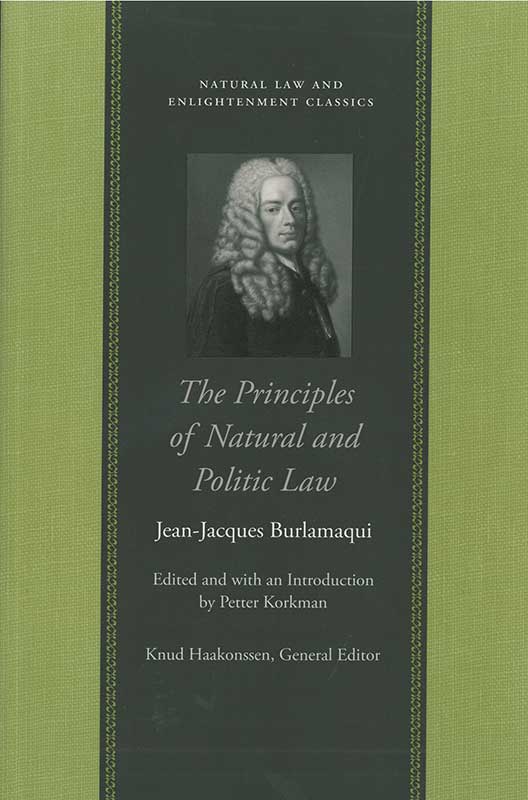
PART II: Of the Law of Nature. - Jean-Jacques Burlamaqui, The Principles of Natural and Politic Law [1747]Edition used:The Principles of Natural and Politic Law, trans. Thomas Nugent, ed. and with an Introduction by Peter Korkman (Indianpolis: Liberty Fund, 2006).
About Liberty Fund:Liberty Fund, Inc. is a private, educational foundation established to encourage the study of the ideal of a society of free and responsible individuals. Copyright information:The copyright to this edition, in both print and electronic forms, is held by Liberty Fund, Inc. Fair use statement:This material is put online to further the educational goals of Liberty Fund, Inc. Unless otherwise stated in the Copyright Information section above, this material may be used freely for educational and academic purposes. It may not be used in any way for profit.
PART IIOf the Law of Nature.CHAPTER IIn what the law of nature consists, and that there is such a thing. First considerations drawn from the existence of God and his authority over us.Subject of this second part.I. After having settled the general principles of law, our business is now to apply them to natural law in particular. The questions we have to examine in this second part are of no less importance than to know, whether man, by his nature and constitution, is really subject to laws properly so called? What are these<126> laws? Who is the superior that imposes them? By what method or means is it possible to know them? From whence results the obligation of observing them? What consequence may follow from our negligence in this respect? And, in fine, what advantage on the contrary may arise from the observance of these laws? II. Let us begin with a proper definition of the terms. By natural law we understand, a law that God imposes on all men, and which they are able to discover and know by the sole light of reason, and by attentively considering their state and nature. Natural law is likewise taken for the system, assemblage, or body of the laws of nature. Natural jurisprudence is the art of attaining to the knowledge of the laws of nature, of explaining and applying them to human actions. Whether there are any natural laws.III. But whether there be really any natural laws, is the first question that presents itself here to our inquiry. In order to make a proper answer, we must ascend to the principles of natural theology, as being the first and true foundation of the law of nature. For when we are asked, whether there are any natural laws, this question cannot be resolved, but by examining the three following articles. 1. Whether there is a God? 2. If there is a God, whether he has a right to impose laws on man? 3. Whether God actually exercises his right in this respect, by really giving us laws, and requiring we should square thereby our actions? These three points will furnish the subject of this and the following chapters.1 <127> Of the existence of God.IV. The existence of God, that is, of a first, intelligent, and self-existent being, on whom all things depend as on their first cause, and who depends himself on no one; the existence, I say, of such a being, is one of those truths that shew themselves to us at the first glance. We have only to attend to the evident and sensible proofs, that present themselves to us, as it were, from all parts. The chain and subordination of causes among themselves, which necessarily requires we should fix on a first cause; the necessity of acknowledging a first mover; the admirable structure and order of the universe; are all so many demonstrations of the existence of God, within the reach of every capacity. Let us unfold them in a few words. First proof. The necessity of a self-existent and intelligent being.V. 1. We behold an infinite number of objects, which form all together the assemblage we call the universe. Something therefore must have always existed. For were we to suppose a time in which there was absolutely nothing, it is evident that nothing could have ever existed; because whatsoever has a beginning, must have a cause of its existence; since nothing can produce nothing.2 It must be therefore acknowledged that there is some eternal being, who exists necessarily and of himself; for he can be indebted to no one else for his origin; and it implies a contradiction that such a being does not exist. Moreover, this eternal being, who necessarily and of himself subsists, is endued with reason and understanding. For to pursue the same manner of arguing, were we to suppose a time in which there was nothing but inanimate beings, it would have been<128> impossible for intelligent beings, such as we now behold, ever to exist. Intellection can no more proceed from a blind and unintelligent cause, than a being, of any kind whatsoever, can come from nothing. There must therefore have always existed a father of spiritual beings, an eternal mind, the source from whence all others derive their existence. Let what system soever be adopted concerning the nature and origin of the soul, our proof subsists still in its full force. Were it even to be supposed that the cogitative part of man is no more than the effect of a certain motion or modification of matter; yet we should still want to know how matter acquired this activity, which is not essential to it, and this particular and so much admired organization, which it cannot impart to itself. We should inquire, who is it that has modified the body in a manner proper to produce such wonderful operations as those of intellection, which reflects, which acts on the very body itself with command, which surveys the earth, and measures the heavens, recollects past transactions, and extends its views to futurity. Such a master-piece must come from the hands of an intelligent cause; wherefore it is absolutely necessary to acknowledge a first, eternal, and intelligent being. We must not seek for this being in this universe.VI. An eternal spirit, who has within himself the principle of his own existence, and of all his faculties, can be neither changed nor destroyed; neither dependent nor limited; he should even be invested with infinite perfection, sufficient to render him the sole and first cause of all, so that we may have no occasion to seek for any other.<129> But does not (some will ask) this quality of an eternal and intelligent being, belong to matter itself, to the visible world, or to some of the parts thereof? I answer, that this supposition is absolutely contrary to all our ideas. Matter is not essentially and of itself intelligent; nor can it be supposed to acquire intellection but by a particular modification received from a cause supremely intelligent.3 Now this first cause cannot have such a modification from any other being; for he thinks essentially and of himself; wherefore he cannot be a material being. Besides, as all the parts of the universe are variable and dependent, how is it possible to reconcile this with the idea of an infinite and all perfect being? As for what relates to man, his dependance and weakness are much more sensible than those of other creatures. Since he has no life of himself, he cannot be the efficient cause of the existence of others. He is unacquainted with the structure of his own body, and with the principle of life; incapable of discovering in what manner motions are connected with ideas, and which is the proper spring of the empire of the will. We must therefore look out for an efficient, primitive, and original cause of mankind, beyond the human chain, be it supposed ever so long; we must trace the cause of each part of the world beyond this material and visible world. Second proof. The necessity of a first mover.VII. 2. After this first proof drawn from the necessity of a first, eternal, and intelligent being, distinct from matter; we proceed to a second, which shews us the Deity in a more sensible manner, and more within the reach of common capacities. The<130> proof I mean, is the contemplation of this visible world, wherein we perceive a motion and order, which matter has not of itself, and must therefore receive from some other being. Motion or active force is not an essential quality of body: extension is of itself rather a passive being; it is easily conceived at rest, and if it has any motion, we may well conceive it may lose it without being stript of its existence; it is a quality or state that passes, and is accidentally communicated from one body to another. The first impression must therefore proceed from an extrinsic cause; and as Aristotle has well expressed it, *The first mover of bodies must not be moveable himself, must not be a body. This has been also agreed to by Hobbes. †But the acknowledging, says he, of one God eternal, infinite, and omnipotent, may more easily be derived, from the desire men have to know the causes of natural bodies, and their several virtues and operations, than from the fear of what was to befall them in time to come. For he that from any effect he seeth come to pass, should reason to the next and immediate cause thereof, and from thence to the cause of that cause, and plunge himself profoundly in the pursuit of causes; shall at last come to this, that there must be (as even the heathen philosophers confessed) one first mover; that is, a first and eternal cause of all things; which is that which men mean by the name of God. Third proof. The structure, order, and beauty of the universe.VIII. 3. But if matter has not been able to move of itself, much less was it capable to move to the<131> exact degree, and with all the determinations, necessary to form such a world as we behold, rather than a confused chaos. In fact, let us only cast our eyes on this universe, and we shall every where discover, even at the first glance, an admirable beauty, regularity, and order; and this admiration will increase in proportion, as in searching more closely into nature, we enter into the particulars of the structure, proportion, and use of each part. For then we shall clearly see, that every thing is relative to a certain end, and that these particular ends, though infinitely varied among themselves, are so dextrously managed and combined, as to conspire all to a general design. Notwithstanding this amazing diversity of creatures, there is no confusion; we behold several thousand different species, which preserve their distinct form and qualities. The parts of the universe are proportioned and balanced, in order to preserve a general harmony; and each of those parts has exactly its proper figure, proportions, situation, and motion, either to produce its particular effect, or to form a beautiful whole. It is evident therefore, that there is a design, a choice, a visible reason in all the works of nature; and consequently there are marks of wisdom and understanding, obvious, as it were, even to our very senses. The world is not the effect of chance.IX. Though there have been some philosophers who have attributed all these phaenomena to chance, yet this is so ridiculous a thought, that I question whether a more extravagant chimera ever entered into the mind of man. Is it possible for any one<132> to persuade himself seriously, that the different parts of matter having been set in some unaccountable manner in motion, produced of themselves the heavens, the stars, the earth, the plants, and even animals and men, and whatever is most regular in the organization? A man that would pass the like judgment on the least edifice, on a book or picture, would be looked upon as a mad extravagant person. How much more shocking is it to common sense, to attribute to chance so vast a work, and so wonderful a composition as this universe? It is not eternal.X. It would be equally frivolous to alledge the eternity of the world, in order to exclude a first intelligent cause. For besides the marks of novelty we meet with in the history of mankind, as the origin of nations and empires, and the invention of arts and sciences, &c. besides the assurance we have from the most general and most ancient tradition that the world has had a beginning (a tradition which is of great weight in regard to a matter of fact, like this) besides, I say, all this, the very nature of the thing does not allow us to admit of this hypothesis no more than that of chance. For the question is still to explain whence comes this beautiful order, this regular structure and design, in a word, whence proceed those marks of reason and wisdom that are so visibly displayed in all parts of the universe. To say that it has been always so, without the intervention of an intelligent cause, does not explain the thing, but leaves us in the same embarrassment, and advances the same absurdity as those<133> who a while ago were speaking to us of chance. For this is in reality telling us that whatever we behold throughout the universe, is blindly ranged, without design, choice, cause, reason, or understanding. Hence the principal absurdity of the hypothesis of chance, occurs likewise in this system; with this difference only, that by establishing the eternity of the world, they suppose a chance that from all eternity hit upon order; whereas those who attribute the formation of the world to the fortuitous junction of its parts, suppose that chance did not succeed till a certain time, when it fell in at length with order after an infinite number of trials and fruitless combinations. Both acknowledge therefore no other cause but chance, or properly speaking they acknowledge none at all; for chance is no real cause, it is a word that cannot account for a real effect, such as the arrangement of the universe. It would not be a difficult matter to carry these proofs to a much greater length, and even to increase them with an additional number. But this may suffice for a work of this kind; and the little we have said, intitles us, methinks, to establish the existence of a First Cause, or of a Creator, as an incontestable truth, that may serve henceforward for the basis of all our reasonings. God has a right to prescribe laws to man.XI. As soon as we have acknowledged a Creator, it is evident, that he has a supreme right to lay his commands on man, to prescribe rules of conduct to him, and to subject him to laws; and it is no less evident, that man on his side finds himself, by his natural constitution, under an ob-<134>ligation of subjecting his actions to the will of this supreme Being. We have already shewn,* that the true foundation of sovereignty in the person of the sovereign, is power united with wisdom and goodness; and that, on the other hand, weakness and wants in the subjects, are the natural cause of dependance. We have only therefore to see, whether all these qualities of the sovereign are to be found in God; and whether men, on their side, are in a state of infirmity and wants, so as to depend necessarily on him for their happiness. This is a consequence of his power, wisdom, and goodness.XII. It is beyond doubt, that he who exists necessarily and of himself, and has created the universe, must be invested with an infinite power. As he has given existence to all things by his own will, he may likewise preserve, annihilate, or change them as he pleases. But his wisdom is equal to his power. Having made every thing, he must know every thing, as well the causes as the effects from thence resulting. We see besides in all his works the most excellent ends, and a choice of the most proper means to attain them; in short, they all bear, as it were, the stamp of wisdom. XIII. Reason informs us, that God is a being essentially good; a perfection which seems to flow naturally from his wisdom and power. For how is it possible for a being, who of his nature is infinitely wise and powerful, to have any inclination to hurt? Surely no sort of reason can ever determine him to it. Malice, cruelty, and injustice, are always a con-<135>sequence of ignorance or weakness.4 Let man therefore consider but never so little the things which surround him, and reflect on his own constitution, he will discover both within and without himself the benevolent hand of his Creator, who treats him like a father. It is from God we hold our life and reason; it is he that supplies most abundantly our wants, adding the useful to the necessary, and the agreeable to the useful. Philosophers observe, that whatever contributes to our preservation, has been arrayed with some agreeable quality.* Nourishment, repose, action, heat, cold, in short, whatever is useful to us, pleases us in its turn, and so long as it is useful. Should it cease to be so, because things are carried to a dangerous excess, we have notice therefore by an opposite sensation. The allurement of pleasure invites us to use them when they are necessary for our wants; disrelish and lassitude induce us to abstain from them, when they are likely to hurt us. Such is the happy and sweet oeconomy of nature, which annexes a pleasure to the moderate exercise of our senses and faculties, insomuch that whatever surrounds us becomes a source of satisfaction, when we know how to use it with discretion. What can be more magnificent, for example, than this great theatre of the world in which we live, and this glittering decoration of heaven and earth, exhibiting a thousand agreeable objects to our view? What<136> satisfaction does not the mind receive from the sciences, by which it is exercised, inlarged, and improved? What conveniences do not we draw from human industry? What advantages do not we derive from an intercourse with our equals! What charms in their conversation! What sweetness in friendship, and the other connexions of the heart! When we avoid the excess and abuse of things, the greatest part of human life abounds with agreeable sensations. And if to this we add, that the laws which God gives us, tend, as hereafter we shall see, to perfect our nature, to prevent all kind of abuse, and to confine us to a moderate use of the good things of life, on which the preservation, excellence, and happiness, as well public as private, of man depends; what more is there wanting to convince us, that the goodness of God is not inferior either to his wisdom or power? We have therefore a superior undoubtedly invested with all the qualities necessary to found the most legitimate and most extensive authority: And since on our side experience shews us, that we are weak and subject to divers wants; and since every thing we have, we have from him, and he is able either to augment or diminish our enjoyments; it is evident, that nothing is wanting here to establish on the one side the absolute sovereignty of God, and on the other our unlimited dependance.<137> CHAPTER IIThat God, in consequence of his authority over us, has actually thought proper to prescribe to us laws or rules of conduct.God exercises his authority over us, by prescribing laws to us.I. To prove the existence of God, and our dependance in respect to him, is establishing the right he has of prescribing laws to man. But this is not sufficient; the question is, whether he has actually thought proper to exercise this right. He can undoubtedly impose laws on us; but has he really done it? and though we depend on him for our life, and for our physical faculties, has he not left us in a state of independance in respect to the moral use to which we are to apply them? This is the third and capital point we have still left to examine. First proof, drawn from the very relations of which we have been speaking.II. 1. We have made some progress already in this research, by discovering all the circumstances necessary to establish an actual legislature. On the one side we find a superior, who by his nature is possessed in the very highest degree of all the conditions requisite to establish a legitimate authority; and on the other we behold man, who is God’s creature, endowed with understanding and liberty, capable of acting with knowledge and choice, sensible of pleasure and pain, susceptible of good and evil, of rewards and punishments. Such an aptitude of giving and receiving laws cannot be useless. This concurrence of relations and circumstances undoubtedly denotes an end, and must have<138> some effect; just as the particular organization of the eye shews we are destined to see the light. Why should God have made us exactly fit to receive laws, if he intended none for us? This would be creating so many idle and useless faculties. It is therefore not only possible, but very probable, that our destination in general is such, unless the contrary should appear from much stronger reasons. Now instead of there being any reason to destroy this first presumption, we shall see that every thing tends to confirm it.1 Second proof, drawn from the end which God proposed to himself with respect to man, and from the necessity of moral laws, to accomplish this end.III. 2. When we consider the beautiful order which the supreme wisdom has established in the physical world, it is impossible to persuade ourselves, that he has abandoned the spiritual or moral world to chance and disorder. Reason, on the contrary, tells us, that a wise being proposes to himself a reasonable end in every thing he does, and that he uses all the necessary means to attain it. The end which God had in view with regard to his creatures, and particularly with respect to man, cannot be any other, on the one side, than his glory; and on the other, the perfection and happiness of his creatures, so far as their nature or constitution will admit. These two views, so worthy of the Creator, are perfectly combined. For the glory of God consists in manifesting his perfections, his power, his goodness, wisdom, and justice; and these virtues are nothing else but the love of order and of the good of the whole. Thus a being absolutely perfect and supremely happy, willing to conduct man to that state of order and happiness which suits his nature, cannot but be willing at the same time to employ whatever is necessary for<139> such an end; and consequently he must approve of those means that are proper, and disapprove of such as are improper for attaining it. Had the constitution of man been merely physical or mechanical, God himself would have done whatever is expedient for his work: But man being a free and intelligent creature, capable of discernment and choice; the means which the Deity uses to conduct him to his end, ought to be proportioned to his nature, that is, such as man may engage in, and concur with, by his own actions. Now as all means are not equally fit to conduct us to a certain end, all human actions cannot therefore be indifferent. Plain it is, that every action, contrary to the ends which God has proposed, is not agreeable to the divine Majesty; and that he approves, on the contrary, those which of themselves are proper to promote his ends. Since there is a choice to be made, who can question but our Creator is willing we should take the right road; and that, instead of acting fortuitously and rashly, we should behave like rational creatures, by exercising our liberty, and the other faculties he has given us, in the manner most agreeable to our state and destination, in order to promote his views, and to advance our own happiness, together with that of our fellow-creatures?2 Confirmation of the preceding proofs.IV. These considerations assume a new force, when we attend to the natural consequences of the opposite system. What would become of man and society, were every one to be so far master of his actions, as to do every thing he listed, without having any<140> other principle of conduct than caprice or passion? Let us suppose, that God abandoning us to ourselves, had not actually prescribed any rules of life, or subjected us to laws; most of our talents and faculties would be of no manner of use to us. To what purpose would it be for man to have the light of reason, were he to follow only the impulse of instinct, without watching over his conduct? What would it avail him to have the power of suspending his judgment, were he to yield stupidly to the first impressions? And of what service would reflexion be, were he neither to chuse nor deliberate; and were he, instead of listening to the counsels of prudence, to be hurried away by blind inclinations? These faculties, which form the excellence and dignity of our nature, would not only be rendered hereby entirely frivolous, but, moreover, would become prejudicial even by their excellence; for the higher and nobler the faculty is, the more the abuse of it proves dangerous. This would be not only a great misfortune for man considered alone, and in respect to himself; but would still prove a greater evil to him when viewed in the state of society. For this more than any other state requires laws, to the end that each person may set limits to his pretensions, without invading another man’s right. Were it otherwise, licentiousness must be the consequence of independance. To leave men abandoned to themselves, is leaving an open field to the passions, and paving the way for injustice, violence, perfidy and cruelty. Take away natural laws, and that moral tie which supports justice and honesty in a whole nation, and establishes<141> also particular duties either in families, or in the other relations of life; man would be then the most savage and ferocious of all animals. The more dexterous and artful he is, the more dangerous he would prove to his equals; his dexterity would degenerate into craft, and his art into malice. Then we should be divested of all the advantages and sweets of society; and thrown into a state of war and libertinism.3 Third proof, drawn from the goodness of God.V. 3. Were any one to say, that man himself would not fail to remedy these disorders, by establishing laws in society; (beside that human laws would have very little force were they not founded on the principles of conscience); this remark shews there is a necessity for laws in general, whereby we gain our cause. For if it be agreeable to the order of reason that men should establish a rule of life among themselves, in order to be screened from the evils they might apprehend from one another, and to procure those advantages that are capable of forming their private and public happiness; this alone ought to convince us, that the Creator, infinitely wiser and better than ourselves, must have undoubtedly pursued the same method. A good parent that takes care to direct his children by his authority and counsels, is able to preserve peace and order in his family; is it then to be imagined, that the common father of mankind should neglect to give us the like assistance? and if a wise sovereign has nothing so much at heart as to prevent licentiousness by salutary regulations; how can any one believe that God, who is a much greater friend to man than man is to his equals, has left all mankind without direction and<142> guide, even on the most important matters, on which our whole happiness depends? Such a system would be no less contrary to the goodness than to the wisdom of God. We must therefore have recourse to other ideas, and conclude that the Creator having, through a pure effect of his bounty, created man for happiness, and having implanted in him an insuperable inclination to felicity, subjecting him at the same time to live in society, he must have given him also such principles as are capable of inspiring him with a love of order, and rules to point out the means of procuring and attaining it. Fourth proof, drawn from the principles of conduct which we actually find within ourselves.VI. 4. But let us enter into ourselves, and we shall actually find, that what we ought to expect in this respect from the divine wisdom and goodness, is dictated by right reason,4 and by the principles engraved in our hearts. If there be any speculative truths that are evident, or if there be any certain axioms that serve as a basis to sciences; there is no less certainty in some principles that are laid down in order to direct our conduct, and to serve as the foundation of morality. For example; That the all-wise and all bountiful Creator merits the respects of the creature: That man ought to seek his own happiness: That we should prefer the lesser to the greater evil: That a benefit deserves a grateful acknowledgment: That the state of order excels that of disorder, &c. Those maxims, and others of the same sort, differ very little in evidence from these, The whole is greater than its part; or the cause precedes the effect, &c. Both are dictated by pure reason; and hence we feel ourselves<143> forced, as it were, to give our assent to them. These general principles are seldom contested; if there be any dispute, it relates only to their application and consequences. But so soon as the truth of those principles is discovered, their consequences, whether immediate or remote, are entirely as certain, provided they be well connected; the whole business being to deduce them by a train of close and conclusive argumentations. These principles are obligatory of themselves.VII. In order to be sensible of the influence which such principles, with their legitimate consequences, ought to have over our conduct, we have only to recollect what has been already said in the first part of this work,* concerning the obligation we are under of following the dictates of reason. As it would be absurd in speculative matters, to speak and judge otherwise than according to that light which makes us discern truth from falshood; so it would be no less preposterous to deviate in our conduct from those certain maxims which enable us to discern good from evil. When once it is manifest, that a particular manner of acting is suitable to our nature, and to the great end we have in view; and that another, on the contrary, does not suit our constitution or happiness; it follows, that man, as a free and rational creature, ought to be very attentive to this difference, and to take his resolutions accordingly. He is obliged to it by the very nature of the thing; because it is absolutely necessary when a person is desirous of the end, to be desirous also of the means; and he is obliged to it moreover, because he cannot mistake the intention and will of his superior in this respect.<144> They are obligatory by the divine will, and thus become real laws.VIII. In effect God being the author of the nature of things, and of our constitution, if, in consequence of this nature and constitution, we are reasonably determined to judge after a certain manner, and to act according to our judgment, the Creator sufficiently manifests his intention, so that we can no longer be ignorant of his will. The language therefore of reason is that of God himself. When our reason tells us so clearly, that we must not return evil for good, it is God himself, who by this internal oracle gives us to understand what is good and just, what is agreeable to him and suitable to ourselves. We said that it is not at all probable, that the good and wise Creator should have abandoned man to himself, without a guide and direction for his conduct. We have here a direction that comes from him; and since he is invested in the very highest degree, as we have already observed, with the perfections on which a legitimate superiority is founded, who can pretend to question that the will of such a superior is a law to us? The reader, I suppose, has not forgot the conditions requisite to constitute a law; conditions that are all to be met with in the present case. 1. There is a rule. 2. This rule is just and useful. 3. It comes from a superior on whom we entirely depend. 4. In fine, it is sufficiently made known to us, by principles engraved in our hearts, and even by our own reason. It is therefore a law properly so called, which we are really obliged to observe. But let us inquire a little further, by what means this natural law is discovered, or, which amounts to the same thing, from what<145> source we must derive it. What we have hitherto proved only in a general manner, will be further illustrated and confirmed by the particulars on which we are now going to inlarge. For nothing can be a stronger proof of our having hit upon the true principles, than when unfolding and considering them in their different branches, we find they are always conformable to the nature of things. CHAPTER IIIOf the means by which we discern what is just and unjust, or what is dictated by natural law; namely, 1. moral instinct, and 2. reason.First means of discerning moral good and evil, namely, instinct or inward sense.I. What has been said in the preceding chapter already shews, that God has invested us with two means of perceiving or discerning moral good and evil; the first is only a kind of instinct; the second is reason or judgment. Moral instinct I call that natural bent or inclination which prompts us to approve of certain things as good and commendable, and to condemn others as bad and blameable, independent of reflexion. Or if any one has a mind to distinguish this instinct by the name of moral sense, as Mr. Hutchinson has done, I shall then say, that it is a faculty of the mind, which instantly discerns, in certain cases, moral good and evil, by a kind of sensation and taste, independent of reason and reflexion.1 <146> Examples.II. Thus at the sight of a man in misery or pain, we feel immediately a sense of compassion, which prompts us to relieve him. The first emotion that strikes us, after receiving a benefit, is to acknowledge the favour, and to thank our benefactor. The first disposition of one man towards another, abstracting from any particular reason he may have of hatred or fear, is a sense of benevolence, as towards his fellow-creature, with whom he finds himself connected by a conformity of nature and wants. We likewise observe, that without any great thought or reasoning, a child, or untutored peasant, is sensible that ingratitude is a vice, and exclaims against perfidy, as a black and unjust action, which highly shocks him, and is absolutely repugnant to his nature. On the contrary, to keep one’s word, to be grateful for a benefit, to pay every body their due, to honour our parents, to comfort those who are in distress or misery, are all so many actions which we cannot but approve and esteem as just, good, honest, beneficent, and useful to mankind. Hence the mind is pleased to see or hear such acts of equity, sincerity, humanity, and beneficence; the heart is touched and moved; and reading them in history we are seized with admiration, and extol the happiness of the age, nation, or family, distinguished by such noble examples. As for criminal instances, we cannot see or hear them mentioned, without contempt or indignation. Whence these sensations proceed.III. If any one should ask, from whence comes this emotion of the heart, which prompts us, almost<147> without any reasoning or inquiry, to love some actions and to detest others; the only answer I am able to give, is, that it proceeds from the author of our being, who has formed us after this manner, and whom it has pleased that our nature or constitution should be such, that the difference of moral good and evil should, in some cases, affect us exactly in the same manner as physical good and evil. It is therefore a kind of instinct, like several others which nature has given us, in order to determine us with more expedition and vigour, where reflexion would be too slow. It is thus we are informed of our corporeal wants by our inward sense; while our outward senses acquaint us with the quality of the objects that may be useful or prejudicial to us, in order to lead us, as it were, mechanically to whatever is requisite for our preservation. Such is also the instinct that attaches us to life, and the desire of happiness, the primum mobile of all our actions. Such is likewise the almost blind, but necessary tenderness of parents towards their children. The pressing and indispensable wants of man required he should be directed by the way of sense, which is always quicker and readier than that of reason. Of what use they are to us.IV. God has therefore thought proper to use this method in respect to the moral conduct of man, by imprinting within us a sense or taste of virtue and justice, which anticipates, in some measure, our reason, decides our first motions, and happily supplies, in most men, the want of attention or reflexion. For what numbers of people would never<148> trouble their heads with reflecting? What multitudes are there of stupid wretches, that lead a mere animal life, and are scarce able to distinguish three or four ideas, in order to form what is called a ratiocination? It was therefore our particular advantage, that the Creator should give us a discernment of good and evil, with a love for the one, and an aversion for the other, by means of a quick and lively kind of faculty, which has no necessity to wait for the speculations of the mind. Objection: These sensations are not found in all men. Answer: 1. We find some traces of them among the most savage people.V. If any one should dispute the reality of these sensations, by saying they are not to be found in all men, because there are savage people who seem to have none at all; and even among civilized nations we meet with such perverse and stubborn minds, as do not appear to have any notion or sense of virtue: I answer, 1. that the most savage people have nevertheless the first ideas above mentioned; and if there are some who seem to give no outward signs or demonstrations thereof, this is owing to our not being sufficiently acquainted with their manners; or because they are intirely stupified, and have stifled almost all sentiments of humanity; or, in fine, by reason that in some respects they fall into an abuse contrary to these principles, not by rejecting them positively, but through some prejudice that has prevailed over their good sense and natural rectitude, and inclines them to make a bad application of these principles. For example, we see savages who devour their enemies whom they have made prisoners, imagining it to be the right of war, and that since they have liberty to kill them, nothing ought to hin-<149>der them from benefiting by their flesh, as their proper spoils. But those very savages would not treat in that manner their friends or countrymen: They have laws and rules among themselves; sincerity and plain dealing are esteemed there as in other places, and a grateful heart meets with as much commendation among them as with us. 2. We must distinguish between the natural state of man, and that of his depravation.VI. 2. With regard to those who in the most enlightened and civilized countries seem to be void of all shame, humanity, or justice, we must take care to distinguish between the natural state of man, and the depravation into which he may fall by abuse, and in consequence of irregularity and debauch. For example, what can be more natural than paternal tenderness? And yet we have seen men who seemed to have stifled it, through violence of passion, or by force of a present temptation, which suspended for a while this natural affection. What can be stronger than the love of ourselves and of our own preservation? It happens, nevertheless, that whether through anger, or some other motion which throws the soul out of its natural position, a man tears his own limbs, squanders his substance, or does himself some great prejudice, as if he were bent on his own misery and destruction. 3. If there be any monsters in the moral order, they are very rare, and no consequence can be drawn from them.VII. 3. In fine, if there are people, who cooly, and without any agitation of mind, seem to have divested themselves of all affection and esteem for virtue; (besides, that monsters like these are as rare, I hope, in the moral as in the physical world); we only see thereby the effects of an exquisite and inveterate de-<150>pravation. For man is not born thus corrupted; but the interest he has in excusing and palliating his vices, the habit he has contracted, and the sophistical arguments to which he has recourse, may stifle, in fine, or corrupt the moral sense of which we have been speaking; as we see that every other faculty of the soul or body may by long abuse be altered or corrupted. Happily nevertheless we observe, that our spiritual senses are less subject than our corporeal ones to depravity and corruption. The principle is almost always preserved; it is a fire, that when it seems even to be extinct, may kindle again and throw out some glimmerings of light, as we have seen examples in very profligate men, under particular conjunctures. Second means of discerning moral good and evil; which is reason.VIII. But notwithstanding God has implanted in us this instinct or sense, as the first means of discerning moral good and evil, yet he has not stopt here; he has also thought proper that the same light which serves to direct us in every thing else, that is, reason, should come to our assistance, in order to enable us the better to discern and comprehend the true rules of conduct. Reason I call the faculty of comparing ideas, of investigating the mutual relations of things, and from thence inferring just consequences. This noble faculty, which is the directress of the mind, serves to illustrate, to prove, to extend, and apply what our natural sense already gave us to understand, in relation to justice and injustice. As reflexion, instead of diminishing paternal tenderness, tends to strengthen it, by making us observe how agreeable it is to the relation of father and son, to the advantage<151> not only of a family, but of the whole species; in like manner the natural sense we have of the beauty and excellence of virtue, is considerably improved by the reflexions we are taught by reason, in regard to the foundations, motives, relations, and the general as well as particular uses of this same virtue, which seemed so beautiful to us at first sight. First advantage of reason in respect to instinct; it serves to verify it.IX. We may even affirm, that the light of reason has three advantages here in respect to this instinct or sense. 1. It contributes to prove its truth and exactness; in the same manner as we observe in other things that study and rules serve to verify the exactness of taste, by shewing us it is neither blind nor arbitrary, but founded on reason, and directed by principles: or as those who are quick-sighted, judge with greater certainty of the distance or figure of an object, after having compared, examined, and measured it quite at their leisure, than if they had depended intirely on the first sight. We find likewise that there are opinions and customs, which make so strong and so general an impression on our minds, that to judge of them only by the sentiment they excite, we should be in danger of mistaking prejudice for truth. It is reason’s province to rectify this erroneous judgment, and to counterbalance this effect of education, by setting before us the true principles on which we ought to judge of things. Second advantage: it unfolds the principles, and from thence infers proper consequences.X. 2. A second advantage which reason has in respect to simple instinct, is, that it unfolds the ideas better, by considering them in all their relations<152> and consequences. For we frequently see that those, who have had only the first notion, find themselves embarrassed and mistaken, when they are to apply it to a case of the least delicate or complicated nature. They are sensible indeed of the general principles, but they do not know how to follow them through their different branches, to make the necessary distinctions or exceptions, or to modify them according to time and place. This is the business of reason, which it discharges so much the better, in proportion as there is care taken to exercise and improve it. Third advantage: reason is an universal means, and applicable to all cases.XI. 3. Reason not only carries its views farther than instinct, with respect to the unfolding and application of principles; but has also a more extensive sphere, in regard to the very principles it discovers, and the objects it embraces. For instinct has been given us only for a small number of simple cases, relative to our natural state, and which require a quick determination. But besides those simple cases, where it is proper that man should be drawn and determined by a first motion; there are cases of a more composite nature, which arise from the different states of man, from the combination of certain circumstances, and from the particular situation of each person; on all which it is impossible to form any rules but by reflexion, and by an attentive observation of the relations and agreements of each thing. Such are the two faculties with which God has invested us, in order to enable us to discern between good and evil. These faculties happily joined, and subordinate one to the other, concur to the same effect. One gives the first notice, the other verifies<153> and proves it; one acquaints us with the principles, the other applies and unfolds them; one serves for a guide in the most pressing and necessary cases, the other distinguishes all sorts of affinity or relation, and lays down rules for the most particular cases. It is thus we are enabled to discern what is good and just, or, which amounts to the same thing, to know what is the divine will, in respect to the moral conduct we are to observe. Let us unite at present these two means, in order to find the principles of the law of nature. CHAPTER IVOf the principles from whence reason may deduce the law of nature.*From whence are we to deduce the principles of the law of nature?I. If we should be afterwards asked, what principles ought reason to make use of, in order to judge of what relates to the law of nature,1 and to deduce or unfold it? our answer is in general, that we have only to attend to the nature of man, and to his states or relations; and as these relations are different, there may be likewise different principles, that lead us to the knowledge of our duties. But before we enter upon this point, it will be proper to make some preliminary remarks on what we call principles of natural law; in order to prevent the ambiguity or equivocation, that has often entangled this subject.<154> Preliminary remarks. What we understand by principles of natural law.II. 1. When we inquire here, which are the first principles of natural law, the question is, which are those truths or primitive rules, whereby we may effectually know the divine will in regard to man; and thus arrive, by just consequences, to the knowledge of the particular laws and duties which God imposes on us by right reason? 2. We must not therefore confound the principles here in question, with the efficient and productive cause of natural laws, or with their obligatory principle.2 It is unquestionable, that the will of the supreme Being is the efficient cause of the law of nature, and the source of the obligation from thence arising. But this being taken for granted, we have still to inquire how man may attain to the knowledge of this will, and to the discovery of those principles, which acquainting us with the divine intention, enable us to reduce from thence all our particular duties, so far as they are discoverable by reason only. A person asks, for example, whether the law of nature requires us to repair injuries, or to be faithful to our engagements? If we are satisfied with answering him, that the thing is incontestable, because so it is ordered by the divine will; it is plain that this is not a sufficient answer to his question; and that he may reasonably insist to have a principle pointed out, which should really convince him that such in effect is the will of the Deity; for this is the point he is in search of. Character of those principles.III. Let us afterwards observe, that the first principles of natural laws, ought to be not only true,<155> but likewise simple, clear, sufficient, and proper for those laws. They ought to be true; that is, they should be taken from the very nature and state of the thing. False or hypothetic principles must produce consequences of the same nature; for a solid edifice can never be raised on a rotten foundation. They ought to be simple and clear of their own nature, or at least easy to apprehend and unfold. For the laws of nature being obligatory for all mankind, their first principles should be within every body’s reach, so that whosoever has common sense may be easily acquainted with them. It would be very reasonable therefore to mistrust principles that are far-fetched, or of too subtle and metaphysical a nature. I add, that these principles ought to be sufficient and universal. They should be such as one may deduce from thence, by immediate and natural consequences, all the laws of nature, and the several duties from thence resulting; insomuch that the exposition of particulars be properly only an explication of the principles; in the same manner, pretty near, as the production or increase of a plant is only an unfolding of the seed. And as most natural laws are subject to divers exceptions, it is likewise necessary that the principles be such as include the reasons of the very exceptions; and that we may not only draw from thence all the common rules of morality, but that they also serve to restrain these rules, according as place, time, and occasion require. In fine, those first principles ought to be established in such a manner, as to be really the proper and<156> direct foundation of all the duties of natural law; insomuch that whether we descend from the principle to deduce the consequences, or whether we ascend from the consequences to the principle, our reasonings ought always to be immediately connected, and their thread, as it were, never interrupted. Whether we ought to reduce the whole to one single principle.IV. But, generally speaking, it is a matter of mere indifference, whether we reduce the whole to one single principle, or establish a variety of them. We must consult and follow in this respect a judicious and exact method. All that can be said on this head, is, that it is not at all necessary to the solidity or perfection of the system, that all natural laws be deduced from one single and fundamental maxim: nay, perhaps the thing is impossible. Be that as it may, it is idle to endeavour to reduce the whole to this unity.3 Such are the general remarks we had to propose. If they prove just, we should reap this double advantage from them, that they will instruct us in the method we are to follow, in order to establish the true principles of natural law; and at the same time they will enable us to pass a solid judgment on the different systems concerning this subject. But it is time now to come to the point. Man cannot attain to the knowledge of natural laws, but by examining his nature, constitution, and state.V. The only way to attain to the knowledge of natural law, is to consider attentively the nature and constitution of man, the relations he has to the beings that surround him, and the states from thence resulting. In fact, the very term of natural law, and the notion we have given of it, shew that the<157> principles of this science must be taken from the very nature and constitution of man. We shall therefore lay down two general propositions, as the foundation of the whole system of the law of nature. First Proposition.Whatever is in the nature and original constitution of man, and appears a necessary consequence of this nature and constitution, certainly indicates the intention or will of God with respect to man, and consequently acquaints us with the law of nature. Second Proposition.But in order to have a complete system of the law of nature, we must not only consider the nature of man, such as it is in itself; it is also necessary to attend to the relations he has to other beings, and to the different states from thence arising: otherwise it is evident we should have only an imperfect and defective system. We may therefore affirm, that the general foundation of the system of natural law, is the nature of man considered under the several circumstances that attend it, and in which God himself has placed him for particular ends; inasmuch as by this means we may be acquainted with the will of God. In short, since man holds from the hand of God himself whatever he possesses, as well with regard to his existence, as to his manner of existing; it is the study of human nature only, that can fully instruct us concerning the views which God proposed to himself in giving<158> us our being, and consequently with the rules we ought to follow, in order to accomplish the designs of the Creator. Three states of man.VI. For this purpose we must recollect what has been already said, of the manner in which man may be considered under three different respects or states, which embrace all his particular relations. In the first place we may consider him as God’s creature, from whom he has received his life, his reason, and all the advantages he enjoys. Secondly, man may be considered in himself as a being, composed of body and soul, and endowed with many different faculties; as a being that naturally loves himself, and necessarily desires his own felicity. In fine, we may consider him as forming a part of the species, as placed on the earth near several other beings of a similar nature, and with whom he is inclined, nay, by his natural condition, obliged to live in society.4 Such, in fact, is the system of humanity, from whence results the most common and natural distinction of our duties, taken from the three different states here mentioned; duties towards God, towards ourselves, and towards the rest of mankind.* Religion: principle of the natural laws, that have God for their object.VII. In the first place, since reason brings us acquainted with God as a self-existent being, and so-<159>vereign Lord of all things, and in particular as our creator, preserver, and benefactor; it follows therefore that we ought necessarily to acknowledge the sovereign perfection of this supreme Being, and our absolute dependance on him: which by a natural consequence inspires us with sentiments of respect, love, and fear, and with an intire submission to his will. For why should God have thus manifested himself to mankind, were it not that their reason should teach them to entertain sentiments proportioned to the excellence of his nature, that is, they should honour, love, adore, and obey him?5 Consequences of this principle.VIII. Infinite respect is the natural consequence of the impression we receive from a prospect of all the divine perfections. We cannot refuse love and gratitude to a being supremely beneficent. The fear of displeasing or offending him, is a natural effect of the idea we entertain of his justice and power, and obedience cannot but follow from the knowledge of his legitimate authority over us, of his bounty, and supreme wisdom, which are sure to conduct us by the road most agreeable to our nature and happiness. The assemblage of these sentiments, deeply engraved in the heart, is called Piety. Piety, if it be real, will shew itself externally two different ways, by our morals, and by outward worship. I say, 1. by our morals, because a pious man, sincerely penetrated with the abovementioned sentiments, will find himself naturally inclined to speak and act after the manner he knows to be most conformable to the divine will and perfections: this is his rule and model; from whence the practice of the most excellent virtues arises.<160> 2. But besides this manner of honouring God, which is undoubtedly the most necessary and most real, a religious man will consider it as a pleasure and duty to strengthen himself in these sentiments of piety, and to excite them in others. Hence external worship, as well public as private, is derived. For whether we consider this worship as the first and almost only means of exciting, entertaining, and improving religious and pious sentiments in the mind; or whether we look upon it as a homage, which men, united by particular or private societies, pay in common to the Deity; or whether, in fine, both these views are joined, reason represents it to us as a duty of indispensable necessity.6 This worship may vary indeed in regard to its form; yet there is a natural principle which determines its essence, and preserves it from all frivolous and superstitious practices; viz. that it consists in instructing mankind, in rendering them pious and virtuous, and in giving them just ideas of the nature of God, as also of what he requires from his creatures. The different duties here pointed out, constitute what we distinguish by the name of Religion. We may define it, a connexion which attaches man to God, and to the observance of his laws, by those sentiments of respect, love, submission, and fear, which the perfections of a supreme Being, and our intire dependance on him, as an all-wise, and all-bountiful Creator, are apt to excite in the human mind. Thus by studying our nature and state, we find, in the relation we have to the Deity, the proper principle from whence those duties of natural law, that have God for their object, are immediately derived.<161> Self-love: the principle of those natural laws which concern ourselves.IX. If we search afterwards for the principle of those duties that regard ourselves, it will be easy to discover them, by examining the internal constitution of man, and inquiring into the Creator’s views in regard to him, in order to know for what end he has endowed him with those faculties of mind and body that constitute his nature. Now it is evident, that God, by creating us, proposed our preservation, perfection, and happiness. This is what manifestly appears, as well by the faculties with which man is invested, which all tend to the same end; as by the strong inclination that prompts us to pursue good, and shun evil. God is therefore willing, that every one should labour for his own preservation and perfection, in order to acquire all the happiness of which he is capable according to his nature and state. This being premised, we may affirm that self-love (I mean an enlightened and rational love of ourselves) may serve for the first principle with regard to the duties which concern man himself; inasmuch as this sensation being inseparable from human nature, and having God for its author, gives us clearly to understand in this respect the will of the supreme Being.7 Yet we should take particular notice, that the love of ourselves cannot serve us as a principle and rule, but inasmuch as it is directed by right reason, according to the exigencies or necessities of our nature and state. For thus only it becomes an interpreter of the Creator’s will in respect to us; that is, it ought to be managed in such a manner, as not to offend the laws of religion or society. Otherwise this self-love<162> would become the source of a thousand iniquities; and so far from being of any service, would prove a snare to us, by the prejudice we should certainly receive from those very iniquities. Natural laws derived from this principle.X. From this principle, thus established, it is easy to deduce the natural laws and duties that directly concern us. The desire of happiness is attended, in the first place, with the care of our preservation. It requires next, that (every thing else being equal) the care of the soul should be preferred to that of the body. We ought not to neglect to improve our reason, by learning to discern truth from falshood, the useful from the hurtful, in order to acquire a just knowledge of things that concern us, and to form a right judgment of them. It is in this that the perfection of the understanding, or wisdom, consists. We should afterwards be determined, and act constantly according to this light, in spite of all contrary suggestion and passion. For it is properly this vigour or perseverance of the soul, in following the counsels of wisdom, that constitutes virtue, and forms the perfection of the will, without which the light of the understanding would be of no manner of use. From this principle all the particular rules arise. You ask, for example, whether the moderation of the passions be a duty imposed upon us by the law of nature? In order to give you an answer, I inquire, in my turn, whether it is necessary to our preservation, perfection, and happiness? If it be, as undoubtedly it is, the question is decided. You have a mind to know whether the love of occupation, the discerning between permitted and forbidden<163> pleasures, and moderation in the use of such as are permitted, whether, in fine, patience, constancy, resolution, &c. are natural duties; I shall always answer, by making use of the same principle; and, provided I apply it well, my answer cannot but be right and exact; because the principle conducts me certainly to the end, by acquainting me with the will of God. Man is made for society.XI. There remains still another point to investigate, namely, the principle from whence we are to deduce those natural laws that regard our mutual duties, and have society for their object. Let us see whether we cannot discover this principle, by pursuing the same method. We ought always to consult the actual state of things, in order to take their result. I am not the only person upon earth; I find myself in the middle of an infinite number of other men, who resemble me in every respect; and I am subject to this state, even from my nativity, by the very act of providence. This induces me naturally to think, it was not the intention of God that each man should live single and separate from the rest; but that, on the contrary, it was his will they should live together, and be joined in society. The Creator might certainly have formed all men at the same time, though separated from one another, by investing each of them with the proper and sufficient qualities for this kind of solitary life. If he has not followed this plan, it is probably because it was his will that the ties of consanguinity and birth should begin to form a more extensive union, which he was pleased to establish amongst men.<164> The more I examine, the more I am confirmed in this thought. Most of the faculties of man, his natural inclinations, his weakness, and wants, are all so many indubitable proofs of this intention of the Creator. 1. Society is absolutely necessary for man.XII. Such in effect is the nature and constitution of man, that out of society he could neither preserve his life, nor display and perfect his faculties and talents, nor attain any real and solid happiness. What would become of an infant, were there not some benevolent and assisting hand to provide for his wants? He must perish, if no one takes care of him; and this state of weakness and ignorance requires even a long and continued assistance. View him when grown up to manhood, you find nothing but rudeness, ignorance, and confused ideas, which he is scarce able to convey; abandon him to himself, and you behold a savage, and perhaps a ferocious animal; ignorant of all the conveniences of life, sunk in idleness, a prey to spleen and melancholy, and almost incapable of providing against the first wants of nature. If he attains to old age, behold him relapsed into infirmities that render him almost as dependent on external aid as he was in his infancy. This dependance shews itself in a more sensible manner in accidents and maladies. What would then become of man, were he to be in a state of solitude? There is nothing but the assistance of our fellow-creatures that is able to preserve us from divers evils, or to redress them, and render life easy and happy, in whatsoever stage or situation of life.8 <165> We have an excellent picture of the use of society, drawn by Seneca.*On what, says he, does our security depend, but on the services we render one another? It is this commerce of benefits that makes life easy, and enables us to defend ourselves against any sudden insults or attacks. What would be the fate of mankind, were every one to live apart? So many men, so many victims to other animals, an easy prey, in short, feebleness itself. In fact, other animals have strength sufficient to defend themselves: Those that are wild and wandering, and whose ferocity does not permit them to herd together, are born, as it were, with arms; whereas man is on all sides encompassed with weakness, having neither arms, nor teeth, nor claws to render him formidable. But the strength he wants by himself, he finds when united with his equals. Nature, to make amends, has endowed him with two things,<166> which give him a considerable force and superiority, where otherwise he would be much inferior; I mean reason and sociability, whereby he who alone could make no resistance, becomes master of the whole. Society gives him an empire over other animals; society is the cause, that, not satisfied with the element on which he was born, he extends his command over the sea. It is this same union that supplies him with remedies in his diseases, assistance in his old age, and comfort in his pains and anxieties; it is this that enables him, as it were, to bid defiance to fortune. Take away society, and you destroy the union of mankind, on which the preservation and the whole happiness of life depends. 2. Man by his constitution is very fit for society.XIII. As society is so necessary to man, God has therefore given him a constitution, faculties, and talents, that render him very proper for this state. Such is, for example, the faculty of speech, which enables us to convey our thoughts with facility and readiness, and would be of no manner of use out of society. The same may be said with regard to our propensity to imitation, and of that surprising mechanism which renders all the passions and impressions of the soul so easy to be communicated. It is sufficient a man appears to be moved, in order to move and soften others.* If a person accosts us with joy painted on his countenance, he excites in us the like sentiment of joy. The tears of a stranger affect us, even before we know the cause there-<167>of;† and the cries of a man related to us only by the common tie of humanity, make us fly to his succour by a mechanical movement previous to all deliberation. This is not all. We see that nature has thought proper to distribute differently her talents among men, by giving to some an aptitude to perform certain things, which to others are impossible; while the latter have received, in their turn, an industry denied to the former. Wherefore, if the natural wants of men render them dependent on one anther, the diversity of talents, which qualifies them for mutual aid, connects and unites them. These are so many evident signs of man’s being designed for society. 3. Our natural inclinations prompt us to look out for society.XIV. But if we consult our own inclinations, we shall likewise find, that our hearts are naturally bent to wish for the company of our equals, and to dread an intire solitude as an irksome and forlorn state. And though there have been instances of people who have thrown themselves into a solitary life, yet we cannot consider this in any other light but as the effect of superstition, or melancholy, or of a singularity extremely remote from the state of nature. Were we to investigate the cause of this social inclination, we should find it was very wisely bestowed on us by the author of our being; by reason that it is in society man finds a remedy for the greatest part of his wants, and an occasion for exercising<168> most of his faculties; it is in society he is capable of feeling and displaying those sensations on which nature has intailed so much satisfaction and pleasure; I mean, the sensations of benevolence, friendship, compassion, and generosity. For such are the charms of social affections, that from thence our purest enjoyments arise. Nothing in fact is so satisfactory and flattering to man, as to think he merits the esteem and friendship of others. Science acquires an additional value, when it can display itself abroad; and our joy becomes more sensible, when we have an opportunity of testifying it in public, or of pouring it into the bosom of a friend: it is redoubled by being communicated; for our own satisfaction is increased by the agreeable idea we have of giving pleasure to our friends, and of fixing them more steadily in our interest. Anxiety, on the contrary, is alleviated and softened by sharing it with our neighbour; just as a burden is eased when a good-natured person helps us to bear it. Thus every thing invites us to the state of society; want renders it necessary to us, inclination makes it a pleasure, and the dispositions we naturally have for it, are a sufficient indication of its being really intended by our Creator. Sociability. Principles of natural laws relative to other men.XV. But as human society can neither subsist, nor produce the happy effects for which God has established it, unless mankind have sentiments of affection and benevolence for one another; it follows therefore, that our Creator and common Father is willing that every body should be animated with these sentiments, and do whatever lies in their power<169> to maintain this society in an agreeable and advantageous state, and to tie the knot still closer by reciprocal services and benefits. This is the true principle of the duties which the law of nature prescribes to us in respect to other men. Ethic writers have given it the name of Sociability, by which they understand that disposition which inclines us to benevolence towards our fellow-creatures, to do them all the good that lies in our power, to reconcile our own happiness to that of others, and to render our particular advantage subordinate to the common and general good. The more we study our own nature, the more we are convinced that this sociability is really agreeable to the will of God. For, beside the necessity of this principle, we find it engraved in our heart; where, if the Creator has implanted on one side the love of ourselves, the same hand has imprinted on the other a sentiment of benevolence for our fellow-creatures.9 These two inclinations, though distinct from one another, have nothing opposite in their nature; and God who has bestowed them upon us, designed they should act in concert, in order to help, and not to destroy each other. Hence good-natured and generous hearts feel a most sensible satisfaction in doing good to mankind, because in this they follow the inclination they received from nature. Natural laws which flow from sociability.XVI. From the principle of sociability, as from their real source, all the laws of society, and all our general and particular duties towards other men, are derived.<170> 1. The public good ought always to be the supreme rule.1. This union which God has established among men requires, that in every thing relating to society, the public good should be the supreme rule of their conduct, and that guided by the counsels of prudence, they should never pursue their private advantage to the prejudice of the public: For this is what their state demands, and is consequently the will of their common father. 2.2. The spirit of sociability ought to be universal. The spirit of sociability ought to be universal. Human society embraces all those with whom we can have possibly any communication; because it is founded on the relations they all bear to one another, in consequence of their nature and state.* 3.3. To observe a natural equality. Reason afterwards informs us, that creatures of the same rank and species, born with the same faculties to live in society, and to partake of the same advantages, have in general an equal and common right. We are therefore obliged to consider ourselves as naturally equal, and to behave as such; and it would be bidding defiance to nature, not to acknowledge this principle of equity (which by the civilians is called aequabilitas juris ) as one of the first foundations of society. It is on this the lex talionis is founded, as also that simple but universal and useful rule, that we ought to have the same dispositions in regard to other men, as we desire they should have towards us, and to behave in the same manner towards them, as we are willing they should behave to us in the like circumstances. 4.4. To preserve a benevolence even towards our enemies. Self-defence is permitted, revenge is not. Sociability being a reciprocal obligation among men, such as through malice or injustice break the<171> band of society, cannot reasonably complain, if those they have injured do not treat them as friends, or even if they proceed against them by forcible methods. But though we have a right to suspend the acts of benevolence in regard to an enemy, yet we are never allowed to stifle its principle. As nothing but necessity can authorise us to have recourse to force against an unjust aggressor, so this same necessity should be the rule and measure of the harm we do him; and we ought to be always disposed to reconcilement so soon as he has done us justice, and we have nothing farther to apprehend. We must therefore distinguish carefully between a just defence of one’s own person, and revenge. The first does but suspend, through necessity, and for a while, the exercise of benevolence, and has nothing in it opposite to sociability. But the other stifling the very principle of benevolence, introduces, in its stead, a sentiment of hatred and animosity, a sentiment vicious in itself, contrary to the public good, and expresly condemned by the law of nature. Particular consequences.XVII. These general rules are very fertile of consequences. We should do no wrong to any one, either in word or action; and we ought to repair all damages by us committed; for society could not subsist, were acts of injustice tolerated. We ought to be sincere in our discourse, and steady to our engagements; for what trust could men repose in one another, and what security could they have in commercial life, were it lawful to violate their plighted faith?<172> We not only ought to do to every man the good he properly deserves, but moreover we should pay him the degree of esteem and honour due to him, according to his estate and rank; because subordination is the link of society, without which there can be no order either in families, or in civil governments. But if the public good requires that inferiors should obey, it demands also that superiors should preserve the rights of those who are subject to them, and should govern their people only in order to render them happy. Again: men are captivated by the heart, and by favours; now nothing is more agreeable to humanity, or more useful to society, than compassion, lenity, beneficence, and generosity. This is what induced Cicero to say,*There is nothing truer than that excellent maxim of Plato, viz. that we are not born for ourselves alone, but likewise for our country and friends: And if, according to the Stoics, the productions of the earth are for men, and men themselves for the good and assistance of one another; we ought certainly, in this respect, to comply with the<173> design of nature, and promote her intention, by contributing our share to the general interest, by mutually giving and receiving good turns, and employing all our care and industry, and even our substance, to strengthen that love and friendship which should always prevail in human society. Since therefore the different sentiments and acts of justice and goodness, are the only and true bonds that knit men together, and are capable of contributing to the stability, peace, and prosperity of society; we must look upon those virtues as so many duties that God imposes on us, for this reason, because whatever is necessary to his design, is of course conformable to his will. These three principles have all the requisite characters.XVIII. We have therefore three general principles of the laws of nature relative to the abovementioned three states of man: And these are, 1. Religion. 2. Self-love. 3. Sociability or benevolence towards our fellow-creatures. These principles have all the characters above required. They are true, because they are taken from the nature of man, in the constitution and state in which God has placed him. They are simple, and within every body’s reach, which is an important point; because, in regard to duties, there is nothing wanting but principles that are obvious to every one; for a subtlety of mind that sets us upon singular and new ways, is always dangerous. In fine, these principles are sufficient, and very fertile; by reason they embrace all the objects of our duties, and acquaint us with the will of God in the several states and relations of man.<174> Remarks on Puffendorf ’s system.XIX. True it is, that Puffendorf reduces the thing within a lesser compass, by establishing sociability alone as the foundation of all natural laws. But it has been justly observed, that this method is defective. For the principle of sociability does not furnish us with the proper and direct foundation of all our duties. Those which have God for their object, and those which are relative to man himself, do not flow directly and immediately from this source, but have their proper and particular principle. Let us suppose man in solitude: He would still have several duties to discharge, such as to love and honour God, to preserve himself, to cultivate his faculties as much as possible, &c. I acknowledge that the principle of sociability is the most extensive, and that the other two have a natural connexion with it; yet we ought not to confound them, as if they had not their own particular force, independent of sociability. These are three different springs, which give motion and action to the system of humanity; springs distinct from one another, but which act all at the same time pursuant to the views of the Creator. The critics have carried their censures too far against him in this respect.XX. Be it said nevertheless, in justification of Puffendorf, and according to a judicious observation made by Barbeyrac, that most of the criticisms on the former’s system, as defective in its principle, have been pushed too far. This illustrious restorer of the study of natural law declares, his design was properly no more than to explain the natural duties<175> of man:* Now for this purpose he had occasion only for the principle of sociability. According to him, our duties towards God form a part of natural theology; and religion is interwoven in a treatise of natural law, only as it is a firm support of society. With regard to the duties that concern man himself, he makes them depend partly on religion, and partly on sociability.* Such is Puffendorf ’s system: He would certainly have made his work more perfect, if embracing all the states of man, he had established distinctly the proper principles agreeable to each of those states, in order to deduce afterwards from thence all our particular duties: For such is the just extent we ought to give to natural law. Of the connexion between our natural duties.XXI. This was so much the more necessary, as notwithstanding our duties are relative to different objects, and deduced from distinct principles, yet they have, as we already hinted, a natural connexion; insomuch that they are interwoven, as it were, with one another, and by mutual assistance, the observance of some renders the practice of others more easy and certain. It is certain, for example, that the fear of God, joined to a perfect submission to his will, is a very efficacious motive to engage men to discharge what directly concerns themselves, and to do for their neighbour and for society whatever the law of nature requires. It is also certain, that the duties<176> which relate to ourselves, contribute not a little to direct us with respect to other men. For what good could the society expect from a man, who would take no care to improve his reason, or to form his mind and heart to wisdom and virtue? On the contrary, what may not we promise ourselves from those who spare no pains to perfect their faculties and talents, and are pushed on towards this noble end, either by the desire of rendering themselves happy, or by that of procuring the happiness of others? Thus whosoever neglects his duty towards God, and deviates from the rules of virtue in what concerns himself, commits thereby an injustice in respect to other men, because he subtracts so much from the common happiness. On the contrary, a person who is penetrated with such sentiments of piety, justice, and benevolence, as religion and sociability require, endeavours to make himself happy; because, according to the plan of providence, the personal felicity of every man is inseparably connected, on the one side with religion, and on the other with the general happiness of the society of which he is a member; insomuch that to take a particular road to happiness is mistaking the thing, and rambling quite out of the way. Such is the admirable harmony, which the divine wisdom has established between the different parts of the human system. What could be wanting to complete the happiness of man, were he always attentive to such salutary directions? Of the opposition that sometimes happens between these very duties.XXII. But as the three grand principles of our duties are thus connected, so there is likewise a natural subordination between them, that helps to decide<177> which of those duties ought to have the preference in particular circumstances or cases, when they have a kind of conflict or opposition that does not permit us to discharge them all alike. The general principle to judge rightly of this subordination is, that the stronger obligation ought always to prevail over the weaker. But to know afterwards which is the stronger obligation, we have only to attend to the very nature of our duties, and their different degrees of necessity and utility; for this is the right way to know in that case the will of God. Pursuant to these ideas, we shall give here some general rules concerning the cases above mentioned. 1. The duties of man towards God should always prevail over any other. For of all obligations, that which binds us to our all-wise and all-bountiful Creator, is without doubt the nearest and strongest. 2. If what we owe to ourselves comes in competition with our duty to society in general, society ought to have the preference. Otherwise, we should invert the order of things, destroy the foundations of society, and act directly contrary to the will of God, who by subordinating the part to the whole, has laid us under an indispensable obligation of never deviating from the supreme law of the common good. 3. But if, every thing else equal, there happens to be an opposition between the duties of self-love and sociability, self-love ought to prevail. For man being directly and primarily charged with the care of his own preservation and happiness, it follows therefore that in a case of intire inequality, the care of ourselves ought to prevail over that of others.<178> 4. But if, in fine, the opposition is between duties relating to ourselves, or between two duties of sociability, we ought to prefer that which is accompanied with the greatest utility, as being the most important.* Natural law obligatory; and natural law of simple permission. General principle of the law of permission.XXIII. What we have hitherto explained, properly regards the natural law called obligatory, viz. that which having for its object those actions wherein we discover a necessary agreeableness or disagreeableness to the nature and state of man, lays us therefore under an indispensable obligation of acting or not acting after a particular manner. But in consequence of what has been said above,† we must acknowledge that there is likewise a law of simple permission, which leaves us at liberty in particular cases to act or not; and by laying other men under a necessity of giving us no let or molestation, secures to us in this respect the exercise and effect of our liberty. The general principle of this law of permission is, that we may reasonably, and according as we judge proper, do or omit whatever has not an absolute and essential agreeableness or disagreeableness to the nature and state of man; unless it be a thing expressly ordained or forbidden by some positive law, to which we are otherwise subject. The truth of this principle is obvious. The Creator having invested man with several faculties, and among the rest with that of modifying his actions as he thinks proper; it is plain that in every thing<179> in which he has not restrained the use of those faculties, either by an express command or a positive prohibition, he leaves man at liberty to exercise them according to his own discretion. It is on this law of permission all those rights are founded, which are of such a nature as to leave us at liberty to use them or not, to retain or renounce them in the whole or in part; and in consequence of this renunciation, actions in themselves permitted, happen sometimes to be commanded or forbidden by the authority of the sovereign, and become obligatory by that means. Two species of natural law; one primitive, the other secondary.XXIV. This is what right reason discovers in the nature and constitution of man, in his original and primitive state. But as man himself may make divers modifications in his primitive state, and enter into several adventitious ones; the consideration of those new states fall likewise upon the object of the law of nature, taken in its full extent; and the principles we have laid down ought to serve likewise for a rule in the states in which man engages by his own act and deed. Hence occasion has been taken to distinguish two species of natural law; the one primary, the other secondary. The primary or primitive natural law is that which immediately arises from the primitive constitution of man, as God himself has established it, independent of any human act. Secondary natural law is that which supposes some human act or establishment; as a civil state, property of goods, &c.<180> It is easy to comprehend, that this secondary natural law is only a consequence of the former; or rather it is a just application of the general maxims of natural law to the particular states of mankind, and to the different circumstances in which they find themselves by their own act; as it appears in fact, when we come to examine into particular duties. * Some perhaps will be surprized, that in establishing the principles of natural law, we have taken no notice of the different opinions of writers concerning this subject. But we judged it more adviseable to point out the true sources from whence the principles were to be drawn, and to establish afterwards the principles themselves, than to enter into a discussion which would have carried us too far for a work of this nature. If we have hit upon the true one, this will be sufficient to enable us to judge of all the rest; and if any one desires a more ample and more particular instruction, he may easily find it, by consulting Puffendorf, who relates the different opinions of civilians, and accompanies them with very judicious reflections.* <181> CHAPTER VThat natural laws have been sufficiently notified; of their proper characteristics, the obligation they produce, &c.God has sufficiently notified the laws of nature to man.I. After what has been hitherto said in relation to the principles of natural laws, and the way we come to know them, there is no need to ask whether God has sufficiently notified those laws to man. It is evident we can discover all their principles, and deduce from thence our several duties, by that natural light which to no man has been ever refused. It is in this sense we are to understand what is commonly said, that this law is naturally known to all mankind. For to think with some people, that the law of nature is innate, as it were, in our minds, and actually imprinted in our souls from the first moment of our existence; is supposing a thing that is not at all necessary, and is moreover contradicted by experience.1 All that can be said on this subject, is, that the most general and most important maxims of the law of nature, are so clear and manifest, and have such a proportion to our ideas, and such an agreeableness to our nature, that so soon as they are proposed to us, we instantly approve of them; and as we are disposed and accustomed from our infancy to feel these truths, we consider them as born with us. Men may assist one another in this respect.II. But we must take care to observe, that when we say man may acquire the knowledge of natural<182> laws, by using his reason; we do not exclude the succours he may receive from elsewhere. Some there are, who having taken a particular care to cultivate their minds, are qualified to enlighten others, and to supply, by their instructions, the rudeness and ignorance of the common run of mankind. This is agreeable to the plan of providence. God having designed man for society, and given him a constitution relative to this end, the different helps which men receive of one another, ought to be equally ranked among natural means, with those which every one finds within himself, and draws from his own fund. In effect, all men are not of themselves capable to unfold methodically the principles of natural laws, and the consequences from thence resulting.2 It is sufficient that middling capacities are able to comprehend at least those principles, when they are explained to them, and to feel the truth and necessity of the duties that flow from thence, by comparing them with the constitution of their own nature. But if there be some capacities of a still inferior order, they are generally led by the impressions of example, custom, authority, or some present and sensible utility. Be this as it will, every thing rightly considered, the law of nature is sufficiently notified to impower us to affirm, that no man at the age of discretion, and in his right senses, can alledge for a just excuse, an invincible ignorance on this article. The manner in which the principles of the laws of nature have been established, is a fresh proof of the reality of those laws.III. Let us make a reflection, which presents itself here very naturally. It is, that whosoever attends seriously to the manner in which we have<183> established the principles of the laws of nature, will soon find, that the method we have followed is a fresh proof of the certainty and reality of those laws. We have waved all abstract and metaphysical speculations, in order to consult plain fact, and the nature and state of things. It is from the natural constitution of man, and from the relations he has to other beings, that we have taken our principles; and the system from thence resulting, has so strict and so necessary a connexion with this nature and state of man, that they are absolutely inseparable. If to all this we join what has been already observed in the foregoing chapters, we cannot, methinks, mistake the laws of nature, or doubt of their reality, without renouncing the purest light of reason, and running into Pyrrhonism. Natural laws are the effect of the divine goodness.IV. But as the principles of the laws of nature are, through the wisdom of the Creator, easy to discover, and as the knowledge of the duties they impose on us, is within the reach of the most ordinary capacities; it is also certain, that these laws are far from being impracticable. On the contrary, they bear so manifest a proportion to the light of right reason, and to our most natural inclinations; they have also such a relation to our perfection and happiness; that they cannot be considered otherwise than as an effect of the divine goodness towards man. Since no other motive but that of doing good, could ever induce a being, who is self-existent, and supremely happy, to form creatures endowed with understanding and sense; it must have been in consequence of this same goodness that he first vouchsafed to direct<184> them by laws. His view was not merely to restrain their liberty; but he thought fit to let them know what agreed with them best, what was most proper for their perfection and happiness; and in order to add greater weight to the reasonable motives that were to determine them, he joined thereto the authority of his commands.* This gives us to understand why the laws of nature are such as they are. It was necessary, pursuant to the views of the Almighty, that the laws he prescribed to mankind, should be suitable to their nature and state; that they should have a tendency of themselves to procure the perfection and advantage of individuals, as well as of the species; of particular people, as well as of the society. In short, the choice of the end determined the nature of the means. The laws of nature do not depend on an arbitrary institution.V. In fact, there are natural and necessary differences in human actions, and in the effects by them produced. Some agree of themselves with the nature and state of man, while others disagree, and are quite opposite thereto; some contribute to the production and maintenance of order, others tend to subvert it; some procure the perfection and happiness of mankind, others are attended with their disgrace and misery. To refuse to acknowledge these differences, would be shutting one’s eyes to the light, and confounding it with darkness. These are differences of a most sensible nature; and whatever a person may say to the contrary, sense and<185> experience will always refute those false and idle subtleties. Let us not therefore seek any where else but in the very nature of human actions, in their essential differences and consequences, for the true foundation of the laws of nature, and why God forbids some things, while he commands others. These are not arbitrary laws, such as God might not have given, or have given others of a quite different nature. Supreme wisdom can no more than supreme power act any thing absurd and contradictory. It is the very nature of things that always serves for the rule of his determinations. God was at liberty, without doubt, to create or not to create man; to create him such as he is, or to give him quite a different nature. But having determined to form a rational and social being, he could not prescribe any thing unsuitable to such a creature. We may even affirm, that the supposition which makes the principles and rules of the law of nature depend on the arbitrary will of God, tends to subvert and destroy even the very idea of natural law. For if these laws were not a necessary consequence of the nature, constitution, and state of man, it would be impossible for us to have a certain knowledge of them, except by a very clear revelation, or by some other formal promulgation on the part of God. But agreed it is, that the law of nature is, and ought to be known by the mere light of reason. To conceive it therefore as depending on an arbitrary will, would be attempting to subvert it, or at least would be reducing the thing to a kind of Pyrrhonism; by reason we could have no natural means of being<186> sure that God commands or forbids one thing rather than another. Hence, if the laws of nature depend originally on divine institution, as there is no room to question; we must likewise agree, that this is not a mere arbitrary institution, but founded, on one side, on the very nature and constitution of man; and, on the other, on the wisdom of God, who cannot desire an end, without desiring at the same time the means that alone are fit to obtain it.3 Our opinion is not very wide from that of Grotius.VI. It is not amiss to observe here, that the manner in which we establish the foundation of the law of nature, does not differ in the main from the principles of Grotius. Perhaps this great man might have explained his thoughts a little better. But we must own that his commentators, without excepting Puffendorf himself, have not rightly understood his meaning, and consequently have passed a wrong censure on him, by pretending, that the manner in which he established the foundation of the law of nature, is reduced to a vicious circle. If we ask, says Puffendorf,*which are those things that form the matter of natural laws? the answer is, that they are those which are honest or dishonest of their own nature. If we inquire afterwards, what are those things that are honest or dishonest of their own nature? there can be no other answer given, but that they are those which form the matter of natural laws. This is what the critics put into the mouth of Grotius.<187> But let us see whether Grotius says really any such thing. The law of nature, says he,†consists in certain principles of right reason, which inform us, that an action is morally honest or dishonest, according to the necessary agreeableness or disagreeableness it has with a rational and sociable nature; and consequently that God, who is the author of nature, commands or forbids such actions. Here I can see no circle: For putting the question, whence comes the natural honesty or turpitude of commanded or forbidden actions? Grotius does not answer in the manner they make him; on the contrary, he says that this honesty or turpitude proceeds from the necessary agreeableness or disagreeableness of our actions with a rational and social nature.‡ The effect of the laws of nature, is an obligation of conforming thereto our conduct.VII. After having seen that the laws of nature are practicable of themselves, evidently useful, highly conformable to the ideas which right reason gives us of God, suitable to the nature and state of man, perfectly agreeable to order, and, in fine, sufficiently notified; there is no longer room to question, but laws invested with all these characteristics are obligatory, and lay men under an indispensable obligation of conforming their conduct to them. It is even certain, that the obligation which God imposes on us by this means, is the strongest of all, by reason of its being produced by the concurrence and union of the strongest motives, such as are most<188> proper to determine the will.4 In fact, the counsels and maxims of reason oblige us, not only because they are in themselves very agreeable, and founded on the nature and immutable relations of things; but moreover by the authority of the supreme Being, who intervenes here, by giving us clearly to understand he is willing we should observe them, because of his being the author of this nature of things, and of the mutual relations they have among themselves. In fine, the law of nature binds us by an internal and external obligation at the same time; which produces the highest degree of moral necessity, and reduces liberty to the very strongest subjection, without destroying it.* Thus the obedience due to natural law is a sincere obedience, and such as ought to arise from a conscientious principle. The first effect of those laws is to direct the sentiments of our minds, and the motions of the heart. We should not discharge what they require of us, were we externally to abstain from what they condemn, but with regret and against our will. And as it is not allowable to desire what we are not permitted to enjoy; so it is our duty not only to practise what we are commanded, but likewise to give it our approbation, and to acknowledge its utility and justice. Natural laws are obligatory in respect to all men.VIII. Another essential characteristic of the laws of nature is, that they be universal, that is, they should oblige all men without exception. For men are not only all equally subject to God’s command; but moreover, the laws of nature having their foun-<189>dation in the constitution and state of man, and being notified to him by reason, it is plain they have an essential agreeableness to all mankind, and oblige them without distinction; whatever difference there may be between them in fact, and in whatever state they are supposed. This is what distinguishes natural from positive laws; for a positive law relates only to particular persons or societies. Grotius’s opinion with regard to divine, positive, and universal law.IX. It is true that Grotius,* and after him several divines and civilians, pretend that there are divine, positive, and universal laws, which oblige all men, from the very moment they are made sufficiently known to them. But in the first place, were there any such laws, as they could not be discovered by the sole light of reason, they must have been very clearly manifested to all mankind; a thing which cannot be fully proved: And if it should be said, that they oblige only those to whom they are made known; this destroys the idea of universality attributed to them, by supposing that those laws were made for all men. Secondly, the divine, positive, and universal laws, ought to be moreover of themselves beneficial to all mankind, at all times, and in all places; and this the wisdom and goodness of God requires. But for this purpose these laws should have been founded on the constitution of human nature in general, and then they would be true natural laws.† <190> Natural laws are immutable, and admit of no dispensation.X. We have already observed, that the laws of nature, though established by the divine will, are not the effect of an arbitrary disposition, but have their foundation in the very nature and mutual relations of things. Hence it follows, that natural laws are immutable, and admit of no dispensation. This is also a proper characteristic of these laws, which distinguishes them from all positive law, whether divine or human. This immutability of the laws of nature has nothing in it repugnant to the independance, supreme power, or liberty of an all-perfect Being. Since he himself is the author of our constitution, he cannot but prescribe or prohibit such things as have a necessary agreeableness or disagreeableness to this very constitution; and consequently he cannot make any change, or give any dispensation, in regard to the laws of nature.* It is a glorious necessity in him not to contradict himself; it is a kind of impotency falsely so called, which far from limiting or diminishing his perfections, adds to their external character, and points out all their excellency. Of the eternity of natural laws.XI. Considering the thing as has been now explained, we may say, if we will, that the laws of nature are eternal; though, to tell the truth, this expression is very uncorrect of itself, and more adapted to throw obscurity than clearness upon our<191> ideas.5 Those who first took notice of the eternity of the laws of nature, did it very probably out of opposition to the novelty and frequent mutations of civil laws. They meant only, that the law of nature is antecedent, for example, to the laws of Moses, of Solon, or of any other legislator, in that it is coeval with mankind; and so far they were in the right. But to affirm, as a great many divines and moralists have done, that the law of nature is coeternal with God, is advancing a proposition, which reduced to its just value is not exactly true; by reason that the law of nature being made for man, its actual existence supposeth that of mankind. But if we are only to understand hereby, that God had the ideas thereof from all eternity, then we attribute nothing to the laws of nature but what is equally common to every thing that exists.† We cannot finish this article better than with a beautiful passage of Cicero, preserved by Lactantius. *Right reason, says this philosopher, is indeed a true<192> law, agreeable to nature, common to all men, constant, immutable, eternal. It prompts men to their duty by its commands, and deters them from evil by its prohibitions.—It is not allowed to retrench any part of this law, or to make any alteration therein, much less to abolish it intirely. Neither the senate nor people can dispense with it; nor does it require any interpretation, being clear of itself and intelligible. It is the same at Rome and Athens; the same to-day and to-morrow. It is the same eternal and invariable law, given at all times and places, to all nations; because God, who is the author thereof, and has published it himself, is always the sole master and sovereign of mankind. Whosoever violates this law, renounces his own nature, divests himself of humanity, and will be rigorously chastised for his disobedience, though he were to escape what is commonly distinguished by the name of punishment. But let this suffice in regard to the law of nature considered as a rule to individuals. In order to embrace the intire system of man, and to unfold our principles in their full extent, it is necessary we say something likewise concerning the rules which nations ought to observe between each other, and are commonly called the law of nations.<193> CHAPTER VIOf the law of nations.How civil societies are formed.I. Among the various establishments of man, the most considerable without doubt is that of civil society, or the body politic, which is justly esteemed the most perfect of societies, and has obtained the name of State by way of preference. Human society is simply, of itself, and with regard to those who compose it, a state of equality and independance. It is subject to God alone; no one has a natural and primitive right to command; but each person may dispose of himself, and of what he possesses, as he thinks proper, with this only restriction, that he keep within the bounds of the law of nature, and do no prejudice or injury to any man. The civil state makes a great alteration in this primitive one. The establishing a sovereignty subverts this independance wherein men were originally with regard to one another; and subordination is substituted in its stead. The sovereign becoming the depositary as it were of the will and strength of each individual, which are united in his person, all the other members of the society become subjects, and find themselves under an obligation of obeying and conducting themselves pursuant to the laws imposed upon them by the sovereign. The civil state does not destroy but improve the state of nature.II. But how great soever the change may be which government and sovereignty make in the state of nature, yet we must not imagine that the civil state<194> properly subverts all natural society, or that it destroys the essential relations which men have among themselves, or those between God and man. This would be neither physically nor morally possible: on the contrary, the civil state supposes the nature of man, such as the Creator has formed it; it supposes the primitive state of union and society, with all the relations this state includes; it supposes, in fine, the natural dependance of man with regard to God and his laws. Government is so far from subverting this first order, that it has been rather established with a view to give it a new degree of force and consistency. It was intended to enable us the better to discharge the duties prescribed by natural laws, and to attain more certainly the end for which we were created. True ideas of civil society.III. In order to form a just idea of civil society, we must say, that it is no more than natural society itself modified in such a manner, as to have a sovereign that commands, and on whose will whatever concerns the happiness of society, ultimately depends; to the end that under his protection and through his care mankind may surely attain the felicity to which they naturally aspire.1 States are considered under the notion of moral persons.IV. All societies are formed by the concurrence or union of the wills of several persons, with a view of acquiring some advantage. Hence it is that societies are considered as bodies, and receive the appellation of moral persons; by reason that those bodies are in effect animated with one sole will, which regulates all their movements. This agrees particularly with<195> the body politic or state. The sovereign is the chief or head, and the subjects the members; all their actions that have any relation to society, are directed by the will of the chief. Hence so soon as states are formed, they acquire a kind of personal properties: and we may consequently, with due proportion, attribute to them whatever agrees in particular with man; such as certain actions and rights that properly belong to them, certain duties they are obliged to fulfill, &c. What is the law of nations.V. This being supposed, the establishment of states introduces a kind of society amongst them, similar to that which is naturally between men; and the same reasons which induce men to maintain union among themselves, ought likewise to engage nations or their sovereigns to keep up a good understanding with one another. It is necessary therefore there should be some law among nations, to serve as a rule for mutual commerce. Now this law can be nothing else but the law of nature itself, which is then distinguished by the name of the law of nations. Natural law, says Hobbes very justly, *is divided into the natural law of man, and the natural law of states: and the latter is what we call the law of nations. Thus natural law and the law of nations are in reality one and the same thing, and differ only by an external denomination. We must therefore say, that the law of nations properly so called, and considered as a law proceeding from a superior, is nothing else, but the law of nature itself, not applied to men considered simply as such;<196> but to nations, states, or their chiefs, in the relations they have together, and the several interests they have to manage between each other. Certainty of this law.VI. There is no room to question the reality and certainty of such a law of nations obligatory of its own nature, and to which nations, or the sovereigns that rule them, ought to submit. For if God, by means of right reason, imposes certain duties between individuals, it is evident he is likewise willing that nations, which are only human societies, should observe the same duties between themselves.* General principle of the law of nations; what polity consists in.VII. But in order to say something more particular concerning this subject, let us observe that the natural state of nations, in respect to each other, is that of society and peace. This society is likewise a state of equality and independance, which establishes a parity of right between them; and engages them to have the same regard and respect for one another. Hence the general principle of the law of nations is nothing more than the general law of sociability, which obliges all nations that have any intercourse with one another, to practise those duties to which individuals are naturally subject. These remarks may serve to give us a just idea of that art, so necessary to the directors of states, and distinguished commonly by the name of Polity. Polity considered with regard to foreign states, is that ability and address by which a sovereign provides for the preservation, safety, prosperity and glory of the nation he governs, by respecting the laws of justice<197> and humanity; that is, without doing any injury to other states, but rather by procuring their advantage, so much as in reason can be expected. Thus the polity of sovereigns is the same as prudence among private people; and as we condemn in the latter any art or cunning, that makes them pursue their own advantage to the prejudice of others, so the like art would be censurable in princes, were they bent upon procuring the advantage of their own people by injuring other nations. The Reason of state, so often alledged to justify the proceedings or enterprises of princes, cannot really be admitted for this end, but inasmuch as it is reconcileable with the common interest of nations, or, which amounts to the same thing, with the unalterable rules of sincerity, justice, and humanity. Inquiry into Grotius’s opinion concerning the law of nations.VIII. Grotius indeed acknowledges that the law of nature is common to all nations; yet he establishes a positive law of nations contradistinct from the law of nature; and reduces this law of nations to a sort of human law, which has acquired a power of obliging in consequence of the will and consent of all or of a great many nations.* He adds, that the maxims of this law of nations are proved by the perpetual practice of people, and the testimony of historians. But it has been justly observed that this pretended law of nations, contradistinct from the law of nature, and invested nevertheless with a force of obliging,<198> whether the people consent to it or not, is a supposition destitute of all foundation.† For 1. all nations are with regard to one another in a natural independance and equality. If there be therefore any common law between them, it must proceed from God their common sovereign. 2. As for what relates to customs established by an express or tacit consent among nations, these customs are neither of themselves nor universally, nor always obligatory. For from this only that several nations have acted towards one another for a long time after a particular manner in particular cases, it does not follow that they have laid themselves under a necessity of acting always in the same manner for the time to come, and much less that other nations are obliged to conform to those customs. 3. Again; those customs are so much the less capable of being an obligatory rule of themselves, as they may happen to be bad or unjust. The profession of a corsair or pirate was, by a kind of consent, esteemed a long while lawful, between nations that were not united by alliance or treaty. It seems likewise, that some nations allowed themselves the use of poisoned arms in time of war.* Shall we say that these were customs authorised by the law of nations, and really obligatory in respect to different people? Or shall we not rather consider them as barbarous practices; from which every just and well-governed nation ought to refrain? We can-<199>not therefore avoid appealing always to the law of nature, the only one that is really universal, whenever we want to judge whether the customs established between nations have any obligatory effect. 4. All that can be said on this subject is, that when customs of an innocent nature are introduced among nations; each of them is reasonably supposed to submit to those customs, so long as they have not made any declaration to the contrary. This is all the force or effect that can be given to received customs; but a very different effect from that of a law properly so called. Two sorts of laws of nations; one of necessity and obligatory by itself; the other arbitrary and conventional.IX. These remarks give us room to conclude, that the whole might perhaps be reconciled, by distinguishing two species of laws of nations. There is certainly an universal, necessary, and self-obligatory law of nations, which differs in nothing from the law of nature, and is consequently immutable, insomuch that the people or sovereigns cannot dispense with it, even by common consent, without trangressing their duty. There is, besides, another law of nations, which we may call arbitrary and free, as founded only on an express or tacit convention; the effect of which is not of itself universal; being obligatory only in regard to those who have voluntarily submitted thereto, and only so long as they please, because they are always at liberty to change or repeal it. To which we must likewise add, that the whole force of this sort of law of nations ultimately depends on the law of nature, which commands us to be true to our engagements. Whatever really belongs to the law of nations, may be reduced to one or other of these<200> two species, and the use of this distinction will easily appear by applying it to particular questions which relate either to war, for example, to ambassadors, or to public treaties, and to the deciding of disputes which sometimes arise concerning these matters between sovereigns.* Use of the foregoing remarks.X. It is a point of importance to attend to the origin and nature of the law of nations, such as we have now explained them. For besides that it is al-<201>ways advantageous to form just ideas of things, this is still more necessary in matters of practice and morality. It is owing perhaps to our distinguishing the law of nations from natural law, that we have insensibly accustomed ourselves to form quite a different judgment between the actions of sovereigns and those of private people. Nothing is more usual than to see men condemned in common, for things which we praise, or at least excuse in the persons of princes. And yet it is certain, as we have already shewn, that the maxims of the law of nations have an equal authority with those of the law of nature, and are equally respectable and sacred, because they have God alike for their author. In short, there is only one sole and the same rule of justice for all mankind. Princes who infringe the law of nations, commit as great a crime as private people, who violate the law of nature: and if there be any difference in the two cases, it must be charged to the prince’s account,† whose unjust actions are always attended with more dreadful consequences than those of private people.† <202> CHAPTER VIIWhether there is any morality of actions, any obligation or duty, antecedent to the laws of nature, and independent of the idea of a legislator?1Different opinions of ethic writers with respect to the first principle of morality.I. The morality of human actions being founded, in general, on the relations of agreeableness or disagreeableness between those actions and the law, according as we have shewn in the eleventh chapter of the first part; there is no difficulty, when once we acknowledge the laws of nature, to affirm, that the morality of actions depends on their conformity or opposition to those very laws. This is a point on which all civilians and ethic writers are agreed. But they are not so unanimous in regard to the first principle or original cause of obligation and morality. A great many are of opinion, that there is no other principle of morality but the divine will, manifested by the laws of nature. The idea of morality, say they, necessarily includes that of obligation; obligation supposes law; and law a legislator. If therefore we abstract from all law, and consequently from a legislator, we shall have no such thing as right, obligation, duty, or morality, properly so called.* <203> Others there are, who acknowledge indeed that the divine will is really a principle of obligation, and consequently a principle of the morality of human actions; but they do not stop here. They pretend, that antecedent to all law, and independent of a legislator, there are things which of themselves, and by their own nature, are honest or dishonest; that reason having once discovered this essential and specific difference of human actions, it imposes on man a necessity of performing the one and omitting the other; and that this is the first foundation of obligation, or the original source of morality and duty. Principles relating to this question.II. What we have already said concerning the primitive rule of human actions, and the nature and origin of obligation,† may help to throw some light on the present question. But in order to illustrate it better, let us turn back and resume the thing from its first principles, by endeavouring to assemble here, in a natural order, the principal ideas that may lead us to a just conclusion. 1. I observe in the first place, that every action considered purely and simply in itself as a natural motion of the mind or body, is absolutely indifferent, and cannot in this respect claim any share of morality. This is what evidently appears; forasmuch as the same natural action is esteemed sometimes lawful and even good, and at other times unlawful or bad. To kill a man, for instance, is a bad action in a robber; but it is lawful or good in an executioner, or in a citizen or soldier that defends his life or coun-<204>try, unjustly attacked: a plain demonstration, that this action considered in itself, and as a simple operation of the natural faculties, is absolutely indifferent and destitute of all morality. 2. We must take care to distinguish here between the physical and moral consideration. There is undoubtedly a kind of natural goodness or malignity in actions, which by their own proper and internal virtue are beneficial or hurtful, and produce the physical good or evil of man. But this relation between the action and its effect is only physical; and if we stop here, we are not yet arrived at morality. It is a pity we are frequently obliged to use the same expressions for the physical and moral ideas, which is apt to create some confusion. It were to be wished that languages had a greater exactness in distinguishing the nature and different relations of things by different names. 3. If we proceed further, and suppose that there is some rule of human actions, and compare afterwards these actions to the rule; the relation resulting from this comparison is what properly and essentially constitutes morality.* 4. From thence it follows, that in order to know which is the principal or efficient cause of the morality of human actions, we must previously be acquainted with their rule. 5. Finally let us add, that this rule of human actions may in general be of two sorts, either internal or external; that is, it may be either found in man himself, or it must be sought for somewhere else.2 Let us now make an application of these principles.<205> Three rules of human actions. 1. Moral sense. 2. Reason. 3. The divine will.III. We have already seen† that man finds within himself several principles to discern good from evil, and that these principles are so many rules of his conduct. The first directive principle we find within ourselves is a kind of instinct, commonly called moral sense; which pointing out readily, though confusedly and without reflection, the most sensible and most striking part of the difference between good and evil, makes us love the one, and gives us an aversion for the other, by a kind of natural sentiment. The second principle is reason, or the reflection we make on the nature, relations, and consequences of things; which gives us a more distinct knowledge, by principles and rules, of the distinction between good and evil in all possible cases. But to these two internal principles we must join a third, namely, the divine will. For man being the handy work of God, and deriving from the Creator his existence, his reason, and all his faculties; he finds himself thereby in an absolute dependance on that supreme being, and cannot help acknowledging him as his lord and sovereign. Therefore, as soon as he is acquainted with the intention of God in regard to his creature, this will of his master becomes his supreme rule, and ought absolutely to determine his conduct. These three principles ought to be united.IV. Let us not separate these three principles. They are indeed distinct from one another, and have each their particular force; but in the actual state of man they are necessarily united. It is sense that<206> gives us the first notice; our reason adds more light; and the will of God, who is rectitude itself, gives it a new degree of certainty; adding withal the weight of his authority. It is on all these foundations united, we ought to raise the edifice of natural law, or the system of morality. Hence it follows, that man being a creature of God, formed with design and wisdom, and endowed with sense and reason; the rule of human actions, or the true foundation of morality, is properly the will of the supreme Being, manifested and interpreted, either by moral sense or by reason. These two natural means, by teaching us to distinguish the relation which human actions have to our constitution, or, which is the same thing, to the ends of the Creator, inform us what is morally good or evil, honest or dishonest, commanded or forbidden. Of the primitive cause of obligation.V. It is already a great matter to feel and to know good and evil; but this is not enough; we must likewise join to this sense and knowledge, an obligation of doing the one, and abstaining from the other. It is this obligation that constitutes duty, without which there would be no moral practice, but the whole would terminate in mere speculation. But which is the cause and principle of obligation and duty? Is it the very nature of things discovered by reason? Or is it the divine will? This is what we must endeavour here to determine. All rules are of themselves obligatory.VI. The first reflection that occurs to us here, and to which very few, methinks, are sufficiently attentive, is, that every rule whatsoever of human<207> actions, carries with it a moral necessity of conforming thereto, and produces consequently a sort of obligation. Let us illustrate this remark. The general notion of rule presents us with the idea of a sure and expeditious method to attain a particular end. Every rule supposes therefore a design, or the will of attaining to a certain end, as the effect we want to produce, or the object we intend to procure. And it is perfectly evident, that were a person to act merely for the sake of acting, without any particular design or determinate end; he ought not to trouble his head about directing his actions one way more than another; he should never mind either counsel or rule. This being premised, I affirm that every man who proposes to himself a particular end, and knows the means or rule which alone can conduct him to it, and put him in possession of what he desires, such a man finds himself under a necessity of following this rule, and of conforming his actions to it. Otherwise he would contradict himself; he would and he would not; he would desire the end, and neglect the only means which by his own confession are able to conduct him to it. Hence I conclude, that every rule, acknowledged as such, that is, as a sure and only means of attaining the end proposed, carries with it a sort of obligation of being thereby directed. For so soon as there is a reasonable necessity to prefer one manner of acting to another, every reasonable man, and who intends to behave as such, finds himself thereby engaged and tied, as it were, to this manner, being hindered by his reason from acting to the contrary. That is, in<208> other terms, he is really obliged; because obligation, in its original idea, is nothing more than a restriction of liberty, produced by reason, inasmuch as the counsels which reason gives us, are motives that determine us to a particular manner of acting, preferable to any other. It is therefore true, that all rules are obligatory.3 Obligation may be more or less strong.VII. This obligation, indeed, may be more or less strong, more or less strict, according as the reasons on which it is founded are more or less numerous, and have more or less power and efficacy of themselves to determine the will. If a particular manner of acting appears to me evidently fitter than any other for my preservation and perfection, fitter to procure my bodily health and the welfare of my soul; this motive alone obliges me to act in conformity to it: And thus we have the first degree of obligation. If I find afterwards, that besides the advantage now mentioned, such a conduct will secure the respect and approbation of those with whom I converse; this is a new motive which strengthens the preceding obligation, and adds still more to my engagement. But if, by pushing my reflections still farther, I find at length that this manner of acting is perfectly agreeable to the intention of my Creator, who is willing and intends I should follow the counsels which reason gives me, as so many real laws he prescribes to me himself; it is visible, that this new consideration strengthens my engagement, ties the knot still faster, and lays me under an indispensable necessity of acting after such or such a manner. For what is there<209> more proper to determine finally a rational being, than the assurance he has of procuring the approbation and benevolence of his superior, by acting in conformity to his will and orders; and of escaping his indignation, which must infallibly pursue a rebellious creature. Reason alone is sufficient to impose some obligation on man.VIII. Let us follow now the thread of the consequences arising from these principles. If it be true, that every rule is of itself obligatory, and that reason is the primitive rule of human actions; it follows, that reason only, independent of the law, is sufficient to impose some obligation on man, and consequently to furnish room for morality and duty, commendation and censure. There will remain no manner of doubt on this subject, if abstracting for a moment from superiority and law, we examine at first the state of man alone, considered merely as a rational being. Man proposes to himself his own good, that is, the welfare of his body and soul. He searches afterwards for the means of procuring those advantages; and so soon as he has discovered them, he approves of some particular actions, and condemns others; and consequently he approves or condemns himself, according as he acts after a manner conformable or opposite to the dictates of his reason. Does not all this evidently demonstrate, that reason puts a restraint on liberty, and lays us therefore under an obligation of doing or abstaining from particular things? Let us proceed. Suppose that man in the forementioned state becomes the father of a family, and has a mind to act reasonably; would it be an indif-<210>ferent thing to him, to take care of, or to neglect his children, to provide for their subsistence and education, or to do neither one nor the other? Is it not, on the contrary, evident, that as this different conduct necessarily procures either the good or evil of his family; the approbation or censure which reason gives it, renders it morally good or bad, worthy of praise or blame?4 It would be an easy matter to pursue this way of arguing, and apply it to all the states of man. But what we have already said, shews it is sufficient to consider man as a rational being, to be convinced that reason pointing out the road which alone can lead him to the end he aims at, lays him under a necessity of following this road, and of regulating thereby his conduct: that consequently reason alone is sufficient to establish a system of morality, obligation, and duties; because when once we suppose it is reasonable to do or to abstain from certain things, this is really owning our obligation. Objection. No body can oblige himself.IX. “But the idea of obligation,” some will say, “imports necessarily a being that obliges, and who ought to be distinct from the person obliged. To suppose that he who obliges, and he who is obliged, are one and the same person, is supposing that a man may make a contract with himself; which is quite absurd. Right reason is, in reality, nothing but an attribute of the person obliged; it cannot be therefore a principle of obligation; no body being capable of imposing on himself an indispensable necessity of acting or not acting after such or such a manner. For<211> supposing a necessity, it must not be removeable at the will and pleasure of the person subject to it; otherwise it would be void of effect. If therefore the person on whom the obligation is imposed, is the same as he who imposes it, he can disengage himself from it whenever he pleases; or rather, there is no obligation; as when a debtor inherits the estate and rights of his creditor, the debt is void. Now duty is a debt, and neither of them can be admitted but between different persons.”* Answer.X. This objection is more specious than solid. In fact, those who pretend that there is properly neither obligation nor morality without a superior and law, ought necessarily to suppose one of these two things: 1. either that there is no other rule of human actions besides law: 2. or if there be any other, none but law is an obligatory rule. The first of these suppositions is evidently unsupportable: and after all that has been said concerning this subject, we think it quite useless to stop here to refute it. Either reason has been idly and without a design bestowed upon man, or we must allow it to be the general and primitive rule of his actions and conduct. And what is there more natural than to think that a rational being ought to be directed by reason? If we should endeavour to evade this argument, by saying, that though reason be the rule of human actions, yet there is nothing but law that can be an<212> obligatory rule; this proposition cannot be maintained, unless we consent to give the name of obligation to some other restriction of liberty, as well as to that which is produced by the will and order of a superior; and then it would be a mere dispute about words. Or else we must suppose, that there neither actually is, nor can even be conceived, any obligation at all, without the intervention of the will of a superior;5 which is far from being exactly true. The source of the whole mistake, or the cause of the ambiguity, is our not ascending to the first principles, in order to determine the original idea of obligation. We have already said, and again we say it, that every restriction of liberty, produced or approved by right reason, forms a real obligation. That which properly and formally obliges, is the dictate of our conscience, or the internal judgment we pass on such or such a rule, the observance whereof appears to us just, that is, conformable to the light of right reason. A fresh objection.XI. “But does not this manner of reasoning,” some will reply, “contradict the clearest notions, and subvert the ideas generally received, which make obligation and duty depend on the intervention of a superior, whose will manifests itself by the law? What sort of thing is an obligation imposed by reason, or which a man imposeth upon himself? Cannot he always get rid of it, when he has a mind; and if the creditor and debtor, as we have already observed, be one and the same person, can it be properly said that there is any such thing as a debt?”<213> Answer.This reply is grounded on an ambiguity, or supposes the thing in question. It supposes all along, that there neither is, nor can be, any other obligation, but that which proceeds from a superior or law. I agree, that such is the common language of civilians; but this makes no manner of alteration in the nature of the thing. What comes afterwards proves nothing at all. It is true that man may, if he has a mind, withdraw himself from the obligations which reason imposes on him; but if he does, it is at his peril, and he is forced himself to acknowledge, that such a conduct is quite unreasonable. But to conclude from thence that reason alone cannot oblige us, is going too far; because this consequence would equally invalidate the obligation imposed by a superior. For, in fine, the obligation produced by law is not subversive of liberty; we have always a power to submit to it or not, and run the hazard of the consequence. In short, the question is not concerning force or constraint, it is only in relation to a moral tie, which in what manner soever it be considered, is always the work of reason. Duty may be taken in a loose or strict sense.XII. True it is, that duty, pursuant to its proper and strict signification, is a debt; and that when we consider it thus, it presents the idea of an action which somebody has a right to require of us. I agree likewise, that this manner of considering duty is just in itself. Man constitutes part of a system, or whole; in consequence whereof he has necessary relations to other beings; and the actions of man viewed in this light, having always some relation to another person, the idea of duty, com-<214> monly speaking, includes this relation. And yet, as it frequently happens in morality, that we give sometimes a more extensive, and at other times a more limited sense to the same term, nothing hinders us from bestowing the more ample signification on the word duty, by taking it in general for an action conformable to right reason. And then, it may be very well said, that man, considered even alone, and as a separate being, has particular duties to fulfill. It is sufficient for this end, that there be some actions which reason approves, and others which it condemns. These different ideas have nothing in them that is opposite; on the contrary, they are perfectly reconciled, and receive mutual strength and assistance from each other. Result of what has been hitherto said.XIII. The result of what we have been now saying is as follows; 1. Reason being the first rule of man, it is also the first principle of morality, and the immediate cause of all primitive obligation. 2. Man being, by his nature and state, in a necessary dependance on the Creator, who has formed him with design and wisdom, and proposed some particular views to himself in creating him; the will of God is another rule of human actions, another principle of morality, obligation, and duty. 3. We may therefore say, there are in general two sorts of morality or obligation; one antecedent to the law, and the work of reason; the other subsequent to the law, and properly the effect thereof;<215> it is on this that the forementioned distinction of internal and external obligation is founded.* 4. True it is, that those different species of obligation have not all the same force. That which arises from the law, is without doubt the most perfect; it lays the strongest restriction on liberty, and merits therefore the name of obligation by way of preference. But we must not from thence infer that it is the only one, and that there can be none of any other kind. One obligation may be real, though it be different from, and even weaker than another. 5. It is so much the more necessary to admit these two sorts of obligation and morality, as that which renders the obligation of law the most perfect, is its uniting the two species; being internal and external both at the same time.† For were there no attention given to the very nature of the laws, and were the things they command or prohibit, not to merit the approbation or censure of reason; the authority of the legislator would have no other foundation but that of power; and laws being then no more than the effect of an arbitrary will, they would produce rather a constraint, properly so called, than any real obligation. 6. These remarks are especially, and in the exactest manner, applicable to the laws of nature. The obligation these produce is of all others the most efficacious and extensive; because, on one side, the disposition of these laws is in itself very reasonable, being founded on the nature of the actions, their specific differences, and the relation or opposition<216> they have to particular ends. On the other side, the divine authority, which enjoins us to observe these rules as laws he prescribes to us, adds a new force to the obligation they produce of themselves, and lays us under an indispensable necessity of conforming our actions to them. 7. From these remarks it follows, that those two ways of establishing morality, whereof one sets up reason and the other the will of God for its principle, ought not to be placed in opposition, as two incompatible systems, neither of which can subsist without destroying or excluding the other. On the contrary, we should join these two methods, and unite the two principles, in order to have a complete system of morality, really founded on the nature and state of man. For man, as a rational being, is subject to reason; and as a creature of God, to the will of the supreme Being. And as these two qualities have nothing opposite or incompatible in their nature, consequently these two rules, reason and the divine will, are perfectly reconciled; they are even naturally connected, and strengthened by their junction. And indeed it could not be otherwise; for, in fine, God himself is the author of the nature and mutual relations of things; and particularly of the nature of man, of his constitution, state, reason, and faculties: The whole is the work of God, and ultimately depends on his will and institution. This manner of establishing morality does not weaken the system of natural law.XIV. This manner of establishing the foundation of obligation and duty, is so far from weakening the system of natural law or morality, that we may affirm, it rather gives it a greater solidity and force.<217> This is tracing the thing to the very source; it is laying the foundation of the edifice. I grant, that in order to reason well on morality, we ought to take things as they are, without making abstractions; that is, we should attend to the nature and actual state of man, by uniting and combining all the circumstances that essentially enter into the system of humanity. But this does not hinder us from considering likewise the system of man in its particulars, and as it were by parts, to the end, that an exact knowledge of each of those parts may help us to understand better the whole. It is the only method we can take in order to attain this end. Grotius’s opinion examined.XV. What has been hitherto set forth, may help to explain and justify at the same time a thought of Grotius in his preliminary discourse, § 11. This author having established, after his manner, the principles and foundation of natural law, on the constitution of human nature, adds, that all he has been saying would in some measure take place, were we even to grant there was no God; or that he did not concern himself about human affairs.6 It is obvious, by his very manner of expressing himself, that he does not intend to exclude the divine will from the system of natural law. This would be mistaking his meaning; because he himself establishes this will of the Creator as another source of right. All he means is, that independent of the intervention of God, considered as a legislator, the maxims of natural law having their foundation in the nature of things and in the human constitution; reason alone imposes already on man a necessity of following those maxims, and<218> lays him under an obligation of conforming his conduct to them. In fact, it cannot be denied but that the ideas of order, agreeableness, honesty, and conformity to right reason, have at all times made an impression on man, at least to a certain degree, and among nations somewhat civilized. The human mind is formed in such a manner, that even those who do not comprehend these ideas in their full exactness and extent, have, nevertheless, a confused notion thereof, which inclines them to acquiescence so soon as they are proposed. In order to have a perfect system of morality, we should join it with religion.XVI. But while we acknowledge the reality and certainty of those principles, we ought likewise to own, that if we proceed no farther, we are got but half way our journey; this would be unreasonably attempting to establish a system of morality independent of religion. For were we even to grant, that such a system is not destitute of all foundation; yet it is certain it could never produce of itself so effectual an obligation, as when it is joined with the divine will. Since the authority of the supreme Being gives the force of laws, properly so called, to the maxims of reason, these maxims acquire thereby the highest degree of strength they can possibly have, to bind and subject the will, and to lay us under the strictest obligation. But (once more we repeat it) to pretend therefore, that the maxims and counsels of reason considered in themselves, and detached, as it were, from God’s command, are not at all obligatory, is carrying the thing too far; it is concluding beyond our premises, and admitting only one species of obligation. Now this is not<219> only unconformable to the nature of things, but, as we have already observed, it is weakening even the obligation resulting from the will of the legislator. For the divine ordinances make a much stronger impression on the mind, and are followed with a greater subjection in the will, in proportion as they are approved by reason, as being in themselves perfectly agreeable to our nature, and extremely conformable to our constitution and state. CHAPTER VIIIConsequences of the preceding chapter: reflections on the distinctions of just, honest, and useful.There is a great deal of ambiguity and mistake concerning this subject.I. The reflections contained in the foregoing chapter give us to understand, that there is a vast deal of ambiguity and mistake in the different sentiments of writers, in relation to morality or the foundation of natural laws. They do not always ascend to the first principles, neither do they define and distinguish exactly; they suppose an opposition between ideas that are reconcileable, and ought even to be joined together. Some reason in too abstract a manner on the human system; and following only their own metaphysical speculations, never attend sufficiently to the actual state of things, and to the natural dependance of man. Others considering principally this dependance, reduce the whole to the will and orders of the sovereign master, and seem thus to lose sight of the very nature and internal con-<220>stitution of man, from which it cannot however be separated. These different ideas are just in themselves; yet we must not establish the one, by excluding the other, or by explaining it to the other’s prejudice. Reason, on the contrary, requires us to unite them, in order to find the true principles of the human system, whose foundations must be sought for in the nature and state of man. Of just, honest, useful, order, and fitness.II. It is very common to use the words utility, justice, honesty, order, and fitness; but these different notions are seldom defined in an exact manner, and some of them are frequently confounded. This want of exactness must necessarily create ambiguity and confusion; wherefore, if we intend to make things clear, we must take care to define and distinguish properly. An useful action may, methinks, be defined, that which of itself tends to the preservation and perfection of man. A just action, that which is considered as conformable to the will of a superior who commands. An action is called honest, when it is considered as conformable to the maxims of right reason, agreeable to the dignity of our nature, deserving of the approbation of man, and consequently procuring respect and honour to the person that does it. By order we can understand, nothing else but the disposition of several things, relative to a certain end, and proportioned to the effect we intend to produce. Finally, as to fitness or agreeableness, it bears a very great affinity with order. It is a relation of conformity between several things, one of which is of itself proper for the preservation and perfection of the<221> other, and contributes to maintain it in a good and advantageous state. Just, honest, and useful, are distinct things, and must not be confounded.III. We must not therefore confound the words just, useful, and honest; for they are three distinct ideas. But though distinct from one another, they have no opposition; they are three relations, which may all agree, and be applied to one single action, considered under different respects. And if we ascend so high as the first origin, we shall find that they are all derived from one common source, or from one and the same principle, as three branches from the same stock. This general principle is the approbation of reason. Reason necessarily approves whatever conducts us to real happiness: and as that which is agreeable to the preservation and perfection of man; that which is conformable to the will of the sovereign master on whom he depends; and that which procures him the esteem and respect of his equals; as all this, I say, contributes to his happiness, reason cannot but approve of each of these things separately considered, much less can it help approving, under different respects, an action in which all these properties are found united. But though they are distinct, yet they are naturally connected.IV. For such is the state of things, that the ideas of just, honest, and useful, are naturally connected, and as it were inseparable; at least if we attend, as we ought to do, to real, general, and lasting utility. We may say, that such an utility becomes a kind of characteristic to distinguish what is truly just, or honest, from what is so only in the erroneous opinions of men. This is a beautiful and judicious remark of<222> Cicero. *The language and opinions of men are very wide, says he, from truth and right reason, in separating the honest from the useful, and in persuading themselves that some honest things are not useful, and other things are useful but not honest. This is a dangerous notion to human life.———Hence we see that Socrates detested those sophists, who first separated those two things in opinion, which in nature are really joined. In fact, the more we investigate the plan of divine providence, the more we find the Deity has thought proper to connect the moral good and evil with the physical, or, which is the same thing, the just with the useful. And though in some particular cases the thing seems otherwise, this is only an accidental disorder, which is much less a natural consequence of the system, than an effect of the ignorance or malice of man. Whereto we must add, that in case we do not stop at the first appearances, but proceed to consider the human system in its full extent, we shall find, that every thing well considered, and all compensations made, these irregularities will be one day or other redressed, as we shall more fully shew when we come to treat of the sanctions of natural laws.<223> Whether an action is just, because God commands it?V. Here a question is sometimes proposed; whether a thing be just, because God commands it, or whether God commands it, because it is just?1 Pursuant to our principles, the question is not at all difficult. A thing is just, because God commands it; this is implied by the definition we gave of justice. But God commands such or such things, because these things are reasonable in themselves, conformable to the order and ends he proposed to himself in creating mankind, and agreeable to the nature and state of man. These ideas, though distinct in themselves, are necessarily connected, and can be separated only by a metaphysical abstraction. In what the beauty of virtue and the perfection of man consists.VI. Let us, in fine, observe that this harmony or surprising agreement, which naturally occurs between the ideas of just, honest, and useful, constitutes the whole beauty of virtue, and informs us at the same time in what the perfection of man consists. In consequence of the different systems above mentioned, moralists are divided with regard to the latter point. Some place the perfection of man in such a use of his faculties as is agreeable to the nature of his being. Others in the use of our faculties and the intention of our Creator.2 Some, in fine, pretend that man is perfect, only as his manner of thinking and acting is proper to conduct him to the end he aims at, namely, his happiness. But what we have above said sufficiently shews, that these three methods of considering the perfection of man, are very little different, and ought not to be set in opposition. As they are interwoven with<224> one another, we ought rather to combine and unite them. The perfection of man consists really in the possession of natural or acquired faculties, which enable us to obtain, and actually put us in possession of solid felicity; and this in conformity to the intention of our Creator, engraved in our nature, and clearly manifested by the state wherein he has placed us.* A modern writer has judiciously said; that to obey only through fear of authority, or for the hope of recompence, without esteeming or loving virtue for the sake of its own excellency; is mean and mercenary. On the contrary, to practise virtue with an abstract view of its fitness and natural beauty, without having any thought of the Creator and Conductor of the universe; is failing in our duty to the first and greatest of Beings. He only who acts jointly through a principle of reason, through a motive of piety, and with a view of his principal interest, is an honest, wise, and pious man; which constitutes, without comparison, the worthiest and completest of characters.<225> CHAPTER IXOf the application of natural laws to human actions; and first of conscience.†What is meant by applying the laws to human actions.I. As soon as we have discovered the foundation and rule of our duties, we have only to recollect what has been already said in the eleventh chapter of the first part of this work, concerning the morality of actions, to see in what manner natural laws are applied to human actions, and what effect ought from thence to result. The application of the laws to human actions is nothing else, but the judgment we pass on their morality, by comparing them with the law; a judgment whereby we pronounce that those actions being either good, bad, or indifferent, we are obliged either to perform or omit them, or that we may use our liberty in this respect: and that according to the side we have taken, we are worthy of praise or blame, approbation or censure. This is done in two different manners. For either we judge on this footing of our own actions, or of those of another person. In the first case, our judgment is called conscience: but the judgment we pass on other men’s actions, is termed imputation. These are, undoubtedly, subjects of great importance, and of universal use in morality, which deserve therefore to be treated with some care and circumspection.<226> What is conscience.II. Conscience is properly no more than reason itself, considered as instructed in regard to the rule we ought to follow, or to the law of nature; and judging of the morality of our own actions, and of the obligations we are under in this respect, by comparing them to this rule, pursuant to the ideas we entertain thereof. Conscience is also very frequently taken for the very judgment we pass on the morality of actions; a judgment which is the result of perfect reasoning, or the consequence we infer from two express or tacit premisses. A person compares two propositions, one of which includes the law, and the other the action; and from thence he deduces a third, which is the judgment he makes of the quality of his action. Such was the reasoning of Judas: Whosoever delivers up an innocent man to death, commits a crime; here is the law. Now this is what I have done; here is the action. I have therefore committed a crime; this is the consequence, or judgment which his conscience passed on the action he committed. Conscience supposes a knowledge of the law.III. Conscience supposes therefore a knowledge of the law; and particularly of the law of nature, which being the primitive source of justice, is likewise the supreme rule of conduct. And as the laws cannot serve us for rules, but inasmuch as they are known, it follows therefore, that conscience becomes thus the immediate rule of our actions:1 for it is evident we cannot conform to the law, but so far as we have notice thereof.<227> First rule.IV. This being premised, the first rule we have to lay down concerning this matter, is, that we must enlighten our conscience, as well as consult it, and follow its counsels. We must enlighten our conscience; that is, we must spare no care or pains to be exactly instructed with regard to the will of the legislator, and the disposition of his laws, in order to acquire just ideas of whatever is commanded, forbidden, or permited. For plain it is, that were we in ignorance or error in this respect, the judgment we should form of our actions would be necessarily vicious, and consequently lead us astray. But this is not enough. We must join to this first knowledge, the knowledge also of the action. And for this purpose, it is not only necessary to examine this action in itself; but we ought likewise to be attentive to the particular circumstances that accompany it, and the consequences that from thence may follow. Otherwise we should run a risk of being mistaken in the application of the laws, whose general decisions admit of several modifications, according to the different circumstances that accompany our actions; which necessarily influences their morality, and of course our duties. Thus it is not sufficient for a judge to be well acquainted with the tenor and purport of the law, before he pronounces sentence; he should likewise have an exact knowledge of the fact and all its different circumstances. But it is not merely with a view of enlightening our reason, that we ought to acquire all this knowledge; it is principally in order to apply it occa-<228>sionally to the direction of our conduct. We should therefore, whenever it concerns us to act, consult previously our conscience, and be directed by its counsels. This is properly an indispensable obligation. For, in fine, conscience being, as it were, the minister and interpreter of the will of the legislator, the counsels it gives us, have all the force and authority of a law, and ought to produce the same effect upon us. Second and third rules.V. It is only therefore by enlightening our conscience, that it becomes a sure rule of conduct, whose dictates may be followed with a perfect confidence of exactly fulfilling our duty. For we should be grosly mistaken, if under a notion that conscience is the immediate rule of our actions, we were to believe that every man may lawfully do whatever he imagines the law commands or permits. We ought first to know whether this notion or persuasion is justly founded. For as Puffendorf* observes, conscience has no share in the direction of human actions, but inasmuch as it is instructed concerning the law, whose office it properly is to direct our actions. If we have therefore a mind to determine and act with safety, we must on every particular occasion observe the two following rules, which are very simple of themselves, easy to practice, and naturally follow our first rule, of which they are only a kind of elucidation.† <229> Second rule. Before we determine to follow the dictates of conscience, we should examine thoroughly whether we have the necessary lights and helps to judge of the things before us. If we happen to want these lights and helps, we can neither decide, nor much less undertake any thing, without an inexcusable and dangerous temerity. And yet nothing is commoner than to transgress against this rule. What multitudes, for example, determine on religious disputes, or difficult questions concerning morality or politics, though they are no way capable of judging or reasoning about them? Third rule. Supposing that in general we have necessary lights and helps to judge of the affair before us, we must afterwards see whether we have actually made use of them; insomuch, that without a new inquiry we may follow what our conscience suggests. It happens every day that for want of attending to this rule, we let ourselves be quietly prevailed upon to do a great many things, which we might easily discover to be unjust, had we given heed to certain clear principles, the justice and necessity of which is universally acknowledged. When we have made use of the rules here laid down, we have done whatever we could and ought; and it is morally certain, that by thus proceeding we can be neither mistaken in our judgment, nor wrong in our determinations. But if, notwithstanding all these precautions, we should happen to be mistaken, which is not absolutely impossible; this would be an infirmity, inseparable from human nature, and would carry its excuse along with it in the eye of the supreme legislator.<230> Antecedent and subsequent conscience. Fourth rule.VI. We judge of our actions either before, or after we have done them; wherefore there is an antecedent and a subsequent conscience. This distinction gives us an opportunity to lay down a fourth rule; which is, that a prudent man ought to consult his conscience before and after he has acted. To determine to act, without having previously examined, whether what we are going to do be good or evil, manifestly indicates an indifference for our duty, which is a most dangerous state in respect to man; a state capable of throwing him into the most fatal excesses. But as, in this first judgment, we may happen to be determined by passion, and to proceed with precipitation, or upon a very slight examen; it is therefore necessary to reflect again on what we have done, either in order to be confirmed in the right side, if we have embraced it; or to correct our mistake if possible, and to guard against the like faults for the future. This is so much the more important, as experience shews us, that we frequently judge quite differently between a past and a future transaction; and that the prejudices or passions which may lead us astray, when we are to take our resolution, oftentimes disappear either in the whole or part, when the action is over; and leave us then more at liberty to judge rightly of the nature and consequences of the action. The habit of making this double examen, is the essential character of an honest man; and indeed nothing can be a better proof of our being seriously inclined to discharge our several duties.<231> Subsequent conscience is either quiet, or uneasy.VII. The effect resulting from this revisal of our conduct, is very different, according as the judgment we pass on it, absolves or condemns us. In the first case, we find ourselves in a state of satisfaction and tranquillity, which is the surest and sweetest recompence of virtue. A pure and untainted pleasure accompanies always those actions that are approved by reason; and reflection renews the sweets we have tasted, together with their remembrance. And indeed what greater happiness is there than to be inwardly satisfied, and to be able with a just confidence to promise ourselves the approbation and benevolence of the sovereign Lord on whom we depend? If, on the contrary, conscience condemns us, this condemnation must be accompanied with inquietude, trouble, reproaches, fear, and remorse; a state so dismal, that the ancients have compared it to that of a man tormented by the furies. Every crime, says the satyrist, is disapproved by the very person that commits it; and the first punishment the criminal feels, is, that he cannot avoid being self-condemned, were he even to find means of being acquitted before the praetor’s tribunal.
Hence the subsequent conscience is said to be quiet or uneasy, good or bad. Decisive and dubious conscience. Fifth, sixth, and seventh rule.VIII. The judgment we pass on the morality of our actions is likewise susceptible of several different modifications, that produce new distinctions of conscience, which we should here point out. These distinctions may, in general, be equally applied to the two first species of conscience above mentioned; but they seem more frequently and particularly to agree with the antecedent conscience. Conscience is therefore either decisive or dubious, according to the degree of persuasion a person may have concerning the quality of the action. When we pronounce decisively, and without any hesitation, that an action is conformable or opposite to the law, or that it is permitted, and consequently we ought to do or omit it, or else that we are at liberty in this respect; this is called a decisive conscience. If, on the contrary, the mind remains in suspense, through the conflict of reasons we see on both sides, and which appear to us of equal weight, insomuch that we cannot tell to which side we ought to incline; this is called a dubious conscience. Such was the doubt of the Corinthians, who did not know whether they could eat things sacrificed to idols, or whether they ought to abstain from them. On the one side, the evangelical liberty seemed to permit it; on the other, they were restrained through apprehension of seeming to give thereby a kind of consent to idolatrous acts.<233> Not knowing what resolution to take, they wrote to St. Paul to remove their doubt. This distinction makes room also for some rules. Fifth Rule. We do not intirely discharge our duty, by doing with a kind of difficulty and reluctance, what the decisive conscience ordains; we ought to set about it readily, willingly, and with pleasure.* On the contrary, to determine without hesitation or repugnance, against the motions of such a conscience, is shewing the highest degree of depravation and malice, and renders a person incomparably more criminal than if he were impelled by a violent passion or temptation.† Sixth Rule. With regard to a dubious conscience, we ought to use all endeavours to get rid of our uncertainty, and to forbear acting, so long as we do not know whether we do good or evil. To behave otherwise, would indicate an indirect contempt of the law, by exposing one’s self voluntarily to the hazard of violating it, which is a very bad conduct. The rule now mentioned ought to be attended to, especially in matters of great importance. Seventh Rule. But if we find ourselves in such circumstances as necessarily oblige us to determine to act, we must then, by a new attention endeavour to distinguish the safest and most probable side, and whose consequences are least dangerous. Such is generally the opposite side to passion; it being the<234> safest way, not to listen too much to our inclinations. In like manner, we run very little risk of being mistaken in a dubious case, by following rather the dictates of charity than the suggestion of self-love. Scrupulous conscience. Eighth rule.IX. Besides the dubious conscience, properly so called, and which we may likewise distinguish by the name of irresolute, there is a scrupulous conscience, produced by slight and frivolous difficulties that arise in the mind, without seeing any solid reason for doubting. Eighth Rule. Such scruples as these ought not to hinder us from acting, if it be necessary; and as they generally arise either from a false delicacy of conscience, or from gross superstition, we should soon get rid of them, were we to examine the thing with attention. Right and erroneous conscience. Ninth rule.X. Let us afterwards observe, that the decisive conscience, according as it determines good or evil,2 is either right or erroneous. Those, for example, who imagine we ought to abstain from strict revenge, though the law of nature permits a legitimate defence, have a right conscience. On the other hand, those who think that the law which requires us to be faithful to our engagements, is not obligatory towards heretics, and that we may lawfully break through it in respect to them, have an erroneous conscience. But what must we do in case of an erroneous conscience? Ninth Rule. I answer, that we ought always to follow the dictates of conscience, even when it is<235> erroneous, and whether the error be vincible or invincible. This rule may appear strange at first sight, since it seems to prescribe evil; because there is no manner of question, but that a man who acts according to an erroneous conscience, espouses a bad cause. Yet this is not so bad, as if we were to determine to do a thing, with a firm persuasion of its being contrary to the decision of the law; for this would denote a direct contempt of the legislator and his orders, which is a most criminal disposition. Whereas the first resolution, though bad in itself, is nevertheless the effect of a laudable disposition to obey the legislator, and conform to his will. But it does not from thence follow, that we are always excusable in being guided by the dictates of an erroneous conscience; this is true only when the error happens to be invincible. If on the contrary it is surmountable, and we are mistaken in respect to what is commanded or forbidden, we sin either way, whether we act according to, or against the decisions of conscience. This shews (to mention it once more) what an important concern it is to enlighten our conscience, because, in the case just now mentioned, the person with an erroneous conscience is actually under a melancholy necessity of doing ill, whichever side he takes. But if we should happen to be mistaken with regard to an indifferent thing, which we are erroneously persuaded is commanded or forbidden, we do not sin in that case, but when we act contrary to the light of our own conscience.<236> Demonstrative and probable conscience. Tenth rule.XI. In fine, there are two sorts of right conscience; the one clear and demonstrative, and the other merely probable. The clear and demonstrative conscience is that which is founded on certain principles, and on demonstrative reasons, so far as the nature of moral things will permit; insomuch that one may clearly and distinctly prove the rectitude of a judgment made on such or such an action. On the contrary, though we are convinced of the truth of a judgment, yet if it be founded only on verisimilitude, and we cannot demonstrate its certainty in a methodical manner, and by incontestible principles, it is then only a probable conscience. The foundations of probable conscience are in general authority and example, supported by a confused notion of a natural fitness, and sometimes by popular reasons, which seem drawn from the very nature of things. It is by this kind of conscience that the greatest part of mankind are conducted, there being very few who are capable of knowing the indispensable necessity of their duties, by deducing them from their first sources by regular consequences; especially when the point relates to maxims of morality, which being somewhat remote from the first principles, require a longer chain of reasonings. This conduct is far from being unreasonable. For those who have not sufficient light of themselves to judge properly of the nature of things, cannot do better than recur to the judgment of enlightened persons; this being the only resource left them to act with safety. We might in this respect<237> compare the persons above mentioned to young people, whose judgment has not yet acquired its full maturity, and who ought to listen and conform to the counsels of their superiors. The authority therefore, and example of sage and enlightened men, may in some cases, in default of our own lights, prove a reasonable principle of determination and conduct. But, in fine, since those foundations of probable conscience are not so solid as to permit us absolutely to build upon them, we must therefore establish, as a Tenth Rule, that we ought to use all our endeavours to increase the degree of verisimilitude in our opinions, in order to approach as near as possible to the clear and demonstrative conscience; and we must not be satisfied with probability, but when we can do no better. CHAPTER XOf the merit and demerit of human actions; and of their imputation relative to the laws of nature.*Distinction of imputability and imputation. Of the nature of a moral cause.I. In explaining the nature of human actions, considered with regard to right,† we observed, that an essential quality of these actions is to be susceptible of imputation; that is, the agent may be reasonably looked upon as the real author thereof,<238> may have it charged to his account, and be made answerable for it; insomuch that the good or bad effects from thence arising, may be justly attributed and referred to him, as to the efficient cause, concerning which we have laid down this principle, that every voluntary action is of an imputable nature. We give in general the name of moral cause of an action to the person that produced it, either in the whole or part, by a determination of his will; whether he executes it himself physically and immediately, so as to be the author thereof; or whether he procures it by the act of some other person, and becomes thereby its cause. Thus whether we wound a man with our own hands, or set assassins to way-lay him, we are equally the moral cause of the evil from thence resulting. It was observed likewise, that we must not confound the imputability of human actions with their actual imputation. The former, as has been just now mentioned, is a quality of the action; the latter is an act of the legislator, or judge, who lays to a person’s charge an action that is of an imputable nature. Of the nature of imputation. It supposes a knowledge of the law, as well as of the fact.II. Imputation is properly therefore a judgment by which we declare, that a person being the author or moral cause of an action commanded or forbidden by the laws, the good or bad effects that result from this action, ought to be actually attributed to him; that he is consequently answerable for them, and as such is worthy of praise or blame, of recompence or punishment.<239> This judgment of imputation, as well as that of conscience, is made by applying the law to the action, and comparing one with the other, in order to decide afterwards the merit of the fact, and to make the author consequently feel the good or evil, the punishment or recompence which the law has thereto annexed. All this necessarily supposes an exact knowledge of the law and of its right sense, as well as of the fact and such circumstances thereof, as may any way relate to the determination of the law. A want of this knowledge must render the application false, and the judgment erroneous. Examples.III. Let us produce a few examples. One of the Horatii, who remained conqueror in the combat between the brothers of this name, and the three Curiatii, inflamed with anger against his sister for bewailing the death of one of the Curiatii her lover, and for bitterly reproaching him therewith, instead of congratulating him for his victory, slew her with his own hand. He was accused before the Duumvirs; and the question was, whether the law against murderers ought to be applied to the present case, in order to make him undergo the punishment? This was the opinion of the judges, who in fact condemned the young Roman. But an appeal being made to the people, they judged quite otherwise. Their notion was, that the law ought not to be applied to the fact; because a Roman lady, who seemed to be more concerned about her own particular interest, than sensible of the good of her country, might in some measure be considered and treated as an enemy; wherefore they pronounced the young<240> man innocent. Let us add another example of an advantageous imputation, or of a judgment of recompence. Cicero, in the beginning of his consulate, discovered the conspiracy of Catiline, which menaced the republic with ruin. In this delicate conjuncture he behaved with so much prudence and address, that the conspiracy was stifled without any noise or sedition, by the death of a few of the criminals. And yet J. Caesar, and some other enemies of Cicero, accused him before the people, for having put citizens to death contrary to rule, and before the senate or people had passed judgment against them. But the people attending to the circumstances of the fact, to the danger the republic had escaped, and to the important service Cicero had done, so far from condemning him as an infringer of the laws, decreed him the glorious title of father of his country. Principles. 1. We ought not to infer actual imputation from imputability only.IV. In order to settle the principles and foundations of this matter, we must observe, 1. That we ought not to conclude the actual imputation of an action merely from its imputability. An action, to merit actual imputation, must necessarily have the concurrence of these two conditions: first, that it be of an imputable nature, and secondly, that the agent be under some obligation of doing or omitting it. An example will clear up the thing. Let us suppose two young men with the same abilities and conveniences, but under no obligation of knowing algebra: one of them applies himself to this science, and the other does not; though the action of the one and the other’s omission, are by themselves of an im-<241>putable nature; yet in this case they can be neither good nor bad. But were we to suppose that these two young men are designed by their prince, the one for some office of state, and the other for a military employment; in this case, their application or neglect in instructing themselves in jurisprudence, for example, or in the mathematics, would be justly imputed to them. The reason is, they are both indispensibly obliged to acquire such knowledge as is necessary for discharging properly the offices or employments to which they are called. Hence it is evident, that as imputability supposeth the power of acting or not acting; actual imputation requires, moreover, that a person be under an obligation of doing either one or the other. 2. Imputation supposes some connexion between the action and its consequences.V. 2. When we impute an action to a person, we render him, as has been already observed, answerable for the good or bad consequences of what he has done. From thence it follows, that in order to make a just imputation, there must be some necessary or accidental connexion between the thing done or omitted, and the good or bad consequences of the action or omission; and besides, the agent must have had some knowledge of this connexion, or at least he must have been able to have a probable foresight of the effects of his action. Otherwise the imputation cannot take place, as will appear by a few examples. A gunsmith sells arms to a man who has the appearance of a sensible, sedate person, and does not seem to have any bad design. And yet this man goes instantly to make an unjust attack on another person, and kills him. Here the<242> gunsmith is not at all chargeable, having done nothing but what he had a right to do; and besides, he neither could nor ought to have foreseen what happened. But if a person carelesly leaves a pair of pistols charged on a table, in a place exposed to every body, and a child insensible of the danger happens to wound or kill himself; the former is certainly answerable for the misfortune: by reason this was a clear and immediate consequence of what he has done, and he could and ought to have foreseen it.1 We must reason in the same manner with respect to an action productive of some good. This good cannot be attributed to a person, that has been the cause of it without knowledge or thought thereof. But in order to merit thanks and acknowledgment, there is no necessity of our being intirely sure of success; it is sufficient there was room to reasonably presume it, and were the effect absolutely to fail, the intention would not be the less commendable. 3. Foundations of merit and demerit.VI. 3. But in order to ascend to the first principles of this theory, we must observe, that as man is supposed to be obliged by his nature and state to follow certain rules of conduct; the observance of those rules constitutes the perfection of his nature and state; and, on the contrary, the infringing of them forms the degradation of both. Now we are made after such a manner, that perfection and order please us of themselves; while imperfection and disorder, and whatever relates thereto, naturally displease us. Consequently, we acknowledge that those who answering the end they were designed<243> for, perform their duty, and contribute thus to the good and perfection of the human system, are deserving of our approbation, esteem, and benevolence; that they may reasonably expect these sentiments in their favour, and have some sort of a right to the advantageous effects which naturally arise from thence. We cannot, on the contrary, avoid condemning those, who, through a bad use of their faculties, degrade their own state and nature; we confess they are worthy of disapprobation and blame, and that it is agreeable to reason, the bad effects of their conduct should fall upon themselves. Such are the foundations of merit and demerit. In what merit and demerit consists.VII. Merit therefore is a quality which intitles us to the approbation, esteem, and benevolence of our superiors or equals, and to the advantages from thence resulting. Demerit is an opposite quality, which rendering us worthy of the censure and blame of those with whom we converse, obliges us, as it were, to acknowledge that it is reasonable they should entertain those sentiments towards us; and that we are under a melancholy obligation of bearing the bad effects that flow from thence. These notions of merit and demerit, have therefore, it is plain, their foundation in the very nature of things, and are perfectly agreeable to common sense and the notions generally received. Praise and blame, where people judge reasonably,2 always follow the quality of actions, according as they are morally good or bad. This is clear with respect to the legislator: He must contradict himself in the grossest manner, were he not to approve what is conforma-<244>ble, and to condemn what is opposite to his laws. And as for those that depend on him, this very dependance obliges them to regulate their judgment on this subject. 4. Merit and demerit have their degrees; and so has imputation.VIII. 4. We have already* observed, that some actions are better than others, and that bad ones may likewise be more or less so, according to the different circumstances that attend them, and the disposition of the person that does them. Merit and demerit have therefore their degrees; they may be greater or lesser. Wherefore when we are to determine exactly how far an action ought to be imputed to a person, we should have regard to these differences; and the praise or blame, the recompence or punishment, ought likewise to have their degrees in proportion to the merit or demerit. Thus, according as the good or evil proceeding from an action is more or less considerable; according as there was more or less facility or difficulty to perform or to abstain from this action; according as it was done with more or less reflection and liberty; and finally, according as the reasons that ought to have determined us thereto, or diverted us from it, were more or less strong, and the intention and motives were more or less noble and generous; the imputation is made after a more or less efficacious manner, and its effects are more or less profitable or pernicious. 5. Imputation is either simple or efficacious.IX. 5. Imputation, as we have already hinted, may be made by different persons; and it is easy to<245> comprehend, that in those different cases, the effects thereof are not always the same; but that they must be more or less important, according to the quality of the persons, and the different right they have in this respect. Sometimes imputation is confined simply to praise or blame; and at other times it goes further. This gives us room to distinguish two sorts of imputation, one simple, and the other efficacious. The first consists only in approving or disapproving the action; insomuch that no other effect arises from thence with regard to the agent. But the second is not confined to blame or praise; it produces moreover some good or bad effect with regard to the agent; that is, some real and positive good or evil that befalls him. 6. Effects of one and the other.X. 6. Simple imputation may be made indifferently by every one, whether they have or have not a particular and personal interest in the doing or omitting of the action: it is sufficient they have a general and indirect interest. And as we may affirm that all the members of society are interested in the due observance of the laws of nature, hence they have all a right to praise or condemn another man’s actions according as they are conformable or contrary to those laws. They have even a kind of obligation in this respect. The regard they owe to the legislator and his laws, requires it of them; and they would be wanting in their duty to society and to individuals, were they not to testify, at least by their approbation or censure, the esteem they have for probity and virtue, and their aversion, on the contrary, to iniquity and vice.<246> But with regard to efficacious imputation, in order to render it lawful, we should have a particular and direct interest in the performing or omitting of the action. Now those who have such an interest, are, firstly, persons whom it concerns to regulate the actions; secondly, such as are the object thereof, namely, those towards whom we act, and to whose advantage or prejudice the thing may turn. Thus a sovereign who has enacted laws, who commands certain things with a promise of recompence, and prohibits others under a commination of punishment, ought without doubt to concern himself about the observance of his laws, and has consequently a right to impute the actions of his subjects after an efficacious manner, that is, to reward or punish them. The same may be said of a person who has received some injury or damage by another man’s action: this very thing gives him a right to impute the action efficaciously to its author, in order to obtain a just satisfaction, and a reasonable indemnification. 7. If all those who are concerned, do not impute an action, it is supposed not to have been done.XI. 7. It may therefore happen, that several persons have a right to impute each on his side, the same action to the person that did it; because this action may interest them in different respects. And in that case, if any of the persons concerned has a mind to relinquish his right, by not imputing the action to the agent so far as it concerns himself; this does not in any shape prejudice the right of the rest, which is no way in his power. When a man does me an injury, I may indeed forgive him, as to what concerns myself; but this does not diminish<247> the right the sovereign may have to take cognizance of the injury, and to punish the author, as an infringer of the law, and a disturber of the civil order and government. But if those who are interested in the action, are willing not to impute it, and all jointly forgive the injury and the crime; in this case the action ought to be morally esteemed as never committed, because it is not attended with any moral effect. 8. Difference between the imputation of good and bad actions.XII. 8. Let us, in fine, observe, that there is some difference between the imputation of good and bad actions. When the legislator has established a certain recompence for a good action, he obliges himself to give this recompence, and he grants a right of demanding it to those who have rendered themselves worthy thereof by their submission and obedience. But with respect to penalties enacted against bad actions, the legislator may actually inflict them, if he has a mind, and has an incontestible right to do it; insomuch that the criminal cannot reasonably complain of the evil he is made to undergo, because he has drawn it upon himself through his disobedience. But it does not from thence ensue, that the sovereign is obliged to punish to the full rigour; he is always master to exercise his right, or to shew grace; to intirely remit or to diminish the punishment; and he may have very good reasons for doing either.<248> CHAPTER XIApplication of those principles to different species of actions, in order to judge in what manner they ought to be imputed.What actions are actually imputed?I. We might be satisfied with the general principles above laid down, were it not useful to make an application of them, and to point out particularly those actions or events for which we are, or are not answerable. 1. And in the first place it follows, from what has been hitherto said, that we may impute to a person every action or omission, of which he is the author or cause, and which he could or ought to have done or omitted. Actions of such as have not the use of reason.2. The actions of those that have not the use of reason, such as infants, fools and madmen, ought not to be imputed to them. The want of knowledge hinders, in such cases, imputation. For these persons being incapable of knowing what they are doing, or of comparing it with the laws; their actions are not properly human actions, nor do they include any morality. If we scold or beat a child, it is not by way of punishment; it is only a simple correction, by which we propose principally to hinder him from contracting a bad habit. Of what’s done in drunkenness.3. With regard to what is done in drunkenness, this state voluntarily contracted does not hinder the imputation of a bad action.<249> Of things that are impossible. Of the want of opportunity.II. 4. We do not impute things that are really above a person’s strength; no more than the omission of a thing commanded, if there has been no opportunity of doing it. For the imputation of an omission manifestly supposes these two things; first, that a person has had sufficient strength and means to act; and secondly, that he could have made use of those means, without any prejudice to some other more indispensible duty, or without drawing upon himself a considerable evil, to which there was no obligation of being exposed. It must be understood however, that the person has not brought himself into an incapacity of acting through his own fault; for then the legislator might as lawfully punish those who have reduced themselves to this incapacity, as if they had refused to act when they were capable of complying. Such was at Rome the case of those who cut off their thumbs, in order to disable themselves from handling arms, and to be exempted from the service. In like manner a debtor is not excusable, when, through his own misconduct, he has rendered himself unable to discharge his debts. And we even become deservedly responsible for a thing in itself impossible, if we have undertaken to do it, when we knew, or might easily have known, that it surpassed our strength; in case any body happens by this means to be injured. Of natural qualities.III. 5. The natural qualities of body or mind cannot of themselves be imputed, either as good or evil. But a person is deserving of praise, when by his application and care these qualities are perfected, or these defects are mended; and, on the contrary,<250> one is justly accountable for the imperfections and infirmities that arise from bad conduct or neglect. Of events produced by external causes.6. The effects of external causes and events, of what kind soever, cannot be attributed to a person, either as good or evil, but inasmuch as he could and ought to procure, hinder, or direct them, and as he has been either careful or negligent in this respect. Thus we charge a good or bad harvest to a husbandman’s account, according as he has tilled well or ill the ground, whose culture was committed to his care. Of what is done through ignorance or error.IV. 7. As for things done through error or ignorance, we may affirm in general, that a person is not answerable for what he has done through invincible ignorance, especially as it is involuntary in its origin and cause. If a prince travels through his own dominions disguised and incognito, his subjects are not to blame for not paying him the respect and honour due to him. But we should reasonably impute an unjust sentence to a judge, who neglecting to instruct himself either in the fact or the law, should happen to want the knowledge necessary to decide with equity. But the possibility of getting instruction, and the care we ought to take for this purpose, are not strictly considered in the common run of life; we only look upon what is possible or impossible in a moral sense, and with a due regard to the actual state of humanity. Ignorance or error, in point of laws and duties, generally passes for voluntary, and does not obstruct the imputation of actions or omissions from thence<251> arising. This is a consequence of the principles* already established. But there may happen some particular cases, wherein the nature of the thing, which of itself is difficult to investigate, joined to the character and state of the person, whose faculties being naturally limited, have likewise been uncultivated for want of education and assistance, renders the error unsurmountable, and consequently worthy of excuse. It concerns the prudence of the legislator to weigh these circumstances, and to modify the imputation on this footing. Of the effect of temperament, habits, or passions.V. 8. Though temperament, habits, and passions, have of themselves a great force to determine some actions; yet this force is not such as absolutely hinders the use of reason and liberty, at least in respect to the execution of the bad designs they inspire. This is what all legislators suppose; and a very good reason they have to suppose it.† Natural dispositions, habits, and passions, do not determine men invincibly to violate the laws of nature. These disorders of the soul are not incurable; with some pains and assiduity one may contrive to remove them, according to Cicero’s observation, who alledges to this purpose the example of Socrates.* But if instead of endeavouring to correct these vicious dispositions, we strengthen them by habit, this does not render us inexcusable.1 The power of habit is, indeed, very great; it even seems to im-<252>pel us by a kind of necessity. And yet experience shews it is not impossible to master it, when we are seriously resolved to make the attempt. And were it even true that inveterate habits had a greater command over us than reason; yet as it was in our power not to contract them, they do not at all diminish the immorality of bad actions, and consequently they cannot hinder them from being imputed. On the contrary, as a virtuous habit renders actions more commendable; so the habit of vice cannot but augment its blame and demerit. In short, if inclinations, passions, or habits, could frustrate the effect of laws, it would be needless to trouble our heads about any direction of human actions; for the principal object of laws in general is to correct bad inclinations, to prevent vicious habits, to hinder their effects, and to eradicate the passions; or at least to contain them within their proper limits. Of forced actions.VI. 9. The different cases hitherto exposed, contain nothing very difficult or puzzling. There are some others a little more embarrassing, which require a particular discussion. The first question is, what we are to think of forced actions; whether they are of an imputable nature, and ought actually to be imputed? I answer, 1. That a physical violence, and such as absolutely cannot be resisted, produces an involuntary action, which so far from meriting to be actually imputed, is not even of an imputable nature.* In this case, the author of the violence is the true and<253> only cause of the action, and as such is the only person answerable for it; whilst the immediate agent being merely passive, the fact can be no more attributed to him than to the sword, to the stick, or to any other weapon with which the blow or wound was given. 2. But if the constraint arises from the apprehension or fear of some great evil, with which we are menaced by a person more powerful than ourselves, and who is able instantly to inflict it; it must be allowed, that the action done in consequence of this fear, does not cease to be voluntary, and therefore, generally speaking, it is of an imputable nature.† In order to know afterwards whether it ought actually to be imputed, it is necessary to inquire, whether the person on whom the constraint is laid, is under a rigorous obligation of doing or abstaining from a thing, at the hazard of suffering the evil with which he is menaced. If so, and he determines contrary to his duty, the constraint is not a sufficient reason to screen him absolutely from imputation. For generally speaking, it cannot be questioned but a lawful superior can lay us under an indispensible obligation of obeying his orders, at the hazard of bodily pain, and even at the risk of our lives. Forced actions are in themselves either good, bad, or indifferent.VII. Pursuant to these principles, we must distinguish between indifferent actions, and those that are morally necessary. An action indifferent of its nature, extorted by main force, cannot be imputed to<254> the person constrained; because, not being under any obligation in this respect, the author of the violence has no right to require any thing of him. And as the law of nature expresly forbids all manner of violence, it cannot authorise it at the same time, by laying the person that suffers the violence, under a necessity of executing a thing to which he has given only a forced consent. Thus every forced promise or convention is null of itself, and has nothing in it obligatory as a promise or convention; on the contrary, it may and ought to be imputed as a crime to the author of the violence. But were we to suppose that the person who uses the constraint, exercises in this respect his own right, and pursues the execution thereof; the action, though forced, is still valid, and attended with all its moral effects. Thus a debtor, who void of any principle of honesty, satisfies his creditor only through imminent fear of imprisonment, or of execution on his goods, cannot complain against this payment, as made by constraint and violence. For being under an obligation of paying his just debts, he ought to have done it willingly and of his own accord, instead of being obliged to it by force. As for good actions, to which a person is determined by force, and, as it were, through fear of blows or punishment, they pass for nothing, and merit neither praise nor recompence. The reason hereof is obvious. The obedience required by the law ought to be sincere; and we should discharge our duties through a conscientious principle, voluntarily, and with our own consent and free will.<255> Finally, with regard to actions manifestly bad or criminal, to which a person is forced through fear of some great evil, and especially death; we must lay down as a general rule, that the unhappy circumstances under which a person labours, may indeed diminish the crime of a man unequal to this trial, who commits a bad action in spite of himself, and against his own inward conviction; yet the action remains intrinsically vicious, and worthy of censure; wherefore it may be, and actually is imputed, unless the exception of necessity can be alledged in the person’s favour. Why a bad action, though forced, may be imputed.VIII. This last rule is a consequence of the principles hitherto established. A man who determines through fear of some great evil, but without suffering any physical violence, to do a thing visibly criminal, concurs in some manner to the action, and acts voluntarily, though with regret. It does not absolutely surpass the fortitude of the human mind to resolve to suffer, nay to die, rather than be wanting in our duty. We see a great many people who have a courage of this kind for very frivolous subjects, which make a lively impression on them; and though the thing be really difficult, yet it is not impossible. The legislator may therefore impose a rigorous obligation of obeying, and have just reasons for so doing. The interest of society frequently requires examples of undaunted constancy. It was never a question among civilized nations, and those that had imbibed any principles of morality, whether, for example, it was lawful to betray one’s country for the preservation of life? and it is well known<256> that the opposite maxim was a received principle among the Greeks and Romans. Several heathen moralists have strongly inculcated this doctrine, namely, that the dread of pains and torments ought not to prevail upon any man to make him do things contrary to religion or justice. If you are summoned as a witness, says a Latin poet, in a dubious and equivocal affair, tell the truth, and do not be afraid; tell it, were even Phalaris to menace you with his bull unless you bore false witness. Fix it as a maxim in your mind, that it is the greatest of evils to prefer life to honour; and never attempt to preserve it at the expence of the only thing that can render it desirable.
Such is the rule. It may happen nevertheless, as we have already hinted, that the necessity a person is under, may furnish a favourable exception, so as to hinder the action from being imputed. To explain this, we should be obliged to enter into some particulars that belong to another place. It is sufficient here to observe, that the circumstances a person is under, give us frequent room to form a reasonable presumption, that the legislator himself excuses him from suffering the evil with which he is menaced, and therefore allows him to deviate from the decision of the law; and this may be always presumed, when the side a person takes, in order to extricate himself from his perplexity, includes a lesser evil than that with which he is menaced. Puffendorf ’s opinion.IX. But Puffendorf ’s principles concerning this question seem to be neither just in themselves, nor well connected. He lays down as a rule, that constraint, as well as physical and actual violence, excludes all imputation, and that an action extorted through fear, ought no more to be imputed to the immediate agent, than to the sword which a person uses in giving a wound. To which he adds, that with regard to some very infamous actions, it is a mark of a generous mind to chuse rather to die than to serve as an instrument to such flagitious deeds, and that cases like these ought to be excepted.* But it has been justly observed, that this author gives too<258> great an extent to the effect of constraint; and that the example of the ax or sword, which are mere passive instruments, proves nothing at all. Besides, if the general principle is solid, we don’t see why he should have excepted particular cases; or at least he ought to have given us some rule to distinguish those exceptions with certainty. Of actions in which more persons than one are concerned.X. 10. But if the person who does a bad action through fear, is generally answerable for it, the author of the constraint is not less so; and we may justly render him accountable for the share he has had therein. This gives us an opportunity to add a few reflections on those cases in which several persons concur to the same action; and to establish some principles whereby we may determine in what manner the action of one person is imputable to another. This subject being of great use and importance, deserves to be treated with exactness. 1. Every man, strictly speaking, is answerable only for his own actions, that is, for what he himself has done or omitted: for with regard to another person’s actions, they cannot be imputed to us, but inasmuch as we have concurred to them, and as we could and ought to have procured, hindered, or at least directed them after a certain manner. The thing speaks for itself. For to impute another man’s actions to a person, is declaring that the latter is the efficient, though not the only cause thereof; and consequently that this action depended in some measure on his will, either in its principle, or execution.<259> 2. This being premised, we may affirm that every man is under a general obligation of doing all he can to induce every other person to discharge his duty, and to prevent him from committing a bad action, and consequently not to contribute thereto himself, either directly or indirectly, with a premeditated purpose and will. 3. By a much stronger reason we are answerable for the actions of those over whom we have a particular inspection, and whose direction is committed to our care; wherefore the good or evil done by those persons, is not only imputable to themselves, but likewise to those to whose direction they are subject; according as the latter have taken or neglected the care that was morally necessary, such as the nature and extent of their commission and power required. It is on this footing we impute, for example, to the father of a family, the good or bad conduct of his children. 4. Let us observe likewise, that in order to be reasonably esteemed to have concurred to another man’s action, it is not at all necessary for us to be sure of procuring or hindering it, by doing or omitting particular things; it is sufficient, in this respect, that we have some probability, or verisimilitude. And as, on the one side, this default of certainty does not excuse neglect; on the other, if we have done all that we ought, the want of success cannot be imputed to us; the blame in that case falls intirely upon the immediate author of the action. 5. In fine, it is proper also to remark, that in the question now before us, we are not inquiring into the degree of virtue or malice which is found<260> in the action itself, and rendering it better or worse, augments its praise or censure, its recompence or punishment. All that we want, is to make a proper estimate of the degree of influence a person has had over another man’s action, in order to know whether he can be considered as the moral cause thereof, and whether this cause is more or less efficacious. To distinguish this properly, is a matter of some importance. Three sorts of moral causes; principal; subaltern; and collateral.XI. In order to measure, as it were, this degree of influence, which decides the manner wherein we can impute to any one, another man’s action, there are several circumstances and distinctions to observe, without which we should form a wrong judgment of things. For example, it is certain that a simple approbation, generally speaking, has much less efficacy to induce a person to act, than a strong persuasion, or a particular instigation. And yet the high opinion we conceive of a person, and the credit from thence arising, may occasion a simple approbation to have sometimes as great, and perhaps a greater influence over a man’s action, than the most pressing persuasion, or the strongest instigation from another quarter. We may range under three different classes, the moral causes that influence another man’s action. Sometimes it is a principal cause, insomuch that the person who executes is only a subaltern agent; sometimes the immediate agent, on the contrary, is the principal cause, while the other is only the subaltern; and at other times they are both collateral causes, which have an equal influence over the action.<261> XII. A person ought to be esteemed the principal cause, who by doing or omitting some things, influences in such a manner another man’s action or omission, that, were it not for him, this action or omission would not have happened, though the immediate agent has knowingly contributed to it. An officer, by express order of his general or prince, performs an action evidently bad: in this case the prince or general is the principal cause, and the officer only the subaltern.2 David was the principal cause of the death of Urias, though Joab contributed thereto, being sufficiently apprized of the king’s intention. In like manner Jezabel was the principal cause of the death of Naboth.* I mentioned that the immediate agent must have contributed knowingly to the action. For suppose he could not know whether the action be good or bad, he can then be considered only as a simple instrument; but the person who gave the orders, being in that case the only and absolute cause of the action, is the only one answerable for it. Such in general is the case of subjects, who serve by order of their sovereign in an unjust war. But the reason why a superior is deemed the principal cause of what is done by those that depend on him, is not properly their dependance; it is the order he gives them, without which it is supposed they would not of themselves have attempted the action. From whence it follows, that every other person, who has the same influence over the actions of his equals, or even of his superiors, may for the<262> same reason be considered as the principal cause. This is what we may very well apply to the counsellors of princes, or to ecclesiastics that have an ascendency over their minds, and who make a wrong use of it sometimes, in order to persuade them to things which they would never have determined to do of themselves. In this case, praise or blame falls principally on the author of the suggestion or counsel.* XIII. A collateral cause is he who in doing or omitting certain things, concurs sufficiently, and as much as in him lies, to another man’s action; insomuch that he is supposed to co-operate with him; though one cannot absolutely presume, that without his concurrence the action would not have been committed. Such are those who furnish succours to the immedi-<263>ate agent; or those who shelter and protect him; for example, he who while another breaks open the door, watches all the avenues of the house, in order to favour the robbery, &c. A conspiracy among several people, renders them generally all guilty alike. They are all supposed equal and collateral causes, as being associated for the same fact, and united in interest and will. And though each of them has not an equal part in the execution, yet their actions may be very well charged to one another’s account. XIV. Finally, a subaltern cause is he who has but a small influence or share in another man’s action, and is only a slight occasion thereof by facilitating its execution; insomuch that the agent, already absolutely determined to act, and having all the necessary means for so doing, is only encouraged to execute his resolution; as when a person tells him the manner of going about it, the favourable moment, the means of escaping, &c. or when he commends his design, and animates him to pursue it. May not we rank in the same class the action of a judge, who, instead of opposing an opinion supported by a generality of votes, but by himself adjudged erroneous, should acquiesce therein, either through fear or complaisance? Bad example must be also ranked among the subaltern causes. For generally speaking, examples of this nature make impression only on those who are otherwise inclined to evil, or subject to be easily led astray; insomuch that those who set such examples, contribute but very weakly to the evil committed by imitation. And yet there are some examples so very efficacious,<264> by reason of the character of the persons that set them, and the disposition of those who follow them, that if the former had refrained from evil, the latter would never have thought of committing it. Such are the bad examples of superiors, or of men who by their knowledge and reputation have a great ascendency over others; these are particularly culpable of all the evil which ensues from the imitation of their actions. We may reason in the same manner with respect to several other cases. According as circumstances vary, the same things have more or less influence on other men’s actions, and consequently those who by so doing concur to these actions, ought to be considered sometimes as principal, sometimes as collateral, and sometimes as subaltern causes. Application of these distinctions.XV. The application of these distinctions and principles is obvious. Supposing every thing else equal, collateral causes ought to be judged alike. But principal causes merit without doubt more praise or blame, and a higher degree of recompence or punishment than subaltern causes. I said, supposing every thing else equal; for it may happen through a diversity of circumstances, which augment or diminish the merit or demerit of an action, that the subaltern cause acts with a greater degree of malice than the principal one, and the imputation is thereby aggravated in respect to the subaltern. Let us suppose, for example, that a person in cool blood assassinates a man, at the instigation of one who was animated thereto by some atrocious injury he had received from his enemy. Though the instigator is the principal au-<265>thor of the murder, yet his action, done in a transport of choler, will be esteemed less heinous than that of the murderer, who, calm and serene himself, was the base instrument of the other’s passion. We shall close this chapter with a few remarks: And 1. though the distinction of three classes of moral causes, in respect to another man’s action, be in itself very well founded, we must own, nevertheless, that the application thereof to particular cases is sometimes difficult. 2. In dubious cases, we should not easily charge, as a principal cause, any other person but the immediate author of the action; we ought to consider those who have concurred thereto, rather as subaltern, or at the most as collateral causes. 3. In fine, it is proper to observe, that Puffendorf, whose principles we have followed, settles very justly the distinction of moral causes; but not having exactly defined these different causes, in the particular examples he alledges, he refers sometimes to one class what properly belonged to another. This has not escaped Mons. Barbeyrac, whose judicious remarks have been here of particular use to us.* <266> CHAPTER XIIOf the authority and sanction of natural laws†and 1. of the good or evil that naturally and generally follows from virtue or vice.What is meant by the authority of natural law.I. We understand here, by the authority of natural laws, the force they receive from the approbation of reason, and especially from their being acknowledged to have God for their author: This is what lays us under a strict obligation of conforming our conduct to them, because of the sovereign right which God has over his creatures. What has been already explained, concerning the origin and nature, reality and certainty of those laws, is sufficient, methinks, to establish also their authority. Yet we have still some small matter to say in relation to this subject. The force of laws, properly so called, depends principally on their sanction.* This is what gives a stamp, as it were, to their authority. It is therefore a very necessary and important point, to inquire whether there be really any such thing as a sanction of natural laws, that is, whether they are accompanied with comminations and promises, punishments and rewards.<267> The observance of natural laws forms the happiness of man and society.II. The first reflection that presents itself to our minds, is, that the rules of conduct, distinguished by the name of natural laws, are proportioned in such a manner to our nature, to the original dispositions and natural desires of our soul, to our constitution, to our wants and actual situation in life, that it evidently appears they are made for us. For in general, and every thing well considered, the observance of those laws is the only means of procuring a real and solid happiness to individuals, as well as to the public; whereas the infraction thereof precipitates men into disorders prejudicial alike to individuals, as to the whole species. This is, as it were, the first sanction of natural laws. Eclaircissements on the state of the question.III. In order to prove our point, and to establish rightly the state of the question, we must observe, 1. that when the observance of natural laws is said to be capable alone of forming the happiness of man and society, we do not mean that this happiness can be ever perfect, or superior to all expectation; humanity having no pretence to any thing of this kind; and if virtue itself cannot produce this effect, it is not at all probable that vice has any advantage over her in this respect. 2. As we are inquiring which is the proper rule that man ought to go by, our question is properly reduced to this point, whether in general, and every thing considered, the observance of natural laws is not the properest and surest means to conduct man to his end, and to procure him the purest, the completest, and the most durable happiness that can possibly be enjoyed in this world; and not only with<268> regard to some persons, but to all mankind; not only in particular cases, but likewise through the whole course of life. On this footing, it will not be a difficult task to prove, as well by reason as by experience, that the proper and ordinary effect of virtue is really such as has been mentioned, and that vice, or the irregularity of passions, produces a quite opposite effect. Proof of the abovementioned truth, by reason.IV. We have already shewn, in discoursing of the nature and state of humanity, that in what manner and light soever we consider the system of humanity, man can neither answer his end, nor perfect his talents and faculties, nor acquire any solid happiness, or reconcile it with that of his fellow-creatures, but by the help of reason; that it ought to be therefore his first care to improve his reason, to consult it, and follow the counsels thereof; that it informs him, there are some things which are fit and others unfit for him; that the former have not all an equal fitness, nor in the same manner: that he ought therefore to make a proper distinction between good and evil, in order to regulate his conduct: that true happiness cannot consist in things incompatible with his nature and state: and, in fine, that since the future ought to be equally the object of his views as the present and past, it is not sufficient, in order to attain certain happiness, to consider merely the present good or evil of each action; but we should likewise recollect what is past, and extend our views to futurity, in order to combine the whole, and see what ought to be the result thereof in the intire duration of our being. These are so many<269> evident and demonstrable truths. Now the laws of nature are no more than consequences of these primitive truths; whence it appears that they have necessarily, and of themselves, a great influence on our happiness. And how is it possible to call this in question, after having seen in the course of this work, that the sole method to discover the principles of those laws, is to set out with the study of the nature and state of man, and to inquire afterwards into what is essentially agreeable to his perfection and happiness. Proofs by experience. 1. Virtue is of itself the principle of an inward satisfaction; and vice a principle of disquiet and trouble.V. But that which appears so clear and so well established by reason, is rendered incontestible by experience. In fact, we generally observe, that virtue, that is, the observance of the laws of nature, is of itself a source of internal satisfaction, and that it is infinitely advantageous in its effects, whether in particular to individuals, or to human society in general, whereas vice is attended with quite different consequences. Whatever is contrary to the light of reason and conscience, cannot but be accompanied with a secret disapprobation of mind, and afford us vexation and shame. The heart is afflicted with the idea of the crime, and the remembrance thereof is always bitter and sorrowful. On the contrary, every conformity to right reason is a state of order and perfection, which the mind approves; and we are framed in such a manner, that a good action becomes the seed, as it were, of a secret joy; and we always recollect it with pleasure. And indeed, what can be sweeter or more comfortable, than to be able to bear an inward<270> testimony to ourselves, that we are what we ought to be, and that we perform what is reasonably our duty, what fits us best, and is most conformable to our natural destination? Whatever is natural, is agreeable; and whatever is according to order, is a subject of satisfaction and content. Of external goods and evils, which are the consequence of virtue and vice.VI. Besides this internal principle of joy, which attends the practice of natural laws, we find it produces externally all sorts of good effects. It tends to preserve our health, and to prolong our days; it exercises and perfects the faculties of the mind; it renders us fit for labour, and for all the functions of domestic and civil life; it secures to us the right use and possession of all our goods and property; it prevents a great number of evils, and softens those it cannot prevent; it procures us the confidence, esteem, and affection of other men; from whence result the greatest comforts of social life, and the most effectual helps for the success of our undertakings. Observe on what the public security, the tranquillity of families, the prosperity of states, and the absolute welfare of every individual are founded. Is it not on the grand principles of religion, temperance, modesty, beneficence, justice, and sincerity? Whence arise, on the contrary, the greatest part of the disorders and evils that trouble society, and break in upon the happiness of man? Whence, but from the neglect of those very principles? Besides the inquietude and infamy that generally accompanies irregularity and debauch, vice is likewise attended with a multitude of external evils, such as the infeebling of<271> the body and mind, distempers and untoward accidents, poverty very often and misery, violent and dangerous parties, domestic jars, enmities, continual fears, dishonour, punishments, contempt, hatred, and a thousand crosses and difficulties in every thing we undertake. One of the ancients has very elegantly said,*that malice drinks one half of her own poison. These different effects of virtue and vice are still greater among those who are invested with power and authority.VII. But if such are the natural consequences of virtue and vice in respect to the generality of mankind, these effects are still greater among those who by their condition and rank have a particular influence on the state of society, and determine the fate of other men. What calamities might not the subjects apprehend, if their sovereigns were to imagine themselves superior to rule, and independent of all law; if directing every thing to themselves, they were to listen only to their own whims and caprice, and to abandon themselves to injustice, ambition, avarice, and cruelty? What good, on the contrary, must not arise from the government of a wise and virtuous prince; who considering himself under a particular obligation of never deviating from the rules of piety, justice, moderation, and beneficence, exercises his power with no other view, but to maintain order within, and security without, and places his glory in ruling his subjects uprightly, that is, in making them wise and happy?1 We need only have recourse to history, and consult experience, to be<272> convinced that these are real truths, which no reasonable person can contest. Confirmation of this truth by the confession of all nations.VIII. This is a truth so generally acknowledged, that all the institutions which men form among themselves for their common good and advantage, are founded on the observance of the laws of nature; and that even the precautions taken to secure the effect of these institutions, would be vain and useless, were it not for the authority of those very laws. This is what is manifestly supposed by all human laws in general; by the establishments for the education of youth; by the political regulations which tend to promote the arts and commerce; and by public as well as private treaties. For of what use would all those things be, or what benefit could accrue from thence, were we not previously to establish them on justice, probity, sincerity, and the sacred inviolability of an oath, as on their real foundation and basis? Confirmation of the same truth by the absurdity of the contrary.IX. But in order to be more sensibly satisfied of this truth, let any one try, that pleases, to form a system of morality on principles directly opposite to those we have now established. Let us suppose that ignorance and prejudice take place of knowledge and reason; that caprice and passion are substituted instead of prudence and virtue: let us banish justice and benevolence from society, and from the commerce of mankind, to make room for unjust self-love, which calculating every thing for itself, takes no notice of other people’s interest, or of the public advantage. Let us extend and apply these principles to the particular conditions of human life, and<273> we shall see what must be the result of a system of this kind, were it ever to be received and pass for a rule. Can we imagine it would be able to produce the happiness of society, the good of families, the advantage of nations, and the welfare of mankind? No one has ever yet attempted to maintain such a paradox; so evident and glaring is the absurdity thereof. Answer to some particular objections.X. I am not ignorant, that injustice and passion are capable in particular cases of procuring some pleasure or advantage. But not to mention that virtue produces much oftener and with greater certainty the same effects; reason and experience inform us, that the good procured by injustice is not so real, so durable, nor so pure, as that which is the fruit of virtue. This is because the former being unconformable to the state of a rational and social being, is defective in its principle, and has only a deceitful appearance.* It is a flower which having no root, withers and falls almost as soon as it blossoms. With regard to such evils and misfortunes as are annexed to humanity, and to which it may be said, that virtuous people are exposed as well as others; certain it is, that virtue has here also a great many advantages. In the first place, it is very proper of itself to prevent or remove several of those evils; and thus we observe that wise and sober people actually escape a great many precipices and snares into which the vicious and inconsiderate are hurried. 2. In cases wherein wisdom and prudence cannot prevent those evils, yet it gives the soul a sufficient vigour to<274> support them, and counterbalances them with sweets and consolations which contribute to abate in great measure their impression. Virtue is attended with an inseparable contentment, of which nothing can bereave us; and our essential happiness is very little impaired by the transitory, and, in some measure, external accidents that sometimes disturb us. Surprised I am, (says Isocrates),†that any one should imagine, that those who adhere constantly to piety and justice, must expect to be more unhappy than the unrighteous, and have not a right to promise themselves greater advantages from the gods and men. For my part, I am of opinion, that the virtuous alone abundantly enjoy whatever is worthy of our pursuit; and the wicked, on the contrary, are entirely ignorant of their real interests. He that prefers injustice to justice, and makes his sovereign good consist in depriving another<275> man of his property, is like, methinks, to those brute creatures that are caught by the bait: the unjust acquisition flatters his senses at first, but he soon finds himself involved in very great evils. Those on the contrary who take up with justice and piety, are not only safe for the present, but have likewise reason to conceive good hopes for the remainder of their lives. I own, indeed, that this does not always happen; yet it is generally confirmed by experience. Now in things whose success cannot be infallibly foreseen, it is the business of a prudent man to embrace that side which most generally turns out to his advantage. But nothing is more unreasonable than the opinion of those, who believing that justice has something in it more beautiful and more agreeable to the gods than injustice, imagine nevertheless that those who embrace the former are more unhappy than such as abandon themselves to the latter. The advantage always ranges itself on the side of virtue; and this is the first sanction of the laws of nature.XI. Thus every thing duly considered, the advantage is without comparison on the side of virtue. It manifestly appears, that the scheme of the divine wisdom was to establish a natural connexion between physical and moral evil, as between the effect and the cause; and, on the contrary, to intail physical good, or the happiness of man, on moral good, or the practice of virtue: insomuch, that generally speaking, and pursuant to the original institution of things, the observance of natural laws is as proper and necessary to advance both the public and particular happiness, as temperance and good regimen is naturally conducive to the preservation of health. And as these natural rewards and punishments of virtue and vice, are an effect of the divine institution;<276> they may be really considered, as a kind of sanction of the laws of nature, which adds a considerable authority to the maxims of right reason. General difficulty drawn from the exceptions, which render this first sanction insufficient.XII. And yet we must acknowledge, that this first sanction does not as yet seem sufficient to give all the authority and weight of real laws, to the counsels of reason. For if we consider the thing strictly, we shall find, that by the constitution of human things, and by our natural dependance upon one another, the general rule above mentioned is not so fixt and invariable, but it admits of divers exceptions, by which the force and effect thereof must certainly be weakened. The goods and evils of nature and fortune, are distributed unequally, and not according to each person’s merit.1. Experience, in general, shews us, that the degree of happiness or misery which every one enjoys in this world, is not always exactly proportioned and measured to the degree of virtue or vice of each particular person. Thus health, the goods of fortune, education, situation of life, and other external advantages, generally depend on a variety of conjunctures, which render their distribution very unequal; and these advantages are frequently lost by accidents, to which all men are equally subject. True it is, that the difference of rank or riches does not absolutely determine the happiness or misery of life: yet agree we must, that extreme poverty, the privation of all necessary means of instruction, excessive labour, afflictions of the mind, and pains of the body, are real evils, which a variety of casualties may bring as well upon virtuous as other men. The evils produced by injustice fall as well upon the innocent as the guilty.2. Besides this unequal distribution of natural goods and evils, honest men are no more sheltered than<277> others from divers evils arising from malice, injustice, violence, and ambition. Such are the persecutions of tyrants, the horrors of war, and so many other public or private calamities to which the good and the bad are indiscriminately subject. It even frequently happens, that the authors of all those miseries are those who feel least their effects, either because of their extraordinary success and good fortune, or because their insensibility is arrived to that pitch, as to let them enjoy, almost without trouble and remorse, the fruit of their iniquities. Sometimes even virtue itself is the cause of persecution.3. Again. It is not unusual to see innocence exposed to calumny, and virtue itself become the object of persecution. Now in those particular cases, in which the honest man falls, as it were, a victim to his own virtue, what force can the laws of nature be said to have, and how can their authority be supported? Is the internal satisfaction arising from the testimony of a good conscience, capable alone to determine man to sacrifice his property, his repose, his honour, and even his life? And yet those delicate conjunctures frequently happen; and the resolution then taken, may have very important and extensive consequences in relation to the happiness and misery of society. The means which human prudence employs to remedy those disorders, are likewise insufficient.XIII. Such is indeed the actual state of things. On the one side we see, that in general the observance of natural laws is alone capable of establishing some order in society, and of constituting the happiness of man; but on the other it appears, that virtue and vice are not always sufficiently characterised by their effects, and by their common and natural conse-<278>quences, to make this order on all occasions prevail. Hence arises a considerable difficulty against the moral system by us established. All laws, some will say, ought to have a sufficient sanction to determine a reasonable creature to obey, by the prospect of its own good and interest, which is always the primum mobile of its actions. Now though the moral system you have spoke of, gives in general a great advantage to its followers, over those who neglect it; yet this advantage is neither so great, nor so sure, as to be capable to indemnify us sufficiently in each particular case for the sacrifices we are obliged to make in the discharge of our duty. This system is not therefore as yet supported with all the authority and force necessary for the end that God proposes; and the character of law, especially of a law proceeding from an all-wise being, requires still a more distinct, surer, and more extensive sanction. That legislators and politicians have been sensible of this deficiency, is manifest, by their endeavouring to supply it in the best manner they are able. They have published a civil law, which tends to strengthen the law of nature; they have denounced punishments against vice, promised rewards to virtue, and erected tribunals. This is undoubtedly a new support of justice, and the best human method that could be contrived to prevent the forementioned inconveniences. And yet this method does not provide against every disorder, but leaves still a great vacuum in the moral system. For 1. there are several evils, as well natural as arising from human injustice, from which all the<279> power of man cannot preserve even the most virtuous. 2. Human laws are not always drawn up in conformity to justice and equity. 3. Let them be supposed never so just, they cannot extend to every case. 4. The execution of those laws is sometimes committed to weak, ignorant, or corrupt men. 5. How great soever the integrity of a magistrate may be, still there are many things that escape his vigilance: he cannot see and redress every grievance. 6. It is not an unexampled case, that virtue instead of finding a protector in its judge, meets with an implacable enemy. What resource shall be left to innocence in that case? To whom shall she fly for succour, if the very person that ought to undertake her protection and defence, is armed against her? The difficulty proposed, is of great consequence.XIV. Thus the difficulty still subsists; a difficulty of very great consequence, because on the one side it makes against the plan of a divine providence, and on the other it may contribute to invalidate what we have said in respect to the empire of virtue, and its necessary connexion with the felicity of man. So weighty an objection that has been started in all ages, deserves we should carefully endeavour to remove it. But the greater and more real it is, the more probably we may presume it has a proper solution. For how is it to be imagined, that the Divine Wisdom could have left such an imperfection, such an enigma in the moral order, after having regulated every thing so well in the physical world? Let us therefore see whether some new reflections on the nature and destination of man, will not direct us to a different place from the present life, for<280> the solution we are here inquiring. What has been said concerning the natural consequences of virtue and vice on this earth, already shews us a demi-sanction of the laws of nature: let us try whether we cannot find an intire and proper one, whose species, degree, time, and manner, depend on the good will of the legislator, and are sufficient to make all the compensations required by strict justice, and to place in this, as in every other respect, the system of the divine laws much above those of human institution. CHAPTER XIIIProofs of the immortality of the soul. That there is a sanction, properly so called, in respect to natural law.1State of the question.I. The difficulty we have been speaking of, and which we attempt here to illustrate, supposes, as every one may see, that the human system is absolutely limited to the present life, that there is no such thing as a future state, and consequently that there is nothing to expect from the Divine Wisdom in favour of the laws of nature, beyond what is manifested in this life. Were it possible, on the contrary, to prove that the present state of man is only the commencement of a more extensive system; and moreover, that the supreme Being has really been pleased to invest the rules of conduct prescribed to us by reason, with all the authority of laws, by strengthening them<281> with a sanction properly so called; we might in fine conclude, that there is nothing wanting to complete the moral system. Division of opinions. How it is possible to know the will of God in respect to this point.II. The learned are divided in their opinions with respect to these important questions. Some there are who maintain, that reason alone affords clear and demonstrative proofs, not only of the rewards and punishments of a future life; but likewise of a state of immortality. Others on the contrary pretend, that by consulting reason alone, we meet with nothing but obscurity and uncertainty, and that so far from finding any demonstration this way, we have not even a probability of a future life. It is carrying the thing too far, perhaps, on both sides, to reason after this manner. Since the question is concerning a point which depends intirely on the will of the Deity, the best way undoubtedly to know this will, would be an express declaration on his side. But confining ourselves within the circle of natural knowledge, let us try whether independently of this first method, reason alone can afford us any sure light in relation to this subject, or furnish us with conjectures and presumptions sufficiently strong, to infer from thence with any certainty the will of God. With this view, let us investigate a little closer the nature and present state of man, let us consult the ideas which right reason gives us of the perfection of the supreme Being, and of the plan he has formed with respect to mankind; in order to know, in fine, the necessary consequences of the natural laws he has been pleased to prescribe.<282> Whether the soul is immortal?III. With regard to the nature of man, we are first of all to inquire whether death be really the last term of our existence, and the dissolution of the body be necessarily followed with the annihilation of the soul; or whether the soul is immortal, that is, whether it subsists after the death of the body? First proof. The nature of the soul seems intirely distinct from that of the body.Now the immortality of the soul is so far from being in itself impossible, that reason supplies us with the strongest conjectures, that this is in reality the state for which it was designed. The observations of the ablest philosophers distinguish absolutely the soul from the body, as a being in its nature essentially different. 1. In fact, we do not find that the faculties of the mind, the understanding, the will, liberty, with all the operations they produce, have any relation to those of extension, figure and motion, which are the properties of matter. 2. The idea we have of an extended substance, as purely passive, seems to be absolutely incompatible with that proper and internal activity which distinguishes a thinking being. The body is not put into motion of itself, but the mind finds inwardly the principle of its own movements; it acts, it thinks, it wills, it moves the body; it turns its operations, as it pleases; it stops, proceeds, or returns the way it went. 3. We observe likewise, that our thinking part2 is a simple, single, and indivisible being; because it collects all our ideas and sensations, as it were, into one point, by understanding, feeling, and comparing them, &c. which cannot be done by a being composed of various parts.<283> Death does not therefore necessarily imply the annihilation of the soul.IV. The soul seems therefore to be of a particular nature, to have nothing in common with gross and material beings, but to be a pure spirit, that participates in some measure of the nature of the supreme Being. This has been very elegantly expressed by Cicero: We cannot find, says he,*on earth the least trace of the origin of the soul. For there is nothing mixt or compound in the mind; nothing that seems to proceed from the earth, water, air, or fire. These elements have nothing productive of memory, understanding, reflection; nothing that is able to recall the past, to foresee the future, and to embrace the present. We shall never find the source from whence man has derived those divine qualities, but by tracing them up to God. It follows therefore, that the soul is endowed with a singular nature, which has nothing in it common with those known and familiar elements. Hence, let the nature of a being that has sensation, understanding, will, and principle of life, be what it will, this being is surely heavenly, divine, and consequently immortal.<284> This conclusion is very just. For if the soul be essentially distinct from the body, the destruction of the one is not necessarily followed with the annihilation of the other; and thus far nothing hinders the soul from subsisting, notwithstanding the destruction of its ruinous habitation.3 Objection. Answer.V. Should it be said, that we are not sufficiently acquainted with the intrinsic nature of substances, to determine that God could not communicate thought to some portion of matter; I should answer, that we cannot however judge of things but according to their appearance and our ideas; otherwise, whatever is not founded on a strict demonstration, must be uncertain, and this would terminate in a kind of pyrrhonism. All that reason requires is, that we distinguish properly between what is dubious, probable, or certain; and since all we know in relation to matter, does not seem to have any affinity with the faculties of the soul; and as we even find in one and the other, qualities that seem incompatible; it is not prescribing limits to the Divine Power, but rather following the notions that reason has furnished us, to affirm it is highly probable, that the thinking part of man is essentially distinct from the body. Confirmation of the preceding truth. Nothing in nature is annihilated.VI. But let the nature of the soul be what it will, and be it even, though contrary to all appearance, supposed corporeal; still it would no ways follow, that the death of the body must necessarily bring on the annihilation of the soul. For we do not find an instance of any annihilation properly so called. The body itself,<285> how inferior soever to the mind, is not annihilated by death. It receives, indeed, a great alteration; but its substance remains always essentially the same, and admits only a change of modification or form. Why therefore should the soul be annihilated? It will undergo, if you please, a great mutation; it will be detached from the bonds that unite it to the body, and will be incapable of operating in conjunction with it: But is this an argument that it cannot exist separately, or that it loses its essential quality, which is that of understanding? This does not at all appear; for one does not follow from the other. Were it therefore impossible for us to determine the intrinsic nature of the soul, yet it would be carrying the thing too far, and concluding beyond what we are authorised by fact to maintain, that death is necessarily attended with a total destruction of the soul. The question is therefore reducible to this point: Is God willing to annihilate, or to preserve the soul? But if what we know in respect to the nature of the soul, does not incline us to think it is destined to perish by death; we shall see likewise, that the consideration of its excellency is a very strong presumption in favour of its immortality. Second proof. The excellency of the soul.VII. And indeed it is not at all probable, that an intelligent being, capable of knowing such a multitude of truths, of making so many discoveries, of reasoning upon an infinite number of things, of discerning their proportions, fitness, and beauties; of contemplating the works of the Creator, of tracing them up to him, of observing his designs, and penetrating into their causes; of raising himself a-<286>bove all sensible things to the knowledge of spiritual and divine subjects; that has a power to act with liberty and discernment, and to array himself with the most beautiful virtues; it is not, I say, at all probable, that a being adorned with qualities of so excellent a nature, and so superior to those of brute animals, should have been created only for the short space of this life. These considerations made a lively impression upon the ancient philosophers. When I consider, says Cicero,*the surprizing activity of the mind, so great a memory of what’s past, and such an insight into futurity; when I behold such a number of arts and sciences, and such a multitude of discoveries from thence arising; I believe, and am firmly persuaded, that a nature which contains so many things within itself, cannot be mortal. Confirmation. Our faculties are always susceptible of a greater degree of perfection.VIII. Again: Such is the nature of the human mind, that it is always capable of improvement, and of perfecting its faculties. Though our knowledge is actually confined within certain limits, yet we see no bounds to that which we are capable of acquiring, to the inventions we are able to make, to the progress of our judgment, prudence, and virtue. Man is in this respect always susceptible of some new degree of perfection and maturity. Death overtakes him before he has finished, as it were, his progress, and when he was capable of proceeding a great deal farther. How can it enter, says a celebrated English<287> writer,†into the thoughts of man, that the soul, which is capable of such immense perfections, and of receiving new improvements to all eternity, shall fall away into nothing almost as soon as it is created? Are such abilities made for no purpose? A brute arrives at a point of perfection that he can never pass: In a few years he has all the endowments he is capable of; and were he to live ten thousand more, would be the same thing he is at present. Were a human soul thus at a stand in her accomplishments, were her faculties to be full blown, and incapable of further enlargements, I could imagine it might fall away insensibly, and drop at once into a state of annihilation. But can we believe a thinking being, that is in a perpetual progress of improvements, and travelling on from perfection to perfection, after having just looked abroad into the works of its Creator, and made a few discoveries of his infinite goodness, wisdom, and power, must perish at her first setting out, and in the very beginning of her enquiries? Objection. Answer.IX. True it is, that most men debase themselves in some measure to an animal life, and have very little concern about the improvement of their faculties. But if those people voluntarily degrade themselves, this ought to be no prejudice to such as chuse to support the dignity of their nature; neither does it invalidate what we have been saying in regard to the excellency of the soul. For to judge rightly of things, they ought to be considered in themselves, and in their most perfect state.<288> Third proof, drawn from our natural dispositions and desires.X. It is undoubtedly in consequence of the natural sense of the dignity of our being, and of the grandeur of the end we are designed for, that we naturally extend our views to futurity; that we concern ourselves about what is to happen after our death; that we seek to perpetuate our name and memory, and are not insensible to the judgment of posterity. These sentiments are far from being the illusion of self-love or prejudice. The desire and hope of immortality is an impression we receive from nature. And this desire is so very reasonable in itself, so useful, and so closely connected with the system of humanity, that we may at least infer from thence a very probable induction in favour of a future state. How great soever the vivacity of this desire may be in itself, still it increases in proportion as we take more care to cultivate our reason, and as we advance in the knowledge of truth and the practice of virtue. This sentiment becomes the surest principle of noble, generous, and public-spirited actions; and we may affirm, that were it not for this principle, all human views would be low, mean, and sordid. All this seems to point out to us clearly, that by the institution of the Creator, there is a kind of natural proportion and relation between the soul and immortality. For it is not by deceit and illusion that the Supreme Wisdom conducts us to his proposed end: a principle so reasonable and necessary; a principle that cannot but be productive of good effects, that raises man above himself, and renders him not only capable of the sublimest undertakings, but superior to the most delicate temptations, and such as are most dan-<289>gerous to virtue; such a principle, I say, cannot be chimerical.* Thus every thing concurs to persuade us that the soul must subsist after death. The knowledge we have of the nature of the mind; its excellence and faculties ever susceptible of a higher degree of perfection; the disposition which prompts us to raise ourselves above the present life, and to desire immortality; are all so many natural indications, and form the strongest presumption, that such indeed is the intention of the Creator. The sanction of natural laws will shew itself in a future life.XI. The clearing up of this first point is of great importance in regard to our principal question, and solves already, in part, the difficulty we are examining. For when once the soul is supposed to subsist after the dissolution of the body, nothing can hinder us from saying, that whatever is wanting in the present state to complete the sanction of natural law, will be executed hereafter, if so it be agreeable to the Divine Wisdom. We come now from considering man on the physical side, which opens us already a passage towards<290> finding the object of our present pursuit. Let us see now whether by viewing man on the moral side, that is, as a being capable of rule, who acts with knowledge and choice, and whether raising ourselves afterwards to God, we cannot discover new reasons and still stronger presumptions of a future life, of a state of rewards and punishments. Here we cannot avoid repeating part of those things which have been already mentioned in this work, because we are upon the point of considering their intire result; the truth we intend here to establish being, as it were, the conclusion of the whole system. It is thus a painter, after having worked singly upon each part of his piece, thinks it necessary to retouch the whole, in order to produce what is called the total effect and harmony. First proof, drawn from the nature of man considered on the moral side.XII. Man, we have seen, is a rational and free agent, who distinguishes justice and honesty, who finds within himself the principles of conscience, who is sensible of his dependance on the Creator, and born to fulfill certain duties. His greatest ornament is reason and virtue; and his chief task in life is to advance in that path, by embracing all the occasions that offer, to improve, to reflect, and to do good. The more he practises and confirms himself in such laudable occupations, the more he accomplishes the views of the Creator, and proves himself worthy of the existence he has received. He is sensible he can be reasonably called to an account for his conduct, and he approves or condemns himself according to his different manner of acting.<291> From all these circumstances it evidently appears, that man is not confined, like other animals, to a mere physical oeconomy, but that he is included in a moral one, which raises him much higher, and is attended with greater consequences. For what appearance or probability is there, that a soul which advances daily in wisdom and virtue, should tend to annihilation, and that God should think proper to extinguish this light in its greatest lustre? Is it not more reasonable to think, that the good or bad use of our faculties will be attended with future consequences; that we shall be accountable to our Creator, and finally receive the just retribution we have merited? Since therefore this judgment of God does not display itself sufficiently in this world, it is natural to presume, that the plan of the Divine Wisdom, with regard to us, embraces a duration of a much greater extent. Second proof, drawn from the perfections of God.XIII. Let us ascend from man to God, and we shall be still further convinced, that such, in reality, is the plan he formed. If God is willing (a point we have already proved) that man should observe the rules of right reason, in proportion to his faculties and the circumstances he is under; this must be a serious and positive will. It is the will of the Creator, of the Governor of the world, of the sovereign Lord of all things. It is therefore a real command, which lays us under an obligation of obeying. It is moreover the will of a Being supremely powerful, wise and good, who proposing always, both with respect to himself and to his creatures, the most excellent ends, cannot fail to esta-<292>blish the means, which in the order of reason, and pursuant to the nature and state of things, are necessary for the execution of his design. No one can reasonably contest these principles; but let us see what consequences may be drawn from thence. 1. If it actually became the Divine Wisdom to give laws to man, this same wisdom requires these laws should be accompanied with necessary motives to determine rational and free agents to conform thereto in all cases. Otherwise we should be obliged to say, either that God does not really and seriously desire the observance of the laws he has enacted, or that he wants power or wisdom to procure it. 2. If through an effect of his goodness, he has not thought proper to let men live at random, or to abandon them to the capriciousness of their passions; if he has given them a light to direct them; this same goodness must, undoubtedly, induce him to annex a perfect and durable happiness to the good use that every man makes of this light. 3. Reason informs us afterwards, that an all-powerful, all-wise, and all-bountiful Being is infinitely fond of order; that these same perfections make him desire that this order should reign among his intelligent and free creatures, and that it was for this very reason he subjected them to laws. The same reasons that induced him to establish a moral order, engage him likewise to procure their observance. It must be therefore his satisfaction and glory, to render all men sensible of the difference he makes between those who disturb, and those who conform to order. He cannot be indifferent in this respect: on the contrary, he is determined, by the love he<293> has for himself and his perfections, to invest his commands with all the efficacy necessary to render his authority respected: This imports an establishment of future rewards and punishments; either to keep man within rule, as much as possible, in the present state, by the potent motives of hope and fear; or to give afterwards an execution worthy of his justice and wisdom to his plan, by reducing every thing to the primitive order he has established. 4. The same principle carries us yet further. For if God be infinitely fond of the order he has established in the moral world, he cannot but approve of those, who with a sincere and constant attachment to this order, endeavour to please him by concurring to the accomplishment of his views; and he cannot but disapprove of such as observe an opposite conduct:* for the former are, as it were, his friends, and the latter declare themselves his enemies. But the approbation of the Deity imports his protection, benevolence, and love; whereas his disapprobation cannot but be attended with quite contrary effects. If so, how can any one imagine, that God’s friends and enemies will be confounded, and no difference made between them? Is it not much more consonant to reason to think, that the Divine Justice will manifest at length, some way or other, the extreme difference he places between virtue and vice, by rendering finally and perfectly happy those, who by a submission to his will are become the objects of his benevolence; and, on the contrary, by making the wicked feel his just severity and resentment?<294> XIV. This is what our clearest notions of the perfections of the supreme Being induce us to judge concerning his views, and the plan he has formed. Were not virtue to meet surely and inevitably with a final recompence, and vice with a final punishment, and this in a general and complete manner, exactly proportioned to the degree of merit or demerit of each person; the plan of natural laws would never answer our expectation from a supreme Legislator, whose prescience, wisdom, power, and goodness, are without bounds. This would be leaving the laws divested of their principal force, and reducing them to the quality of simple counsels; it would be subverting, in fine, the fundamental part of the system of intelligent creatures, namely, that of being induced to make a reasonable use of their faculties, with a view and expectation of happiness. In short, the moral system would fall into a state of imperfection, which could be reconciled neither with the nature of man, nor with the state of society, nor with the moral perfections of the Deity. It is otherwise, when we acknowledge a future life. The moral system is thereby supported, connected, and finished, so as to leave nothing wanting to render it complete: It is then a plan really worthy of God, and useful to man. The supreme Being does all he ought to do with free and rational creatures, to induce them to behave as they should; the laws of nature are thus established on the most solid foundations; and nothing is wanting to bind men by such motives as are properest to make an impression. Hence if this plan be without comparison the most beautiful and the best; if it be likewise the<295> most worthy of God, and the most connected with what we know of the nature, wants, and state of man; how can any one doubt of its being that which the Divine Wisdom has actually chosen? The objection drawn from the present state of things serves to prove the sentiment it opposes.XV. I acknowledge, indeed, that could we find in the present life a sufficient sanction of the laws of nature, in the measure and plenitude above mentioned, we should have no right to press this argument; for nothing could oblige us to search into futurity for an intire unravelling of the divine plan. But we have seen in the preceding chapter, that though by the nature of things, and even by the various establishments of man, virtue has already its reward, and vice its punishment; yet this excellent and just order is accomplished only in part, and that we find a great number of exceptions to this rule in history, and the experience of human life. Hence arises a very puzzling objection against the authority of natural laws. But as soon as mention is made of another life, the difficulty disappears; every thing is cleared up and set to right; the system appears connected, finished, and supported; the Divine Wisdom is justified: we find all the necessary supplements and compensations to redress the present irregularities; virtue acquires a firm and unshaken prop, by furnishing the virtuous man with a motive capable to support him in the most dangerous difficulties, and to render him triumphant over the most delicate temptations. Were this only a simple conjecture, it might be considered rather as a convenient than solid supposition. But we have seen that it is founded also<296> on the nature and excellence of the soul; on the instinct that inclines us to raise ourselves above the present life; and on the nature of man considered on the moral side, as a creature accountable for his actions, and obliged to conform to a certain rule. When besides all this we behold that the same opinion serves to support, and perfectly crowns the whole system of natural law, it must be allowed to be no less probable than it is beautiful and engaging. The belief of a future state has been received by all nations.XVI. Hence this same opinion has been received more or less at all times, and by all nations, according as reason has been more or less cultivated, or as people have inquired closer into the origin of things. It would be an easy matter to alledge divers historical proofs, and to produce also several beautiful passages from the ancient philosophers, in order to shew that the reasons which strike us, made the like impressions on the wisest of the Pagans. But we shall be satisfied with observing, that these testimonies, which have been collected by other writers, are not indifferent on this subject; because this shews, either the vestiges of a primitive tradition, or the voice4 of reason and nature, or both; which adds a considerable weight to our argument.<297> CHAPTER XIVThat the proofs we have alledged have such a probability and fitness, as renders them sufficient to fix our belief, and to determine our conduct.The proofs we have given of the sanction of natural laws are sufficient.I. We have seen how far our reason is capable of conducting us with regard to the important question of the immortality of the soul, and a future state of rewards and punishments. Each of the proofs we have alledged, has without doubt its particular force; but joining to the assistance of one another, and acquiring a greater strength by their union, they are certainly capable of making an impression on every attentive and unprejudiced mind, and ought to appear sufficient to establish the authority and sanction of natural law in as full an extent as we desire. Objection. These proofs contain no more than a fit or suitable reason. General answer.II. If any one should say, that all our reasonings on this subject are only probability and conjecture, and properly reducible to a plausible reason or fitness, which leaves the thing still at a great distance from demonstration; I shall agree, if he pleases, that we have not here a complete evidence; yet the probability, methinks, is so very strong, and the fitness so great and so well established, that this is sufficient to make it prevail over the contrary opinion, and consequently to determine us.<298> For we should be strangely embarrassed, if in every question that arises, we should refuse to be determined by any thing but a demonstrative argument. Most commonly we are obliged to be satisfied with an assemblage of probabilities, which, in a conjunct consideration, very seldom deceive us, and ought to supply the place of evidence in subjects unsusceptible of demonstration. It is thus that in natural philosophy, in physic, criticism, history, politics, commerce, and generally in all the affairs of life, a prudent man is determined by a concurrence of reasons, which, every thing considered, he judges superior to the opposite arguments. What is meant by a suitable reason.III. In order to render the force of this kind of proof more obvious, it will not be amiss to explain here at first what we mean by a plausible reason or fitness; to inquire afterwards into the general principle on which this sort of reasoning is founded; and to see in particular what constitutes its force when applied to the law of nature. This will be the right way to know the just value of our arguments, and what weight they ought to have in our determinations. A plausible reason or fitness is that which is drawn from the necessity of admitting a point as certain, for the perfection of a system in other respects solid, useful, and well connected, but which would be defective without this point; when there is no reason to suppose that it has any essential defect.* For example: upon beholding a great and magnificent palace, we remark an admirable symmetry and propor-<299>tion; where all the rules of art, which form the solidity, convenience, and beauty of a building, are strictly observed. In short, all that we see of the building denotes an able architect. May it not therefore be reasonably supposed, that the foundation which we do not see is equally solid and proportioned to the great mass it bears? Can it be imagined that the architect’s ability and knowledge should have forsaken him in so important a point? In order to form such a supposition, we should have certain proofs of this deficiency, or have seen that in fact the foundation is imperfect; otherwise we could not presume so improbable a thing. Who is it, that on a mere metaphysical possibility of the architect’s having neglected to lay the foundation, would venture to wager that the thing is really so? General foundation of this manner of reasoning.IV. Such is the nature of fitness. The general foundation of this manner of reasoning is, that we must not consider only what is possible, but what is probable; and that a truth of itself very little known, acquires a probability by its natural connexion with other truths more obvious. Thus natural philosophers do not question but they have discovered the truth, when an hypothesis happily explains all the phenomena; and an event very little known in history, appears no longer doubtful, when we see it serves for a key and basis to many other indubitable events. It is on this principle in great measure that moral certainty is founded,* which is so much used<300> in most sciences, as well as in the conduct of life, and in things of the greatest importance to individuals, families, and to the whole society. This kind of fitness is very strong in respect to natural law.V. But if this manner of judging and reasoning takes place so frequently in human affairs, and is in general founded on so solid a principle; it is still much surer when we are to reason on the works of God, to discover his plan, and to judge of his views and designs. For the whole universe, with the several systems that compose it, and particularly the system of man and society, are the work of a supreme understanding. Nothing has been done by chance; nothing depends on a blind, capricious, or impotent cause; every thing has been calculated and measured with a profound wisdom. Here therefore, more than any where else, we have a right to judge, that so powerful and so wise an author, has omitted nothing necessary for the perfection of his plan; and that consistent with himself he has fitted it with all the essential parts, for the design he proposed. If we ought to presume reasonably such a care in an able architect, who is nothing more than a man subject to error; how much more ought we to presume it in a being of infinite wisdom? This fitness has different degrees. Principles to judge of it.VI. What we have been now saying, shews that this fitness is not always of the same weight, but may be more or less strong, in proportion to the greater or lesser necessity on which it is established. And to lay down rules on this subject, we may say in general, 1. That the more we know the views and design of the author; 2. The more we<301> are assured of his wisdom and power; 3. The more this power and wisdom are perfect; 4. The more considerable are the inconveniences that result from the opposite system; the more they border upon the absurd; and the more pressing we find the consequences drawn from this sort of considerations. For then we have nothing to set in opposition to them by way of counterbalance; and consequently it is on that side we are determined by right reason. Application of these principles to our subject.VII. These principles are of themselves applicable to our subject, and this in so just and complete a manner, that the reason drawn from probability or fitness cannot be carried any farther. After what has been said in the preceding chapters, it would be entering into useless repetitions, to attempt to prove here all the particulars: the thing sufficiently proves itself. Let us be satisfied with observing, that the fitness in favour of the sanction of natural laws, is so much the stronger and more pressing, as the contrary opinion throws into the system of humanity an obscurity and confusion, which borders very much upon the absurd, if it does not come quite up to it. The plan of the Divine Wisdom becomes in respect to us an insoluble enigma; we are no longer able to account for any thing; and we cannot tell why so necessary a thing should be wanting in a plan so beautiful in other respects, so useful, and so perfectly connected. Comparison of the two opposite systems.VIII. Let us draw a comparison between the two systems, to see which is most conformable to order, most suitable to the nature and state of man, and, in short, most reasonable and worthy of God.<302> Suppose, on one side, that the Creator proposed the perfection and felicity of his creatures, and in particular the good of man and society. That for this purpose, having invested man with understanding and liberty, and rendered him capable of knowing his end, of discovering and following the road that can alone conduct him to it, he lays him under a strict obligation of walking constantly in this road, and of ever following the light of reason, which ought always to direct his steps. That in order to guide him the better, he has given him all the principles1 necessary to serve him as a rule. That this direction, and these principles, coming from a powerful, wise, and good superior, have all the characteristics of a real law. That this law carries already along with it, even in this life, its reward and punishment; but that this first sanction being insufficient, God, in order to give to a plan so worthy of his wisdom and goodness, its full perfection, and to furnish mankind in all possible cases with necessary motives and helps, has moreover established a proper sanction in respect to natural law, which will be manifested in a future life: and that attentive to the conduct of man, he proposes to make him give an account of his actions, to recompence virtue, and to punish vice, by a retribution exactly proportioned to the merit or demerit of each person. Let us set now in opposition to this first system the other, which supposes that every thing is limited, in respect to man, to the present life, and that he has nothing to hope or fear beyond this term: that God after having created man and instituted society, concerns himself no more about them: that<303> after giving us a power of discerning good and evil by the help of reason, he takes no manner of notice of the use we make thereof, but leaves us in such a manner to ourselves, that we are absolutely at liberty to do as we please: that we shall have no account to give to our Creator, and that notwithstanding the unequal and irregular distribution of the goods and evils of this life, notwithstanding the disorders caused by the malice or injustice of mankind, we have no redress or compensation ever to expect from God. The system of the sanction of natural laws is far preferable to the opposite system.IX. Can any one say that this last system is comparable to the first? Does it set the divine perfections in so great a light? Is it so worthy of the divine wisdom, bounty, and justice? Is it so proper to stem the torrent of vice and to support virtue, in delicate and dangerous conjunctures? Does it render the structure of society as solid, and invest the laws of nature with such an authority as the glory of the supreme Legislator and the good of humanity requires? Were we to chuse between two societies, one of which admitted the former system, while the other acknowledged only the latter, is there a prudent man but would highly prefer to live in the first of those societies? There is, certainly, no comparison between those two systems, in respect to beauty and fitness: the first is a work of the most perfect reason; the second is defective, and provides no manner of remedy against a great many disorders. Now even this alone points out sufficiently on which side the truth lies; because the business is to judge and reason of the designs and works of the Deity, who does every thing with infinite wisdom.<304> Objection. Answer.X. Let no one say, that limited as we are, it is temerity to decide after this manner; and that we have too imperfect ideas of the divine nature and perfections, to be able to judge of his plan and designs with any certainty. This reflection, which is in some measure true, and in some cases just, proves too much, if applied to our subject, and consequently has no weight. Let us but reflect a little, and we shall find that this thought leads us insensibly to a kind of pyrrhonism, which would be the subversion of all order and social oeconomy. For in fine there is no medium; we must chuse one of the two systems above explained. To reject the first, is admitting the second with all its inconveniences. This remark is of some importance, and alone is almost sufficient to shew us the force of fitness in this case; because not to acknowledge the solidity of this reason, is to lay one’s self under a necessity of receiving a defective system; a system loaded with inconveniences, and whose consequences are very far from being reasonable. Of the influence which those proofs ought to have over our conduct. We should act in this world on the foundation of the belief of a future state.XI. Such are the nature and force of the fitness, on which the proofs of the sanction of natural laws are established. All that remains now, is to see what impression these proofs united, ought to make on our minds, and what influence they should have over our conduct. This is the capital point in which the whole ought to terminate. 1. In the first place I observe, that though all that can be said in favour of the sanction of natural laws, were still to leave the question undecided; yet it<305> would be reasonable even in this very uncertainty to act, as if it had been determined in the affirmative. For it is evidently the safest side, namely, that in which there is less at all events to lose, and more to gain. Let us state the thing as dubious. If there be a future state, it is not only an error not to believe it, but likewise a dangerous irregularity to act as if there were no such thing: an error of this kind is attended with pernicious consequences; whereas if there is no such thing, the mistake in believing it, produces in general none but good effects; it is not subject to any inconveniences hereafter, nor does it, generally speaking, expose us to any great difficulties for the time present. Be it therefore as it may, and let the case be ever so unfavourable to natural laws, a prudent man will never hesitate which side he is to embrace, whether the observance, or the violation of those laws: virtue will certainly have the preference of vice. 2. But if this side of the question is the most prudent and eligible, even under a supposition of doubt and uncertainty, how much more will it be so, if we acknowledge, as we cannot avoid, that this opinion is at least more probable than the other? A first degree of verisimilitude, or a simple though slight probability, becomes a reasonable motive of determination, in respect to every man that calculates and reflects. And if it be prudent to conduct ourselves by this principle in the ordinary affairs of life, does prudence permit us to deviate from this very road in the most important affairs, such as essentially interest our felicity?<306> 3. But, in fine, if proceeding still further, and reducing the thing to its true point, it is agreed that we have actually, if not a strict demonstration of a future life, at least a probability founded on many reasonable presumptions, and so great a fitness as borders very near upon certainty; it is still more evident, that in the present state of things, we ought to act on this footing, and are not reasonably allowed to form any other rule of conduct.* It is a necessary consequence of our nature and state.XII. Nothing, indeed, is more worthy of a rational being, than to seek for evidence on every subject, and to be determined only by clear and certain principles. But since all subjects are not susceptible thereof, and yet we are obliged to determine; what would become of us, if we were always to wait for a perfect demonstration? In failure of the highest degree of certainty, we must take up with the next to it; and a great probability becomes a sufficient reason of acting, when there is none of equal weight to oppose it. If this side of the question be not in itself evidently certain, it is at least an evident and certain rule, that in the present state of things, it ought to have the preference. This is a necessary consequence of our nature and condition. As we have only a limited knowledge, and yet are under a necessity of determining and acting; were it requisite for this purpose to have a perfect certainty, and were we to refuse to accept of probability as a principle of determi-<307>nation; we should be either obliged to determine in favour of the least probable side, and contrary to verisimilitude (which no body, methinks, will attempt to maintain) or we should be forced to spend our days in dubiousness and uncertainty, to fluctuate continually in a state of irresolution, and to remain ever in suspence, without acting, without resolving upon any thing, or without having any fixt rule of conduct; which would be a total subversion of the system of humanity. Reason lays us under an obligation of so doing.XIII. But if it be reasonable in general to admit of fitness and probability as the rule of conduct, for want of evidence; this rule becomes still more necessary and just, in particular cases, in which, as hath been already observed, a person runs no risk in following it. When there is nothing to lose, if we are mistaken; and a great deal to win, if we are not; what can we desire more for a rational motive of acting? Especially when the opposite side exposes us to very great danger, in case of error; and affords us no manner of advantage, supposing we are in the right. Under such circumstances there is no room for hesitating; reason obliges us to embrace the safest side; and this obligation is so much the stronger, as it arises from a concurrence of motives of the greatest weight and solidity. In short, if it be reasonable to embrace this side, even in case of an intire uncertainty, it is still more so when there is some probability in its favour; it becomes necessary if these probabilities are co-<308>gent and numerous; and, in fine, the necessity still increases, if, at all events, this is the safest and most advantageous party. What can any one desire more, in order to produce a real obligation,* according to the principles we have established in regard to the internal obligation imposed by reason. It is a duty that God himself imposes on us.XIV. Again. This internal and primitive obligation is confirmed by the Divine Will itself, and consequently rendered as strong as possible. In fact, this manner of judging and acting being, as we have seen, the result of our constitution, such as the Creator has formed it; this alone is a certain proof, that it is the will of God we should be directed by those principles, and consider it as a point of duty. For whatever, as we have already observed,* is inherent in the nature of man, whatever is a consequence of his original constitution and state, acquaints us clearly and distinctly with the will of the Creator, with the use he expects we should make of our faculties, and the obligations to which he has thought proper to subject us. This is a point that merits great attention. For if we may affirm, without fear of mistake, that the Deity is actually willing that man should conduct himself in this life on the foundation of the belief of a future state, and as having every thing to hope or to fear on his side, according as he has acted justly or unjustly; does there not arise from thence a more than probable proof of the reality of this state, and<309> of the certainty of rewards and punishments? Otherwise we should be obliged to say, that God himself deceives us, because this error was necessary for the execution of his designs, as a principle essential to the plan he has formed in respect to humanity. But to speak after this manner of the most perfect Being, of a Being, whose power, wisdom, and goodness, are infinite, would be using a language equally absurd and indecent. For this very reason, that as the abovementioned article of belief is necessary to mankind, and enters into the views of the Creator, it cannot be false. Whatever the Deity sets before us as a duty, or as a reasonable principle of conduct, must be certainly true. Conclusion.XV. Thus every thing concurs to establish the authority of natural laws. 1. The approbation they receive from reason. 2. The express command of God. 3. The real advantages which their observance procures us in this world; and, in fine, the great hopes and just fears we ought to have in respect to futurity, according as we have observed or despised those laws. Thus it is that God binds us to the practice of virtue by such strong and so numerous connexions, that every man who consults and listens to reason, finds himself under an indispensible obligation of rendering them the unvariable rule of his conduct. That which is already probable by reason only, is set in full evidence by revelation.XVI. Some perhaps will object, that we have been too diffusive in respect to the sanction of natural laws. True it is, that most of those who have written concerning the law of nature, are more con-<310>cise on this article, and Puffendorf himself does not say much about it.* This author, without absolutely excluding the consideration of a future life from this science, seems nevertheless to confine the law of nature within the bounds of the present life, as tending only to render us sociable.† And yet he acknowledges that man is naturally desirous of immortality, and that this has induced heathens to believe the soul immortal; that this belief is likewise authorised by an ancient tradition concerning the Goddess of revenge; to which he adds, that in fact it is very probable God will punish the violation of the laws of nature; but that there is still a great2 obscurity in this respect, and nothing but revelation can put the thing out of doubt.‡ But were it even true, that reason affords us nothing but probabilities in regard to this question, yet we must not exclude from the law of nature all considerations of a future state; especially if these probabilities are so very great, as to border upon certainty. The above article enters necessarily into<311> the system of this science, and forms a part thereof so much the more essential, that were it not for this, the authority of natural law would be weakened, as we have already demonstrated; and it would be difficult (to say nothing more) to establish on any solid grounds several important duties, which oblige us to sacrifice our greatest advantages to the good of society, or to the support of equity and justice. Necessary therefore it was, to examine with some care, how far our natural light may lead us in respect to this question, and to shew the force of the proofs that our reason affords us, and the influence those proofs ought to have over our conduct. True it is, as we have already observed, that the best way to know the will of God in this respect, would be an express declaration on his part. But if reasoning, as mere philosophers, we have not been able to make use of so decisive a proof, nothing can hinder us, as christian philosophers, to avail ourselves of the advantage we have from revelation, in order to strengthen our conjectures. Nothing, indeed, can be a better argument that we have reasoned and conjectured right, than the positive declaration of the Deity on this important point. For since it appears in fact that God is willing to recompense virtue, and to punish vice in another life, it is no longer possible to doubt of what we have advanced, namely, that this is extremely conformable to his wisdom, goodness, and justice. The proofs we have drawn from the nature of man, from God’s designs in his favour, from the wisdom and equity with which he governs the world, and from the present state of things, are not a work of the imagina-<312>tion, or an illusion of self-love; no, they are reflections dictated by right reason: and when revelation comes up to their assistance, it sets then in full evidence what already had been rendered probable by the sole light of nature. But the reflection we have here made, regards not only the sanction of natural laws, it may be equally extended to the other parts of this work. It is to us a great pleasure to see that the principles we have laid down, are exactly those that the christian religion adopts for its basis, and on which the whole structure of religion and morality is raised.3 If on one side this remark serves to confirm us in these principles, by assuring us that we have hit upon the true system of nature; on the other, it ought to dispose us to have an infinite esteem for a revelation which perfectly confirms the law of nature, and converts moral philosophy into a religious and popular doctrine; a doctrine founded on facts, and in which the authority and promises of the Deity manifestly intervene in the fittest manner to make an impression upon man. This happy agreement between natural and revealed light, is equally honourable to both. Finis. VOLUME 2THE PRINCIPLES OF POLITIC LAWTHE PRINCIPLES OF NATURAL and POLITIC LAW, IN TWO VOLUMES, By J. J. BURLAMAQUI, Counsellor of State, and late Professor of Natural and Civil Law at Geneva. Translated into English by Mr. Nugent. The Second Edition, revised and corrected. vol. ii. london, Printed for J. Nourse, Bookseller in Ordinary to his Majesty. mdcclxiii. THE PRINCIPLES OF POLITIC LAW;
[1. ]Pufendorf had indeed stressed that the natural laws are divine commands and that their character as law is dependent on their expressing the divine will (see, e.g., DNG I.1 §4, DNG I.2 §6, and DNG II.3 §20). Pufendorf also emphasized (see, e.g., DHC I.3 §11) that man has “natural” knowledge of God and of God’s intentions to a sufficient extent for the natural laws to be perceived by all as divinely imposed. Yet Pufendorf did not use the term “natural theology,” nor did he or Barbeyrac stop to prove God’s existence as Burlamaqui does in this chapter; Pufendorf simply made a few offhand remarks in DHC I.4 §2. Barbeyrac does, however, refer his readers to Locke’s Essay Concerning Human Understanding IV.10 for a more extensive discussion. He does so in footnote 1 to DNG II.3 §20. [2. ]The word Burlamaqui uses is “néant” or “nothingness,” a term he may have taken from Coste’s translation of Locke’s Essay Concerning Human Understanding IV.10 §§2–3. Locke’s discussions in those and the following paragraphs of the Essay seem to constitute the main source for Burlamaqui’s arguments in this paragraph and in this chapter as a whole. [3. ]Burlamaqui repeats Locke, Essay Concerning Human Understanding IV.10 §§10–11 and §§13–17. [* ]Aristot. Metaphys. [† ]Leviathan, chap. xii. p. 53. edit. 1651. [* ]See part i. chap. ix. [4. ]This argument is familiar from DHC I.4 §5 and from DNG II.1 §3, including note 4, as well as from DNG II.3 §§5–6. [* ]See an excellent treatise lately published, (at Geneva, for Barillot and son, in 12mo, 1747.) intitled, The Theory of agreeable Sensations; where, after pointing out the rules that nature follows in the distribution of pleasure, the principles of natural theology and ethics are established. [When Burlamaqui wrote this, the small book by Louis de Pouilly had recently been published in a new edition (Geneva, 1747) with a foreword by Jacob Vernet. The book glorifies God’s wisdom in creating man, who naturally desires felicity and finds his way toward that goal through reasoning as well as instinct and sentiment.] [1. ]The question whether God deems it fit that man should live without law frames the beginning of DNG book 2. Burlamaqui’s first argument that this is not the case is drawn from DNG II.1 §5. [2. ]For Burlamaqui, happiness is both the goal that every man sets before himself as a matter of fact and a goal that God imposes on man as a matter of duty. Given that Burlamaqui tends to deduce man’s duty to obey God from God’s ability to help man secure the end he in fact proposes to himself, that is, happiness, the resulting theory is somewhat ambiguous. [3. ]Libertinism does not here refer to freethinking: the original’s “brigandage” denotes robbery and other specifically lawless actions. Burlamaqui’s discussion draws on DNG II.1 §§6–8. [4. ]The translator avoids Burlamaqui’s formulation “the right reason that he [God] gave us.” [* ]Chap. vi. [1. ]The author is Francis Hutcheson, who developed Shaftesbury’s notion of a “moral sense” into a central element in his theory. [* ]See on this, and the following chapter, Puffendorf ’s Law of nature and nations, book ii. chap. iii. [1. ]Here as elsewhere, the translator gives the singular “law of nature” for Burlamaqui’s plural “les lois naturelles.” [2. ]In his critique of Pufendorf, Leibniz had stated that it is surprising and contradictory to argue that God’s will constitutes the “efficient cause” of natural law. See “The Judgment of an Anonymous Writer” §13, in Samuel Pufendorf, The Whole Duty of Man, According to the Law of Nature, ed. Ian Hunter and David Saunders (Indianapolis: Liberty Fund, 2003), pp. 267–305. See the introduction. [3. ]Burlamaqui sides with Pufendorf ’s critics, many of whom agreed that it was a mistake for Pufendorf to deduce all natural law duties (including, e.g., man’s religious duties) from the needs of society and of social life. Burlamaqui follows Barbeyrac in deducing the natural law duties from three separate sources: see DHC I.3 §13 note 1; see also DNG II.3 §15 note 5. [4. ]This threefold division is in DHC I.3 §13. [* ]We meet with this division in Cicero: Philosophy, says he, teaches us in the first place the worship of the deity; secondly, the mutual duties of men, founded on human society; and, in fine, moderation and greatness of soul. “Haec (philosophia ) nos primum ad illorum (deorum ) cultum, deinde ad jus hominum, quod situm est in generis humani societate, tum ad modestiam magnitudinemque animi erudivit.” Cic. Tusc. quaest. lib. 1. cap. 26. [5. ]Burlamaqui’s discussion of man’s duties toward God is mainly based on Pufendorf in DHC I.4, but without Pufendorf ’s insistence on the social dangers of atheism and his discussion of religion as “the strongest bond of human society,” DHC I.4 §9. [6. ]Observations on the need for external worship based on DNG II.4 §3 note 2. [7. ]Pufendorf treats man’s duties to himself in, for example, DHC I.5; Burlamaqui summarizes Pufendorf ’s long chapter, but he also follows Barbeyrac in making self-love the source of these duties; see DHC I.5 §1 note 1. [8. ]Before discussing the duties of sociability, Burlamaqui provides a set of arguents to prove that man in fact needs social life in order to secure his own happiness; much of this discussion is from DNG II.1 §8 and DHC I.3 §3. [* ]Quo alio tuti sumus, quàm quòd mutuis juvamur officiis? Hoc uno instructior vita contraque incursiones subitas munitior est, beneficiorum commercio. Fac nos singulos, quid sumus? praeda animalium et victimae, ac imbellissimus et facillimus sanguis. Quoniam caeteris animalibus in tutelam sui satis virium est: quaecunque vaga nascuntur, & actura vitam segregem, armata sunt. Hominem imbecillitas cingit; non unguium vis, non dentium, terribilem caeteris fecit. Nudum & infirmum societas munit. Duas res dedit quae illum, obnoxium caeteris, validissimum facerent, rationem & societatem. Itaque, qui par esse nulli poterat, si seduceretur, rerum potitur. Societas illi dominium omnium animalium dedit: Societas terris genitum, in alienae naturae transmisit imperium, & dominari etiam in mari jussit. Haec morborum impetus arcuit, senectuti adminicula prospexit, solatia contra dolores dedit. Haec fortes nos facit, quod licet contra fortunam advocare. Hanc societatem tolle, & unitatem generis humani, quá vita sustinetur, scindes. Senec. de Benef. lib. 4. cap. 18. [* ]Homo sum; humani nihil a me alienum puto. Ter. Heauton.
[9. ]The emphasis on man’s natural benevolence for his fellow creatures is absent in Pufendorf and Barbeyrac, but constitutes a central theme in Hutcheson’s thought. [* ]See Puffendorf, Law of nature and nations, book ii. chap. iii. § 15. [* ]Sed quoniam (ut praeclarè scriptum est a Platone ) non nobis solùm nati sumus, ortusque nostri partem patria vindicat, partem amici: atque (ut placet Stoicis ) quae in terris gignuntur, ad usum hominum omnia creari, homines autem hominum causa esse generatos, ut ipsi inter se aliis alii prodesse possent: in hoc naturam debemus ducem sequi, & communes utilitates in medium afferre, mutatione officiorum, dando, accipiendo: tum artibus, tum opera, tum facultatibus devincire hominum inter homines societatem. Cic. de Offic. lib. 1. cap. 7. [* ]See the Law of nature and nations, book ii. chap. iii. § 19. Specim. controvers. cap. 5. § 25. Spicilegium controversiarum, cap. 1. § 14. [* ]See the Duties of man and a citizen, book i. chap. iii. § 15. [* ]See Barbeyrac’s fifth note on section 15. of the third chapter, book ii. of the Law of nature and nations. [Burlamaqui makes one modification to Barbeyrac’s rule 2, which in Barbeyrac’s text states that preference is to be given to the option which promotes more overall utility. Burlamaqui’s modification results in a conflict between rules 2 and 3.] [† ]See part i. chap. x. § 5. and 6. [* ]See Grotius, Rights of war and peace, book i. chap. i. § 10. and Puffendorf, Law of nature and nations, book ii. chap. iii. § 22. [* ]See Puffendorf, Law of nature and nations, book ii. chap. iii. § 1–14. [1. ]The critique of the thesis that man’s knowledge, especially moral knowledge, is based on innate ideas, imprinted in the soul or “engraved in the heart,” originated with Pufendorf ’s remarks in DNG II.3 §13 and elsewhere. Barbeyrac also discusses the matter in his famous preface to DNG and repeatedly mentions Locke’s discussions in the Essay Concerning Human Understanding. [2. ]This paragraph is based on DNG II.3 §13 and note 7. [* ]See, part i. chap. x. § 3. [3. ]Based on Barbeyrac, “The Judgment of an Anonymous Writer” §15 (in Samuel Pufendorf, The Whole Duty of Man, According to the Law of Nature, ed. Ian Hunter and David Saunders [Indianapolis: Liberty Fund, 2003], pp. 267–305) and DNG II.3 §4 note 2. See also DNG I.1 §4 note 5. [* ]See Puffendorf, Law of nature and nations, book ii. chap. iii. § 4. Apol. § 19. [† ]See Grotius, Rights of war and peace, book i. chap. i. § 10. [‡ ]See Barbeyrac’s fifth note on the Law of nature and nations, book ii. chap. iii. § 4. [4. ]While Burlamaqui’s discussion of morality as a nonarbitrary institution follows Barbeyrac quite closely, the understanding of obligation as explainable in terms of motives is directly opposed to Barbeyrac; see, for example, “The Judgment of an Anonymous Writer” §6. [* ]See part i. chap. vi. § 13. [* ]See Rights of war and peace, book i. chap. i. § 15. with Barbeyrac’s notes. [† ]See Barbeyrac’s sixth note on Puffendorf ’s Law of nature and nations, book i. chap. xi. § 18. [* ]See Puffendorf, Law of nature and nations, book ii. chap. iii. § 6. and Grotius, Rights of war and peace, book i. chap. i. § 10. [5. ]This discussion of the eternity of the natural laws derives from DNG I.2 §6 in fine. [† ]The immutability of the laws of nature is acknowledged by all those who reason with any exactness. See Instit. lib. 1. tit. 2. § 11. Noodt. Probabil. Juris, lib. 2. cap. 11. [* ]Est quidem vera lex, recta ratio, naturae congruens, diffusa in omnes, constans, sempiterna, quae vocet ad officium jubendo, vetando a fraude deterreat: quae tamen neque probos frustra jubet, aut vetat; nec improbos jubendo aut vetando movet. Huic legi nec abrogari fas est, neque derogari ex hac aliquid licet; neque tota abrogari potest. Nec verò aut per senatum, aut per populum solvi hac lege possumus: neque est quaerendus explanator aut interpres ejus alius. Nec erit alia lex Romae, alia Athenis, alia nunc, alia posthac; sed omnes gentes, & omni tempore, una lex & sempiterna & immutabilis continebit; unusque erit communis quasi magister & imperator omnium Deus. Ille legis hujus inventor, disceptator, lator: cui qui non parebit ipse se fugiet, ac naturam hominis, aspernabitur; atque hoc ipso luet maximas poenas etiamsi caetera supplicia, quae putantur, effugerit. Cicero de Republ. lib. 3. apud Lactant. Instit. Divin. lib. 6. cap. 8. [1. ]Burlamaqui’s discussion of Hobbes’s view is taken from DNG II.3 §23. [* ]De Cive, cap. 14. § 4. [* ]See chap. v. § 8. [* ]See Grotius, Rights of war and peace: preliminary discourse, § 18. and book i. chap. i. § 14. [† ]See Puffendorf, Law of nature and nations, book ii. chap. iii. § 23. with Barbeyrac’s notes. [* ]See Virgil, Aeneid, book x. ver. 139. with the 15th note of the Abbè des Fontaines. [* ]Let us remark here by the way, that the ideas of the ancient Roman lawyers concerning the law of nations, are not always uniform; which creates some confusion. Some there are that understand by the law of nations those rules of right that are common to all men, and established amongst themselves pursuant to the light of reason; in opposition to the particular laws of each people. (See the 9th law in the Digest. de Justitia & Jure, book 1. tit. 1.) And then the law of nations signified also the law of nature. Others distinguished between these two species, as Ulpian has done in law I. of the title now mentioned. They gave the name of law of nations to that which agrees with man as such; in opposition to that which suits him as an animal. (See Puffendorf, Law of nature and nations, book 2. chap. 3. § 3. note 10.) Some, in fine, comprised the one and the other under the idea of natural law. (See law XI. Digest. de Justitia & Jure.) And hence it comes, that the better sort of Latin writers give indifferently the name of natural law, or the law of nations, to that which relates to either. This we find in the following passage of Cicero, where he says, that by the law of nature, that is, by the law of nations, one man is not allowed to pursue his advantage at the expence of another. Neque vero hoc solumnatura,id est,jure gentium———constitutum est, ut non liceat sui commodi causa, alteri nocere. De Offic. lib. 3. cap. 5. See Mr. Noodt’s commentary on the Digest, book 1. tit. 1. where this able lawyer explains very well the ambiguity of the distinction of natural law, and the law of nations, according to the different language of ancient civilians. [† ]See part i. chap. ix. § 12. [† ]It is Monsieur Bernard that furnishes us with these reflections: If a private person, says he, offends without cause a person of the same station, his action is termed an injustice; but if a prince attacks another prince without cause, if he invades his territories, and ravages his towns and provinces, this is called waging war, and it would be temerity to think it unjust. To break or violate contracts or agreements, is esteemed a crime among private people: but among princes, to infringe the most solemn treaties, is prudence, is understanding the art of government. True it is, that some pretext is always sought for, but those who trump up these pretexts, give themselves very little trouble whether they are thought just or not, &c. Nouvelles de la republique des lettres, Mars 1704. page 340, 341. [1. ]In the original chapter title, Burlamaqui professes to provide an “Essay on this question: whether there is any morality …” The word “essay” in the title may reflect Burlamaqui’s ambition to provide more than a textbook presentation of Pufendorfian natural law. The issue was hotly debated and one of the central issues that all natural law thinkers had to have a view on. [* ]See Puffendorf, Law of nature and nations, book i. chap. ii. § 6. [† ]See part i. chap. v. & vi. [* ]See part i, chap. xi. § 1. [2. ]The translator gives “somewhere else” for Burlamaqui’s “outside himself ” (“hors de lui-même”). Burlamaqui follows Pufendorf DNG I.2 §6 very closely up to this point of the chapter. The distinction between an obligatory yet internal natural law founded in man himself without the idea of a commanding God (defined here as external natural law) is not in Pufendorf or in Barbeyrac and is even incompatible with Pufendorf ’s insistence that man is unable to impose obligations on himself; see DNG I.6 §7. [† ]Part i. chap. v. and part ii. chap. iii. [3. ]Burlamaqui’s target is Pufendorf as explained by Barbeyrac in “The Judgment of an Anonymous Writer” §15 (in Samuel Pufendorf, The Whole Duty of Man, According to the Law of Nature, ed. Ian Hunter and David Saunders [Indianapolis: Liberty Fund, 2003], pp. 267–305), according to which reason as such can never put us under an obligation, and therefore the laws of nature remain mere speculative principles without any moral necessity until they are understood as divine commandments. See also DHC I.1 §1 note 1. [4. ]Burlamaqui here works with a stoic idea of rational self-interest: the rational egoist is not understood as an isolated individual, but as a self embedded in social groups. The individual’s real interests cannot be defined separately from the interests of those larger wholes. [* ]Nemo sibi debet (says Seneca de Benef. lib. 5. cap. 8.) hoc verbum debere non habet nisi inter duos locum. [This is Pufendorf ’s view, as presented in DNG II.3 §20 and DHC I.2 §4; Barbeyrac affirms this view in “The Judgment of an Anonymous Writer” §15.] [5. ]Read: “… this proposition cannot be maintained, unless we refuse to give the name of obligation to any other restriction of liberty than that which is produced by the will and order of a superior.” [* ]See part i. chap. vi. § 13. [† ]See part i. chap. ix. § 12. [6. ]Grotius’s famous dictum was severely criticized by Pufendorf in DNG I.2 §6. According to Barbeyrac, Pufendorf ’s critique was too severe: Grotius did not imply that natural laws are obligatory independently of the realization that they are divinely imposed; DNG II.3 §4 note 5. Grotius’s dictum could thus be accepted, as long as it was taken to imply only that the laws of nature are not arbitrary as to their content, although their status as morally obligatory does depend on divine will; see DGP Prolegomena §11. Burlamaqui’s position differs from both Pufendorf ’s and Barbeyrac’s, coming closer to the views of Leibniz’s critical letter, which also refers to Grotius’s dictum; see “The Judgment of an Anonymous Writer” §15. [* ]In quo lapsa consuetudo deflexit de via, sensimque eò deducta est, ut honestatem ab utilitate secernens, & constituerit honestum esse aliquid quod utile non esset, & utile quod non honestum: quâ nulla pernicies major hominum vitae potuit adferri. Cic. de Offic. lib. 2. cap. 3. Itaque accepimus, Socratem exsecrari solitum eos, qui primum haec naturâ cohaerentia opinione distraxissent. Idem, lib. 3. cap. 13. See likewise Grotius, Rights of war and peace, preliminary discourse, § 17. and following; and Puffendorf, Law of nature and nations, book ii. chap. iii. § 10, 11. [1. ]This question is originally from Plato’s Euthyphro 10a. The question was usually presented by critics of Pufendorfian voluntarism, who argued that Pufendorf ended up with a paradoxical claim, that good and evil are imposed by an arbitrary act of the divine will. This paragraph expresses Burlamaqui’s conviction that he has found a system that can do justice to the insights of both Pufendorf (and Barbeyrac) and his (their) critics. [2. ]The translation is not very clear. The second option discussed by Burlamaqui is to emphasize “the relation there is between our usage of our faculties and the intentions of the Creator of our being.” [* ]Theory of agreeable sensations, chap. viii. [† ]See the Law of nature and nations, book i. chap. iii. § 4. and following: and the Duties of man and a citizen, book i. chap. i. § 5, 6. [1. ]This is from Barbeyrac in DNG I.3 §4 note 3. Most of Burlamaqui’s discussion in this chapter is from that note and from DHC I.1 §5 notes 1–3 and DHC I.1 §7 note 1. [* ]See the Law of nature and nations, book i. chap. iii. § 4. [† ]See Barbeyrac’s first note on the Duties of man and a citizen, book i. chap. i. § 5. [* ]See Grotius, Rights of war and peace, book ii. chap. xx. § 19. [† ]See part ii. chap. v. § 7. [2. ]Read: “to judge reasonably of matters” (“à en juger raisonnablement”). [* ]See on this, and the following chapter, Puffendorf ’s Law of nature and nations, book i. chap. v. and chap. ix. [† ]Part i. chap. iii. [1. ]See especially DNG I.5 §3 note 4. [2. ]Read: “to judge reasonably of matters” (“à en juger raisonnablement”). [* ]Part i. chap xi. § 12. [* ]See part i. chap. i. § 12. [† ]See part i. chap. ii. § 16. [* ]Seneca, ep. 82. Quemadmodum Attalus noster dicere solebat, malitia ipsa maximam partem veneni sui bibit. [1. ]Read: “does not render us excusable” (“l’on ne deviant pas excusable”). [* ]See § 1. [† ]See part i. chap. ii. § 12. [* ]See the Duties of man and a citizen, book i. chap. i. § 24. and the Law of nature and nations, book i. chap. v. § 9. with Barbeyrac’s notes. [2. ]Burlamaqui takes a middle position between Pufendorf and Barbeyrac. The former argued that subjects are not morally responsible for crimes committed in accordance with a command from the sovereign in the state. The subjects, especially as their safety would be threatened were they to disobey, are mere passive instruments of the sovereign’s action. Barbeyrac was violently opposed to this view, referring to the experiences of the Huguenot minority in France under Louis XIV and holding that men may have both a right and a duty to disobey unjust orders. See DHC I.1 §24 note 1 and DNG I.5 §9 note 4 and especially the long footnotes 4 and 5 in DNG VIII.1 §6. See Burlamaqui’s note at the end of this chapter. [* ]See 2 Sam. chap. ii. and 1 Kings, chap. xxi. [* ]We shall transcribe here, with pleasure, the judicious reflections of M. Bernard (Nouvelles de la republique des lettres, August 1702. p. 291.). In England it is very common to charge the faults of the prince to the ministers; and I own, that very often the charge is just. But the crimes of the ministers do not always excuse the faults of the sovereign; for after all, they have reason and understanding as well as other people, and are masters to do as they please. If they let themselves be too much governed by those that have the freest access to them, it is their fault. They ought on several occasions to see with their own eyes, and not to be led by the nose by a wicked and avaricious courtier. But if they are incapable to manage matters themselves, and to distinguish good from evil, they ought to resign the care of government to others that are capable: For I do not know, why we may not apply to princes who govern ill, the saying of Charles Borromeus, in respect to bishops who do not feed properly their flocks:If they are incapable of such an employment, why so much ambition? If they are capable, why so much neglect? [* ]See Barbeyrac’s notes on the Duties of man and a citizen, book i. chap. i. § 27. [† ]See Puffendorf, Law of nature and nations, book ii. chap. iii. § 21. [For Burlamaqui, the authority of the natural laws and their sanction are more intimately related than for Barbeyrac or Pufendorf. Pufendorf discusses the authority of the natural laws in DNG II.3 §20 (§21, the paragraph to which Burlamaqui refers, deals only with the sanction of natural law), and his main point is that the precepts of reason cannot bind man morally without the intervention of the idea of a commanding God, a view that Burlamaqui tried to refute in chapter 7 above.] [* ]See part i. chap. x. § 11. [* ]Seneca, ep. 82. Quemadmodum Attalus noster dicere solebat, malitia ipsa maximam partem veneni sui bibit. [1. ]Burlamaqui’s conception of the aims of good governance differs noticeably from that of Barbeyrac and Pufendorf. Barbeyrac quite explicitly denied that the civil laws exist in order to render the subjects virtuous. The laws exist to guarantee a tranquil public order. Barbeyrac, “Discourse onWhat Is Permitted by the Laws,” in Samuel Pufendorf, The Whole Duty of Man, According to the Law of Nature, ed. Ian Hunter and David Saunders (Indianapolis: Liberty Fund, 2003), p. 317. [* ]See part i. chap. vi. § 3. [† ]Θαυμάζω δ’ εἴ τις οἴεται τοùς τὴν εὐσéβειαν καì τὴν δικαιοσúνην ἀσκου̑ντας, καì καρτερει̑ν καì μéνειν ἐν τοúτοις ἐθéλοντας, ἔλαττον ἕξειν τω̑ν πονηρω̑ν. ἀλλ’ οὐχ ἡγουμéνους καì παρὰ ϑεοι̑ς καì παρὰ ἀνθρώποις πλéον οἴσεσθαι, τω̑ν ἄλλων. ἐγὼ μèν γὰρ οἴομαι τοúτους μóνους, ὠ̑ν δει̑ πλεονεκτει̑ν, τοùς δ’ ἄλλους οὐδè γινώσκειν οὐδèν ὠ̑ν βελτíον ἐστìν. ὁρω̑ γὰρ τοùς μèν τὴν ἀδικíαν προτιμω̑ντας, καì τò λαβει̑ν τι τω̑ν ἀλλοτρíων μéγιστον ἀγαθòν νομíζοντας, ὅμοια πάσχοντας τοι̑ς δελεαζομéνοις τω̑ν ζώων, καì καταρχὰς μèν ἀπολαúοντας ὠ̑ν ἃν λάβωσιν, ὀλíγω δ’ ὕστερον ἐν τοι̑ς μεγíστοις κακοι̑ς ὄντας. τοùς δè μετ’ εὐσεβεíας καì δικαιοσúνης ζω̑ντας, ἔν τε τοι̑ς παρου̑σι χρóνοις ἀσφαλω̑ς διάγοντας, καì περì του̑ σúμπαντος αἰω̑νος ἡδíους τὰς ἐλπíδας ἔχοντας. καì ταυ̑τ’ εἰ μὴ κατὰ πάντων οὕτως εἴθισται συμβαíνειν, ἀλλὰ τó γ’ ὡς ἐπì τò πολù του̑τον γíγνεται τòν τρóπον. χρὴ δè τοùς εὐ̑ φρονου̑ντας, ἐπειδὴ τò μéλλον ἀεì συνοíσειν οὐ καθορω̑μεν, τò πολλάκις ὠφéλουν του̑το φαíνεσθαι προαιρουμéνους. πάντων δ’ ἀλογώτατον πεπóνθασιν, ὅσοι κάλλιον μèν ἐπιτῄδευμα νομíζουσιν εἰ̑ναι, καì ϑεοφιλéστερον τὴν δικαιοσúνην τη̑ς ἀδικíας, χει̑ρον δ’ οἴονται βιώσεσθαι τοùς ταúτη χρωμéνους, τω̑ν τὴν πονηρíαν προηρημéνων. Isocrat. Orat. de Permutatione §§ 33–35. [The text is today known as “On peace”; for a modern edition, see Isocrates, vol. 2, trans. George Norlin. Loeb Classical Series. (Cambridge: Harvard University Press, 1962), pp. 28–31.] [1. ]While the foregoing chapter elaborated on Pufendorf ’s views in DNG II.3 §21, the present chapter agrees with Barbeyrac in insisting that reason alone can establish reasonable grounds for taking sanctions in the afterlife into account; see Barbeyrac in DNG II.3 §21 note 6; DHC préface de l’auteur §4 note 1; “The Judgment of an Anonymous Writer,” §6, in Samuel Pufendorf, The Whole Duty of Man, According to the Law of Nature, ed. Ian Hunter and David Saunders (Indianapolis: Liberty Fund, 2003), pp. 267–305. Burlamaqui’s discussion of immortality is much more elaborate than Barbeyrac’s. [2. ]The original uses the more amorphous expression “that which thinks in us” (“ce qui pense en nous”). [* ]Animorum nulla in terris origo inveniri potest: nihil enim in animis mixtum atque concretum, aut quod ex terrâ natum atque fictum esse videatur: nihil ne aut humidum quidem aut flabile aut igneum. His enim in naturis nihil inest, quod vim memoriae, mentis, cogitationis habeat; quod et praeterita teneat, & futura provideat, & complecti possit praesentia: quae sola divina sunt; nec invenietur unquam, unde ad hominem venire possint nisi a Deo. Singularis est igitur quaedam natura atque vis animi, sejuncta ab his usitatis notisque naturis. Ita quicquid est illud, quod sentit, quod sapit, quod vivit, quod viget, caeleste et divinum ob eamque rem aeternum sit necesse est. Cic. Tuscul. disput. lib. 1. cap. 27. [3. ]The original talks of the destruction not of our “ruinous” but of our “fragile” habitation (“la ruine du bâtiment fragile où il habitait”). [* ]Quid multa? Sic mihi persuasi, sic sentio, cum tanta celeritas animorum sit, tanta memoria praeteritorum futurorumque prudentia, tot artes, tantae scientiae, tot inventa, non posse eam naturam, quae res eas contineat, esse mortalem. Cic. de Senec. cap. 2. [† ]Spectator, Vol. II. N° 117. [* ]Cicero gives an admirable picture of the influence which the desire and hope of immortality has had in all ages, to excite men to great and noble actions. “Nemo unquam,” says he, “sine magna spe immortalitatis se pro patria offerret ad mortem. Licuit esse otioso Themistocli; licuit Epaminondae; licuit, ne et vetera et externa quaeram, mihi: sed nescio quo modo inhaeret in mentibus quasi saeculorum quoddam augurium futurorum; idque in maximis ingeniis altissimisque animis existit maxime, et apparet facillimè. Quoquidem dempto, quis tam esset amens, qui semper in laboribus et periculis viveret?” Tuscul. Quaest. lib. 1. cap. 15. [* ]See part ii. chap. x. § 7. [4. ]The original has a more dramatic “cri” or “cry” of reason and nature. [* ]See chap. viii. § 2. [* ]See M. Boullier’s philosophical essay on the souls of brutes, &c. second edition; to which has been joined a treatise of the true principles that serve as a foundation to moral certainty. Amst. 1737. [1. ]In the original, God is said to have given man all the sentiments and principles necessary, etc. [* ]See part i. chap. vi. § 6. [* ]See part i. chap. vi. § 9, and 13. [* ]See part ii. chap. iv. § 5. [* ]The reader may see in a small treatise, intitled, Judgment of an anonymous, &c. and inserted in the 5th edition of the Duties of man and a citizen, the remarks that Mr. Leibnitz, author of that treatise, makes against Puffendorf upon this score. Barbeyrac, who has joined his own remarks to Mr. Leibnitz’s work justifies Puffendorf pretty well. And yet an attentive observer will find there is still something wanting to the entire justification of this author’s system. [The translator abbreviates this note by omitting Burlamaqui’s judgment. The sentence continues “… of this author’s system, which, on this point, is in fact somewhat weak.” Most of Pufendorf ’s numerous commentators agreed with Leibniz on this point and held that sanctions in the afterlife form a crucial part in a system of natural law. However, Burlamaqui is far more insistent on providing explicit arguments for the immortality of the soul and for sanctions in the afterlife than, for example, Barbeyrac.] [† ]See Puffendorf ’s preface on the Duties of man and a citizen, § 6, 7. [2. ]“Some” rather than “a great” (“quelque obscurité”). [‡ ]See the Law of nature and nations, book ii. chap. iii. § 21. [3. ]Read: “on which she [the Christian religion] raises the whole structure of religion and morality.” [1. ]“Being a sequal …” was added by the translator in order to strengthen the impression that the Principles of Politic Law was a genuine sequel and second part of the Principles of Natural Law. See the introduction. |

Titles (by Subject)