Econlib

The Library

Other Sites

Front Page arrow Titles (by Subject) arrow WHAT CAN NULLIFY AND BREAK UP A MARRIAGE. - Selected Works of Huldrich Zwingli

Return to Title Page for Selected Works of Huldrich Zwingli

Search this Title:

Also in the Library:

Subject Area: Religion

WHAT CAN NULLIFY AND BREAK UP A MARRIAGE. - Huldrych Zwingli, Selected Works of Huldrich Zwingli [1522]

Edition used:

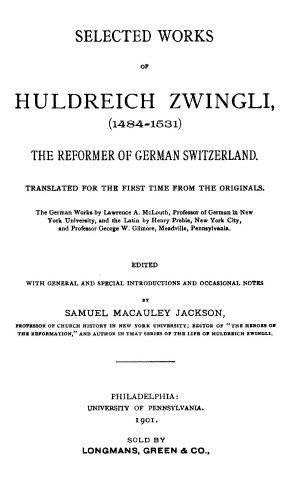
Selected Works of Huldrich Zwingli, (1484-1531) The Reformer of German Switzerland, translated for the First Time from the Originals, ed. Samuel Macauley Jackson (Philadelphia: University of Pennsylvania, 1901).

About Liberty Fund:

Liberty Fund, Inc. is a private, educational foundation established to encourage the study of the ideal of a society of free and responsible individuals.


WHAT CAN NULLIFY AND BREAK UP A MARRIAGE.

It is proper for a pious married person, who has given no cause for such act, to put away from himself or herself the other who is caught in open adultery, indeed to leave him or her, and to provide himself or herself with another spouse.

This we call and consider open adultery, which is discovered and proved, with sufficient public notice, before the matrimonial court, as is proper, or is so plain and suspicious in fact that the deed cannot be denied with any kind of truth.

But in order that adultery may not be condoned, and that no one may seek a cause to secure a new marriage by means of adultery, it will be necessary that a severe punishment be placed upon adultery, for it was forbidden in the Old Testament on pain of stoning to death.

The preachers to whom the Word of God and superintendence (of morals) are commended shall ban and exclude such sinners from the Christian parish, but the corporal punishment and the matter of the property shall be referred to the civil authorities.

But that no one for this reason may fear marriage, and resort to prostitution, these sinners, too, as is now announced, shall be excluded.

Since, now, marriage was instituted by God to avoid unchastity, and since it often occurs that some, by nature or other shortcomings, are not fitted for the partners they have chosen, they shall nevertheless live together as friends for a year, to see if matters may not better themselves by the prayers of themselves and of other honest people. If it does not grow better in that time, they shall be separated and allowed to marry elsewhere.

Likewise, greater reasons than adultery, as destroying life, endangering life, being mad or crazy, offending by whorishness, or leaving one’s spouse without permission, remaining abroad a long time, having leprosy, or other such reasons, of which no rule can be mdae on account of their dissimilarity—these cases the judges can investigate, and proceed as God and the character of the cases shall demand.

The ordinances shall be carefully and repeatedly announced by all clergymen, and their parishes warned against trespassing them.

Given at Zurich on Wednesday, the 10th of May, in the year 1525.

V.

REFUTATION OF THE TRICKS OF THE BAPTISTS BY HULDREICH ZWINGLI.*

[* ]Zwingli’s Works, III., 357-437. Translated from the Latin by Henry Preble and George W. Gilmore.

On Monday, October 26, 1523, the Second Disputation was held in Zurich, again between Zwingli and the representatives of the Old Faith and other clergy, and in that Disputation for the first time the Baptist party in Zurich made their appearance. The subject of the debate was what position the reform party should take in regard to the use of images in the churches and in regard to the sacraments. The Baptist party in Zurich were the radicals. The origin of this party was in a sort of inquiry meeting—that is, some members of Zwingli’s congregation used to meet in a private house and talk over the sermons which they had heard from Zwingli, frequently in his presence. Zwingli may have said in these gatherings a good many things which were not for publication, but he had said enough in his public discourses to show this little group of earnest men that he was on the side of a complete break with the Old Church. Zwingli was a very cautious person, and while he saw plainly that his opinions led logically to very radical reforms, he wished to make haste slowly and come at the changes, which he knew would cause considerable sorrow to many conservative people, by successive steps; but the little group referred to wished to accomplish the same results at once, without tarrying for any, and accordingly they started out without first preparing the people for such action to do the things Zwingli had at heart. Thus they made an attack upon churches and stripped them of their ornaments; they refused to observe the church fasts; and what is of more interest in this connection, they declared that the baptism of infants was unscriptural, and therefore should not be observed. Zwingli was very much distressed at the precipitance of his enthusiastic friends, because such actions were on the side of disorder, and it was very important to guard the growing Reformation from the charge of disorderly conduct. At the same time he could not say that what they did was in itself wrong, as he had himself advocated the removal of all ornaments from the churches, and it is doubtless true that in his earlier addresses from the pulpit he exposed the unbiblical character of the church doctrine upon the general subject of baptism, and probable that he inclined towards ruling out infant baptism, as lacking biblical support.

The followers of a great teacher are frequently guilty of bringing their master into compromising situations, because they make prominent what he thinks of very small account, although it may be in the line of his teaching, and so Zwingli found himself criticised severely in Zurich when his remarks upon infant baptism were repeated. To those who were brought up to regard baptism as necessary to salvation it was a great shock to be told that the ceremony had no validity. To those who believed that the rite of baptism was the Christian obligation in lieu of circumcision, and just as binding, to hear that there was grave doubt whether it should be so considered was to knock the underpinning from their faith. When Zwingli found that opposition to the popular belief and practice upon this point meant that he would be exposed not only to clerical and lay adverse criticism, but probably would lose him his influence with the city magistrates, who were all friends of the Old faith on this doctrine, he devoted a great deal of attention to it, with the result that he convinced himself that as to the subjects of baptism he had been wrong, and henceforth he took the orthodox side. As Zwingli was an honest man and morally courageous, his change of view should be accepted as sincere, and not as time-serving and hypocritical. He soon had a chance to attack his former friends and admirers on other than speculative grounds, because they had been influenced by men like Thomas Muenzer and Balthasar Hubmaier, who were in the stream of the Baptist movement in Germany. Balthasar, indeed, developed into the leading theologian of the Baptists of Switzerland. From Germany the idea came to the little company of Baptists in Zurich to practice the rite of baptism upon believing adults who had already, as the Church claimed, been baptized, upon the theory that only those could be baptized truly who were old enough to have at the time an intelligent comprehension of the doctrines to which they were giving assent, and as this could not have been the case with those “baptized” in infancy, therefore they had never really been baptized. The first of these adult baptisms occurred in a gathering of these Baptists in Zollicon, a little village to the east of Zurich, and was by pouring from a dipper. But these first Baptists in Switzerland cared so little in regard to the mode of baptism that the question does not seem to have been discussed among them, and in the writings of Zwingli is not referred to. This is a curious fact, because the modern Baptist church lays great stress upon a certain mode of baptism.

The elaborate attack upon the Baptists here presented derives additional interest from the two documents that it embodies. The first is the attack upon Zwingli written probably by Conrad Grebel, one of the earliest friends of Zwingli, and the second is the Confession of Faith written by the Baptists of Bern. Zwingli replies to both these documents, quoting them verbally and fully, and this enables us to reconstruct them. The Confession of the Bernese Baptists is in very simple language, showing a very honest and God-fearing mind, and is in itself a triumphant refutation of the charges of fanaticism and immorality which Zwingli brings against them. In fact in this paper Zwingli shows himself up in a very bad light.

This is no place in which to describe the outrageous treatment which the Baptist party received in Zurich and elsewhere through Switzerland. The writer feels the freer to use such a term because he is not himself a Baptist, but he comes to the subject merely as a historical student. He considers that the part which Zwingli played in this wretched business is a serious blot upon his reputation, and reveals a defect in his character. The Baptists were pursued relentlessly; drowning, beheading, burning at the stake, confiscation of property, exile, fines and other forms of social obloquy were employed to suppress them and prevent their increase. The fact shows plainly that the persecuting spirit in the times of the Reformation was just as rife among Protestants as among Roman Catholics, and that the devil was abroad in the hearts of those who considered themselves on both sides as the true servants of the Lord Jesus Christ, whose tenderness and love must have been greatly tried by thesewicked doings of his friends.

Peace came at last to Switzerland—the peace of the grave-yard and of the sea which gives not up its dead. The orthodox party congratulated themselves upon having got rid of the pestilential heresy of adult baptism, yet the student of history as he looks upon the large, flourishing and world-wide Baptist church of to-day asks himself which side really won the battle for the right of private judgment and liberty of action, the side of the persecutor or the side of the persecuted?