Econlib

The Library

Other Sites

Front Page arrow Titles (by Subject) arrow TRACT III.: A Letter from a Merchant in London TO HIS NEPHEW in AMERICA. - Four Tracts on Political and Commercial Subjects

Return to Title Page for Four Tracts on Political and Commercial Subjects

Search this Title:

Also in the Library:

Subject Area: Economics
Subject Area: War and Peace
Topic: The American Revolution and Constitution

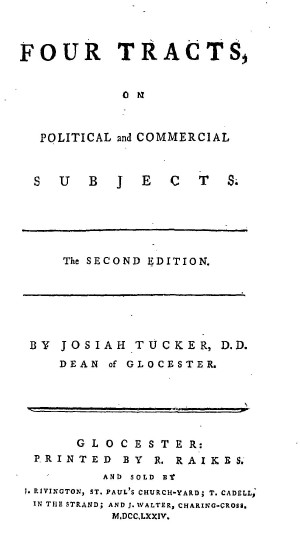
TRACT III.: A Letter from a Merchant in London TO HIS NEPHEW in AMERICA. - Josiah Tucker, Four Tracts on Political and Commercial Subjects [1774]

Edition used:

Four Tracts on Political and Commercial Subjects, 2nd edition (Glocester: R. Raikes, 1774).

About Liberty Fund:

Liberty Fund, Inc. is a private, educational foundation established to encourage the study of the ideal of a society of free and responsible individuals.


TRACT III.

A Letter from a Merchant in London TO HIS NEPHEW in AMERICA.

Dear Cousin,

YOUR Letters gave me formerly no small Pleasure, because they seemed to have proceeded from a good Heart, guided by an Understanding more enlightened than is usually found among young Men: And the honest Indignation you express against those Artifices and Frauds, those Robberies and Insults, which lost us the Hearts and Affections of the Indians, is particularly to be commended; for these were the Things, as you justly observed, which involved us in the most bloody and expensive War that ever was known; and these, by being repeated, will stimulate the poor injured Savages to redress their Wrongs, and retaliate the Injury as soon as they can, by some Means or other. You did therefore exceedingly right, in manifesting the utmost Abhorrence and Detestation of all such Practices.

But of late I cannot say, that I receive the same Satisfaction from your Correspondence: You, and your Countrymen, certainly are discontented to a great Degree; but whether your Discontent arises from a Desire of Change, and of making Innovations in your Form of Government, or from a mistaken Notion, that we are making Innovations in it, is hard to say.

Give me Leave, therefore, to expostulate with you, on this strange Alteration in your Conduct. You indeed talk loudly of Chains, and exclaim vehemently against Slavery:—But surely you do not suspect, that I can entertain the most distant Wish of making any Man a Slave, much less my own Brother’s Son, and my next of Kin.—So far from it, that whether I can make you a Convert to my Way of thinking or not, I shall still act by you as my nearest Relation; being always desirous of allowing that Liberty to others, which I hope ever to enjoy myself,—of letting every Man see with his own Eyes, and act according to his own Judgment:—This I say, I would willingly indulge every Man in, as far as ever is consistent with good Government, and the public Safety. For indeed Governments there must be of some Kind or other; and Peace and Subordination are to be preserved; otherwise, there would be no such Thing as true Liberty subsisting in the World.

In Pursuance therefore of this rational Plan of Liberty, give me Leave to ask you, young Man, What is it you mean by repeating to me so often in every Letter, The Spirit of the Constitution? I own, I do not much approve of this Phrase, because its Meaning is so vague and indeterminate; and because it may be made to serve all Purposes alike, good or bad. And indeed it has been my constant Remark, That when Men were at a Loss for solid Arguments and Matters of Fact, in their political Disputes, they then had Recourse to the Spirit of the Constitution as to their last Shift, and the only Thing they had to say. An American, for Example, now insists, That according to the Spirit of the English Constitution, he ought not to be taxed without his own Consent, given either by himself, or by a Representative in Parliament chosen by himself. Why ought he not? And doth the Constitution say in so many Words, that he ought not? Or doth it say, That every Man either hath, or ought to have, or was intended to have a Vote for a Member of Parliament? No, by no Means: The Constitution says no such Thing.—But the Spirit of it doth; and that is as good, perhaps better.—Very well: See then how the same Spirit will presently wheel about, and assert a Doctrine quite repugnant to the Claims and Positions of you Americans. Magna Charta, for Example, is the great Foundation of English Liberties, and the Basis of the English Constitution. But by the Spirit of Magna Charta, all Taxes laid on by Parliament are constitutional, legal Taxes; and Taxes raised by the Prerogative of the Crown, without the Consent of the Parliament, are illegal. Now remember, young Man, that the late Tax of Duties upon Stamps was laid on by Parliament; and therefore, according to your own Way of reasoning, must have been a regular, constitutional, legal Tax. Nay more, the principal End and Intention of Magna Charta, as far as Taxation is concerned, was to assert the Authority and Jurisdiction of the three Estates of the Kingdom, in Opposition to the sole Prerogative of the King: So that if you will now plead the Spirit of Magna Charta against the Jurisdiction of Parliament, you will plead Magna Charta against itself.

Leaving therefore all these shifting, unstable Topics, which, like changeable Silks, exhibit different Colours, according as they are viewed in different Lights; let us from the Spirit of the Constitution, come to the Constitution itself. For this is a plain, obvious Matter of Fact; and Matters of Fact are said to be stubborn Things. Now the first Emigrants, who settled in America, were certainly English Subjects,—subject to the Laws and Jurisdiction of Parliament, and consequently to parliamentary Taxes, before their Emigration; and therefore subject afterwards, unless some legal, constitutional Exemption can be produced.

Now this is the Question, and the sole Question between you and me, reduced to a plain, simple Matter of Fact. Is there therefore any such Exemption as here pretended? And if you have it, why do you not produce it?—“The King, you say, hath granted Charters of Exemption to the American Colonies.” This is now coming to the Point; and this will bring the Dispute to a short Issue. Let us therefore first enquire, Whether he could legally and constitutionally grant you such a Charter? And secondly, Whether he did ever so much as attempt to do it? And whether any such Charters are upon Record?

Now, upon the first settling an English Colony, and before ever you, Americans, could have chosen any Representatives, and therefore before any Assembly of such Representatives could have possibly met,—to whose Laws, and to what legislative Power were you then subject? To the English most undoubtedly; for you could have been subject to no other. You were Englishmen yourselves; and you carried the English Government, and an English Charter over along with you. This being the Case, were you not then in the same Condition, as to Constitutional Rights and Liberties, with the rest of your Fellow-subjects, who remained in England? Certainly you were. I most cordially agree, that you ought not to have been placed in a worse; and surely you had no Right to expect a better. Suppose, therefore, that the Crown had been so ill advised, as to have granted a Charter to any City or County here in England, pretending to exempt them from the Power and Jurisdiction of an English Parliament;—what would the Judges? what would the Lawyers? nay, what would you Americans have said to it? Apply this now to your own Case; for surely you cannot wish to have it put upon a fairer Footing; try, therefore, and see, and then tell me; is it possible for you to believe, that the King has a Power vested in him by the Constitution of dividing his Kingdom into several independant States, and petty Kingdoms, like the Heptarchy in the Times of the Saxons? Or can you really imagine, that he could crumble the parliamentary Authority and Jurisdiction, were he so minded, into Bits and Fragments, by assigning one Parliament to one City or County, another to another, and so on? Is it possible, I say, for you to believe an Absurdity so gross and glaring? And yet gross and palpable as this Absurdity is, you must either believe it, or adopt a still greater, viz. that, though the King cannot do these strange Things in England, yet he can do them all in America; because the Royal Prerogative, like Wire coiled up in a Box, can be stretched and drawn out to almost any Length, according to the Distance and Extent of his Dominions. Good Heavens! what a sudden Alteration is this! An American pleading for the Extension of the Prerogative of the Crown? Yes, if it could make for his Cause; and for extending it too beyond all the Bounds of Law, of Reason, and of Common Sense!

But though I have for Argument’s Sake, and merely to confute you in your own Way, here supposed, that the Crown had been so ill-advised, as to grant Charters to the Colonies so unconstitutional and illegal, as these undoubtedly must have been;—yet the Fact itself is far otherwise* ; for no such Charters were ever granted. Nay, many of your Colony Charters assert quite the contrary, by containing express Reservations of Parliamentary Rights, particularly that great one of levying Taxes. And those Charters which do not make such Provisoes in express Terms, must be supposed virtually to imply them; because the Law and Constitution will not allow, that the King can do more either at home or abroad, by the Prerogative Royal, than the Law and Constitution authorize him to do.

However, if you are still doubtful, and if you would wish to have a Confirmation of this Argument by some plain Fact, some striking Proof, and visible Example, I will give you one; and such an one too, as shall convince you, if any thing can, of the Folly and Absurdity of your Positions: The City of London, for Instance,—a Body Politic as respectable, without Offence, as the greatest of your Colonies, with Regard to Property, and superior to many of them with respect to Numbers;—this great City, I say, the Metropolis of the whole British Empire, hath long enjoyed, before the Colonies were ever thought of, the threefold Power of Jurisdiction, Legislation, and Taxation in certain Cases: But no Man in his Senses ever yet supposed, that the City of London either was, or could be exempted by these Charters from Parliamentary Jurisdiction, or Parliamentary Taxes; and if any Citizen should plead the Charters in Bar to Parliamentary Authority, or refuse to pay his Quota of the Land Tax, because that Tax is not laid on by an Act of the Lord-Mayor, Aldermen, and Common-Council;—I do not say, indeed, that the Judges would commit him to Newgate;—but I do verily believe, that they would order him to another Place of Confinement, much fitter for a Person in his unhappy Situation.

And now, my good Friend, what can you say to these Things?—The only Thing which you ought to say is, that you did not see the Affair in its true Light before; and that you are sincerely sorry for having been so positive in a wrong Cause. Confuted most undoubtedly you are beyond the Possibility of a Reply, as far as the Law and Constitution of the Realm are concerned in this Question. But indeed it seems to me by certain Passages in your Letters, that, though you raise a terrible Outcry against the supposed Violation of your Charters; you yourself would not rest the Merits of your Cause upon the Proof of such a Violation; and that you would rather drop that Point, than attempt to justify the Charge if called upon to do it.

What then is it, which you have next to offer? Oh! “The Unreasonableness! the Injustice! and the Cruelty of taxing a free People, without permitting them to have Representatives of their own to answer for them, and to maintain their fundamental Rights and Privileges!”

Strange, that you did not discover these bad Things before! Strange, that though the British Parliament has been, from the Beginning, thus unreasonable, thus unjust, and cruel towards you, by levying Taxes on many Commodities outwards and inwards,—nay, by laying an internal Tax, the Post-Tax for Example, on the whole British Empire in America;—and, what is still worse, by making Laws to affect your Property,—your Paper Currency, and even to take away Life itself, if you offend against them:—Strange and unaccountable, I say, that after you had suffered this so long, you should not have been able to have discovered, that you were without Representatives in the British Parliament, of your own electing, ’till this enlightening Tax upon Paper opened your Eyes! And what a Pity is it, that you have been Slaves for so many Generations, and yet did not know that you were Slaves until now.

But let that pass, my dear Cousin; for I always choose to confute you in your own Way. Now, if you mean any Thing at all by the Words unreasonable, unjust, and cruel, as used in this Dispute; you must mean, that the Mother Country deals worse by you, than by the Inhabitants of Great-Britain; and that she denies certain Constitutional Rights and Privileges to you abroad, which we enjoy here at home. Now pray what are these constitutional Rights and Liberties, which are refused to you? Name them, if you can. The Things which you pretend to alledge are, “The Rights of voting for Members of the British Parliament; and the Liberty of chusing your own Representatives.” But surely you will not dare to say, that we refuse your Votes, when you come hither to offer them, and choose to poll: You cannot have the Face to assert, that on an Election Day any Difference is put between the Vote of a Man born in America, and of one born here in England. Yet this you must assert, and prove too, before you can say any thing to the present Purpose. Suppose therefore, that an American hath acquired a Vote (as he legally may, and many have done) in any of our Cities or Counties, Towns, or Boroughs; suppose, that he is become a Freeman, or a Freeholder here in England;—on that State of the Case, prove if you can, that his Vote was ever refused, because he was born in America:—Prove this, I say, and then I will allow, that your Complaints are very just; and that you are indeed the much injured, the cruelly treated People, you would make the World believe.

But, my good Friend, is this supposed Refusal the real Cause of your Complaint? Is this the Grievance that calls so loudly for Redress? Oh! no, you have no Complaint of this Sort to make: But the Cause of your Complaint is this; that you live at too great a Distance from the Mother Country to be present at our English Elections, and that in Consequence of this Distance, the Freedom of our Towns, or the Freeholds in our Counties, as far as voting is concerned, are not worth attending to. It may be so; but pray consider, if you yourselves do choose to make it inconvenient for you to come and vote, by retiring into distant Countries,—what is that to us? And why are we to be reproached for committing a ‘Violation on the Birth-rights of Englishmen, which, if it be a Violation, is committed only by yourselves?’ It seems, you find it to be your particular Interest to live in the Colonies; it seems, that you prefer the Emoluments of residing there to your Capacity, or Capability (take which Word you please) of residing and voting here. Now this is your own free Choice; and we leave you at full Liberty to act as you think proper: But then, are we obliged to alter our Political System merely to accord with your Convenience? Are we to change and new model our fixed and ancient Constitution, just as you shall see fit to command us? and according as it shall please you to remove from Place to Place? And is this the Complaisance, which you expect the Mother Country should shew to her dutiful Children? Yes, it is; and you demand it too with a loud Voice, full of Anger, of Defiance, and Denunciation.

However, the Lion is not always so fierce as he is painted; and ’till we are beaten into a Compliance, it is to be hoped, that we may be allowed to expostulate with you in a few harmless, unbloody Words. Granting therefore, that the Colonies are unrepresented in the British Parliament: Granting that two Millions of People in America have, in this Respect, no Choice, nor Election of their own, through the Necessity of the Case, and their Distance from the Place of Election:—What would you infer from this Concession? And wherein can such Kind of Topics support your Cause? For know, young Man, that not only two Millions which are the utmost, that your exaggerated Accounts can be swelled to;—I say not only two Millions, but six Millions at least of the Inhabitants of Great-Britain, are still unrepresented in the British Parliament. And this Omission arises, not from the Necessity of the Case, not from consulting Interest and Convenience as with you, but from original Ideas of Gothic Vassalage,—from various Casualties and Accidents,—from Changes in the Nature of Property,—from the Alteration of Times and Circumstances,—and from a thousand other Causes. Thus, for Example, in the great Metropolis, and in many other Cities, landed Property itself hath no Representative in Parliament; Copyholds and Leaseholds of various Kinds have none likewise, though of ever so great a Value. This you yourself very well know; because when you were here last, you knew, that I was possessed of considerable landed Property in London, and of several Copyhold and beneficial Leaseholds, in the Country, and yet that I never had a Vote. Moreover, in some Towns neither Freedom, nor Birth right, nor the serving of an Apprenticeship, shall entitle a Man to give his Vote, though they may enable him to set up a Trade: In other Towns the most numerous, the most populous and flourishing of any, there are no Freedoms or Votes of any Sort; but all is open; and none are represented. And besides all this, it is well known, that the great East-India Company, which have such vast Settlements, and which dispose of the Fate of Kings and Kingdoms abroad, have not so much as a single Member, or even a single Vote, quatenus a Company, to watch over their Interests at home. What likewise shall we say in regard to the prodigious Number of Stock-holders in dur public Funds? And may not their Property, perhaps little short of One hundred Millions Sterling, as much deserve to be represented in Parliament, as the scattered Townships, or straggling Houses of some of your Provinces in America? Yet we raise no Commotions; we neither ring the Alarm-Bell, nor sound the Trumpet; but submit to be taxed without being represented, and taxed too, let me tell you, for your Sakes. Witness the additional Duties on our Lands, Windows, Houses; also on our Malt, Beer, Ale, Cyder, Perry, Wines, Brandy, Rum, Coffee, Chocolate, &c. &c. &c. for defraying the Expences of the late War,—nor forgetting the grievous Stamp-Duty itself. All this, I say, we submitted to, when you were, or at least, when you pretended to be, in great Distress; so that neither Men, almost to the last Drop of Blood we could spill,—nor Money, to the last Piece of Coin, were spared: But all was granted away, all was made a Sacrifice, when you cried out for Help. And the Debt which we contracted on this Occasion, is so extraordinary, as not to be parallelled in History. It is to be hoped, for the Credit of human Nature, that the Returns which you have made us for these Succours, and your present Behaviour towards us, which perhaps is still more extraordinary, may not be parallelled likewise.

But as you Americans do not chuse to remember any thing, which we have done for you;—though we, and our Children shall have Cause to remember it ’till latest Posterity;—let us come to the Topic, which you yourselves do wish to rest your Cause upon, and which you imagine to be the Sheet Anchor of your State Vessel. “You are not represented; and you are Two Milions; therefore you ought not to be taxed.” We are not represented; and we are Six Millions; therefore we ought not to be taxed. Which now, even in your own Sense of Things, have most Reason to complain? And which Grievance, if it be a Grievance, deserves first to be redressed? Be it therefore supposed, than an Augmentation ought to take place in our House of Commons, in order to represent in Parliament the prodigious Numbers of British Subjects hitherto unrepresented. In this Case the first Thing to be done, is to settle the Proportion. And therefore if Two Millions (the Number of Persons actually represented at present) require Five Hundred and Fifty-eight Representatives (which I think is the Number of our modern House of Commons) how many will Six Millions require?—The Answer is, that they will require One Thousand Six Hundred and Seventy-four Representatives. Now this is the first Augmentation, which is to be made to our List of Parliament Men. And after this Increase, we are to be furnished, by the same Rule of Proportion, with Five Hundred and Fifty-eight more from the Colonies. So that the total Numbers will be Two Thousand Seven Hundred and Ninety Representatives in Parliament! A goodly Number truly! and very proper for the Dispatch of Business! Oh, the Decency and Order of such an Assembly! The Wisdom and Gravity of Two Thousand Seven Hundred and Ninety Legisiators all met together in one Room! What a Pity is it, that so hopeful a Project should not be carried into immediate Execution!

But, my noble Senator,—for certainly you yourself intend to figure away in such an august Assembly,—permit an old Man to reveal one Secret to you, before you proceed any further in your representing Scheme—That the Complaint itself of being unrepresented, is entirely false and groundless. For both the Six Millions at home, and the Two Millions in the Colonies, are all represented already. This perhaps may startle you; but nevertheless this is the Fact. And though I have hitherto used a different Language merely to accommodate myself to your Ideas, and to confute your Folly in your own Way, I must now tell you, that every Member of Parliament represents you and me, and our public Interests in all essential Points, just as much as if we had voted for him. For though one Place, or one Set of Men may elect, and send him up to Parliament, yet, when once he becomes a Member, he becomes then the equal Guardians of all. And he ought not, by the Duty of his Office, to shew a Preference to his own Town City, or County, but in such Cases only, where a Preference shall not be found to interfere with the general Good. Nay, he ought in Conscience to give his vote in Parliament against the Sense, and against the Instructions of his Electors, if he should think in his Conscience, that what they require, is wrong in itself, is illegal or injurious, and detrimental to the public Welfare. This then being the Case, it therefore follows, that our Birminghams, Manchesters, Leeds, Halifaxes, &c. and your Bostons, New-Yorks, and Philadelphias, are all as really, though not so nominally represented, as any Part whatsoever of the British Empire:—And that each of these Places have in fact, instead of one or two, not less than Five Hundred and Fifty-eight Guardians in the British Senate. A Number abundantly sufficient, as far as human Prudence can suggest, or the present imperfect State of Things will permit, for the Security of our Rights, and the Preservation of our Liberties.

But perhaps you will say, That though it may be a Senator’s Duty to regard the Whole rather than a Part, and to be the equal Protector of all;—yet he will, in fact, regard that most, which can best promote his own Interest, and secure his Election another Time. It may be so: For who can guard against all Possibility of Danger? And what System can there be devised, but may be attended with Inconveniences and Imperfections in some Respect or other?—Nevertheless, if your general Objection proves any thing, it proves a great deal too much: For it proves that no Man ought to pay any Tax, but that only, to which the Member of his own Town, City, and County, hath particularly assented: Because all other Members being chosen by other Persons, and not by him, and perhaps by Persons in an opposite Interest are therefore not his Representatives, and consequently not the true Guardians of his Property. Being therefore without a Representative in such a Parliament, he is under no Obligation to obey its Laws, or pay any of its Taxes.

Where now, my Friend, will you turn? And what can you do to extricate yourself from the Difficulties which arise on all Sides on this Occasion? You cannot turn about, and say, that the other Representatives, whom this Man never chose, and for whom he had no Vote to give, and against whom perhaps he had particular Exceptions, have nevertheless a Right of taxing him because he makes a Part of the Body Politic implied in, and concluded by the rest;—you cannot say this, because the Doctrine of Implication is the very Thing to which you object, and against which you have raised so many Batteries of popular Noise and Clamour. Nay, as the Objection is entirely of your own making, it must go still further: For if your Argument is good for any thing, it is as good for North-America as it is for Great-Britain; and consequently you must maintain, that all those in your several Provinces who have no Votes (and many Thousands of such there are) and also all those Voters, whose Representatives did not expressly consent to the Act of your Assemblies for raising any of your own provincial Taxes,—ought not to be compelled to pay them. These now are the happy Consequences of your own Principles, fairly, clearly, and evidently deduced: Will you abide by them?

But however, not to push you into more Absurdities of this Kind, let us wave the present Point, and come to another. For, after all your doleful Complaints, what if it should appear, that these Five Hundred and Fifty-eight Parliamentary Guardians, who represent you only by Implication, have, in fact, been kinder and more bountiful to you Americans, than they have been to their own British Voters, whom they represent by Nomination? And, what if even this Argument, so full of Sorrow and Lamentation, should at last be retorted upon you, and made to conclude, like all the rest, the very Reverse of what you intended? This, I believe, is what you little expected: But nevertheless, this is the Case: For if there be any Partiality to be complained of in the Conduct of the British Parliament, it will appear to be a Partiality in Favour of the Colonies, and against the Mother Country. Do you demand my Authority; for this Assertion? I will give it you:—The Statutes of the Realm are my Authority; and surely you cannot demand a better. By these then it will appear, that a Colonist, who is consequently subordinate to the Mother Country in the very Nature to Things, is nevertheless put upon a better Footing, in many Respects, than an Inhabitant of Great-Britain. By these it will appear, that the Parliament, like an over-indulgent Parent to his favourite, froward Child, hath been continually heaping Favours upon you, of which we are not permitted to taste. Thus, for Example, you have your Choice, whether you will accept of my Price for your Tobacco,—or after bringing it here, whether you will carry it away, and try your Fortune at another Market: But I have no Alternative allowed, being obliged to buy yours at your own Price; or else to pay such a Duty for the Tobacco of other Countries, as must amount to a Prohibition. Nay, in order to favour your Plantations, I am not permitted to plant this Herb on my own Estate, though the Soil should be ever so proper for it. Again, the same Choice, and the same Alternative are allowed to you, and denied to me, in regard to Rice; with this additional Advantage, that in many Respects you need not bring it into England at all, unless you are so minded. And what will you say in Relation to Hemp? The Parliament now gives you a Bounty of 8l. per Ton for exporting your Hemp from North-America; but will allow me nothing for growing it here in England; nay, will tax me very severely for fetching it from any other Country; though it be an Article most essentially necessary for all the Purposes of Shipping and Navigation. Moreover in respect to the Culture of Raw Silk, you have an immense Parliamentary Premium for that Purpose; and you receive further Encouragements from our Society for Arts and Sciences, which is continually adding fresh Rewards:—But I can receive no Encouragement either from the one, or from the other, to bear my Expences at first setting out; though most undeniably the white Mulberry-Trees can thrive as well on my Grounds, as they can in Switzerland, Brandenburgh, Denmark, or Sweden, where vast Quantities are now raising. Take another Instance:—Why shall not I be permitted to buy Pitch, Tar, and Turpentine,—without which I cannot put my Ships to Sea;—and Indigo, so useful in many Manufactures;—why shall not I be permitted to purchase these Articles wherever I can, the best in their Kind, and on the best Terms?—No, I shall not; for though they are all raw Materials, which therefore ought to have been imported Duty free, yet I am restrained by an heavy Duty, almost equal to a Prohibition, from purchasing them any where, but from you:—Whereas you on the contrary are paid a Bounty for selling these very Articles, at the only Market, in which you could sell them to Advantage, viz. the English* .

Much more might have been said on this Subject; and the like Observations might have been extended to the Sugar Colonies: But I forbear. For indeed enough has been said already (and as it exposes our Partiality and Infatuation a little severely, perhaps too much)—in order to prove to the World, that of all People upon Earth, you have the least Reason to complain.

But complain you will; and no sooner is one Recital of imaginary Grievances silenced and confuted; but like the Hydra in the Fable, up starts another. Let us see, therefore, what is your next Objection, which I think, is the last, that with all your Zeal, and Goodwill, you are able to muster up.—“The Inexpediency and Excessiveness of such a Tax! a Tax ill-timed in itself, and ill digested! unseasonably laid on! and exceeding all Rules of Proportion in regard to the Abilities of those who are to pay it!”

Now, my Friend, had there been any Truth, in these Assertions, which I shall soon make to appear, that there is not;—but had there been, the Plea itself comes rather at the latest, and out of Place from you:—from you, I say, who peremptorily object to the very Power and Authority of the British Parliament of laying any internal Taxes upon the Colonies, great or small or at any Time seasonable, or unseasonable. And therefore, had you been able to have proved the Illegality of such a Tax, it would have been quite superfluous to have informed us afterwards, that this Usurpation of your Rights and Liberties was either an excessive, or an unseasonable Usurpation. But as you have failed in this first Point; nay, as all your own Arguments have proved the very reverse of what you intended; and very probably, as you yourself was not originally quite satisfied with the Justice of your Cause;—and must have seen abundant Reason before this Time to have altered your former hasty, and rash Opinion;—I will therefore wave the Advantage, and now debate the Point with you, as though you had acknowledged the Parliamentary Right of Taxation, and only excepted to the Quantum, or the Mode, the Time, or the Manner of it.

Now two Things are here to be discussed; first, the pretended Excessiveness of the Tax; and secondly, the Unseasonableness of it. As to the Excessiveness of the Stamp Duties, the Proof of this must depend upon the Proof of a previous Article,—the relative Poverty, and Inability of those, who are to pay it. But how do you propose to make out this Point? And after having given us for some Years past such Displays of your growing Riches and encreasing Magnificence, as perhaps never any People did in the same Space of Time; how can you now retract and call yourselves a poor People? Remember, my young Man, the several Expostulations I had with your deceased Father on the prodigious Increase of American Luxury. And what was his Reply? Why, that an Increase of Luxury was an inseparable Attendant on an Increase of Riches; and that, if I expected to continue my North-American Trade, I must suit my Cargo to the Taste of my Customers; and not to my own old-fashioned Notions of the Parsimony of former Days, when America was a poor Country. Remember therefore the Orders given by him, and afterwards by you, to have your Assortment of Goods made richer, and finer every Year. And are your Gold and Silver Laces;—your rich Brocades, Silks and Velvets;—your Plate, and China, and Jewels;—your Coaches and Equipages,—your sumptuous Furniture, Prints, and Pictures. Are all these Things now laid aside? Have you no Concerts, or Assemblies, no Play Houses, or Gaming Houses, now subsisting? Have you put down your Horse Races and other such like Sports and Diversions? And is the Luxury of your Tables, and the Variety and Profusion of your Wines and Liquors quite banished from among you?—These are the Questions, which you ought to answer, before an Estimate can be made of your relative Poverty, or before any Judgment can be formed concerning the Excessiveness of the Tax.

But I have not yet done with you on this Head. For even though you were poor (which you know, you are not, compared with what you were Thirty Years ago) it may nevertheless happen, that our relative Poverty may be found to be greater than yours. And if so, when a new Burden is to be laid on, the proper Question is, which of these two Sorts of poor People, is the best able, or, if you please, the least unable to bear it?—especially if it be taken into the Account, that this additional Load is an American Burthen, and not a British one. Be it therefore granted, according to what you say, that you are Two Millions of Souls; be it also allowed, as it is commonly asserted, that the Public Debt of the several Provinces amounts to about 800,000l. Sterling; and in the next Place, be it supposed, for Argument’s Sake, that were this general Debt equally divided among the Two Millions, each Individual would owe about the Value of Eight Shillings. Thus stands the Account on one Side. Now we in Britain are reckoned to be about Eight Millions of Souls; and we owe almost One Hundred and Forty-four Millions of Money; which Debt were it equally divided among us, would throw a Burthen upon each Person of about 18l. Sterling. This then being the State of the Case on both Sides, would it be so capital an Offence, would it be High-Treason in us to demand of you, who owe so little, to contribute equally with ourselves, who owe so much, towards the public Expences;—and such Expences too as you were the Cause of creating?—Would it be a Crime of a Nature so very heinous and diabolical, as to call forth the hottest of your Rage and Fury? Surely no:—And yet, my gentle Friend, we do not so much as ask you to contribute equally with ourselves, we only demand, that you would contribute something. And what is this something? Why truly it is, that when we raise about Eight Millions of Money annually upon Eight Millions of Persons, we expect, that you would contribute One Hundred Thousand Pounds (for the Stamp Duty upon the Continent alone, without comprehending the Islands, cannot possibly amount to more) I say, we expect, that you should contribute One Hundred Thousand Pounds to be raised on Two Millions: that is, when each of us pays, one with another, Twenty Shillings per Head, we expect, that each of you should pay the Sum of One Shilling! Blush! blush for shame at your perverse and scandalous Behaviour!—Words still more severe, and perhaps more just, are ready to break forth, through an honest Indignation:—But I suppress them.

Perhaps you will say, and I think it is the only Thing left for you to say in Excuse for such Proceedings, that you have other Public Taxes to pay, besides those which the British Parliament now requires. Undoubtedly you have, for your Provincial and other Taxes are likewise to be paid: But here let me ask, is not this our Case also? And have not we many other Taxes to discharge besides those which belong to the Public, and are to be accounted for at the Exchequer? Surely we have: Witness our County Taxes, Militia Taxes, Poor Taxes, Vagrant Taxes, Bridge Taxes, High Road and Turnpike Taxes, Watch Taxes, Lamps and Scavenger Taxes, &c. &c. &c.—all of them as numerous and as burthensome as any that you can mention, And yet with all this Burthen, yea, with an additional Weight of a National Debt of 18l. Sterling per Head,—we require of each of you to contribute only One Shilling to every Twenty from each of us!—yes; and this Shilling too to be spent in your own Country, for the Support of your own Civil and Military Establishments; together with many Shillings drawn from us for the same Purpose. Alas! had you been in our Situation, and we in yours, would you have been content with our paying so small, so inconsiderable a Share of the Public Expences? And yet, small and inconsiderable as this Share is, you will not pay it. No, you will not! And be it at our Peril, if we demand it.

Now, my Friend, were Reason and Argument, were Justice, Equity, or Candour to be allowed by you to have any Concern in this Affair, I would then say, that you Americans are the most unfortunate People in the World in your Management of the present Controversy. Unfortunate you are, because the very Attempts you make towards setting forth your Inability, prove to a Demonstration, that you are abundantly able, were you but truly willing to pay this Tax. For how, and in what Manner do you prove your Allegations? Why truly, by breaking forth into Riots and Insurrections, and by committing every kind of Violence, that can cause Trade to stagnate, and Industry to cease. And is this the Method, which you have chosen to pursue, in order to make the World believe, that you are a poor People? Is this the Proof you bring, that the Stamp Duty is a Burthen too heavy for you to bear? Surely, if you had really intended our Conviction, you would have chosen some other Medium: And were your Inability, or Poverty the single Point in Question, you would not have taken to such Courses, as must infallibly render you still the poorer. For in fact, if, after all your Complaints of Poverty, you can still afford to idle away your Time, and to waste Days, and Weeks, in Outrages and Uproars; what else do you prove, but that you are a prodigal, and extravagant People? For you must acknowledge, that if but Half of this Time were spent, as it ought to be, in honest Industry and useful Labour, it would have been more than sufficient to have paid double the Tax which is now required.

But you will still say, that though the Tax may be allowed (nay indeed it must be allowed) to be very moderate, every thing considered, and not all excessive; “It may nevertheless be laid on very unseasonably; it may be wrong-timed, and ill-digested.”

Now, here I must own, that I am somewhat at a Loss how to answer you, because I am not quite certain that I unsterstand your Meaning. If, for Example, by the Term ill-digested, you would insinuate, that the American Stamp Duty would grind the Faces of the Poor, and permit the Rich to escape;—that it would affect the Necessaries, and not the Superfluities of Life;—that it would prevent the Building of Houses, or the Clearing of Lands, or the Cultivation of Estates already cleared;—or lastly, that it would diminish the Number of your Shipping, or stop the Pay of your Sailors: If these, or any of these are the Evils, which you would lay to the Charge of the Stamp Duty, nothing upon Earth could be a falser Charge; and you could not give a stronger Proof either of your Defect in Judgment, or Want of Integrity, than by uttering such Assertions as these;—Assertions, which both daily Experience and the Nature of Things evidently demonstrate to be void of Truth. We in Britain have been subject to a Stamp Duty for many, very many Years; a Duty much higher than that which is intended for America; and yet we know by long Experience, that it hath not been attended with any of the dreadful Consequences which are here supposed.

Again, as to the wrong-timing, or the Unseasonableness of this Tax:—If by this you mean to say, that it was laid on, at a Time, when you were poorer, and less able to bear it, than you were before;—that is false also. For you never were richer, and you never were more able to contribute your Quota towards the general Expences, than at the Juncture of laying on this Tax. To prove this, let it be observed, that just before this Event, you had not only been draining the Mother Country by the immense Sums drawn from us to pay our Fleets and Armies, when acting in Defence of America;—and that your Jobbers and Contractors had not only been sucking our Blood and Vitals by their extortionate Demands;—but you had also been enriched by the Spoils, and by the Traffic of the numerous Colonies of France and Spain. For you were continually acting the double Part either of Trade, or War, of Smuggling, or Privateering, according to the Prospect of greater Gain. And while we at Home were exerting our utmost to put a speedy End to the War by an honourable Peace,—you on the contrary were endeavouring to prolong it as much as possible; and were supplying our Enemies with all Manner of Provisions, and all Sorts of warlike Stores for that Purpose. Nay, because a Part of these ill-gotten Riches was laid out in English Manufactures (there being at that Time hardly a Possibility of purchasing any but English, when our Fleets were absolute Masters of the Sea) your Advocates and Authors trumpeted aloud the prodigious Profits of this North-American Trade;—not considering, or rather not willing that we should consider, that while a few Individuals were getting Thousands, the Public was spending Millions.

Once more:—If by the Epithet unseasonable, you would be understood to mean, that there was no need of taxing you at all at that Juncture; because the Mother Country was still as able to carry the additional Load, which you had brought upon her, as she had been to bear all the rest: If this be your Meaning, I must tell you once for all, that you are egregiously mistaken. For we can bear no more: we cannot support ourselves under heavier Taxations, even were we ever so willing; we have strained every Nerve already, and have no Resources left for new Impositions. Therefore let what will come of the present Affairs, let the Stamp Duty be repealed, or not; still the Expences of America must be borne by the Americans in some Form, or under some Denomination or other.

But after all; perhaps you meant none of these Things; perhaps you meant to insinuate (though it was Prudence in you not to speak out) that the late Act was ill-contrived and ill-timed; because it was made at a Juncture, when neither the French nor Indians were in your Rear to frighten, nor the English Fleets and Armies on your Front to force you to a Compliance. Perhaps this was your real Meaning; and if it was, it must be confessed, that in that Sense, the late Act was not well-timed; and that a much properer Season might have been chosen. For had the Law been made five or six Years before, when you were moving Heaven and Earth with your Cries and Lamentations; not a Tongue would then have uttered a Word against it; all your Orators would have displayed their Eloquence on other Topics; and even American Patriotism itself would at that Season have made no Difficulty of acknowledging, that the Mother Country had a Right to the Obedience of the Colonies in Return for her kind and generous Protection.

Upon the whole therefore, what is the Cause of such an amazing Outcry as you raise at present?—Not the Stamp Duty itself; all the World are agreed on that Head; and none can be so ignorant, or so stupid, as not to see, that this is a mere Sham and Pretence. What then are the real Grievances, seeing that the Things which you alledge are only the pretended ones? Why, some of you are exasperated against the Mother Country, on account of the Revival of certain Restrictions laid upon their Trade:—I say, a*Revival; for the same Restrictions have been the standing Rules of Government from the Beginning; though not enforced at all Times with equal Strictness. During the late War, you Americans could not import the Manufactures of other Nations (which it is your constant Aim to do, and the Mother Country always to prevent) so conveveniently as you can in Times of Peace; and therefore, there was no Need of watching you so narrowly, as far as that Branch of Trade was concerned. But immediately upon the Peace, the various Manufactures of Europe, particularly those of France, which could not find Vent before, were spread, as it were, over all your Colonies, to the prodigious Detriment of your Mother Country; and therefore our late Set of Ministers acted certainly right, in putting in Force the Laws of their Country, in order to check this growing Evil. If in so doing, they committed any Error; or, if the Persons to whom the Execution of these Laws were intrusted, exceeded their Instructions; there is no Doubt to be made, but that all this will be rectified by the present Administration. And having done that, they will have done all that in Reason you can expect from them. But alas! the Expectations of an American carry him much further: For he will ever complain and smuggle, and smuggle and complain, ’till all Restraints are removed, and ’till he can both buy and sell, whenever, and wheresoever he pleases. Any thing short of this, is still a Grievance, a Badge of Slavery, an Usurpation on the natural Rights and Liberties of a free People, and I know not how many bad Things besides.

But, my good Friend, be assured, that these are Restraints, which neither the present, nor any future Ministry can exempt you from. They are the standing Laws of the Kingdom; and God forbid, that we should allow that dispensing Power to our Ministers, which we so justly deny to our Kings. In short, while you are a Colony, you must be subordinate to the Mother Country. These are the Terms and Conditions, on which you were permitted to make your first Settlements: They are the Terms and Conditions on which you alone can be entitled to the Assistance and Protection of Great Britain;—they are also the fundamental Laws of the Realm;—and I will add further that if we are obliged to pay many Bounties for the Importation of your Goods, and are excluded from purchasing such Goods, in other Countries (where we might purchase them on much cheaper Terms) in order to promote your Interest;—by Parity of Reason you ought to be subject to the like Exclusions, in order to promote ours. This then being the Case, do not expect, from the present Ministry, that which is impossible for any Set of Ministers to grant. All that they can do, is to connive a while at your unlawful Proceedings. But this can be but of short Duration: For as soon as ever fresh Remonstrances are made by the British Manufacturers, and British Merchants, the Ministry must renew the Orders of their Predecessors; they must enforce the Laws; they must require Searches, and Confiscations to be made; and then the present Ministers will draw upon themselves, for doing their Duty, just the same Execrations, which you now bestow upon the last.

So much as to your first Grievance; and as to your second, it is, beyond Doubt, of a Nature still worse. For many among you are sorely concerned, That they cannot pay their British Debts with an American Sponge. This is an intolerable Grievance; and they long for the Day when they shall be freed from this galling Chain. Our Merchants in London, Bristol, Liverpool, Glasgow &c. &c. perfectly understand your many Hints and Inuendoes to us, on this Head. But indeed, lest we should be so dull as not to comprehend your Meaning, you have spoken out, and proposed an open Association against paying your just Debts. Had our Debtors in any other Part of the Globe, had the French or Spaniards proposed the like (and surely they have all at least an equal Right) what Name would you have given to such Proceedings? But I forget: You are not the faithless French or Spaniards: You are ourselves: You are honest Englishmen.

Your third Grievance is the Sovereignty of Great-Britain: For you want to be independent: You wish to be an Empire by itself, and to be no longer the Province of another. This Spirit is uppermost; and this Principle is visible in all your Speeches, and all your Writings, even when you take some Pains to disguise it.—“What! an Island! A Spot such as this to command the great and mighty Continent of North-America! Preposterous! A Continent, whose Inhabitants double every five and twenty Years! Who therefore, within a Century and an Half will be upwards of an hundred and twenty Millions of Souls!—Forbid it Patriotism, forbid it Politics, that such a great and mighty Empire as this, So should be held in Subjection by the paltry Kingdom of Great-Britain! Rather let the Seat of Empire be transferred; and let it be fixt, where it ought to be, viz. in Great America!

Now my good Friend, I will not stay to dispute with you the Calculations, on which your Orators, Philosophers, and Politicians have, for some Years past, grounded these extravagant Conceits (though I think the Calculations themselves both false, and absurd); but I will only say, that while we have the Power, we may command your Obedience, if we please: And that it will be Time enough for you to propose the making us a Province to America, when you shall find yourselves able to execute the Project.

In the mean Time, the great Question is, What Course are we to take? And what are we to do with you, before you become this great and formidable People?—Plain and evident it is by the whole Tenor of your Conduct, that you endeavour, with all your Might to drive us to Extremities. For no Kind of Outrage, or Insult, is omitted on your Part, that can irritate Individuals, or provoke a Government to chastise the Insolence, not to say the Rebellion, of its Subjects; and you do not seem at all disposed to leave Room for an Accommodation. In short, the Sword is the only Choice, which you will permit us to make; unless we will chuse to give you entirely up, and subscribe a Recantation. Upon those Terms indeed, you will deign to acknowledge the Power and Authority of a British Parliament;—that is, you will allow, that we have a Right and a Power to give you Bounties, and to pay your Expences; but no other. A strange Kind of Allegiance this! And the first that has ever yet appeared in the History of Mankind!

However, this being the Case, shall we now compel you, by Force of Arms, to do your Duty?—Shall we procrastinate your Compulsion?—Or shall we entirely give you up, and have no other Connections with you, than if you had been so many Sovereign States, or Independent Kingdoms? One or other of these three will probably be resolved upon: And if it should be the first, I do not think that we have any Cause to fear the Event, or to doubt of Success.

For though your Populace may rob and plunder the Naked and Defenceless, this will not do the Business when a regular Force is brought against them. And a British Army, which performed so many brave Actions in Germany, will hardly fly before an American Mob; not to mention that our Officers and Soldiers, who passed several Campaigns with your Provincials in America, saw nothing either in their Conduct, or their Courage, which could inspire them with a Dread of seeing the Provincials a second Time.—Neither should we have the least Cause to suspect the Fidelity of our Troops, any more than their Bravery,—notwithstanding the base Insinuations of some of your Friends here (if indeed such Persons deserve to be called your Friends, who are in reality your greatest Foes, and whom you will find to be so at the last); notwithstanding, I say, their Insinuations of the Feasibility of corrupting his Majesty’s Forces, when sent over, by Means of large Bribes, or double Pay. This is a Surmise, as weak as it is wicked: For the Honour of the British Soldiery, let me tell you, is not so easily corrupted. The French in Europe never found it so, with all their Gold, or all their Skill for Intrigue, and insinuating Address. What then, in the Name of Wonder, have you to tempt them with in America, which is thus to overcome, at once, all their former Sense of Duty, all the Tyes of Conscience, Loyalty and Honour?—Besides, my Friend, if you really are so rich, as to be able to give double Pay to our Troops, in a wrong Cause; do not grudge, let me beseech you, to give one third of single Pay (for we ask no more) in a right one:—And let it not be said, that you complain of Poverty, and plead an Inability to pay your just Debts, at the very Instant that you boast of the scandalous Use which you intend to make of your Riches.

But notwithstanding all this, I am not for having Recourse to Military Operations. For granting, that we shall be victorious, still it is proper to enquire, before we begin, How we are to be benefitted by our Victories? And what Fruits are to result from making you a conquered People?—Not an Increase of Trade; that is impossible: For a Shop-keeper will never get the more Custom by beating his Customers: And what is true of a Shop-keeper, is true of a Shop-keeping Nation. We may indeed vex and plague you, by stationing a great Number of Ships to cruize along your Coasts; and we may appoint an Army of Custom-house Officers to patrole (after a Manner) two thousand Miles by Land. But while we are doing these Things against you, what shall we be doing for ourselves? Not much, I am afraid: For we shall only make you the more ingenious, the more intent, and the more inventive to deceive us. We shall sharpen your Wits, which are pretty sharp already, to elude our Searches, and to bribe and corrupt our Officers. And after that is done, we may perhaps oblige you to buy the Value of twenty or thirty thousand Pounds of British Manufactures, more than you would otherwise have done,—at the Expence of two or three hundred thousand Pounds Loss to Great Britain, spent in Salaries, Wages, Ships, Forts, and other incidental Charges. Is this now a gainful Trade, and fit to be encouraged in a commercial Nation, so many Millions in Debt already? And yet this is the best, which we can expect by forcing you to trade with us, against your Wills, and against your Interests?

Therefore such a Measure as this being evidently detrimental to the Mother Country, I will now consider the second Proposal, viz. to procrastinate your Compulsion.—But what good can that do? And wherein will this Expedient mend the Matter? For if Recourse is to be had at last to the Military Power we had better begin with it at first; it being evident to the whole World, that all Delays on our Side will only strengthen the Opposition on yours, and be interpreted by you as a Mark of Fear, and not as an Instance of Lenity. You swell with too much vain Importance, and Self-sufficiency already; and therefore, should we betray any Token of Submission; or should we yield to these your ill-humoured and petulant Desires; this would only serve to confirm you in your present Notions, viz. that you have nothing more to do, than to demand with the Tone of Authority, and to insist, with Threatenings and Defiance, in order to bring us upon our Knees, and to comply with every unreasonable Injunction, which you shall be pleased to lay upon us. So that at last, when the Time shall come of appealing to the Sword, and of deciding our Differences by Dint of Arms, the Consequence of this Procrastination will be, that the Struggle will become so much the more obstinate, and the Determination the more bloody. Nay, the Merchants themselves, whose Case is truly pitiable for having confided so much to your Honour, and for having trusted you with so many hundred thousand Pounds, or perhaps with some Millions of Property, and for whose Benefit alone such a Suspension of the Stamp Act could be proposed; they* will find to their Costs, that every Indulgence of this Nature will only furnish another Pretence to you for the suspending of the Payment of their just Demands. In short, you declare, that the Parliament hath no Right to tax you; and therefore you demand a Renunciation of the Right, by repealing the Act. This being the Case, nothing less than a Renunciation can be satisfactory; because nothing else can amount to a Confession, that the Parliament has acted illegally and usurpingly in this Affair. A bare Suspension, or even a mere Repeal, is no Acknowledgement of Guilt; nay, it supposes quite the contrary; and only postpones the Exercise of this usurped Power to a more convenient Season. Consequently if you think you could justify the Non-payment of your Debts, ’till a Repeal took Place, you certainly can justify the Suspension of the Payment ’till we have acknowledged our Guilt. So that after all, the Question may come to this at last, viz. Shall we renounce any Legislative Authority over you, and yet maintain you as we have hitherto done? Or shall we give you entirely up, unless you will submit to be governed by the same Laws as we are, and pay something towards maintaining yourselves?

The first it is certain we cannot do; and therefore the next Point to be considered is (which is also the third Proposal) Whether we are to give you entirely up?—And after havingobliged you to pay your Debts, whether we are to have no further Connection with you, as a dependent State, or Colony.

Now, in order to judge properly of this Affair, we must give a Delineation of two Political Parties contending with each other, and struggling for Superiority:—And then we are to consider, which of these two, must be first tired of the Contest, and obliged to submit.

Behold therefore a Political Portrait of the Mother Country;—a mighty Nation under one Government of a King and Parliament,—firmly resolved not to repeal the Act, but to give it Time to execute itself,—steady and temperate in the Use of Power,—not having Recourse to sanguinary Methods,—but enforcing the Law by making the Disobedient feel the Want of it,—determined to protect and cherish those Colonies, which will return to their Allegiance within a limited Time (suppose twelve or eighteen Months)—and as determined to compel the obstinate Revolters to pay their Debts,—then to cast them off, and to exclude them for ever from the manifold Advantages and Profits of Trade, which they now enjoy by no other Title, but that of being a Part of the British Empire. Thus stands the Case; and this is the View of Things on one Side.

Observe again a Prospect on the other; viz. a Variety of little Colonies under a Variety of petty Governments,—Rivals to, and jealous of each other.—never able to agree about any thing before,—and only now united by an Enthusiastic Fit of false Patriotism;—a Fit which necessarily cools in Time, and cools still the faster, in Proportion, as the Object which first excited it is removed, or changed. So much as to the general Outlines of your American Features;—but let us now take a nearer View of the Evils, which by your own mad Conduct you are bringing so speedily upon yourselves.

Externally, by being severed from the British Empire, you will be excluded from cutting Logwood in the Bays of Campeache and Honduras,—from fishing on the Banks of Newfoundland, on the Coast of Labrador, or in the Bay of St. Laurence,—from trading (except by Stealth) with the Sugar Islands, or with the British Colonies in any Part of the Globe. You will also lose all the Bounties upon the Importation of your Goods into Great-Britain: You will not dare to seduce a single Manufacturer or Mechanic from us under Pain of Death; because you will then be considered in the Eye of the Law as mere Foreigners, against whom these Laws were made. You will lose the Remittance of 300,000l. a Year to pay your Troops; and you will lose the Benefit of these Troops to protect you against the Incursions of the much injured and exasperated Savages; moreover, in Case of Difference with other Powers, you will have none to complain to, none to assist you: For assure yourself, that Holland, France, and Spain, will look upon you with an evil Eye; and will be particularly on their Guard against you, lest such an Example should infect their own Colonies; not to mention that the two latter will not care to have such a Nest of professed Smugglers so very near them. And after all, and in Spite of any thing you can do, we in Britain shall still retain the greatest Part of your European Trade; because we shall give a better Price for many of your Commodities than you can have any where else; and we shall sell to you several of our Manufactures, especially in the Woollen, Stuff, and Metal Way, on cheaper Terms. In short you will do then, what you only do now; that is, you will trade with us, as far as your Interest will lead you; and no farther.

Take now a Picture of your internal State. When the great Power, which combined the scattered Provinces together, and formed them into one Empire, is once thrown off; and when there will be no common Head to govern and protect, all your ill Humours will break forth like a Torrent: Colony will enter into Bickerings and Disputes against Colony; Faction will intrigue and cabal against Faction; and Anarchy and Confusion will every where prevail. The Leaders of your Parties will then be setting all their Engines to work, to make Fools become the Dupes of Knaves, to bring to Maturity their half-formed Schemes and lurking Designs, and to give a Scope to that towering Ambition which was checked and restrained before. In the mean Time, the Mass of your People, who expected, and who are promised Mountains of Treasures upon throwing off, what was called, the Yoke of the Mother Country, will meet with nothing but sore Disappointments: Disappointments indeed! For instead of an imaginary Yoke, they will be obliged to bear a real, a heavy, and a galling one: Instead of being freed from the Payment of 100,000l. (which is the utmost that is now expected from them) they will find themselves loaded with Taxes to the Amount of at least 400,000l.: Instead of an Increase of Trade, they will feel a palpable Decrease; and instead of having Troops to defend them, and those Troops paid by Great-Britain, they must desend themselves, and pay themselves. Nay, the Number of the Troops to be paid, will be more than doubled; for some must be stationed in the back Settlements to protect them against the Indians, whom they have so often injured and exasperated, and others also on each Frontier to prevent the Encroachments of each Sister Colony. Not to mention, that the Expences of your Civil Governments will be necessarily increased; and that a Fleet, more or less, must belong to each Province for guarding their Coasts, ensuring the Payment of Duties, and the like.

Under all these Pressures and Calamities, your deluded Countrymen will certainly open their Eyes at last. For Disappointments and Distresses will effectuate that Cure, which Reason and Argument, Lenity and Moderation, could not perform. In short, having been severely scourged and disciplined by their own Rod, they will curse their Ambitious Leaders and detest those Mock-Patriots, who involved them in so many Miseries. And having been surfeited with the bitter Fruits of American Republicism, they will heartily wish, and petition to be again united to the Mother Country. Then they will experience the Difference between a rational Plan of Constitutional Dependence, and the wild, romantic, and destructive Schemes of popular Independence.

And you also, after you have played the Hero, and spoke all your fine Speeches; after you have been a Gustavus Vasa, and every other brave Deliverer of his Country; after you have formed a thousand Utopian Schemes, and been a thousand Times disappointed; perhaps even you may awake out of your present political Trance, and become a reasonable Man at last. And assure yourself, that whenever you can be cured of your present Delirium, and shall betray no Symptoms of a Relapse, you will be received with Affection by

Your old Uncle,
Your true Friend,
And faithful Monitor,

A. B.

[* ]Our former Princes claimed a Right, and frequently exercised the Power of levying Taxes, without the Consent of Parliament. But upon settling the Colonies, this supposed Right, which cost Charles I. his Crown, and his Life, was not insisted on in any of the Charters, and was expressly given up in that which was granted to Lord Baltimore for Maryland. Now this Clause, which is nothing more than the Renunciation of obsolete Prerogative, is quoted in our Newspapers, as if it was a Renunciation of the Rights of Parliament to raise Taxes. Whereas the King in that Charter stipulated only for himself, his Heirs, and Successors, not to raise Taxes by Virtue of the Prerogative Royal; which certainly he might do, and which was very proper to be done for the Encouragement and Security of a new Colony. But he could not stipulate for the Parliament; and indeed he did not attempt to do it.

[* ]Those who have not the Statutes at large, may see the Things here referred to, and many others of the like Sort, in Crouche’s or Saxby’s Book of Rates.

[* ]Ever since the Discovery of America, it has been the System of every European Power, which had Colonies in that Part of the World, to confine (as far as Laws can confine) the Trade of the Colonies to the Mother Country, and to exclude all others, under the Penalty of Confiscation, &c. from partaking in it. Thus, the Trade of the Spanish Colonies is confined by Law to Old Spain,—the Trade of the Brazils to Portugal,—the Trade of Martinico and the other French Colonies to Old France,—and the Trade of Curacoa and Surinam to Holland. But in one Instance the Hollanders make an Exception (perhaps a wise one) viz. in the Case of Eustatia, which is open to all the World. Now, that the English thought themselves entitled to the same Right over their Colonies, which other Nations claim over theirs, and that they exercised the same Right by making what Regulations they pleased, may be seen by the following Acts of Parliament, viz. 12 of Car. II Chap. 18.—15 of Car. II. Ch. 7.—22 and 23 of C. II. Ch. 26—25 of C. II. Ch. 7.—7 and 8 of Will. III. Ch. 22.—10 and 11 of W. III. Ch. 21.—3 and 4 of Ann. Ch. 5 and 10.—8 of Ann. Ch. 13.—12 of Ann. Ch. 9.—1 of G. I. Ch. 26.—3 of G. I. Ch. 21.—8 of G. I. Ch. 15 and 18.—11 of G. I. Ch. 29.—12 of G. I. Ch. 5.—2 of G. II. Ch. 28 and 35.—3 of G. II. Ch. 28.—4 of G. II. Ch. 15—5 of G. II. Ch. 7. and 9.—6 of G. II. Ch. 13.—8 of G. II. Ch. 18.—11. of G. II. Ch. 29.—12 of G. II. Ch. 30.—13 of G. II. Ch. 4 and 7.—15 and 16 of G. II. Ch. 23.—with many others of a later Date. I might also mention the Laws made in the Reign of his present Majesty; but as these Laws are now the Point of Controversy, I forbear.

[* ]The Event has severely proved this Conjecture to be but too justly founded.