Econlib

The Library

Other Sites

Front Page arrow Titles (by Subject) arrow CHAP. VI.: Consumption. - Commerce Defended. An Answer to the Arguments by which Mr. Spence, Mr. Cobbett, and Others, have attempted to Prove that Commerce is not a source of National Wealth

Return to Title Page for Commerce Defended. An Answer to the Arguments by which Mr. Spence, Mr. Cobbett, and Others, have attempted to Prove that Commerce is not a source of National Wealth

Search this Title:

Also in the Library:

Subject Area: Economics
Subject Area: War and Peace
Topic: Free Trade
E-Books: Kindle Pilot Project

CHAP. VI.: Consumption. - James Mill, Commerce Defended. An Answer to the Arguments by which Mr. Spence, Mr. Cobbett, and Others, have attempted to Prove that Commerce is not a source of National Wealth [1808]

Edition used:

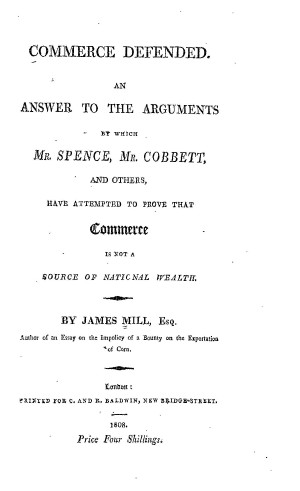
Commerce Defended. An Answer to the Arguments by which Mr. Spence, Mr. Cobbett, and Others, have attempted to Prove that Commerce is not a source of National Wealth (London: C. and R. Baldwin, 1808).

About Liberty Fund:

Liberty Fund, Inc. is a private, educational foundation established to encourage the study of the ideal of a society of free and responsible individuals.


CHAP. VI.

Consumption.

The doctrine of Mr. Spence respecting consumption is not less worthy of examination than his doctrine concerning production.

This author divides the members of a civilized society into four classes; the class of landowners—The class of cultivators—The class of manufacturers—And the unproductive class. ‘As the whole revenue of a country,’ he says,* ‘is derived from its land; and as the class of land-proprietors are the recipients of this revenue, it is evident that from this class must be drawn the revenues, of the two other classes of society; the manufacturing and unproductive class. It is a condition, then, essential,’ he adds, ‘to the creation of national wealth, that the class of land-proprietors expend the greater part of the revenue which they derive from the soil. So long as they perform this duty, every thing goes on in its proper train. With the funds which the manufacturing and the unproductive classes appropriate to themselves from the expenditure, of the class of landowners, they are enabled to purchase the food which the farmer offers to them. The farmer being enabled to dispose of his produce, acquires the funds necessary for the payment of his rent, &c. Let us make the supposition that fifty of our great landowners, each deriving twenty thousand pounds a year from his estates, which they have been accustomed to spend, were to be convinced by the arguments of Dr. Smith, that the practice of parsimony is the most effectual way of accumulating national riches, and should save the £1000000 which their revenue amounted to. Is it not self-evident that the members of the manufacturing and unproductive classes, who had been accustomed to receive this sum, would have their power of consuming diminished? The farmer consequently could not sell so mush of his produce, nor at so good a price as before. It is clear then that expenditure, not parsimony, is the province of the class of land proprietors; and that it is upon the due performance of this duty by the class in question, that the production of national wealth depends. And not only does the production of national wealth depend upon the expenditure of the class of land-proprietors, but for the due increase of this wealth, and for the constantly progressive maintenance of the prosperity of the community, it is absolutely requisite that this class should go on progressively increasing its expenditure. It will follow, as a consequence, that in countries constituted as this and those composing the rest of Europe are, the increase of luxury is absolutely essential to their necessities. It is impossible exactly to define what are luxuries and what necessaries; yet a slight consideration will shew that a very great proportion of our manufactures cannot be included under the latter title. Every one knows that a few hundreds a year are sufficient to procure all the necessaries and comforts of life: in what then can the sums above this amount, which are spent by the numbers in this country who have their £10,000 and £20,000 a year, be expended, but in luxuries? And as from this consideration it is plain that the population of the manufacturing class, at present occupied in providing necessaries, is fully equal to fabricate all that are wanted of this description, it follows that the additional population of this class can only be employed in the manufacture of new luxuries.’

This is the first part of our author's doctrine concerning consumption; and I have been anxious to exhibit a full view of it. Its nature and value we now proceed to investigate.

The reader of this pamphlet, we trust, will immediately discover one short argument subversive of this whimsical speculation. It is founded, we see, upon the assumption that land is the only source of wealth; a position which we have found to be altogether untenable. Both manufactures and commerce are sources, and important sources of wealth; therefore the landed proprietors are not the original owners of the whole, nor of nearly the whole, annual revenue of the country. The foundation of Mr. Spence's doctrine being thus removed, the superstructure of necessity falls to the ground* .

It may be useful, however, to exhibit a fuller and more accurate view of the fallacy of this doctrine respecting consumption, It proceeds entirely upon a misapprehension; upon the confounding together of two things, which are remarkably different, by failing to distinguish the double meaning of an ambiguous term. The two senses of the word consumption are not a little remarkable. We say, that a manufacturer consumes the wine which is laid up in his cellar, when he drinks it; we say too, that he has consumed the cotton, or the wool in his warehouse, when his workmen have wrought it up: he consumes part of his money in paying the wages of his footmen; he consumes another part of it in paying the wages of the workmen in his manufactory. It is very evident, however, that consumption, in the case of the wine and the livery servants, means something very different from what it means in the case of the wool or cotton, and the manufacturing servants. In the first case, it is plain, that consumption means extinction, actual annihilation of property; in the second case, it means more properly renovation, and increase of property. The cotton or wool is consumed only that it may appear in a more valuable form; the wages of the workmen only that they may be repaid, with a profit, in the produce of their labour. In this manner too, a land proprietor may consume a thousand quarters of corn a year, in the maintenance of dogs, of horses for pleasure, and of livery servants; or he may consume the same quantity of Corn in the maintenance of agricultural horses, and of agricultural servants. In this instance too, the consumption of the corn, in the first case, is an absolute destruction of it. In the second case, the consumption is a renovation and increase. The agricultural horses and servants will produce double or triple the quantity of corn which they have consumed. The dogs, the horses of pleasure, and the livery servants, produce nothing.

We perceive, therefore, that there are two species of consumption; which are so far from being the same, that the one is more properly the very reverse of the other. The one is an absolute destruction of property, and is consumption properly so called; the other is a consumption for the sake of reproduction, and might perhaps with more propriety be called employment than consumption. Thus the land proprietor might with more propriety be said to employ, than consume the corn, with which he maintains his agricultural horses and servants; but to consume the corn which he expends upon his dogs, livery servants, &c. The manufacturer too, would most properly be said to employ, not to consume, that part of his capita, with which he pays the wages of his manufacturing servants; but to consume in the strictest sense of the word what he expends upon wine, or in maintaining livery servants. Such being the remarkable difference between the meanings of the word consumption, the man in whose reasonings and doctrines those meanings are confounded, must arrive at woeful conclusions.

It appears from this very explanation of the meanings of the term, that it is of importance to the interests of the country, that as much as possible of its annual produce should be employed, but as little as possible of it consumed. The whole annual produce of every country is distributed into two great parts; that which is destined to be employed for the purpose of reproduction, and that which is destined to be consumed. That part which is destined to serve for reproduction, naturally appears again next year, with its profit. This reproduction, with the profit, is naturally the whole produce of the country for that year. It is evident, therefore, that the greater the quantity of the produce of the preceding year, which is destined to administer to reproduction in the next, the greater will natuturally be the produce of the country for that year. But as the whole annual produce of the country is necessarily distributed into two parts, the greater the quantity which is taken for the one, the smaller is the quantity which is left for the other. We have seen, that the greatness of the produce of the country in any year, is altogether dependent upon the greatness of the quantity of the produce of the former year, which is set apart for the business of reproduction. The annual produce is therefore the greater, the less the portion is which is alloted for consumption. If by consumption therefore Mr. Spence means, what we have termed consumption properly so called, or dead unproductive consumption, and it does appear that this is his meaning, his doctrine is so far from being true, that it is the very reverse of the truth. The interests of the country are the most promoted, not by the greatest, but by the least possible consumption of this description.

Let not Mr. Spence, however, be alarmed. Let him rest in perfect assurance, that the whole annual produce of the country will be always very completely consumed, whether his landholders choose to spend or to accumulate. No portion of it will be left unappropriated to the one species of consumption, or to the other. No man, if he can help it, will let any part of his property lie useless and run to waste. Nothing is more clear, than that the self-interest of men, ever has impelled and ever will impel them, with some very trifling exceptions, to use every particle of property which accrues to them, either to the purpose of immediate gratification, or of future profit. That part, however, which is destined for future profit, is just as completely consumed, as that which is destined for immediate gratification. A thousand ploughmen consume fully as much corn and cloth in the course of a year as a regiment of soldiers. But the difference between the kinds of consumption is immense. The labour of the ploughman has, during the year, served to call into existence a quantity of property, which not only repays the corn and cloth which he has consumed, but repays it with a profit. The soldier on the other hand produces nothing. What he has consumed is gone, and its place is left ab solutely vacant. The country is the poorer for his consumption, to the full amount of what he has consumed. It is not the poorer, hut the richer for what the ploughman has consumed, because, during the time he was consuming it, he has reproduced what does more than replace it.

We may hence perceive how it is, that a country advances in property, and how it is that it declines. When the produce of each year is the same with that of the preceding year, it is plain that the riches of the country are stationary; when the produce of each year is greater than that of the preceding, the wealth of the country is advancing; and when the produce of each year is less than that of the preceding, the wealth of the country is on the decline. What then is the cause by which the annual produce of a country is increased? About this there can luckily be no controversy. The cause by which the annual produce of a country is increased, is the increase of that division of the annual produce, which is destined to administer to reproduction. That we may have more work, we must employ more workmen, and use more materials. The maintenance of these workmen, and the materials on which they operate, are the new fund which is indispensably requisite to the increase of the annual produce. But the only source whence this provision can be drawn, is the source whence the whole fund destined to administer, to reproduction is drawn, the annual produce of the country. Now, we have already clearly seen, that the annual produce of every country is always divided into two parts, that which is destined for mere consumption, and that which is destined for the business of reproduction; and that these two parts always wholly exhaust that produce. In whatever proportion, therefore, the part destined for reproduction is augmented, in the same proportion must the part intended for consumption be diminished, and vice versa. When the affairs of a country are stationary, when the produce of this year, for example, is the same with that of the last, that is to say, is equal both to that part which was appropriated to the business of reproduction, and to that which was appropriated to consumption, the part destined for reproduction must have been so large as to suffice for replacing itself, and for affording an increase equal to that part of the annual produce which was taken for consumption. Again, if the produce for the succeeding year is to be the same with the present, such a part of this year's produce must be devoted to the business of reproduction as will suffice to replace itself, and to afford a surplus equal to that part which is reserved for immediate consumption. While this proportion is maintained, the situation of the country is stationary, When, however, it fortunately happens, that a smaller proportion than this of the annual produce is withdrawn for consumption, and a greater proportion than this is left for reproduction, the prosperity of the country advances. The produce of each year is greater than that of the preceding. On the other hand, whenever in the stationary situation of a country, a greater than the usual proportion of the annual produce is withdrawn from the business of reproduction, and devoted to consumption, the produce of the succeeding year becomes necessarily diminished, and as long as this consumption continues, the affairs of the country are retrograde. It is evident, that the arrangement of society, which has a tendency to draw the greatest proportion of the annual produce to consumption, is that in which there is the greatest inequality of fortunes, in which there is the greatest number of persons, who have no occasion to devote themselves to any useful pursuit. But it is the maintenance of great fleets and armies, which is always the most formidable weight in the scale of consumption, and which has the most fatal tendency to turn the balance against reproduction and prosperity. It is by the lamentable continuance of wars, almost always nourished by puerile prejudices and blind passions, that the affairs of prosperous nations are first brought to the stationary condition, and from this plunged into the retrograde.

Mr. Spence offers one curious observation. After the statement which we have already quoted, of the miseries which he supposes would flow from a disposition in the landholders not to spend, he anticipates an objection* . Let it not be urged, says he, that what they might save would not be hoarded, (for misers now-a-days are wiser than to keep their money in strong boxes at home) but would be lent on interest; it would still be employed in circulation, and would still give employment to manufacturers. This objection he encounters with the following answer: ‘It should be considered, that money borrowed on interest is destined not for expenditure, but to be employed as capital; that the very circumstance of lessening expenditure decreases the means of the profitable employment of capital, and consequently that the employment of the sum alluded to as capital, would in no degree diminish the hardships of those, who had been deprived of the revenue derived from its expenditure.’ Wonderful, as after what we have been considering, it may appear, it is yet certain, that Mr. Spence here objects to the augmentation of the portion of the annual produce, which is destined for reproduction. The savings of the landholders, says he, would be employed as capital. But why should they not be employed as capital? Because, says Mr. Spence, expenditure would be lessened. Well may we here congratulate our author on the clearness and comprehensiveness of his views. What then? The corn which we supposed the landowner to consume upon his agricultural servants and horses, would not be as completely expended as that which we supposed him to consume upon his livery servants, his stud, and his dog kennel? The ploughmen of the country do not expend as well as the soldiers? There is here a want of discernment, which in a man, who stands up as an emphatical teacher in political economy, does hardly deserve quarter* . Of the two parts of the annual produce, that which is destined for reroduction and that which is destined for consumption, the one is as completely expended as the other, and that part which is destined for reproduction, is that which is probably all expended in the shortest time. For the man who intends to make a profit is in haste to obtain it. But a considerable time may elapse before a man consume the whole of what he lays up for mere gratification. He may have in his cellar a stock of wine to serve him for several years, but the flax or the wool in his warehouse will probably be all worked up in the course of one year.

To render the futility of Mr. Spence's objection stiil more clear, we may shew him by an analysis of a particular case in what manner the savings of his landholders would contribute not to the worst but to the best effects in civil society. As this error respecting the importance of dead consumption is common both to the mercantile system and to that of the Economistes, and very generally diffused among the ordinary part of mankind, it is of no little importance, even at the risk of being thought tedious, to endeavour to set it in the strongest light I am able. Let us suppose that one of Mr. Spence's landholders with a revenue of £10,000, the whole of which he has been accustomed to spend in the maintainance of a brilliant and luxurious establishment, becomes resolved all at once to cut short his expenditure one half. He has thus the very first year £5,000 to dispose of. Even Mr. Spence allows that he will lend not hoard it. Let us suppose that he lends it to the linen manufacturer in his neighbourhood. To what use in his hands is it immediately applied? to the augmentation unquestionably of his business. He goes directly and buys an additional quantity of flax from the farmer, he sets to work, an additional number of flax-dressers and spinners, he employs the carpenters, blacksmiths, and other necessary artisans in erecting for him an additional number of looms, and he hires an additional number of weavers. In this manner the £10,000 of the landholder is as completely consumed as ever it was. But £5,000 of it is consumed in a very different manner. It is consumed, 1st upon a very different set of people, and 2d to a very different end. 1. It is consumed upon the growers, the dressers, the spinners, and weavers of flax, with the carpenters, blacksmiths, and other artisans whose labours are subservient to that manufacture, instead of being expended, as formerly, upon lacqueys and cooks, and the other artificers of luxury. 2. It is expended for the sake of reproduction. By means of its expenditure a property of an equal and more than equal amount is now called into existence; by its former expenditure nothing was called into existence, The produce of the country for this year therefore is greater than it would otherwise have been by the amount of £5,000, with its natural profits. If we suppose these profits to be only ten per cent, which is surely reasonable, the produce of the country is thus £5,500 the greater, on account of the very first year's saving of the landholder.*

Another strange perversity of Mr. Spence's doctrine here presents itself. It is directly opposed to the very end which it purposes to promote, consumption. By renouncing Mr. Spence's plan in the instance we have adduced, the country would have more to expend to the amount of £5,500 in the very first year of the new operation of the £5,000; because it would have more produce to the amount of £5,500. Mr. Spence will not surely say that a nation can consume more than it produces; and it is very odd that he and the other pupils of the same doctrine do not reflect that consumption is posterior to production, as it is impossible to consume what is not produced. Consumption in the necessary order of things is the effect of production, not production the effect of consumption. But as every country will infallibly consume to the full amount of its production, whatever is applied to augment the annual produce of the country by consequence augments its annual consumption. The greater therefore the departure from Mr. Spence's rules, the more rapid in every country the increase of consumptíon will be.*

There is another idea the explication of which I could have willingly avoided, because it is more abstruse than may appear adapted to the greater part of the readers of a pamphlet, and after all the pains I can take to render it plain in the narrow space to which I am confined, considerable obscurity may still appear to rest upon it. This explication however is not only necessary because it serves to clear away a remaining objection of the Economistes, but because it exposes the fallacy of certain notions even in this country, which threaten to have very extensive practical consequences. The Economistes and their disciples espress great apprehensions lest capital should increase too fast, lest the production of commodities should be too rapid. There is only, say they, a market for a given quantity of commodities, and if yon increase the supply beyond that quantity you will be unable to dispose of the surplus.

No proposition however in political œconomy seems to be more certain than this which I am going to announce, how paradoxical soever it may at first sight appear; and if it be true, none undoubtedly can be deemed of more importance. The production of commodities creates, and is the one and universal cause which creates a market for the commodities produced. Let us but consider what is meant by a market. Is any thing else Understood by it than that something is ready to be exchanged for the commodity which we would dispose of? When goods are carried to market what is wanted is somebody to buy. But to buy, one must have wherewithal to pay. It is obviously therefore the collective means of payment which exist in the whole nation that constitute the entire market of the nation. But wherein consist the collective means of payment of the whole nation? Do they not consist in its annual produce, in the annual revenue of the general mass of its inhabitants? But if a nation's power of purchasing is exactly measured by its annual produce, as it undoubtedly is; the more you increase the annual produce, the more by that very act you extend the national market, the power of purchasing and the actual purchases of the nation. Whatever be the additional quantity of goods therefore which is at any time created in any country, an additional power of purchasing, exactly equivalent, is at the same instant created; so that a nation can never be naturally overstocked either with capital or with commodities; as the very operation of capital makes a vent for its produce. Thus to recur to the example which we have already analyzed; fresh goods to the amount of £5,500 were prepared for the market in consequence of the application of the £5000 saved by the landholder. But what then? have we not seen that the annual produce of the country was increased; that is, the market of the country widened, to the extent of £5,500, by the very same operations? Mr. Spence in one place advises his reader to consider the circumstances of a country in which all exchange should be in the way of barter, as the idea of money frequently tends to perplex. If he will follow his own advice on this occasion, he will easily perceive how necessarily production creates a market for produce. When money is laid out of the question, is it not in reality the different commodities of the country, that is to say, the different articles of the annual produce, which are annually exchanged against one another? Whether these commodities are in great quantities or in small, that is to say, whether the country is rich or poor, will not one half of them ahvavs balance the other? and is it not the barter of one half of them with the other which actually constitutes the annual purchases and sales of the country? Is it not the one half of the goods of a country which universally forms the market for the other half, and vice versa? And is, this a market that can ever be overstocked? Or can it produce the least disorder in this market whether the goods are in great or in small quantity? All that here can ever be requisite is that the goods should be adapted to one another; that is to say, that every man who has goods to dispose of should always find all those different sorts of goods with which he wishes to supply himself in return. What is the difference when the goods are in great quantity and when they are in small? Only this, that in the one case the people are liberally supplied with goods, in the other that they are scantily; in the one case that the country is rich, in the other that it is poor: but in the one case, as well as in the other, the whole of the goods will be exchanged, the one half against the other; and the market will always be equal to the supply. Thus it appears that the demand of a nation is always equal to the produce of a nation. This indeed must be so; for what is the demand of a nation? The demand of a nation is exactly its power of purchasing. But what is its power of purchasing? The extent undoubtedly of its annnal produce. The extent of its demand therefore and the extent of its supply are always exactly commensurate. Every particle of the annual produce of a country falls as revenue to somebody. But every individual in the nation uniformly makes purchases, or does what is equivalent to making purchases, with every farthing's worth which accrues to him. All that part which is destined for mere consumption is evidently employed in purchases. That too which is employed as capital is not less so. It is either paid as wages to labourers, who immediately buy with it food and other necessaries, or it is employed in the purchase of raw materials. The whole annual produce of the country, therefore, is employed in making purchases. But as it is the whole annual produce too which is offered to sale, it is visible that the one part of it is employed in purchasing the other; that how great soever that annual produce may be it always creates a market to itself; and that how great soever that portion of the annual produce which is destined to administer to reproduction, that is, how great soever the portion employed as capital, its effects always are to render the country richer, and its inhabitants more opulent, but never to confuse or to overload the national market. I own that nothing appears to me more completely demonstrative than this reasoning.*

It may be necessary, however, to remark, that a nation may easily have more than enough of any one commodity, though she can never have more than enough of commodities in general. The quantity of any one commodity may easily be carried beyond its due proportion; but by that very circumstance is implied that some other commodily is not provided in sufficient proportion. What indeed is meant by a commodity's exceeding the market? Is it not that there is a portion of it for which there is nothing that can be had in exchange. But of those other things then the proportion is too small. A part of the means of production which had been applied to the preparation of this superabundant commodity, should have been applied to the preparation of those other commodities till the balance between them had been established. Whenever this balance is properly preserved, there can be no superfluity of commodities, none for which a market will not be ready.* This balance too the natural order of things has so powerful a tendency to produce, that it uill always be very exactly preserved where the injudicious tampering of government does not prevent, or those disorders in the intercourse of the world, produced by the wars into which the inoffending part of mankind are plunged, by the folly much more frequently than by the wisdom of their rulers.

This important, and as it appears demonstrative doctrine, affords a view of commerce which ought to be very consolatory to Mr. Spence. It shews that a nation always has within itself a market equal to all the commodities of which it can possibly have to dispose; that its power of purchasing is always equivalent to its power of producing, or at least to its actual produce; and that as it never can be greater, so it never can be less. Foreign commerce, therefore, is in all cases a matter of expediency rather than of necessity. The intention of it is not to furnish a vent for the produce of the industry of the country, because that industry always furnishes a vent for itself. The intention of it is to exchange a part of our own commodities for a part of the commodities which we prefer to our own of some other nation; to exchange a set of commodities which it peculiarly suits onr country to produce for a set of commodities which it peculiarly suits that other country to produce. Its use and advantage is to promote a better distribution, division and application of the labour of the country than would otherwise take place, and by consequence to render it more productive. It affords us a better, a more convenient and more opulent supply of commodities than could have been obtained by the application of our labour within ourseives, exactly in the same manner as by the free interchange of commodities from province to province within the same country, its labour is befter divided and rendered more productive.

It thus appears of what extraordinary importance to everv community is the augmentation of capital; that is to say, the augmentation of that part of the annual produce which is consumed in the way of reproduction. If we but recall the thought of that important doctrine first illustrated by Smith, that a progression is necessary in national affairs to render the circumstances of the great body of the people in any degree comfortable, our humanity, as well as our patriotism, will become deeply interested in the doctrine ot parsimony. Dr. Smith shews that even when a country is stationary, the subsistence of the labouring classes is reduced to the lowest rate which is consistent with common humanity; that is to say, it is barely sufficient to enable them to maintain their present numbers, but not sufficient to enable them in the least degree to augment them. But if we recollect how much greater than this are the powers of multiplication in the species, how natural it is for the average of families to be more numerous than merely to replace the father and the mother; we shall see with feelings of commiseration how wretched must be the circumstances of those families that are more numerous, and of how many human creatures brought into existence, it must be the miserable fate to perish through want of subsistence. But if such is the dismal situation of the great body of the people, when the national affairs are but stationary, how much more shocking to our feelings are their circumstances, when the situation of the country is retrograde! In this situation the labourer is unable to earn even at a rate which is sufficient to maintain the numbers of the labouring class. Calamity now comes down with a heavier hand. That class must even be thinned by the dreadful operation of deficient subsistence! On the other hand, when the affairs of the country are progressive, the wages of the labouring class arc sufficient not only to maintain their existing numbers, but to augment them. The reward of labour is liberal. The labourer can support a moderate family with ease; and plenty and comfort diffuse themselves throughout the community. Have we not seen that this progressive state of society, that all these happy consequences result from continual additions made to the capital of the country, or to that part of the annual produce which is devoted to reproduction? and have we not seen that the retrograde condition, with all its deplorable consequences, results from making continual additions to that part of the annual produce which is taken for mere consumption? Little obligation then has society to those doctrines by which this consumption is recommended. Obstacles enow exist to the augmentation of capital without the operation of ridiculous speculations. Were the doctrine that it can increase too fast, as great a truth as it is an nbsurdily, the experience of all the nations on earth proves to us, that of all possible calamities this would be the least to be feared. Slow has been its progress every where; and low the degree of prosperity which has in any place been given to the mass of the people to enjoy.

[*]See Mr. S's pamphlet, from p. 29 to 37.

[*]Mr. Spence here furnishes us with an unanswerable argument against his doctrine of durable commodities. He insists upon it, as we have already seen, that all commerce is unprofitable, which dees not import durable commodities. But commodities the more they are durable, are the more opposed to consumption. In conformity with his doctrine of consumption, he ought to recommend commerce in the most perishable commodities, His doctrine of durable commodities affords an argument against his doctrine of consumption; end his doctrine of consumption affords an argument against his doctrine of durable commodities.

[*]See Mr. S's pamphlet, p. 55.

[*]Here too, Mr. Spence follows a remarkable part of the system of the original Economistes. ‘La consommation est la mesure de la reproduction.—Plus il se consomme, plus il se produit,’ said Mercier de la Rivière, Ordre Essentiel des Sociétés Polit. Tom. ii. p. 138. At the time when this system was first invented, when men had just begun to analyse the operations of society, such a mistake deserved, perhaps, indulgence. But after the real causes of wealth have been so clearly evolved by Dr. Smith, after the mysterious process of production has been so exactly resolved into its first elements, it shows either a very slight acquaintance with his work, or a woeful inability to trace the consequences of the truths demonstrated in it, if a man can now adopt the doctrine of the Economistes respecting consumption.—A late French writer, M. Say, Economie Polit. Liv. v. ch. 3, tells a pleasant anecdote of a practical pup il of this doctrine. “J'ai connu,” says he, “un jeune homme qui fesait voler par la fenitre les flacons cristal à mesure qu'il les vidoit; il yaul, disait-il, encourager les manufactures.”

[*]Mr. Spence says in a note (p. 24 of his pamphlet, 5d edition) ‘There is a singular vagueness and confusion in the whole of Dr. Smith's reasoning, relative to the different effects of prodigality and parsimony upon national wealth. His arcriments seem to be intended to maintain, that fresh capital may be profitably employed, in manufacturing goods which nobody will buy; for, certainly no purchasers would be found for the goods brought into existence by the employment of new capital, if all the members of the society were to convert the greater part of their revenue into capital.’—This is pretty much as if a follower of the Ptolemaic astronomy should accuse the reasonings of Sir Isaac Newton of vagueness and confusion, because they do not tally with the doctrines of the cycles and epicycles.

[*]My reader may convince himself by personal inspection that the following passage is actually to be found In Mr. Spence's pamphlet, (p. 55) ‘Sir Richard Arkwright, by his invention and employment of improved machinery, in the spinning of cotton, annually gained great riches. But would he ever have been wealthy, if he had every year spent in tea, wine, sugar, &c. destined for his immediate consumption, a sum equal to, or greater than, the whole of his gain? Surely not. The dullest intellect must see, that he never could have acquired wealth, by this constant expenditure of his gains, in articles to be consumed by himself, which, when consumed, left no relic behind them; however great might have been his gains, and however long he might have acted on this system. If, then, a private manufacturer cannot acquire wealth in this way, neither can a manufacturing nation. The cases are precisely parallel.’

[*]The attentive reader will perceive that do deduction is made in the preceding argument for that part of the annual produce which is consumed immediately by the producer. The motive for this was a desire not to perplex the argument by qualifying clauses. To notice this particular, it the same time, was entirely unnecessary, since that part of the annual produce which may be consumed by the producer, as it increases not the demand in the national market, so neither doss it increase the stock or supply in that market, because it is not carried to market at all. It is also to be considered that in every country where labour is well divided, and skil fully applied, the proportion of the produce which the producers immediately a asume is always very small.

[*]What then are we to think of such speculators as Lord Henry Petty, who told the House of Commons in one of the debates on the appropriation of part of the sinking fund in his new finance plan, that it was necessary to prevent the national debt from being paid too fast, lest the country should become overstocked with capital? There was not an individual in the House who contradicted him.