Econlib

The Library

Other Sites

Front Page arrow Titles (by Subject) arrow introduction - Vindiciae Gallicae and Other Writings on the French Revolution

Return to Title Page for Vindiciae Gallicae and Other Writings on the French Revolution

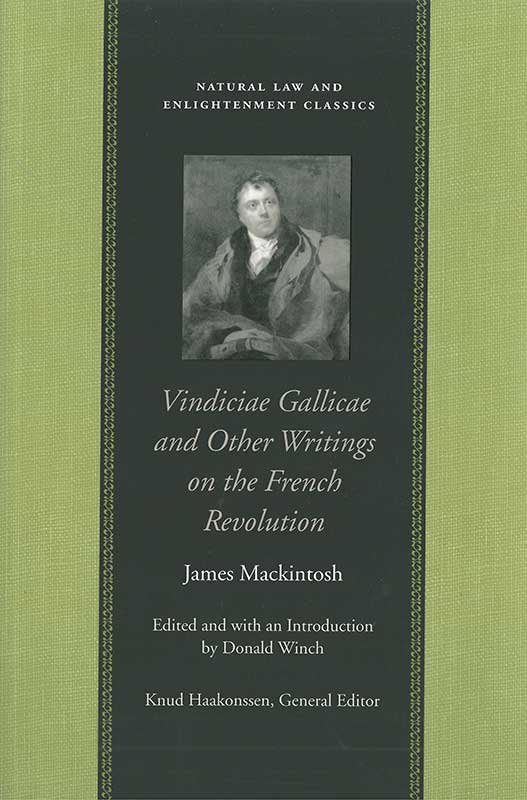
introduction - Sir James Mackintosh, Vindiciae Gallicae and Other Writings on the French Revolution [1791]

Edition used:

Vindiciae Gallicae and Other Writings on the French Revolution, edited and with an Introduction by Donald Winch (Indianapolis: Liberty Fund, 2006).

About Liberty Fund:

Liberty Fund, Inc. is a private, educational foundation established to encourage the study of the ideal of a society of free and responsible individuals.


introduction

The late opinions of Mr. Burke furnished more matter of astonishment to those who had distantly observed, than to those who had correctly examined the system of his former political life. An abhorrence for abstract politics, a predilection for aristocracy, and a dread of innovation, have ever been among the most sacred articles of his public creed. It was not likely that at his age he should abandon to the invasion of audacious novelties, opinions which he had received so early, and maintained so long, which had been fortified by the applause of the great, and the assent of the wise, which he had dictated to so many illustrious pupils, and supported against so many distinguished opponents. Men who early attain eminence, repose in their first<ii> creed. They neglect the progress of the human mind subsequent to its adoption, and when, as in the present case, it has burst forth into action, they regard it as a transient madness, worthy only of pity or derision. They mistake it for a mountain torrent that will pass away with the storm that gave it birth. They know not that it is the stream of human opinion in omne volubilis aevum,1 which the accession of every day will swell, which is destined to sweep into the same oblivion the resistance of learned sophistry, and of powerful oppression.

But there still remained ample matter of astonishment in the Philippic of Mr. Burke. He might deplore the sanguinary excesses—he might deride the visionary policy that seemed to him to tarnish the lustre of the Revolution, but it was hard to have supposed that he should have exhausted against it every epithet of contumely and opprobium that language<iii> can furnish to indignation; that the rage of his declamation should not for one moment have been suspended; that his heart should not betray one faint glow of triumph, at the splendid and glorious delivery of so great a people. All was invective—the authors, and admirers of the Revolution—every man who did not execrate it, even his own most enlightened and accomplished friends, were devoted to odium and ignominy.

This speech did not stoop to argument—the whole was dogmatical and authoritative; the cause seemed decided without discussion; the anathema fulminated before trial. But the ground of the opinions of this famous speech, which, if we may believe a foreign journalist, will form an epoch in the history of the eccentricities of the human mind, was impatiently expected in a work soon after announced.2 The name of the author, the importance of the subject, and the singularity of his opinions,<iv> all contributed to inflame the public curiosity, which though it languished in a subsequent delay, has been revived by the appearance, and will be rewarded by the perusal of the work.

It is certainly in every respect a performance, of which to form a correct estimate, would prove one of the most arduous efforts of critical skill. “We scarcely can praise it, or blame it too much.”3 Argument every where dextrous and specious, sometimes grave and profound, cloathed in the most rich and various imagery, and aided by the most pathetic and picturesque description, speaks the opulence and the powers of that mind, of which age has neither dimmed the discernment nor enfeebled the fancy, neither repressed the ardor, nor narrowed the range. Virulent encomiums on urbanity, and inflammatory harangues against violence; homilies of moral and religious mysticism, better adapted<v> to the amusement than to the conviction of an incredulous age, though they may rouse the languor of attention, can never be dignified by the approbation of the understanding.

Of the Senate and people of France, his language is such as might have been expected to a country which his fancy has peopled only with plots, assassinations, and massacres, and all the brood of dire chimeras which are the offspring of a prolific imagination, goaded by an ardent and deluded sensibility. The glimpses of benevolence, which irradiate this gloom of invective, arise only from generous illusion, from misguided and misplaced compassion—his eloquence is not at leisure to deplore the fate of beggared artizans, and famished peasants, the victims of suspended industry, and languishing commerce. The sensibility which seems scared by the homely miseries of the vulgar, is attracted only by the splendid sorrows of royalty, and agonizes at the slen-<vi>derest pang that assails the heart of sottishness or prostitution, if they are placed by fortune on a throne.

To the English friends of French freedom,4 his language is contemptuous, illiberal, and scurrilous. In one of the ebbings of his fervor, he is disposed not to dispute “their good intentions.”5 But he abounds in intemperate sallies, in ungenerous insinuations, which wisdom ought to have checked, as ebullitions of passion, which genius ought to have disdained, as weapons of controversy.

The arrangement of his work is as singular as the matter. Availing himself of all the privileges of epistolary effusion, in their utmost latitude and laxity, he interrupts, dismisses, and resumes argument at pleasure. His subject is as extensive as political science—his allusions and excursions reach almost every region of human knowledge. It must<vii> be confessed that in this miscellaneous and desultory warfare, the superiority of a man of genius over common men is infinite. He can cover the most ignominious retreat by a brilliant allusion. He can parade his arguments with masterly generalship, where they are strong. He can escape from an untenable position into a splendid declamation. He can sap the most impregnable conviction by pathos, and put to flight a host of syllogisms with a sneer. Absolved from the laws of vulgar method, he can advance a groupe of magnificent horrors to make a breach in our hearts, through which the most undisciplined rabble of arguments may enter in triumph.

Analysis and method, like the discipline and armour of modern nations, correct in some measure the inequalities of controversial dexterity, and level on the intellectual field the giant and the dwarf. Let us then analyse the production of Mr. Burke, and dismissing what<viii> is extraneous and ornamental, we shall discover certain leading questions, of which the decision is indispensible to the point at issue.

The natural order of these topics will dictate the method of reply. Mr. Burke, availing himself of the indefinite and equivocal term, Revolution, has, altogether, reprobated that transaction. The first question, therefore, that arises, regards the general expediency and necessity of a Revolution in France.—This is followed by the discussion of the composition and conduct of the National Assembly, of the popular excesses which attended the Revolution, and the New Constitution that is to result from it. The conduct of its English admirers forms the last topic, though it is with rhetorical inversion first treated by Mr. Burke, as if the propriety of approbation should be determined before the discussion of the merit or demerit of what was approved. In pursuance<ix> of this analysis, the following sections will comprise the substance of our refutation.

Sect. I. The General Expediency and Necessity of a Revolution in France.

II. The Composition and Character of the National Assembly considered.

III. The Popular Excesses which attended, or followed the Revolution.

IV. The new Constitution of France.

V. The Conduct of its English Admirers justified.

With this reply to Mr. Burke will be mingled some strictures on the late publication of M. Calonne.6 That minister, who has for some time exhibited to the eyes of indignant Europe the spectacle of an exiled robber living<x> in the most splendid impunity, has, with an effrontery that beggars invective, assumed in his work the tone of afflicted patriotism, and delivers his polluted Philippics as the oracles of persecuted virtue.

His work is more methodical than that of his coadjutor, Mr. Burke.* Of his financial calculations it may be remarked, that in a work professedly popular they afford the strongest presumption of fraud. Their extent and intricacy seem contrived to extort assent from<xi> public indolence, for men will rather believe than examine them. His inferences are so outrageously incredible, that most men of sense will think it more safe to trust their own plain conclusions than to enter such a labyrinth of financial sophistry.

The only part of his production that here demands reply, is that which relates to general political questions. Remarks on what he has offered concerning them will naturally find a place under the corresponding sections of the Reply to Mr. Burke. Its most important view is neither literary nor argumentative. It appeals to judgments more decisive than those of criticism, and aims at wielding weapons more formidable than those of logic.

It is the manifesto of a Counter Revolution, and its obvious object is to inflame every passion and interest, real or supposed, that has received any shock in the establishment of<xii> freedom. He probes the bleeding wounds of the princes, the nobility, the priesthood, and the great judicial aristocracy. He adjures one body by its dignity degraded, another by its inheritance plundered, and a third by its authority destroyed, to repair to the holy banner of his philanthropic crusade. Confident in the protection of all the monarchs of Europe, whom he alarms for the security of their thrones, and having insured the moderation of a fanatical rabble, by giving out among them the savage war-whoop of atheism, he already fancies himself in full march to Paris, not to re-instate the deposed despotism (for he disclaims the purpose, and who would not trust such virtuous disavowals!!) but at the head of this army of priests, mercenaries and fanatics, to dictate as the tutelar genius of France, the establishment of a just and temperate freedom, obtained without commotion and without carnage, and equally hostile to the interested ambition of demagogues and the lawless authority of kings.<xiii>

Crusades were an effervescence of chivalry, and the modern St. Francis has a knight for the conduct of these crusaders, who will convince Mr. Burke, that the age of chivalry is not past, nor the glory of Europe gone for ever. The Comte d’Artois,* that scyon worthy of Henry the Great, the rival of the Bayards and Sidneys, the new model of French Knighthood, is to issue from Turin with ten thousand cavaliers to deliver the peerless and immaculate Antonietta of Austria from the durance vile in which she has so long been immured in the Thuilleries, from the swords of the discourteous knights of Paris, and the spells of the sable wizards of democracy.

Vindiciae Gallicae &c. &c.<15>

[1. ]“Rolling its flood forever.” Horace, Epistles, in Satires, Epistles, and Ars poetica, trans. H. Rushton Fairclough (London and Cambridge, Mass.: Heinemann and Harvard University Press, 1978), 264–65 (I.ii.43).

[2. ]Edmund Burke, Substance of the Speech of the Right Honourable Edmund Burke, in the Debate on the Army Estimates, in the House of Commons, on Tuesday the 9th Day of February, 1790 (London: Debrett, 1790).

[3. ]Oliver Goldsmith, “Retaliation: A Poem,” in Collected Works, ed. A. Friedmann, 5 vols. (Oxford: Clarendon Press, 1966), 4:353.

[4. ]A general term for those in Britain who supported the French Revolution and called for reform at home. These included members of the London Corresponding Society, the Society for Constitutional Information, and other such societies. See A. Goodwin, The Friends of Liberty: The English Democratic Movement in the Age of the French Revolution (London: Hutchinson, 1979).

[5. ]Edmund Burke, Reflections on the Revolution in France, vol. 2 of Select Works of Edmund Burke, 3 vols. (Indianapolis: Liberty Fund, 1999), 233.

[6. ]C. A. Calonne, De l’état de la France, présent et à venir, par M. de Calonne ministre d’état (Londres: T. Spilsbury & fils, 1790).

[* ]It cannot be denied that the production of M. Calonne is, “eloquent, able,” and certainly very “instructive” in what regards his own character and designs. [Burke, Reflections, 295.] But it contains one instance of historical ignorance so egregious, that I cannot resist quoting it.—In his long discussion of the pretensions of the Assembly to the title of a National Convention, he deduces the origin of that word from Scotland, where he informs us, p. 328, “On lui donna le nom de Convention Ecossoise, le résultat de ses déliberations fut appellé Covenant, & ceux qui l’avoient souscrit ou qui y adhe-roient Covenanters!!” [“It was given the name Scottish Convention, the result of its deliberations was called a Covenant, and those who subscribed or adhered to it Covenanters!!” Calonne, De la France, 328.]

[* ]Ce digne rejeton du grand Henri—Calonne, p. 413. Un nouveau modèle de la Chevalerie Françoise. Ibid. p. 114. [“This offspring worthy of Henry the Great”; “A new model of French chivalry.” Calonne, De la France, 415 and 416. Mackintosh’s page numbers are wrong.]