EconlibThe LibraryOther Sites |
Front Page Titles (by Subject) Vindiciae Gallicae - Vindiciae Gallicae and Other Writings on the French Revolution
Return to Title Page for Vindiciae Gallicae and Other Writings on the French RevolutionThe Online Library of LibertyA project of Liberty Fund, Inc.Search this Title:Also in the Library:
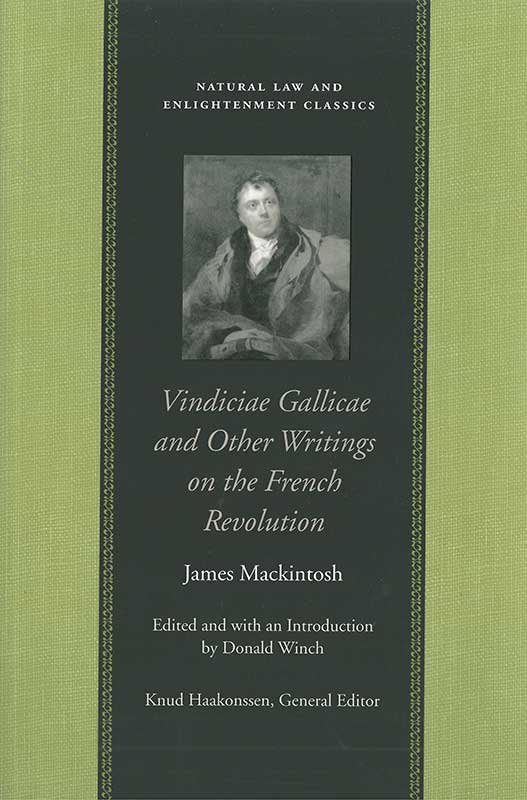
Vindiciae Gallicae - Sir James Mackintosh, Vindiciae Gallicae and Other Writings on the French Revolution [1791]Edition used:Vindiciae Gallicae and Other Writings on the French Revolution, edited and with an Introduction by Donald Winch (Indianapolis: Liberty Fund, 2006).
About Liberty Fund:Liberty Fund, Inc. is a private, educational foundation established to encourage the study of the ideal of a society of free and responsible individuals. Copyright information:The copyright to this edition, in both print and electronic forms, is held by Liberty Fund, Inc. Fair use statement:This material is put online to further the educational goals of Liberty Fund, Inc. Unless otherwise stated in the Copyright Information section above, this material may be used freely for educational and academic purposes. It may not be used in any way for profit.
AdvertisementHad I foreseen the size to which the following volume was to grow, or the obstacles that were to retard its completion, I should probably have shrunk from the undertaking; and perhaps I may now be supposed to owe an apology for offering it to the Public, after the able and masterly Publications to which this controversy has given occasion. Many parts of it bear internal marks of having been written some months ago, by allusions to circumstances which are now changed; but as they did not affect the reasoning, I was not solicitous to alter them. For the lateness of its appearance, I find a consolation in the knowledge, that respectable Works on the same subject are still expected by the Public; and the number of my fellow-labourers only suggests the reflection—that too many minds cannot be employed on a controversy so immense as to present the most various aspects to different understandings, and so important, that the more correct statement of one fact, or the more successful illustration of one argument, will at least rescue a book from the imputation of having been written in vain. Little Ealing, Middlesex, April 26, 1791. Advertisement to the Third EditionI now present the following Work to the Public a third time, rendered, I hope, less unworthy of their favor.—Of Literary Criticism it does not become me to question the justice, but Moral Animadversion I feel it due to myself to notice. The vulgar clamor which has been raised with such malignant art against the friends of Freedom, as the apostles of turbulence and sedition, has not even spared the obscurity of my name. To strangers I can only vindicate myself by defying the authors of such clamors to discover one passage in this volume not in the highest degree favorable to peace and stable government. Those to whom I am known would, I believe, be slow to impute any sentiments of violence to a temper which the partiality of my friends must confess to be indolent, and the hostility of enemies will not deny to be mild. I have been accused, by valuable friends, of treating with ungenerous levity the misfortunes of the Royal Family of France. They will not however suppose me capable of deliberately violating the sacredness of misery in a palace or a cottage; and I sincerely lament that I should have been betrayed into expressions which admitted that constuction. Little Ealing, August 28, 1791. introductionThe late opinions of Mr. Burke furnished more matter of astonishment to those who had distantly observed, than to those who had correctly examined the system of his former political life. An abhorrence for abstract politics, a predilection for aristocracy, and a dread of innovation, have ever been among the most sacred articles of his public creed. It was not likely that at his age he should abandon to the invasion of audacious novelties, opinions which he had received so early, and maintained so long, which had been fortified by the applause of the great, and the assent of the wise, which he had dictated to so many illustrious pupils, and supported against so many distinguished opponents. Men who early attain eminence, repose in their first<ii> creed. They neglect the progress of the human mind subsequent to its adoption, and when, as in the present case, it has burst forth into action, they regard it as a transient madness, worthy only of pity or derision. They mistake it for a mountain torrent that will pass away with the storm that gave it birth. They know not that it is the stream of human opinion in omne volubilis aevum,1 which the accession of every day will swell, which is destined to sweep into the same oblivion the resistance of learned sophistry, and of powerful oppression. But there still remained ample matter of astonishment in the Philippic of Mr. Burke. He might deplore the sanguinary excesses—he might deride the visionary policy that seemed to him to tarnish the lustre of the Revolution, but it was hard to have supposed that he should have exhausted against it every epithet of contumely and opprobium that language<iii> can furnish to indignation; that the rage of his declamation should not for one moment have been suspended; that his heart should not betray one faint glow of triumph, at the splendid and glorious delivery of so great a people. All was invective—the authors, and admirers of the Revolution—every man who did not execrate it, even his own most enlightened and accomplished friends, were devoted to odium and ignominy. This speech did not stoop to argument—the whole was dogmatical and authoritative; the cause seemed decided without discussion; the anathema fulminated before trial. But the ground of the opinions of this famous speech, which, if we may believe a foreign journalist, will form an epoch in the history of the eccentricities of the human mind, was impatiently expected in a work soon after announced.2 The name of the author, the importance of the subject, and the singularity of his opinions,<iv> all contributed to inflame the public curiosity, which though it languished in a subsequent delay, has been revived by the appearance, and will be rewarded by the perusal of the work. It is certainly in every respect a performance, of which to form a correct estimate, would prove one of the most arduous efforts of critical skill. “We scarcely can praise it, or blame it too much.”3 Argument every where dextrous and specious, sometimes grave and profound, cloathed in the most rich and various imagery, and aided by the most pathetic and picturesque description, speaks the opulence and the powers of that mind, of which age has neither dimmed the discernment nor enfeebled the fancy, neither repressed the ardor, nor narrowed the range. Virulent encomiums on urbanity, and inflammatory harangues against violence; homilies of moral and religious mysticism, better adapted<v> to the amusement than to the conviction of an incredulous age, though they may rouse the languor of attention, can never be dignified by the approbation of the understanding. Of the Senate and people of France, his language is such as might have been expected to a country which his fancy has peopled only with plots, assassinations, and massacres, and all the brood of dire chimeras which are the offspring of a prolific imagination, goaded by an ardent and deluded sensibility. The glimpses of benevolence, which irradiate this gloom of invective, arise only from generous illusion, from misguided and misplaced compassion—his eloquence is not at leisure to deplore the fate of beggared artizans, and famished peasants, the victims of suspended industry, and languishing commerce. The sensibility which seems scared by the homely miseries of the vulgar, is attracted only by the splendid sorrows of royalty, and agonizes at the slen-<vi>derest pang that assails the heart of sottishness or prostitution, if they are placed by fortune on a throne. To the English friends of French freedom,4 his language is contemptuous, illiberal, and scurrilous. In one of the ebbings of his fervor, he is disposed not to dispute “their good intentions.”5 But he abounds in intemperate sallies, in ungenerous insinuations, which wisdom ought to have checked, as ebullitions of passion, which genius ought to have disdained, as weapons of controversy. The arrangement of his work is as singular as the matter. Availing himself of all the privileges of epistolary effusion, in their utmost latitude and laxity, he interrupts, dismisses, and resumes argument at pleasure. His subject is as extensive as political science—his allusions and excursions reach almost every region of human knowledge. It must<vii> be confessed that in this miscellaneous and desultory warfare, the superiority of a man of genius over common men is infinite. He can cover the most ignominious retreat by a brilliant allusion. He can parade his arguments with masterly generalship, where they are strong. He can escape from an untenable position into a splendid declamation. He can sap the most impregnable conviction by pathos, and put to flight a host of syllogisms with a sneer. Absolved from the laws of vulgar method, he can advance a groupe of magnificent horrors to make a breach in our hearts, through which the most undisciplined rabble of arguments may enter in triumph. Analysis and method, like the discipline and armour of modern nations, correct in some measure the inequalities of controversial dexterity, and level on the intellectual field the giant and the dwarf. Let us then analyse the production of Mr. Burke, and dismissing what<viii> is extraneous and ornamental, we shall discover certain leading questions, of which the decision is indispensible to the point at issue. The natural order of these topics will dictate the method of reply. Mr. Burke, availing himself of the indefinite and equivocal term, Revolution, has, altogether, reprobated that transaction. The first question, therefore, that arises, regards the general expediency and necessity of a Revolution in France.—This is followed by the discussion of the composition and conduct of the National Assembly, of the popular excesses which attended the Revolution, and the New Constitution that is to result from it. The conduct of its English admirers forms the last topic, though it is with rhetorical inversion first treated by Mr. Burke, as if the propriety of approbation should be determined before the discussion of the merit or demerit of what was approved. In pursuance<ix> of this analysis, the following sections will comprise the substance of our refutation. Sect. I. The General Expediency and Necessity of a Revolution in France. II. The Composition and Character of the National Assembly considered. III. The Popular Excesses which attended, or followed the Revolution. IV. The new Constitution of France. V. The Conduct of its English Admirers justified. With this reply to Mr. Burke will be mingled some strictures on the late publication of M. Calonne.6 That minister, who has for some time exhibited to the eyes of indignant Europe the spectacle of an exiled robber living<x> in the most splendid impunity, has, with an effrontery that beggars invective, assumed in his work the tone of afflicted patriotism, and delivers his polluted Philippics as the oracles of persecuted virtue. His work is more methodical than that of his coadjutor, Mr. Burke.* Of his financial calculations it may be remarked, that in a work professedly popular they afford the strongest presumption of fraud. Their extent and intricacy seem contrived to extort assent from<xi> public indolence, for men will rather believe than examine them. His inferences are so outrageously incredible, that most men of sense will think it more safe to trust their own plain conclusions than to enter such a labyrinth of financial sophistry. The only part of his production that here demands reply, is that which relates to general political questions. Remarks on what he has offered concerning them will naturally find a place under the corresponding sections of the Reply to Mr. Burke. Its most important view is neither literary nor argumentative. It appeals to judgments more decisive than those of criticism, and aims at wielding weapons more formidable than those of logic. It is the manifesto of a Counter Revolution, and its obvious object is to inflame every passion and interest, real or supposed, that has received any shock in the establishment of<xii> freedom. He probes the bleeding wounds of the princes, the nobility, the priesthood, and the great judicial aristocracy. He adjures one body by its dignity degraded, another by its inheritance plundered, and a third by its authority destroyed, to repair to the holy banner of his philanthropic crusade. Confident in the protection of all the monarchs of Europe, whom he alarms for the security of their thrones, and having insured the moderation of a fanatical rabble, by giving out among them the savage war-whoop of atheism, he already fancies himself in full march to Paris, not to re-instate the deposed despotism (for he disclaims the purpose, and who would not trust such virtuous disavowals!!) but at the head of this army of priests, mercenaries and fanatics, to dictate as the tutelar genius of France, the establishment of a just and temperate freedom, obtained without commotion and without carnage, and equally hostile to the interested ambition of demagogues and the lawless authority of kings.<xiii> Crusades were an effervescence of chivalry, and the modern St. Francis has a knight for the conduct of these crusaders, who will convince Mr. Burke, that the age of chivalry is not past, nor the glory of Europe gone for ever. The Comte d’Artois,* that scyon worthy of Henry the Great, the rival of the Bayards and Sidneys, the new model of French Knighthood, is to issue from Turin with ten thousand cavaliers to deliver the peerless and immaculate Antonietta of Austria from the durance vile in which she has so long been immured in the Thuilleries, from the swords of the discourteous knights of Paris, and the spells of the sable wizards of democracy. Vindiciae Gallicae &c. &c.<15>SECTION IThe General Expediency and Necessity of a Revolution in France.It is asserted in many passages* of Mr. Burke’s work, though no where with that precision which the importance of the assertion demanded, that the French Revolution was not only in its parts reprehensible, but in the whole was absurd, inexpedient, and unjust; yet he has no where exactly informed us what he understands by the term. The French Revolution, in its most popular sense, perhaps would be understood in England to<16> consist of those splendid events that formed the prominent portion of its exterior, the Parisian revolt, the capture of the Bastile, and the submission of the King. But these memorable events, though they strengthened and accelerated, could not constitute a Political Revolution. It must have been a change of Government, but even limited to that meaning, it is equivocal and wide. It is capable of three senses. The King’s recognition of the rights of the States General to a share in the legislation, was a change in the actual government of France, where the whole legislative and executive power had, without the shadow of interruption, for nearly two centuries been enjoyed by the Crown; in that sense the meeting of the States-General was the Revolution, and the 5th of May was its aera. The union of the three Orders in one assembly was a most important change in the forms and spirit of the legislature. This<17> too may be called the Revolution, and the 23d of June will be its aera. This body, thus united, are forming a new Constitution. This may be also called a Revolution, because it is of all the political changes the most important, and its epoch will be determined by the conclusion of the labours of the National Assembly. Thus equivocal is the import of Mr. Burke’s expressions. To extricate them from this ambiguity, a rapid survey of these events will be necessary. It will prove too the fairest and most forcible confutation of his arguments. It will best demonstrate the necessity and justice of all the successive changes in the State of France, which formed the mixed mass called the Revolution. It will discriminate legislative acts from popular excesses, and distinguish transient confusion from permanent establishment. It will evince the futility and fallacy of attributing to the<18> conspiracy of individuals, or bodies, a Revolution which, whether it be beneficial or injurious, was produced only by general causes, where the most conspicuous individual produced little real effect. The Constitution of France resembled in the earlier stages of its progress the other Gothic governments of Europe. The history of its decline and the causes of its extinction are abundantly known. Its infancy and youth were like those of the English government. The Champ de Mars, and the Wittenagemot, the tumultuous assemblies of rude conquerors, were in both countries melted down into representative bodies. But the downfall of the feudal aristocracy happening in France before Commerce had elevated any other class of citizens into importance, its power devolved on the Crown. From the conclusion of the fifteenth century the powers of the States General had almost dwindled into formalities.<19> Their momentary re-appearance under Henry III. and Louis XIII. served only to illustrate their insignificance. Their total disuse speedily succeeded. The intrusion of any popular voice was not likely to be tolerated in the reign of Louis XIV. a reign which has been so often celebrated as the zenith of warlike and literary splendor, but which has always appeared to me to be the consummation of whatever is afflicting and degrading in the history of the human race. Talent seemed, in that reign, robbed of the conscious elevation, of the erect and manly part, which is its noblest associate and its surest indication. The mild purity of Fenelon,* the lofty spirit of Bossuet, the masculine mind of Boileau, the sublime fervor of Corneille, were confounded by the conta-<20>gion of ignominious and indiscriminate servility. It seemed as if the “representative majesty”7 of the genius and intellect of man were prostrated before the shrine of a sanguinary and dissolute tyrant, who practised the corruption of Courts without their mildness, and incurred the guilt of wars without their glory. His highest praise is to have supported the stage trick of Royalty with effect; and it is surely difficult to conceive any character more odious and despicable, than that of a puny libertine, who, under the frown of a strumpet, or a monk, issues the mandate that is to murder virtuous citizens, to desolate happy and peaceful hamlets, to wring agonizing tears from widows and orphans. Heroism has a splendor that almost atones for its excesses; but what shall we think of him, who, from the luxurious and dastardly security in which he wallows at Versailles, issues with calm and cruel apathy his orders to butcher the Protestants of Languedoc, or<21> to lay in ashes the villages of the Palatinate?8 On the recollection of such scenes, as a scholar, I blush for the prostitution of letters; as a man, I blush for the patience of humanity. But the despotism of this reign was pregnant with the great events which have signalized our age. It fostered that literature which was one day destined to destroy it. Its profligate conquests have eventually proved the acquisitions of humanity; and the usurpations of Louis XIV. have served only to add a larger portion to the great body of freemen. The spirit of its policy was inherited by the succeeding reign. The rage of conquest, repressed for a while by the torpid despotism of Fleury, burst forth with renovated violence in the latter part of the reign of Louis XV. France, exhausted alike by the misfortunes of one war and the victories of another, groaned under a weight of impost and debt, which it was equally difficult to remedy or to endure.<22> The profligate expedients were exhausted by which successive Ministers had attempted to avert the great crisis, in which the credit and power of the government must perish. The wise and benevolent administration of M. Turgot, though long enough for his glory, was too short, and perhaps too early, for those salutary and grand reforms which his genius had conceived, and his virtue would have effected. The aspect of purity and talent spread a natural alarm among the minions of a Court, and they easily succeeded in the expulsion of such rare and obnoxious intruders. The magnificent ambition of M. de Vergennes, the brilliant, profuse and rapacious career of M. de Calonne, the feeble and irresolute violence of M. Brienne, all contributed their share to swell this financial embarrassment. The deficit, or inferiority of the revenue to the expenditure, at length rose to<23> the enormous sum of 115 millions of livres, or about 4,750,000l. annually.* This was a disproportion between income and expence with which no government, and no individual, could long continue to exist. In this exigency there was no expedient left, but to guarantee the ruined credit of bankrupt despotism by the sanction of the national voice. The States General were a dangerous mode of collecting it. Recourse was there-fore had to the Assembly of the Notables, a mode well known in the history of France, in which the King summoned a number of individuals, selected, at his discre-<24>tion, from the mass, to advise him in great emergencies. They were little better than a popular Privy Council. They were neither recognized nor protected by law. Their precarious and subordinate existence hung on the nod of despotism. They were called together by M. Calonne, who has now the inconsistent arrogance to boast of the schemes which he laid before them, as the model of the Assembly whom he traduces. He proposed, it is true, the equalization of impost, and the abolition of the pecuniary exemptions of the Nobility and Clergy; and the difference between his system and that of the Assembly, is only in what makes the sole distinction in human actions—its end. He would have destroyed the privileged Orders, as obstacles to despotism. They have destroyed them, as derogations from freedom. The object of his plans was to facilitate Fiscal oppression. The motive of theirs<25> is to fortify general liberty. They have levelled all Frenchmen as men—he would have levelled them all as slaves. The Assembly of the Notables, however, soon gave a memorable proof, how dangerous are all public meetings of men, even without legal powers of controul, to the permanence of despotism. They had been assembled by M. Calonne to admire the plausibility and splendor of his speculations, and to veil the extent and atrocity of his rapine. But the fallacy of the one, and the profligacy of the other, were detected with equal ease. Illustrious and accomplished orators, who have since found a nobler sphere for their talents, in a more free and powerful Assembly, exposed this plunderer to the Notables. Detested by the Nobles and Clergy, of whose privileges he had suggested the abolition; undermined in the favour of the Queen, by his attack on one of her favourites (Breteuil);<26> exposed to the fury of the people, and dreading the terrors of judicial prosecution, he speedily sought refuge in England, without the recollection of one virtue, or the applause of one party, to console his retreat.* Thus did the Notables destroy their creator. Little appeared to be done to a superficial observer; but to a discerning eye, all was done; for the dethroned authority of Public opinion was restored. The succeeding Ministers, uninstructed by the example of their predecessors, by the destruction of Public credit, and the fermentation of the popular mind, hazarded measures of a still more preposterous and perilous description. The usurpation of some share in the sovereignty by the Parliament of Paris had become popular and venerable, because its tendency was useful,<27> and its exercise virtuous.—That body had, as it is well known, claimed a right, which, in fact, amounted to a negative on all the acts of the King. They contended, that their registering his Edicts was necessary to give them force. They would, in that case, have possessed the same share of legislation with the King of England. It is unnecessary to descant on the historical fallacy, and political inexpediency, of doctrines, which should vest in a narrow aristocracy of lawyers, who had bought their places, such extensive powers. It cannot be denied that their resistance had often proved salutary, and was some feeble check on the capricious wantonness of despotic exaction.—But the temerity of the Minister now assigned them a more important part. They refused to register two edicts for the creation of imposts. They averred, that the power of imposing taxes was vested only in the National<28> Representatives, and they claimed the immediate convocation of the States General of the kingdom. The minister banished them to Troyes. But he soon found how much the French were changed from that abject and frivolous people, which had so often endured the exile of its magistrates. Paris exhibited the tumult and clamour of a London mob. The cabinet, which could neither advance nor recede with safety, had recourse to the expedient of a compulsory registration. The Duke of Orleans, and the magistrates who protested against this execrable mockery, were exiled or imprisoned. But all these hacknied expedients of despotism were in vain. These struggles, which merit notice only as they illustrate the progressive energy of Public opinion, were followed by events still less equivocal. Lettres de Cachet were issued against M.M. d’Epresmenil & Goestard. They took refuge in the sanctuary of justice, and the Par-<29>liament pronounced them under the safeguard of the law and the King. A deputation was sent to Versailles, to intreat his Majesty to listen to sage counsels. Paris expected, with impatient solicitude, the result of this deputation; when towards midnight, a body of 2000 troops marched to the palace where the Parliament were seated, and their Commander, entering into the Court of Peers, demanded his victims. A loud and unanimous acclamation replied, “We are all d’Epresmenil & Goestard!”9 These magistrates surrendered themselves, and the satellite of despotism led them off in triumph, amid the execrations of an aroused and indignant people. These spectacles were not without their effect. The spirit of resistance spread daily over France. The intermediate commission of the States of Bretagne, the States of Dauphiné, and many other public bodies, began to assume a new and menacing tone. The Cabinet dis-<30>solved in its own feebleness, and M. Necker was recalled. That Minister, probably upright, and not illiberal, but narrow, pusillanimous, and entangled by the habits of detail* in which he had been reared, possessed not that erect and intrepid spirit, those enlarged and original views, which adapt themselves to new combinations of circumstances, and sway in the great convulsions of human affairs. Accustomed to the tranquil accuracy of commerce, or the elegant amusements of literature, he was “called on to ride in the whirlwind, and direct the storm.”10 He seemed superior to his privacy while he was limited<31> to it, and would have been adjudged by history equal to his elevation had he never been elevated.† The reputation of few men, it is true, has been exposed to so severe a test; and a generous observer will be disposed to scrutinize less rigidly the claims of a Statesman, who has retired with the applause of no party, who is detested by the aristocracy as the instrument of their ruin, and despised by the democratic leaders for pusillanimous and fluctuating policy. But had the character of M. Necker possessed more originality or decision, it could have had little influence on the fate of France. The minds of men had received an impulse. Individual aid and individual opposition were equally vain. His views, no doubt, extended only to palliation; but he was involved in a<32> stream of opinions and events, of which no force could resist the current, and no wisdom adequately predict the termination. He is represented by M. Calonne as the Lord Sunderland of Louis XVI. seducing the King to destroy his own power. But he had neither genius nor boldness for such designs. To return to our rapid survey.—The Autumn of 1788 was peculiarly distinguished by the enlightened and disinterested patriotism of the States of Dauphiné. They furnished, in many respects, a model for the future Senate of France. Like them they deliberated amidst the terrors of ministerial vengeance and military execution. They annihilated the absurd and destructive distinction of Orders, the three estates were melted into a Provincial Assembly; and they declared, that the right of imposing taxes resided ultimately in the States General of France. They voted a deputation to the King to solicit the convocation of that<33> Assembly. They were emulously imitated by all the provinces that still retained the shadow of Provincial States. The States of Languedoc, of Velay, and Vivarois, the Tiers Etat of Provence, and all the Municipalities of Bretagne, adopted similar resolutions. In Provence and Bretagne, where the Nobles and Clergy, trembling for their privileges, and the Parliaments for their jurisdiction, attempted a feeble resistance, the fermentation was peculiarly strong. Some estimate of the fervor of public sentiment may be formed from the reception of the Count de Mirabeau in his native Provence, where the Burgesses of Aix assigned him a body-guard, where the citizens of Marseilles crowned him in the theatre, and where, under all the terrors of despotism, he received as numerous and tumultuous proofs of attachment as ever were bestowed on a favourite by the enthusiasm of the most free people. M. Caraman, the Governor of Provence, was even reduced to im-<34>plore his interposition with the populace, to appease and prevent their excesses. The contest in Bretagne was more violent and sanguinary. It had preserved its independence more than any of those Provinces which had been united to the Crown of France. The Nobles and Clergy possessed almost the whole power of the States, and their obstinacy was so great, that their Deputies did not take their seats in the National Assembly till an advanced period of its proceedings. The return of M. Necker, and the recall of the exiled magistrates, restored a momentary calm. The personal reputation of the Minister for probity, re-animated the credit of France. But the finances were too irremediably embarrassed for palliatives; and the fascinating idea of the States General, presented to the public imagination by the unwary zeal of the Parliament, awakened recollections of ancient freedom, and prospects<35> of future splendor, which the virtue or popularity of no Minister could banish. The convocation of that body was resolved—but many difficulties respecting the mode of electing and constituting it remained, which a second Assembly of Notables was summoned to decide. The third Estate demanded representatives equal to those of the other two Orders jointly. They required that the number should be regulated by the population of the districts, and that the three Orders should vote in one Assembly. All the Committees into which the Notables were divided, except that of which Monsieur was President, decided against the Third Estate in every one of these particulars. They were strenuously supported by the Parliament of Paris, who, too late sensible of the suicide into which they had been betrayed, laboured to render the Assembly impotent, when they were unable to pre-<36>vent its meeting. But their efforts were in vain. M. Necker, whether actuated by respect for justice, or ambition of popularity, or yielding to the irresistible torrent of public sentiment, advised the King to adopt the propositions of the Third Estate in the two first particulars, and to leave the last to be decided by the States General themselves. Letters patent were accordingly issued on the 24th of January, 1789, for assembling the States General,* to which were annexed regulations for the detail of their elections. In the constituent assemblies of the several provinces, bailliages, and constabularies of the kingdom, the progress of the public mind became still more evident. The Clergy and Nobility ought not to be denied the praise of having emulously sacrificed their pe-<37>cuniary privileges. The instructions to the Representatives breathed every where a spirit of freedom as ardent, though not so liberal and enlightened, as that which has since presided in the deliberations of the National Assembly. Paris was eminently conspicuous. The union of talent, the rapid communication of thought, and the frequency of those numerous assemblies, where men learn their force, and compare their wrongs,* ever make a great capital the heart that circulates emotion and opinion to the extremities of an empire. No sooner had the convocation of the States General been announced, than the batteries of the press were opened. Pamphlet succeeded pamphlet, surpassing each other in boldness and elevation; and the advance of Paris to light and freedom was greater in three months than it had been in almost as many centuries.<38> Doctrines† were universally received in May, which in January would have been deemed treasonable, and which in March were derided as the visions of a few deluded fanatics. It was amid this rapid diffusion of light, and increasing fervor of public sentiment, that the States General of France assembled at Versailles on the 5th of May, 1789; a day which will probably be accounted by posterity one of the most memorable in the annals of the human race. Any detail of the parade<39> and ceremonial of their Assembly would be totally foreign to our purpose, which is not to narrate events, but to seize their spirit, and to mark their influence on the political progress from which the Revolution was to arise. The preliminary operation necessary to constitute the Assembly gave rise to the first great question—The mode of authenticating the commissions of the Deputies. It was contended by the Clergy and Nobles, that according to ancient usage, each Order should separately scrutinize and authenticate the commissions of its own Deputies. It was argued by the Commons, that, on general principles, all Orders, having an equal interest in the purity of the national representative, had an equal right to take cognizance of the authenticity of the commissions of all the members who compose it, and therefore to scrutinize them in common. To the authority of precedent it was answered, that it would establish too much; for in the ancient States, their ex-<40>amination of powers was subordinate to the revision of Royal Commissaries, a subjection too degrading and injurious for the free and vigilant spirit of an enlightened age. This controversy involved another of more magnitude and importance. If the Orders united in this scrutiny, they were likely to continue in one Assembly; the separate voices of the two first Orders would be annihilated, and the importance of the Nobility and Clergy reduced to that of their individual suffrages. This great Revolution was obviously meditated by the leaders of the Commons. They were seconded in the Chamber of the Noblesse by a minority eminently distinguished for rank, character, and talent. The obscure and useful portion of the Clergy were, from their situation, accessible to popular sentiment, and naturally coalesced with the Commons. Many who favoured the division of the Legislature in the ordinary arrangements of Go;n-<41>vernment, were convinced that the grand and radical reforms, which the situation of France demanded, could only be effected by its union as one Assembly.* So many prejudices were to be vanquished, so many difficulties to be surmounted, such obstinate habits to be extirpated, and so formidable a power to be re-<42>sisted, that there was an obvious necessity to concentrate the force of the reforming body. In a great Revolution, every expedient ought to facilitate change. In an established Government, every thing ought to render it difficult. Hence the division of a Legislature, which in an established Government may give a beneficial stability to the laws, must, in a moment of Revolution, be proportionably injurious, by fortifying abuse and unnerving reform. In a Revolution, the enemies of freedom are external, and all powers are therefore to be united. Under an establishment her enemies are internal, and power is therefore to be divided. But besides this general consideration, the state of France furnished others of more local and temporary cogency. The States General, acting by separate Orders, were a body from which no substantial reform could be hoped. The two first Orders were interested<43> in the perpetuity of every abuse that was to be reformed. Their possession of two equal and independent voices must have rendered the exertions of the Commons impotent and nugatory, and a collusion between the Assembly and the Crown would probably have limited its illusive reforms to some sorry palliatives, the price of financial disembarrassment. The state of a nation lulled into complacent servitude by such petty concessions, is far more hopeless than the state of those who groan under the most galling yoke of despotism, and the condition of France would have been more irremediable than ever. Such reasonings produced an universal conviction, that the question, whether the States General were to vote individually, or in Orders, was a question, whether they were or were not to produce any important benefit. Guided by these views, and animated by public support, the Commons adhered inflexibly to their principle of incorporating the three Orders. They<44> adopted a provisory organization, but studiously declined whatever might seem to suppose legal existence, or to arrogate constitutional powers. The Nobles, less politic or timid, declared themselves a legally constituted Order, and proceeded to discuss the great objects of their convocation. The Clergy affected to preserve a mediatorial character, and to conciliate the discordant claims of the two hostile Orders. The Commons, faithful to their system, remained in a wise and masterly inactivity, which tacitly reproached the arrogant assumption of the Nobles, while it left no pretext to calumniate their own conduct; gave time for the encrease of popular fervor, and distressed the Court by the delay of financial aid. Several conciliatory plans were proposed by the Minister, and rejected by the haughtiness of the Nobility and the policy of the Commons.<45> Thus passed the period between the 5th of May and the 12th of June, when the popular leaders, animated by public support, and conscious of the maturity of their schemes, assumed a more resolute tone. The Third Estate commenced the scrutiny of commissions, summoned the Nobles and Clergy to repair to the Hall of the States General, and resolved that the absence of the Deputies of some districts and classes of citizens could not preclude them, who formed the representatives of ninety-six hundred parts of the nation, from constituting themselves into a National Assembly. These decisive measures betrayed the designs of the Court, and fully illustrated that bounty and liberality for which Lewis XVI. has been so idly celebrated. That feeble Prince, whose public character varied with every fluctuation in his Cabinet, the instru-<46>ment alike of the ambition of Vergennes, the prodigality of Calonne, and the ostentatious popularity of Necker, had hitherto yielded to the embarrassment of the finances, and the clamor of the people. The cabal that retained its ascendant over his mind, permitted concessions which they hoped to make vain, and flattered themselves with frustrating, by the contest of struggling Orders, all idea of substantial reform. No sooner did the Assembly betray any symptom of activity and vigor, than their alarms became conspicuous in the Royal conduct. The Comte d’Artois, and the other Princes of the Blood, published the boldest manifestoes against the Assembly; the credit of M. Necker at Court declined every day; the Royalists in the Chamber of the Noblesse spoke of nothing less than an impeachment of the Commons for high treason, and an immediate dissolution of the States; a vast military force and a tremendous artillery were collected from all parts of the kingdom<47> towards Versailles and Paris, and under these menacing and inauspicious circumstances, the meeting of the States General was prohibited by the King’s order till a Royal Session, which was destined for the 22d, but held on the 23d of June. The Commons, on repairing to their Hall on the 20th, found it invested with soldiers, and themselves excluded from it by the point of the bayonet. They were summoned by their President to a Tennis-Court, where they were reduced to hold their assembly, and which they rendered famous as the scene of their unanimous and memorable oath, never to separate till they had atchieved the regeneration of France. The Royal Session thus announced, corresponded with the new tone of the Court. Its exterior was marked by the gloomy and ferocious haughtiness of despotism. The Royal puppet was now evidently moved by different persons from those who had prompted its<48> speech at the opening of the States. He probably spoke both with the same spirit and the same heart, and felt as little firmness under the cloak of arrogance, as he had been conscious of sensibility amidst his professions of affection. He was probably as feeble in the one as he had been cold in the other; but his language is some criterion of the system of his prompters. This speech was distinguished by insulting condescension and ostentatious menace. He spoke not as the Chief of a free nation to its sovereign Legislature, but as a Sultan to his Divan. He annulled and prescribed deliberations at pleasure. He affected to represent his will as the rule of their conduct, and his bounty as the source of their freedom. Nor was the matter of his harangue less injurious than its manner was offensive. Instead of containing any concession important to public liberty, it indicated a relapse into a more lofty<49> despotism than had before marked his pretensions. Tithes, feudal, and seignorial rights, he consecrated as the most inviolable property; and of Lettres de Cachet themselves, by recommending the regulation, he obviously condemned the abolition. The distinction of Orders he considered as essential to the Constitution of the kingdom, and their present union as only legitimate by his permission. He concluded with commanding them to separate, and to assemble on the next day in the Halls of their respective Orders. The Commons, however, inflexibly adhering to their principles, and conceiving themselves constituted as a National Assembly, treated these threats and injunctions with equal neglect. They remained assembled in the Hall, which the other Orders had quitted, in obedience to the Royal command; and when the Marquis de Breze, the King’s Master of Ceremonies, reminded them of his<50> Majesty’s orders, he was answered by M. Bailli, with Spartan energy, “The Nation assembled has no Orders to receive.”11 They proceeded to pass resolutions declaratory of adherence to their former decrees, and of the personal inviolability of the members.—The Royal Session, which the Aristocratic party had expected with such triumph and confidence, proved the severest blow to their cause. Forty-nine members of the Nobility, at the head of whom was M. de Clermont Tonnerre, repaired on the 26th of June to the Assembly.* The popular enthusiasm was enflamed to such a degree, that alarms were either felt, or affected, for the safety of the King, if the Union of Orders was delayed. The union was accordingly resolved on, and<51> the Duke of Luxemburg, President of the Nobility, was authorized by his Majesty to announce to his Order the request and even command of the King, to unite themselves with the other Orders. He remonstrated with the King on the fatal consequences of this step. The Nobility, he remarked, were not fighting their own battles, but those of the Crown. The support of the Monarchy was inseparably connected with the division of the States General. Divided, that body was subject to the Crown—united, its authority was sovereign, and its force irresistible.† The King was not, however, shaken by these considerations, and on the following day, in an official letter to the Presidents of the Nobility and Clergy, he notified his pleasure. A gloomy and re-<52>luctant obedience was yielded to this mandate, and the union of the National Representatives at length promised some hope to France. But the general system of the Government formed a suspicious and tremendous contrast with this applauded concession. New hordes of foreign mercenaries were summoned to the blockade of Paris and Versailles, from the remotest provinces; an immense train of artillery was disposed in all the avenues of these cities; and seventy thousand men already invested the Legislature and Capital of France, when the last blow was hazarded against the public hopes, by the ignominious banishment of M. Necker. Events followed the most unexampled and memorable in the annals of mankind, which history will record and immortalize, but, on which, the object of the political reasoner is only to speculate. France was on the brink of civil war. The Pro-<53>vinces were ready to march immense bodies to the rescue of their Representatives. The Courtiers and their minions, Princes and Princesses, male and female favorites, crowded to the camps with which they had invested Versailles, and stimulated the ferocious cruelty of their mercenaries, by caresses, by largesses, and by promises. Mean time the people of Paris revolted, the French soldiery felt that they were citizens, and the fabric of Despotism fell to the ground. These soldiers, whom posterity will celebrate for patriotic heroism, are stigmatized by Mr. Burke as “base hireling deserters,”12 who sold their King for an increase of pay.* <54> This position he every where asserts or insinuates; but nothing seems more false. Had the defection been confined to Paris, there might have been some speciousness in the accusation. The Exchequer of a faction might have been equal to the corruption of the guards. The activity of intrigue might have seduced by promise, the troops cantoned in the neighbourhood of the capital. But what policy, or fortune, could pervade by their agents, or donatives, an army of 150,000 men, dispersed over so great a monarchy as France. The spirit of resistance to uncivic commands broke forth at once in every part of the empire. The garrisons of the cities of Rennes, Bourdeaux, Lyons, and Grenoble, refused, almost at the same moment, to resist the virtuous insurrection of their fellow citizens. No largesses could have seduced, no intrigues could have reached so vast and divided a body. Nothing but sympathy with the national spirit could have produced their<55> noble disobedience. The remark of Mr. Hume is here most applicable, that what depends on a few may be often attributed to chance (secret circumstances) but that the actions of great bodies must be ever ascribed to general causes.13 It was the apprehension of Montesquieu, that the spirit of increasing armies would terminate in converting Europe into an immense camp, in changing our artizans and cultivators into military savages, and reviving the age of Attila and Genghis.14 Events are our preceptors, and France has taught us that this evil contains in itself its own remedy and limit. A domestic army cannot be increased without increasing the number of its ties with the people, and of the channels by which popular sentiment may enter. Every man who is added to the army is a new link that unites it to the nation. If all citizens were compelled to become soldiers, all soldiers must of necessity adopt the feelings of citizens, and the despots cannot increase their<56> army without admitting into it a greater number of men interested to destroy them. A small army may have sentiments different from the great body of the people, and no interest in common with them, but a numerous soldiery cannot. This is the barrier which Nature has opposed to the increase of armies. They cannot be numerous enough to enslave the people, without becoming the people itself. The effects of this truth have been hitherto conspicuous only in the military defection of France, because the enlightened sense of general interest has been so much more diffused in that nation than in any other despotic monarchy of Europe. But they must be felt by all. An elaborate discipline may for a while in Germany debase and brutalize soldiers too much to receive any impressions from their fellow men—artificial and local institutions are, however, too feeble to resist the energy of natural causes. The constitution of man survives the transient fashions of des-<57>potism, and the history of the next century will probably evince on how frail and tottering a basis the military tyrannies of Europe stand. The pretended seduction of the French troops by the promise of the increased pay, is in every view contradicted by facts. This increase of pay did not originate in the Assembly. It was not therefore any part of their policy—It was prescribed to them by the instructions of their constituents, before the meeting of the States.* It could not therefore be the project of any cabal of demagogues to seduce the army; it was the decisive and unanimous voice of the nation, and if there was any conspiracy, it must have been that of the people. What had the demagogues<58> to offer. The soldiery knew that the States must, in obedience to their instructions, increase their pay. An increase of pay, therefore, was no temptation to sell their King, for of that they felt themselves already secure, as the national voice had prescribed it. It was in fact a necessary part of the system which was to raise the army to a body of respectable citizens, from a gang of mendicant ruffians. It must infallibly operate to limit the increase of armies in the north. This influence has been already felt in the Netherlands, which fortune seems to have restored to Leopold, that they might furnish a school of revolt to German soldiers. The Austrian troops have there murmured at their comparative indigence, and supported their plea for increase of pay by the example of France. The same example must operate on the other armies of Europe. The solicitations of armed petitioners must be heard. The indigent de-<59>spots of Germany and the North will feel a limit to their military rage, in the scantiness of their Exchequer. They will be compelled to reduce the number, and increase the pay of their armies, and a new barrier will be opposed to the progress of that depopulation and barbarism, which philosophers had dreaded from the rapid increase of military force. These remarks on the spirit which actuated the French army in their unexampled, misconceived, and calumniated conduct, are peculiarly important, as they serve to illustrate a principle, which cannot too frequently be presented to view, that in the French Revolution all is to be attributed to general causes influencing the whole body of the people, and almost nothing to the schemes and the ascendant of individuals. But to return to our rapid sketch. It was at the moment of the Parisian revolt, and of the defection of the army, that the whole<60> power of France devolved on the National Assembly. It is at that moment, therefore, that the discussion commences, whether that body ought to have re-established and re-formed the Government which events had subverted, or to have proceeded to the establishment of a new Constitution, on the general principles of reason and freedom. The arm of the ancient Government had been palsied, and its power reduced to formality, by events over which the Assembly possessed no controul. It was theirs to decide, not whether the monarchy was to be subverted, for that had been already effected, but whether, from its ruins, fragments were to be collected for the re-construction of the political edifice. They had been assembled as an ordinary Legislature under existing laws. They were transformed by these events into a National Convention, and vested with powers to organize a Government. It is in vain that<61> their adversaries contest this assertion, by appealing to the deficiency of forms.* It is in vain to demand the legal instrument that changed their Constitution, and extended their powers. Accurate forms in the conveyance of power are prescribed by the wisdom of law, in the regular administration of States. But great Revolutions are too immense for technical formality. All the sanction that can be hoped for in such events, is the voice of the people, however informally and irregularly expressed. This cannot be<62> pretended to have been wanting in France. Every other species of authority was annihilated by popular acts, but that of the States General. On them, therefore, devolved the duty of exercising their unlimited* trust, ac-<63>cording to their best views of general interest. Their enemies have, even in their invectives, confessed the subsequent adherence of the people, for they have inveighed against it as the infatuation of a dire fanaticism. The authority of the Assembly was then first conferred on it by public confidence, and its acts have been since ratified by public approbation. Nothing can betray a disposition to puny and technical sophistry more strongly, than to observe with M. Calonne, that this ratification, to be valid, ought to have been made by France, not in her new organization of municipalities, but in her ancient division of bailliages and provinces. The same individuals act in both forms. The approbation of the men legitimates the Government. It is of no importance, whether they are assembled as bailliages, or as municipalities. If this latitude of informality, this subjection of laws to their principle, and of Government to its source, are not permitted in Revolutions,<64> how are we to justify the assumed authority of the English Convention of 1688? “They did not hold the authority they exercised under any constitutional law of the State.”15 They were not even legally elected, as, it must be confessed, was the case with the French Assembly. An evident though irregular ratification by the people, alone legitimated their acts. Yet they possessed, by the confession of Mr. Burke, an authority only limited by prudence and virtue. Had the people of England given instructions to the Members of that Convention, its ultimate measures would probably have departed as much from them as the French Assembly have deviated from those of their constituents, and the public acquiescence in the deviation would, in all likelihood, have been the same. It will be confessed by any man who has considered the public temper of England at the landing of William, that the majority of those instructions would not have proceeded<65> to the deposition of James. The first aspect of these great changes perplexes and intimidates men too much for just views and bold resolutions. It is by the progress of events that their hopes are emboldened, and their views enlarged. This influence was felt in France. The people, in an advanced period of the Revolution, virtually recalled the instructions by which the feebleness of their political infancy had limited the power of their Representatives; for they sanctioned acts by which those instructions were contradicted. The formality of instructions was indeed wanting in England, but the change of public sentiment, from the opening of the Convention to its ultimate decision, was as remarkable as the contrast which has been so ostentatiously displayed by M. Calonne, between the decrees of the National Assembly and the first instructions of their constituents.<66> Thus feeble are the objections against the authority of the Assembly. We now resume the consideration of its exercise, and proceed to enquire, whether they ought to have reformed, or destroyed their Government? The general question of innovation is an exhausted common-place, to which the genius of Mr. Burke has been able to add nothing but splendor of eloquence and felicity of illustration. It has long been so notoriously of this nature, that it is placed by Lord Bacon among the sportive contests which are to exercise rhetorical skill. No man will support the extreme on either side. Perpetual change and immutable establishment are equally indefensible. To descend therefore from these barren generalities to a more near view of the question, let us state it more precisely. Was the Civil Order in France corrigible, or was it necessary to destroy it? Not to mention the extirpation of the feudal system, and<67> the abrogation of the civil and criminal code, we have first to consider the destruction of the three great corporations, of the Nobility, the Church, and the Parliaments. These three Aristocracies were the pillars which in fact formed the Government of France. The question then of forming or destroying these bodies is fundamental. There is one general principle applicable to them all adopted by the French Legislators—that the existence of Orders is repugnant to the principles of the social union. An Order is a legal rank, a body of men combined and endowed with privileges by law.—There are two kinds of inequality, the one personal—that of talent and virtue, the source of whatever is excellent and admirable in society—the other, that of fortune, which must exist, because property alone can stimulate to labour; and labour, if it were not necessary to the existence, would be indispensible to the happiness of man. But though it be necessary, yet, in its excess it is the great malady<68> of civil society. The accumulation of that power which is conferred by wealth in the hands of the few, is the perpetual source of oppression and neglect to the mass of mankind. The power of the wealthy is farther concentrated by their tendency to combination, from which, number, dispersion, indigence and ignorance equally preclude the poor. The wealthy are formed into bodies by their professions, their different degrees of opulence (called ranks), their knowledge, and their small number.—They necessarily in all countries administer government, for they alone have skill and leisure for its functions. Thus circumstanced, nothing can be more evident than their inevitable preponderance in the political scale. The preference of partial to general interests is however the greatest of all public evils. It should therefore have been the object of all laws to repress this malady, but it has been their perpetual tendency to aggravate it. Not content with the inevit-<69>able inequality of fortune, they have superadded to it honorary and political distinctions. Not content with the inevitable tendency of the wealthy to combine, they have embodied them in classes. They have fortified those conspiracies against the general interest, which they ought to have resisted, though they could not disarm. Laws, it is said, cannot equalize men. No. But ought they for that reason to aggravate the inequality which they cannot cure? Laws cannot inspire unmixed Patriotism—But ought they for that reason to foment that corporation spirit which is its most fatal enemy? All professional combinations, said Mr. Burke, in one of his late speeches in Parliament, are dangerous in a free State.16 Arguing on the same principle, the National Assembly has proceeded further. They have conceived that the laws ought to create no inequality of combination, to recognize all only in their capacity of citizens, and<70> to offer no assistance to the natural preponderance of partial over general interest. But besides the general source of hostility to Orders, the particular circumstances of France presented other objections, which it is necessary to consider more in detail. It is in the first place to be remarked, that all the bodies and institutions of the kingdom participated the spirit of the ancient Government, and in that view were incapable of alliance with a free Constitution. They were tainted by the despotism of which they were members or instruments. Absolute monarchies, like every other consistent and permanent government, assimilate every thing with which they are connected to their own genius. The Nobility, the Priesthood, the Judicial Aristocracy, were unfit to be members of a free government, because their corporate character had been formed under arbitrary estab-<71>lishments. To have preserved these great corporations, would be to have retained the seeds of reviving despotism in the bosom of freedom. This remark may merit the attention of Mr. Burke, as illustrating an important difference between the French and English Revolutions. The Clergy, the Peerage, and Judicatures of England, had in some degree the sentiments inspired by a Government in which freedom had been eclipsed, but not extinguished—They were therefore qualified to partake of a more stable and improved liberty. But the case of France was different. These bodies had there imbibed every sentiment, and adopted every habit under arbitrary power. Their preservation in England, and their destruction in France, may in this view be justified on similar grounds. It is absurd to regard the Orders as remnants of that free constitution which France, in common with the other Gothic nations of Europe, once enjoyed. Nothing remained of these ancient Orders<72> but the name. The Nobility were no longer those haughty and powerful Barons, who enslaved the people and dictated to the King. The Ecclesiastics were no longer that Priesthood, before whom, in a benighted and superstitious age, all civil power was impotent and mute. They have both dwindled into dependents on the crown. Still less do the opulent and enlightened Commons of France resemble its servile and beggared populace in the sixteenth century. Two hundred years of uninterrupted exercise had legitimated absolute authority as much as prescription can consecrate usurpation. The ancient French Constitution was therefore no farther a model than that of any foreign nation, which was to be judged of alone by its utility, and possessed in no respect the authority of establishment. It had been succeeded by another Government, and if France were to recur to a period antecedent to her servitude for legislative models, she might as well ascend to the aera of Clovis<73> or Charlemagne, as be regulated by the precedents of Henry III. or Mary of Medicis. All these forms of government existed only historically. These observations include all the Orders. Let us consider each of them successively. The devotion of the Nobility of France to the Monarch was inspired equally by their sentiments, their interests, and their habits. “The feudal and chivalrous spirit of fealty,”17 so long the prevailing passion of Europe, was still nourished in their bosoms by the military sentiments from which it first arose. The majority of them had still no profession but war, no hope but in Royal favor. The youthful and indigent filled the camps; the more opulent and mature partook the splendor and bounty of the Court: But they were equally dependents on the Crown. To the plentitude of the Royal power were attached those immense and magnificent privileges, which di-<74>vided France into distinct nations; which exhibited a Nobility monopolizing the rewards and offices of the State, and a people degraded to political helotism.* Men do not cordially resign such privileges, nor quickly dismiss the sentiments which they have inspired. The ostentatious sacrifice of pecuniary exemptions in a moment of general fermentation is a wretched criterion of their genuine feelings. They affected to bestow as a gift, what they would have been speedily compelled to abandon as an usurpation, and they hoped by the sacrifice of a part to purchase security for the rest. They have been most justly stated to be a band of political janissaries,† far more valuable to a Sultan than mercenaries, because attached to him by unchangeable interest and indelible sentiment. Whether any reform could have extracted from this body a portion which<75> might have entered into the new constitution is a question which we shall consider when that political system comes under our review. Their existence, as a member of the Legislature, is a question distinct from their preservation as a separate Order, or great corporation, in the State. A senate of Nobles might have been established, though the Order of the Nobility had been destroyed, and England would then have been exactly copied.—But it is of the Order that we now speak, for we are now considering the destruction of the old not the formation of the new Government.—The suppression of Nobility has been in England most absurdly confounded with the prohibition of titles. The union of the Orders in one Assembly was the first step towards the destruction of a legislative Nobility. The abolition of their feudal rights, in the memorable session of the 4th of August, 1789, may be regarded as the second. They retained after these measures no distinction but what<76> was purely nominal, and it remained to be determined what place they were to occupy in the new Constitution. That question was decided by the decree of the 22d of December, in the same year, which enacted, that the Electoral Assemblies were to be composed without any regard to rank, and that citizens of all Orders were to vote in them indiscriminately. The distinction of Orders was destroyed by this decree, the Nobility were to form no part of the new Constitution, and they were stripped of all that they had enjoyed under the old Government, but their titles. Hitherto all had passed unnoticed, but no sooner did the Assembly, faithful to their principles, proceed to extirpate the external signs of ranks, which they no longer tolerated, then all Europe resounded with clamours against their Utopian and levelling madness. The incredible* decree of the 19th of June,<77> 1790, for the suppression of titles, is the object of all these invectives, yet without that measure the Assembly would certainly have been guilty of the grossest inconsistency and absurdity. An untitled Nobility forming a member of the State, had been exemplified in some Commonwealths of antiquity. Such were the Patricians in Rome. But a titled Nobility, without legal privileges, or political existence, would have been a monster new in the annals of legislative absurdity. The power was possessed without the bauble by the Roman Aristocracy. The bauble would have been reverenced, while the power was trampled on, if titles had been spared in France. A titled Nobility, is the most undisputed progeny of feudal barbarism. Titles had in all nations denoted offices, it was reserved for Gothic Europe to attach them to ranks, yet this conduct of our remote ancestors admits explanation, for with them offices were hereditary, and hence the titles denoting them<78> became hereditary too. But we, who have rejected hereditary office, retain an usage to which it gave rise, and which it alone could justify. So egregiously is this recent origin of titled Nobility misconceived, that it has been even pretended to be necessary to the order and existence of society: A narrow and arrogant bigotry, which would limit all political remark to the Gothic States of Europe, or establish general principles on events that occupy so short a period of history, and manners that have been adopted by so slender a portion of the human race. A titled Nobility, was equally unknown to the splendid Monarchies of Asia, and to the manly simplicity of the ancient Commonwealths.† It arose from<79> the peculiar circumstances of modern Europe, and yet its necessity is now erected on the basis of universal experience, as if these other renowned and polished States were effaced from the records of history, and banished from the society of nations. “Nobility is the Corinthian capital of polished states.”18 The august fabric of society is deformed and encumbered by such Gothic ornaments. The massy Doric that sustains it is Labour, and the splendid variety of arts and talents that solace and embellish life, form the decorations of its Corinthian and Ionic capitals. Other motives besides the extirpation of feudality, disposed the French Legislature to the suppression of titles. To give stability<80> to a popular Government, a democratic character must be formed, and democratic sentiments inspired. The sentiment of equality which titular distinctions have, perhaps, more than any other cause, extinguished in Europe, and without which democratic forms are impotent and short-lived, was to be revived: a free Government was to be established, by carrying the spirit of equality and freedom into the feelings, the manners, the most familiar intercourse of men. The badges of inequality, which were perpetually inspiring sentiments adverse to the spirit of the Government, were therefore destroyed: Distinctions which only served to unfit the Nobility for obedience, and the people for freedom; to keep alive the discontent of the one, and to perpetuate the servility of the other; to deprive the one of the moderation that sinks them into citizens, and to rob the other of the spirit that exalts them into free men. A single example can alone dispel inveterate pre-<81>judices. Thus thought our ancestors at the Revolution, when they deviated from the succession, to destroy the prejudice of its sanctity. Thus also did the Legislators of France feel, when by the abolition of titles, they gave a mortal blow to the slavish prejudices which unfitted their country for freedom. It was a practical assertion of that equality which had been consecrated in the Declaration of Rights, but which no abstract assertion could have conveyed into the spirits and the hearts of men. It proceeded on the principle that the security of a revolution of government can only arise from a revolution of character. To these reasonings it has been opposed, that hereditary distinctions are the moral treasure of a State, by which it excites and rewards public virtue and public service, which, without national injury or burden, operates with resistless force on generous minds. To this I answer, that of personal distinctions this de-<82>scription is most true, but that this moral treasury of honour is in fact impoverished by the improvident profusion that has made them hereditary. The possession of honours by the multitude, who have inherited but not acquired them, engrosses and depreciates these incentives and rewards of virtue. Were they purely personal, their value would be doubly enhanced, as the possessors would be fewer while the distinction was more honourable. Personal distinctions then every wise State will cherish as its surest and noblest resource, but of hereditary title, at least in the circumstances of France,* the abolition seems to have been just and politic. The fate of the Church, the second great corporation that sustained the French despo-<83>tism, has peculiarly provoked the indignation of Mr. Burke. The dissolution of the Church as a body, the resumption of its territorial revenues, and the new organization of the Priesthood, appear to him to be dictated by the union of robbery and irreligion to glut the rapacity of Stock-jobbers, and to gratify the hostility of Atheists. All the outrages and proscriptions of ancient or modern tyrants vanish, in his opinion, in the comparison with this confiscation of the property of the Gallican Church. Principles had, it is true, been on this subject explored, and reasons had been urged by men of genius, which vulgar men deemed irresistible. But with these reasons Mr. Burke will not deign to combat. “You do not imagine, Sir,” says he to his correspondent “that I am going to compliment this miserable description of persons with any long discussion?”†19 What immediately follows<84> this contemptuous passage is so outrageously offensive to candor and urbanity, that an honourable adversary will disdain to avail himself of it. The passage itself, however, demands a pause. It alludes to an opinion of which I trust Mr. Burke did not know the origin. That the church-lands were national property was not first asserted among the Jacobins, or in the Palais Royal.20 The author of that opinion, the master of that wretched<85> description of persons, whom Mr. Burke disdains to encounter, was one whom he might have combated with glory, with confidence of triumph in victory, and without fear or shame in defeat. The author of that opinion was Turgot! a name now too high to be exalted by eulogy, or depressed by invective.—That benevolent and philosophic Statesman delivered it in the article Fondation of the Encyclopedie,21 as the calm and disinterested opinion of a scholar, at a moment when he could have no view to palliate rapacity, or prompt irreligion. It was no doctrine contrived for the occasion by the agents of tyranny; it was a principle discovered in pure and harmless speculation, by one of the best and wisest of men. I adduce the authority of Turgot, not to oppose the arguments (if there had been any) but to counteract the insinuations of Mr. Burke. The authority of his assertions forms a prejudice, which is thus to be removed before we can hope for a fair au-<86>dience at the bar of reason. If he insinuates the flagitiousness of these opinions by the supposed vileness of their origin, it cannot be unfit to pave the way for their reception, by assigning them a more illustrious pedigree. But dismissing the genealogy of doctrines, let us examine their intrinsic value, and listen to no voice but that of truth. “Are the lands occupied by the Church thePropertyof its Members?” Various considerations present themselves, which may elucidate the subject. I. It has not hitherto been supposed that any class of Public servants are proprietors. They are salaried* by the State for the performance of certain duties. Judges are paid for the distribution of justice; Kings for execution of the laws; Soldiers, where there is a mercenary army, for public defence; and<87> Priests, where there is an established religion, for public instruction. The mode of their payment is indifferent to the question. It is generally in rude ages by land, and in cultivated periods by money. But a territorial pension is no more property than a pecuniary one. The right of the State to regulate the salaries of those servants whom it pays in money has not been disputed. But if it has chosen to provide the revenue of a certain portion of land for the salary of another class of servants, wherefore is its right more disputable, to resume that land, and to establish a new mode of payment? In the early history of Europe, before fiefs became hereditary, great landed estates were bestowed by the Sovereign, on condition of military service. By a similar tenure did the Church hold its lands. No man can prove, that because the State has intrusted its ecclesiastical servants with a portion of land, as the source and security of their pensions, they are in any respect more the proprietors of<88> it, than the other servants of the State are of that portion of the revenue from which they are paid. II. The lands of the Church possess not the most simple and indispensible requisites of property. They are not even pretended to be held for the benefit of those who enjoy them. This is the obvious criterion between private property and a pension for public service. The destination of the first is avowedly the comfort and happiness of the individual who enjoys it; as he is conceived to be the sole judge of this happiness, he possesses the most unlimited rights of enjoyment, alienation, and even abuse: But the lands of the Church, destined for the support of public servants, exhibited none of the characters of property—They were inalienable, because it would have been not less absurd for the Priesthood to have exercised such authority over these lands, than it would be for seamen to claim the property of a fleet<89> which they manned, or soldiers that of a fortress they garrisoned. III. It is confessed that no individual Priest was a proprietor, and it is not denied that his utmost claim was limited to a possession for life of his stipend. If all the Priests, taken individually, were not proprietors, the Priesthood, as a body, cannot claim any such right. For what is a body, but an aggregate of individuals, and what new right can be conveyed by a mere change of name?—Nothing can so forcibly illustrate this argument as the case of other corporations. They are voluntary associations of men for their own benefit. Every member of them is an absolute sharer in their property, it is therefore alienated and inherited. Corporate property is here as sacred as individual, because in the ultimate analysis it is the same. But the Priesthood is a Corporation, endowed by the country, and destined for the benefit of other men. It is hence that the<90> members have no separate, nor the body any collective, right of property. They are only entrusted with the administration of the lands from which their salaries are paid.* IV. It is from this last circumstance that their legal semblance of property arises. In charters, bonds, and all other proceedings of law, they are treated with the same formalities as real property.—“They are identified,” says Mr. Burke, “with the mass of private property”;22 and it must be confessed, that if we are to limit our view to forms, this language is correct. But the repugnance of these formalities to legal truth proceeded from a very obvious cause. If estates are vested in the Clergy, to them most unquestionably ought to be entrusted the protection of these estates<91> in all contests at law, and actions for that purpose can only be maintained with facility, simplicity, and effect, by the fiction of their being proprietors.—Nor is this the only case in which the spirit and the forms of law are at variance respecting property. Scotland, where lands still are held by feudal tenures, will afford us a remarkable example. There, if we extend our views no further than legal forms, the superior is to be regarded as the proprietor, while the real proprietor appears to be only a tenant for life. Such is the language of the charter by which he obtains a legal right to his estate. In this case, the vassal is formally stript of the property which he in fact enjoys. In the other, the Church is formally invested with a property, to which in reality it had no claim. The argument of prescription will appear to be altogether untenable, for prescription implies a certain period during which the rights of property had been exercised, but in the case before us they never were exercised, because they never could be supposed to exist.<92> It must be proved that these possessions were of the nature of property, before it can follow that they are protected by prescription, and to plead it is to take for granted the question in dispute. If they never were property, no length of time can change their nature.* <93> V. When the British Islands, the Dutch Republic, the German and Scandinavian States, reformed their ecclesiastical establishments, the howl of sacrilege was the only armour by which the Church attempted to protect its pretended property. The age was too tumultuous and unlettered for discussions of abstract jurisprudence. The clamour of sacrilege seems, however, to have fallen into early contempt. The Treaty of Westphalia23 secularized many of the most opulent benefices of Germany, under the mediation and guarantee of the first Catholic Powers<94> of Europe. In our own island, on the abolition of episcopacy in Scotland at the Revolution, the revenues of the Church peaceably devolved on the Sovereign, and he devoted a portion of them to the support of the new establishment. When, at a still later period, the Jesuits were suppressed in most Catholic Monarchies, the wealth of that formidable and opulent body was every where seized by the Sovereign. In all these memorable examples, no traces are to be discovered of the pretended property of the Church.—The salaries of a class of Public servants are, in all these cases, resumed by the State, when it ceases to deem their service, or the mode of it, useful. It is in none of them recognized as property. That claim, now so forcibly urged by M. Calonne, was probably little respected by him, when he lent his agency to the destruction of the Jesuits with such peculiar activity and rancor. The sacredness of their property could not strongly impress him,<95> when he was instrumental in degrading the members of that accomplished Society, the glory of Catholic Europe, from their superb endowments to scanty and beggarly pensions. In all these contests, the inviolability of Church possessions was a principle that never made its appearance. A murmur of sacrilege might, indeed, be heard among the fanatical or interested few: But the religious horror in which the Priesthood had enveloped its robberies, had long been dispelled, and it was reserved for Mr. Burke to renew that cry of sacrilege, which, in the darkness of the sixteenth century, had resounded in vain. No man can be expected to oppose arguments to epithets. When a definition of sacrilege is given, consistent with good logic and plain English, it will be time enough to discuss it. Till that definition (with the Greek Calends) comes, I should as soon dispute about the meaning of sacrilege as about that of heresy or witchcraft.<96> VI. The whole subject is indeed so evident, that little diversity of opinion could have arisen, if the question of church property had not been confounded with that of the present incumbents. The distinction, though neither stated by Mr. Burke nor M. Calonne, is extremely simple. The State is the proprietor of the Church revenues, but its faith, it may be said, is pledged to those who have entered into the Church, for the continuance of those incomes, for which they abandoned all other pursuits. The right of the State to arrange at its pleasure the revenues of any future Priests may be confessed, while a doubt may be entertained, whether it is competent to change the fortune of those to whom it has solemnly promised a certain income for life. But these distinct subjects have been confounded, that sympathy with suffering individuals might influence opinion on a general question, that feeling for the degradation of the hierarchy might supply the<97> place of argument to establish the property of the Church. To consider this subject distinctly it cannot be denied, that the mildest, the most equitable, and the most usual expedient of polished States in periods of emergency, is the reduction of the salaries of their servants, and the suppression of superfluous places. This and no more has been done regarding the Church of France. Civil, naval, and military servants of the State are subject to such retrenchments in a moment of difficulty. They often cannot be effected without a wound to individuals;* neither can the reform of a civil office, nor the reduction of a regiment: But all men who enter into the public service must do so with the implied condition of subjecting their emoluments, and even their official existence, to the exigencies of the State. The great grievance of such derangements is the shock they give to family settlements. This is precluded by the<98> compulsory celibacy of the Romish Church; and when the debts of the Clergy are incorporated with those of the State, and their subsistence insured by moderate incomes, though sensibility may, in the least retrenchment, find somewhat to lament, justice will, in the whole of these arrangements, discover little to condemn. To the individual members of the Church of France, whose hopes and enjoyments have been abridged by this resumption, no virtuous mind will refuse the tribute of its sympathy and its regrets. Every man of humanity must wish, that public exigencies had permitted the French Legislature to spare the income of present incumbents, and more especially of those whom they still continued in the discharge of active functions. But these sentiments imply no sorrow at the downfall of a great Corporation, the determined and implacable enemy of freedom; at the conversion of an immense public property to national use, nor at the reduc-<99>tion of a servile and imperious Priesthood to humble utility, as the moral and religious instructors of mankind. The attainment of these great objects console us for the portion of evil that was, perhaps, inseparable from them, and will be justly admired by a posterity too remote to be moved by these minute afflictions, or to be afflicted by any thing but their general splendor. The enlightened observer of an age thus distant will contemplate with peculiar astonishment, the rise, progress, decay, and downfall* of spiritual power in Christian Europe. It will attract his attention as an appearance which stands alone in history. Its connection in all stages of its progress with the civil power will peculiarly occupy his mind. He will remark the unpre-<100>suming humility by which it gradually gained the favor and divided the power of the Magistrate; the haughty and despotic tone in which it afterwards gave law to Sovereigns and subjects; the zeal with which, in the first desperate moments of decline, it armed the people against the Magistrate, and aimed at re-establishing spiritual despotism on the ruins of civil order; and the asylum which it at last found against the hostilities of reason in the prerogatives of temporal despotism, of which it had so long been the implacable foe. The first and last of these periods will prove, that the Priesthood are servilely devoted when they are weak. The second and third, that they are dangerously ambitious when strong. In a state of feebleness, they are dangerous to liberty; possessed of power, they are dangerous to civil government itself. But the last period of their progress will appear peculiarly connected with the<101> state of France. There was no protection for the opulence and existence* of the European Priesthood in an enlightened period, but the Throne. It formed the only bulwark against the inroads of reason; for the superstition which once formed their power was gone. Around the Throne therefore they rallied. To the Monarch they transferred the devotion which had formerly attached them to the Church, and the fierceness of priestly† zeal was succeeded in their bosoms by the more peaceful sentiments of a courtly and polished servility. Such is, in a greater or less degree, the present condition of the Church in every nation of Europe; yet France has been reproached for the dissolution of such a body. It might as well be maintained, that in her conquests over despotism, she ought to have spared the strongest fortresses and most faithful troops of her adversary. Such<102> in truth, were the corporations of the Nobility and the Church. The National Assembly ensured permanence to their establishments, by dismantling the fortresses, and disbanding the troops of their vanquished foe. In the few remarks that are here made on the Nobility and Clergy of France, we confine ourselves strictly to their political and collective character. Mr. Burke, on the contrary, has grounded his eloquent apology purely on their individual and moral character. This however is totally irrelevant to the question, for we are not discussing what place they ought to occupy in society as individuals, but as a body. We are not considering the demerit of citizens whom it is fit to punish, but the spirit of a body which it is politic to dissolve. We are not contending that the Nobility and Clergy were in their private capacity bad citizens, but that they were mem-<103>bers of corporations which could not be preserved with security to public freedom. The Judicial Aristocracy formed by the Parliaments, seems still less susceptible of union with a free Government. Their spirit and claims were equally incompatible with liberty. They had imbibed a spirit congenial to the authority under which they had acted, and suitable to the arbitrary genius of the laws which they had dispensed. They retained those ambiguous and indefinite claims to a share in the legislation, which the fluctuations of power in the kingdom had in some degree countenanced. The spirit of a corporation was from the smallness of their numbers more concentrated and vigorous in them than in the Nobles and Clergy; and whatever aristocratic zeal is laid to the charge of the Nobility, is imputable with tenfold force to the ennobled Magistrates, who regarded their recent honors with an enthusiasm of vanity, inspired<104> by that bigotted veneration for rank which is the perpetual character of upstarts. A free people could not form its tribunals of men who pretended to any controul on the Legislature. Courts of Justice, in which seats were legally purchased, had too long been endured: Judges who regarded the right of dispensing justice as a marketable commodity, could neither be fit organs of equitable laws, nor suitable magistrates for a free State. It is vain to urge with Mr. Burke the past services of these judicial bodies. It is not to be denied that Montesquieu is correct, when he states, that under bad Governments one abuse often limits another.24 The usurped authority of the Parliaments formed, it is true, some bulwark against the caprice of the Court. But when the abuse is destroyed, why preserve the remedial evil? Superstition certainly alleviates the despotism of Turkey; but if a rational Government could be erected in that empire, it might with confidence disclaim the aid of<105> the Koran, and despise the remonstrances of the Mufti. To such establishments, let us pay the tribute of gratitude for past benefit; but when their utility no longer exists, let them be canonized by death, that their admirers may be indulged in all the plenitude of posthumous veneration. The three Aristocracies, Military, Sacerdotal, and Judicial, may be considered as having formed the French Government. They have appeared, so far as we have considered them, incorrigible. All attempts to improve them would have been little better than (to use the words of Mr. Burke) “mean reparations on mighty ruins.”25 They were not perverted by the accidental depravity of their members. They were not infected by any transient passion, which new circumstances would extirpate. The fault was in the essence of the institutions themselves, which were irreconcileable with a free Government. But<106> it is objected, these institutions might have been gradually reformed.* The spirit of Freedom would have silently entered. The progressive wisdom of an enlightened nation would have remedied, in process of time, their defects, without convulsion. To this argument I confidently answer, that these institutions would have destroyedLiberty,before Liberty had corrected theirSpirit. Power vegetates with more vigor after these gentle prunings. A slender reform amuses and lulls the people; the popular enthusiasm subsides, and the moment of effectual reform is irretrievably lost. No important political improvement was ever obtained in a period of tranquility. The corrupt interest of the Governors is so strong, and the cry of the people so feeble, that it were vain to expect it. If the effervescence of the po-<107>pular mind is suffered to pass away without effect, it would be absurd to expect from languor what enthusiasm has not obtained. If radical reform is not, at such a moment, procured, all partial changes are evaded and defeated in the tranquility which succeeds.† The gradual reform that arises from the presiding principle exhibited in the specious theory of Mr. Burke, is belied by the experience of all ages. Whatever excellence, whatever freedom is discoverable in Governments, has been infused into them by the shock of a revolution, and their subsequent progress has been only the accumulation of abuse. It is hence that the most enlightened politicians have recognized the necessity of<108> frequently recalling Governments to their first principles; a truth equally suggested to the penetrating intellect of Machiavel, by his experience of the Florentine democracy, and by his research into the history of ancient Commonwealths.—Whatever is good ought to be pursued at the moment it is attainable. The public voice, irresistible in a period of convulsion, is contemned with impunity, when dictated by that lethargy into which nations are lulled by the tranquil course of their ordinary affairs. The ardor of reform languishes in unsupported tediousness. It perishes in an impotent struggle with adversaries, who receive new strength from the progress of the day. No hope of great political improvement (let us repeat it) is to be entertained from tranquility,* for its natural operation is to<109> strengthen all those who are interested in perpetuating abuse. The National Assembly seized the moment of eradicating the corruptions and abuses which afflicted their country. Their reform was total, that it might be commensurate with the evil, and no part of it was delayed, because to spare an abuse at such a period was to consecrate it; because the enthusiasm which carries nations to such enterprizes is short-lived, and the opportunity of reform, if once neglected, might be irrevocably fled. But let us ascend to more general principles, and hazard bolder opinions. Let us grant that the state of France was not so desperately incorrigible. Let us suppose that changes far more gentle, innovations far less extensive, would have remedied the grosser evils of her Government, and placed it almost on a level with free and celebrated Constitutions. These concessions, though too large<110> for truth, will not convict the Assembly. By what principle of reason, or of justice, were they precluded from aspiring to give France a Government less imperfect, than accident had formed in other States?—Who will be hardy enough to assert, that a better Constitution is not attainable than any which has hitherto appeared? Is the limit of human wisdom to be estimated in the science of politics alone, by the extent of its present attainments? Is the most sublime and difficult of all arts, the improvement of the social order, the alleviation of the miseries of the civil condition of man, to be alone stationary, amid the rapid progress of every other art, liberal and vulgar, to perfection? Where would be the atrocious guilt of a grand experiment, to ascertain the portion of freedom and happiness, that can be created by political institutions? That guilt (if it be guilt) is imputable to the National Assembly of France. They are<111> accused of having rejected the guidance of experience, of having abandoned themselves to the illusion of theory, and of having sacrificed great and attainable good to the magnificent chimeras of ideal excellence. If this accusation be just, if they have indeed abandoned experience, the basis of human knowledge, as well as the guide of human action, their conduct deserves no longer any serious argument; and if (as Mr. Burke more than once insinuates) their contempt of it is avowed and ostentatious, it was surely unworthy of him to have expended so much genius against so preposterous an insanity. But the explanation of terms will diminish our wonder—Experience may, both in the arts and in the conduct of human life, be regarded in a double view, either as furnishing models, or principles. An artist who frames his machine in exact imitation of his predecessor, is in the first sense said to be guided by experience. In this sense all improvements<112> of human life, have been deviations from experience. The first visionary innovator was the savage who built a cabin, or covered himself with a rug. If this be experience, man is degraded to the unimproveable level of the instinctive animals—But in the second acceptation, an artist is said to be guided by experience, when the inspection of a machine discovers to him principles, which teach him to improve it, or when the comparison of many both with respect to their excellencies and defects, enables him to frame another more perfect machine, different from any he had examined. In this latter sense, the National Assembly have perpetually availed themselves of experience. History is an immense collection of experiments on the nature and effect of the various parts of various Governments. Some institutions are experimentally ascertained to be beneficial; some to be most indubitably destructive. A third class, which produces partial good, obviously possess<113> the capacity of improvement. What, on such a survey, was the dictate of enlightened experience?—Not surely to follow the model of any of those Governments, in which these institutions lay indiscriminately mingled; but, like the mechanic, to compare and generalize; and, guided equally by experience, to imitate and reject. The process is in both cases the same. The rights and the nature of man are to the Legislator what the general properties of matter are to the Mechanic, the first guide, because they are founded on the widest experience. In the second class are to be ranked observations on the excellencies and defects of those Governments which have existed, that teach the construction of a more perfect machine. But experience is the basis of all. Not the puny and trammelled experience of a Statesman by trade, who trembles at any change in the tricks which he has been taught, or the routine in which he has been accustomed to move, but an experience liberal<114> and enlightened, which hears the testimony of ages and nations, and collects from it the general principles which regulate the mechanism of society. Legislators are under no obligation to retain a constitution, because it has been found “tolerably to answer the common purposes of Government.”26 It is absurd to expect, but it is not absurd to pursue perfection. It is absurd to acquiesce in evils, of which the remedy is obvious, because they are less grievous than those which are endured by others. To suppose the social order is not capable of improvement from the progress of the human understanding, is to betray the inconsistent absurdity of an arrogant confidence in our attainments, and an abject distrust of our powers. If indeed the sum of evil produced by political institutions, even in the least imperfect Governments, were small, there might be some pretence for this dread of innovation, this hor-<115>ror at remedy, which has raised such a clamour over Europe: But, on the contrary, in an estimate of the sources of human misery, after granting that one portion is to be attributed to disease, and another to private vices, it might perhaps be found that a third equal part arose from the oppressions and corruptions of Government, disguised under various forms. All the Governments that now exist in the world (except the United States of America) have been fortuitously formed. They are the produce of chance, not the work of art. They have been altered, impaired, improved and destroyed by accidental circumstances, beyond the foresight or controul of wisdom. Their parts thrown up against present emergencies formed no systematic whole. It was certainly not to have been presumed, that these fortuitous Governments should have surpassed the works of intellect, and precluded all nearer approaches to perfection. Their origin without doubt furnishes a strong presumption of an<116> opposite nature. It might teach us to expect in them many discordant principles, many jarring forms, much unmixed evil, and much imperfect good, many institutions which had long survived their motive, and many of which reason had never been the author, nor utility the object. Experience, even in the best of these Governments, accords with such expectations. A Government of art, the work of legislative intellect, reared on the immutable basis of natural right and general happiness, which should combine the excellencies, and exclude the defects of the various constitutions which chance had scattered over the world, instead of being precluded by the perfection of any of those forms, was loudly demanded by the injustice and absurdity of them all. It was time that men should learn to tolerate nothing ancient that reason does not respect, and to shrink from no novelty to which reason may<117> conduct. It was time that the human powers, so long occupied by subordinate objects, and inferior arts, should mark the commencement of a new aera in history, by giving birth to the art of improving government, and increasing the civil happiness of man. It was time, as it has been wisely and eloquently said, that Legislators, instead of that narrow and dastardly coasting which never ventures to lose sight of usage and precedent, should, guided by the polarity of reason, hazard a bolder navigation, and discover, in unexplored regions, the treasure of public felicity. The task of the French Legislators was, however, less hazardous. The philosophers of Europe had for a century discussed all objects of public oeconomy. The conviction of a great majority of enlightened men had, after many controversies, become on most questions of general politics, uniform. A degree of certainty, perhaps nearly equal to that which<118> such topics will admit, had been attained. The National Assembly were therefore not called on to make discoveries. It was sufficient if they were not uninfluenced by the opinions, nor exempt from the spirit of their age. They were fortunate enough to live in a period when it was only necessary to affix the stamp of laws to what had been prepared by the research of philosophy. They will here, however, be attacked by a futile common-place. The most specious theory, it will be said, is often impracticable, and any attempt to transfer speculative doctrines into the practice of States is chimerical and frantic. If by theory be understood vague conjecture, the objection is not worth discussion; but if by theory be meant inference from the moral nature and political state of man, then I assert, that whatever such theory pronounces to be true, must be practicable, and that whatever on the subject is impracticable, must be false. To resume the illustration from the<119> mechanical arts—Geometry, it may be justly said, bears nearly the same relation to mechanics that abstract reasoning does to politics.* The moral forces which are employed in politics are the passions and interests of men, of which it is the province of metaphysics to teach the nature and calculate the strength, as mathematics do those of the mechanical powers. Now suppose it had been mathematically proved, that by a certain alteration in the structure of a machine, its effect would be increased four-fold, would an instructed mechanic hesitate about the change? Would he be deterred, because he was the first to discover it? Would he thus sacrifice his own advantage to the blindness of his predecessors, and the obstinacy of his cotemporaries?—Let<120> us suppose a whole nation, of which the artizans thus rejected theoretical improvement. Mechanics might there, as a science, be most profoundly understood, while as an art, it exhibited nothing but rudeness and barbarism. The principles of Newton and Archimedes might be taught in the schools, while the architecture of the people might not have reached beyond the cabins of New Holland, or the ship-building of the Esquimaux. In a state of political science somewhat similar has Europe continued for a great part of the eighteenth century.† <121> All the great questions of general politics had, as we have remarked, been nearly decided, and almost all the decisions had been hostile to established institutions—yet these institutions, still flourished in all their vigour. The same man who cultivated liberal science in his cabinet was compelled to administer a barbarous jurisprudence on the bench. The same Montesquieu, who at Paris reasoned as a philosopher of the eighteenth, was compelled to decide at Bourdeaux as a magistrate of the fourteenth century. The apostles of toleration and the ministers of the Inquisition were cotemporaries. The torture continued to be practised in the age of Beccaria. The Bastile devoured its victims in the country of Turgot. The criminal code, even of nations in which it was the mildest, was oppressive and savage. The laws respecting religious opinion, even where there was a pretended toleration, outraged the most evident deductions of reason. The true principles of commercial policy,<122> though they had been reduced to demonstration, influenced the councils of no State. Such was the fantastic spectacle presented by the European nations, who, philosophers in theory, and barbarous in practice, exhibited to the observing eye two opposite and inconsistent aspects of manners and opinions. But such a State carried in itself the seeds of its own destruction. Men will not long dwell in hovels, with the model of a palace before their eyes. A State approaching to it in some measure existed indeed in the ancient world. But the art of Printing had not then provided a channel by which the opinions of the learned pass insensibly into the popular mind. A bulwark then existed between the body of mankind and the reflecting few. They were distinct nations, inhabiting the same country, and the opinions of the one (I speak comparatively with modern times) had little influence on the<123> other. But that bulwark is now levelled with the ground.—The convictions of philosophy insinuate themselves by a slow, but certain progress, into popular sentiment. It is vain for the arrogance of learning to condemn the people to ignorance by reprobating superficial knowledge—The people cannot be profound, but the truths which regulate the moral and political relations of man, are at no great distance from the surface. The great works in which discoveries are contained cannot be read by the people; but their substance passes through a variety of minute and circuitous channels to the shop and the hamlet. The conversion of these works of unproductive splendor into latent use and unobserved activity, resembles the process of nature in the external world. The expanse of a noble lake, the course of a majestic river, imposes on the imagination by every impression of dignity and sublimity. But it is the moisture that insensibly arises from them, which, gradually ming-<124>ling with the soil, nourishes all the luxuriancy of vegetation, fructifies and adorns the surface of the earth. It may then be remarked, that though liberal opinions so long existed with abusive establishments, it was not natural that this state of things should be permanent. The philosophers of antiquity did not, like Archimedes, want a spot on which to fix their engines, but they wanted an engine to move the moral world. The press is that engine, which has subjected the powerful to the wise, by governing the opinion of mankind. The discussion of great truths has prepared a body of laws for the National Assembly. The diffusion of political knowledge has almost prepared a people to receive them, and good men are at length permitted to indulge the hope, that the miseries of the human race are about to be alleviated; that hope may be illusive, for the grounds of its enemies are strong, the folly and villainy<125> of men. Yet they who entertain it will feel no shame in defeat, and no envy of the triumphant prediction of their adversaries. Mehercule malim cum Platone errare.27 Whatever be the ultimate fate of the French Revolutionists, the friends of freedom must ever consider them as the authors of the greatest attempt that has hitherto been made in the cause of man. They never can cease to rejoice, that in the long catalogue of calamities and crimes which blacken human annals, the year 1789 presents one spot on which the eye of humanity may with compla-cence dwell.<126> SECTION IIOf the Composition and Character of the National Assembly.Events are rarely separated by the Historian from the character of those who are conspicuous in conducting them. From it alone they often receive the tinge which determines their moral colour.—What is admired as noble pride in Sully, would be execrated as intolerable arrogance in Richlieu. But the degree of this influence varies with the importance of the events.—In the ordinary affairs of State it is great, because in fact they are only of importance to posterity, as they illustrate the characters of those who have acted distinguished parts on the<127> theatre of the world. But in events, which themselves are of immense magnitude, the character of those who conduct them becomes of far less relative importance. No ignominy is at the present day reflected on the Revolution of 1688 from the ingratitude of Churchill, or the treachery of Sunderland. The purity of Somers, and the profligacy of Spencer are equally lost in the splendor of that great transaction, in the sense of its benefits, and the admiration of its justice. No moral impression remains on our mind, but that whatever voice speaks truth, whatever hand establishes freedom, delivers the oracles and dispenses the gifts of God. If this be true of the deposition of James II. it is far more so of the French Revolution. Among many circumstances which distinguished that event, as unexampled in history, it was none of the least extraordinary, that it might truly be said to have been a<128> Revolutionwithout Leaders. It was the effect of general causes operating on the people. It was the revolt of a nation enlightened from a common source. Hence it has derived its peculiar character, and hence the merits of the most conspicuous individuals have had little influence on its progress.—The character of the National Assembly is of secondary importance indeed. But as Mr. Burke has expended so much invective against that body, a few strictures on his account of it will not be improper. The representation of the third estate was, as he justly states, composed of Lawyers, Physicians, Merchants, Men of Letters, Tradesmen and Farmers. The choice was indeed limited by necessity, for except men of these ranks and professions, the people had no objects of election, the Army and the Church being engrossed by the Nobility.—“No vestige of the landed interest of the country appeared<129> in this representation.”28 —For an obvious reason—Because the Nobility of France, like the Gentry of England, formed almost exclusively the landed interest of the kingdom.—These professions then could only furnish Representatives for the Tiers Etat.—They form the majority of that middle rank among whom almost all the sense and virtue of society reside. Their pretended incapacity for political affairs is an arrogant fiction of Statesmen which the history of Revolutions has ever belied. These emergencies have never failed to create politicians. The subtle counsellors of Philip II. were baffled by the Burgomasters of Amsterdam and Leyden. The oppression of England summoned into existence a race of Statesmen in her Colonies. The lawyers of Boston, and the planters of Virginia, were transformed into ministers and negociators, who proved themselves inferior neither in wisdom as legislators, nor in dexterity as politicians. These facts evince that the powers<130> of mankind have been unjustly depreciated, the difficulty of Political affairs artfully magnified, and that there exists a quantity of talent latent among men, which ever rises to the level of the great occasions that call it forth. But the predominance of the profession of the law, that profession which teaches men “to augur mis-government at a distance, and snuff the approach of tyranny in every tainted breeze,”* was the fatal source from which, if we may believe Mr. Burke, have arisen the calamities of France. The majority of the Third Estate was indeed composed of lawyers. Their talents of public speaking, and their professional habits of examining questions analogous to those of politics, rendered them the most probable objects of popular choice, especially in a despotic country, where political speculation was no natural amusement<131> for the leisure of opulence. But it does not appear that the majority of them consisted of the unlearned, mechanical members of the profession.* From the list of the States General, it should seem that the majority were provincial advocates, a name of very different import from country attorneys, and whose importance is not to be estimated by purely English ideas. All forensic talent and eminence is here concentered in the capital. But in France, the institution of circuits did not exist. The provinces were imperfectly united, their laws various, their judicatures distinct, and almost independent. Twelve or thirteen Parliaments formed as many circles of advocates, who nearly emulated in learning and eloquence the Parisian Bar. This dispersion of talent was in<132> some respect also the necessary effect of the immensity of the kingdom. No liberal man will in England bestow on the Irish and Scottish bar the epithet provincial with a view of degradation. The Parliaments of many Provinces in France, presented as wide a field for talent as the Supreme Courts of Ireland and Scotland. The Parliament of Rennes, for example, dispensed justice to a Province which contained two million three hundred thousand inhabitants;† a population equal to that of some respectable kingdoms of Europe. The Cities of Bourdeaux, Lyons, and Marseilles, surpass in wealth and population Copenhagen, Stockholm, Petersburg, and Berlin. Such were the theatres on which the Provincial Advocates of France pursued professional fame. A general Convention of the British empire would yield perhaps as distinguished a place to<133> Curran and Erskine, and the other eminent and accomplished barristers of Dublin and Edinburgh, as to those of the capital. And on the same principles have the Thourets and Chapeliers of Rouen, and Rennes, acquired as great an ascendant in the National Assembly as the Targets and Camus’s of the Parisian bar. The proof that this “faculty” influence, as Mr. Burke chuses to phrase it, was not injuriously predominant, is to be found in the decrees of the Assembly respecting the judicial Order. It must on his system have been their object to have established what he calls “a litigious Constitution.” The contrary has so notoriously been the case, all their decrees have so obviously tended to lessen the importance of lawyers, by facilitating arbitrations, by the adoption of juries, by diminishing the expence and tediousness of suits, by the destruction of an intricate and barbarous jurisprudence, and by the simplicity introduced<134> into all judicial proceedings, that their system has been accused of a direct tendency to extinguish the profession of the law. A system which may be condemned as leading to visionary excess, but which cannot be pretended to bear very strong marks of the supposed ascendant of “chicane.”29 To the lawyers, besides the parochial clergy, whom Mr. Burke contemptuously stiles “Country Curates,”* were added, those Noblemen whom he so severely stigmatizes as deserters from their Order. Yet the deputation of the Nobility who first joined the Commons, and to whom therefore that title best belongs, was not composed of men whom desperate fortunes and profligate ambition prepare for civil confusion. In that number were found the heads of the most ancient and opulent families in France, the Rochefoucaults, the Richlieus,<135> the Montmorencies, the Noailles. Among them was M. Lally, who has received such liberal praise from Mr. Burke, and it will be difficult to discover in one individual of that body any interest adverse to the preservation of order, the security of rank and wealth. Having thus followed Mr. Burke in a very short sketch of the classes of men who compose the Assembly, let us proceed to consider his representation of the spirit and general rules which have guided it, and which according to him have presided in all the events of the Revolution. “A cabal of Philosophic Atheists had conspired the abolition of Christianity. A monied interest, who had grown into opulence from the calamities of France, contemned by the Nobility for their origin, and obnoxious to the people by their exactions, sought the alliance of these philosophers, by whose influence on public opinion they were to avenge themselves on the No-<136>bility, and conciliate the people. The Atheists were to be gratified with the extirpation of religion, and the Stock-jobbers with the spoils of the Nobles and the Church. The prominent features of the Revolution bear evidence of this league of impiety and rapine. The degraded establishment of the Church is preparatory to the abolition of Christianity, and all the financial operations are designed to fill the coffers of the monied capitalists of Paris.”30 Such is the theory of Mr. Burke respecting the spirit and character of the French Revolution. To separate the portion of truth that gives plausibility to his statement from the falsehood that invests it with all its horrors, will however neither be a tedious nor a difficult task. The commercial, or monied interest, has in all nations of Europe (taken as a body) been less prejudiced, more liberal, and more intelligent, than the landed gentry. Their views are enlarged by a wider intercourse with<137> mankind, and hence the important influence of commerce in liberalizing the modern world. We cannot wonder then that this enlightened class of men ever prove the most ardent in the cause of freedom, the most zealous for political reform. It is not wonderful that philosophy should find in them more docile pupils; and liberty more active friends, than in a haughty and prejudiced aristocracy. The Revolution in 1688 produced the same division in England. The monied interest long formed the strength of Whiggism, while a majority of the landed gentlemen long continued zealous Tories. It is not unworthy of remark, that the pamphleteers of Toryism accused the Whigs of the same hostility to religion of which Mr. Burke now supposes the existence in France. They predicted the destruction of the Church, and even the downfall of Christianity itself from the influx of Heretics, Infidels, and Atheists, which the new Government of England protected. Their pamphlets<138> have perished with the topic which gave them birth, but the talents and fame of Swift have preserved his, which furnish abundant proof of this coincidence in clamour between the enemies of the English, and the detractors of the French Revolution. That the philosophers, the other party in this unwonted alliance between affluence and literature, in this new union of authors and bankers, did prepare the Revolution by their writings, it is the glory of its admirers to avow.* <139> What the speculative opinions of these philosophers were on remote and mysterious questions, is here of no importance. It is not as Atheists, or Theists, but as political reasoners, that they are to be considered in a political Revolution. All their writing, on the subjects of metaphysics and theology, are foreign to the question. If Rousseau has had any influence in promoting the Revolution, it is not by his Letters from the Mountain, but by his Social Contract. If Voltaire contributed to spread liberality in France, it was not by his Philosophical Dictionary, but by his Defences of Toleration. The obloquy of their Atheism (if it existed) is personal—it does not belong to the Revolution, for that event could<140> neither have been promoted nor retarded by abstract discussions of theology. The supposition of their conspiracy for the abolition of Christianity, is one of the most extravagant chimeras that ever entered the human imagination. Let us grant their infidelity in the fullest extent. Their philosophy must have taught them that the passions, whether rational or irrational, from which religion arises, could be eradicated by no human power from the heart of man.—Their incredulity must have made them indifferent what particular mode of religion might prevail. These philosophers were not the Apostles of any new Revelation that was to supplant the faith of Christ. They knew that the heart can on this subject bear no void, and they had no interest in substituting the Vedam, or the Koran for the Gospel. They could have no reasonable motives to promote any revolution in the popular faith. Their purpose was accomplished when the Priesthood was disarmed. What-<141>ever might be the freedom of their private speculations, it was not against religion, but against the Church, that their political hostility was directed. But, says Mr. Burke, the degraded pensionary establishment, and the elective constitution of the new Clergy of France is sufficient evidence of the design. The Clergy are to be made contemptible, that the popular reverence for religion may be destroyed, and the way thus paved for its abolition. It is amusing to examine the different aspects which the same object presents to various minds.—Mr. Hume vindicates the policy of an opulent establishment, as a bribe which purchases the useful inactivity of the Priesthood.31 They have no longer, he supposes, any temptation to court a dangerous dominion over the minds of the people, because they are independent of it. Had that philosopher been now alive, he must on the same principle have remarked, that<142> an elective Clergy and a scantily endowed Church, had a far greater tendency to produce fanaticism than irreligion. If the priests depend on the people, they can only maintain their influence by cultivating those passions in the popular mind, which gave them an ascendant over it. Their only influence is through the religious passions. To inflame these passions is their obvious ambition. Priests would be in a nation of sceptics contemptible, in a nation of fanatics omnipotent. It has not therefore been more uniformly the habit of a Clergy that depends on a court, to practise servility, than it would evidently be the interest of a Clergy that depends on the people to cultivate religious enthusiasm. Scanty endowments too would still more dispose them to seek a consolation for the absence of worldly enjoyments, in the exercise of a flattering authority over the minds of men.—Such would have been the view of a philosopher who was indifferent to Christianity, on the<143> new Constitution of the Gallican Church. He never would dream of rendering religion unpopular by devoting her ministers to activity, contemptible by compelling them to purity, or unamiable by divesting her of invidious splendor. He would have seen in these changes the seeds of enthusiasm and not of laxity. But he would be consoled by the reflection, that the dissolution of the Church as a corporation had broken the strength of the priesthood, that religious liberty without limit would disarm the animosity of sects, and the diffusion of knowledge restrain the extravagances of fanaticism. I am here only considering the establishment of the Gallican Church as an evidence of the supposed plan for abolishing Christianity. I am not discussing its intrinsic merits.—I therefore personate a Philosophic Infidel, and it appears that he must have discerned the tendency of this plan to be directly<144> the reverse of that conceived by Mr. Burke.* There is a fact, which though little known, amounts almost to a proof of the solidity of these speculations. It is in truth rather a fanatical than an irreligious spirit which dictates the organization of the Church of France. A Jansenistical party was formed in the Parlia-<145>ments of that kingdom by their long hostilities with the Jesuits and the See of Rome.32 Members of this party have in the National Assembly, by the support of the inferior Clergy, acquired the ascendant in ecclesiastical affairs. Of this number is M. Camus. The new constitution of the Church accords exactly with their dogmas.* The Clergy are, according to their principles, to notify to the Bishop of Rome their union in doctrine, but to recognize no subordination in discipline. The spirit of a dormant sect thus revived in a new shape at so critical a period, the unintelligible subtleties of the Bishop of Ypres thus influencing the institutions of the eighteenth century, might present an ample field of reflexion to an enlightened observer of human affairs. But it is sufficient for our<146> purpose to observe the fact, and to remark the error of attributing to the hostile designs of atheism what in so great a degree has arisen from the ardour of religious zeal. The establishment of the Church has not furnished any evidence of that to which Mr. Burke has attributed so much of the system of the National Assembly. Let us examine whether a short review of their financial operations will supply the defect. † To the gloomy statement of French finance offered by M. Calonne, let us oppose<147> the report of M. de la Rochefoucault, from the Committee of Finance on the 9th Dec. 1790,33 which from premises that appear indisputable, infers a considerable surplus revenue in the present year. The purity of that distinguished person has hitherto been arraigned by no party. That understanding must be of a singular construction which could hesitate between the Duc de la Rochefoucault and M. Calonne. But without using this argumentum ad verecundiam,34 we are to remark, that there are radical faults, which vitiate the whole calculations of that minister, and the consequent reasonings of Mr. Burke. They are taken from a year of confusion, of languishing and disturbed industry, and absurdly applied to the future revenue of peaceful and flourishing periods. They are taken from a year in which much of the old revenue of the State had been destroyed, and during which the Assembly had scarcely commenced its scheme of taxation. It is an error to assert<148> that the Assembly had destroyed the former oppressive taxes, which formed so important a source of revenue. These taxes perished in the expiring struggle of the ancient Government. No authority remaining in France could have maintained them. Calculations cannot fail of being most grossly illusive, which are formed from a period when so many taxes had failed before they could be replaced by new impost, and when productive industry itself, the source of all revenue, was struck with a momentary palsy.* Mr. Burke discusses the financial merit of the Assembly before it had begun its system of taxation. It is premature to examine their general scheme<149> of revenue, or to establish general maxims on the survey of a period which may be considered as an interregnum of finance. The only financial operation which may be regarded as complete is their emission of assignats35 —the establishment of a paper money, the representative of the national property, which, while it facilitated the sale of that property, should supply the absence of specie in ordinary circulation. On this, as well as most other topics, the predictions of their enemies have been completely falsified. They predicted, that no purchasers would be found hardy enough to trust their property on the tenure of a new and insecure establishment. But the national property has in all parts of France been bought with the greatest avidity. They predicted that the estimate of its value would prove exaggerated; but it has sold uniformly for double and treble that estimate. They have predicted that the depreciation of<150> the assignats would in effect heighten the price of the necessaries of life, and fall with the most cruel severity on the most indigent class of mankind: The event has however been, that the assignats, supported in their credit by the rapid sale of the property which they represented, have kept almost at par, that the price of the necessaries of life has lowered, and the sufferings of the indigent been considerably alleviated. Many millions of assignats, already committed to the flames, form the most unanswerable reply to the objections urged against them.* Many purchasers, not availing themselves of that indulgence for gradual payment, which in so immense a sale was unavoidable, have paid the whole price in advance. This has been peculiarly the case in the Northern Provinces, where opulent farmers have been<151> the chief purchasers; a happy circumstance, if it only tended to multiply that most useful and respectable class of men, who are proprietors and cultivators of the ground. The evils of this emission in the circumstances of France were transient; the beneficial effects permanent. Two great objects were to be obtained by it, one of policy, and another of finance. The first was to attach a great body of Proprietors to the Revolution, on the stability of which depended the security of their fortunes. This is what Mr. Burke terms, making them accomplices in confiscation, though it was precisely the policy adopted by the English Revolutionists, when they favoured the growth of a national debt, to interest a body of creditors in the permanence of their new establishment. To render the attainment of the other great object, the liquidation of the public debt, improbable, M. Calonne has been reduced to so<152> gross a misrepresentation, as to state the probable value of the national property at only two milliards, (about 83 millions sterling) though the best calculations have rated it at more than double that sum.36 There is every probability that this immense national estate will speedily disburden France of the greatest part of her national debt, remove the load of impost under which her industry has groaned, and open to her that career of prosperity for which she was so evidently destined by the bounty of Nature. With these great benefits, with the acquittal of the public debt, and the stability of freedom, this operation has, it must be confessed, produced some evils. It cannot be denied to have promoted, in some degree, a spirit of gambling, and it may give an undue ascendant in the municipal bodies to the agents of the paper circulation. But these evils are fugitive. The moment that witnesses the extinction of assignats, by the complete sale of the national lands, must terminate<153> them; and that period, our past experience renders probable, is not very remote. There was one general view, which to persons conversant in political economy, would, from the commencement of the operation have appeared decisive. Either the assignats were to retain their value, or they were not. If they retained their value, none of the apprehended evils could arise from them. If they were discredited, every fall in their value was a new motive to their holders to exchange them for national lands. No man would retain depreciated paper who could acquire solid property. If a great portion of them were thus employed the value of those left in circulation must immediately rise, both because their number was diminished, and their security become more obvious. The fall of their value must have hastened the sale of the lands, and the sale of the lands must have remedied the fall of their value. The failure, as a medium of<154> circulation, must have improved them as an instrument of sale; and their success as an instrument of sale must in return have restored their utility as a medium of circulation. This action and re-action was inevitable, though the slight depreciation of the assignats had not made its effects very conspicuous in France. So determined is the opposition of Mr. Burke to those measures of the Assembly which regard the finances of the Church, that even monastic institutions have in him found an advocate. Let us discuss the arguments which he urges for the preservation of these monuments of human madness. In support of an opinion so singular, he produces one moral and one commercial reason.* “In monastic institutions,” in his opinion, “was found a great power for the mechanism of politic benevolence.”—“To destroy any<155> power growing wild from the rank productive force of the human mind, is almost tantamount, in the moral world, to the destruction of the apparently active properties of bodies in the material.” In one word, the spirit and the institutions of monachism were an instrument in the hand of the Legislator, which he ought to have converted to some public use. I confess myself so far to share the blindness of the National Assembly, that I cannot form the most remote conjecture concerning the various uses which “have suggested themselves to a contriving mind.”37 But without expatiating on them, let us attempt to construct an answer to his argument on a broader basis. The moral powers by which a Legislator moves the mind of man are his passions; and if the insane fanaticism which first peopled the deserts of Upper Egypt with anchorites, still existed in Europe, the Legislator must attempt the direction of a spirit which humanity forbad him<156> to persecute, and wisdom to neglect. But monastic institutions have for ages survived the spirit which gave them birth. It was not necessary for any Legislature to destroy “that power growing wild out of the rank productive force of the human mind,”38 from which monachism had arisen. It was like all other furious and unnatural passions, in its nature transient. It languished in the discredit of miracles and the absence of persecution, and was gradually melted down in the sunshine of tranquility and opulence so long enjoyed by the Church. The soul which actuated monachism had fled. The skeleton only remained to load and deface society.—The dens of fanaticism, where they did not become the recesses of sensuality, were converted into the styes of indolence and apathy. The moral power therefore no longer existed, for the spirit by which the Legislator could alone have moved these bodies was no more. The product of fanaticism was therefore not<157> fit to be the instrument of wisdom. Nor had any new spirit succeeded which might be an instrument in the hands of legislative skill. These short-lived phrenzies leave behind them an inert product, in the same manner as, when the fury and splendor of volcanic eruption is past for ages, there still remains a mass of lava to encumber the soil, and deform the aspect of the earth.* <158> The sale of the monastic estates is also questioned by Mr. Burke on a commercial principle. The sum of his reasoning may be thus expressed. The surplus product of the earth forms the income of the landed proprietor. That surplus the expenditure of some one must disperse, and of what import is it to society, whether it be circulated by the expence of one landholder, or of a society of monks. A very simple statement furnishes an unanswerable reply to this defence. The wealth of society is its stock of productive labour. There must, it is true, be unproductive consumers, but the fewer their number the greater (all things else being the same) must be the opu-<159>lence of a State. The possession of an estate by a society of monks establishes, let us suppose forty, unproductive consumers. The possession of the same estate by a single landholder only necessarily produces one. It is therefore evident there is forty times the quantity of labour subtracted from the public stock, in the first case, than there is in the second. If it be objected that the domestics of a landholder are unproductive, let it be remarked that a monastry has its servants, and that those of a lay proprietor are not professionally and perpetually unproductive, as many of them become farmers and artizans, and it is to be observed above all, that many of them are married.—Nothing then can appear on a plain commercial view of the subject more evident than the distinction between lay and monkish landholders. It is surely unnecessary to appeal to the motives which has every where produced statutes of Mortmain, the neglected estate in which the land of ecclesiastical cor-<160>porations is suffered to remain, and the infinite utility which arises from changes of property in land. The face of those countries where the transfers have been most rapid, will sufficiently prove their benefit. Purchasers seldom adventure without fortune, and the novelty of their acquisition inspires them with the ardor of improvement. No doubt can be entertained that the estates possessed by the Church will encrease immensely in their value. It is vain to say that they will be transferred to Stock-jobbers. Situations, not names, are to be considered in human affairs. He that has once tasted the indolence and authority of a landholder, will with difficulty return to the comparative servility and drudgery of a monied capitalist. But should the usurious habits of the immediate purchaser be inveterate, his son will imbibe the sentiments of a landed proprietor from his birth. The heir of the stock-jobbing<161> Alpheus may acquire as perfectly the habits of an active improver of his patrimonial estate, as the children of Cincinnatus, or Cato. To aid the feebleness of these arguments, Mr. Burke has brought forward a panegyrical enumeration of the objects on which monastic revenue is expended. On this masterpiece of fascinating and magnificent eloquence it is impossible to be lavish of praise. It would have been quoted by Quintilian as a splendid model of rhetorical common-place. But criticism is not our object, and, all that the display of such powers of oratory can on such a subject suggest, is what might perhaps have served as a characteristic motto to Mr. Burke’s production. Addidit invalidae robur Facundiacausae.39 <162> SECTION IIIPopular Excesses which attended the Revolution.That no great Revolutions can be accomplished without excesses and miseries at which humanity revolts, is a truth which cannot be denied. This unfortunately is true, in a peculiar manner, of those Revolutions, which, like that of France, are strictly popular. Where the people are led by a faction, its leaders find no difficulty in the re-establishment of that order, which must be the object of their wishes, because it is the sole security of their power. But when a general movement of the popular mind levels a despotism with the ground, it is far less easy to<163> restrain excess. There is more resentment to satiate and less authority to controul. The passion which produced an effect so tremendous, is too violent to subside in a moment into serenity and submission. The spirit of revolt breaks out with fatal violence after its object is destroyed, and turns against the order of freedom those arms by which it had subdued the strength of tyranny. The attempt to punish the spirit that actuates a people, if it were just, would be in vain, and if it were possible would be cruel. They are too many to be punished in a view of justice, and too strong to be punished in a view of policy. The ostentation of vigor would in such a case prove the display of impotence, and the rigor of justice conduct to the cruelty of extirpation. No remedy is therefore left but the progress of instruction, the force of persuasion, the mild authority of opinion. These remedies, though infallible, are of slow operation; and in the interval which elapses before a<164> calm succeeds the boisterous moments of a Revolution, it is vain to expect that a people, inured to barbarism by their oppressors, and which has ages of oppression to avenge, will be punctiliously generous in their triumph, nicely discriminative in their vengeance, or cautiously mild in their mode of retaliation. “They will break their chains on the heads of their oppressors.”* Such was the state of France, and such were the obvious causes that gave birth to scenes which the friends of freedom deplore as tarnishing her triumphs. They feel these evils as men of humanity. But they will not bestow the name on that womanish and complexional sensibility, towards which, even in the still intercourse of private life, indulgence is mingled with love. The only humanity<165> which, in the great affairs of men, claims their respect, is that manly and expanded humanity, which fixes its steady eye on the object of general happiness. The sensibility which shrinks at a present evil, without extending its views to future good, is not a virtue, for it is not a quality beneficial to mankind: It would arrest the arm of a Surgeon in amputating a gangrened limb, or the hand of a Judge in signing the sentence of a parricide. I do not say, (God forbid!) that a crime may be committed for the prospect of good. Such a doctrine would shake morals to their center. But the case of the French Revolutionists is totally different. Has any moralist ever pretended, that we are to decline the pursuit of a good which our duty prescribed to us, because we foresaw that some partial and incidental evil would arise from it. This is the true view of the question, and it is only by this principle that we are to estimate the re-<166>sponsibility of the leaders of the Revolution for the excesses which attended it. If any of these leaders had crimes in contemplation for the attainment of their purpose, I abandon them to merited obloquy and execration. The man who would erect freedom on the ruins of morals, understands nor loves neither. But the number against whom this charge has ever been insinuated, is so small, that supposing (what I do not believe) its truth, it only proves that corrupt and ambitious men will mix with great bodies. The question with respect to the rest, is reducible to this—“Whether they were to abstain from establishing a free Government, because they foresaw that it could not be effected without confusion and temporary distress—Whether they were to be deterred from pursuing that Constitution which they deemed best for their country, by the<167> prospect of partial and transient evils, or to be consoled for these calamities by the view of that happiness to which their labours were to give ultimate permanence and diffusion?” A Minister is not conceived to be guilty of systematic immorality, because he balances the evils of the most just war with that national security that is produced by the reputation of spirit and power; nor ought the Patriot, who, balancing the evils of transient anarchy with the inestimable good of established liberty, finds the last preponderate in the scale. Such, in fact, have ever been the reasonings of the leaders in those insurrections which have preserved the remnant of freedom that still exists among mankind. Holland, England, America, must have reasoned thus, and the different portions of liberty which they enjoy, have been purchased by the endurance of far greater calamities than have been suf-<168>fered by France. It is unnecessary to appeal to the wars which for almost a century afflicted the Low Countries. But it may be necessary to remind England of the price she paid for the establishment at the Revolution. The disputed succession which arose from that event, produced a destructive civil war in Ireland, two rebellions in Scotland, the consequent slaughter and banishment of thousands of citizens, with the widest confiscation of their properties; not to mention the continental connections into which it plunged England, the foreign wars in which it engaged us, and the necessity thus imposed upon us of maintaining a standing army, and accumulating an enormous public debt.* <169> The freedom of America was purchased by calamities still more inevitable. The authors of the Revolution must have foreseen them, for they were not contingent or remote, but ready in a moment to burst on their heads. Their case is most similar to that of France, and best answers one of Mr. Burke’s most triumphant arguments. They enjoyed some liberty, which their oppressors did not attack. The object of resistance was conceded in the progress of the war.—But like France, after the concessions of her King, they refused to acquiesce in an imperfect liberty, when a more perfect one was within their reach. They pursued what Mr. Burke, whatever were his then sentiments, on his present system, must reprobate as a speculative and ideal good. They sought their beloved independence through new calamities, through the prolonged horrors of civil war.—“Their resistance,” from that moment, “was against concession. Their blows were<170> aimed at a hand holding forth immunity and favours.”40 —Events have indeed justified that noble resistance. America has emerged from her struggle into tranquility and freedom, into affluence and credit.—The authors of her Constitution have constructed a great permanent experimental answer to the sophisms and declamations of the detractors of liberty. But what proportion did the price she paid for so great a blessing bear to the transient misfortunes which have afflicted France?—The extravagance of the comparison shocks every unprejudiced mind. No series of events in history have probably been more widely, malignantly, and systematically exaggerated than the French commotions. An enraged, numerous and opulent body of exiles, dispersed over Europe, have possessed themselves of every venal press, and filled the public ear with a perpetual buz of the<171> crimes and horrors that were acting in France.* Instead of entering on minute scrutiny, of which the importance would neither expiate the tediousness, nor reward the toil, let us content ourselves with opposing one general fact to this host of falsehoods. No commercial house of importance has failed in France since the Revolution!—How is this to be reconciled with the tales that have been circulated. As well might the transfers of the Royal-Exchange, be quietly executed in the ferocious anarchy of Gondar,<172> and the peaceful opulence of Lombard-street, flourish amidst hordes of Galla and Agows.—Commerce, which shrinks from the breath of civil confusion, has resisted this tempest, and a mighty Revolution has been accomplished with less commercial derangement than could arise from the bankruptcy of a second rate house in London, or Amsterdam. The manufacturers of Lyons, the merchants of Bourdeaux and Marseilles, are silent amidst the lamentations of the Abbé Maury, M. Calonne, and Mr. Burke. Happy is that people whose commerce flourishes in Ledgers, while it is bewailed in orations, and remains untouched in calculation, while it expires in the pictures of eloquence. This unquestionable fact, is on such a subject worth a thousand arguments, and to any mind qualified to judge, must expose in their true light those execrable fabrications, which have sounded such a “senseless yell” through Europe.<173> But let us admit for a moment their truth, and take as a specimen of the evils of the Revolution, the number of lives which have been lost in its progress. That no possibility of cavil may remain, let us surpass in an exaggerated estimate the utmost audacity of falsehood. Let us make a statement, from which the most frontless hireling of Calonne would shrink. Let us for a moment suppose, that in the course of the Revolution 20,000 lives have been lost. On the comparison of even this loss with parallel events in history, is there any thing in it from which a manly and enlightened humanity will recoil? Can it be compared with the slaughter that established American freedom, or with the fruits of the English Revolution? But this comparison is an injustice to the argument. Compare it with the expenditure of blood by which in ordinary wars so many pernicious and ignoble objects are sought.—Compare it with the blood spilt by Eng-<174>land in the attempt to subjugate America, and if such be the guilt of the Revolutionists of France, for having, at the hazard of this evil, sought the establishment of freedom, what new name of obloquy shall be applied to the Minister of England, who with the certainty of a destruction so much greater, attempted the establishment of tyranny. The illusion which prevents the effect of these comparisons, is not peculiar to Mr. Burke. The massacres of war, and the murders committed by the sword of justice, are disguised by the solemnities which invest them. But the wild justice of the people has a naked and undisguised horror. Its slightest exertion awakens all our indignation, while murder and rapine, if arrayed in the gorgeous disguise of acts of State, may with impunity stalk abroad. Our sentiments are reconciled to them in this form, and we forget that the evils of anarchy must be short-<175>lived, while those of despotic government are fatally permanent. Another illusion has particularly in England favored the exaggeration of the exiles. We judge of France by our own situation. This is to view it through a false medium. We ought to judge of it by a comparison with nations in similar circumstances. With us “the times may be moderate,* and therefore ought to be peaceable”: But in France the times were not moderate, and could not be peaceable. Let us correct that illusion of moral optics which makes near objects so disproportionately large. Let us place the scene of the French Revolution in a remote age, or in a distant nation, and then let us calmly ask our own minds, whether the most reasonable subject of wonder be not its unexampled mild-<176>ness, and the small number of individuals crushed in the fall of so vast a pile. Such are the general reflexions suggested by the disorders of the French Revolution. Of these, the first in point of time as well as of importance, was the Parisian insurrection and the capture of the Bastile. The mode in which that memorable event is treated by Mr. Burke, is worthy of notice. It occupies no conspicuous place in his work. It is only obscurely and contemptuously hinted at as one of those examples of successful revolt, which have fostered a mutinous spirit in the soldiery. “They have not forgot the taking of the King’s Castles in Paris and at Marseilles. That they murdered with impunity in both places the Governors has not escaped their minds.” (Burke, p. 324.) Such is the courtly circumlocution by which Mr. Burke designs the Bastile—the King’s Castle at Paris. Such is the igno-<177>minious language in which he speaks of the summary justice executed on the titled ruffian who was its Governor; and such is the apparent art with which he has thrown into the back ground invective and asperity, which if they had been prominent, would have provoked the indignation of mankind. “Je sais,” says Mounier, in the language of that frigid and scanty approbation that is extorted from an enemy, “qu’il est des circonstances qui legitiment l’insurrection, & je mets dans ce nombre celles qui ont causé le siège de la Bastille.” (Exposé de Mounier, p. 24.)41 But the admiration of Europe and of posterity, is not to be estimated by the penurious applause of M. Mounier, nor repressed by the insidious hostility of Mr. Burke. It will correspond to the splendor of an insurrection, as much ennobled by heroism as it was justified by necessity, in which the citizens of Paris, the unwarlike inhabitants of a vo-<178>luptuous capital, listening to no voice but that of the danger which menaced their representatives, their families, and their country, animated, instead of being awed, by the hosts of disciplined mercenaries that invested them on every side, formed themselves into an army, attacked with a gallantry and success equally incredible, a fortress formidable from its strength, and tremendous from its destination; dispelled every hostile project, and changed the destiny of France. To palliate or excuse such a revolt, would be abject treachery to its principles. It was a case in which revolt was the dictate of virtue, and the path of duty; and in which submission would have been the most dastardly baseness, and the foulest crime. It was an action not to be excused, but applauded; not to be pardoned, but admired. I shall not therefore descend to vindicate acts of heroism, which history will teach the remotest posterity to revere, and of which the recital is destined to<179> kindle in unborn millions the holy enthusiasm of Freedom. Commotions of another description early followed the Revolution, partly arising from the general causes before stated, and partly from others of more limited and local operation. The peasantry of the provinces, buried for so many ages in the darkness of servitude, saw, indistinctly and confusedly, in the first dawn of liberty, the boundaries of their duties and their rights. It was no wonder that they should little understand that freedom which so long had been remote from their views. The name conveyed to their ear a right to reject all restraint, to gratify every resentment, and to attack all property. Ruffians mingled with the deluded peasants, with hopes of booty, and inflamed their ignorance and prejudices, by forged acts of the King and the Assembly authorizing their licentiousness. From these circumstances arose many calamities in the<180> provinces. The country houses of many gentlemen were burnt, and some obnoxious persons were assassinated. But one may without excessive scepticism doubt, whether they had been the mildest masters whose chateaux had undergone that fate. Perhaps the peasants had oppressions to avenge, those silent grinding oppressions that form almost the only intercourse of the rich with the indigent; which though less flagrant than those of Government, are perhaps productive of more intolerable and diffusive misery. But whatever was the demerit of these excesses, they can by no torture of reason be imputable to the National Assembly, or the leaders of the Revolution. In what manner were they to repress them? If they exerted against them their own authority with rigor, they must have provoked a civil war. If they invigorated the police and tribunals of the deposed Government, besides incurring the ha-<181>zard of the same calamity, they put arms into the hands of their enemies. Placed in this dilemma, they were compelled to expect a slow remedy from the returning serenity of the public mind, and from the progress of the new Government towards consistence and vigor.* A degree of influence exerted by the people, far more than would be tolerated by a firm Government, or could exist in a state of tranquility, must be expected in the crisis of a<182> Revolution which the people have made.—They have too recent experience of their own strength to abstain at once from exerting it. Their political passions have been agitated by too fierce a storm to regain in a moment that serenity which would expect with patient acquiescence the decrees of their Representatives. From an inflamed multitude, who had felt themselves irresistible, and whose fancy annexed to the decision of every political question the fate of their freedom, an undue interposition in the proceedings of the Legislature was to have been expected. The passions which prompt it are vehement; the arguments which prove its impropriety are remote and refined. Too much, therefore, of this interposition was at such a conjuncture inevitable. It is without doubt a great evil, but it is irremediable. The submission of the people in a period of tranquility, degenerates into a listless and torpid negligence of public affairs, and the fervor which the moment of Revolu-<183>tion inspires, necessarily produces the opposite extreme. That, therefore, the conduct of the populace of Paris should not have been the most decorous and circumspect respecting the deliberations of the Assembly, that it should be frequently irregular and tumultuous, was, in the nature of things, inevitable. But the horrible picture which Mr. Burke has drawn of that “stern necessity” under which this “captive”42 Assembly votes, is neither justified by this concession, nor by the state of facts. It is the overcharged colouring of a fervid imagination. Those whom he alludes to, as driven away by assassins, M.M. Lally and Mounier, might, surely, have remained with perfect safety in an Assembly in which such furious invectives are daily bellowed forth with impunity against the popular leaders. No man will deny, that that Member of the Minority enjoyed liberty of speech in its utmost plenitude, who called M. Mirabeau “Le plus vil de tous les assassins.”43 “The terrors<184> of the lamp-post and bayonet”44 have hitherto been visionary. Popular fury has hitherto spared the most furious declaimers of Aristocracy, and the only decree, so far as I can discern, which has even been pretended to have been materially influenced by the populace, is that respecting the prerogatives of war and peace. That tumult has frequently derogated from the dignity and decorum which ought to distinguish the deliberations of a legislative Assembly, is not to be denied. But the only important question regards the effect of these tumults on their decisions. That their debates have been tumultuous, is of little importance, if their decisions have been independent.—Even in the question of war and peace, “the highest bidder at the auction of popularity”* did not succeed. The scheme of M. Mirabeau, with few amendments, prevailed, while the more “splendidly popular”<185> propositions, which vested in the Legislature alone the prerogative of war and peace were rejected. We are now conducted by the course of these strictures to the excesses committed at Versailles on the 5th and 6th of October, 1789. After the most careful perusal of the voluminous evidence before the Chatelet, of the controversial pamphlets of M.M. d’Orleans and Mounier, and of the official report of M. Chabroud to the Assembly,45 the details of the affair seem to me so much involved in obscurity and contradiction, that they afford little on which a candid mind can with confidence pronounce. They afford, indeed, to frivolous and puerile adversaries the means of convicting Mr. Burke of some minute errors. Mons. Miomandre, the centinel at the Queen’s-gate, it is true, survives, but it is no less true, that<186> he was left for dead by his assassins. On the comparison of evidence, it seems probable, that the Queen’s chamber was not broken into, “that the asylum of beauty and Majesty was not profaned.”† But these slight corrections palliate little the atrocity, and alter not, in the least, the general complexion of these flagitious scenes. The most important question which the subject presents is, whether the Parisian populace were the instruments of conspirators, or whether their fatal march to Versailles was a spontaneous movement, produced by real or chimerical apprehensions of plots against their<187> freedom. I confess that I incline to the latter opinion.—Natural causes seem to me adequate to account for the movement. A scarcity of provision is not denied to have existed in Paris. The dinner of the body-guards might, surely have provoked a people more tranquil than those of a city scarce recovered from the shock of a great Revolution. The maledictions poured forth against the National Assembly, the insults offered to the patriotic cockade, the obnoxious ardor of loyalty displayed on that occasion, might have awakened even the jealousy of a people whose ardor had been sated by the long enjoyment, and whose alarms had been quieted by the secure possession of liberty. The escape of the King would be the infallible signal of civil war—the exposed situation of the Royal residence was therefore a source of perpetual alarm. These causes operating on that credulous jealousy, which is the malady of the Public mind in<188> times of civil confusion, which sees hostility and conspiracy on every side, seem sufficient to have actuated the Parisian populace. The apprehensions of the people in such a period torture the most innocent and frivolous accidents into proofs of sanguinary plots.—Witness the war of conspiracies carried on by the contending factions in the reign of Charles the Second. The boldness with which such charges are then fabricated, and the facility with which they are credited, form indeed, in the mind of a wise man, the strongest presumptions against their truth. It is in perusing the history of such a period, that his scepticism respecting conspiracies is the most vigilent. The research of two centuries has not, in England, been able to decide disputes which these accusations have produced. The participation of Queen Mary in Babington’s Plot against Elizabeth, is still the subject of controversy. We, at the present day, dispute<189> about the nature of the connection which subsisted between Charles the First and the Catholic insurgents of Ireland. It has occupied the labour of a century to separate truth from falsehood in the Rye-house Plot, to distinguish what both the friendship and enmity of cotemporaries confounded; the views of the leaders from the schemes of the inferior conspirators, and to discover that Russel and Sydney had, indeed, conspired a revolt, but that the underlings alone had plotted the assassination of the King.46 It may indeed be said, that ambitious leaders availed themselves of the inflamed state of Paris, that by false rumours, and exaggerated truths, they stimulated the revenge, and increased the fears of the populace; that their emissaries, mixing with the mob, and concealed by its confusion, were to execute their flagitious purposes; that conspiracy was thus joined to popular madness, and fanatics, as<190> usual, were the dupes of hypocritical leaders. Such is the accusation which has been made against M. d’Orleans and M. Mirabeau. Their defence is not imposed on the admirers of the French Revolution. That Revolution is not stigmatized, if its progress has not been altogether exempt from the interposition of profligate ambition, from which who can guard any of the affairs of men? Their cause is foreign from that of Revolution, and to become the advocate of individuals, were to forget the dignity of a discussion that regards the rights and interests of an emancipated nation. Of their guilt, however, I will be bold to say, evidence was not collected by the malignant activity of an avowedly hostile tribunal, which, for a moment, would have suspended their acquittal by an English Jury. It will be no mean testimony to the innocence of M. Mirabeau, that an opponent, not the mildest in his enmity, nor the most candid in his judgment, confessed, that he saw no seri-<191>ous ground of accusation against him.—“J’avoue,” says the Abbé Maury, “que je ne vois aucune imputation grave contre M. de Mirabeau.”* One circumstance of repulsive improbability is on the face of the project attributed to them, that of intimidating the King into a flight, that there might be a pretext for elevating the Duke of Orleans to the office of Regent. But the King could have had no rational hopes of escaping,* for he must have traversed 200 miles of a country guarded by a people in arms, before he could reach the nearest frontier of the kingdom. The object of the conspiracy then was too absurd to be pursued by conspirators, to whom talent and sagacity have not been denied by their enemies. That the popular leaders in France<192> did, indeed, desire to fix the Royal residence at Paris, it is impossible to doubt. The name, the person, and the authority of the King, would have been most formidable weapons in the hands of their adversaries. The peace of their country, the stability of their freedom, called on them to use every measure that could prevent their enemies from getting possession of that “Royal Figure.”47 The name of the King would have sanctioned foreign powers in supporting the aristocracy. Their interposition, which now would be hostility against the King and kingdom, would then have been only regarded as aid against rebellion. The name of the King would fascinate and inflame the people of the provinces. Against all these dreadful consequences, there seemed only one remedy, the residence of the King at Paris. Whether that residence is to be called a captivity, or by whatever other harsh name it is to be designed, I will not hesitate to affirm, that the Parliament of England would have merited<193> the gratitude of their country, and of posterity, by a similar prevention of the escape of Charles I. from London. The same act would have given stability to their limitations of kingly power, prevented the horrors of civil war, the despotism of Cromwell, the relapse into servitude under Charles II. and the calamities that followed the subsequent Revolution. Fortunate would it have been for England, if the person of James II. had been retained while his authority was limited. She would then have been circumstanced as France is now; where the odium of personal misconduct would have kept alive a salutary jealousy of power, the prejudices of personal right would not have been provoked to hostility against the Constitution, nor the people compelled to entrust their new Sovereign with exorbitant strength to defend their freedom and his contested throne. Such is the general view which a calm survey may suggest of the 6th October. The march to Versailles seems<194> to have been the spontaneous movement of an alarmed populace. Their views, and the suggestions of their leaders, were probably bounded by procuring the King to change his residence to Paris, but the collision of armed multitudes terminated in unforeseen excesses and execrable crimes. In the eye of Mr. Burke, however, these crimes and excesses assume an aspect far more important than can be communicated to them by their own insulated guilt. They form, in his opinion, the crisis of a Revolution, far more important than any change of Government; a Revolution, in which the sentiments and opinions that have formed the manners of the European nations are to perish. “The age of chivalry is gone, and the glory of Europe extinguished for ever.”48 He follows this exclamation by an eloquent eulogium on chivalry, and by gloomy predictions of the future state of Europe, when the nation that has<195> been so long accustomed to give her the tone in arts and manners is thus debased and corrupted. A caviller might remark, that ages much more near the meridian fervor of chivalry than ours have witnessed a treatment of Queens as little gallant and generous as that of the Parisian mob. He might remind Mr. Burke, that in the age and country of Sir Philip Sidney, a Queen of France, whom no blindness to accomplishment, no malignity of detraction could reduce to the level of Maria Antonietta, was, by “a nation of men of honour and cavaliers,”49 permitted to languish in captivity and expire on a scaffold; and he might add, that the manners of a country are more surely indicated by the systematic cruelty of a Sovereign, than by the licentious phrenzy of a mob. He might remark, that the mild system of modern manners which survived the massacres with which fanaticism had for a century desolated, and almost barbarized Europe, might, perhaps,<196> resist the shock of one day’s excesses committed by a delirious populace. He might thus, perhaps, oppose specious and popular topics to the declamation of Mr. Burke. But the subject itself is, to an enlarged thinker, fertile in reflexions of a different nature. That system of manners which arose among the Gothic nations of Europe, of which chivalry was more properly the effusion than the source, is without doubt one of the most peculiar and interesting appearances in human affairs. The moral causes which formed its character have not, perhaps, been hitherto investigated with the happiest success. But to confine ourselves to the subject before us. Chivalry was certainly one of the most prominent features and remarkable effects of this system of manners. Candor must confess, that this singular institution is not alone admirable as a corrector of the ferocious ages in which it flourished. It contributed to polish<197> and soften Europe. It paved the way for that diffusion of knowledge and extension of commerce which afterwards, in some measure, supplanted it, and gave a new character to manners. Society is inevitably progressive.—In Government, commerce has overthrown that “feudal and chivalrous system”50 under whose shade it first grew. In religion, learning has subverted that superstition whose opulent endowments had first fostered it. Peculiar circumstances softened the barbarism of the middle ages to a degree which favoured the admission of commerce and the growth of knowledge. These circumstances were connected with the manners of chivalry; but the sentiments peculiar to that institution could only be preserved by the situation which gave them birth. They were therefore enfeebled in the progress from ferocity and turbulence, and almost obliterated by tranquillity and refinement. But the auxiliaries which the manners of chivalry had in rude ages reared, ga-<198>thered strength from its weakness, and flourished in its decay. Commerce and diffused knowledge have, in fact, so compleatly assumed the ascendant in polished nations, that it will be difficult to discover any relics of Gothic manners, but in a fantastic exterior, which has survived the generous illusions that made these manners splendid and seductive. Their direct influence has long ceased in Europe,* but their indirect influence, through the medium of those causes, which would not perhaps have existed, but for the mildness which chivalry created in the midst of a barbarous age, still operates with encreasing vigor. The manners of the middle age were, in the most singular sense, compulsory. Enterprizing benevolence was produced by general fierceness, gallant courtesy by ferocious rude-<199>ness, and artificial gentleness resisted the torrent of natural barbarism. But a less incongruous system has succeeded, in which commerce, which unites men’s interests, and knowledge, which excludes those prejudices that tend to embroil them, present a broader basis for the stability of civilized and beneficent manners. Mr. Burke, indeed, forebodes the most fatal consequences to literature from events, which he supposes to have given a mortal blow to the spirit of chivalry. I have ever been protected from such apprehensions by my belief in a very simple truth, that diffused knowledge immortalizes itself. A literature which is confined to a few, may be destroyed by the massacre of scholars and the conflagration of libraries; but the diffused knowledge of the present day could only be annihilated by the extirpation of the civilized part of mankind.<200> Far from being hostile to letters, the French Revolution has contributed to serve their cause in a manner hitherto unexampled in history. The political and literary progress of nations has hitherto been the same; the period of their eminence in arts has also been the aera of their historical fame; and no example occurs in which great political splendor has been subsequent to the Augustan age of a people. Previous to the year 1789, this might have been considered as a maxim to which history furnished no exception. But France, which is destined to refute every abject and arrogant doctrine that would limit the human powers, presents a new scene. There the shock of a Revolution has infused the ardor of juvenile literature into a nation tending to decline. New arts are called forth when all seemed to have passed their zenith. France enjoyed one Augustan age, fostered by the favor of despotism. She seems about to witness another, created by the energy of freedom.<201> In the opinion of Mr. Burke, however, she is advancing by rapid strides to ignorance and barbarism.* “Already,” he informs us, “there appears a poverty of conception, a coarseness and vulgarity in all the proceedings of the Assembly, and of all their instructors. Their liberty is not liberal. Their science is presumptuous ignorance. Their humanity is savage and brutal.” To animadvert on this modest and courteous picture belongs not to the present subject; and impressions cannot be disputed, more especially when their grounds are not assigned. All that is left is, to declare opposite impressions with a confidence authorized by the example. The proceedings of the National Assembly of France appear to me to contain models of more splendid eloquence, and examples of more profound political research than have been exhibited by any public body<202> in modern times. I cannot therefore augur, from these proceedings, the downfall of philosophy, or the extinction of eloquence. Thus various are the aspects which the French Revolution, not only in its influence on literature, but in its general tenor and spirit, presents to minds occupied by various opinions. To the eye of Mr. Burke it exhibits nothing but a scene of horror. In his mind it inspires no emotion but abhorrence of its leaders, commiseration of their victims, and alarms at the influence of an event which menaces the subversion of the policy, the arts, and the manners of the civilized world. Minds who view it through another medium are filled by it with every sentiment of admiration and triumph—of admiration due to splendid exertions of virtue, and of triumph inspired by widening prospects of happiness.<203> Nor ought it to be denied by the candor of philosophy, that events so great are never so unmixed as not to present a double aspect to the acuteness and exaggeration of contending parties. The same ardor of passion which produces patriotic and legislative heroism becomes the source of ferocious retaliation, of visionary novelties, and precipitate change. The attempt were hopeless to encrease the fertility, without favouring the rank luxuriance of the soil. He that on such occasions expects unmixed good, ought to recollect, that the oeconomy of Nature has invariably determined the equal influence of high passions in giving birth to virtues and to crimes. The soil of Attica was remarked by antiquity as producing at once the most delicious fruits and the most virulent poisons. It is thus with the human mind; and to the frequency of convulsions in the ancient commonwealths, they owe those examples of sanguinary tumult and virtuous heroism,<204> which distinguish their history from the monotonous tranquillity of modern States. The passions of a nation cannot be kindled to the degree which renders it capable of great atchievements, without endangering the commission of violences and crimes. The reforming ardor of a Senate cannot be inflamed sufficiently to combat and overcome abuses, without hazarding the evils which arise from legislative temerity. Such are the immutable laws, which are more properly to be regarded as libels on our nature than as charges against the French Revolution. The impartial voice of History ought, doubtless, to record the blemishes as well as the glories of that great event, and to contrast the delineation of it which might have been given by the specious and temperate Toryism of Mr. Hume, with that which we have received from the repulsive and fanatical invectives of Mr. Burke, might still be amusing and instructive. Both these great men would be adverse to the Re-<205>volution; but it would not be difficult to distinguish between the undisguised fury of an eloquent advocate and the well dissembled partiality of a philosophical Judge. Such would probably be the difference between Mr. Hume and Mr. Burke, were they to treat on the French Revolution. The passions of the latter would only feel the excesses which had dishonoured it; but the philosophy of the former would instruct him, that the human feelings, raised by such events above the level of ordinary situations, become the source of a guilt and a heroism unknown to the ordinary affairs of nations; that such periods are only fertile in those sublime virtues and splendid crimes, which so powerfully agitate and interest the heart of man.<206> SECTION IVNew Constitution of France.*A dissertation approaching to completeness on the new Constitution of France would, in fact, be a vast system of political science. It would include a development of the principles that regulate every portion of Government. So immense an attempt is little suited to our present limits. But some remarks on the prominent features of the French system are exacted by the nature of our vindication. They will consist chiefly of a defence of their grand Theoretic Principle, and their most importantPractical Institution.<207> The principle of theory which has actuated the Legislators of France has been, that the object of all legitimate Government is the assertion and protection of the Natural Rights of Man. They cannot indeed be absolved of some deviations† from the path prescribed by this great principle; few indeed compared with those of any other body of whom history has preserved any record; but too many for their own glory, and for the happiness of the human race. This principle, however, is the basis of their edifice, and if it be false, the structure must fall to the ground. Against this principle, therefore, Mr. Burke has, with great judgment, directed his attack. Appeals to natural right are, according to him, inconsistent and preposterous. A complete abdication and surrender of all natural right is made by man in entering into<208> Society, and the only rights which he retains are created by the compact which holds together the society of which he is member. This doctrine he thus explicitly asserts.—“The moment,” says he, “you abate any thing from the full rights of men each to govern himself, and suffer any artificial positive limitation on those rights, from that moment the whole organization of society becomes a consideration of convenience.” Burke, p. 152. “How can any man claim under the conventions of civil society rights which do not so much as suppose its existence—Rights which are absolutely repugnant to it?” Ibid. p. 151. To the same purpose is his whole reasoning from p. 149 to p. 155. To examine this doctrine, therefore, is of fundamental importance. To this effect it is not necessary to enter on any elaborate research into the metaphysical principles of politics and ethics. A full discussion of the subject would<209> indeed demand such an investigation.* The origin of natural rights must have been illustrated, and even their existence proved against some theorists. But such an enquiry would have been inconsistent with the nature of a publication, of which the object was to enforce conviction on the people. We are besides absolved from the necessity of it in a controversy with Mr. Burke, who himself recognizes, in the most ample form, the existence of those natural rights. Granting their existence, the discussion is short. The only criterion by which we can<210> estimate the portion of natural right surrendered by man on entering into society is the object of the surrender. If more is claimed than that object exacts, it becomes not an object, but a pretext. Now the object for which a man resigns any portion of his natural sovereignty over his own actions is, that he may be protected from the abuse of the same dominion in other men. No greater sacrifice is therefore necessary than is prescribed by this object, the resignation of powers that in their exercise might be injurious to another. Nothing, therefore, can be more fallacious than to pretend, that we are precluded in the social state from any appeal to natural right.* It remains<211> in its full integrity and vigor, if we except that portion of it which men mutually sacrifice for protection against each other. They do not surrender all; that is not exacted by the object they have in view; and whatever<212> Government, under pretence of that surrender of natural right which is made for mutual security, assumes more than that object rigorously prescribes, is an usurpation supported by sophistry, a despotism varnished by illusion. It follows from this principle, that the surrender of right must be equal in all the members of society, as the object is to all precisely the same. In effect, society, instead of destroying, realizes and substantiates equality. In a state of nature, the equality of right is an impotent theory, which inequalities of strength and skill every moment violate. It is called into energy and effect only by society. As natural equality is not contested, and that the sum of right surrendered by every individual is equal, it cannot be denied that the remnant spared by the social compact must be equal also. Civil inequalities, or, more correctly, civil distinction, must exist in the social body, because it must possess organs destined for different functions. But political inequality<213> is equally inconsistent with the principles of natural right and the object of civil institution.* Men retain a right to a share in their own Government, because the exercise of this right by one man is not inconsistent with its possession by another, which is evidently the only case where the surrender of a natural right can be exacted by society. This doctrine is not more abstractly evident than it is practically important. The slightest deviation from it legitimates every tyranny. If the only criterion of Governments be the supposed convention which forms them, all are equally legitimate, for the<214> only interpreter of the convention is the usage of the Government, which is thus preposterously made its own standard. Governors must, indeed, abide by the maxims of the Constitution they administer; but what the Constitution is, must be on this system immaterial. The King of France it does not, indeed, permit to put out the eyes of the Princes of the Blood, nor the Sophi of Persia to have recourse to lettres de cachet.51 They must tyrannize by precedent, and oppress in reverent imitation of the models consecrated by the usage of despotic predecessors. But if they adhere to these, there is no remedy for the oppressed, since an appeal to the rights of Nature were treason against the principles of the social union. If, indeed, any offence against precedent, in the kind or degree of oppression, be committed, this theory may (though most inconsistently) permit resistance. But as long as the forms of any Government are preserved, it possesses, in a view of justice, (whatever be<215> its nature) equal claims to obedience. This inference is irresistible, and it is thus evident, that the doctrines of Mr. Burke are doubly refuted by the fallacy of the logic which supports them, and the absurdity of the conclusions to which they lead. They are also virtually contradicted by the laws of all nations. Were his opinions true, the language of laws should be permissive, not restrictive. Had men surrendered all their rights into the hands of the magistrate, the object of laws should have been to announce the portion he was pleased to return them, not the part of which he is compelled to deprive them. The criminal code of all nations consists of prohibitions, and whatever is not prohibited by the law, men every where conceive themselves entitled to do with impunity. They act on the principle which this language of law teaches them, that they retain rights which no power can impair or infringe, which<216> are not the boon of society, but the attribute of their nature. The rights of magistrates and public officers are truly the creatures of Society. They, therefore, are guided, not by what the law does not prohibit, but by what it authorizes or enjoins. Were the rights of citizens equally created by social institution, the language of the civil code would be similar, and the obedience of subjects would have the same limits. This doctrine, thus false in its principles, absurd in its conclusions, and contradicted by the avowed sense of mankind, is even abandoned by Mr. Burke himself. He is betrayed into a confession directly repugnant to his general principle.—“Whatever each man can do without trespassing on others, he has a right to do for himself, and he has a right to a fair portion of all that society, with all its combinations of skill and force can do for him.”52 Either this right<217> is universal, or it is not. If it be universal, it cannot be the offspring of convention, for conventions must be as various as forms of government, and there are many of them which do not recognize this right, nor place man in this condition of just equality. All Governments, for example, which tolerate slavery neglect this right: for a slave is neither entitled to the fruits of his own industry, nor to any portion of what the combined force and skill of society produce. If it be not universal, it is no right at all, and it can only be called a privilege accorded by some Governments, and with-held by others. I can discern no mode of escaping from this dilemma, but the avowal that these civil claims are the remnant of those metaphysic rights which Mr. Burke holds in such abhorrence, but which it seems the more natural object of society to protect than destroy. But it may urged, that though all appeals to the natural rights of men be not precluded<218> by the social compact, though their integrity and perfection in the civil state may theoretically be admitted, yet as men unquestionably may refrain from the exercise of their rights, if they think their exertion unwise: and as Government is not a scientific subtlety, but a practical expedient for general good, all recourse to these elaborate abstractions is frivolous and futile, and the grand question in Government is not its source, but its tendency; not a question of right, but a consideration of expediency. Political forms, it may be added, are only the means of ensuring a certain portion of public felicity. If the end be confessedly obtained, all discussion of the theoretical aptitude of the means to produce it is nugatory and redundant. To this I answer, first, that such reasoning will prove too much, and that, taken in its proper extent, it impeaches the great system of morals, of which political principles form<219> only a part. All morality is, no doubt, founded on a broad and general expediency—“Ipsa utilitas justi prope mater & equi,”53 may be safely adopted, without the reserve dictated by the timid and inconstant philosophy of the Poet. Justice is expediency, but it is expediency, speaking by general maxims, into which reason has concentrated the experience of mankind. Every general principle of justice is demonstrably expedient, and it is this utility alone that confers on it a moral obligation. But it would be fatal to the existence of morality, if the utility of every particular act were to be the subject of deliberation in the mind of every moral agent. A general moral maxim is to be obeyed, even if the inutility is evident, because the precedent of deviating more than balances any utility that may exist in the particular deviation. Political first principles are of this description. They are only moral principles adapted to the civil union of men. When I assert that a man has a right<220> to life, liberty, &c. I only mean to enunciate a moral maxim founded on general interest, which prohibits any attack on these possessions. In this primary and radical sense, all rights, natural as well as civil, arise from expediency. But the moment the moral edifice is reared, its basis is hid from the eye for ever. The moment these maxims, which are founded on an utility that is paramount and perpetual, are embodied and consecrated, they cease to yield to partial and subordinate expediency. It then becomes the perfection of virtue to consider, not whether an action be useful, but whether it be right. The same necessity for the substitution of general maxims exists in politics as in morals. These precise and inflexible principles, which yield neither to the seductions of passion, nor the suggestion of interest, ought to be the guide of Public as well as private morals.—Acting according to the natural rights of men,<221> is only another expression for acting according to those general maxims of social morals which prescribe what is right and fit in human intercourse. We have proved that the social compact does not alter these maxims, or destroy these rights, and it incontestibly follows, from the same principles which guide all morality, that no expediency can justify their infraction. The inflexibility of general principles is, indeed, perhaps more necessary in political morals than in any other class of actions. If the consideration of expediency be admitted, the question recurs, who are to judge of it? They are never the many whose interest is at stake: They cannot judge, and no appeal to them is hazarded. They are the few, whose interest is linked to the perpetuity of oppression and abuse. Surely that Judge ought to be bound down by the strictest rules, who is undeniably interested in the decision; and he<222> would scarcely be esteemed a wise Legislator, who should vest in the next heir to a lunatic a discretionary power to judge of his sanity or derangement. Far more necessary then is the obedience to general principles, and the maintenance of natural rights, in politics than in the morality of common life. The moment that the slenderest infraction of these rights is permitted for motives of convenience, the bulwark of all upright politics is lost. If a small convenience will justify a little infraction, a greater pretended convenience will expiate a bolder violation. The Rubicon is past. Tyrants never seek in vain for sophists. Pretences are multiplied without difficulty and without end. Nothing, therefore, but an inflexible adherence to the principles of general right can preserve the purity, consistency, and stability of a free State. We have thus vindicated the first theoretical principle of French legis-lation. The doc-<223>trine of an absolute surrender of natural rights by civil and social man, has appeared to be deduced from inadequate premises; and to conduct to absurd conclusions, to sanctify the most atrocious despotism, to outrage the most avowed convictions of men, and, finally, to be abandoned, as hopelessly untenable by its author. The existence and perfection of these rights being proved, the first duty of law-givers and magistrates is to assert and protect them. Most wisely and auspiciously then did France commence her regenerating labours with a solemn declaration of these sacred, inalienable, and imprescriptible rights—a declaration which must be to the citizen the monitor of his duties, as well as the oracle of his rights; by a perpetual recurrence to which the deviations of the magistrate are to be checked, the tendency of power to abuse corrected, and every political proposition (being compared with the end of society) correctly and dispassionately estimated. These declara-<224>tions of the rights of men originated from the juvenile vigor of reason and freedom in the new world, where the human mind was unincumbered with that vast mass of usage and prejudice, which so many ages of ignorance had accumulated, to load and deform society in Europe. France learned this, among other lessons, from America; and it is perhaps the only expedient that can be devised by human wisdom to keep alive the public vigilance against the usurpation of partial interests, by perpetually presenting the general right and the general interest to the public eye. Thus far I trust will be found correct the scientific principle which has been the Polar Star, by the light of which the National Assembly of France has hitherto navigated the vessel of the State, amid so many tempests howling destruction around them on every side. There remains a much more extensive and complicated enquiry, the consideration of their<225> political institutions. As it is impossible to examine all, we must limit our remarks to the most important. To speak then generally of their Constitution, it is a preliminary remark, that the application of the word Democracy to it is fallacious and illusive.—If that word, indeed, be taken in its etymological sense, as the power of the people, it is a Democracy, and so is all legitimate Government. But if it be taken in its historical sense, it is not so, for it does not resemble those Governments which have been called Democracies in ancient or modern times. In the ancient Democracies there was neither representation nor division of powers. The rabble legislated, judged and exercised every political authority. I do not mean to deny that in Athens, the Democracy of which history has transmitted to us the most monuments, there did exist some feeble controls. But it has been well remarked, that a multitude, if it was composed of Newtons, must<226> be a mob. Their will must be equally unwise, unjust, and irresistible. The authority of a corrupt and tumultuous populace has indeed by the best writers of antiquity been regarded rather as an Ochlocracy than a Democracy, as the despotism of the rabble, not the dominion of the people. It is a degenerate Democracy. It is a febrile paroxysm of the social body, which must speedily terminate in convalescence or dissolution. The New Constitution of France is almost directly the reverse of these forms. It vests the legislative authority in the Representatives of the people, the executive in an hereditary First Magistrate, and the judicial in Judges, periodically elected, unconnected either with the Legislature or with the executive Magistrate. To confound such a constitution with the Democracies of antiquity, for the purpose of quoting historical and experimental evidence against it, is to recur to the most paltry<227> and shallow arts of sophistry.—In discussing it, on the present occasion, the first question that arises regards the mode of constituting the Legislature, and the first division of this question, which considers the right of suffrage, is of primary importance in Commonwealths. Here I most cordially agree with Mr. Burke* in reprobating the impotent and preposterous qualification by which the Assembly have disfranchised every citizen who does not pay a direct contribution equivalent to the price of three days labour. Nothing can be more evident than its inefficacy for any purpose but the display of inconsistency, and the violation of justice. But these remarks were made at the moment of discussion in France, and the plan† was combated in the Assembly with all the force of reason and elo-<228>quence by the most conspicuous leaders of the popular party. M.M. Mirabeau, Target, and Petion more particularly distinguished themselves by their opposition. But the more timid and prejudiced members of the democratic party shrunk from so bold an innovation in political systems, as justice. They fluctuated between their principles and their prejudices, and the struggle terminated in an illusive compromise, the constant resource of feeble and temporizing characters. They were content that little practical evil should in fact be produced.—Their views were not sufficiently enlarged and exalted to perceive, that the inviolability of principles is the Palladium of virtue and of freedom. The members of this description do not, indeed, form the majority of their party; but Aristocratic minority, anxious for whatever might dishonor or embarrass the Assembly, eagerly coalesced with them, and stained the infant Constitution with this absurd usurpation.<229> An enlightened and respectable antagonist of Mr. Burke has attempted the defence of this measure. In a letter to Earl Stanhope, p. 78–79,54 it is contended, that the spirit of this regulation accords exactly with the principles of natural justice, because even in an unsocial state, the pauper has a claim only on charity, and he who produces nothing has no right to share in the regulation of what is produced by the industry of others. But whatever be the justice of disfranchising the unproductive poor, the argument is, in point of fact, totally misapplied. Domestic servants are excluded by the decree of the Assembly, though they subsist as evidently on the produce of their own labour as any other class of men in society; and to them therefore the argument of our acute and ingenious writer is totally inapplicable.* But it is the consola-<230>tion of the consistent friends of freedom, that this abuse must be short-lived. The spirit of reason and liberty, which has atchieved such mighty victories, cannot long be resisted by this puny foe. The number of primary electors is at present so great, and the importance of their single votes so proportionally little, that their interest in resisting the extension of the right of suffrage is insignificantly small. Thus much have I spoken of the usurpation of the rights of suffrage with the ardor of anxious affection, and the freedom of liberal admiration. The moment is too serious for compliment, and I leave untouched to the partizans of despotism, their monopoly of blind and servile applause.* <231> I must avow, with the same frankness, equal disapprobation of the elements of territory and contribution which enter into the proportion of Representatives deputed by the various portions of the kingdom. Territorial or financial representation,† is a monstrous relic of ancient prejudice. Land or money cannot be represented. Men only can be represented, and population alone ought to regulate the number of Representatives which any district delegates.<232> The next consideration that presents itself is, the nature of those bodies into which the citizens of France are to be organized for the performance of their political functions.—In this important part of the subject, Mr. Burke has committed some fundamental errors. It is more amply, more dexterously, and more correctly treated by M. de Calonne, of whose work this discussion forms the most interesting part. The Assemblies into which the people of France are divided, are of four kinds.—Primary, Municipal, Electoral, and Administrative. To the Municipalities belong the care of preserving the police, and collecting the revenue within their jurisdiction. An accurate idea of their nature and object may be formed by supposing the country of England uniformly<233> divided, and governed, like its cities and towns, by magistracies of popular election. The Primary Assemblies, the first elements of the Commonwealth, are formed by all the citizens, who pay a direct contribution, equal to the price of three days labour, which may be averaged at half a Crown English. Their functions are purely electoral. They send Representatives directly to the Assembly of the Department, in the proportion of one to every hundred active citizens. This they do not through the medium of the district, as was originally proposed by the Constitutional Committee, and has been erroneously stated by Mr. Burke.55 They send, indeed, Representatives to the Assembly of the district, but it is the object of that Assembly not to depute electors to the department, but to elect the administrators of the district itself.<234> The Electoral Assemblies of the Departments, formed by the immediate delegates of the people in their primary Assemblies, elect the Members of the Legislature, the Judges, the Administrators, and the* Bishop of the Department. The Administrators are every where the organs and instruments of the Executive Power. As the provinces of France, under her ancient Government were ruled by Governors, Intendants, &c. appointed by the Crown, so they are now governed by these administrative bodies, who are chosen by the Electoral Assemblies of the Departments. Such is the rude outline of that elaborate organization which the French Legislature have formed. Details are not necessary to my purpose; and I the more chearfully abstain<235> from them, because I know that they will be speedily laid before the Public by a person far more competent to deliver them with precision, and illustrated with a very correct and ingenious chart of the New Constitution of France.56 Against the arrangement of these Assemblies, many subtle and specious objections are urged, both by Mr. Burke and the exiled Minister of France. The first and most formidable is, “the supposed tendency of it to dismember France into a body of confederated Republics.”57 To this objection there are several unanswerable replies. But before I state them, it is necessary to make one distinction. These several bodies are, in a certain sense independent, in what regards subordinate and interior regulation. But they are not independent in the sense which the objection supposes, that of possessing a separate will from that of the nation, or influencing, but by their Representatives, the general sys-<236>tem of the State. Nay, it may be demonstrated, that the Legislators of France have solicitously provided more elaborate precautions against this dismemberment than have been adopted by any recorded Government. The first circumstance which is adverse to it is the minuteness of the parts into which the kingdom is divided. They are too small to possess a separate force. As elements of the social order, as particles of a great political body, they are something; but as insulated States, they would be impotent. Had France been moulded into great masses, each of them might have been strong enough to claim a separate will; but divided as she is, no body of citizens is conscious of sufficient strength to feel their sentiments of any importance, but as constituent parts of the general will. Survey the Administrative, the Primary, and the Electoral Assemblies, and nothing will be more evident than their impotence in indivi-<237>duality. The Municipalities, surely, are not likely to arrogate independence. A 48000th part of the kingdom has not energy sufficient for separate existence, nor can a hope arise in the Assembly of such a slender community of influencing, in a direct and dictatorial manner, the counsels of a great State. Even the Electoral Assemblies of the Departments do not, as we shall afterwards shew, possess force enough to become independent confederated Republics. Another circumstance, powerfully hostile to this dismemberment, is the destruction of the ancient provincial division of the kingdom. In no part of Mr. Burke’s work have his arguments been chosen with such infelicity of selection as in what regards this subject. He has not only erred, but his error is the precise reverse of truth. He represents as the harbinger of discord what is, in fact, the instrument of union. He mistakes the<238> cement of the edifice for a source of instability and a principle of repulsion. France was, under the ancient Government, an union of Provinces acquired at various times, and on different conditions, differing in constitution, laws, language, manners, privileges, jurisdiction, and revenue. It had the exterior of a simple Monarchy, but it was in reality an aggregate of independent States. The Monarch was in one place King of Navarre, in another Duke of Britanny, in a third Count of Provence, in a fourth Dauphin of Vienne. Under these various denominations, he possessed, at least nominally, different degrees of power, and he certainly exercised it under different forms.—The mass composed of these heterogeneous and discordant elements, was held together by the compressing force of despotism. When that compression was withdrawn, the provinces must have resumed their ancient independence, perhaps in a form more absolute than as members of a federative Repub-<239>lic. Every thing tended to inspire provincial and to extinguish national patriotism. The inhabitants of Bretagne, or Guienne, felt themselves linked together by ancient habitudes, by congenial prejudices, by similar manners, by the relics of their Constitution, and the common name of their country; but their character as members of the French Empire, could only remind them of long and ignominous subjection to a tyranny, of which they had only felt the strength in exaction, and blessed the lenity in neglect. These causes must have formed the provinces into independent Republics, and the destruction of their provincial existence was indispensible to the prevention of this dismemberment. It is impossible to deny, that men united by no previous habitude, (whatever may be said of the policy of the union in other respects) are less qualified for that union of will and force, which produces an independent Republic, than provincials on whom every circumstance<240> tended to confer local and partial attraction, and a repulsion to the common center of the national system. Nothing could have been more inevitable than the independence of those great provinces which had never been moulded and organized into one Empire; and we may boldly pronounce, in direct opposition to Mr. Burke, that the new division of the kingdom was the only expedient that could have prevented its dismemberment into a confederacy of sovereign Republics. The solicitous and elaborate division of powers, is another expedient of infallible operation, to preserve the unity of the body politic. The Municipalities are limited to minute and local administration. The Primary Assemblies solely to elections. The Assemblies of the District to objects of administration and control of a superior class; and the Assemblies of the Departments, where this may be the most apprehended, possess functions pure-<241>ly electoral. They elect Judges, Legislators, Administrators, and Ministers of Religion, but they are to exert no authority legislative, administrative, or judicial. In any other capacity but that of executing their electoral functions, in voting an address, an instruction, or a censure, they are only simple citizens.* But whatever danger might be apprehended from the assumption of powers by these for-<242>midable Assemblies, the depositaries of such extensive electoral powers are precluded by another circumstance, which totally disqualifies and unnerves them for any purpose but that for which they are created by the Constitution. They are biennially renewed, and their fugitive nature makes systematic usurpation hopeless. What power, indeed, could they possess of dictating to the National Assembly,† or what interest could the members of that Assembly have in obeying the mandates of those who held as fugitive and precarious a power as their own; not one of whom might, at the next election, have<243> a suffrage to bestow? The same probability gives the provincial Administrators that portion of independence which the Constitution demands. By a still stronger reason, the Judges, who are elected for six years, must feel themselves independent of constituents whom three elections may so radically and completely change. These circumstances then, the minuteness of the divisions, the dissolution of provincial ties, the elaborate distribution of powers, and the fugitive constitution of the Electoral Assemblies, seem to form an insuperable barrier against the assumption of such powers by any of the bodies into which France is organized, as would tend to produce the federal form. Thus the first great argument of Mr. Burke and M. de Calonne seems to be refuted in principles, if not in the expansion of detail. The next objection that is to be considered is peculiar to Mr. Burke. The subordination<244> of elections has been regarded by the admirers of the French law-givers as a master-piece of legislative wisdom. It seemed as great an improvement on representative Government, as representation itself was on pure Democracy. No extent of territory is too great for a popular Government thus organized; and as the Primary Assemblies may be divided to any degree of minuteness, the most perfect order is reconcileable with the widest diffusion of political right. Democracies were supposed by philosophers to be necessarily small, and therefore feeble; to demand numerous Assemblies, and to be therefore venal and tumultuous. Yet this great discovery, which gives force and order in so high a degree to popular Governments, is condemned and derided by Mr. Burke. An immediate connection between the representative and the primary constituent, he considers as essential to the idea of representation. As the electors in the Primary Assemblies do not immediately<245> elect their law-givers, he regards their rights of suffrage as nominal and illusory.* It will in the first instance be remarked, from the statement which has already been given, that in stating three interposed elections between the primary electors and the Legislature, Mr. Burke has committed a most important error in point of fact. The original plan of the Constitutional Committee was indeed agreeable to the statement of Mr. Burke. The Primary Assemblies were to elect Deputies to the District, the District to the Department, and the Department to the National Assembly. But this plan was forcibly and successfully combated. It was represented as tending to introduce a vicious complexity into the Government, and, by making the channel<246> through which the national will passes into its public acts so circuitous, to enfeeble its energy under pretence of breaking its violence. It was accordingly radically changed. The series of three elections was still preserved for the choice of provincial Administrators, but the Electoral Assemblies in the Departments, who are the immediate constituents of the Legislature, are directly chosen by the Primary Assemblies, in the proportion of one elector to every hundred active citizens.* <247> But to return to the general question, which is perhaps not much affected by these details, I profess I see no reason why the right of election is not as susceptible of delegation as any other civil function, why a citizen may not as well delegate the right of choosing law-givers, as that of making laws. Such a gradation of elections, says Mr. Burke, excludes responsibility and substantial election, since the primary electors neither can know, nor bring to account the members of the Assembly. This argument has (considering the peculiar system of Mr. Burke) appeared to me to be the most singular and inconsistent that he has urged in his work. Representation itself must be confessed to be an infringement on<248> the most perfect liberty, for the best organized system cannot preclude the possibility of a variance between the popular and the representative will. Responsibility, strictly and rigorously speaking, it can rarely admit, for the secrets of political fraud are so impenetrable, and the line which separates corrupt decision from erroneous judgment so indiscernibly minute, that the cases where the Deputies could be made properly responsible are too few to be named as exceptions. Their dismission is all the punishment that can be inflicted, and all that the best Constitution can attain is a high probability of unison between the constituent and his deputy. This seems attained in the arrangements of France. The electors of the Departments are so numerous, and so popularly elected, that there is the highest probability of their being actuated in their elections, and re-elections, by the sentiments of the Primary Assemblies. They have too many points of contact with the ge-<249>neral mass to have an insulated opinion, and too fugitive an existence to have a separate interest. It is besides to be remarked, that they come immediately from among the people, with all its opinions, and predilections, and enmities, to their elective functions; and it is surely improbable, that, too shortly united for the acquisition of a corporation spirit, they should have any will or voice but that of their constituents. This is true of those cases where the merits or demerits of candidates may be supposed to have reached the Primary Assemblies. In those far more numerous cases, where they are too obscure to obtain that notice, but by the polluted medium of a popular canvas, this delegation is still more evidently wise. The peasant, or artizan, who is a primary elector, knows intimately men among his equals, or immediate superiors, who have information and honesty enough to chuse a good representative. But among this class (the only one which he can know sufficiently<250> to judge) he rarely meets with any who have genius, leisure, and ambition for that situation themselves. Of the candidates to be electors in the Department, he may be a disinterested, deliberate, and competent judge. But were “he to be complimented, or rather mocked,”58 with the direct right of electing to the legislative body, he must, in the tumult, venality, and intoxication of an election mob, give his suffrage without any possible just knowledge of the situation, character, and conduct of the candidates. So unfortunately false, indeed, seems the opinion of Mr. Burke, that this arrangement in the French Constitution is the only one that substantially, and in good faith, provides for the exercise of deliberate discrimination in the constituent. The hierarchy of elections was obtruded on France by necessity. Had they rejected it, they had only the alternative of tumultuous electoral Assemblies, or a tumultuous Legis-<251>lature. If the primary electoral Assemblies were to be so divided as to avoid tumult, their deputies would be so numerous as to make the National Assembly a mob. If the number of electoral Assemblies were reduced according to the number of deputies that ought to constitute the Legislature, each of them would be numerous enough, on the other hand, to be also a mob. I cannot perceive that peculiar unfitness which is hinted at by Mr. Burke* in the right of personal choice to be delegated. It is in the practice of all States delegated to great officers, who are entrusted with the power of nominating their subordinate agents. It is in the most ordinary affairs of common life delegated, when our ultimate representatives are too remote from us to be within the sphere of our observation.<252> It is remarkable that M. Calonne, addressing his work to a people enlightened by the masterly discussions to which these subjects have given rise, has not, in all the fervor of his zeal to criminate the new institutions, hazarded this objection. This is not the only instance in which the Ex-Minister has shewn more respect to the nation whom he addresses, than Mr. Burke has paid to the intellect and information of the English Public.† <253> Thus much of the elements that are to generate the Legislative body. Concerning that body, thus constituted, various questions remain. Its unity or division will admit of much dispute, and it will be deemed of the greatest moment by the zealous admirers of the English Constitution, to determine, whether any semblance of its legislative organization could have been attained by France, if good, or ought to have been pursued by her, if attainable. Nothing has been asserted with more confidence by Mr. Burke than the facility with which the fragments of the long subverted liberty of France might have been formed into a British Constitution.* But of<254> this general position he has neither explained the mode, nor defined the limitations. Nothing is more favourable to the popularity of a work than these loftly generalities, which are light enough to pass into vulgar currency, and to become the maxims of a popular creed. Touched by definition, they become too simple and precise for eloquence, too cold and abstract for popularity. But exhibited as they are by Mr. Burke, they gratify the pride and<255> indolence of the people, who are thus taught to speak what gains applause, without any effort of intellect, and imposes silence, without any labour of confutation; what may be acquired without being studied, and uttered without being understood. Of this nature are these vague and confident assertions, which without furnishing any definite idea, afford a ready jargon for vulgar prejudice, flattering to national vanity, and sanctioned by a distinguished name. It is necessary to enquire with more precision in what manner France could have assimilated the remains of her ancient Constitution to that of the English Legislature. Three modes only seem conceivable. The preservation of the three Orders distinct. The union of the Clergy and Nobility in one upper Chamber, or some mode of selecting from these two Orders a body like the House of Lords in England. Unless the insinuations of Mr. Burke point to one or other of these schemes, I cannot divine their meaning. The<256> first mode (the three Orders sitting in separate houses with equal privileges) would neither have been congenial in spirit nor similar in form to the Constitution of England. To convert the Convocation into an integrant and co-ordinate Member of our Legislature, would give it some semblance of the structure; but it would be a faint one. It would be necessary to arm our Clergy with an immense mass of property, rendered still more formidable by the concentration of great portions in the hands of a few, to constitute it in effect the same body with the Nobility, by granting them the monopoly of great benefices, and to bestow on this clerico-military aristocracy, in its two shapes of Priesthood and Nobility, two separate and independent voices in Legislation. This double body, from its necessary dependence on the King, must necessarily have in both forms become the organ of his voice. The Monarch would thus possess three negatives, one avowed and disus-<257>ed, two latent and in perpetual activity on the single voice which impotent and illusive formality had yielded to the Third Estate. Such and much more must the Parliament of England become before it could in any respect resemble the division of the French Legislature, according to those ancient Orders which formed the Gothic assemblies of Europe. So monstrous did the arrangement appear, that even under the reign of Despotism, the second plan was proposed by M. Calonne* —that the Clergy and Nobility should form an Upper House, to exercise conjointly with the King and the Commons the Legislative Authority. It admits, however, of the clearest proof, that<258> such a Constitution would have been diametrically opposite in its spirit and principles to the English Government. This will at once be evident from the different description of the body of Nobles in France and England. In England they are a small body, united to the mass of the people by innumerable points of contact, receiving from it perpetual new infusions, and returning to it, undistinguished and unprivileged, the majority of their children. In France they formed an immense insulated cast, separated from society by every barrier that prejudice or policy could raise, receiving few plebeian accessions, and precluded, by the indelible character of nobility, the equal patrimony of all their children, from the possibility of their most remote descendants being restored to the general mass. The Nobles of England are a Senate of 200. The Noblesse of France were a tribe of 200,000. Nobility is in England only hereditary, so far as its professed object, the sup-<259>port of a hereditary Senate demands. It is therefore descendible only to one heir. Nobility in France was as widely inheritable as its real purpose, the maintenance of a privileged cast, prescribed. It was therefore necessarily descendible to all male children. There are other points of contrast still more important. The Noblesse of France were at once formidable from their immense body of property, and dependent from the indigence of their Patrician rabble of cadets, whom honour inspired with servility, and servility excluded from the path to independence. They in fact possessed so large a portion of the landed property, as to be justly, and almost exclusively considered as the landed interest of the kingdom. To this formidable property were added the revenues of the Church, monopolized by the Children. The younger branches of these opulent families had in general no patrimony but their honours and their sword. They<260> were therefore reduced to seek fortune and distinction in military dependence on the Crown. If they were generous, the habits of military service devoted them, from loyalty; if they were prudent, the hope of military promotion devoted them, from interest, to the King.—How immense therefore and irresistible would the Royal influence have been in elections, where the majority of the voters were the servants and creatures of the Crown? What would be thought in England of a House of Lords, which, while it represented or contained the whole landed interest of the kingdom, should necessarily have a majority of its members septennially or triennially nominated by the King. Yet it would still yield to the French Upper House of M. Calonne; for the monied and commercial interests of England, which would continue to be represented by the Commons, are important and formidable, but in France they are comparatively insignificant. It would have been a<261> Government where the Aristocracy could have been strong only against the people, impotent against the Crown. This second arrangement then is equally repugnant to the theory of the British Constitution as the first. There remains only some mode of selection of a body from amidst the Nobility and Clergy to form an Upper House, and to this there are insuperable objections. Had the right of thus forming a branch of the Legislature by a single act of prerogative been given to the King, it must have strengthened his influence to a degree terrible at any period, but fatal in the moment of political reform. Had any mode of election by the Provinces, or the Legislature, been adopted, or if they had been vested with any control on the nomination of the Crown, the new dignity would have been sought with an activity of corruption and intrigue, of which, in such a national convulsion, it is impossible to estimate the danger. No general principle of selection, such as that<262> of opulence or antiquity, would have remedied the evil, for the excluded and degraded Nobles would feel the principle, that nobility is the equal and inalienable patrimony of all. By the abolition of nobility, no nobleman was degraded, for to degrade is to lower from a rank that continues to exist in society. No man can be degraded when the rank he possessed no longer exists. But had the rank of nobility remained in the mode of which we have been speaking, the great body of the Nobles would indeed, in a proper and penal sense, have been degraded, the new dignity of their former Peers would have kept alive the memory of what they once possessed, and provoked them to enterprizes far more fatal than resentment of an indignity, that is at least broken by division, and impartially inflicted on the greatest and most obscure. So evident indeed was the impossibility of what Mr. Burke supposes attainable with such<263> ease, that no party in the Assembly suggested the imitation of the English model, the system of his oracles in French politics.* M.M. Lally and Mounier, approached more near to the Constitution of the American States. They proposed a Senate to be chosen for life by the King, from a certain number of candidates to be offered to his choice by the provinces.† This Senate was to enjoy an absolute negative on legislative acts, and to form the great national court for the trial of public delinquents. In effect, such a body would have formed a far more vigorous Aristocracy than<264> the English Peerage. The latter body only preserves its dignity by a wise disuse of its power. Potentia ad impotentiam abusi59 would otherwise be descriptive of their fate. But the Senate of M. Mounier would be an Aristocracy moderated and legalized, which, because it appeared to have less independence, would in fact be emboldened to exert more. Deriving their rights equally with the Lower House from the people, and vested with a more dignified and extensive trust, they would neither shrink from the conflict with the Commons nor the King. The permanence of their authority must give them a superiority over the former; the speciousness of their cause over the latter: and it seems probable, that they must have terminated in subjugating both. Those who suppose that a Senate for life might not be infected by the corporation spirit, may consider the ancient judicatures of France, who were as keenly<265> actuated by that spirit, as any body of hereditary Nobles that ever existed. But to quit the details of these systems—a question arises for our consideration of a more general and more difficult nature—Whether a simple representative Legislature, or a Constitution of mutual control, be the best form of Government?* —To examine this question at length is inconsistent with the object and limits of the present publication (which already grows insensibly beyond its intended size) but a few general principles may be hinted, on which the decision of the question perhaps chiefly depends. 1. It will not be controverted, that the object of a representative Legislature is to col-<266>lect the general will. To accord with this principle, there must be the same unity in the representative as in the originalwill.—That will is one. It cannot therefore, without solecism, be doubly represented. The social body supposes a perfect unity, and no man’s will can have two discordant organs. Any absolute† negative opposed to the national will, decisively spoken by its Representatives, is radically null, as an usurpation of popular sovereignty. Thus far does the abstract principle of a representative Government condemn the division of the Legislature. 2. All bodies possessed of effectual control have a tendency to that great evil, which all laws have hitherto fostered, though it be the end of Legislation to repress, the preponde-<267>rance of partial interests. The spirit of corporation infallibly seizes every Public body, and the creation of every new Assembly creates a new, dexterous, and vigilant enemy to the general interest. This alone is a sufficient objection to a controling Senate. Such a body would be most peculiarly accessible to this contagious spirit. A representative body itself can only be preserved from it by those frequent elections which break combinations, and infuse into it new portions of popular sentiments. Let us grant that a popular assembly may sometimes be precipitated into unwise decision by the seductions of eloquence, or the rage of faction. Let us grant that a controling Senate might remedy this evil, but let us recollect, that it is better the Public interest should be occasionally mistaken than systematically opposed. 3. It is perhaps susceptible of proof, that these Governments of balance and control<268> have never existed but in the vision of theorists. The fairest example will be the Constitution of England. If it can be proved that the two members of the Legislature, who are pretended to control each other, are ruled by the same class of men, the control must be granted to be imaginary. That opposition of interest, which is supposed to preclude all conspiracy against the people, can no longer exist. That this is the state of England, the most superficial observation must evince. The great proprietors, titled and untitled, possess the whole force of both Houses of Parliament that is not immediately dependent on the Crown. The Peers have a great influence in the House of Commons. All political parties are formed by a confederacy of the members of both Houses. The Court party, by the influence of the Crown, acting equally in both, supported by a part of the independent Aristocracy. The opposition by the remainder of the Aristocracy, whether Commoners<269> or Lords. Here is every symptom of collusion: No vestige of control. The only case indeed, where it could arise, is where the interest of the Peerage is distinct from that of the other great proprietors. But these separate interests are few and paltry, and have established so feeble a check, that the history of England will not afford one undisputed example of this vaunted control. The rejection of the Peerage Bill of George the First is urged with great triumph by De Lolme.60 There it seems the Commons rejected the bill, purely actuated by their fears, that the Aristocracy would acquire a strength from a limitation on the number of Peers, destructive of that balance of power which forms the Constitution. It is unfortunate that political theorists do not consult the history as well as the letter of legislative proceedings. It is a matter of perfect notoriety, that the rejection of that bill was occasioned by the secession of<270> Sir Robert (then Mr.) Walpole from the Cabinet, and the opposition of him and his party to it was merely as a ministerial measure. The debate was not guided by any general legislative principles. It was simply an experiment on the strength of two parties contending for power. The reader will no doubt feel a high reverence for the Constitutional principles of that Parliament, when he is informed that to it we owe the Septennial Act!61 In fact, if such a check existed in much greater force, it would be of little importance to the general question. “Through a diversity of members and interests,” if we may believe Mr. Burke, “general Liberty had as many securities as there were separate views in the several Orders.”62 And if by general Liberty be understood the power of the collective body of these Orders, the position is undeniable. But if it means, what it ought to mean, the liberty of mankind,<271> nothing can be more false. The higher class in society, whatever be their names, of Nobles, Bishops, Judges, or possessors of landed and commercial wealth, have ever been united by a common view, far more powerful than those petty repugnancies of interest to which this variety of description may give rise. Whatever may be the little conflicts of ecclesiastical with secular, of commercial with landed opulence, they have one common interest to preserve, the elevated place to which the social order has raised them. There never was, or will be, in civilized society, but two grand interests, that of the Rich and that of the Poor. The differences of interest among the several classes of the rich will be ever too slender to preclude their conspiracy against mankind. In the mean time, the privileges of their several Orders will be guarded, and Mr. Burke will decide that general Liberty is secure!—It is thus that a Polish Palatine harangues in the Diet on the liberty of Poland,<272> without a blush at the recollection of his bondsmen.—It is thus that the Assembly of Jamaica, amidst the slavery and sale of Men, profanely appeal to the principles of freedom. It is thus that Antiquity, with her pretended political philosophy, cannot boast one philosopher who questioned the justice of servitude, nor with all her pretended public virtue, one philanthropist who deplored the misery of slaves. One circumstance more remains concerning the Legislature—the exclusion of the King’s Ministers from seats in it. This self-denying Ordinance I must unequivocally disapprove.—I regard all disfranchisement as equally unjust in its principle, destructive in its example, and impotent for its pretended purpose. The presence of Ministers in the Assembly would have been of great utility in a view of business, and perhaps, by giving publicity to their opinions, favorable on the whole to Public<273> Liberty. To exclude them from the Legislature, is to devote them to the purposes of the Crown, by giving them no interest in the Constitution. The fair and open influence of Ministers was never formidable. It is only that indirect and secret influence which this exclusion will perhaps enable them to practise with more impunity and success. It is also to be observed, that it is equivalent to an exclusion of all men of superior talent from the Cabinet. The object of liberal ambition will be a seat in the Supreme Assembly; and no man of genius will accept, much less pursue, branded and degraded offices, which banish him from the natural sphere of his powers. Of the Plan of Judicature formed by the Assembly, I have not yet presumed to form a decided opinion. It certainly approaches to an experiment, whether a code of laws can be formed sufficiently simple and intelligible to supercede the necessity of lawyers<274> by profession.* Of all the attempts of the Assembly, the complicated relations of civilized society seem to render this the most problematical. They have not, however, concluded this part of their labours, and the feebleness attributed to the elective judicatures of the Departments may probably be remedied by the dignity and force with which they will invest the two high national tribunals (La Cour de Cassation & la Haute Cour Nationale) which they are about to organize.* On the subject of the Executive Magistracy, there is a preliminary remark, which the advocates as well as the enemies<275> of the Revolution have too much neglected. The Assembly have been accused of violating their own principles by the assumption of executive powers, and their advocates have pleaded guilty to the charge. It has been forgotten that they had a double function to perform. They were not only to erect a new Constitution, but they were to guard it from destruction. Hence a necessary assumption of executive powers in the crisis of a Revolution. Had superstitious tenderness for the principle confined them to theoretical erections, which the breath of power was every day destroying, they would indeed have merited those epithets of visionaries and enthusiasts with which they have been loaded. To judge, therefore, of the future executive magistracy of France by its present state, is absurd. We must not, as has been justly observed, mistake for the new political edifice what is only the scaffolding necessary to its erection. The powers of the first magistrate<276> are not to be estimated by the debility to which the convulsions of the moment have reduced them, but by the provisions of the future Constitution. The portion of power with which the King of France is invested, is certainly as much as pure theory demands for the executive magistrate. An organ to collect the Public will, and a hand to execute it, are the only necessary constituents of the social union. The popular representative forms the first; the executive officer the second. To the point where this principle would have conducted them, the French have not ventured to proceed. It has been asserted by Mr. Burke, that the French King has no negative on laws. This, however, is not true. The minority who opposed any species of negative in the Crown was only 100, when 800 members were present in the Assembly. The King possesses the power of with-holding his<277> assent to a proposed law for two successive Assemblies. If it is proposed by the third, his assent, indeed, becomes necessary. This species of suspensive veto is with great speciousness and ingenuity contended by M. Necker to be more efficient than the obsolete negative of the English Princes.* A mild and limited negative may, he remarked, be exercised without danger or odium, while a prerogative, like the absolute veto, must sink into impotence from its invidious magnitude. It is too great to be exercised, and must, as it has in England, be tacitly abandoned by disuse. Is not that negative really efficient, which is only to yield to the national voice, spoken after four years deliberation, and in two successive elections of Representatives? What Monarch of a free State, I will be bold to ask, could with decency or impunity oppose a negative the most unlimited in law to<278> the public sentiment, thus explicitly and constantly expressed? The most absolute veto must, if the people persist, prove eventually suspensive. A suspensive veto is therefore equivalent to an absolute one, and being of less invidious exercise, confers more real power. “The power of remonstrance,”† says Mr. Burke, “which was anciently vested in the Parliament of Paris, is now absurdly entrusted to the executive magistrate.”63 One might have supposed that this was a power of remonstrance like that of the Parliament of Paris to the Legislature. It is however, as we have seen, a power of a very different<279> description, a power of remonstrating to the people against their Representatives, the only share in legislation (whether it be nominally absolute, or nominally limited) that a free Government can entrust to its supreme magistrate.‡ On the Prerogative of War and Peace, Mr. Burke* has shortly, and M. Calonne† at great length, arraigned the system of the Assembly. In the Constitution of France, war is to be declared by a decree of the Legislature, on the proposition of the King. He possesses exclusively the initiative. It cannot originate with any member of the Legislature. The first remark suggested by this arrangement is, that the difference between it and the theory of the English Constitution is purely nominal.<280> That theory supposes an independent House of Commons, a rigorous responsibility, and an effective power of impeachment. Were these in any respect realized, it is perfectly obvious, that a decision for war must in every case depend on the deliberation of the Legislature. No Minister would hazard hostilities without the sanction of a body who held a sword suspended over his head; and, as this theory supposes the House of Commons perfectly uninfluenced by the Crown, the ultimate decision could in no respect depend on the executive magistrate, and no power remains to him but the initiative. The forms indeed, in the majority of cases, aim at a semblance of the theory. A Royal message announces imminent hostilities, and a Parliamentary address of promised support, re-echoes the message. It is this address alone which emboldens and authorizes the Cabinet to proceed in their measures. The Royal message corresponds to the French initiative;<281> and if the purity of our practice bore any proportion to the speciousness of our theory, the address would be a decree of the Legislature, adopting the proposition of the King. No man therefore, who is a sincere and enlightened admirer of the English Constitution, as it ought, and is pretended to exist, can consistently reprobate an arrangement which differs from it only in the most frivolous circumstances. To speak of our practical Government would be an outrage on common sense. There no trace of those discordant powers which are supposed in our theoretical Constitution remains. The most beautiful simplicity prevails. The same influence determines the executive and legislative power. The same Cabinet makes war in the name of the King, and sanctions it in the name of the Parliament. But France, destitute of the cement which united these jarring powers, was reduced to imitate our theory instead of our practice. Her Exchequer was<282> ruined. She could not, therefore, adopt this admirable system. Supposing however, but not granting, that this formidable prerogative was more abridged in France than it is by the theory of our Government, the expediency of the limitation remains to be considered. The chief objections are its tendency to favour the growth of foreign factions, and to derogate from the promptitude so necessary to military success. To both these objections there is one general answer. They proceed on the supposition of the frequency of wars. They both suppose, that France will retain part of that political system which she has disclaimed. But if she adheres with good faith to her declarations, war must become to her so rare an occurrence, that the objections become insignificant. Foreign Powers have no temptation to purchase factions in a State which does not interpose in foreign politics; and a wise nation, which re-<283>gards victorious war as not less fatally intoxicating to the victors, than widely destructive to the vanquished, will not surrender their probability of peace from the dread of defeat, nor purchase the hope of victory by provisions for facilitating war. France, after having renounced for ever the idea of conquest, can, indeed, have no source of probable hostility but her colonies. Colonial possessions have been so unanswerably demonstrated to be commercially useless, and politically ruinous, that the conviction of philosophers cannot fail of having, in due time, its effect on the minds of enlightened Europe, and delivering the French Empire from this cumbrous and destructive appendage. But even were the exploded villainy that has obtained the name of politics to be readopted in France, the objections would still be feeble. The first, which must be confessed to have a specious and formidable air,<284> seems evidently to be founded on the history of Sweden and Poland, and on some facts in that of the Dutch Republic. It is a remarkable example of those loose and remote analogies by which sophists corrupt and abuse history. Peculiar circumstances in the situation of these States disposed them to be the seat of foreign factions. It did not arise from war being decided by public bodies, for if it had, it must have existed in ancient Rome and Carthage—in modern Venice, and Switzerland—in the republican Parliament of England, and in the Congress of the United States of America.— Holland too, in her better and more vigorous days, was perfectly exempt from this evil.—No traces of it appear in her history till the age of Charles II. and Louis XIV. when, divided between jealousy of the commerce of England and dread of the conquests of France, she threw herself into the arms of the House of Orange, and forced the partizans of freedom into a<285> reliance on French support. In more recent periods, domestic convulsions have more fatally displayed her debility, and too clearly evinced, that of that splendor which she gained from the ignorant indolence of the world, she now only retains the shadow, by the indulgence and courtesy of Europe. The case of Sweden is with the utmost facility explicable. An indigent and martial people, whether it be governed by one or many despots, will ever be sold by its tyrants to the enterprizes of opulent ambition; and recent facts have proved, that a change in the Government of Sweden has not changed the stipendiary spirit of its military system. Poland is an example still less relevant. There an independent anarchy of despots naturally league themselves variously with foreign Powers. Yet Russian force has done more than Russian gold; and Poland has suffered still more from feebleness than venality. No analogy can be supposed to exist between these<286> cases and that of France. I hazard the issue of the discussion on one plain point. All the Powers of Europe could not expend money enough to form and maintain a faction in their interest in France. Let us suppose it possible that the Legislature of this vast and opulent kingdom could once be corrupted; but let us recollect, that a series of Legislatures, collected by the most extensively popular election, are to be in succession purchased, to obtain any permanent ascendant, and it will be evident, that Potosi would be unequal to the attempt. If we consider that their deliberations are conducted under the detecting eye of a vigilant and enlightened people, the growth of foreign factions will appear still more chimerical. All the States which have been quoted were poor, therefore cheaply corrupted; their Government was an Aristocracy, and was therefore only to be once bought; the people were ignorant, and could therefore be sold by their Governors with impunity. The reverse of<287> these circumstances will save France, as they have saved England, from this “worst of evils.”64 Their wealth makes the attempt difficult; their discernment makes it hazardous; their short trust of power renders the object worthless, and its permanence impossible. That subjecting the decision of war to the deliberations of a popular assembly will, in a great measure, derogate from its energy, and unnerve it for all destructive purposes, I am not disposed to deny. France must, however, when her constitution is cemented, be, in a defensive view, invincible; and if her Government is unfitted for aggression, it is little wonder that the Assembly should have made no provision for a case which their principles do not suppose. This is the last important arrangement respecting the executive power which Mr. Burke has considered, and it conducts us to a subject of infinite delicacy and difficulty, which<288> has afforded no small triumph to the enemies of the Revolution—The Organization of the Army. It must be confessed, that to conciliate an army of a hundred and fifty thousand men, a navy of a hundred ships of the line, and a frontier guarded by a hundred fortresses, with the existence of a free Government, is a tremendous problem. It cannot be denied, that history affords no example in which such a Public force has not recoiled on the State, and become the ready instrument of military usurpation. And if the State of France were not perfectly unexampled, and to which these historical arguments are not therefore applicable or pertinent, the inference would be inevitable. An army, with the sentiments and habits which it is the system of modern Europe to inspire, is not only hostile to freedom, but incompatible with it. A body of men possessed of the whole force of a State, and systematically divested of every civic sentiment, is a monster that no<289> rational polity can tolerate, and every circumstance clearly shews it to be the object of French legislation to destroy it, not as a body of armed citizens—but as an Army. This is wisely and gradually to be effected. Two grand operations conduct to it—arming the people, and unsoldiering the army.* The first of these measures, the formation of the municipal army, certainly makes the nation independent of its military servants. An army of four millions can never be coerced by one of a hundred and fifty thousand; neither can they have a separate sentiment from the body of the nation, for they are the same. Whence the horror of Mr. Burke at thus arming the nation, under the title of a municipal army, has arisen, it is even difficult to conjecture. Has it ceased to be true, that the defence of a free State is only to be committed to its citizens? Are the long opposition to a standing<290> army in England, its tardy and jealous admission, and the perpetual clamor (at length illusively gratified) for a militia, to be exploded, as the gross and uncourtly sentiments of our unenlightened ancestors? The Assembly have put arms into the hands of the citizens, and by that means have for ever precluded both their own despotism and the usurpation of the army. “They must rule,” says Mr. Burke, “by an army.”65 If that be their system, their policy is still more wretched than he has represented it. For they systematically strengthen those who are to be governed, while they systematically enfeeble their engine of Government. They fortify the people, and weaken the army. They reduce themselves and their army to dependence on the nation, whom alone they strengthen and arm. A Military Democracy, if it means a deliberative body of soldiers, is the most execrable of tyrannies; but if it be understood to denote a popular Government, where every citizen<291> is disciplined and armed, it must then be pronounced to be the only free Government which retains within itself the means of preservation. The professed soldiers, rendered impotent to any dangerous purpose by the strength of the municipal army, are by many other circumstances invited to throw off those abject and murderous habits which form the perfection of a modern soldier. In other States the soldiery were in general disfranchised. They were too poor to be citizens. But in France a great part may enjoy the full rights of citizens. They are not then likely to sacrifice their superior to their inferior capacity, nor to elevate their military importance by committing political suicide. They feel themselves servile as soldiers, they are conscious of being sovereign as citizens. That diffusion of political knowledge among them, which is ridiculed and reprobated by Mr.<292> Burke, is the only remedy that could have fortified them against the seduction of an aspiring Commander. That alone will teach them, that in lending themselves to his views, they submit themselves to his yoke; that to destroy the liberty of others, they must sacrifice their own. They have, indeed, gigantic strength, and they may crush their fellow citizens, by dragging down the social edifice, but they must themselves be overwhelmed by its fall. The Despotism of Armies is the Slavery of Soldiers. An army cannot be strong enough to tyrannize, that is not itself cemented by the most absolute interior tyranny. The diffusion of these great truths will perpetuate, as they have produced, a revolution in the character of the French soldiery. They will therefore, in the sense of despotic disciplinarians, cease to be an army; and while the soldiers assume the sentiments of citizens, and the citizens acquire the discipline of soldiers, the military character will be diffused, and the military profession an-<293>nihilated. Military services will be the duty of all citizens, and the trade of none.* To this object their system evidently and inevitably tends. If a separate body of citizens, as an army, is deemed necessary, it will probably be formed by rotation. A certain period of military service will be exacted from every citizen, and may, as in ancient Republics, be made a necessary qualification for the pursuit of civil honors. In the present state of France, the national guard is a sufficient bulwark against the enemy, should it relapse into its ancient habits; and in its future state, no body susceptible of such dangerous habits<294> seems likely to exist. “Gallos quoque in bellis floruisse audivimus,”66 may indeed be the sentiment of our children. The glory of heroism, and the splendor of conquest, have long enough been the patrimony of that great nation. It is time that it should seek a new glory, and a new splendor, under the shade of freedom, in cultivating the arts of peace, and extending the happiness of mankind.—Happy if the example of that “Manifesto of Humanity”67 which has been adopted by the Legislators of France into their constitutional code, made an adequate impression on surrounding nations.
SECTION VEnglish Admirers vindicated.It is thus that Mr. Burke has spoken of the men and measures of a foreign nation, where patriotism could neither excuse his prepossession nor asperity; where no duty nor feeling ought to preclude him from adopting the feelings of disinterested posterity, and assuming the dispassionate tone of a philosopher and a historian. What wonder then that he should wanton still less temperately in all the eloquence and virulence of an advocate against fellow-citizens, to whom he attributes the flagitious purpose of stimulating England to the imitation of such enormities. The Revolution and Constitutional Societies, and Dr. Price, whom he regards as their oracle and guide, are the grand objects of his hostility.<296> For them no contumely is too debasing, no invective is too intemperate, no imputation too foul. Joy at the downfall of despotism is the indelible crime, for which no virtue can compensate, and no punishment can atone. An inconsistency however betrays itself not unfrequently in literary quarrels. He affects to despise those whom he appears to dread. His anger exalts those whom his ridicule would vilify; and on those whom at one moment he derides as too contemptible for resentment, he at another confers a criminal eminence, as too audacious for contempt. Their voice is now the importunate chink of the meagre shrivelled insects of the hour, now the hollow murmur, ominous of convulsions and earthquakes, that are to lay the fabric of society in ruins. To provoke against the doctrines and persons of these unfortunate Societies this storm of execration and derision, it was not sufficient that the French Revolution should be traduced, every record of English policy and law is to be distorted.<297> The Revolution of 1688 is confessed to have established principles by those who lament that it has not reformed institutions. It has sanctified the theory, if it has not insured the practice of a free Government. It declared, by a memorable precedent, the right of the people of England to revoke abused power, to frame the Government, and bestow the Crown. There was a time, indeed, when some wretched followers of Filmer and Blackwood lifted their heads in opposition. But more than half a century had withdrawn them from public contempt to the amnesty and oblivion which their innoxious stupidity had purchased. It was reserved for the latter end of the eighteenth century to construe these innocent and obvious inferences into libels on the Constitution and the laws. Dr. Price had asserted (I presume without fear of contradiction) that the House of Hanover owes the Crown<298> of England to the choice of their people, that the Revolution has established our right “to choose our own Governors, to cashier them for misconduct, and to Frame a Government for ourselves.”69 The first proposition, says Mr. Burke, is either false or nugatory. If it imports that England is an elective Monarchy, “it is an unfounded, dangerous, illegal, and unconstitutional position.”* If it alludes to the election of his Majesty’s ancestors to the Throne, it no more legalizes the Government of England than that of other nations, where the founders of dynasties have generally founded their claims on some sort of election. The first member of this dilemma merits no reply. The people may certainly, as they have done, chuse hereditary rather than elective Monarchy. They may elect a race instead of an individual. Their right is in all these cases equally unimpaired.<299> It will be in vain to compare the pretended elections in which a council of Barons, or an army of mercenaries, have imposed usurpers on enslaved and benighted kingdoms, with the solemn, deliberate, national choice of 1688. It is, indeed, often expedient to sanction these deficient titles by subsequent acquiescence. It is not among the projected innovations of France to revive the claims of any of the posterity of Paramond and Clovis, nor to arraign the usurpations of Pepin or Hugh Capet. Public tranquility thus demands a veil to be drawn over the successful crimes through which Kings have so often waded to the Throne. But wherefore should we not exult, that the Supreme Magistracy of England is free from this blot; that as a direct emanation from the sovereignty of the people, it is as legitimate in its origin as in its administration. Thus understood, the position of Dr. Price is neither false nor nugatory. It is not nugatory, for it honourably distinguishes the English Monarchy among the<300> Governments of the world; and if it be false, the whole history of our Revolution must be a legend. The fact was shortly, that the Prince of Orange was elected King of England, in contempt of the claims, not only of the exiled Monarch and his son, but of the Princesses Mary and Anne, the undisputed progeny of James II. The title of William III. was then clearly not succession; and the House of Commons ordered Dr. Burnet’s tract to be burnt by the hands of the hangman for maintaining that it was conquest.70 There remains only election, for these three claims to Royalty are all that are known among men. It is futile to urge, that the Convention deviated only slenderly from the order of succession. The deviation was indeed slight, but it destroyed the principle, and established the right to deviate, the point at issue. The principle that justified the elevation of William III. and the preference of the posterity of Sophia of Hanover to those of Henrietta of Orleans, would<301> equally, in point of right, have vindicated the election of Chancellor Jefferies or Colonel Kirk. The choice was, like every other choice, to be guided by views of policy and prudence, but it was a choice still. From these views arose that repugnance between the conduct and the language of the Revolutionists, of which Mr. Burke has availed himself. Their conduct was manly and systematic. Their language was conciliating and equivocal. They kept measures with prejudice which they deemed necessary to the order of society. They imposed on the grossness of the popular understanding, by a sort of compromise between the Constitution and the abdicated family. “They drew a politic, well-wrought veil,”71 to use the expressions of Mr. Burke, over the glorious scene which they had acted. They affected to preserve a semblance of succession, to recur for the objects of their election to the posterity<302> of Charles and James, that respect and loyalty might with less violence to public sentiment attach to the new Sovereign. Had a Jacobite been permitted freedom of speech in the Parliaments of William III. he might thus have arraigned the Act of Settlement—“Is the language of your statutes to be at eternal war with truth?—Not long ago you profaned the forms of devotion by a thanksgiving, which either means nothing, or insinuates a lie. You thanked Heaven for the preservation of a King and Queen on the Throne of their ancestors; an expression which either was singly meant of their descent, which was frivolous, or insinuated their hereditary right, which was false.—With the same contempt for consistency and truth, we are this day called on to settle the Crown of England on a Princess of Germany, ‘because’ she is the granddaughter of James the First. If that be, as the phraseology insinuates, the true and<303> sole reason of the choice, consistency demands that the words after ‘excellent’ should be omitted, and in their place be inserted ‘Victor Amadeus, Duke of Savoy, married to the daughter of the most excellent Princess Henrietta, late Duchess of Orleans, daughter of our late Sovereign Lord Charles I. of glorious memory.’—Do homage to loyalty in your actions, or abjure it in your words—avow the grounds of your conduct, and your manliness will be respected by those who detest your rebellion.” What reply Lord Somers, or Mr. Burke, could have devised to this Philippic, I know not, unless they confessed that the authors of the Revolution had one language for novices and another for adepts. Whether this conduct was the fruit of caution and consummate wisdom, or of a narrow, arrogant, and dastardly policy, which regarded the human race as only to be governed by being duped, it is useless to en-<304>quire, and might be presumptuous to determine. But it certainly was not to be expected, that any controversy should have arisen by confounding their principles with their pretexts. With the latter the position of Dr. Price has no connexion; from the former, it is an infallible inference. The next doctrine of this obnoxious sermon that provokes the indignation of Mr. Burke is, that the Revolution has established “our right to cashier our Governors for misconduct.”72 Here a plain man could have foreseen scarcely any diversity of opinion. To contend that the deposition of a King for the abuse of his powers did not establish a principle in favour of the like deposition, when the like abuse should again occur, is certainly one of the most arduous enterprizes that ever the heroism of paradox encountered. He has, however, not neglected the means of retreat. “No Government,” he tells us,<305> “could stand a moment, if it could be blown down with any thing so loose and indefinite as opinion of misconduct.”73 One might suppose, from the dexterous levity with which the word misconduct is introduced, that the partizans of Democracy had maintained the expediency of deposing Kings for every frivolous and venial fault, of revolting against a Monarch for the choice of his titled or untitled valets, for removing his footmen, or his Lords of the Bedchamber. It would have been candid in Mr. Burke not to have dissembled what he must know, that by misconduct was meant that precise species of misconduct for which James II. was dethroned—A Conspiracy against the Liberty of his Country. Nothing can be more weak than to urge the Constitutional irresponsibility of Kings or Parliaments. The law can never suppose them responsible, because their responsibility supposes the dissolution of society, which is<306> the annihilation of law. In the Governments which have hitherto existed, the power of the magistrate is the only article in the social compact. Destroy it, and society is dissolved. A legal provision for the responsibility of Kings would infer, that the authority of laws could co-exist with their destruction. It is because they cannot be legally and constitutionally, that they must be morally and rationally responsible. It is because there are no remedies to be found within the pale of society, that we are to seek them in nature, and throw our parchment chains in the face of our oppressors. No man can deduce a precedent of law from the Revolution, for law cannot exist in the dissolution of Government. A precedent of reason and justice only can be established on it; and perhaps the friends of freedom merit the misrepresentation with which they have been opposed, for trusting their cause to such frail and frivolous auxiliaries, and for seeking in the profligate<307> practices of men what is to be found in the sacred rights of Nature. The system of lawyers is indeed widely different. They can only appeal to usage, precedents, authorities, and statutes. They display their elaborate frivolity, their perfidious friendship, in disgracing freedom with the fantastic honor of a pedigree. A pleader at the Old Bailey, who would attempt to aggravate the guilt of a robber, or a murderer, by proving that King John, or King Alfred, punished robbery and murder, would only provoke derision. A man who should pretend that the reason why we had right to property is, because our ancestors enjoyed that right 400 years ago, would be justly contemned. Yet so little is plain sense heard in the mysterious nonsense which is the cloak of political fraud, that the Cokes, the Blackstones, and Burkes, speak as if our right to freedom depended on its possession by our ancestors. In the common cases of morality we would blush at such an absurdity. No<308> man would justify murder by its antiquity, or stigmatize benevolence for being new. The genealogist who should emblazon the one as coeval with Cain, or stigmatize the other as upstart with Howard, would be disclaimed even by the most frantic partizan of Aristocracy. This Gothic transfer of genealogy to truth and justice is peculiar to politics. The existence of robbery in one age makes its vindication in the next; and the champions of freedom have abandoned the strong hold of right for precedent, which, when the most favorable, is, as might be expected from the ages which furnish it, feeble, fluctuating, partial, and equivocal. It is not because we have been free, but because we have a right to be free, that we ought to demand freedom. Justice and liberty have neither birth nor race, youth nor age. It would be the same absurdity to assert, that we have a right to freedom, because the Englishmen of Alfred’s reign were free, as that three and three are six,<309> because they were so in the camp of Genghis Khan. Let us hear no more of this ignoble and ignominious pedigree of freedom. Let us hear no more of her Saxon, Danish, or Norman ancestors. Let the immortal daughter of Reason, of Justice, and of God, be no longer confounded with the spurious abortions that have usurped her name. But, says Mr. Burke, we do not contend that right as created by antiquarian research. We are far from contending that possession legitimates tyranny, or that fact ought to be confounded with right. But, (to strip Mr. Burke’s eulogies on English wisdom of their declamatory appendage) the impression of antiquity endears and ennobles freedom, and fortifies it by rendering it august and venerable in the popular mind. The illusion is useful. The expediency of political imposture is the whole force of the argument. A principle odious and suspected to the friends of<310> freedom, as the grand bulwark of secular and spiritual despotism in the world. To pronounce that men are only to be governed by delusion is to libel the human understanding, and to consecrate the frauds that have elevated Despots and Muftis, Pontiffs and Sultans, on the ruin of degraded and oppressed humanity. But the doctrine is as false as it is odious. Primary political truths are few and simple. It is easy to make them understood, and to transfer to Government the same enlightened self-interest that presides in the other concerns of life. It may be made to be respected, not because it is ancient, or because it is sacred, not because it has been established by Barons, or applauded by Priests, but because it is useful. Men may easily be instructed to maintain rights which it is their interest to maintain, and duties which it is their interest to perform. This is the only principle of authority that does not violate justice and insult humanity. It is also the only<311> one which can possess stability. The various fashions of prejudice and factitious sentiment which have been the basis of Governments, are short-lived things. The illusions of chivalry, and the illusions of superstition, which give splendor or sanctity to Government, are in their turn succeeded by new modes of opinion and new systems of manners. Reason alone, and natural sentiment, are the denizens of every nation, and the cotemporaries of every age. A conviction of the utility of Government affords the only stable and honorable security for obedience. Our ancestors at the Revolution, it is true, were far from feeling the full force of these sublime truths; nor was the public mind of Europe, in the seventeenth century, sufficiently enlightened and matured for the grand enterprizes of legislation. The science which teaches the rights of man, the eloquence that kindles the spirit of freedom, had for ages<312> been buried with the other monuments of the wisdom and relics of the genius of antiquity. But the revival of letters first unlocked only to a few the sacred fountain. The necessary labors of criticism and lexicography occupied the earlier scholars, and some time elapsed before the spirit of antiquity was transfused into its admirers. The first man of that period who united elegant learning to original and masculine thought was Buchanan,* and he too seems to have been the first scholar who caught from the ancients the noble flame of republican enthusiasm. This praise is merited by his neglected, though incomparable<313> tract, De Jure Regni, in which the principles of popular politics, and the maxims of a free Government, are delivered with a precision, and enforced with an energy, which no former age had equalled, and no succeeding has surpassed.74 But the subsequent progress of the human mind was slow. The profound views of Harrington were derided as the ravings of a visionary; and who can wonder, that the frantic loyalty which depressed Paradise Lost, should involve in ignominy the eloquent apology of Milton* for the people of England<314> against a feeble and venal pedant. Sidney “by ancient learning, to the enlightened love of ancient freedom warmed,”75 taught the principles which he had sealed with his blood; and Locke, whose praise is less that of being bold and original, than of being temperate, sound, lucid, and methodical, deserves the immortal honour of having systematized and rendered popular the doctrines of civil and religious liberty. In Ireland, Molyneux, the friend of Locke, produced the “Case of Ireland,” a production of which it is sufficient praise to say, that it was ordered to be burnt by a despotic Parliament;76 and in Scotland, Andrew Fletcher, the scholar of Algernon Sidney, maintained the cause of his deserted country with the force of ancient eloquence, and the dignity of ancient virtue. Such is a rapid enumeration of those who had before, or near the Revolution, contributed to the diffusion of political light. But<315> their number was small, their writings were unpopular, their dogmas were proscribed. The habits of reading had only then begun to reach the great body of mankind, whom the arrogance of rank and letters has ignominiously confounded under the denomination of the vulgar. Many causes too contributed to form a powerful Tory interest in England. The remnant of that Gothic sentiment, the extinction of which Mr. Burke so pathetically deplores, which engrafted loyalty on a point of honor in military attachment, formed one part, which may be called the Toryism of Chivalry. Doctrines of a divine right in Kings, which are now too much forgotten even for successful ridicule, were then supported and revered.—This may be called the Toryism of Superstition. And a third species arose from the great transfer of property into an upstart commercial interest, which drove the ancient gentry of England, for protection against its inroads, behind the Throne. This<316> may be called the Toryism of Landed Aristocracy.* Religious prejudices, outrages on natural sentiments, which any artificial system is too feeble to withstand, and the stream of events which bore them along to extremities which no man could have foreseen, involved the Tories in the Revolution, and made it a truly national act. But their repugnance to every shadow of innovation was invincible. Something the Whigs may be supposed to have conceded for the sake of conciliation, but few even of their<317> leaders, it is probable, had grand and liberal views. What indeed could have been expected from the delegates of a nation, in which, a few years before, the University of Oxford, representing the national learning and wisdom, had, in a solemn decree offered their congratulations to Sir George Mackenzie (infamous for the abuse of brilliancy and accomplishment to the most servile and profligate purposes) as having confuted the abominable doctrines of Buchanan and Milton, and demonstrated the divine rights of Kings to tyrannize and oppress mankind! It must be evident, that a people which could thus, by the organ of its most learned body, prostrate its reason before such execrable absurdities, was too young for legislation. Hence the absurd debates in the Convention about the palliative phrases of abdicate, desert, &c. which were better cut short by the Parliament of Scotland, when they used the correct and manly expression, that James II. had for-<318>feited the Throne. Hence we find the Revolutionists perpetually belying their political conduct by their legal phraseology.—Hence their impotent and illusive reforms.—Hence their neglect of foresight* in not providing bulwarks against the natural tendency of a disputed succession to accelerate most rapidly the progress of Royal influence, by rendering it necessary to strengthen so much the possessor of the Crown against the pretender to it, and thus partially sacrificing freedom to the very means of preserving it.<319> But to elucidate the question more fully, “let us listen to the genuine oracles of Revolution policy”;77 not to the equivocal and palliative language of their statutes, but to the unrestrained effusion of sentiment in that memorable conference between the Lords and Commons, on Tuesday the 5th of February, 1688, which terminated in establishing the present Government of England. The Tories yielding to the torrent, in the personal exclusion of James II. resolved to embarrass the Whigs, by urging that the declaration of the abdication and vacancy of the Throne, was a change of the Government, pro hac vice,78 into an elective Monarchy. The inference is irresistible, and it must be confessed, that though the Whigs were the better citizens, the Tories were the more correct logicians. It is in this conference that we see the Whig leaders compelled to disclose so much of those principles, which tenderness for prejudice, and reverence for usage, had influenced<320> them to dissemble. It is here that we shall discover sparks kindled in the collision of debate sufficient to enlighten the “politic gloom” in which they had enveloped their measures. If there be any names venerable among the constitutional lawyers of England, they are those of Lord Somers and Mr. Serjeant Maynard. They were both conspicuous managers for the Commons in this conference, and the language of both will more than sanctify the inferences of Dr. Price, and the creed of the Revolution Society. My Lord Nottingham, who conducted the conference on the part of the Tories, in a manner most honorable to his dexterity and acuteness, demanded of the Managers for the Commons, “Whether they mean the Throne to be so vacant as to null the succession in the hereditary line, and so all the heirs to be cut off? which we (the Lords) say, will make the Crown elective.”79 Maynard, whose argument al-<321>ways breathed much of the old republican spirit, replied with force and plainness, “It is not that the Commons do say the Crown of England is always and perpetually elective, but it is necessary there be a supply where there is a defect.” It is impossible to mistake the import of these words. Nothing can be more evident, than that by the mode of denying that the Crown was always and perpetually elective, he confesses that it was for the then exigency elective. In pursuance of his argument, he uses a comparison strongly illustrative of his belief in dogmas anathematized by Mr. Burke. “If two of us make a mutual agreement to help and defend each other from any one that should assault us in a journey, and he that is with me turns upon me, and breaks my head, he hath undoubtedly abdicated my assistance, and revoked.”80 Sentiments of the Kingly office, more irreverent and correct, are not to be<322> found in the most profane evangelist that disgraces the Democratic canon. It is not unworthy of incidental remark, that there were then persons who felt as great horror at novelties, which have since been universally received, as Mr. Burke now feels at the “rights of men.”81 The Earl of Clarendon, in his strictures on the speech of Mr. Somers, said, “I may say thus much in general, that this breaking the original contract is a language that has not long been used in this place; nor known in any of our law-books, or Public records. It is sprung up but as taken from some late authors, and those none of the best received!”82 —This language one might have supposed to be that of Mr. Burke. It is not however his; it is that of a Jacobite Lord of the 17th century! The Tories continued to perplex and intimidate the Whigs with idea of election.—Maynard again replies, “The word elective is none of the Commons word. The provi-<323>sion must be made, and if it be, that will not render the kingdom perpetuallyelective.”83 If it were necessary to multiply citations to prove, that the Revolution was to all intents and purposes an election, we might hear Lord Nottingham, whose distinction is peculiarly applicable to the case before us. “If,” says he, “you do once make it elective, I do not say you are always bound to go to election, but it is enough to make it so, if by that precedent there be a breach in the hereditary succession.”84 The reasoning of Sir Robert Howard, another of the Managers for the Commons, is bold and explicit. “My Lords, you will do well to consider; have you not yourselves limited the succession, and cut off some that might have a line of right? Have you not concurred with us in our vote, that it is inconsistent with our religion and our laws to have a Papist to reign over us? Must we not then come to an election, if the next heir be a Papist?”85 The precise fact which followed.—But what<324> tends the most strongly to illustrate that contradiction between the exoteric and esoteric doctrine, the legal language, and the real principles, which forms the basis of this whole argument, is the avowal of Sir Richard Temple, another of the Managers for the Commons—“We are in as natural a capacity as any of our predecessors were to provide for a remedy in such exigencies as this.”86 Hence it followed infallibly, that their posterity to all generations would be in the same “natural capacity,” to provide remedy for exigencies. But let us hear their Statutes. There “the Lords Spiritual and Temporal, and Commons, do, in the name of all the people of England, most humbly and faithfully submit themselves, their heirs and posterity, for ever,” &c.87 Here is the triumph of Mr. Burke—a solemn abdication and renunciation of right to change the Monarch or the Constitution! His triumph is increased by this statutory abolition of the rights of men<325> being copied from a similar profession of eternal allegiance made by the Parliament of Elizabeth!—It is difficult to conceive any thing more preposterous. In the very act of exercising a right which their ancestors had abdicated in their name, they abdicate the same right in the name of their posterity. To increase the ridicule of this legislative farce, they impose an irrevocable law on their posterity in the precise words of that law irrevocably imposed on them by their ancestors, at the moment when they are violating it. The Parliament of Elizabeth submit themselves and their posterity for ever. The Convention of 1688 spurn the submission for themselves, but re-enact it for their posterity. And after such a glaring inconsistency, this language of statutory adulation is seriously and triumphantly brought forward as “the unerring oracles of Revolution policy.”88 <326> Thus evidently has it appeared, from the conduct and language of the leaders of the Revolution, that it was a deposition and an election; and that all language of a contrary tendency, which is to be found in their acts, arose from the remnant of their own prejudice, or from concession to the prejudice of others, or from the superficial and presumptuous policy of imposing august illusions on mankind. The same spirit regulated, the same prejudices impeded their progress in every department. “They acted,” says Mr. Burke, “by their ancient States.”89 They did not—Were the Peers, and the members of a dissolved House of Commons, with the Lord-Mayor of London, &c. convoked by a summons from the Prince of Orange, the Parliament of England?—No. They were neither lawfully elected nor lawfully assembled. But they affected a semblance of a Parliament in their convention, and a semblance of hereditary right in their election. The subsequent<327> act of Parliament is nugatory; for as that Legislature derived its whole existence and authority from the Convention, it could not return more than it had received, and could not therefore legalize the acts of the body which created it. If they were not previously legal, the Parliament itself was without legal authority, and could, therefore, give no legal sanction. It is therefore without any view to a prior, or allusion to a subsequent Revolution, that Dr. Price, and the Revolution Society of London, think themselves entitled to conclude, that abused power is revocable, and corrupt Governments ought to be reformed. Of the first of these Revolutions, that in 1648, they may, perhaps, entertain different sentiments from Mr. Burke. They will confess that it was debased by the mixture of fanaticism; they may lament that history has so often prostituted her ungenerous suffrage to success, and that the Commonwealth was obscured and overwhelmed by the splendid pro-<328>fligacy of military usurpation. But they cannot arrogate the praise of having been the first to maintain, nor can Mr. Burke support his claim to have been the first who reprobated, since that period, the audacious heresy of popular politics. The prototype of Mr. Burke is not a less notorious personage than the predecessor he has assigned to Dr. Price. History has preserved fewer memorials of Hugh Peters than of Judge Jeffries. It was the fortune of that luminary and model of lawyers to sit in judgment on one of the fanatical apostles of Democracy. In the present ignominious obscurity of the sect in England, it may be necessary to mention that the name of this criminal was Algernon Sidney. He had, it is true, in his time acquired some renown: He was celebrated as the hero, and deplored as the martyr of freedom. But the learned magistrate was above this “epidemical fanaticism.”90 He inveighed against his pestilential dogmas in a spirit that deprives Mr. Burke’s<329> invective against Dr. Price of all pretensions to originality. An unvarnished statement will so well evince the harmony both of the culprits and the accusers, that remark is superfluous— Algernon Sidney
“And that the aforesaid Algernon Sidney did make, compose and write, or cause to be made, composed and written, a certain false, scandalous and seditious libel, in which is contained the following English words—“The Power originally in the people is delegated to the Parliament—He (meaning the King) is subject to the laws of God, as he is a man, and to the people that made him a King, inasmuch as he is a King.” And in another place of the said libel he says, “We may therefore take away Kings without breaking any yoke, or that is made a yoke, which ought not to be one, and the injury therefore is making or imposing, and there can be none in breaking it,” &c.91 Doctor Price
“We have a right to chuse our own Governors, to cashier them for misconduct, and to frame a Government for ourselves.”92 <330> Thus we see the harmony of the culprits. The one is only a perspicuous and precise abridgment of the other. The harmony of the Judges will not be found less remarkable. Mr. Burke, “when he talks as if he had made a discovery, only follows a precedent.”93 Judge Jeffries’
“The King, it says, is responsible to them, and he is only their trustee. He has misgoverned, and he is to give it up, that they may be all Kings themselves. Gentlemen, I must tell you, I think I ought, more than ordinarily to press this on you, because I know the misfortunes of the late unhappy rebellion; and the bringing of the late blessed King to the scaffold was first begun by such kind of principles.”* Mr. Burke“The Revolution Society chuses to assert, that a King is no more than the first servant of the Public, created by it, and responsible to it.”94 —“The second claim of the Revolution Society is cashiering the Monarch for misconduct,” p. 114. “The Revolution Society, the heroic band of fabricators of Governments, electors of Sovereigns,” p. 159. “This sermon is in a strain which has never been heard in this kingdom in any of the pulpits which are tolerated or encouraged in it since 1648.” p. 97.<331> Thus does Mr. Burke chaunt his political song in exact unison with the strains of the venerable Magistrate; they indict the same crimes; they impute the same motives; they dread the same consequences. The Revolution Society felt, from the great event which they professedly commemorated, new motives to exult in the emancipation of France. The Revolution of 1688 deserves more the attention of a philosopher from its indirect influence on the progress of human opinion, than from its immediate effects on the Government of England. In the first view, it is perhaps difficult to estimate the magnitude of its effects. It sanctified, as we have seen, the general principles of freedom. It gave the first example in civilized modern Europe of a Government which reconciled a semblance of political, and a large portion of civil liberty with stability and peace. But above all, Europe owes to it the<332> inestimable blessing of an asylum for freedom of thought. Hence England became the preceptress of the world in philosophy and freedom. Hence arose the school of sages, who unshackled and emancipated the human mind; from among whom issued the Lockes, the Rousseaus, the Turgots, and the Franklins, the immortal band of preceptors and benefactors of mankind. They silently operated a grand moral Revolution, which was in due time to meliorate the social order. They had tyrants to dethrone more formidable than Kings, and from whom Kings held their power. They wrested the sceptre from superstition, and dragged prejudice in triumph. They destroyed the arsenal whence despotism had borrowed her thunders and her chains. These grand enterprizes of philosophic heroism must have preceded the reforms of civil Government. The Colossus of tyranny was undermined, and a pebble overthrew it.—From this progress of opinion arose the Ame-<333>rican revolution, and from this, most unquestionably the delivery of France. Nothing, therefore, could be more natural, than that those who, without blind bigotry for the forms, had a rational reverence for the principles of our ancestors, should rejoice in a Revolution, where these principles, which England had so long suffered to repose in impotent abstraction, were called forth into energy, expanded, invigorated, and matured. If, as we have presumed to suppose, the Revolution of 1688 may have had no small share in accelerating that progress of light which has dissolved the prejudices that supported despotism, they may be permitted, besides their exultation as friends of humanity, to indulge some pride as Englishmen. It must be confessed that our ancestors in 1688, confined, in their practical regulations, their views solely to the urgent abuse. They punished the usurper without meliorating the<334> Government, and they proscribed usurpations without correcting their source. They were content to clear the turbid stream, instead of purifying the polluted fountain. They merit, however, veneration for their atchievements, and the most ample amnesty for their defects, for the first were their own, and the last are imputable to the age in which they lived.—The true admirers of the Revolution will pardon it for having spared abusive establishments, only because they revere it for having established grand principles. But the case of Mr. Burke is different; he deifies its defects, and derides its principles; and were Lord Somers to listen to such misplaced eulogy, and tortured inference, he might justly say, “You deny us the only praise we can claim, and the only merit you allow us is in the sacrifices we were compelled to make to prejudice and ignorance. Your glory is our shame.” Reverence for the principles, and pardon to the defects of civil changes, which<335> arise in ages partially enlightened, are the plain dictates of common-sense. Admiration of Magna Charta does not infer any respect for villainage. Reverence for Roman patriotism is not incompatible with detestation of slavery; nor does veneration for the Revolutionists of 1688 impose any blindness to the gross, radical, and multiplied absurdities and corruptions in their political system. The true admirers of Revolution principles cannot venerate institutions as sage and effectual protection of freedom, which experience has proved to be nerveless and illusive. “The practical claim of impeachment,” the vaunted responsibility of Ministers is the most sorry juggle of a political empiricism by which a people were ever attempted to be lulled into servitude. State prosecutions in free states have ever either languished in impotent and despised tediousness, or burst forth in a storm of popular indignation, that at once overwhelms its object, without discrimination<336> of innocence or guilt. Nothing but this irresistible fervor can destroy the barriers within which powerful and opulent delinquents are fortified. If this fervor is not with eminent hazard of equity and humanity gratified in the moment, it subsides. The natural influence of the culprit, and of the accomplices interested in his impunity, resumes its place. As these trials are necessarily long, the facts which produce conviction, and the eloquence which rouzes indignation, being effaced from the Public mind by time, by ribaldry and sophistry, the shame of a corrupt decision is extenuated. Every source of obloquy or odium that can be attached to the obnoxious and invidious character of an accuser, is exhausted by the profuse corruption of the delinquent. The tribunal of Public opinion, which alone preserves the purity of others, is itself polluted, and a people wearied, disgusted, irritated, and corrupted, suffer the culprit to re-<337>tire in impunity* and splendor. Damnatus inani judicio quid enim salvis infamia nummis.95 Such has ever been the state of things, when the force of the Government has been sufficient to protect the accused from the first ebulition of popular impetuosity. The Democracies of antiquity presented a spectacle directly the reverse. But no history affords any example of a just medium. State trials will always either be impotent or oppressive, a persecution or a farce. Thus vain is the security of impeachment, and equally absurd, surely, is our confidence in “the control of Parliaments,”96 in their present constitution, and with their remaining powers. To begin with the last. They possess the nominal power of impeachment. Not to mention its disuse in<338> the case of any Minister for more than seventy years, it is always too late to remedy the evil, and probably always too weak to punish the criminal. They possess a pretended power of with-holding supplies. But the situation of society has in truth wrested it from them. The supplies they must vote, for the army must have its pay, and the Public creditors their interest. A power that cannot be exercised without provoking mutiny, and proclaiming bankruptcy, the blindest bigot cannot deny to be purely nominal. A practical substitute for these theoretical powers existed till our days in the negative exercised by the House of Commons on the choice of the Minister of the Crown. But the elevation of Mr. Pitt established a precedent which extirpated the last shadow of popular control from the Government of England—
But in truth, the force and the privileges of Parliament are almost indifferent to the people, for it is not the guardian of their rights, nor the organ of their voice. We are said to be unequally represented. This is one of those contradictory phrases that form the political jargon of half-enlightened periods. Unequal freedom is a contradiction in terms. It ought not to be called freedom, but the power of some, and the slavery of others—the oppression of one portion of mankind by another. The law is the deliberate reason of all, guiding their occasional will. Representation is an expedient for peacefully, systematically, and unequivocally collecting this universal voice. So thought and so spoke the Edmund Burke of better times. “To follow, not to force the Public inclination, to give a direction, a form, a technical dress, and a specific sanction to the general sense of the community is the true end of Legislature.” Burke’s two Letters to Gentlemen in Bristol,<340> page 52.98 There spoke the correspondent of Franklin,* the Champion of America, the enlightened advocate of humanity and freedom!—If these principles be true, and they are so true that it seems almost puerile to repeat them, who can without indignation hear the House of Commons of England called a popular representative. A more insolent and preposterous abuse of language is not to be found in the vocabulary of tyrants. The criterion that distinguishes laws from dictates, freedom from servitude, rightful Government from usurpation, the law being an expression of the general will, is wanting. This is the grievance which the admirers of the Revolution in 1688 desire to remedy according to its principles. This is that perennial source of corruption which has increased, is increasing, and ought to be diminished. If the general<341> interest is not the object of our Government, it is, it must be, because the general will does not govern. We are boldly challenged to produce our proofs; our complaints are asserted to be chimerical, and the excellence of our Government is inferred from its beneficial effects. Most unfortunately for us, most unfortunately for our country, these proofs are too ready, and too numerous. We find them in that “monumental debt,” the bequest of wasteful and profligate wars, which already wrings from the peasant something of his hard-earned pittance, which already has punished the industry of the useful and upright manufacturer, by robbing him of the asylum of his house, and the judgment of his peers, to which the madness of political Quixotism adds a million for every farthing that the pomp of Ministerial empiricism pays, and which menaces our children with convulsions and calamities, of which no age has seen the parallel. We find them in the black and bloody<342> Roll of persecuting statutes that are still suffered to stain our code; a list so execrable, that were no monument to be preserved of what England was in the eighteenth century but her statute book, she might be deemed still plunged in the deepest gloom of superstitious barbarism. We find them in the ignominious exclusion of great bodies of our fellow citizens from political trusts, by tests which reward falshood and punish probity, which profane the rites of the religion they pretend to guard, and usurp the dominion of the God they profess to revere. We find them in the growing corruption of those who administer the Government, in the venality of a House of Commons which has become only a cumbrous and expensive chamber for registering Ministerial edicts—in the increase of a Nobility arrived to a degradation, by the profusion and prostitution of honors which the most zealous partizans of Democracy would have spared them. We find them, above<343> all, in the rapid progress which has been made to silence the great organ of Public opinion, the Press, which is the true control on Ministers and Parliaments, who might else, with impunity, trample on the impotent formalities that form the pretended bulwark of our freedom. The mutual control, the well-poised balance of the several members of our Legislature, are the visions of theoretical, or the pretext of practical politicians. It is a Government, not of check, but of conspiracy—a conspiracy which can only be repressed by the energy of popular opinion. These are no visionary ills, no chimerical apprehensions. They are the sad and sober reflections of as honest and enlightened men as any in the kingdom; nor are they alleviated by the torpid and listless security into which the people seem to be lulled—Summum otium forense non quiescentis sed senescentis civitatis.99 It is in this fatal temper that men<344> become sufficiently debased and embruted to sink into placid and polluted servitude. It is then that it may most truly be said, that the mind of a country is slain. The admirers of Revolution principles naturally call on every aggrieved and enlightened citizen to consider the source of his oppression. If penal statutes hang over our Catholic brethren,* <345> if test acts outrage our Protestant fellow-citizens, if the remains of feudal tyranny are still suffered to exist in Scotland, if the press is fettered, if our right to trial by jury is abridged, if our manufacturers are proscribed and hunted down by excise, the reason of all these oppressions is the same. No branch of the Legislature represents the people. Men are oppressed, because they have no share in their own government. Let all these classes of oppressed citizens melt their local and partial grievances into one great mass. Let them cease to be suppliants for their rights, or to sue for them like mendicants, as a precarious boon from the arrogant pity of usurpers. Until the Legislature speaks their voice, it will oppress them. Let them unite to procure such a reform in the representation of the people, as will make the House of Commons their representatives. If dismissing all petty views of obtaining their own particular ends, they unite for this great object, they must succeed.<346> The co-operating efforts of so many bodies of citizens must awaken the nation, and its voice will be spoken in a tone that virtuous Governors will obey, and tyrannical Governors must dread. It is impossible to suppose the existence of such insolent profligacy as would affect to despise the national voice, if it were unequivocally spoken. This tranquil and legal reform is the ultimate object of those whom Mr. Burke has so foully branded. In effect this would be amply sufficient. The powers of the King and the Lords have never been formidable in England, but from discords between the House of Commons and its pretended constituents. Were that House really to become the vehicle of the popular voice, the privileges of other bodies, in opposition to the sense of the people and their representatives, would be but as dust in the balance. From this radical improvement all subaltern reform<347> would naturally and peaceably arise. We dream of no more, and in claiming this, instead of meriting the imputation of being apostles of sedition, we conceive ourselves entitled to be considered as the most sincere friends of tranquil and stable Government.—We desire to avert revolution* by reform; subversion by correction. We admonish our Governors to reform, while they retain the force to reform with dignity and security; and we conjure them not to wait the moment, which will infallibly arrive, when they shall be obliged to supplicate that people, whom they oppress and despise, for the slenderest pittance of their present powers.<348> The grievances of England do not now, we confess, justify a change by violence. But they are in a rapid progress to that fatal state, in which they will both justify and produce it. It is because we sincerely love tranquil* freedom, that we earnestly deprecate the moment when virtue and honor shall compel us to seek her with our swords. Are not they the true friends to authority who desire, that whatever is granted by it “should issue as a gift of her bounty and beneficence, rather than as claims recovered against a struggling litigant? Or, at least, that if her beneficence obtained no credit in her concessions, they should appear the salutary provisions of wisdom and foresight, not as things wrung with blood by the cruel gripe of a rigid necessity.”† We desire that the political light which is to break in on England<349> should be “through well-contrived and well-disposed windows, not through flaws and breaches, through the yawning chasms of our ruin.”‡ Such was the language of Mr. Burke in cases nearly parallel to the present. But of those who now presume to give similar counsels, his alarm and abhorrence are extreme. They deem the “present times,” favorable “to all exertions in the cause of liberty.”100 They naturally must. Their hopes in that great cause are from the determined and according voices of enlightened men. The shock that destroyed the despotism of France has widely dispersed the clouds that intercepted reason from the political and moral world; and we cannot suppose, that England is the only spot that has not been reached by this “flood of light” that has burst upon the human race.—We might suppose<350> too, that Englishmen would be shamed out of their torpor by the great exertions of nations whom we had long deemed buried in hopeless servitude. Thus far we might be pardoned for thinking the present moment peculiarly auspicious to exertions in the cause of freedom. But nothing can be more absurd than to assert, that all who admire wish to imitate the French Revolution. In one view there is room for diversity of opinion among the warmest and wisest friends of freedom, as to the portion of Democracy infused into the Government of France. In another, and a more important one, it is to be recollected, that the conduct of nations is to vary with the circumstances in which they are placed.—Blind admirers of Revolutions take them for implicit models. Thus Mr. Burke admires that of 1688; but we, who conceive that we pay the purest homage to the authors of that<351> Revolution, not in contending for what they thendid, but for what they nowwould do, can feel no inconsistency in looking on France, not to model our conduct, but to invigorate the spirit of freedom. We permit ourselves to imagine how Lord Somers, in the light and knowledge of the eighteenth century, how the patriots of France, in the tranquillity and opulence of England, would have acted. We are not bound to copy the conduct to which the last were driven by a bankrupt Exchequer and a dissolved Government, nor to maintain the establishments which were spared by the first in a prejudiced and benighted age. Exact imitation is not necessary to reverence. We venerate the principles which presided in both events, and we adapt to political admiration a maxim which has long been received in polite letters, that the only manly and liberal imitation is to speak as a great man would have spoken, had he lived in our times, and been placed in our circumstances.<352> But let us hear the charge of Mr. Burke. “Is our Monarchy to be annihilated, with all the laws, all the tribunals, all the ancient corporations of the kingdom? Is every land-mark of the kingdom to be done away in favour of a geometrical and arithmetical Constitution? Is the House of Lords to be useless? Is Episcopacy to be abolished?”101 —and, in a word, is France to be imitated? Yes! if our Governors imitate her policy, the State must follow her catastrophe. Man is every where Man—imprisoned grievance will at length have vent, and the storm of popular passion will find a feeble obstacle in the solemn imbecility of human institutions. But who are the true friends to the order of Government, the prerogative of the Monarch, the splendor of the hierarchy, and the dignity of the peerage? Those most certainly who inculcate, that to with-hold reform is to stimulate convulsion; those who admonish all to whom honor, and rank, and<353> dignity, and wealth are dear, that they can only in the end preserve them by conceding, while the moment of concession remains; those who aim at draining away the fountains that feed the torrent, instead of opposing puny barriers to its course. “The beginnings of confusion in England are at present feeble enough, but with you we have seen an infancy still more feeble growing by moments into a strength to heap mountains upon mountains, and to wage war with Heaven itself.—Whenever our neighbour’s house is on fire, it cannot be amiss for the engines to play a little upon our own.”102 This language, taken in its most natural sense, is exactly what the friends of reform in England would adopt. Every gloomy tint that is added to the horrors of the French Revolution by the tragic pencil of Mr. Burke, is a new argument in support of their claims, and those only are<354> the real enemies of the Nobility and the Priesthood, and other bodies of men that suffer in such convulsions, who stimulate them to unequal and desperate conflicts. Such are the sentiments of those who can admire without servilely copying recent changes, and can venerate the principles without superstitiously defending the corrupt reliques of old Revolutions. “Grand swelling sentiments of liberty,” says Mr. Burke, “I am sure I do not despise. Old as I am, I still read the fine raptures of Lucan and Corneille with pleasure.”103 Long may that virtuous and venerable age enjoy such pleasures. But why should he be indignant that “the glowing sentiment and the lofty speculation” should have passed from the schools and the closet to the Senate, and no longer serving “to point a moral or adorn a tale,”104 should be brought home to the busi-<355>ness and the bosoms of men. The sublime genius whom Mr. Burke admires, and who sung the obsequies of Roman freedom, has one sentiment, which the friends of liberty in England, if they are like him condemned to look abroad for a free government, must adopt—
SECTION VISpeculations on the probable Consequences of the French Revolution in Europe.There is perhaps only one opinion about the French Revolution in which its friends and its enemies agree. They both conceive that its influence will not be confined to France; they both predict that it will produce important changes in the general state of Europe. This is the theme of the exultation of its admirers, this is the source of the alarms of its detractors. It were indeed difficult to suppose that a Revolution so unparalelled should take place in the most renowned of the European nations, without spreading its influence throughout the Christian Commonwealth;<357> connected as it is by the multiplied relations of politics, by the common interest of commerce, by the wide intercourse of curiosity and of literature, by similar arts and by congenial manners. The channels by which the prevailing sentiments of France may enter into the other nations of Europe, are so obvious and so numerous, that it were unnecessary and tedious to detail them, but I may remark as among the most conspicuous, a central situation, a predominating language, an authority almost legislative in the ceremonial of the private intercourse of life. These and many other causes must facilitate the diffusion of French politics among the neighbouring nations, but it will be justly remarked, that their effect must in a great measure depend on the stability of the Revolution. The suppression of an honourable revolt would strengthen all the governments of Europe; the view of a splendid Revolution would be the signal of insurrection to their subjects. Any reasonings on the influ-<358>ence of the French Revolution may therefore be supposed to be premature until its permanence be ascertained. Of that permanence my conviction is firm, but I am sensible that in the field of political prediction, where veteran sagacity* has so often been deceived; it becomes me to harbour with distrust, and to propose with diffidence a conviction influenced by partial enthusiasm, and perhaps produced by the inexperienced ardour of youth. The moment at which I write is peculiarly critical (August 25th 1791). The invasion of France is now spoken of as immediate by the exiles and their partizans; and the confederacy of<359> despots† is announced with new confidence; but notwithstanding these threats, I retain my doubts whether the jarring interests of the European courts will permit this alliance to have much energy or cordiality; and whether the cautious prudence of despots will send their military slaves to a school of freedom in France; but if there be doubts about the likelihood of the enterprize being undertaken, there can be few about the probability of its event. History celebrates many conquests of obscure tribes whose valour was animated by enthusiasm, but she records no example where<360> foreign force has subjugated a powerful and gallant people, governed by the most imperious passion‡ that can sway the human breast. Whatever wonders fanaticism has performed, may be again effected by a passion as ardent, though not so transitory, because it is sanctioned by virtue and reason. To animate<361> patriotism, to silence tumult, to banish division, would be the only effects of an invasion in the present state of France. A people abandoned to its own inconstancy, have often courted the yoke which they had thrown off; but to oppose foreign hostility to the enthusiasm of a nation, can only have the effect of adding to it ardour, and constancy, and force. These and similar views must offer themselves to the European cabinets, but perhaps they perceive themselves to be placed in so peculiar a situation, that exertion and inactivity are equally perilous. If they fail in the attempt to crush the infant liberty of France, the ineffectual effort will recoil on their own Governments, and hasten their destruction. If they tamely suffer a school* of<362> freedom to be founded in the centre of Europe, they must foresee the hosts of disciples that are to issue from it for the subversion of their despotism. They cannot be blind to a species of danger which the history of Europe reveals to them in legible characters. They see, indeed, that the negociations, the wars, and the revolutions of vulgar policy, pass away without leaving behind them any vestige of their tran-<363>sitory and ignominious operation. But they must remark, that besides this monotonous villainy, there are cases in which Europe, actuated by a common passion, has appeared as one nation. When a society of nations are so closely united as to resemble the union of the provinces of a State, the propagation of sentiment is indeed inevitable, and the European annals already afford sufficient evidence of its effect. The religious passion animated and guided the spirit of chivalry—Hence arose the Crusades. “A nerve was touched of exquisite feeling, and the sensation vibrated to the heart of Europe.”* In the same manner the Reformation gave rise to religious wars, the duration of which exceeded a century and a half. Both examples prove the existence of that sympathy, by the means of which a great passion, taking its rise in any considerable State of Europe, must circulate through the whole<364> Christian Commonwealth. Illusion is, however, transient, and truth is immortal. The epidemical fanaticism of former times was short-lived, for it could only flourish in the eclipse of reason. But the virtuous enthusiasm of liberty, though it be like that fanaticism contagious, it is not like it transitory. But besides the facility with which we have seen a common passion to be diffused in Europe, there are other circumstances which entitle us to expect, that the example of France will have a mighty influence on the subjects of despotic Governments. The Gothic Governments of Europe have lived their time. Man, and for ever! is the sage exclamation of Mr. Hume.106 Limits are no less rigorously prescribed by Nature to the age of Governments than to that of individuals. Whether it be owing to our fickleness or our wisdom, to the inflexibility or the imperfection of our institutions, or to the combined operation of these<365> various causes, certain it is, that the wide survey of history discovers with as much clearness, the growth, the decay, and the dissolution of Governments, as the narrow view of personal experience can remark the progress and the death of individual man. The heroic Governments of Greece yielded to a body of legislative republics. They were in their turn swallowed up by the conquests of Rome. That great empire itself, under the same forms, passed through various modes of Government. The first usurpers concealed it under a republican disguise; their successors threw off the mask, and avowed a military despotism. The empire expired in the ostentatious feebleness of an Asiatic monarchy.* <366> It was overthrown by savages, whose rude institutions and barbarous manners have, until our days, influenced Europe with a permanence refused to wiser and milder laws. But, unless historical analogy be altogether delusive, the decease of the Gothic Governments cannot be distant. Their maturity is long past, and symptoms of their decrepitude are rapidly accumulating. Whether they are to be succeeded by more beneficial or more injurious Governments may be doubted, but that they are about to perish, we are authorized to suppose, from the usual age to which the Governments recorded in history have arrived. There are also other presumptions furnished by historical analogy, which favour the supposition that legislative Governments are about to succeed the rude usurpations of Gothic Europe. The commonwealths which in the sixth and seventh centuries before the Christian aera were erected on the ruins of the he-<367>roic monarchies of Greece, are perhaps the only genuine example of Governments truly legislative recorded in history. A close inspection will, perhaps, discover some coincidence between the circumstances which formed these Governments and those which now influence the state of Europe. The Phenecian and Egyptian colonies were not like our colonies in America, numerous enough to subdue or extirpate the native savages of Greece. They were, however, sufficiently numerous to instruct and civilize them. From that alone could their power be derived. To that therefore were their efforts directed. Imparting the arts and the knowledge of polished nations to rude tribes, they attracted, by avowed superiority of knowledge, a submission necessary to the effect of their legislation; a submission which impostors acquire from superstition, and conquerors derive from force. An age of legislation supposes a great inequality of knowledge between the legislators and those who<368> receive their institutions. The Asiatic Colonists, who first scattered the seeds of refinement, possessed this superiority over the Pelasgic hordes, and the legislators who in subsequent periods organized the Grecian commonwealths, acquired from their travels in the polished States of the East, that reputation of superior knowledge, which enabled them to dictate laws to their fellow-citizens. Let us then compare Egypt and Phenicia with the enlightened part of Europe, separated as widely from the general mass by the moral difference of instruction, as these countries are from Greece by the physical obstacles which impeded a rude navigation. We must discern, that when philosophers become legislators, they are colonists from an enlightened country reforming the institutions of rude tribes. The present moment indeed resembles with wonderful exactness the legislative age of Greece. The multitude have attained sufficient knowledge to value the superiority of<369> enlightened men, and they retain a sufficient consciousness of ignorance to preclude rebellion against their dictates. This is the precise state in which the human mind is equally by discernment and deference prepared for legislation. This is the present condition of Europe. Philosophers have long remained a distinct nation in the midst of an unenlightened multitude. It is only now that the conquests of the press are enlarging the dominion of reason, as the vessels of Cadmus and Cecrops spread the arts and the wisdom of the East among the Pelasgic barbarians.* <370> These general causes, the unity of the European Commonwealth, the decrepitude on which its fortuitous governments are verging, and the similarity between our age and the only recorded period when the ascendant of philosophy dictated laws, entitle us to hope that freedom and reason will be rapidly propagated from their source in France. But there are not wanting symptoms of their probable progress, which justify the speculalation. The first symptoms which indicate the approach of a contagious disease are the precautions adopted against it. The first marks of the probable progress of French principles are the alarms betrayed by despots. The Courts of Europe seem to look on France, and to exclaim in their despair—
The Courts of Europe have in various modes paid the homage of their fears to the French Revolution. The King of Spain already seems to tremble for his throne, though it be erected on so firm a basis of general ignorance and triumphant priestcraft. By the expulsion of foreigners, and by subjecting the entrance of travellers to such multiplied restraints, he seeks the preservation of his despotism in a vain attempt to convert his kingdom into a Bastile, and to banish his subjects from the European Commonwealth. The Chinese Government has indeed thus maintained its permanency, but it is insulated by nature more effectually than by policy. Let the Court of Madrid recall her Ambassadors, shut up her ports, abandon her commerce, sever every tie that unites her to Europe; the effect of such shallow policy must be that of all ineffectual rigors (and all rigors short of extirpation are here ineffectual) to awaken reflexion, to stimulate enquiry, to aggravate<372> discontent, and to provoke convulsion.—There are no longer Pyrenees, said Louis XIV. on the accession of his grandson to the Spanish throne. There are no longer Pyrenees, exclaim the alarmed statesmen of Aranjuez, to protect our despotism from being consumed by the Sun of Liberty. The alarms of the Pope for the little remnant of his authority naturally increase with the probability of the diffusion of French principles. Even the mild and temperate Aristocracies of Switzerland seem to apprehend the arrival of that period, when men will not be content to owe the benefits of Government to the fortuitous character of their Governors, but to the intrinsic excellence of its constitution. Even the unsuccessful struggle of Liege, and the Theocratic insurrection of Brabant, have left behind them traces of a patriotic party, whom a more favourable moment may call into more successful action. The despotic<373> Court of the Hague are betraying alarms that the Dutch Republic may yet revive. The Stadtholderian Government, supported only by the terror of foreign arms, naturally dreads the destruction of a Government odious and intolerable to an immense majority of the people. Every where then are those alarms discernible, which are the most evident symptoms of the approaching downfall of the European despotisms. But the impression produced by the French Revolution in England, in an enlightened country, which had long boasted of its freedom, merits more particular remark. Before the publication of Mr. Burke, the public were not recovered from that astonishment into which they are plunged by unexampled events, and the general opinion could not have been collected with precision. But that performance divided the nation into marked parties. It produced a controversy,<374> which may be regarded as the trial of the French Revolution before the enlightened and independent tribunal of the English public.—What its decision* has been, I shall not presume to decide; for it does not become an advocate to announce the decision of the Judge. But this I may be permitted to remark, that the conduct of our enemies has not resembled the usual triumph of those who<375> have been victorious in the war of reason. Instead of the triumphant calmness that is ever inspired by conscious superiority, they have betrayed the bitterness of defeat, and the ferocity of resentment, which is peculiar to the black revenge of detected imposture. Priestcraft and Toryism were supported only by literary advocates of the most miserable description.* But they were abundantly supported by auxiliaries of another kind. Of the two great classes of enemies to political reform—the interested and the prejudiced—the activity of the first usually supplies what may be wanting in the talents of the<376> last.† Judges forgot the dignity of their function, Priests the mildness of their religion; the Bench, which should have spoken with the serene temper of justice; the Pulpit, whence only should have issued the healing sounds of charity, were prostituted to party purposes, and polluted with invective against<377> freedom. The churches resounded with language at which Laud would have shuddered, and Sacheverell would have blushed; the most profane comparisons between the duty to the Divinity and to Kings, were unblushingly pronounced; flattery to Ministers was mixed with the solemnities of religion, by the servants, and in the temple of God. These profligate proceedings were not limited to a single spot. They were general over England. In many churches the French Revolution was expressly named! In a majority it was the constant theme of invective for many weeks before its intended celebration. Yet these are the peaceful pastors who so sincerely and meekly deprecate political sermons!* <378> Nor was this sufficient. The grossness of the popular mind, on which political invective made but a faint impression, was to be roused into action by religious fanaticism, the most intractable and domineering of all destructive passions. A clamour which had for half a century lain dormant was revived. TheChurchwas in danger! The spirit of persecution against an unpopular sect was artfully excited, and the friends of freedom, whom it might be odious and dangerous professedly to attack, were to be overwhelmed as Dissenters. That the majority of the advocates for the French Revolution were not so, was, indeed, sufficiently known to their enemies. They were well known to be philosophers and friends of humanity, who were superior to the creed of any sect, and indifferent to the dogmas of any popular faith. But it suited the purpose of their profligate adversaries to confound them with Dissenters, and to animate against them<379> the fury of prejudices which they themselves despised. The diffusion of these invectives produced those obvious and inevitable effects, which it may require something more than candour to suppose not foreseen and desired. A banditti, who had been previously stimulated, as they have since been excused and panegyrized by incendiary libellists, wreaked their vengeance on a Philosopher, illustrious by his talents and his writings, venerable for the spotless purity of his life, and amiable for the unoffending simplicity of his manners.108 The excesses of this mob of churchmen and loyalists are to be poorly expiated by the few misguided victims who are sacrificed to the vengeance of the law. We are, however, only concerned in these facts, as they are evidence from our enemies of<380> the probable progress of freedom. The probability of that progress they all conspire to prove. The briefs of the Pope, and the pamphlets of Mr. Burke,* the edicts of the<381> Spanish Court, and the mandates of the Spanish inquisition, the Birmingham rioters, and the Oxford graduates, equally render to Liberty the involuntary homage of their alarms. FINIS. A LETTER to the right honourable WILLIAM PITT, on HIS APOSTACY from the cause of PARLIAMENTARY REFORM. to which is subjoined AN APPENDIX, containing IMPORTANT DOCUMENTS on that subject. Audax venali comitatur curio linguâ Vox quondam Populi libertatemque tueri Ausus!— Lucan Pharsalia,Lib. i. l. 269–71.1 LONDON: printed by T. Gillet, (19) bartholomew-close, and sold by H. D. Symonds, paternoster-row. 1792.<iii> [1. ]“Rolling its flood forever.” Horace, Epistles, in Satires, Epistles, and Ars poetica, trans. H. Rushton Fairclough (London and Cambridge, Mass.: Heinemann and Harvard University Press, 1978), 264–65 (I.ii.43). [2. ]Edmund Burke, Substance of the Speech of the Right Honourable Edmund Burke, in the Debate on the Army Estimates, in the House of Commons, on Tuesday the 9th Day of February, 1790 (London: Debrett, 1790). [3. ]Oliver Goldsmith, “Retaliation: A Poem,” in Collected Works, ed. A. Friedmann, 5 vols. (Oxford: Clarendon Press, 1966), 4:353. [4. ]A general term for those in Britain who supported the French Revolution and called for reform at home. These included members of the London Corresponding Society, the Society for Constitutional Information, and other such societies. See A. Goodwin, The Friends of Liberty: The English Democratic Movement in the Age of the French Revolution (London: Hutchinson, 1979). [5. ]Edmund Burke, Reflections on the Revolution in France, vol. 2 of Select Works of Edmund Burke, 3 vols. (Indianapolis: Liberty Fund, 1999), 233. [6. ]C. A. Calonne, De l’état de la France, présent et à venir, par M. de Calonne ministre d’état (Londres: T. Spilsbury & fils, 1790). [* ]It cannot be denied that the production of M. Calonne is, “eloquent, able,” and certainly very “instructive” in what regards his own character and designs. [Burke, Reflections, 295.] But it contains one instance of historical ignorance so egregious, that I cannot resist quoting it.—In his long discussion of the pretensions of the Assembly to the title of a National Convention, he deduces the origin of that word from Scotland, where he informs us, p. 328, “On lui donna le nom de Convention Ecossoise, le résultat de ses déliberations fut appellé Covenant, & ceux qui l’avoient souscrit ou qui y adhe-roient Covenanters!!” [“It was given the name Scottish Convention, the result of its deliberations was called a Covenant, and those who subscribed or adhered to it Covenanters!!” Calonne, De la France, 328.] [* ]Ce digne rejeton du grand Henri—Calonne, p. 413. Un nouveau modèle de la Chevalerie Françoise. Ibid. p. 114. [“This offspring worthy of Henry the Great”; “A new model of French chivalry.” Calonne, De la France, 415 and 416. Mackintosh’s page numbers are wrong.] [* ]Page 227, 236–37, 270, and many other passages.
[G. Lyttleton, first Baron Lyttleton, “To the Reverend Dr. Ayscough at Oxford. Writ from Paris in the Year 1728,” in Poems (Glasgow, 1777), lines 45–46. Fénelon was archbishop of Cambray.] [7. ]Burke, Reflections, 92. [8. ]A reference to Louis XIV’s revocation of the Edict of Nantes, October 22, 1685, which reversed the policy of toleration toward French Protestants introduced under Henry IV in 1598. [* ]For this we have the authority of M. de Calonne himself. See his late Publication, page 50. [Calonne, De la France, 56. Mackintosh’s figures do not match those of Calonne.] This was the account presented to the Notables in April, 1787. He, indeed, makes some deductions on account of part of this deficit being expirable. But this is of no consequence to our purpose, which is to view the influence of the present urgency, the political, not the financial state of the question. [* ]Histoire de la Revolution en 1789, &c. tom. i. p. 18 & 19. [F. M. de Kerverseau and G. Clavelin, Histoire de la Révolution de 1789, et de l’établissement d’une constitution en France; précédée de l’exposé rapide des administrations successives qui ont déterminé cette Révolution mémorable, 7 vols. (additional volumes appeared later) (Paris, 1790), 1:18–19.] [9. ]Kerverseau and Clavelin, Histoire de la Révolution de 1789, 1:46. [* ]The late celebrated Dr. Adam Smith, always held this opinion of Necker, whom he had known intimately when a Banker in Paris. He predicted the fall of his fame when his talents should be brought to the test, and always emphatically said, “He is but a man of detail.” [Mackintosh himself appears to have been the source of this anecdote. See J. Rae, Life of Adam Smith, ed. J. Viner (New York: Augustus Kelley, 1965), 206.] At a time when the commercial abilities of Mr. Eden, the present Lord Auckland were the theme of profuse eulogy, Dr. Smith characterized him in the same words. [10. ]Joseph Addison, The Campaign,A Poem, To His Grace the Duke of Marlborough, 2d ed. (London: J. Jonson, 1705), 14. [† ]Major Privato visus dum privatus fuit et omnium consensú capax imperii nisi imperasset.—Tac. [“He seemed too great to be a subject so long as he was subject, and all would have agreed that he was equal to the imperial office if he had never held it.” Tacitus, The Histories, in The Histories, The Annals, trans. C. H. Moore, 3 vols. (London and Cambridge, Mass.: Heinemann and Harvard University Press, 1956), 1:82–83 (I.49).] [* ]Lettre du Roi pour la convocation des Etats Generaux & regement pour l’execution des lettres de convocation, donné le 24 Janvier, 1789. [* ]Conferre injurias & interpretando accendere.—Tac. [“To compare their wrongs and inflame their significance.” Tacitus, Agricola, in Dialogus, Agricola, Germania, trans. W. Peterson (London and New York: Heinemann and G. P. Putnam’s Sons, 1920), 194–95 (§15).] [† ]The principles of freedom had long been understood, perhaps better than in any country of the world, by the philosophers of France. It was as natural that they should have been more diligently cultivated in that kingdom than in England, as that the science of medicine should be less understood and valued among simple and vigorous, than among luxurious and enfeebled nations. But the progress which we have noticed was among the less instructed part of society. [* ]“Il n’est pas douteux que pour aujourd’hui, que pour cette premiere tenue une Chambre Unique n’ait été préferable & peut-être necessaire. Il y avoit tant de difficultés à surmonter, tant de prejugés à vaincre, tant de sacrifices à faire, de si vieilles habitudes à deraciner, une puissance si forte à contenir, en un mot, tant à detruire & presque tout à creer.”—“Ce nouvel ordre de choses que vous avez fait eclore, tout cela vous en êtes bien surs n’a jamais pu naître que de la reunion de toutes les personnes, de tous le sentiments, & de tous les coeurs.”—Discours de M. Lally Tolendahl à l’Assemblée Nationale. 31 Aout, 1789, dans ses Pieces Justificatifs, p. 105–6. [“There is no doubt that today, that for this first meeting, a single chamber has been preferable and perhaps necessary. There have been too many difficulties to overcome, too many prejudices to conquer, too many sacrifices to make, and so many old habits to uproot, such a strong power to contain, in a word, so much to destroy and almost everything to create.” “This new order of things that you have brought into being, you are very sure could only emerge out of a meeting of all people, of all sentiments, and of all hearts.” Trophime-Gérard, marquis de Lally-Tollendal, “Sur la Déclaration des Droits,” in Pièces justificatives contenant différentes motions et opinions de M. le comte de Lally-Tollendal (Paris, 1789), 105–6.]—This passage is in more than one respect remarkable. It fully evinces the conviction of the Author, that changes were necessary great enough to deserve the name of a Revolution; and, considering the respect of Mr. Burke for his authority, ought to have weight with him. [11. ]E. Madival and E. Laurent, Archives Parlementaires 1787–1860, 1e série, 99 vols., vols. 1–82 (Paris: Dupont, 1879–1914), vols. 83–99 (Paris, 1961–95), 8:137–38 (June 20, 1789). [* ]It deserves remark, that in this number were Noblemen who have ever been considered as of the moderate party. Of these may be mentioned M.M. Lally, Virieu, and Clermont Tonnerre, none of whom certainly can be accused of democratic enthusiasm. [† ]These remarks of M. de Luxembourg are equivalent to a thousand defenses of the Revolutionists against Mr. Burke. They unanswerably prove that the division of Orders was supported only as necessary to palsy the efforts of the Legislature against the Despotism. [12. ]Edmund Burke, Substance of the Speech of the Right Honourable Edmund Burke, in the Debate on the Army Estimates, in the House of Commons, on Tuesday the 9th Day of February, 1790 (London: Debrett, 1790), p. 21. [* ]Mr. Burke is sanctioned in this opinion by an authority not the most respectable, that of his late countryman Count Dalton, Commander of the Austrian troops in the Netherlands. In September, 1789, he addressed the Regiment de Ligne, at Brussels, in these terms, “J’espere que vous n’imiterez jamais ces laches François qui ont abandonné leur Souverain!” [“I hope that you will not imitate these cowardly French who have abandoned their sovereign.” Unable to trace the source of this reference.] [13. ]David Hume, “Of the Rise and Progress of the Arts and Sciences,” in Essays Moral, Political, and Literary (Indianapolis: Liberty Fund, 1985), 112. [14. ]Montesquieu, Considérations sur les causes de la grandeur des Romains et de leur décadence (Amsterdam: Mortier, 1734). For an English translation see Montesquieu, Considerations on the Causes of the Greatness of the Romans and Their Decline, trans. D. Lowenthal (Ithaca: Cornell University Press, 1965; repr. Indianapolis and Cambridge: Hackett, 1985, 1999). [* ]I appeal to M. Calonne, as an authority beyond suspicion on this subject—See his Summary of the Cahiers, or Instructions. Art. 73.—“L’Augmentation de la Paie du Soldat.” Calonne, p. 390. [“The increase in soldiers’ pay.” C. A. Calonne, De l’état de la France, présent et à venir, par M. de Calonne ministre d’état (Londres: T. Spilsbury & fils, 1790), 390.] [* ]This circumstance is shortly stated by Mr. Burke. “I can never consider this Assembly as any thing else than a voluntary association of men, who have availed themselves of circumstances to seize upon the power of the State. They do not hold the authority they exercise under any Constitutional law of the State. They have departed from the instructions of the people that sent them, &c.” Burke, p. 270. The same argument is treated by M. Calonne, in an expanded memorial of 44 pages, against the pretensions of the Assembly to be a convention, with much unavailing ingenuity and labour.—See his Work from p. 314 to 358. [* ]A distinction made by Mr. Burke between the abstract and moral competency of a Legislature (p. 107) has been much extolled by his admirers. To me it seems only a novel and objectionable mode of distinguishing between a right and the expediency of using it. But the mode of illustrating the distinction is far more pernicious than a mere novelty of phrase. This moral competence is subject, says our author, to “faith, justice, and fixed fundamental policy.” Thus illustrated, the distinction appears liable to a double objection. It is false that the abstract competence of a Legislature extends to the violation of faith and justice. It is false that its moral competence does not extend to the most fundamental policy, and thus to confound fundamental policy with faith and justice, for the sake of stigmatizing innovators, is to stab the vitals of morality. There is only one maxim of policy truly fundamental—the good of the governed—and the stability of that maxim, rightly understood, demonstrates the mutability of all policy that is sub-ordinate to it. [15. ]Burke, Reflections, 270. [16. ]Possibly based on Burke, Speech on the Army Estimates, 24. [17. ]Burke, Reflections, 172. [* ]I say political in contradistinction to civil, for in the latter sense the assertion would have been untrue. [† ]See Mr. Rous’s excellent “Thoughts on Government.” [G. Rous, Thoughts on Government, occasioned by Mr. Burke’s Reflections, &c. in a letter to a friend (London: Debrett, 1790).] [* ]So called by M. Calonne. [Calonne, De la France, 232.] [† ]Aristocratic bodies did indeed exist in the ancient world, but titles were unknown. Though they possessed political privileges, yet as they did not affect the manners, they had not the same inevitable tendency to taint the public character as titular distinctions. These bodies too being in general open to property, or office, they are in no respect to be compared to the Nobles of Europe. They might affect the forms of free Government as much, but they did not in the same proportion injure the Spirit of Freedom. [18. ]Burke, Reflections, 241. [* ]I have been grossly misunderstood by those who have supposed this qualification an assumed or affected reserve. I believe the principle only as qualified by the circum-stances of different nations. [† ]The Abbé Maury, who is not less remarkable for the fury of eloquent declamation, than for the inept parade of historical erudition, attempted in the debate on this subject to trace the opinion higher. Base lawyers, according to him, had insinuated it to the Roman Emperors, and against it was pointed the maxim of the Civil Law, “Omnia tenes Caesar imperio sed non dominio.” [Speech by the Abbé Maury in Archives Parlementaires, 9:610. “You hold all things, Caesar, by power of command, but not by ownership.” The ultimate source is Seneca: “Under the best sort of king everything belongs to the king by his right of authority, and to his subjects by their individual rights of ownership.” Seneca, “De Beneficiis,” in Moral Essays, trans. J. W. Basore, 3 vols. (London and Cambridge, Mass.: Heinemann and Harvard University Press, 1958) 3:468–69 (VII.v.10).] Louis XIV. and Louis XV. had, if we may believe him, both been assailed by this Machiavelian doctrine, and both had repulsed it with magnanimous indignation. The learned Abbé committed only one mistake. The despots of Rome and France had indeed been poisoned with the idea that they were the immediate proprietors of their subjects’ estates. That opinion is execrable and flagitious, and it is not, as we shall see, the doctrine of the French Legislators. [19. ]Burke, Reflections, 204. [20. ]The Jacobin Club was a popular political club. It was originally a meeting place for deputies to the Estates General but later opened up its membership. The mother society in Paris also became affiliated with a network of clubs across the country. The Palais Royal was a focus for popular debate in the early years of the revolution. [21. ]One of the five articles that Turgot wrote for the Encyclopédie. It was included as an appendix to Condorcet’s Vie de Turgot in Oeuvres, vol. 5 (Paris: Firmin Didot Frères, 1847–49), 1–233. For a recent translation see R. L. Meek, ed., Turgot on Progress, Economics, and Sociology (London: Cambridge University Press, 1973). [* ]“Ils sont ou salariés, ou mendians, ou voleurs.” They are either salaried, or beggars, or robbers—was the expression of M. Mirabeau respecting the Priesthood. [Unable to trace the source of this reference.] [* ]This admits a familiar illustration. If a land-holder chuses to pay his steward for the collection of his rents, by permitting him to possess a farm gratis, is he conceived to have resigned his property in the farm? The case is precisely similar. [22. ]Burke, Reflections, 198. [* ]There are persons who may not relish the mode of reasoning here adopted. They contend that property, being the creature of civil society, may be resumed by that Public will which created it, and on this principle they justify the National Assembly of France. But such a justification is adverse to the principles of that Assembly; for they have consecrated it as one of the first maxims of their Declaration of Rights, that the State cannot violate property, except in cases of urgent necessity, and on condition of previous indemnification. This defence too will not justify their selection of Church property, in preference of all others, for resumption. It certainly ought in this view to have fallen equally on all citizens. The principle is besides false in the extreme to which it is assumed. Property is, indeed, in some senses created by an act of the Public will; but it is by one of those fundamental acts which constitute society. Theory proves it to be essential to the social state. Experience proves that it has, in some degree, existed in every age and nation of the world. But those public acts which form and endow corporations, are subsequent and subordinate.—They are only ordinary expedients of legislation. The property of individuals is established on a general principle, which seems coeval with civil society itself. But bodies are instruments fabricated by the Legislator for a specific purpose, which ought to be preserved while they are beneficial, amended when they are impaired, and rejected when they become useless or injurious. [23. ]The Treaty of Westphalia was signed at Munster on October 24, 1648, between the Holy Roman Emperor and his allies, and the king of France and his allies. It brought an end to the Thirty Years’ War. [* ]This is precisely the case of “damnum absque injuria.” [“Loss without wrong”—Loss or damage for which there is no legal remedy.] [* ]Did we not dread the ridicule of political prediction, it would not seem difficult to assign its period.—Church power (unless some Revolution, auspicious to Priestcraft, should replunge Europe in ignorance) will certainly not survive the nineteenth century. [* ]I always understand their corporate existence. [† ]Odium Theologicum. [24. ]Montesquieu, The Spirit of the Laws, Cambridge Texts in the History of Political Thought, trans. and ed. Anne M. Cohler et al. (Cambridge: Cambridge University Press, 1989), 17–19, 25–27 (pt. 1, bk. 2, chap. 4; bk. 3, chap. 5). [25. ]Probably based on Burke, Speech on the Army Estimates, 30. [* ]See Mr. Burke’s Reflexions, p. 273–76. [† ]“Ignore t’on que c’est en attaquant, en reversant tous les abus a la fois, qu’on peut esperer de s’en voir delivré sans retour—que les reformes lentes et partielles ont toujours fini par ne rien reformer: enfin que l’abus que l’on conserve devient l’appui et bientot le restaurateur de tous ceux qu’on croioit avoir detruits.”—Adresse aux François par l’Eveque d’Autun—11 Fevrier 1790. [“You ignore [the fact] that it is in attacking, in reversing all the abuse at once, that one can hope to be released without return … that slow and partial reforms have always ended in reforming nothing; finally that the abuse that one retains becomes the support and soon the restorer of all those which one thought had been destroyed?” C. M. Talleyrand, bishop of Autun, “Adresse aux François,” in E. Madival and E. Laurent, Archives Parlementaires 1787–1860, 1e série, 99 vols., vols. 1–82 (Paris: Dupont, 1879–1914), vols. 83–99 (Paris: 1961–95), 11:549.] [* ]The only apparent exception to this principle is the case where Sovereigns make important concessions to appease discontent, and avert convulsion. This, however, rightly understood, is no exception, for it arises evidently from the same causes, acting at a period less advanced in the progress of popular interposition. [26. ]Burke, Reflections, 153. [* ]I confess my obligation for this parallel to a learned friend, who though so justly admired in the republic of letters for his excellent writings, is still more so by his friends for the rich, original, and masculine turn of thought that animates his conversation. But the Continuator of “the History of Phillip III.” little needs my praise. [William Thompson (1746–1817). Thomson wrote the final two chapters of R. Watson, History of the Reign of Philip the Third, King of Spain (London: J. Johnson, 1808).] [† ]Mechanics, because no passion or interest is concerned in the perpetuity of abuse, always yield to scientific improvement. Politics, for the contrary reason, always resist it. It was the remark of Hobbes, that if any interest or passion were concerned in disputing the theorems of geometry, different opinions would be maintained regarding them. [Thomas Hobbes, Leviathan (1651), pt. 1, chap. 11; p. 74 in the Richard Tuck edition for the Cambridge Texts in the History of Political Thought series (Cambridge and New York: Cambridge University Press, 1996).] It has actually happened (as if to justify the remark of that great man) that under the administration of Turgota financial reform, grounded on a mathematical demonstration was derided as visionary nonsense! So much for the sage preference of practice to theory. [27. ]“For goodness’ sake, I had rather be wrong with Plato [than right with them]”; compare “I prefer, before heaven, to go astray with Plato [… rather than hold true views with his opponents].” Cicero, Tusculan Disputations, trans. J. E. King (London and Cambridge, Mass.: Heinemann and Harvard University Press, 1960), 46–47. [28. ]Burke, Reflections, 133. [* ]Mr. Burke’s Speech on American Affairs, 1775. [“Speech of Edmund Burke, Esq., On Moving His Resolutions for Conciliation with the Colonies, March 22, 1775,” in Select Works of Edmund Burke, 3 vols. (Indianapolis, Liberty Fund, 1999), 1:242.] [* ]See an accurate list of them in the Supplement to the Journal de Paris, 31st of May, 1789. [† ]See a Report on the Population of France to the National Assembly, by M. Brion de la Tour, Engineer and Geographer to the King, 1790. [L. Brion de la Tour, Tableau de la population, avec les citations des auteurs … qui ont écrit sur cette partie de la statistique … suivi d’un tableau de l’étendue quarrée des généralités du royaume; avec une carte devisée par gouvernemens généraux et par généralités (Paris, 1789).] [29. ]The quotations from Burke in this and the previous paragraph are from Reflections, 132–35. [* ]It is hardly necessary to remark that Curé means Rector. [30. ]This is a composite quotation based on Burke, Reflections, 184. [* ]Mr. Burke’s remark on the English Free-thinkers is unworthy of him. [Burke, Reflections, 184–85.] It more resembles the rant by which Priests inflame the languid bigotry of their fanatical adherents, than the calm, ingenuous and manly criticism of a philosopher and a scholar. Had he made extensive enquiries among his learned friends, he must have found many who read and admired Collins’s incomparable tract on Liberty and Necessity. [Anthony Collins, A Dissertation on Liberty and Necessity (1729).] Had he looked abroad into the world, he would have found many who still read the philosophical works of Bolingbroke, not as philosophy, but as eloquent and splendid declamation. What he means by “their successors” I will not conjecture. I will not suppose that, with Dr. Hurd, he regards David Hume as “a puny dialectician from the north!!” [Richard Hurd was an ally of William Warburton, an inveterate opponent of Hume’s irreligion. The remark is that of Warburton as reported in an anonymous pamphlet with an introduction by Hurd, Remarks on Mr. David Hume’s Essay on the Natural History of Religion (1757).]—yet it is hard to understand him in any other sense. [31. ]David Hume, The History of England, 6 vols. (Indianapolis: Liberty Fund, 1983), 3:135–36. [* ]The theory of Mr. Burke on the subject of Religious Establishments, I am utterly at a loss to comprehend. He will not adopt the impious reasoning of Mr. Hume, nor does he suppose with Warburton any “alliance between Church and State,” [Burke, Reflections, 149] for he seems to conceive them to be originally the same. When he or his admirers translate his statements (Reflections, p. 187–91) into a series of propositions expressed in precise and unadorned English, they may become the proper objects of argument and discussion. In their present state they irresistibly remind one of the obser-vations of Lord Bacon. “Pugnax enim philosophiae genus & sophisticum illaqueat intellectum at illud alterum Phantasticum et tumidum et quasi poeticum magis blanditur intellectui. Inest enim homini quaedam intellectus ambitio non minor quam voluntatis praesertim in ingeniis altis et elevatis.” Nov. Org. § LXV. [“For the contentious and sophistical kind of philosophy ensnares the understanding; but this kind, being fanciful and timid and half poetical, misleads it more by flattery. For there is in man an ambition of the understanding, no less than of the will, especially in high and lofty spirits.” Francis Bacon, “Novum Organum,” in The Works of Francis Bacon, collected and ed. J. Spedding, R. L. Ellis, and D. Denon Heath, 14 vols. (London: Longman & Co., 1858–74), 1:175, LXV (English translation, 4:66).] [32. ]Jansenism was a movement within the Catholic Church inspired by the teachings of the Dutch Roman Catholic theologian Cornelius Jansen (1585–1638), bishop of Ypres from 1636. Jansenist beliefs, not least their adoption of the doctrine of predestination, brought them into conflict with both the Catholic Church and the Jesuits. In eighteenth-century France Jansenists in the parlements played an important role in the growing opposition to the monarchy. See D. Van Kley, The Religious Origins of the French Revolution (New Haven: Yale University Press, 1996). [* ]See the speech of M. Syeyes on Religious Liberty, where he reproaches the Ecclesiastical Committee with abusing the Revolution for the revival of Port Royal, the famous Jansenistical Seminary. See also M. Condorcetsur l’Instruction Publique. [E. J. Sieyès, Opinion de M. Emm. Sieyes, Député de Paris A l’Assemblée Nationale, Le 7 mai 1791; En réponse à la dénonciation de l’Arrêté du Département de Paris, du 11 Avril précédent, sur les Edifices religieux & la liberté générale des cultes (Paris: Imprimerie Nationale, 1791), repr. in Oeuvres de Sieyès, ed. M. Dorigny, 3 vols. (Paris: EDHIS, 1989), vol. 2, no. 24. Condorcet, Cinq mémoires sur l’instruction publique (Paris, 1791). See the recent edition by C. Coutel and C. Kintzler (Paris: Flammarion, 1994).] [† ]It may be remarked, that on the subject of finance I have declined all details. They were not necessary to my purpose, which was to consider the Assembly’s arrangements of revenue, more with a view to their supposed political profligacy, than to their financial talents. I confine myself, therefore, to general remarks, and this I do with the greater pleasure, because I know the ability with which the subject will be treated by a gentleman, whom general sagacity and accurate knowledge of French finance, peculiarly qualify for exposing to the public the errors of Mr. Burke. [Thomas Christie. See footnote to page 91.] [33. ]Possibly a reference to the speech by M. de la Rochefoucault which appears in the Archives Parlementaires, 21:261–63. [34. ]Argument from respect (modesty). [* ]Mr. Burke exults in the deficiency confessed by M. Vernet of 8 millions sterling, in August, 1790. He follows it with an invective against the National Assembly, which one simple reflexion would have repressed. The suppression of the gabelle alone accounted for almost a half of that deficiency! Its produce was estimated at 60 millions of livres, or about two millions and a half sterling. [35. ]The revolutionary paper currency secured on the basis of the nationalized property of the church. Issued for the first time on December 19, 1789. [* ]At this moment nearly one-third. [36. ]C. A. Calonne, De l’état de la France, présent et à venir, par M. de Calonne ministre d’état (Londres: T. Spilsbury & fils, 1790), 88 bis. [* ]Burke, p. 262–69. [37. ]Edmund Burke, Reflections on the Revolution in France, vol. 2 of Select Works of Edmund Burke, 3 vols. (Indianapolis: Liberty Fund, 1999), 263. [38. ]Ibid. [* ]It is urged by Mr. Burke, [Burke, Reflections, 263–66] as a species of incidental defence of monachism, that there are many modes of industry, from which benevolence would rather rescue men than from monastic quiet. This must be allowed, in one view, to be true. But, though the laws must permit the natural progress which produces this species of labour, does it follow, that they ought to create monastic seclusion? Is the existence of one source of misery a reason for opening another! Because noxious drudgery must be tolerated, are we to sanction compulsory inutility?—Instances of similar bad reasoning from what society must suffer to what she ought to enact, occur in other parts of Mr. Burke’s production. We in England, he says, do not think £.10,000 a year worse in the hands of a Bishop than in those of a Baronet or a ’Squire. Excessive inequality is in both cases an enormous evil. The laws must permit property to grow as the course of things affect it. But ought they to add a new factitious evil to this natural and irremediable one? They cannot avoid inequality in the income of property, because they must permit property to distribute itself. But they can remedy excessive inequalities in the income of office, because the income and the office are their creatures. [39. ]“His eloquence gave force to an unsound argument.” Lucan, “The Civil War,” in Lucan, trans. J. D. Duff (London and New York: Heinemann and G. P. Putnam’s Sons, 1928), 372–73 (VII.67). [* ]The eloquent expression of Mr. Curran in the Parliament of Ireland, respecting the Revolution. [John Philpot Curran. Unable to identify the source of this quotation.] [* ]Yet this was only the combat of reason and freedom against one prejudice, that of hereditary right, whereas the French Revolution is, as has been sublimely said by the Bishop of Autun, “Le premier combat qui se soit jamais livrée entre tous les Principes et toutes les Erreurs!”—Addresse aux François, 11 Fev. 1790. [“The first conflict which ever took place between ALL the PRINCIPLES and ALL the ERRORS!” Talleyrand, bishop of Autun, “Adresse aux François,” in E. Madival and E. Laurent, Archives Parlementaires 1787–1860, 1e série, 99 vols., vols. 1–82 (Paris: Dupont, 1879–1914), vols. 83–99 (Paris: 1961–95), 11:549.] [40. ]Burke, Reflections, 127. [* ]The manoeuvres of M. Calonne, in England, are too obvious from the complexion of some English prints. He informs us, that he had at once in contemplation to have inserted in a note at the end of his work extracts from the public papers in all the nations of Europe, demonstrating the general horror in which the French Revolution was held. This note would have been the more amusing, as probably all these paragraphs were composed, and transmitted to these papers by M. Calonne himself:—who would thus be the self-created organ of the voice of Europe. [* ]Junius. [The Letters of Junius, ed. J. Cannon (Oxford: Clarendon Press, 1978), 288, letter 58, September 30, 1771.] [41. ]“I know that it is the circumstances which legitimate insurrection, and I place among this number those which caused the storming of the Bastille,” J. J. Mounier, Exposé de la conduite de M. Mounier, dans l’assemblée nationale: et des motifs de son retour en Dauphiné (Paris: Buisson, 1789), 24n. [* ]If this statement be candid and exact, what shall we think of the language of Mr. Burke, when he speaks of the Assembly as “authorizing treasons, robberies, rapes, assassinations, slaughters, and burnings, throughout all their harrassed land.” P. 129. In another place he groupes together the legislative extinction of the Order of Nobles with the popular excesses committed against individual Noblemen, to load the Assembly with the accumulated obloquy. See p. 236–37. A mode of proceeding more remarkable for controversial dexterity than for candor. [42. ]Burke, Reflections, 160–61. [43. ]“The vilest of all the assassins.” See Burke, Reflections, 167n in which Burke quotes from Lally-Tollendal’s Second Letter to a Friend. [44. ]Burke, Reflections, 161. [* ]Burke, p. 362. [45. ]Procedure criminelle fait au Chatelet de Paris (Paris, 1790); Justification de M. d’Orléans, du réflexions d’un bon citoyen sur la conduite du Chatelet au sujet de l’affaire du cinq octobre (1789) ([Paris?], 1790); J. Mounier, Appel au tribunal de l’opinion publique, du rapport de M. Chabraud, et du décret rendu par l’Assemblée Nationale le 2 octobre 1790. Examen du mémoire du Duc d’Orléans, et du plaidoyer du Comte de Mirabeau, et nouveaux ecclaircissemens sur les crimes du 5 et du 6 octobre 1789 (Génève, 1790); speech of M. Chabraud to National Assembly, Archives Parlementaires, 19:354. [† ]The expression of M. Chabroud. Five witnesses assert that the ruffians did not break into the Queen’s chamber. Two give the account followed by Mr. Burke, and to give this preponderance its due force, let it be recollected, that the whole proceedings before the Chatelet were ex parte. See Procedure Criminelle fait au Chatelet de Paris, &c. deux Parties.Paris, 1790. [46. ]The Rye House plot, which was foiled in June 1683, involved an attempt to seize the king and resulted in the execution of William Lord Russell and Algernon Sidney for their alleged involvement. [* ]Discours de M. l’Abbé Maury dans l’Assemblée Nationale, 1 Octobre, 1790. [“I avow that I see no serious charge against M. de Mirabeau.” Probably a reference to Abbé Maury’s speech to the National Assembly, in Archives Parlementaires, 19:399.] [* ]The circumstances of his late attempt sanction this reasoning. [For flight to Varennes in 1791, see chronology of events.] [47. ]Burke, Reflections, 325. [48. ]Ibid., 169–70. [49. ]Ibid., 169. [50. ]Burke, Reflections, 172.
[Thomas Warton, “On the Birth of the Prince of Wales,” in Poems, a new edition, with additions (London: T. Becket, 1777), 22.] [* ]Burke, p. 174. [* ]I cannot help exhorting those who desire to have accurate notions on the subject of this section, to peruse and study the delineation of the French Constitution, which, with a correctness so admirable, has been given by Mr. Christie. [Thomas Christie, Letters on the Revolution of France (London: J. Johnson, 1791).] [† ]I particularly allude to their Colonial policy; but I think it candid to say, that I see in their full force the difficulties of that embarrassing business. [* ]It might, perhaps, not be difficult to prove, that far from a surrender, there is not even a diminution of the natural rights of men by their entrance into Society. The existence of some union with greater or less permanence and perfection of public force for public protection (the essence of Government) might be demonstrated to be coeval, and co-extended with man. All theories therefore, which suppose the actual existence of any state antecedent to the social, might be convicted of futility and falsehood. [* ]“Trouver une forme d’association qui defende & protege de toute la force commune la personne & les biens de chaque associé, & par laquelle chacun s’unissant a tous n’obeisse pourtant qu’a lui-même & reste aussi libre qu’auparavant?” Rousseau du Contrat Social, livre i. chap. vi. [“To find a form of association which defends and protects the person and goods of each associate with the force of all, and by which each uniting himself with all obeys only himself and remains as free as before?” Rousseau, The Social Contract, bk. 1, chap. 6, from The Collected Writings of Rousseau, vol. 4, ed. Roger D. Masters and Christopher Kelly (Hanover and London: Published for Dartmouth College by University Press of New England, 1990–2004).] I am not intimidated from quoting Rousseau by the derision of Mr. Burke. Mr. Hume’s report of his literary secret seems most unfaithful. [The secret, according to Burke’s version of Hume’s report, was that Rousseau employed paradox to excite attention to his work; see Burke, Reflections, 277.] The sensibility, the pride, the fervor of his character, are pledges of his sincerity; and had he even commenced with the fabrication of paradoxes, for attracting attention, it would betray great ignorance of human nature to suppose, that in the ardor of contest, and the glory of success, he must not have become the dupe of his own illusions, a convert to his own imposture. It is indeed not improbable, that when rallied on the eccentricity of his paradoxes, he might, in a moment of gay effusion, have spoken of them as a sport of fancy, and an experiment on the credulity of mankind. The Scottish philosopher, inaccessible to enthusiasm, and little susceptible of those depressions and elevations, those agonies and raptures, so familiar to the warm and wayward heart of Rousseau, neither knew the sport into which he could be relaxed by gaiety, nor the ardor into which he could be exalted by passion. Mr. Burke, whose temperament is so different, might have experimentally known such variation, and learnt better to discriminate between effusion and deliberate opinion. [* ]“But as to the share of power, authority and direction which each individual ought to have in the management of a state, that I must deny to be among the direct original rights of man in civil society.” [Burke, Reflections, 150–51.] This is evidently denying the existence of what has been called political, in contradistinction to civil liberty. [51. ]A warrant to hold a subject without trial that was signed by the king and minister. For many revolutionaries warrants epitomized the arbitrary nature of justice under the ancien régime. [52. ]Burke, Reflections, 150. [53. ]“And so does Expedience herself, the mother, we may say, of justice and right.” Horace, Satires, in Satires, Epistles, and Ars poetica, trans. H. Rushton Fairclough (London and Cambridge, Mass.: Heinemann and Harvard University Press, 1978), 40–41 (I.iii.98). [* ]P. 281–83. [† ]For the history of this decree, the 27th and 29th days of October, 1789, see the Procès verbaux of these days.—See also the Journal de Paris, No. 301, & Les Revolutions de Paris, No. 17, p. 73, & seq. These authorities amply corroborate the assertions of the text. [See E. Madival and E. Laurent, Archives Parlementaires 1787–1860, 1e série, 99 vols., vols. 1–82 (Paris: Dupont, 1879–1914), vols. 83–99 (Paris: 1961–95), 9:589–601; Journal de Paris, no. 301; Les Révolutions de Paris, no. 17, p. 73 ff.] [54. ]Catharine Macaulay, Observations on the Reflections of the Right Hon. Edmund Burke, on the Revolution in France, in a letter to the Right Hon. the Earl of Stanhope (London, 1790), 78–79. [* ]It has been very justly remarked, that even on the idea of taxation, all men have equal rights of election. For the man who is too poor to pay a direct contribution to the State, still pays a tax in the increased price of his food and cloaths. It is besides to be observed, that life and liberty are more sacred than property, and that the right of suffrage is the only shield that can guard them. [* ]“He who freely magnifies what has been nobly done and fears not to declare as freely what might have been done better, gives you the best covenant of his fidelity. His highest praise is not flattery and his plainest advice is praise.” Milton’s Areopagitica. [John Milton, “Areopagitica,” in The Works of John Milton, ed. F. A. Patterson, 18 vols. (New York: Columbia University Press, 1931–40), 4:294–95.] [† ]Montesquieu, I think, mentions a federative Republic in Lycia, where the proportion of Representatives deputed by each State was in a ratio compounded of its population and contribution. [Montesquieu, Spirit of the Laws, bk. 9, chap. 3.] There might be some plausibility in this institution among confederated independent States, but it is grossly absurd in a Commonwealth, which is vitallyOne. In such a state, the contribution of all being proportioned to their capacity, it is relatively to the contributors equal, and if it can confer any political claims, they must derive from it equal rights. [55. ]Burke, Reflections, 282. [* ]Every Department is an Episcopal See. [56. ]Christie, Letters on the Revolution of France. [57. ]Burke, Reflections, 143. [* ]Compare these remarks with the reasoning of M. Calonne under the head, “Que faut-il penser de l’etablissement perpetuel de 83 Assemblées, composées chacune de plus 600 citoyens, chargées de choix des Legislateurs Supremes, du choix des Administrateurs Provinciaux, du choix des Juges, du choix des Principaux Ministres du Culte, & ayant en consequence le droit de se mettre en activité toutes fois & quantes?” [“What must one think of the perpetual establishment of 83 Assemblies, each composed of at least 600 citizens, charged with choosing the Supreme Legislators, the Provincial Administrators, the Judges, the Principal Ministers of Religion, and having in consequence the right of putting it into action at any time or in any place.” C. A. Calonne, De l’état de la France, présent et à venir, par M. de Calonne ministre d’état (Londres: T. Spilsbury & fils, 1790), 358–72.] The objection which we are combating is stated with great precision by M. de Calonne, from p. 358 to p. 372 of his work. The discussion must be maturely weighed by every reader who would fathom the legislation of France. [† ]I do not mean that their voice will not be there respected. That would be to suppose the Legislature as insolently corrupt as that of a neighbouring Government of pretended freedom. I only mean to assert, that they cannot possess such a power as will enable them to dictate instructions to their Representatives as authoritatively as Sovereigns do to their Embassadors; which is the idea of a confederated Republic. [* ]P. 298. “For what are these Primary Electors complimented, or rather mocked with a choice?—They can never know any thing of the qualities of him that is to serve them, nor has he any obligation to serve them.” [* ]For a charge of such fundamental inaccuracy against Mr. Burke, the Public will most justly and naturally expect the highest evidence. I do therefore boldly appeal to the Decret sur la nouvelle Division du Royaume, Art. 17.—to the Procés Verbal of the Assembly for the 22d Dec. 1789. [See Archives Parlementaires, 10:714–52.] If this evidence demanded any collateral aid, the authority of M. Calonne (which it is remarkable that Mr. Burke should have overlooked) corroborates it most amply. “On ordonne que chacune de ces Assemblées (Primaires) nommera un Electeur a raison de 100 citoyens actifs.”—Calonne, p. 360. “Ces cinquantes mille Electeurs (des Departements) choisis de deux ans en deux ans parles Assemblees Primaires.” Id. ibid. [“It is decreed that each of these (Primary) Assemblies will name one elector for every 100 active citizens.” “These 50,000 electors (of the Departments) chosen every two years by the PRIMARY ASSEMBLIES,” Calonne, De la France, 360.] The Ex-Minister, indeed, is rarely to be detected in any departure from the solicitous accuracy of professional detail. [58. ]Burke, Reflections, 298. [* ]“Of all the powers to be delegated by those who have any real means of judging, that most peculiarly unfit is what relates to a personal choice.” Burke, p. 298. [† ]Though it may, perhaps, be foreign to the purpose, I cannot help thinking one remark on this topic interesting. It will illustrate the difference of opinion between even the Aristocratic party in France and the rulers of England.—M. Calonne rightly states it to be the unanimous instruction of France to her Representatives, to enact the equal admissibility of all citizens to public employ!—England adheres to the Test Act! The arrangements of M. Necker for elections to the States General, and the scheme of M.M. Mounier and Lally Tolendahl for the new Constitution, included a representation of the people nearly exact. Yet the idea of it is regarded with horror in England!—The highest Aristocrates of France approach more nearly to the creed of general liberty than the most popular politicians of England, of which these two circumstances are signal proofs. Calonne [De la France], p. 383. [* ]To place this opinion in a stronger point of light, I have collected the principal passages in which it is announced or insinuated. “In your Old States you possessed that variety of parts, corresponding with the various descriptions of which your community was happily composed.” Burke, p. 123. “If diffident of yourselves, and not clearly the almost obliterated Constitution of your ancestors, seeing you had looked to your neighbours in this land, who had kept alive the principles and models of the old common law of Europe meliorated and adapted to the present state.” Id. p. 125. “Have they never heard of a Monarchy directed by laws, controled and balanced by the great hereditary wealth and hereditary dignity of a nation, and both again controled by a judicious check from the reason and feeling of the people at large, acting by a suitable and permanent organ?” Id. p. 224. And in the same page he represents France as a nation which had it in its choice to obtain such a Government with ease, or rather to confirm it when actually possessed.”—“I must think such a Government well deserved to have its excellencies heightened, its faults corrected, and its capacities improved into a British Constitution.” Id. p. 232. The precise question at issue is, whether the ancient Government of France possessed capacities which could have been improved into a British Constitution. [* ]See his Lettre au Roi 9th February 1789. [C. A. Calonne, Lettre adressée au Roi, Par M. de Calonne, Le 9 Février 1789 (London: T. Spilsbury, 1789); Calonne, De la France, 167.] See also Sur l’Etat de France, &c. p. 167. It was also, as we are informed by M. Calonne, suggested in the Cahiers of the Nobility of Metz and Montargis. It is worthy of incidental remark, that the proposition of such radical changes even by the Nobility is an incontestible evidence of the general conviction that a revolution or total change in the Government was necessary. It is therefore an unanswerable reply to Mr. Burke and M. Calonne. [* ]“De quelle manière sera compose le Senat? Sera-t-il formé de ce qu’on appelle aujourd’hui la Noblesse & le Clergé? Non sans doute. Ce seroit perpetuer cette separation d’Ordres, cette esprit de corporation qui est le plus grand ennemi de l’esprit Public.” Pièces Justificatifs de M. Lally Tolendahl, p. 121. [“In what fashion will the senate be composed? Will it be formed of that which one calls today the Nobility and the Clergy? WITHOUT DOUBT NO. This would perpetuate this separation of Orders, this spirit of corporation which is the greatest enemy of the Public spirit.” Trophime-Gérard, marquis de Lally-Tolendal, “Sur la Déclaration des Droits,” in Pièces justificatives contenant différentes motions et opinions de M. le comte de Lally-Tolendal (Paris, 1789), 121.] [† ]“Après avoir examiné & balancé tous les inconveniens de chaque parti peut-être trouvera-t-on que faire nommer les Senateurs par le Roi, sur la presentation des provinces, & ne les faire nommer qu’à vie seroit encore le moyen le plus propre à concilier tous les interêts.” Id. p. 124. [“After having examined & weighed all the inconveniences of each part, perhaps one will find that the means most suited to reconciling all interests is to have the King name Senators, on the recommendations of the provinces, and to have them named only for life.” Lally-Tolendal, “Sur la Déclaration des Droits,” in Pièces justificatives, 124.] [59. ]This is an adaptation of Velleius Paterculus on Pompey: “potentia sua numquam aut raro ad impotentiam usus” (never, or at least rarely, abusing his power). Velleius Paterculus, Compendium of Roman History, trans. F. W. Shipley (London and Cambridge, Mass.: Heinemann and Harvard University Press, 1961), 112–13 (II.xxix.3–4). [* ]This question, translated into familiar language, may perhaps be thus expressed,—“Whether the vigilance of the master, or the squabbles of the servants, be the best security for faithful service?” [† ]The suspensive veto vested in the French King is only an appeal to the people on the conduct of their Representatives. The voice of the people clearly spoken, the negative ceases. [60. ]The Peerage Bill of 1719 attempted to limit the creation of new peers in order to ensure a permanent Whig majority. It was, however, defeated in the Commons. See Jean Louis de Lolme, The Rise and Progress of the English Constitution, 2 vols. (New York: Garland, 1978; facsimile of 1838 edition), 2:939, chap. 17, “The English Constitution.” [61. ]The Septennial Act of 1716 extended the full lifetime of a parliament from three to seven years. [62. ]Burke, Reflections, 124. [* ]The sexenial election of the Judges is strongly and ably opposed by M. Calonne, p. 294, chiefly on the principle, that the stability of judicial offices is the only inducement to men to devote their lives to legal study, which alone can form good magistrates. [* ]I have on this subject read with much pleasure and instruction the profound and ingenious, though perhaps occasionally paradoxical, remarks of Mr. Bentham. [Jeremy Bentham, Draught of a Code for the Organization of the Judicial Establishment [in France] (London, 1791).] [* ]Rapport fait au Roi dans son Conseil, par le premier Ministre des Finances, à Versailles, le 11 Sept. 1789. [Jacques Necker, “Rapport fait au Roi dans son Conseil, par le premier Ministre des Finances, à Versailles, le 11 septembre 1789,” in Oeuvres Complètes, 15 vols. (Paris, 1821; repr. Aalen: Scientia Verlag, 1971), 7:58–61.] [† ]The negative possessed by the King of France is precisely double of that which is entrusted to the Assembly. He may oppose his will to that of his whole people for four years or the term of two Legislatures, while the opposition of the Assembly to the general voice can only exist for two years, when a new election annihilates them. So inconsiderately has this prerogative been represented as nominal. The whole of this argument is in some measure ad hominem, for I myself am dubious about the utility of any species of Royal veto, absolute or suspensive. [63. ]Burke, Reflections, 319. [‡ ]P. 315. [* ]Burke, p. 313. [† ]Calonne, p. 170–200. [64. ]Burke, Reflections, 192. [* ]To use the language of M. Calonne, “armant le peuple & popularisant l’armée.” [“Arming the people and popularizing the army.” Quotation not found in C. A. Calonne, De l’état de la France, présent et à venir, par M. de Calonne ministre d’état (Londres: T. Spilsbury & fils, 1790).] [65. ]Burke, Reflections, 334. [* ]Again I must encounter the derision of Mr. Burke, by quoting the ill-fated citizen of Geneva, whose life was embittered by the cold friendship of a Philosopher, and whose memory is proscribed by the alarmed enthusiasm of an orator. I shall presume to recommend to the perusal of every reader his tract entitled, “Considerations sur le Gouvernement de Pologne, &c.” more especially what regards the military system. Oeuvres de Rousseau, Geneve, 1782, tome ii. p. 381–397. [Rousseau, “Considerations sur le Gouvenement de Poland,” in Oeuvres de Rousseau (Genève, 1782), 2:381–97. For a recent English translation see Rousseau, The Social Contract and Other Later Political Writings, ed. V. Gourevitch (Cambridge: Cambridge University Press, 1997), 177–260.] It may be proper to remark, that my other citations from Rousseau are from the same edition. [66. ]“The Gauls also, according to history, once shone in war.” The immediate source is Edmund Burke, Substance of the Speech of the Right Honourable Edmund Burke, in the Debate on the Army Estimates, in the House of Commons, on Tuesday the 9th Day of February, 1790 (London: Debrett, 1790), 5. The text comes from Tacitus, Agricola, in Dialogus, Agricola, Germania, trans. W. Peterson (London and New York: Heinemann and G. P. Putnam’s Sons, 1920), 188–89 (§11). [67. ]This is a reference to the Declaration of the Rights of Man and of the Citizen proclaimed by the National Assembly on August 26, 1789. [68. ]“In that day let mankind lay down their arms and seek their own welfare, and let all nations love one another.” Lucan, “The Civil War,” in Lucan, trans. J. D. Duff (London and New York: Heinemann and G. P. Putnam’s Sons, 1928), 6–7 (bk. 1, lines 60–61). This quotation was also used as the epigraph to J. J. Rousseau, Jugement sur le projet de paix perpétuelle de L’Abbé de Saint Pierre. [69. ]Richard Price, “A Discourse on the Love of our Country,” in Political Writings, ed. D. O. Thomas (Cambridge: Cambridge University Press, 1991), 190. [* ]Page 100, p. 101. [70. ]Bishop Gilbert Burnet’s pastoral letters urging the taking of the oath of allegiance to William and Mary in 1689 were burned by the public hangman in 1692. [71. ]Edmund Burke, Reflections on the Revolution in France, vol. 2 of Select Works of Edmund Burke, 3 vols. (Indianapolis: Liberty Fund, 1999), 105. [72. ]Ibid., 102. Compare Price, “A Discourse on the Love of Our Country,” 190. [73. ]Burke, Reflections, 115. [* ]It is not a little remarkable, that Buchanan puts into the mouth of his antagonist, Maitland, the same alarms for the downfall of literature that have been excited in the mind of Mr. Burke by the French Revolution. We can smile at such alarms on a retrospect of the literary history of Europe for the 17th of 18 centuries; and should our controversies reach the enlightened scholars of a future age, they will probably, with the same reason, smile at the alarms of Mr. Burke. [74. ]George Buchanan, De jure regni apud Scotos. Or A dialogue, concerning the due priviledge of government in the kingdom of Scotland (1579). [* ]“Pessime enim vel naturâ vel legibus comparatum foret si arguta servitus, libertas muta esset; & haberent tyranni qui pro se dicerent, non haberent qui tyrannos debellare possunt: Miserum esset si haec ipsa ratio quo utimur Dei munere non multo plura ad homines conservandos, liberandos, et quantum natura fertinter se aequandos quam ad opprimendos et sub unius Imperio malè perdendos argumenta suppe ditaret. Causam itaque Pulcherrimam hâc certè fiduciâ laeti aggrediamur; illinc fraudem, fallaciam, ignorantiam atque barbaeriem; hinc lucem, veritatem rationem et seculorum omnium studia atque doctrinam nobis cum stare.” [75. ]James Thompson, The Seasons: Summer (London: H. Jennings, 1779), 73 (lines 1520–21). [76. ]William Molyneux, The Case of Ireland’s being bound by the Acts of Parliament of England (1698). [* ]Principle is respectable, even in its mistakes, and these Tories of the last century were a party of principle. There were accordingly among them men of the most elevated and untainted honor. Who will refuse that praise to Clarendon and Southampton, Ormond and Montrose?—But Toryism, as a party of principle, cannot now exist in England; for the principles on which we have seen it to be founded, exist no more. The Gothic sentiment is effaced, the superstition is exploded, and the landed and commercial interests are completely intermixed. The Toryism of the present day can only arise from an abject spirit or a corrupt heart. [* ]This progress of Royal influence from a disputed succession has, in fact, most fatally taken place. The Protestant succession was the supposed means of preserving our liberties, and to that means the end has been most deplorably sacrificed. The Whigs, the sincere, though timid and partial friends of freedom, were forced to cling to the Throne as the anchor of liberty. To preserve it from utter shipwreck, they were forced to yield something to its protectors. Hence a national debt, a septennial Parliament, and a standing army. The avowed reason of the two last was Jacobitism. Hence the unnatural Coalition between Whiggism and Kings during the reigns of the two first Princes of the House of Hanover, which the pupillage of Leicester-house so totally broke. [77. ]Burke, Reflections, 104. [78. ]“For this occasion”—An appointment for a particular occasion only. [79. ]Parliamentary History of England from the Norman Conquest, in 1066, to the Year 1803, 36 vols. (London: Hansard, 1806–20), vol. 5, Comprising the Period from the Revolution, in 1688, to the Accession of Queen Anne, in 1702, 72. [80. ]Ibid., 5:72–73. Revolted, not revoked, in original. [81. ]Burke, Reflections, 150. [82. ]Parliamentary History, 5:76. [83. ]Ibid., 5:89. [84. ]Ibid., 5:92. [85. ]Ibid., 5:98. [86. ]Ibid., 5:99. [87. ]The Statutes of the Realm. Printed by Command of His Majesty King George the Third, 10 vols. (London, 1810–24; repr. 1963), 6:144, 1 William and Mary, session 2 C.2. [88. ]Burke, Reflections, 104. [89. ]Ibid., 109. [90. ]Ibid., 257. [91. ]Algernon Sidney, Discourses Concerning Government (Indianapolis: Liberty Fund, 1996), 313, 314; and see “Trial of Algernon Sidney for High Treason,” in A Complete Collection of State Trials, and Proceedings upon High Treason, and Other Crimes and Misdemeanours, from the Reign of King Richard II to the End of the Reign of King George I, 8 vols. (London, 1730), 3:710–40. [92. ]Price, “A Discourse on the Love of Our Country,” 190. [93. ]Burke, Reflections, 158. [* ]Trial of Algernon Sidney for High Treason. State Trials, vol. iii. page 710, & seq. [94. ]Ibid., 117. [* ]Part of this description is purely historical. Heaven forbid that the sequel should prove prophetic. When this subject presents Mr. Burke to my mind, I must say, Taliscum sis utinam noster esses. [As Agesilaus said to his enemy Pharnabazus, “They are so good that I wish they were on our side.” Quoted in Bacon, “Of the Dignity and Advancement of Learning,” in The Works of Francis Bacon, collected and ed. J. Spedding, R. L. Ellis, and D. Denon Heath, 14 vols. (London: Longman & Co., 1858–74), 3:277, (I.3.1). Compare Xenophon, Hellenica, in Hellenica, Anabasis, trans. C. L. Brownson, 3 vols. (London and Cambridge, Mass.: Heinemann and Harvard University Press, 1961), 1:278–79 (IV.1.38).] [95. ]“Condemned by a futile verdict—for what matters infamy if the cash be kept?” Juvenal, “Satires,” in Juvenal and Persius, trans. G. G. Ramsay, rev. ed. (London and Cambridge, Mass.: Heinemann and Harvard University Press, 1965), 6–7 (satire 1, 47–48). [96. ]Burke, Reflections, 116. [97. ]“Sincere belief in Rome’s freedom died long ago, when Sulla and Marius were admitted within the walls; but now, when Pompey has been removed from the world, even the sham belief is dead.” Lucan, “The Civil War,” in Lucan, trans. J. D. Duff (London and New York: Heinemann and G. P. Putnam’s Sons, 1928), 518–21 (IX. 204–6). [98. ]Burke, “Letter to the Sheriffs of Bristol, 3 April 1777,” in The Writings and Speeches of Edmund Burke, general ed. P. Langford, vol. 3, Party, Parliament, and the American War 1774–1780, ed. W. M. Elofson and John Woods (Oxford: Clarendon Press, 1996), 315. [* ]Mr. Burke has had the honor of being traduced for corresponding, during the American war, with this great man, because he was a Rebel! [99. ]“The forum is profoundly tranquil, but that indicates senile decay, rather than acquiescence, on the part of the State.” Cicero, The Letters to His Brother Quintus, trans. W. Glynn Williams (London and Cambridge, Mass.: Heinemann and Harvard University Press, 1972), 534–35 (bk. 2, letter 15a, line 5). [* ]No body of men in any State that pretends to freedom have ever been so insolently oppressed as the CatholicMajority of Ireland. Their cause has been lately pleaded by an eloquent Advocate, whose virtues might have been supposed to have influenced my praise as the partial dictate of friendship, had not his genius extorted it as a strict tribute to justice. I perceive that he retains much of that admiration which we cherished in common by his classical quotation respecting Mr. Burke—
See “The Constitutional Interests of Ireland with respect to the Popery Laws.” P. IV. Dublin, 1791. [“Who, actually left alone without studies or shrines, has the task of weeping for the human race” (aditisque for adiisque). As quoted in The Constitutional Interests of Ireland with Respect to the Popery Laws Impartially Investigated (Dublin: J. Moore, 1791), iv.] [* ]Let the Governors of all States compare the convulsion which the obstinacy of the Government provoked in France, with the peaceful and dignified reform which its wisdom effected in Poland. The moment is important, the dilemma inevitable, the alternative awful, the lesson most instructive!—
[“This hand hostile to tyrants / seeks with a sword quiet peace with liberty.” The first half of the sentence was written by Algernon Sidney in the visitors’ book of the University of Copenhagen. It has been assumed since the end of the seventeenth century that his inscription also included the second half of the sentence. The words were later adopted as the founding motto of the State of Massachusetts. See B. Worden, Roundhead Reputations: The English Civil Wars and the Passions of Posterity (London: Allen Lane, 2001), 126–27.] [† ]Burke’s Speech at Bristol, page 13. [Burke, “Speech at Bristol Previous to the Election, 6 September 1780,” in The Writings and Speeches of Edmund Burke, 3:630.] [‡ ]Id., 631. [100. ]Burke, Reflections, 144. [101. ]Ibid., 145. [102. ]Ibid., 95. [103. ]Ibid., 361. [104. ]Samuel Johnson, “Vanity of Human Wishes,” in Works, 16 vols. (New Haven, Conn.: Yale University Press, 1958–90), 6:102 (line 221). [105. ]“And that Freedom, banished by civil war, has retreated beyond the Tigris and the Rhine, never to return; often as we have wooed her with our life-blood, she wanders afar.” (The last word should be vagatur.) Lucan, “The Civil War,” in Lucan, 400–401 (VII.432–35). [* ]Witness the memorable example of Harrington, who published a demonstration of the impossibility of reestablishing monarchy in England six months before the restoration of Charles II. [Probably a reference to James Harrington, Valerius and Publicola (London, 1659). For a recent edition see The Political Works of James Harrington, ed. J. G. A. Pocock (Cambridge: Cambridge University Press, 1977), 781–806.] Religious prophecies have usually the inestimable convenience of relating to a distant futurity. [† ]The malignant hostility displayed against French freedom by a perfidious Prince, who occupies and dishonours the throne of Gustavus Vasa, cannot excite our wonder, though it may provoke our indignation. The Pensioner of French despotism could not rejoice in its destruction, nor could a monarch, whose boasted talents have hitherto been confined to perjury and usurpation, fail to be wounded by the establishment of freedom; for freedom demands genius, not intrigue; wisdom, not cunning. [‡ ]May I be permitted to state how the ancestors of a nation now stigmatized for servility, felt this powerful sentiment. The Scottish nobles contending for their liberty under Robert Bruce, thus spoke to the Pope, “Non pugnamus propter divitias honores, aut dignitates sed propterLibertatemtantummodo quam nemo bonus nisi simul cum vita amittit!”—Nor was this sentiment confined to the Magnates, for the same letter declares the assent of the Commons: “Totaque Communitas Regni Scotiae!”—[“It is in truth not for glory, nor riches, nor honors that we are fighting, but for freedom—for that alone, which no honest man gives up but with life itself”; and “the whole community of the realm of Scotland.” Declaration of Abroath, 1320.] Reflecting on the various fortunes of my country, I cannot exclude from my mind the comparison between its present reputation and our ancient character—“terrarum et libertatis extremos” [“Here at the world’s end, on its last inch of liberty.” Tacitus, Agricola, in Dialogus, Agricola, Germania, trans. W. Peterson (London and New York: Heinemann and G. P. Putnam’s Sons, 1920), 220–21 (§30).]—nor can I forget the honourable reproach against the Scottish name in the character of Buchanan by Thuanus, who remarks of that illustrious scholar “Libertategenti innatain regium fastigium accibior.” [“Harsher against the royal dignity by the sense of freedom innate in his people.” Thuanus (Jacques-Auguste de Thou), Historiae suorum temporum (Geneva, 1626), 3:582 (bk. 76).] This melancholy retrospect is however relieved by the hope that a gallant and enlightened people will not be slow in renewing the aera of such reproaches. [* ]The most important materials for the philosophy of history are collected from remarks on the coincidence of the situations and sentiments of distant periods, and it may be curious as well as instructive, to present to the Reader the topics by which the Calonnes of Charles I. were instructed, to awaken the jealousy and solicit the aid of the European Courts. “A dangerous combination of his Majesty’s subjects have laid a design to dissolve the Monarchy and frame of Government—becoming a dangerous precedent to all the Monarchies of Christendom, if attended with success in their design.” [* ]Gibbon. [Edward Gibbon, The Decline and Fall of the Roman Empire, ed. D. Womersley, 3 vols. (London: Allen Lane, 1994), 3:554 (vol. 5, chap. 57).] [106. ]Hume, “Idea of a Perfect Commonwealth,” in Essays Moral, Political, and Literary (Indianapolis: Liberty Fund, 1985), 528. [* ]See this progress stated by the concise philosophy of Montesquieu, and illustrated by the copious eloquence of Gibbon. [Montesquieu, Considérations sur les causes de la grandeur des Romains (Amsterdam: Mortier, 1734) and Gibbon, The Decline and Fall of the Roman Empire.] The republican disguise extends from Augustus to Severus. The military despotism from Severus to Diocletian. The Asiatic Sultanship from Diocletian to the final extinction of the Roman name. [* ]The subject of this argument merits a more ample illustration. Profound and ingenious philosophers have even questioned the existence of Grecian Legislation. No competent judge will refuse these epithets to Professor Millar. [John Millar, professor of civil law at Glasgow. Probably a reference to his An Historical View of the English Government, 4 vols. (1787), vol. 4, chap. 7, “The Progress of Science Relative to Law and Government.”] But this important subject, and more especially the similarity between the legislative age of Greece and the present condition of Europe, I reserve for a more undisturbed leisure; for a reflection and research which may enable me to reason with more force, and entitle me to decide with more confidence. [107. ]“That from it a people, kings of broad realms and proud in war, should come forth for Libya’s downfall.” Virgil, “Aeneid,” in Virgil, trans. H. Rushton Fairclough, 2 vols. (London and Cambridge, Mass.: Heinemann and Harvard University Press, 1967), 1:242–43 (I, 21–22). [* ]Those who doubt the service done by Mr. Burke to his cause may be pleased with this passage of Milton.—“Magnam a regibus iniisse te gratiam omnes principes et terrarum Dominos demeruisse Defensione hâc regiâ te fortè putas Salmasi; cum illi si bona sua remque suam ex veritate potius quam ex adulationibus tuisvellent aestimare neminem te pejus, odisse, neminem a se longius abigere, atque arcere debeant. Dum enim regiam potestatem in immensum extollas admones eâdem operâ omnes fere populos servitutis suae nec opinatae; eoque vehementius impellis ut veternum illum quo se esse liberos inaniter somniabant repentè excutiant.” [* ]ADoctor Cooper, or aDoctor Tatham, cannot be so infatuated as to dream, that even their academical titles can procure them the perusal, not to mention the refutation of men of sense. The insolence of the latter pedant had, indeed, nearly obtained him the honor of a castigation, which would have made him for ever sick of political controversy! [† ]Both are admirably delineated by Helvetius. [* ]These are no vague accusations. A sermon was preached in a parish church in Middlesex on the anniversary of the restoration of Charles II. in which eternal punishmentwas denounced against political disaffection! Persons for whose discernment and veracity I can be responsible, were among the indignant auditors of this infernal homily. [108. ]Joseph Priestley. [* ]The only thing that I recollect to have the air of argument in the two last pamphlets of Mr. Burke is, the reasoning against the right of a majority to change a Government. [Presumably a reference to Burke’s “Letter to a Member of the National Assembly” (May 1791) and “Appeal from the New to the Old Whigs” (August 1791). For recent editions see E. Burke, Further Reflections on the Revolution in France, ed. D. E. Ritchie (Indianapolis: Liberty Fund, 1992), 27–72 and 73–201.] Whatever be the plausibility or dexterity of this reasoning, its originality will be best estimated by the following passage of a profane philosopher! [1. ]“With them came Curio of the reckless heart and venal tongue; yet once he had been the spokesman of the people and a bold champion of freedom.” Lucan, “The Civil War,” in Lucan, trans. J. D. Duff (London and New York: Heinemann and G. P. Putnam’s Sons, 1928), 22–23 [bk. 1, lines 269–71]. |

Titles (by Subject)