Econlib

The Library

Other Sites

Front Page arrow Titles (by Subject) arrow On Behalf of Profits, Percy L. Greaves, Jr. - Toward Liberty: Essays in Honor of Ludwig von Mises, vol. 2

Return to Title Page for Toward Liberty: Essays in Honor of Ludwig von Mises, vol. 2

Search this Title:

Also in the Library:

Subject Area: Economics
Subject Area: Political Theory

On Behalf of Profits, Percy L. Greaves, Jr. - Friedrich August von Hayek, Toward Liberty: Essays in Honor of Ludwig von Mises, vol. 2 [1971]

Edition used:

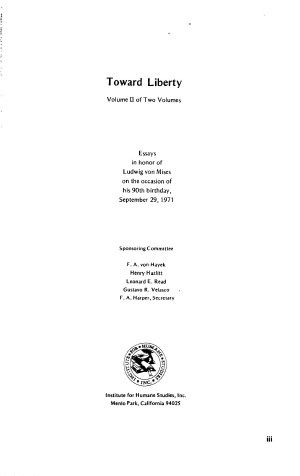
Toward Liberty: Essays in Honor of Ludwig von Mises on the Occasion of his 90th Birthday, September 29, 1971, vol. 2, ed. F.A. Hayek, Henry Hazlitt, Leonrad R. Read, Gustavo Velasco, and F.A. Harper (Menlo Park: Institute for Humane Studies, 1971).

About Liberty Fund:

Liberty Fund, Inc. is a private, educational foundation established to encourage the study of the ideal of a society of free and responsible individuals.


On Behalf of Profits Percy
L. Greaves, Jr.

Profits Are Priceless

Contrary to popular opinion, profits cost consumers nothing. They actually add nothing to the prices consumers must pay to obtain the quantities of goods and services offered on the market. Also, contrary to popular opinion, profits are not obtained by holding wage rates down. In a free market, competition tends to force all employers to pay wage rates that represent the full amounts that consumers are willing to pay for each worker's contribution.

Profits are earned in the service of consumers. Profits are always an incentive to increased investments, higher wage rates, greater production and lower prices. Profits act as a beacon to investors and entrepreneurs, guiding them into the production of just those goods and services that consumers want more of most urgently. Profits are acquired only to the extent that individual market suppliers succeed in serving consumers better than their competitors have done.

Profits Poorly Understood

Before the days of the Austrian School, profits were generally considered something that producers and sellers added to the costs of production to arrive at and set market prices. Many still think this is the way market prices and profits are determined. This includes large numbers of academic “economists” who are unable either to refute the validity of the subjective marginal theory of value, or to comprehend the full significance of its universal application to all human actions, as revealed in the lucid irrefutable writings of Mises.

Just as many “economists” talk of “administered prices” and so-called “excess profits” as though these were phenomena of an unhampered market, so many shopkeepers and small businessmen still total up their costs and then add what is popularly called a “mark-up” to set their asking prices. This is probably why there have been so many failures among such ventures.

It is certainly a reflection on the economics teachings and textbooks of our schools, colleges and universities that, today, one hundred years after Menger wrote his Principles of Economics, large numbers of uninformed people still think prices and profits are determined objectively by sellers, rather than by the subjective values of the ultimate consumers.

While many now realize that all businessmen are not able to set their prices and that profits are not always made on every business transaction, many people, including some called economists, still think that prices are determined primarily by costs of production rather than by the market interplay of the subjective values of the ultimate consumers. Consciously or unconsciously, many students and non-students of economics still hold an objective theory of values. Many still embrace the labor theory of value on which Marx built his house of “scientific socialism.” Many others sincerely believe in some form of “just price” and “just wage” that they seem to think can be objectively determined by some “fact-finding” body. Many in high places, not only in labor unions but also in the academic community and the political arena, still think that entrepreneurial profits are “unearned incomes” purloined from either employees, or consumers, or both employees and consumers.

The Poor Also Pay Taxes

Such economic ignorance has created, and is responsible for, a great deal of the anti-profit mentality that is abroad in the world today. It has also led to the high repute of so-called “non-profit” organizations. There is an almost universal feeling in today's society that profits are something antisocial that are obtained at the expense of the general welfare. Nothing else can account for the unquestioned acceptance of the very popular fallacy that rich individuals and “big business” can continually be “soaked” without hurting those at the bottom of the income ladder.

Actually, in a market society, the burden of taxes levied on businesses and high income earners do not fall only on them. Such taxpayers are often able to offset all or part of the tax by raising their incomes. As long as a market exists, shifts in prices, workers' wages, executive salaries and interest rates will determine how the ultimate tax burden will be shared.

People do not go into business for charitable reasons. If those taxed cannot pass these taxes on in the form of higher prices or lower wage rates, they will sooner or later reduce their contributions to society or go completely out of business. Then their discharged workers will have to be satisfied with the next best, i.e., lower, wages they can earn elsewhere. And former consumers will have to settle for goods and services less valuable to them.

In a market society, there is just no way to place the tax burden solely on “big business” and the rich. Those who want and buy bread, shoes, gasoline and whatnot will pay part of such taxes. Governments may pass tax laws, but short of a complete dictatorship, it is always the market that allocates the tax burden.

Economics Is a Science

True economists are scientists. They do not talk in terms of good or bad any more than do chemists or physicists. Sound economists talk in terms of what is and what is not. They try to appraise human actions objectively and deduce the significant inevitable consequences of proposed actions or policies. They are not opinionated partisans, but searchers for the truth, spurred on by the hope their teachings will help all mankind and reduce unnecessary human sufferings.

Mises, the greatest economist of our century, builds all economics deductively and scientifically from the two words: “Man acts.” Basically, he elaborates step by step the full significance of what these two words really mean. The present writer elaborates these two words into three a priori postulates:

  • (1) Every man seeks to improve his situation from his viewpoint, based on his limited knowledge and understanding;
  • (2) The factors available to each man for improving his situation are limited; and
  • (3) All men make mistakes.

All men always seek success in achieving their ends. They choose those available means which they hope, believe or know will best help them attain their objectives, whatever these may be. They constantly strive to keep their mistakes to a minimum. In all human actions, all men seek a psychic profit, an increase in their satisfactions or happiness.

All Actions Are Unequal Exchanges

Every human action is an exchange of something the actor has for something he prefers. In a market economy, it is frequently an exchange of a quantity of money for a specific commodity or a service. However, it may be an exchange of his limited time, skill, energy, or of some other scarce good in his possession for something on which he places a higher value. It is a characteristic of every human action that it is an exchange of something a man has for something he prefers. It is never a transfer of equal values.

A man may make a mistake, but at the time he commits himself to any action he expects that action will produce a psychic profit for him. He never enters into a transaction without such an anticipation. Men enter into society when they participate in the division of labor and the resulting indirect exchanges of the market place. As Mises states, “The market process is an interaction of men deliberately striving after the best possible removal of dissatisfaction.”1 Men do this all in keeping with the three above-stated a priori postulates. In fact, everything every man or woman does is in harmony with these postulates. So profits are the goal of every living man. They are sought by everyone. They are merely another term for what all men consider success. The more profits a person gains, the happier he is in terms of his own valuation of the returns from his efforts and his use of his other scarce factors of production.

Source of Profits

As Mises has taught us, entrepreneurial profits are “the prize” the market place awards to those who remove a maladjustment in production and thus satisfy consumers better than their competitors. Profits “disappear as soon as the maladjustment is entirely removed.”2 In his greatest work, Human Action, and in his remarkable paper, “Profit and Loss,” reprinted in Planning for Freedom, Mises has demonstrated, beyond cavil, that profits are earned payments to entrepreneurs for successful foresight, speculation, and resulting actions in using available factors of production to satisfy consumers' needs, wants and desires better than their competitive entrepreneurs.

“Entrepreneurial profits result from a better-than-others ability to anticipate and satisfy market demands. This is done by directing the use or combination of the factors of production available on the market in such a way that the goods or services produced bring a higher market price than other products made with the same factors of production.

Entrepreneurial profits and losses emerge due to the following ever present market factors:

  • (1) The uncertainty of future consumer demand;
  • (2) The ceaseless changes in the demand for and supply of the various human and physical factors of production, which constantly create new opportunities for better adjusting production to anticipated future consumer wants;
  • (3) The fact that all production takes time;
  • (4) Differences in entrepreneurial ability to foresee, at the time production must start, what the most urgent wants of consumers will be at the various future times when the available alternative processes of production might be completed.

Entrepreneurial profits and losses are society's appraisal of the contributions of individuals and other business units to societal welfare or satisfaction. Entrepreneurial profits and losses are the means that consumers use to shift the control of capital, and the direction of production, into the hands of those who have demonstrated their ability to serve consumers best.”3

Prices Not Determined by Prices

At any given moment, prices have no relation to the cost of production. At any given moment, the market process allocates the available supply of all goods and services, regardless of their cost of production, to those who place the highest market value (price) on the units available. The more units available, the lower the unit price must be, as additional units must always be sold to those who could not, or would not, buy them at the higher price for which a smaller number of units can always be sold.

As Mises tells us, “The consumers do not care about the investments made with regard to past market conditions and do not bother about the vested interests of entrepreneurs, capitalists, land-owners, and workers, who may be hurt by changes in the structure of prices. Such sentiments play no role in the formation of prices. The prices of the past are for the entrepreneur, the shaper of future production, merely a mental tool. The entrepreneurs ... merely transform what the past has transmitted in better adapting it to the altered conditions.”4

As has often been said, in economics bygones are always bygones. Only the future counts. This applies to past costs. The consumers are not interested in the costs of sellers. If they want something, they ask only: Can they buy it for less than its value to them, and if so, how little need they pay for it.

The cost of producing the present available supply of any good or service never affects its present market price. The prices of scarce flash-lights, particularly during an electric power blackout, have little or no relation to their cost of production. The sole question is always how much can and will the consumer voluntarily pay for the available units. The more units available, the lower the price will be and the larger the number of consumers who can be satisfied with the available quantity.

How Prices Are Determined

As Boehm Bawerk has shown, and Mises has reiterated, “Exchange ratios are now as a rule money prices. They are determined between extremely narrow margins: the valuations on the one hand of the marginal buyer and those of the marginal offerer who abstains from selling, and the valuations on the other hand of the marginal seller and those of the marginal potential buyer who abstains from buying.”5 So that a product owner, who has a larger quantity than he needs or wants for his own use, is dependent solely upon what prospective buyers can and will pay for it in competition with all other offerings in the market.

Prices are always determined at the margin where the number of units to be sold will attract a sufficient number of buyers, each of whom will expect to profit from a purchase at that price. The more units owners desire to sell, the lower that margin price must be. No unit can be sold at a price that the potential buyer does not believe will present him with a psychic gain or profit. The unit price for X + 1 units must be lower than the unit price for X units, just as the unit price for X + 2 units must be lower than that for X + 1 units. Each additional unit is allocated by the market process to a buyer who places a lower value on it than the buyers of the previously smaller quantity. Yet, all buyers at the same time and place pay the same unit price—the marginal market value. At any given moment, it is always the buyers who set prices in the market society. As Mises expresses it: “The ultimate source of the determination of prices is the value judgments of the consumers.”6

However, as we know, consumers' demands for the myriads of different goods and services available in a modern society are constantly in flux. Entrepreneurs are led to change their production mix by the ever-changing prices consumers voluntarily pay for labor and raw materials in the forms of different finished products or services that entrepreneurs offer in the market place. This constant shifting of prices helps guide entrepreneurs in their efforts to earn profits by better serving consumers.

Society Rests on Profits

The quantity of any good or service available at any one time is always the result of the earlier speculations of entrepreneurs—speculations that they can obtain and combine certain specific factors of production at costs, including interest on invested capital, that will prove to be below the prices consumers will pay later when the finished good or service becomes available on the market. Entrepreneurs are not infallible and often blunder, but as Mises says, “They earn profit not because they are clever in performing their tasks, but because they are more clever or less clumsy than other people are.”7

In the words of Mises, the “market is actuated and kept in motion by the exertion of the promoting entrepreneurs, eager to profit from differences in the market prices of the factors of production and the expected prices of the products. The operation of this market would stop if a situation were ever to emerge in which the sum of the prices of the complementary factors of production—but for interest—equaled the prices of the products and nobody believed that further price changes were to be expected. Thus we have described the process adequately and completely by pointing out, positively, what actuates it and, negatively, what would suspend its motion.”8

If there were no hope or anticipation of profits, there would be no entrepreneurs and no production. So all production, all living standards, and all market processes depend on the hope and anticipation of profits. Profits are thus the very lifeline of a continuing society or civilization.

Mises continues, “The pricing process is a social process. It is consummated by an interaction of all members of the society. All collaborate and cooperate, each in the particular role he has chosen for himself in the framework of the division of labor. Competing in cooperation and cooperating in competition, all people are instrumental in bringing about the result, viz., the price structure of the market, the allocation of the factors of production to the various lines of want-satisfaction, and the determination of the share of each individual.”9 And all this is done by each person and business firm constantly striving for greater profits.

Prices Direct Production

In the actual market, the marginal producer, or the producer of the marginal unit, tends to make no profit on the marginal unit. He merely recovers costs. Each producer or entrepreneur is intent on increasing his production to the point where he anticipates he can no longer earn a profit from any further increase in his production. He thus limits his production at the point where his costs are expected to equal the price received. The last or marginal unit produced is therefore not expected to yield any net profit.

“The pricing process of the unhampered market,” as Mises points out, “directs production into those channels in which it best serves the wishes of the consumers as manifested on the market.... The prices determine which of the factors of production should be employed and which should be left unused. The specific factors of production are employed only if there is no more valuable employment available for the complementary nonspecific factors.... Men are not infallible. A certain amount of malinvestment is unavoidable. What has to be done is to shun policies that like credit expansion artificially foster malinvestment.”10

Plans for, as well as actual, production are always speculations. Producers attempt to anticipate, as correctly as they can, all their costs, including interest, and the prices they expect consumers will pay for their finished products. If all their anticipations are accurate, they will earn profits. If their costs are higher, or if the final prices paid by consumers are lower, than anticipated, they may suffer losses. On the other hand, if they can keep their costs lower than anticipated, or if the consumers voluntarily pay higher prices than anticipated, their profits will be higher than anticipated.

Profitable Industries Expand

Profits in any industry are always a beacon to investors. They attract increased investments. This results in increasing production and lowering prices until the profits are eliminated at the point where costs rise to meet the necessarily lower prices obtainable whenever a larger supply is offered for sale. So profits are always a price lowering inducement.

Where profits exist, there is always a temptation for existing businesses to expand their production and for new businesses to compete for a part of the ever-diminishing profits. In a market society, conditions are always in flux. Consequently, new possibilities for profit are constantly emerging.

However, the market process always tends to set the prices of marginal units at figures which barely cover the cost of producing the marginal unit. Consequently, profits are seldom earned on the last units produced. If profits are earned on all units produced, it is because too few units were produced. If this shortage is not due merely to a temporary, unforeseen situation, profit seekers will soon remove the shortage by increasing production and lowering the price of the marginal unit.

So in a free and unhampered market, entrepreneurial profits tend to be earned only by those entrepreneurs or producers able to produce all or most of their production at unit costs below the unit prices buyers will pay for the total available units. This means that those who earn profits in an unhampered market receive them only because their superior efficiency permits them to produce units at a lower unit cost than that of those producing the marginal units which determine market prices. If the producer of the marginal unit should ask for a price which included some profit, the price would be too high for all the available units to be sold. Then, to sell all the available units, the asking price would have to be dropped to the point at which there was no longer any profit from the sale of the marginal unit.

So, contrary to popular opinion, profits actually add nothing to the prices consumers must pay to induce the production of quantities of goods and services for which they are willing to pay the marginal cost of production. If there were no profits, the sellers of the marginal units would suffer losses. They would then reduce their production and consumers would soon find fewer units offered in the market place.

Profits always stimulate an increase in investments, wage rates, and production. They attract investors eager to get a share of the profits. This increases the production of what consumers want more of most urgently. This increased production raises wage rates and lowers prices, providing more of the satisfactions that all men seek.

The Poverty Problem

The main problem of society today, as always, is to reduce poverty. The only permanent way to reduce poverty is to increase production. Mises has demonstrated, beyond any possibility of refutation, that the only logical way to increase production continually is to rid men of all laws, customs and regulations which restrict the voluntary cooperation inherent in a free and unhampered market society. Those who have grasped the full significance of Mises' writings realize that under such conditions even the poorest benefit greatly from the ever-increasing production that inevitably results.

Those familiar with Mises' teachings know that the only sure way to increase production is to increase capital accumulation per capita. This is possible only if more persons can be encouraged to spend less on consumption than they earn and then invest the difference—their newly amassed savings—either in productive enterprise or in improving their ability to increase their own contributions to society.

All such increased savings per capita invested in private productive enterprise must raise the living standards of every member of a market society. All newly invested funds must first be used to offer workers higher wages to attract them to the new jobs. Such investment funds must also compete for and bid up the prices of the needed raw materials. Then the new workers and expanded productive facilities must be used to produce either new goods not previously produced, or larger quantities of goods for which there exists a greater demand than could previously be satisfied.

After these additional goods or services have been produced, they must compete in the market place with all previously existing goods. With more goods competing for an unchanged quantity of cash holdings, the competition of sellers will reduce prices. No one will buy any of the new or additional goods unless he or she considers such goods a better buy than anything else that could be bought for the same sum of money.

So the increased investment must result in higher wages, lower prices, and greater consumer satisfaction before the investors can get their savings back, much less any interest or profits on the increased savings invested. Consequently, workers and consumers must benefit before the savers can. Actually when the savers do not serve the consumers better than their competitors, they stand to lose part or all of their savings.

The Importance of Profits

So the best way to alleviate poverty and increase the living standards of all members of society is to increase the savings invested in private productive enterprise. Human nature being what it is, no one will save and invest without the hope of earning profits. So the best way to help everyone, including those with the lowest incomes, is to adopt laws and social policies that raise the hopes of earning profits in return for offering consumers more of the goods and services they want most urgently.

Mises has stated: “The attainment of an excess of the value of the product over the costs, a profit, is the goal of every production effort. Profit is the pay-off of successful action.”11 As John Bates Clark phrased it, “Profit is the lure that insures improvement, and improvement is the source of permanent additions to wages. To secure progress, this lure must be sufficient to make men overcome obstructions and take risks.”12

Unquestionably, the best criterion available for judging the folly or wisdom of any proposed law or social policy is: Does it decrease or increase the uncertainties that businesses face in their quest for profits? Does it encourage or discourage people to save and invest in productive enterprise? For it is only increased savings per capita, lured by the hope of profits, that can lead to producing more and better goods and services at ever lower prices.

Once profits are popularly understood to be sums that can only be earned by providing very valuable contributions to society, the many laws which now hamper our market economy will be on the way out and man's eternal vision of peace and prosperity will assume a clearer form.

[1]Human Action (3rd ed.), p.335.

[2]Planning for Freedom, p.119.

[3]Greaves' Glossary for “Human Action.”

[4]Human Action (3rd ed.), p. 337.

[5]Op. cit., p. 327.

[6]Ibid., p. 331.

[7]Planning for Freedom, p. 114.

[8]Human Action (3rd ed.), p. 334.

[9]Op. cit., p. 338.

[10]Ibid., p. 394.

[11]Op. cit., p. 396.

[12]The Distribution of Wealth, p. 411.