EconlibThe LibraryOther Sites |
Front Page Titles (by Subject) XVII: PEACE - Selected Speeches of the Rt. Hon. John Bright M.P. On Public Questions
Return to Title Page for Selected Speeches of the Rt. Hon. John Bright M.P. On Public QuestionsThe Online Library of LibertyA project of Liberty Fund, Inc.Search this Title:Also in the Library:
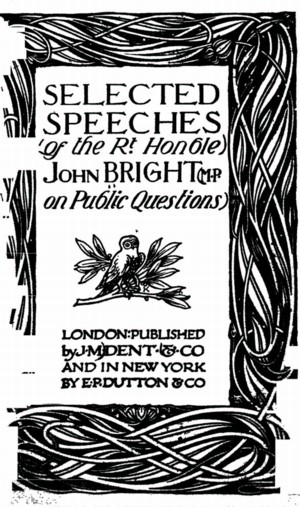
XVII: PEACE - John Bright, Selected Speeches of the Rt. Hon. John Bright M.P. On Public Questions [1853]Edition used:Selected Speeches of the Rt. Hon. John Bright M.P. On Public Questions, introduction by Joseph Sturge (London: J.M. Dent and Co., 1907).
About Liberty Fund:Liberty Fund, Inc. is a private, educational foundation established to encourage the study of the ideal of a society of free and responsible individuals. Copyright information:The text is in the public domain. Fair use statement:This material is put online to further the educational goals of Liberty Fund, Inc. Unless otherwise stated in the Copyright Information section above, this material may be used freely for educational and academic purposes. It may not be used in any way for profit.
XVIIPEACEEdinburgh, October 13, 1853. [This speech was spoken at the Conference of the Peace Society, held at Edinburgh in the autumn of 1853. The relation of this meeting to the Russian war, then impending, made the gathering more than ordinarily important] IT is a great advantage in this country, I think, that we have no want of ample criticism. Whatever we may have said yesterday and to-day will form the subject of criticism, not of the most friendly character, in very many newspapers throughout the United Kingdom. I recollect when we met in Manchester, that papers disposed to be friendly, warned us as to the course we were taking, and that the time was ill-chosen for a peace meeting. It was said that the people were excited against France, and were alarmed at their almost total defencelessness, and that there was no use in endeavouring to place before them the facts which the peace men offered to their audience. The result showed that they were mistaken, for you will recollect that, while up to that meeting there was a constantly swelling tide of alarm and hostility with regard to France, from the day the Conference was held there was a gradual receding of the tide, that the alarm and apprehension rapidly diminished, and that by the time the House of Commons met in February we were willing to receive from Lord John Russell and other statesmen the most positive assurances that France was not increasing her force, and that there was not the slightest reason to believe that the Government of France entertained anything but the most friendly feeling towards the Government of this country. The right time to oppose the errors and prejudices of the people never comes to the eyes of those writers in the public press who pander to these prejudices. They say, We must not do so and so, we shall embarrass the Government. But rumour says the Government has been pretty well embarrassed already. They say that we shall complicate the question if we interfere; but it cannot well be more complicated than it is; for hardly anybody but the peace men can tell how to unravel it. Next, they tell us that we shall impair the harmony of opinion which there appears to be in the country, from the fact of there having been three or four insignificant meetings, by which the Government is to be impelled to more active and energetic measures. Now, what is it that we really want here? We wish to protest against the maintenance of great armaments in time of peace; we wish to protest against the spirit which is not only willing for war, but eager for war; and we wish to protest, with all the emphasis of which we are capable, against the mischievous policy pursued so long by this country, of interfering with the internal affairs of other countries, and thereby leading to disputes, and often to disastrous wars. I mentioned last night what it was we were annually spending on our armaments. Admiral Napier says that the hon. Member for the West Riding, who can do everything, had persuaded a feeble Government to reduce the armaments of this country to “nothing.” What is “nothing” in the Admiral’s estimation? Fifteen millions a year! Was all that money thrown away? We have it in the estimates, we pay it out of the taxes—it is appropriated by Parliament, it sustains your dockyards, pays the wages of your men, and maintains your ships. Fifteen millions sterling paid in the very year when the Admiral says that my hon. Friend reduced the armaments of the country to nothing! But take the sums which we spent for the past year in warlike preparations — seventeen millions, and the interest on debt caused by war—twenty-eight millions sterling; and it amounts to 45,000,000l. What are our whole exports? Even this year, far the largest year of exports we have ever known, they may amount to 80,000,000l. Well, then, plant some one at the mouth of every port and harbour in the United Kingdom, and let him take every alternate ship that leaves your rivers and your harbours with all its valuable cargo on board, and let him carry it off as tribute, and it will not amount to the cost that you pay every year for a war, that fifty years ago was justified as much as it is attempted to justify this impending war, and for the preparations which you now make after a peace which has lasted for thirty-eight years. Every twenty years—in a nation’s life nothing, in a person’s life something—every twenty years a thousand millions sterling out of the industry of the hard-working people of this United Kingdom, are extorted, appropriated, and expended to pay for that unnecessary and unjust war, and for the absurd and ruinous expenditure which you now incur. A thousand millions every twenty years! Apply a thousand millions, not every twenty years, but for one period of twenty years, to objects of good in this country, and it would be rendered more like a paradise than anything that history records of man’s condition, and would make so great a change in these islands, that a man having seen them as they are now, and seeing them as they might then be, would not recognize them as the same country, nor our population as the same people. But what do we expend all this for? Bear in mind that Admirals, and Generals, and statesmen defended that great war, and that your newspapers, with scarcely an exception, were in favour of it, and denounced and ostracized hundreds of good men who dared, as we dare now, to denounce the spirit which would again lead this country into war. We went to war that France should not choose its own Government; the grand conclusion was that no Bonaparte should sit on the throne of France; yet France has all along been changing its Government from that time to this, and now we find ourselves with a Bonaparte on the throne of France, and, for anything I know to the contrary, likely to remain there a good while. So far, therefore, for the calculations of our forefathers, and for the results of that enormous expenditure which they have saddled upon us. We object to these great armaments as provoking a war spirit. I should like to ask, what was the object of the Chobham exhibition? There were special trains at the disposal of Members of Parliament, to go down to Chobham the one day, and to Spithead the other, What was the use of our pointing to the President of the French Republic two years ago, who is the Emperor now, and saying that he was spending his time at playing at soldiers in his great camp at Satory, and in making great circuses for the amusement of his soldiers? We, too, are getting into the way of playing at soldiers, and camps, and fleets, and the object of this is to raise up in the spirit of the people a feeling antagonistic to peace, and to render the people—the deluded, hardworking, toiling people—satisfied with the extortion of 17,000,000l. annually, when, upon the very principles of the men who take it, it might be demonstrated that one-half of the money would be amply sufficient for the purpose to which it is devoted. What observation has been more common during the discussion upon Turkey than this—“Why are we to keep up these great fleets if we are not to use them? Why have we our Mediterranean fleet lying at Besika Bay, when it might be earning glory, and adding to the warlike renown of the country?” This is just what comes from the maintenance of great fleets and armies. There grows up an esprit de corps—there grows a passion for these things, a powerful opinion in their favour, that smothers the immorality of the whole thing, and leads the people to tolerate, under those excited feelings, that which, under feelings of greater temperance and moderation, they would know was hostile to their country, as it is opposed to everything which we recognize as the spirit of the Christian religion. Then, we are against intervention. Now, this question of intervention is a most important one, for this reason, that it comes before us sometimes in a form so attractive that it invites us to embrace it, and asks us by all our love of freedom, by all our respect for men struggling for their rights, to interfere in the affairs of some other country. And we find now in this country that a great number of those who are calling out loudest for interference are those who, being very liberal in their politics, are bitterly hostile to the despotism and exclusiveness of the Russian Government. But I should like to ask this meeting what sort of intervention we are to have? There are three kinds—one for despotism, one for liberty; and you may have an intervention like that now proposed, from a vague sense of danger which cannot be accurately described. What have our interventions been up to this time? I will come to that of which Admiral Napier spoke by and by. It is not long since we intervened in the case of Spain. The foreign enlistment laws ware suspended; and English soldiers went to join the Spanish legion, and the Government of Spain was fixed in the present Queen of that country; and yet Spain has the most exclusive tariff against this country in the world, and a dead Englishman is there reckoned little better than a dead dog. Then take the case of Portugal. We interfered, and Admiral Napier was one of those employed in that interference, to place the Queen of Portugal on the throne, and yet she has violated every clause of the charter which she had sworn to the people; and in 1849, under the Government of Lord John Russell, and with Lord Palmerston in the Foreign Office, our fleet entered the Tagus and destroyed the Liberal party, by allowing the Queen to escape from their hands, when they would have driven her to give additional guarantees for liberty; and from that time to this she has still continued to violate every clause of the charter of the country. Now, let us come to Syria; what has Admiral Napier said about the Syrian war? He told us that the English fleet was scattered all about the Mediterranean, and that if the French fleet had come to Cherbourg, and had taken on board 50,000 men and landed them on our coasts, all sorts of things would have befallen us. But how happened it that Admiral Napier and his friends got up the quarrel with the French? Because we interfered in the Syrian question when we had no business to interfere whatever. The Egyptian Pasha, the vassal of the Sultan, became more powerful than the Sultan, and threatened to depose him and place himself as monarch upon the throne of Constantinople; and but for England, he would assuredly have done it. Why did we interfere? What advantage was it to us to have a feeble monarch in Constantinople, when you might have had an energetic and powerful one in Mehemet Ali? We interfered, however, and quarrelled with France, although she neither declared war nor landed men upon our coast. France is not a country of savages and banditti. The Admiral’s whole theory goes upon this, that there is a total want of public morality in France, and that something which no nation in Europe would dare to do, or think of doing, which even Russia would scorn to do, would be done without any warning by the polished, civilized, and intelligent nation across the Channel. But if they are the friends of freedom who think we ought to go to war with Russia because Russia is a despotic country, what do you say to the interference with the Roman Republic three or four years ago? What do you say to Lord John Russell’s Government,—Lord Palmerston with his own hand writing the despatch, declaring that the Government of her Majesty, the Queen of England, entirely concurred with the Government of the French Republic in believing that it was desirable and necessary to re-establish the Pope upon his throne? The French army, with the full concurrence of the English Government, crossed over to Italy, invaded Rome, destroyed the Republic, banished its leading men, and restored the Pope; and on that throne he sits still, maintained only by the army of France. My hon. Friend has referred to the time when Russia crossed through the very Principalities we hear so much about, and entered Hungary. I myself heard Lord Palmerston in the House of Commons go out of his way needlessly, but intentionally, to express a sort of approbation of the intervention of Russia in the case of Hungary. I heard him say, in a most unnecessary parenthesis, that it was not contrary to international law, or to the law of Europe, for Russia to send an army into Hungary to assist Austria in putting down the Hungarian insurrection. I should like to know whether Hungary had not constitutional rights as sacred as ever any country had—as sacred, surely, as the Sovereign of Turkey can have upon his throne. If it were not contrary to international law and to the law of Europe for a Russian army to invade Hungary, to suppress there a struggle which called for, and obtained too, the sympathy of every man in favour of freedom in every part of the world, I say, how can it be contrary to international law and the law of Europe for Russia to threaten the Sultan of Turkey, and to endeavour to annex Turkey to the Russian Empire? I want our policy to be consistent. Do not let us interfere now, or concur in or encourage the interference of anybody else, and then get up a hypocritical pretence on some other occasion that we are against interference. If you want war, let it be for something that has at least the features of grandeur and of nobility about it, but not for the miserable, decrepit, moribund Government which is now enthroned, but which cannot long last, in the city of Constantinople. But Admiral Napier is alarmed lest, if Russia was possessed of Turkey, she would, somehow or other, embrace all Europe—that we all should be in the embrace of the Bear—and we know very well what that is. I believe that is all a vague and imaginary danger; and I am not for going to war for imaginary dangers. War is much too serious a matter. I recollect when France endeavoured to lay hold on Algeria, it was said that the Mediterranean was about to become a French lake. I do not believe that France is a bit more powerful in possessing it. It requires 100,000 French soldiers to maintain Algeria; and if a balance-sheet could be shown of what Algeria has cost France, and what France has gained from it, I believe you would have no difficulty whatever in discovering the reason why the French finances show a deficit, and why there is a rumour that another French loan is about to be created. But they tell us that if Russia gets to Constantinople, Englishmen will not be able to get to India by the overland journey. Mehemet Ali, even when Admiral Napier was battering down his towns, and not interfere with the carriage of our mails through his territory. We bring our overland mails at present partly through Austria, and partly through France, and the mails from Canada pass through the United States; and though I do not think there is the remotest possibility or probability of anything of the kind happening, yet I do not think that, in the event of war with these countries, we should have our mails stopped or our persons arrested in passing through these countries. At any rate it would be a much more definite danger that would drive me to incur the ruin, guilt, and suffering of war. But they tell us, further, that the Emperor of Russia would get India. That is a still more remote contingency. If I were asked as to the probabilities of it, I should say that, judging from our past and present policy in Asia, we are more likely to invade Russia from India than Russia is to invade us in India. The policy we pursue in Asia is much more aggressive, aggrandizing, and warlike than any that Russia has pursued or threatened during our time. But it is just possible that Russia may be more powerful by acquiring Turkey. I give the Admiral the benefit of that admission. But I should like to ask whether, even if that be true, it is a sufficient reason for our going to war, and entering on what perhaps may be a long, ruinous, and sanguinary struggle, with a powerful empire like Russia? What is war? I believe that half the people that talk about war have not the slightest idea of what it is. In a short sentence it may be summed up to be the combination and concentration of all the horrors, atrocities, crimes, and sufferings of which human nature on this globe is capable. But what is even a rumour of war? Is there anybody here who has anything in the funds, or who is the owner of any railway stock, or anybody who has a large stock of raw material or manufactured goods? The funds have recently gone down 10 per cent. I do not say that the fall is all on account of this danger of war, but a great proportion of it undoubtedly is. A fall of 10 per cent. in the funds is nearly 80,000,000l. sterling of value, and railway stock having gone down 20 per cent. makes a difference of 60,000,000l. in the value of the railway property of this country. And the two—140,000,000l.—and take the diminished prosperity and value of manufactures of all kinds during the last few months, and you will understate the actual loss to the country now if you put it down at 200,000,000l. sterling. But that is merely a rumour of war. That is war a long way off—the small cloud, no bigger than a man’s hand—what will it be if it comes nearer and becomes a fact? And surely sane men ought to consider whether the case is a good one, the ground fair, the necessity clear, before they drag a nation of nearly 30,000,000 of people into a long and bloody struggle, for a decrepit and tottering empire, which all the nations in Europe cannot long sustain. And, mind, war now would take a different aspect from what it did formerly. It is not only that you send out men who submit to be slaughtered, and that you pay a large amount of taxes—the amount of taxes would be but a feeble indication of what you would suffer. Our trade is now much more extensive than it was; our commerce is more expanded, our undertakings are more vast, and war will find you all out at home by withering up the resources of the prosperity enjoyed by the middle and working classes of the country. You would find that war in 1853 would be infinitely more perilous and destructive to our country than it has ever yet been at any former period of our history. There is another question which comes home to my mind with a gravity and seriousness which I can scarcely hope to communicate to you. You who lived during the period from 1815 to 1822 may remember that this country was probably never in a more uneasy position. The sufferings of the working classes were beyond description, and the difficulties, and struggles, and bankruptcies of the middle classes were such as few persons have a just idea of. There was scarcely a year in which there was not an incipient insurrection in some parts of the country, arising from the sufferings which the working classes endured. You know very well that the Government of the day employed spies to create plots, and to get ignorant men to combine to take unlawful oaths; and you know that in the town of Stirling, two men who, but for this diabolical agency, might have lived good and honest citizens, paid the penalty of their lives for their connection with unlawful combinations of this kind. Well, if you go into war now you will have more banners to decorate your cathedrals and churches. Englishmen will fight now as well as they ever did, and there is ample power to back them, if the country can be but sufficiently excited and deluded. You may raise up great Generals. You may have another Wellington, and another Nelson too; for this country can grow men capable for every enterprise. Then there may be titles, and pensions, and marble monuments to eternize the men who have thus become great; but what becomes of you and your country, and your children? For there is more than this in store. That seven years to which I have referred was a period dangerous to the existence of Government in this country, for the whole substratum, the whole foundations of society were discontented, suffering intolerable evils, and hostile in the bitterest degree to the institutions and the Government of the country. Precisely the same things will come again. Rely on it, that injustice of any kind, be it bad laws, or be it a bloody, unjust, and unnecessary war, of necessity creates perils to every institution in the country. If the Corn-law had continued, if it had been impossible, by peaceful agitation, to abolish it, the monarchy itself would not have survived the ruin and disaster that it must have wrought. And if you go into a war now, with a doubled population, with a vast commerce, with extended credit, and a wider diffusion of partial education among the people, let there ever come a time like the period between 1815 and 1822, when the whole basis of society is upheaving with a sense of intolerable suffering, I ask you, how many years’ purchase would you give even for the venerable and mild monarchy under which you have the happiness to live? I confess when I think of the tremendous perils into which unthinking men—men who do not intend to fight themselves—are willing to drag or to hurry this country, I am amazed how they can trifle with interests so vast, and consequences so much beyond their calculation. But, speaking here in Edinburgh to such an audience—an audience probably for its numbers as intelligent and as influential as ever was assembled within the walls of any hall in this kingdom—I think I may put before you higher considerations even than those of property and the institutions of your country. I may remind you of duties more solemn, and of obligations more imperative. You profess to be a Christian nation. You make it your boast even—though boasting is somewhat out of place in such questions—you make it your boast that you are a Protestant people, and that you draw your rule of doctrine and practice, as from a well pure and undefiled, from the living oracles of God, and from the direct revelation of the Omnipotent. You have even conceived the magnificent project of illuminating the whole earth, even to its remotest and darkest recesses, by the dissemination of the volume of the New Testament, in whose every page are written for ever the words of peace. Within the limits of this island alone, on every Sabbath, 20,000, yes, far more than 20,000 temples are thrown open, in which devout men and women assemble that they may worship Him who is the “Prince of Peace.” Is this a reality? or is your Christianity a romance? is your profession a dream? No, I am sure that your Christianity is not a romance, and I am equally sure that your profession is not a dream. It is because I believe this that I appeal to you with confidence, and that I have hope and faith in the future. I believe that we shall see, and at no very distant time, sound economic principles spreading much more widely amongst the people; a sense of justice growing up in a soil which hitherto has been deemed unfruitful; and, which will be better than all—the churches of the United Kingdom —the churches of Britain awaking, as it were, from their slumbers, and girding up their loins to more glorious work, when they shall not only accept and believe in the prophecy, but labour earnestly for its fulfilment, that there shall come a time—a blessed time—a time which shall last for ever—when “nation shall not lift up sword against nation, neither shall they learn war any more.” |

Titles (by Subject)