EconlibThe LibraryOther Sites |
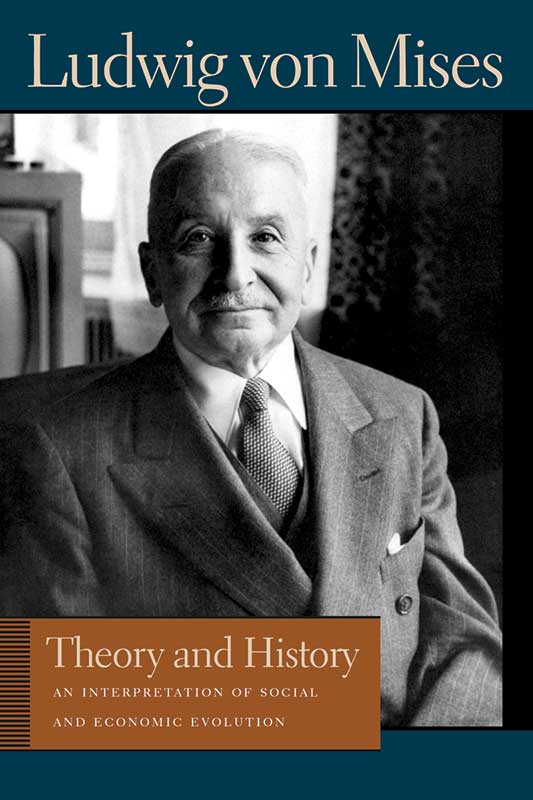
Front Page Titles (by Subject) part 2: Determinism and Materialism - Theory and History: An Interpretation of Social and Economic Evolution (LF ed.)
Return to Title Page for Theory and History: An Interpretation of Social and Economic Evolution (LF ed.)The Online Library of LibertyA project of Liberty Fund, Inc.Search this Title:Also in the Library:
part 2: Determinism and Materialism - Ludwig von Mises, Theory and History: An Interpretation of Social and Economic Evolution (LF ed.) [1957]Edition used:Theory and History: An Interpretation of Social and Economic Evolution, ed. Bettina Bien Greaves (Indianapolis: Liberty Fund, 2005).
About Liberty Fund:Liberty Fund, Inc. is a private, educational foundation established to encourage the study of the ideal of a society of free and responsible individuals. Copyright information:The copyright to this edition, in both print and electronic forms, is held by Liberty Fund, Inc. Fair use statement:This material is put online to further the educational goals of Liberty Fund, Inc. Unless otherwise stated in the Copyright Information section above, this material may be used freely for educational and academic purposes. It may not be used in any way for profit.
part 2Determinism and Materialismchapter 5Determinism and Its Critics1DeterminismWhatever the true nature of the universe and of reality may be, man can learn about it only what the logical structure of his mind makes comprehensible to him. Reason, the sole instrument of human science and philosophy, does not convey absolute knowledge and final wisdom. It is vain to speculate about ultimate things. What appears to man’s inquiry as an ultimate given, defying further analysis and reduction to something more fundamental, may or may not appear such to a more perfect intellect. We do not know. Man cannot grasp either the concept of absolute nothingness or that of the genesis of something out of nothing. The very idea of creation transcends his comprehension. The God of Abraham, Isaac, and Jacob, whom Pascal in his Mémorial opposed to that of the “philosophes et savants,” is a living image and has a clear and definite meaning for the faithful believer. But the philosophers in their endeavors to construct a concept of God, his attributes, and his conduct of world affairs, became involved in insoluble contradictions and paradoxes. A God whose essence and ways of acting mortal man could neatly circumscribe and define would not resemble the God of the prophets, the saints, and the mystics. The logical structure of his mind enjoins upon man determinism and the category of causality. As man sees it, whatever happens in the universe is the necessary evolution of forces, powers, and qualities which were already present in the initial stage of the X out of which all things stem. All things in the universe are interconnected, and all changes are the effects of powers inherent in things. No change occurs that would not be the necessary consequence of the preceding state. All facts are dependent upon and conditioned by their causes. No deviation from the necessary course of affairs is possible. Eternal law regulates everything. In this sense determinism is the epistemological basis of the human search for knowledge.1 Man cannot even conceive the image of an undetermined universe. In such a world there could not be any awareness of material things and their changes. It would appear a senseless chaos. Nothing could be identified and distinguished from anything else. Nothing could be expected and predicted. In the midst of such an environment man would be as helpless as if spoken to in an unknown language. No action could be designed, still less put into execution. Man is what he is because he lives in a world of regularity and has the mental power to conceive the relation of cause and effect. Any epistemological speculation must lead toward determinism. But the acceptance of determinism raises some theoretical difficulties that have seemed to be insoluble. While no philosophy has disproved determinism, there are some ideas that people have not been able to bring into agreement with it. Passionate attacks have been directed against it because people believed that it must ultimately result in absurdity. 2The Negation of Ideological FactorsMany authors have assumed that determinism, fully implying consistent materialism, strictly denies that mental acts play any role in the course of events. Causation, in the context of the doctrine so understood, means mechanical causation. All changes are brought about by material entities, processes, and events. Ideas are just intermediary stages in the process through which a material factor produces a definite material effect. They have no autonomous existence. They merely mirror the state of the material entities that begot them. There is no history of ideas and of actions directed by them, only a history of the evolution of the real factors that engender ideas. From the point of view of this integral materialism, the only consistent materialist doctrine, the customary methods of historians and biographers are to be rejected as idealistic nonsense. It is vain to search for the development of certain ideas out of other previously held ideas. For example, it is “unscientific” to describe how the philosophical ideas of the seventeenth and eighteenth centuries evolved out of those of the sixteenth century. “Scientific” history would have to describe how out of the real—physical and biological—conditions of each age its philosophical tenets necessarily spring. It is “unscientific” to describe as a mental process the evolution of Saint Augustine’s ideas that led him from Cicero to Manichaeus and from Manichaeism to Catholicism. The “scientific” biographer would have to reveal the physiological processes that necessarily resulted in the corresponding philosophical doctrines. The examination of materialism is a task to be left to the following chapters. At this point it is enough to establish the fact that determinism in itself does not imply any concessions to the materialist standpoint. It does not negate the obvious truth that ideas have an existence of their own, contribute to the emergence of other ideas, and influence one another. It does not deny mental causation and does not reject history as a metaphysical and idealistic illusion. 3The Free-Will ControversyMan chooses between modes of action incompatible with one another. Such decisions, says the free-will doctrine, are basically undetermined and uncaused; they are not the inevitable outcome of antecedent conditions. They are rather the display of man’s inmost disposition, the manifestation of his indelible moral freedom. This moral liberty is the essential characteristic of man, raising him to a unique position in the universe. Determinists reject this doctrine as illusory. Man, they say, deceives himself in believing that he chooses. Something unknown to the individual directs his will. He thinks that he weighs in his mind the pros and cons of the alternatives left to his choice and then makes a decision. He fails to realize that the antecedent state of things enjoins on him a definite line of conduct and that there is no means to elude this pressure. Man does not act, he is acted upon. Both doctrines neglect to pay due attention to the role of ideas. The choices a man makes are determined by the ideas that he adopts. The determinists are right in asserting that everything that happens is the necessary sequel of the preceding state of things. What a man does at any instant of his life is entirely dependent on his past, that is, on his physiological inheritance as well as on all he went through in his previous days. Yet the significance of this thesis is considerably weakened by the fact that nothing is known about the way in which ideas arise. Determinism is untenable if based upon or connected with the materialist dogma.1 If advanced without the support of materialism, it says little indeed and certainly does not sustain the determinists’ rejection of the methods of history. The free-will doctrine is correct in pointing out the fundamental difference between human action and animal behavior. While the animal cannot help yielding to the physiological impulse which prevails at the moment, man chooses between alternative modes of conduct. Man has the power to choose even between yielding to the most imperative instinct, that of self-preservation, and the aiming at other ends. All the sarcasms and sneers of the positivists cannot annul the fact that ideas have a real existence and are genuine factors in shaping the course of events. The offshoots of human mental efforts, the ideas and the judgments of value that direct the individuals’ actions, cannot be traced back to their causes, and are in this sense ultimate data. In dealing with them we refer to the concept of individuality. But in resorting to this notion we by no means imply that ideas and judgments of value spring out of nothing by a sort of spontaneous generation and are in no way connected and related to what was already in the universe before their appearance. We merely establish the fact that we do not know anything about the mental process which produces within a human being the thoughts that respond to the state of his physical and ideological environment. This cognition is the grain of truth in the free-will doctrine. However, the passionate attempts to refute determinism and to salvage the notion of free will did not concern the problem of individuality. They were prompted by the practical consequences to which, as people believed, determinism inevitably leads: fatalist quietism and absolution from moral responsibility. 4Foreordination and FatalismAs theologians teach, God in his omniscience knows in advance all the things that will happen in the universe for all time to come. His foresight is unlimited and is not merely the result of his knowledge of the laws of becoming that determine all events. Even in a universe in which there is free will, whatever this may be, his precognition is perfect. He anticipates fully and correctly all the arbitrary decisions any individual will ever make. Laplace proudly declared that his system does not need to resort to the hypothesis of God’s existence. But he constructed his own image of a quasi God and called it superhuman intelligence. This hypothetical mind knows all things and events beforehand, but only because it is familiar with all the immutable and eternal laws regulating all occurrences, mental as well as physical. The idea of God’s omniscience has been popularly pictured as a book in which all future things are recorded. No deviation from the lines described in this register is possible. All things will turn out precisely as written in it. What must happen will happen no matter what mortal man may undertake to bring about a different result. Hence, consistent fatalism concluded, it is useless for man to act. Why bother if everything must finally come to a preordained end? Fatalism is so contrary to human nature that few people were prepared to draw all the conclusions to which it leads and to adjust their conduct accordingly. It is a fable that the victories of the Arabian conquerors in the first centuries of Islam were due to the fatalist teachings of Mohammed. The leaders of the Moslem armies which within an unbelievably short time conquered a great part of the Mediterranean area did not put a fatalistic confidence in Allah. Rather they believed that their God was for the big, well-equipped, and skillfully led battalions. Other reasons than blind trust in fate account for the courage of the Saracen warriors; and the Christians in the forces of Charles Martel and Leo the Isaurian who stopped their advance were no less courageous than the Moslems, although fatalism had no hold on their minds. Nor was the lethargy which spread later among the Islamitic peoples caused by the fatalism of their religion. It was despotism that paralyzed the initiative of the subjects. The harsh tyrants who oppressed the masses were certainly not lethargic and apathetic. They were indefatigable in their quest for power, riches, and pleasures. Soothsayers have claimed to have reliable knowledge of some pages at least of the great book in which all coming events are recorded. But none of these prophets was consistent enough to reject activism and to advise his disciples to wait quietly for the day of fulfillment. The best illustration is provided by Marxism. It teaches perfect foreordination, yet still aims to inflame people with revolutionary spirit. What is the use of revolutionary action if events must inevitably turn out according to a preordained plan, whatever men may do? Why are the Marxians so busy organizing socialist parties and sabotaging the operation of the market economy if socialism is bound to come anyway “with the inexorability of a law of nature”? It is a lame excuse indeed to declare that the task of a socialist party is not to bring about socialism but merely to provide obstetrical assistance at its birth. The obstetrician too diverts the course of events from the way they would run without his intervention. Otherwise expectant mothers would not request his aid. Yet the essential teaching of Marxian dialectic materialism precludes the assumption that any political or ideological fact could influence the course of historical events, since the latter are substantially determined by the evolution of the material productive forces. What brings about socialism is the “operation of the immanent laws of capitalistic production itself.”1 Ideas, political parties, and revolutionary actions are merely superstructural; they can neither delay nor accelerate the march of history. Socialism will come when the material conditions for its appearance have matured in the womb of capitalist society, neither sooner nor later.2 If Marx had been consistent, he would not have embarked upon any political activity.3 He would have quietly waited for the day on which the “knell of private capitalist property sounds.”4 In dealing with fatalism we may ignore the claims of soothsayers. Determinism has nothing at all to do with the art of fortune tellers, crystal gazers, and astrologers or with the more pretentious effusions of the authors of “philosophies of history.” It does not predict future events. It asserts that there is regularity in the universe in the concatenation of all phenomena. Those theologians who thought that in order to refute fatalism they must adopt the free-will doctrine were badly mistaken. They had a very defective image of God’s omniscience. Their God would know only what is in perfect textbooks of the natural sciences; he would not know what is going on in human minds. He would not anticipate that some people might endorse the doctrine of fatalism and, sitting with clasped hands, indolently await the events which God, erroneously assuming that they would not indulge in inactivity, had meted out to them. 5Determinism and PenologyA factor that often entered the controversies concerning determinism was misapprehension as to its practical consequences. All nonutilitarian systems of ethics look upon the moral law as something outside the nexus of means and ends. The moral code has no reference to human well-being and happiness, to expediency, and to the mundane striving after ends. It is heteronomous, i.e., enjoined upon man by an agency that does not depend on human ideas and does not bother about human concerns. Some believe that this agency is God, others that it is the wisdom of the forefathers, some that it is a mystical inner voice alive in every decent man’s conscience. He who violates the precepts of this code commits a sin, and his guilt makes him liable to punishment. Punishment does not serve human ends. In punishing offenders, the secular or theocratic authorities acquit themselves of a duty entrusted to them by the moral code and its author. They are bound to punish sin and guilt whatever the consequences of their action may be. Now these metaphysical notions of guilt, sin, and retribution are incompatible with the doctrine of determinism. If all human actions are the inevitable effect of their causes, if the individual cannot help acting in the way antecedent conditions make him act, there can no longer be any question of guilt. What a haughty presumption to punish a man who simply did what the eternal laws of the universe had determined! The philosophers and lawyers who attacked determinism on these grounds failed to see that the doctrine of an almighty and omniscient God led to the same conclusions that moved them to reject philosophical determinism. If God is almighty, nothing can happen that he does not want to happen. If he is omniscient, he knows in advance all things that will happen. In either case, man cannot be considered answerable.1 The young Benjamin Franklin argued “from the supposed attributes of God” in this manner: “That in erecting and governing the world, as he was infinitely wise, he knew what would be best; infinitely good, he must be disposed; and infinitely powerful, he must be able to execute it. Consequently all is right.”2 In fact, all attempts to justify, on metaphysical and theological grounds, society’s right to punish those whose actions jeopardize peaceful social cooperation are open to the same criticism that is leveled against philosophical determinism. Utilitarian ethics approaches the problem of punishment from a different angle. The offender is not punished because he is bad and deserves chastisement but so that neither he nor other people will repeat the offense. Punishment is not inflicted as retribution and retaliation but as a means to prevent future crimes. Legislators and judges are not the mandataries of a metaphysical retributive justice. They are committed to the task of safeguarding the smooth operation of society against encroachments on the part of antisocial individuals. Hence it is possible to deal with the problem of determinism without being troubled by inane considerations of practical consequences concerning the penal code. 6Determinism and StatisticsIn the nineteenth century some thinkers maintained that statistics have irrefutably demolished the doctrine of free will. It was argued that statistics show a regularity in the occurrence of certain human acts, e.g., crimes and suicides; and this alleged regularity was interpreted by Adolphe Quetelet and by Thomas Henry Buckle as an empirical demonstration of the correctness of rigid determinism. However, what the statistics of human actions really show is not regularity but irregularity. The number of crimes, suicides, and acts of forgetfulness—which play such a conspicuous role in Buckle’s deductions—varies from year to year. These yearly changes are as a rule small, and over a period of years they often—but not always—show a definite trend toward either increase or decrease. These statistics are indicative of historical change, not of regularity in the sense which is attached to this term in the natural sciences. The specific understanding of history can try to interpret the why of such changes effected in the past and to anticipate changes likely to happen in the future. In doing this it deals with judgments of value determining the choice of ultimate ends, with reasoning and knowledge determining the choice of means, and with thymological traits of individuals.1 It must, sooner or later, but inevitably, reach a point at which it can only refer to individuality. From beginning to end the treatment of the problems involved is bound to follow the lines of every scrutiny of human affairs; it must be teleological and as such radically different from the methods of the natural sciences. But Buckle, blinded by the positivist bigotry of his environment, was quick to formulate his law: “In a given state of society a certain number of persons must put an end to their own life. This is the general law; and the special question as to who shall commit the crime depends of course upon special laws; which, however, in their total action must obey the large social law to which they are all subordinate. And the power of the larger law is so irresistible that neither the love of life nor the fear of another world can avail anything towards even checking its operation.”2 Buckle’s law seems to be very definite and unambiguous in its formulation. But in fact it defeats itself entirely by including the phrase “a given state of society,” which even an enthusiastic admirer of Buckle termed “viciously vague.”3 As Buckle does not provide us with criteria for determining changes in the state of society, his formulation can be neither verified nor disproved by experience and thus lacks the distinctive mark of a law of the natural sciences. Many years after Buckle, eminent physicists began to assume that certain or even all laws of mechanics may be “only” statistical in character. This doctrine was considered incompatible with determinism and causality. When later on quantum mechanics considerably enlarged the scope of “merely” statistical physics, many writers cast away all the epistemological principles that had guided the natural sciences for centuries. On the macroscopic scale, they say, we observe certain regularities which older generations erroneously interpreted as a manifestation of natural law. In fact, these regularities are the result of the statistical compensation of contingent events. The apparent causal arrangement on a large scale is to be explained by the law of large numbers.4 Now the law of large numbers and statistical compensation is operative only in fields in which there prevail large-scale regularity and homogeneity of such a character that they offset any irregularity and heterogeneity that may seem to exist on the small-scale level. If one assumes that seemingly contingent events always compensate one another in such a way that a regularity appears in the repeated observation of large numbers of these events, one implies that these events follow a definite pattern and can therefore no longer be considered as contingent. What we mean in speaking of natural law is that there is a regularity in the concatenation and sequence of phenomena. If a set of events on the microscopic scale always produces a definite event on the macroscopic scale, such a regularity is present. If there were no regularity in the microscopic scale, no regularity could emerge on the macroscopic scale either. Quantum mechanics deals with the fact that we do not know how an atom will behave in an individual instance. But we know what patterns of behavior can possibly occur and the proportion in which these patterns really occur. While the perfect form of a causal law is: A “produces” B, there is also a less perfect form: A “produces” C in n% of all cases, D in m% of all cases, and so on. Perhaps it will at a later day be possible to dissolve this A of the less perfect form into a number of disparate elements to each of which a definite “effect” will be assigned according to the perfect form. But whether this will happen or not is of no relevance for the problem of determinism. The imperfect law too is a causal law, although it discloses shortcomings in our knowledge. And because it is a display of a peculiar type both of knowledge and of ignorance, it opens a field for the employment of the calculus of probability. We know, with regard to a definite problem, all about the behavior of the whole class of events, we know that class A will produce definite effects in a known proportion; but all we know about the individual A’s is that they are members of the A class. The mathematical formulation of this mixture of knowledge and ignorance is: We know the probability of the various effects that can possibly be “produced” by an individual A. What the neo-indeterminist school of physics fails to see is that the proposition: A produces B in n% of the cases and C in the rest of the cases is, epistemologically, not different from the proposition: A always produces B. The former proposition differs from the latter only in combining in its notion of A two elements, X and Y, which the perfect form of a causal law would have to distinguish. But no question of contingency is raised. Quantum mechanics does not say: The individual atoms behave like customers choosing dishes in a restaurant or voters casting their ballots. It says: The atoms invariably follow a definite pattern. This is also manifested in the fact that what it predicates about atoms contains no reference either to a definite period of time or to a definite location within the universe. One could not deal with the behavior of atoms in general, that is, without reference to time and space, if the individual atom were not inevitably and fully ruled by natural law. We are free to use the term “individual” atom, but we must never ascribe to an “individual” atom individuality in the sense in which this term is applied to men and to historical events. In the field of human action the determinist philosophers referred to statistics in order to refute the doctrine of free will and to prove determinism in the acts of man. In the field of physics the neo-indeterminist philosophers refer to statistics in order to refute the doctrine of determinism and to prove indeterminism in nature. The error of both sides arises from confusion as to the meaning of statistics. In the field of human action statistics is a method of historical research. It is a description in numerical terms of historical events that happened in a definite period of time with definite groups of people in a definite geographical area. Its meaning consists precisely in the fact that it describes changes, not something unchanging. In the field of nature statistics is a method of inductive research. Its epistemological justification and its meaning lie in the firm belief that there are regularity and perfect determinism in nature. The laws of nature are considered perennial. They are fully operative in each instance. What happens in one case must also happen in all other like cases. Therefore the information conveyed by statistical material has general validity with regard to the classes of phenomena to which it refers; it does not concern only definite periods of history and definite geographical sites. Unfortunately the two entirely different categories of statistics have been confused. And the matter has been still further tangled by jumbling it together with the notion of probability. To unravel this imbroglio of errors, misunderstanding, and contradictions let us emphasize some truisms. It is impossible, as has been pointed out above, for the human mind to think of any event as uncaused. The concepts of chance and contingency, if properly analyzed, do not refer ultimately to the course of events in the universe. They refer to human knowledge, prevision, and action. They have a praxeological, not an ontological connotation. Calling an event contingent is not to deny that it is the necessary outcome of the preceding state of affairs. It means that we mortal men do not know whether or not it will happen. Our notion of nature refers to an ascertainable, permanent regularity in the concatenation and sequence of phenomena. Whatever happens in nature and can be conceived by the natural sciences is the outcome of the operation, repeated and repeated again, of the same laws. Natural science means the cognition of these laws. The historical sciences of human action, on the other hand, deal with events which our mental faculties cannot interpret as a manifestation of a general law. They deal with individual men and individual events even in dealing with the affairs of masses, peoples, races, and the whole of mankind. They deal with individuality and with an irreversible flux of events. If the natural sciences scrutinize an event that happened but once, such as a geological change or the biological evolution of a species, they look upon it as an instance of the operation of general laws. But history is not in a position to trace events back to the operation of perennial laws. Therefore in dealing with an event it is primarily interested not in the features such an event may have in common with other events but in its individual characteristics. In dealing with the assassination of Caesar history does not study murder but the murder of the man Caesar. The very notion of a natural law whose validity is restricted to a definite period of time is self-contradictory. Experience, whether that of mundane observation as made in daily life or that of deliberately prearranged experiments, refers to individual historical cases. But the natural sciences, guided by their indispensable aprioristic determinism, assume that the law must manifest itself in every individual case, and generalize by what is called inductive inference. The present epistemological situation in the field of quantum mechanics would be correctly described by the statement: We know the various patterns according to which atoms behave and we know the proportion in which each of these patterns becomes actual. This would describe the state of our knowledge as an instance of class probability: We know all about the behavior of the whole class; about the behavior of the individual members of the class we know only that they are members.5 It is inexpedient and misleading to apply to the problems concerned terms used in dealing with human action. Bertrand Russell resorts to such figurative speech: the atom “will do” something, there is “a definite set of alternatives open to it, and it chooses sometimes one, sometimes another.”6 The reason Lord Russell chooses such inappropriate terms becomes obvious if we take into account the tendency of his book and of all his other writings. He wants to obliterate the difference between acting man and human action on the one hand and nonhuman events on the other hand. In his eyes “the difference between us and a stone is only one of degree”; for “we react to stimuli, and so do stones, though the stimuli to which they react are fewer.”7 Lord Russell omits to mention the fundamental difference in the way stones and men “react.” Stones react according to a perennial pattern, which we call a law of nature. Men do not react in such a uniform way; they behave, as both praxeologists and historians say, in an individual way. Nobody has ever succeeded in assigning various men to classes each member of which behaves according to the same pattern. 7The Autonomy of the Sciences of Human ActionThe phraseology employed in the old antagonism of determinism and indeterminism is inappropriate. It does not correctly describe the substance of the controversy. The search for knowledge is always concerned with the concatenation of events and the cognition of the factors producing change. In this sense both the natural sciences and the sciences of human action are committed to the category of causality and to determinism. No action can ever succeed if not guided by a true—in the sense of pragmatism—insight into what is commonly called a relation of cause and effect. The fundamental category of action, viz., means and ends, presupposes the category of cause and effect. What the sciences of human action must reject is not determinism but the positivistic and panphysicalistic distortion of determinism. They stress the fact that ideas determine human action and that at least in the present state of human science it is impossible to reduce the emergence and the transformation of ideas to physical, chemical, or biological factors. It is this impossibility that constitutes the autonomy of the sciences of human action. Perhaps natural science will one day be in a position to describe the physical, chemical, and biological events which in the body of the man Newton necessarily and inevitably produced the theory of gravitation. In the meantime, we must be content with the study of the history of ideas as a part of the sciences of human action. The sciences of human action by no means reject determinism. The objective of history is to bring out in full relief the factors that were operative in producing a definite event. History is entirely guided by the category of cause and effect. In retrospect, there is no question of contingency. The notion of contingency as employed in dealing with human action always refers to man’s uncertainty about the future and the limitations of the specific historical understanding of future events. It refers to a limitation of the human search for knowledge, not to a condition of the universe or of some of its parts. chapter 6Materialism1Two Varieties of MaterialismThe term “materialism” as applied in contemporary speech has two entirely different connotations. The first connotation refers to values. It characterizes the mentality of people who desire only material wealth, bodily satisfactions, and sensuous pleasures. The second connotation is ontological. It signifies the doctrine that all human thoughts, ideas, judgments of value, and volitions are the product of physical, chemical, and physiological processes going on in the human body. Consequently materialism in this sense denies the meaningfulness of thymology and the sciences of human action, of praxeology as well as of history; the natural sciences alone are scientific. We shall deal in this chapter only with this second connotation. The materialist thesis has never yet been proved or particularized. The materialists have brought forward no more than analogies and metaphors. They have compared the working of the human mind with the operation of a machine or with physiological processes. Both analogies are insignificant and do not explain anything. A machine is a device made by man. It is the realization of a design and it runs precisely according to the plan of its authors. What produces the product of its operation is not something within it but the purpose the constructor wanted to realize by means of its construction. It is the constructor and the operator who create the product, not the machine. To ascribe to a machine any activity is anthropomorphism and animism. The machine has no control over its running. It does not move; it is put into motion and kept in motion by men. It is a dead tool which is employed by men and comes to a standstill as soon as the effects of the operator’s impulse cease. What the materialist who resorts to the machine metaphor would have to explain first of all is: Who constructed this human machine and who operates it? In whose hands does it serve as a tool? It is difficult to see how any other answer could be given to this question than: It is the Creator. It is customary to call an automatic contrivance self-acting. This idiom too is a metaphor. It is not the calculating machine that calculates, but the operator by means of a tool ingeniously devised by an inventor. The machine has no intelligence; it neither thinks nor chooses ends nor resorts to means for the realization of the ends sought. This is always done by men. The physiological analogy is more sensible than the mechanistic analogy. Thinking is inseparably tied up with a physiological process. As far as the physiological thesis merely stresses this fact, it is not metaphorical; but it says very little. For the problem is precisely this, that we do not know anything about the physiological phenomena constituting the process that produces poems, theories, and plans. Pathology provides abundant information about the impairment or total annihilation of mental faculties resulting from injuries of the brain. Anatomy provides no less abundant information about the chemical structure of the brain cells and their physiological behavior. But notwithstanding the advance in physiological knowledge, we do not know more about the mind-body problem than the old philosophers who first began to ponder it. None of the doctrines they advanced has been either proved or disproved by newly won physiological knowledge. Thoughts and ideas are not phantoms. They are real things. Although intangible and immaterial, they are factors in bringing about changes in the realm of tangible and material things. They are generated by some unknown process going on in a human being’s body and can be perceived only by the same kind of process going on in the body of their author or in other human beings’ bodies. They can be called creative and original insofar as the impulse they give and the changes they bring about depend on their emergence. We can ascertain what we wish to about the life of an idea and the effects of its existence. About its birth we know only that it was engendered by an individual. We cannot trace its history further back. The emergence of an idea is an innovation, a new fact added to the world. It is, because of the deficiency of our knowledge, for human minds the origin of something new that did not exist before. What a satisfactory materialist doctrine would have to describe is the sequence of events going on in matter that produces a definite idea. It would have to explain why people agree or disagree with regard to definite problems. It would have to explain why one man succeeded in solving a problem which other people failed to solve. But no materialistic doctrine has up to now tried to do this. The champions of materialism are intent upon pointing out the untenability of all other doctrines that have been advanced for the solution of the mind-body problem. They are especially zealous in fighting the theological interpretation. Yet the refutation of a doctrine does not prove the soundness of any other doctrine at variance with it. Perhaps it is too bold a venture for the human mind to speculate about its own nature and origin. It may be true, as agnosticism maintains, that knowledge about these problems is forever denied to mortal men. But even if this is so, it does not justify the logical positivists’ condemning the questions implied as meaningless and nonsensical. A question is not nonsensical merely because it cannot be answered satisfactorily by the human mind. 2The Secretion AnalogyA notorious formulation of the materialist thesis states that thoughts stand in about the same relation to the brain as the gall to the liver or urine to the kidneys.1 As a rule materialist authors are more cautious in their utterances. But essentially all they say is tantamount to this challenging dictum. Physiology distinguishes between urine of a chemically normal composition and other types of urine. Deviation from the normal composition is accounted for by certain deviations in the body’s physique or in the functioning of the body’s organs from what is considered normal and healthy. These deviations too follow a regular pattern. A definite abnormal or pathological state of the body is reflected in a corresponding alteration of the urine’s chemical composition. The assimilation of certain foodstuffs, beverages, and drugs brings about related phenomena in the urine’s composition. With hale people, those commonly called normal, urine is, within certain narrow margins, of the same chemical nature. It is different with thoughts and ideas. With them there is no question of normalcy or of deviations from normalcy following a definite pattern. Certain bodily injuries or the assimilation of certain drugs and beverages obstruct and trouble the mind’s faculty to think. But even these derangements are not uniform with various people. Different people have different ideas, and no materialist ever succeeded in tracing back these differences to factors that could be described in terms of physics, chemistry, or physiology. Any reference to the natural sciences and to material factors they are dealing with is vain when we ask why some people vote the Republican and others the Democratic ticket. Up to now at least the natural sciences have not succeeded in discovering any bodily or material traits to whose presence or absence the content of ideas and thoughts can be imputed. In fact, the problem of the diversity of the content of ideas and thoughts does not even arise in the natural sciences. They can deal only with objects that affect or modify sensuous intuition. But ideas and thoughts do not directly affect sensation. What characterizes them is meaning—and for the cognition of meaning the methods of the natural sciences are inappropriate. Ideas influence one another, they provide stimulation for the emergence of new ideas, they supersede or transform other ideas. All that materialism could offer for the treatment of these phenomena is a metaphorical reference to the notion of contagion. The comparison is superficial and does not explain anything. Diseases are communicated from body to body through the migrations of germs and viruses. Nobody knows anything about the migration of a factor that would transmit thoughts from man to man. 3The Political Implications of MaterialismMaterialism originated as a reaction against a primeval dualistic interpretation of man’s being and essential nature. In the light of these beliefs, living man was a compound of two separable parts: a mortal body and an immortal soul. Death severed these two parts. The soul moved out of sight of the living and continued a shadow-like existence beyond the reach of earthly powers in the realm of the deceased. In exceptional cases it was permitted to a soul to reappear for a while in the sensible world of the living or for a still living man to pay a short visit to the fields of the dead. These rather crude representations have been sublimated by religious doctrines and by idealistic philosophy. While the primitive descriptions of a realm of souls and the activities of its inhabitants cannot bear critical examination and can easily be exposed to ridicule, it is impossible both for aprioristic reasoning and for the natural sciences to refute cogently the refined tenets of religious creeds. History can explode many of the historical narrations of theological literature. But higher criticism does not affect the core of the faith. Reason can neither prove nor disprove the essential religious doctrines. But materialism as it had developed in eighteenth-century France was not merely a scientific doctrine. It was also a part of the vocabulary of the reformers who fought the abuses of the ancien régime. The prelates of the Church in royal France were with few exceptions members of the aristocracy. Most of them were more interested in court intrigues than in the performance of their ecclesiastical duties. Their well-deserved unpopularity made antireligious tendencies popular. The debates on materialism would have subsided about the middle of the nineteenth century if no political issues had been involved. People would have realized that contemporary science has not contributed anything to the elucidation or analysis of the physiological processes that generate definite ideas and that it is doubtful whether future scientists will succeed better in this task. The materialist dogma would have been regarded as a conjecture about a problem whose satisfactory solution seemed, at least for the time being, beyond the reach of man’s search for knowledge. Its supporters would no longer have been in a position to consider it an irrefutable scientific truth and would not have been permitted to accuse its critics of obscurantism, ignorance, and superstition. Agnosticism would have replaced materialism. But in most of the European and Latin American countries Christian churches cooperated, at least to some extent, with the forces that opposed representative government and all institutions making for freedom. In these countries one could hardly avoid attacking religion if one aimed at the realization of a program that by and large corresponded with the ideals of Jefferson and of Lincoln. The political implications of the materialism controversy prevented its fading away. Prompted not by epistemological, philosophical, or scientific considerations but by purely political reasons, a desperate attempt was made to salvage the politically very convenient slogan “materialism.” While the type of materialism that flourished until the middle of the nineteenth century receded into the background, gave way to agnosticism, and could not be regenerated by such rather crude and naïve writings as those of Haeckel, a new type was developed by Karl Marx under the name of dialectical materialism. chapter 7Dialectical Materialism1Dialectics and MarxismDialectical materialism as taught by Karl Marx and Friedrich Engels is the most popular metaphysical doctrine of our age. It is today the official philosophy of the Soviet empire and of all the schools of Marxism outside of this empire. It dominates the ideas of many people who do not consider themselves Marxians and even of many authors and parties who believe they are anti-Marxians and anti-communists. It is this doctrine which most of our contemporaries have in mind when they refer to materialism and determinism. When Marx was a young man, two metaphysical doctrines whose teachings were incompatible with one another dominated German thought. One was Hegelian spiritualism, the official doctrine of the Prussian state and of the Prussian universities. The other was materialism, the doctrine of the opposition bent upon a revolutionary overthrow of the political system of Metternich and of Christian orthodoxy as well as of private property. Marx tried to blend the two into a compound in order to prove that socialism is bound to come “with the inexorability of a law of nature.” In the philosophy of Hegel logic, metaphysics, and ontology are essentially identical. The process of real becoming is an aspect of the logical process of thinking. In grasping the laws of logic by aprioristic thinking, the mind acquires correct knowledge of reality. There is no road to truth but that provided by the study of logic. The peculiar principle of Hegel’s logic is the dialectic method. Thinking takes a triadic way. It proceeds from thesis to antithesis, i.e., the negation of the thesis, and from antithesis to synthesis, i.e., the negation of the negation. The same trinal principle of thesis, antithesis, and synthesis manifests itself in real becoming. For the only real thing in the universe is Geist (mind or spirit). Matter has its substance not in itself. Natural things are not for themselves (für sich selber). But Geist is for itself. What—apart from reason and divine action—is called reality is, viewed in the light of philosophy, something rotten or inert (ein Faules) which may seem but is not in itself real.1 No compromise is possible between this Hegelian idealism and any kind of materialism. Yet, fascinated by the prestige Hegelianism enjoyed in the Germany of the 1840’s, Marx and Engels were afraid to deviate too radically from the only philosophical system with which they and their contemporary countrymen were familiar. They were not audacious enough to discard Hegelianism entirely as was done a few years later even in Prussia. They preferred to appear as continuators and reformers of Hegel, not as iconoclastic dissenters. They boasted of having transformed and improved Hegelian dialectics, of having turned it upside down, or rather, of having put it on its feet.2 They did not realize that it was nonsensical to uproot dialectics from its idealistic ground and transplant it to a system that was labeled materialistic and empirical. Hegel was consistent in assuming that the logical process is faithfully reflected in the processes going on in what is commonly called reality. He did not contradict himself in applying the logical apriori to the interpretation of the universe. But it is different with a doctrine that indulges in a naïve realism, materialism, and empiricism. Such a doctrine ought to have no use for a scheme of interpretation that is derived not from experience but from apriori reasoning. Engels declared that dialectics is the science of the general laws of motion, of the external world as well as of human thinking; two series of laws which are substantially identical but in their manifestation different insofar as the human mind can apply them consciously, while in nature, and hitherto also to a great extent in human history, they assert themselves in an unconscious way as external necessity in the midst of an infinite series of apparently contingent events.3 He himself, says Engels, had never had any doubts about this. His intensive preoccupation with mathematics and the natural sciences, to which he confesses to have devoted the greater part of eight years, was, he declares, obviously prompted only by the desire to test the validity of the laws of dialectics in detail in specific instances.4 These studies led Engels to startling discoveries. Thus he found that “the whole of geology is a series of negated negations.” Butterflies “come into existence from the egg through negation of the egg . . . they are negated again as they die,” and so on. The normal life of barley is this: “The barleycorn . . . is negated and is supplanted by the barley plant, the negation of the corn. . . . The plant grows . . . is fructified and produces again barleycorns and as soon as these are ripe, the ear withers away, is negated. As a result of this negation of the negation we have again the original barleycorn, however not plainly single but in a quantity ten, twenty, or thirty times larger.”5 It did not occur to Engels that he was merely playing with words. It is a gratuitous pastime to apply the terminology of logic to the phenomena of reality. Propositions about phenomena, events, and facts can be affirmed or negated, but not the phenomena, events, and facts themselves. But if one is committed to such inappropriate and logically vicious metaphorical language, it is not less sensible to call the butterfly the affirmation of the egg than to call it its negation. Is not the emergence of the butterfly the self-assertion of the egg, the maturing of its inherent purpose, the perfection of its merely passing existence, the fulfillment of all its potentialities? Engels’ method consisted in substituting the term “negation” for the term “change.” There is, however, no need to dwell longer upon the fallacy of integrating Hegelian dialectics into a philosophy that does not endorse Hegel’s fundamental principle, the identity of logic and ontology, and does not radically reject the idea that anything could be learned from experience. For in fact dialectics plays a merely ornamental part in the constructions of Marx and Engels without substantially influencing the course of reasoning.6 2The Material Productive ForcesThe essential concept of Marxian materialism is “the material productive forces of society.” These forces are the driving power producing all historical facts and changes. In the social production of their subsistence, men enter into certain relations—production relations—which are necessary and independent of their will and correspond to the prevailing stage of development of the material productive forces. The totality of these production relations forms “the economic structure of society, the real basis upon which there arises a juridical and political superstructure and to which definite forms of social consciousness correspond.” The mode of production of material life conditions the social, political, and spiritual (intellectual) life process in general (in each of its manifestations). It is not the consciousness (the ideas and thoughts) of men that determines their being (existence) but, on the contrary, their social being that determines their consciousness. At a certain stage of their development the material productive forces of society come into contradiction with the existing production relations, or, what is merely a juridical expression for them, with the property relations (the social system of property laws) within the frame of which they have hitherto operated. From having been forms of development of the productive forces these relations turn into fetters of them. Then comes an epoch of social revolution. With the change in the economic foundation the whole immense superstructure slowly or rapidly transforms1 itself. In reviewing such a transformation,1 one must always distinguish between the material transformation1 of the economic conditions of production, which can be precisely ascertained with the methods of the natural sciences, and the juridical, political, religious, artistic,2 or philosophical, in short ideological, forms in which men become conscious (aware) of this conflict and fight it out. Such an epoch of transformation can no more be judged according to its own consciousness than an individual can be judged according to what he imagines himself to be; one must rather explain this consciousness out of the contradictions of the material life, out of the existing conflict between social productive forces and production relations. No social formation ever disappears before all the productive forces have been developed for which its frame is broad enough, and new, higher production relations never appear before the material conditions of their existence have been hatched out in the womb of the old society. Hence mankind never sets itself tasks other than those it can solve, for closer observation will always discover that the task itself only emerges where the material conditions of its solution are already present or at least in the process of becoming.3 The most remarkable fact about this doctrine is that it does not provide a definition of its basic concept, material productive forces. Marx never told us what he had in mind in referring to the material productive forces. We have to deduce it from occasional historical exemplifications of his doctrine. The most outspoken of these incidental examples is to be found in his book, The Poverty of Philosophy, published in 1847 in French. It reads: The hand mill gives you feudal society, the steam mill industrial capitalism.4 This means that the state of practical technological knowledge or the technological quality of the tools and machines used in production is to be considered the essential feature of the material productive forces, which uniquely determine the production relations and thereby the whole “superstructure.” The production technique is the real thing, the material being that ultimately determines the social, political, and intellectual manifestations of human life. This interpretation is fully confirmed by all other examples provided by Marx and Engels and by the response every new technological advance roused in their minds. They welcomed it enthusiastically because they were convinced that each such new invention brought them a step nearer the realization of their hopes, the coming of socialism.5 There have been, before Marx and after Marx, many historians and philosophers who emphasized the prominent role the improvement of technological methods of production has played in the history of civilization. A glance into the popular textbooks of history published in the last one hundred and fifty years shows that their authors duly stressed the importance of new inventions and of the changes they brought about. They never contested the truism that material well-being is the indispensable condition of a nation’s moral, intellectual, and artistic achievement. But what Marx says is entirely different. In his doctrine the tools and machines are the ultimate thing, a material thing, viz., the material productive forces. Everything else is the necessary superstructure of this material basis. This fundamental thesis is open to three irrefutable objections. First, a technological invention is not something material. It is the product of a mental process, of reasoning and conceiving new ideas. The tools and machines may be called material, but the operation of the mind which created them is certainly spiritual. Marxian materialism does not trace back “superstructural” and “ideological” phenomena to “material” roots. It explains these phenomena as caused by an essentially mental process, viz., invention. It assigns to this mental process, which it falsely labels an original, nature-given, material fact, the exclusive power to beget all other social and intellectual phenomena. But it does not attempt to explain how inventions come to pass. Second, mere invention and designing of technologically new implements are not sufficient to produce them. What is required, in addition to technological knowledge and planning, is capital previously accumulated out of saving. Every step forward on the road toward technological improvement presupposes the requisite capital. The nations today called underdeveloped know what is needed to improve their backward apparatus of production. Plans for the construction of all the machines they want to acquire are ready or could be completed in a very short time. Only lack of capital holds them up. But saving and capital accumulation presuppose a social structure in which it is possible to save and to invest. The production relations are thus not the product of the material productive forces but, on the contrary, the indispensable condition of their coming into existence. Marx, of course, cannot help admitting that capital accumulation is “one of the most indispensable conditions for the evolution of industrial production.”6 Part of his most voluminous treatise, Das Kapital, provides a history—wholly distorted—of capital accumulation. But as soon as he comes to his doctrine of materialism, he forgets all he said about this subject. Then the tools and machines are created by spontaneous generation, as it were. Furthermore it must be remembered that the utilization of machines presupposes social cooperation under the division of labor. No machine can be constructed and put into use under conditions in which there is no division of labor at all or only a rudimentary stage of it. Division of labor means social cooperation, i.e., social bonds between men, society. How then is it possible to explain the existence of society by tracing it back to the material productive forces which themselves can only appear in the frame of a previously existing social nexus? Marx could not comprehend this problem. He accused Proudhon, who had described the use of machines as a consequence of the division of labor, of ignorance of history. It is a distortion of fact, he shouted, to start with the division of labor and to deal with machines only later. For the machines are “a productive force,” not a “social production relation,” not an “economic category.”7 Here we are faced with a stubborn dogmatism that does not shrink from any absurdity. We may summarize the Marxian doctrine in this way: In the beginning there are the “material productive forces,” i.e., the technological equipment of human productive efforts, the tools and machines. No question concerning their origin is permitted; they are, that is all; we must assume that they are dropped from heaven. These material productive forces compel men to enter into definite production relations which are independent of their wills. These production relations farther on determine society’s juridical and political superstructure as well as all religious, artistic, and philosophical ideas. 3The Class StruggleAs will be pointed out below, any philosophy of history must demonstrate the mechanism by means of which the supreme agency that directs the course of all human affairs induces individuals to walk in precisely the ways which are bound to lead mankind toward the goal set. In Marx’s system the doctrine of the class struggle is designed to answer this question. The inherent weakness of this doctrine is that it deals with classes and not with individuals. What has to be shown is how the individuals are induced to act in such a way that mankind finally reaches the point the productive forces want it to attain. Marx answers that consciousness of the interests of their class determines the conduct of the individuals. It still remains to be explained why the individuals give the interests of their class preference over their own interests. We may for the moment refrain from asking how the individual learns what the genuine interests of his class are. But even Marx cannot help admitting that a conflict exists between the interests of an individual and those of the class to which he belongs.1 He distinguishes between those proletarians who are class conscious, i.e., place the concerns of their class before their individual concerns, and those who are not. He considers it one of the objectives of a socialist party to awake to class consciousness those proletarians who are not spontaneously class conscious. Marx obfuscated the problem by confusing the notions of caste and class. Where status and caste differences prevail, all members of every caste but the most privileged have one interest in common, viz., to wipe out the legal disabilities of their own caste. All slaves, for instance, are united in having a stake in the abolition of slavery. But no such conflicts are present in a society in which all citizens are equal before the law. No logical objection can be advanced against distinguishing various classes among the members of such a society. Any classification is logically permissible, however arbitrarily the mark of distinction may be chosen. But it is nonsensical to classify the members of a capitalistic society according to their position in the framework of the social division of labor and then to identify these classes with the castes of a status society. In a status society the individual inherits his caste membership from his parents, he remains through all his life in his caste, and his children are born as members of it. Only in exceptional cases can good luck raise a man into a higher caste. For the immense majority birth unalterably determines their station in life. The classes which Marx distinguishes in a capitalistic society are different. Their membership is fluctuating. Class affiliation is not hereditary. It is assigned to each individual by a daily repeated plebiscite, as it were, of all the people. The public in spending and buying determines who should own and run the plants, who should play the parts in the theater performances, who should work in the factories and mines. Rich men become poor, and poor men rich. The heirs as well as those who themselves have acquired wealth must try to hold their own by defending their assets against the competition of already established firms and of ambitious newcomers. In the unhampered market economy there are no privileges, no protection of vested interests, no barriers preventing anybody from striving after any prize. Access to any of the Marxian classes is free to everybody. The members of each class compete with one another; they are not united by a common class interest and not opposed to the members of other classes by being allied either in the defense of a common privilege which those wronged by it want to see abolished or in the attempt to abolish an institutional disability which those deriving advantage from it want to preserve. The laissez-faire liberals asserted: If the old laws establishing status privileges and disabilities are repealed and no new practices of the same character—such as tariffs, subsidies, discriminatory taxation, indulgence granted for nongovernmental agencies like churches, unions, and so on to use coercion and intimidation—are introduced, there is equality of all citizens before the law. Nobody is hampered in his aspirations and ambitions by any legal obstacles. Everybody is free to compete for any social position or function for which his personal abilities qualify him. The communists denied that this is the way capitalistic society, as organized under the liberal system of equality before the law, is operating. In their eyes private ownership of the means of production conveys to the owners—the bourgeois or capitalists in Marx’s terminology—a privilege virtually not different from those once accorded to the feudal lords. The “bourgeois revolution” has not abolished privilege and discrimination against the masses; it has, says the Marxian, merely supplanted the old ruling and exploiting class of noblemen by a new ruling and exploiting class, the bourgeoisie. The exploited class, the proletarians, did not profit from this reform. They have changed masters but they have remained oppressed and exploited. What is needed is a new and final revolution, which in abolishing private ownership of the means of production will establish the classless society. This socialist or communist doctrine fails entirely to take into account the essential difference between the conditions of a status or caste society and those of a capitalistic society. Feudal property came into existence either by conquest or by donation on the part of a conqueror. It came to an end either by revocation of the donation or by conquest on the part of a more powerful conqueror. It was property by “the grace of God,” because it was ultimately derived from military victory which the humility or conceit of the princes ascribed to special intervention of the Lord. The owners of feudal property did not depend on the market; they did not serve the consumers; within the range of their property rights they were real lords. But it is quite different with the capitalists and entrepreneurs of a market economy. They acquire and enlarge their property through the services they have rendered to the consumers, and they can retain it only by serving daily again in the best possible way. This difference is not eradicated by metaphorically calling a successful manufacturer of spaghetti “the spaghetti king.” Marx never embarked on the hopeless task of refuting the economists’ description of the working of the market economy. Instead he was eager to show that capitalism must in the future lead to very unsatisfactory conditions. He undertook to demonstrate that the operation of capitalism must inevitably result in the concentration of wealth in the possession of an ever diminishing number of capitalists on the one hand and in the progressive impoverishment of the immense majority on the other hand. In the execution of this task he started from the spurious iron law of wages according to which the average wage rate is that quantum of the means of subsistence which is absolutely required to enable the laborer to barely survive and to rear progeny.2 This alleged law has long since been entirely discredited, and even the most bigoted Marxians have dropped it. But even if one were prepared for the sake of argument to call the law correct, it is obvious that it can by no means serve as the basis of a demonstration that the evolution of capitalism leads to progressive impoverishment of the wage earners. If wage rates under capitalism are always so low that for physiological reasons they cannot drop any further without wiping out the whole class of wage earners, it is impossible to maintain the thesis of the Communist Manifesto that the laborer “sinks deeper and deeper” with the progress of industry. Like all Marx’s other arguments this demonstration is contradictory and self-defeating. Marx boasted of having discovered the immanent laws of capitalist evolution. The most important of these laws he considered the law of progressive impoverishment of the wage-earning masses. It is the operation of this law that brings about the final collapse of capitalism and the emergence of socialism.3 When this law is seen to be spurious, the foundation is pulled from under both Marx’s system of economics and his theory of capitalist evolution. Incidentally we have to establish the fact that in capitalistic countries the standard of living of the wage earners has improved in an unprecedented and undreamt-of way since the publication of the Communist Manifesto and the first volume of Das Kapital. Marx misrepresented the operation of the capitalist system in every respect. The corollary of the alleged progressive impoverishment of the wage earners is the concentration of all riches in the hands of a class of capitalist exploiters whose membership is continually shrinking. In dealing with this issue Marx failed to take into account the fact that the evolution of big business units does not necessarily involve the concentration of wealth in a few hands. The big business enterprises are almost without exception corporations, precisely because they are too big for single individuals to own them entirely. The growth of business units has far outstripped the growth of individual fortunes. The assets of a corporation are not identical with the wealth of its shareholders. A considerable part of these assets, the equivalent of preferred stock and bonds issued and of loans raised, belong virtually, if not in the sense of the legal concept of ownership, to other people, viz., to owners of bonds and preferred stock and to creditors. Where these securities are held by savings banks and insurance companies and these loans were granted by such banks and companies, the virtual owners are the people who have claims against them. Also the common stock of a corporation is as a rule not concentrated in the hands of one man. The bigger the corporation, as a rule, the more widely its shares are distributed. Capitalism is essentially mass production to fill the needs of the masses. But Marx always labored under the deceptive conception that the workers are toiling for the sole benefit of an upper class of idle parasites. He did not see that the workers themselves consume by far the greater part of all the consumers’ goods turned out. The millionaires consume an almost negligible part of what is called the national product. All branches of big business cater directly or indirectly to the needs of the common man. The luxury industries never develop beyond small-scale or medium-size units. The evolution of big business is in itself proof of the fact that the masses and not the nabobs are the main consumers. Those who deal with the phenomenon of big business under the rubric “concentration of economic power” fail to realize that economic power is vested in the buying public on whose patronage the prosperity of the factories depends. In his capacity as buyer, the wage earner is the customer who is “always right.” But Marx declares that the bourgeoisie “is incompetent to assure an existence to its slave within his slavery.” Marx deduced the excellence of socialism from the fact that the driving force of historical evolution, the material productive forces, is bound to bring about socialism. As he was engrossed in the Hegelian brand of optimism, there was to his mind no further need to demonstrate the merits of socialism. It was obvious to him that socialism, being a later stage of history than capitalism, was also a better stage.4 It was sheer blasphemy to doubt its merits. What was still left to show was the mechanism by means of which nature brings about the transition from capitalism to socialism. Nature’s instrument is the class struggle. As the workers sink deeper and deeper with the progress of capitalism, as their misery, oppression, slavery, and degradation increase, they are driven to revolt, and their rebellion establishes socialism. The whole chain of this reasoning is exploded by the establishment of the fact that the progress of capitalism does not pauperize the wage earners increasingly but on the contrary improves their standard of living. Why should the masses be inevitably driven to revolt when they get more and better food, housing and clothing, cars and refrigerators, radio and television sets, nylon and other synthetic products? Even if, for the sake of argument, we were to admit that the workers are driven to rebellion, why should their revolutionary upheaval aim just at the establishment of socialism? The only motive which could induce them to ask for socialism would be the conviction that they themselves would fare better under socialism than under capitalism. But Marxists, anxious to avoid dealing with the economic problems of a socialist commonwealth, did nothing to demonstrate the superiority of socialism over capitalism apart from the circular reasoning that runs: Socialism is bound to come as the next stage of historical evolution. Being a later stage of history than capitalism, it is necessarily higher and better than capitalism. Why is it bound to come? Because the laborers, doomed to progressive impoverishment under capitalism, will rebel and establish socialism. But what other motive could impel them to aim at the establishment of socialism than the conviction that socialism is better than capitalism? And this pre-eminence of socialism is deduced by Marx from the fact that the coming of socialism is inevitable. The circle is closed. In the context of the Marxian doctrine the superiority of socialism is proved by the fact that the proletarians are aiming at socialism. What the philosophers, the utopians, think does not count. What matters is the ideas of the proletarians, the class that history has entrusted with the task of shaping the future. The truth is that the concept of socialism did not originate from the “proletarian mind.” No proletarian or son of a proletarian contributed any substantial idea to the socialist ideology. The intellectual fathers of socialism were members of the intelligentsia, scions of the “bourgeoisie.” Marx himself was the son of a well-to-do lawyer. He attended a German Gymnasium, the school all Marxians and other socialists denounce as the main offshoot of the bourgeois system of education, and his family supported him through all the years of his studies; he did not work his way through the university. He married the daughter of a member of the German nobility; his brother-in-law was Prussian minister of the interior and as such head of the Prussian police. In his household served a maid, Helene Demuth, who never married and who followed the Marx ménage in all its shifts of residence, the perfect model of the exploited slavey whose frustration and stunted sex life have been repeatedly depicted in the German “social” novel. Friedrich Engels was the son of a wealthy manufacturer and himself a manufacturer; he refused to marry his mistress Mary because she was uneducated and of “low” descent;5 he enjoyed the amusements of the British gentry such as riding to hounds. The workers were never enthusiastic about socialism. They supported the union movement whose striving after higher wages Marx despised as useless.6 They asked for all those measures of government interference with business which Marx branded petty-bourgeois nonsense. They opposed technological improvement, in earlier days by destroying new machines, later by union pressure and compulsion in favor of feather-bedding. Syndicalism—appropriation of the enterprises by the workers employed in them—is a program that the workers developed spontaneously. But socialism was brought to the masses by intellectuals of bourgeois background. Dining and wining together in the luxurious London homes and country seats of late Victorian “society,” ladies and gentlemen in fashionable evening clothes concocted schemes for converting the British proletarians to the socialist creed. 4The Ideological Impregnation of ThoughtFrom the supposed irreconcilable conflict of class interests Marx deduces his doctrine of the ideological impregnation of thought. In a class society man is inherently unfit to conceive theories which are a substantially true description of reality. As his class affiliation, his social being, determines his thoughts, the products of his intellectual effort are ideologically tainted and distorted. They are not truth, but ideologies. An ideology in the Marxian sense of the term is a false doctrine which, however, precisely on account of its falsity, serves the interests of the class from which its author stems. We may omit here dealing with many aspects of this ideology doctrine. We need not disprove anew the doctrine of polylogism, according to which the logical structure of mind differs in the members of various classes.1 We may furthermore admit that the main concern of a thinker is exclusively to promote the interests of his class even if these clash with his interests as an individual. We may finally abstain from questioning the dogma that there is no such thing as the disinterested search for truth and knowledge and that all human inquiry is exclusively guided by the practical purpose of providing mental tools for successful action. The ideology doctrine would remain untenable even if all the irrefutable objections that can be raised from the point of view of these three aspects could be rejected. Whatever one may think of the adequacy of the pragmatist definition of truth, it is obvious that at least one of the characteristic marks of a true theory is that action based on it succeeds in attaining the expected result. In this sense truth works, while untruth does not work. Precisely if we assume, in agreement with the Marxians, that the end of theorizing is always success in action, the question must be raised why and how an ideological (that is, in the Marxian sense, a false) theory should be more useful to a class than a correct theory? There is no doubt that the study of mechanics was motivated, at least to some extent, by practical considerations. People wanted to make use of the theorems of mechanics to solve various problems of engineering. It was precisely the pursuit of these practical results that impelled them to search for a correct, not for a merely ideological (false) science of mechanics. No matter how one looks at it, there is no way in which a false theory can serve a man or a class or the whole of mankind better than a correct theory. How did Marx come to teach such a doctrine? To answer this question we must remember the motive that impelled Marx to all his literary ventures. He was driven by one passion—to fight for the adoption of socialism. But he was fully aware of his inability to oppose any tenable objection to the economists’ devastating criticism of all socialist plans. He was convinced that the system of economic doctrine developed by the Classical economists was impregnable, and remained unaware of the serious doubts which essential theorems of this system had already raised in some minds. Like his contemporary John Stuart Mill he believed “there is nothing in the laws of value which remains for the present or any future writer to clear up; the theory of the subject is complete.”2 When in 1871 the writings of Carl Menger and William Stanley Jevons inaugurated a new epoch of economic studies, Marx’s career as a writer on economic problems had already come to a virtual end. The first volume of Das Kapital had been published in 1867; the manuscript of the following volumes was well along. There is no indication that Marx ever grasped the meaning of the new theory. Marx’s economic teachings are essentially a garbled rehash of the theories of Adam Smith and, first of all, of Ricardo. Smith and Ricardo had not had any opportunity to refute socialist doctrines, as these were advanced only after their death. So Marx let them alone. But he vented his full indignation upon their successors who had tried to analyze the socialist schemes critically. He ridiculed them, calling them “vulgar economists” and “sycophants of the bourgeoisie.” And as it was imperative for him to defame them, he contrived his ideology scheme. These “vulgar economists” are, because of their bourgeois background, constitutionally unfit to discover truth. What their reasoning produces can only be ideological, that is, as Marx employed the term “ideology,” a distortion of truth serving the class interests of the bourgeoisie. There is no need to refute their chains of argument by discursive reasoning and critical analysis. It is enough to unmask their bourgeois background and thereby the necessarily “ideological” character of their doctrines. They are wrong because they are bourgeois. No proletarian must attach any importance to their speculations. To conceal the fact that this scheme was invented expressly to discredit the economists, it was necessary to elevate it to the dignity of a general epistemological law valid for all ages and for all branches of knowledge. Thus the ideology doctrine became the nucleus of Marxian epistemology. Marx and all his disciples concentrated their efforts upon the justification and exemplification of this makeshift. They did not shrink from any absurdity. They interpreted all philosophical systems, physical and biological theories, all literature, music, and art from the “ideological” point of view. But, of course, they were not consistent enough to assign to their own doctrines merely ideological character. The Marxian tenets, they implied, are not ideologies. They are a foretaste of the knowledge of the future classless society which, freed from the fetters of class conflicts, will be in a position to conceive pure knowledge, untainted by ideological blemishes. Thus we can understand the thymological motives that led Marx to his ideology doctrine. Yet this does not answer the question why an ideological distortion of truth should be more advantageous to the interests of a class than a correct doctrine. Marx never ventured to explain this, probably aware that any attempt to would entangle him in an inextricable jumble of absurdities and contradictions. There is no need to emphasize the ridiculousness of contending that an ideological physical, chemical, or therapeutical doctrine could be more advantageous for any class or individual than a correct one. One may pass over in silence the declarations of the Marxians concerning the ideological character of the theories developed by the bourgeois Mendel, Hertz, Planck, Heisenberg, and Einstein. It is sufficient to scrutinize the alleged ideological character of bourgeois economics. As Marx saw it, their bourgeois background impelled the Classical economists to develop a system from which a justification of the unfair claims of the capitalist exploiters must logically follow. (In this he contradicts himself, as he drew from the same system just the opposite conclusions.) These theorems of the Classical economists from which the apparent justification of capitalism could be deduced were the theorems which Marx attacked most furiously: that the scarcity of the material factors of production on which man’s well-being depends is an inevitable, nature-given condition of human existence; that no system of society’s economic organization could create a state of abundance in which to everybody could be given according to his needs; that the recurrence of periods of economic depressions is not inherent in the very operation of an unhampered market economy but, on the contrary, the necessary outcome of government’s interfering with business with the spurious aim of lowering the rate of interest and making business boom by inflation and credit expansion. But, we must ask, of what use, from the very Marxian point of view, could such a justification of capitalism be for the capitalists? They themselves did not need any justification for a system which—according to Marx—while wronging the workers was beneficial to themselves. They did not need to quiet their own consciences since, again according to Marx, every class is remorseless in the pursuit of its own selfish class interests. Neither is it, from the point of view of the Marxian doctrine, permissible to assume that the service which the ideological theory, originating from a “false consciousness” and therefore distorting the true state of affairs, rendered to the exploiting class was to beguile the exploited class and to make it pliable and subservient, and thereby to preserve or at least to prolong the unfair system of exploitation. For, according to Marx, the duration of a definite system of production relations does not depend on any spiritual factors. It is exclusively determined by the state of the material productive forces. If the material productive forces change, the production relations (i.e., the property relations) and the whole ideological superstructure must change too. This transformation cannot be accelerated by any human effort. For as Marx said, “no social formation ever disappears before all the productive forces are developed for which it is broad enough, and new higher production relations never appear before the material conditions of their existence have been hatched out in the womb of the old society.”3 This is by no means merely an incidental observation of Marx. It is one of the essential points of his doctrine. It is the theorem on which he based his claim to call his own doctrine scientific socialism as distinguished from the merely utopian socialism of his predecessors. The characteristic mark of the utopian socialists, as he saw it, was that they believed that the realization of socialism depends on spiritual and intellectual factors. You have to convince people that socialism is better than capitalism and then they will substitute socialism for capitalism. In Marx’s eyes this utopian creed was absurd. The coming of socialism in no way depends on the thoughts and wills of men; it is an outgrowth of the development of the material productive forces. When the time is fulfilled and capitalism has reached its maturity, socialism will come. It can appear neither earlier nor later. The bourgeois may contrive the most cleverly elaborated ideologies—in vain; they cannot delay the day of the breakdown of capitalism. Perhaps some people, intent upon salvaging the Marxian “ideology” concept, would argue this way: The capitalists are ashamed of their role in society. They feel guilty at being “robber barons, usurers, and exploiters” and pocketing profits. They need a class ideology in order to restore their self-assertion. But why should they blush? There is, from the point of view of the Marxian doctrine, nothing in their conduct to be ashamed of. Capitalism, in the Marxian view, is an indispensable stage in the historical evolution of mankind. It is a necessary link in the succession of events which finally results in the bliss of socialism. The capitalists, in being capitalists, are merely tools of history. They execute what, according to the preordained plan for mankind’s evolution, must be done. They comply with the eternal laws which are independent of the human will. They cannot help acting the way they do. They do not need any ideology, any “false consciousness,” to tell them that they are right. They are right in the light of the Marxian doctrine. If Marx had been consistent, he would have exhorted the workers: Don’t blame the capitalists; in “exploiting” you they do what is best for yourselves; they are paving the way for socialism. However one may turn the matter, one cannot discover any reason why an ideological distortion of truth should be more useful to the bourgeoisie than a correct theory. 5The Conflict of IdeologiesClass consciousness, says Marx, produces class ideologies. The class ideology provides the class with an interpretation of reality and at the same time teaches the members how to act in order to benefit their class. The content of the class ideology is uniquely determined by the historical stage of the development of the material productive forces and by the role the class concerned plays in this stage of history. The ideology is not an arbitrary brain child. It is the reflection of the thinker’s material class condition as mirrored in his head. It is therefore not an individual phenomenon conditional upon the thinker’s fancy. It is enjoined upon the mind by reality, i.e., by the class situation of the man who thinks. It is consequently identical with all members of the class. Of course, not every class comrade is an author and publishes what he has thought. But all writers belonging to the class conceive the same ideas and all other members of the class approve of them. There is no room left in Marxism for the assumption that the various members of the same class could seriously disagree in ideology. There exists for all members of the class only one ideology. If a man expresses opinions at variance with the ideology of a definite class, that is because he does not belong to the class concerned. There is no need to refute his ideas by discursive reasoning. It is enough to unmask his background and class affiliation. This settles the matter. But if a man whose proletarian background and membership in the workers’ class cannot be contested diverges from the correct Marxian creed, he is a traitor. It is impossible to assume that he could be sincere in his rejection of Marxism. As a proletarian he must necessarily think like a proletarian. An inner voice tells him in an unmistakable way what the correct proletarian ideology is. He is dishonest in overriding this voice and publicly professing unorthodox opinions. He is a rogue, a Judas, a snake in the grass. In fighting such a betrayer all means are permissible. Marx and Engels, two men of unquestionable bourgeois background, hatched out the class ideology of the proletarian class. They never ventured to discuss their doctrine with dissenters as scientists, for instance, discuss the pros and cons of the doctrines of Lamarck, Darwin, Mendel, and Weismann. As they saw it, their adversaries could only be either bourgeois idiots1 or proletarian traitors. As soon as a socialist deviated an inch from the orthodox creed, Marx and Engels attacked him furiously, ridiculed and insulted him, represented him as a scoundrel and a wicked and corrupt monster. After Engels’ death the office of supreme arbiter of what is and what is not correct Marxism devolved upon Karl Kautsky. In 1917 it passed into the hands of Lenin and became a function of the chief of the Soviet government. While Marx, Engels, and Kautsky had to content themselves with assassinating the character of their opponents, Lenin and Stalin could assassinate them physically. Step by step they anathematized those who once were considered by all Marxians, including Lenin and Stalin themselves, as the great champions of the proletarian cause: Kautsky, Max Adler, Otto Bauer, Plechanoff, Bukharin, Trotsky, Riasanov, Radek, Sinoviev, and many others. Those whom they could seize were imprisoned, tortured, and finally murdered. Only those who were happy enough to dwell in countries dominated by “plutodemocratic reactionaries” survived and were permitted to die in their beds. A good case can be made, from the Marxian point of view, in favor of decision by the majority. If a doubt concerning the correct content of the proletarian ideology arises, the ideas held by the majority of the proletarians are to be considered those which truthfully reflect the genuine proletarian ideology. As Marxism supposes that the immense majority of people are proletarians, this would be tantamount to assigning the competence to make the ultimate decisions in conflicts of opinion to parliaments elected under adult franchise. But although to refuse to do this is to explode the whole ideology doctrine, neither Marx nor his successors were ever prepared to submit their opinions to majority vote. Throughout his career Marx mistrusted the people and was highly suspicious of parliamentary procedures and decisions by the ballot. He was enthusiastic about the Paris revolution of June 1848, in which a small minority of Parisians rebelled against the government supported by a parliament elected under universal manhood suffrage. The Paris Commune of the spring of 1871, in which again Parisian socialists fought against the regime duly established by the overwhelming majority of the French people’s representatives, was still more to his liking. Here he found his ideal of the dictatorship of the proletariat, the dictatorship of a self-appointed band of leaders, realized. He tried to persuade the Marxian parties of all countries of Western and Central Europe to base their hopes not upon election campaigns but upon revolutionary methods. In this regard the Russian communists were his faithful disciples. The Russian parliament elected in 1917 under the auspices of the Lenin government by all adult citizens had, in spite of the violence offered to the voters by the ruling party, less than 25 per cent communist members. Three-quarters of the people had voted against the communists. But Lenin dispersed the parliament by force of arms and firmly established the dictatorial rule of a minority. The head of the Soviet power became the supreme pontiff of the Marxian sect. His title to this office is derived from the fact that he had defeated his rivals in a bloody civil war. As the Marxians do not admit that differences of opinion can be settled by discussion and persuasion or decided by majority vote, no solution is open but civil war. The mark of the good ideology, i.e., the ideology adequate to the genuine class interests of the proletarians, is the fact that its supporters succeeded in conquering and liquidating their opponents. 6Ideas and InterestsMarx assumes tacitly that the social condition of a class uniquely determines its interests and that there can be no doubt what kind of policy best serves these interests. The class does not have to choose between various policies. The historical situation enjoins upon it a definite policy. There is no alternative. It follows that the class does not act, since acting implies choosing among various possible ways of procedure. The material productive forces act through the medium of the class members. But Marx, Engels, and all other Marxians ignored this fundamental dogma of their creed as soon as they stepped beyond the borders of epistemology and began commenting upon historical and political issues. Then they not only charged the nonproletarian classes with hostility to the proletarians but criticized their policies as not conducive to promoting the true interests of their own classes. The most important of Marx’s political pamphlets is the Address on the Civil War in France (1871). It furiously attacks the French government which, backed by the immense majority of the nation, was intent upon quelling the rebellion of the Paris Commune. It recklessly calumniates all the leading members of that government, calling them swindlers, forgers, and embezzlers. Jules Favre, it charges, was “living in concubinage with the wife of a dipsomaniac,” and General de Gallifet profited from the alleged prostitution of his wife. In short, the pamphlet set the pattern for the defamation tactics of the socialist press which the Marxians indignantly chastised as one of the worst excrescences of capitalism when the tabloid press adopted it. Yet all these slanderous lies, however reprehensible, may be interpreted as partisan strategems in the implacable war against bourgeois civilization. They are at least not incompatible with Marxian epistemological principles. But it is another thing to question the expediency of the bourgeois policy from the standpoint of the class interests of the bourgeoisie. The Address maintains that the policy of the French bourgeoisie has unmasked the essential teachings of its own ideology, the only purpose of which is “to delay the class struggle”; henceforth it will no longer be possible for the class rule of the bourgeoisie “to hide in a nationalist uniform.” Henceforth there will no longer be any question of peace or armistice between the workers and their exploiters. The battle will be resumed again and again and there can be no doubt about the final victory of the workingmen.1 It must be noted that these observations were made with regard to a situation in which the majority of the French people had only to choose between unconditional surrender to a small minority of revolutionaries or fighting them. Neither Marx nor anybody else had ever expected that the majority of a nation would yield without resistance to armed aggression on the part of a minority. Still more important is the fact that Marx in these observations ascribes to the policies adopted by the French bourgeoisie a decisive influence upon the course of events. In this he contradicts all his other writings. In the Communist Manifesto he had announced the implacable and relentless class struggle without any regard to the defense tactics the bourgeois may resort to. He had deduced the inevitability of this struggle from the class situation of the exploiters and that of the exploited. There is no room in the Marxian system for the assumption that the policies adopted by the bourgeoisie could in any way affect the emergence of the class struggle and its outcome. If it is true that one class, the French bourgeoisie of 1871, was in a position to choose between alternative policies and through its decision to influence the course of events, the same must be true also of other classes in other historical situations. Then all the dogmas of Marxian materialism are exploded. Then it is not true that the class situation teaches a class what its genuine class interests are and what kind of policy best serves these interests. It is not true that only such ideas as are conducive to the real interests of a class meet with approval on the part of those who direct the policies of the class. It may happen that different ideas direct those policies and thus get an influence upon the course of events. But then it is not true that what counts in history are only interests, and that ideas are merely an ideological superstructure, uniquely determined by these interests. It becomes imperative to scrutinize ideas in order to sift those which are really beneficial to the interests of the class concerned from those which are not. It becomes necessary to discuss conflicting ideas with the methods of logical reasoning. The makeshift by means of which Marx wanted to outlaw such dispassionate weighing of the pros and cons of definite ideas breaks down. The way toward an examination of the merits and demerits of socialism which Marx wanted to prohibit as “unscientific” is reopened. Another important address of Marx was his paper of 1865, Value, Price and Profit. In this document Marx criticizes the traditional policies of the labor unions. They should abandon their “conservative motto, A fair day’s wages for a fair day’s work! and ought to inscribe on their banner the revolutionary watchword, Abolition of the wages system!”2 This is obviously a controversy about which kind of policy best serves the class interests of the workers. Marx in this case deviates from his usual procedure of branding all his proletarian opponents traitors. He implicitly admits that there can prevail dissent even among honest and sincere champions of the class interests of the workers and that such differences must be settled by debating the issue. Perhaps on second thought he himself discovered that the way he had dealt with the problem involved was incompatible with all his dogmas, for he did not have printed this paper which he had read on June 26, 1865, in the General Council of the International Workingmen’s Association. It was first published in 1898 by one of his daughters. But the theme we are scrutinizing is not Marx’s failure to cling consistently to his own doctrine and his lapses into ways of thinking incompatible with it. We have to examine the tenability of the Marxian doctrine and must therefore turn to the peculiar connotation the term “interests” has in the context of this doctrine. Every individual, and for that matter every group of individuals, aims in acting at the substitution of a state of affairs that suits him better for a state of affairs that he considers less satisfactory. Without any regard to the qualification of these two states of affairs from any other point of view, we may say in this sense that he pursues his own interests. But the question of what is more desirable and what is less is decided by the acting individual. It is the outcome of choosing among various possible solutions. It is a judgment of value. It is determined by the individual’s ideas about the effects these various states may have upon his own well-being. But it ultimately depends upon the value he attaches to these anticipated effects. If we keep this in mind, it is not sensible to declare that ideas are a product of interests. Ideas tell a man what his interests are. At a later date, looking upon his past actions, the individual may form the opinion that he has erred and that another mode of acting would have served his own interests better. But this does not mean that at the critical instant in which he acted he did not act according to his interests. He acted according to what he, at that time, considered would serve his interests best. If an unaffected observer looks upon another man’s action, he may think: This fellow errs; what he does will not serve what he considers to be his interest; another way of acting would be more suitable for attaining the ends he aims at. In this sense a historian can say today or a judicious contemporary could say in 1939: In invading Poland Hitler and the Nazis made a mistake; the invasion harmed what they considered to be their interests. Such criticism is sensible so long as it deals only with the means and not with the ultimate ends of an action. The choice of ultimate ends is a judgment of value solely dependent on the judging individual’s valuation. All that another man can say about it is: I would have made a different choice. If a Roman had said to a Christian doomed to be lacerated by wild beasts in the circus: You will best serve your interests by bowing down and worshiping the statue of our divine Emperor, the Christian would have answered: My prime interest is to comply with the precepts of my creed. But Marxism, as a philosophy of history claiming to know the ends which men are bound to aim at, employs the term “interests” with a different connotation. The interests it refers to are not those chosen by men on the ground of judgments of value. They are the ends the material productive forces are aiming at. These forces aim at the establishment of socialism. They use the proletarians as a means for the realization of this end. The superhuman material productive forces pursue their own interests, independently of the will of mortal men. The proletarian class is merely a tool in their hands. The actions of the class are not its own actions but those which the material productive forces perform in using the class as an instrument without a will of its own. The class interests to which Marx refers are in fact the interests of the material productive forces which want to be freed from “the fetters upon their development.” Interests of this kind, of course, do not depend upon the ideas of ordinary men. They are determined exclusively by the ideas of the man Marx, who generated both the phantom of the material productive forces and the anthropomorphic image of their interests. In the world of reality, life, and human action there is no such thing as interests independent of ideas, preceding them temporally and logically. What a man considers his interest is the result of his ideas. If there is any sense in the proposition that the interests of the proletarians would be best served by socialism, it is this: the ends which the individual proletarians are aiming at will be best achieved by socialism. Such a proposition requires proof. It is vain to substitute for such a proof the recourse to an arbitrarily contrived system of philosophy of history. All this could never occur to Marx because he was engrossed by the idea that human interests are uniquely and entirely determined by the biological nature of the human body. Man, as he saw it, is exclusively interested in the procurement of the largest quantity of tangible goods. There is no qualitative, only a quantitative, problem in the supply of goods and services. Wants do not depend on ideas but solely on physiological conditions. Blinded by this preconception, Marx ignored the fact that one of the problems of production is to decide what kind of goods are to be produced. With animals and with primitive men on the verge of starvation it is certainly true that nothing counts but the quantity of edible things they can secure. There is no need to point out that conditions are entirely different for men, even for those in the earliest stages of civilization. Civilized man is faced with the problem of choosing among the satisfactions of various needs and among various modes of satisfying the same need. His interests are diversified and are determined by the ideas that influence his choosing. One does not serve the interests of a man who wants a new coat by giving him a pair of shoes or those of a man who wants to hear a Beethoven symphony by giving him admission to a boxing match. It is ideas that are responsible for the fact that the interests of people are disparate. Incidentally it may be mentioned that this misconstruing of human wants and interests prevented Marx and other socialists from comprehending the distinction between freedom and slavery, between the condition of a man who himself decides how to spend his income and that of a man whom a paternal authority supplies with those things which, as the authority thinks, he needs. In the market economy the consumers choose and thereby determine the quantity and the quality of the goods produced. Under socialism the authority takes care of these matters. In the eyes of Marx and the Marxians there is no substantial difference between these two methods of want satisfaction; it is of no consequence who chooses, the “paltry” individual for himself or the authority for all its subjects. They fail to realize that the authority does not give its wards what they want to get but what, according to the opinion of the authority, they ought to get. If a man who wants to get the Bible gets the Koran instead, he is no longer free. But even if, for the sake of argument, we were to admit that there is uncertainty neither concerning the kind of goods people are asking for nor concerning the most expedient technological methods of producing them, there remains the conflict between interests in the short run and those in the long run. Here again the decision depends on ideas. It is judgments of value that determine the amount of time preference attached to the value of present goods as against that of future goods. Should one consume or accumulate capital? And how far should capital depletion or accumulation go? Instead of dealing with all these problems Marx contented himself with the dogma that socialism will be an earthly paradise in which everybody will get all he needs. Of course, if one starts from this dogma, one can quietly declare that the interests of everybody, whatever they may be, will be best served under socialism. In the land of Cockaigne people will no longer need any ideas, will no longer have to resort to any judgments of value, will no longer think and act. They will only open their mouths to let the roast pigeons fly in. In the world of reality, the conditions of which are the only object of the scientific search for truth, ideas determine what people consider to be their interests. There is no such thing as interests that could be independent of ideas. It is ideas that determine what people consider as their interests. Free men do not act in accordance with their interests. They act in accordance with what they believe furthers their interests. 7The Class Interests of the BourgeoisieOne of the starting points of the thinking of Karl Marx was the dogma that capitalism, while utterly detrimental to the working class, is favorable to the class interests of the bourgeoisie and that socialism, while thwarting only the unfair claims of the bourgeoisie, is highly beneficial to the whole of mankind. These were ideas developed by the French communists and socialists and disclosed to the German public in 1842 by Lorenz von Stein in his voluminous book Socialism and Communism in Present-Day France. Without any qualms Marx adopted this doctrine and all that was implied in it. It never occurred to him that its fundamental dogma might require a demonstration, and the concepts it employs a definition. He never defined the concepts of a social class and of class interests and their conflicts. He never explained why socialism serves the class interests of the proletarians and the true interests of the whole of mankind better than any other system. This attitude has been up to our time the characteristic mark of all socialists. They simply take it for granted that life under socialism will be blissful. Whoever dares to ask for reasons is by this very demand unmasked as a bribed apologist of the selfish class interests of the exploiters. The Marxian philosophy of history teaches that what brings about the coming of socialism is the operation of the immanent laws of capitalistic production itself. With the inexorability of a law of nature, capitalistic production begets its own negation.1 As no social formation ever disappears before all the productive forces are developed for which it has room,2 capitalism must run its full course before the time comes for the emergence of socialism. The free evolution of capitalism, not upset by any political interference, is therefore, from the Marxian point of view, highly beneficial to the—we would have to say “rightly understood” or long-term—class interests of the proletarians. With the progress of capitalism on the way to its maturity and consequently to its collapse, says the Communist Manifesto, the laborer “sinks deeper and deeper,” he “becomes a pauper.” But seen sub specie aeternitatis, from the point of view of mankind’s destination and the long-run interests of the proletariat, this “mass of misery, oppression, slavery, degradation, and exploitation” is in fact to be regarded as a step forward on the road toward eternal bliss. It appears therefore not only vain but manifestly contrary to the—rightly understood—interests of the working class to indulge in—necessarily futile—attempts to improve the wage earners’ conditions through reforms within the framework of capitalism. Hence Marx rejected labor union endeavors to raise wage rates and to shorten the hours of work. The most orthodox of all Marxian parties, the German Social-Democrats, voted in the eighties in the Reichstag against all measures of Bismarck’s famous Sozialpolitik, including its most spectacular feature, social security. Likewise in the opinion of the communists the American New Deal was just a foredoomed scheme to salvage dying capitalism by postponing its breakdown and thereby the appearance of the socialist millennium. If employers oppose what is commonly called pro-labor legislation, they are consequently not guilty of fighting what Marx considered to be the true interests of the proletarian class. On the contrary. In virtually freeing economic evolution from the fetters by means of which ignorant petty bourgeois, bureaucrats, and such utopian and humanitarian pseudo socialists as the Fabians plan to slow it down, they are serving the cause of labor and socialism. The very selfishness of the exploiters turns into a boon for the exploited and for the whole of mankind. Would not Marx, if he had been able to follow his own ideas to their ultimate logical consequences, have been tempted to say, with Mandeville, “private vices, public benefits,” or, with Adam Smith, that the rich “are led by an invisible hand” in such a way that they “without intending it, without knowing it, advance the interest of the society?”3 However, Marx was always anxious to bring his reasoning to an end before the point beyond which its inherent contradictions would have become manifest. In this regard his followers copied their master’s attitude. The bourgeois, both capitalists and entrepreneurs, say these inconsistent disciples of Marx, are interested in the preservation of the laissez-faire system. They are opposed to all attempts to alleviate the lot of the most numerous, most useful, and most exploited class of men; they are intent upon stopping progress; they are reactionaries committed to the—of course, hopeless—task of turning history’s clock back. Whatever one may think of these passionate effusions, repeated daily by newspapers, politicians, and governments, one cannot deny that they are incompatible with the essential tenets of Marxism. From a consistent Marxian point of view the champions of what is called prolabor legislation are reactionary petty bourgeois, while those whom the Marxians call labor-baiters are progressive harbingers of the bliss to come. In their ignorance of all business problems, the Marxians failed to see that the present-day bourgeois, those who are already wealthy capitalists and entrepreneurs, are in their capacity as bourgeois not selfishly interested in the preservation of laissez faire. Under laissez faire their eminent position is daily threatened anew by the ambitions of impecunious newcomers. Laws that put obstacles in the way of talented upstarts are detrimental to the interests of the consumers but they protect those who have already established their position in business against the competition of intruders. In making it more difficult for a businessman to reap profit and in taxing away the greater part of the profits made, they prevent the accumulation of capital by newcomers and thus remove the inducement that impels old firms toward the utmost exertion in serving the customers. Measures sheltering the less efficient against the competition of the more efficient and laws that aim at reducing or confiscating profits are from the Marxian point of view conservative, nay, reactionary. They tend to prevent technological improvement and economic progress and to preserve inefficiency and backwardness. If the New Deal had started in 1900 and not in 1933, the American consumer would have been deprived of many things today provided by industries which grew in the first decades of the century from insignificant beginnings to national importance and mass production. The culmination of this misconstruction of industrial problems is the animosity displayed against big business and against the efforts of smaller concerns to become bigger. Public opinion, under the spell of Marxism, considers “bigness” one of the worst vices of business and condones every scheme devised to curb or to hurt big business by government action. There is no comprehension of the fact that it is solely bigness in business which makes it possible to supply the masses with all those products the present-day American common man does not want to do without. Luxury goods for the few can be produced in small shops. Luxury goods for the many require big business. Those politicians, professors, and union bosses who curse big business are fighting for a lower standard of living. They are certainly not furthering the interests of the proletarians. And they are, precisely also from the point of view of the Marxian doctrine, ultimately enemies of progress and of improvement of the conditions of the workers. 8The Critics of MarxismThe materialism of Marx and Engels differs radically from the ideas of classical materialism. It depicts human thoughts, choices, and actions as determined by the material productive forces—tools and machines. Marx and Engels failed to see that tools and machines are themselves products of the operation of the human mind. Even if their sophisticated attempts to describe all spiritual and intellectual phenomena, which they call superstructural, as produced by the material productive forces had been successful, they would only have traced these phenomena back to something which in itself is a spiritual and intellectual phenomenon. Their reasoning moves in a circle. Their alleged materialism is in fact no materialism at all. It provides merely a verbal solution of the problems involved. Occasionally even Marx and Engels were aware of the fundamental inadequacy of their doctrine. When Engels at the grave of Marx summed up what he considered to be the quintessence of his friend’s achievements, he did not mention the material productive forces at all. Said Engels: As Darwin discovered the law of evolution of organic nature, Marx discovered the law of mankind’s historical evolution, that is the simple fact, hitherto hidden beneath ideological overgrowths, that men must first of all eat, drink, have shelter and clothing before they can pursue politics, science, art, religion, and the like, that consequently the production of the immediately required foodstuffs and therewith the stage of economic evolution attained by a people or an epoch constitute the foundation out of which the governmental institutions, the ideas about right and wrong, art, and even the religious ideas of men have been developed and by means of which they must be explained—not, as hitherto had been done, the other way round.1 Certainly no man was more competent than Engels to provide an authoritative interpretation of dialectic materialism. But if Engels was right in this obituary, then the whole of Marxian materialism fades away. It is reduced to a truism known to everybody from time immemorial and never contested by anybody. It says no more than the worn-out aphorism: Primum vivere, deinde philosophari [“first live, then philosophize”]. As an eristic trick Engels’ interpretation turned out very well. As soon as somebody begins to unmask the absurdities and contradictions of dialectical materialism, the Marxians retort: Do you deny that men must first of all eat? Do you deny that men are interested in improving the material conditions of their existence? Since nobody wants to contest these truisms, they conclude that all the teachings of Marxian materialism are unassailable. And hosts of pseudo philosophers fail to see through this non sequitur. The main target of Marx’s rancorous attacks was the Prussian state of the Hohenzollern dynasty. He hated this regime not because it was opposed to socialism but precisely because it was inclined to accept socialism. While his rival Lassalle toyed with the idea of realizing socialism in cooperation with the Prussian government led by Bismarck, Marx’s International Workingmen’s Association sought to supplant the Hohenzollern. Since in Prussia the Protestant Church was subject to the government and was administered by government officials, Marx never tired of vilifying the Christian religion too. Anti-Christianism became all the more a dogma of Marxism in that the countries whose intellectuals first were converted to Marxism were Russia and Italy. In Russia the church was even more dependent on the government than in Prussia. In the eyes of the Italians of the nineteenth century anti-Catholic bias was the mark of all who opposed the restoration of the Pope’s secular rule and the disintegration of the newly won national unity. The Christian churches and sects did not fight socialism. Step by step they accepted its essential political and social ideas. Today they are, with but few exceptions, outspoken in rejecting capitalism and advocating either socialism or interventionist policies which must inevitably result in the establishment of socialism. But, of course, no Christian church can ever acquiesce in a brand of socialism which is hostile to Christianity and aims at its suppression. The churches are implacably opposed to the anti-Christian aspects of Marxism. They try to distinguish between their own program of social reform and the Marxian program. The inherent viciousness of Marxism they consider to be its materialism and atheism. However, in fighting Marxian materialism the apologists of religion have entirely missed the point. Many of them look upon materialism as an ethical doctrine teaching that men ought only to strive after satisfaction of the needs of their bodies and after a life of pleasure and revelry, and ought not to bother about anything else. What they advance against this ethical materialism has no reference to the Marxian doctrine and no bearing on the issue in dispute. No more sensible are the objections raised to Marxian materialism by those who pick out definite historical events—such as the rise of the Christian creed, the crusades, the religious wars—and triumphantly assert that no materialist interpretation of them could be provided. Every change in conditions affects the structure of demand and supply of various material things and thereby the short-run interests of some groups of people. It is therefore possible to show that there were some groups who profited in the short run and others who were prejudiced in the short run. Hence the advocates of Marxism are always in a position to point out that class interests were involved and thus to annul the objections raised. Of course, this method of demonstrating the correctness of the materialist interpretation of history is entirely wrong. The question is not whether group interests were affected; they are necessarily always affected at least in the short run. The question is whether the striving after lucre of the groups concerned was the cause of the event under discussion. For instance, were the short-run interests of the munitions industry instrumental in bringing about the bellicosity and the wars of our age? In dealing with such problems the Marxians never mention that where there are interests pro there are necessarily also interests con. They would have to explain why the latter did not prevail over the former. But the “idealist” critics of Marxism were too dull to expose any of the fallacies of dialectical materialism. They did not even notice that the Marxians resorted to their class-interest interpretation only in dealing with phenomena which were generally condemned as bad, never in dealing with phenomena of which all people approve. If one ascribes warring to the machinations of munitions capital and alcoholism to machinations of the liquor trade, it would be consistent to ascribe cleanliness to the designs of the soap manufacturers and the flowering of literature and education to the maneuvering of the publishing and printing industries. But neither the Marxians nor their critics ever thought of it. The outstanding fact in all this is that the Marxian doctrine of historical change has never received any judicious critique. It could triumph because its adversaries never disclosed its fallacies and inherent contradictions. How entirely people have misunderstood Marxian materialism is shown in the common practice of lumping together Marxism and Freud’s psychoanalysis. Actually no sharper contrast can be thought of than that between these two doctrines. Materialism aims at reducing mental phenomena to material causes. Psychoanalysis, on the contrary, deals with mental phenomena as with an autonomous field. While traditional psychiatry and neurology tried to explain all pathological conditions with which they were concerned as caused by definite pathological conditions of some bodily organs, psychoanalysis succeeded in demonstrating that abnormal states of the body are sometimes produced by mental factors. This discovery was the achievement of Charcot and of Josef Breuer, and it was the great exploit of Sigmund Freud to build upon this foundation a comprehensive systematic discipline. Psychoanalysis is the opposite of all brands of materialism. If we look upon it not as a branch of pure knowledge but as a method of healing the sick, we would have to call it a thymological branch (geisteswissenschaftlicher Zweig) of medicine. Freud was a modest man. He did not make extravagant pretensions regarding the importance of his contributions. He was very cautious in touching upon problems of philosophy and branches of knowledge to the development of which he himself had not contributed. He did not venture to attack any of the metaphysical propositions of materialism. He even went so far as to admit that one day science may succeed in providing a purely physiological explanation of the phenomena psychoanalysis deals with. Only so long as this does not happen, psychoanalysis appeared to him scientifically sound and practically indispensable. He was no less cautious in criticizing Marxian materialism. He freely confessed his incompetence in this field.2 But all this does not alter the fact that the psychoanalytical approach is essentially and substantially incompatible with the epistemology of materialism. Psychoanalysis stresses the role that the libido, the sexual impulse, plays in human life. This role had been neglected before by psychology as well as by all other branches of knowledge. Psychoanalysis also explains the reasons for this neglect. But it by no means asserts that sex is the only human urge seeking satisfaction and that all psychic phenomena are induced by it. Its preoccupation with sexual impulses arose from the fact that it started as a therapeutical method and that most of the pathological conditions it had to deal with are caused by the repression of sexual urges. The reason some authors linked psychoanalysis and Marxism was that both were considered to be at variance with theological ideas. However, with the passing of time theological schools and groups of various denominations are adopting a different evaluation of the teachings of Freud. They are not merely dropping their radical opposition as they have already done before with regard to modern astronomical and geological achievements and the theories of phylogenetic change in the structure of organisms. They are trying to integrate psychoanalysis into the system and the practice of pastoral theology. They view the study of psychoanalysis as an important part of the training for the ministry.3 As conditions are today, many defenders of the authority of the church are guideless and bewildered in their attitude toward philosophical and scientific problems. They condemn what they could or even should endorse. In fighting spurious doctrines, they resort to untenable objections which in the minds of those who can discern the fallaciousness of the objections rather strengthen the tendency to believe that the attacked doctrines are sound. Being unable to discover the real flaw in false doctrines, these apologists for religion may finally end by approving them. This explains the curious fact that there are nowadays tendencies in Christian writings to adopt Marxian dialectical materialism. Thus a Presbyterian theologian, Professor Alexander Miller, believes that Christianity “can reckon with the truth in historical materialism and with the fact of class-struggle.” He not only suggests, as many eminent leaders of various Christian denominations have done before him, that the church should adopt the essential principles of Marxian politics. He thinks the church ought to “accept Marxism” as “the essence of a scientific sociology.”4 How odd to reconcile with the Nicene creed a doctrine teaching that religious ideas are the superstructure of the material productive forces! 9Marxian Materialism and SocialismLike many frustrated intellectuals and like almost all contemporary Prussian noblemen, civil servants, teachers, and writers, Marx was driven by a fanatical hatred of business and businessmen. He turned toward socialism because he considered it the worst punishment that could be inflicted upon the odious bourgeois. At the same time he realized that the only hope for socialism was to prevent further discussion of its pros and cons. People must be induced to accept it emotionally without asking questions about its effects. In order to achieve this, Marx adapted Hegel’s philosophy of history, the official creed of the schools from which he had graduated. Hegel had arrogated to himself the faculty of revealing the Lord’s hidden plans to the public. There was no reason why Doctor Marx should stand back and withhold from the people the good tidings that an inner voice had communicated to him. Socialism, this voice announced, is bound to come because this is the course that destiny is steering. There is no use indulging in debate about the blessings or ills to be expected from a socialist or communist mode of production. Such debates would be reasonable only if men were free to choose between socialism and some alternative. Besides, being later in the succession of stages of historical evolution, socialism is also necessarily a higher and better stage, and all doubts about the benefits to be derived from it are futile.1 The scheme of philosophy of history that describes human history as culminating and ending in socialism is the essence of Marxism, is Karl Marx’s main contribution to the prosocialist ideology. Like all similar schemes including that of Hegel, it was begot by intuition. Marx called it science, Wissenschaft, because in his day no other epithet could give a doctrine higher prestige. In pre-Marxian ages it was not customary to call philosophies of history scientific. Nobody ever applied the term “science” to the prophecies of Daniel, the Revelation of St. John, or the writings of Joachim of Flora. For the same reasons Marx called his doctrine materialistic. In the environment of left-wing Hegelianism in which Marx lived before he settled in London, materialism was the accepted philosophy. It was taken for granted that philosophy and science admit of no treatment of the mind-body problem but that taught by materialism. Authors who did not want to be anathematized by their set had to avoid being suspected of any concession to “idealism.” Thus Marx was anxious to call his philosophy materialistic. In fact, as has been pointed out above, his doctrine does not deal at all with the mind-body problem. It does not raise the question of how the “material productive forces” come into existence and how and why they change. Marx’s doctrine is not a materialist but a technological interpretation of history. But, from a political point of view, Marx did well in calling his doctrine scientific and materialistic. These predicates lent it a reputation it would never have acquired without them. Incidentally it must be noted that Marx and Engels made no effort to establish the validity of their technological interpretation of history. In the earlier days of their careers as authors they enunciated their dogmas in clear-cut, challenging formulations such as the above-quoted dictum about the hand mill and the steam mill.2 In later years they became more reserved and cautious; after the death of Marx, Engels occasionally even made remarkable concessions to the “bourgeois” and “idealistic” point of view. But never did Marx or Engels or any of their numerous followers try to give any specifications about the operation of a mechanism which would, out of a definite state of the material productive forces, bring forth a definite juridical, political, and spiritual superstructure. Their famous philosophy never grew beyond the abrupt enunciation of a piquant aperçu. The eristic tricks of Marxism succeeded very well and enrolled hosts of pseudo intellectuals in the ranks of revolutionary socialism. But they did not discredit what economists had asserted about the disastrous consequences of a socialist mode of production. Marx had tabooed the analysis of the operation of a socialist system as utopian, that is, in his terminology, as unscientific, and he as well as his successors smeared all authors who defied this taboo. Yet these tactics did not alter the fact that all Marx contributed to the discussion on socialism was to disclose what an inner voice had told him, namely that the end and aim of mankind’s historical evolution is expropriation of the capitalists. From the epistemological point of view it must be emphasized that Marxian materialism does not accomplish what a materialist philosophy claims to do. It does not explain how definite thoughts and judgments of value originate in the human mind. The exposure of an untenable doctrine is not tantamount to confirmation of a doctrine conflicting with it. There is need to state this obvious fact because many people have forgotten it. The refutation of dialectical materialism implies, of course, invalidation of the Marxian vindication of socialism. But it does not demonstrate the truth of the assertions that socialism is unrealizable, that it would destroy civilization and result in misery for all, and that its coming is not inevitable. These propositions can be established only by economic analysis. Marx and all those who sympathize with his doctrines have been aware that an economic analysis of socialism will show the fallacy of the prosocialist arguments. The Marxists cling to historical materialism and stubbornly refuse to listen to its critics because they want socialism for emotional reasons. chapter 8Philosophy of History1The Theme of HistoryHistory deals with human action, that is, the actions performed by individuals and groups of individuals. It describes the conditions under which people lived and the way they reacted to these conditions. Its subjects are human judgments of value and the ends men aimed at guided by these judgments, the means men resorted to in order to attain the ends sought, and the outcome of their actions. History deals with man’s conscious reaction to the state of his environment, both the natural environment and the social environment as determined by the actions of preceding generations as well as by those of his contemporaries. Every individual is born into a definite social and natural milieu. An individual is not simply man in general, whom history can regard in the abstract. An individual is at any instant of his life the product of all the experiences to which his ancestors were exposed plus those to which he himself has so far been exposed. An actual man lives as a member of his family, his race, his people, and his age; as a citizen of his country; as a member of a definite social group; as a practitioner of a certain vocation. He is imbued with definite religious, philosophical, metaphysical, and political ideas, which he sometimes enlarges or modifies by his own thinking. His actions are guided by ideologies that he has acquired through his environment. However, these ideologies are not immutable. They are products of the human mind and they change when new thoughts are added to the old stock of ideas or are substituted for discarded ideas. In searching for the origin of new ideas history cannot go beyond establishing that they were produced by a man’s thinking. The ultimate data of history beyond which no historical research can go are human ideas and actions. The historian can trace ideas back to other, previously developed ideas. He can describe the environmental conditions to which actions were designed to react. But he can never say more about a new idea and a new mode of acting than that they originated at a definite point of space and time in the mind of a man and were accepted by other men. Attempts have been made to explain the birth of ideas out of “natural” factors. Ideas were described as the necessary product of the geographical environment, the physical structure of people’s habitat. This doctrine manifestly contradicts the data available. Many ideas are the response elicited by the stimulus of a man’s physical environment. But the content of these ideas is not determined by the environment. To the same physical environment various individuals and groups of individuals respond in a different way. Others have tried to explain the diversity of ideas and actions by biological factors. The species man is subdivided into racial groups with distinctive hereditary biological traits. Historical experience does not preclude the assumption that the members of some racial groups are better gifted for conceiving sound ideas than those of other races. However, what is to be explained is why a man’s ideas differ from those of people of the same race. Why do brothers differ from one another? It is moreover questionable whether cultural backwardness conclusively indicates a racial group’s permanent inferiority. The evolutionary process that transformed the animal-like ancestors of man into modern men extended over many hundreds of thousands of years. Viewed in the perspective of this period, the fact that some races have not yet reached a cultural level other races passed several thousand years ago does not seem to matter very much. There are individuals whose physical and mental development proceeds more slowly than the average who yet in later life far excel most normally developing persons. It is not impossible that the same phenomenon may occur with whole races. There is for history nothing beyond people’s ideas and the ends they were aiming at motivated by these ideas. If the historian refers to the meaning of a fact, he always refers either to the interpretation acting men gave to the situation in which they had to live and to act, and to the outcome of their ensuing actions, or to the interpretation which other people gave to the result of these actions. The final causes to which history refers are always the ends individuals and groups of individuals are aiming at. History does not recognize in the course of events any other meaning and sense than those attributed to them by acting men, judging from the point of view of their own human concerns. 2The Theme of the Philosophy of HistoryPhilosophy of history looks upon mankind’s history from a different point of view. It assumes that God or nature or some other superhuman entity providentially directs the course of events toward a definite goal different from the ends which acting men are aiming at. There is a meaning in the sequence of events which supersedes the intentions of men. The ways of Providence are not those of mortal men. The shortsighted individual deludes himself in believing that he chooses and acts according to his own concerns. In fact he unknowingly must act in such a way that finally the providential plan will be realized. The historical process has a definite purpose set by Providence without any regard to the human will. It is a progress toward a preordained end. The task of the philosophy of history is to judge every phase of history from the point of view of this purpose. If the historian speaks of progress and retrogression, he refers to one of the ends men are consciously aiming at in their actions. In his terminology progress means the attainment of a state of affairs which acting men considered or consider more satisfactory than preceding states. In the terminology of a philosophy of history progress means advance on the way that leads to the ultimate goal set by Providence. Every variety of the philosophy of history must answer two questions. First: What is the final end aimed at and the route by which it is to be reached? Second: By what means are people induced or forced to pursue this course? Only if both questions are fully answered is the system complete. In answering the first question the philosopher refers to intuition. In order to corroborate his surmise, he may quote the opinions of older authors, that is, the intuitive speculations of other people. The ultimate source of the philosopher’s knowledge is invariably a divination of the intentions of Providence, hitherto hidden to the noninitiated and revealed to the philosopher by dint of his intuitive power. To objections raised about the correctness of his guess the philosopher can only reply: An inner voice tells me that I am right and you are wrong. Most philosophies of history not only indicate the final end of historical evolution but also disclose the way mankind is bound to wander in order to reach the goal. They enumerate and describe successive states or stages, intermediary stations on the way from the early beginnings to the final end. The systems of Hegel, Comte, and Marx belong to this class. Others ascribe to certain nations or races a definite mission entrusted to them by the plans of Providence. Such are the role of the Germans in the system of Fichte and the role of the Nordics and the Aryans in the constructions of modern racists. With regard to the answer given to the second question, two classes of philosophies of history are to be distinguished. The first group contends that Providence elects some mortal men as special instruments for the execution of its plan. In the charismatic leader superhuman powers are vested. He is the plenipotentiary of Providence whose office it is to guide the ignorant populace the right way. He may be a hereditary king, or a commoner who has spontaneously seized power and whom the blind and wicked rabble in their envy and hatred call a usurper. For the charismatic leader but one thing matters: the faithful performance of his mission no matter what the means he may be forced to resort to. He is above all laws and moral precepts. What he does is always right, and what his opponents do is always wrong. Such was the doctrine of Lenin, who in this point deviated from the doctrine of Marx.1 It is obvious that the philosopher does not attribute the office of charismatic leadership to every man who claims that he has been called. He distinguishes between the legitimate leader and the fiendish impostor, between the God-sent prophet and the hell-born tempter. He calls only those heroes and seers legitimate leaders who make people walk toward the goal set by Providence. As the philosophies disagree with regard to this goal, so they disagree with regard to the distinction between the legitimate leader and the devil incarnate. They disagree in their judgments about Caesar and Brutus, Innocent III and Frederick II, Charles I and Cromwell, the Bourbons and the Napoleons. But their dissent goes even further. There are rivalries between various candidates for the supreme office which are caused only by personal ambition. No ideological convictions separated Caesar and Pompey, the house of Lancaster and that of York, Trotsky and Stalin. Their antagonism was due to the fact that they aimed at the same office, which of course only one man could get. Here the philosopher must choose among various pretenders. Having arrogated to himself the power to pronounce judgment in the name of Providence, the philosopher blesses one of the pretenders and condemns his rivals. The second group suggested another solution of the problem. As they see it, Providence resorted to a cunning device. It implanted in every man’s mind certain impulses the operation of which must necessarily result in the realization of its own plan. The individual thinks that he goes his own way and strives after his own ends. But unwittingly he contributes his share to the realization of the end Providence wants to attain. Such was the method of Kant.2 It was restated by Hegel and later adopted by many Hegelians, among them by Marx. It was Hegel who coined the phrase “cunning of reason” (List der Vernunft).3 There is no use arguing with doctrines derived from intuition. Every system of the philosophy of history is an arbitrary guess which can neither be proved nor disproved. There is no rational means available for either endorsing or rejecting a doctrine suggested by an inner voice. 3The Difference between the Point of View of History and That of Philosophy of HistoryBefore the eighteenth century most dissertations dealing with human history in general and not merely with concrete historical experience interpreted history from the point of view of a definite philosophy of history. This philosophy was seldom clearly defined and particularized. Its tenets were taken for granted and implied in commenting on events. Only in the Age of Enlightenment did some eminent philosophers abandon the traditional methods of the philosophy of history and stop brooding about the hidden purpose of Providence directing the course of events. They inaugurated a new social philosophy, entirely different from what is called the philosophy of history. They looked upon human events from the point of view of the ends aimed at by acting men, instead of from the point of view of the plans ascribed to God or nature. The significance of this radical change in the ideological outlook can best be illustrated by referring to Adam Smith’s point of view. But in order to analyze the ideas of Smith we must first refer to Mandeville. The older ethical systems were almost unanimous in the condemnation of self-interest. They were ready to find the self-interest of the tillers of the soil pardonable and very often tried to excuse or even to glorify the kings’ lust for aggrandisement. But they were adamant in their disapprobation of other people’s craving for well-being and riches. Referring to the Sermon on the Mount, they exalted self-denial and indifference with regard to the treasures which moth and rust corrupt, and branded self-interest a reprehensible vice. Bernard de Mandeville in his Fable of the Bees tried to discredit this doctrine. He pointed out that self-interest and the desire for material well-being, commonly stigmatized as vices, are in fact the incentives whose operation makes for welfare, prosperity, and civilization. Adam Smith adopted this idea. It was not the object of his studies to develop a philosophy of history according to the traditional pattern. He did not claim to have guessed the goals which Providence has set for mankind and aims to realize by directing men’s actions. He abstained from any assertions concerning the destiny of mankind and from any prognostication about the ineluctable end of historical change. He merely wanted to determine and to analyze the factors that had been instrumental in man’s progress from the straitened conditions of older ages to the more satisfactory conditions of his own age. It was from this point of view that he stressed the fact that “every part of nature, when attentively surveyed, equally demonstrates the providential care of its Author” and that “we may admire the wisdom and goodness of God, even in the weakness and folly of men.” The rich, aiming at the “gratification of their own vain and insatiable desires,” are “led by an invisible hand” in such a way that they “without intending it, without knowing it, advance the interest of society, and afford means for the multiplication of the species.”1 Believing in the existence of God, Smith could not help tracing back all earthly things to Him and His providential care, just as later the Catholic Bastiat spoke of God’s finger.2 But in referring in this way to God neither of them intended to make any assertion about the ends God may want to realize in historical evolution. The ends they dealt with in their writings were those aimed at by acting men, not by Providence. The pre-established harmony to which they alluded did not affect their epistemological principles and the methods of their reasoning. It was merely a means devised to reconcile the purely secular and mundane procedures they applied in their scientific efforts with their religious beliefs. They borrowed this expedient from pious astronomers, physicists, and biologists who had resorted to it without deviating in their research from the empirical methods of the natural sciences. What made it necessary for Adam Smith to look for such a reconciliation was the fact that—like Mandeville before him—he could not free himself from the standards and the terminology of traditional ethics that condemned as vicious man’s desire to improve his own material conditions. Consequently he was faced with a paradox. How can it be that actions commonly blamed as vicious generate effects commonly praised as beneficial? The utilitarian philosophers found the right answer. What results in benefits must not be rejected as morally bad. Only those actions are bad which produce bad results. But the utilitarian point of view did not prevail. Public opinion still clings to pre-Mandevillian ideas. It does not approve of a businessman’s success in supplying the customers with merchandise that best suits their wishes. It looks askance at wealth acquired in trade and industry, and finds it pardonable only if the owner atones for it by endowing charitable institutions. For the agnostic, atheistic, and antitheistic historians and economists there is no need to refer to Smith’s and Bastiat’s invisible hand. The Christian historians and economists who reject capitalism as an unfair system consider it blasphemous to describe egoism as a means Providence has chosen in order to attain its ends. Thus the theological views of Smith and Bastiat no longer have any meaning for our age. But it is not impossible that the Christian churches and sects will one day discover that religious freedom can be realized only in a market economy and will stop supporting anticapitalistic tendencies. Then they will either cease to disapprove of self-interest or return to the solution suggested by these eminent thinkers. Just as important as realizing the essential distinction between the philosophy of history and the new, purely mundane social philosophy which developed from the eighteenth century on is awareness of the difference between the stage-doctrine implied in almost every philosophy of history and the attempts of historians to divide the totality of historical events into various periods or ages. In the context of a philosophy of history the various states or stages are, as has been mentioned already, intermediary stations on the way to a final stage which will fully realize the plan of Providence. For many Christian philosophies of history the pattern was set by the four kingdoms of the Book of Daniel. The modern philosophies of history borrowed from Daniel the notion of the final stage of human affairs, the notion of “an everlasting dominion, which shall not pass away.”3 However Hegel, Comte, and Marx may disagree with Daniel and with one another, they all accept this notion, which is an essential element in every philosophy of history. They announce either that the final stage has already been reached (Hegel), or that mankind is just entering it (Comte), or that its coming is to be expected every day (Marx). The ages of history as distinguished by historians are of a different character. Historians do not claim to know anything about the future. They deal only with the past. Their periodization schemes aim at classifying historical phenomena without any presumption of forecasting future events. The readiness of many historians to press general history or special fields—like economic or social history or the history of warfare—into artificial subdivisions has had serious drawbacks. It has been a handicap rather than an aid to the study of history. It was often prompted by political bias. Modern historians agree in paying little attention to such period schemes. But what counts for us is merely establishing the fact that the epistemological character of the periodization of history by historians is different from the stage schemes of the philosophy of history. 4Philosophy of History and the Idea of GodThe three most popular pre-Darwinian1 philosophies of history of the nineteenth century—those of Hegel, Comte, and Marx—were adaptations of the Enlightenment’s idea of progress. And this doctrine of human progress was an adaptation of the Christian philosophy of salvation. Christian theology discerns three stages in human history: the bliss of the age preceding the fall of man, the age of secular depravity, and finally the coming of the Kingdom of Heaven. If left alone, man would not be able to expiate the original sin and to attain salvation. But God in his mercy leads him to eternal life. In spite of all the frustrations and adversities of man’s temporal pilgrimage, there is hope for a blessed future. The Enlightenment altered this scheme in order to make it agree with its scientific outlook. God endowed man with reason that leads him on the road toward perfection. In the dark past superstition and sinister machinations of tyrants and priests restrained the exercise of this most precious gift bestowed upon man. But at last reason has burst its chains and a new age has been inaugurated. Henceforth every generation will surpass its predecessors in wisdom, virtue, and success in improving earthly conditions. Progress toward perfection will continue forever. Reason, now emancipated and put in its right place, will never again be relegated to the unseemly position the dark ages assigned to it. All “reactionary” ventures of obscurantists are doomed to failure. The trend toward progress is irresistible. Only in the doctrines of the economists did the notion of progress have a definite, unambiguous meaning. All men are striving after survival and after improvement of the material conditions of their existence. They want to live and to raise their standard of living. In employing the term “progress” the economist abstains from expressing judgments of value. He appraises things from the point of view of acting men. He calls better or worse what appears as such in their eyes. Thus capitalism means progress since it brings about progressive improvement of the material conditions of a continually increasing population. It provides people with some satisfactions which they did not get before and which gratify some of their aspirations. But to most of the eighteenth-century champions of meliorism this “mean, materialistic” content of the economists’ idea of progress was repulsive. They nurtured vague dreams of an earthly paradise. Their ideas about the conditions of man in this paradise were rather negative than affirmative. They pictured a state of affairs free of all those things which they found unsatisfactory in their environment: no tyrants, no oppression or persecution, no wars, no poverty, no crime; liberty, equality, and fraternity; all men happy, peacefully united, and cooperating in brotherly love. As they assumed that nature is bountiful and all men were good and reasonable, they could see no cause for the existence of all that they branded evil but inherent deficiencies in mankind’s social and political organization. What was needed was a constitutional reform that would substitute good laws for bad laws. All who opposed this reform dictated by reason were considered hopelessly depraved individuals, enemies of the common weal, whom the good people were bound to annihilate physically. The main defect of this doctrine was its incomprehension of the liberal program as developed by the economists and put into effect by the harbingers of capitalistic private enterprise. The disciples of Jean Jacques Rousseau who raved about nature and the blissful condition of man in the state of nature did not take notice of the fact that the means of subsistence are scarce and that the natural state of man is extreme poverty and insecurity. They disparaged as greed and predatory selfishness the businessmen’s endeavors to remove need and want so far as possible. Witnesses to the inauguration of new ways of economic management that were destined to provide unprecedented improvement in the standard of living for an unprecedented increase of population, they indulged in daydreams about a return to nature or to the alleged virtuous simplicity of early republican Rome. While manufacturers were busy improving the methods of production and turning out more and better commodities for the consumption of the masses, the followers of Rousseau perorated about reason and virtue and liberty. It is vain to talk about progress pure and simple. One must first clearly designate the goal one has chosen to attain. Only then is it permissible to call an advance on the way that leads to this goal progress. The philosophers of the Enlightenment entirely failed in this regard. They did not say anything definite about the characteristics of the goal they had in mind. They only glorified this insufficiently described goal as the state of perfection and the realization of all that is good. But they were rather hazy in employing the epithets perfect and good. As against the pessimism of ancient and modern authors who had described the course of human history as the progressive deterioration of the perfect conditions of the fabulous golden age of the past, the Enlightenment displayed an optimistic view. As has been pointed out above, its philosophers derived their belief in the inevitability of progress toward perfection from the confidence they placed in man’s reason. By dint of his reason man learns more and more from experience. Every new generation inherits a treasure of wisdom from its forebears and adds something to it. Thus the descendants necessarily surpass their ancestors. It did not occur to the champions of this idea that man is not infallible and that reason can err in the choice both of the ultimate goal to be aimed at and of the means to be resorted to for its attainment. Their theistic faith implied faith in the goodness of almighty Providence that will guide mankind along the right path. Their philosophy had eliminated the Incarnation and all the other Christian dogmas but one: salvation. God’s magnificence manifested itself in the fact that the work of his creation was necessarily committed to progressive improvement. Hegel’s philosophy of history assimilated these ideas. Reason (Vernunft) rules the world, and this cognition is tantamount to the insight that Providence rules it. The task of philosophy of history is to discern the plans of Providence.2 The ultimate foundation of the optimism that Hegel displayed with regard to the course of historical events and the future of mankind was his firm faith in God’s infinite goodness. God is genuine goodness. “The cognition of philosophy is that no power surpasses the might of the good, i.e., God, and could prevent God from asserting himself, that God is right at the last, that human history is nothing else than the plan of Providence. God rules the world; the content of his government, the realization of his plan, is the history of mankind.”3 In the philosophy of Comte as well as in that of Marx there is no room left for God and his infinite goodness. In the system of Hegel it made sense to speak of a necessary progress of mankind from less to more satisfactory conditions. God had decided that every later stage of human affairs should be a higher and better stage. No other decision could be expected from the Almighty and infinitely good Lord. But the atheists Comte and Marx should not have simply assumed that the march of time is necessarily a march toward ever better conditions and will eventually lead to a perfect state. It was up to them to prove that progress and improvement are inevitable and a relapse into unsatisfactory conditions impossible. But they never embarked upon such a demonstration. If for the sake of argument one were prepared to acquiesce in Marx’s arbitrary prediction that society is moving “with the inexorability of a law of nature”4 toward socialism, it would still be necessary to examine the question whether socialism can be considered as a workable system of society’s economic organization and whether it does not rather mean the disintegration of social bonds, the return to primitive barbarism, and poverty and starvation for all. The purpose of Marx’s philosophy of history was to silence the critical voices of the economists by pointing out that socialism was the next and final stage of the historical process and therefore a higher and better stage than the preceding stages; that it was even the final state of human perfection, the ultimate goal of human history. But this conclusion was a non sequitur in the frame of a godless philosophy of history. The idea of an irresistible trend toward salvation and the establishment of a perfect state of everlasting bliss is an eminently theological idea. In the frame of a system of atheism it is a mere arbitrary guess, deprived of any sense. There is no theology without God. An atheistic system of philosophy of history must not base its optimism upon confidence in the infinite goodness of God Almighty. 5Activistic Determinism and Fatalistic DeterminismEvery philosophy of history is an instance of the popular idea, mentioned above,1 that all future events are recorded in advance in the great book of fate. A special dispensation has allowed the philosopher to read pages of this book and to reveal their content to the uninitiated. This brand of determinism inherent in a philosophy of history must be distinguished from the type of determinism that guides man’s actions and search for knowledge. The latter type—we may call it activistic determinism—is the outgrowth of the insight that every change is the result of a cause and that there is a regularity in the concatenation of cause and effect. However unsatisfactory the endeavors of philosophy to throw light upon the problem of causality may have been hitherto, it is impossible for the human mind to think of uncaused change. Man cannot help assuming that every change is caused by a preceding change and causes further change. Notwithstanding all the doubts raised by the philosophers, human conduct is entirely and in every sphere of life—action, philosophy, and science—directed by the category of causality. The lesson brought home to man by activistic determinism is: If you want to attain a definite end, you must resort to the appropriate means; there is no other way to success. But in the context of a philosophy of history determinism means: This will happen however much you may try to avoid it. While activistic determinism is a call to action and the utmost exertion of a man’s physical and mental capacities, this type of determinism—we may call it fatalistic determinism—paralyzes the will and engenders passivity and lethargy. As has been pointed out,2 it is so contrary to the innate impulse toward activity that it never could really get hold of the human mind and prevent people from acting. In depicting the history of the future the philosopher of history as a rule restricts himself to describing big-scale events and the final outcome of the historical process. He thinks that this limitation distinguishes his guesswork from the augury of common soothsayers who dwell upon details and unimportant little things. Such minor events are in his view contingent and unpredictable. He does not bother about them. His attention is exclusively directed toward the great destiny of the whole, not to the trifle which, as he thinks, does not matter. However, the historical process is the product of all these small changes going on ceaselessly. He who claims to know the final end must necessarily know them too. He must either take them all in at a glance with all their consequences or be aware of a principle that inevitably directs their result to a preordained end. The arrogance with which a writer elaborating his system of philosophy of history looks down upon the small fry of palmists and crystal gazers is therefore hardly different from the haughtiness which in precapitalistic times wholesalers displayed toward retailers and peddlers. What he sells is essentially the same questionable wisdom. Activistic determinism is by no means incompatible with the—rightly understood—idea of freedom of the will. It is, in fact, the correct exposition of this often misinterpreted notion. Because there is in the universe a regularity in the concatenation and sequence of phenomena, and because man is capable of acquiring knowledge about some of these regularities, human action becomes possible within a definite margin. Free will means that man can aim at definite ends because he is familiar with some of the laws determining the flux of world affairs. There is a sphere within which man can choose between alternatives. He is not, like other animals, inevitably and irremediably subject to the operation of blind fate. He can, within definite narrow limits, divert events from the course they would take if left alone. He is an acting being. In this consists his superiority to mice and microbes, plants and stones. In this sense he applies the—perhaps inexpedient and misleading—term “free will.” The emotional appeal of the cognizance of this freedom, and the idea of moral responsibility which it engenders, are as much facts as anything else called by that name. Comparing himself with all other beings, man sees his own dignity and superiority in his will. The will is unbendable and must not yield to any violence and oppression, because man is capable of choosing between life and death and of preferring death if life can be preserved only at the price of submitting to unbearable conditions. Man alone can die for a cause. It was this that Dante had in mind: “Chè volontà, se non vuol, non s’ammorza.”3 One of the fundamental conditions of man’s existence and action is the fact that he does not know what will happen in the future. The exponent of a philosophy of history, arrogating to himself the omniscience of God, claims that an inner voice has revealed to him knowledge of things to come. [1 ]“La science est déterministe; elle l’est a priori; elle postule le déterminisme, parce que sans lui elle ne pourrait être.” Henri Poincaré, Dernières pensées (Paris, Flammarion, 1913), p. 244. [“Science is deterministic, a priori; it needs determinism because without determinism science could not exist.”] [1 ]See below, pp. 63–66. [1 ]Marx, Das Kapital (7th ed. Hamburg, 1914), 1, 728. [Eng. trans. Marx, Karl. Capital: A Critique of Political Economy, Friedrich Engels, ed. N.Y.: Modern Library (Random House) n.d. (Charles H. Kerr, 1906), p. 836.] [2 ]Cf. below pp. 72 and 81. [3 ]Neither would he have written the often quoted eleventh aphorism on Feuerbach: “The philosophers have only provided different interpretations of the world, but what matters is to change it.” According to the teachings of dialectical materialism only the evolution of the material productive forces, not the philosophers, can change the world. [4 ]Marx, Das Kapital, as quoted above. [p. 837.] [1 ]See Fritz Mauthner, Wörterbuch der Philosophie (2d ed. Leipzig, 1923), 1, 462–7. [2 ]Benjamin Franklin, Autobiography (New York, A. L. Burt, n.d.), pp. 73–4. Franklin very soon gave up this reasoning. He declared: “The great uncertainty I found in metaphysical reasonings disgusted me, and I quitted that kind of reading and study for others more satisfactory.” In the posthumous papers of Franz Brentano a rather unconvincing refutation of Franklin’s flash of thought was found. It was published by Oskar Kraus in his edition of Brentano’s Vom Ursprung sittlicher Erkenntnis (Leipzig, 1921), pp. 91–5. [1 ]On thymology see pp. 176 ff. [2 ]Buckle, Introduction to the History of Civilization in England, J. M. Robertson, ed. (London, G. Routledge; New York, E. P. Dutton, n.d.), ch. 1 in 1, 15–16. [3 ]J. M. Robertson, Buckle and His Critics (London, 1895), p. 288. [4 ]John von Neumann, Mathematische Grundlagen der Quantenmechanik (New York, 1943), pp. 172 ff. [5 ]On the distinction between class probability and case probability, see Mises, Human Action, 4th ed. 1996, pp. 106–13. [6 ]Bertrand Russell, Religion and Science, Home University Library (London, Oxford University Press, 1936), pp. 152–8. [7 ]Ibid., p. 131. [1 ] C. Vogt, Köhlerglaube und Wissenschaft (2d ed. Giessen, 1855), p. 32. [1 ]See Hegel, Vorlesungen über die Philosophie der Weltgeschichte, ed. Lasson (Leipzig, 1917), pp. 31–4, 55. [2 ]Engels, Ludwig Feuerbach und der Ausgang der klassischen deutschen Philosophie (5th ed. Stuttgart, 1910), pp. 36–9. [3 ]Ibid., p. 38. [4 ]Engels, Herrn Eugen Dührings Revolution in Science (Anti-Dühring), (London, Lawrence & Wishart Ltd., 1934). See Engels, September 23, 1885, preface, p. 15. [5 ]Ibid., p. 152. [6 ]E. Hammacher, Das philosophisch-ökonomische System des Marxismus (Leipzig, 1909), pp. 506–11. [1 ]The term used by Marx, umwälzen, Umwälzung, is the German-language equivalent of “revolution.” [2 ]The German term Kunst includes all branches of poetry, fiction, and playwriting. [3 ]K. Marx, Zur Kritik der politischen Oekonomie, ed. Kautsky (Stuttgart, 1897), Preface, pp. x–xii. [4 ]“Le moulin à bras vous donnera la société avec le souzerain; le moulin à vapeur, la société avec le capitaliste industriel.” Marx, La Misère de la philosophie (Paris and Brussels, 1847), p. 100. [5 ]Marx and some of his followers at times also included natural resources in the notion of material productive forces. But these remarks were made only incidentally and were never elaborated, obviously because this would have led them into the doctrine that explains history as determined by the structure of the people’s geographical environment. [6 ]Marx, La Misère de la philosophie (1847), English trans., The Poverty of Philosophy (New York, International Publishers, n.d.), p. 115. [7 ]Ibid., pp. 112–13. [1 ]Marx’s Communist Manifesto has been reprinted many times including in the Eastman anthology: Max Eastman, ed. Capital: The Communist Manifesto and Other Writings, pp. 314–55. “This organization of the proletarians into a class, and consequently into a political party, is continually being upset again by the competition between the workers themselves” (p. 331). [2 ]Of course, Marx did not like the German term “das eherne Lohngesetz” [“the iron law of wages”] because it had been devised by his rival Ferdinand Lassalle. [3 ]Marx, Das Kapital, 1, 728. [English trans. Capital, Charles H. Kerr, 1906. Modern Library, pp. 836–37. [4 ]On the fallacy implied in this reasoning, see below pp. 116 ff. [5 ]After the death of Mary, Engels took her sister Lizzy as mistress. He married her on her deathbed “in order to provide her a last pleasure.” Gustav Mayer, Frederick Engels (The Hague, Martinus Nijhoff, 1934), 2, 329. [6 ]Marx, Value, Price and Profit, ed. E. Marx Aveling (Chicago, Charles H. Kerr & Co. Cooperative), pp. 125–6. See below, p. 91. [1 ]Mises, Human Action, 4th ed. 1996, pp. 72–91. [2 ]Mill, Principles of Political Economy, Bk. III, ch. 1, § 1. [3 ]Marx, Zur Kritik der politischen Oekonomie, p. xii (see above, pp. 72 f.). [1 ]E.g., “bourgeois stupidity” (about Bentham, Das Kapital, 1, 574), “bourgeois cretinism” (about Destutt de Tracy, ibid., 2, 465), and so on. [See p. 54; quote re Bentham on p. 668, n. 2, bottom line; Eng. trans. re Bentham Mod. Lib. 1, 668, n. 2. Quote re Destutt de Tracy in Kapital, 2, 465.] [1 ]Marx, Der Bürgerkrieg in Frankreich, ed. Pfemfert (Berlin, 1919), p. 7. [2 ]Marx, Value, Price and Profit, pp. 126–7. [1 ]Marx, Das Kapital, 1, 728. [Eng. trans. vol. I, p. 837 (See Socialism, p. 498 n.)]. [2 ]See above, pp. 71 and 85. [3 ]Adam Smith, The Theory of Moral Sentiments, Pt. IV, ch. 1 (Edinburgh, 1813), (Liberty Fund, 1982), pp. 184–5. [1 ]Engels, Karl Marx, Rede an seinem Grab [“Remarks at His Gravesite”], many editions. Reprinted in Franz Mehring, Karl Marx (2d ed. Leipzig, 1919, Leipziger Buchdruckerei Aktiengesellschaft), p. 535. [2 ]Freud, Neue Folge der Vorlesungen zur Einführung in die Psychoanalyse (Vienna, 1933), pp. 246–53. [3 ]Of course, few theologians would be prepared to endorse the interpretation of an eminent Catholic historian of medicine, Professor Petro L. Entralgo, according to which Freud has “brought to full development some of the possibilities offered by Christianity.” P. L. Entralgo, Mind and Body, trans. by A. M. Espinosa, Jr. (New York, P. J. Kennedy and Sons, 1956), p. 131. [4 ]Alexander Miller, The Christian Significance of Karl Marx (New York, Macmillan, 1947), pp. 80–1. [1 ]See below, pp. 116 ff. [2 ]See above, p. 73. [1 ]On the doctrine of Marx see above, pp. 75 ff. [2 ]Kant, Idee zu einer allgemeinen Geschichte in weltbürgerlicher Absicht, Werke (Inselausgabe, Leipzig, 1921), 1, 221–40. [3 ]Hegel, Vorlesungen über die Philosophie der Weltgeschichte, 1, 83. [1 ]Adam Smith, The Theory of Moral Sentiments, Pt. II, Sec. III, ch. 3, pp. 105–6 and Pt. IV, ch. 1, p. 185 (Edinburgh, 1813), 1, 243, 419–20. [2 ]Bastiat, Harmonies économiques (2d ed. Paris, 1851), p. 334. Eng. trans. Economic Harmonies (Princeton, D. Van Nostrand, 1964; FEE, 1968), p. 318n. [3 ]Daniel 7:14. [1 ]The Marxian system of philosophy of history and dialectic materialism was completed with the Preface, dated January 1859, of Zur Kritik der Politischen Oekonomie. Darwin’s The Origin of Species appeared in the same year. Marx read it in the first part of December 1860 and declared in letters to Engels and Lassalle that in spite of various shortcomings it provided a biological foundation (“naturhistorische Grundlage” or “naturwissenschaftliche Unterlage”) for his doctrine of the class struggle. Karl Marx, Chronik seines Lebens in Einzeldaten (Moscow, Marx-Engels-Lenin Institute, 1934), pp. 206, 207. [2 ]Hegel, Vorlesungen über die Philosophie der Weltgeschichte, 1, 4, 17–18. [3 ]Ibid., p. 55. [4 ][Marx, Capital,1, 387.] [1 ]See above, p. 53. [2 ]See above, pp. 54 ff. [3 ]Dante, Paradiso, IV, 76: “The will does not die if it does not will.” |

Titles (by Subject)