EconlibThe LibraryOther Sites |
Front Page Titles (by Subject) essay ii: Foundation and Principles of Morality i - Essays on the Principles of Morality and Natural Religion
Return to Title Page for Essays on the Principles of Morality and Natural ReligionThe Online Library of LibertyA project of Liberty Fund, Inc.Search this Title:Also in the Library:
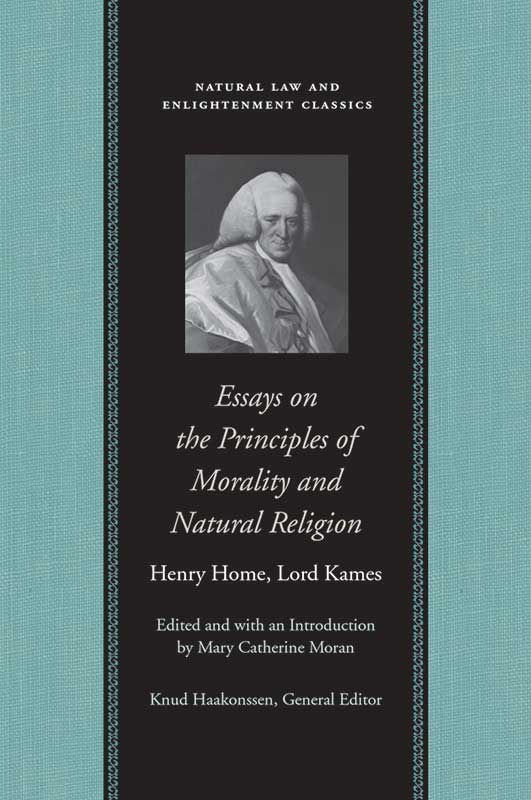
essay ii: Foundation and Principles of Morality i - Henry Home, Lord Kames, Essays on the Principles of Morality and Natural Religion [1779]Edition used:Essays on the Principles of Morality and Natural Religion, Corrected and Improved, in a Third Edition. Several Essays Added Concerning the Proof of a Deity, Edited and with an Introduction by Mary Catherine Moran (Indianapolis: Liberty Fund, 2005).
About Liberty Fund:Liberty Fund, Inc. is a private, educational foundation established to encourage the study of the ideal of a society of free and responsible individuals. Copyright information:The copyright to this edition, in both print and electronic forms, is held by Liberty Fund, Inc. Fair use statement:This material is put online to further the educational goals of Liberty Fund, Inc. Unless otherwise stated in the Copyright Information section above, this material may be used freely for educational and academic purposes. It may not be used in any way for profit.
essay iiFoundation and Principles of MoralityiintroductionSuperficial knowledge produces the boldest adventurers, because it gives no check to the imagination when fired by a new thought. Shallow writers lay down plans, contrive models, and are hurried on to execution by the pleasure of novelty, without considering whether, after all, there be any solid foundation to support the spacious edifice. It redounds not a little to the honour of some late inquirers after truth, that, subduing this bent of nature, they have submitted to the slow and more painful method of experiment; a method that has been applied to natural philosophy with great success. The accurate Locke, in the science of logics, has pursued the same method, and has been followed by several ingenious writers. The mistress-science alone is neglected; and it seems hard that less deference should be paid to her than to her hand-maids. Every author gives a system of morals, as if it were his privilege to adjust it to his own taste and fancy. Regulations for human conduct are daily framed, without the least consideration, whether they arise out of human nature, or can be accommodated to it. And hence many airy systems, that relate not to man nor to any other being. Authors of a warm imagination and benevolent temper, exalt man to the angelic nature, and compose laws for his conduct, so refined as to be far above the reach of humanity. Others of a contrary disposition, forcing down all men to a level with the very lowest of their kind, assign them laws more suitable to brutes than to rational beings. In abstract science, writers may more innocently indulge their fancies. The worst that can happen is, to mislead us in matters where error has little influence on practice. But they who deal in moral philosophy ought to be cautious; for their errors seldom fail to have a bad tendency. The exalting of nature above its standard, is apt to disgust the mind, conscious of its weakness, and of its inability to attain such an uncommon degree of perfection. The debasing of nature tends to break the balance of the affections, by adding weight to the selfish and irregular appetites. Beside these bad effects, clashing opinions about morality are apt to tempt men who have any hollowness of heart, to shake off all principles, and to give way to every appetite: and then adieu to a just tenor of life, and consistency of conduct. These considerations give the author of this essay a just concern to proceed with the utmost circumspection in his inquiries, and to try his conclusions by their true touchstone, that of facts and experiments. Had this method been strictly followed, the world would not have been perplexed with that variety of inconsistent systems, which unhappily have rendered morality a difficult and intricate science. An attempt to restore it to its original simplicity and authority, must be approved, however short one falls in the execution. Writers differ about the origin of the laws of nature, and they differ about the laws themselves. As the author is not fond of controversy, he will attempt a plan of the laws of nature, drawn from their proper source, laying aside what has been written on this subject. chapter iFoundation of MoralityIn searching for the foundation of the laws of our nature, the following reflections occur. In the first place, two things cannot be more intimately connected than a being and its actions: for the connection is that of cause and effect. Such as the being is, such must its actions be. In the next place, the several classes into which nature has distributed living creatures, are not more distinguishable by an external form, than by an internal constitution, which manifests itself in an uniformity of conduct, peculiar to eachspecies. In the third place, any action conformable to the common nature of the species, is considered by us as regular and proper. It is according to order, and according to nature. But if there exist a being of a constitution different from that of its kind, the actions of this being, though conformable to its own peculiar constitution, will, to us, appear whimsical and disorderly. We shall have a feeling of disgust, as if we saw a man with two heads or four hands. These reflections lead us to the foundation of the laws of our nature. They are to be derived from the common nature of man, of which every person partakes who is not a monster. As the foregoing observations make the groundwork of all morality, it may not be improper to enlarge a little upon them. Looking around, we find creatures of very different kinds, both as to external and internal constitution. Each species having a peculiar nature, ought to have a peculiar rule of action resulting from its nature. We find this to hold in fact; and it is extremely agreeable to observe, how accurately the laws of each species are adjusted to the frame of the individuals which compose it, so as to procure the conveniencies of life in the best manner, and to produce regularity and consistency of conduct. To give but one instance: the laws which govern sociable creatures, differ widely from those which govern the savage and solitary. Among solitary creatures, who have no mutual connection, there is nothing more natural nor more orderly, than to make food one of another. But for creatures in society to live after that manner, must be the effect of jarring and inconsistent principles. No such disorderly appearance is discovered upon the face of this globe. There is, as above observed, a harmony betwixt the internal and external constitution of the several classes of animals; and this harmony affords a delightful prospect of deep design, effectively carried into execution. The common nature of every class of beings is perceived by us as perfect; and if, in any instance, a particular being swerve from the common nature of its kind, the action produces a sense of disorder and wrong. In a word, it is according to order, that the different sorts of living creatures should be governed by laws adapted to their peculiar nature. We consider it as fit and proper that it should be so; and it is beautiful to find creatures acting according to their nature. The force of these observations cannot be resisted by those who admit of final causes. We make no difficulty to pronounce, that a species of beings who have such or such a nature, are made for such or such an end. A lion has claws, because nature made him an animal of prey. A man has fingers, because he is a social animal made to procure food by art not by force. It is thus we discover for what end we were designed by nature, or the Author of nature. And the same chain of reasoning points out to us the laws by which we ought to regulate our actions: for acting according to nature, is acting so as to answer the end of our creation. chapter iiMoral SenseHaving made out that the nature of man is the foundation of the laws that ought to govern his actions, it will be necessary to trace out human nature, so far as regards the present subject. If we can happily accomplish this part of our undertaking, it will be easy, in the synthetical method, to deduce the laws that ought to regulate our conduct. And we begin with examining in what manner we are related to beings and things around us; a speculation that will lead to the point in view. As we are placed in a great world, surrounded with beings and things, some beneficial, some hurtful; we are so constituted, that scarce any object is indifferent to us: it either gives pleasure or pain; witness sounds, tastes, and smells. This is the most remarkable in objects of sight, which affect us in a more lively manner than objects of any other external sense. Thus, a spreading oak, a verdant plain, a large river, are objects that afford delight. A rotten carcase, a distorted figure, create aversion; which, in some instances, goes the length of horror. With regard to objects of sight, whatever gives pleasure is said to be beautiful: whatever gives pain, is said to be ugly. The terms beauty and ugliness, in their proper signification, are confined to objects of sight. And indeed such objects, being more highly agreeable or disagreeable than others, deserve well to be distinguished by a proper name. But, as it happens with words that convey a more lively idea than ordinary, the terms are applied in a figurative sense to almost every thing that gives a high relish or disgust. Thus, we talk of a beautiful theorem, a beautiful thought, and a beautiful passage in music. And this way of speaking has become so familiar, that it is scarce reckoned a figurative expression. Objects considered simply as existing, without relation to any end orany designing agent, are in the lowest rank or order with respect to beauty and ugliness; a smooth globe for example, or a vivid colour. But when external objects, such as works of art, are considered with relation to some end, we feel a higher degree of pleasure or pain. Thus, a building regular in all its parts, pleases the eye upon the very first view: but considered as a house for dwelling in, which is the end purposed, it pleases still more, supposing it to be well fitted to its end. A similar sensation arises in observing the operations of a well-ordered state, where the parts are nicely adjusted to the ends of security and happiness. This perception of beauty in works of art or design, which is produced not barely by a sight of the object, but by viewing the object as fitted to some use, and as related to some end, includes in it what is termed approbation: for approbation, when applied to works of art, means our being pleased with them or conceiving them beautiful, in the view of being fitted to their end. Approbation and disapprobation are not applicable to the lowest class of beautiful and ugly objects. To say, that we approve a sweet taste, or a flowing river, is really saying no more but that we are pleased with such objects. But the term is justly applied to works of art, because it means more than being pleased with such an object merely as existing. It imports a peculiar beauty, which is perceived, upon considering the object as fitted to the use intended. It must be further observed to avoid obscurity, that the beauty which arises from the relation of an object to its end, is independent of the end itself, whether good or bad, whether beneficial or hurtful: it arises from considering its fitness to the end purposed, whatever that end be. When we take the end itself under consideration, there is discovered a beauty or ugliness of a higher kind than the two former. A beneficial end strikes us with a peculiar pleasure; and approbation belongs also to this feeling. Thus, the mechanism of a ship is beautiful, in the view of means well fitted to an end. But the end itself, of carrying on commerce and procuring so many conveniencies to mankind, exalts the object, and heightens our approbation and pleasure. By an end, I mean what it serves to procure and bring about, whether it be an ultimate end, or subordinate to something farther. Considered with respect to its end, the degree of its beauty depends on the degree of its usefulness. Let it be only kept in view, that as the end or use of a thing is an object of greater dignity and importance than the means, the approbation bestowed on the former rises higher than that bestowed on the latter. These three orders of beauty may be blended together in many different ways, to have very different effects. If an object in itself beautiful be ill fitted to its end, it will, upon the whole, be disagreeable. This may be exemplified in a house regular in its architecture and beautiful to the eye, but incommodious for dwelling. If there be in an object an aptitude to a bad end, it will, upon the whole, be disagreeable, though it have the second modification of beauty in perfection. A constitution of government formed with the most perfect art for enslaving the people, may be an instance of this. If the end be good but the object not well fitted to the end, it will be beautiful, or ugly, as the goodness of the end, or unfitness of the means, is prevalent. Of this instances will occur at first view, without being suggested. The foregoing modifications of beauty and deformity, apply to all objects, animate and inanimate. A voluntary agent produceth a peculiar species of beauty and deformity, which may be distinguished from all others. The actions of living creatures are more interesting than the actions of matter. The instincts and principles of action of the former, give us more delight than the blind powers of the latter; or, in other words, are more beautiful. No one can doubt of this fact, who is in any degree conversant with the poets. In Homer every thing lives: even darts and arrows are endued with voluntary motion. And we are sensible, that nothing animates a poem more than the frequent use of this figure. Hence a new circumstance in the beauty and deformity of actions, considered as proceeding from intention, deliberation, and choice. This circumstance, which is of the utmost importance in the science of morals, concerns chiefly human actions: for we discover little of intention, deliberation, and choice, in the actions of inferior creatures. Human actions are not only agreeable or disagreeable, beautiful or deformed, in the different views above mentioned, but are further distinguished in our perception of them, as fit and meet to be done, or as unfit and unmeet. These are simple perceptions, capable of no definition. But let any man attentively examine what passeth in his mind, when the object of his thought is an action proceeding from deliberate intention, and he will soon discover the meaning of these words, and the perceptions which they denote. Let him reflect upon a signal act of generosity to a person of merit, relieving him from want or from a cruel enemy: let him reflect on a man of exemplary patriotism bearing patiently rank oppression, rather than break the peace of society. Such conduct will not only be agreeable to him, and appear beautiful, but will be agreeable and beautiful, as fit and meet to be done. He will approve the action in that quality, and he will approve the actor for his humanity and disinterestedness. This distinguishing circumstance intitles the beauty and deformity of human actions to peculiar names: they are termed moral beauty and moral deformity. Hence the morality and immorality of human actions; founded on a faculty termed the moral sense. It gives no clear notion of morality, to rest it upon simple approbation, as some writers do. I approve a well constructed plough or waggon for its usefulness. I approve a fine picture or statue for the justness of its representation; and I approve the maker for his skill. I approve an elegant dress on a fine woman; and I approve her taste. But such approbation is far from being the same with that which is occasioned by human actions deliberately done in order to some end. If the end be beneficial, the action is approved as right and fit to have been done: if hurtful, it is disapproved as wrong and unfit to have been done. None of these qualities are applicable to the instances first given.ii Of all objects whatever, human actions are the most highly delightful or disgustful, and possess the highest degree of beauty or deformity. In these every circumstance concurs: the fitness or unfitness of the means, the goodness or badness of the end, the intention of the actor; which give them the peculiar character of fit and meet, or unfit and unmeet. Thus we find the nature of man so constituted, as to approve certain actions, and to disapprove others; to consider some actions as fit and meet to be done, and others as unfit and unmeet. What distinguisheth actions to make them objects of the one or the other perception, will be explained in the following chapter. And with regard to some of our actions, another circumstance will be discovered, different from what have been mentioned, sounding the well known terms of duty and obligation, directing our conduct, and constituting what in the strictest sense may be termed a law. With regard to other beings, we have no data to discover the laws of their nature, other than their frame and constitution. We have the same data to discover the laws of our own nature; and over and above, a peculiar sense of approbation or disapprobation, termed the moral sense. And one thinge xtremely remarkable will be explained afterwards, that the laws which are fitted to the nature of man and to his external circumstances, are the same that we approve by the moral sense. chapter iiiDuty and ObligationThough these terms are of the utmost importance in morals, I know not that any author hath attempted to explain them, by pointing out those principles or perceptions which they express. This defect I shall endeavour to supply, by tracing these terms to their proper source, without which the system of morals cannot be complete; because these terms point out to us the most precise and essential branch of morality. Lord Shaftesbury, to whom the world is greatly indebted for his inestimable writings, has clearly and convincingly made out, “that virtue is the good, and vice the ill of every one.”1 But he has not proved virtue to be our duty, other ways than by showing it to be our interest; which comes not up to the idea of duty. For this term plainly implies somewhat indispensable in our conduct; what we ought to do, what we ought to submit to. Now, a man may be considered as foolish for acting against his interest; but he cannot be considered as wicked or vitious. His Lordship indeed, in his essay upon virtue,* approaches to an explanation of duty and obligation, by asserting the subordinancy of the self-affections to the social. But though he states this as a proposition to be made out, he drops it in the subsequent part of his work, and never again brings it into view. Hutcheson, in his essay upon beauty and virtue,* founds the morality of actions on a certain quality of actions, that procures approbation and love to the agent. But this account of morality is also imperfect, as it makes no distinction between duty and simple benevolence. It is scarce applicable to justice; for the man who, confining himself strictly to it, is true to his word and avoids harming others, is a just and moral man, is in titled to some share of esteem; but will never be the object of love or friendship. He must show a disposition to the good of mankind, of his friends at least and neighbours, he must exert acts of humanity and benevolence; before he can hope to procure the affection of others. But it is chiefly to be observed, that in this account of morality, the terms obligation, duty, ought and should, have no distinct meaning; which shows, that the entire foundation of morality is not taken in by this author. It is true, that toward the close of his work, he attempts to explain the meaning of the term obligation; but without success. He explains it to be, either, “a motive from self-interest, sufficient to determine those who duly consider it to a certain course of action;” which surely is not moral obligation; or “a determination, without regard to our own interest, to approve actions, and to perform them; which determination shall also make us displeased with ourselves, and uneasy upon having acted contrary to it;” in which sense, he says, there is naturally an obligation upon all men to benevolence.2 But this account falls short of the true idea of obligation; because it makes no destinction betwixt it and that simple approbation of the moral sense which can be applied to heroism, magnanimity, generosity, and other exalted virtues, as well as to justice. Duty however belongs to the latter only; and no man reckons himself under an obligation to perform any action that belongs to the former. Neither is the author of the treatise upon human nature more successful, when he endeavours to resolve the moral sense into pure sympathy.* According to that author, there is no more in morality, but approving or disapproving an action, after we discover by reflection that it tends to the good or hurt of society. This would be too fainta principle to control our irregular appetites and passions. It would scarce be sufficient to restrain us from in croaching upon our friends and neighbours; and, with regard to strangers, would be the weakest of all restraints. We shall by and by show, that morality has a more solid foundation. In the mean time, it is of importance to observe, that, upon this author’s system, as well as Hutcheson’s, the noted terms of duty, obligation, ought and should, &c. have no meaning. We shall now proceed to explain these terms, by pointing out the perceptions which they express. And, in performing this task, there will be discovered a wonderful and beautiful contrivance of the Author of our nature, to give authority to morality, by putting the self-affections in a due subordination to the social. The moral sense has in part been explained above; that by it we perceive some actions to be fit and meet to be done; and others to be unfit and unmeet. When this observation is applied to particulars, it is an evident fact, that we have a sense of fitness in kindly and beneficent actions: we approve ourselves and others for performing actions of this kind; as, on the other hand, we disapprove the unsociable, peevish, and hard-hearted. But in one class of actions, an additional circumstance is regarded by the moral sense. Submission to parents, gratitude to benefactors, and the acting justly to all, are perceived not only as fit and meet, but as our indispensable duty. On the other hand, the injuring others in their persons, in their fame, or in their goods are perceived not only as unfit to be done, but as absolutely wrong to be done, and what, upon no account, we ought to do. What is here asserted, is a matter of fact, which can admit of no other proof than an appeal to every man’s own perceptions. Lay prejudice aside, and give fair play to what passes in the mind: I ask no other concession. There is no man, however irregular in his life and manners, however poisoned by a wrong education, but must be sensible of these perceptions. And indeed the words which are to be found in all languages, and which are perfectly understood in the communication of sentiments, are an evident demonstration of it. Duty, obligation, ought and should, would be empty sounds, unless upon supposition of such perceptions. We do not consider actions that come under the notion of duty or obligation, or prohibited by them, as in any degree under our own power. We have the consciousness of necessity, and of being bound and tied to performance, as if under some external compulsion. It is proper here to be remarked, that benevolent and generous actions are not objects of this peculiar sense. Hence, such actions, though considered as fit and right to be done, are not however considered to be our duty, but as virtuous actions beyond what is strictly our duty. Benevolence and generosity are more beautiful, and more attractive of love and esteem, than justice. Yet, not being so necessary to the support of society, they are left upon the general footing of approbatory pleasure; while justice, faith, truth, without which society cannot subsist, are objects of the foregoing peculiar sense, to take away all shadow of liberty, and to put us under a necessity of performance. The virtues that are exacted from us as duties, may be termed primary: the other which are not exacted as duties, may be termed secondary. Dr. Butler, a manly and acute writer, hath gone farther than any other, to assign a just foundation for moral duty. He considers conscience or reflection,* as one principle of action, which, compared with the rest as they stand together in the nature of man, plainly bears upon it marks of authority over all the rest, and claims the absolute direction of them all, to allow or forbid their gratification. And his proof of this proposition is, “that a disapprobation or reflection is in itself a principle manifestly superior to a mere propension.” Had this admirable writer handled the subject more professedly than he had occasion to do in a preface, it is more than likely he would have put it in a clear light. But he has not said enough to afford that light the subject is capable of. For it may be observed, in the first place, that a disapprobation of reflection is far from being the whole of the matter. Such disapprobation is applied to moroseness, selfishness, and many other partial affections, which are, however, not considered in a strict sense as contrary to our duty. And it may be doubted, whether a disapprobation of reflection be, in every case, a principle superior to a mere propension. We disapprove a man who neglects his private affairs, and gives himself up to love, hunting, or any other amusement: nay, he disapproves himself. Yet from this we cannot fairly conclude, that he is guilty of any breach of duty, or that it is unlawful for him to follow his propension. We may observe, in the next place, what will be afterward explained, that conscience, or the moral sense, is none of our principles of action, but their guide and director. It is still of greater importance to observe, that the authority of conscience does not consist merely in an act of reflection. It arises from a direct perception, which we have upon presenting the object, without the intervention of any sort of reflection. And the authority lies in this circumstance, that we perceive the action to be our duty, and what we are indispensably bound to perform. It is in this manner that the moral sense, with regard to some actions, plainly bears upon it the marks of authority over all our appetites and passions. It is the voice of God within us, which commands our strictest obedience, just as much as when his will is declared by express revelation. What is here stated will I hope clearly distinguish duty or moral obligation from benevolence: I know of no words in our language to make the distinction more clear. The overlooking this distinction is a capital defect in the writers who acknowledge morality to be founded on an innate sense: it has led them to reduce the whole of virtue to benevolence; and consequently, to hold mankind as bound to perform the highest acts of benevolence, because such acts produce the highest approbation. This doctrine cannot be altogether harmless, because it converts benevolence into indispensable duty, contrary to the system of nature. A young man who enters the world full of such notions soon discovers it to be above his power to conform his conduct to them. Will he not be naturally led to consider morality as a romance or chimera? If he escape that conclusion, he may justly consider himself as remarkably fortunate.iii A very important branch of the moral sense remains still to be unfolded. In the matters above mentioned, performing of promises, gratitude, and abstaining from harming others, we have the peculiar sense of duty and obligation: but in transgressing these duties, we have not only the sense of vice and wickedness, but we have further the sense of merited punishment, and dread of its being inflicted upon us. This dread may be but slight in the more venial transgressions. But, in crimes of a deep dye, it rises to a degree of anguish and despair. Hence remorse of conscience, which, upon the commission of certain crimes, is a dreadful torture. This dread of merited punishment operates for the most part so strongly upon the imagination, that every unusual accident, every extraordinary misfortune, is by the criminal judged to be a punishment purposely inflicte dupon him. During prosperity, he makes a shift to blunt the stings of his conscience. But no sooner does he fall into distress or into any depression of mind, than his conscience lays fast hold of him: his crime stares him in the face; and every accidental misfortune is converted into a real punishment. “Andthey said one to another, We are verily guilty concerning our brother, in that we saw the anguish of his soul, when he besought us; and we would not hear: therefore is this distress come upon us. And Reuben answered them, saying, Spake I not unto you, saying, Do not sin against the child; and ye would not hear? therefore behold also, his blood is required.”* One material circumstance is here to be remarked, which widens the difference still more betwixt the primary and secondary virtues. As justice, and the other primary virtues, are more essential to society, than generosity, benevolence, or any other secondary virtue, they are more indispensable. Friendship, generosity, softness of manners, form peculiar characters, and serve to distinguish one person from another. But the sense of justice and of the other primary virtues, belongs to man as such. Though it exists in very different degrees of strength, there perhaps never was a human creature altogether void of it. And it makes a delightful appearance in the human constitution, that even where this sense is weak, as it is in some individuals, it notwithstanding retains its authority as the director of their conduct. If there be a sense of justice, it must distinguish right from wrong, what we ought to do from what we ought not to do; and, by that very distinguishing faculty, justly claims to be our guide and governor. This consideration may serve to justify human laws, which make no distinction among men, as endued with a stronger or weaker sense of justice. And here we must pause a moment, to indulge some degree of admiration upon this part of the human system. Man is evidently intended to live in society; and because there can be no society among creatures who prey upon one another, it was necessary, in the first place, to provide against mutual injuries. Further, man is the weakest of all creatures separately, and the very strongest in society; therefore mutual assistance is the chief end of society; and to this end it was necessary, that there should be mutual trust and reliance upon engagements, and that favours received should be thankfully repaid. Now, nothing can be more finely adjusted than the human heart, to answer these purposes. It is not sufficient that we approve every action that is essential to the preservation of society: it is not sufficient, that we disapprove every action that tends to its dissolution. Approbation or disapprobation merely, is not sufficient to subject our conduct to the authority of a law. These sentiment shave in this case the peculiar modification of duty, that such actions are what we ought to perform, and what we are indispensably bound to perform. This circumstance converts into a law, what without it can only be considered as a rational measure, and a prudential rule of conduct. Nor is any thing omitted to give it the most complete character of a law. The transgression is attended with apprehension of punishment, nay with actual punishment; as every misfortune which befals the transgressor is considered by him as a punishment. Nor is this the whole of the matter. Sympathy is a principle implanted in the breast of every man; we cannot hurt another without suffering for it, which is an additional punishment. And we are still further punished for our injustice or ingratitude, by incurring the aversion and hatred of all men. chapter ivDifferent Ranks of Moral VirtuesIt is a truth universally admitted, that no man thinks so highly of himself or of another, for having done a just, as for having done a generous action: yet every one must be sensible, that justice is to society more essential than generosity; and why we should place the greater merit upon the less essential action, may appear unaccountable. This matter deserves to be examined, because it discloses more and more the science of morals; and to this examination we shall proceed, after making some further observations upon the subject of the preceding chapter.iv The primary virtues, as observed in that chapter, being duties essential to the subsistance of society, are entirely withdrawn from our election and choice. They are perceived as indispensably obligatory upon us; and the transgression of them as laws of our nature, is attended with severe and never-failing punishment. In a word, there is not a characteristic of positive law which is not applicable, in the strictest sense, to the selaws of our nature; with this material difference, that the sanctions of these laws are greatly more efficacious than any that have been invented to enforce municipal laws. The secondary virtues, which contribute to the improvement of society, but are not strictly necessary to its subsistence, are left to our own choice. They have not the character of necessity impressed upon them, nor is the forbearance of them attended with a sense of guilt. On the other hand, the actions which belong to this class, are objects of the strongest perceptions of moral beauty; of the highest degree of approbation, both from ourselves and others. Offices of undeserved kindness, requital of good for evil, generous toils and sufferings for the good of our country, come under this class. These are not made our duty. There is no motive to the performance, which in any proper sense can be called a law. But there are the strongest motives that can consist with perfect freedom. The performance is rewarded with a consciousness of self-merit, and with the praise and admiration of all the world, which are the highest and most desirable rewards human nature is susceptible of. There is so much of enthusiasm in this branch of moral beauty, that it is not wonderful to find persons of a free and generous turn of mind captivated with it, who are less attentive to the primary virtues. The magnanimous, who cannot bear restraint, are guided more by generosity than by justice. The sense however of strict duty is, with the bulk of mankind, a more powerful incitement to honesty, than praise and self-approbation are to generosity. And there cannot be a more pregnant instance of wisdom than in this part of the human constitution; it being far more essential to society, that all men be just and honest, than that they be patriots and heroes. From what is above laid down, the following observation naturally arises, that with respect to the primary virtues, the pain of transgressing our duty is much greater than the pleasure which results from obeying it. The contrary holds in the secondary virtues. The pleasure which arises from performing a generous action is much greater than the pain of neglect. Among the vices opposite to the primary virtues, the most striking appearances of moral deformity are found; among the secondary virtues, the most striking appearances of moral beauty. We are now prepared to carry on the speculation suggested in the beginning of this chapter. In ranking the moral virtues according to their dignity and merit, one would readily imagine, that the primary virtues should be intitled to the highest class, as being more essential to society than the secondary. But, upon examination, we find that this is not the order of nature. The first rank in point of dignity is assigned to the secondary virtues, which are not the first in point of utility. Generosity, in the sense of mankind, hath more merit than justice; and other secondary virtues, undaunted courage, magnanimity, heroism, rise still higher in our esteem. Is not nature whimsical and irregular, in ranking after this manner the moral virtues? One at first view would think so. But, like other difficulties that meet us in contemplating the works of nature, this arises from partial and obscure views. When the whole is surveyed as well as its several parts, we discover, that nature has here taken her measures with peculiar foresight and wisdom. Let us only recollect what is inculcated in the foregoing part of this essay, that justice is enforced by natural sanctions of the most effectual kind, by which it becomes a law in the strictest sense, a law that never can be transgressed with impunity. To extend this law to generosity and the other secondary virtues, and to make these our duty, would produce an in consistency in human nature. It would make universal benevolence a strict duty, to which the limited capacity and more limited abilities of man, bear no proportion. Generosity, therefore, heroism, and all the extraordinary exertions of virtue, must be left to our own choice, without annexing any punishment to the forbearance. Day-light now begins to break in upon us. If the secondary virtues must not be enforced by punishment, it becomes necessary that they be encouraged by reward; for without such encouragement, examples would be rare of sacrificing one’s own interest to that of others. And after considering the matter with the utmost attention, I cannot imagine any reward more proper than that actually bestowed, which is to place these virtues in the highest rank, to give them a superior dignity, and to make them productive of grand and lofty emotions. To place the primary virtues in the highest rank, would no doubt be a strong support to them. But as this could not be done without displacing the secondary virtues, detruding them into a lower rank, and consequently depriving them of their reward, the alteration would be ruinous to society. It would indeed more effectually prevent injustice and wrong; but would it not as effectually prevent the exercise of benevolence, and of numberless reciprocal benefits in a social state? If it would put an end to our fears, so it would to our hopes. And, to say all in one word, we would, in the midst of society, become solitary beings; worse if possible than being solitary in a desart. Justice at the same time is not left altogether destitute of reward. Though it reaches not the splendor of the more exalted virtues, it gains at least our esteem and approbation; and, which is still of greater importance, it never fails to advance the happiness of those who obey its dictates, by the mental satisfaction it bestows. chapter vPrinciples of ActionIn the three chapters immediately foregoing, we have taken pains to inquire into the moral sense, and to analyze it into its different parts. Our present task must be to inquire into those principles in our nature which move us to action. These must be distinguished from the moral sense; which, properly speaking, is not a principle of action. Its province, as shall forthwith be explained, is to instruct us, which of our principles of action we may indulge, and which of them we must restrain. It is the voice of God within us, regulating our appetites and passions, and showing us what are lawful, what unlawful. Our nature, as far as concerns action, is made up of appetites and passions which move us to act, and of the moral sense by which these appetites and passions are governed. The moral sense is not intended to be the first mover: but it is an excellent second, by the most authoritative of all motives, that of duty. Nature is not so rigid to us her favourite children, as to leave our conduct upon the motive of duty solely. A more masterly and kindly hand is visible in the architecture of man. We are impelled to motion by the very constitution of our nature; and to prevent our being carried too far, or in a wrong direction, conscience is set as at the helm. That such is our nature, may be made evident from induction. Were conscience alone, in any case, to be the sole principle of action, it might be expected to be so in matters of justice, of which we have the strongest sense as our indispensable duty. We find however justice not to be an exception from the general plan. For is not love of justice a principle of action common to all men; and is not affection between parents and children equally so, as well as gratitude, veracity, and every primary virtue? These principles give the first impulse, which is finely seconded by the influence and authority of conscience. It may therefore be safely pronounced, that no action is a duty, to the performance of which we are not prompted by some natural motive or principle. To make such an action our duty, would be to lay down a rule of conduct contrary to our nature; or that has no foundation in our nature. This is a truth little attended to by those who have given us systems of natural laws. No wonder they have gone astray. Let this truth be kept close in view, and it will put an end to many a controversy about these laws. If, for example, it be laid down as a primary law of nature, That we are strictly bound to advance the good of all, regarding our own interest no farther than as it makes a part of the general happiness; we may safely reject such a law, unless it be made appear, that there is a principle of benevolence in man prompting him to pursue the happiness of all. To found this disinterested scheme wholly upon the moral sense, would be a vain attempt. The moral sense, as above observed, is our guide only, not our mover. Approbation or disapprobation of those actions, to which, by some natural principle, we are antecedently directed, is all that can result from it. If it be laid down on the other hand, That we ought to regard ourselves only in all our actions; and that it is folly, if not vice, to concern ourselves for others; such a law can never be admitted, unless upon the supposition that self-love is our only principle of action. It is probable, that in the following particular, man differs from the brute creation. Brutes are entirely governed by principles of action, which, in them, obtain the name of instincts. They blindly follow their instincts, and are led by that instinct which is strongest for the time. It is meet and fit they should act after this manner, because it is acting according to the whole of their nature. But for man to suffer himself to be led implicitly by instinct or by his principles of action, without check or control, is not acting according to the whole of his nature. He is endued with a moral sense or conscience, to check and control his principles of action, and to instruct him which of them he may indulge, and which of them he ought to restrain. This account of the brute creation is undoubtedly true in the main: whether so in every particular, is of no importance to the present subject, being suggested by way of contrast only, to illustrate the peculiar nature of man. A full account of our principles of action would be an endless theme. But as it is proposed to confine the present short essay to the laws which govern social life, we shall have no occasion to inquire into any principles of action, but what are directed to others; dropping those which have self alone for their object. And in this inquiry, we set out with the following question, In what sense are we to hold a principle of universal benevolence, as belonging to human nature? This question is of importance in the science of morals: for, as observed above, universal benevolence cannot be a duty, if we be not antecedently promp[t]ed to it by a natural principle. When we consider a single man, abstracted from all circumstances and all connections, we are not conscious of any benevolence to him; we feel nothing within us that prompts us to advance his happiness. If one be agreeable at first sight and attract any degree of affection, it is owing to looks, manners, or behaviour. And for evidence of this we are as apt to be disgusted at first sight, as to be pleased. Man is by nature a shy and timorous animal. Every new object gives an impression of fear, till upon better acquaintance it is discovered to be harmless. Thus an infant clings to its nurse, upon the sight of a new face; and this natural dread is not removed but by experience. If every human creature did produce affection in every other at first sight, children, by natural instinct, would be fond of strangers. But no such instinct discovers itself. The fondness of a child is confined to the nurse, the parents, and those who are most about it; till by degrees it opens to a sense of other connections. This argument may be illustrated by a low, but apt instance. Dogs have by nature an affection for the human species; and puppies run to the first man they see, show marks of fondness, and play about his feet. There is no such general fondness of man to man by nature. Certain circumstances are always required to produce and call it forth. Distress indeed never fails to beget sympathy. The misery of the most unknown gives us pain, and we are prompted by nature to afford relief. But when there is nothing to call forth our sympathy; where there are no peculiar circumstances to interest us or beget a connection, we rest in a state of indifference, and are not conscious of wishing either good or ill to the person. Those moralists therefore who require us to lay aside all partial affection and to act upon a principle of equal benevolence to all men, require us to act upon a principle, which has no place in our nature. In the manner now mentioned, a principle of universal benevolence does certainly not exist in man. Let us next inquire if it exist in any other manner. The happiness of mankind is an object agreeable to the mind in contemplation; and good men have a sensible pleasure in every study or pursuit by which they can promote it. Benevolence, not equally directed to all men, gradually decreaseth according to the distance of the object, till it dwindles away to nothing. But here comes in a happy contrivance of nature, to supply the want of benevolence to distant objects; which is, to give power to an abstract term, such as our religion, our country, our government, or even mankind, to raise benevolence or public spirit. The particular objects under each of these classes, considered singly and apart, may have little or no force to produce affection; but when comprehended under one general view, they become an object that dilates and warms the heart. In this manner, a man is enabled to embrace in his affection all mankind: and in this sense man is endued with a principle of universal benevolence. Any person who can reflect upon this branch of human nature without some degree of emotion, must be of a very cold temperament. There is perhaps not one scene to be met with in the natural or moral world where more of design and of consummate wisdom are displayed, than in this under consideration. The authors, who, impressed with reverence for human nature, have endeavoured to exalt it the highest, could none of them stretch their imagination beyond a principle of equal benevolence to every individual. And a very fine scheme it is in idea; but, unluckily it is entirely of the Utopian kind, altogether unfit for life and action. It hath escaped the consideration of these authors, that man is by nature of a limited capacity; and that his affection, by multiplication of objects, instead of being increased, is split into parts, and weakened by division. A principle of universal equal benevolence, by dividing the attention and affection, instead of promoting benevolent actions, would be an obstruction to them. The mind would be distracted by the multiplicity of objects that have an equal influence, so as to be eternally at a loss where to begin. But the human system is better adjusted than to admit of such disproportion betwixt ability and affection. The chief objects of a man’s love are his friends and relations. He reserves some share to bestow on his neighbours. His affection lessens gradually, in proportion to the distance of the object, till it vanish altogether. But were this the whole of human nature with regard to benevolence, man would be but an abject creature. By a very happy contrivance, objects which, because of their distance, have little or no influence, are gathered together in one general view, and made to have the very strongest effect; exceeding, in many instances, the most lively affection that is bestowed on a particular object. By this happy contrivance, the attention of the mind, and its affections are preserved entire, to be bestowed upon general objects, instead of being dissipated among an endless number of individuals. Nothing more ennobles human nature than this principle of action: nor is there any thing more wonderful, than that a general term which has no precise meaning, should be the foundation of a more intense affection than is bestowed, for the most part, upon particular objects, even the most attractive. When we talk of our country, our religion, our government, the ideas annexed to these general terms, are obscure and indistinct. General terms are extremely useful in language; serving, like mathematical signs, to communicate our thoughts in a summary way. But the use of them is not confined to language: they serve for a much nobler purpose, that of exciting us to generous and benevolent actions of the most exalted kind; not confined to individuals, but grasping whole societies, towns, countries, kingdoms, nay all mankind. By this curious mechanism, the defect of our nature is amply remedied. Distant objects, other ways invisible, are rendered conspicuous: accumulation makes them great; and greatness brings them near the eye: affection is preserved, to be bestowed entire, as upon a single object. And, to say all in one word, this system of benevolence, which is really founded on human nature and not the invention of man, is infinitely better contrived to advance the good and happiness of mankind, than any Utopian system that ever has been produced by the warmest imagination. Upon the opposite system of absolute selfishness, there is no occasion to lose a moment. It is evidently chimerical, because it has no foundation in human nature. It is not more certain that there exists the creature man, than that he hath principles of action directed entirely upon others; some to do good, and others to do mischief. Who can doubt of this, when friendship, compassion, gratitude, on the one hand; and on the other, malice and resentment, are considered? It hath indeed been observed, that we indulge such passions and affections merely for our own gratification. But no person can relish this observation, who is in any measure acquainted with human nature. The social affections are in fact the source of the deepest afflictions, as well as of the most exalted pleasures, as has been fully laid open in the foregoing essay. In a word, we are evidently formed by nature for society, and for indulging the social as well as the selfish passions; and therefore to contend, that we ought to regard ourselves only and to be influenced by no principles but what are selfish, is directly to fly in the face of nature, and to lay down a rule of conduct inconsistent with it. These systems being laid aside, as deviating from the nature of man, the way lies open to come at what are his true and genuine principles of action. The first thing that nature consults, is the preservation of her creatures. Hence the love of life is made the strongest of all instincts. Upon the same foundation, pain is in a greater degree the object of aversion, than pleasure is of desire. Pain warns us of what tends to our dissolution: pleasure is often sought after unwarily, and by means dangerous to health and life. Pain comes in as a monitor of our danger; and nature, consulting our preservation in the first place and our gratification in the second only, wisely gives pain more force to draw us back, than it gives pleasure to push us on. The second principle of action is self-love, or desire of our own happiness and good. This is a stronger principle than benevolence, or love bestowed upon others: wisely so ordered; because every man has more power, knowledge, and opportunity, to promote his own good than that of others. Thus individuals are mostly left to their own care. It is agreeable to the limited nature of such a creature as man, that it should be so; and, consequently, it is wisely ordered, that every man should have the strongest affection for himself. The foregoing principles having self for their object, come not properly under the present undertaking. They are barely mentioned, to illustrate, by opposition, the following principles, which regard others. Of this sort, the most universal is the love of justice, without which there can be no society.v Veracity is another principle, no less universal. Fidelity, a third principle, is circumscribed within narrower bounds; for it cannot exist without a peculiar connection betwixt two persons, to found a reliance on the one side, which requires on the other a conduct corresponding to the reliance. Gratitude is a fourth principle, universally acknowledged. And benevolence possesses the last place, diversified by its objects, and exerting itself more vigorously or more faintly, in proportion to the distance of particular objects, and the grandeur of those that are general. This principle of action has one remarkable quality, that it operates with much greater force to relieve those in distress, than to promote positive good. In the case of distress, sympathy comes to it said; and, in that circumstance, it acquires the name of compassion. These several principles of action are ordered with admirable wisdom, to promote the general good in the best and most effectual manner. When we act on these principles, we act for the general good, even when it is not our immediate aim. The general good is an object too remote, to be the sole impulsive motive to action. It is better ordered, that in most instances individuals should have a limited aim, what they can readily accomplish. To every man is assigned his own task; and if every man do his duty, the general good will be promoted much more effectually, than if it were the aim in every single action. The above-mentioned principles of action belong to man as such, and constitute what may be called the common nature of man. Many other principles exert themselves upon particular objects in the instinctive manner, without the intervention of any sort of reasoning or reflection; appetite for food, animal love, &c. Other particular appetites, passions, and affections, such as ambition, avarice, envy, &c. constitute the peculiar nature of some individuals; being distributed in different proportions. It belongs to the science of ethics, to treat of these particular principles of action. chapter viJustice and InjusticeJustice is that moral virtue which guards the persons, the property, and the reputation of individuals, and gives authority to promises and covenants. And as it is made out above, that justice is one of those primary virtues which are enforced by the strongest natural laws, it would be unnecessary to say more upon the subject, were it not for a doctrine espoused by the author of a treatise upon human nature, that justice, so far from being one of the primary virtues, is not even a natural virtue, but established in society by a sort of tacit convention, founded upon a notion of public interest.3 The figure this author deservedly makes in the learned world, will not admit of his being passed over in silence. To people beside who live in society, it cannot but be agreeable to learn how solidly founded the principle of justice is, and how finely contrived to protect them from injury. Our author’s doctrine, as far as concerns that branch of justice by which property is secured, comes to this: That, in a state of nature, there can be no such thing as property; and that the idea of property arises, after justice is established by convention, securing every one in their possessions. In opposition to this singular doctrine, there is no difficulty to make out, that property is founded on a natural sense independent altogether of agreement or convention; and that violation of property is attended with remorse, and a perception of breach of duty. In prosecuting this subject, it will appear how admirably the springs of human nature are adapted one to another, and to external circumstances. The surface of this globe, which scarce yields spontaneously food for the wildest savages, is by labour and industry made so fruitful, as to supply man, not only with necessaries, but even with materials for luxury. Men originally made shift to support themselves, partly by prey, and partly by the natural fruits of the earth. In this state they in some measure resemble beasts of prey, who devour instantly what they seize, and whose care is at an end when the belly is full. But man was not designed by nature to be an animal of prey. A tenor of life where food is so precarious, requires a constitution that can bear long fasting and immoderate eating, as occasion offers. Man is of a different make. He requires regular and frequent supplies of food, which could not be obtained in his original occupations of fishing and hunting. He found it necessary therefore to abandon this manner of life, and to become shepherd. The wild creatures, such of them as are gentle and proper for food, were brought under subjection. Hence herds of cattle, sheep, goats, &c. ready at hand for sustenance. This contrivance was succeeded by another. A bit of land is divided from the common; it is cultivated with the spade or plough; grain is sown, and the product is stored for the use of a family. Reason and reflection prompted these improvements, which are essential to our well-being, and in a good measure necessary even for bare subsistence. But self-preservation, is of too great moment to be left entirely to the conduct of reason. To secure against neglect or indolence, man is provided with a principle that operates instinctively without reflection; and that is the hoarding appetite, common to him with several other animals. No author, I suppose, will be so bold as to deny this disposition to be natural and universal, considering how solicitous every man is for a competency, and how anxious the plurality are to swell that competency beyond bounds. The hoarding appetite, while moderate, is so natural and so common as not to be graced with a proper name. When it exceeds just bounds, it is known by the name of avarice. The compass I have taken is wide, but the shortest road is not always the smoothest or most patent. I come now to the point, by putting a plain question, What sort of creature would man be, endued as he is with a hoarding appetite, but with no sense or notion of property? He hath a constant propensity to hoard for his own use; conscious at the same time that his stores are no less free to others than to himself;—racked thus perpetually betwixt the desire of appropriation, and consciousness of its being in vain. I say more: the hoarding appetite is an instinct obviously contrived for assisting reason, in moving us to provide against want. This instinct, like all others in the human soul, ought to be a cause adequate to the effect intended to be accomplished by it. But this it cannot be, independent of a sense of property. For what effectual provision can be made against want, when the stores of every individual are, without any check from conscience, left free to the depredations of the whole species? Here would be a palpable defect or inconsistency in the nature of man. If I could suppose this to be his case, I should believe him to be a creature made in haste, and left unfinished. I am certain there is no such inconsistency to be found in any other branch of human nature; nor indeed, as far as we can discover, in any other creature that is endued with the hoarding appetite. Every bee inhabits its own cell, and feeds on its own honey. Every crow has its own nest; and punishment is always applied, when a single stick happens to be pilfered. But we find no such inconsistency in man. The cattle tamed by an individual, and the field cultivated by him, were held universally to be his own from the beginning. A relation is formed betwixt every man and the fruits of his own labour, the very thing we call property, which he himself is sensible of, and of which every other is equally sensible. Yours and mine are terms in all languages, familiar among savages, and understood even by children. This is a fact, which every human creature can testify. This reasoning might be illustrated by many apt analogies. I shall mention but one. Veracity, and a disposition to believe what is affirmed for truth, are corresponding principles, which make one entire branch of the human nature. Veracity would be of no use were men not disposed to believe; and, abstracting from veracity, a disposition to believe, would be a dangerous quality; for it would lay us open to fraud and deceit. There is precisely the same correspondence betwixt the hoarding appetite and the sense of property. The latter is useless without the former; witness animals of prey, who having no occasion for property, have no notion of it. The former again, without the latter, is altogether insufficient to produce the effect for which it is intended by nature. Thus it is clear, that the sense of property owes not its existence to society. But in a matter of so great importance in the science of morals, I cannot rest satisfied with a successful defence. I aim at a complete victory, by insisting on a proposition directly opposite to that of my antagonist, namely, That society owes its existence to the sense of property; or at least, that without this sense no society ever could have been formed. In the proof of this proposition, we have already made a considerable progress, by evincing that man by his nature is a hoarding animal and loves to store for his own use. In order to the conclusion, we have but one farther step to make; which is, to consider what originally would have been the state of man, supposing him destitute of the sense of property. The answer is extremely obvious, That it would have been a state of universal war—of men preying upon each other—of robbing and pilfering the necessaries of life where ever found, without regard to industry, or the connection that is formed betwixt an individual and the fruits of his own labour. Courage and bodily strength would have stood in place of right, and nothing left for the weak, but to hide themselves and their goods. And to do Hobbes justice, who, as well as our author, denies the sense of property to be natural, he fairly owns this reasoning to be just, and boldly asserts that the state of nature is a state of war, all against all. In a word, destitute of the sense of property, men would naturally be enemies to each other, no less than they are to wolves and foxes at present. Now, if this must have been the original condition of man, let our author say, by what over-ruling power, by what miracle, individuals so disposed ever came to unite in society. We may pronounce with great assurance, that so signal a revolution in the state of man could never have been compassed by natural means. Nothing can be more evident than that relying upon the sense of property and of justice, a few individuals ventured at first to unite for mutual defence and mutual support; and finding the manifold comforts of such a state, that they afterward gradually united into larger and larger societies.vi It must not be overlooked, that the sense of property is fortified by another principle. Every man has a peculiar affection for what he calls his own. He applies his skill and industry with great alacrity to improve his own subject: his affection to it grows with the time of his possession; and he puts a much greater value upon it, than upon any subject of the same kind that belongs to another.vii But this is not all that is involved in the sense of property. We not only suffer pain in having our goods taken from us by force; for that would happen were they destroyed or lost by accident: we have the sense of wrong and injustice. The person who robs us has the same sense; and every mortal who beholds the action, considers it as vitious, and contrary to right. Holding it not altogether sufficient to have overturned our author’s doctrine, we proceed to make some observations upon it, in order to show how ill the parts of it hang together. And, in the first place, he appears to reason not altogether consistently in making out his system. He founds justice on a general sense of common interest.* And yet, at no greater distance than a few pages, he endeavours to make out,† and does it successfully, that public interest is a motive too remote and too sublime to affect the generality of mankind, and to operate with any force in actions so contrary to private interest, as are frequently those of justice and common honesty.4 In the second place, abstracting from the sense of property, it does not appear that a sense of common interest would necessarily lead to such a regulation, as that every man should have the undisturbed enjoyment of what he hath acquired by his industry or good fortune. Supposing no sense of property, I do not see it inconsistent with society to have a Lacedemonian constitution, that every man may lawfully take what by address he can make himself master of, without force or violence.5 The depriving us of that to which we have no right, would be doing little more than drinking in our brook, or breathing in our air. At any rate, a regulation so refined would never be considered of such importance as to be established at the very commencement of society. It must come late, if at all, and be the effect of long experience and great refinement in the art of living. It is very true, that, abstaining from the goods of others, is a regulation, without which society cannot subsist. But the necessity of this regulation ariseth from the sense of property, without which a man would suffer little pain in losing his goods, and would have no notion of wrong or injustice. There appears not any way to evade the force of this reasoning, but to deny the reality of the sense of property. Others may, but our author cannot with a good grace. An appeal may be safely made to his own authority. For what else but that sense has suggested to him the necessity in the institution of every society, to secure individuals in their possessions? He cannot but be sensible, that, abstracting from the affection for property, the necessity would be just nothing at all. But our perceptions operate calmly and silently; and there is nothing more common, than to strain for far-fetched arguments in support of conclusions which are suggested by the simplest and most obvious perceptions. A third observation is, that since our author resolves all virtue into sympathy, why should he with-hold the same principle from being the foundation of justice? Why should not sympathy give us a painful sensation, in depriving our neighbour of the goods he has acquired by industry, as well as in depriving him of his life or limb? For it is a fact too evident to be denied, that many men are more uneasy at the loss of their goods, than at the loss of a member. And, in the last place, were justice founded on a general sense of common interest only, it would be the weakest sense in human nature; especially where in justice is committed against a stranger, with whom we are not in any manner connected. Now, this is contrary to all experience. The sense of injustice is one of the strongest that belongs to humanity, and is also of a peculiar nature. It involves a sense of duty transgressed, and of punishment merited for the transgression. Had our author but once reflected upon these peculiarities, he never could have been satisfied with the slight foundation he gives to justice; for these peculiarities are altogether unaccountable upon his system. I shall close this reasoning with a reflection upon the whole. The subject debated is a strong instance how dangerous it is to erect schemes and assert propositions, without regard to facts and experiments—no less dangerous in morals than in natural philosophy. Had our author examined human nature, and patiently submitted to the making a complete collection of facts, before venturing upon general propositions; I am positive he would have been as far as any man from maintaining that justice is an artificial virtue, or that property is the child of society. Discovering this edifice of his to be a mere castle in the air, without the slightest foundation, he would have abandoned it without any reluctance. If a man’s property be guarded by justice against the violence of others, still more his person and reputation. That branch of justice which regards promises and covenants, hath also a solid foundation in human nature; notwithstanding what is laid down by our author in two distinct propositions,* “That a promise would not be intelligible, before human conventions had established it; and, That, even if it were intelligible, it would not be attended with any moral obligation.”6 As man is framed for society, mutual trust and confidence, without which there can be no useful society, enter into the character of the human species. Corresponding to these, are the principles of veracity and fidelity. Veracity and fidelity would be of no significancy, were men not disposed to have faith, and to rely upon what is said to them, whether in the way of evidence or engagement. Faith and trust, on the other hand, would be very hurtful principles, were mankind void of veracity and fidelity. For upon that supposition, the world, as observed above, would be over-run with fraud and deceit. If that branch of justice which restrains us from harming each other, be essential to the very existance of society, fidelity and veracity are not less essential to its well-being: for from them spring mostly the advantages that are peculiar to the social life. It is justly observed by our author, that man in a solitary state is the most helpless of beings; and that by society only he is enabled to supply his defects, and to acquire a superiority over his fellow-creatures; that, by conjunction of forces, our power is augmented; by partition of employments, we work to better purpose; and, by mutual succour, we acquire security. But, without mutual fidelity and trust, we could enjoy none of these advantages; without them, we could not have any comfortable intercourse with each other. Hence it is, that treachery is the vilest of crimes, held in utter abhorrence. It is worse than murder, because it forms a character, and is directed against all mankind; whereas murder is but a transitory act, directed against a single person. Infidelity is of the same species with treachery. The essence of both crimes is the same, to wit, breach of trust. Treachery has only this aggravating circumstance, that it turns the confidence reposed in me against the friend who trusts me. Now, breach of promise is a species of infidelity; and therefore our author has but a single choice: he must maintain either that treachery is no crime, or that breach of promise is a crime. And, in fact, that it is so, every man can bear evidence from his own feelings. The performance of a deliberate promise has, in all ages, been considered as a duty. We have that sense of a promise, as what we are strictly bound to perform; and the breach of promise is attended with the same natural stings which attend other crimes, namely remorse, and a sense of merited punishment. Our author’s notion of a promise is extremely imperfect, as he takes under consideration the person only who makes the promise.* In this act two persons are concerned; the person who makes the promise, and the person to whom the promise is made. Were there by nature no trust nor reliance upon promises, breach of promise would be a matter of indifferency. The reliance upon us, produced by our own act, constitutes the obligation. We feel ourselves bound to perform; we consider it as our duty. And when we violate our engagement, we have a sense of moral turpitude in disappointing the person who relied upon our faith. We shall close this subject concerning the foundation of justice, with a general reflection. Running over every branch of our duty, what concerns ourselves as well as our neighbours, we find, that nature has been more provident than to trust us entirely to the guidance of cool reason. If man be a social being, and justice essential to society, it is not agreeable to the analogy of nature, that we should be left to investigate this branch of our duty by a chain of reasoning; especially where the reasoning, according to our author, turns upon so remote an object as public good. May we not apply to justice, what is so beautifully reasoned concerning society, in a dialogue upon happiness,* “If society be thus agreeable to our nature, is there nothing within us to excite and lead us to it? no impulse; no preparation of faculties? It would be strange if there should not.” If we be fitted by our nature for society; if pity, benevolence, friendship, love, dislike of solitude and desire of company, be natural affections, all of them conducive to society, it would be strange if there should be no natural affection, no preparation of faculties, to direct us to do justice, which is so essential to society. But nature has not failed us here, more than in the other parts of our constitution. We have a sense of property; we have a sense of obligation to perform our engagements; and we have a sense of wrong in incroaching upon property, and in being untrue to our engagements. Society could not subsist without these affections, more than it could subsist without the social affections, properly so called. We have reason, a priori, to conclude equally in favour of both; and we find upon examination that our conclusion is just. chapter viiPrimary Laws of NatureWe are now arrived at what is chiefly the purpose of the present essay; and that is, to give a slight sketch, or cursory view, of the primary laws of nature, deduced from human nature, their true source. This task I undertake as a specimen merely of that sort of reasoning which belongs to the subject; for a complete treatise is far beyond my reach. Action ought to be the object of all our inquiries; without which, moral as well as met a physical reasonings are but empty speculation. And as life and manners are more peculiarly the object of the moral science, the weight and importance of the subject, one would imagine, should have brought authors to one way of thinking. But it is lamentable to find the world divided about these primary laws, almost as much as they commonly are about the most airy and abstract points. Some authors acknowledge no principle in man, and consequently no duty, but what is altogether selfish; and it is curious to observe how they wrest and torture every social principle to give it the appearance of selfishness. Others exalt human nature much above its just standard, give no quarter to selfishness, but consider man as bound to direct every action to the good of the whole, and not to prefer his own interest to that of others. The celebrated Lord Shaftesbury goes so far, as not to admit of any thing like partial benevolence; holding, that if it be not entire and directed to the whole species, it is not benevolence at all.7 It is not difficult to assign a cause for such difference in opinion; though it may appear strange, that authors should differ so widely about the nature of man, which every man ought to be acquainted with. There is nothing more common in philosophy, as well as in action, than to build castles in the air. Impatient of the slow and cold method of induction, every writer takes the liberty of framing systems according to his own taste and fancy. Fond of the fabric which he hath erected, it is far from his thoughts to try whether it will stand the test of stubborn facts. Men of narrow minds and contracted principles, naturally fall in with the selfish system. The system of universal benevolence attracts the generous and warm-hearted. In the midst of various and opposite opinions, the purpose of this essay is, by the patient method of induction, to search for truth; and, after what is above laid down, it will not be difficult to find it. Let us only recapitulate, that the principles of action impel to action, and that the moral sense is given as an instructor to regulate our actions, to enforce one principle, to restrain another, and to prefer one to another when they are in opposition. Hence the laws of nature may be defined to be, Rules of our conduct founded on natural principles approved by the moral sense, and enforced by natural rewards and punishments. In searching for these laws, it must be obvious from what is above said, that, by the moral sense, a difference is clearly established among our principles of action. Some are enforced by the consciousness of duty; some are left in a measure upon our own will. With respect to the former, we have no liberty, but ought to proceed to action; with respect to the latter, we may freely indulge every natural impulse, where the action is not disapproved by the moral sense. From this short sketch may be readily deduced all the laws of nature which govern human actions; though, in the present essay, the duty which a man owes to himself, where others are not concerned, is not comprehended. Among the principles of action that compel us to do our duty, the principle of justice takes the lead. It consists of two branches, one to abstain from harming others, and one to perform our positive engagements. With respect to both, we have no liberty; but are bound to perform every act of justice as our indispensible duty. Veracity, fidelity, and gratitude, are principles of action which come under the same class. And with respect to the whole, it ought not to be overlooked, that the internal constitution of man is adjusted with admirable wisdom to his external circumstances as a social being. Were we allowed to prey upon one another like savage animals, there could be no society; and were there nothing in our nature that could bind us to instruct, to comfort, to benefit each other, society would be deprived of all its advantages, and man, in the midst of society, would be a solitary being. Benevolence is another principle of action, which, in many circumstances, by means of peculiar connections, becomes also an indispensible duty. Witness the connection of parent and child. We are obliged to provide for our children; it is strict duty, and the neglect of it causes remorse. In the case of other blood-relations, an only brother for example who depends entirely on us, we feel the same obligation, though in a weaker degree; and thus, through other connections, it diminisheth by successive gradations, till at last the sense of duty is lost in simple approbation, without any obligatory feeling. This is universally the course that nature holds. Her transitions are soft and gentle: she makes things approximate so nicely one to another, as to leave no gap or chasm. One other instance of a connection that produceth a sense of obligation, shall suffice. In the general case of procuring positive good to others or advancing happiness, without any connection save merely that of humanity, it is self-approbation and not strict obligation that is felt. But let us put the case of a person in distress. By this single circumstance, though it forms no intimate connection, the moral sense is influenced, and now it becomes a positive duty to exert our benevolence, by affording relief. The neglect of this duty is attended with remorse and self-condemnation; though not so pungent as where we betray our trust, or are the authors of positive mischief to others. Thus charity is by all men considered as a duty to which we are strictly bound.viii With respect to principles of action that are not enforced by consciousness of duty, these we may restrain at pleasure, but may not always indulge at pleasure. For in various circumstances, the moral sense interposes, and forbids the gratification. Self-preservation is the strongest of all our principles of action, and the means are infinite which may be put in motion for that end. Yet here the moral sense frequently interposes, and gives no indulgence to the transgression of any positive duty, even for the preservation of life. Self-preservation, however it may alleviate, will not justify any wrong done to an innocent person: it will not justify treachery, nor infidelity. For once admitting it lawful to deprive a man of a hand or a foot in order to save my life; why not kill another to save my life? Both must be lawful or neither. The doctrine thus laid down in general, may be liable to misconstruction; and therefore it must be further explained. Self-preservation, it is certain, will not justify an immoral action. But then, in the circumstances of imminent danger, several actions become lawful, which are unlawful in ordinary circumstances. For example, to prevent dying of hunger, a man may take food at short-hand without consulting the proprietor. Seizing upon what belongs to another, is in ordinary circumstances an unlawful act: but in a case that can bear no delay, the act is lawful, because the approbation of the proprietor will be presumed. At any rate, it is his duty to relieve the distressed; and what he ought to give, may justly be forced from him when the delay of applying to a judge would be fatal. Another example, is the case of two men in a shipwreck, laying hold at the same instant of a plank which cannot support both. In this case it becomes lawful to struggle for the sole possession, though one must perish in the struggle: for each has an equal title to act for self-preservation; and if both cannot be preserved, mere force is the only method by which the controversy can be determined. If the moral sense have such authority over the principle of self-preservation, its authority must, if possible, be still more complete over the inferior principles that belong to the same class. These are the outlines of the laws which govern our actions, comprehending what we may do, what we ought to do, and what we ought not to do. The two latter, as matter of duty, are the proper objects of law, natural and municipal. And no more seems requisite but to point out our duty, by informing us of what we ought to do, and what we ought not to do; seeing actions that come not under the character of duty, may be safely left to our own will. With regard then to what may be called our duty, the first and primary law is the law of restraint, by which we are prohibited to hurt others in their persons, goods, or whatever else is dear to them. This is a law which dictates to us what ought not to be done; and so sacred it is, as to yield to none of our principles of action, not even that of self-preservation. The second, which is a law dictating what we ought to do, binds us to the performance of our promises and covenants. Veracity occupies the next place. This law excludes not fable, nor any liberty of speech which tends to amusement. It excludes deceit only, and obliges us to adhere to truth where truth is expected from us. Fidelity is a fourth law, not less vigorous, though more confined, than veracity; for, as observed above, fidelity presupposes a peculiar connection betwixt two persons, to found a reliance on the one side, and on the other an obligation to fulfil what is justly expected. Gratitude comes next, limited, like fidelity, to particular objects, but more arbitrary as to what it requires of us. Gratitude, without doubt, is strictly our duty; but the measure of performance, and the kind, are left pretty much to our own choice. Benevolence occupies the last place; which, considered abstractly, is not a positive duty. But there are many connections of different sorts that make it a duty. I shall slightly mention a few. The connection of parent and child is one of the strongest, for it makes mutual benevolence an indispensible duty. Benevolence among other blood-relations becomes also a duty in particular circumstances, though here we seldom feel ourselves so firmly bound as in the former connection. Many are the connections, some intimate, some more slight, which come under the law of equity, and which bind us to the performance of certain acts of benevolence. I shall add but one connection more, namely, that which subsists betwixt us and a person in distress. Benevolence in that case becomes the duty of every one who can afford relief. These several laws are admirably adjusted to our nature and circumstances, and tend in the most perfect manner to promote the ends of society. In the first place, as man is limited in power and capacity, the foregoing laws are accommodated to his nature, ordering and forbidding nothing but what falls within his power. In the second place, peace and security in society are amply provided for, by tying up the hands, as it were, of every person from harming others. In the third place, man is prompted in an admirable manner to be useful to others. It is his positive duty, to relieve the distressed and to perform his engagements. Boundless are the good offices that are enforced by veracity, fidelity, and gratitude. We are incited to do all the good we can, by the pleasure of being useful, and by grateful returns from the persons obliged. And, lastly, in competition betwixt a man himself and others, though his principles of action directed to himself, may be stronger than those directed to others; the superior rewards bestowed by the constitution of our nature upon the latter, may be deemed a sufficient counterbalance to give an ascendant to the social affections, even such of them as are left to our own will. It may seem strange, that the municipal law of all countries is so little regardful of the laws of nature, as to adopt but a very few of them. There never was a general law in any country, to punish ingratitude, if it was not among the ancient Persians.8 There is no positive law to enforce compassion, and to relieve those in distress, if the maintenance of the poor be excepted; which, in some countries, is provided for by law. No notice is taken of breach of friendship, by statute; nor of the duty we owe our children, further than of supporting them while they are under age. But municipal laws, being of human invention, are of no great extent. They cannot reach the heart nor its intentions, further than as expressed by outward acts. And these are to be judged of cautiously, and with reserve; because they form a language, dark, and at best full of ambiguities. At the same time, the object of human laws is man, considered singly in the quality of a citizen. When society is formed, and government submitted to, every private right inconsistent with society and government is surrendered. But, in every other respect, individuals reserve their independency and their private rights. Whether a man be virtuous, is not the concern of the society, at least not of its laws; but only whether he transgress the regulations that are necessary to the preservation of society. In this view, great attention is given by legislators to enforce the natural law of restraint. The like attention is given to enforce the natural obligation of engagements, and of fidelity, at least as far as relates to commerce; for infidelity in love and friendship are left to the natural law. Ingratitude is not punished by human laws, because it may be guarded against by positive engagements; nor hard-heartedness with regard to objects of distress, because society may subsist without such a law, and mankind are scarce yet arrived at such refinement in manners, as to have an abhorrence of this crime sufficient to make it an object of human punishment. There is another substantial reason that confines municipal laws within a much narrower compass than the laws of nature. It is essential to municipal laws, that they be clear, plain, and readily applicable to particular cases; without which judges would be arbitrary, and law made a handle for oppression. For this reason, none of our actions can be the object of positive law, but what are reducible to a precise rule. Ingratitude therefore cannot be the object of municipal laws, because the quality of the crime depends upon a multiplicity of circumstances, which can never be reduced to a precise rule. Duty to our children, friends, and relations, is mostly in the same case. The duty of relieving the distressed, depends upon many circumstances; the nature of the distress, the connection betwixt the parties, the opportunity and ability of affording relief. The abstinence from mutual harm, and the performance of promises, are capable to be brought under a precise rule, and consequently to be objects of municipal law. The chief attention of the legislature in all countries, was at first to explain and enforce the natural law of restraint, without which society cannot have a being. Municipal law was afterward extended to support promises and covenants and to enforce performance, without which society may exist, but cannot flourish. Gradual improvements in the arts of life, have in later times extended municipal law still farther. The duty of benevolence arising from certain peculiar connections among individuals, is susceptible in many cases of a precise rule. So far benevolence is also taken under the authority of the legislature, and enforced by rules passing commonly under the name of the law of equity. chapter viiiLaw of NationsIf we can trust history, the original inhabitants of this earth were a brutish and savage race. And we have little reason to doubt of the fact, when, even at this day, we find in distant corners the same sort of people. The state of nature is accordingly represented by most writers, as a state of war; nothing but rapine and bloodshed. From this picture of the first men, one would be apt to conclude, that man is a wild and rapacious animal, little better than a beast of prey, till he be moulded by society into a rational creature. If this conclusion be just, we cannot help being in some pain for the principles above laid down. Brutish manners imply brutish principles of action; and, from this view of the original state of mankind, it might seem that moral virtues are not natural, but acquired by means of education and example in a well-regulated society; in a word, that the whole moral part of the human system is artificial, as justice is represented by a late writer. But to be satisfied of the error of this conclusion, we need only look back to what has already been said upon the moral sense. If the perception of beauty and deformity in external existences be natural to man, the perception of beauty and deformity, and of a right and wrong, in actions, is equally so. The influence of education may be great upon a docile mind; but it would be miraculously great, could it create but any one sense. That miracle is reserved for our Maker. Education may well cherish and improve the plants of nature’s formation; but cannot introduce any new or original plant. We must therefore attribute the foregoing appearances to some other cause than want of a moral sense; and these appearances may easily be explained, from peculiar circumstances, that over balance them oral sense, and produce in appearance the same effects which would result from a total absence of that sense. Let us point out these circumstances; for the subject is worthy of our strictest attention. In the first place, we must look back to the original state of man, destitute entirely of those arts which produce the conveniencies of life. In this state, man, a most indigent creature, would be incited by self-preservation to supply his wants the best way he could, without much obstruction from the moral sense. Debates and differences would multiply to be determined by the strong-hand; there being no established rules of conduct to appeal to, nor judges to apply rules to particular cases. In this state, barbarity, roughness, and cruelty, formed the character of the human species. For, in the practice and habit of war, the malevolent principles gain strength and vigour, as the benevolent principles do by the arts of peace. And to this consideration may be added, that man is by nature shy and timorous; and consequently cruel to those he masters. The security obtained in a regular society, puts an end in a great measure to our fears. Man becomes a magnanimous and generous being, not easily daunted, and therefore not easily provoked to acts of cruelty. It may be observed in the next place, that the rude and illiterate are governed by their appetites and passions, more than by general principles. We have our first impressions from external objects. It is by education and practice that we acquire a facility in forming complex ideas and abstract propositions. The ideas of a common interest, of a country, of a people, of a society under government, of public good, are complex, and not soon acquired even by the thinking part of mankind. They are scarce ever acquired by rustics; and consequently can scarce make any impression on them. One’s own interest, considered in general, is too complex an object for the bulk of mankind; and therefore it is, that appetites and passions, aiming at particular objects, are stronger motives to action with the ignorant and unthinking, than the principle of self-love, or even of self-preservation, when it is not excited by some object that threatens danger. And the same must hold more strongly with regard to the affections of benevolence, charity, and such like, when there is no particular object in view, but only, in general, the good of others. Man is a complex machine, composed of various principles of motion, which may be conceived as so many springs or weights, counteracting or balancing one another. When these are accurately adjusted, the movement of life is beautiful, because regular and uniform. But if some springs or weights be withdrawn, those which remain, acting now without opposition from their antagonists, will disorder the balance, and derange the whole machine. Remove those principles of action, which, being directed to general and complex objects, are conducted by reflection; the force of the appetites and passions, which act by blind impulse, will of course be doubled. This is precisely the condition of those, who, abandoning the authority of reason, surrender themselves to every appetite. They are tyrannized by passion, and have no consistent rule of conduct. It is no cause of wonder, that the moral sense should not have sufficient authority to command obedience in such a case. This is the character of savages. We have no reason then to conclude from the foregoing picture, that even the greatest savages are destitute of the moral sense. Their defect rather lies in the weakness of their general principles of action, which are directed to objects too complex for savages readily to comprehend. This defect is remedied by education and reflection; and then it is, that the moral sense, in concert with these general principles, acquires its full authority, which is openly recognised, and chearfully submitted to. The contemplation is beautiful, when we compare our gradual improvement in knowledge and in morality. Beginning with surveying particular objects, we lay in a stock of simple ideas. Our affections keep pace, being all directed to particular objects; and during this period, we are governed chiefly by out passions and appetites. As soon as we begin to form complex and general ideas, these also become the objects of our affections. Then it is, that love to our country begins to unfold itself, benevolence to our neighbours and acquaintance, affection for our relations. We acquire by degrees the taste of public good, and of being useful in life. The pleasures of society are more and more relished, selfish passions are tamed and subdued, and social affections gain the ascendant. We refine upon the pleasures of society, because our happiness consists chiefly in social intercourse. We learn to submit our opinions: we affect to give preference to others, and readily accommodate ourselves to whatever may render society more complete. The malevolent passions above all, are brought under the strictest discipline, if not totally eradicated. Instead of unbounded revenge for the smallest injury, we acquire a degree of self-denial to overlook trifling wrongs, and in greater wrongs to be satisfied with moderate reparation. The moral sense also, though rooted in the nature of man, admits of great refinements by culture and education. It improves gradually, like our other powers and faculties, till it comes to be productive of the strongest as well as the most delicate feelings. I will endeavour to explain in what manner this happens. Every one must be sensible of the great advantages of education and imitation. The most polished nations differ only from savages in refinement of taste, which is a source of pleasure and pain, more exquisite than savages are susceptible of. Hence it is, that many actions which make little impression upon savages, appear to us elegant and beautiful; as, on the other hand, actions which give them no pain, raise in us aversion and disgust. This may be illustrated by a comparison betwixt the English and French dramatic performances. The English, a rough and hardy people, take delight in representations, which more refined manners render insupportable to the French. The distresses, on the other hand, represented on the French theatre, are too slight for an English audience: their passions are not raised; they feel no concern. In general, horror, which denotes the highest degree of pain and aversion that can be raised by a harsh action, is an emotion seldom felt among fierce and savage nations where humanity is little regarded. But when the tender affections are improved by society, horror is more easily raised, and objects which move horror, become more frequent. The moral sense not only accompanies our other senses in their gradual refinement, but receives additional strength upon every occasion from these other senses. For example, a savage inured to acts of cruelty, feels little pain or aversion in putting an enemy to death in cold blood; and consequently, will have no remorse at such an action, other than what proceeds from the moral sense acting by its native strength. But let us suppose a person of so delicate feelings, as scarce to endure a common operation of phlebotomy, and who cannot behold without some degree of horror the amputation of a fractured member; such a person will be shocked to the highest degree, if he see an enemy put to death in cold blood. The grating emotion thus raised in him, must communicate itself to the feelings of the moral sense, and render them more acute. And thus, refinement in taste and manners, operating by communication upon the moral sense, occasions a stronger perception of immorality in every vitious action, than what would arise before such refinement. Upon the whole, the operations of the moral sense in a savage, bear no proportion to its operations in a person possessed of all the advantages of which human nature is susceptible by refined education. I never was satisfied with the description given of the law of nations, commonly so called, That it is a law established among nations by common consent, for regulating their conduct with regard to each other. This foundation of the law of nations I take to be chimerical. For upon what occasion was this covenant made, and by whom? If it be said, that the sense of common good gradually brought this law into force; I answer, that the sense of common good is too complex and too remote an object to be a solid foundation for any positive law, if it have no other foundation. But there is no necessity to recur to so slender a foundation. What is just now observed, will lead us to a more rational account of these laws. They are no other but gradual refinements of the original law of nature, accommodating itself to the improved state of mankind. The law of nature, which is the law of our nature, cannot be stationary: it must vary with the nature of man, and consequently refine gradually as human nature refines. Putting an enemy to death in cold blood, raises at present distaste and horror, and therefore is immoral; though it was not always so in the same degree. It is considered as barbarous and inhuman to fight with poisoned weapons; and therefore is more remarkably disapproved by the moral sense than it was originally. Influenced by general objects, we have enmity against France, our natural enemy. But this enmity is not directed against individuals; conscious, as we are, that it is the duty of subjects to serve their king and country. Therefore we treat the prisoners of war with humanity. And now it is creeping in among civilized nations, that in war a cartel should be established for exchange of prisoners. The function of an ambassador has ever been held sacred. To treat him ill was originally immoral; because it is treating as an enemy the man who comes to us with friendly intentions. But the improved manners of later times have refined upon the privileges of an ambassador, and extended them far beyond what they were originally. It is true, that these refinements of the law of nature gain strength and firmness from constant exercise. Hereby they acquire the additional support of common consent. And as every nation trusts that these laws will be observed, it is upon that account a breach of faith to transgress them. But this is not peculiar to these institutions which pass under the name of the law of nations. There is the same adventitious foundation for all the laws of nature, which every man trusts will be observed, and upon that faith directs his conduct. chapter ixVarious Opinions concerning the Foundation of MoralityAs truth cannot be confirmed more successfully than by setting it in opposition to error, a view of erroneous opinions concerning the foundation of morality must be acceptable to every reader who is anxious about truth. That morality depends entirely on the will of God, and that his will creates the only obligation we lie under to be virtuous, is the opinion of several writers. This opinion in one sense, is true; but far from being true in their sense who inculcate it. And, true or false, it does not advance us a single step in the knowledge of our duty. For what does it avail to know that morality depends upon the will of God, till we once know what his will is? If it be said, there is an original revelation of it to us in our nature; this can only mean, that our nature itself makes us perceive the distinction betwixt virtue and vice, which is the very doctrine above laid down. But, say they, God, from the purity and rectitude of his nature, cannot but approve good actions, and disapprove such as are other ways. They do not advert, that this argument supposes a distinction betwixt virtue and vice, antecedent to the will of God. For if, abstracting from his will, virtue and vice were indifferent, which is supposed in the proposition, we have no data from the purity of God’s nature, or from any other principle, to conclude, that virtue is more the object of his choice than vice. But further, the very supposition of the purity and rectitude of the nature of the divine Being, presupposes a sense or knowledge in us of an essential difference betwixt virtue and vice. Therefore it can never be said, in any proper sense, that our only obligation to virtue is the will of God; seeing that an obligation to virtue is wrought into the very frame of our nature. In one sense indeed it is true, that morality depends upon the will of God, as he made us with a moral sense to distinguish virtue from vice. But this is saying no more, but that it is God’s will, or that it is agreeable to him, we should be virtuous. It is another thing to maintain, that man is indifferent to virtue and vice, and that he is under no obligation to the one more than to the other, unless as far as he is determined by the arbitrary will of a superior or sovereign. That a being may be so framed as to answer this description, may be yielded. But, taking man as he is, endued with a moral sense, it is a direct contradiction to hold, that he is under no obligation to virtue, other than the mere will of God. In this sense, morality no more depends upon the will of God, than upon our own will. We shall next take a view of a doctrine which may be set in opposition to the foregoing; and that is Dr. Clarke’s demonstration of the unalterable obligation of moral duty. His proposition is, That, from the eternal and necessary differences of things, there naturally and necessarily arise certain moral obligations, which are of themselves incumbent on all rational creatures, antecedent to all positive institution, and to all expectation of reward or punishment. And this proposition he demonstrates in the following manner. That there is a fitness of certain circumstances to certain persons, and an unfitness of others, antecedent to positive laws; and that, from the different relations of different things, there arises a fitness and unfitness of certain behaviour of some persons. For instance, God is superior to man, and therefore it is fit that man should worship him.9 If this demonstration, as it is called, be the only or chief foundation of morals, unlucky it is, that a doctrine of such importance should have so long been hid from mankind. And now that the important discovery is made, it is not however likely to do great service; considering how little the bulk of mankind are able to enter into abstruse reasoning, and how little influence such reasoning generally has when apprehended. But abstruseness is not the only imperfection of this celebrated argument. It appears to me entirely inconclusive. Laying aside the moral sense, upon which the Doctor founds no part of his demonstration, I should be utterly at a loss, from any given relation betwixt persons, to draw a conclusion of the fitness or unfitness of a certain course of behaviour. “God is our superior, and therefore it is fit we should worship him.” I put the question, Upon what principle of reason does this conclusion rest? where is the connecting proposition by means of which the inference is drawn? It is clear to me, that the terms fitness and unfitness, in their present signification, depend entirely upon the moral sense. Fitness and unfitness with regard to a certain end or purpose, are qualities of actions which may be gathered from experience. But fitness or unfitness of actions, as importing right or wrong, as denoting what we ought to do, or abstain from, have truly no meaning, unless upon supposition of a moral sense, which this learned divine never once dreams of founding upon. The Doctor’s error is a common one, that he endeavours to substitute reason in place of sentiment. The fitness of worshipping our Creator was obvious to him, as it is to every person, because it is founded on our very nature. It is equally obvious with the preference of honesty to dishonesty. His only mistake is, that, over-looking the law written in his own heart, he vainly imagines that his metaphysical argument is just, because the consequence he draws from it happens to be true. And to satisfy even his most devoted disciples that this is the case, let us only suppose, that man by nature had no approbatory or disapprobatory sense of actions; it could never be evinced by any abstract argument, that the worship of the Deity is his duty, or, in the moral sense of fitness, that it is more fit for him to be honest than to be dishonest. We will take the liberty to add, because it is of importance to the subject in general, that, supposing our duty could be made plain to us by an abstract chain of reasoning, yet we have good ground to conclude, that the Author of nature has not left our actions to be directed by so weak a principle as reason: and a weak principle it must be to the bulk of mankind, who have little capacity to enter into abstract reasoning; whatever effect it may have upon the learned and contemplative. Nature has dealt more kindly by us. We are compelled by cogent principles, to perform all the different duties of life. Self-preservation is not left to the conduct of reason, but is guarded by the strongest instinct, which makes us carefully, or rather mechanically, avoid every appearance of danger. The propagation of the species is enforced by the most importunate of all appetites; and the care of our offspring, by a lively and constant affection. Is nature so deficient, as to leave the duty we owe our neighbour, which stands in the first rank of duties, to be directed by cool reasoning? This is not according to the analogy of nature: nor is it fact; witness compassion, friendship, benevolence, and all the tribe of the social affections. Neither is common justice left upon this footing, the most useful, though not the most exalted virtue. We are compelled to it by a principle common to all men; and every transgression of it is attended with a sense of disapprobation, and of merited punishment. A late author,* whom I shall just mention by the way, gives a whimsical system of morals. He endeavours to reduce all crimes to that of telling a lie; and, because telling a lie is immoral, he concludes, that the several crimes he mentions are immoral.10 Robbery, for example, is acting or telling a lie; because it is in effect saying, that the goods I seize are mine. Adultery is acting or telling a lie, because it is in effect maintaining, that my neighbour’s wife is not his, but mine. But not to insist upon the absurdity of giving all crimes the same character and confounding their nature, it is evident, that in this argument the very thing is taken for granted that is undertaken to be proved. For why is it a virtual lie to rob one of his goods? Is it not by imposing upon mankind, who must presume those goods to be mine which I take as my own? But does not this evidently presuppose a difference betwixt meum and tuum, and that I ought not to make free with another’s property without his consent? For what other reason are the goods presumed to be mine, but that it is unlawful to meddle with what belongs to another? The same observation is applicable to all his other transmutations; for, in acting or telling the lie, it is constantly taken for granted, that the action is wrong in itself. And this very wrong is the circumstance which, by the author’s supposition, imposes upon the spectators. The error therefore of this author is of the same nature with Dr. Clarke’s. It is an evident begging of the question: the very thing is taken for granted which is undertaken to be proved. With regard to the present subject, we shall only further observe, that when this curious author draws so strong consequences from telling a lie, it was incumbent upon him to set in the clearest light the immorality of that action. But this he does not so much as attempt, leaving it upon the conviction of one’s own mind. This indeed he might safely do; but not more safely than to leave upon the same conviction all the other crimes he treats of.ix A system that resolves every moral sensation of sentiment into sympathy, shall next be introduced. Listen to the author himself. As we have no immediate experience of what other men feel, we can form no idea of it but by imagining what we ourselves would feel in the like situation. Our senses will never inform us of what a man suffers on the rack. They cannot carry us beyond our own persons; and it is by the imagination only that we can form any perception of what he suffers. Neither can that faculty help us to this, any other way than by representing to us what would be our own sufferings if we were in his place. His agonies when thus brought home to ourselves, begin at last to affect us; and we then tremble and shudder at the thought of what he feels.* The foundation here assigned for the various sentiments of morality, ought to have been very strictly examined before venturing to erect so weighty a superstructure upon it. Is it certain that this play of imagination will necessarily raise the passion of sympathy? The celebrated Rousseau affirms the contrary. “Pity is sweet, says he, because in putting ourselves in place of the person who suffers, we feel the pleasure of not suffering as he does.”† And considering that the rack is a punishment reserved for atrocious criminals, I should be inclined to think with Rousseau, that the sight of an odious wretch on the rack, instead of sympathizing in his pain, would make one feel pleasure in not suffering as he does; precisely as a ship in a storm makes the spectators at land rejoice in their own security. But however that may be, my respect to the author of this system as a man of genius and learning, cannot make me blind to a difficulty that appears unsurmountable. If the torments of a man on the rack be not obvious to my sight from his violent perturbation, nor to my hearing from dismal screams and groans, what can I learn from imagining myself to be in his place? He may be happy for ought I know. To give that act of imagination any effect, I ought before hand to know that the person on the rack is suffering violently. Then indeed, the bringing his case home to myself, would naturally inflame my sympathy. I have another argument against this system, which, being more simple and popular, will probably be more relished. That a man should conceive himself to be another, is no slight effort of imagination; and to make sympathy depend on that effort, confines it to persons who have given much exercise to a ductile imagination. Dull people and illiterate rustics are intirely excluded; and yet, among such there appears no defect of sympathy to associates and blood-relations. Nay, we find sympathy eminent even in children; and yet, it would be a hard task to make a child imagine itself to be what it is not. This shows clearly, that sympathy must proceed from some natural principle inherent in all human beings, the young as well as the old. This principle will appear from the following facts, which every thinking person knows to be true. First, every passion stamps on the countenance certain signs appropriated to it by nature. Next, being taught by nature to connect every external sign with the passion that caused it; we can read in every man’s countenance his internal emotions. Third, certain emotions, thus made known, raise in beholders the passion of sympathy.* With respect to the last, nothing is more natural than that a social being should be affected with the passions of its fellows. Joy is infectious: so is grief. Fear communicates itself to the beholders; and in an army, the fright of a few spreads the infection till it becomes an universal panic. These facts are clear and certain; and applying them to the subject before us, is it not evident, that the distress we read in a person’s countenance, directly moves our sympathy, without needing any aid from imagination? I appeal to any man who has seen a person on the rack, whether his sympathy was not raised by sight merely, without any effort of imagination. Thus, in the sympathetic system under examination, an intricate circuit is made in order to account for a passion that is raised by a single glance. The system indeed is innocent; but did it hold in fact, its consequences would not be so. Sympathy is but one of many principles that constitute us moral beings; and yet is held furth as the foundation of every moral sentiment. Had not morality a more solid foundation in our nature, it would give very little obstruction to vicious desires or unjust actions. It is observed above, that, according to this system, sympathy would be rare among the lower ranks. And I now add, that if moral sentiments had no foundation but the imagining myself to be another, the far greater part of mankind would be destitute of any moral sentiment. So much for the sake of truth: in every other view controversy is my aversion. One observation more, and I conclude. This system is far from comprehending all our moral sentiments. It may pretend to account for my sentiments regarding others; but my sentiments regarding myself are entirely left out. My distress upon losing an only son, or my gratitude for a kindly office, are sentiments that neither need to be explained by imagining myself to be another person, nor do they admit of such explanation. The selfish system shall be more strictly examined. The sympathetic system is a harmless conceit; but a system that resolves all morality into self-love, cannot but be dangerous among luxurious nations whose bent to selfish pleasures is already too strong. Man is a being composed of many parts, external and internal. He has passions that move him; some to advance his own interest, some to advance the interest of others; a few that prompt him to harm himself, many that prompt him to harm others. A variety of connections with persons and things, require these different springs of action. Yet there are writers more ambitious of singularity than of truth, who hold that self-love is the only motive to action; and that in every action, even the most disinterested in appearance, our own good is always the prime mover. With shallow thinkers the selfish system naturally prevails. During childhood, our desires terminate mostly on ourselves; which is wisely ordered, as children have little power to give aid or assistance to others. But as soon as we acquire ability to do good, the social principle is felt. One thing is certain, that however much selfishness may prevail in practice, it never meets with any degree of approbation. All agree to condemn actions that are eminently selfish; and no wonder, for if absolute selfishness be the system of nature, man is little superior to the brute: heroism, magnanimity, generosity, are degraded from an exalted station to be no better than self-love in a mask. And what is still more humbling, every moral duty and obligation are torn up by the root, not a single fibre left to spring again.* These horrid consequences notwithstanding, the selfish system is adopted without disguise by every French writer. Considering the humanity and benevolence of that nation in general, an attempt to vilify their own people along with the rest of mankind, was little to be expected from French writers. One of their profound philosophers, Helvetius, boldly maintains, that man is superior to a horse in nothing but in having ten fingers.11 I owe the following thoughts to an ingenious correspondent.* From what I learn, the French writers have all become rank Epicureans. One would think that French politesse might consort well with disinterested benevolence. But if we believe themselves, it is all grimace: it is flattering in order to be flattered; like a horse who scratches his fellow that he may be scratched. I detest all systems that depretiate human nature. If it be a delusion to think that the constitution of man is worthy of its Author, let me live and die in that delusion, rather than to behold the vileness of my species. Every good man finds his stomach rise against those who disparage his kindred or his country. Why should it not rise against those who disparage his species? Were it not that extremes sometimes meet, I should think it strange to see your Atheist and your high-shod divine contending who should give the blackest representation of human nature. The Atheist acts the more consistent part; for surely, such representations tend more to promote Atheism than to promote religion.12 As the selfish system consorts the best with the degeneracy of the present times, any plausible attempt to establish it as the true system of nature, must tend to spread the infection, and to make actions the most grossly selfish pass even without a blush. All good men will join in disgracing it; and I shall think myself happy to contribute a mite. I hope to evince, not only that it gives a false representation of human nature, but that the arguments urged in its defence are weak and inconclusive. To prevent the being imposed on by words substituted for things, I beg in with marking out the distinction between social and selfish actions. The end in view denominates the action to be social or selfish. When I have nothing in view but my own interest, the action is purely selfish: when my only view is the interest of another, the action is purely social. Thus, when affection moves me to serve my friend for his sake, without regard to myself, the action is entirely social: if done partly from the prospect of its affording me a pleasant recollection, it is so far selfish. Instinctive actions which proceed without having any end in view, are neither social nor selfish; as where one is impelled by hunger to eat, without even thinking of its being necessary for health. But when we have in view that eating will contribute to health or to pleasure, the action so far is selfish. An action prompted by the principle of duty solely, is neither social nor selfish: if desire of approbation be added, it is so far selfish. If desire of approbation be the sole motive, it is entirely selfish: I pay a debt for my own sake, not for the sake of arigorous creditor: if gratitude to a benefactor who assisted me with money at a pinch, be in my view, the action so far is social.* In a word, it is not the motive or impulsive cause that determines an action to be social or selfish, but the end which the actor has in view. In bringing the selfish system to trial, I begin with enquiring how far the advocates for it admit man to be a social being. Rousseau excepted, I know no writer but who acknowledges in man an appetite for society; and I am willing to believe that a morose and solitary disposition influenced him more to form that opinion, than reason or experience.† An inclination to communicate thoughts and sentiments and to express wishes and wants, is inherent in the human race. For that end was the blessing of speech bestowed on man; and hence books without end. An appetite to be esteemed by our fellow-creatures will readily be admitted by my opponents, as being selfish. Is any thing more natural than to wish well to our benefactors, and ill to our enemies? These gentlemen probably will also admit, that to retaliate upon the latter is equally natural. If so, is not a grateful return to a benefactor, also natural? If a man can act with the sole view of doing mischief to his enemy, what is it in nature that bars him from acting with the sole view of doing good to his friend? A late French writer, pinched with this argument, finds it necessary to deny that there is in man any such principle as benevolence. He discards by the lump good will to others, parental affection, and even love between the sexes. He holds the expression improper, I love my father, my friend, my mistress; observing that the expression ought to be, I love myself in my father, in my friend, in my mistress. This, it must be acknowledged, is arguing consequentially, however absurdly. Yet with great assurance he condemns the English writers as being strangely bewildered about morality. Hutcheson, says he, talks of a moral sense, as if he had never read Locke, who banishes innate ideas, and demonstrates, that we can have no ideas, but from external objects.13 I readily yield to these gentlemen, that a man may justly prefer his own interest before that of others; which is wisely ordered even for the general good, as it lies more within a man’s reach to benefit himself than others. But cases daily occur when I can serve others without prejudice to myself. If self-interest make no opposition, what can obstruct my benevolence from operating? Writers for the selfish system seem to entertain some obscure notion of benevolence being inconsistent with self-love. On the contrary, so friendly is the social principle to the selfish, that every thing I do for the sake of another, is a pleasure to myself. Is there a sweeter pleasure than what one feels in having relieved a man of merit from oppression, in having comforted a friend in affliction, in having served the public at a critical time? Every one perceives intuitively the comfort of food and raiment, of a snug dwelling, of riches; but that the doing good to others will make us happy, is not so evident; feeding the hungry for example, or cloathing the naked. This truth is seen but obscurely by the gross of mankind. The superior pleasure that follows the exercise of benevolence, of friendship, and of every social principle, is not clearly understood till it be frequently felt. To perceive the social principle in its triumphant state, a man, like an unconcerned spectator, must direct his thoughts upon the conduct of his fellow creatures: he will feel a secret charm in every passion that tends to the good of others, and a secret aversion against every unfeeling heart that is indifferent to their happiness and distresses.* Here the superiority of social affections is conspicuous; as little or no pleasure of that kind arises from those that are selfish. The pleasure a man feels in doing acts of benevolence, has misled selfish writers to think that that pleasure is the only motive we have for doing good to others. They maintain, that in serving my father, my friend, or my mistress, my motive is not affection to them, but a prospect of the pleasure or satisfaction that will result to myself. And they obstinately deny, that there is in nature such a thing as serving those we love for their sake, independent of our own. But a simple denial cannot be thought sufficient against numberless instances of serving those we love, without the least appearance of self-interest. Such instances must be decisive, unless these writers be able to prove, that to serve others without regard to ourselves, is inconsistent with the nature of man. If they succeed in that proof, the selfish system will be established upon a sure foundation. But without that proof, hitherto not attempted, they must submit. Let them therefore prove, or abandon their system altogether: there is no medium. But not satisfied with reducing my opponents to this dilemma, I undertake to prove, tho’ not incumbent on me, that benevolence frequently operates independent altogether of self-love. I admit that the prospect of consequent pleasure may be an additional motive for doing a benevolent action; and so far the action is selfish; but that it cannot be the only motive, will appear as follows. That pleasure attends benevolent actions, we learn from experience only. Therefore, such an action done by one who has no experience, must proceed from some motive independent of the consequent pleasure. Children have no experience, nor are they capable of foreseeing distant consequences: yet children express good will to others by kindly acts; from what motive other than benevolence? But even with respect to those who have felt pleasure in doing good, what gloss will my opponents put upon the following facts? If we give credit to history, or if we can rely on our own experience, there are in stances without number of persons acting for the sake of those they love, even against their own interest. What motive other than duty and affection can prompt a man to sacrifice himself for others, stepping in for example to intercept a deadly blow aimed at his father or his prince? Here, the certainty of death admits not any prospect of consequent pleasure. In a shipwreck, people on shore venture their lives to save the crew: the case is urgent, and they have not a moment for reflection. Nor would any faint thought of consequent pleasure be sufficient among the low and illiterate, to over balance their danger. Sympathy with fellow creatures in deep distress, is with such people the only motive; and that motive operates like a charm. Gratitude for a slight favour, is commonly attended with a selfish motive. But a great and unexpected favour, swells my heart, and inflames my gratitude to my worthy benefactor: I burn to repay his generosity, without a single thought of gratification to myself. The power of stifling selfish motives, is equally remarkable in dissocial passions. Resentment for a slight injury is often accompanied with a prospect of gratification; and so far is selfish. But revenge instigated by an atrocious injury, admits not a thought but against the offender, whom it devotes to destruction; and in that state the action is neither social nor selfish. There is not a man of a benevolent disposition but who can inform you, that he has often acted for the sake of his friend, without any view to himself. These are subborn facts not easily subdued. Will my opponents have the assurance to affirm, that this is all a deceit; and that their assertion ought to be adopted against the testimony of all others? But now, even in the case of experience I am ready to demonstrate, that the prospect of gratification can never be the sole motive for acting. To prepare the reader for that demonstration, I premise the following data, First, that the accomplishment of desire produces a pleasant feeling, termed gratification of the passion.* Next, that where there is no desire, there is no gratification. I have no desire to pay a certain debt, but am compelled by a decree: the payment far from producing any gratification, is not a little unpleasant. I make a rash promise, which I have no desire to perform: the performance affords me no gratification. The more vigorous my desire is to do a benevolent deed, the more exquisite is my gratification: the more faint my desire is, the more faint is my gratification. Therefore, where there is no desire, there can be no gratification. And now to the demonstration. Those who hold self-love to be the only motive to action, maintain that the prospect of gratification is the only motive one can have for voluntary deeds of benevolence. I ask these gentlemen a plain question, When I have it in view to do a benevolent deed, whence arises the prospect of gratification? They must admit that it arises from my desire of performing the benevolent deed; for if I have no desire to perform, the performance will not gratify me, nor consequently will it afford me an antecedent prospect of gratification. It clearly follows, that as the desire to do a benevolent deed must always precede the prospect of gratification, the latter never can be the sole motive. The prospect of gratification may be an additional motive to act, but never can stand single. Let a man attend to what passes in his mind when he acts for the good of one he loves: he will find, that desire to accomplish his purpose is his primary motive; and that the prospect of gratification, is only a consequent view. I am sensible how difficult it is to convince one of an error that has long been disguised under the mask of truth. And yet I entertain some hope, that this demonstration, for it is truly such, will oblige my opponents to abandon their favourite system, and rest satisfied with self-love, as one only of many principles that govern the actions of men. They who acknowledge no motive to action but self-love, know little of human nature. How will they account for instinctive actions, which have no end in view, social or selfish? how will they account for revenge, which often impels a man to act more against his own interest than against that of the offender? how will they account for my killing my friend in a sudden fit of passion; and wishing the moment after to have rather put an end to my own life? Can actions instigated by envy or peevishness be owing to self-love? Gratification, attending such actions, may be a motive; but is the impulse of the passion no motive? In stormy and impetuous passions, there is seldom a thought of gratification; and the slight and momentary gratification that follows, is immediately suffocated by remorse and repentance. Can a prospect of these consequences be a motive for any action? On the contrary, the prospect is powerfully dissuasive, though overbalanced by the violence of the passion. The nature of man is wonderfully various. Avarice, far from consulting my interest, is a bitter enemy to self-love: it locks up my stores, and deprives me of every comfort that wealth can afford. Can self-love account for those singular passions which prompt people to hurt themselves? A man in deep distress is prone to afflict himself, rejecting all consolation. The vexation of a man for having treated his son harshly, is painted in the genuine colours of nature by Terence in the Heautontimorumenos.
Nature goes still farther in this tract. Instances are not extremely rare of persons, stung with remorse for secret crimes, delivering themselves up to justice, in order to suffer condign punishment. Nor shall my opponents escape here under their favourite pretext of gratification; malevolent passions directed against self, being in every stage of their progress unpleasant. Such passions, inveterate foes to self-love, admit not of any selfish motive. This suggests a reflection that must have influence. Seeing there are passions so contrary to self-love as to excite a man to afflict and even to destroy himself; why should we doubt of passions, perfectly concordant with self-love, exciting a man to serve those he loves for their sake? To conclude, far from admitting self-love to be the sole mover in human actions; it is my firm opinion, that it is rather too sparingly distributed among men, the instances being extremely rare of its prevailing over any impetuous passion. I should willingly give my vote for a larger portion, were it not the hazard of making it over balance the social principle. To envigorate that principle in proportion, would indeed remove the objection; but it would be at the cost of the impetuous passions. And why not, it will be said, for would it not be a great improvement to bridle such passions? It appears so.—And yet, an attempt to mend the works of the Almighty, is to tread on forbidden ground. What might be the consequences cannot readily be for seen; only, that it would leave without exercise many exalted virtues. But this interesting subject does not necessarily enter into the present speculation; and is handled at large in Sketches of the History of Man.* The only author I know who holds up utility as the chief foundation of morality, is David Hume Esq.; first in A Treatise of Human Nature, and more fully in a following work entitled An Enquiry concerning the Principles of Morals. The latter shows uncommon genius exerted in a pleasing stile. The author has given great scope to invention, but has been little attentive to facts and principles. Love of simplicity has betrayed him into the same error with the authors above-mentioned; that of founding morality upon a single principle, overlooking the complex nature of man, composed of many principles. Utility indeed is not made the sole foundation of morality; for it is admitted that benevolence is founded on a moral sense. The author so far is more cautious than the French writers, who reject every principle but self-love. But he denies that we have any original sense of justice, affirming it to be an artificial virtue, of which public good is the only foundation. It must appear to every one, even upon the most superficial view, that if this doctrine hold true, human nature must be an irregular and disjointed machine. Benevolence indeed is an amiable virtue, tending greatly to make society comfortable. Justice however is a virtue of much higher importance, as without it there can be no society among men; more than among lions and tigers. Here then is a system that distinguishes the less useful virtue by marks of pre-eminence, that ingrafts it upon our nature, and inforces it by a moral sense; while the more useful virtue is left to the fluctuating notions of men; and extremely fluctuating these notions must be where public good is the object. Is it not surprising, that so acute a philosopher who acknowledges benevolence to be founded upon an innate sense, should refuse that privilege to a virtue much more essential? Does not this look as if he thought that man was made by chance? Yet, a very slight survey of human nature and of our principles of action, must have discovered to him, that justice is founded upon an innate sense as well as benevolence. He must have seen, that notions of right and wrong make an appearance even among children, who cannot have any conception of public good. Had our perceptions of right and wrong no foundation but utility, there never could have prevailed any uniformity of opinion concerning them. Our notions of utility from partiality and prejudice, would be so various, as to leave no shadow of uniformity. But impartiality will not suffer us to stop our ears against our author’s arguments in behalf of his system. His proposition is, “That public utility is the sole origin of justice, and that reflections on the beneficial consequences of this virtue, are the sole foundation of its merit.”15 Before entering into particulars, it must be observed, that here two very different propositions are jumbled together, as if they were necessary members of a single proposition. It is granted, that the end of justice is public utility, and that its merit consists in contributing to that end. But it cannot be granted that public utility is the sole origin of justice; because it would be to grant, that there is no such thing in man as a moral sense, or a natural faculty to distinguish right from wrong, just from unjust. If our author can make out this negative proposition, it must be yielded to him, that public utility is not only the sole end of justice but its sole origin. These things premised, it belongs to the reader to judge, whether our author’s following arguments tend to evince that negative proposition. He supposes a golden age where even luxuries are in superfluity, and where friendship and generosity universally prevail. “It would follow, says he, that men could not have the least idea of justice, nor of separate property.”* Whence he concludes that justice derives its existence from its use in our present state. This conclusion does not follow. It only follows, that there may be circumstances in which there would be no occasion to enforce justice by courts of law, nor for separate property. With respect to the former, did friendship and generosity universally prevail, were all men upright and honest, there would indeed be little occasion for courts of law. But does it follow, that therefore man has no sense of right and wrong? The direct contrary follows; for the goodness and rectitude supposed must be founded on a more vivid sense of right and wrong than is common among men. Society would be an uncomfortable state, were the stern authority of a magistrate always necessary to compel men to do their duty. The people of Switzerland, we are told, are so fair in their dealings, as to make a law-suit seldom necessary. Will this infer that these good people have no sense of justice? Is it not a lively sense of justice that makes them so fair in their dealings? With respect to separate property, I have no difficulty to yield, that in a country superabounding with every necessary of life ready for use, there would be no necessity for separate property more than in the air we breathe. But because in one state of things separate property is unnecessary, is it a good inference, that it is necessary in no state. This has not even a plausible appearance. A philosopher ought to be ashamed of such an argument. Would it not be a gross imperfection in man, to be fitted, not for the state he is placed in, but for an imaginary state, that never existed, nor probably ever will exist? Reverse, says our author, in any considerable circumstance the condition of man; produce extreme abundance or extreme necessity; implant in the human breast moderation and equity, or perfect rapaciousness or malice: by rendering justice totally useless, you totally destroy its essence and suspend its obligation on mankind.† To have the exercise of justice suspended in certain circumstances, and to have its essence totally destroyed, are widely different. It is admitted above, that universal moderation and equity would render courts of law very little useful; and I also admit, that perfect rapaciousness and malice would make men ungovernable. But does it follow from either of these admissions, that man is destitute of a moral sense? Benevolence is admitted by our author to be inherent in the nature of man. A state may be supposed so flourishing as to afford no objects for compassion, a branch of benevolence: its exercise would be suspended; but would its essence be totally destroyed? Let proper objects appear, and it will not lie dormant. Why not the same in justice? I add in general, that more solid evidence is necessary than bare suppositions to prove or disprove controverted facts. “But, says he, in some cases that actually happen, such as that of famine or a city besieged, the distinctions of property are overthrown, and the obligation to justice ceases.” It is far from being clear, that either property or justice ceases even in these cases of extremity.16 But supposing them to cease, does the argument prove more than that in such cases the great law of self-preservation prevails over that of property? These, to the best of my understanding, are all the arguments adduced by Mr. Hume to prove that public good is the sole origin of justice; and consequently that there is not in the nature of man a moral sense: whether they are conclusive, every reader must judge for himself. Much labour is bestowed upon proving a proposition that no mortal controverts, namely, that public good is the sole end of justice; which is perfectly consistent with what is all along inculcated in the present Essay, that the moral sense is bestowed on man to fit him for society. Nothing can be more simple than to distinguish between the means and the end, or between the cause and the effect: yet the subject is handled as if the origin and end of justice were the same; and that to prove either is to prove both. He accordingly bends his whole force to prove that public utility is the end of justice; taking for granted, as it would appear, that the same proof would serve to make it also the origin of justice. Justice, I acknowledge, goes for the most part hand in hand with utility: there are however cases where they differ widely. Take the following example. A large sum is deposited privately in my hand by an intimate friend. He dies suddenly, leaving an overgrown fortune to his heir, who is ignorant of the deposit. Every argument from utility would justify me in retaining this sum, as the only fund I have for educating and providing a numerous family of children. But if even in this trying case I stand bound in conscience to restore, of which no honest man can doubt, it follows necessarily, that justice must have a foundation independent of utility. The only answer that can be given is, that justice is founded upon public utility, what concerns the whole society, without regarding the interest of one or other individual. With respect to this case I cannot enter into the distinction. Robbery, it is true, or murder may benefit me; and yet upon the whole may be detrimental to the public. But in the example given, as no person is hurt, the public suffers no prejudice. But letting it pass that my retaining this sum is hurtful to the public, I am greatly mistaken if our author’s theory can stand upon that foundation. To complete that theory, it was incumbent on him to show, that there can exist a public, a regular government, independent of an original sense of justice. This however he has not made out, nor attempted to make out. To me it is evident, that without an original sense of justice, there never could have existed any public, any society under government; far less a government with authority sufficient to subdue the rapacity of man, his love of power, and his other selfish and unruly passions. Were there no law antecedent to society but major vis, every man would shun those of his own kind, as he would a savage tiger: war would be perpetual of all against all, as happily expressed by Mr. Hobbes.17 There is in man, it is true, an appetite for society; but that appetite would be blasted in the bud by selfish and dissocial passions. Our author here has been guilty of a palpable error: he founds justice upon public utility; instead of making justice the foundation of every republic that exists or has existed among men. The cause is mistaken for the effect: nor is this the single instance of the kind that occurs in the enquiry. It is agreed on all hands, that justice is established among men for making them good citizens, or, in our author’s words, for public utility; consequently that public utility is the sole end of justice. It ought however carefully to be attended to, that in no case is it made our duty to act for the public good: we are left at liberty by the moral sense to act for the public good if we incline; but the moral sense lays us under no obligation. The good of mankind, or even of our own country, resulting from an endless variety of combined circumstances, is an object too complex and intricate to be taken under consideration by a creature so limited in capacity as man. And were it made our duty to take public good under consideration, a wide door would be opened to partiality and passion: the opinions of men would be as various as their faces, which would disqualify them entirely for society. Behold the art that is displayed in this branch of our nature! It is more wisely ordered, even for the general good, that we are strictly bound to perform or to forbear certain plain and simple acts, incapable of a mistake; leaving the consequences to providence. We must be obedient to our parents and to magistrates. We must be grateful to our benefactors, kindly to our relations, and faithful to our engagements. We are forbidden to rob, to lie, or in any other way to injure others. These precepts, simple and perspicuous, are made our duty; and we are not left at liberty to act by any other rule. Mr. Hume holds “public good to be the foundation of justice, and justice to be the foundation of property.”18 The first proposition being discussed above, it occurs upon the other, that at any rate it is too extensive; for surely, it is not meant that duty to parents, performance of promises, or other obligations of that kind, are the foundation of property; but only that justice as relative to subjects of property is its foundation. Now, with respect to the proposition thus limited, I beg leave to refer the reader for a proof of the contrary, to the sixth chapter of the present essay, where the following propositions are clearly demonstrated, First, that property is founded on an innate sense; and that every violation of property is a moral wrong, attended with remorse, a severe punishment. Next, that property as well as justice are essential to society; and that no society can exist without them. The cause here is mistaken for the effect, precisely as in the other proposition affirming public utility to be the foundation of justice. A stronger objection cannot lie against any moral system, than that it discords with human nature. Were utility the only foundation of morals, justice would be intitled to a higher degree of approbation, than patriotism, generosity, or any other secondary virtue; because justice undoubtedly is more essential to the public than any of these. The contrary however holds in truth. The transgression of justice meets indeed with severe punishment, remorse in the transgressor and disapprobation from others; while the neglect of any secondary virtue passes with impunity. But the exercise of justice meets with little approbation compared with what is bestowed upon the exercise of any secondary virtue. The reason of the difference is obvious. Generosity and other secondary virtues being voluntary, the man thinks himself highly obliged who profits by them. No man thinks himself obliged by an act of justice, because every one is bound to be just. I conclude this branch of the system with a few reflections. That man is a social animal, is evident from his appetite for society, and from various principles directing his conduct in it. Were he not endued with a sense of property and with a sense of right and wrong, he would in society resemble lions and leopards that have no appetite for society. Even in so simple a thing as the taking nourishment, he is not left to reason as his sole guide; but is provided with an appetite for food, a faithful monitor, directing both the time and the quantity. But your great philosophers take no pleasure to dissect the human heart; though that anatomy be necessary for unfolding the true system of nature. They love to surprise the world with some pompuous system, entirely their own. A complete system of morals is erected upon self-love, or upon benevolence, or upon utility, or upon a play of imagination. Such bold structures may charm by their novelty; but cannot long stand the test of cool investigation. The late Lord Bolinbroke, the vainest of writers, exceeds all in affectation of singularity. He gravely maintains, that compassion has not for its foundation any instinct or innate principle.19 Yet for this strange doctrine he can find no better reason, than that savages and men-eaters seem to have as strong an instinct for cruelty as for compassion. Could that profound philosopher be ignorant of what every school-boy knows, that man is composed of different principles and passions, prevailing, sometimes one, sometimes another, according to circumstances? But whatever may be imagined by writers ambitious of singularity, men of plain sense will tell them, that both justice and compassion are natural principles; to prove which there is no need of reasoning; because every man who has not a system to defend will acknowledge, that these principles are engraved on his own heart. Not satisfied with deriving justice and even property from utility as its genuine offspring, the same taste for simplicity has prompted our author to derive also from utility every virtue, so as to rank in the same class with the primary virtues almost every thing that is useful. His notion is, that whatever in character or conduct we approve as useful, is virtue, intitled to moral approbation. He accordingly includes in the class of virtues, every intellectual ability, penetration for example, secrecy, courage, industry. These qualities are indeed useful to the possessor; but to call every thing virtue that is useful, is strangely to pervert the meaning of words. But he does not stop there: moral approbation is applied to qualities still inferior, such as cheerfulness, politeness, wit, and even cleanliness. Nay, he employs a whole section to make out, that bodily strength, beauty, riches, enter into the same class with the primary virtues. He even admits into the same class that quality in a male which characterizes him a good woman’s-man, “a like principle, says he, operating more extensively is the general source of moral affection and approbation.”* What more effectual service to vice could any person do, than in this manner to depretiate virtue? But virtue will maintain its dignity in spite of all the engines that can be levelled against it. The sense of right and wrong in voluntary actions, is what eminently distinguishes virtue from the many trifling qualities confounded with it by this author. He jumbles all of them into one mass by the test of approbation; and yet has not attempted to give any precise meaning to that term. We approve every thing that is either agreeable or useful; but such approbation is far inferior to what is bestowed on virtuous actions. Is the approbation of a pleasant prospect, of a fine picture, of a commodious habitation, sufficient to denominate such objects virtuous? Our author admits, that it is not sufficient. For, says he, though a species of approbation attends inanimate objects when beneficial, it is so weak and so different from the approbation bestowed on beneficial magistrates or statesmen, that they ought not to be ranked under the same class or appellation.* This is a most unwary concession; for it overturns at one stroke his darling system of utility. A strong approbation is now to be held the criterion of virtue, not utility. A criterion more vague and arbitrary, never certainly entered into the mind of any thinking person: to one of a lively imagination an object would be virtuous, not to one who has but a small share of that faculty: nay, to the same person it would be virtuous or not, as the spirits are high or low. If it be this author’s plan to exclude from the moral system inanimate objects, it cannot be from defect of utility; for as many objects of that kind afford both food and raiment, they are highly useful. I do not recollect that our author has delivered an opinion, whether any of the brute creation ought to be included in his moral system. If utility be made the criterion, all of them cannot be excluded; as many are highly useful by their labour and by affording food and raiment. Upon his rectified system some of them must be included, such as merit high approbation for their many admirable properties; witness the faithfulness of a dog to his master, zeal to serve him, and care of his property. Reflect only upon the gratitude of a lion to Androcles, and many instances of the same kind.20 This is a pregnant instance how far a man’s fancy can mislead him, when he once deviates from the path of nature and truth. As the moral sense is the true criterion of virtue, virtue undoubtedly is confined to the human species, and cannot in any just sense be attributed to any inferior being. When a system is not founded on nature and truth, it requires much attention to avoid contradictions. Our author here has fallen into a palpable contradiction. He refuses moral approbation to the inanimate objects above mentioned; and yet more than once bestows moral approbation upon riches. They are indeed useful; but is not a fine garden or a commodious habitation also useful? Here I have an opportunity to retort our author’s argument. Though a species of approbation attends riches, it is so weak and so different from the approbation bestowed on beneficial magistrates or statesmen, that they ought not to be ranked under the same class or appellation. To soften this contradiction, he admits that the approbation given to riches, to bodily strength, and to other particulars mentioned above, is inferior in degree to what is given to justice and humanity; but still insists, that in both the approbation is of the same kind. If they be of the same kind, disapprobation of their contraries must be also of the same kind. One man betrays his trust, is inhuman to his parents, or in grateful to his benefactor: another is a sloven, means well but frequently blunders, or is aukward in his address, or blunt in his manners. I appeal to any person, whether the disapprobation be of the same kind in these two examples; whether we feel the least of that indignation against the sloven, which we feel against the betrayer. To this strange conclusion our author is led by making approbation depend entirely on utility. Was he ignorant, that approbation, as far as concerns virtue, is founded on the moral sense? By that sense certain actions are perceived to be right, and are approved accordingly as virtuous. The most illiterate rustic would have told him simply, that to be honest or to be grateful is right; and there he would stop, never having thought of their useful tendency. Does not this evince, that men are directed by the internal light of conscience to approve virtuous actions? Could our author hope to escape a sneer, in contending that female chastity has no foundation but a conviction of its utility?* That it is a virtue highly beneficial to society, will readily be admitted. But when the chastity of a virtuous woman is attacked, did he seriously think, that there is nothing to protect her innocence, but regard to public utility? Is there no such thing as a principle of chastity, of honour, or of pride, to guard her in the critical minute? An objection lies against this system, still more weighty. If utility be the sole foundation of morality, it is to me evident, that duty and obligation have no meaning that can distinguish them from benevolence, generosity, or friendly affection. In the section on that head, duty is resolved into a motive from interest, directing us to acquire those laudable qualities which experience points out to be so useful. This confounds all, as no perception differs more from another than that of duty from that of interest. That they often appear in opposition is severely felt by the interested, when barred by duty from doing what would redound much to their profit. From the beginning to the end of the Enquiry, Mr. Hume appears to have totally overlooked that innate sense of duty, that authority of conscience, which is a law to man, regulating his conduct in society. Had he given more attention to facts and less scope to invention he could not have erred. If there be ideas corresponding to the words duty, obligation, ought and should, they undoubtedly imply something beyond an interested motive. If not, the miser is under the same obligation to augment his stores, that the honest man is to pay a debt or perform a promise. But now having followed this author through many intricate mazes, it appears to me demonstrable even from his own admission, that utility cannot be the foundation of morals. He fairly admits, that benevolence is in some measure the object of immediate approbation; but at the same time contends, “that at least a part of the merit of benevolence arises from its tendency to promote the interest of our species and to bestow happiness on human society.”* I admit on my part, that not a part only, but the whole merit of benevolence arises from that tendency; and that the same holds of every social virtue. But this will not answer the author’s intention of elevating utility above benevolence. On the contrary, the whole merit of utility arises evidently from benevolence. Is it not benevolence that interests me in the welfare of a fellow creature, that makes me rejoice with him in good fortune, and sympathise with him in affliction? Laying aside benevolence, it would not concern me whether my neighbours or even my relations, are happy or miserable. Here then, as in some former instances, the author has mistaken the effect for the cause. Actions done to promote the happiness of others, are approved: but is not benevolence the ground of the approbation? Supposing envy or malice to be the universal passion, utility would be odious in the sight of all men. But though I am clear that the merit of utility is derived from benevolence, I am far from adopting Doctor Hutcheson’s system, of morality being entirely founded on benevolence. Benevolence is justly entitled to a decisive vote in every action that is left to our own choice; but in none that concern right and wrong has it any authority. It would be iniquity in a judge to make benevolence his rule in any decision. Justice enforces payment of debt and performance of covenants, without regard to the circumstances of the person bound, whether rich or poor. Benevolence will not justify a man for a donation even to the most indigent, if his funds be not sufficient for every claim that can justly be made upon him. I repeat it again and again, that the true and solid foundation of morality is the moral sense, independent of which the terms right and wrong, approbation and disapprobation, praise and blame, would have no meaning when apply’d to human actions. I am not however for banishing utility out of the moral system. I admit, that by a reflex mental act, it may become an additional motive to justice and to every other moral action. Justice with regard to utility resembles food. Justice is useful, so is food; and nature has provided us with an appetite for both. But appetite, not utility, is the fundamental cause that moves us to do justice as well as to take food. Utility indeed, by a reflex act, may be an additional motive for both. I conclude with observing, that man is a complex machine, complex no less in mind than in body. The only way to acquire knowledge of either, is carefully and patiently to investigate its various springs and movements. We are at least more likely to discover the truth in that way, than by seizing hastily a single principle, and erecting upon it an entire system. Morality lays claim to the first place among the sciences; and justly, because its tendency is to regulate our conduct. It therefore concerns all men to have the principles of that science firmly established, and their consequences accurately traced. In many branches of knowledge, we may err without much prejudice to ourselves or to others; but in the moral system, there is scarce an error but what is fatal. Will the reader indulge me a few words more, to express some concern I feel for myself. The arguments urged in the Enquiry, appear inferior to the other productions of an author, who was justly esteemed the greatest philosopher of his time; and people will be apt to suspect, that I have disguised these arguments, in order for victory. The world will judge, as I have quoted chapter and verse. I am fond however of any apology I can make for Mr. Hume. That justice is an artificial virtue, was a favorite doctrine of his, early adopted, so as to become in him a sort of natural principle. And every one knows, that arguments upon a favourite opinion, commonly appear conclusive, while arguments against it are heard with a deaf ear, or rejected without examination. It is indeed mortifying, to find human reason so frequently led astray by partiality and prejudice, not only in religious matters, but in every science. Did controversial writers keep this bias always in view, they would be more moderate than they commonly are. Whatever prejudice I may have against the doctrines of the Enquiry, my conscience acquits me of any prejudice against the author. Our friendship was sincere while he lived, without ever a difference, except in matters of opinion. I never was addicted to controversy; and would have avoided the attacking a gentleman who had both my love and esteem, had it been consistent with the plan of the present work. [1. ]Anthony Ashley Cooper, Third Earl of Shaftesbury (1671–1713), Inquiry Concerning Virtue or Merit, in Characteristics of Men, Manners, Opinions, Times (London, 1711; reprint, ed. Lawrence E. Klein, Cambridge: Cambridge University Press, 1999), p. 230. First published in 1699, the Inquiry argued that man has a “natural sense of right and wrong,” which Shaftesbury called a “moral” sense (pt. 3, sec. 1, pp. 177–9.) [* ]Page 98. [* ]Page 101. [2. ]Francis Hutcheson’s An Inquiry into the Original of Our Ideas of Beauty and Virtue (London, 1725) consists of two separate essays bound in one volume. Kames quotes from the second essay (Inquiry II), An Inquiry concerning the Original of our Ideas of Virtue or Moral Good, pp. 249–51. Francis Hutcheson (1694–1746) was Chair of Moral Philosophy at the University of Glasgow, where he taught his famous successor Adam Smith, and a major influence on the generation of literati associated with the high point of the Enlightenment in Scotland. Hutcheson drew upon Shaftesbury’s somewhat looser notion of a natural moral sense to posit an innate moral sense, a distinctive faculty of perception, analogous to the external senses, through which people recognize and distinguish between vice and virtue. [* ]Vol. 3 Part 3 [David Hume, A Treatise of Human Nature (London, 1739; reprint, ed. David Fate Norton and Mary J. Norton, Oxford: Oxford University Press, 2000), 3.3.7–12, pp. 368–70.] [* ]Preface to the later editions of his sermons. [Preface to the 2d ed. (1729) and to subsequent editions of Joseph Butler (1692–1752), Fifteen Sermons Preached at the Rolls Chapel (1st ed., London, 1726); in The Works of Joseph Butler, 3 vols. (Oxford: Clarendon Press, 1896; reprint, Bristol: Thoemmes Press, 1995), 2:13. Against the psychologicalegoism of Thomas Hobbes, Butler argued that human nature is a complex system in which the principles of self-love and benevolence are guided by conscience or reflection.] [* ]Genesis xlii. 21, 22. [3. ]“The sense of justice and injustice is not deriv’d from nature, but arises artificially, tho’ necessarily from education, and human conventions” (Hume, Treatise, 3.2.1.17, p. 311). [* ]Vol. 3. p. 59. [† ]Vol. 3. p. 43. [4. ]Kames cites from Hume’s Treatise, 3.2.2.22, pp. 319–20; 3.2.1.11, p. 309. [5. ]A reference to the Spartan practice of permitting and even encouraging boys to steal food, as described by Xenophon in the “Constitution of the Lacedaemonians” (2.1.6–9) and by Plutarch in Lycurgus (17). [* ]P. 102. [6. ]Hume, Treatise, 3.2.5.1, p. 331. [* ]Vol. 3. p. 102. [Arguing that the performance of promises is not natural but artificial and conventional, Hume considers the case of a man “unacquainted with society” in order to demonstrate that “I promise” makes no sense outside the context of the social conventions which have already created a sense of obligation to keep one’s promises. Treatise, 3.2.5.2, p. 331.] [* ]Page 155. [Not traced.] [7. ]Shaftesbury argues that “partial affection, or social love in part, without regard to a complete society or whole, is in itself an inconsistency and implies an absolute contradiction” (Inquiry Concerning Virtue or Merit, pt. II, sec. i, p. 205). [8. ]Xenophon’s Cyropaedia (1.2.6–7) reported that Persian boys learned justice at school, where they brought each other to trial for any number of offences, including that of ingratitude. [9. ]Samuel Clarke, A Discourse Concerning the Unalterable Obligations of Natural Religion, in A Discourse concerning the Being and Attributes of God, the Obligations of Natural Religion, and the Truth and Certainty of Christian Revelation (9th ed., London, 1738), pp. 176–7. First published in 1711, the Discourse concerning the Being and Attributes of God consists of the two series of Boyle lectures that Clarke delivered at St Paul’s Cathedral in 1704 and 1705, bound together in one volume. The first set of Boyle lectures, A Demonstration of the Being and Attributes of God, was first published in 1705, while the second set, A Discourse Concerning the Unchangeable Obligations of Natural Religion, was first published in 1706. Samuel Clarke (1675–1729), Anglican clergyman and rationalist theologian, sought to counter both atheism and deism by demonstrating the existence and attributes of God and the moral certainty of Christianity through a series of incontrovertible proofs that no rational person could deny. [* ]Wollaston. [10. ]William Wollaston, The Religion of Nature Delineated (London, 1724). Wollaston (1660–1724) defined the morality of an act in terms of its compatibility with universal moral truths, and asserted that “no act (whether word or deed) of any being, to whom moral good and evil are imputable, that interferes with any true proposition, or denies any thing to be as it is, can be right” (p. 16). [* ]Theory of Moral Sentiments, p. 2. [Adam Smith, The Theory of Moral Sentiments (1759; reprint, ed. D. D. Raphael and A. L. Macfie, Indianapolis: Liberty Classics, 1982), 1.1.1.2, p. 9. By “sympathy” Smith means not only benevolence or compassion but “our fellow-feeling with any passion whatsoever” (1.1.1.5, p. 10).] [† ]Emile, liv. 4. [Jean-Jacques Rousseau, Emile, ou de l’éducation (1762); Emile, or, On Education, ed. and trans. Allan Bloom (New York: Basic Books, 1979), bk. 4, p. 221.] [* ]See Elements of Criticism, vol. I. page 446. Edit. 5th. [Kames refers to the chapter on “External Signs of Emotions and Passions” in his Elements of Criticism, 5th ed., 2 vols. (Edinburgh and London: 1774), vol. 1, chap. 15. First published in 1762, the Elements of Criticism ran through six editions (the sixth edition, with Kames’s final revisions, was published in 1785; reprint, Peter Jones, ed., 2 vols., Indianapolis: Liberty Fund, 2005), with many reprints in both Britain and America.] [* ]Observe how far one may be carried in contradiction to moral principles by adopting zealously selfishness as our only rule of conduct. Lord Chesterfield, in a series of letters to his favorite son, takes great pains to initiate him in this poisonous system. The young man is instructed to regard nothing but his own interest; and to boggle at no wickedness that can advance it. Friendship is nothing; blood-relation nothing; dissimulation and treachery are to be no obstacles in the way of his preferment. One lesson I give for a specimen, which is sedulously inculcated, that one sure way of coming at a man’s secret, is under the mask of friendship to corrupt his wife. [Chesterfield, Philip Dormer Stanhope, 4th Earl of (1694–1773), Letters written by the late Right Honourable Philip Dormer Stanhope, Earl of Chesterfield, to his son, Philip Stanhope, Esq., 2 vols. (London, 1774). Though Chesterfield’s Letters were enormously popular and frequently reprinted, many Scottish moralists shared Samuel Johnson’s opinion that “they teach the morals of a whore, and the manners of a dancing master.” James Boswell, Life of Johnson (London, 1791; reprint, ed. R. W. Chapman, New York: Oxford University Press, 1980, p. 188.)] [11. ]“If, instead of hands with flexible fingers, nature had finished our wrists with hooves like a horse, who can doubt that humans, without useful arts, without dwellings, without defenses against other animals, completely occupied in securing a subsistence and in avoiding ferocious beasts, would still be wandering in the forests?” (Claude-Adrien Helvétius [1715–1771], De l’esprit [Paris, 1758], pt. 1, chap. 1, p. 2). Helvétius’s materialist account of human nature, combined with his resolutely anti-clerical stance, made him one of the most controversial of the Enlightenment philosophes. His Del’esprit (translated as Essays on the Mind in 1759) was banned by the Sorbonne and publicly burned at Paris, and Helvétius was forced to write three recantations. [* ]Doctor Reid. [12. ]Kames quotes from a letter by Thomas Reid, 27 February 1778, the full text of which can be found in The Correspondence of Thomas Reid, ed. Paul Wood (University Park, Pa.: Pennsylvania State University Press, 2002), pp. 96–8. Thomas Reid (1710–1796), who succeeded Adam Smith as Professor of Moral Philosophy at the University of Glasgow (a position he held from 1764 to 1780), is best known as the founder of the Scottish school of Common Sense philosophy. [* ]See Elements of Criticism, vol. I. p. 47, Edit. 5th. [Kames, Elements of Criticism, vol. 1, chap. 2, pt. 1, sec. i.] [† ]“It is the weakness of man, says he, that renders him social. If a man had no use for others, he would never think of an union with them. A being truly happy is a solitary being. I have no conception, that the man who needs nothing can love any thing.”(Emile liv. 4.) Not a word here of an appetite for society, though it makes a principal branch in the nature of man; and is the chief cause that makes men flock together. Nor in his famous discourse upon the origin of inequality among men, is there the least hint of it. If he had acknowledged this appetite, one of the most urgent that belongs to human nature, he would never have preferred the savage state before that of society. It is indeed strange, that an eloquent writer, who paints so deliciously the passions even in their nicest tints, should betray such ignorance in accounting for them. Pity, like the appetite for society, is an original branch of human nature, which is raised at the very first sight of a person in distress. Yet observe how far this author goes out of the road to account for this the simplest of all passions. [13. ]Not traced. Possibly a reference to Helvétius, whose posthumously published De L’Homme (1772) took aim at the “absurdity” of the “much vaunted moral sense” of “les schaftesburystes” (sec. 5, chap. 3, pp. 12–13). [* ]Elements of Criticism, vol. I. page 195. Edit. 5th. [* ]Elements of Criticism, vol. I. page 46. Edit. 5th. [14. ]“I have come to this conclusion, Chremes, that I do my son a less injury, while I am unhappy; and that it is not right for me to enjoy any pleasure here, until such time as he returns home safe to share it with me.” The speaker here, Menedemus, has exiled himself to the country to lead a life of self-imposed hardship and privation out of remorse for having driven his son from home (Terence, Heautontimorumenos: The Self-Tormentor, 1.1.147–9, in The Comedies of Terence, ed. Henry Thomas Riley, New York: Harper and Brothers, 1874). [* ]Vol. II. p. 204. Edit. 2d. [A reference to the chapter (or “sketch”) on “Appetite for Society—Origin of National Societies” in Kames, Henry Home, Lord, Sketches of the History of Man, 2nd ed. (Edinburgh, 1778), vol. 2, bk. 2, sketch 1.] [15. ]David Hume, An Enquiry Concerning the Principles of Morals (1751; reprint, ed. Tom L. Beauchamp, Oxford: Oxford University Press, 1998), 3.1, p. 83. [* ]Page 34, 35. [Hume, An Enquiry Concerning the Principles of Morals, 3.2–3, p. 83. Kames does not quote verbatim but paraphrases Hume’s statement that,“ in such a happy state, every other social virtue would flourish . . . but the cautious, jealous virtue of justice would never once have been dreamed of. For what purpose make a partition of goods, when every one has already more than enough? Why give rise to property, where there cannot possibly be any injury?”] [† ]Page 41. [Ibid., 3.8, p. 85.] [16. ]Kames’s paraphrase is not entirely accurate. Hume argues that in cases of famine, shipwreck, and other emergencies, “the strict laws of justice are suspended ” in favor of “the stronger motives of necessity and self-preservation” (Ibid.). [17. ]“Hereby it is manifest, that during the time men live without a common Power to keep them all in awe, they are in that condition that is called Warre; and such a warre, as is of every man, against every man” (Thomas Hobbes, Leviathan or the Matter, Forme and Power of a Commonwealth Ecclesiastical and Civill [1651; reprint, ed. Richard Tuck, Cambridge: Cambridge University Press, 1996], pt. 1, ch. 13, pp. 88–9). [18. ]Not a direct quote, but Kames’s paraphrase of Hume’s position that the interest of society is “the sole foundation of justice and property” (An Enquiry concerning the Principles of Morals, 3.34, n. 12, p. 93). [19. ]In his Reflections Concerning Innate Moral Principles (published in 1752, though written in 1724 while he was in exile in France), Henry St. John, Viscount Bolingbroke (1678–1751) argued that self-love was innate while benevolence had to be cultivated by education and experience. [* ]Page 135. [“’Tis a general remark, that those we call good women’s men, who have either signaliz’d themselves by their amorous exploits, or whose make of body promises any extraordinary vigour of that kind, are well receiv’d by the fair sex, and naturally engage the affections even of those, whose virtue prevents any design of ever giving employment to those talents.” Hume, Treatise, 3.3.5.2.] [* ]Page 75. [Hume, An Enquiry Concerning the Principles of Morals, 5.1, fn. 17, pp. 104–5.] [20. ]“Gratitude is the sign of noble souls” is the moral of Aesop’s tale of Androcles, in which the escaped slave nursed a wounded lion back to health and the two lived together until both man and lion were captured. When Androcles was thrown to the lion as punishment, he faced not a bloodthirsty adversary but his old and grateful friend. Aesop, Fables, retold by Joseph Jacobs, vol. 17, The Harvard Classics (New York: Collier & Son, 1909–14). [* ]Page 66. [Hume argues that chastity, like justice, is an artificial virtue, based on social utility (An Enquiry concerning the Principles of Morals, 4.5–7, pp. 100–101). Also see the Treatise, 3.2.12. pp. 364–6.] [* ]Page 31. [An Enquiry concerning the Principles of Morals, 2.22, p. 82.] |

Titles (by Subject)