Econlib

The Library

Other Sites

Front Page arrow Titles (by Subject) arrow chapter v: Of the Profits of Capital - The Works and Correspondence of David Ricardo, Vol. 2 Notes on Malthus

Return to Title Page for The Works and Correspondence of David Ricardo, Vol. 2 Notes on Malthus

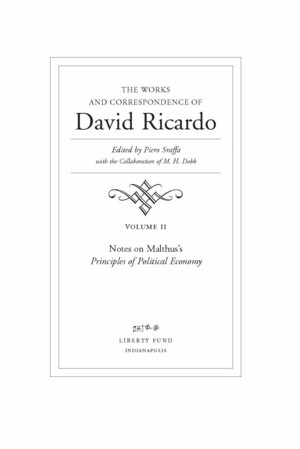
chapter v: Of the Profits of Capital - David Ricardo, The Works and Correspondence of David Ricardo, Vol. 2 Notes on Malthus [1820]

Edition used:

The Works and Correspondence of David Ricardo, ed. Piero Sraffa with the Collaboration of M.H. Dobb (Indianapolis: Liberty Fund, 2005). Vol. 2 Notes on Malthus.

Part of: The Works and Correspondence of David Ricardo, 11 vols (Sraffa ed.)

About Liberty Fund:

Liberty Fund, Inc. is a private, educational foundation established to encourage the study of the ideal of a society of free and responsible individuals.


chapter v

Of the Profits of Capital

section i

Of Profits as affected by the increasing Difficulty of procuring the Means of Subsistence

It has been usual, in speaking of that portion of the national revenue which goes to the capitalist in return for the employment of his capital, to call it by the name of the profits of stock. But stock is not so appropriate an expression in this case, as capital. Stock is a general term, and may be defined to be all the material possessions of a country, or all its actual wealth, whatever may be its destination; while capital is that particular portion of these possessions, or of this accumulated wealth, which is destined to be employed with a view to profit. They are often, however, used indiscriminately; and perhaps no great error may arise from it; but it may be useful to recollect that all stock is not properly speaking capital, though all capital is stock.

The profits of capital consist of the difference between the value of the advances necessary to produce a commodity, and the value of the commodity when produced; and these advances are generally | composed of accumulations which have previously cost in their production a certain quantity of wages, profit and rent, exclusive of the rent which, in the case of landed products, is paid directly.

The rate of profits is the proportion which the difference between the value of the advances and the value of the commodity produced bears to the value of the advances, and it varies with the variations of the value of the advances compared with the value of the product. When the value of the advances is great compared with the value of the product, the remainder being small, the rate of profits will be low. When the value of the advances is inconsiderable the remainder being great, the rate of profits will be high.

The varying rate of profits, therefore, obviously depends upon the causes which alter the proportion between the value of the advances and the value of the produce; and this proportion may be altered either by circumstances which affect the value of the advances, or the value of the product.

Of the advances necessary to production, the means of supporting labour are generally the greatest and most important. These means, therefore, will have the greatest influence on the value of the advances.

The two main causes which influence the means of supporting labour, are

1st. The difficulty or facility of production on the land, by which a greater or less proportion of the value of the whole produce is capable of supporting the labourers employed. |

And 2dly, The varying relation of the quantity of capital to the quantity of labour employed by it, by which more or less of the necessaries of life may go to each individual labourer.(161)

Each of these causes is alone sufficient to occasion all the variations of which profits are susceptible. If one of them only acted, its operation would be simple. It is the combination of the two, and of others in addition to them, sometimes acting in conjunction and sometimes in opposition, which occasions in the progress of society those varied phenomena which it is not always easy to explain.

If the first cause operated singly, and the wages of the individual labourer were always the same, then supposing that the skill in agriculture were to remain unchanged, and that there were no means of obtaining corn from foreign countries, the rate of profits must regularly and without any interruption fall, as the society advanced, and as it became necessary to resort to inferior machines which required more labour to put in action.

It would signify little, in this case, whether the last land taken into cultivation for food had yielded a rent in its uncultivated state. It is certain that the landlord would not allow it to be cultivated, unless he could, at the least, obtain the same rent for it as before. This must be considered as an absolute condition on the worst lands taken into cultivation in an improved country. After this payment was made, the remainder of | the produce would be divided chiefly* between the capitalist and the labourers, and it is evident that if the number of labourers necessary to obtain a given produce were continually increasing, and the wages of each labourer remained the same, the portion destined to the payment of labour would be continually encroaching upon the portion destined to the payment of profits; and the rate of profits would of course continue regularly diminishing till, from the want of power or will to save, the progress of accumulation had ceased.

In this case, and supposing an equal demand for all the parts of the same produce, it is obvious that the profits of capital in agriculture would be in proportion to the fertility of the last land taken into cultivation, or to the amount of the produce obtained by a given quantity of labour. And as profits in the same country tend to an equality, the general rate of profits would follow the same course.(162)

But a moment’s consideration will shew us, that the supposition here made of a constant uniformity in the real wages of labour is not only contrary to the actual state of things, but involves a contradiction.(163)

The progress of population is almost exclusively regulated by the quantity of the necessaries of life actually awarded to the labourer; and if from the first he had no more than sufficient to keep up the actual population, the labouring classes could not increase, nor would there be any occasion for the progressive cultivation of poorer land. On the other hand, if the real wages of labour were such as to admit of and encourage an increase of population, and yet were always to remain the same, it would involve the contradiction of a continued increase of population after the accumulation of capital, and the means of supporting such an increase had entirely ceased.

We cannot then make the supposition of a natural and constant price of labour, at least if we mean by such a price, an unvarying quantity of the necessaries of life. And if we cannot fix the real price of labour, it must evidently vary with the progress of capital and revenue, and the demand for labour compared with the supply.

We may however, if we please, suppose a uniform progress of capital and population, by which is not meant in the present case the same rate of progress permanently, which is impossible; but a uniform progress towards the greatest practicable amount, without temporary accelerations or retardations. | And before we proceed to the actual state of things, it may be curious to consider in what manner profits would be affected under these circumstances.

At the commencement of the cultivation of a fertile country by civilized colonists, and whole rich land was in great plenty, a small portion only of the value of the produce would be paid in the form of rent. Nearly the whole would be divided between profits and wages; and the proportion which each would take, as far as it was influenced by the share of each individual labourer, must be determined by the demand and supply of capital compared with the demand and supply of labour.

As the society continued to proceed, if the territory were limited, or the soil of different qualities, it is quite obvious that the productive powers of labour as applied to the cultivation of land must gradually diminish; and as a given quantity of capital and of labour would yield a smaller and smaller return, there would evidently be a less and less produce to be divided between labour and profits.

If, as the powers of labour diminished, the physical wants of the labourer were also to diminish in the same proportion, then the same share of the whole produce might be left to the capitalist, and the rate of profits would not necessarily fall. But the physical wants of the labourer remain always the same; and though in the progress of society, from the increasing scarcity of provisions compared with labour, these wants are in general less fully supplied, and the real wages of labour | gradually fall; yet it is clear that there is a limit, and probably at no great distance, which cannot be passed. The command of a certain quantity of food is absolutely necessary to the labourer in order to support himself, and such a family as will maintain merely a stationary population. Consequently, if poorer lands which required more labour were successively taken into cultivation, it would not be possible for the corn wages of each individual labourer to be diminished in proportion to the diminished produce; a greater proportion of the whole would necessarily go to labour; and the rate of profits would continue regularly falling till the accumulation of capital had ceased.

Such would be the necessary course of profits and wages in the progressive accumulation of capital, as applied to the progressive cultivation of new and less fertile land, or the further improvement of what had before been cultivated; and on the supposition here made, the rates both of profits and of real wages would be highest at first, and would regularly and gradually diminish together, till they both came to a stand at the same period, and the demand for an increase of produce ceased to be effective.

In the mean time, it will be asked, what becomes of the profits of capital employed in manufactures and commerce, a species of industry not like that employed upon the land, where the productive powers of labour necessarily diminish; but where these powers not only do not necessarily diminish, but very often greatly increase? |

In the cultivation of land, the immediate and main cause of the necessary diminution of profits appeared to be the increased quantity of labour necessary to obtain the same produce. In manufactures and commerce, it is the fall in the exchangeable value of the products of industry in these departments, compared with corn and labour.

The cost of producing corn and labour continually increases from inevitable physical causes, while the cost of producing manufactures and articles of commerce sometimes diminishes, sometimes remains stationary, and at all events increases much slower than the cost of producing corn and labour. Upon every principle therefore of demand and supply, the exchangeable value of these latter objects must fall, compared with the value of labour. But if the exchangeable value of labour continues to rise, while the exchangeable value of manufactures either falls, remains the same, or rises in a much less degree, profits must continue to fall; and thus it appears that in the progress of improvement, as poorer and poorer land is taken into cultivation, the rate of profits must be limited by the powers of the soil last cultivated. If the last land taken into cultivation can only be made to yield a certain excess of value above the value of the labour necessary to produce it, it is obvious that, upon the principles of competition, profits, generally, cannot possibly be higher than this excess will allow. In the ascending scale, this is a barrier which cannot be passed. But limitation is essentially different from regulation. In the de-|scending scale, profits may be lower in any degree. There is here no controlling necessity which determines the rate of profits; and below the highest limit which the actual state of the land will allow, ample scope is left for the operation of other causes.(164)

section ii

Of Profits as affected by the Proportion which Capital bears to Labour

The second main cause which, by increasing the amount of advances, influences profits, is the proportion which capital bears to labour.*

This is obviously a cause which alone is capable of producing the very greatest effects; and on the supposition of adequate variations taking place between the supplies of capital and the supplies of labour, all the same effects might be produced on profits as by the operation of the first cause, and in a much shorter time.

When capital is really abundant compared with labour, nothing can prevent low profits; and the | greatest facility of production is incapable of producing high profits, unless capital is scarce compared with labour.

But in order to see more clearly the powerful effects of the second cause on profits, let us consider it for a moment as operating alone; and suppose, that while the capital of a country continued increasing, its population were checked and kept short of the demand for it, by some miraculous influence. Under these circumstances, every sort of gradation might take place in the proportion which capital would bear to labour, and we should see in consequence every sort of gradation take place in the rate of profits.

If, in an early period of improvement, capital were scarce compared with labour, the wages of labour being on this account low, while the productive powers of labour, from the fertility of the land, were great, the proportion left for profits would necessarily be very considerable, and the rate of profits would be very high.

In general, however, though capital may be said to be scarce in the early periods of cultivation, yet that particular portion of capital, which resolves itself into food, is often plentiful compared with the population, and high profits and high real wages are found together.(165) In the most natural state of things this is generally the case, though it is not so when capital is prematurely checked by extravagance, or other causes. But whether we set out from low or high corn wages, the diminution in the rates of profits, from the gradual in-|crease of capital compared with labour, will remain undisturbed.

As capital at any time increases faster than labour, the profits of capital will fall, and if a progressive increase of capital were to take place, while the population, by some hidden cause, were prevented from keeping pace with it, notwithstanding the fertility of the soil and the plenty of food, then profits would be gradually reduced, until, by successive reductions, the power and will to accumulate had ceased to operate.(166)

Profits in this case would experience exactly the same kind of progressive diminution as they would by the progressive accumulation of capital in the present state of things; but rent and wages would be very differently affected. From what has before been stated on the subject of rent, the amount of it in such a country could not be great. According to the supposition, the progress of the population is retarded, and the number of labourers is limited, while land of considerable fertility remains uncultivated. The demand for fertile land therefore, compared with the supply, would be comparatively inconsiderable; and in reference to the whole of the national produce, the portion which would consist of rent would depend mainly upon the gradations of more fertile land that had been cultivated before the population had come to a stop, and upon the value of the produce to be derived from the land that was not cultivated.

With regard to wages they would continue progressively to rise, and would give the labourer a | greater command not only of manufactures and of the products of foreign commerce (as is generally the case in the present state of things) but of corn and all other necessaries, so as to place him in a condition continually and in all respects improving, as long as capital continued to increase.

In short, of the three great portions into which the mass of produce is divided, rent, profits, and wages, the two first would be low, because both the supply of land and the supply of capital would be abundant compared with the demand; while the wages of labour would be very high, because the supply of labourers would be comparatively scanty; and thus the value of each would be regulated by the great principle of demand and supply.

If, instead of supposing the population to be checked by some peculiar influence, we make the more natural supposition of a limited territory, with all the land of nearly equal quality, and of such great fertility as to admit of very little capital being laid out upon it, the effects upon the profits of capital would be just the same as in the last instance, though they would be very different on rents and wages. After all the land had been cultivated, and no more capital could be employed on it, there cannot be a doubt that rents would be extremely high and profits and wages very low. The competition of increasing capital in manufactures and commerce would reduce the rate of profits, while the principle of population would continue to augment the number of the | labouring classes, till their corn wages were so low as to check their further increase. It is probable that, owing to the facility of production on the land and the great proportion of persons employed in manufactures and commerce, the exports would be great and the value of money very low. The money price of corn and money wages would perhaps be as high as when their cost in labour had been double or treble;(167) rents would rise to an extraordinary pitch without any assistance from poor lands, and the gradations of soil; and profits might fall to the point only just sufficient to keep up the actual capital without any additional labour being necessary to procure the food of the labourer.

The effects which would obviously result from the two suppositions just made, clearly shew that the increasing quantity of labour required for the successive cultivation of poorer land is not theoretically necessary to a fall of profits from the highest rate to the lowest.(168)

The former of these two suppositions further shews the extraordinary power possessed by the labouring classes of society, if they chose to exercise it. The comparative check to population, which was considered as occasioned by some miraculous influence, might in reality be effected by the prudence of the poor; and it would unquestionably be followed by the result described. It may naturally appear hard to the labouring classes that, of the vast mass of productions obtained from the land, the capital, and the labour of the | country, so small a portion should individually fall to their share. But the division is at present determined, and must always in future be determined, by the inevitable laws of supply and demand. If the market were comparatively understocked with labour, the landlords and capitalists would be obliged to give a larger share of the produce to each workman. But with an abundant supply of labour, such a share, for a permanence, is an absolute impossibility. The rich have neither the power, nor can it be expected that they should all have the will, to keep the market understocked with labour. Yet every effort to ameliorate the lot of the poor generally, that has not this tendency, is perfectly futile and childish. It is quite obvious therefore, that the knowledge and prudence of the poor themselves, are absolutely the only means by which any general improvement in their condition can be effected. They are really the arbiters of their own destiny; and what others can do for them, is like the dust of the balance compared with what they can do for themselves. These truths are so important to the happiness of the great mass of society, that every opportunity should be taken of repeating them.(169)

But, independently of any particular efforts of prudence on the part of the poor, it is certain that the supplies of labour and the supplies of capital do not always keep pace with each other. They are often separated at some distance, and for a considerable period; and sometimes population in-|creases faster than capital, and at other times capital increases faster than population.

It is obvious, for instance, that from the very nature of population, and the time required to bring full-grown labourers into the market, a sudden increase of capital cannot effect a proportionate supply of labour in less than sixteen or eighteen years; and, on the other hand, when capital is stationary from the want of will to accumulate, it is well known that population in general continues to increase faster than capital, till the wages of labour are reduced to that standard which, with the actual habits of the country, are no more than sufficient to maintain a stationary population.

These periods, in which capital and population do not keep pace with each other, are evidently of sufficient extent to produce the most important results on the rate of profits, and to affect in the most essential manner the progress of national wealth.

The value of the government long annuities has a natural and inevitable tendency to diminish as they approach nearer and nearer to the end of the term for which they were granted. This is a proposition which I conceive no person is inclined to doubt; but under the fullest acknowledgment of its truth, it would be a most erroneous calculation to estimate the value of this kind of stock solely by the number of years which it would have to run. It is well known that out of the comparatively short term of ninety years, so large a propor-|tion as twenty has sometimes elapsed, not only without any diminution, but with an actual increase of value.(170)

In the same manner, the natural and necessary tendency of profits to fall in the progress of society, owing to the increasing difficulty of procuring food, is a proposition which few will be disposed to controvert; but to attempt to estimate the rate of profits in any country by a reference to this cause alone, for ten, twenty, or even fifty years together, that is for periods of sufficient length to produce the most important effects on national prosperity, would inevitably lead to the greatest practical errors.

Yet notwithstanding the utter inadequacy of this single cause to account for existing phenomena, Mr. Ricardo, in his very ingenious chapter on profits, has dwelt on no other.(171)

If the premises were all such as he has supposed them to be, that is, if no other cause operated on profits than the increasing difficulty of procuring the food of the labourer, and no other cause affected the exchangeable and money value of commodities than the quantity of labour which they had cost in production, the conclusions which he has drawn would be just, and the rate of profits would certainly be regulated in the way which he has described. But, since in the actual state of things the premises are most essentially different from those which he has supposed; since another most powerful cause operates upon profits, as I have endeavoured to shew in the present section; and since | the exchangeable value of commodities is not determined by the labour they have cost, as I endeavoured to shew in a former chapter, the conclusion drawn by Mr. Ricardo must necessarily contradict experience; not slightly, and for short periods, as the market prices of some articles occasionally differ from the natural or necessary price, properly explained; but obviously and broadly, and for periods of such extent, that to overlook them, would not be merely like overlooking the resistance of the air in a falling body, but like overlooking the change of direction given to a ball by a second impulse acting at a different angle from the first.

It is impossible then to agree in the conclusion at which Mr. Ricardo arrives in his chapter on profits, “that in all countries, and at all times, profits depend upon the quantity of labour required to provide necessaries for the labourer on that land, or with that capital which yields no rent.”*

If by the necessaries of the labourer be meant, such wages as will just keep up the population, or what Mr. Ricardo calls the natural wages of labour, it is the same as saying that land of equal fertility will always yield the same profits—a proposition which must necessarily be untrue.

If, for instance, in one country, with the last land taken into cultivation of a given fertility, capital were stationary, not from want of demand, | but from great expenditure and the want of saving habits, it is certain that labour, after a time, would be paid very low, and profits would be very high.

If, in another country with similar land in cultivation, such a spirit of saving should prevail as to occasion the accumulation of capital to be more rapid than the progress of population, it is as certain that profits would be very low.

So understood therefore, the proposition cannot for a moment be maintained.

If, on the other hand, by necessaries be meant the actual earnings of the labourer, whatever they may be, the proposition is essentially incomplete. Even allowing that the exchangeable value of commodities is regulated by the quantity of labour that has been employed in their production, (which it has been shewn is not so,) little is done towards determining the rate of profits. It is merely a truism to say that if the value of commodities be divided between labour and profits, the greater is the share taken by one, the less will be left for the other; or in other words, that profits fall as labour rises, or rise as labour falls. We can know little of the laws which determine profits, unless, in addition to the causes which increase the price of necessaries, we explain the causes which award a larger or a smaller share of these necessaries to each labourer. And here it is obvious that we must have recourse to the great principles of demand and supply, or to that very principle of competition brought for-|ward by Adam Smith, which Mr. Ricardo expressly rejects, or at least considers as of so temporary a nature as not to require attention in a general theory of profits.*

And yet in fact there is no other cause of permanently high profits than a deficiency in the supply of capital; and under such a deficiency, occasioned by extravagant expenditure, the profits of a particular country might for hundreds of years together continue very high, compared with others, owing solely to the different proportions of capital to labour.

In Poland, and some other parts of Europe, profits are said to be higher than in America; yet it is probable that the last land taken into cultivation in America is richer than the last land taken into cultivation in Poland. But in America the labourer earns perhaps the value of sixteen or eighteen quarters of wheat in the year; in Poland only the value of eight or nine quarters of rye. This difference in the division of the same or nearly the same produce, must make an extraordinary difference in the rate of profits; yet the causes which determine this division can hardly be said to form any part of Mr. Ricardo’s theory of profits, although, far from being of so temporary a nature that they may be safely overlooked, they might contribute to operate most powerfully for almost any length of time. Such is the extent of America, that the price of its labour may not essentially fall for hundreds of years; and | the effects of a scanty but stationary capital on an overflowing but stationary population might last for ever.

In dwelling thus upon the powerful effects which must inevitably be produced by the proportion which capital bears to labour, and upon the necessity of giving adequate weight to the principle of demand and supply or competition in every explanation of the circumstances which determine profits, it is not meant to underrate the importance of that cause which has been almost exclusively considered by Mr. Ricardo. It is indeed of such a nature as finally to overwhelm every other. To recur to the illustration already used—as the Long Annuities approach nearer and nearer to the term at which they expire, their value must necessarily so diminish, on this account alone, that no demand arising from plenty of money could possibly keep up their value. In the same manner, when cultivation is pushed to its extreme practical limits, that is, when the labour of a man upon the last land taken into cultivation will scarcely do more than support such a family as is necessary to maintain a stationary population, it is evident that no other cause or causes can prevent profits from sinking to the lowest rate required to maintain the actual capital.

But though the principle here considered is finally of the very greatest power, yet its progress is extremely slow and gradual; and while it is proceeding with scarcely perceptible steps to its final destination, the second cause, particularly when combined with others which will be noticed | in the next section, is producing effects which entirely overcome it, and often for twenty or thirty, or even 100 years together, make the rate of profits take a course absolutely different from what it ought to be according to the first cause.

section iii

Of Profits as affected by the Causes practically in operation

We come now to the consideration of the causes which influence profits in the actual state of things. And here it is evident that we shall have in operation not only both the causes already stated, but others which will variously modify them.

In the progressive cultivation of poorer land for instance, as capital and population increase, profits, according to the first cause, will regularly fall; but if at the same time improvements in agriculture are taking place, they may certainly be such as, for a considerable period, not only to prevent profits from falling, but to allow of a considerable rise. To what extent, and for what length of time, this circumstance might interrupt the progress of profits arising from the first cause, it is not easy to say; but, as it is certain that in an extensive territory, consisting of soils not very different in their natural powers of production, the fall of profits arising | from this cause would be extremely slow, it is probable that for a considerable extent of time agricultural improvements, including of course the improved implements and machinery used in cultivation, as well as an improved system of cropping and managing the land, might more than balance it.

A second circumstance which would contribute to the same effect is, an increase of personal exertion among the labouring classes. This exertion is extremely different in different countries, and at different times in the same country. A day’s labour of a Hindoo, or a South-American Indian, will not admit of a comparison with that of an Englishman; and it has even been said, that though the money price of day-labour in Ireland is little more than the half of what it is in England, yet that Irish labour is not really cheaper than English, although it is well known that Irish labourers when in this country, with good examples and adequate wages to stimulate them, will work as hard as their English companions.

This latter circumstance alone clearly shews how different may be the personal exertions of the labouring classes in the same country at different times; and how different therefore may be the products of a given number of days labour, as the society proceeds from the indolence of the savage to the activity of the civilized state. This activity indeed, within certain limits, appears almost always to come forward when it is most called for, that is, when there is much work to be done without | a full supply of persons to do it. The personal exertions of the South American Indian, the Hindoo, the Polish boor, and the Irish agricultural labourer, may be very different indeed 500 years hence.(172)

The two preceding circumstances tend to diminish the expenses of production, or to reduce the relative amount of the advances necessary to obtain a certain value of produce. But it was stated at the beginning of this chapter, that profits depend upon the prices of products compared with the expenses of production, and must vary therefore with any causes which affect prices without proportionally affecting costs, as well as with any causes which affect costs without proportionally affecting prices.(173)

A considerable effect on profits may therefore be occasioned by a third circumstance which not unfrequently occurs, namely, the unequal rise of some parts of capital, when the price of corn is raised by an increased demand. I was obliged to allude to this cause, and indeed to the two preceding ones, in the chapter on rents. I will only therefore add here, that when the prices of corn and labour rise and terminate in an altered value of money,(174) the prices of many home commodities will be very considerably modified for some time, by the unequal pressure of taxation, and by the different quantities of fixed capital employed in their production; and the prices of foreign commodities and of the commodities worked up at home from foreign | materials, will permanently remain comparatively low. The rise of corn and labour at home will not proportionally raise the price of such products; and as far as these products form any portion of the farmer’s capital this capital will be rendered more productive; but leather, iron, timber, soap, candles, cottons, woollens, &c. &c. all enter more or less into the capitals of the farmer, or the wages of the labourer, and are all influenced in their prices more or less by importation. While the value of the farmer’s produce rises, these articles will not rise in proportion, and consequently a given value of capital will yield a greater value of produce.(175)

All these three circumstances, it is obvious, have a very strong tendency to counteract the effects arising from the necessity of taking poorer land into cultivation; and it will be observed that, as they are of a nature to increase in efficiency with the natural progress of population and improvement, it is not easy to say how long and to what extent they may balance or overcome them.

The reader will be aware that the reason why, in treating of profits, I dwell so much on agricultural profits is, that the whole stress of the question rests upon this point. The argument against the usual view which has been taken of profits, as depending principally upon the competition of capital, is founded upon the physical necessity of a fall of profits in agriculture, arising from the in-|creasing quantity of labour required to procure the same food; and it is certain that if the profits on land permanently fall from this or any other cause, profits in manufactures and commerce must fall too, as it is an acknowledged truth that in an improved and civilized country the profits of stock, with few and temporary exceptions which may be easily accounted for, must be nearly on a level in all the different branches of industry to which capital is applied.

Now I am fully disposed to allow the truth of this argument, as applied to agricultural profits, and also its natural consequences on all profits. This truth is indeed necessarily involved both in the Principle of Population and in the theory of rent which I published separately in 1815. But I wish to shew, theoretically as well as practically, that powerful and certain as this cause is, in its final operation, so much so as to overwhelm every other; yet in the actual state of the world, its natural progress is not only extremely slow, but is so frequently counteracted and overcome by other causes as to leave very great play to the principle of the competition of capital; so that at any one period of some length in the last or following hundred years, it might most safely be asserted that profits had depended or would depend very much more upon the causes which had occasioned a comparatively scanty or abundant supply of capital than upon the natural fertility of the land last taken into cultivation.

The facts which support this position are obvious | and incontrovertible. Some of them have been stated in the preceding section, and their number might easily be increased. I will only add however one more, which is so strong an instance as to be alone almost decisive of the question, and having happened in our own country, it is completely open to the most minute examination.

From the accession of George II. in 1727 to the commencement of the war in 1739, the interest of money was little more than 3 per cent. The public securities which had been reduced to 4 per cent. rose considerably after the reduction. According to Chalmers, the natural rate of interest ran steadily at 3 per cent.;* and it appears by a speech of Sir John Barnard’s that the 3 per cent. stocks sold at a premium upon Change. In 1750, after the termination of the war, the 4 per cent. stocks were reduced to 3½, for seven years, and from that time to 3 per cent. permanently.

Excluding then the interval of war, we have here a period of twenty-two years, during which the general rate of interest was between 3½ and 3 per cent.

The temporary variations in the value of government securities will not certainly at all times be a correct criterion of the rate of profits or even of the rate of interest; but when they remain nearly steady for some time together, they must be considered as a fair approximation to a correct mea-|sure of interest; and when the public creditors of a government consent to a great fall in the interest which they had before received, rather than be paid off, it is a most decisive proof of a great difficulty in the means of employing capital profitably, and consequently a most decisive proof of a low rate of profits.

After an interval of nearly seventy years from the commencement of the period here noticed, and forty years from the end of it, during which a great accumulation of capital had taken place, and an unusual quantity of new land had been brought into cultivation, we find a period of twenty years succeed in which the average market rate of interest was rather above than below 5 per cent.; and we have certainly every reason to think, from the extraordinary rapidity with which capital was recovered, after it had been destroyed, that the rate of profits in general was quite in proportion to this high rate of interest.(176)

The difficulty of borrowing on mortgage during a considerable part of the time is perfectly well known; and though the pressure of the public debt might naturally be supposed to create some alarm and incline the owners of disposable funds to give a preference to landed security; yet it appears from the surveys of Arthur Young, that the number of years purchase given for land was in 1811, 29¼, and forty years before, 32 or 32½,* —the | most decisive proof that can well be imagined of an increase in the profits of capital employed upon land.

The different rates of interest and profits in the two periods here noticed are diametrically opposed to the theory of profits founded on the natural quality of the last land taken into cultivation. The facts, which are incontrovertible, not only cannot be accounted for upon this theory, but in reference to it, either exclusively or mainly, they ought to be directly the reverse of what they are found to be in reality.(177)

The nature of these facts, and the state of things under which they took place, (in the one case, in a state of peace with a slack demand for agricultural products, and in the other, a state of war with an unusual demand for these products,) obviously and clearly point to the relative redundancy or deficiency of capital, as, according to every probability, connected with them.(178)

And the question which now remains to be considered, is, whether the circumstances which have been stated in this section are sufficient to account theoretically for such a free operation of this principle, notwithstanding the progressive accumulation of capital, and the progressive cultivation of fresh land, as to allow of low profits at an earlier period of this progress and high profits at a later period. At all events, the facts must be accounted for, as they are | so broad and glaring, and others of the same kind are in reality of such frequent recurrence, that I cannot but consider them as at once decisive against any theory of profits which is inconsistent with them.

In the first period of the two which have been noticed, it is known that the price of corn had fallen, but that the wages of labour had not only not fallen in proportion, but had been considered by some authorities as having risen. Adam Smith states the fall of corn and the rise of labour during the first sixty-four years of the last century as a sort of established fact* ; but Arthur Young, in his very useful inquiries into the prices of corn and labour published in his Annals of Agriculture, seems to think with some reason, that the fact is not well authenticated, and is besides a little inconsistent with the apparently slack demand for labour and produce and comparatively slow progress of population, which took place during the period in question. Allowing, however, even a stationary price of labour, with a falling price of corn, and the fall of agricultural profits is at once accounted for.

Such a state of prices might alone be much more than sufficient to counteract the effects arising from the circumstance of pretty good land being yet uncultivated. When we add, that the other outgoings belonging to the farmers’ capital, such as leather, iron, timber, &c. &c., are | supposed to have risen while his main produce was falling, we can be at no loss to account for a low rate of agricultural profits, notwithstanding the unexhausted state of the country. And as to the low rate of mercantile and manufacturing profits, that would be accounted for at once by the proportion of capital to labour.(179)

In the subsequent period, from 1793 to 1813, it is probable that all the circumstances noticed in this section concurred to give room for the operation of that principle which depends upon the proportion of capital to labour.

In the first place, there can be no doubt of the improvements in agriculture which were going forwards during these twenty years, both in reference to the general management of the land and the instruments which are connected with cultivation, or which in any way tend to facilitate the bringing of raw produce to market. 2dly, the increasing practice of task-work during these twenty years, together with the increasing employment of women and children, unquestionably occasioned a great increase of personal exertion; and more work was done by the same number of persons and families than before.

These two causes of productiveness in the powers of labour were evidently encouraged and in a manner called into action by the circumstances of the times, that is, by the high price of corn, (180) which encouraged the employment of more capital upon the land with the most effective modes of applying it, and by the increasing demand for labour, | owing to the number of men wanted in the army and navy at the same time that more than ever were wanted in agriculture and manufactures.

The third cause, which had a very considerable effect, much more indeed than is generally attributed to it, was a rise in the money price of corn without a proportionate rise in mercantile and manufacturing produce. This state of things always allows of some diminution in the corn wages of labour without a proportionate diminution of the comforts of the labourer; and if the money price of the farmer’s produce increases without a proportionate increase in the price of labour and of the materials of which his capital consists, this capital becomes more productive and his profits must necessarily rise.(181)

In a country in which labour had been well paid, it is obvious that an alteration in the proportion between labour and capital might occasion a rise in the rate of profits without supposing any increase in the productive powers of labour. But all the causes just noticed are of a nature to increase the productive powers both of labour and capital; and if in any case they are of sufficient force to overcome the effect of taking poorer land into cultivation, the rate of profits may rise consistently even with an increase in the real wages of labour.

In the case in question, though it is generally supposed that the money wages of labour did not rise in proportion to the rise in the price of provisions; yet I cannot help thinking, both from the acknowledged demand for labour and the rapid in-|crease of population, that, partly owing to parish assistance and the more extended use of potatoes, and partly to task-work and the increased employment of women and children, the labouring classes had on an average an increased command over the necessaries of life. I am inclined to think, therefore, that the increased rate of profits from 1793 to 1813 did not arise so much from the diminished quantity of agricultural produce given to the labourer’s family, as from the increase in the amount of agricultural produce obtained by the same number of families. As a matter of fact, I have no doubt that, as I stated in the chapter on rent, the capital employed upon the last land taken into cultivation in 1813 was more productive than the capital employed upon the last land taken into cultivation in 1727; and it appears to me that the causes which have been mentioned are sufficient to account for it theoretically, and to make such an event appear not only possible, but probable, and likely to be of frequent recurrence.

It will be said, perhaps, that some of the causes which have been noticed are in part accidental; and that in contemplating a future period, we cannot lay our account to improvements in agriculture, and an increase of personal exertions in the labouring classes. This is in some degree true. At the same time it must be allowed that a great demand for corn of home growth must tend greatly to encourage improvements in agriculture,(182) and a great demand for labour must stimulate the actual population to do more work; and when to these two | circumstances we add the necessary effect of a rising price of corn owing to an increase of wealth, without a proportionate rise of other commodities,(183) the probabilities of an increase in the productive powers of labour sufficient to counterbalance the effect of taking additional land into cultivation are so strong, that, in the actual state of most countries in the world, or in their probable state for some centuries to come, we may fairly lay our account to their operation when the occasion calls for them.

I should feel no doubt, for instance, of an increase in the rate of profits in this country for twenty years together, at the beginning of the twentieth century, compared with the twenty years which are now coming on; provided this near period were a period of profound tranquillity and peace and abundant capital, and the future period were a period in which capital was scanty in proportion to the demand for it owing to a war, attended by the circumstances of an increasing trade and an increasing demand for agricultural produce similar to those which were experienced from 1793 to 1813.(184)

But if this be so, it follows, that in the actual state of things in most countries of the world, and within limited periods of moderate extent, the rate of profits will practically depend more upon the causes which affect the relative abundance or scarcity of capital, than on the natural powers of the last land taken into cultivation. And consequently, to dwell on this latter point as the sole, or even the main cause which determines profits, | must lead to the most erroneous conclusions.(185) Adam Smith, in stating the cause of the fall of profits, has omitted this point, and in so doing has omitted a most important consideration; but in dwelling solely upon the abundance and competition of capital, he is practically much nearer the truth,* than those who dwell almost exclusively on the quality of the last land taken into cultivation.

section iv

Remarks on Mr. Ricardo’s Theory of Profits

According to Mr. Ricardo, profits are regulated by wages, and wages by the quality of the last land taken into cultivation.(186) This theory of profits depends entirely upon the circumstance of the mass of commodities remaining at the same price, while money continues of the same value, whatever may be the variations in the price of labour. This uniformity in the value of wages and profits taken together is indeed assumed by Mr. Ricardo in all his calculations, from one end of his work to the other; and if it were true, | we should certainly have an accurate rule which would determine the rate of profits upon any given rise or fall of money wages. But if it be not true, the whole theory falls to the ground. We can infer nothing respecting the rate of profits from a rise of money wages, if commodities, instead of remaining of the same price, are very variously affected, some rising, some falling, and a very small number indeed remaining stationary. But it was shewn in a former chapter* that this must necessarily take place upon a rise in the price of labour. Consequently the money wages of labour cannot regulate the rate of profits.

This conclusion will appear still more strikingly true, if we adopt that supposition respecting the mode of procuring the precious metals which would certainly maintain them most strictly of the same value, that is, if we suppose them to be procured by a uniform quantity of unassisted labour without any advances in the shape of capital beyond the necessaries of a single day. That the precious metals would in this case retain, more completely than in any other, the same value, cannot be denied, as they would both cost and command the same quantity of labour. But in this case, as was before stated, the money price of labour could never permanently rise. We cannot however for a moment imagine that this impossibility of a rise or fall in the money price of labour could in any respect impede or interrupt the | natural career of profits. The continued accumulation of capital and increasing difficulty of procuring subsistence would unquestionably lower profits. All commodities, in the production of which the same quantity of labour continued to be employed, but with the assistance of capitals of various kinds and amount, would fall in price, and just in proportion to the degree in which the price of the commodity had before been affected by profits; and with regard to corn, in the production of which more labour would be necessary, this article would rise in money price, notwithstanding the capital used to produce it, just to that point which would so reduce corn wages as to render the population stationary; and thus all the effects upon profits, attributed by Mr. Ricardo to a rise of money wages, would take place while money wages and the value of money remained precisely the same. This supposition serves further to shew how very erroneous it must be to consider the fall of profits as synonymous with a rise of money wages, or to make the money price of labour the great regulator of the rate of profits. It is obvious that, in this case, profits can only be regulated by the principle of competition, or of demand and supply, which would determine the degree in which the prices of commodities would fall; and their prices, compared with the uniform price of labour, would mainly regulate the rate of profits.

But Mr. Ricardo never contemplates the fall of prices as occasioning a fall of profits, although prac-|tically in many cases, as well as on the preceding supposition, a fall of profits must be produced in this way.

Let us suppose a prosperous commercial city, greatly excelling in some manufactures, and purchasing all its corn abroad. At first, and perhaps for a considerable time, the prices of its manufactures in foreign markets might be such as, compared with the price of its imported corn, to yield high profits; but, as capital continued to be accumulated and employed in larger quantities on the exportable manufactures, such manufactures, upon the principles of demand and supply, would in all probability fall in price. A larger portion of them must then be exchanged for a given portion of corn, and profits would necessarily fall. It is true that, under these circumstances, the labouring manufacturer must do more work for his support, and Mr. Ricardo would say that this is the legitimate cause of the fall of profits. In this I am quite willing to agree with him; but surely the specific cause, in this case, of more work being necessary to earn the same quantity of corn is the fall in the prices of the exportable manufactures with which it is purchased, and not a rise in the price of corn, which may remain exactly the same. The fall in these manufactures is the natural consequence of an increase of supply arising from an accumulation of capital more rapid than the extension of demand for its products; and that the fall of profits so occasioned depends entirely upon the principles of demand and supply will be acknowledged, if we | acknowledge, as we certainly must do, that the opening a new market for the manufactures in question would at once put an end to the fall of profits.(187)

Upon the same principle, of considering the prices of commodities as constant, Mr. Ricardo is of opinion, that if the prices of our corn and labour were to fall, the profits of our foreign trade would rise in proportion. But what is it, I would ask, that is to fix the prices of commodities in foreign markets?(188) —not merely the quantity of labour which has been employed upon them, because, as was noticed in a former chapter, commodities will be found selling at the same price in foreign markets, which have cost very different quantities of labour. But if they are determined, as they certainly are, both on an average and at the moment, by supply and demand, what is to prevent a much larger supply, occasioned by the competition of capital thrown out of employment, from rapidly lowering prices, and with them reducing the rate of profits?(189)

If the price of corn during the last twenty-five years could have been kept at about fifty shillings the quarter, and the increasing capital of the country had chiefly been applied to the working up of exportable commodities for the purchase of foreign corn, I am strongly disposed to believe that the profits of stock would have been lower instead of higher.(190) The millions which have been employed in permanent agricultural improvements* have had | no tendency whatever to lower profits; but if, in conjunction with a large portion of the common capital employed in domestic agriculture, they had been added to the already large capitals applied to the working up of exportable commodities, I can scarcely feel a doubt that the foreign markets would have been more than fully supplied; that the prices of commodities would have been such as to make the profits of stock quite low; and that there would have been both a greater mass of moveable capitals at a loss for employment, and a greater disposition in those capitals to emigrate than has actually taken place.

Mr. Ricardo has never laid any stress upon the influence of permanent improvements in agriculture on the profits of stock, although it is one of the most important considerations in the whole compass of Political Economy, as such improvements unquestionably open the largest arena for the employment of capital without a diminution of profits. He observes, that “however extensive a country may be, where the land is of a poor quality, and where the importation of food is prohibited, the most moderate accumulations of capital | will be attended with great reductions in the rate of profits, and a rapid rise in rent; and on the contrary, a small but fertile country, particularly if it freely permits the importation of food, may accumulate a large stock of capital, without any great diminution in the rate of profits, or any great increase in the rent of land.”(191)

Adverting to the known effects of permanent improvements on the land, I should have drawn an inference from these two cases precisely the reverse of that which Mr. Ricardo has drawn. A very extensive territory, with the soil of a poor quality, yet all, or nearly all capable of cultivation, might, by continued improvements in agriculture, admit of the employment of a vast mass of capital for hundreds of years, with little or with no fall of profits; while the small but fertile territory, being very soon filled with all the capital it could employ on the land, would be obliged to employ its further accumulations in the purchase of corn with falling manufactures; a state of things which might easily reduce profits to their lowest rate before one-third of the capital had been accumulated that had been accumulated in the former case.

A country, which accumulates faster than its neighbours, might for hundreds of years still keep up its rate of profits, if it were successful in making permanent improvements on the land; but, if with the same rapidity of accumulation it were to depend chiefly on imported corn, its profits could | scarcely fail to fall; and the fall would probably be occasioned, not by a rise in the bullion price of corn in the ports of Europe, but by a fall in the bullion price of the exports with which the corn was purchased by the country in question.(192)

These statements appear to me to accord with the most correct theory of profits, and they certainly seem to be confirmed by experience. I have already adverted to the unquestionable fact of the profits on land being higher in 1813 than they were above eighty years before, although in the interval millions and millions of accumulated capital had been employed on the soil. And the effect of falling prices in reducing profits is but too evident at the present moment. In the largest article of our exports, the wages of labour are now lower than they probably would be in an ordinary state of things if corn were at fifty shillings a quarter. If, according to the new theory of profits, the prices of our exports had remained the same, the master manufacturers would have been in a state of the most extraordinary prosperity, and the rapid accumulation of their capitals would soon have employed all the workmen that could have been found. But, instead of this, we hear of glutted markets, falling prices, and cotton goods selling at Kamschatka lower than the costs of production.

It may be said, perhaps, that the cotton trade happens to be glutted; and it is a tenet of the new doctrine on profits and demand, that if one trade be overstocked with capital, it is a certain sign that some other trade is understocked. But where, | I would ask, is there any considerable trade that is confessedly under-stocked, and where high profits have been long pleading in vain for additional capital? The war has now been at an end above four years; and though the removal of capital generally occasions some partial loss, yet it is seldom long in taking place, if it be tempted to remove by great demand and high profits; but if it be only discouraged from proceeding in its accustomed course by falling profits, while the profits in all other trades, owing to general low prices, are falling at the same time, though not perhaps precisely in the same degree, it is highly probable that its motions will be slow and hesitating.

It must be allowed then, that in contemplating the altered relation between labour and the produce obtained by it which occasions a fall of profits, we only take a view of half the question if we advert exclusively to a rise in the wages of labour without referring to a fall in the prices of commodities. Their effects on profits may be precisely the same; but the latter case, where there is no question respecting the state of the land, shews at once how much profits depend upon the prices of commodities, and upon the cause which determines these prices, namely the supply compared with the demand.(193)

[On every supposition, however, the great limiting principle, which depends upon the increasing difficulty of procuring subsistence, is always ready to act, and must finally lower profits; but even this principle acts according to the laws of supply and demand.

The reason why profits must fall as the land becomes more exhausted is, that the effective demand for necessaries cannot possibly increase in proportion to the increased expense of producing them.

The further demand for corn must cease when the last land taken into cultivation will but just replace the capital and support the population engaged in cultivating it.

But what would be the effect on profits of any particular amount of accumulation could not be predicted beforehand, as it must always depend upon the principles of demand and supply.]

[* ]I say chiefly, because, in fact, some rent, though it may be trifling, is almost always paid in the materials of the farmer’s capital.

[]It is necessary to qualify the position in this way, because, with regard to the main products of agriculture, it might easily happen that all the parts were not of the same value. If a farmer cultivated his lands by means of domestics living in his house whom he found in food and clothing, his advances might always be nearly the same in quantity and of the same high value in use; but in the case of a glut from the shutting up of an accustomed market, or a season of unusual abundance, a part of the crop might be of no value either in use or exchange, and his profits could by no means be determined, by the excess of the quantity produced, above the advances necessary to produce it.

[* ]I have stated in a former chapter, that the demand for labour does not depend upon capital alone, but upon capital and revenue together, or the value of the whole produce; but to illustrate the present supposition, it is only necessary to consider capital and labour. We may allow that no difficulty will occur with respect to demand.

[* ]Princ. of Polit. Econ. c. vi. p. [126]. 2d edit.

[* ]Princ. of Polit. Econ. chap. vi. p. [125–6]. and ch. xxi. 2d edit.

[* ]Estimate of the Strength of Great Britain, c. vii. p. 115.

[]Id. ch. vii. p. 120.

[* ]Annals of Agriculture, No. 270. pp. 96. and 97. and No. 271. p. 215. Mr. Young expresses considerable surprize at these results, and does not seem sufficiently aware, that the number of | years purchase given for land has nothing to do with prices, but mainly expresses the abundance or scarcity of movable capital compared with the means of employing it.

[* ]Wealth of Nations, Book I. ch. xi. p. 309. 313. 6th edit.

[]Annals of Agriculture, No. 270. p. 89.

[* ]Perhaps it ought to be allowed that Adam Smith, in speaking of the effects of accumulation and competition on profits, naturally means to refer to a limited territory, a limited population, and a limited demand; but accumulation of capital under these circumstances involves every cause that can affect profits.

[* ]Chap. ii. sects. 4 and 5.

[* ]The millions of capital which have been expended in drainings, and in the roads and canals for the conveyance of agricul-|tural products, have tended rather to raise than lower profits; and millions and millions may yet be employed with the same advantageous effect.

[]Our present body of manufacturers, when they call for imported corn, think chiefly of the additional demand for their goods occasioned by the increased imports, and seem quite to forget the prodigious increase of supply which must be occasioned by the competition of so many more capitals and workmen in the same line of business.

[]Princ. of Pol. Econ. ch. vi. p. [126]. 2d edit.