EconlibThe LibraryOther Sites |
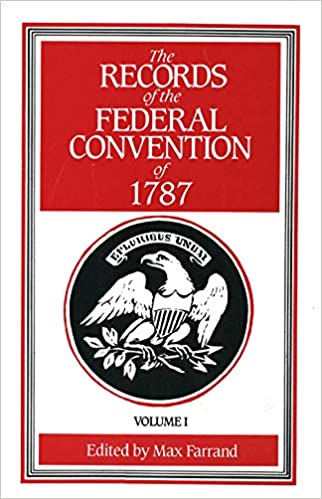
Front Page Titles (by Subject) TUESDAY, JULY 3, 1787. - The Records of the Federal Convention of 1787, vol. 1
Return to Title Page for The Records of the Federal Convention of 1787, vol. 1The Online Library of LibertyA project of Liberty Fund, Inc.Search this Title:Also in the Library:
TUESDAY, JULY 3, 1787. - Max Farrand, The Records of the Federal Convention of 1787, vol. 1 [1911]Edition used:The Records of the Federal Convention of 1787, ed. Max Farrand (New Haven: Yale University Press, 1911). Vol. 1.
Part of: The Records of the Federal Convention of 1787, 3 vols.About Liberty Fund:Liberty Fund, Inc. is a private, educational foundation established to encourage the study of the ideal of a society of free and responsible individuals. Copyright information:The text is in the public domain. Fair use statement:This material is put online to further the educational goals of Liberty Fund, Inc. Unless otherwise stated in the Copyright Information section above, this material may be used freely for educational and academic purposes. It may not be used in any way for profit.
TUESDAY, JULY 3, 1787.YATES
The grand committee met. Mr. Gerry was chosen chairman. The committee proceeded to consider in what manner they should discharge the business with which they were entrusted. By the proceedings in the convention they were so equally divided on the important question of representation in the two branches, that the idea of a concilatory adjustment must have been in contemplation of the house in the appointment of this committee. But still how to effect this salutary purpose was the question. Many of the members, impressed with the utility of a general government, connected with it the indispensible necessity of a representation from the states according to their numbers and wealth; while others, equally tenacious of the rights of the states, would admit of no other representation but such as was strictly federal, or in other words, equality of suffrage. This brought on a discussion of the principles on which the house had divided, and a lengthy recapitulation of the arguments advanced in the house in support of these opposite propositions. As I had not openly explained my sentiments on any former occasion on this question, but constantly in giving my vote, showed my attachment to the national government on federal principles, I took this occasion to explain my motives — (See a copy of my speech hereunto annexed.)* These remarks gave rise to a motion of Dr. Franklin, which after some modification was agreed to, and made the basis of the following report of the committee. The committee to whom was referred the eighth resolution, reported from the committee of the whole house, and so much of the seventh as had not been decided on, submit the following report: That the subsequent propositions be recommended to the convention, on condition that both shall be generally adopted. That in the first branch of the legislature, each of the states now in the union, be allowed one member for every 40,000 inhabitants, of the description reported in the seventh resolution of the committee of the whole house — That each state, not containing that number, shall be allowed one member. That all bills for raising or apportioning money, and for fixing salaries of the officers of government of the United States, shall originate in the first branch of the legislature, and shall not be altered or amended by the second branch; and that no money shall be drawn from the public treasury, but in pursuance of appropriations to be originated in the first branch. That in the second branch of the legislature, each state shall have an equal vote. [1 ]See Martin’s account of the discussions in the committee, Appendix A, CLVIII (24-26), and Gerry’s account in CLXXXI. See also Madison’s note below, July 5. [* ]It is matter of regret that this document cannot be found: the principles it contained are perhaps embodied in the letter from Mr. Yates and Mr. Lansing to Gov. George Clinton, on their retiring from the convention. |

Titles (by Subject)