Econlib

The Library

Other Sites

Front Page arrow Titles (by Subject) arrow FRIDAY, JUNE 29, 1787. - The Records of the Federal Convention of 1787, vol. 1

Return to Title Page for The Records of the Federal Convention of 1787, vol. 1

Search this Title:

Also in the Library:

Subject Area: Political Theory
Subject Area: History
Topic: The American Revolution and Constitution

FRIDAY, JUNE 29, 1787. - Max Farrand, The Records of the Federal Convention of 1787, vol. 1 [1911]

Edition used:

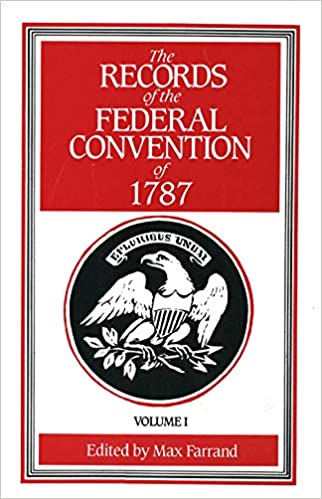
The Records of the Federal Convention of 1787, ed. Max Farrand (New Haven: Yale University Press, 1911). Vol. 1.

Part of: The Records of the Federal Convention of 1787, 3 vols.

About Liberty Fund:

Liberty Fund, Inc. is a private, educational foundation established to encourage the study of the ideal of a society of free and responsible individuals.


FRIDAY, JUNE 29, 1787.

JOURNAL

Friday June 29. 1787.

It was moved and seconded to strike the word “not” out of the first clause of the seventh resolution reported from the Committee

On the question to strike out

it passed in the negative [Ayes — 4; noes — 6; divided — 1.]

It was moved and seconded to agree to the first clause of the seventh resolution, as reported from the Committee namely.

Resolved that the right of suffrage in the first branch of the Legislature of the United States ought not to be according to the rule established in the articles of confederation but according to some equitable ratio of representation

On the question to agree

it passed in the affirmative [Ayes — 6; noes — 4; divided — 1.]

It was moved and seconded to postpone the farther consideration of the seventh in order to take up the eighth resolution

which passed in the affirmative [Ayes — 9; noes — 2.]

It was moved and seconded to amend the eighth resolution reported from the Committee so as to read as follows namely

Resolved that in the second branch of the Legislature of the United States each State shall have an equal vote. —

Before the determination of the House was taken on the last motion, the House adjourned till to-morrow at 11 o’Clock A. M

DETAIL OF AYES AND NOES
New HampshireMassachusettsRhode IslandConnecticutNew YorkNew JerseyPennsylvaniaDelawareMarylandVirginiaNorth CarolinaSouth CarolinaGeorgiaQuestionsAyesNoesDivided
[105]noayeayeayenoayeddnonononoTo strike the word “not” out of the first clause of the seventh resolution461
[106]ayenononoayenoddayeayeayeayeTo agree to the first clause of the seventh resolution as reported641
[107]noayeayeayeayenoayeayeayeayeayeTo postpone the seventh in order to take up the eighth reso.92

MADISON

Friday June 29th in Convention

Doctr. Johnson. The controversy must be endless whilst Gentlemen differ in the grounds of their arguments; Those on one side considering the States as districts of people composing one political Society; those on the other considering them as so many political societies. The fact is that the States do exist as political Societies, and a Govt. is to be formed for them in their political capacity, as well as for the individuals composing them. Does it not seem to follow, that if the States as such are to exist they must be armed with some power of self-defence. This is the idea of (Col. Mason) who appears to have looked to the bottom of this matter. Besides the Aristocratic and other interests, which ought to have the means of defending themselves, the States have their interests as such, and are equally entitled to likes means. On the whole he thought that as in some respects the States are to be considered in their political capacity, and in others as districts of individual citizens, the two ideas embraced on different sides, instead of being opposed to each other, ought to be combined; that in one branch the people, ought to be represented; in the other, the States.

Mr. Ghorum. The States as now confederated have no doubt a right to refuse to be consolidated, or to be formed into any new system. But he wished the small States which seemed most ready to object, to consider which are to give up most, they or the larger ones. He conceived that a rupture of the Union wd. be an event unhappy for all, but surely the large States would be least unable to take care of themselves, and to make connections with one another. The weak therefore were most interested in establishing some general system for maintaining order. If among individuals, composed partly of weak, and partly of strong, the former most 〈need〉 the protection of law & Government, the case is exactly the same with weak & powerful States. What would be the situation of Delaware (for these things he found must be spoken out, & it might as well be done first as last) what wd. be the situation of Delaware in case of a separation of the States? Would she not lie at the mercy of Pennsylvania? would not her true interest lie in being consolidated with her, and ought she not now to wish for such a union with Pa. under one Govt. as will put it out of the power of Pena. to oppress her? Nothing can be more ideal than the danger apprehended by the States, from their being formed into one nation. Massts. was originally three colonies, viz old Massts. — Plymouth — & the province of Mayne. These apprehensions existed then. An incorporation took place; all parties were safe & satisfied; and every distinction is now forgotten. The case was similar with Connecticut & Newhaven. The dread of Union was reciprocal; the consequence of it equally salutary and satisfactory. In like manner N. Jersey has been made one society out of two parts. Should a separation of the States take place, the fate of N. Jersey wd. be worst of all. She has no foreign commerce & can have but little. Pa. & N. York will continue to levy taxes on her consumption. If she consults her interest she wd. beg of all things to be annihilated. The apprehensions of the small States ought to be appeased by another reflection. Massts. will be divided. The province of Maine is already considered as approaching the term of its annexation to it; and Pa. will probably not increase, considering the present state of her population, & other events that may happen. On the whole he considered a Union of the States as necessary to their happiness, & a firm Genl. Govt. as necessary to their Union. He shd. consider it as his duty if his colleagues viewed the matter in the same light he did to stay here as long as any other State would remain with them, in order to agree on some plan that could with propriety be recommended to the people.

〈Mr. Elseworth, did not despair. He still trusted that some good plan of Govt. wd. be divised & adopted.〉1

Mr. Read. He shd. have no objection to the system if it were truly national, but it has too much of a federal mixture in it. The little States he thought had not much to fear. He suspected that the large States felt their want of energy, & wished for a genl. Govt. to supply the defect. Massts. was evidently labouring under her weakness and he believed Delaware wd. not be in much danger if in her neighbourhood. Delaware had enjoyed tranquillity & he flattered himself wd. continue to do so. He was not however so selfish as not to wish for a good Genl. Govt. In order to obtain one the whole States must be incorporated. If the States remain, the representatives of the large ones will stick together, and carry every thing before them. The Executive also will be chosen under the influence of this partiality, and will betray it in his administration. These jealousies are inseparable from the scheme of leaving the States in Existence. They must be done away. The ungranted lands also which have been assumed by particular States must also be given up. He repeated his approbation of the plan of Mr. Hamilton, & wished it to be substituted in place of that on the table.

Mr. Madison agreed with Docr. Johnson, that the mixed nature of the Govt. ought to be kept in view; but thought too much stress was laid on the rank of the States as political societies. There was a gradation, he observed from the smallest corporation, with the most limited powers, to the largest empire with the most perfect sovereignty. He pointed out the limitations on the sovereignty of the States. as now confederated; 〈their laws in relation to the paramount law of the Confederacy were analogous to that of bye laws to the supreme law, within a State.〉2 Under the proposed Govt. the 〈powers of the States〉 will be much farther reduced. According to the views of every member, the Genl. Govt. will have powers far beyond those exercised by the British Parliament when the States were part of the British Empire. It will in particular have the power, without the consent of the State Legislatures, to levy money directly on the people themselves; and therefore not to divest such unequal portions of the people as composed the several States, of an equal voice, would subject the system to the reproaches & evils which have resulted from the vicious representation in G. B.

He entreated the gentlemen representing the small States to renounce a principle wch. was confessedly unjust, which cd. never be admitted, & if admitted must infuse mortality into a Constitution which we wished to last forever. He prayed them to ponder well the consequences of suffering the Confederacy to go to pieces. It had been sd. that the want of energy in the large states wd. be a security to the small. It was forgotten that this want of energy proceded from the supposed security of the States agst. all external danger. Let each State depend on itself for its security, & let apprehensions arise of danger from distant powers or from neighbouring States, & the languishing condition of all the States, large as well as small, wd. soon be transformed into vigorous & high toned Govts. His great fear was that their Govts. wd. then have too much energy, that these might not only be formidable in the large to the small States, but fatal to the internal liberty of all. The same causes which have rendered the old world the Theatre of incessant wars, & have banished liberty from the face of it, wd. soon produce the same effects here. The weakness & jealousy of the small States wd. quickly introduce some regular military force agst. sudden danger from their powerful neighbours. The example wd. be followed by others, and wd. soon become universal. In time of actual war, great discretionary powers are constantly given to the Executive Magistrate. Constant apprehension of War, has the same tendency to render the head too large for the body. A standing military force, with an overgrown Executive will not long be safe companions to liberty. The means of defence agst. foreign danger, have been always the instruments of tyranny at home. Among the Romans it was a standing maxim to excite a war, whenever a revolt was apprehended. Throughout all Europe, the armies kept up under the pretext of defending, have enslaved the people. It is perhaps questionable, whether the best concerted system of absolute power in Europe cd. maintain itself, in a situation, where no alarms of external danger cd. tame the people to the domestic yoke. The insular situation of G. Britain was the principal cause of her being an exception to the general fate of Europe. It has rendered less defence necessary, and admitted a kind of defence wch. cd. not be used for the purpose of oppression. — These consequences he conceived ought to be apprehended whether the States should run into a total separation from each other, or shd. enter into partial confederacies. Either event wd. be truly deplorable; & those who might be accessary to either, could never be forgiven by their Country, nor by themselves.

* Mr. Hamilton observed that individuals forming political Societies modify their rights differently, with regard to suffrage. Examples of it are found in all the States. In all of them some individuals are deprived of the right altogether, not having the requisite qualification of property. In some of the States the right of suffrage is allowed in some cases and refused in others. To vote for a member in one branch, a certain quantum of property, to vote for a member in another branch of the Legislature, a higher quantum of property is required. In like manner States may modify their right of suffrage differently, the larger exercising a larger, the smaller a smaller share of it. But as States are a collection of individual men which ought we to respect most, the rights of the people composing them, or of the artificial beings resulting from the composition. Nothing could be more preposterous or absurd than to sacrifice the former to the latter. It has been sd. that if the smaller States renounce their equality, they renounce at the same time their liberty. The truth is it is a contest for power, not for liberty. Will the men composing the small States be less free than those composing the larger. The State of Delaware having 40,000 souls will lose power, if she has only of the votes allowed to Pa. having 400,000: but will the people of Del: be less free, if each citizen has an equal vote with each citizen of Pa. He admitted that common residence within the same State would produce a certain degree of attachment; and that this principle might have a certain influence in public affairs. He thought however that this might by some precautions be in a great measure excluded: and that no material inconvenience could result from it, as there could not be any ground for combination among the States whose influence was most dreaded. The only considerable distinction of interests, lay between the carrying & non-carrying States, which divide instead of uniting the largest States. No considerable inconvenience had been found from the division of the State of N. York into different districts, of different sizes.

Some of the consequences of a dissolution of the Union, and the establishment of partial confederacies, had been pointed out. He would add another of a most serious nature. Alliances will immediately be formed with different rival & hostile nations of Europes, who will foment disturbances among ourselves, and make us parties to all their own quarrels. Foreign nations having American dominions are & must be jealous of us. Their representatives betray the utmost anxiety for our fate, & for the result of this meeting, which must have an essential influence on it. — It had been said that respectability in the eyes of foreign Nations was not the object at which we aimed; that the proper object of republican Government was domestic tranquillity & happiness. This was an ideal distinction. No Governmt. could give us tranquillity & happiness at home, which did not possess sufficient stability and strength to make us respectable abroad. This was the critical moment for forming such a government. We should run every risk in trusting to future amendments. As yet we retain the habits of union. We are weak & sensible of our weakness. Henceforward the motives will become feebler, and the difficulties greater. It is a miracle that we were now here exercising our tranquil & free deliberations on the subject. It would be madness to trust to future miracles. A thousand causes must obstruct a reproduction of them.

〈Mr. Peirce considered the equality of votes under the Confederation as the great source of the public difficulties. The members of Congs. were advocates for local advantages. State distinctions must be sacrificed as far as the general good required: but without destroying the States. Tho’ from a small State he felt himself a Citizen of the U. S.〉4

Mr. Gerry, urged that we never were independent States, were not such now, & never could be even on the principles of the Confederation. The States & the advocates for them were intoxicated with the idea of their sovereignty. He was a member of Congress at the time the federal articles were formed. The injustice of allowing each State an equal vote was long insisted on. He voted for it, but it was agst. his Judgment, and under the pressure of public danger, and the obstinacy of the lesser States. The present confederation he considered as dissolving. The fate of the Union will be decided by the Convention. If they do not agree on something, few delegates will probably be appointed to Congs. If they do Congs. will probably be kept up till the new System should be adopted — He lamented that instead of coming here like a band of brothers, belonging to the same family, we seemed to have brought with us the spirit of political negociators.

Mr. L. Martin. remarked that the language of the States being Sovereign & independent, was once familiar & understood; though it seemed now so strange & obscure. He read those passages in the articles of Confederation, which describe them in that language.

On the question as moved by Mr. Lansing. Shall the word “not” be struck out.

Massts. no. Cont. ay. N. Y. ay. N. J. ay. Pa. no. Del. ay. Md. divd. Va. no. N. C. no. S. C. no. Geo. no [Ayes — 4; noes — 6; divided — 1.]

On the 〈motion to agree to the clause as reported. “that the rule of suffrage in the 1st. branch ought not to be according to that established by the Articles of Confederation.〉5 Mass. ay. Cont. 〈no〉 N. Y. no. N. J. no. Pa. ay. Del. no. Md. divd. Va. ay. N. C. ay. S. C. ay. Geo. ay. [Ayes — 6; noes — 4; divided — 1.]6

Docr. Johnson & Mr. Elseworth moved to postpone the residue of the clause, and take up — ye 8 — Resol:

〈On question〉

Mass. no. Cont. ay. N. Y. ay. 〈N. J. ay.〉 Pa. ay. Del. no. Md. ay. Va. ay. N. C. ay. S. C. ay. Geo. ay. [Ayes — 9; noes — 2.]7

Mr. Elseworth moved that the rule of suffrage in the 2d. branch be the same with that established by the articles of confederation”. He was not sorry on the whole he said that the vote just passed, had determined against this rule in the first branch. He hoped it would become a ground of compromise with regard to the 2d. branch. We were partly national; partly federal. The proportional representation in the first branch was conformable to the national principle & would secure the large States agst. the small. An equality of voices was conformable to the federal principle and was necessary to secure the Small States agst. the large. He trusted that on this middle ground a compromise would take place. He did not see that it could on any other. And if no compromise should take place, our meeting would not only be in vain but worse than in vain. To the Eastward he was sure Massts. was the only State that would listen to a proposition for excluding the States as equal political Societies, from an equal voice in both branches. The others would risk every consequence rather than part with so dear a right. An attempt to deprive them of it, was at once cutting the body 〈of America〉 in two, and as he supposed would be the case, somewhere about this part of it. The large States he conceived would notwithstanding the equality of votes, have an influence that would maintain their superiority. Holland, as had been admitted (by Mr. 〈Madison〉) had, notwithstanding a like equality in the Dutch Confederacy, a prevailing influence in the public measures. The power of self-defence was essential to the small States. Nature had given it to the smallest insect of the creation. He could never admit that there was no danger of combinations among the large States. They will like individuals find out and avail themselves of the advantage to be gained by it. It was true the danger would be greater, if they were contiguous and had a more immediate common interest. A defensive combination of the small States was rendered more difficult by their greater number. He would mention another consideration of great weight. The existing confederation was founded on the equality of the States in the article of suffrage: was it meant to pay no regard to this antecedent plighted faith. Let a strong Executive, a Judiciary & Legislative power be created; but Let not too much be attempted; by which all may be lost. He was not in general a half-way man, yet he preferred doing half the good we could, rather than do nothing at all. The other half may be added, when the necessity shall be more fully experienced.

Mr. Baldwin would have wished that the powers of the General Legislature had been defined, before the mode of constituting it had been agitated. He should vote against the motion of Mr. Elseworth, tho’ he did not like the Resolution as it stood in the Report of the Committee of the whole. He thought the second branch ought to be the representation of property, and that in forming it therefore some reference ought to be had to the relative wealth of their Constituents, and to the principles on which the Senate of Massts. was constituted. He concurred with those who thought it wd. be impossible for the Genl. Legislature to extend its cares to the local matters of the States.

Adjd.

YATES

Friday, June 29th, 1787.

Met pursuant to adjournment. Present 11 states.

Dr. Johnson. As the debates have hitherto been managed, they may be spun out to an endless length; and as gentlemen argue on different grounds, they are equally conclusive on the points they advance, but afford no demonstration either way. States are political societies. For whom are we to form a government? for the people of America, or for those societies? Undoubtedly for the latter. They must, therefore, have a voice in the second branch of the general government, if you mean to preserve their existence. The people already compose the first branch. This mixture is proper and necessary. For we cannot form a general government on any other ground.

Mr. Gorham. I perceive no difficulty in supposing a union of interest in the different states. Massachusetts formerly consisted of three distinct provinces — they have been united into one, and we do not find the least trace of party distinctions arising from their former separation. Thus it is that the interest of the smaller states will unite in a general government. It is thus they will be supported. Jersey, in particular, situated between Philadelphia and New-York, can never become a commercial state. It would be her interest to be divided, and part annexed to New-York and part to Pennsylvania — or otherwise the whole to the general government. Massachusetts cannot long remain a large state. The province of Maine must soon become independent of her. Pennsylvania can never become a dangerous state — her western country must at some period become separated from her, and consequently her power will be diminished. If some states will not confederate on a new plan, I will remain here, if only one state will consent to confederate with us.

Judge Elsworth. I do not despair but that we shall be so fortunate as to devise and adopt some good plan of government.

Judge Read. I would have no objection, if the government was more national — but the proposed plan is so great a mixture of both, that it is best to drop it altogether. A state government is incompatible with a general government. If it was more national, I would be for a representation proportionate to population. The plan of the gentleman from New-York is certainly the best — but the great evil is the unjust appropriation of the public lands. If there was but one national government, we would be all equally interested.

Mr. Madison.8 Some gentlemen are afraid that the plan is not sufficiently national, while others apprehend that it is too much so. If this point of representation was once well fixed, we would come nearer to one another in sentiment. The necessity would then be discovered of circumscribing more effectually the state governments and enlarging the bounds of the general government. Some contend that states are sovereign, when in fact they are only political societies. There is a gradation of power in all societies, from the lowest corporation to the highest sovereign. The states never possessed the essential rights of sovereignty.9 These were always vested in congress. Their voting, as states, in congress, is no evidence of sovereignty. The state of Maryland voted by counties — did this make the counties sovereign? The states, at present, are only great corporations, having the power of making by-laws, and these are effectual only if they are not contradictory to the general confederation. The states ought to be placed under the control of the general government — at least as much so as they formerly were under the king and British parliament.9 The arguments, I observe, have taken a different turn, and I hope may tend to convince all of the necessity of a strong energetic government, which would equally tend to give energy to, and protect the state governments. What was the origin of the military establishments of Europe? It was the jealousy which one state or kingdom entertained of another. This jealousy was ever productive of evil. In Rome the patricians were often obliged to excite a foreign war to divert the attention of the plebeians from encroaching on the senatorial rights. In England and France, perhaps, this jealousy may give energy to their governments, and contribute to their existence. But a state of danger is like a state of war, and it unites the various parts of the government to exertion. May not our distractions, however, invite danger from abroad? If the power is not immediately derived from the people, in proportion to their numbers, we may make a paper confederacy, but that will be all. We know the effects of the old confederation, and without a general government this will be like the former.

Mr. Hamilton. The course of my experience in human affairs might perhaps restrain me from saying much on this subject. I shall, however, give birth to some of the observations I have made during the course of this debate. The gentleman from Maryland has been at great pains to establish positions which are not denied. Many of them, as drawn from the best writers on government, are become almost self-evident principles. But I doubt the propriety of his application of those principles in the present discussion. He deduces from them the necessity that states entering into a confederacy must retain the equality of votes — this position cannot be correct — Facts plainly contradict it. The parliament of Great Britain asserted a supremacy over the whole empire, and the celebrated Judge Blackstone labors for the legality of it, although many parts were not represented. This parliamentary power we opposed as contrary to our colonial rights. With that exception, throughout that whole empire, it is submitted to. May not the smaller and greater states so modify their respective rights as to establish the general interest of the whole, without adhering to the right of equality? Strict representation is not observed in any of the state governments. The senate of New-York are chosen by persons of certain qualifications, to the exclusion of others. The question, after all is, is it our interest in modifying this general government to sacrifice individual rights to the preservation of the rights of an artificial being, called states? There can be no truer principle than this — that every individual of the community at large has an equal right to the protection of government. If therefore three states contain a majority of the inhabitants of America, ought they to be governed by a minority? Would the inhabitants of the great states ever submit to this? If the smaller states maintain this principle, through a love of power, will not the larger, from the same motives, be equally tenacious to preserve their power? They are to surrender their rights — for what? for the preservation of an artificial being. We propose a free government — Can it be so if partial distinctions are maintained? I agree with the gentleman from Delaware, that if the state governments are to act in the general government, it affords the strongest reason for exclusion. In the state of New-York, five counties form a majority of representatives, and yet the government is in no danger, because the laws have a general operation. The small states exaggerate their danger, and on this ground contend for an undue proportion of power. But their danger is increased, if the larger states will not submit to it. Where will they form new alliances for their support? Will they do this with foreign powers? Foreigners are jealous of our encreasing greatness, and would rejoice in our distractions. Those who have had opportunities of conversing with foreigners respecting sovereigns in Europe, have discovered in them an anxiety for the preservation of our democratic governments, probably for no other reason, but to keep us weak. Unless your government is respectable, foreigners will invade your rights; and to maintain tranquility it must be respectable — even to observe neutrality you must have a strong government. — I confess our present situation is critical. We have just finished a war which has established our independency, and loaded us with a heavy debt. We have still every motive to unite for our common defence — Our people are disposed to have a good government, but this disposition may not always prevail. It is difficult to amend confederations — it has been attempted in vain, and it is perhaps a miracle that we are now met — We must therefore improve the opportunity, and render the present system as perfect as possible. Their good sense, and above all, the necessity of their affairs, will induce the people to adopt it.

Mr. Pierce. The great difficulty in congress arose from the mode of voting. Members spoke on the floor as state advocates, and were biassed by local advantages. — What is federal? No more than a compact between states; and the one heretofore formed is insufficient. We are now met to remedy its defects, and our difficulties are great, but not, I hope, insurmountable. State distinctions must be sacrificed so far as the general government shall render it necessary — without, however, destroying them altogether. Although I am here as a representative from a small state, I consider myself as a citizen of the United States, whose general interest I will always support.

Mr. Gerry. It appears to me that the states never were independent — they had only corporate rights. Confederations are a mongrel kind of government, and the world does not afford a precedent to go by. Aristocracy is the worst kind of government, and I would sooner submit to a monarchy. We must have a system that will execute itself.

The question was then put on Mr. Lansing’s motion, and lost — 4 ayes — 6 noes — one state divided.

Question on the clause — 6 ayes — 4 noes — and one state divided.

Judge Elsworth. I move that the consideration of the 8th resolve be postponed. Carried — 9 ayes — 2 noes.

I now move the following amendment to the resolve — that in the second branch each state have an equal vote. I confess that the effect of this motion is, to make the general government partly federal and partly national. This will secure tranquility, and still make it efficient; and it will meet the objections of the larger states. In taxes they will have a proportional weight in the first branch of the general legislature — If the great states refuse this plan, we will be for ever separated. Even in the executive the larger states have ever had great influence. — The provinces of Holland ever had it. If all the states are to exist they must necessarily have an equal vote in the general government. Small communities when associating with greater, can only be supported by an equality of votes. I have always found in my reading and experience, that in all societies the governors are ever gradually rising into power.

The large states, although they may not have a common interest for combination, yet they may be partially attached to each other for mutual support and advancement. This can be more easily effected than the union of the remaining small states to check it; and ought we not to regard antecedent plighted faith to the confederation already entered into, and by the terms of it declared to be perpetual? And it is not yet obvious to me that the states will depart from this ground. When in the hour of common danger we united as equals, shall it now be urged by some that we must depart from this principle when the danger is over? Will the world say that this is just? We then associated as free and independent states, and were well satisfied — To perpetuate that independence, I wish to establish a national legislature, executive and judiciary, for under these we shall I doubt not preserve peace and harmony — nor should I be surprised (although we made the general government the most perfect in our opinion,) that it should hereafter require amendment — But at present this is as far as I possibly can go — If this convention only chalk out lines of a good government we shall do well.

Mr. Baldwin. It appears to be agreed that the government we should adopt ought to be energetic and formidable, yet I would guard against the danger of becoming too formidable. The second branch ought not to be elected as the first. Suppose we take the example of the constitution of Massachusetts, as it is commended for its goodness: There the first branch represents the people, and the second its property.

Mr. Madison. I would always exclude inconsistent principles in framing a system of government. The difficulty of getting its defects amended are great and sometimes insurmountable. The Virginia state government was the first which was made, and though its defects are evident to every person, we cannot get it amended. The Dutch have made four several attempts to amend their system without success. The few alterations made in it were by tumult and faction, and for the worse. If there was real danger, I would give the smaller states the defensive weapons — But there is none from that quarter. The great danger to our general government is the great southern and northern interests of the continent, being opposed to each other. Look to the votes in congress, and most of them stand divided by the geography of the country, not according to the size of the states.

Suppose the first branch granted money, may not the second branch, from state views, counteract the first? In congress, the single state of Delaware prevented an embargo, at the time that all the other states thought it absolutely necessary for the support of the army. Other powers, and those very essential, besides the legislative, will be given to the second branch — such as the negativing all state laws. I would compromise on this question, if I could do it on correct principles, but otherwise not — if the old fabric of the confederation must be the ground-work of the new, we must fail.

Adjourned till to-morrow morning.

KING

Friday — 29. June —

Question of Representation —

Johnson — The two sides of the house reason in such a manner that we can never meet — Those who contend for an equality of Votes among the States, define a State to be a mere association of men & then say these Associations are equal — on the other hand those who contend for a Representation in proportion to numbers, Define a State to be a District of Country with a certain Number of Inhabitants, like a parish or County, and then say, these districts shd. have an influence in proportion to their Number of Inhabitants — both reason justly from yr. premises — we must then compromise — let both parties be gratified — let one House or Branch be formed by one Rule & & the other by another

Madison — We are vague in our Expressions — we speak of the sovereignty of the States — they are not sovereign — there is a regular gradation from the lowest Corporation, such as the incorporation of mechanicks to the most perft. Sovereignty — The last is the true and only Sovereignty — the states are not in that high degree Sovereign — they are Corporations with power of Bye Laws —

Hamilton

Men are naturally equal — societies or Nations are equal when independent — it is as reasonable that States shd. inter into a League departing from the Equality of States, as that men shd. inter into the Social Compact and agree to depart from the natural Equality of man — This is done in every Society — property goes into the Confederation, age, & minority are admitted — A man shall not be Elector or Elected, unless he is of a given Age, & possesses the adventitious circumstance of property — We propose that the people shd. be reprented in proportion to yr. numbers, the people then will be free — the avenues to every Office are equally open to every man; and the Laws are to be formed by a majority of the People — yet it is said the States will be destroyed & therefore the people will be slaves — The consequence is not true. The people are free, at the expense of a mere ideal & artificial being —

On the Question shall the rule of Confederation be departed with for a more equitable Ratio of Representation —

Cont. NYk. : N Jersey: & Delaware No

MarylandNADivd.

Mass. Penn. Virgin. NC. SC. & Georg. Ay

Elsworth — moves that in the second Br, or ye Senate, each State shd. have one vote & no more —

The first Br. or the Democratic Br. will represent the people, the 2d. that of the States — the people will be secured, and the States will be protected —

if we don’t agree in this measure, we have met in vain — None of the Eastern States except Mass. will ever agree to adopt the plan wh. abolishes the States — If the Southern States contend for this plan of a popular instead of State Representation we shall separate; the political body must be cut asunder at the Delaware — This mode of forming the Senate will secure the small states, and as the members of the large states although they can give but one vote will have more Influence than those of the small ones, they will not be injured — Holland has one voice only in the States General, yet her Influence is more than any two of the States — there is danger from the combination of the larger overpowering the small States — The Danger is not so great since the large States are separated, but yet there is danger — they will have the power to do it — if they have the power there is Danger — three or four States can more easily combine, than Nine or Ten States —

Madison — The Gentleman from Connecticut has proposed doing as much at this Time as is prudent, and leavg. future amendments to posterity — this a dangerous Doctrine — the Defects of the Amphictionick League were acknowledged, but they never cd. be reformed. The U Netherlands have attempted four several Times to amend their Confederation, but have failed in each Attempt — The fear of Innovation, and the Hue & Cry in favor of the Liberty of the people will prevent the necessary Reforms — If the States have equal, influence, and votes in the Senate, we are in the utmost Danger — Delaware during the War opposed and defeated an Embargo agreed to by 12. States; and continued to supply the Enemy with provisions during the war.10

PATERSON11

June 29th.

Doct. Johnson

If the States are represented as States — they must be represented as Individuals.

Mr. Gorham —

New-Jersey ought not to oppose the plan, as she at present pays the Taxes of Penn. and N. York, from which she would be relieved.

Mr. Madison

Will have the States considered as so many great Corporations, and not otherwise.

Col. Hamilton

That States have equal rights to vote, is not true It is estabd. by the Law of Nations that they have equal votes — but does it follow that they can not contract upon a different footing —

That the Genl. Governmt. will act, not only, upon the States, but upon Individuals.

As long as the State influence is kept up there will be danger — but the influence will not be as great as is apprehended.

The small States have had a lesson of State Honesty11a

It is a contest for power in the weaker States.12

Mr. Pierce

Gentlemen of Congress when they vote always connect with them the State views and politicks — and therefore —

Mr. Gerry.

That upon Tryal it has been found that the Articles of Confn. are not adequate —

That the small States have abused their power, and instanced Rho. Island.

[1 ]Taken from Yates.

[2 ]Substance taken from Yates. This is the very speech for the misrepresenting of which Madison condemned Yates so severely. See Appendix A, CCCX, CCCXXXIX-CCCXLI, CCCLVII, CCCLXV, CCCLXXXVIII, CCCXCI.

[* ]〈From this date he was absent till theof〉3

[4 ]Taken from Yates.

[5 ]Revised from Journal.

[6 ]Connecticut’s vote corrected from Journal and Yates. On this vote see Appendix A, CLVIII (24).

[7 ]Vote corrected from Journal and Yates.

[8]For Genet’s interpretation of this speech, see Appendix A, CCCX.

[9 ]See Madison’s explanation, Appendix A, CCCXCI, also CCCLXXXVIII.

[9 ]See Madison’s explanation, Appendix A, CCCXCI, also CCCLXXXVIII.

[10 ][Endorsed:] 29 June | Shall Representatives be equal | numbers from each State? or | founded on a census | N Y. N J Del — No | N Y N J Del — Equal betw States | Mar divided | M. Pen. Virg. N. & S. Car & Geor — census

[11 ]See June 27, note 8.

[11a]A marginal note opposite the line following.

[12 ]A hand drawn on the margin points to this as if to indicate its importance.

[* ]〈From this date he was absent till theof〉3

[3]Crossed out: “This was the last day of his remaining with the Convention previous to”. See further Appendix A, CCLXXI, CCCXIII.