Econlib

The Library

Other Sites

Front Page arrow Titles (by Subject) arrow MONDAY, JUNE 11, 1787. - The Records of the Federal Convention of 1787, vol. 1

Return to Title Page for The Records of the Federal Convention of 1787, vol. 1

Search this Title:

Also in the Library:

Subject Area: Political Theory
Subject Area: History
Topic: The American Revolution and Constitution

MONDAY, JUNE 11, 1787. - Max Farrand, The Records of the Federal Convention of 1787, vol. 1 [1911]

Edition used:

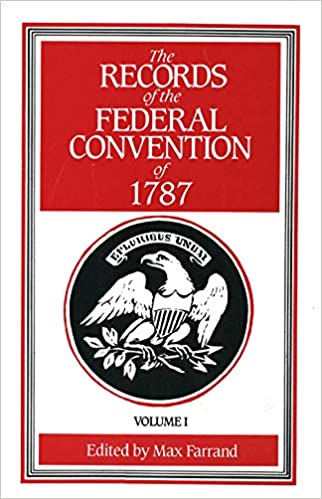
The Records of the Federal Convention of 1787, ed. Max Farrand (New Haven: Yale University Press, 1911). Vol. 1.

Part of: The Records of the Federal Convention of 1787, 3 vols.

About Liberty Fund:

Liberty Fund, Inc. is a private, educational foundation established to encourage the study of the ideal of a society of free and responsible individuals.


MONDAY, JUNE 11, 1787.

JOURNAL

Monday June 11. 1787.

The Honorable Abraham Baldwin Esquire, one of the Deputies of the State of Georgia, attended and took his seat.

The Order of the day being read

The House resolved itself into a Committee of the whole House to consider of the State of the american union

Mr President left the chair

Mr Gorham took the Chair of the Committee

Mr President resumed the Chair

Mr Gorham reported from the Committee that the Committee had made a further progress in the matter to them referred: and had directed him to move that they may have leave to sit again.

Resolved that this House will to-morrow again resolve itself into a Committee of the whole House to consider of the State of the American union

And then the House adjourned till to-morrow at 11 o clock A. M

In a Committee of the whole House

Monday June 11. 1787.

Mr Gorham in the Chair.

It was moved by Mr King seconded by Mr Rutledge to agree to the following resolution namely

Resolved that the right of suffrage in the first branch of the national Legislature ought not to be according to the rule established in the articles of confederation; but according to some equitable ratio of representation

And on the question to agree to the same

it passed in the affirmative. [Ayes—7; noes—3; divided—1.]1

It was then moved by Mr Rutledge seconded by Mr Butler to add the following words to the last resolution

“namely, according to the quotas of contribution”

It was moved by Mr Wilson seconded by Mr C. Pinckney to postpone the consideration of the last motion in order to introduce the following words, after the words “equitable ratio of representation” namely.

“in proportion to the whole number of white and other free Citizens and inhabitants of every age, sex and condition, including those bound to servitude for a term of years, and three fifths of all other persons not comprehended in the foregoing description, except Indians, not paying taxes in each State”

On the question to postpone

it passed in the affirmative. [Ayes — 10; noes — 1.]

On the question to agree to Mr Wilson’s motion

it passed in the affirmative [Ayes — 9; noes — 2.]

It was moved by Mr Sherman seconded by Mr Ellsworth

“That in the second branch of the National Legislature each State have One vote”

On the question to agree to the same

it passed in the negative. [Ayes — 5; noes — 6.]

It was then moved by Mr Wilson seconded by Mr Hamilton to adopt the following resolution, namely,

“Resolved that the right of suffrage in the second branch of the national Legislature ought to be according to the rule established for the first”

On the question to agree to the same

it passed in the affirmative [Ayes—6; noes 5.]

[To amend the 11th resolution submitted by Mr Randolph by adding the words voluntary junction or partition. Ayes — 7; noes — 4.

To amend the resolution by adding the words “national government” after the words [Ayes — 7; noes — 4.]2

It was moved and seconded to agree to the 11th resolution submitted by Mr Randolph — and amended to read as follows —

“Resolved that a republican constitution, and it’s existing laws ought to be guaranteed to each State by the United States.”

And on the question to agree to the same

it passed unanimously in the affirmative

It was then moved and seconded to agree to the following resolution

Resolved that provision ought to be made for the amendment of the articles of union whensoever it shall seem necessary.

On the question to agree to the same

it passed in the affirmative

It was agreed to postpone the following clause in the 13th resolution submitted by Mr Randolph namely

“and that the assent of the national legislature ought not to be required thereto”

It was then moved and seconded to agree to the 14 resolution submitted by Mr Randolph namely

“Resolved that the legislative, executive, and judiciary powers within the several States ought to be bound by oath to support the articles of union”

It was then moved by Mr Martin seconded byNAto strike out the words “within the several States”

and on the question to strike out.

it passed in the negative [Ayes — 4; noes — 7.]

It was then moved and seconded to agree to the 14th resolution as submitted by Mr. Randolph

And on the question to agree to the same.

it passed in the affirmative [Ayes — 6; noes — 5.]

It was then moved and seconded that the Committee do now rise, report a further progress, and request leave to sit again

The Committee then rose.

DETAIL OF AYES AND NOES
New HampshireMassachusettsRhode IslandConnecticutNew YorkNew JerseyPennsylvaniaDelawareMarylandVirginiaNorth CarolinaSouth CarolinaGeorgiaQuestionsAyesNoesDivided
[37]ayeayenonoayenoddayeayeayeayeThat the right of suffrage in the first branch of the N. L. ought not to be accordg to the rule established in the confedn but accordg to some equitable ratio of representation731
[38]ayeayeayeayeayenoayeayeayeayeayeTo postpone Mr Rutledge’s motion in order to take up Mr Wilson’s, respecting the right of suffrage in the N. L.101
[39]ayeayeayenoayenoayeayeayeayeayeThat the right of suffrage in the first branch be accordg to the whole number of white and three fifths of the other inhabitants92
[40]noayeayeayenoayeayenonononoThat in the second branch of the national Legislature each State have One vote56
[41]ayenononoayenonoayeayeayeayeThat the right of suffrage in the second branch ought to be accordg to the rule established for the first65
[42]ayenoayenoayenonoayeayeayeayeTo amend the 11th resolution submitted by Mr Randolph by adding the words voluntary junction or partition74
[43]ayeayenonoayenonoayeayeayeayeTo amend theresolution by adding the words “national government” after the words74
[44]noayenoayenoayeayenonononoTo strike these words out of the 14 resolution “within the sevl States”47
[45]ayenononoayenonoayeayeayeayeTo agree to the 14 resolution as submitted by Mr Randolph65

MADISON

Monday, June 11th. 〈Mr Abraham Baldwin from Georgia took His Seat.〉3 In Committee of the Whole.

The clause concerning the rule of suffrage in the natl. Legislature postponed 〈on Saturday,〉 was resumed.4

Mr. Sharman proposed that the proportion of suffrage in the 1st branch should be according to the respective numbers of free inhabitants; and that in the second branch or Senate, each State should have one vote and no more. He said as the States would remain possessed of certain individual rights, each State ought to be able to protect itself: otherwise a few large States will rule the rest. The House of Lords in England he observed had certain particular rights under the Constitution, and hence they have an equal vote with the House of Commons that they may be able to defend their rights.

Mr. Rutlidge proposed that the proportion of suffrage in the 1st branch should be according to the quotas of contribution. The justice of this rule he said could not be contested. Mr. Butler urged the same idea: 〈adding that money was power; and that the States ought to have weight in the Govt. — in proportion to their wealth.〉5

Mr. King & Mr. Wilson* 〈in order to bring the question to a point〉5 moved “that the right of suffrage in 〈the first branch of〉6 the national Legislature ought not to be according the rule established in the articles of Confederation, but according to some equitable ratio of representation”. The clause so far as it related to suffrage in the first branch was postponed in order to consider this motion:

Mr. Dickenson contended for the actual contributions of the States as the rule of their representation & suffrage 〈in the first branch〉. By thus connecting the interest of the States with their duty, the latter would be sure to be performed.

Mr. King remarked that it was uncertain what mode might be used in levying a national revenue; but that it was probable, imports would be one source of it. If the actual contributions were to be the rule the non-importing States, as Cont. & N. Jersey, wd. be in a bad situation indeed. It might so happen that they wd. have no representation. This situation of particular States had been always one powerful argument in favor of the 5 Per Ct. impost.

The question being abt. to be put Docr. Franklin sd. he had thrown his ideas of the matter on a paper wch. Mr. Wilson read to the Committee in the words following —7

Mr Chairman

It has given me a great pleasure to observe that till this point, the proportion of representation, came before us, our debates were carried on with great coolness & temper. If any thing of a contrary kind, has on this occasion appeared. I hope it will not be repeated; for we are sent here to consult not to contend, with each other; and declarations of a fixed opinion, and of determined resolution, never to change it, neither enlighten nor convince us. Positiveness and warmth on one side, naturally beget their like on the other; and tend to create and augment discord & division in a great concern, wherein harmony & Union are extremely necessary to give weight to our Councils, and render them effectual in promoting & securing the common good.

I must own that I was originally of opinion it would be better if every member of Congress, or our national Council, were to consider himself rather as a representative of the whole, than as an Agent for the interests of a particular State; in which case the proportion of members for each State would be of less consequence, & it would not be very material whether they voted by States or individually. But as I find this is not to be expected, I now think the number of Representatives should bear some proportion to the number of the Represented; and that the decisions shd. be by the majority of members, not by the majority of States. This is objected to from an apprehension that the greater States would then swallow up the smaller. I do not at present clearly see what advantage the greater States could propose to themselves by swallowing the smaller, and therefore do not apprehend they would attempt it. I recollect that in the beginning of this Century, when the Union was proposed of the two Kingdoms, England & Scotland, the Scotch Patriots were full of fears, that unless they had an equal number of Representatives in Parliament, they should be ruined by the superiority of the English. They finally agreed however that the different proportions of importance in the Union, of the two Nations should be attended to, whereby they were to have only forty members in the House of Commons, and only sixteen in the House of Lords; A very great inferiority of numbers! And yet to this day I do not recollect that any thing has been done in the Parliament of Great Britain to the prejudice of Scotland; and whoever looks over the lists of public officers, Civil & military of that nation will find I believe that the North Britons enjoy at least their full proportion of emolument.

But, Sir, in the present mode of voting by States, it is equally in the power of the lesser States to swallow up the greater; and this is mathematically demonstrable. Suppose for example, that 7 smaller States had each 3 members in the House, and the 6 larger to have one with another 6 members; and that upon a question, two members of each smaller State should be in affirmative and one in the Negative, they will make

Affirmatives14Negatives7
And that all the larger States should be unanimously
in the negative, they would makeNegatives36
In all43

It is then apparent that the 14 carry the question against the 43. and the minority overpowers the majority, contrary to the common practice of Assemblies in all Countries and Ages.

The greater States Sir are naturally as unwilling to have their property left in the disposition of the smaller, as the smaller are to have theirs in the disposition of the greater. An honorable gentleman has, to avoid this difficulty, hinted a proposition of equalizing the States. It appears to me an equitable one, and I should, for my own part, not be against such a measure, if it might be found practicable. Formerly, indeed, when almost every province had a different Constitution, some with greater others with fewer privileges, it was of importance to the borderers when their boundaries were contested, whether by running the division lines, they were placed on one side or the other. At present when such differences are done away, it is less material. The Interest of a State is made up of the interests of its individual members. If they are not injured, the State is not injured. Smal. States are more easily well & happily governed than large onesl If therefore in such an equal division, it should be found necessary to diminish Pennsylvania, I should not be averse to the giving a part of it to N. Jersey, and another to Delaware. But as there would probably be considerable difficulties in adjusting such a division; and however equally made at first, it would be continually varying by the augumentation of inhabitants in some States, and their [more]8 fixed proportion in others; and thence frequent occasion for new divisions, I beg leave to propose for the consideration of the Committee another mode which appears to me to be as equitable, more easily carried into practice, and more permanent in its nature.

Let the weakest State say what proportion of money or force it is able and willing to furnish for the general purposes of the Union.

Let all the others oblige themselves to furnish each an equal proportion.

The whole of these joint supplies to be absolutely in the disposition of Congress.

The Congress in this case to be composed of an equal number of Delegates from each State:

And their decisions to be by the majority of individual members voting.

If these joint and equal supplies should on particular occasions not be sufficient, Let Congress make requisitions on the richer and more powerful States for farther aids, to be voluntarily afforded, leaving to each State the right of considering the necessity and utility of the aid desired, and of giving more or less as it should be found proper.

This mode is not new, it was formerly practiced with success by the British Government with respect to Ireland and the Colonies. We sometimes gave even more than they expected, or thought just to accept; and in the last war carried on while we were united, they gave us back in five years a million Sterling. We should probably have continued such voluntary contributions, whenever the occasions appeared to require them for the common good of the Empire. It was not till they chose to force us, and to deprive us of the merit and pleasure of voluntary contributions that we refused & resisted. Those contributions however were to be disposed of at the pleasure of a Government in which we had no representative. I am therefore persuaded, that they will not be refused to one in which the Representation shall be equal

My learned colleague (Mr. Wilson) has already mentioned that the present method of voting by States, was submitted to originally by Congress, under a conviction of its impropriety, inequality, and injustice. This appears in the words of their Resolution. It is of Sepr. 6. 1774. The words are

“Resolved that in determining questions in this Congs. each colony or province shall have one vote: the Congs. not being possessed of or at present able to procure materials for ascertaining the importance of each Colony.”

On the question for agreeing to Mr. Kings and Mr. Wilsons motion. 〈it passed in the affirmative〉 Massts. ay. Ct. ay. N. Y no. N. J. no. Pa. ay. Del. no. Md. divd. Va. ay. N. C. ay. S. C. ay. Geo. ay. [Ayes — 7; noes — 3; divided — 1.]

〈It was then moved by Mr. Rutlidge 2ded. by Mr. Butler to add to the words “equitable ratio of representation” at the end of the motion just agreed to, the words “according to the quotas of Contribution.9 On motion of

Mr. Wilson seconded by Mr. C. Pinckney,9 this was postponed; in order to add, after, after the words “equitable ratio of representation” the words following “in proportion to the whole number of white & other free Citizens & inhabitants of every age sex & condition including those bound to servitude for a term of years and three fifths of all other persons not comprehended in the foregoing description, except Indians not paying taxes, in each State.”10 this being the rule in the Act of Congress agreed to by eleven States, for apportioning quotas of revenue on the States. and requiring a census only every 5 — 7, or 10 years.

Mr. Gerry thought property not the rule of representation. Why then shd. the blacks, who were property in the South, be in the rule of representation more than the cattle & horses of the North.11

On the question.

Mass: Con: N. Y. Pen: Maryd. Virga. N. C. S. C. and Geo: were in the affirmative: N. J. &. Del: in the negative. [Ayes — 9; noes — 2.]〉12

Mr. Sharman moved that a question be taken whether each State shall have 〈one〉 vote13 in the 2d. branch. Every thing he said depended on this. The smaller States would never agree to the plan on any other principle 〈than an equality of suffrage in this branch. Mr. Elsworth14 seconded the motion.〉 On the question for allowing each State 〈one〉 vote in the 2d. branch.

Massts. no. Cont. ay. N. Y. ay. N. J. ay. Pa. no. Del. ay Md. ay. Va. no. N. C. no. S. C. no. Geo. no. [Ayes — 5; noes — 6.]

〈Mr. Wilson & Mr. Hamilton moved that the right of suffrage in the 2d. branch ought to be according to the same rule as in the 1st. branch.〉14a

On this question for making the ratio of representation the same in the 2d. as in the 1st. branch 〈it passed in the affirmative:〉 Massts. ay. Cont. no. N. Y. no. N. J. no. Pa. ay. Del. no. Md. no. Va. ay. N. C. ay. S. C. ay. Geo. ay. [Ayes — 6; noes — 5.]15

〈Resol: 11.〉 for guarantying Republican Govt. & territory to each State 〈being〉 considered: 〈the words “or partition” were, on motion of Mr. Madison added, after the words “voluntary junction”: Mas. N. Y. P. Va. N. C. S. C. G. ay.

Con: N. J. Del. Md. - - - no.〉16

Mr. Read disliked the idea of guarantying territory. It abetted the idea of distinct States wch. would be a perpetual source of discord. There can be 〈no〉 cure for this evil but in doing away States altogether and uniting them all into 〈one〉 great Society.

Alterations 〈having been made in the Resolution, making it read “that a republican Constition & its existing laws ought to be guaranteed to each State by the U. States”〉17 the whole was agreed to nem. con.

〈Resolution 13.〉 for amending the national Constitution hereafter without consent of Natl. Legislature 〈being〉 considered, several members did not see the necessity of the 〈Resolution〉 at all, nor the propriety of making the consent of the Natl. Legisl. unnecessary.

Col. Mason urged the necessity of such a provision. The plan now to be formed will certainly be defective, as the Confederation has been found on trial to be. Amendments therefore will be necessary, and it will be better to provide for them, in an easy, regular and Constitutional way than to trust to chance and violence. It would be improper to require the consent of the Natl. Legislature, because they may abuse their power, and refuse their consent on that very account. The opportunity for such an abuse, may be the fault of the Constitution calling for amendmt.

Mr. Randolph 〈enforced〉 these arguments.

The words, “without requiring the consent of the Natl. Legislature” were postponed. The other provision in the clause passed nem. con.

〈Resolution 14.〉 requiring oaths from the 〈members of the State Govts.〉 to observe the Natl. Constitution 〈& laws, being〉 considered.

Mr. Sharman opposed it as unnecessarily intruding into the State jurisdictions.

Mr. Randolph considered 〈it〉 as necessary to prevent that competition between the National Constitution & laws & those of the particular States, which had already been felt. The officers of the States are already under oath to the States. To preserve a due impartiality they ought to be equally bound to the Natl. Govt. The Natl. authority needs every support we can give it. The Executive & Judiciary of the States, notwithstanding their nominal independence on the State Legislatures are in fact, so dependent on them, that unless they be brought under some tie 〈to〉 the Natl. system, they will always lean too much to the State systems, whenever a contest arises between the two.

Mr. Gerry did not like the clause. He thought there was as much reason for requiring an oath of fidelity to the States, from Natl. officers, as vice. versa.

Mr. Luther Martin moved to strike out the 〈words〉 requiring such an oath from the State Officers 〈viz “within the several States.”〉 observing that if the new oath should be contrary to that already taken 〈by them〉 it would be improper; if coincident the oaths already taken will be sufficient.18

On the question for striking out as proposed by Mr. L. Martin

Massts. no. Cont. ay. N. Y. no. N. J. ay. Pa. no. Del. ay. Md. ay. Va. no. N. C. no. S. C. no. Geo. no. [Ayes — 4; noes — 7.]

Question on whole 〈Resolution as proposed by Mr. Randolph;〉

Massts. ay. Cont. no. N. Y. no. N. J. no. Pa. ay. Del. no. Md. no. Va. ay. N. C. ay. S. C. ay. Geo. ay. Ayes — 6; noes — 5.]

〈Come. rose & House〉 adjd.19

YATES

Monday, June 11th, 1787.

Met pursuant to adjournment. Present 11 states.

Mr. Sherman moved that the first branch of the national legislature be chosen in proportion to the number of the whole inhabitants in each state. He observed that as the people ought to have the election of one of the branches of the legislature, the legislature of each state ought to have the election of the second branch, in order to preserve the state sovereignty; and that each state ought in this branch to have one vote.

Gov. Rutledge moved as an amendment of the first proposition, that the proportion of representation ought to be according to and in proportion to the contribution of each state.

Mr. Butler supported the motion, by observing that money is strength; and every state ought to have its weight in the national council in proportion to the quantity it possesses. He further observed, that when a boy he read this as one of the remarks of Julius Cæsar, who declared if he had but money he would find soldiers, and every thing necessary to carry on a war.

Mr. King observed, that it would be better first to establish a principle (that is to say) whether we will depart from federal grounds in forming a national government; and therefore, to bring this point to view, he moved as a previous question, that the sense of the committee be taken on the following question:

That the right of suffrage in the first branch of the national legislature, ought not to be according to the rule in the articles of confederation, but according to some equitable ratio of representation.

Gov. Franklin’s written remarks on this point were read by Mr. Wilson. In these Gov. Franklin observes, that representation ought to be in proportion to the importance of numbers or wealth in each state — that there can be no danger of undue influence of the the greater against the lesser states. This was the apprehension of Scotland when the union with England was proposed, when in parliament they were allowed only 16 peers and 45 commons; yet experience has proved that their liberties and influence were in no danger.

The question on Mr. King’s motion was carried in the affirmative — 7 ayes — 3 noes, and Maryland divided. New-York, New-Jersey and Delaware in the negative.

Mr. Dickinson moved as an amendment, to add the words, according to the taxes and contributions of each state actually collected and paid into the national treasury.

Mr. Butler was of opinion that the national government will only have the right of making and collecting the taxes, but that the states individually must lay their own taxes.

Mr. Wilson was of opinion, and therefore moved, that the mode of representation of each of the states ought to be from the number if its free inhabitants, and of every other description three fifths to one free inhabitant. He supposed that the impost will not be the only revenue — the post office he supposes would be another substantial source of revenue. He observed further, that this mode had already received the approbation of eleven states in their acquiescence to the quota made by congress. He admitted that this resolve would require further restrictions, for where numbers determined the representation a census at different periods of 5, 7 or 10 years, ought to be taken.

Mr. Gerry. The idea of property ought not to be the rule of representation. Blacks are property, and are used to the southward as horses and cattle to the northward; and why should their representation be increased to the southward on account of the number of slaves, than horses or oxen to the north?20

Mr. Madison was of opinion at present, to fix the standard of representation, and let the detail be the business of a subcommittee.

Mr. Rutledge’s motion was postponed.

Mr. Wilson’s motion was then put, and carried by 9 states against 2. New York in the majority.

Mr. Wilson then moved, as an amendment to Mr. Sherman’s motion, That the same proportion be observed in the election of the second branch as the first.

The question however was first put on Mr. Sherman’s motion, and lost — 6 states against, and 5 for it.

Then Mr. Wilson’s motion was put and carried — 6 ayes, 5 noes.

The eleventh resolve was then taken into consideration. Mr. Madison moved to add after the word junctions, the words, or separation.

Mr. Read against the resolve in toto. We must put away state governments, and we will then remove all cause of jealousy. The guarantee will confirm the assumed rights of several states to lands which do belong to the confederation.

Mr. Madison moved an amendment, to add to or alter the resolution as follows: The republican constitutions and the existing laws of each state, to be guaranteed by the United States.

Mr. Randolph was for the present amendment, because a republican government must be the basis of our national union; and no state in it ought to have it in their power to change its government into a monarchy. — Agreed to

13th Resolve — the first part agreed to.

14th Resolve — taken into consideration.

Mr. Williamson. This resolve will be unnecessary, as the union will become the law of the land.

Governor Randolph. He supposes it to be absolutely necessary. Not a state government, but its officers will infringe on the rights of the national government. If the state judges are not sworn to the observance of the new government, will they not judicially determine in favor of their state laws? We are erecting a supreme national government; ought it not to be supported, and can we give it too many sinews?

Mr. Gerry rather supposes that the national legislators ought to be sworn to preserve the state constitutions, as they will run the greatest risk to be annihilated — and therefore moved it.

For Mr. Gerry’s amendment, 7 ayes, 4 noes.

Main question then put on the clause or resolve — 6 ayes, 5 noes. New-York in the negative.

Adjourned to to-morrow morning.

PATERSON

Resolved, That the Rights of Suffrage in the first Branch of the national Legr. ought not to be according to the Article of Confedn., but according to some equitable Ratio of Representation —

Rutledge. Not by the Number of free Inhabitants, but according to the Quotas of Contribution —

Dickinson — The Terms, “Quotas of Contribution,” very indefinite—it ought to be according to the actual Contribution

Wm.son. Supposes, that there will not be any Assignment or Quotas to States; the Governmt. to operate individually, and not on States —

Dickinson The Power to be in Proportion to actual Contribution —

King — Suppose an Impost — Connecticut and Jersey do not import — they will have no Representatives —

Butler. This to be left to the State Legrs. — Sum to be proportioned —

Wilson. Either Rule good — by Numbers best to ascertain the Right of Representn. this agreeably to the Sentiments of 11 States — Impost alone will not be sufficient to answer the national Exigencies — Revenues arising from Postage — The present Quota not a lasting Rule — People to be numbered at fixed Periods — A Rule arising from Property and Numbers —

Gerry. Rule of Taxation not the Rule of Representation — 4 might then have more Voices than ten — Slaves not to be put upon the Footing of freemen — Freemen of Massts. not to be put upon a Footing with the Slaves of other States — Horses and Cattle ought to have the Right of Representn. Negroes — Mules —

The Taxes must be drawn by the natl. Governmt. immediately from the People; otherwise will never be collected —

Madison. Leave the particular Rule for the present. A common Standard ought to be provided —

[1 ]Vote 37, Detail of Ayes and Noes.

[2 ]Votes 42 and 43, Detail of Ayes and Noes.

[3 ]Taken from Journal.

[4 ]See also Records of May 30, June 27-July 16, and references under June 27 note 2.

[5 ]Taken from Yates.

[* ]〈In the printed Journal Mr Rutlidge is named as the seconder of the motion.〉

[5 ]Taken from Yates.

[6 ]Taken from Journal.

[7 ]In the Franklin Papers in the Library of Congress is the first, or an earlier, draft of this speech which differs from Madison’s copy only in the use of capitals (and in a few cases in spelling).

[8 ]“more” in Franklin MS.

[9 ]Taken from Journal.

[10 ]Madison originally had recorded the substance of this motion, but later revised it as given from Journal.

[11 ]Taken from Yates. For further discussion of the “three fifths rule” see July 11, note 5.

[12 ]Madison originally had recorded this vote in his usual form, and confusing two votes in Journal had made a note that New Jersey was there recorded as voting “ay.” Then, apparently seeing his mistake, this was all struck out and the vote rewritten. All of this portion of the records was twice revised by Madison.

[13 ]Madison originally had “an equal vote”. Revised from Journal.

[14 ]Taken from Journal.

[14a]Taken from Journal.

[15 ]Gerry voted in the affirmative, see Appendix A, CLXXXI.

[16 ]Taken from Journal and Yates.

[17 ]Madison originally wrote: “The Alterations made in clause (compare its original state with the Report of Comte. of Whole, June 14)” but struck this out and substituted from Journal the wording given.

[18 ]Revised from Journal.

[19 ]See further Appendix A, XLII.

[20 ]Luther Martin cites this comparison in his Genuine Information. See Appendix A, CLVIII (38).