EconlibThe LibraryOther Sites |
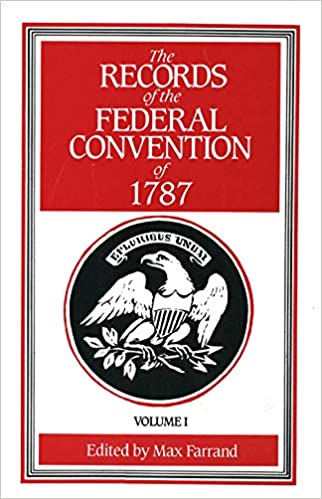
Front Page Titles (by Subject) TUESDAY, JUNE 5, 1787. - The Records of the Federal Convention of 1787, vol. 1
Return to Title Page for The Records of the Federal Convention of 1787, vol. 1The Online Library of LibertyA project of Liberty Fund, Inc.Search this Title:Also in the Library:
TUESDAY, JUNE 5, 1787. - Max Farrand, The Records of the Federal Convention of 1787, vol. 1 [1911]Edition used:The Records of the Federal Convention of 1787, ed. Max Farrand (New Haven: Yale University Press, 1911). Vol. 1.
Part of: The Records of the Federal Convention of 1787, 3 vols.About Liberty Fund:Liberty Fund, Inc. is a private, educational foundation established to encourage the study of the ideal of a society of free and responsible individuals. Copyright information:The text is in the public domain. Fair use statement:This material is put online to further the educational goals of Liberty Fund, Inc. Unless otherwise stated in the Copyright Information section above, this material may be used freely for educational and academic purposes. It may not be used in any way for profit.
TUESDAY, JUNE 5, 1787.JOURNAL
The Order of the day being read The House resolved itself into a Committee of the whole House to consider of the State of the American union. His Excellency William Livingston Esquire, a Deputy of the State of New Jersey, attended and took his seat Mr President left the chair Mr Gorham took the Chair of the Committee Mr President resumed the chair Mr Gorham reported from the Committee that the Committee had made a further progress in the matter to them referred; and had directed him to move that they may have leave to sit again Resolved that this House will to-morrow again resolve itself into a Committee of the whole House to consider of the State of the American union. The following credentials were then produced and read. (here insert the credentials of His Excellency William Livingston Esquire, and the honorable Abraham Clark Esquire)1 And then the House adjourned till to-morrow at 11 o’clock. A M. In a Committee of the whole House Tuesday June 5. 1787. Mr Gorham in the Chair It was moved and seconded to proceed to the further considn of the 9th resolution, submitted by Mr Randolph. It was then moved and seconded to amend the last clause by striking out the words “One or more” so as to read “and of inferior to tribunals” and on the question to strike out it passed in the affirmative It was then moved and seconded to strike out the words “the national legislature” so as to read to be appointed by. On the question to strike out it passed in the affirmative [Ayes — 8; noes — 2.]2 Notice was given by Mr. Wilson that he should at a future day move for a reconsideration of that clause which respects “inferior tribunals” Mr C. Pinckney gave notice that when the clause which respects the appointment of the Judiciary came before the Committee he should move to restore the words “the national legislature” It was then moved and seconded to agree to the following part of the 9th resolution namely. “To hold their offices during good behaviour and to receive punctually, at stated times, a fixed compensation for their services, in which no encrease or diminution shall be made, so as to affect the persons actually in office at the time of such encrease or diminution” and on the question to agree to the same it passed in the affirmative It was then moved and seconded to postpone the remaining clause of the 9th resolution and on the question to postpone it passed in the affirmative On the question to agree to the 10th resolution, as submitted by Mr Randolph namely “resolved that provision ought to be made for the admission of States lawfully arising within the limits of the United States, whether from a voluntary junction of government and territory or otherwise, with the consent of a number of voices in the national legislature less than the whole” it passed in the affirmative It was moved and seconded to postpone the consideration of the 11th resolution submitted by Mr Randolph. and on the question to postpone it passed in the affirmative3 On the question to agree to the 12th resolution submitted by Mr Randolph — namely “resolved that provision ought to be made for the continuance of a Congress and their authorities and privileges, until a given day, after the reform of the articles of union shall be adopted, and for the completion of all their engagements” it passed in the affirmative [Ayes — 8; noes — 2.]4 It was then moved and seconded to postpone the consideration of the 13th resolution submitted by Mr Randolph and on the question to postpone it passed in the affirmative5 It was moved and seconded to postpone the considn of the 14th resolution submitted by Mr Randolph. and on the question to postpone it passed in the affirmative6 It was moved and seconded to postpone the considn of the 15th resolution submitted by Mr Randolph and on the question to postpone it passed in the affirmative It was moved by Mr C Pinckney seconded by Mr Rutledge that to-morrow be assigned to reconsider that clause of the 4th resolution which respects the election of the first branch of the national legislature. And on the question to reconsider the same to-morrow it passed in the affirmative [Ayes — 6; noes — 5.]7 It was moved by Mr Rutledge seconded by Mr. Sherman To strike out the following words in the 9th resolution submitted by Mr Randolph namely “and of inferior tribunals” And on the question to strike out it passed in the affirmative [Ayes — 5; noes — 4; divided — 2.]8 It was then moved and seconded that the following clause be added to the 9th resolution namely “That the national legislature be empowered to appoint inferior Tribunals” And on the question to agree to the same it passed in the affirmative [Ayes — 7; noes — 3; divided — 1.]9 It was then moved and seconded that the Committee do now rise, report a further progress, and request leave to sit again. The Committee then rose
MADISON
〈Governor Livingston from New Jersey took his seat. The words, “one or more” were struck out before “inferior tribunals” as an amendment to the last clause of Resoln. 9th.〉10 〈The〉 Clause — “that the national Judiciary be 〈chosen〉11 by the National Legislature”, 〈being under consideration.〉 Mr. Wilson opposed the appointmt 〈of Judges by the〉 national Legisl: Experience shewed the impropriety of such appointmts. by numerous bodies. Intrigue, partiality, and concealment were the necessary consequences. A principal reason for unity in the Executive was that officers might be appointed by a single, responsible person.12 Mr. Rutlidge was by no means disposed to grant so great a power to any single person. The people will think we are leaning too much towards Monarchy. He was against establishing any national tribunal except a single supreme one. The State Tribunals 〈are most proper〉 to decide in all cases in the first instance. Docr. Franklin observed that two modes of chusing the Judges had been mentioned, to wit, by the Legislature and by the Executive. He wished such other modes to be suggested as might occur to other gentlemen; it being a point of great moment. He would mention 〈one which〉 he had understood was practiced in Scotland. He then in a brief and entertaining manner related a Scotch mode, in which the nomination proceeded from the Lawyers, who always selected the ablest of the profession in order to get rid of him, and share his practice 〈among themselves〉. It was here he said the interest of the electors to make the best choice, which should always be made the case if possible. Mr. Madison disliked the election of the Judges by the Legislature or any numerous body. Besides, the danger of intrigue and partiality, many of the members were not judges of the requisite qualifications. The Legislative talents which were very different from those of a Judge, commonly recommended men to the favor of Legislative Assemblies. It was known too that the accidental circumstances of presence and absence, of being a member or not a member,13 had a very undue influence on the appointment. On the other hand He was not satisfied with referring the appointment to the Executive. He rather inclined to give it to the Senatorial branch, as numerous eno’ to be confided in — as not so numerous as to be governed by the motives of the other branch; and as being sufficiently stable14 and independent to follow their deliberate judgments. He hinted this only and moved that the appointment by the Legislature might be struck out, & and a blank left to be hereafter filled on maturer reflection. Mr. Wilson seconds it. On the question for striking out. Massts. ay. Cont. no. N. Y. ay. N. J. ay. Pena. ay. Del. ay. Md. ay. Va. ay. N. C. ay. S. C. no. Geo. ay. [Ayes — 9; noes — 2.]15 〈Mr. Wilson gave notice that he should at a future day move for a reconsideration of that clause which respects “inferior tribunals”16 Mr. Pinkney gave notice that when the clause respecting the appointment of the Judiciary should again come before the Committee, he should move to restore the “appointment by the national Legislature”17 The following clauses of Resol: 9. were agreed to viz “to hold their offices during good behaviour, and to receive punctually at stated times, a fixed compensation for their services, in which no increase or diminution shall be made so as to affect the persons actually in office at the time of such increase or diminution” The remaining clause of Resolution 9. was postponed. Resolution 10 was agreed to — viz — that provision ought to be made for the admission of States lawfully arising within the limits of the U. States, whether from a voluntary junction of Government & territory, or otherwise with the consent of a number of voices in the National Legislature less than the whole.〉 〈The 11. propos:〉 “for guarantying to States 〈Republican Govt. & territory &c,” being read,〉18 Mr. Patterson wished the point of representation could be decided before this clause should be considered, and moved to postpone it: which was not. opposed, and agreed to: 〈Connecticut & S. Carolina only voting agst. it.19 propos. 12〉 “for continuing Congs. till a given day, and for fulfilling their engagements.” 〈produced〉 no debate” On the question Mass. ay. Cont. no. N. Y. ay. N. J.* ay. Pa. ay. Del. no. Md. ay. Va. ay. N C. ay. S. C. ay. G. ay. [Ayes — 9; noes — 2.] 〈propos: 13.〉 “that provision ought to be made for 〈hereafter〉 amending the system now to be established, without requiring the assent of the Natl. Legislature.” 〈being taken up.〉 Mr. Pinkney doubted the propriety or necessity of it. Mr. Gerry favored it. The novelty & difficulty of the experiment requires periodical revision. The prospect of such a revision would also give intermediate stability to the Govt. Nothing had yet happened in the States where this provision existed to proves its impropriety. — The Proposition was postponed for further consideration: 〈the votes being. Mas: Con. N. Y. Pa. Del. Ma. N. C. — ay Virga. S. C. Geo: no〉20 propos. 14. “requiring oath from the State officers to support national Govt.” was postponed after a short uninteresting conversation; 〈the votes, Con. N. Jersey. Md. Virg: S. C. Geo. ay N. Y. Pa. Del. N. C. . . . no Massachusetts. . . . divided〉21 〈propos. 15.〉 for “recommending conventions under appointment 〈of the people〉 to ratify the new Constitution &c.” 〈being taken up.〉 Mr. Sherman thought such a popular ratification unnecessary. the articles of Confederation providing for changes and alterations with the assent of Congs. and ratification of State Legislatures. Mr. M〈adison〉 thought this provision essential. The articles of Confedn. themselves were defective in this respect, resting in many of the States on the Legislative sanction only. Hence in conflicts between acts of the States, and of Congs. especially where the former are of posterior date, and the decision is to be made by State Tribunals, an uncertainty must necessarily prevail, or rather perhaps a certain decision in favor of the State authority. He suggested also that as far as the articles of Union were to be considered as a Treaty only of a particular sort, among the Governments of Independent States, the doctrine might be set up that a breach of any one article, by any of the parties, absolved the other parties from 〈the whole〉 obligation. For these 〈reasons as well as others〉 he thought it indispensable that the new Constitution should be ratified in the most unexceptionable form, and by the supreme authority of the people themselves. Mr. Gerry. Observed that in the Eastern States the Confedn. had been sanctioned by the people themselves. He seemed afraid of referring the new system to them. The people in that quarter have 〈at this time〉 the wildest ideas of Government in the world. They were for abolishing the Senate in Massts. and giving all the other powers of Govt. to the other branch of the Legislature. Mr. King supposed the last article of ye Confedn. Rendered the legislature competent to the ratification. The people of the Southern States where the federal articles had been ratified by the Legislatures only, had since impliedly given their sanction to it. He thought notwithstanding that there might be policy in varying the mode. A Convention being a single house, the adoption may more easily be carried thro’ it. than thro’ the Legislatures where there are several branches. The Legislatures also being to lose power, will be most likely to raise objections. 〈The people having already parted with the necessary powers it is immaterial to them, by which Government they are possessed, provided they be well employed.〉 Mr. Wilson took this occasion to lead the Committee by a train of observations to the idea of not suffering a disposition in the plurality of States to confederate anew on better principles, to be defeated by the inconsiderate or selfish opposition of a few 〈States〉. He hoped the provision for ratifying would be put on such a footing as to admit of such a partial union, with a door open for the accession of the rest. —* Mr. Pinkney hoped that in the case the experiment should not unanimously take place nine States might be authorized to unite under the same Governmt. The 〈propos. 15.〉 was postponed nem. cont:22 〈Mr. Pinkney & Mr. Rutlidge moved that tomorrow be assigned to reconsider that clause of Propos. 4: which respects the elections of the first branch of the National Legislature — which passed in affirmative: Con: N. Y. Pa. Del: Md. Va. ay — 6 Mas. N J. N. C. S. C. Geo. no. 5〉23 Mr. Rutlidge havg. obtained a rule for reconsideration of the clause for establishing inferior tribunals under the national authority, now moved that that part of the clause 〈in propos. 9.〉 should be expunged: arguing that the State Tribunals might and ought to be left in all cases to decide in the first instance the right of appeal to the supreme national tribunal being sufficient to secure the national rights & uniformity of Judgmts: that it was making an unnecessary encroachment on the jurisdiction 〈of the States,〉 and creating unnecessary obstacles to their adoption of the new system. — 〈Mr. Sherman 2ded. the motion.〉 Mr. 〈Madison〉 observed that unless inferior tribunals were dispersed throughout the Republic with final juridsiction in many cases, appeals would be multiplied to a most oppressive degree; that besides, an appeal would not in many cases be a remedy. What was to be done after improper Verdicts in State tribunals obtained under the biassed directions of a dependent Judge, or the local prejudices of an undirected jury? To remand the cause for a new trial would answer no purpose. To order a new trial at the supreme bar would oblige the parties to bring up their witnesses, tho’ ever so distant from the seat of the Court. An effective Judiciary establishment commensurate to the legislative authority, was essential. A Government without a proper Executive & Judiciary would be the mere trunk of a body without arms or legs to act or move. Mr. Wilson opposed the motion on like grounds. he said the admiralty jurisdiction ought to be given wholly to the national Government, as it related to cases not within the jurisdiction of particular states, & to a scene in which controversies with foreigners would be most likely to happen. Mr. Sherman was in favor of the motion. He dwelt chiefly on the supposed expensiveness of having a new set of Courts, when the existing State Courts would answer the same purpose. Mr. Dickinson contended strongly that if there was to be a National Legislature, there ought to be a national Judiciary, and that the former ought to have authority to institute the latter. On the question for Mr. Rutlidge’s motion to strike out “inferior tribunals” Massts. divided, Cont. ay. N. Y. divd. N. J. ay. Pa. no. Del. no. Md. no. Va. no. N. C. ay. S. C. ay. Geo ay [Ayes — 5; noes — 4; divided — 2.] Mr. Wilson & Mr. Madison then moved, in pursuance of the idea expressed above by Mr. Dickinson, to add to Resol: 9. the words following “that the National Legislature be empowered to institute inferior tribunals”. They observed that there was a distinction between establishing such tribunals absolutely, and giving a discretion to the Legislature to establish or not establish them. They repeated the necessity of some such provision. Mr. Butler. The people will not bear such innovations. The States will revolt at such encroachments. Supposing such an establishment to be useful, we must not venture on it. We must follow the example of Solon who gave the Athenians not the best Govt. he could devise; but the best they wd. receive. Mr. King remarked as to the comparative expence that the establishment of inferior tribunals wd. cost infinitely less than the appeals that would be prevented by them.24 On this question as moved by Mr. W. and Mr. M. Mass. ay. Ct. no. N. Y. divd. N. J.* ay. Pa. ay. Del. ay. Md. ay. Va. ay. N. C. ay. S. C. no. Geo. ay. [Ayes — 8; noes — 2; divided — 1.] The Committee then rose & the House adjourned to 11 OC. tomw. YATES
Met pursuant to adjournment. The 9th resolve, That a national judicial be established to consist of one supreme tribunal, and of inferior tribunals, to hold their offices during good behaviour, and no augmentation or diminution in the stipends during the time of holding their offices. Agreed to. Mr. Wilson moved that the judicial be appointed by the executive, instead of the national legislature. Mr Madison opposed the motion, and inclined to think that the executive ought by no means to make the appointments, but rather that branch of the legislature called the senatorial; and moves that the words, of the appointment of the legislature, be expunged. Carried by 8 states — against it 2. The remaining part of the resolve postponed. The 10th resolve read and agreed to. The 11th resolve agreed to be postponed. The 12th resolve agreed to without debate. The 13th and 14th resolves postponed. The 15th or last resolve, That the amendment which shall be offered to the confederation, ought at a proper time or times after the approbation of congress to be submitted to an assembly or assemblies of representatives, recommended by the several legislatures, to be expressly chosen by the people, to consider and decide thereon, was taken into consideration. Mr. Madison endeavored to enforce the necessity of this resolve — because the new national constitution ought to have the highest source of authority, at least paramount to the powers of the respective constitutions of the states — points out the mischiefs that have arisen in the old confederation, which depends upon no higher authority than the confirmation of an ordinary act of a legislature — Instances the law operation of treaties, when contravened by any antecedent acts of a particular state. Mr. King supposes, that as the prople have tacitly agreed to a federal government, that therefore the legislature in every state have a right to confirm any alterations or amendments in it — a convention in each state to approve of a new government he supposes however the most eligible.26 Mr. Wilson is of opinion, that the people by a convention are the only power that can ratify the proposed system of the new government. It is possible that not all the states, nay, that not even a majority, will immediately come into the measure; but such as do ratify it will be immediately bound by it, and others as they may from time to time accede to it. Question put for postponement of this resolve. 7 states for postponment — 3 against it. Question on the 9th resolve to strike out the words, and of inferior tribunals. Carried by 5 states against 4 — 2 states divided, of which last number New-York was one. Mr. Wilson then moved, that the national legislature shall have the authority to appoint inferior tribunals, be added to the resolve. Carried by 7 states against 3. New-York divided. (N. B. Mr. Lansing from New-York was prevented by sickness from attending this day.) Adjourned to to-morrow morning. KING
How shall the Judiciary be appointed by the Legislative or Executive — Wilson in favor of the latter because the Executive will be responsible — Rutledge agt. it because the States in genl. appt. in yt. way Franklin. The 16 lords of Sessions in Scotland are the Judicial — they are appointed by the Barristers or Doctors. They elect the most learned, Doctor, because he has the most business wh. they may divide when he becomes a Judge — Madison — I am for farther Diliberation perhaps it will be best that the appointment shd. be by the Senate — postponed. N. H. Mas. N Y. Pen. Mard. by ye. Executive R INAby the people Con. N Jer. Del. Virg. N C. S C. by the Leg. Rutledge proposes to have a supreme Tribunal to be appointed by the Genl. Govt. but no subordinate Tribunals — except those already in the several States — Wilson agt. it — Dickerson — agt. Wilson the State and Genl. Tribunals will interfere — we want a National Judicial — let it be entire and originate from the Genl. Govt. Madison proposes to vest the Genl. Govt. with authority to erect an Independent Judicial, coextensive wt. ye. Nation — 5 A. 4 No. 2 divd.27 PIERCEMr. Rutledge was of opinion that it would be right to make the adjudications of the State Judges, appealable to the national Judicial. Mr. Madison was for appointing the Judges by the Senate. Mr. Hamilton suggested the idea of the Executive’s appointing or nominating the Judges to the Senate which should have the right of rejecting or approving. Mr. Butler was of opinion that the alteration of the confederation ought not to be confirmed by the different Legislatures because they have sworne to support the Government under which they act, and therefore that Deputies should be chosen by the People for the purpose of ratifying it. Mr. King thought that the Convention would be under the necessity of referring the amendments to the different Legislatures, because one of the Articles of the confederation expressly made it necessary. As the word perpetual in the Articles of confederation gave occasion for several Members to insist upon the main principles of the confederacy, i e that the several States should meet in the general Council on a footing of compleat equality each claiming the right of sovereignty, Mr. Butler observed that the word perpetual in the confederation meant only the constant existence of our Union, and not the particular words which compose the Articles of the union. Some general discussions came on. — [1 ]See Appendix B. [2 ]Vote 22, Detail of Ayes and Noes. Madison includes New Jersey in the affirmative making eleven votes in all, but Yates gives only ten. [3 ]Journal ascribes Vote 22, Detail of Ayes and Noes, to this question. A mistake, see above, and note 19 below. [4 ]Vote 23, Detail of Ayes and Noes. Madison includes New Jersey in the affirmative. [5 ]Journal ascribes Vote 24, Detail of Ayes and Noes, to this question. There is no reason for assigning it here except that of the order in which it comes. Probably a mistake, see note 20, and cf. Yates. [6 ]Journal ascribes to this question Vote 25, Detail of Ayes and Noes, but without any apparent reason. [7 ]Vote 26, Detail of Ayes and Noes. [8 ]Vote 27, Detail of Ayes and Noes. [9 ]Vote 28, Detail of Ayes and Noes. [10 ]Taken from Journal. [11 ]Revised from Journal. [12 ]Crossed out: “The examples in the States are in favor.” [13 ]Crossed out “of the body at the time of election”. [14 ]Crossed out “and cool”. [15 ]See note 2. [16 ]This and the four paragraphs following were taken from Journal. [17 ]See Appendix A, CCLXXXVII. [18 ]Revised from Journal. [19 ]Vote taken from Journal. A mistake, as Madison’s original record shows the question was passed without opposition and this is the same vote recorded by Madison above. See above Vote 22, Detail of Ayes and Noes, and note 3. [* ]〈New Jersey omitted in the Printed Journal〉 [20 ]Madison originally recorded that this provision was “postponed nem. con.,” but later substituted this vote from Journal. His original record was doubtless correct as there is no apparent reason for ascribing this vote to this question. See note 5 above. [21 ]Vote taken from Journal, see note 6 above. [* ]This hint was probably meant in terrorem to the smaller States of N. Jersey & Delaware. Nothing was said in reply to it. [22 ]According to Yates, the vote was, Ayes — 7, Noes — 3. [23 ]Taken from Journal. [24 ]See further Appendix A, CLVIII (50), CCXIV, CCLXXII, CCXC. [* ]〈In the printed Journal N. Jersey — no.〉25 [26 ]Note Genet’s comment in Appendix A, CCCX. [27 ][Endorsed:] 5 June | Judicial by wh. appointed [* ]〈In the printed Journal N. Jersey — no.〉25 [25]Yates apparently confirms Journal. |
|||||||||||||||||||||||||||||||||||||||||||||||||||||||||||||||||||||||||||||||||||||||||||||||||||||||||||||||||||||||||||||||||||||||||||||||||||||||||||||||||||||

Titles (by Subject)