|
|
Front Page Quotations Other Quotes Week of 25 December, 2011
About this Quotation:
In a letter to a member of the clergy written at Christmas time (probably in 1852) Cobden argues that the peace party cannot move forward in Britain until the commonly held delusion that Britain was a peace-loving nation was overcome. He reminds the reverend that before Clarkson and Wilberforce began their campaign against slavery the British people supported the existence of the slave trade and took great pride in its profitability. Only after a long period of agitation by the abolitionists were the British people shamed into opposing the trade. Similarly, the peace party in the 1850s had to get the British people to recognize that they had a “pugnacious propensity” to use the military throughout the world to enforce British interests and that they were too eager to erect statues and praise its military leaders “even at the doors of our marts of commerce” and ” in our metropolitan cathedral”. Cobden hoped that he could redirect the enormous energy of the British people away from supporting war and military budgets and towards “abating the spirit of war and correcting the numberless moral evils from which society is suffering”.
Other quotes from this week:Other quotes about War & Peace:- 2013: The 10th Day of Christmas: Richard Cobden on public opinion and peace on earth (c. 1865)
- 2013: The 8th Day of Christmas: Jefferson on the inevitability of revolution in England only after which there will be peace on earth (1817)
- 2012: The 7th Day of Christmas: Madison on “the most noble of all ambitions” which a government can have, of promoting peace on earth (1816)
- 2012: The 4th Day of Christmas: Dante Alighieri on human perfectibility and peace on earth (1559)
- 2012: The 3rd Day of Christmas: Erasmus stands against war and for peace on earth (16th century)
- 2012: The 2nd Day of Christmas: Petrarch on the mercenary wars in Italy and the need for peace on earth (1344)
- 2012: The 1st Day of Christmas: Jan Huss’ Christmas letters and his call for peace on earth (1412)
- 2012: The evangelist Luke “on earth peace, good will toward men” (1st century)
- 2012: Molinari on the elites who benefited from the State of War (1899)
- 2012: John Bright calls British foreign policy “a gigantic system of (welfare) for the aristocracy” (1858)
- 2012: James Madison on the necessity of separating the power of “the sword from the purse” (1793)
- 2012: Sumner’s vision of the American Republic was a parsimonious government which had little to do (1898)
- 2012: Sumner’s vision of the American Republic as a confederation of free and peaceful industrial commonwealths (1898)
- 2012: Cobden argues that the British Empire will inevitably suffer retribution for its violence and injustice (1853)
- 2012: John Bright on war as all the horrors, atrocities, crimes, and sufferings of which human nature on this globe is capable (1853)
- 2011: The City of War and the City of Peace on Achilles’ new shield (900 BC)
- 2011: Cobden on the principle of non-intervention in the affairs of other countries (1859)
- 2011: Cobden urges the British Parliament not to be the “Don Quixotes of Europe” using military force to right the wrongs of the world (1854)
- 2011: James Mill likens the expence and economic stagnation brought about by war to a “pestilential wind” which ravages the country (1808)
- 2011: The Duke of Burgundy asks the Kings of France and England why “gentle peace” should not be allowed to return France to its former prosperity (1599)
- 2011: Grotius on Moderation in Despoiling the Country of one’s Enemies (1625)
- 2011: Sumner and the Conquest of the United States by Spain (1898)
- 2010: Trenchard on the dangers posed by a standing army (1698)
- 2010: John Jay on the pretended as well as the just causes of war (1787)
- 2010: Vicesimus Knox on how the aristocracy and the “spirit of despotism” use the commemoration of the war dead for their own aims (1795)
- 2010: Milton warns Parliament’s general Fairfax that justice must break free from violence if “endless war” is to be avoided (1648)
- 2009: Madison argued that war is the major way by which the executive office increases its power, patronage, and taxing power (1793)
- 2009: Thomas Jefferson on the Draft as "the last of all oppressions" (1777)
- 2009: Daniel Webster thunders that the introduction of conscription would be a violation of the constitution, an affront to individual liberty, and an act of unrivaled despotism (1814)
- 2008: Alexander Hamilton warns of the danger to civil society and liberty from a standing army since “the military state becomes elevated above the civil” (1787)
- 2008: John Trenchard identifies who will benefit from any new war “got up” in Italy: princes, courtiers, jobbers, and pensioners, but definitely not the ordinary taxpayer (1722)
- 2008: Adam Smith observes that the true costs of war remain hidden from the taxpayers because they are sheltered in the metropole far from the fighting and instead of increasing taxes the government pays for the war by increasing the national debt (1776)
- 2007: James Madison on the need for the people to declare war and for each generation, not future generations, to bear the costs of the wars they fight (1792)
- 2007: Thomas Gordon on standing armies as a power which is inconsistent with liberty (1722)
- 2007: James Madison argues that the constitution places war-making powers squarely with the legislative branch; for the president to have these powers is the “the true nurse of executive aggrandizement” (1793)
- 2007: St. Thomas Aquinas discusses the three conditions for a just war (1265-74)
- 2006: A.V. Dicey noted that a key change in public thinking during the 19thC was the move away from the early close association between “peace and retrenchment” in the size of the government (1905)
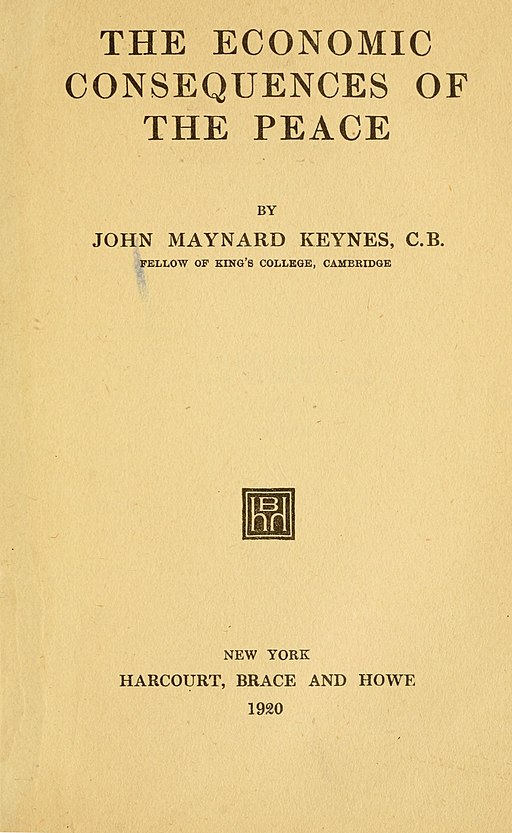
- 2006: J.M. Keynes reflected on that “happy age” of international commerce and freedom of travel that was destroyed by the cataclysm of the First World War (1920)
- 2006: John Jay in the Federalist Papers discussed why nations go to war and concluded that it was not for justice but “whenever they have a prospect of getting any thing by it” (1787)
- 2005: Thomas Gordon gives a long list of ridiculous and frivolous reasons why kings and tyrants have started wars which have led only to the enslavement and destruction of their own people (1737)
- 2005: Hugo Grotius states that in an unjust war any acts of hostility done in that war are “unjust in themselves” (1625)
- 2005: Hugo Grotius discusses the just causes of going to war, especially the idea that the capacity to wage war must be matched by the intent to do so (1625)
- 2005: Herbert Spencer argued that in a militant type of society the state would become more centralised and administrative, as compulsory education clearly showed (1882)
- 2005: William Graham Sumner denounced America’s war against Spain and thought that “war, debt, taxation, diplomacy, a grand governmental system, pomp, glory, a big army and navy, lavish expenditures, political jobbery” would result in imperialsm (1898)
- 2005: Erasmus has the personification of Peace come down to earth to see with dismay how war ravages human societies (1521)
- 2004: Ludwig von Mises laments the passing of the Age of Limited Warfare and the coming of Mass Destruction in the Age of Statism and Conquest (1949)
- 2004: Thomas Hodgskin on the Suffering of those who had been Impressed or Conscripted into the despotism of the British Navy (1813)
- 2004: Robert Nisbet on the Shock the Founding Fathers would feel if they could see the current size of the Military Establishment and the National Government (1988)
- 2004: Adam Smith on the Sympathy one feels for those Vanquished in a battle rather than for the Victors (1762)
- 2004: Hugo Grotius on sparing Civilian Property from Destruction in Time of War (1625)
- 2004: Bernard Mandeville on how the Hardships and Fatigues of War bear most heavily on the “working slaving People” (1732)
25 December, 2011Read the full quote in context here. The peace and free trade advocate Richard Cobden (1804-1865) believed that before the “peace party” in Britain could be successful it had to overcome the popular misconception the British people had that they were a “peace-loving nation”:
But to rouse the conscience of the people in favour of peace, the whole truth must be told them of the part they have played in past wars. In every pursuit in which we embark, our energies carry us generally in advance of all competitors… It must be even so in the agitation of the peace party. They will never rouse the conscience of the people, so long as they allow them to indulge the comforting delusion that they have been a peace-loving nation. We have been the most combative and aggressive community that has existed since the days of the Roman dominion. Since the revolution of 1688 we have expended more than fifteen hundred millions of money upon wars, not one of which has been upon our own shores, or in defence of our hearths and homes. “For so it is,” says a not unfriendly foreign critic,∗ “other nations fight at or near their own territory: the English everywhere.” From the time of old Froissart, who, when he found himself on the English coast, exclaimed that he was among a people who “loved war better than peace, and where strangers were well received,” down to the day of our amiable and admiring visitor, the author of the Sketch Book, who, in his pleasant description of John Bull, has portrayed him as always fumbling for his cudgel whenever a quarrel arose among his neighbours, this pugnacious propensity has been invariably recognised by those who have studied our national character. It reveals itself in our historical favourites, in the popularity of the madcap Richard, Henry of Agincourt, the belligerent Chatham, and those monarchs and statesmen who have been most famous for their warlike achievements. It is displayed in our fondness for erecting monuments to warriors, even at the doors of our marts of commerce; in the frequent memorials of our battles, in the names of bridges, streets, and omnibuses; but above all in the display which public opinion tolerates in our metropolitan cathedral, whose walls are decorated with bas-reliefs of battle scenes, of storming of towns, and charges of bayonets, where horses and riders, ships, cannon and musketry, realise by turns, in a Christian temple, the fierce struggle of the siege and the battle-field.
The full passage from which this quotation was taken can be be viewed below (front page quote in bold):But to rouse the conscience of the people in favour of peace, the whole truth must be told them of the part they have played in past wars. In every pursuit in which we embark, our energies carry us generally in advance of all competitors. How few of us care to remember that, during the first half of the last century, we carried on the slave-trade more extensively than all the world besides; that we made treaties for the exclusive supply of negroes; that ministers of state, and even royalty were not averse to profit by the traffic. But when Clarkson (to whom fame has not yet done justice) commenced his agitation against this vile commerce, he laid the sin at the door of the nation; he appealed to the conscience of the people, and made the whole community responsible for the crimes which the slave-traders were perpetrating with their connivance; and the eternal principles of truth and humanity, which are ever present in the breasts of men, however they may be for a time obscured, were not appealed to in vain. We are now, with our characteristic energy, first and foremost in preventing, by force, that traffic which our statesmen sought to monopolise a century ago.
It must be even so in the agitation of the peace party. They will never rouse the conscience of the people, so long as they allow them to indulge the comforting delusion that they have been a peace-loving nation. We have been the most combative and aggressive community that has existed since the days of the Roman dominion. Since the revolution of 1688 we have expended more than fifteen hundred millions of money upon wars, not one of which has been upon our own shores, or in defence of our hearths and homes. “For so it is,” says a not unfriendly foreign critic, “other nations fight at or near their own territory: the English everywhere.” From the time of old Froissart, who, when he found himself on the English coast, exclaimed that he was among a people who “loved war better than peace, and where strangers were well received,” down to the day of our amiable and admiring visitor, the author of the Sketch Book, who, in his pleasant description of John Bull, has portrayed him as always fumbling for his cudgel whenever a quarrel arose among his neighbours, this pugnacious propensity has been invariably recognised by those who have studied our national character. It reveals itself in our historical favourites, in the popularity of the madcap Richard, Henry of Agincourt, the belligerent Chatham, and those monarchs and statesmen who have been most famous for their warlike achievements. It is displayed in our fondness for erecting monuments to warriors, even at the doors of our marts of commerce; in the frequent memorials of our battles, in the names of bridges, streets, and omnibuses; but above all in the display which public opinion tolerates in our metropolitan cathedral, whose walls are decorated with bas-reliefs of battle scenes, of storming of towns, and charges of bayonets, where horses and riders, ships, cannon and musketry, realise by turns, in a Christian temple, the fierce struggle of the siege and the battle-field. I have visited, I believe, all the great Christian temples in the capitals of Europe; but my memory fails me, if I saw anything to compare with it. Mr. Layard has brought us some very similar works of art from Nineveh, but he has not informed us that they were found in Christian churches.
Nor must we throw on the aristocracy the entire blame of our wars. An aristocracy never governs a people by opposing their ruling instincts. In Athens a lively and elegant fancy was gratified with the beautiful in art. In Genoa and Venice, where the population were at first without territory, and consequently where commerce was the only resource, the path to power was on the deck of their merchantmen or on ‘Change. In England, where a people possessing a powerful physical organisation and an unequalled energy of character were ready for projects of daring and enterprise, an aristocracy perverted these qualities to a century of constantly recurring wars. The peace party of our day must endeavour to turn this very energy to good account in the same spirit in which Clarkson turned a nation of man-stealers into a society of determined abolitionists. Far from wishing to destroy the energy, or even the combativeness which has made us such fit instruments for the battle-field, we shall require these qualities for abating the spirit of war and correcting the numberless moral evils from which society is suffering. Are not our people uneducated—juvenile delinquents uncared for? Does not drunkenness still reel through our streets? Have we not to battle with vice, crime, and their parent, ignorance, in every form? And may not even charity display as great energy and courage in saving life as was ever put forth in its destruction?
[More works by Richard Cobden (1804 – 1865) and on War and Peace] |